
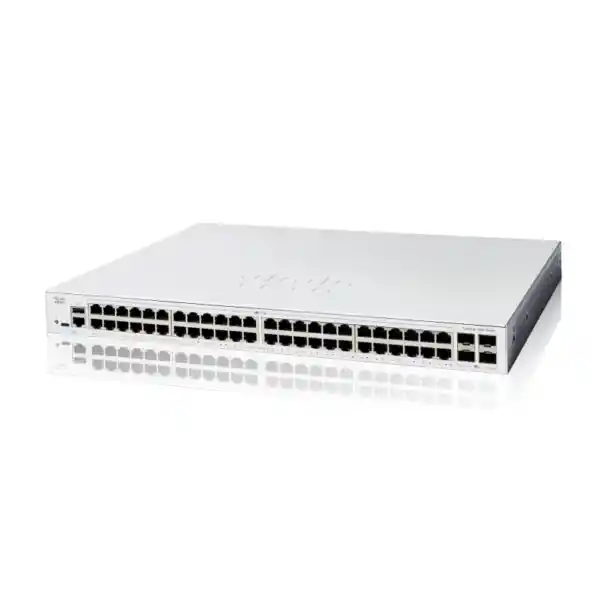
4 × 10G SFP+ uplinks
Non-PoE model
Cisco Catalyst C1200-48T-4X Network Switch Dubai
A 48-port business switch for organizations that need dense 1 Gigabit wired access, four 10 Gigabit fibre or DAC uplinks, practical Layer 2 controls, static Layer 3 routing and a simpler operational model than a large enterprise campus platform.
Direct answer: what is the C1200-48T-4X and who should buy it?
The Cisco Catalyst C1200-48T-4X is a 1RU managed Ethernet switch in Cisco’s Catalyst 1200 Series for small and medium-sized business networks. This exact model provides forty-eight 10/100/1000BASE-T copper access ports and four SFP+ uplink ports that support 10 Gigabit and 1 Gigabit speeds. It is mainly used to connect large groups of desktop computers, printers, servers, firewalls, wireless controllers, storage appliances and other Ethernet devices while providing segmentation, traffic control, monitoring and resilient uplink options that an unmanaged switch cannot offer.
Organizations should consider it when they need close to forty-eight wired endpoints on one access switch, want 10 Gigabit uplinks to a core switch, firewall, server or another distribution point, and do not need the switch itself to provide Power over Ethernet. The most important factor to confirm before purchase is that distinction: the C1200-48T-4X is a data-only model. It does not provide PoE to IP phones, wireless access points, cameras or other powered devices. If those endpoints depend on switch-supplied power, the C1200-48P-4X or another PoE-capable model should be evaluated instead.
FourTeck can help determine whether the 48T model is appropriate for the actual port count, uplink media, transceiver type, VLAN plan, routing requirement, cabinet depth, environmental conditions and growth horizon. The quotation can then be built around the exact switch, compatible optics or DACs where required, patching, rack installation, configuration and migration scope rather than treating the switch as an isolated box.
Best fit
Dense business access layers, office floors, server rooms, training centers, labs and branch environments where most endpoints already have their own power and where a 48-port switch materially reduces the number of separate access switches required.
Key strength
Four SFP+ uplinks provide substantially more upstream flexibility than the 1G-only C1200-48T-4G. That matters when many access ports can be active at once, when local servers are busy or when multiple VLANs converge toward a firewall or core.
Primary limitation
No PoE output. The model designation “T” is the clue to its data-only role. A buyer connecting powered phones, cameras or access points must budget external injectors or, more sensibly for larger deployments, select the appropriate PoE switch.
Cisco C1200-48T-4X verified hardware specifications
The following values identify the exact C1200-48T-4X rather than the Catalyst 1200 family in general. This distinction is important because the family contains 8-, 16-, 24- and 48-port models, Gigabit-only uplink variants and PoE variants with different power budgets.
| Specification | C1200-48T-4X value | Buyer significance |
|---|---|---|
| Access ports | 48 × 10/100/1000 Gigabit Ethernet RJ-45 | Supports a dense wired access layer without needing a second switch solely for port count. |
| Uplinks | 4 × SFP+, supporting 10G and 1G | Allows fibre or compatible direct-attach connectivity to upstream switching, servers or security appliances, subject to the selected module and peer interface. |
| PoE | Not supported on this model | Do not select it for powered endpoints unless those devices have separate power arrangements. |
| Switching capacity | 176 Gbps | Matches the aggregate full-duplex port architecture for wire-speed, nonblocking switching within the platform specification. |
| Forwarding rate | 130.94 Mpps at 64-byte packets | Useful for comparing the model’s packet-processing capability against other access switches, especially in small-packet workloads. |
| Packet buffer | 3 MB aggregate, dynamically shared | Relevant where bursty traffic converges from many 1G ports toward fewer uplinks; design should still avoid persistent oversubscription. |
| Memory | 1 GB DDR4 DRAM; 512 MB flash | Platform resources support its management and feature set; they should not be interpreted as application-server memory. |
| CPU | Dual-core ARM, 1.4 GHz | Handles control-plane and management functions while forwarding is performed by switching hardware. |
| MAC address table | 8,000 addresses | Suitable for typical SMB access-layer populations; very large Layer 2 domains should still be designed carefully. |
| Jumbo frames | Up to 9000 bytes; default MTU 2000 bytes | End-to-end MTU consistency must be confirmed before enabling large frames for storage or specialized workloads. |
| Dimensions | 445 × 288 × 44 mm | Standard 1RU rack format, with cabinet depth, cable bend radius and ventilation clearance still needing verification. |
| Weight | 3.95 kg | Relevant for rack planning and shipping, though rack loading is usually dominated by UPS, servers and other equipment. |
| Power input | Internal universal 100–240V AC, 50–60 Hz | Compatible with common UAE mains environments when paired with the correct supplied or approved regional power cord and installation practice. |
| System power, worst case | 40.01 W at 110V; 39.77 W at 220V | Helps UPS and rack-power sizing; actual consumption depends on operating conditions and connected links. |
| Idle power | 13.12 W at 110V; 12.93 W at 220V | Provides a reference for low-traffic energy planning rather than a guaranteed site power figure. |
| Cooling / acoustics | 1 fan; 29.7 dBA at 25°C | Quiet for a rack switch, but not fanless. Noise-sensitive open-office placement should still be assessed. |
| Operating temperature | -5°C to 50°C | The rating does not remove the need for controlled rack ventilation in Dubai’s climate, especially in poorly conditioned telecom rooms. |
Why the four 10G uplinks matter on a 48-port access switch
The biggest architectural difference between the C1200-48T-4X and the C1200-48T-4G is not the number of user-facing copper ports; both provide forty-eight Gigabit Ethernet access ports. The difference is upstream bandwidth. The 48T-4G provides four 1G SFP uplinks, whereas the 48T-4X provides four SFP+ uplinks capable of 10G or 1G. In a lightly used office, a single 1G uplink may appear adequate for long periods. In a denser environment, however, many users can simultaneously access cloud services, local file servers, virtualization hosts, backup targets or internet security services. The uplink becomes the shared path for this traffic, so additional uplink headroom can prevent the access layer from becoming an avoidable bottleneck.
Four 10G-capable uplinks also provide design flexibility rather than simply “40 Gbps of internet.” A business might use one or two ports as an LACP bundle toward an upstream switch, reserve another for a local server or storage path, and retain a port for future expansion. Another deployment might use redundant uplinks to separate upstream devices, subject to the intended topology and spanning-tree design. A branch with a firewall that exposes 10G SFP+ LAN interfaces can connect the switch to the security gateway at greater than 1G, provided the firewall, transceivers and cabling all support the selected link type.
The uplinks should therefore be sized from actual traffic paths, not from a simplistic rule that every access port needs dedicated upstream bandwidth. Forty-eight 1G edge ports do not usually transmit at line rate simultaneously, but backups, software distribution, video, large file transfers and east-west server traffic can create bursts. The 3 MB shared packet buffer can absorb temporary bursts, yet persistent congestion still requires a sound oversubscription ratio, adequate uplink capacity and suitable QoS. If the expected traffic is modest and cost sensitivity is high, the 48T-4G may deserve comparison. If 10G is already part of the core, firewall or server strategy, the 48T-4X is usually the more coherent choice.
Port planning before ordering
Count real copper endpoints
List workstations, printers, servers, phones with local power, access-control controllers, building systems and other Ethernet devices. Include patch-panel ports that are genuinely expected to be active rather than buying forty-eight ports simply because a cabinet contains forty-eight outlets.
Reserve practical growth
A switch installed at 100% port utilization on day one gives no room for desk moves, temporary devices or expansion. Reserve capacity according to the organization’s growth horizon, not an arbitrary fixed percentage.
Separate access from uplink ports
The four SFP+ ports are not extra RJ-45 access sockets. Copper 10G connectivity requires compatible transceiver choices where supported, while fibre connections need the correct optical modules and patch leads for distance and fibre type.
Confirm PoE separately
Do not count a powered endpoint as “compatible” merely because it has an RJ-45 network interface. The C1200-48T-4X carries data only. Power requirements must be solved independently or by selecting a PoE model.
VLAN segmentation and Layer 2 control
The C1200-48T-4X supports up to 255 active VLANs simultaneously, including port-based and IEEE 802.1Q tagged VLANs. It also supports management VLAN, guest VLAN and Auto Surveillance VLAN functions, along with a voice VLAN capability in the Catalyst 1200 feature set. For a business buyer, the practical value is separation: user computers, finance systems, guest devices, voice endpoints, building systems, servers and management interfaces do not have to live in one flat broadcast domain. Proper segmentation can improve manageability, limit unnecessary broadcast exposure and create clean policy boundaries for the firewall or routing layer.
VLAN planning should be done before installation rather than improvised port by port. Decide which VLANs need to cross each uplink, which should terminate at the switch for local static routing, which should be routed by a firewall, and which interfaces require tagged trunks versus untagged access membership. A frequent migration issue occurs when the old switch and new switch use different native VLAN assumptions or when phones expect a voice VLAN while attached computers use a separate data VLAN. Documenting the existing port profile, endpoint type and current VLAN ID avoids a large amount of troubleshooting during cutover.
The switch provides Spanning Tree Protocol support including classic 802.1D, Rapid Spanning Tree, Multiple Spanning Tree and Cisco PVST+/Rapid PVST+ options within the published platform limits. Those capabilities matter when redundant links or multiple switches create possible Layer 2 loops. Redundancy without a loop-prevention design can cause a broadcast storm and make a network unusable. Conversely, indiscriminately blocking redundant paths without understanding topology can remove the resilience the links were meant to provide. The appropriate spanning-tree mode should match the broader network, especially when the C1200 is introduced into an environment containing other Cisco Catalyst families or third-party switches.
Loopback detection provides another protection mechanism that operates independently of STP, but it is not a substitute for disciplined cabling and documented topology. Network teams should label uplinks, patch panels and access ports, maintain a current logical diagram and verify which ports are permitted to form trunks. The feature set is capable, yet the operational quality of the deployment still depends on configuration consistency.
Static Layer 3 routing: useful, but understand its role
The Catalyst 1200 Series includes wire-speed IPv4 and IPv6 routing capabilities. For IPv4, Cisco specifies up to 32 static routes and up to 16 IP interfaces. A Layer 3 interface can be configured on a physical port, link aggregation group, VLAN interface or loopback interface. The switch also supports CIDR and DHCP relay. This can make the C1200-48T-4X more useful than a purely Layer 2 smart switch in offices that want local inter-VLAN routing without pushing every internal packet through the firewall.
The important word is static. The C1200-48T-4X should not be assumed to replace a larger campus distribution switch or router that relies on extensive dynamic routing protocols, large route tables or advanced policy-routing features. For a modest network with predictable subnets, static routes can be straightforward and stable. For a growing multi-site design, a network with many route changes or an environment that depends on dynamic routing convergence, another platform may be more appropriate. Buyers should map the required routing functions before choosing the switch based solely on port count.
There is also a security architecture decision. If all VLAN-to-VLAN traffic must be inspected by a next-generation firewall, routing those VLANs locally on the switch could bypass the intended security enforcement point. In that design, the C1200 can remain a Layer 2 access switch with VLAN trunks to the firewall. If some high-volume internal traffic is trusted and should be routed locally while selected VLANs are firewall-controlled, static routing can reduce needless hairpinning. The correct architecture depends on security policy, not on whether the switch happens to support routing.
During a replacement project, FourTeck can review the existing gateway addresses, subnet masks, DHCP relay paths, default route, firewall interfaces and VLAN ownership. This is often more important than copying old switch commands, because a hardware refresh is an opportunity to confirm that routing responsibilities still make sense for the current network.
Link aggregation and resilience choices
Cisco specifies IEEE 802.3ad Link Aggregation Control Protocol support with up to four LAG groups and up to eight ports per group, with sixteen candidate ports for each dynamic LAG. Link aggregation can increase aggregate bandwidth across multiple physical links and provide resilience against a single member-link failure. It is especially relevant on the C1200-48T-4X because the four 10G SFP+ interfaces can be used in designs where upstream capacity needs to exceed one 10G path or where a bundled connection is desired.
A LAG is not a magic method for making one individual traffic flow use the sum of all member speeds. Traffic distribution is normally based on a hashing method, so a single session may remain on one physical member while multiple conversations are spread across the bundle. This distinction matters when a buyer expects a two-port 10G LAG to make a single 12 Gbps file transfer run at 20 Gbps. The aggregate benefit is real across multiple flows, but application behavior, server NIC teaming, storage design and upstream switch configuration all influence the outcome.
Both ends of the bundle must agree on the configuration. Cabling two switch ports to another switch without properly configured aggregation can create a Layer 2 loop. During installation, each LAG should be documented, peer ports verified, allowed VLANs confirmed and failover tested. If uplink resilience requires two physically separate upstream switches, the design must also consider whether those upstream devices support the necessary multi-chassis technology; ordinary LACP to two unrelated standalone switches does not automatically create a valid cross-chassis bundle.
Traffic security: 802.1X, ACLs, port security and management protection
For access control, the Catalyst 1200 platform supports IEEE 802.1X in the authenticator role with RADIUS, guest VLAN and multiple host/session modes. In a network with a RADIUS or identity service, this enables port-based authentication so that physical access to an Ethernet socket does not automatically equal trusted network access. The switch also offers port security that can lock source MAC addresses to ports or limit the number of learned addresses. These controls are useful in offices, shared facilities, education environments and other locations where wall outlets are physically accessible.
Access Control Lists provide another layer of policy. Cisco publishes support for up to 512 ACL rules, with matching criteria that include source and destination MAC addresses, VLAN IDs, IPv4 and IPv6 addresses, protocols, TCP/UDP ports, DSCP or IP precedence, 802.1p priority, Ethernet type, ICMP, IGMP and TCP flags. ACLs can be applied on ingress and egress, and time-based ACLs are supported. This gives the switch meaningful filtering capability, but rule design should remain maintainable. A long unstructured ACL copied from another platform can be more difficult to audit than a smaller set of clearly named policy boundaries.
The platform also includes storm control for broadcast, multicast and unknown unicast traffic, denial-of-service prevention, STP loopback guard and Secure Core Technology. For management access, HTTPS and SSH are available, while RADIUS can be used for administrator authentication. SNMPv3 provides a more secure monitoring option than older community-string approaches when a network management system supports it. A strong baseline is to use secure management protocols, place the management interface in a dedicated VLAN, restrict access with ACLs where practical and forward system logs to a centralized collector.
These features should not be marketed as a substitute for a firewall. A switch ACL can constrain local traffic, but internet-edge inspection, application control, malware defense, VPN termination and other next-generation security functions belong on a suitable security platform. The C1200-48T-4X is most effective when its local access controls complement the wider security architecture.
Quality of Service for voice, video and business applications
The switch provides eight hardware queues and supports strict-priority and Weighted Round-Robin scheduling based on DSCP and 802.1p Class of Service. It can classify traffic by port, VLAN priority, IPv4/IPv6 precedence or DSCP, and it supports rate limiting through ingress policing, egress shaping and controls per VLAN, port and flow. These tools matter when latency-sensitive voice or interactive applications share links with backups, software downloads or large file transfers.
QoS does not create bandwidth. It determines how constrained bandwidth is allocated when congestion occurs. If a 1G uplink is persistently asked to carry 2 Gbps of traffic, prioritization can protect selected classes but cannot make all traffic lossless. The first design step is therefore sufficient capacity; QoS is then used to preserve predictable treatment for important flows. With four 10G uplinks available, the C1200-48T-4X provides useful capacity options, but congestion can still occur elsewhere in the path, such as the firewall, WAN circuit or internet service.
Voice VLAN features can simplify endpoint placement and appropriate treatment for supported environments. Nevertheless, phone deployment should include DHCP options, call-control reachability, WAN latency and jitter, firewall rules and power. Because the 48T model does not provide PoE, a voice deployment with many desk phones generally points toward the C1200-48P-4X or another PoE-capable access switch unless the phones use separate adapters.
Management options and operational workflow
The Catalyst 1200 Series is positioned for businesses that want managed switching without the operational overhead of a large enterprise platform. Cisco provides a built-in web user interface with configuration wizards, system dashboard, maintenance and monitoring functions. The series also supports Cisco Business Dashboard, including an embedded probe that can remove the need for a separate onsite probe appliance or virtual machine. Cisco Business mobile management and Network Plug and Play are additional options for supported deployment workflows.
Traditional network operations are also supported. SNMP versions 1, 2c and 3, syslog, SSH, HTTPS, RADIUS, ping, traceroute, TFTP upgrade, cable diagnostics, port mirroring and other management functions give IT teams multiple ways to integrate the switch into an existing monitoring and administration process. The C1200-48T-4X includes an RJ-45 console interface and USB Type-C console capability, useful when IP management is unavailable during initial configuration or troubleshooting.
A sensible management design starts with an assigned management VLAN and IP address, secure administrator credentials, time synchronization, logging destination, backup procedure and firmware maintenance plan. SNMPv3 should be preferred when supported by the monitoring platform. Configuration backups should be taken after initial commissioning and after significant changes. The business should also record which switch ports correspond to patch-panel outlets and critical devices; a technically correct configuration becomes far easier to support when the physical documentation is equally accurate.
For multi-switch sites, consistency matters more than cleverness. Reusable port templates for common endpoint types, standardized VLAN names, a clear uplink convention and a small number of approved change procedures reduce troubleshooting time. The platform’s approachable interface is useful, but operational discipline remains essential as the network grows.
SFP+ uplink media: transceivers, fibre and DAC decisions
The four SFP+ slots support both 10 Gigabit and 1 Gigabit speeds, but the slot alone does not determine the physical link. The correct module or direct-attach cable must match the remote interface, required distance, fibre type and connector standard. A short switch-to-server or switch-to-switch connection within the same rack may be a good candidate for a compatible DAC, while longer building links often use optical transceivers and structured fibre. Existing 1G optics may sometimes be reusable if they are supported and the link is intentionally operating at 1G, but the compatibility matrix should be checked before relying on old modules.
For optical links, multimode and single-mode fibre are not interchangeable decisions. The installed fibre plant, connector condition, patch lead type and path loss all matter. A transceiver capable of a long nominal distance is not automatically the best answer for a short link, and mismatched optics can create errors even when connectors physically fit. Cleanliness is especially important: contaminated fibre connectors are a common cause of intermittent or degraded optical links.
When replacing an older switch, record the exact part number of every optic and the peer device model before the maintenance window. Also record whether the uplink is 1G or 10G, whether auto-negotiation or forced speed settings are in use, and whether the link is a standalone trunk or part of a LAG. This information turns an uncertain migration into a controlled change. If the old switch uses unsupported third-party optics, the quotation should include approved replacements rather than assuming reuse.
For UAE deployments across separate telecom rooms or buildings, fibre routing, termination quality and physical protection can matter as much as switch selection. FourTeck can scope the switch together with the required uplink medium so that the purchased SFP+ ports arrive with a usable path to their intended peers.
Power, cooling and rack installation in Dubai
The C1200-48T-4X uses an internal universal 100–240V AC, 50–60 Hz power supply. Cisco lists worst-case system consumption of 40.01 W at 110V and 39.77 W at 220V, with idle values of 13.12 W and 12.93 W respectively. These figures are useful for estimating the switch’s contribution to UPS load and rack heat, but UPS sizing should include the entire equipment set, desired runtime, conversion losses, battery aging and future additions. A low switch wattage does not mean a small UPS is always appropriate if the same UPS also powers firewalls, servers, storage or ISP equipment.
The chassis is 445 mm wide, 288 mm deep and 44 mm high, placing it in a standard 1RU form factor. Weight is 3.95 kg. Cisco includes mounting hardware for the 24- and 48-port models, yet the rack itself still needs suitable depth, rails or mounting structure, cable management and free space for patch cords. Dense 48-port patching can quickly become difficult to service if horizontal cable managers are omitted or if patch cables are too long.
This model has one fan and is rated at 29.7 dBA at 25°C. It is relatively quiet for a 48-port rack switch, but it is not fanless. Where the switch is installed inside a meeting room, quiet workspace or retail area, evaluate the acoustic impact rather than relying on a general assumption that all Catalyst 1200 models are silent. In a normal comms cabinet, airflow and temperature control are usually more important concerns.
Cisco specifies an operating range of -5°C to 50°C for this model class, with 10% to 90% noncondensing operating humidity. Dubai’s external climate makes room conditioning especially important because a closed wall cabinet in an inadequately cooled area can run significantly hotter than the ambient office. Keep ventilation openings clear, avoid placing heat-producing equipment directly against airflow paths and monitor cabinet temperature where the site has a history of cooling problems.
Rack installation should also consider electrical resilience. The switch has an internal AC supply, but this is not a dual-hot-swap power-supply platform. If the business requires power-path redundancy, the wider design may need redundant access switches on separate power feeds, suitable UPS architecture or a different switch family with higher hardware-resilience options.
Non-PoE is a deliberate buying decision, not a missing detail
The C1200-48T-4X does not supply 802.3af or 802.3at power on its forty-eight RJ-45 ports. That can be an advantage where every endpoint is a desktop, server, printer or other self-powered device, because the buyer avoids paying for a PoE power budget that may never be used. The non-PoE model also consumes far less power than a fully loaded PoE switch because it is not supplying downstream devices. For a wired office floor with powered desktops and printers, this may be exactly the correct economic and operational choice.
The same decision becomes a limitation the moment the access layer is expected to power wireless access points, IP cameras, desk phones, door controllers or other powered devices. External injectors can solve isolated cases, but they add adapters, power sockets and failure points. When dozens of powered devices are expected, a PoE-capable switch usually produces a cleaner installation and allows centralized power protection through the network UPS.
Cisco’s nearby C1200-48P-4X keeps the same forty-eight 1G access ports and four 10G SFP+ uplinks while adding PoE+ with a published 375 W power budget. That does not mean it is automatically the better model. Its higher power requirements, cost and thermal characteristics only make sense when the powered-device requirement exists. The correct comparison therefore starts with a port-by-port endpoint inventory including the device’s PoE standard and wattage, not with a preference for the model that has more features on paper.
For mixed environments, another reasonable architecture is to use the C1200-48T-4X for desktops and servers while a smaller PoE switch serves phones, cameras or access points. That separation can be practical when powered devices are concentrated in specific zones. The trade-off is more hardware and potentially more uplinks. FourTeck can compare the capital cost, rack space, power, cabling and operational simplicity of each approach.
Licensing and subscription check
Cisco’s current Catalyst 1200 datasheet presents the switching, VLAN, static routing, ACL, QoS, management and security capabilities as platform features and does not list a mandatory feature license or subscription for the C1200-48T-4X in the product specification or ordering section. That is materially different from Cisco platforms whose feature operation depends on a separately selected software tier. For procurement, this means the switch should not be casually quoted with an invented license simply because other Cisco product families use subscription models.
However, “no mandatory feature license shown in the datasheet” should not be interpreted as a promise that every optional support, cloud service or future management offering is free forever. Support entitlements, advanced external management systems and vendor service terms can change independently of the hardware’s built-in capabilities. The quotation should identify any separately priced support or service item explicitly instead of burying it inside a generic “license” line.
Cisco states that the Catalyst 1200 Series includes complimentary one-year access to the Small Business Support Center and a limited lifetime warranty with return-to-factory replacement. Warranty and support eligibility can depend on purchase channel, region, product registration and Cisco terms, so commercial documentation should preserve the exact supplied SKU and authorized procurement trail.
Energy efficiency and ongoing operating cost
The Catalyst 1200 platform supports IEEE 802.3az Energy Efficient Ethernet on its copper Gigabit ports. It can reduce port power when a link is inactive, adjust signal strength according to detected cable length and allow administrators to disable port LEDs or schedule port operation. These features will not transform an access switch into a major energy-saving project by themselves, but they are useful in organizations that operate large numbers of network ports continuously.
The bigger energy decision is still model selection. A non-PoE C1200-48T-4X has dramatically different power behavior from a PoE switch supplying hundreds of watts to endpoints. If the endpoints do not need PoE, buying a PoE model “just in case” can increase acquisition cost and may complicate UPS sizing. If the endpoints do need PoE, external adapters distributed throughout the office may shift rather than eliminate the electrical load. Whole-system power planning is more useful than comparing switch chassis wattage in isolation.
For a Dubai equipment room, lower power also means lower heat, which can reduce cooling demand at scale. The effect of one switch is modest, but disciplined equipment selection across racks can matter. The network plan should balance energy, resilience and future capacity rather than optimizing only for the lowest present wattage.
Multicast, discovery and voice-aware features
The switch supports IGMP snooping versions 1, 2 and 3 and can act as an IGMP querier in a Layer 2 multicast domain when a multicast router is absent. Cisco lists support for up to 255 multicast groups in this function. IPv6 environments can use MLD snooping. These capabilities are useful for networks carrying multicast video, digital signage, imaging or other applications where flooding multicast traffic to every access port would waste bandwidth.
Discovery features include LLDP with LLDP-MED extensions, Cisco Discovery Protocol and Bonjour. LLDP and CDP can help administrators identify neighboring devices and understand which switch port connects to a particular phone, access point or upstream device. LLDP-MED adds information useful to IP telephony. Voice VLAN functionality can automatically place supported voice traffic into the intended VLAN and apply appropriate QoS treatment.
These functions improve visibility but should not replace documentation. Discovery output is a live operational aid; the network inventory should still contain switch names, management addresses, uplink peers, patch-panel references, VLANs and critical endpoint locations. This becomes especially important during emergency support when a device is offline and can no longer advertise itself.
Practical deployment scenarios in UAE businesses
Office floor access
A floor with thirty to forty-five desktops, printers and room systems can use one C1200-48T-4X as the local access layer. A 10G uplink to a building distribution switch prevents the access layer from being constrained by a single 1G trunk. If desk phones or access points need PoE, either separate them onto a PoE switch or choose a PoE model.
Server room edge connectivity
The switch can connect 1G management interfaces, appliances, backup devices and lower-throughput servers while its 10G SFP+ ports provide faster paths to a core or selected servers. High-performance virtualization or storage fabrics may require a switch with more 10G/25G access ports rather than treating four uplinks as a substitute.
Training or lab environment
Forty-eight copper ports are useful where many student, test or lab endpoints must be connected and segmented. VLANs, ACLs and port security provide control beyond an unmanaged switch, while 10G uplinks give central services more headroom. Lab designs should still confirm whether frequent topology changes call for features beyond the Catalyst 1200 scope.
Retail or operations back-office
A back-office cabinet can connect terminals, controllers, local servers and administrative PCs while separating operational devices from guest or corporate traffic. The switch’s fan means acoustic placement should be checked if the cabinet is inside a quiet customer-facing area.
Firewall aggregation
Where several internal VLANs terminate at a firewall with 10G interfaces, the SFP+ uplinks can provide a higher-bandwidth trunk than 1G-only access switching. Firewall throughput, inspection profile, transceiver support and VLAN interface design must all be checked together.
Branch consolidation
A growing branch that has accumulated multiple small unmanaged switches can consolidate endpoints onto one managed platform. The benefit is not only fewer boxes: centralized VLANs, monitoring, LAG, ACLs, port descriptions and diagnostics create a far more supportable environment.
When this model may be unsuitable
A technically capable product can still be the wrong purchase. The C1200-48T-4X is not the right first choice when a large share of endpoints require PoE, when the access layer itself needs multi-gigabit 2.5G or 5G copper ports, when the design requires numerous 10G server-facing ports, or when the network depends on advanced enterprise routing and automation features beyond the published Catalyst 1200 scope. In those cases, selecting a different platform at the start is cheaper than forcing the switch into a role it was not designed to perform.
It may also be oversized for a small branch with twelve or fifteen endpoints and little growth. A 24-port or 16-port Catalyst 1200 model could consume less rack space or budget while still providing appropriate management. Conversely, a site already close to forty-eight active endpoints may need more than one access switch from day one so that expansion does not require an unplanned replacement.
High availability requirements deserve separate treatment. The C1200-48T-4X is a single fixed switch with a single internal AC power supply, not a modular chassis with redundant supervisors and hot-swappable power architecture. If one access switch failure would stop a critical operation, resilience should be built at the network level through duplicate switching, endpoint teaming, redundant uplinks, appropriate spanning-tree or multi-chassis design, separate power paths and a documented failover plan.
Finally, 10G uplinks do not make every connection 10G. The forty-eight RJ-45 access ports are 1G. Workstations, servers or access points needing greater than 1G on their edge port require a different access-port specification. This is a common procurement misunderstanding and should be resolved before the purchase order is raised.
C1200-48T-4X versus nearby Catalyst 1200 options
| Model | Access ports | Uplinks | PoE | When to compare it |
|---|---|---|---|---|
| C1200-48T-4X | 48 × 1G RJ-45 | 4 × 10G SFP+ | No | Choose when dense wired access and 10G upstream capacity matter but endpoint power does not. |
| C1200-48T-4G | 48 × 1G RJ-45 | 4 × 1G SFP | No | Compare when current and expected upstream traffic is modest and 10G is not required. |
| C1200-48P-4X | 48 × 1G RJ-45 | 4 × 10G SFP+ | PoE+, 375 W budget | Compare when phones, APs, cameras or other powered devices need centralized PoE. |
| C1200-24T-4X | 24 × 1G RJ-45 | 4 × 10G SFP+ | No | Compare when 24 access ports are sufficient but high-speed uplinks are still important. |
A model comparison should include more than purchase price. The 48T-4G may appear cheaper but can require a future upgrade if the site later adopts a 10G firewall or core. The 48P-4X costs and consumes more because it adds endpoint power, but it can eliminate dozens of external adapters. The 24T-4X reduces port capacity while retaining 10G uplinks. The best choice is the one that fits the endpoint inventory, physical layout and growth plan with the fewest avoidable compromises.
Migration from an existing switch: a controlled cutover plan
Replacing a forty-eight-port switch is not simply a matter of moving cables one by one. A reliable migration begins with discovery. Export or document the old switch configuration, record active VLANs, trunks, access port assignments, LAGs, voice settings, management IP information, static routes, ACLs, monitoring destinations and any ports that are administratively disabled. Capture MAC-address observations and neighbor information before shutdown where possible. The aim is to understand the existing intent, not merely reproduce every historical setting.
Next, clean the design. Remove obsolete VLANs only when their lack of use has been confirmed, standardize descriptions and identify any old workarounds that should not be carried into the new platform. If the previous switch used 1G uplinks and the new design will use 10G, verify the peer interface, optic or DAC, LAG mode and spanning-tree behavior in advance. If the default gateway moves from a firewall to the switch or vice versa, treat that as a routing change with its own rollback plan.
Build and test the new switch before the maintenance window. Configure secure management, system name, time, VLANs, trunks, access profiles, uplinks, static routes and monitoring. Save a baseline configuration. During cutover, move critical uplinks first or according to the planned sequence, then endpoint groups in labeled batches. Check link state, VLAN membership, DHCP, DNS, internal application reachability, internet access and voice where applicable after each stage rather than waiting until all forty-eight cables have been moved.
A rollback should remain physically and logically possible until the new switch has passed validation. Keep the old switch configuration and cabling map available, and do not dismantle reusable fibre or patching until the maintenance lead agrees that the new environment is stable. After cutover, save the final C1200 configuration, update diagrams and asset records, and document any differences from the original plan.
For business-critical sites, change management should include an approved window, user communication, test owners and a clear definition of success. A strong switch can still produce a poor outcome when the migration is treated as an improvised cabling exercise.
Monitoring, logging and troubleshooting after deployment
A managed switch creates value when its visibility is actually used. SNMP can expose interface state, utilization and errors to a monitoring system. Syslog can record operational events centrally. Port mirroring can copy selected traffic to a network analyzer when deeper troubleshooting is required. Cable diagnostics can help identify physical-layer faults on copper runs. Ping and traceroute assist with reachability checks from the device itself. Together, these capabilities make it easier to distinguish a switching problem from a cabling, endpoint, routing or upstream security issue.
After installation, establish normal baselines. Know typical uplink utilization during business hours, the expected number of active ports, the normal error rate and the usual fan or temperature environment. Alerting thresholds should be useful rather than noisy. For example, a brief uplink utilization spike may be harmless while sustained near-capacity operation could justify additional bandwidth. Repeated interface flaps often deserve attention even when the link is currently up.
Configuration changes should be logged and backed up. A switch that fails after years of service is much easier to replace when the organization has a current configuration file, port map and documented optic types. Without those records, the replacement hardware may be available yet the recovery still takes hours because the intended network behavior has to be rediscovered.
Troubleshooting should proceed from physical to logical layers: verify power and link, check errors and speed/duplex, confirm VLAN membership, review spanning-tree state, validate LAG membership, inspect Layer 3 addressing and routes, then test firewall or application policy. This structured process prevents random configuration changes that can introduce new faults while chasing the original one.
Cabling and copper access considerations
Cisco specifies Category 5e or better cabling for 1000BASE-T operation. In a new UAE office fit-out, Category 6 or a higher standard may be selected for broader structured-cabling goals, but the switch’s copper access interfaces still operate at up to 1 Gigabit. The quality of termination, patch panels, faceplates and patch leads matters as much as the printed category on the cable jacket. Poor terminations can cause link negotiation problems, errors or intermittent drops that are wrongly blamed on the switch.
Use permanent cable labels that relate wall outlets to patch-panel ports and switch-port descriptions. Avoid dense bundles of unnecessarily long patch leads in front of the switch because they obstruct airflow and make troubleshooting difficult. For a 48-port switch, horizontal cable management and a consistent port-ordering scheme can significantly reduce operational errors during changes.
Where the existing copper plant is old, test questionable runs before migration. A switch replacement can expose latent cabling problems because ports renegotiate, endpoints are moved or patch leads change. A failed cable test is cheaper to resolve during planned installation than after users return to work.
Procurement details that affect an accurate quotation
The hardware model is only the first line of a complete switch quotation. For the C1200-48T-4X, procurement should confirm quantity, deployment location, expected delivery timeline, rack environment, uplink medium and whether optics or DACs are required. If the switch will replace an existing model, provide the current switch part number and the part numbers of installed transceivers. This allows compatibility to be checked before the order rather than during installation.
Installation scope also affects price. A supply-only order is different from a project that includes rack mounting, patching, VLAN configuration, static routing, ACL migration, firmware alignment, cutover and post-change testing. The buyer should state whether work must occur outside business hours, whether site access requires permits or induction, and whether there is a maintenance-window limitation. These factors are often more significant to the services quotation than the number of commands entered on the switch.
For multi-site projects, identify whether every location uses the same topology. A standard switch configuration can reduce deployment effort, but only if VLAN IDs, uplink types, addressing and local equipment are actually consistent. Sites with different ISP handoffs, firewall models or cabinet conditions may need separate designs even when the access switch SKU is identical.
Commercial documentation should also identify warranty/support expectations, whether configuration backups or handover documents are required and who will own ongoing administration after commissioning. A clear quotation avoids later disagreement about whether “installation” meant physical mounting only or a complete migration.
Support and lifecycle planning
Cisco currently lists the Catalyst 1200 Series as available to order and publishes a limited lifetime warranty for the family, together with complimentary one-year access to the Small Business Support Center. The current product status is important because businesses generally prefer a platform that remains orderable for expansion and replacement rather than installing an already-discontinued access switch. Even so, lifecycle status can change over the years, so major rollouts should record the purchase date and periodically review Cisco notices.
Firmware maintenance deserves a defined owner. New software can address defects, security issues or operational improvements, but production upgrades should be planned. Review release notes, back up the configuration, confirm a recovery path and choose a suitable maintenance window. In a site with redundant access switching, upgrade sequencing can preserve service; in a single-switch site, the business should expect an interruption while the unit reboots.
Spares strategy depends on impact. A small office may accept vendor replacement lead time. A critical facility with forty-eight dependent endpoints may keep a compatible spare switch, optics and configuration backup on hand. The spare does not always need to be identical if the organization has a validated substitute, but identical hardware simplifies emergency replacement and reduces the risk of feature differences.
Asset records should include serial number, SKU, management IP, rack location, warranty information, firmware version and configuration-backup location. These simple records reduce future support time and help with audits, renewals and eventual refresh planning.
Buying for growth without overbuying
Growth planning should separate port growth from bandwidth growth. A site with twenty-two devices today may not need forty-eight copper ports even if internet bandwidth is increasing. The C1200-24T-4X provides the same four 10G SFP+ uplinks with twenty-four access ports and could be more appropriate. A site with forty-two active copper endpoints, by contrast, is already too close to the limit of a 48-port switch if headcount or connected devices are expected to expand quickly.
Bandwidth growth has its own questions. If the business plans to move from a 1G firewall LAN interface to 10G, deploy faster local storage or consolidate server traffic, the 4X uplink model provides a more useful runway than a 4G model. If endpoints themselves will move to 2.5G or 5G for new Wi-Fi access points or high-performance workstations, the limitation is on the access ports and the buyer should consider a different platform rather than assuming 10G uplinks solve multi-gig access.
Feature growth also matters. A small network using simple static routing today may later adopt dynamic routing, advanced segmentation, central automation or more extensive telemetry. If those requirements are already part of a funded roadmap, it can be cheaper to select the appropriate enterprise switch family now. If they are only hypothetical, the Catalyst 1200 may provide a sensible balance of capability and cost.
A good procurement decision therefore has a defined planning horizon. Buying only for today’s port count can create an early refresh, while buying for every imagined future requirement wastes budget. The objective is enough headroom for credible change backed by the organization’s actual business plan.
UAE availability and FourTeck resources
FourTeck can quote the Cisco Catalyst C1200-48T-4X for Dubai and wider UAE requirements subject to distributor availability, lead time and the requested project scope. Rather than stating unverified live stock, the quotation should confirm the current commercial position at the time of request, including any required optics, DACs, rack accessories, implementation or support services.
For UAE infrastructure procurement and broader business technology requirements, visit FourTeck UAE. Organizations coordinating projects across markets can also review FourTeck for wider company information.
If the switch deployment forms part of a larger managed infrastructure, migration, support or maintenance requirement, FourTeck IT Services UAE provides a relevant service path. Where the access switch will connect into a firewall-led security architecture, Firewall Dubai by FourTeck provides specialist network-security context.
For an accurate switch quote, provide the quantity, delivery location, endpoint count, PoE requirement, uplink type, current switch model, required transceivers and whether configuration or migration is included. Those inputs are usually enough to turn a generic product request into a technically coherent bill of materials.
Frequently asked buyer questions
Does the C1200-48T-4X provide PoE?
No. This exact model provides data connectivity on its 48 Gigabit RJ-45 ports but does not supply PoE. For 48-port PoE+ with 10G SFP+ uplinks, compare the C1200-48P-4X, which Cisco specifies with a 375 W PoE budget.
Are all four uplinks 10 Gigabit?
The four uplink interfaces are SFP+ slots and support 10G and 1G speeds. The actual operating speed depends on the selected module or cable and the peer device. Compatible media must be selected separately where it is not already available.
Can it route between VLANs?
Yes. The platform supports IPv4 and IPv6 routing, and Cisco specifies up to 32 IPv4 static routes and up to 16 IP interfaces. It is suitable for straightforward static routing but should not be assumed to replace an advanced dynamic-routing platform.
How many VLANs can be active?
Cisco publishes support for up to 255 active VLANs simultaneously, with 802.1Q tagging, management VLAN, guest VLAN and additional voice/surveillance-oriented features in the Catalyst 1200 platform.
Does it have a fan?
Yes. Cisco lists one fan and an acoustic level of 29.7 dBA at 25°C for the C1200-48T-4X. It is not one of the fanless Catalyst 1200 models, so noise-sensitive placement should be evaluated.
Is it rack mountable?
Yes. The chassis is 445 × 288 × 44 mm, a 1RU form factor, and Cisco states that 24- and 48-port models include 19-inch mounting brackets. The cabinet still needs sufficient depth, airflow and cable-management space.
Does it require a feature subscription?
Cisco’s current datasheet does not list a mandatory feature license or subscription for the published switching, routing, security and management functions. Separate support or optional service terms should still be confirmed in the commercial quote.
What is the switching performance?
Cisco specifies 176 Gbps switching capacity and 130.94 Mpps forwarding at 64-byte packets. The switch is described as wire-speed and nonblocking within its platform specification.
Can the uplinks be aggregated?
Yes. The platform supports IEEE 802.3ad LACP, up to four LAG groups and up to eight ports per group. The peer device and VLAN/trunk settings must be configured consistently.
Can it replace an unmanaged 48-port switch directly?
Physically it can serve the same basic Ethernet access role, but a managed migration should intentionally configure VLANs, management IP, uplinks and security. Copying cables without a configuration plan can leave features unused or create connectivity issues.
Is it suitable for a core switch?
It can perform aggregation and static routing in smaller networks, but suitability as a core depends on resilience, routing scale, interface speeds, automation and growth requirements. Larger enterprise environments often require a more capable core/distribution platform.
What should be included with a Dubai quote?
Specify switch quantity, delivery location, uplink speed and media, required optics or DACs, PoE needs, installation scope, migration requirements, support expectations and the model of the upstream firewall or switch.
Technical interpretation: what the specifications mean in a real network
A specification table is most useful when it changes a design decision. The 176 Gbps switching capacity tells the buyer that the switch fabric is designed to support the aggregate full-duplex bandwidth of its 48 one-gigabit access ports and four ten-gigabit uplinks. The 130.94 Mpps figure provides a packet-rate reference at the demanding 64-byte frame size. Neither figure predicts application speed by itself because endpoint NICs, server disks, protocol overhead, firewall throughput, WAN bandwidth and traffic patterns also limit performance.
The 8,000-entry MAC table tells us that the switch can learn thousands of Layer 2 addresses, enough for a typical SMB access domain but not a reason to build an unnecessarily large flat network. The 255 active VLAN limit gives substantial segmentation room, but operational clarity is usually better with a smaller purposeful VLAN design. The 32 static IPv4 routes and 16 IP interfaces enable useful local routing, yet they also define the product’s scale: it is designed for manageable business networks, not large dynamic routing tables.
The 3 MB shared buffer is sufficient for the platform’s intended use, but buffer size should not be treated as permission to oversubscribe uplinks indefinitely. Bursts are normal in Ethernet networks; continuous congestion is a capacity problem. The four 10G uplinks provide the most direct tool for increasing upstream headroom, while QoS determines which traffic is protected when contention still occurs.
The one-fan design and 29.7 dBA acoustic figure indicate that the switch can work comfortably in a normal communications rack but is not intended to be acoustically invisible in a quiet office. The -5°C to 50°C operating rating is generous, but electronics are generally more reliable in a clean, temperature-controlled environment. A Dubai comms room that regularly approaches the upper limit should be treated as a cooling problem rather than proof that the switch can be left in poor conditions.
Finally, the non-PoE designation is not a small specification row. It changes the complete endpoint-power architecture. When a buyer understands that point, the C1200-48T-4X becomes easy to position: it is a dense, managed, 1G data-access switch with fast upstream options and useful SMB routing/security controls, not a universal access switch for every endpoint type.
Implementation checklist for the C1200-48T-4X
Decision recap
Model fit
Choose the C1200-48T-4X when forty-eight 1G data-only access ports and 10G upstream connectivity match the site. Do not choose it solely because “48-port Cisco switch” sounds sufficient.
Capacity
176 Gbps switching capacity and 130.94 Mpps forwarding are strong for its intended access role, while real application performance still depends on end-to-end bottlenecks.
PoE
No PoE is the defining procurement checkpoint. If endpoints require switch power, compare the 48P-4X or another PoE platform before ordering.
Compatibility
Match SFP+/SFP modules, fibre, DACs, peer interfaces, VLANs and LAG settings. The uplink slot alone does not guarantee a working optical path.
Operations
Plan secure management, monitoring, configuration backup, firmware ownership and physical documentation so the switch remains supportable after installation.
Resilience
LACP and spanning-tree controls support resilient links, but the unit itself has a single fixed chassis and internal AC supply. Critical sites may need network-level redundancy.
What FourTeck needs from the buyer
An accurate C1200-48T-4X quotation can usually be prepared quickly when the technical inputs are clear. Provide the following information where applicable:
Confirm C1200-48T-4X and the number of units required.
State how many copper devices will connect now and within the planning horizon.
List any phones, APs, cameras or controllers that expect switch-supplied power.
Specify 1G/10G, fibre or DAC, distance, peer model and any existing transceiver part numbers.
Provide VLAN count, static routing needs, trunks, LAGs and security-policy dependencies.
Confirm cabinet location, available 1RU space, depth, cooling and UPS arrangement.
State whether the order is supply-only, installation, configuration or full cutover from an existing switch.
Share delivery location, access restrictions, preferred maintenance window and ongoing support needs.
Confirm the right Cisco 48-port switch before you order
The C1200-48T-4X is a strong choice when your requirement is specifically forty-eight 1G data ports, four 10G uplinks and managed SMB switching without PoE. A useful quotation should also settle the optics, uplink topology, VLAN/routing plan, rack conditions and migration scope so the switch fits the complete network rather than only the port count.

Reviews
There are no reviews yet.