
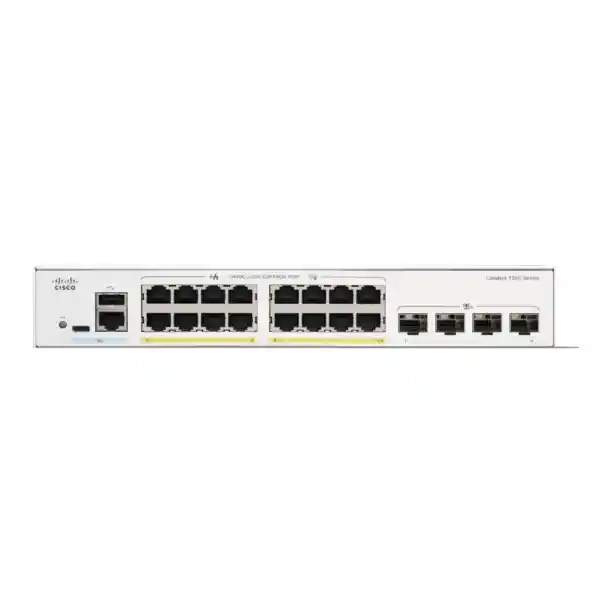
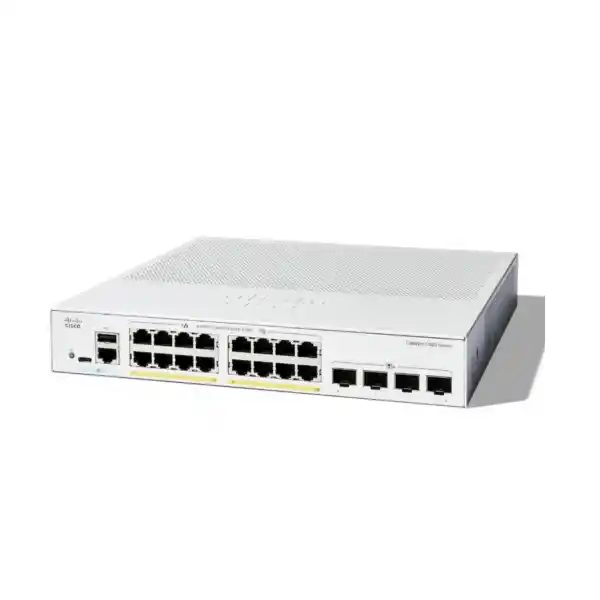
Cisco Catalyst C1300-16P-4X Network Switch in UAE
The Cisco Catalyst C1300-16P-4X is designed for organizations that have outgrown basic smart switching but do not want the operational weight of a large campus platform. It combines sixteen 10/100/1000BASE-T PoE+ access ports with four dedicated 10 Gigabit SFP+ uplinks, a 120-watt PoE power pool, wire-speed switching, advanced VLAN and security functions, Layer 3 routing, hardware stacking and a compact fanless chassis. For UAE branch offices, professional services firms, hospitality locations, clinics, schools, retail spaces and distributed enterprise edges, that combination provides a practical balance of performance, power delivery, resiliency and manageable cost.
Direct answer: who should choose the C1300-16P-4X?
Choose the C1300-16P-4X when a site needs up to sixteen powered Gigabit endpoints, expects meaningful east-west traffic, and benefits from multiple 10G fiber paths to a core, firewall cluster, server room or adjacent switch. It is especially attractive when the access layer must remain silent because the chassis is fanless, when hardware stacking is desirable for unified management and resiliency, and when Layer 3 functions such as static or dynamic RIP routing, inter-VLAN routing, DHCP services or policy-based forwarding can reduce unnecessary traffic through an upstream router.
The model is not a multigigabit access switch. Every copper access interface is Gigabit Ethernet, so Wi-Fi access points that require 2.5G or 5G wired backhaul should be mapped to a multigigabit Catalyst 1300 or Catalyst 1300X alternative. It is also not a PoE++ model. Although every one of the sixteen copper ports can deliver up to 30 watts of 802.3at PoE+ on a per-port basis, the complete switch shares a 120-watt PoE budget. That distinction matters during design because sixteen devices cannot all draw 30 watts simultaneously. For common IP phones, standard cameras, door controllers and moderate-power access points, however, a 120-watt pool can be efficient when actual endpoint consumption is measured rather than sized from maximum nameplate values.
FourTeck positions this switch as a compact managed access platform rather than a generic port expander. A correctly designed deployment considers endpoint count, PoE draw, VLAN boundaries, uplink oversubscription, optics, stack topology, route ownership, QoS policy, authentication method, monitoring and growth. That engineering context is what determines whether the C1300-16P-4X is the right SKU for a Dubai office or a regional branch, not simply the fact that it has sixteen ports.
Hardware specification at a glance
| Access interfaces | 16 × 10/100/1000BASE-T RJ-45 ports with 802.3af/802.3at PoE/PoE+ |
| Uplink interfaces | 4 × 10 Gigabit SFP+ interfaces for fiber or supported direct-attach connectivity |
| PoE budget | 120 watts shared across 16 PoE-capable ports; up to 30W PoE+ per port subject to total budget |
| Switching performance | 112 Gbps switching capacity and 83.32 Mpps forwarding rate at 64-byte packets |
| Control hardware | 1.5 GHz dual-core ARM CPU, 1 GB DDR4 DRAM, 1 GB SLC flash, 1.5 MB dynamically shared packet buffer |
| Chassis | 268 × 297 × 43.94 mm; approximately 2.49 kg; compact 1U-height form factor |
| Cooling | Fanless operation for silent deployment and fewer moving parts |
| Power input | Internal universal 100–240V AC, 50–60Hz power supply |
| Operating environment | -5°C to 50°C operating range, with 0°C minimum ambient for cold start; 10% to 90% noncondensing relative humidity |
| Management access | RJ-45 console, USB Type-C console/file access, web interface, CLI, SNMP, Cisco Business management tooling and network plug-and-play capabilities |
Why four 10G uplinks matter
Many sixteen-port access switches are constrained by one or two uplink interfaces. The C1300-16P-4X provides four SFP+ ports capable of 10 Gigabit Ethernet, which changes the design options available at a small site. An engineer can dedicate redundant fiber links to two upstream switches, create aggregated uplinks, reserve one interface for a server or storage target, and still retain a port for stack connectivity or future growth depending on the chosen topology.
The aggregate front-panel capacity also explains the 112 Gbps nonblocking switching specification: sixteen full-duplex 1G copper ports contribute 32 Gbps of bidirectional bandwidth and four full-duplex 10G interfaces contribute 80 Gbps, totaling 112 Gbps. That architecture allows the platform to forward at wire speed under supported conditions instead of forcing a hidden internal bottleneck between access and uplink groups.
Why fanless matters in UAE sites
Fanless operation is not merely a comfort feature. It removes fan bearings and fan motors from the failure chain, eliminates acoustic noise, and makes the switch easier to place in reception cupboards, clinics, meeting areas, classrooms, boutique retail spaces and small branch racks that are close to occupied rooms. Cisco publishes an MTBF figure of 426,778 hours at 25°C for this model, which provides a useful reliability reference for lifecycle planning.
A fanless switch still requires thermal discipline. Dubai and other UAE sites can experience high ambient conditions when cooling is interrupted. The published operating ceiling is 50°C, but network racks should be designed with much lower normal temperatures, clear airflow paths around the chassis, controlled dust ingress and appropriate UPS-backed HVAC where business continuity is important. Fanless does not mean ventilation-free.
Access-port architecture for phones, cameras, APs and user devices
The sixteen copper interfaces support 10/100/1000 Mbps Ethernet and auto-negotiation, making the switch suitable for mixed estates that may still contain legacy 100 Mbps devices alongside modern Gigabit endpoints. In a typical UAE office, the same access layer can connect desktop workstations, printers, IP phones, video conferencing endpoints, security cameras, biometric terminals, access-control panels and wireless access points. The important design task is to classify these endpoints before installation so that each port receives the correct VLAN, PoE behavior, QoS trust boundary, authentication method and security profile.
Cisco Discovery Protocol and LLDP/LLDP-MED help the switch learn adjacent devices and simplify service discovery. Voice VLAN functionality can automatically place supported phones into a dedicated voice network and pair that segmentation with suitable QoS treatment. Auto Smartports can apply role-oriented policy when devices are discovered. This is particularly valuable during branch rollouts because it reduces the number of repetitive commands required at each location while maintaining predictable port behavior.
For IP surveillance, the switch can separate camera traffic from user data, constrain access with ACLs and use rate controls where required. For wireless access points, the Gigabit access limit should be checked against AP capabilities. A Wi-Fi 6 or Wi-Fi 6E access point can operate perfectly well on a 1G port in many office traffic profiles, but a high-density AP with sustained throughput above 1 Gbps may justify a multigigabit switch. The decision should be based on expected application load and RF design, not only the wireless standard printed on the AP.
For workstations and printers, administrators can apply 802.1X, MAC-based controls, guest or unauthenticated VLAN assignment, storm control and port security policies. The result is a much stronger edge than an unmanaged switch, where any attached device effectively joins the same trust zone. In offices subject to customer security reviews or internal governance, these access-layer controls can help demonstrate that physical connectivity does not automatically imply unrestricted network access.
Engineering the 120W PoE budget correctly
The C1300-16P-4X supports IEEE 802.3af PoE and IEEE 802.3at PoE+ on all sixteen access interfaces, with up to 30 watts available to a PoE+ port and 120 watts available to the switch as a whole. This shared-budget model is common in compact switches and should be planned from realistic endpoint consumption. The safest method is to create a device schedule showing each powered endpoint, its expected steady-state draw, maximum draw, startup behavior and business criticality. Add the expected figures, include a practical reserve, and compare the total with the 120-watt switch budget.
Do not multiply sixteen ports by 30 watts and assume the switch can deliver 480 watts. Thirty watts is the per-port ceiling for 802.3at behavior; 120 watts is the model-level pool. If the calculated requirement is near or above the budget, move high-draw endpoints to an additional switch or select a Catalyst model with a larger PoE supply. This is preferable to relying on priority-based power denial during peak conditions.
Persistent PoE can maintain power to connected devices while the switch itself reboots, reducing disruption to phones, cameras and access points during selected maintenance events. Time-based PoE can schedule power on or off, which may be useful for noncritical endpoints outside operating hours. Power policy should still be aligned with security and availability requirements: turning off cameras or access-control equipment for energy savings is rarely appropriate, while scheduled shutdown of display panels or guest devices can be reasonable.
UAE deployments should also consider UPS sizing. The switch’s system load and the powered-device load both draw from the UPS. If a branch requires 60 minutes of backup, calculate battery autonomy at the realistic combined wattage rather than the switch’s idle draw. Include the firewall, ISP equipment, optical network terminal, wireless controller if present, and any local server or storage device that must remain online during a power event.
Switching capacity, forwarding rate and packet-buffer behavior
Cisco specifies the C1300-16P-4X at 112 Gbps of switching capacity and 83.32 million packets per second for 64-byte packets. The platform is described as wire-speed and nonblocking. For buyers, these figures mean the internal switching fabric is dimensioned to service the full set of front-panel interfaces at their nominal line rates rather than oversubscribing the switching silicon under standard forwarding conditions. This is an important distinction when the switch aggregates traffic from users, IP cameras, wireless APs and local servers at the same time.
Packet forwarding performance matters most under small-frame conditions because packets per second rise dramatically as frame size shrinks. The 83.32 Mpps specification aligns with the theoretical forwarding requirement of the port mix. In ordinary office traffic, frame sizes vary and sustained loads are normally below the laboratory maximum, so the switch has ample headroom for typical access-layer use. The practical bottlenecks are more likely to be a 1G endpoint interface, an undersized uplink design, an overloaded firewall, a WAN circuit, a server NIC, or an application-layer constraint.
The model includes a 1.5 MB aggregate packet buffer that is dynamically shared across ports. Buffers absorb short bursts when a faster ingress flow must exit through a temporarily busy or slower interface. They are not a substitute for traffic engineering. A common example is several 1G senders converging toward one 1G receiver, or multiple access ports converging onto a constrained WAN path. QoS, shaping, application behavior and link design remain important because no finite packet buffer can indefinitely absorb sustained oversubscription.
Jumbo frames up to 9000 bytes are supported, while the default MTU is lower. Jumbo frames can improve efficiency in selected storage, virtualization or backup workflows, but they should be enabled only when the complete Layer 2 path supports a consistent MTU. A single mismatched switch, firewall or server interface can create hard-to-diagnose failures. For general user, voice and internet traffic, standard Ethernet MTUs are usually simpler and more interoperable.
Layer 2 segmentation
The switch supports up to 4094 VLAN identifiers, with a small reserved internal range, and can use port-based and 802.1Q tagged VLANs plus MAC, protocol and IP-subnet-based classification. It also supports management VLANs, guest or unauthenticated VLANs, private VLAN constructs, dynamic VLAN assignment and specialized voice or surveillance segmentation. This allows a sixteen-port branch to be segmented with the same discipline as a larger site.
Spanning Tree capabilities include classic STP, Rapid Spanning Tree, Multiple Spanning Tree and Cisco-oriented PVST+/Rapid PVST+ behavior. LACP supports aggregated links, with up to eight groups and up to eight active member ports per group. These features are useful when redundant paths are required without creating Layer 2 loops, and when multiple links should be combined for bandwidth or resiliency.
Multicast control
IGMP snooping helps confine IPv4 multicast traffic to ports that actually request a stream rather than flooding it throughout the VLAN. The 1 Gigabit Catalyst 1300 class supports substantial multicast group scale for an SMB access environment. IGMP querier and proxy functions add flexibility where multicast services are present but a dedicated multicast router is not available in every segment.
For IPv6, MLD snooping and proxy functions serve an equivalent purpose. These controls can matter in IPTV, digital signage, surveillance and discovery-heavy environments because unnecessary multicast can consume bandwidth and processing capacity on endpoints. A sound design still maps where multicast originates, where it must be received and which Layer 3 boundary should own routing decisions.
Layer 3 routing without turning the access layer into an uncontrolled router
The C1300-16P-4X can route IPv4 and IPv6 packets at wire speed, create Layer 3 interfaces on physical ports, LAGs, VLAN interfaces or loopbacks, and support inter-VLAN communication directly on the switch. The standard C1300 family supports static routing, RIP v2, CIDR and policy-based routing. It can also operate as an IPv4 DHCP server, relay DHCP across Layer 3 boundaries and relay selected UDP services. OSPF is reserved for Catalyst 1300X models and should not be included in a design assumption for the C1300-16P-4X.
A useful branch architecture is to keep local east-west traffic on the access switch while sending north-south internet or intersite traffic to a firewall. For example, a user VLAN may need controlled access to a local printer or on-premises application VLAN. If policy allows, routing those flows on the switch prevents unnecessary hairpinning through the firewall. However, if security inspection must occur between those VLANs, the firewall should remain the default gateway or the routing design should direct traffic through the security appliance. Performance is not the only consideration; inspection and policy ownership matter.
Policy-based routing can direct selected traffic to a next hop based on IPv4 or IPv6 ACL logic. This can support service chaining or special egress requirements, but PBR should be documented carefully because it can override the intuition of a normal destination-based routing table. In troubleshooting, engineers need to know whether a packet is being forwarded by connected routes, static routes, RIP information or policy rules. Simpler is better unless a genuine operational requirement justifies the additional behavior.
The switch’s routing scale is more than adequate for most small branch and SMB access scenarios, but it should not be treated as a replacement for an enterprise core router. Design boundaries should keep internet security, advanced WAN routing, VPN termination, threat inspection and complex multi-area routing on purpose-built platforms. The C1300-16P-4X is strongest when it performs local switching and selected Layer 3 duties close to endpoints.
Access-layer security for a zero-trust-minded branch
A managed edge switch is part of the security architecture because every wired device enters the network through an access port. The C1300 platform includes IEEE 802.1X authenticator functions with RADIUS integration, accounting, guest or unauthenticated VLAN behavior, dynamic VLAN assignment and multiple host or session modes. It can also use MAC-based authentication for devices that do not support an interactive 802.1X supplicant. In practice, many organizations combine methods: laptops authenticate with certificates, phones use a supported device identity workflow, and printers or IoT equipment use tightly controlled MAC-based access with restricted ACLs.
DHCP snooping helps block rogue DHCP server behavior on untrusted ports. IP Source Guard can use DHCP-snooping information or static bindings to reject packets whose source address does not match the expected endpoint. These functions are valuable against accidental misconfiguration as well as intentional spoofing. A small office can experience a complete outage if a consumer router or incorrectly configured device begins handing out addresses; switch-level controls reduce that risk.
Spanning Tree protections include BPDU Guard, Root Guard and loop-related mechanisms. Edge ports that should never participate in the switching topology can be configured so that unexpected BPDUs trigger protection rather than allowing a connected unmanaged switch to influence the root bridge. Storm control can constrain broadcast, multicast or unknown-unicast floods. Denial-of-service prevention and ACL policy add further filtering capabilities at the access layer.
ACLs can match source and destination MAC addresses, VLAN IDs, IPv4 or IPv6 addresses, protocols, TCP or UDP ports, DSCP values, Ethernet types, ICMP conditions, IGMP and other attributes. Rules can be applied on ingress and egress, and time-based ACLs are supported. This allows a camera VLAN, for example, to reach only its recorder and management services while being blocked from user subnets. The switch is not a next-generation firewall, but access-layer ACLs reduce unnecessary reachability and can contain lateral movement.
Management should use secure channels. SSH provides encrypted CLI access, HTTPS protects browser-based management, SNMPv3 can secure monitoring with authentication and privacy, and TACACS+ or RADIUS can centralize administrator access where the environment supports it. Legacy protocols should be disabled unless explicitly required. Management interfaces should live on a dedicated administration VLAN reachable only from authorized jump hosts, monitoring systems and network administrators.
QoS for IP telephony, video meetings and business applications
Quality of Service becomes important when real-time voice, video, business applications and bulk transfers share the same links. The C1300 Series provides eight hardware queues, strict-priority and weighted round-robin scheduling, classification based on ports, 802.1p CoS, IPv4 or IPv6 precedence, ToS or DSCP values, DiffServ logic, ACLs and trusted marking. Ingress policing and egress shaping or rate control can be applied to manage flows. These mechanisms give the switch enough policy depth to protect latency-sensitive traffic without treating every packet equally.
The design should define trust boundaries. An IP phone from a managed voice estate may be trusted to mark voice correctly, while a user workstation should not automatically be allowed to place arbitrary traffic into a high-priority queue. LLDP-MED and voice VLAN features can simplify phone deployment, but QoS still requires consistent markings across switches, firewalls, routers and WAN circuits. Prioritizing traffic on one access switch does not help if the WAN edge discards or reclassifies those markings.
For Microsoft Teams, Zoom, Webex and similar platforms, the network should be assessed end to end. Access-switch queues can protect local contention, but internet uplink quality, ISP latency, packet loss, Wi-Fi design and firewall processing are equally important. Bulk backup or cloud-sync traffic can be shaped or scheduled so that it does not consume all available bandwidth during business hours. For camera networks, video streams are predictable and continuous, so uplink sizing should account for aggregate bitrate rather than relying on QoS to solve a capacity shortage.
The C1300 also includes iSCSI traffic optimization, which can prioritize storage-oriented flows when that feature is relevant. For SMB deployments, the larger point is that the switch provides enterprise-style traffic classification and queueing tools in a smaller platform. Use only the policies that can be monitored and supported operationally; overly complex queue maps can become difficult to troubleshoot long after installation.
Hardware stacking and high availability
Current Catalyst 1300 documentation supports hardware stacking of up to eight switches, with up to 400 ports managed as a single system across supported combinations. The C1300-16P-4X belongs to a compatible C1300 family group that can be stacked with supported models from the same family. Cross-stacking between different Catalyst 1300 families or between C1300 and C1300X groups is not supported, so SKU selection matters before the first switch is purchased.
A hardware stack is more than a common management screen. The stack presents unified control and forwarding behavior, supports active/standby control, hardware failover, cross-stack LAG and features such as VLANs, QoS and port mirroring across members. Ring and chain arrangements are supported, and hot-swap and auto-numbering capabilities simplify expansion and replacement. For a growing office, this means the network can begin with one or two switches and scale without turning every additional access switch into a separate operational island.
The 10G front-panel interfaces are used for high-speed stack interconnects. That creates an engineering tradeoff because an interface allocated to stacking is not simultaneously available as an ordinary uplink. A design that needs four 10G uplinks plus stacking may require a different model or topology. Conversely, many branches can use two interfaces for a resilient stack ring and the remaining interfaces for upstream connectivity, depending on switch count and traffic requirements.
High availability also requires upstream diversity. Two stacked access switches connected to a single firewall, one power circuit and one ISP are not a fully redundant site. For business-critical branches, evaluate dual UPS paths, redundant firewall interfaces, diverse fiber uplinks, separate core switches, redundant ISP circuits and configuration backup. The stack reduces switch-level operational complexity and can improve failover, but the full availability target comes from removing single points of failure across the complete service chain.
For very small sites, stacking may be unnecessary. A single C1300-16P-4X can provide sufficient capacity and management simplicity. The advantage is that the same model leaves an upgrade path open if a second switch is added later. FourTeck can validate supported stack combinations and optics before procurement so that expansion does not discover a family mismatch after equipment reaches site.
Web, CLI and centralized visibility
The switch includes a built-in browser interface for configuration, monitoring, maintenance and guided setup. Engineers who prefer command-line workflows can use secure CLI access. SNMP versions 1, 2c and 3 are supported, enabling integration with common network monitoring platforms; SNMPv3 is the preferred option where authentication and encryption are required. Syslog, RADIUS, TACACS+, DNS, SNTP and other standard services support integration into an existing operations framework.
Cisco Business Dashboard support includes an embedded probe option, reducing the need for a separate onsite probe appliance in smaller environments. Cisco Network Plug and Play can simplify branch provisioning, and editable configuration files make standardized rollout easier across multiple sites. The operational goal should be repeatability: one approved baseline, one naming convention, one monitoring policy and a documented process for exceptions.
Console and recovery access
The C1300 platform provides both a standard RJ-45 console interface and USB Type-C connectivity for console or file operations. That is useful during first-day configuration, password recovery, offline image handling and situations where IP management is unavailable. The front-panel USB-C workflow also reduces dependency on legacy serial hardware for engineers carrying modern laptops.
Console access should be treated as privileged administration. Secure the wiring closet or cabinet, record asset serials and port maps, maintain encrypted configuration backups and use individual administrator identities rather than shared credentials. Branch support becomes faster when the physical rack diagram, switch name, management address, uplink map and recovery procedure are available to both onsite and remote teams.
Management-plane hardening and lifecycle operations
A switch should enter production with a hardened management baseline rather than factory-oriented defaults. Change default credentials, use strong unique administrator authentication, limit management access to dedicated source networks, prefer HTTPS and SSH, and use SNMPv3 when the monitoring platform supports it. Configure an accurate timezone, NTP or SNTP source and remote syslog so events can be correlated with firewall, server and identity logs. Where centralized AAA is available, use RADIUS or TACACS+ for administrative accountability and retain a controlled local break-glass account for outages.
Firmware lifecycle should be planned rather than reactive. Before upgrading, read the Cisco release notes, confirm the supported upgrade path, save the active configuration, export a backup and document the current firmware image. In a stack, follow stack-specific procedures so member compatibility is maintained. After the change, validate link states, PoE delivery, routing neighbors where applicable, VLAN trunks, authentication, SNMP polling and critical application paths. A technically successful reboot is not the same as a validated network service.
Configuration drift is another operational risk. If branch engineers make local changes without updating the standard, the estate becomes inconsistent. Maintain a version-controlled baseline or formal configuration repository and record approved deviations. Useful documentation includes VLAN IDs and names, subnet assignments, gateway ownership, ACL purpose, uplink LAG membership, STP priorities, PoE-critical ports, stack member numbering, optics types and management contacts.
Monitoring should track more than whether the switch answers ping. Collect interface utilization, errors, discards, PoE consumption, CPU and memory health, temperature or environment information where exposed, stack status, spanning-tree events, authentication failures and link changes. Trend these values so capacity growth can be identified before users report congestion. A port operating at 85 percent utilization every afternoon is a planning signal even when no outage has occurred.
10G optics, fiber and uplink design
The four SFP+ cages are a major value point, but an SFP+ port is only one component of an optical link. The transceiver type at both ends, fiber class, connector type, link distance and remote interface must be compatible. For short intra-rack or adjacent-rack links, supported direct-attach copper may be economical. For building or campus links, multimode or single-mode fiber is selected according to distance, installed plant and optic standards. The patching design should be documented before hardware is ordered so that transceivers and cables arrive as part of the same bill of materials.
Uplink capacity should be based on concurrency, not a simple sum of endpoint line rates. Sixteen 1G ports do not imply that every office needs 16 Gbps of sustained upstream bandwidth. Typical user traffic is bursty, while cameras and backup systems are more predictable. A single 10G uplink can be enough for many branches, but multiple uplinks provide resilience, service separation and room for growth. LACP can aggregate supported links when both ends are configured consistently.
For dual-core designs, uplinks can be split across two upstream switches when the topology and spanning-tree or multi-chassis capabilities permit. If the upstream devices operate as a logical pair, a cross-device LAG may provide active-active forwarding; if they do not, standard spanning-tree behavior may block a redundant path until failover. The correct method depends on the exact core platform, so do not assume that connecting two cables automatically creates a safe redundant topology.
When a 10G interface is reserved for stack operation, include that in the port map. A three-member stack may consume different stack links than a single-switch installation. FourTeck can review optical budgets, fiber paths, patch panels and uplink architecture as part of a deployment through FourTeck IT Services UAE, helping ensure that the switch, optics and upstream equipment are designed as one system.
Deployment topology 1: compact professional office
Consider a 35-person professional office in Dubai with ten desk phones connected inline with user PCs, two meeting-room endpoints, three wireless access points, two printers and a small number of non-PoE wired devices. The C1300-16P-4X can serve as the powered access switch for the phones, APs and conferencing devices while a second non-PoE or larger access switch handles additional user ports if required. Voice, corporate data, guest Wi-Fi, infrastructure management and meeting-room devices can be separated into VLANs.
One 10G SFP+ interface can connect to the firewall or core, while a second provides redundancy or a server-room path. The remaining uplinks can be reserved for expansion or stacking. QoS can prioritize voice markings, while 802.1X or MAC authentication controls access. DHCP may remain centralized on the firewall or server, with the switch relaying requests as needed. If inter-VLAN traffic is heavily inspected, gateways remain on the firewall; if local traffic is trusted and performance-sensitive, selected VLAN gateways can move to the switch.
The fanless chassis makes the model suitable for a small communications cabinet near occupied areas, provided the cabinet is ventilated. PoE sizing should be calculated from the actual phone and AP power profile. If ten phones average 6W and three APs average 15W, the baseline is approximately 105W before conferencing devices, leaving little margin. That scenario may justify moving some endpoints to another PoE source or selecting a higher-budget model even though the physical port count fits.
Deployment topology 2: IP surveillance and access control
A branch with eight PoE cameras, two door controllers, two intercom devices and a local network video recorder can use the C1300-16P-4X as a dedicated security access switch. Camera and access-control VLANs can be isolated from user networks, and ACLs can permit only the traffic required between cameras, the recorder, management stations and time or DNS services. DHCP snooping and source validation reduce the impact of rogue endpoints. Port descriptions and physical labels should map each switch interface to a camera or door location for faster maintenance.
Camera bandwidth is calculated from codec, resolution, frame rate, scene complexity and retention architecture. Eight cameras producing 8 Mbps each generate roughly 64 Mbps before overhead, which is far below a 1G access link and trivial for a 10G uplink. The more important concern may be PoE. Eight cameras averaging 9W use around 72W; adding controllers and intercoms can push the total toward the 120W ceiling. Heated outdoor cameras, PTZ units or advanced analytics devices may draw substantially more and should be checked individually.
If the recorder resides on another switch or server network, one 10G uplink provides abundant headroom and multiple SFP+ interfaces allow redundant paths. Multicast controls may help where video distribution uses multicast. The switch is not a substitute for video-system cybersecurity: cameras should use strong credentials, updated firmware, limited management reachability and monitored outbound access. The network layer should enforce least privilege around those devices.
Deployment topology 3: retail, clinic or education branch
Retail stores, clinics and training centers often mix business-critical and guest traffic in a small physical space. A single access switch may serve payment or point-of-sale terminals, printers, staff PCs, IP phones, cameras, wireless access points, digital signage and building systems. The C1300-16P-4X provides the policy tools to keep these functions logically separated even when they share the same wiring closet. Private VLAN or protected-port concepts can further reduce peer-to-peer exposure in selected segments.
A clinic may separate clinical workstations, voice, guest wireless, CCTV and medical or building devices. A school branch can distinguish faculty, student, guest, voice and camera networks. A retail site can isolate POS traffic from guest Wi-Fi and digital signage. These are architectural examples, not compliance claims; actual regulatory requirements depend on the organization’s obligations, data types and security framework. Network segmentation should support, not replace, governance and endpoint security.
Fanless operation is especially useful where the communications cabinet is close to customer or patient areas. The compact chassis can fit smaller installations, but mounting must be mechanically secure and power should be protected by an appropriate UPS. For multi-site organizations, standardized templates allow the same VLAN names, port roles, monitoring and administrative controls to be replicated at each branch. Procurement and regional project coordination can begin through FourTeck UAE for local requirements and FourTeck global solutions where broader sourcing or architecture coordination is required.
UAE environmental, rack and power planning
The published operating range extends from -5°C to 50°C, with 0°C as the minimum ambient for cold start, and relative humidity from 10 to 90 percent noncondensing. These limits describe supported conditions, not recommended room targets. In the UAE, network rooms should be designed around stable conditioned temperatures, filtered air, clean power and clear ventilation. A switch that survives a hot room is not evidence that repeated high-temperature operation is desirable for the wider rack, UPS batteries, optics, firewalls and servers.
Because the switch is fanless, heat leaves the chassis through passive thermal paths. Do not stack equipment directly against ventilation surfaces, bury the unit among loose cables or place it in a sealed cabinet without convection. Maintain service loops without obstructing airflow. Verify cabinet depth for the approximately 297 mm chassis plus power-cord bend radius, fiber management and patch cables. The width is approximately 268 mm, so rack-mount method should be checked against the supplied mounting accessories and chosen cabinet. Cisco documentation notes that 19-inch mounting brackets are included with certain larger models; procurement teams should verify mounting requirements for this compact SKU as part of the order.
Use a UPS where service continuity matters and account for powered endpoints. A 120W PoE allocation can dominate the switch’s electrical load when many devices are active. Battery calculations should use real or conservative operating draw, UPS efficiency and desired runtime. If cameras, phones and access points must stay online during generator transfer, the switch must remain powered for the same interval. Dual power supplies are not a feature of this compact model, so UPS quality and upstream power design are particularly important.
Copper runs should comply with structured-cabling standards and remain within Ethernet channel limits. Cisco specifies Category 5e or better for 1000BASE-T. In new UAE office fit-outs, Category 6 or suitable higher-grade cabling is commonly selected to provide better margin and future readiness, but the installed cable should be tested and certified rather than judged by its printed category alone. Fiber links should be cleaned, labeled and tested, especially in dusty construction environments where contaminated connectors can cause intermittent loss.
Energy efficiency and operating economics
Energy Efficient Ethernet under IEEE 802.3az can reduce consumption on supported copper links during quiet periods. The platform can also reduce power on ports when links are down and adjust signal strength according to cable length. LEDs can be disabled where appropriate, and time-based port or PoE scheduling can further reduce consumption for noncritical devices. These functions are most useful when applied through an operating policy rather than enabled randomly.
The fanless architecture also removes fan power consumption and can reduce maintenance associated with failed or dust-loaded fans. However, total site energy is influenced more by PoE endpoints than by the base switching electronics in many deployments. A camera, access point or phone powered by the switch still consumes energy somewhere in the facility. Centralized PoE can nevertheless improve operational control because the network team can monitor or schedule endpoint power and keep devices on a common UPS.
For lifecycle cost, include procurement, optics, mounting, UPS capacity, implementation, monitoring, support and eventual replacement. A lower-cost unmanaged switch can appear attractive until VLAN segmentation, remote diagnostics, loop protection or secure access becomes necessary. Conversely, buying a far larger enterprise platform than a branch needs can increase capital and operational complexity. The C1300-16P-4X fits environments that value managed functionality and 10G uplinks but do not require high-density multigigabit access, PoE++ or advanced routing such as OSPF on this specific SKU.
Cisco states a limited lifetime warranty with return-to-factory replacement terms for the series and complimentary access to its Small Business Support Center for an initial support period. Exact entitlement, regional service process and any optional support contract should be verified at quotation time because commercial terms can vary by geography, seller, bundle and date.
Licensing and feature planning
The Catalyst 1300 Series is positioned as a straightforward SMB managed switching family. Product selection should still distinguish hardware capability, software capability and optional service coverage. Do not assume that features from Catalyst enterprise switching families, Catalyst 1300X models or other Cisco operating systems automatically apply to this switch. The safest procurement process is to match the required feature list to the current C1300 documentation for the exact PID and firmware train.
For this model, commonly relevant built-in functions include advanced Layer 2 switching, VLANs, link aggregation, IPv4 and IPv6 routing, RIP v2, PBR, DHCP server and relay, access control, 802.1X, QoS, multicast controls, secure management and hardware stacking. OSPF is not a C1300-16P-4X capability in current Cisco documentation; it is listed for C1300X SKUs. That distinction can determine whether the switch is suitable for a branch participating in a larger dynamic routing design.
Optional commercial services should be evaluated separately. Organizations may require enhanced replacement targets, technical assistance, project implementation or managed monitoring beyond the base product warranty. Those are procurement decisions rather than assumptions about the chassis. The quotation should clearly identify the switch PID, power cord region, optics, cables, support items, mounting components and professional services so stakeholders can compare complete solutions rather than only switch unit prices.
FourTeck can support multi-country standardization as well as UAE-specific delivery. Organizations extending a common branch design into African operations can coordinate wider requirements through FourTeck Africa, while preserving a consistent configuration standard, approved optic list, naming convention and support process across locations.
Sizing methodology: use requirements, not port count alone
Start with physical interfaces. Count all copper endpoints expected on day one, then include ports reserved for growth, temporary users, printers, APs, cameras and operational testing. A switch running at one hundred percent physical occupancy from installation day has no room for change. For a sixteen-port model, many designers target a lower initial fill percentage unless the branch is stable and additional switching is readily available.
Next calculate PoE. Record each powered device’s expected and maximum draw, then add a reserve. If the total approaches 120W, move to a higher-budget SKU or distribute powered devices. Do not confuse the sixteen PoE-capable ports with sixteen simultaneously full-power PoE+ endpoints. If future Wi-Fi access points may require 802.3bt PoE++ or more than 1G access speed, select a different platform now rather than planning an early replacement.
Then model uplinks. Measure or estimate northbound traffic, local east-west flows and failover requirements. Decide whether one, two, three or four 10G interfaces are needed for upstream connectivity, server attachment or stack links. Consider whether LACP is supported end to end and whether redundant core switches can participate in the required logical aggregation. Include optics and fiber availability in this stage.
Next define Layer 2 and Layer 3 ownership. List VLANs, subnets, gateways, DHCP sources, routing protocols and security boundaries. If OSPF is mandatory, this model is not the correct choice. If RIP, static routing or local inter-VLAN routing is sufficient, the C1300 capabilities may fit well. If all inter-VLAN traffic must be inspected by a firewall, keep gateway interfaces on that security platform unless a deliberate routed design says otherwise.
Finally, evaluate operations. Decide how the switch will be monitored, backed up, upgraded and remotely accessed. Define stack expansion, spare strategy, UPS runtime and support expectations. A technically compatible switch can still be a poor operational choice if the team lacks a management process. FourTeck’s role is to align the hardware selection with this complete requirement set.
When to choose another Catalyst model
Need more PoE budget
If endpoint calculations exceed 120W or leave no safe reserve, use a model with a larger PoE supply. This may be more reliable and simpler than adding midspan injectors or accepting power-priority compromises.
Need multigigabit access
If APs, workstations or servers require 2.5G or 5G copper interfaces, select a multigigabit Catalyst 1300/1300X SKU rather than forcing those endpoints to 1G.
Need PoE++
High-power APs, displays, cameras or building devices may require IEEE 802.3bt. The C1300-16P-4X is an 802.3af/at PoE/PoE+ model, so choose a suitable PoE++ platform where required.
Need OSPF
Current Cisco documentation assigns OSPF v2/v3 support to C1300X SKUs. If the branch must participate directly in an OSPF domain, move to an appropriate C1300X or other routing-capable platform.
Need more than 16 access ports
A 24- or 48-port model may reduce rack complexity and leave better growth margin if the endpoint count is already close to sixteen before deployment.
Need larger enterprise campus functions
Large campuses may require features, scale, redundancy and automation beyond the SMB-oriented Catalyst 1300 family. Match the operating model and architecture rather than selecting solely by interface count.
Migration from an unmanaged or older access switch
Migration should begin with discovery. Record every active port on the existing switch, its MAC address, endpoint type, VLAN, IP subnet, PoE requirement and upstream dependency. Identify devices that use static IP addresses or unusual link settings. Capture the old switch configuration if it is managed. This inventory reduces the risk of moving a forgotten printer, camera or controller into the wrong network.
Build the new C1300 configuration before the cutover where possible. Create VLANs, trunks, access-port roles, management addressing, authentication, SNMP, syslog, time services and security controls. Test an uplink and representative endpoint types in a maintenance window. If 802.1X is being introduced at the same time as the hardware migration, stage it carefully; changing switch, VLAN design and identity control simultaneously can make troubleshooting difficult. A phased approach may first replace the hardware and then tighten admission policy.
During cutover, move ports in a documented sequence and verify link speed, PoE state, address assignment, gateway reachability, DNS, application access and monitoring after each group. For voice, place a test call in both directions and confirm QoS markings. For cameras, confirm streams reach the recorder and remote management. For APs, verify controller/cloud registration, client access and VLAN tagging. For printers and IoT devices, confirm any fixed addresses and ACL exceptions.
Keep the old switch available until the new installation is validated, subject to the approved rollback plan. After stabilization, archive the final configuration, update diagrams and asset records, and label both ends of uplink and stack cables. The result should be an operationally cleaner environment, not merely a hardware swap.
Frequently asked technical questions
Does every port support PoE+?
Yes. All sixteen 10/100/1000 copper access ports are PoE capable and support 802.3af/802.3at behavior. The important limit is the 120W total switch budget, so not all ports can deliver 30W simultaneously.
Are the four uplinks 10 Gigabit?
Yes. The model provides four SFP+ uplink interfaces supporting 10 Gigabit Ethernet. Transceiver, fiber and remote-interface compatibility must be validated for each link.
Is the switch fanless?
Yes. The C1300-16P-4X uses a fanless design, making it suitable for quiet office, retail, classroom or clinic environments when the installation still provides adequate passive ventilation.
Can it route between VLANs?
Yes. It supports IPv4 and IPv6 Layer 3 routing and can create routed interfaces on VLANs, physical ports, LAGs and loopbacks. Gateway placement should be aligned with firewall inspection requirements.
Does it support OSPF?
No, not according to the current C1300/C1300X feature distinction. OSPF v2/v3 is listed for C1300X SKUs. The C1300-16P-4X supports RIP v2, static routing and policy-based routing.
Can it be stacked?
Yes. Current Catalyst 1300 documentation supports hardware stacking up to eight switches across compatible same-family models, with unified management and hardware failover capabilities.
How many VLANs can it handle?
The platform supports up to 4094 VLAN identifiers, with part of the upper range reserved internally. It also supports private, guest, voice, management and dynamically assigned VLAN behavior.
Does it support 802.1X?
Yes. The switch can operate as an 802.1X authenticator with RADIUS integration and supports features such as dynamic VLAN assignment, guest access and multiple host/session modes.
Can it power Wi-Fi 6 access points?
Many Wi-Fi 6 APs operate within 802.3at PoE+ and can be powered by this switch, but confirm the AP’s exact wattage and Ethernet speed. Models requiring PoE++ or multigigabit backhaul need a different switch.
Is it suitable for a server uplink?
A 10G SFP+ interface can serve a compatible server or storage connection where the transceiver or direct-attach media is supported. Server redundancy and storage traffic patterns should be designed separately.
What is the switch fabric capacity?
Cisco specifies 112 Gbps switching capacity and 83.32 Mpps forwarding for 64-byte packets, corresponding to wire-speed nonblocking operation across the front-panel port mix.
Does FourTeck provide deployment support?
FourTeck can assist with architecture, PoE sizing, VLAN plans, optics, configuration, migration, testing, monitoring integration and documentation for UAE branch and SMB deployments.
Implementation baseline for a production deployment
A practical baseline begins with identity: set a meaningful hostname tied to site and rack, configure the management VLAN and IP address, define DNS and time services, and set the timezone appropriate to the site. Enable secure administrative access, central AAA where available, remote logging and SNMPv3. Disable insecure or unused management services. Record the switch serial number, firmware level and configuration backup location.
At Layer 2, create only required VLANs and assign clear names. Define trunks explicitly, allow only necessary VLANs and avoid using an all-VLAN trunk as a default convenience. Set STP priorities deliberately where redundant switches exist, enable edge protections such as BPDU Guard on user-facing ports and use storm control based on the environment. Configure LACP only when the peer supports the intended bundle and document member interfaces at both ends.
At the access edge, define reusable port profiles for user, phone-plus-user, camera, AP, printer, server, infrastructure and unused ports. Apply 802.1X or MAC authentication according to endpoint capability. Place inactive interfaces in a nonproduction VLAN or administratively shut them down based on policy. Use descriptions that identify endpoint, room or patch-panel reference. A good port description can reduce troubleshooting time dramatically during an incident.
For PoE, mark critical endpoints and verify total draw under peak conditions. Test a controlled switch reboot to confirm expected persistent PoE behavior where that function is required. For Layer 3, document every SVI, subnet, DHCP pool or relay target, static or RIP route and any policy-based routing rule. Keep route tables simple and avoid duplicate gateway ownership between the switch and firewall.
Before handover, run a structured acceptance test: verify all physical links, PoE states, VLAN membership, trunk tagging, gateway reachability, DNS, DHCP, internet access, local applications, voice calls, camera streams, wireless registration, monitoring, log delivery and backup. Then create a concise as-built document. Operations teams should be able to understand the network without reverse-engineering the configuration during an outage.
Procurement guidance for Dubai and the wider UAE
A complete quotation should identify the exact C1300-16P-4X product ID rather than a generic “16-port Cisco switch” description. It should also state power-cord requirement, quantity, optics or DAC cables, fiber patch leads, rack or mounting accessories, UPS requirements, implementation scope, support coverage and delivery location. This prevents hidden gaps where the switch arrives but the SFP+ links cannot be commissioned because transceivers or fiber jumpers were not included.
For projects replacing older switches, survey existing fiber before ordering optics. Record connector type, fiber mode, estimated length, patch-panel path and remote switch interface. For new sites, coordinate with the structured-cabling contractor so copper and fiber testing reports are available before network commissioning. An installer should not have to discover during a cutover that the uplink fiber is the wrong type or has excessive loss.
Lead times and commercial terms can change, so project schedules should separate technical approval from final availability confirmation. Where multiple branches are involved, keep the switch configuration standardized while allowing local variation in WAN providers, rack dimensions and endpoint counts. Spare strategy can include one compatible unit held centrally, but confirm stack family and firmware compatibility before assuming a spare can be inserted into any site.
FourTeck can help UAE customers validate bill of materials, technical fit and implementation services. The goal is to quote a deployable network package rather than a bare chassis. That is particularly important for the C1300-16P-4X because its value depends heavily on correct PoE sizing, SFP+ media selection and integration with the upstream switching or firewall architecture.
Technical decision recap
Compact managed access, sixteen Gigabit PoE+ edge ports, high-speed 10G fiber uplinks, silent fanless operation, advanced VLAN/security policy and hardware stacking.
Total PoE draw, growth beyond sixteen ports, whether APs need multigigabit, number of uplinks consumed by stacking, fiber/optic compatibility and gateway placement.
PoE++ support, 2.5G/5G copper access, sixteen simultaneous 30W PoE+ loads, OSPF capability, or enterprise-campus features that belong to other Cisco families.
A standardized branch access layer with predictable segmentation, secure admission, resilient 10G uplinks, monitored PoE usage, documented routing and a clear expansion path.
Quotation input checklist
For the most accurate Cisco Catalyst C1300-16P-4X quotation and deployment recommendation, prepare the information below. These inputs allow the switch quantity, PoE headroom, optics and services to be sized correctly instead of relying on a generic estimate.
Users, phones, APs, cameras, printers, controllers, servers and spare ports.
Model and expected/max wattage for every powered endpoint.
User, voice, guest, CCTV, management, server and special-purpose segments.
Core/firewall models, required speed, redundancy, LACP and stack topology.
Single-mode or multimode, connector type, distance and remote optic/interface.
802.1X, RADIUS/TACACS+, ACLs, DHCP snooping and management restrictions.
Static, RIP, PBR, inter-VLAN routing, firewall gateway ownership or OSPF need.
Rack dimensions, cooling, UPS runtime, power sockets and access constraints.
FourTeck consultation for Cisco Catalyst C1300-16P-4X UAE deployments
The C1300-16P-4X is a strong access-layer choice when its constraints are matched to the site: sixteen Gigabit endpoints, a 120W PoE pool, four 10G SFP+ interfaces and a requirement for managed security, Layer 3 flexibility and stackable growth. FourTeck can review the network as a complete system, including access switching, firewall handoff, VLAN architecture, IP telephony, wireless AP requirements, surveillance traffic, optics, structured cabling, UPS sizing and monitoring.
A good proposal should answer four questions before purchase: Will the PoE budget remain comfortable under realistic peak load? Are four 10G interfaces sufficient after accounting for stack links and redundancy? Does the site require any feature—such as multigigabit access, PoE++ or OSPF—that belongs on another model? And can the operations team monitor, back up and support the design consistently? If those answers align, the C1300-16P-4X can provide a compact, quiet and highly capable foundation for UAE branch connectivity.

Reviews
There are no reviews yet.