
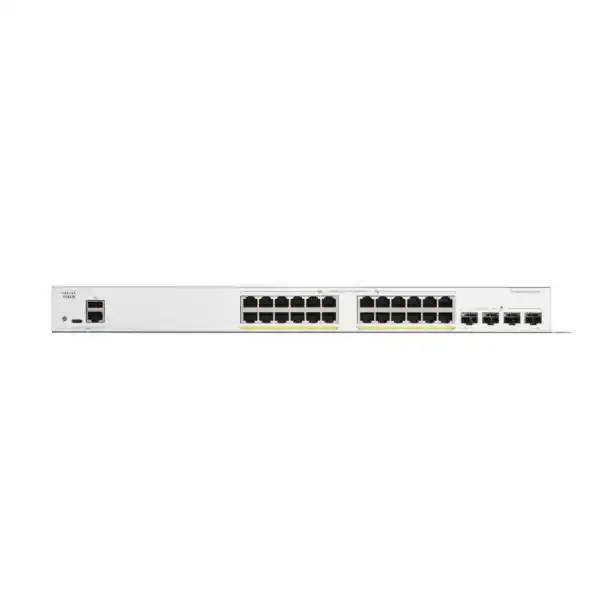
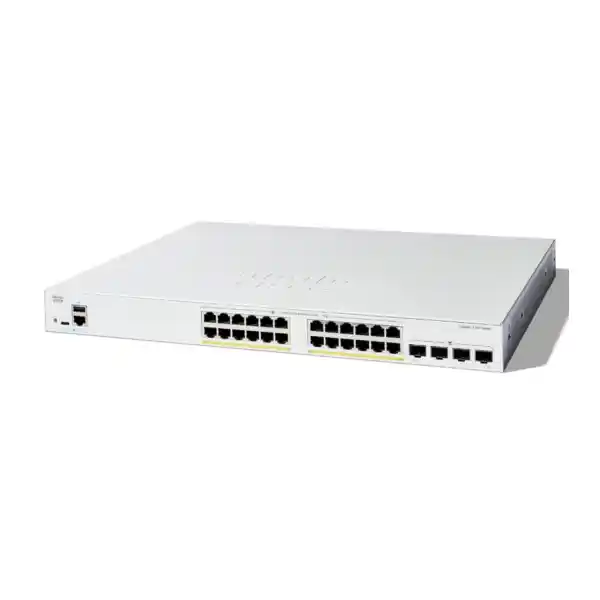
Cisco Catalyst C1300-24FP-4G Network Switch
A 24-port managed Gigabit PoE+ access switch with four dedicated Gigabit SFP uplinks, enterprise-class Layer 3 capabilities, hardware-based security controls and the PoE capacity required for demanding UAE branch, office, surveillance, voice and wireless deployments.
The C1300-24FP-4G is best understood as a high-power Gigabit access-layer switch rather than a high-speed aggregation platform. It provides 24 copper 10/100/1000 interfaces that can deliver IEEE 802.3af/802.3at power and four 1 Gigabit SFP uplinks. Cisco lists 56 Gbps of switching capacity and 41.67 million packets per second of forwarding performance for this exact model. The current Cisco technical table lists 375W dedicated to PoE, while the ordering description markets the SKU with a 370W PoE budget; for practical design FourTeck recommends using 370W as the conservative planning value unless the final project bill of materials and firmware release establish otherwise.
Direct answer: who should buy it?
Choose the C1300-24FP-4G when the primary requirement is twenty-four 1 Gigabit PoE+ edge ports, a comparatively generous PoE pool, four fiber uplink positions and managed Layer 2/Layer 3 control in a branch-size environment.
If your design requires 10 Gigabit uplinks, high-speed hardware stacking, heavy east-west aggregation, Wi-Fi 6E/7 access points that need multigigabit access, or a larger routing scale, specify an appropriate C1300 4X/multigigabit model or Catalyst 1300X platform instead of treating the 4G model as equivalent.
Copper Gigabit Ethernet access interfaces supporting standards-based endpoint power for phones, cameras, wireless APs and other compatible powered devices.
Dedicated fiber uplink positions for distribution-switch, firewall-zone, inter-building or server-room connectivity where 1G optical links are appropriate.
Cisco rates the model as wire-speed and nonblocking, providing the forwarding headroom expected from a 24-port Gigabit access switch with four 1G uplinks.
Use 370W as a conservative project budget, keeping margin for startup behavior, device growth and real operating conditions instead of sizing to theoretical maximums.
1. Hardware architecture and why the 56 Gbps number matters
The C1300-24FP-4G is engineered as a fixed access switch. Its port arithmetic explains Cisco’s 56 Gbps switching-capacity figure: twenty-four full-duplex Gigabit copper links plus four full-duplex Gigabit SFP links create twenty-eight Gigabit interfaces, and bidirectional capacity doubles that aggregate to 56 Gbps. In practical terms, the forwarding fabric is designed not to become the first bottleneck when every physical interface is operating at line rate. Cisco also specifies 41.67 mpps for 64-byte packets, which is the relevant stress condition for packet-processing throughput. For normal office payloads, IP phone media, camera streams and wireless client traffic, average packet sizes are usually larger, so the forwarding requirement is typically less severe than the 64-byte benchmark.
This architecture is suitable when the edge is predominantly Gigabit Ethernet and when traffic converges into a distribution layer through one or more 1G links. The four SFP positions provide topology flexibility: an administrator can use a pair of uplinks in an LACP port channel, dedicate a fiber to a camera-recording zone, use another for a server-room connection, or build redundant paths to separate upstream switches where the surrounding topology supports it. The key engineering limitation is equally important: these are Gigabit SFP ports. A project that expects a 10G fiber handoff to a firewall, core switch, storage network or high-density wireless aggregation layer should not purchase the 4G model on the assumption that an SFP+ optic can make it 10G. Interface speed is a property of the switch hardware and software support, not just the transceiver inserted into the cage.
The switch uses an ARM dual-core processor at 1.5 GHz with 1 GB DDR4 and 1 GB SLC flash. Those control-plane resources handle management, routing processes, protocol state, configuration, monitoring and system services. User-plane forwarding is designed for hardware execution, which is why the switching and routing behavior should be evaluated by forwarding tables, packet-rate limits, buffers and feature scale rather than by comparing CPU clock speeds as if this were a general-purpose server. The 1.5 MB aggregate dynamically shared packet buffer is adequate for the intended access role, but it is not an argument for positioning the switch as a storage fabric or oversubscribed data-center aggregation device. Microbursts can still create queue pressure when many 1G ingress ports converge toward a smaller number of 1G egress links.
For a UAE design review, FourTeck therefore starts by asking where the traffic goes, not simply how many ports are required. Twenty-four endpoints sending occasional office traffic may barely load one uplink, while twenty-four high-bitrate cameras, a local NVR, multiple Wi-Fi access points and backup traffic can create sustained uplink utilization. The same switch can be an excellent fit in the first case and constrained in the second. A correct bill of materials maps application flows, estimates normal and peak throughput, identifies failure-mode bandwidth, and decides whether 1G SFP uplinks are sufficient over the intended service life.
2. Port map, SFP uplinks and access-layer design
On the copper side, all twenty-four user-facing ports operate at 10/100/1000 Mbps and can negotiate with legacy Fast Ethernet devices while providing Gigabit connectivity to modern endpoints. Auto-negotiation makes migration easier, but structured cabling still matters. Cisco specifies Category 5e or better for 1000BASE-T; FourTeck normally recommends properly certified Cat6 or Cat6A in new UAE projects where pathway space, heat, future multigigabit migration and electromagnetic conditions justify the additional margin. The switch can only deliver 1G on these ports, yet the permanent cabling can be designed for a longer life than the active electronics.
The four SFP ports allow optical separation between floors, buildings, telecom rooms or electrically noisy areas. Optic selection must match fiber type, wavelength, distance, connector presentation and the far-end device. Multimode and single-mode fiber are not interchangeable design assumptions. A short in-building link may use multimode optics where existing OM3/OM4 infrastructure is available, while a campus or inter-building link may justify single-mode fiber because of distance, future flexibility and lower sensitivity to later speed upgrades. The switch SKU does not by itself include the optical transceivers, patch leads, fiber panels or cleaning/inspection accessories required for a complete link, so those items belong in the quotation checklist.
LACP is useful when two or more physical links should operate as a logical bundle. Cisco specifies support for IEEE 802.3ad link aggregation with up to eight groups and up to eight active ports in a group, subject to platform rules. Aggregation can increase total available bandwidth across multiple traffic flows and can improve link resilience, but it does not turn several 1G links into a single faster serialization path for one ordinary flow. Hashing determines which member carries a flow. A two-port LAG can therefore provide 2 Gbps aggregate capacity across multiple conversations while an individual TCP session normally remains on one member. This distinction is important when designing server, firewall or distribution uplinks.
Spanning Tree Protocol remains part of the resilience design whenever Layer 2 has redundant physical paths. The Catalyst 1300 family supports STP-related controls, including rapid and multiple spanning-tree variants, BPDU Guard, Root Guard and loop-protection mechanisms. The desired topology should decide which ports are edge-facing, which can participate in trunking, where root roles belong and how fast failure recovery needs to be. Simply connecting redundant cables without a documented STP or LAG design can create a broadcast loop rather than resilience.
A useful rule for this model is to preserve SFP ports for functions that genuinely benefit from fiber or dedicated uplinks. Using all four immediately for low-priority point-to-point links can leave no clean path for redundancy or a later distribution connection. FourTeck’s network implementation team can map switch ports, VLAN trunks and fiber assignments as part of broader IT services and network deployment in the UAE, especially when the switch is being introduced into an existing live environment with mixed vendors or undocumented cabling.
3. PoE+ engineering: treat watts as a budget, not a marketing label
Power over Ethernet is the defining reason to choose the FP version. Every one of the twenty-four copper ports can support IEEE 802.3af PoE and 802.3at PoE+ operation, with up to 30W class capability on a port, but the switch cannot deliver 30W simultaneously to all twenty-four ports because that would require 720W at the PSE side. Cisco’s ordering description lists a 370W power budget, while a technical table in the current datasheet lists 375W dedicated to PoE. A conservative project should therefore treat 370W as the available planning pool and retain reserve rather than allocating every watt on paper.
A simple sizing method starts with the maximum negotiated requirement of each powered-device type. Suppose a branch needs twelve IP phones budgeted at 7W each, six fixed cameras budgeted at 12W each, four Wi-Fi access points budgeted at 18W each and two access-control devices budgeted at 10W each. The theoretical total is 84 + 72 + 72 + 20 = 248W. That leaves more than 120W of planning space under a 370W budget. The exact numbers must come from the endpoint datasheets, because device labels, PoE classes and real maximum draw vary. A Wi-Fi AP that averages 10W can still negotiate or require a higher class during radio activation, USB accessory use or peak transmit conditions.
Reserve is important for three reasons. First, projects change: a basic camera may be replaced later by a model with heater, illuminator, motorized optics or additional analytics hardware. Second, simultaneous startup or reboot events can produce a different power profile from steady operation. Third, network teams often add devices after handover without revisiting the original PoE worksheet. An engineering target of roughly 70–80 percent of the conservative budget is often healthier than designing to 99 percent, although the correct reserve depends on business requirements, known endpoint behavior and expansion plans.
Persistent PoE support on the Catalyst 1300 family can help keep endpoint power available during a switch software reboot where the supported behavior and configuration permit it. This can be operationally valuable for IP phones, cameras and access points because a management-plane restart does not necessarily need to trigger a full endpoint power cycle. However, persistent power is not a substitute for electrical resilience. If the switch loses AC power, the attached devices lose PoE unless the switch itself is supported by an appropriately sized UPS. For a surveillance or access-control environment, the UPS must be sized for both the switch’s system load and the aggregate PoE load, plus efficiency losses and target runtime.
PoE also affects cooling. Cisco lists worst-case switch power consumption with PoE well above the non-PoE system load and specifies heat dissipation of roughly 1542 BTU/hour for this model under the test condition represented in its table. A small communications cabinet with several PoE switches can therefore generate substantial heat even if the office around it feels comfortable. In Dubai, where outdoor and service-area temperatures can be high, the rack should not depend on incidental corridor cooling. Airflow paths, cabinet depth, front/rear clearance, room ventilation, AC operating hours and UPS heat all need to be considered together.
The practical procurement advantage is consolidation: a properly sized C1300-24FP-4G can remove a collection of endpoint power adapters, simplify UPS-backed power design and centralize shutdown/restart control. The engineering discipline is to calculate watts before purchase. FourTeck can include a port-by-port PoE schedule in the quotation so the customer can see each device class, estimated maximum demand, reserve and growth capacity rather than relying on a generic statement that the switch is ‘full PoE.’
4. Layer 3 routing: more capable than a basic smart switch, but not a core router
Cisco positions the Catalyst 1300 family as managed, enterprise-class Layer 3 switching for SMB and branch use. On the C1300 class, the switch supports wire-speed IPv4 routing, IPv6 routing, Layer 3 interfaces on physical ports, LAGs, VLAN interfaces and loopbacks, plus static routes and RIP v2 dynamic routing. Cisco lists up to 990 combined dynamic and static IPv4 routes and up to 128 IP interfaces for the C1300 scale. This gives a branch architect meaningful freedom to route locally between user, voice, camera, wireless, printer, server and management VLANs instead of hairpinning all internal traffic through an external firewall.
Whether that local routing is desirable is a security-policy question. If corporate policy requires every inter-VLAN flow to be inspected by a next-generation firewall, then the switch may remain primarily Layer 2 and use trunks toward the firewall. If the goal is to keep high-volume local traffic such as client-to-server or camera-to-NVR flows off the firewall, selected VLAN interfaces can reside on the switch and ACLs can enforce local policy. A hybrid architecture is also possible: routine internal segmentation can be routed at the switch while sensitive VLANs and Internet-bound traffic are directed toward the firewall. The right choice depends on visibility requirements, firewall capacity, threat model and operational ownership.
Policy-Based Routing adds another design tool by allowing traffic that matches IPv4 or IPv6 ACL criteria to use a specified next hop. PBR can solve branch scenarios such as directing a particular application subnet toward a security appliance or alternate WAN edge. It should be used deliberately, because policy routing adds state to troubleshooting. A clean route table is easier to reason about than a collection of exceptions, and PBR rules should be documented alongside the VLAN and firewall policy.
The exact C1300-24FP-4G should not be confused with the newer C1300X routing scale. Cisco reserves OSPF v2/v3 support for C1300X SKUs in the current documentation. If a project specification explicitly requires OSPF on the access switch, the non-X C1300-24FP-4G is not the appropriate assumption. Similarly, if the site is expected to become a sophisticated routed campus with thousands of prefixes, large equal-cost multipath requirements or extensive dynamic routing policy, a higher-tier platform should be considered.
For many UAE SME and branch networks, however, the C1300 routing set is a strong middle ground. Static routes and RIP can handle straightforward branch segmentation, while DHCP server and DHCP relay capabilities support centralized or local address allocation models. The switch can route internal VLANs in hardware and allow the upstream security appliance to focus on WAN, VPN, Internet inspection and advanced threat functions. For firewall architecture, policy review and procurement, customers can also explore FourTeck’s Firewall Dubai solutions alongside the switching BOM.
5. VLANs, QoS, voice and multicast for converged branch networks
A modern branch switch rarely carries one homogeneous network. The Catalyst 1300 feature set supports port-based and IEEE 802.1Q tagged VLANs, management VLANs, private VLAN functions, guest and unauthenticated VLAN behavior, dynamic VLAN assignment through RADIUS and 802.1X, MAC-based and protocol-based segmentation, and other service-provider-oriented functions such as Q-in-Q. Cisco states support for up to 4094 VLAN identifiers with a reserved internal range. In practice, an office with twenty-four access ports will normally use far fewer VLANs, but the broad feature set lets the switch participate cleanly in standardized enterprise addressing and segmentation schemes.
A sensible office template might use separate VLANs for corporate users, IP phones, wireless infrastructure, employee Wi-Fi, guest Wi-Fi, CCTV cameras, access-control systems, printers, servers and network management. The value is not merely organization. Segmentation gives security controls well-defined boundaries, reduces broadcast scope, allows different DHCP options and DNS policies, and makes troubleshooting more deterministic. VLAN naming, numbering and subnet assignment should be consistent across switches, firewalls, access points and documentation so that an engineer looking at VLAN 120 in one closet understands its role everywhere.
Voice VLAN functionality can automatically classify compatible voice endpoints into a voice-specific segment and apply appropriate QoS treatment. LLDP/LLDP-MED and vendor discovery behaviors can simplify deployments where a phone and a workstation share one physical switch port through the phone’s integrated PC pass-through interface. QoS then protects latency-sensitive signaling and RTP media from bulk data congestion. Correct QoS design requires trust boundaries: an organization should not blindly accept endpoint markings from any device that connects to an access port. Classification can occur at the edge, with the switch rewriting or trusting DSCP/CoS according to endpoint type and policy.
Multicast is another area where managed switching matters. IGMP snooping restricts multicast distribution to interested receivers instead of flooding every port, and Cisco lists support for 2000 multicast groups on C1300 1 Gigabit Ethernet SKUs. This can be relevant for IPTV, digital signage, market feeds, AV distribution and certain surveillance or discovery applications. Multicast VLAN Registration and related controls support specialized architectures, but multicast should be designed end-to-end; the access switch can control Layer 2 replication, while routed multicast requirements depend on the broader network.
The most important operational principle is that feature richness does not eliminate the need for a clean configuration standard. A twenty-four-port switch with inconsistent trunks, native VLAN mismatches, unused open ports and ad-hoc QoS can cause more trouble than a simpler device with disciplined policy. FourTeck normally recommends a baseline template covering hostname, management IP, NTP, DNS, AAA, SNMPv3, syslog, VLANs, trunk rules, edge protections, PoE priorities, interface descriptions and configuration backup before site-specific changes are added.
6. Security controls for access ports and management plane
Access-layer security starts with controlling who can connect. The Catalyst 1300 family supports IEEE 802.1X in the authenticator role with RADIUS authentication/accounting, guest and unauthenticated VLAN behavior, single- and multi-host modes, multiple sessions, time-based 802.1X, dynamic VLAN assignment and MAC authentication functions. This lets organizations move from a simple ‘plug in and receive network access’ model toward identity-aware edge control. In a mature deployment, managed laptops may use certificate-based 802.1X, IP phones can receive voice policy, and non-802.1X IoT devices can be handled through controlled MAC-authentication workflows or isolated VLANs.
DHCP snooping protects the access layer from rogue DHCP servers. The administrator marks trusted interfaces toward legitimate infrastructure and treats edge ports as untrusted; unexpected DHCP server responses can then be filtered. IP Source Guard can use learned or static bindings to reject traffic whose source address does not match the expected attachment, reducing IP-spoofing opportunities. Dynamic ARP Inspection validates ARP behavior against binding information and can block common man-in-the-middle techniques based on forged ARP mappings. Cisco groups these complementary mechanisms under IP/MAC/port binding concepts. Their effectiveness depends on correct trust boundaries and consistent DHCP behavior.
IPv6 requires equivalent attention. It is not enough to secure IPv4 while leaving IPv6 active and unmanaged. Cisco documents IPv6 First Hop Security features including Neighbor Discovery inspection, Router Advertisement Guard, DHCPv6 Guard and neighbor-binding integrity checks. These controls can reduce exposure to rogue IPv6 routers, address spoofing and first-hop manipulation. Even organizations that ‘do not use IPv6’ should make an explicit decision about endpoint IPv6 behavior rather than assuming it is absent; modern operating systems typically enable IPv6 by default.
Layer 2 topology protections matter as well. BPDU Guard can shut an edge port that unexpectedly receives spanning-tree BPDUs, helping prevent an unmanaged or misconfigured downstream switch from changing the topology. Root Guard can prevent edge-connected devices from attempting to become spanning-tree root. Loopback detection and storm controls provide additional containment options. Unused ports should be administratively disabled or placed in a non-routed parking VLAN, and interface descriptions should identify authorized endpoints or patch-panel destinations.
The management plane should use SSH and HTTPS rather than legacy clear-text protocols. Cisco supports SSH and secure browser management, plus SNMPv3 with the User-Based Security Model. Management interfaces should live in a dedicated VLAN reachable only from authorized admin networks or a jump host. AAA credentials should be role-appropriate, default passwords must never remain in service, and configuration backups should be protected because they contain network addressing, user names, shared secrets or topology information. Syslog and NTP should be configured so events have reliable timestamps and can be correlated with firewall, server and identity-system logs.
No access switch replaces a firewall, EDR platform or identity system. Its role is to enforce the first set of network admission and forwarding rules closest to the endpoint. The strongest result comes from combining switch features with secure WLAN design, endpoint posture, centralized logging and a next-generation firewall. For broader infrastructure projects, FourTeck’s UAE technology portfolio can be used to align switching, security, wireless, voice, servers and support under one design rather than purchasing each device in isolation.
7. Stacking, redundancy and the important 4G versus 4X distinction
Cisco’s Catalyst 1300 family documentation discusses front-panel stacking for supported models, with up to eight units in a stack and unified control, data and management behavior. It is easy to overgeneralize that statement to every SKU. The C1300-24FP-4G has four 1 Gigabit SFP uplinks, while Cisco’s high-speed stacking mechanisms are associated with supported high-speed uplink models. The practical design rule for this exact 4G SKU is therefore not to assume hardware stacking through its four 1G SFP ports. If a project requires native stack behavior, select a model explicitly documented for the required stack type, commonly a 4X or other supported high-speed variant, and validate firmware compatibility and cabling before purchase.
This does not prevent redundant standalone designs. Two independent C1300-24FP-4G switches can connect upstream with separate trunks or LAGs according to the distribution architecture, and endpoints can be divided across the units. What is missing compared with a true hardware stack is the single logical control/data-plane abstraction and cross-stack functions associated with supported stack designs. An administrator should therefore manage each standalone switch as its own failure domain and ensure spanning-tree, link aggregation and gateway design reflect that reality.
Redundancy must also account for power. The switch uses an internal AC supply, not a field-swappable dual redundant PSU architecture. If continuous operation is important, power it from a properly sized UPS backed by a maintained electrical source. For higher availability, distribute critical devices across separate switches and preferably separate UPS circuits where the facility design allows. A single high-power PoE switch can otherwise become a common failure point for dozens of cameras, phones or access points even if the upstream network has redundant links.
Software resilience includes dual-image support, allowing more controlled upgrade workflows. A production change plan should still back up configuration, confirm the target firmware’s release notes and feature compatibility, schedule a maintenance window, verify PoE behavior, confirm rollback image integrity and test all uplinks after reboot. Automated configuration backups are especially valuable for distributed UAE branch networks where travel to the site may be slower than restoring configuration remotely.
When comparing 4G and 4X models, avoid deciding on price alone. The 4G model can be very cost-effective for a branch that only needs 1G uplinks. The 4X model may provide significantly better lifecycle value when the uplink is expected to move to 10G, when higher stack capability is required or when the switch aggregates more high-bandwidth endpoints. FourTeck can quote both and show the cost difference against the expected five-year topology, which is more useful than buying the cheapest SKU and replacing it early.
8. Management, Cisco Business Dashboard and operational workflow
The Catalyst 1300 family is designed for organizations that need managed-switch functionality without the operational weight of a large campus controller stack. Cisco Business Dashboard can manage supported Cisco Business and Catalyst 1200/1300 devices, and the 1300 series supports an embedded probe so a separate probe VM or hardware appliance is not always necessary onsite. Device onboarding, visibility, inventory and lifecycle workflows can therefore be centralized for small distributed networks. Cisco’s current material also describes an integrated AI Assistant in the Business Dashboard ecosystem, though organizations should evaluate management features against the exact release, entitlement and governance policy used in production.
The built-in web interface provides a practical path for branch administrators who prefer GUI configuration, while a full text/CLI view supports engineers who want deterministic commands, templates and change records. SNMP versions 1, 2c and 3 are supported, but SNMPv3 is the preferred choice where secure authenticated and encrypted monitoring is required. Syslog, NTP and configuration backups should be integrated into the same monitoring model. A switch is an infrastructure component; it should not become a device that is only noticed when users complain.
Cisco Network Plug and Play can support near-zero-touch provisioning in repeatable branch rollouts. The value is greatest when the configuration standard is already mature. A new branch can receive a switch, connect it to the correct upstream service and allow the provisioning workflow to apply approved parameters rather than relying on a technician to recreate them manually. Standardization reduces differences between sites, which shortens troubleshooting time and makes audit results more predictable.
Management access should be designed before the switch leaves staging. Define whether the management address is static or DHCP-reserved, which VLAN carries management, which source networks may connect over SSH/HTTPS, what AAA server is authoritative, how local break-glass credentials are stored, where syslog is sent, which NTP source is trusted, and how frequently configuration backups are retained. For remote branches, add an out-of-band or alternate-access plan if the switch is involved in the primary WAN path; otherwise a routing or VLAN mistake can remove the very management access needed to fix it.
Support planning belongs in the same discussion. Cisco documents a limited lifetime warranty with return-to-factory replacement and complimentary one-year access to the Small Business Support Center for the series, subject to Cisco’s current terms. Organizations that require defined response times, advance replacement, onsite engineering or extended lifecycle assistance should price the appropriate support arrangement instead of assuming the base warranty equals a managed service. Software and management feature availability can also change by firmware, so the final quotation should state required feature versions and support options rather than relying on a generic ‘Cisco managed switch’ description.
9. Four balanced deployment patterns for Dubai and UAE sites
Office and unified communications floor
Use access ports for IP phones and workstations, place phones in a dedicated voice VLAN, apply QoS, and reserve SFP uplinks for distribution. A typical twenty-four-port floor may not need PoE on every port, which leaves significant budget for wireless APs or future devices. 802.1X can authenticate managed endpoints while guest/unauthenticated policies constrain unknown devices.
This pattern fits professional services, clinics, small corporate branches and mixed desk environments where deterministic voice quality, central monitoring and secure segmentation matter more than 10G edge speed.
CCTV and physical-security access switch
Twenty-four PoE+ ports and a high total power budget make the FP model attractive for fixed cameras, selected PTZ models and access-control endpoints. Keep camera traffic in dedicated VLANs, enable storm and edge protections, and decide whether the NVR sits locally or across an uplink. Calculate bitrate × camera count and include recording bursts, multicast or viewing traffic before accepting a 1G uplink design.
Where high-resolution cameras, multiple NVRs or analytics servers create sustained throughput, consider distributed uplinks or a 10G model rather than assuming four 1G ports automatically remove all aggregation constraints.
Wireless and hospitality access
The switch can power many mainstream Wi-Fi access points while carrying separate employee, guest and operational VLANs. The key limitation is the 1G copper edge: a modern AP with a multigigabit uplink cannot exceed 1G through this switch even if its radio aggregate is higher. For moderate-density Wi-Fi 5/6 access this may be perfectly adequate; for high-density Wi-Fi 6E/7, choose a multigigabit model with the required PoE class.
Guest isolation, 802.1X, private VLAN functions and upstream firewall policy can be combined to keep public traffic separated from point-of-sale, back-office and building systems.
Retail or remote branch infrastructure
A branch can converge POS terminals, printers, phones, cameras, APs and local servers on segmented VLANs, with static or RIP-based routing where appropriate. A firewall provides WAN, VPN and Internet security while the switch handles local access. The compact 1RU form factor suits a standard rack, but the cabinet must have enough depth and cooling for a high-PoE chassis.
Standardized templates and Cisco management tools become particularly valuable when the organization repeats the same branch design across the Emirates or across GCC/African operations.
10. Sizing methodology: ports, watts, bandwidth, routes and growth
Correct switch sizing starts with an endpoint schedule. List every device expected on day one and at the end of the planning horizon: desktops, phones, printers, APs, cameras, biometric readers, door controllers, meeting-room systems, IoT gateways, servers and uplinks. Mark whether each device needs PoE, expected speed, VLAN, estimated maximum power, criticality and any special requirement such as LLDP-MED or 802.1X. Reserve physical ports for growth. A 24-port switch that starts with 23 occupied ports may technically fit the project, but it leaves no operational flexibility for temporary troubleshooting, an extra AP or a new camera.
Then calculate PoE. Use endpoint maximum or negotiated class values rather than average dashboard readings. Sum the demands and compare them with a conservative 370W pool. Add reserve. If a customer expects twenty-four PoE+ endpoints each capable of drawing near 20W, the projected 480W exceeds the switch budget even though every port supports PoE+. That project needs lower endpoint demand, multiple switches or a higher-power model. Conversely, twenty-four IP phones drawing 5–8W each may use less than half the available budget.
Next evaluate uplink throughput. Measure or estimate sustained and peak traffic by category. A 4 Mbps camera stream sounds small, but twenty-four such streams create roughly 96 Mbps before protocol overhead and viewing/export bursts. Office clients may be burstier: a few users pulling large files can saturate a 1G uplink briefly even if average utilization remains low. Wireless APs can aggregate many client sessions. Use LACP when multiple independent flows justify a bundle, but remember that one flow remains constrained by the hashing model and the speed of its selected member.
Routing scale is rarely the limiting factor in a branch this size, but it should still be checked. If the switch will host dozens of SVIs and hundreds of routes, confirm current firmware limits and leave margin. If OSPF is a hard requirement, move to an appropriate C1300X design because the standard C1300 documentation does not provide OSPF for this SKU class. If thousands of MAC addresses arrive through downstream switches, remember that the 1G C1300 family scale is 16,000 MAC entries; this is generous for normal branch access but still finite.
Finally, size the rack and power system. The chassis is approximately 444.3 mm wide, 350 mm deep and 43.94 mm high, weighing about 4.6 kg. Allow space for power leads, fiber bend radius, patch-panel depth and airflow. The internal supply accepts 100–240V AC at 50–60 Hz, but UAE installations should still use a quality UPS and correct PDU arrangement. UPS runtime calculations must include the switch’s own system draw plus the attached PoE load. A 1000VA UPS sized only against the switch’s idle wattage can deliver a disappointing runtime when 250–350W of endpoints are actually being powered.
This five-part sizing process—ports, watts, bandwidth, tables and facilities—prevents the two most common mistakes: buying by port count alone and assuming that a ’24-port PoE switch’ has enough power and uplink capacity for any twenty-four powered devices.
11. Cabling, optics and physical installation in UAE environments
Copper cabling should be certified as an installed channel, not judged by link LEDs alone. Gigabit Ethernet requires Category 5e or better, and PoE adds DC resistance and heat considerations. In new builds, Cat6 is a common baseline; Cat6A can be appropriate where future 10G or multigigabit upgrades are likely, cable bundles are dense, or designers want additional alien-crosstalk margin. Patch panels, jacks, patch cords and horizontal cable should come from a coherent cabling system where possible. Poor termination can create intermittent faults that appear only under temperature variation, high PoE load or Gigabit signaling.
Fiber design starts with the existing plant. Identify single-mode versus multimode, connector type, strand count, path length and any intermediate patching. Select an SFP supported by the switch and compatible with the far-end optic. Both ends must agree on speed and optical standard. Optical power should be within the transceiver’s receive window, and connectors should be inspected/cleaned before troubleshooting mysterious loss. Spare strands and labeled patch panels reduce future downtime.
The C1300-24FP-4G uses a standard rack-width 1RU chassis and includes 19-inch mounting brackets for the 24-port form factor according to Cisco’s package information. At approximately 350 mm deep, it fits many communications cabinets but should still be checked against usable depth after front patch cords and rear power connections are considered. Dense wall-mount cabinets sometimes advertise an external depth that is substantially larger than the internal rail-to-door clearance. Fiber patch cords also need a gentle bend radius; crushing them against a cabinet door can cause optical issues.
Thermal planning deserves particular attention in Dubai. Cisco rates the model for operation from -5°C to 50°C, with a 0°C minimum ambient for cold start, but staying within the absolute operating envelope is not the same as building a good equipment room. High temperature can shorten component and UPS battery life, increase fan speed and reduce environmental margin. The model has one fan and is listed around 39 dBA at 25°C. It is therefore better suited to a network cabinet or equipment space than to a noise-sensitive desk environment.
For projects where switching is part of a server-room refresh, FourTeck can align rack dimensions, UPS capacity, patching and compute connectivity with its Server Dubai infrastructure solutions. Coordinating rack, power, server NICs, firewall ports and switch uplinks before delivery reduces the number of last-minute adapters, unsupported optics and emergency cabling changes during commissioning.
12. Integration with firewalls, servers, IP phones, cameras and wireless
A switch is most effective when its role is explicitly defined relative to the firewall. In a small branch, the firewall may provide all default gateways, DHCP and inter-VLAN policy, with the C1300 carrying tagged VLANs at Layer 2. This is simple and centralizes policy, but all inter-VLAN traffic consumes firewall interfaces and processing. In a larger branch, the C1300 can host selected SVIs and route local trusted VLANs at wire speed while a default route sends external traffic to the firewall. Sensitive networks can still terminate at the firewall for inspection. The design should document which device owns each gateway, which device provides DHCP relay or server functions, and where ACLs are enforced.
Servers may connect directly to the switch if 1G is sufficient, but dual-NIC teaming or LACP requires compatible server NIC, operating-system or hypervisor configuration. A two-port LAG increases aggregate multi-flow throughput and can provide link redundancy, yet the server application architecture still matters. Virtualization hosts, backup servers and NAS systems can exceed 1G quickly, especially during backup windows. If those workloads are important, a 10G access or aggregation switch may be a better neighbor even if ordinary user ports remain on the C1300-24FP-4G.
IP telephony benefits from PoE, voice VLAN and QoS. A phone can often share one switch port with a PC, with the phone tagging voice traffic and passing the PC’s data traffic through. Configure the access port according to vendor recommendations, trust or remark QoS at the correct boundary, and confirm the phone’s PoE requirement. Emergency calling, call-manager reachability and DHCP options should be validated after VLAN changes.
Cameras benefit from dedicated VLANs and predictable power, but bandwidth and security require equal attention. Restrict camera subnets from initiating unnecessary Internet or user-network connections, allow only the NVR/VMS and management services required, and protect the switch ports against unauthorized replacement devices. For remotely mounted cameras, surge protection and building grounding become part of the physical design, especially for outdoor copper runs. Ethernet cabling should remain within standards-based distance limits and should not be used casually between buildings where fiber isolation would be safer.
Wireless APs should be selected with the port’s 1G and PoE+ limits in mind. Many mainstream APs operate effectively on 1G PoE+; newer high-end APs may require 2.5G/5G multigigabit Ethernet or higher-power PoE. Buying an advanced AP and connecting it to a 1G access switch can still work, but it may constrain performance or disable features. The correct BOM therefore matches switch port speed, PoE standard and AP model rather than treating all RJ-45 PoE ports as interchangeable.
13. Performance design under real branch workloads
The 56 Gbps switching fabric tells us that the chassis can provide nonblocking line-rate capacity across its twenty-eight Gigabit interfaces under the stated conditions. The more common real-world bottleneck is not the internal fabric but traffic concentration. Consider twenty users, four APs and ten cameras all sending toward a server or firewall reachable over one 1G uplink. Even though each access port individually has 1G, the uplink is shared. The correct design manages oversubscription according to workload rather than expecting the switch fabric to change physical link speed.
QoS helps protect important applications during congestion but does not create bandwidth. Priority queues can reduce delay for voice and critical control traffic by servicing them ahead of bulk transfers, while rate limiting can prevent one class from consuming excessive capacity. If the link is persistently saturated, the structural fix is more bandwidth, better traffic localization or a different architecture. QoS is a congestion-management tool, not a substitute for an adequate uplink.
The 1.5 MB dynamically shared packet buffer can absorb short bursts and smooth queueing across ports, but buffer size should not be treated as infinite protection against incast. When many 1G sources send simultaneously to one 1G destination, the egress queue must discard traffic once buffering is exhausted. Modern TCP reacts to loss and congestion, but UDP applications may not. This is especially relevant for video, real-time media and certain storage protocols.
Jumbo frames up to 9000 bytes can reduce per-packet overhead for storage or large data transfers, but enabling them only on the switch is insufficient. The entire path—including server NICs, virtualization bridges, downstream switches, firewalls and storage targets—must support the selected MTU. Mismatched MTUs can produce subtle application failures, especially where Path MTU Discovery is blocked or encapsulation adds overhead. Office endpoints generally do not need jumbo frames, so enable them only where there is a documented performance case.
A FourTeck design review can therefore distinguish three capacities: switch fabric, individual link speed and aggregate topology bandwidth. The fabric is 56 Gbps; each access/uplink interface is 1G; the usable end-to-end capacity is determined by the slowest shared segment along the path. This framework makes it easier to decide whether the 4G model is the correct SKU or whether a 4X/10G option will avoid future congestion.
14. Procurement and lifecycle considerations for Dubai, UAE
Enterprise network procurement should specify more than the switch model. The quotation should identify the exact product ID, power-cord region, required SFPs, fiber patch leads, rack kit, support option, firmware baseline, installation scope, configuration scope and delivery location. This avoids a common problem where the active chassis arrives but the optical links cannot be commissioned because transceivers or patch leads were assumed to be included. Cisco’s package description indicates that 24- and 48-port models include 19-inch mounting brackets, but project teams should still confirm package contents at supply time.
Warranty and support should be aligned with business impact. The series documentation lists a limited lifetime return-to-factory warranty and one year of Small Business Support Center access. Return-to-factory replacement may be acceptable for a noncritical branch with an onsite spare; it may be insufficient for a hotel, healthcare clinic, 24-hour retailer or security-camera network where a failed PoE switch disables critical services. In those environments, keep a compatible spare, purchase the appropriate support service or design redundant switch capacity.
Firmware lifecycle is equally important. Before rollout, review release notes for security fixes, feature changes and known issues, and keep a tested rollback image. Do not upgrade every branch automatically on day one of a new release. A staged approach—lab, pilot site, small production group, then broad rollout—limits impact. Configuration backups should be stored centrally and tagged to serial number, site and firmware version.
UAE projects should also account for lead times and import availability. A quote that depends on one exact optic or support SKU should remain valid only for the stated period. If substitution is acceptable, define what can change without re-engineering. For example, changing an SFP to a different reach class may require verifying fiber type and receive levels; changing from C1300-24FP-4G to C1300-24FP-4X changes uplink capability and may affect transceiver choices. Model substitutions should be reviewed technically, not treated as purely commercial equivalents.
For organizations with multiple offices, standardization can reduce total cost more than negotiating a small discount on one unit. Using a consistent switch family, VLAN template, monitoring configuration, spare strategy and optic set simplifies training and troubleshooting. FourTeck can support UAE standardization while also coordinating regional requirements through its approved partner network and main UAE presence.
15. C1300-24FP-4G versus nearby design alternatives
| Requirement | C1300-24FP-4G fit | When to select another model |
|---|---|---|
| 24 × 1G PoE+ access ports | Excellent fit | Move higher only if endpoint count, PoE class or speed increases |
| High total PoE budget | Strong fit with ~370W conservative planning basis | Use higher-power model when demand plus reserve exceeds budget |
| 1G fiber uplinks | Four dedicated SFP ports provide flexibility | Choose 4X/10G model if upstream requires SFP+ 10G |
| Hardware stacking | Do not assume it on this 1G-SFP 4G SKU | Select a specifically stack-capable high-speed C1300 model and validate stack rules |
| OSPF | Not the target SKU for OSPF | Current Cisco docs reserve OSPF v2/v3 for C1300X SKUs |
| Multigigabit APs | AP will be constrained to Gigabit Ethernet | Choose mGig model for 2.5G/5G edge requirements |
| Basic Layer 3 branch routing | Strong fit for static/RIP-based segmented networks | Use larger platform for advanced campus routing scale/protocols |
The right comparison is therefore not ‘C1300 versus another switch’ in the abstract. It is the exact port-speed, PoE, routing and resilience profile of the 24FP-4G against the site’s requirements. A customer who values high PoE capacity and does not need 10G uplinks can avoid paying for unused capabilities. A customer expecting 10G aggregation within a year should usually invest in the faster uplink model now to avoid replacing a working access switch solely because its uplink ceiling was underestimated.
16. Recommended implementation sequence
A disciplined deployment reduces outage risk. Start with discovery: inventory current switches, VLANs, IP ranges, firewall interfaces, trunks, spanning-tree root locations, DHCP servers, voice systems, APs, cameras and fiber paths. Capture the current configuration before touching cabling. If the existing network has undocumented links, trace and label them. Identify every endpoint that is operationally critical and the maintenance window available for migration.
Stage the C1300-24FP-4G offline. Upgrade to the approved firmware, configure hostname and management access, create VLANs, define trunks, configure LAGs, set NTP/DNS/syslog/SNMP, apply AAA and security policies, configure PoE priorities, disable unused ports and save a baseline backup. If Cisco Business Dashboard or PnP will be used, onboard the switch during staging so the device appears in inventory before it is installed onsite.
Migrate infrastructure links first where possible, then endpoints in logical groups. Verify the management plane after each critical step. Test DHCP, DNS, default gateway, Internet access, internal application reachability, phone registration, camera streams, AP status and PoE draw. Confirm that trunk allowed-VLAN lists match both ends and that no native-VLAN mismatch is present. Check spanning-tree state before introducing redundant links.
After migration, inspect port counters for errors, discards and unexpected speed/duplex negotiation. Review the PoE table and compare actual consumption with the design worksheet. Check uplink utilization during a representative business period, not only during the quiet commissioning window. If the network uses LACP, verify that traffic is distributed across members and that failure of one member preserves service as designed.
Close the project with documentation. Export the final configuration, update rack elevations and port maps, record switch serial number and warranty/support information, list SFP types and fiber destinations, document management IP and credential-storage process, and capture the approved firmware version. A concise as-built record can save hours during an outage months later. Customers that want continuing health checks, patch management or network troubleshooting can incorporate the switch into a managed support plan rather than treating commissioning as the final operational task.
The resulting system should be easy for another competent engineer to understand without tribal knowledge. That is the practical standard for an enterprise-quality branch deployment: not merely that packets pass on installation day, but that the topology, policy and recovery process remain supportable throughout the equipment lifecycle.
17. Frequently asked technical questions
Does every port provide 30W at the same time?
No. Each access port can support PoE+ class capability, but the total switch budget is limited. Twenty-four ports at 30W would require 720W, far above the approximately 370W project budget. Sum endpoint requirements and leave reserve.
Are the four SFP ports 10 Gigabit?
No. The C1300-24FP-4G provides four Gigabit SFP uplinks. If 10G SFP+ uplinks are required, specify an appropriate 4X or other 10G-capable model.
Can it route between VLANs?
Yes. The C1300 family supports Layer 3 interfaces and wire-speed IPv4/IPv6 routing, including static routing and RIP v2. Decide whether routing should occur on the switch or firewall according to security policy.
Does this exact SKU support OSPF?
Do not specify it for OSPF. Cisco’s current Catalyst 1300/1300X documentation identifies OSPF v2/v3 support with C1300X SKUs. Use the correct platform if OSPF is mandatory.
Can the 4G model be treated as a hardware stack switch?
Do not assume hardware stacking through the four 1G SFP ports. Stack capability depends on supported high-speed models and stack rules. If stacking is a requirement, specify a documented stack-capable C1300 variant.
Is it suitable for Wi-Fi 7 APs?
It can connect an AP that supports 1G and PoE+ operation, but it cannot provide multigigabit edge speed or PoE++ power. High-end Wi-Fi 7 designs often justify mGig and 802.3bt-capable switching.
What UPS size should be used?
Size the UPS from actual system plus PoE load and desired runtime, not idle switch consumption. Include conversion losses, battery aging and any other devices powered by the same UPS.
Does it need special licenses?
Feature and management requirements should be confirmed against the ordered SKU, firmware and support plan. Do not import licensing assumptions from higher-end Catalyst families; state required management/support services explicitly in the quotation.
18. Why the C1300-24FP-4G is often a strong value point
The model occupies a useful middle position. It is significantly more capable than a basic unmanaged PoE switch because it provides Layer 3 routing, 802.1X, DHCP snooping, IP Source Guard, Dynamic ARP Inspection, IPv6 first-hop protections, VLAN flexibility, LACP, QoS, management APIs/protocols and centralized Cisco management options. At the same time, it avoids the cost and complexity of a high-end modular campus platform when the site only needs twenty-four Gigabit access ports.
Its high PoE budget is particularly attractive. A lower-budget 24-port switch may have the same port count but force uncomfortable compromises once cameras, APs and phones are added. The FP model gives substantially more room for powered-device density. That matters because replacing a switch due to insufficient watts is frustrating: the Ethernet port count may look fine while the power table blocks the actual deployment.
The trade-off is uplink speed. The four SFP positions provide redundancy and topology flexibility, but they remain 1G. A customer who knows that an upstream firewall or core has 10G SFP+ interfaces may prefer the 4X model even if day-one traffic is low. The additional spend should be evaluated against lifecycle rather than against today’s average Mbps. If the switch will remain at the branch edge for five to seven years, 10G uplink headroom can be cheap insurance in a growth-oriented site.
Therefore the C1300-24FP-4G is neither ‘entry level’ nor universally future-proof. It is a technically strong fit when the access edge is Gigabit, PoE density is high, routing/security features are required and upstream bandwidth remains within a well-designed 1G topology. That precise positioning helps procurement teams buy for the application instead of buying on brand and port count alone.
19. UAE network design checklist before purchase
Before requesting a final quote, confirm the access-device count and growth target. If twenty-four ports are required immediately, decide whether one 24-port unit is enough or whether operational reserve justifies a 48-port chassis or second switch. Check how many ports genuinely need PoE. Record the maximum wattage or PoE class of every powered device and identify which devices are business critical. Determine whether any endpoint requires 802.3bt PoE++ or more than 1G Ethernet; those endpoints may require a different switch class.
Confirm uplink architecture. State how many uplinks are needed, their destination devices, fiber type, distance and target speed. If any required link is 10G, the 4G SKU is wrong for that link. If multiple 1G uplinks will be aggregated, verify the far-end platform supports matching LACP and VLAN configuration. If redundant upstream switches are used, define spanning-tree or multi-chassis aggregation behavior clearly.
Confirm logical design. List VLAN IDs, IP subnets, gateway location, DHCP location, DNS/NTP/syslog servers and management network. Decide whether the switch will route between VLANs or whether a firewall owns the gateways. If the design needs OSPF, do not use this SKU on the assumption that every Catalyst 1300 variant supports it. Record security requirements such as 802.1X, guest VLAN, MAC authentication, DHCP snooping, DAI and ACLs.
Confirm facilities. Provide rack type and usable depth, patch-panel layout, available RU space, PDU outlet type, UPS capacity, expected runtime and equipment-room cooling. Verify that the cabinet can handle a 350 mm deep chassis plus cabling and airflow. In hot or minimally conditioned spaces, measure the actual rack temperature during peak conditions. The switch’s 50°C upper operating rating should be treated as an absolute boundary, not a normal target.
Finally, confirm services: delivery, rack installation, configuration, migration, after-hours cutover, testing, documentation, training, support and spare strategy. A clear services scope allows quotations to be compared on equivalent outcomes rather than on hardware line items alone.
20. Decision recap: buy this SKU when these statements are true
✓ Gigabit access is enough
Your PCs, phones, cameras, APs and IoT endpoints can operate effectively on 1G access ports and you do not require 2.5G/5G edge connectivity.
✓ 1G SFP uplinks are sufficient
Your distribution or firewall design can operate within one or more Gigabit fiber links and does not require 10G SFP+ from this access switch.
✓ PoE density is a priority
Your powered-device worksheet fits comfortably within a conservative 370W budget, including reasonable reserve for startup and growth.
✓ Branch Layer 3 features are appropriate
Static/RIP routing, VLAN interfaces, ACLs, DHCP services/relay and standard branch segmentation meet the routing requirement without OSPF on this SKU.
21. Quotation input checklist for an accurate FourTeck BOM
Providing the details below allows FourTeck to quote the switch with the correct optics, power design and implementation scope rather than returning an incomplete chassis-only price.
Endpoints and PoE
Number of phones, cameras, APs, access-control devices and other PoE endpoints; make/model where known; maximum power or PoE class; expected growth; devices that must remain powered during maintenance.
Uplinks and optics
Number of uplinks, far-end switch/firewall models, 1G or 10G requirement, single-mode or multimode fiber, connector type, approximate distance and whether LACP or path redundancy is required.
Logical network
VLAN IDs, IP subnets, gateway owner, firewall interfaces, DHCP/DNS/NTP/syslog details, 802.1X/RADIUS requirement, routing protocols, ACL policy and management subnet.
Rack, power and services
Rack depth and RU availability, UPS model/runtime target, PDU arrangement, room cooling, installation location, delivery deadline, after-hours cutover requirement, configuration/documentation scope and desired support coverage.
Where these details are not yet known, FourTeck can help establish them through discovery. A short technical call often prevents expensive substitutions later because it exposes whether the actual requirement is the 24FP-4G, the 24FP-4X, a multigigabit model or a larger distribution platform.
22. Final consultation panel: design the switch as part of the network, not as an isolated box
The Cisco Catalyst C1300-24FP-4G is a compelling choice for a specific design envelope: twenty-four Gigabit PoE+ edge ports, four 1G fiber uplinks, high PoE capacity and rich managed-switch functions for SMB or enterprise branch operation. Its 56 Gbps nonblocking fabric and 41.67 mpps forwarding rate are well matched to that port configuration. Security features such as 802.1X, DHCP snooping, IP Source Guard, Dynamic ARP Inspection and IPv6 first-hop controls make it suitable for more disciplined access networks than a basic smart switch. Layer 3 functions provide local routing flexibility, and Cisco management options support standardized operations across multiple sites.
The strongest purchasing decision also recognizes what the model is not. Its SFP uplinks are 1G, not 10G. It should not be assumed to provide the high-speed hardware stacking behavior associated with stack-capable C1300 4X and related models. Current Cisco documentation does not assign OSPF to the standard C1300 class; OSPF is identified for C1300X. The copper edge is Gigabit rather than multigigabit, and the PoE standard is 802.3af/at rather than the higher-power 802.3bt capability available on selected newer models. Those boundaries are not weaknesses when they match the application—they are simply the engineering limits that make SKU selection precise.
FourTeck can turn that precision into a complete UAE bill of materials by validating endpoint count, PoE demand, fiber type, SFP reach, uplink speed, VLANs, firewall policy, route ownership, rack depth, UPS runtime and implementation scope. This is especially useful for camera, wireless and voice projects where a switch may appear adequate by port count but fail the real requirement because of power, uplink or cabling constraints.
For new builds, the network can be staged before site handover. For upgrades, a migration plan can preserve existing VLANs and services while improving security and management. For distributed companies, a standard switch template can be repeated across branches and monitored centrally. FourTeck can also coordinate related network, server, firewall and structured infrastructure components so that optics, port speeds and power budgets match across devices.
Recommended next step
Send the endpoint list, required number of switches, delivery city, uplink/fiber details and the firewall or upstream switch model. FourTeck can then validate whether C1300-24FP-4G is the correct SKU and prepare a compatible quotation with optics, accessories and services.
For broader enterprise sourcing and project coordination, visit FourTeck Global or use the contact action below for the Dubai firewall and network team.

Reviews
There are no reviews yet.