
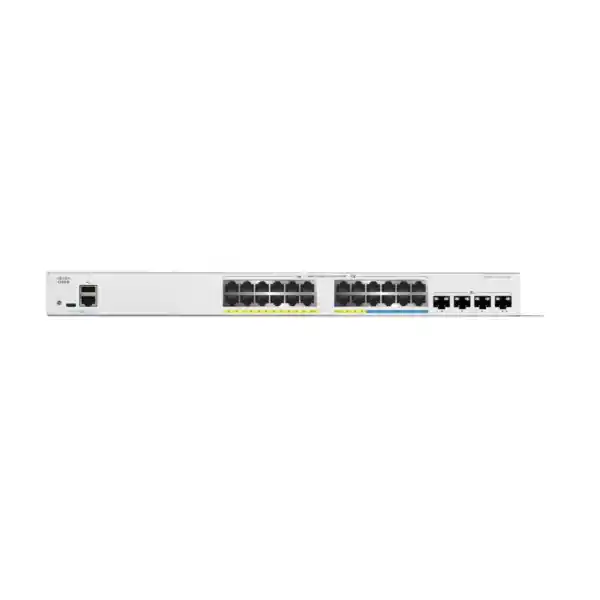
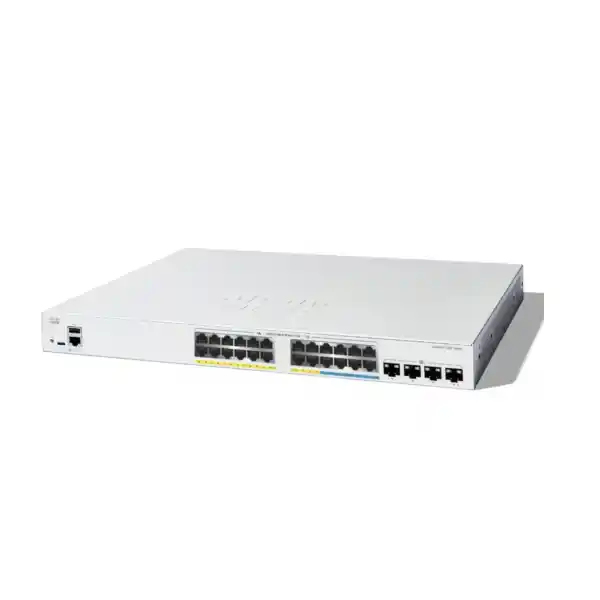
Cisco Catalyst C1300-24MGP-4X Network Switch
A 24-port managed Layer 3 access switch designed for modern UAE business networks that need Gigabit and 2.5 Gigabit edge connectivity, PoE+ power, 10 Gigabit fiber uplinks, resilient stacking, strong segmentation and practical operational control in a single rack-mountable platform.
Choose the C1300-24MGP-4X when you need eight 2.5GbE PoE+ access ports for high-throughput endpoints, sixteen additional 1GbE PoE+ ports, four 10GbE SFP+ uplinks and enough PoE budget to support a mixed fleet of access points, phones, cameras and other powered devices.
Cisco C1300-24MGP-4X at a glance
The Cisco Catalyst C1300-24MGP-4X sits in a useful middle ground between conventional 1GbE access switching and more expensive all-multigigabit or high-density enterprise access designs. Cisco specifies sixteen 10/100/1000 PoE+ interfaces, eight 2.5GbE PoE+ interfaces and four 10GbE SFP+ ports. The switch provides a 375W PoE budget and is rated for 152Gbps switching capacity with forwarding performance of approximately 113.08 million packets per second using 64-byte packets. That combination gives network architects enough edge diversity to connect ordinary user devices economically while reserving higher-speed copper interfaces for Wi-Fi access points, content-creation systems, compact servers, high-performance workstations or bandwidth-sensitive infrastructure.
For phones, cameras, printers, standard APs and wired endpoints that do not require multigigabit access.
Target high-throughput access points and endpoints without forcing every port into a premium speed tier.
For fiber aggregation, server connectivity, inter-switch links and supported hardware stacking designs.
A practical budget for a mixed powered edge when endpoint power classes are sized before deployment.
Why this switch matters for UAE network upgrades
Many business networks in Dubai, Abu Dhabi, Sharjah and other UAE locations are no longer limited by internet bandwidth alone. Local traffic generated by cloud synchronization, high-resolution video collaboration, Wi-Fi 6 and Wi-Fi 6E access points, networked storage, virtualized workloads, surveillance systems and large file transfers can saturate traditional access designs even when users perceive the issue as a generic “slow network.” A switch such as the C1300-24MGP-4X addresses the access-layer side of that problem by giving architects a controlled mix of 1GbE and 2.5GbE user-facing ports and four 10GbE interfaces for upstream capacity.
The design is particularly relevant where a complete 10GbE-to-the-desk strategy would be unnecessary or too expensive. Most phones, printers, cameras and ordinary office workstations continue to operate comfortably at Gigabit speeds. Newer wireless access points, however, can aggregate client traffic at rates that make a single 1GbE uplink a potential bottleneck. By dedicating the eight 2.5GbE PoE+ interfaces to those devices, the network can preserve performance where it has the most impact while still using the sixteen Gigabit PoE+ interfaces for mainstream access. This mixed-speed approach improves cost efficiency, simplifies phased upgrades and extends the useful life of existing structured cabling when the cabling plant is suitable for the target Ethernet rate.
For organizations that want regional design, implementation and lifecycle support rather than a standalone hardware purchase, FourTeck’s UAE technology portfolio can be used as the wider project context for switching, wireless, security and infrastructure planning.
Port architecture: how to use the 24 access interfaces intelligently
The defining feature of the C1300-24MGP-4X is not merely its total port count but the way those ports are divided. Sixteen copper interfaces operate at 10/100/1000 rates and support PoE+, while eight additional copper interfaces operate up to 2.5GbE and also support PoE+. This gives a network designer twenty-four powered access ports without requiring every port to carry multigigabit silicon cost. In real deployments, that matters because device requirements are rarely uniform. A reception phone, ceiling camera and desktop printer do not need the same access bandwidth as a dense conference-room access point or creative workstation.
A sensible port-allocation plan begins by classifying endpoints. Use the 2.5GbE interfaces for devices whose expected sustained or burst throughput can exceed 1Gbps, or for infrastructure that aggregates traffic from multiple clients. Modern wireless access points are the most obvious example because one AP can serve dozens of concurrent stations. High-end workstations connected to fast network-attached storage may also benefit. The sixteen Gigabit ports can then support IP telephony, access control systems, standard surveillance cameras, thin clients, office PCs and lower-throughput IoT or building devices.
The four 10GbE SFP+ interfaces should be treated as strategic resources. They can connect the access switch to a core or distribution layer, build redundant uplinks, provide direct high-speed links to supported servers or storage targets, or participate in supported stacking arrangements. Where availability is important, using two uplinks in a resilient topology is generally more valuable than consuming a single 10GbE link and leaving no alternate path. Link aggregation with LACP can also be considered when both ends support it and the traffic pattern benefits from multiple parallel links.
The practical engineering principle is to assign port speed according to traffic role rather than convenience. That reduces oversubscription, prevents expensive ports from being wasted on low-bandwidth devices and makes future capacity planning easier because the multigigabit ports remain available for endpoints that can actually use them.
Switching capacity, forwarding rate and nonblocking behavior
Cisco rates the C1300-24MGP-4X for 152Gbps switching capacity and approximately 113.08 million packets per second forwarding performance for 64-byte packets. Cisco also positions the family as wire-speed and nonblocking. These specifications are important because they describe the switch’s ability to move traffic through the data plane rather than simply listing interface speeds. A switch with many fast ports but inadequate internal capacity can become a bottleneck when multiple links are active at the same time. The C1300-24MGP-4X is engineered so the access and uplink combination can be serviced without the kind of simplistic backplane bottleneck associated with low-end unmanaged equipment.
In practice, application performance still depends on end-to-end design. A 2.5GbE client connected to this switch will not automatically receive 2.5Gbps application throughput if the upstream firewall is limited to 1Gbps, if the server storage subsystem is slower, if routing is performed elsewhere at lower capacity, or if the wireless medium is congested. The correct interpretation of the switching specification is that the switch provides a capable local forwarding foundation. It does not remove constraints in the rest of the path.
The model includes a 1.5MB dynamically shared packet buffer across ports. Shared buffering lets the switching system allocate available packet memory according to active congestion conditions instead of reserving a fixed amount for every interface. This is useful for short traffic bursts, but packet buffering should never be treated as a substitute for adequate uplink sizing. Persistent congestion must be solved through capacity planning, QoS, traffic engineering or topology changes. Excessive buffering can also add latency, so the objective is not to accumulate packets but to move them predictably.
For a UAE branch with multiple access points, voice endpoints, cloud applications and video traffic, the 152Gbps internal capacity creates enough headroom for a properly designed 24-port access block. The real design question therefore becomes how many 10GbE uplinks are required, which VLANs should terminate locally, and where security policy and internet breakout occur.
PoE+ engineering and the 375W power budget
Power over Ethernet is often discussed as if every powered port can simultaneously draw the maximum advertised wattage. Real switch design is more nuanced. The C1300-24MGP-4X offers PoE+ capability across all twenty-four access ports with a total PoE budget of 375W. IEEE 802.3at PoE+ supports higher per-port power than basic 802.3af PoE, but the aggregate draw across all attached powered devices must remain within the switch’s available budget. For that reason, an accurate device schedule is essential before deployment.
Start with each powered device’s actual classification or maximum consumption, not its marketing category. A Wi-Fi access point may negotiate a particular PoE class, a PTZ camera may consume significantly more than a fixed camera, and an IP phone may use relatively little power unless it is driving an expansion module or pass-through device. Add realistic maximums, include operational margin and check whether the total remains comfortably below 375W. Avoid sizing a production network so tightly that adding one camera or replacing an AP with a higher-powered model triggers a budget problem.
Cisco also supports time-based PoE control in the Catalyst 1300 family. This can be useful for endpoints that do not need power around the clock. Examples may include selected signage, lab equipment or guest-area devices. Scheduling can reduce energy consumption and simplify operational policy, although critical infrastructure such as surveillance, access control or business wireless should be evaluated carefully before any automated power-down schedule is applied.
Persistent PoE support is another practical feature because power can remain available to connected devices while the switch itself is rebooting, depending on the operational scenario and configuration. This helps reduce disruption for powered endpoints during maintenance. It does not eliminate the need for a UPS. In a professionally designed rack, the switch, firewall, WAN equipment and other critical components should be connected to appropriately sized backup power so that short utility interruptions do not drop both data and endpoint power simultaneously.
When calculating rack power in the UAE, include switch consumption, PoE load, UPS efficiency, environmental cooling and the capacity of the electrical circuit. Cisco lists universal 100-240V AC input for this model family, which suits standard enterprise deployment conditions, but the final installation should still follow local electrical, rack and thermal requirements.
2.5GbE multigigabit access for Wi-Fi 6 and Wi-Fi 6E
Wireless is one of the strongest reasons to deploy the C1300-24MGP-4X. Modern access points can serve enough aggregate wireless traffic that a single 1GbE wired uplink becomes restrictive, particularly in dense meeting rooms, training spaces, hospitality venues, schools, clinics, shared offices and collaboration-heavy environments. The switch’s eight 2.5GbE PoE+ ports allow selected access points to exceed the traditional Gigabit edge without requiring a complete 10GbE copper access layer.
This does not mean every new AP should automatically be placed on a 2.5GbE port. Wireless throughput depends on channel width, spectrum, client capability, antenna design, RF interference, backhaul, airtime utilization and application mix. A lightly used AP in a corridor may never approach 1Gbps of aggregate traffic. Conversely, an AP serving a large open office or high-density room can benefit materially from a multigigabit wired connection. Port assignment should therefore follow the wireless design and expected client density.
The switch is also useful in phased wireless upgrades. An organization can leave existing lower-bandwidth APs on Gigabit PoE+ ports while moving the most demanding new APs to 2.5GbE ports. As the wireless estate evolves, ports can be reassigned without replacing the entire switch. This is a valuable lifecycle advantage for organizations that upgrade wireless hardware faster than they refresh their complete wired switching platform.
For deployment services that combine switching, VLAN design, wireless segmentation, firewall integration and field implementation, FourTeck’s UAE IT services practice can be aligned with the access-layer design so the switch is delivered as part of an engineered network rather than as an isolated box.
10GbE SFP+ uplinks: design for aggregation, resilience and growth
Four 10GbE SFP+ interfaces give the C1300-24MGP-4X significantly more uplink flexibility than a basic access switch with one or two fixed uplinks. A straightforward branch deployment may use one 10GbE link to a firewall, core switch or distribution switch and keep the remaining ports available for redundancy or server connections. A more resilient design can use dual uplinks to separate upstream devices or a logical aggregation where the topology supports it.
Fiber choice depends on distance, existing cabling and transceiver support. Cisco lists compatible 10GbE options including short-reach multimode, long-reach single-mode and selected direct-attach copper assemblies. Short DAC links are attractive inside a rack because they are simple and cost-effective when the equipment is physically close. Multimode fiber suits many building and data-room runs, while single-mode optics can extend much farther. The correct optic must match the physical medium, optical budget, connector plan and supported transceiver matrix.
When using 10GbE uplinks, avoid assuming that one link will always be enough simply because it is faster than any individual access port. The switch has 16 Gigabit and 8 multigigabit access ports, so aggregate user demand can exceed 10Gbps. For many SMB and branch applications, traffic patterns are bursty and a single 10GbE uplink may still be entirely sufficient. In environments with heavy east-west traffic, large file movement, dense wireless use or multiple local servers, dual links or a higher-capacity distribution design may be appropriate.
The four SFP+ interfaces also create design flexibility for separation. One uplink can carry corporate VLANs to a core, another can support a server or backup target, and additional interfaces can be reserved for stack connectivity or migration. The final layout should be documented so an engineer knows which ports are production uplinks, which are protected by spanning-tree or aggregation logic, and which are reserved for future growth.
Layer 2 switching, VLANs and loop protection
The Catalyst 1300 family provides a broad managed Layer 2 feature set suitable for structured business networks. VLAN support allows the access layer to separate corporate users, voice, guest wireless, cameras, servers, building systems and management traffic. The platform supports port-based and 802.1Q tagged VLANs along with several additional VLAN classification options. In a practical UAE office, this means an administrator can keep a visitor network logically isolated from finance systems, place IP phones into a dedicated voice VLAN and prevent building or surveillance devices from sharing unrestricted access with employee workstations.
Spanning Tree Protocol support includes classic 802.1D, Rapid Spanning Tree and Multiple Spanning Tree, while Cisco also lists PVST+ and Rapid PVST+ support. These mechanisms are critical when redundant Layer 2 links exist because they prevent switching loops that can otherwise create broadcast storms and destabilize the network. The switch also provides loopback detection independent of STP, adding another tool for protecting the access edge from accidental loops created by unmanaged switches, patching mistakes or improperly connected devices.
Link aggregation using IEEE 802.3ad LACP is supported, with multiple groups and multiple ports per group. Aggregation can increase logical link capacity and provide resiliency between compatible devices. It should be designed with an understanding of traffic hashing: a single flow generally remains on one member link, so adding four links does not make one TCP transfer four times faster. The benefit comes from distributing many flows across the group and maintaining connectivity if a member link fails.
Private VLAN capabilities, protected ports, guest VLAN functions and dynamic VLAN assignment through RADIUS provide additional segmentation options. These features are especially useful in hospitality, shared offices, education and managed residential environments where endpoints may need internet access but should not be able to reach one another or internal business resources.
Layer 3 routing capabilities and what they mean in practice
The C1300-24MGP-4X is more than a Layer 2 access switch. The Catalyst 1300 family supports wire-speed IPv4 and IPv6 routing, Layer 3 interfaces on physical ports, link aggregates, VLAN interfaces and loopback interfaces, as well as CIDR, RIP v2, policy-based routing, DHCP server functions and DHCP relay. Cisco specifies up to 990 combined dynamic and static IPv4 routes and up to 128 IP interfaces for the standard C1300 family. OSPF v2 and v3 are specifically listed for C1300X models rather than this C1300 model, so architects should not assume OSPF is available on the C1300-24MGP-4X.
In a small or medium branch, inter-VLAN routing can therefore be performed on the switch when that topology is appropriate. Local routing can keep traffic between internal VLANs at switch speed instead of sending every packet to an upstream router. However, routing location should be chosen based on security policy. If traffic between VLANs must be inspected by a next-generation firewall, terminating every VLAN on the access switch and routing locally could bypass the desired security enforcement. In that case, the switch can remain primarily Layer 2 toward the firewall, or selective routed interfaces can be used for trusted internal paths.
Policy-Based Routing provides another level of control by allowing selected traffic to use a different next hop based on ACL classification. This can help with specialized WAN paths, service insertion or migration scenarios, but PBR should be documented carefully because it changes the normal destination-based routing behavior. Troubleshooting becomes harder when engineers do not know that a policy overrides the routing table.
DHCP relay is particularly valuable in segmented networks. Instead of placing a DHCP server inside every VLAN, the switch can relay requests to a central service. This supports cleaner server architecture while preserving VLAN separation. DHCP server functionality can also be useful for smaller standalone branches, labs or temporary deployments, though many enterprises will continue using centralized Windows, appliance or cloud-integrated DHCP services.
Security controls at the access edge
Access switches sit where users and devices enter the network, so security controls at this layer can reduce risk before traffic reaches a firewall. The Catalyst 1300 platform supports 802.1X authentication with RADIUS, dynamic VLAN assignment, MAC authentication, guest and unauthenticated VLAN behavior, ACLs, secure management through SSH and HTTPS, DHCP-related protections and other access controls. Used correctly, these functions can turn a simple Ethernet jack into a policy-controlled network entry point.
802.1X is especially valuable in organizations that want identity-aware wired access. A connected endpoint can be authenticated before receiving full network connectivity. Depending on policy, authenticated users or devices may be placed into different VLANs. This helps prevent the common security weakness where any person who finds an active office socket can connect and immediately reach internal resources. Where full 802.1X is not practical for legacy endpoints, MAC-based mechanisms can provide an alternate onboarding path, though MAC addresses should not be considered strong identity credentials on their own.
The C1300 family supports extensive ACL matching criteria across MAC, VLAN, IPv4, IPv6, TCP/UDP ports, protocol, DSCP and related fields. ACLs can be used for coarse segmentation at the switch, such as preventing a camera VLAN from initiating sessions toward user workstations or limiting a guest segment to required upstream services. The best policy architecture avoids duplicating complex firewall rules on every access switch unless there is a clear operational reason. Switch ACLs are strongest when used for predictable local restrictions, infrastructure protection and access-edge enforcement.
Secure management is equally important. HTTP should be avoided when HTTPS is available, Telnet should be replaced by SSH for administrative access, SNMPv3 should be preferred over insecure community-string models where practical, and management interfaces should reside in dedicated administrator-controlled VLANs. Configuration backups, role-based administrative access and logging should be included in the commissioning checklist.
QoS for voice, video and business-critical applications
Quality of Service becomes important whenever real-time and bulk traffic compete for the same links. The Catalyst 1300 platform provides eight hardware queues, strict-priority and weighted round-robin scheduling, classification based on port, 802.1p, IP precedence, DSCP and ACL criteria, as well as ingress policing and egress shaping mechanisms. These capabilities allow an engineer to distinguish latency-sensitive voice or collaboration traffic from large backups, software downloads and other elastic flows.
The switch also supports a dedicated voice VLAN and mechanisms intended to simplify recognition and treatment of voice endpoints. In a properly integrated IP telephony environment, phones can be placed into the voice VLAN while a connected PC remains in the data VLAN. QoS then preserves real-time traffic during congestion. The key word is congestion: QoS does not create bandwidth. It decides which packets receive preferential treatment when a link cannot carry everything simultaneously.
For video collaboration, a common mistake is to trust every endpoint marking. A compromised or misconfigured client could mark ordinary traffic as high priority. A better design establishes trust boundaries. For example, markings from managed IP phones or controlled wireless infrastructure may be trusted, while workstation traffic can be remarked according to centrally defined policy. The switch’s classification tools support this kind of structured approach.
QoS policy should also be consistent with the upstream network. Prioritizing voice on the access switch provides limited benefit if an internet edge, WAN router or firewall later treats all traffic identically. End-to-end policy alignment is particularly important for multi-site UAE organizations using MPLS, SD-WAN, site-to-site VPNs or cloud voice services.
Hardware stacking and resilient access-layer design
Cisco lists the C1300-24MGP-4X among the Catalyst 1300 models that support hardware stacking. The current Catalyst 1300/X platform documentation supports up to eight switches in a stack, with up to 400 ports managed as one system and hardware failover. Models must follow family compatibility rules, so a proposed mixed stack should always be checked against Cisco’s current family guidance rather than assuming every Catalyst 1300 and 1300X product can be combined.
Stacking is operationally useful because several physical switches can be administered as a unified system. This reduces management overhead, simplifies VLAN consistency and can support cross-unit link aggregation for higher availability. In a two-switch access design, a server or downstream device with two network interfaces can connect one link to each physical stack member and still participate in a logical aggregation, provided the endpoint and switch configuration support the arrangement.
For large UAE floors or multi-rack branch locations, a stack can also simplify expansion. Rather than replacing a 24-port switch when capacity grows, another compatible unit can be added. However, stacking should not be treated as a substitute for architectural redundancy. A stack still shares physical location, power environment and often upstream dependencies. Critical sites may require separate stacks, redundant core devices, diverse power feeds and resilient WAN paths.
The best stacking design begins with failure-domain analysis. Ask what happens if one member fails, if the active control function moves, if a stack link is interrupted, if a UPS fails, or if an upstream fiber is disconnected. Then build cabling, link aggregation and monitoring around those scenarios. The result is a topology that uses stacking for operational simplicity while still respecting physical resilience.
Management: web interface, CLI, SNMP and Cisco Business tools
The C1300-24MGP-4X is designed to support both smaller IT teams and experienced network engineers. Cisco provides a browser-based management interface with guided configuration and monitoring, a full text-based CLI for scriptable administration, SNMP support including SNMPv3, and integration with Cisco Business Dashboard capabilities. This flexibility is valuable because the preferred operational model changes as networks grow.
A single small branch may be managed comfortably through the web interface. An administrator can configure VLANs, access ports, trunks, link aggregation, PoE settings and monitoring without memorizing a large command set. For larger fleets, CLI templates and centralized tooling become more efficient because they allow repeatable configuration. Text-editable configuration files and secure copy workflows further support standardized rollout.
SNMP enables integration with network-monitoring platforms so administrators can track interface state, utilization, errors and device health. SNMPv3 adds authentication and encryption capabilities that are preferable to legacy community-string approaches. Syslog should also be forwarded to a central collector where possible. A switch that is only monitored by manually opening its web interface is harder to operate proactively.
Cisco Business Dashboard support provides another operational path for organizations with multiple compatible Cisco devices. The embedded probe concept can simplify discovery and management without requiring a separate probe appliance at every site. Cisco Network Plug and Play capabilities can assist with repeatable branch deployment, reducing the amount of manual staging required for each switch.
Regardless of management method, production configuration should include a controlled administrator list, strong credentials or AAA integration, secure protocols, NTP/SNTP time synchronization, configuration backups, firmware governance and documented recovery procedures. Central visibility is valuable only when the underlying operational process is disciplined.
Monitoring, troubleshooting and traffic visibility
A managed switch should make faults easier to isolate. The Catalyst 1300 family includes port mirroring, VLAN mirroring, RSPAN, sFlow export, cable diagnostics, ping, traceroute, syslog and SNMP monitoring functions. These capabilities help answer practical questions such as whether a user port is dropping packets, whether a device is negotiating the expected speed, whether a VLAN is reaching the correct uplink, and which applications are contributing to congestion.
Port mirroring allows traffic from selected source interfaces to be copied to an analyzer port. An engineer can connect a packet-capture workstation and inspect traffic without physically inserting a tap into every link. VLAN mirroring extends that approach to traffic associated with selected VLANs, while RSPAN can transport mirrored traffic across a Layer 2 domain to a remote analysis location. These are valuable functions during intermittent application troubleshooting, VoIP quality investigations and security incident analysis.
sFlow provides sampled traffic visibility and can export information to compatible collectors. This is useful for identifying top talkers, unusual traffic patterns and changing utilization over time. It should be combined with interface counters because sampled flow data and raw port statistics answer different questions. Flow telemetry indicates who is communicating, while interface statistics reveal link-level behavior such as errors, drops and utilization.
Cable diagnostics can shorten troubleshooting of structured copper links, but results should be interpreted as one data point rather than as a replacement for certified cabling tests. If a 2.5GbE port repeatedly falls back to 1Gbps or shows errors, investigate patch leads, termination quality, cable category, path length, EMI exposure and endpoint capabilities before assuming the switch itself is faulty.
Physical design, rack planning, acoustics and environment
The C1300-24MGP-4X is a standard 1U rack-mountable switch measuring approximately 444.3mm wide by 350mm deep by 43.94mm high. Cisco lists a unit weight of about 5.53kg. These dimensions fit conventional 19-inch network racks, but depth should still be checked because compact wall cabinets can have restricted usable space once front patching, rear power cabling and bend radius are considered.
Unlike smaller fanless models in the family, the C1300-24MGP-4X uses one fan. Cisco lists acoustic output below 39dBA at 25°C. This is reasonable for a communications room but should still be considered if the switch will be installed in an open office, reception area, meeting room or other noise-sensitive location. Thermal conditions can also influence fan behavior. A quiet office installation is not only about the switch specification; rack placement, ambient temperature, neighboring equipment and airflow all matter.
PoE switches generate more heat than non-PoE access switches because they supply power to connected devices and include higher-capacity power components. Rack layouts should leave clear airflow paths and should not place the switch in a sealed cabinet without adequate ventilation. In hot UAE environments, the communications room should be conditioned independently enough to remain within equipment operating limits even when the office air-conditioning schedule changes after business hours.
The unit uses internal universal AC power for the relevant model. A rack-level UPS should be sized using realistic switch draw plus PoE load, firewall, router, wireless controller if present, ISP equipment and any other critical infrastructure. Battery runtime requirements should be based on business continuity objectives, not only on nominal wattage. If surveillance and access control depend on PoE from the switch, loss of switch power may affect physical-security functions as well as network connectivity.
Cabling strategy for 1GbE, 2.5GbE and 10GbE uplinks
The switch can only deliver the expected performance when the physical layer is designed correctly. Cisco specifies Category 5e or better for standard 1000BASE-T operation. Multigigabit 2.5GbE is often achievable on installed twisted-pair cabling, but real-world performance depends on cable category, length, termination quality, bundling and interference. Where a project is refreshing the access layer specifically to support 2.5GbE wireless backhaul, cable certification should be part of commissioning rather than an afterthought.
Patch leads are frequent sources of problems. A high-quality permanent link can still produce errors if a cheap, damaged or poorly terminated patch cord is inserted between the patch panel and switch. For multigigabit AP ports, use verified patching and document the exact panel and outlet mapping. If errors appear after migration, compare negotiated speed, error counters and cable test results before changing switch configuration.
The SFP+ uplinks introduce additional choices. Short direct-attach copper cables can be efficient for switch-to-server or switch-to-switch links in the same rack. Multimode optics may be preferable for building distribution within typical enterprise distances, while single-mode optics provide much longer reach and are often selected for campus or inter-building links. Every optical design should match the transceiver on both ends, fiber type, connector style and link budget.
For new builds, the cabling decision should consider future requirements. Pulling higher-grade copper or suitable fiber during construction may cost relatively little compared with reopening ceilings and pathways later. A switch refresh can then take advantage of the physical plant instead of being constrained by it.
Recommended deployment scenarios
SMB headquarters floor
Use the eight 2.5GbE PoE+ ports for high-density wireless access points, allocate Gigabit PoE+ ports to phones, cameras and general endpoints, and connect the switch to a distribution or firewall layer using redundant 10GbE SFP+ links. VLANs can separate corporate, voice, guest, camera and management traffic. This creates a high-capacity access block without forcing all endpoints onto multigigabit ports.
Branch office with local services
For branches with a small local server, VoIP, surveillance and business wireless, the switch can provide PoE and local inter-VLAN routing while 10GbE links connect servers or upstream security appliances. DHCP relay and policy-based routing can assist in more advanced designs. Security policy should determine whether sensitive VLANs route locally or traverse a firewall.
Hospitality or education edge
The mix of powered ports suits access points, cameras, phones and room devices. Guest VLANs, private VLAN controls, ACLs and authentication functions can strengthen segmentation. Multigigabit ports can be reserved for APs in high-density spaces such as ballrooms, auditoriums, labs, classrooms or conference facilities.
Surveillance and access-control aggregation
A portion of the 375W PoE budget can support IP cameras and access devices while higher-speed ports remain available for APs or local recording systems. Camera VLANs should be isolated, management should be restricted, and total PoE demand should be calculated from actual camera models, especially when PTZ, heaters or higher-power accessories are used.
Creative or engineering workspace
The 2.5GbE ports can serve workstations that access centralized media or project data, while 10GbE SFP+ interfaces provide a faster path to storage or aggregation. This is useful when 1GbE is becoming restrictive but deploying 10GbE copper to every desk is not economically justified.
Growing multi-switch network
Hardware stacking support allows compatible units to be managed together as the port count grows. Stack-aware link aggregation can improve resilience. Family compatibility, stack topology and upstream design should be validated before ordering so expansion remains consistent with Cisco’s supported architecture.
How to size the PoE budget before ordering
A useful sizing exercise is to build a simple endpoint power table. List every planned powered device, its maximum expected draw, quantity, and which switch port type it requires. Suppose a site has eight Wi-Fi access points, eight IP phones and six cameras. If the APs are the largest consumers, they will dominate the budget. Add the maximum values supplied by the device manufacturers, then apply a practical contingency margin. Do not size against average consumption alone because endpoints may draw more during boot, radio activity, infrared illumination, pan-tilt-zoom movement or peripheral use.
The 375W budget can support many common mixed deployments, but it is not the same as providing 30W to all twenty-four ports simultaneously. Twenty-four ports at a full 30W would require 720W. The switch’s value is that it can negotiate power per device and distribute the aggregate budget according to actual demand. If a project genuinely requires very high power on most ports, a higher-PoE-budget model may be more appropriate.
Also reserve power for change. Network designs are rarely static. A low-power phone may later be replaced by a model with an expansion module, a fixed camera may become PTZ, or a new AP generation may require more power. Keeping 15 to 25 percent headroom is often more operationally comfortable than using the budget to its absolute limit, though the exact margin should follow project requirements.
Finally, remember that PoE budget and UPS budget are linked. A 375W-capable PoE switch can draw substantially more under load than a lightly used unit. UPS runtime calculations should use expected high-load conditions and include all critical devices in the rack.
How to size uplinks and avoid oversubscription surprises
Every access layer is oversubscribed to some degree because not all users transmit at line rate simultaneously. The objective is to make oversubscription intentional. With sixteen 1GbE ports and eight 2.5GbE ports, the theoretical aggregate access-side bandwidth is much higher than a single 10GbE uplink. That does not automatically mean multiple uplinks are required. Typical office users are bursty, and many workloads are limited by internet, server or application performance long before the access link reaches its maximum.
Estimate uplink requirements by examining the actual traffic pattern. If the switch primarily serves cloud-connected users and the site’s internet service is 2Gbps, a single 10GbE uplink to the firewall may provide substantial headroom. If the switch serves local high-speed storage, virtual machines, backup jobs and dense wireless traffic, two or more 10GbE paths may be justified. Monitoring existing switches before migration can reveal peak utilization and help quantify the change.
Link aggregation can increase aggregate capacity, but traffic distribution is flow-based. A single large transfer may still be limited to one member link. For environments where individual applications require more than 10Gbps between specific endpoints, the network architecture should move beyond this switch model and consider higher-speed aggregation. The C1300-24MGP-4X is best viewed as a capable multigigabit access switch, not as a substitute for a data-center leaf switch.
Resiliency is another reason to deploy multiple uplinks even when utilization is low. Two separate 10GbE links may be selected primarily so a fiber, transceiver or upstream port failure does not isolate the access switch. Capacity planning and availability planning often arrive at the same physical design for different reasons.
Integration with firewalls and security gateways
The switch and firewall should be designed as one system. VLANs on the C1300-24MGP-4X typically map to subinterfaces, routed links or transit networks toward the security gateway. The right approach depends on which traffic must be inspected. Guest internet access, user-to-server traffic, camera access and management sessions may each require different enforcement points.
For smaller branches, the firewall often acts as the default gateway for most VLANs. This keeps policy centralized and ensures inter-VLAN traffic crosses security inspection. The switch carries tagged VLANs to the firewall over a trunk or aggregate link. This is simple to understand and secure, but the firewall must have enough throughput to route internal traffic as well as internet sessions.
For larger or performance-sensitive sites, selected trusted VLANs may terminate on the switch while sensitive or untrusted segments continue to route through the firewall. Static routes or dynamic mechanisms supported by the environment then connect the layers. Because the standard C1300 model does not provide OSPF according to Cisco’s current feature matrix, designs that require OSPF at the access switch should select a different model or use another routing strategy.
Organizations evaluating switching together with perimeter security, VPN design or segmented branch architecture can align the access project with FourTeck’s Firewall Dubai solutions so throughput, VLAN and inspection requirements are considered end to end.
Server and storage connectivity considerations
The four 10GbE SFP+ ports make it possible to connect selected servers or storage systems directly to the C1300-24MGP-4X, but the topology should be evaluated carefully. In a small branch, a local virtualization host or NAS may connect directly to a spare 10GbE interface and deliver much better performance than a 1GbE server link. In a larger environment, servers are usually better attached to a dedicated aggregation or data-center switching layer so the access switch remains focused on user and device connectivity.
Storage traffic deserves particular attention because it can create sustained high utilization rather than the short bursts typical of office clients. Cisco includes iSCSI traffic optimization functions in the Catalyst 1300 feature set, but storage design still depends on the storage vendor’s recommendations, multipathing method, MTU strategy, redundancy and latency requirements. A switch feature should never override an array vendor’s validated design.
Jumbo frames up to 9000 bytes are supported. Jumbo MTU can reduce processing overhead in some storage and virtualization workloads, but all devices in the path must be configured consistently. A partial jumbo-frame deployment can cause confusing connectivity problems, especially when ICMP behavior or path-MTU discovery is restricted. Use jumbo frames only when there is a clear workload benefit and an end-to-end test plan.
For broader infrastructure projects that include server racks, virtualization or storage refreshes, FourTeck’s Server Dubai infrastructure practice can be considered alongside the access-switch design so server interface speed, transceivers and network topology are matched before procurement.
IPv6 readiness and dual-stack operations
The Catalyst 1300 family supports IPv6 host functions, dual IPv4/IPv6 operation, IPv6 routing, neighbor discovery, stateless address autoconfiguration, DHCPv6 client behavior, IPv6 ACLs and IPv6 QoS classification. For organizations still operating primarily on IPv4, these capabilities allow the access layer to participate in a controlled migration rather than becoming a blocker later.
IPv6 should be treated as a security domain even if an organization believes it is “not using IPv6.” Modern operating systems enable IPv6 by default, and uncontrolled IPv6 traffic can exist alongside a carefully governed IPv4 network. Switch ACLs, router advertisements, DHCPv6 policies and monitoring should therefore be included in design discussions. Disabling IPv6 blindly is not always the best answer; understanding and controlling it is preferable.
Dual-stack networks also increase operational complexity because every routing, ACL, DNS and monitoring decision may need both IPv4 and IPv6 equivalents. A switch that can process both protocols in hardware helps preserve performance, but people and process remain essential. Address plans, naming standards and troubleshooting procedures should be prepared before production rollout.
For branches connecting to cloud platforms or international services, IPv6 support can become more important over the switch’s lifecycle. Buying an access switch with mature dual-stack capabilities reduces the chance that an otherwise serviceable device must be replaced merely because addressing strategy changes.
Multicast, voice and media distribution
Business networks increasingly carry one-to-many streams such as IPTV, digital signage, building media and selected video-distribution applications. Uncontrolled multicast can behave like broadcast traffic and consume unnecessary bandwidth across access ports. The Catalyst 1300 platform includes multicast-oriented VLAN and registration functions that help keep traffic constrained to the ports and segments that need it.
In hospitality and education, multicast television or internal media distribution may coexist with guest Wi-Fi, business systems and voice. Segmentation keeps these workloads from interfering with one another. QoS then provides a second control layer by protecting latency-sensitive voice and interactive collaboration from large data transfers. The switch’s eight hardware queues and classification functions support structured policy rather than best-effort forwarding for everything.
Voice VLAN automation can simplify IP phone deployments, especially when a phone and workstation share one physical access port through the phone’s integrated switch. The voice device can receive its own VLAN and service treatment while the attached PC remains in the normal user network. LLDP-MED and related discovery capabilities help endpoint identification and policy assignment in supported environments.
The key to a stable converged network is to define traffic classes before problems occur. Voice, business-critical applications, management, guest access, surveillance and bulk data should have documented policy objectives. The switch can enforce those objectives only after the design team decides what is important.
Energy efficiency and lifecycle operations
Cisco includes Energy Efficient Ethernet support on copper Gigabit interfaces, along with energy-detect behavior, cable-length-based signal adjustment, scheduled port operation, time-based PoE and the ability to disable port LEDs. Each feature saves a relatively small amount of power, but across many switches and years of operation these efficiencies can contribute to lower energy use.
The greater lifecycle opportunity comes from right-sizing. A switch with a 375W PoE capability does not continuously consume 375W for powered devices; actual load depends on connected endpoints. Similarly, selecting a mixed 1GbE/2.5GbE model can be more efficient economically than deploying all high-speed ports that remain unused. Capacity should be sufficient for expected growth without being disconnected from real requirements.
Firmware lifecycle management should be part of operations. New switch software can address security issues, improve interoperability or add management refinements. Updates should be tested, backed up and scheduled rather than applied casually during production hours. The Catalyst 1300 family supports dual images, which helps reduce risk during software changes, but every upgrade should still include rollback and recovery planning.
Cisco currently lists a limited lifetime warranty with return-to-factory replacement for the Catalyst 1300/X family and complimentary one-year access to its Small Business Support Center. Procurement teams should confirm the exact regional support entitlement, replacement process and distributor terms applicable to the UAE order, because commercial support logistics can vary by channel and contract.
Migration from older Gigabit access switches
Replacing an older 24-port Gigabit switch with the C1300-24MGP-4X is not simply a hardware swap if the objective is to gain real value from multigigabit access. Before migration, export the existing VLAN, trunk, spanning-tree, link aggregation, voice, PoE and management configuration. Document every connected endpoint, especially uplinks and devices that depend on static port settings. This reduces the chance that a hidden legacy configuration is lost.
Next, identify which endpoints should move to the eight 2.5GbE ports. Do not consume them randomly during patching. Label patch-panel positions and create a migration map showing old switch port, new switch port, VLAN, PoE requirement and endpoint role. High-throughput APs and selected workstations should be intentionally assigned to the multigigabit interfaces, while phones and ordinary devices can use Gigabit ports.
Uplink migration deserves a separate plan. If the old switch uses 1GbE fiber and the new design targets 10GbE, confirm optics, fiber type and upstream port capability in advance. A new SFP+ transceiver in the access switch does not create a 10GbE link if the core side is still Gigabit. Both ends and the physical medium must support the intended rate.
After cutover, verify more than simple ping. Check negotiated speeds, PoE status, VLAN membership, DHCP, DNS, internet access, inter-VLAN policy, VoIP registration, AP backhaul rates, camera streams, uplink utilization, spanning-tree state and monitoring visibility. Retain the previous switch configuration and a rollback option until the new environment is stable.
A disciplined migration converts the hardware upgrade into a measurable network improvement. An unplanned migration can preserve old bottlenecks or create new ones even though the new switch is technically more capable.
Procurement guidance for Dubai and the wider UAE
A correct switch order involves more than the base chassis. Confirm the exact model identifier C1300-24MGP-4X, regional power cord requirements, required SFP or SFP+ transceivers, rack accessories, patching, stacking connectivity if applicable, UPS capacity and support expectations. Transceivers are particularly important because project delays often occur when the switch arrives before the optics needed to connect it upstream.
If the project is an upgrade, inspect the existing fiber plant and patch panels before selecting optics. Multimode and single-mode designs require different transceivers, and connector types must match. For short same-rack 10GbE links, a supported DAC may be more economical and easier to deploy than separate optical modules and fiber cords.
Support and warranty handling should be included in commercial evaluation. Confirm whether the product is sourced through an authorized channel, what serial registration or entitlement process applies, and how return-to-factory replacement is handled locally. A lower initial purchase price is not always better if the unit has uncertain provenance, unsupported regional terms or delayed replacement logistics.
Lead time should be aligned with staging. If multiple switches are being deployed across sites, allocate time for firmware standardization, configuration templates, asset tagging and acceptance testing before field installation. The project should also reserve spare optics and patch leads because these inexpensive accessories can become single points of delay during a cutover.
For UAE organizations, the final procurement bill of materials should combine the switch with optics, fiber or DACs, copper patch cords, rack position, UPS allocation and implementation scope. This gives stakeholders a realistic project cost rather than a chassis-only price that omits essentials.
What the C1300-24MGP-4X is not
Good product selection also depends on understanding boundaries. The C1300-24MGP-4X is not an all-10GbE access switch. It provides eight 2.5GbE copper ports and sixteen Gigabit copper ports, so users who require 5GbE, 10GbE or higher copper connectivity across many endpoints should select a different model. It is also not a high-end data-center switch designed for extremely deep buffers, very high-density 25/40/100GbE connectivity or specialized low-latency fabrics.
The switch supports 802.3at PoE+ on its access ports with a 375W budget. It should not be selected for endpoints that require higher-power 802.3bt PoE++ unless those endpoints can operate within PoE+ limits. Cisco’s current feature table identifies PoE++ support on specific C1300X PoE models, not this C1300-24MGP-4X. Power requirements must therefore be checked against every planned AP, camera or device.
Although it provides Layer 3 routing, it is not a next-generation firewall and does not replace advanced security services such as application inspection, IPS, malware protection, web filtering or VPN concentration. ACLs and segmentation on the switch complement a firewall; they do not make the firewall unnecessary.
Finally, the standard C1300 family does not provide OSPF according to Cisco’s current data sheet, which reserves OSPF v2/v3 for C1300X SKUs. Environments that require dynamic OSPF adjacency at the access layer should plan accordingly. Being explicit about these limits prevents expensive redesign after purchase.
Technical specification summary
| Specification | Cisco Catalyst C1300-24MGP-4X |
|---|---|
| Access ports | 16 × 10/100/1000 Ethernet PoE+ and 8 × 2.5GbE multigigabit PoE+ |
| Uplinks | 4 × 10GbE SFP+ |
| PoE budget | 375W total |
| Switching capacity | 152Gbps |
| Forwarding rate | 113.08 mpps at 64-byte packets |
| Packet buffer | 1.5MB dynamically shared |
| DRAM / flash | 1GB DDR4 DRAM / 1GB SLC flash for standard C1300 platform |
| CPU | ARM dual-core at 1.5GHz |
| Jumbo frame | Up to 9000 bytes |
| Hardware stacking | Supported; current family documentation supports stacks of up to eight compatible switches |
| IPv4 routes | Up to 990 combined dynamic and static routes on standard C1300 family |
| Dimensions | Approximately 444.3 × 350 × 43.94mm (W × D × H) |
| Weight | Approximately 5.53kg |
| Cooling / acoustics | 1 fan; Cisco lists less than 39dBA at 25°C |
| Power input | Internal universal 100–240V AC, 50–60Hz |
Frequently asked technical questions
Does every access port support 2.5GbE?
No. Eight access ports support 2.5GbE, while sixteen access ports operate up to 1GbE. This mixed design is intentional and lets you reserve multigigabit ports for APs and high-throughput endpoints.
Does it support PoE on all 24 access ports?
Yes, Cisco specifies PoE+ support across the sixteen Gigabit and eight 2.5GbE access ports, subject to the 375W total PoE budget. Power planning must consider the combined load of all powered devices.
Can it route between VLANs?
Yes. The C1300 family supports Layer 3 IPv4 and IPv6 routing and VLAN interfaces. Whether inter-VLAN routing should occur on the switch or firewall depends on security policy and performance requirements.
Does this model support OSPF?
Cisco’s current data sheet lists OSPF v2 and v3 for C1300X SKUs only. The C1300-24MGP-4X should therefore not be selected on the assumption that OSPF is available.
Can the four SFP+ ports be used for stacking?
The model is listed among C1300 switches supporting hardware stacking over high-speed 10GbE fiber interfaces. Stack family compatibility and topology should be validated against the software and hardware release used in the project.
Is a subscription required for basic switching?
The switch provides its managed switching, routing and local administration feature set as a network device. Optional management, support and lifecycle services should be confirmed according to the chosen operational model and procurement channel.
Is it suitable for Wi-Fi 6E APs?
It can be a strong fit when the AP accepts 2.5GbE and operates within PoE+ power limits. Always confirm the specific AP’s Ethernet speed, PoE requirement and expected throughput before assigning a port.
Can I use it in a quiet office?
The model has one fan and Cisco lists less than 39dBA at 25°C. It is better suited to a communications room or rack than a desk-side placement when low acoustic noise is important.
Decision recap: when the C1300-24MGP-4X is the right choice
Select this model when the project requires a manageable 24-port access layer with a combination of mainstream Gigabit endpoints and a smaller number of multigigabit devices. It is particularly compelling when eight 2.5GbE ports are enough for wireless APs or high-performance workstations, while sixteen 1GbE PoE+ ports cover the remaining phones, cameras and user devices. Four 10GbE SFP+ interfaces create enough upstream flexibility for resilient aggregation, server links or supported stacking.
The 375W PoE budget is suitable for many mixed deployments but should be calculated against real endpoint loads. The Layer 3 feature set supports local routing, RIP, policy-based routing, DHCP services and IPv6, while standard C1300 models should not be assumed to provide OSPF. Security capabilities such as 802.1X, ACLs, VLAN segmentation, secure management and SNMPv3 allow the switch to participate in an engineered security architecture rather than functioning as a simple unmanaged edge.
If the requirement instead calls for PoE++, more than eight multigigabit access ports, all-10GbE access, OSPF at the switch, higher-speed uplinks or data-center-class switching, compare alternative Cisco models before ordering. Correct product selection is cheaper than redesign after deployment.
Quotation input checklist for an accurate UAE proposal
1. Endpoint inventory
Provide counts for Wi-Fi APs, IP phones, cameras, access-control devices, workstations, printers, servers and any other connected equipment. Identify which devices require PoE and which require 2.5GbE.
2. PoE consumption
Include the maximum wattage or PoE class of every powered endpoint so the 375W aggregate budget can be checked with operational headroom.
3. Uplink requirements
State whether the switch will connect to a firewall, core, server or another switch; note required link count, speed, fiber type, distance and redundancy objective.
4. Optics and cabling
Specify multimode or single-mode fiber, connector types, existing transceivers, DAC requirements, patch-panel details and any copper cabling that must be certified for 2.5GbE.
5. VLAN and security plan
List corporate, guest, voice, camera, server, management and IoT VLANs, plus whether inter-VLAN traffic should route locally or through a firewall for inspection.
6. Services and support
Confirm whether the scope includes staging, firmware update, rack installation, configuration, migration, after-hours cutover, documentation, monitoring integration, warranty handling and ongoing support.
Plan the switch as part of the network, not as a standalone purchase
The Cisco Catalyst C1300-24MGP-4X is an effective UAE access-switch platform when its mixed-speed ports, PoE budget and uplinks match the actual endpoint plan. A good deployment starts with device inventory and cabling, then defines VLANs, security zones, routing location, QoS policy, uplink resiliency, monitoring and support. That design work ensures the switch’s 2.5GbE and 10GbE capabilities solve real bottlenecks instead of becoming unused specifications.
For a quotation, provide the number of switches, deployment city, required optics, AP and PoE device models, uplink topology, rack environment and whether installation and configuration are included. The resulting bill of materials can then cover the switch, transceivers, patching, power protection and engineering services as one coherent project.
Pre-order engineering checks
• Confirm eight 2.5GbE ports are sufficient.
• Verify every powered device fits PoE+ and the 375W total.
• Select compatible 10GbE optics or DACs.
• Confirm rack depth, cooling and UPS capacity.
• Define VLAN, routing and firewall boundaries.
• Validate stacking family compatibility if expansion is planned.

Reviews
There are no reviews yet.