
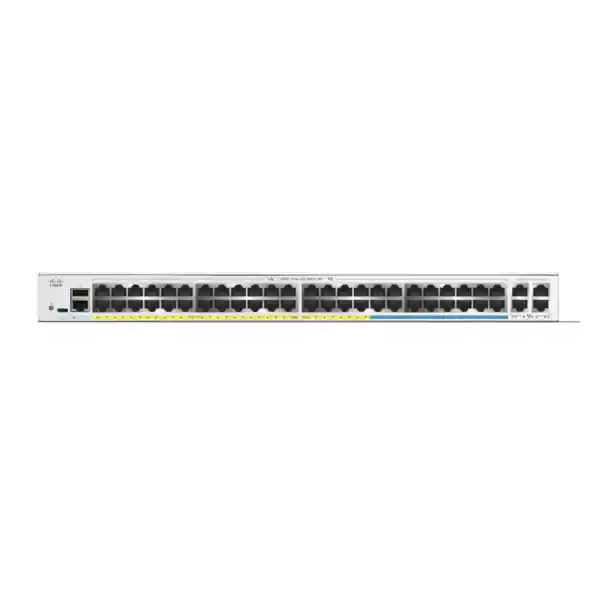
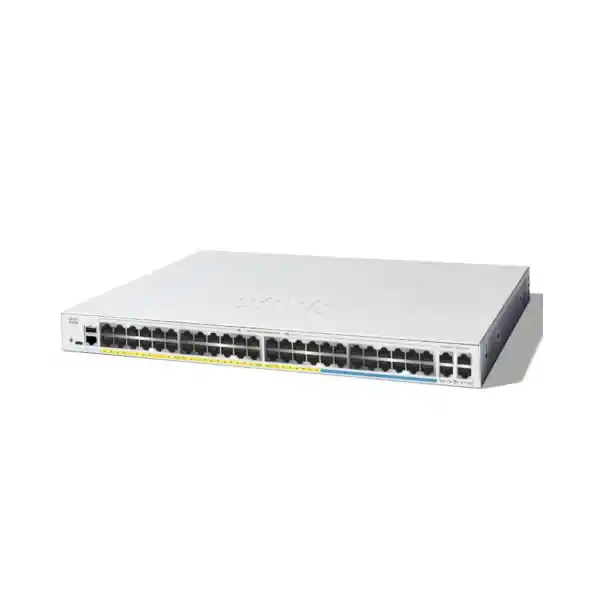
Cisco Catalyst C1300-48MGP-4X Network Switch in Dubai, UAE
The Cisco Catalyst C1300-48MGP-4X is a high-density managed Layer 3 access switch created for branch offices, growing businesses and distributed sites that need a practical combination of Gigabit Ethernet, 2.5 Gigabit multigigabit access, high PoE capacity and 10 Gigabit fiber uplinks. Its physical port mix is especially relevant to modern UAE networks where Wi-Fi access points, IP phones, surveillance cameras, building systems and conventional user devices have to coexist on the same structured-cabling platform without forcing an immediate migration of every endpoint to multigigabit speeds.
For network architects, the model is notable because it combines 32 x 10/100/1000 PoE+ access ports, 16 x 2.5G-capable PoE+ access ports, 4 x 10G SFP+ uplinks and a 740W PoE budget in a rack-mountable 1RU-class chassis. Cisco specifies 224 Gbps of switching capacity and 166.65 million packets per second of forwarding performance for the model, enabling nonblocking wire-speed operation within its published architecture. This makes the C1300-48MGP-4X a strong candidate for dense access-layer closets where endpoint diversity, wireless throughput and power delivery matter as much as simple port count.
Direct answer: who should choose it?
Choose the C1300-48MGP-4X when a 48-port access switch must power many edge devices, when several wireless APs or high-performance endpoints can benefit from 2.5G copper, and when four 10G SFP+ interfaces provide sufficient uplink and stacking flexibility.
It is particularly well suited to office floors, schools, clinics, hospitality sites, retail environments, warehouses and enterprise branches that want managed Layer 2/Layer 3 features without building the access layer around a recurring software subscription.
Cisco C1300-48MGP-4X at a Glance
Core Hardware Specification
The value of the C1300-48MGP-4X is easiest to understand from the relationship between its access ports, PoE power, forwarding capacity and uplink design. Unlike a basic 48-port Gigabit PoE switch, this model reserves one third of its copper access interfaces for 2.5G operation. That matters because the access layer is increasingly expected to handle wireless APs and other devices whose traffic can exceed a single Gigabit Ethernet link, while the remaining installed base of phones, printers, cameras, desktops and building devices still operates perfectly well at 1G or below.
| Specification | Cisco Catalyst C1300-48MGP-4X | Design significance |
|---|---|---|
| Copper access ports | 32 x 10/100/1000 + 16 x 2.5G mGig | Mixes conventional 1G endpoints with higher-throughput access devices. |
| PoE capability | PoE+ across 48 access ports, 740W shared budget | Supports dense powered-device deployments when budgeted correctly. |
| Uplinks | 4 x 10 Gigabit SFP+ | Provides fiber aggregation and stacking options without consuming access ports. |
| Switching capacity | 224 Gbps | Published wire-speed, nonblocking performance for the model. |
| Forwarding rate | 166.65 Mpps at 64-byte packets | Useful for packet-rate sizing, not only headline bandwidth sizing. |
| Packet buffer | 3 MB | Helps absorb microbursts, though traffic engineering remains important. |
| Dimensions | 444.3 x 350 x 43.94 mm | Standard rack-width deployment with approximately 350 mm chassis depth. |
| Weight | 5.83 kg | Plan proper rack rails, shelf clearances and cable support. |
| Input power | 100–240V AC, 50–60 Hz, internal universal PSU | Compatible with standard UAE electrical distribution when correctly corded and protected. |
Port Architecture: Why 32 x 1G + 16 x 2.5G Is a Practical Enterprise Edge Mix
A 48-port switch can be purchased in many forms, but not every 48-port layout fits a modern access closet. The C1300-48MGP-4X deliberately separates the access layer into thirty-two conventional Gigabit Ethernet ports and sixteen multigigabit ports capable of 2.5Gbps. All forty-eight access ports support up to 30W-class PoE+ delivery, subject to the overall 740W budget. This allows an administrator to place ordinary user devices and lower-bandwidth powered endpoints on the 1G interfaces while reserving the 2.5G interfaces for devices that can actually use the additional throughput.
The most common reason to value 2.5G at the edge is wireless. Modern Wi-Fi access points can aggregate more than 1Gbps of traffic across their radios under favorable client and airtime conditions. If an access point is connected to a 1G switch port, the wired interface can become a ceiling even when the radio system is capable of more. A 2.5G port gives the access point more wired headroom without requiring the organization to deploy 10GBASE-T to every ceiling location. That intermediate speed is operationally attractive because many existing Cat5e/Cat6 cabling runs can support multigigabit Ethernet depending on cable quality, distance, termination and environmental conditions.
The second benefit is controlled investment. A business may have only six or eight multigigabit devices today but expect that number to grow as its wireless network is refreshed. Deploying a switch with sixteen 2.5G interfaces creates expansion headroom without making every access port more expensive than necessary. The remaining thirty-two 1G ports remain appropriate for IP phones, desktop computers, standard cameras, door-access controllers, printers, room systems and many IoT endpoints whose actual traffic is far below one gigabit.
Port placement should still be designed rather than improvised. FourTeck normally recommends creating a port map before installation that identifies endpoint type, VLAN, expected speed, PoE requirement, cable identifier, patch-panel position and redundancy requirement. That discipline makes it easier to keep the sixteen multigigabit ports available for the devices that benefit from them and prevents high-value ports from being consumed by endpoints with no requirement above 1G.
PoE+ Engineering: How to Use the 740W Budget Correctly
The 740W PoE budget is one of the strongest reasons to select the C1300-48MGP-4X, but a PoE number should never be interpreted as permission to assume every attached device can draw its theoretical maximum simultaneously. Forty-eight ports at 30W would represent 1,440W of endpoint demand, which is far above the shared 740W budget. The right design method is to build a per-port power schedule using the actual powered-device models, their negotiated or worst-case power requirements, and an operational reserve.
For example, consider a branch with twenty IP phones drawing approximately 7W each, twelve cameras drawing 12W each, eight wireless APs budgeted at 22W each and four room devices budgeted at 18W each. The arithmetic becomes 140W + 144W + 176W + 72W, or roughly 532W before design margin. That leaves meaningful reserve inside a 740W budget for startup behavior, model variations, future devices and operational changes. The exact figures must come from the endpoint datasheets, and some devices may negotiate less or more power than a planning assumption. The important point is that the switch provides a large shared pool, but professional sizing turns that pool into a predictable deployment.
It is also important to distinguish PoE+ support on this C1300 model from higher-power PoE++ support found on selected C1300X models. The C1300-48MGP-4X is specified with 30W PoE+ access ports. If a UAE project includes devices that require IEEE 802.3bt Type 3 or higher power classes, the switch selection must be revisited rather than assuming that a large aggregate power budget automatically means every port can deliver PoE++. High-power pan-tilt-zoom cameras, specialty displays, advanced conferencing devices and some newer access points can trigger this requirement.
Power planning should also account for failure behavior. In a single-switch closet, a power-supply or switch failure removes both network connectivity and endpoint power for all attached PoE devices. Business-critical sites should therefore evaluate UPS runtime, dual-switch distribution of important endpoints, spare switch strategy, and stack architecture. A redundant UPS does not create redundant switch power hardware, but it can protect the switch from utility interruption and voltage instability. For surveillance and voice networks, the desired runtime should be calculated from the total load of the switch plus the powered endpoints, not from the switch’s idle consumption alone.
For quotations in Dubai and other UAE emirates, request a PoE schedule rather than only a switch quantity. A useful bill of materials identifies the number and model of APs, cameras, phones and specialty devices on each access switch. FourTeck can then validate the aggregate budget, recommend port allocation, and identify where a higher-power platform or a second access switch would produce a safer design.
10G SFP+ Uplinks: Designing the Northbound Path
Four dedicated 10G SFP+ interfaces give the C1300-48MGP-4X much more uplink flexibility than a switch limited to one or two uplinks. In a conventional access-to-distribution design, two interfaces can be used for redundant uplinks or an LACP port channel, while the remaining interfaces can be reserved for another aggregation path, a server-room connection or stacking requirements. The final allocation depends on whether the switch is standalone or part of a hardware stack.
Uplink sizing should be based on traffic concentration rather than the sum of nominal access-port speeds. Forty-eight active ports do not normally transmit at line rate simultaneously. Wireless APs can generate significant bursts, however, and the sixteen 2.5G ports increase the potential access-side load. A single 10G uplink may be entirely adequate for a moderate office, while a pair of 10G links in LACP can provide additional aggregate bandwidth and link resilience for heavier environments. The correct choice depends on measured or forecast application demand, oversubscription tolerance, inter-VLAN traffic location, internet bandwidth, backup windows, camera recording flows and server access patterns.
Optics must be selected as part of the system, not as an afterthought. Fiber type, connector, patch-panel plant, distance, wavelength and transceiver compatibility must all match. Multimode short-range optics are commonly used inside buildings, while single-mode optics are more suitable for longer campus or inter-building runs. Never assume that any generic SFP+ will deliver a supportable result. The transceiver should be selected from Cisco-supported options for the software and hardware revision in use, with the complete optical path verified for attenuation and connector type.
For a new UAE installation, the uplink design should be documented alongside the access-port plan. That document should show distribution-switch endpoints, fiber pairs, primary and secondary paths, LAG membership, VLAN trunking, spanning-tree role, optical module SKUs and spare fiber availability. A well-designed 10G uplink path protects the value of the multigigabit access layer by ensuring traffic is not unnecessarily constrained at the first aggregation hop.
Switching Performance, Buffering and the ASIC Question
Cisco publishes a switching capacity of 224Gbps and a forwarding rate of 166.65Mpps for the C1300-48MGP-4X, describing the family as wire-speed and nonblocking. Those are the figures that should guide architecture decisions because they are vendor-validated performance specifications. The model also has a published 3MB packet buffer. Buffer size is relevant to burst absorption, but it must be interpreted together with queue behavior, QoS policy, traffic patterns and the speed transitions that occur between access and uplink interfaces.
The public product data does not identify a specific model-level merchant-silicon or switching-ASIC part number for the C1300-48MGP-4X. It would therefore be misleading to market the switch using an assumed chipset or to infer capabilities from an unofficial teardown. From a procurement standpoint, the more useful facts are the validated forwarding performance, supported protocol scale, software feature set, port layout and operational limits. Network design should be based on those documented characteristics rather than on speculative silicon branding.
Nonblocking capacity is particularly useful for access-layer evaluation because it indicates that the switch fabric is engineered to handle the aggregate port design at wire speed within Cisco’s stated test methodology. Real applications can still experience congestion when many ingress streams converge onto a lower-capacity egress link. A common example is several 2.5G AP ports sending simultaneously toward a single 10G uplink. The switching fabric may be capable of moving the traffic, but the 10G egress becomes the congestion point. That is where LACP, QoS, traffic distribution and realistic oversubscription planning become important.
For latency-sensitive services such as voice and interactive video, a sound design does not rely solely on raw throughput. It also classifies traffic correctly, preserves markings where appropriate, limits uncontrolled broadcast domains, prevents loops, and avoids chronically congested uplinks. The C1300 platform provides the managed switching features needed for that access-layer discipline, while the architecture team must still apply them coherently.
Layer 2 Design: VLANs, Spanning Tree and Link Aggregation
A managed switch becomes valuable when it is used to create predictable Layer 2 boundaries instead of extending one flat broadcast domain across every device. The C1300 family supports conventional VLAN segmentation and the spanning-tree technologies expected in managed access networks, including IEEE 802.1D Spanning Tree, 802.1w Rapid Spanning Tree and 802.1s Multiple Spanning Tree. Cisco’s current series specification also lists PVST+ and Rapid PVST+ support. These options allow the network design to align with the distribution layer and the organization’s existing Cisco operational model.
A typical UAE office design may separate corporate users, voice, wireless management, guest wireless, CCTV, access control, printers, building management and network-management traffic into distinct VLANs. Segmentation does not automatically provide security, but it creates the boundaries on which ACLs, firewall policy, routing controls and monitoring can operate. It also reduces the scope of broadcasts and makes troubleshooting more structured. The VLAN plan should therefore be agreed before switch deployment rather than created reactively as devices arrive.
Spanning-tree design deserves explicit attention when redundant links or multiple switches exist. Rapid convergence features help reduce downtime after a topology change, but they are not a substitute for defining root-bridge priorities, edge-port behavior and loop protections. Access ports connected to endpoints should normally be treated differently from switch-to-switch trunks. Features such as loopback protection and BPDU-related safeguards should be applied according to the site’s topology and risk tolerance.
LACP link aggregation can combine multiple physical links into a logical channel, increasing aggregate capacity and reducing the impact of a single-link failure when both ends are configured compatibly. In a stacked design, Cisco also supports link aggregation across stack members, which can improve physical resilience because the member links need not terminate on the same chassis. This is a useful technique when two physical switches form one logical access stack and both connect to an upstream aggregation layer.
The best Layer 2 configuration is the simplest one that meets the availability and segmentation requirements. Excessive VLAN extension, undocumented trunks and unmanaged loops create operational risk. FourTeck’s UAE IT services practice can support VLAN planning, switch configuration, migration windows and documentation where the project requires implementation rather than hardware supply alone.
Layer 3 Routing: Capable Access-Layer Routing Without Overstating the Platform
The Catalyst C1300 family is positioned as a managed Layer 3 switching platform for SMB and branch environments. The C1300-48MGP-4X can perform IPv4 and IPv6 routing and supports Layer 3 interfaces on physical ports, link aggregations, VLAN interfaces and loopbacks. Cisco specifies up to 990 combined dynamic and static IPv4 routes and up to 128 IP interfaces for the standard C1300 platform. That scale is sufficient for many branch and campus-access designs, but it is still important to compare the requirement with the platform limits rather than treating the switch as a substitute for every distribution or core role.
Static routes are appropriate where the topology is small and stable. The platform also supports RIPv2 for dynamic IPv4 routing and supports policy-based routing so traffic can be directed to a selected next hop based on IPv4 or IPv6 ACL matching. DHCP server and Layer 3 DHCP relay functions are available, which can simplify selected branch deployments or allow client VLANs to reach centralized address-management services. UDP relay can support application-discovery or BOOTP/DHCP-related broadcast forwarding across Layer 3 domains.
One important boundary must be stated clearly: OSPF v2/v3 support in Cisco’s current specification is listed for C1300X SKUs, not for the standard C1300 family. The C1300-48MGP-4X should therefore not be selected for a design that explicitly requires OSPF on the access switch unless Cisco documentation for the exact hardware and firmware revision confirms otherwise. When OSPF, larger route tables, higher interface scale or advanced enterprise routing is mandatory, the correct response is to evaluate a different Catalyst family or C1300X model rather than to force the requirement onto the wrong platform.
In many branches, the access switch does not need to be the security gateway. Inter-VLAN routing may instead occur on a firewall or upstream Layer 3 switch so that traffic crossing trust zones is inspected. That approach is often preferable for guest, IoT, CCTV and sensitive business segments. Local Layer 3 switching can still be useful for trusted east-west traffic or infrastructure networks where low-latency routing and simple topology are priorities.
The architectural decision should therefore answer three questions: where should default gateways live, which VLAN-to-VLAN flows need security inspection, and what happens if the upstream router or firewall fails? Once those answers are known, the C1300-48MGP-4X can be placed appropriately as either a primarily Layer 2 access switch or a Layer 3-capable branch access/aggregation device.
Security Controls for the Access Layer
Access switches are a security enforcement point because they are the first managed infrastructure device encountered by many endpoints. The Catalyst 1300 feature set includes 802.1X-oriented access control capabilities, web-based authentication options, IPv4/IPv6/MAC access control lists and secure management through SSH. These controls can be combined with VLAN segmentation and upstream firewall policy to reduce the risk that an unauthorized or compromised endpoint obtains unrestricted reachability.
Cisco includes DHCP snooping, IP Source Guard and Dynamic ARP Inspection in the C1300 security toolkit. DHCP snooping helps identify trusted and untrusted DHCP paths and blocks inappropriate DHCP behavior from access interfaces. IP Source Guard can filter source-IP traffic that does not match a learned or configured binding. Dynamic ARP Inspection checks ARP behavior against valid bindings to reduce spoofing and man-in-the-middle opportunities. Used together, these features create a stronger Layer 2 access posture than simple VLAN separation alone.
IPv6 requires equal attention. Organizations sometimes secure IPv4 thoroughly while leaving IPv6 enabled but ungoverned. Cisco’s IPv6 First Hop Security capabilities include controls such as Neighbor Discovery inspection, Router Advertisement guard, DHCPv6 guard and neighbor-binding integrity functions. These capabilities help protect against rogue router advertisements, spoofed addressing and related first-hop attacks. Whether IPv6 is actively deployed or only present by default on endpoints, the network design should make an intentional choice about how it is handled.
Management-plane security should also be designed. Administrative access should use secure protocols such as SSH and HTTPS rather than legacy clear-text methods. SNMP should be configured with appropriate credentials and versioning, management traffic should be restricted to dedicated subnets where practical, and configuration backups should be protected. AAA integration, administrator role separation and logging should be considered for environments with formal governance requirements.
The switch does not replace an enterprise firewall. It controls access-layer behavior and segmentation, but internet security, application inspection, VPN termination, advanced threat prevention and policy between security zones typically belong on a firewall or security gateway. FourTeck’s Firewall Dubai solutions can be aligned with the switch VLAN architecture so that user, guest, server, voice, camera and IoT networks cross the appropriate inspection points.
A strong deployment therefore treats the C1300-48MGP-4X as one layer of a defense-in-depth model. Port security, authentication, binding checks, VLAN isolation, ACLs, firewall inspection, endpoint security and monitoring work together. No single feature should be marketed as a complete security solution, but the access switch provides important mechanisms that allow the network to enforce identity and topology expectations closer to the connected device.
Quality of Service for Voice, Video, Wireless and Business Applications
Unified access networks carry traffic with very different sensitivity to loss, delay and jitter. A large file transfer can tolerate short bursts of delay; a voice call cannot. The C1300 platform provides QoS capabilities that can classify and prioritize traffic so that important real-time flows receive appropriate treatment during periods of contention. The correct design begins with an end-to-end marking policy rather than simply enabling a priority queue on one switch.
For IP telephony, voice VLAN features can simplify endpoint segmentation, while QoS policies can preserve or remark DSCP values according to trust boundaries. The switch port connected to an IP phone may also carry a workstation behind the phone, which means the network has to distinguish voice traffic from ordinary user traffic correctly. For video conferencing, wireless infrastructure and interactive cloud applications, congestion usually appears at aggregation or WAN boundaries, so access-layer QoS must align with upstream switches, routers and firewalls.
The 2.5G interfaces reduce the chance that a high-throughput wireless AP is constrained by a 1G edge link, but they do not remove oversubscription elsewhere. Ten or more 2.5G APs can collectively offer much more theoretical access bandwidth than a single 10G uplink. In real networks, simultaneous peak load is lower than the arithmetic maximum, yet architects should still understand the expected concurrency and traffic patterns. LAGs, redundant uplinks and careful distribution design can provide additional headroom.
QoS configuration should be validated with application behavior after deployment. Monitor interface utilization, queue drops, uplink congestion and packet loss during busy periods. The objective is not to reserve large amounts of bandwidth permanently for one traffic class; it is to ensure that critical traffic remains usable when demand spikes while lower-priority traffic continues to receive fair service.
Deployment Fit by Application
Wi-Fi Access Layer
The sixteen 2.5G PoE+ ports are natural candidates for multigigabit wireless access points. Reserve these ports according to AP density and expected radio throughput, then use the 10G SFP+ interfaces to keep the wired uplink from becoming an avoidable bottleneck. Confirm each AP’s actual PoE class; if an AP requires 802.3bt rather than PoE+, select a compatible switching platform for that AP.
IP Surveillance
The large PoE budget can support many fixed cameras, while VLAN separation and ACLs help isolate camera traffic from user networks. Size uplinks from total camera bitrate plus recording and viewing patterns. High-power PTZ or specialty cameras must be checked individually because PoE+ port power, not just aggregate budget, is the limiting factor.
IP Telephony
Voice VLAN and QoS capabilities make the switch suitable for converged data and telephony access. A phone-and-PC daisy-chain can reduce cable demand while retaining logical segmentation. UPS runtime is especially important if telephony must remain available during short utility interruptions.
Education & Training
Classrooms can combine access points, smart displays, phones, cameras and wired user devices. The mixed-speed port plan helps institutions concentrate 2.5G connectivity on wireless infrastructure while using 1G ports for desktops and peripherals. Segmentation can separate students, staff, guests and facilities systems.
Hospitality & Retail
Hotels and retail environments often need POS, staff devices, guest Wi-Fi, cameras, digital signage and building systems on the same physical network. The switch’s VLAN, security and PoE capabilities let these services share infrastructure while remaining logically separated and operationally manageable.
Enterprise Branch
A branch office can use the C1300-48MGP-4X as a managed access layer with local Layer 3 routing where appropriate, or as a Layer 2 access switch feeding a centralized firewall or distribution layer. Hardware stacking provides growth and simplified management when a single 48-port chassis is insufficient.
Hardware Stacking: Scale and Failure-Domain Planning
Cisco supports hardware stacking on the C1300-48MGP-4X. Current C1300 documentation states that compatible switches can form stacks of up to eight units, with up to 400 ports managed as a single system, and that stacking is restricted by model family. The C1300-48MGP-4X belongs to C1300 Family 1, which means it can stack with designated models in that same family but should not be assumed to cross-stack with C1300 Family 2 or C1300X units. Compatibility should always be checked against the current stacking matrix before ordering a mixed stack.
The operational benefit of a stack is unified management. Instead of treating each access switch as an unrelated device, administrators can manage the stack as one system, with active/standby control behavior and support for stack-level functions. Cisco documents fast stack failover and cross-unit link aggregation capabilities, which can improve resilience when uplinks are distributed across different members. Stacking also simplifies VLAN and configuration consistency compared with independently managed switches.
A stack is not the same thing as eliminating every single point of failure. Each powered endpoint remains physically connected to one member port. If that member fails, its directly attached devices lose connectivity even if the rest of the stack remains operational. Critical endpoints should therefore be distributed across members where practical, and network architects should determine whether dual-homed devices, redundant access switches or alternate physical paths are required for specific services.
The 10G SFP+ interfaces serve both conventional uplink and stacking roles, so port allocation matters. A design using multiple stack links plus redundant uplinks can consume several SFP+ interfaces per switch. Before purchasing optics, create a stack diagram that shows every inter-switch and upstream connection. That prevents an implementation team from discovering during installation that the desired stacking topology and uplink topology compete for the same physical interfaces.
For expansion planning, stacking is most valuable when future port growth is predictable. A first C1300-48MGP-4X can be deployed with an architecture that reserves fiber, rack space and power for additional members. When the second switch is introduced, the access layer can grow without requiring a complete redesign. This is especially useful in phased office fit-outs, education buildings, clinics and hospitality sites where occupancy or endpoint count increases over time.
Management and Day-2 Operations
A switch should be evaluated not only by how it forwards packets but also by how efficiently it can be configured, monitored, backed up and troubleshot. Cisco positions the Catalyst 1300 family for straightforward management through an on-device web interface, command-line interface, SNMP, Cisco Business Dashboard and Cisco Business mobile app. This gives smaller IT teams multiple management methods without forcing every operational task through a single cloud service.
The web interface is useful for administrators who prefer graphical configuration, while the CLI offers more direct control and repeatable troubleshooting for experienced network engineers. SNMP integration allows the switch to participate in established monitoring systems for interface status, utilization and events. Syslog, time synchronization and configuration backup should be part of the standard commissioning template so that the switch can be operated consistently after handover.
Cisco Business Dashboard can simplify discovery, monitoring and management across multiple compatible Cisco business-networking devices. For distributed UAE branches, centralized visibility is particularly useful because an engineer does not need to travel to every site for routine status checks. The exact management architecture should still account for secure remote access, authentication, management VLAN design and whether the organization already uses another network-management platform.
Firmware governance is another important day-2 discipline. Cisco states that the Catalyst 1200/1300 family does not require a software license purchase to operate and that software updates are available without an additional license fee. This reduces licensing complexity, but updates still need planned change control. Firmware should be assessed for bug fixes, security advisories, feature changes and stack compatibility before deployment. In a stack, software version consistency is especially important.
A maintainable installation should leave behind a port schedule, VLAN list, IP addressing plan, switch hostname and management addressing, uplink diagram, stack diagram, configuration backup, firmware record, optic inventory and administrative handover notes. The hardware is only one part of a supportable network; documentation determines how quickly the next engineer can understand and restore service.
Power, Heat and Rack Planning for UAE Sites
High-density PoE access switches require environmental planning because endpoint power ultimately becomes electrical load and heat somewhere in the system. Cisco specifies a universal internal 100–240V AC, 50–60Hz power supply for the C1300-48MGP-4X. The published worst-case system power consumption is approximately 92.4W at 110V and 93.6W at 220V without PoE load, while the full-with-PoE figure is approximately 883W. Cisco lists heat dissipation around 3012 BTU per hour for this model under the stated worst-case condition. These numbers make clear that a dense PoE closet must be treated as an engineered equipment environment, not as an ordinary storage room.
The switch is approximately 444.3mm wide, 350mm deep and 43.94mm high, with a weight around 5.83kg. The physical chassis will fit standard rack environments, but the rack design must account for cable bend radius, rear clearance, power connectors, patch panels and ventilation. Dense 48-port patching can create a large cable bundle, so horizontal and vertical cable management should be planned at the same time as rack-unit allocation.
Cisco publishes an operating range of -5°C to 50°C for the model, with a minimum cold-start ambient of 0°C. That specification should not be used as a reason to operate a UAE communications room at the edge of the allowable temperature. Lower, stable ambient conditions improve operational margin and make the environment more comfortable for adjacent UPS systems, firewalls, servers and optics. Air-conditioning capacity should be calculated from the entire rack load and expected room conditions, including the heat contribution of PoE equipment.
UPS sizing must use realistic load and runtime targets. If a switch powers cameras, access points and phones, the UPS sees the switch plus all of those endpoint loads through the PoE supply. A UPS that provides thirty minutes of runtime at a 150W switch load may provide far less when the same switch is delivering several hundred watts of PoE. Battery aging, temperature and expansion headroom should be included in runtime calculations. For critical sites, UPS monitoring and maintenance are as important as the original VA rating.
Power-cord type, PDU outlet compatibility and rack earthing should be confirmed before delivery. International network hardware can be packaged with different cord options depending on ordering path. A UAE quotation should therefore specify the required local power cord or PDU connection, rack-mount kit expectations and any optical accessories so the installation team receives a deployable bill of materials rather than only the chassis.
Licensing, Software Updates and Lifecycle Considerations
The Catalyst 1300 family is attractive to organizations that want managed switching without a mandatory recurring software subscription for normal operation. Cisco states that the Catalyst 1200 and 1300 switches require no license purchase to operate and that software updates are available at no additional cost. This is materially different from platforms where core management or feature entitlement depends on a subscription term.
No recurring operating license does not mean the lifecycle is cost free. Organizations still need to budget for support, spares, monitoring, engineering time, firmware change management, UPS maintenance and eventual hardware refresh. Cisco also provides a limited lifetime warranty framework for the series, with replacement conditions that can vary by offer, geography and channel. The exact warranty and support terms on a FourTeck quotation should be checked against the supplied SKU and sales channel rather than assumed from a generic web statement.
For procurement, the absence of a required software subscription simplifies total-cost-of-ownership comparisons. When evaluating the C1300-48MGP-4X against another switch, compare not only chassis price but also mandatory licenses, management subscriptions, optics, stacking accessories, PoE capacity, support contract, replacement strategy and implementation effort. A lower purchase price can become more expensive over five years if the design requires additional switches or recurring entitlements.
The model should also be assessed against the expected technology horizon. Sixteen 2.5G ports provide a useful bridge from gigabit access to higher-speed wireless without requiring an all-10G edge. If the organization expects most access points to require 5G/10G copper or PoE++ within the project life, a higher-tier model may deliver better lifecycle value. If 2.5G PoE+ is the realistic need, the C1300-48MGP-4X provides a balanced cost/performance point.
Migration from CBS350, Catalyst 1000 and Older Access Switches
Cisco positions the Catalyst 1300 family as the successor generation for environments that previously considered Cisco Business CBS350 and selected Catalyst 1000 use cases. Migration should be treated as a configuration redesign opportunity rather than as a blind line-by-line copy. Syntax, supported features, default behaviors and management workflows can differ across product families and software generations.
Start by exporting and reviewing the existing configuration. Identify active VLANs, trunks, voice VLAN behavior, port channels, spanning-tree settings, management IPs, static routes, ACLs, DHCP snooping trust boundaries, 802.1X settings, SNMP, syslog destinations and any unusual per-port overrides. Then map those requirements to the C1300 feature set and current firmware. Obsolete or undocumented settings should not be carried forward simply because they exist on the old switch.
The hardware transition is also an opportunity to improve port allocation. Older switches may have one-gigabit ports only. When moving to the C1300-48MGP-4X, assign APs and other high-throughput devices to the sixteen 2.5G interfaces. Review PoE consumption from the old environment rather than assuming the new 740W budget is automatically sufficient. Confirm optics and fiber compatibility instead of moving transceivers between families without verification.
A controlled migration plan should define rollback steps. For a live office, it may be safer to pre-stage the new switch, load the baseline configuration, test management access, preconfigure trunks and VLANs, then move patch-panel connections in documented groups. Services such as phones and APs may reboot when PoE moves to the new switch, so the change window should account for endpoint startup times and DHCP or controller registration.
After cutover, validate more than link lights. Test DHCP, DNS, internet reachability, inter-VLAN policy, voice registration, AP uplink speed, camera recording, monitoring, syslog, spanning-tree state and redundant uplink failover. A migration is complete when services, monitoring and documentation have been verified—not simply when every Ethernet port shows an active LED.
Sizing Methodology: How Many C1300-48MGP-4X Switches Does a Site Need?
Switch quantity should be calculated from more than forty-eight divided by the number of devices. The design needs spare ports, PoE headroom, multigigabit port availability, uplink capacity, failure domains and physical closet location. A simple worksheet can produce a much safer answer than relying on headline port count.
1. Count copper endpoints by type
List users, phones, cameras, access points, printers, room systems, IoT devices, access-control panels and any copper-connected infrastructure. Separate endpoints that require PoE from those that do not. Then add planned growth. In a 48-port chassis, designing for exactly forty-eight day-one endpoints leaves no room for an extra AP, temporary troubleshooting connection or office expansion.
2. Count devices that actually need 2.5G
The model has sixteen 2.5G access interfaces. If the site requires twenty-four multigigabit AP connections in one closet, the switch may still have spare physical ports but it does not have enough 2.5G ports. Two switches, or a different model with a higher multigigabit density, should be considered. Conversely, if only four devices need 2.5G, this model provides substantial growth headroom.
3. Build a PoE budget
Use the powered-device maximum or validated planning value for each endpoint. Add the totals and preserve reserve. A switch with twenty free data ports can still be unsuitable if its PoE budget is fully committed. Likewise, a large PoE budget does not help if one endpoint requires a power standard above what an individual port supports.
4. Size uplinks from real traffic
Estimate user internet demand, server access, camera recording flows, AP aggregate throughput, backup traffic and inter-VLAN patterns. Decide whether one 10G uplink, a dual-link LACP bundle or redundant independent paths are appropriate. In stacked networks, account for SFP+ ports used by stack links before assigning uplinks.
5. Decide the failure domain
If one switch failure would disconnect an entire critical department, divide important endpoints across multiple stack members or access switches. Physical diversity can be more valuable than maximizing port utilization. In a surveillance deployment, for example, half of the cameras on each of two switches may preserve partial coverage during a single member outage.
6. Reserve rack, power and cooling capacity
A future second switch requires more than one rack unit. It needs patching, PDU outlets, UPS capacity, airflow, uplink optics and cable pathways. Infrastructure should be sized for the planned endpoint growth, not only for the chassis installed on day one.
Example UAE Deployment Scenarios
Scenario A: 100-user office floor
A Dubai office floor has twenty-four IP phones with PCs behind them, eight Wi-Fi APs, eight cameras, four meeting-room devices and several printers. One C1300-48MGP-4X can accommodate a large portion of the endpoint set, but the port count must include both direct switch connections and the workstation topology. The APs should be placed on 2.5G ports; phones, cameras and printers can occupy 1G ports. If forty-eight ports are approached closely, a second switch provides better growth and service continuity than designing to 100% utilization.
The network can use two 10G uplinks toward a distribution pair or a port channel, with user, voice, Wi-Fi, guest and CCTV VLANs separated. PoE should be calculated from the actual phone, AP, camera and room-system models.
Scenario B: School or training center
A school wing may have twelve classroom APs, twenty cameras, phones in staff areas and wired teacher devices. The C1300-48MGP-4X gives the APs multigigabit access while retaining many PoE+ 1G ports for cameras and phones. Separate student, staff, guest, CCTV and management VLANs create clear traffic boundaries. The 740W PoE budget can be sufficient for a dense mix, but individual AP and camera power requirements must be verified.
Stacking two switches can provide more ports and unified operations. Critical APs and cameras can be split between members so that a single member failure does not remove every wireless or surveillance endpoint in the area.
Scenario C: Hospitality site
A hotel floor may combine guest-room APs, corridor cameras, IP phones, door/access devices and staff terminals. The switch’s PoE capacity reduces local power-adapter complexity, while VLAN segmentation keeps guest and operational networks apart. Multigigabit ports can be reserved for high-density APs rather than consumed by low-bandwidth room devices.
In hospitality, maintenance windows are difficult, so stack design, spare strategy and UPS runtime are important. The uplink topology should avoid one fiber path becoming the only connection for a large number of rooms.
Scenario D: Warehouse and logistics
Warehouses often need APs for handheld scanners, IP cameras, access-control equipment and office endpoints distributed across large spaces. Multigigabit uplinks to APs can be valuable in high-density zones, but cable distance and fiber distribution may determine how many access closets are needed. The switch should remain in a controlled equipment environment rather than being placed in an exposed hot or dusty location simply because its operating-temperature range is broad.
Redundant fiber paths and documented switch-to-closet mapping make fault isolation easier when operations cannot stop for extended troubleshooting.
Configuration Blueprint for a Clean Installation
A repeatable configuration standard makes the C1300-48MGP-4X easier to deploy and support. The exact commands and feature syntax depend on firmware, but the design sequence is consistent. Begin with the management plane: hostname, management IP, default route or management routing, secure administrator credentials, time synchronization, DNS where required, SNMP policy, syslog destination and configuration backup. Restrict management access to trusted networks and disable services that are not part of the operating standard.
Next build the Layer 2 structure. Create VLANs using a consistent numbering and naming convention. Define trunk interfaces toward distribution switches, firewalls or stack members. Configure access ports by endpoint type, including voice VLAN behavior where phones and workstations share a physical connection. Apply edge-port spanning-tree settings only where appropriate and define the root bridge at the correct upstream layer. LACP groups should be built symmetrically on both ends.
Then apply access security. Configure 802.1X or other authentication where the organization uses network access control. Establish DHCP snooping trust only on legitimate server or uplink interfaces, then layer IP Source Guard and Dynamic ARP Inspection as appropriate. Apply ACLs according to the network security policy. For IPv6, decide whether to permit and secure IPv6 or to handle it through an explicit policy; do not leave first-hop behavior accidental.
PoE and port-speed settings should reflect the endpoint map. Multigigabit ports should be assigned intentionally, and PoE consumption should be monitored after devices have negotiated power. If a device is expected to operate at 2.5G but links at 1G, investigate cabling, patching and endpoint capability before assuming a switch fault. Copper-channel quality becomes more important as link speeds increase.
Finally, test failure behavior. Disconnect one uplink in a redundant design and verify convergence. Reboot a noncritical stack member and confirm expected impact. Validate that guest networks cannot reach protected VLANs, that cameras continue to record, that phones register and that monitoring receives switch events. Record the final configuration and update rack/port documentation after testing, not before, so the handover reflects the actual production state.
For organizations building a wider network and security stack, FourTeck UAE can coordinate the switching layer with firewalling, wireless, structured network services and site implementation rather than treating the switch as an isolated hardware purchase.
Access Security Policy Example
A practical branch policy might use VLAN 10 for corporate users, VLAN 20 for voice, VLAN 30 for corporate Wi-Fi, VLAN 40 for guest Wi-Fi, VLAN 50 for CCTV, VLAN 60 for building/IoT devices and VLAN 99 for management. User switch ports receive the correct access VLAN, phone ports receive voice VLAN configuration, AP ports carry the WLAN-related VLANs as required by the wireless design, and camera ports are locked to the CCTV segment. The management VLAN is not exposed as an ordinary access network.
The upstream firewall can then control traffic between sensitive zones. Guest Wi-Fi may receive internet access only. CCTV devices may reach their NVR or management server but not corporate user subnets. IoT devices may reach only their controller and required internet services. Voice systems may reach call-control resources and approved services. Corporate users can reach permitted servers according to organizational policy. The switch enforces local access behavior while the firewall performs broader security-zone inspection.
DHCP snooping can be enabled so that access ports cannot act as unauthorized DHCP-server paths. Dynamic ARP Inspection and IP Source Guard can build on the resulting binding information. 802.1X can add identity-based admission for supported endpoints, while devices that cannot use 802.1X may need an alternate controlled onboarding process. IPv6 Router Advertisement guard and other IPv6 first-hop protections should be considered if IPv6 is enabled.
This is an architecture example, not a universal configuration. Every organization has different servers, wireless controllers, security gateways and compliance requirements. The useful principle is separation: define what each endpoint class is, where it belongs, which services it may reach and how the network verifies those assumptions. The C1300-48MGP-4X provides the managed access features needed to implement that policy close to the endpoint.
What the C1300-48MGP-4X Is Not
Accurate product selection is easier when boundaries are explicit. First, this is not a 48-port 2.5G switch. Sixteen copper ports support 2.5G, while thirty-two are 1G. If most endpoints require multigigabit access, another model may provide better port economics. Second, this is a PoE+ model, not a PoE++ access platform. The 740W aggregate budget is large, but individual high-power devices may still require a different switch.
Third, the C1300-48MGP-4X is not a C1300X model. Cisco’s current routing specification reserves OSPF support for C1300X SKUs. If OSPF is mandatory on the switch, do not assume the standard C1300 can provide it. Fourth, while the switch provides advanced security controls, it is not a replacement for a next-generation firewall. Application inspection, VPN, threat prevention and internet edge policy should remain on the appropriate security platform.
Fifth, a hardware stack does not make every endpoint physically redundant. A device connected to one member loses that connection if the member fails. Stack-level control and cross-stack link aggregation improve system resilience, but endpoint-level redundancy needs additional physical design. Finally, published performance figures do not eliminate the need for uplink sizing. Congestion can still occur when traffic converges onto an oversubscribed egress link.
These boundaries are strengths rather than weaknesses when understood early. They allow the switch to be positioned correctly: a high-capacity, multigigabit-aware, PoE-rich managed access platform for branches and medium-scale sites. Projects that need all-multigigabit access, PoE++, larger routing scale or different management architecture should evaluate the next platform tier before purchase.
Performance and Capacity Planning Beyond Port Count
The published 224Gbps switching capacity is sufficient for the physical port architecture, but network utilization remains application dependent. A useful capacity model divides traffic into local east-west traffic, traffic routed within the branch, traffic sent to central servers, internet traffic, video recording traffic and backup or replication flows. Each category may traverse a different uplink or security device, so one aggregate percentage does not tell the whole story.
Wireless can create bursty patterns. A group of 2.5G APs may each be quiet for much of the day, then experience synchronized demand during meetings, training sessions or events. Video surveillance creates more constant upstream traffic toward recording systems. Backup jobs may dominate links at night. Voice uses relatively little bandwidth but has high sensitivity to jitter and loss. QoS and uplink design should therefore be based on traffic behavior, not only on megabits per second.
The 3MB packet buffer is one element in this system. Buffers can absorb short bursts, but sustained oversubscription still produces queueing and drops. Increasing buffer size is not a substitute for fixing a chronically congested uplink. Monitor interface counters, utilization and queue drops after deployment. If a 10G uplink is consistently near capacity, add capacity through an appropriate LAG or redesign the aggregation path rather than attempting to tune around persistent saturation.
For a new site without historical traffic data, use conservative workload assumptions and preserve expansion options. Pull sufficient fiber, reserve SFP+ ports, choose a distribution layer with adequate capacity, and keep spare rack and power. It is much cheaper to include those options in the initial fit-out than to discover later that a growing wireless or camera environment requires a complete physical redesign.
UAE Procurement and Bill-of-Materials Guidance
A production-ready quotation should include more than the C1300-48MGP-4X chassis. The bill of materials may need SFP+ optics, fiber patch cords, copper patch leads, rack hardware, cable managers, power cords, a UPS, rack PDU outlets and potentially spare transceivers. If stacking is planned, identify the exact interconnect method and optic quantities. If redundant uplinks are planned, account for both ends of every fiber path.
Regional procurement should also clarify stock status, expected lead time, warranty channel, installation location and delivery terms. UAE projects often have fixed handover dates tied to office fit-outs, school terms, store openings or hospitality commissioning. A technically correct switch that arrives after the network cutover date is not a successful project. Final quotations should therefore separate confirmed availability from estimated future supply.
Compatibility is especially important when the switch is being added to an existing network. Provide the current distribution-switch models, firewall model, wireless AP models, fiber type, optic types and existing C1300 stack members. Mixed-vendor networks are common and can work well, but LACP, spanning tree, VLAN tagging and optics must be deliberately aligned. For an existing Cisco environment, current firmware and management tooling should be documented as part of the compatibility review.
For wider regional or multinational projects, FourTeck Global can support consistent technical scoping across sites, while the UAE implementation can remain aligned with local rack, power, cabling and delivery requirements. The objective is one repeatable access-layer standard with site-specific adjustments rather than a different unmanaged design at every branch.
When requesting a price, send the endpoint count, PoE device models, number of 2.5G requirements, fiber distances and target topology. Those inputs allow the quotation to include the correct switch quantity and accessories instead of producing a chassis-only price that later expands through change orders.
Why Buy the Cisco Catalyst C1300-48MGP-4X Through FourTeck UAE?
The switch is only useful when it is correctly matched to the network. FourTeck can scope the C1300-48MGP-4X as part of an access architecture that includes port density, PoE budget, wireless throughput, VLAN design, uplink optics, stacking, firewall integration, rack power and migration planning. That reduces the risk of purchasing a technically capable switch that is wrong for one critical requirement such as PoE class, routing protocol or multigigabit density.
For Dubai and UAE deployments, the procurement conversation can include compatible Cisco optics, patching, structured network dependencies, UPS capacity, implementation services and documentation. The FourTeck UAE technology portfolio supports projects where switching must integrate with broader infrastructure rather than being delivered as an isolated box.
A technically useful quotation should state assumptions. If the proposed design uses sixteen 2.5G AP links, document that. If the PoE calculation assumes specific AP or camera wattage, show it. If stacking consumes SFP+ ports, include those ports in the uplink plan. If the site needs OSPF or PoE++, identify the mismatch before purchase and propose the appropriate alternative. Transparent assumptions make comparison between quotations much easier.
FourTeck can also support pre-staging and deployment workflows where required: baseline firmware review, management addressing, VLAN creation, trunk configuration, stack preparation, uplink testing and handover documentation. The exact service scope should be defined in the quotation so responsibilities between the customer, cabling contractor, security integrator and network team are clear before the change window.
Technical Decision Recap
The Cisco Catalyst C1300-48MGP-4X is best understood as a PoE-rich, multigigabit-aware access switch rather than a generic 48-port device. Its thirty-two 1G PoE+ ports handle the large installed base of conventional endpoints. Its sixteen 2.5G PoE+ ports provide targeted bandwidth for modern wireless APs and other higher-throughput edge devices. Four 10G SFP+ interfaces create a practical path to distribution, fiber aggregation and supported hardware stacking. The 740W PoE budget supports dense powered-device environments when the load is calculated correctly.
For a typical UAE branch, office floor, school, clinic, retail site or hospitality environment, this balance can deliver a long useful service life because it does not force the organization to choose between an all-1G access layer and a more expensive all-multigigabit design. The switch places faster ports where they are most likely to be needed while retaining enough conventional ports for everyday endpoints.
Quotation Input Checklist
Send the following information with your request for quotation so the switch, optics and PoE design can be checked as one system:
Consultation and Deployment Support in Dubai and the UAE
If your project already specifies the Cisco Catalyst C1300-48MGP-4X, FourTeck can validate the bill of materials and confirm whether the planned PoE, multigigabit and uplink usage fits the model. If you are still comparing Cisco access switches, provide the endpoint and topology requirements instead of choosing only by port count. The result can be a more accurate recommendation that accounts for switch quantity, compatible optics, power budget, growth and failure domains.
For environments that include firewalls, servers, voice or wireless services, the switching layer should be coordinated with the rest of the network. This avoids common integration errors such as mismatched VLAN trunks, insufficient firewall interfaces, unsupported optics, duplicated IP subnets or APs connected to ports that cannot provide their required speed or power class.
Use FourTeck’s UAE infrastructure resources for broader planning and contact the team with your site requirements, current topology, target go-live date and preferred installation scope. A complete request enables a response that is based on the network you are actually building rather than on a generic switch specification.

Reviews
There are no reviews yet.