
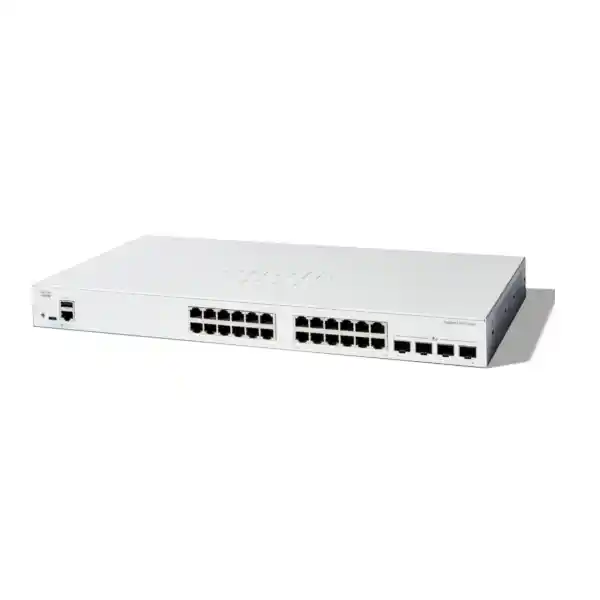
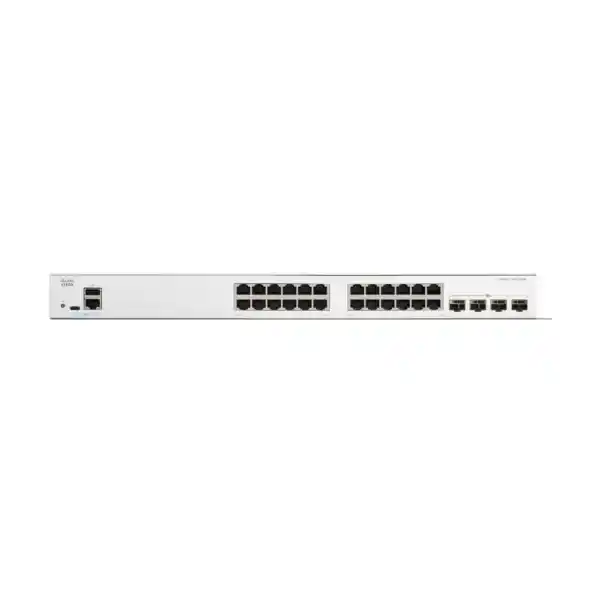
Cisco Catalyst C1300X-24T-4X Network Switch
A 24-port Gigabit Ethernet managed switch with four SFP28 interfaces for 10GbE uplinks, 25GbE stacking capability, wire-speed nonblocking forwarding, advanced Layer 2 controls, IPv4/IPv6 Layer 3 routing, OSPF on the C1300X platform, hardware stacking, granular security policy, and business-class management for UAE office, branch, campus-edge, retail, education, hospitality, and distributed enterprise deployments.
Cisco C1300X-24T-4X in one minute
The Cisco Catalyst C1300X-24T-4X is positioned as a compact, stackable managed access switch for organizations that want straightforward operational control without giving up enterprise-oriented switching, routing, security, and resiliency features. Its front-panel access layer consists of 24 10/100/1000BASE-T copper interfaces. Above that access layer are four SFP28 interfaces. On this model those interfaces support 10 Gigabit Ethernet for network uplinks and can operate at 25 Gigabit Ethernet specifically for stacking. That distinction matters during design: the switch is not a general-purpose four-port 25GbE aggregation switch. For normal production uplinks, plan around 10GbE optics or supported direct-attach connectivity; use 25GbE when the interfaces are participating in supported stack interconnects.
The hardware forwarding design is wire-speed and nonblocking, with a published switching capacity of 128 Gbps and forwarding performance of 95.23 million packets per second for 64-byte packets. C1300X hardware uses a dual-core 1.5 GHz ARM CPU, 2 GB DDR4 system memory, 1 GB SLC flash, and a dynamically shared 3 MB packet buffer on this SKU. The platform supports a MAC table scale of up to 32,000 entries on C1300X models. For Layer 2 design, features include 802.1Q VLANs, STP/RSTP/MSTP, PVST+/Rapid PVST+, LACP, private VLAN functionality, voice VLAN, multicast controls, link monitoring, and extensive traffic classification. For Layer 3, the C1300X family adds static routing capabilities and OSPFv2/v3, making the switch useful not only as a simple endpoint aggregator but also as a capable routing boundary for many small and midsize networks.
Technical specification snapshot
Copper Gigabit Ethernet for wired endpoints and downstream infrastructure. This model is non-PoE.
10GbE for uplinks; 25GbE capability is available for supported stacking only.
Wire-speed, nonblocking architecture for simultaneous traffic across access and uplink interfaces.
Published performance at 64-byte packet size, useful for high packet-rate edge workloads.
C1300X platform memory with ARM dual-core 1.5 GHz CPU and 3 MB shared packet buffer on this model.
Approximately 444.3 × 270 × 43.94 mm and 3.28 kg, with a universal 100–240V internal power supply.
Why this model is different from an ordinary 24-port managed switch
Many 24-port managed switches look similar when reduced to a basic port count, yet their usefulness changes dramatically once traffic growth, redundancy, routing, security policy, and operational tooling are considered. The C1300X-24T-4X is designed for organizations that need a stronger control plane and more resilient topology options than an entry-level smart switch normally provides. The combination of four high-speed SFP28 interfaces, hardware stacking, Layer 3 services, OSPF support, granular access controls, eight hardware queues, traffic policing and shaping, IPv6 capability, and centralized stack behavior means the switch can remain useful as the network evolves instead of becoming a bottleneck immediately after the first server refresh, wireless upgrade, or office expansion.
The most important architectural benefit is not a single headline feature. It is the ability to combine predictable Gigabit access with multiple 10GbE northbound paths and a resilient stack design. A typical small office can begin with one switch and one or two uplinks. A larger office can use paired uplinks to a firewall, router, core, or distribution layer and reserve additional high-speed interfaces for redundancy or expansion. Multi-floor or multi-rack deployments can stack compatible C1300X family members and operate them as one logical system, reducing repetitive configuration while improving failover behavior. Link aggregation can span multiple units in a stack, helping engineers distribute physical connections across different chassis so one member failure does not necessarily isolate the connected service.
This model should also be selected with its power-delivery profile clearly understood. C1300X-24T-4X is a data-only access switch. It does not supply PoE to access points, IP phones, cameras, badge readers, or IoT endpoints. That is an advantage when the deployment is deliberately non-PoE because the chassis is simpler and the buyer is not paying for an unused PoE power budget. Where a site has mixed requirements, architects can combine this T-model for servers, workstations, printers, security appliances, and fixed infrastructure with a separate PoE model dedicated to powered edge devices.
Port architecture and practical cabling design
The 24 copper access interfaces support 10, 100, and 1000 Mbps Ethernet. In a modern business network most user-facing devices will negotiate at 1 Gbps, but backward compatibility remains useful for printers, building systems, industrial controllers, legacy terminals, and specialized appliances that may still operate at Fast Ethernet. For 1000BASE-T, Category 5e or better cabling is appropriate. In UAE deployments, structured cabling quality matters because office refurbishments frequently combine new Cat6 or Cat6A horizontal runs with older patch panels and mixed patch-lead grades. A switch replacement should therefore include basic copper certification or at least link testing so intermittent errors are not misdiagnosed as switch faults.
The four SFP28 cages are the design pivot. In ordinary uplink use, treat them as 10GbE interfaces. Depending on distance and media, a network can use supported direct-attach copper assemblies for short in-rack links, multimode optical modules for building or data-room connections, or single-mode optics for longer campus and inter-building paths. Cisco lists multiple 10GbE media options for the platform, including SR, LR, ER, bidirectional and copper variants. Optic selection should be validated against the exact firmware release and Cisco compatibility guidance, and both ends of the link must match fiber type, wavelength, connector presentation, and optical budget.
The SFP28 label can lead to a common planning mistake: assuming all four interfaces provide general-purpose 25GbE uplinks to servers or upstream switches. Cisco specifies 10GbE operation for uplink service on this SKU and reserves 25GbE capability for stacking. For a network that truly needs 25GbE server attachment or 25GbE upstream aggregation, select a model designed for that role rather than stretching the intended use of the C1300X-24T-4X. Used correctly, its four 10GbE uplinks provide substantial headroom over the 24 Gigabit edge ports while keeping the access layer cost and complexity controlled.
A practical port plan should assign dedicated roles before installation. For example, ports 1–16 may serve desk endpoints, 17–20 printers and meeting-room equipment, 21–24 local infrastructure, while the SFP28 interfaces handle two redundant uplinks and two stack links or additional aggregation connections. Reserving capacity avoids a situation in which every interface is consumed on day one. A useful procurement rule is to target no more than roughly 70–80 percent initial access-port utilization when the site is expected to grow, leaving room for temporary migrations, troubleshooting, new staff, and service additions.
Switching performance: what 128 Gbps and 95.23 mpps mean in production
Switching capacity is the aggregate internal bandwidth available for frame forwarding across the switch fabric. Cisco rates the C1300X-24T-4X at 128 Gbps and describes the platform as wire-speed and nonblocking. Forwarding performance is specified at 95.23 million packets per second for 64-byte frames. These figures indicate that the device is designed to forward traffic across its access and uplink interfaces without intentional oversubscription inside the switching fabric under supported operating conditions. For business buyers, that is more meaningful than simply having four high-speed cages: the internal forwarding architecture must be able to sustain the traffic they collect.
Real traffic is rarely composed entirely of minimum-size frames. User applications generate a mixture of short transactional packets, larger TCP segments, voice and video flows, storage traffic, backups, software updates, cloud synchronization, authentication requests, and broadcast or multicast control traffic. The published packet-per-second figure is therefore best understood as a stress-oriented forwarding reference rather than an expected daily measurement. The practical design question is whether the switch provides enough fabric and uplink capacity that ordinary edge traffic can reach the network core without forcing avoidable congestion. With 24 Gigabit access ports and up to four 10GbE uplinks, the answer is generally yes for the branch and business-access use cases this model targets.
The 3 MB aggregate packet buffer is dynamically shared across ports. Buffering can absorb short bursts when frames arrive faster than an egress interface can transmit them, but it is not a substitute for good capacity planning. Sustained congestion should be addressed with appropriate uplink sizing, traffic engineering, QoS, and application design. The switch supports eight hardware queues, strict-priority and weighted round-robin scheduling, classification by 802.1p, DSCP and other criteria, ingress policing, egress shaping, and flow-based controls. These capabilities allow administrators to protect latency-sensitive applications and prevent one traffic class from monopolizing a constrained path.
For a UAE office using cloud productivity services, SaaS applications, local file servers, IP voice through a separate PoE access layer, and internet security appliances, a common design is dual 10GbE uplinks from the access switch or stack to a distribution/core pair. Even if the WAN connection is only 1–5 Gbps, faster internal uplinks reduce contention between local services, backups, wireless traffic, and east-west flows. The added headroom also supports growth without requiring another access-layer replacement simply because the upstream network was upgraded.
Hardware stacking and resilient access-layer design
Hardware stacking is one of the central reasons to choose the C1300X family instead of a simpler standalone managed switch. Cisco supports stacks of up to eight switches on the Catalyst 1300/1300X architecture, with the important qualification that product IDs must belong to the same supported family; cross-stacking between different defined families is not supported. The C1300X-24T-4X belongs to the C1300X family, so a design can combine it with other supported C1300X members where Cisco permits family stacking. The stack presents a simplified operational model with active/standby control behavior, member auto-numbering, hot-swap support, ring or chain arrangements, and fast failover mechanisms.
For this model, 25GbE capability on the SFP28 interfaces is specifically valuable for stacking. That creates a higher-speed interconnect path between stack members than a basic 1GbE access uplink would provide. Stack topology should be designed with failure domains in mind. A ring is usually preferred when cabling and rack placement allow it because traffic can retain an alternate path after a single stack-link interruption. A chain may be acceptable for temporary expansion or constrained installations, but it provides less physical path resilience. Engineers should also document which interfaces are consumed for stacking because those interfaces are then unavailable for ordinary 10GbE uplinks.
Stacking improves more than configuration convenience. Cisco supports link aggregation across multiple units in a stack. This allows a critical server, firewall, upstream switch, or distribution pair to connect through a logical LAG whose physical members terminate on different switch chassis. When properly designed, a single member failure can be absorbed without total loss of the aggregated service. This is especially useful in branch server rooms where there is insufficient budget or rack space for a larger modular chassis but business continuity still requires component-level redundancy.
A capacity plan should distinguish physical port count from logical management scale. Cisco states that the overall stack architecture can manage up to 400 ports as a single system depending on model combination. Eight C1300X-24T-4X units would contribute 192 copper access ports before counting high-speed interfaces, which is below that overall platform figure. In practice, a stack of two to four units is common for many business sites because it balances density, manageable fault domains, and rack design. Larger deployments should also consider whether a dedicated distribution architecture provides cleaner scalability than extending a single access stack indefinitely.
Layer 2 switching controls for segmented business networks
The C1300X-24T-4X includes the Layer 2 mechanisms expected in a professionally segmented LAN. VLAN support allows traffic separation by department, device type, security zone, service role, tenant, voice class, guest access, building system, or management plane. Cisco documents support for up to 4094 VLAN identifiers, with a subset reserved internally. The switch supports port-based and 802.1Q-tagged VLANs as well as MAC-based, protocol-based, and IP-subnet-based VLAN behavior. Private VLAN capability provides promiscuous, isolated, and community port models, while Private VLAN Edge can restrict direct communication between protected access ports.
Spanning Tree safeguards Layer 2 networks from accidental loops. The platform supports classic 802.1D STP, Rapid Spanning Tree under 802.1w, Multiple Spanning Tree under 802.1s, and Cisco-oriented PVST+ and Rapid PVST+ modes. Cisco specifies up to 16 MST instances and up to 126 PVST+/RPVST+ instances. The correct choice depends on network size and interoperability. Smaller mixed-vendor sites often use RSTP or MSTP for simplicity, while Cisco-centric designs may prefer Rapid PVST+ for per-VLAN control. Whichever mode is selected, edge ports should be clearly defined and guard features used to prevent an incorrectly connected switch from becoming the topology root.
Link aggregation through IEEE 802.3ad LACP permits multiple physical Ethernet links to operate as one logical channel. Cisco documents up to eight link aggregation groups and up to eight active ports per group, with additional candidate ports in dynamic configurations. LACP is useful for redundant uplinks, server connectivity, NAS appliances, virtualization hosts, and cross-stack resilience. It should not be confused with stacking: LACP aggregates data-plane links between endpoints, while stacking combines multiple switches into one managed system. In many resilient designs both are used together.
Other Layer 2 features support service-provider-like and multi-tenant use cases, including VLAN translation, Q-in-Q and selective Q-in-Q. For a normal office these may never be required, but they are valuable in managed buildings, hospitality networks, labs, or service-provider edge scenarios where customer or tenant tags must be carried transparently. Multicast VLAN registration and snooping functions help control video and other multicast traffic so frames are forwarded only where needed rather than being flooded to every access port.
Layer 3 routing: static routes, inter-VLAN design and OSPF on C1300X
Layer 3 functionality allows the C1300X-24T-4X to do more than bridge Ethernet frames. In a routed design, VLAN interfaces can act as local gateways for defined segments, allowing traffic to be switched and routed within the access or distribution layer rather than sending every inter-VLAN packet through an external router. This can reduce unnecessary hairpinning and simplify branch architectures, especially where the security policy permits internal routing on the switch and reserves the firewall for traffic crossing higher-risk trust boundaries.
The C1300X family supports OSPFv2 and OSPFv3. OSPF is a dynamic interior gateway protocol that allows routers and Layer 3 switches to exchange network reachability information and calculate preferred paths. For a single small office, static routes may be easier to understand and operate. For multiple buildings, redundant uplinks, multiple routed VLANs, or a branch design with more than one upstream path, OSPF can reduce manual route maintenance and improve convergence after topology changes. OSPFv2 is used for IPv4 routing, while OSPFv3 supports IPv6 routing scenarios.
The switch can also provide IPv4 DHCP server functionality for multiple pools or scopes and can act as a DHCP relay when the authoritative DHCP server resides in another IP domain. UDP relay supports selected broadcast-dependent applications across routed boundaries. In enterprise deployments, DHCP is often centralized on Windows Server, a firewall, an IP address management platform, or dedicated infrastructure. In smaller sites, local DHCP capability can be useful for isolated networks, temporary deployments, lab VLANs, or fallback designs.
A routing design should deliberately separate forwarding capability from security enforcement. Although the switch supports ACLs and many first-hop protections, a Layer 3 switch is not a next-generation firewall. Traffic that requires application inspection, threat prevention, URL controls, VPN termination, malware detection, or detailed identity-based policy should traverse an appropriate security gateway. A common UAE architecture is therefore to route trusted internal service VLANs on the switch while directing internet, guest, partner, and sensitive-zone traffic through a dedicated firewall according to the organization’s segmentation policy.
Access control, first-hop security and Layer 2 threat containment
A managed access switch is part of the security architecture because it is the first network device encountered by many endpoints. The C1300X-24T-4X supports 802.1X authentication in the authenticator role, allowing a RADIUS-backed identity service to decide whether a connected user or device is permitted on the network. Cisco documents support for guest and unauthenticated VLANs, dynamic VLAN assignment, MAC authentication, and single or multiple host/session modes. This provides a foundation for access policies that are stronger than simply plugging a device into an open wall socket.
The platform also includes protections against common local-network attacks. DHCP snooping can define trusted and untrusted interfaces and reject illegitimate DHCP behavior. IP Source Guard uses validated bindings to reduce address spoofing from access ports. Dynamic ARP Inspection checks ARP messages against trusted binding information and can help prevent ARP-based man-in-the-middle activity. Used together, these mechanisms form a valuable first-hop security layer for user VLANs, especially in shared offices, educational environments, retail branches, and other locations where endpoint physical access is difficult to control completely.
Spanning Tree guard controls protect topology stability. BPDU Guard can shut an edge interface when unexpected bridge protocol messages are detected, helping stop accidental loops caused by an unmanaged switch connected under a desk. Root Guard prevents an unauthorized or incorrectly configured switch from becoming the STP root. Loopback guard provides another layer of protection against forwarding loops. These are operational security features as much as protocol features: a simple loop can create broadcast storms, high CPU load, unstable connectivity, and an outage that resembles a cyber incident.
Access control lists provide granular traffic filtering. Cisco states that C1300X models support up to 3072 ACL rules, with matching options that include source and destination MAC addresses, VLAN information, IPv4 and IPv6 addresses, protocol types, TCP/UDP ports, DSCP, 802.1p priority, Ethernet type, ICMP, IGMP and TCP flag criteria. Rules can be applied on ingress and egress, and time-based ACLs are supported. This allows an administrator to restrict management-plane access, isolate device classes, control service ports, and implement basic segmentation at the switch.
Management traffic can be protected through HTTPS and SSH rather than unencrypted interfaces. RADIUS supports centralized authentication workflows, and logging can be exported to syslog for operational visibility. Security configuration should always be paired with governance: disable unused ports, move management interfaces into a dedicated VLAN, use strong administrator credentials, synchronize time, send logs to a central platform, document authorized uplinks, and maintain current firmware under an approved change process.
Quality of Service for voice, video, cloud applications and business traffic
Quality of Service becomes important whenever multiple traffic classes compete for the same constrained uplink. The C1300X platform provides eight hardware queues and supports strict-priority and weighted round-robin scheduling. Strict priority is useful for a carefully bounded latency-sensitive class because it transmits that queue ahead of lower-priority traffic. Weighted scheduling can share bandwidth between classes more predictably. Poorly designed QoS can create starvation or hide an under-capacity network, so policies should be based on measured traffic and business requirements rather than applied as generic templates.
Classification can use port, 802.1p Class of Service, IPv4 or IPv6 precedence and DSCP values, DiffServ policy, and ACL matching. The switch can remark traffic and map it to appropriate queues. Ingress policing limits traffic entering the device, while egress shaping and rate control can smooth or constrain traffic leaving an interface. These mechanisms are useful for guest networks, backup streams, replication traffic, non-critical bulk transfers, and service-level separation between departments or tenants.
Voice and real-time collaboration normally need consistent latency, jitter, and packet loss more than raw throughput. The switch supports voice VLAN behaviors and LLDP-MED extensions that can assist endpoint discovery and network policy for compatible IP phones. Even though the C1300X-24T-4X does not supply PoE, it can carry voice traffic when phones are powered separately or when voice devices are connected through another powered access layer. For complete unified communications deployments, FourTeck’s IP phone solutions can be planned alongside VLAN, QoS, addressing, and upstream security requirements so the switching design supports the application instead of being treated as an isolated hardware purchase.
IPv6 readiness without sacrificing IPv4 operations
Organizations do not need to migrate every service to IPv6 at once to benefit from IPv6-capable infrastructure. The C1300X platform supports dual IPv4/IPv6 operation, IPv6 neighbor and router discovery, stateless address autoconfiguration behavior, duplicate address detection, path MTU discovery, ICMPv6, and DHCPv6 client functions. This allows the access layer to support gradual dual-stack adoption while existing IPv4 applications continue to function.
Security controls are also important in IPv6 networks because simply ignoring IPv6 can create visibility gaps. Cisco documents IPv6 ACL processing in hardware and first-hop protections including Router Advertisement Guard, Neighbor Discovery inspection, DHCPv6 Guard, a neighbor binding table, and binding integrity checks. Multicast Listener Discovery snooping can constrain IPv6 multicast delivery to appropriate receivers instead of flooding unnecessary traffic across the LAN. These features support a more deliberate transition strategy in environments where laptops, mobile devices, cloud services, operating systems, and security tools may already use IPv6 even before the organization formally announces an IPv6 program.
For new UAE office builds, it is sensible to assign an IPv6-ready addressing and security design from the beginning even if external connectivity remains primarily IPv4. This avoids redesigning VLAN boundaries, management tools, ACL conventions, and monitoring processes later. OSPFv3 support on the C1300X platform gives network teams an additional path for dynamic IPv6 routing when the topology grows beyond simple directly connected networks.
Management, diagnostics and day-two operations
The quality of a switch is measured after deployment as much as during installation. Day-two operations include configuration changes, fault isolation, firmware management, log review, cable troubleshooting, capacity monitoring, and recovery from mistakes. The C1300X family supports browser-based management over HTTPS, command-line administration over SSH, SNMP-oriented monitoring, RADIUS integration, syslog export, ping and traceroute, port mirroring, file and image transfer functions, time synchronization, DHCP client behavior, and cable diagnostics. A standard Cisco RJ-45 console interface and USB Type-C connection support local administrative access and file or image handling.
Single-IP management and stacking reduce repetitive administration when multiple compatible switches are deployed together. Instead of managing every unit as an entirely isolated device, a stack can be treated as a coordinated system. This lowers the risk of configuration drift between access switches and makes common changes easier to apply. It does not remove the need for backup, change control, and documentation. Every production deployment should retain a known-good configuration, record switch serial numbers and rack positions, label stack members and uplinks, maintain a firmware baseline, and document which services depend on each port or VLAN.
Monitoring should go beyond a simple up/down status. Useful operational data includes interface errors, discards, negotiation speed, duplex state, link flaps, queue congestion, CPU and memory behavior, temperature events, STP topology changes, authentication failures, DHCP snooping violations, and routing adjacency state. Thresholds should be tuned so alerts indicate actionable conditions rather than generating constant noise. Port descriptions are particularly valuable: an interface labeled with the connected room, device, patch-panel port, service owner, and role can reduce fault-resolution time dramatically.
Organizations that need implementation assistance can combine switching procurement with FourTeck UAE IT services for rack planning, structured cabling coordination, VLAN design, IP addressing, migration support, testing, and documentation. The objective should be a supportable operating model, not merely a switch that passes traffic on installation day.
Energy efficiency, acoustics and environmental considerations
The C1300X-24T-4X uses an internal universal 100–240V, 50–60 Hz power supply, which fits typical UAE commercial electrical environments when installed through appropriately protected rack power distribution. Cisco lists Energy Efficient Ethernet support under IEEE 802.3az on copper Gigabit Ethernet ports. The platform can reduce power use on inactive links and can adjust signaling behavior based on detected cable length. Administrators can also disable port LEDs when appropriate. These functions are incremental rather than transformational, but across many switches and continuously operating offices, small efficiency improvements can contribute to lower heat output and operating cost.
Unlike many fanless access switches, this C1300X model includes one fan. Cisco publishes an acoustic figure of 20.3 dBA at 25°C for the C1300X-24T-4X, making it relatively quiet for a rack-mountable managed device under the stated conditions. Even so, a switch should ideally be installed in a communications room or rack rather than next to employees. Acoustics can change with ambient temperature and system load, and the noise from other rack equipment often dominates the overall environment.
Cisco specifies an operating temperature range of -5°C to 50°C for the model, with a minimum ambient temperature of 0°C for cold start, and 10–90 percent relative humidity noncondensing. Those values describe equipment tolerance, not recommended room design. In Dubai and other hot UAE locations, reliable operation depends on indoor cooling, airflow, dust management, and rack layout. Network closets should not depend on building air conditioning that is switched off outside office hours unless the measured thermal load supports that policy.
The chassis is approximately 444.3 mm wide, 270 mm deep, and 43.94 mm high, corresponding to a standard 1RU format, with a published unit weight of about 3.28 kg. The relatively shallow depth can help in compact communications cabinets, but installers must still allow space for front patch leads, rear power cabling, airflow, fiber bend radius, and service access. A technically correct switch that is squeezed into an overcrowded cabinet is still an unreliable deployment.
Optics and uplink media planning
Choosing the right transceiver is part of the switch design, not an accessory decision made after installation. The C1300X-24T-4X provides four SFP28 cages, but normal uplink service is 10GbE. For links within a rack or between adjacent racks, supported direct-attach copper can provide a low-latency, low-complexity option without optical transceivers. For multimode fiber within a data room or building, 10GBASE-SR is commonly used when distance and fiber grade are appropriate. For longer single-mode runs, 10GBASE-LR and other supported variants can reach further distances. Cisco’s platform compatibility information lists a range of 1GbE and 10GbE modules and cables; final BOM validation should use the current compatibility matrix and the intended firmware release.
Fiber type must be identified before ordering optics. OM3/OM4 multimode and OS2 single-mode cabling require different optical modules. Connector style, patch-panel presentation, attenuation, splice loss, and total route length must be included in the link budget. A common field problem occurs when installers know only that a cable is “fiber” but not whether it is multimode or single-mode. Another occurs when one end uses an SR optic and the other end uses an LR optic. Both devices may show light, yet the link will not operate correctly because the optical standards are different.
For copper-based 10GbE through an SFP+ transceiver, Cisco lists SFP-10G-T-X support with Cat6A/Cat7 or better and a maximum distance of 30 meters in the platform documentation. This can be useful when a short copper 10GbE run is unavoidable, but fiber or DAC is often cleaner for switch-to-switch rack connectivity because of power, thermal, reach, and electromagnetic considerations. The correct medium depends on site constraints rather than a universal preference.
Stack links require their own planning. If the SFP28 interfaces are used at 25GbE for stacking, those ports should be treated as dedicated stack resources. Document the ring or chain topology, label both ends, and avoid mixing stack and production uplink assumptions in the same diagram. The purchase order should include every required transceiver, direct-attach cable, fiber patch lead, cleaning accessory, rack mounting part, and cable-management component so deployment is not delayed by a missing low-cost item.
Deployment scenario 1: UAE head office access layer
A head-office floor with 40–80 wired users can use two or more C1300X switches as a stack, depending on port density and growth plans. User VLANs can be separated from printers, building-management equipment, corporate wireless infrastructure, voice systems connected through dedicated powered switching, and network management. The stack can use redundant 10GbE uplinks to a distribution or core pair. LACP can bundle links where the upstream design supports multi-chassis or stack-aware aggregation. The result is a compact access layer with manageable redundancy and substantially more uplink capacity than a legacy 1GbE-only switch stack.
The C1300X-24T-4X is especially appropriate where the endpoints are non-PoE. Desktop PCs, engineering workstations, printers, local server interfaces, storage management ports, firewall inside interfaces, appliances, controllers, and fixed wired devices are typical examples. Powered devices should be counted separately. If 30 wireless access points and IP cameras are planned, a non-PoE T-model should not be selected as their primary access switch unless separate injectors are deliberately part of the design. Mixing large numbers of injectors into a new office often creates unnecessary power and cabling clutter; in that case, pair the T-model with a suitable PoE switch or choose a PoE-capable C1300X variant for those endpoints.
For a head office, network segmentation should align with security zones rather than organizational labels alone. Finance, guest, IoT, server, voice, printer, and management networks may each have different trust requirements. The switch can enforce VLAN boundaries and ACL policy, but sensitive traffic should traverse an appropriate firewall when deeper inspection is required. FourTeck’s UAE technology solutions team can coordinate the switching layer with firewall, wireless, server, and structured-cabling requirements so port counts and uplink design match the full site architecture.
Deployment scenario 2: branch office with routed VLANs
A branch with 15–25 wired endpoints may begin with a single C1300X-24T-4X and reserve capacity for growth. The switch can host separate VLANs for users, printers, local services, guest access handoff, and infrastructure management. Inter-VLAN routing can occur locally where policy permits, while a default or learned route points toward the branch firewall or WAN router. DHCP relay can forward client requests to a central server, or the switch’s DHCP server function can support selected local scopes where centralized services are unnecessary.
If the branch has two WAN/security appliances or two upstream devices, multiple 10GbE interfaces create options for redundant connectivity. OSPF may be useful when the branch participates in a routed corporate WAN and has multiple paths, although static routing remains entirely reasonable for simple single-exit branches. The design objective is not to use every feature. It is to choose the smallest set of mechanisms that produces a stable, understandable network with defined failure behavior.
Branch networks benefit significantly from repeatable standards. Port numbering, VLAN IDs, management subnets, SNMP settings, syslog destinations, NTP servers, administrator authentication, spanning-tree guard features, unused-port shutdown, and firmware versions should follow a common template across sites. A standardized C1300X deployment can reduce training and support complexity while still allowing site-specific changes for local services, ISP handoffs, and device counts.
Deployment scenario 3: server room, storage management and appliance aggregation
The C1300X-24T-4X can also serve as a compact infrastructure switch for management and general-purpose server-room connectivity. Many servers, hypervisors, storage systems, UPS devices, PDUs, firewalls, out-of-band controllers, backup appliances, and monitoring systems include 1GbE management ports even when their production data interfaces operate at 10, 25, or 100 Gbps. A dedicated switch for these management networks can improve segmentation and reduce the risk that a production data-plane issue isolates administrative access to every device at once.
For production server traffic, the model is suitable when 1GbE access is acceptable and aggregate uplink capacity is planned correctly. It is not intended to replace a high-density 10/25GbE top-of-rack data-center switch. If virtualization hosts need multiple 10GbE or 25GbE server-facing links, select a switch with native high-speed access ports instead. The C1300X-24T-4X is strongest when most downlinks are Gigabit Ethernet and the high-speed interfaces are used primarily for upstream aggregation or stacking.
Server-room deployments should consider redundant power upstream even though the switch itself uses a single internal AC input. A UPS-backed rack PDU, clear circuit labeling, monitored environmental conditions, and an appropriate maintenance plan reduce operational risk. If higher availability is required, deploy redundant switches or stack members and dual-home critical endpoints where the endpoint supports link aggregation or separate management paths. Critical servers should not depend on a single access switch simply because that switch is stackable.
For organizations planning compute refreshes alongside switching, server solutions in Dubai can be evaluated together with NIC speeds, rack capacity, virtualization design, storage bandwidth, backup windows, and switch uplink sizing. Coordinating these decisions prevents a new server platform from being constrained by an access network designed only around legacy traffic levels.
How to size the C1300X-24T-4X correctly
Start with endpoint count, not switch count. Record every device that needs a wired port today, then add known projects and realistic growth. Separate PoE and non-PoE devices. A workstation, printer, server management interface, firewall port, building controller, video decoder, and NAS interface may all consume a physical switch port. A wireless access point or IP phone may need both data and power and therefore belongs in the PoE count. If the non-PoE requirement is around 16–18 ports, a 24-port switch leaves useful reserve capacity. If the requirement is already 23 or 24 ports, a 48-port model or second switch usually provides a cleaner growth path.
Next calculate uplink demand. Do not assume that twenty-four 1GbE access ports require 24 Gbps of sustained uplink bandwidth. Most office endpoints are bursty. However, large backup jobs, software deployment, video production, VDI, local storage, and high-density wireless aggregation can create sustained loads. Review actual switch or firewall counters when replacing an existing network. If measurements are unavailable, identify worst-case concurrent flows and design a safety margin. Dual 10GbE uplinks are a strong baseline for many business networks and still leave high-speed interfaces for redundancy or stacking depending on topology.
Then size logical scale. Count VLANs, routed interfaces, static and dynamic routes, ACL requirements, multicast groups, 802.1X sessions, LAGs, monitoring integrations, and MAC address volume. Most small and midsize networks will remain well within platform limits, but unusual environments such as labs, multi-tenant buildings, large Layer 2 domains, or extensive ACL policy can consume resources faster than endpoint count suggests. Keep the design simpler than the maximum supported feature scale whenever possible.
Finally consider failure behavior. Ask what happens if one switch member, one uplink, one optic, one fiber pair, one firewall interface, or one power circuit fails. If the answer is a complete site outage, the topology may need another path. Availability requirements should be defined in business terms first and then translated into stack design, redundant uplinks, spare optics, UPS runtime, replacement coverage, and support procedures.
When to choose the T-model and when to choose a PoE or multigigabit alternative
Choose C1300X-24T-4X when the access devices need standard Ethernet data connectivity and power delivery is unnecessary. Typical examples include desktop-heavy offices, server management networks, printer and appliance aggregation, internal firewall interfaces, lab devices, fixed terminals, and branch infrastructure. The T-model is also appropriate when PoE is handled by a separate access layer and the organization wants to keep powered endpoints physically and operationally separated from ordinary data ports.
Choose a PoE variant when a significant portion of endpoints are IP phones, access points, cameras, door controllers, sensors, or other devices that should receive power through Ethernet. Cisco’s C1300X family includes PoE-capable alternatives, and the correct model depends on port count and total power budget. The decision should be based on actual endpoint wattage, startup draw, future device count, and reserve margin rather than merely the number of PoE-capable ports.
Choose a multigigabit model when access points, workstations, or other endpoints require more than 1GbE over copper. Wi-Fi 6E and Wi-Fi 7 deployments can make 2.5GbE or 5GbE edge ports desirable, especially where wireless aggregate throughput can exceed a single Gigabit Ethernet link. The C1300X family includes multigigabit variants for those scenarios. Paying for multigigabit access is unnecessary when the installed endpoint fleet is firmly 1GbE, but under-specifying the access layer can create an expensive early replacement when higher-speed devices arrive.
If a customer needs native 10GbE or 25GbE server-facing access on many ports, the C1300X-24T-4X is not the right class of switch. Its high-speed interfaces are intended primarily for 10GbE uplinks and 25GbE stacking. A data-center or aggregation-focused platform should be evaluated for high-speed server density, larger buffers, redundant power, and fabric-scale features. Correct product selection begins by matching interface roles, not by assuming the newest model in a family is universally suitable.
Network segmentation blueprint for a secure office
A practical office segmentation plan might create separate VLANs for corporate users, management, printers, servers, guest services, voice, CCTV, access control, building systems, and wireless infrastructure. The purpose is not to create as many VLANs as possible. Each boundary should reflect a different trust level, administrative owner, broadcast domain, routing policy, or quality-of-service requirement. Every added segment introduces addressing, DHCP, routing, ACL, monitoring, and documentation work, so segmentation should be deliberate.
Management interfaces deserve particular protection. The switch management address should normally be reachable only from approved administrative networks or jump hosts. Access lists can restrict HTTPS, SSH, SNMP and related traffic to known sources. RADIUS can centralize administrator authentication, while local break-glass credentials should be controlled and stored securely. Management VLANs should not be casually extended to user access ports, and unused services should be disabled.
User-facing ports can combine 802.1X, dynamic VLAN assignment, DHCP snooping, IP Source Guard, Dynamic ARP Inspection, BPDU Guard, storm controls, and unused-port shutdown. The exact combination depends on endpoint support and operational maturity. For example, a managed Windows laptop can participate in 802.1X authentication, while a legacy printer may require MAC-based admission or a statically assigned restricted port profile. Security controls should be introduced with staged testing so legitimate devices are not unexpectedly isolated across an entire office.
Traffic between segments can follow one of three common models: local routing on the switch with ACL restrictions, routing on an upstream Layer 3 core, or firewall-mediated routing for deep inspection. Many organizations use a hybrid. High-trust internal application flows may route on the switching layer, while guest, IoT, partner, and sensitive-system traffic crosses a firewall. The C1300X-24T-4X supports the VLAN, ACL, routing, and first-hop controls needed to participate effectively in that architecture.
Migration from an older 24-port switch
A switch replacement should begin with discovery. Export the existing configuration, interface status, VLAN database, trunk list, spanning-tree roles, LAG settings, MAC table snapshots, routing table, DHCP relay configuration, ACL policy, port descriptions, monitoring addresses, and authentication settings. Record every connected device before the maintenance window. If the existing switch has been in service for many years, the configuration may include abandoned VLANs, unused trunks, old voice settings, and undocumented exceptions. Migration is an opportunity to clean the design, but cleanup should be planned rather than improvised during an outage.
Build the C1300X configuration in advance using the approved design. Match VLAN tags and access assignments, validate trunk allowed lists, replicate routing only where still required, configure management access, and set the appropriate spanning-tree mode. If the old network uses proprietary behavior, verify interoperability before cutover. Pre-stage firmware to the organization’s target release and back up the prepared configuration. Where possible, lab-test critical features such as LACP, 802.1X, DHCP snooping, OSPF adjacency, and monitoring integration.
During cutover, move links in controlled groups rather than all at once. Start with management and uplinks, verify reachability and spanning-tree state, then migrate representative endpoints from each VLAN. Confirm DHCP, DNS, gateway reachability, authentication, internet access, internal application access, voice behavior where applicable, and monitoring. After each group succeeds, proceed to the next. This staged approach keeps fault domains small and makes rollback easier.
After migration, compare interface counters and learned MAC addresses with the pre-cutover baseline. Verify that no critical port remains disconnected, no unexpected errors are accumulating, stack members are healthy, uplinks are aggregated as intended, and routing adjacencies are stable. Update diagrams, asset records, rack labels, configuration repositories, and support documentation immediately. The migration is not complete until operations staff can understand the new environment without relying on the memory of the installer.
UAE procurement and deployment considerations
Product procurement in the UAE should include the full deployment bill of materials rather than only the switch SKU. Confirm the correct regional power cord, rack mounting kit, supported transceivers or DAC cables, fiber patch leads, copper patch cords, spare optics where operationally justified, labeling materials, and any console accessories required by the engineering team. Cisco’s package information for 24- and 48-port models includes 19-inch mounting brackets, but the final supplied bundle and power-cord selection should still be checked against the commercial quotation.
Lead time can matter more than unit price when an office opening, branch migration, or data-room move has a fixed date. Project buyers should align hardware availability with cabling completion, rack installation, ISP delivery, firewall deployment, and acceptance testing. Ordering switches early but leaving optics until the final week is a common source of avoidable delay. The same applies to patch-panel capacity and rack PDUs: a complete network requires every dependency to be ready together.
Warranty and support expectations should be recorded in the purchase file. Cisco lists limited lifetime warranty terms with return-to-factory replacement for this product family, but organizations with strict recovery objectives may require additional support coverage, local spares, or vendor-maintained stock. A branch that can tolerate a next-business-day replacement has different requirements from a trading floor, clinic, hotel front office, or manufacturing site that cannot accept prolonged network loss.
Environmental readiness is equally important in Dubai, Abu Dhabi, Sharjah, and other UAE locations. Verify rack ventilation, continuous cooling policy, dust control, UPS capacity, grounding, and cable management. The switch can operate within Cisco’s published temperature range, but long-term reliability improves when the communications room remains comfortably inside the extremes. Procurement should therefore be treated as a systems exercise: hardware, power, optics, cabling, configuration, documentation, and support all contribute to the final service.
Firmware lifecycle, compatibility and change management
The C1300X platform is actively maintained through Cisco software releases, and production deployments should standardize on a validated release rather than simply running whatever firmware shipped from the warehouse. Firmware affects feature behavior, security fixes, supported hardware, optics compatibility, and stack operation. Before deployment, review Cisco release notes for the target version, confirm the C1300X-24T-4X is supported, identify resolved and open caveats relevant to the planned features, and test the release in a representative environment where business impact justifies the effort.
A stack should run a coordinated firmware level. Mixed versions complicate troubleshooting and can affect member behavior. Schedule upgrades with configuration backups, console access, a rollback plan, and sufficient maintenance-window time for reboot and validation. After upgrade, verify stack membership, interface status, LACP state, VLANs, spanning tree, routing adjacencies, 802.1X authentication, DHCP snooping, logging, and management access rather than assuming a successful boot means the change is complete.
Optics and cables should also be checked against compatibility guidance when firmware changes. A transceiver that worked on an older platform or earlier release is not automatically a valid design choice for every new switch. Record manufacturer part numbers and firmware baselines in the asset register. This is especially useful when a site contains a mixture of Cisco-branded optics, approved third-party components, and legacy modules inherited from previous projects.
Change management does not need to be bureaucratic to be useful. A concise change record should state the reason, affected devices, pre-checks, implementation steps, validation steps, rollback plan, responsible engineer, maintenance window, and outcome. This makes future troubleshooting easier and prevents configuration drift. In a stacked environment, a single logical change can affect many physical ports, so peer review becomes increasingly valuable as the number of attached services grows.
Operational troubleshooting methodology
When an endpoint reports “the network is down,” begin at the physical layer. Confirm link state, negotiated speed, error counters, patch lead condition, patch-panel mapping, and whether the same endpoint works on a known-good port. Cable diagnostics can help identify copper faults, while interface counters reveal CRC errors, drops, and flapping. Do not immediately replace the switch when a damaged patch cable or wall jack is the actual cause.
At Layer 2, verify VLAN membership, trunk tagging, MAC learning, spanning-tree state, LAG membership, and protection features. A port placed in the wrong access VLAN can have perfect Ethernet link but no access to the expected services. An LACP member that is misconfigured at one end may remain out of the bundle. BPDU Guard can intentionally disable a port when an unauthorized switch appears. DHCP snooping or Dynamic ARP Inspection can block traffic that violates trusted bindings. Each feature should therefore have documented expectations and logging.
At Layer 3, check the endpoint address, subnet mask or prefix, gateway, DHCP lease, switch interface state, route table, OSPF adjacency, and ACL policy. Ping progressively from local gateway to upstream next hop to destination. Traceroute can show where forwarding stops. If only one application fails, confirm DNS resolution and transport ports before concluding the routing layer is at fault. Network troubleshooting is fastest when engineers move methodically through layers rather than changing multiple configurations simultaneously.
For intermittent congestion, collect evidence over time. Look for uplink utilization peaks, queue drops, broadcast storms, backup schedules, large file transfers, Wi-Fi aggregation patterns, and asymmetric routing. Port mirroring can support packet capture when protocol-level analysis is necessary. Historical monitoring is particularly valuable because by the time an engineer logs in, the traffic burst may already have ended. A well-instrumented C1300X deployment turns troubleshooting from guesswork into a measurement-driven process.
Security hardening checklist for production
Management plane
Place management on a dedicated VLAN, restrict source networks with ACLs, prefer HTTPS and SSH, integrate RADIUS where available, retain controlled break-glass credentials, synchronize time, and export logs to a monitored destination.
Access ports
Shut unused interfaces, enable edge protections, define allowed VLANs explicitly, use 802.1X or appropriate fallback authentication, and apply DHCP snooping, IP Source Guard and DAI where the endpoint model supports them.
Layer 2 resiliency
Define spanning-tree root placement, use BPDU Guard on access edges, apply Root Guard where appropriate, document LAGs, and avoid extending unnecessary VLANs through every trunk.
Layer 3 policy
Use the smallest required route set, authenticate routing where supported and appropriate, limit management access, review ACL order carefully, and send high-risk inter-zone flows through the organization’s firewall architecture.
Lifecycle control
Maintain approved firmware, back up configurations, track serial numbers and optics, review release notes, apply security updates through change control, and periodically test recovery procedures.
Monitoring
Alert on interface errors, link flaps, stack events, authentication failures, temperature warnings, STP changes, routing adjacency loss, abnormal broadcast levels, and sustained uplink utilization.
Hardening is most effective when applied as a repeatable baseline. Copying a configuration from another network without understanding its assumptions can be dangerous. For example, enabling DHCP snooping without correctly defining trusted uplinks can block every client lease, while an overly broad ACL can provide a false sense of segmentation. Build controls in stages, validate them against real traffic, document the intended behavior, and ensure support engineers know which protections may intentionally place an interface into a restricted state.
Frequently asked technical questions
Does the C1300X-24T-4X provide PoE?
No. The C1300X-24T-4X is the non-PoE 24-port Gigabit Ethernet model. Use a PoE-capable C1300X variant or another powered access switch when endpoints need power over Ethernet.
Are the four SFP28 ports usable as 25GbE uplinks?
For this model, Cisco specifies the SFP28 interfaces as 10GbE uplinks with 25GbE capability available for stacking only. General network uplink planning should therefore be based on 10GbE operation.
Can it route between VLANs?
Yes. The platform provides Layer 3 routing features suitable for inter-VLAN routing and supports additional services such as DHCP relay. C1300X SKUs also support OSPFv2 and OSPFv3.
How many switches can be stacked?
Cisco states support for up to eight switches in a C1300/C1300X hardware stack, subject to family compatibility. The C1300X-24T-4X must be stacked with supported members of the same C1300X family rather than across unrelated C1300 families.
Does stacking replace redundant uplinks?
No. Stacking creates a resilient multi-switch system, but upstream path design is still required. Use appropriate LACP, multiple physical paths, redundant upstream devices, and a topology that avoids a single fiber, optic, switch, or firewall interface becoming the only route out of the access layer.
Can it be used in a server room?
Yes for 1GbE server, appliance, management, and infrastructure connectivity. It should not be treated as a high-density 10/25GbE top-of-rack switch because its high-speed ports are primarily for 10GbE uplinks and 25GbE stacking.
Is it suitable for IPv6 networks?
Yes. The C1300X platform supports dual-stack IPv4/IPv6 operation, IPv6 ACLs, first-hop security, MLD snooping, and OSPFv3 for dynamic IPv6 routing on supported designs.
Integration with firewall, wireless, voice and server infrastructure
A switch does not operate in isolation. Its VLAN design must align with firewall zones, wireless SSIDs, DHCP scopes, DNS services, IP phone policies, identity systems, monitoring, server subnets, and WAN routing. Before deployment, create a simple service matrix showing which VLAN can reach which destination, where the default gateway resides, which device performs DHCP, which security platform inspects traffic, and which uplinks carry each tagged network. This prevents one team from assuming that the firewall owns a gateway while another configures the same gateway on the switch.
For wireless, determine whether access points connect directly to this non-PoE model through external power or to a separate PoE/multigigabit access switch. Map each SSID to a VLAN and confirm trunk tagging, DHCP, DNS, guest isolation, and upstream firewall policy. High-density wireless may create more aggregate traffic than traditional wired users, so uplink utilization should be reviewed after deployment rather than assumed from endpoint count.
For voice, ensure the voice VLAN, QoS markings, LLDP-MED behavior, DHCP options, call-control reachability, and power source are coordinated. For servers, confirm NIC bonding or LACP behavior and whether the server requires 1GbE, 10GbE, or higher data connectivity. For firewalls, document whether interfaces are Layer 2 trunks, routed point-to-point links, or aggregated channels. Each model affects failure behavior and troubleshooting steps.
This systems view is particularly useful in renovation projects where legacy cabling and inherited address plans meet new security, server, and cloud requirements. FourTeck can align network-switch selection with the broader project so that the C1300X-24T-4X is used where its 1GbE access density, 10GbE uplinks, stacking, and routing capabilities provide measurable value rather than simply matching an old switch port-for-port.
Detailed installation sequence
Begin with rack preparation. Confirm 19-inch mounting space, rack depth, front and rear clearance, PDU socket availability, UPS loading, patch-panel position, fiber tray routing, and cable-management paths. Mount the switch securely, avoid blocking ventilation, and route power separately from fiber and data cabling where practical. Label the chassis with hostname, management IP, asset tag, and stack member number if the organization’s standards permit.
Next establish local console access before connecting production uplinks. Configure the management address, administrator access, time source, logging, hostname, DNS settings if required, and firmware baseline. Create VLANs and routed interfaces according to the approved design. Configure access ports with descriptions, expected VLANs, speed/duplex defaults unless fixed settings are required, STP edge behavior, and security controls. Configure trunks with explicit allowed VLAN lists rather than permitting every VLAN by default when the topology does not need them.
For stacks, connect and verify stack links before introducing all production traffic. Confirm member numbering, active/standby state, ring completeness, stack speed, and consistent software. For LAGs, configure both ends before connecting all member links and verify LACP state. For routed links, verify addressing and routing adjacency. For optics, clean fiber connectors, check receive/transmit levels where available, and confirm that the correct modules are installed at both ends.
Finally move endpoints in logical groups and test services. A commissioning record should include interface status, VLAN reachability, DHCP operation, DNS resolution, management access, routing, authentication, uplink redundancy, stack failover behavior, monitoring alarms, and backup of the final configuration. Photographs of rack layout and patching can be included in the handover pack. A structured installation process turns the switch from a piece of hardware into an operationally supportable network component.
Performance and design caveats engineers should know
The headline switching capacity does not guarantee application performance when another link is slower. Twenty-four users can still experience congestion if all traffic is forced through a single 1GbE firewall connection, an overloaded server NIC, a saturated WAN circuit, or a misconfigured LAG. Network performance is end-to-end. The switch provides substantial fabric headroom, but engineers must identify the narrowest point across access, uplink, firewall, routing, server, storage, and internet paths.
A 3 MB shared packet buffer is appropriate for the target access role but is not designed to absorb prolonged oversubscription. Large incast workloads, microbursts from clustered systems, or sustained many-to-one storage traffic can create drops even when average utilization appears moderate. Where such traffic dominates, a platform with deeper buffering or higher-speed server-facing ports may be more appropriate. QoS can prioritize important classes but cannot create bandwidth that does not exist.
The four SFP28 ports should not be overcounted. If two or more are used for stack interconnects, fewer remain for ordinary 10GbE uplinks. A two-switch stack might reserve interfaces for resilient stacking and still require redundant upstream connectivity, so port allocation needs to be drawn before purchase. In some architectures, a different C1300X model or a separate distribution switch may provide cleaner topology.
Finally, feature support should always be checked against the selected firmware. Product-family data sheets describe capability at a broad level, while release notes document software-specific behavior, minimum supported versions, and known caveats. For a production rollout involving 802.1X, OSPF, advanced ACLs, stacking, or specific optics, validate the exact firmware release in advance. This is a normal part of enterprise deployment, not an indication that the platform is unstable.
Who should buy the Cisco Catalyst C1300X-24T-4X?
This model is a strong fit for small and midsize organizations, enterprise branches, departmental networks, education facilities, retail sites, professional offices, hospitality back-office networks, healthcare administrative environments, warehouses, and server-room management segments where 24 Gigabit copper ports are the right access speed and four high-speed interfaces provide sufficient aggregation flexibility. It is especially attractive when the network needs stacking, dynamic routing, robust security features, and richer management than an unmanaged or entry-level smart switch can provide.
It is also suitable for organizations standardizing a repeatable branch architecture. A single product family can cover smaller and larger sites while maintaining similar operational concepts, and compatible C1300X members can be stacked within the supported family. Standardization makes configuration templates, spares, monitoring, documentation, and engineer training easier to maintain across many branches.
It is not the best fit when most endpoints require PoE, when copper access must routinely exceed 1GbE, when high-density 10/25GbE server interfaces are required, or when the design needs modular-chassis features, dual hot-swappable power supplies, or data-center-scale buffering. Those requirements point to a different Cisco model or switching family. Selecting a platform because it is “more enterprise” than needed can be as inefficient as under-sizing it.
The best purchase decision is therefore role-driven. If the role is secure 1GbE access with resilient 10GbE aggregation, stacking, advanced Layer 2 controls, C1300X routing capabilities, and non-PoE edge ports, the C1300X-24T-4X matches that brief closely. If the role changes, the switch selection should change with it.
Technical buying checklist before requesting a quotation
Port count
List every current wired endpoint, separate PoE from non-PoE devices, add known projects, and reserve sensible growth capacity.
Uplink design
State the number of 10GbE uplinks, whether LACP is required, destination devices, fiber type, cable distance, and redundancy expectations.
Stacking
Specify single-switch or stack deployment, number of members, ring or chain preference, stack-link media, and planned member compatibility.
Routing
Provide VLAN gateway requirements, static routes, OSPFv2/v3 needs, DHCP server or relay roles, and firewall routing boundaries.
Security
Identify 802.1X, RADIUS, ACL, DHCP snooping, DAI, IP Source Guard, management VLAN, logging, and monitoring requirements.
Physical environment
Confirm rack space, UPS/PDU capacity, cooling, patch panels, cable management, dust control, fiber termination, and maintenance access.
Decision recap: where the C1300X-24T-4X delivers the most value
The C1300X-24T-4X is best understood as a resilient, security-capable, Layer 3-ready 1GbE access switch with strong 10GbE aggregation flexibility. Its 24 copper ports fit common office and infrastructure density. Its four SFP28 interfaces provide 10GbE uplinks and 25GbE stacking capability. Its 128 Gbps switching fabric and 95.23 mpps forwarding specification support wire-speed operation for the intended port mix. Hardware stacking enables compatible C1300X members to operate as a coordinated system, while LACP across stack members supports physically diversified link bundles.
On the software side, the switch combines VLAN segmentation, multiple spanning-tree options, private VLANs, LACP, multicast controls, extensive QoS, IPv4/IPv6 operation, OSPFv2/v3 on C1300X, DHCP services and relay, ACLs, 802.1X, DHCP snooping, IP Source Guard, Dynamic ARP Inspection, secure management, logging, monitoring and cable diagnostics. This breadth makes it suitable for teams that want one access platform to support straightforward deployments today and more advanced network policy later.
The main exclusion is equally clear: this is not a PoE switch and not a general-purpose 25GbE access or aggregation switch. Buyers should choose it when those limitations align with the intended role. Correctly positioned, it provides a balanced combination of port density, manageability, segmentation, routing, resiliency, and deployment flexibility for UAE business networks.
Quotation input checklist
For an accurate quotation and deployment plan, provide the switch quantity, exact site location in the UAE, number of non-PoE endpoints, number of PoE endpoints handled elsewhere, required 10GbE uplinks, whether stacking is needed, number of stack members, fiber type and approximate distance, preferred optic or DAC type if already standardized, VLAN count, Layer 3 routing requirements, OSPF requirement, 802.1X or RADIUS requirement, rack availability, UPS availability, installation date, and whether configuration, migration, testing, and documentation are required.
FourTeck consultation for Cisco switching in UAE
A successful C1300X-24T-4X deployment begins with the role of the switch in the complete network. FourTeck can help map endpoint counts, PoE separation, uplink bandwidth, stack topology, VLANs, Layer 3 routing, optics, rack conditions, firewall boundaries, monitoring, and migration sequencing before hardware is installed. This reduces the risk of purchasing the correct switch model with the wrong optics, insufficient rack capacity, an unsuitable uplink plan, or an incomplete power and cabling bill of materials.
For new offices, the design can include structured cabling, switch stack layout, IP addressing, segmentation, gateway placement, resilient firewall connectivity, wireless integration, voice network policy, server connectivity, monitoring, documentation, and commissioning. For existing sites, the engagement can begin with discovery of the current switches and connected devices, then move through migration planning, configuration staging, cutover, validation, and post-change monitoring. The goal is a network that is technically correct and operationally clear for the team that will support it after handover.
When requesting pricing, include the expected project date and whether supply-only or supply-and-implementation is required. That allows the quotation to reflect the actual deployment scope and associated components instead of treating the C1300X-24T-4X as an isolated line item.

Reviews
There are no reviews yet.