
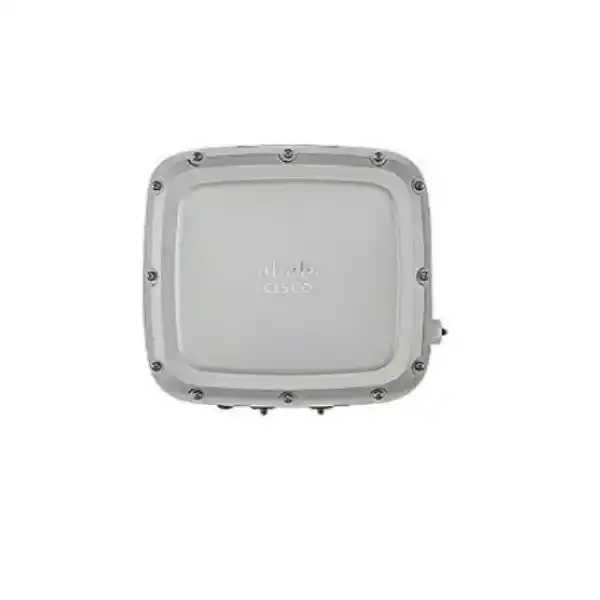
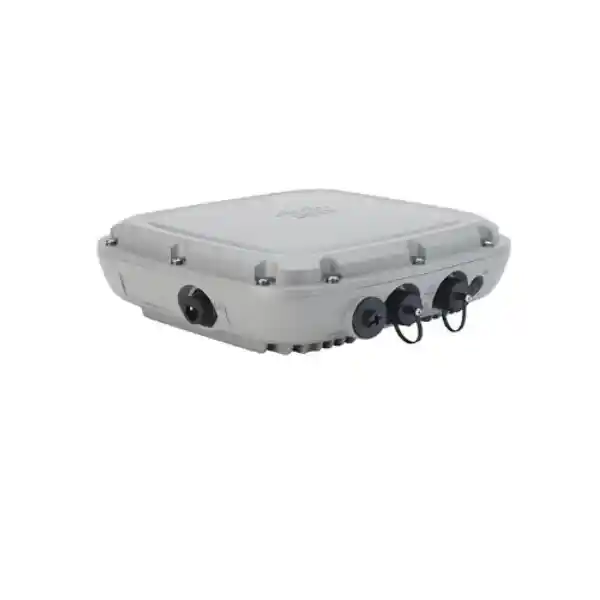
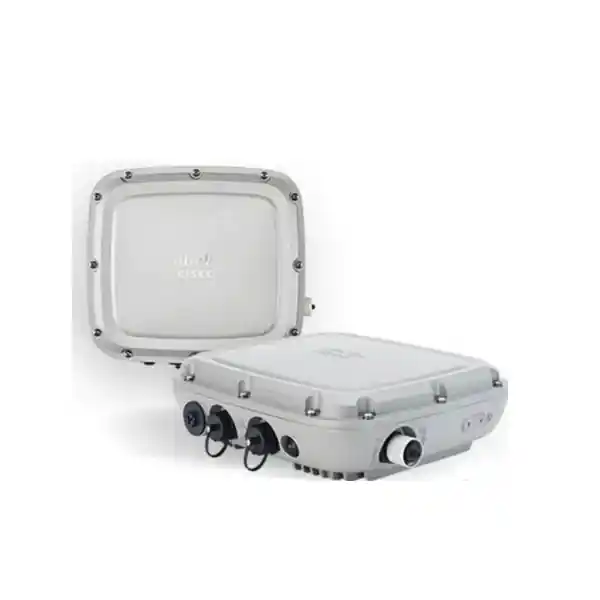
Cisco Catalyst C9124AXE Outdoor Access Point
A rugged, enterprise-class Cisco Wi-Fi 6 access point for outdoor spaces where radio design, antenna choice, multigigabit backhaul, environmental tolerance and centralized operational control matter as much as raw throughput.
FourTeck provides the Cisco Catalyst C9124AXE for projects in Dubai and across the UAE, including campus grounds, logistics compounds, ports, warehouses, manufacturing yards, hospitality estates, education campuses, transportation zones, public spaces and outdoor industrial networks. The C9124AXE is the external-antenna member of the Catalyst 9124AX family, giving wireless architects far more freedom to shape RF coverage than fixed-antenna outdoor access points.
Choose C9124AXE when your design requires external omni, directional, sector or specialized Cisco-supported antennas, strong environmental protection, Catalyst 9800 controller integration and a 2.5GbE-capable wired uplink.
OFDMA, MU-MIMO, Target Wake Time, BSS coloring, beamforming and WPA3-class security capabilities.
Designed for flexible external antenna combinations and Cisco Self-Identifiable Antenna support on designated ports.
One 100/1000/2500BASE-T uplink plus fiber/SFP flexibility for appropriate deployment designs.
Built for exposed enterprise environments with wide temperature tolerance, weather protection and rugged mechanical construction.
Why the C9124AXE is a different kind of outdoor access point
Outdoor wireless projects fail for reasons that have little to do with the headline Wi-Fi standard. A design may have sufficient theoretical throughput but still suffer from poor antenna placement, unsuitable polarization, excessive cell overlap, weak backhaul, inadequate switch power, uncontrolled interference, environmental exposure or controller configuration that does not match the site. The Cisco Catalyst C9124AXE is valuable because it addresses the problem as an enterprise outdoor RF platform rather than as a simple weatherproof radio.
The “E” variant is specifically aimed at deployments that need external antennas. That choice is important in Dubai and the wider UAE, where a single project can combine open courtyards, roads, loading areas, metal-clad warehouses, long perimeter routes, shaded pedestrian zones, roof spaces, container yards and semi-industrial environments. An access point with an integrated omnidirectional pattern may be convenient, but it can waste RF energy in directions where no users exist. The C9124AXE allows a designer to pair the AP with supported antennas that better match the geometry of the coverage objective.
Cisco’s 9124AX outdoor family is based on 802.11ax Wi-Fi 6. The platform adds enterprise features such as uplink and downlink OFDMA, MU-MIMO, beamforming, BSS coloring, Target Wake Time, robust security options and network intelligence through Cisco’s controller ecosystem. For the C9124AXE, the external-antenna architecture also supports flexible radio behavior, including dual-radio operation and dynamic tri-radio designs that can divide 5 GHz resources for certain high-density use cases. This makes the product particularly relevant when the wireless team needs more than basic outdoor coverage and wants RF behavior that can be engineered around demand.
FourTeck positions the C9124AXE as part of a complete network, not an isolated AP. A production design must consider the access switch, PoE class, controller software, VLANs, authentication, RF profiles, cabling, surge protection, mounting, antenna types, regulatory domain and backhaul strategy. Customers planning a broader Cisco infrastructure refresh can also use the FourTeck UAE technology portfolio as a starting point for related switching, wireless, security and enterprise infrastructure discussions.
C9124AXE radio design: what network engineers should understand
The C9124AXE is often summarized as a 4×4 Wi-Fi 6 outdoor access point, but the external-antenna model deserves a more precise explanation. It has an RF architecture that supports a 2.4 GHz serving radio and flexible 5 GHz operation, with six external antenna connections on the chassis. Four of those connections serve dual-band 2.4/5 GHz antenna functions, while two additional connections support 5 GHz. The design also includes a separate internal antenna for the integrated IoT/Bluetooth Low Energy function. This topology gives the access point the physical resources required for both conventional dual-radio operation and more advanced 5 GHz use.
In practical dual-radio deployments, architects can operate a 2.4 GHz and a 5 GHz serving radio while selecting antennas appropriate to the area. In dynamic tri-radio scenarios, the 5 GHz resources can be divided into two 2×2 radios, allowing the network to use additional 5 GHz channel resources when the channel plan, client density and controller configuration justify it. That flexibility is useful in event spaces, resort grounds, transport areas or large outdoor enterprise zones where one AP location has to serve a complex RF footprint. However, tri-radio capability should not be treated as an automatic throughput multiplier. Proper channel reuse, client capability, co-channel interference, DFS behavior, antenna pattern and controller policy still determine real performance.
The Wi-Fi 6 feature set includes OFDMA in both uplink and downlink directions. OFDMA can divide a channel into resource units so that the AP serves multiple clients more efficiently, especially when many clients exchange smaller packets rather than each consuming a full channel opportunity. MU-MIMO improves simultaneous spatial transmission opportunities for compatible devices. BSS coloring helps clients and infrastructure distinguish overlapping basic service sets, potentially improving spatial reuse in congested environments. Target Wake Time can reduce unnecessary radio activity for compatible battery-powered clients, which is relevant for some IoT-oriented deployments.
These features matter most when supported end to end by client devices, the Cisco controller design and the RF plan. A high-density outdoor network should not be designed solely from maximum PHY rates. The engineer should model client count, expected application mix, channel width, minimum data rates, roaming behavior, airtime utilization, antenna gain, EIRP limits and uplink capacity. In many enterprise projects, a carefully planned 20 or 40 MHz channel strategy delivers more usable capacity across a large site than aggressively deploying wide 80 MHz channels everywhere.
External antenna flexibility: the main reason to choose the AXE model
Omnidirectional coverage
An omnidirectional antenna can suit poles or central locations where clients exist around the AP. The external-antenna design lets the engineer select a supported antenna with the required gain, vertical beamwidth and installation characteristics instead of being locked to one integrated pattern.
Directional and sector coverage
Directional antennas concentrate energy into a defined area, making them useful for loading bays, long courtyards, approach roads, perimeter zones, grandstands or coverage from a building edge. Focused patterns can reduce unwanted energy behind the antenna and simplify cell shaping.
Specialized RF geometry
Warehouses and industrial compounds often need unusual elevation angles, narrow sectors or a combination of service areas. External antennas allow the design team to consider specialized patterns while respecting Cisco-supported antenna combinations and local regulatory limits.
Self-Identifiable Antenna support
The C9124AXE supports Cisco Self-Identifiable Antennas on designated SIA ports. In compatible deployments, this can improve operational awareness by helping the system identify supported antenna information rather than relying entirely on manual documentation.
Cisco specifies the C9124AXE for supported external antennas with certified gain up to 13 dBi in the 2.4 GHz and 5 GHz bands. That does not mean every site should use the highest-gain antenna available. Antenna gain changes beam shape and effective radiated power. Regulatory EIRP limits, cable loss, mounting height, expected client transmit capability and desired cell boundaries must all be considered. A high-gain AP-side antenna can create an asymmetric link if client devices cannot transmit back with comparable reach. For mobile phones and tablets, balanced two-way link budget planning is normally more important than simply maximizing AP transmit power.
Power design: PoE class changes what the AP can do
Power planning is one of the most important details in a C9124AXE deployment. The access point can accept multiple PoE levels, but not every PoE source enables the same radio and interface capabilities. This is a design characteristic, not a defect. Cisco allows reduced operation under lower power so that the AP can still function in constrained situations, while full capability is available when the infrastructure delivers the required power budget.
At the lowest 802.3af power level, radio capability is severely restricted, so this should not be considered the normal design target for a new deployment. 802.3at PoE+ can enable more operation, but it still does not expose the complete interface and radio capability available with 802.3bt, Cisco UPOE or suitable DC input. For a properly engineered C9124AXE project, FourTeck recommends validating the exact switch model, line card, per-port power capability, total switch PoE budget, cable length and any intermediate injector before ordering the AP quantity.
With high-power input such as 802.3bt/UPOE or correctly rated DC, the C9124AXE can use its 2.5GbE multigigabit uplink, SFP capability, downlink Ethernet and PoE output feature according to Cisco’s supported power matrix. This matters if the AP is expected to provide a downstream Ethernet connection to another field device or if the site design relies on fiber plus local power. It also matters when selecting outdoor switches, rugged injectors and surge-protection components.
The electrical design should account for more than wattage. Outdoor Ethernet runs need suitable cable, grounding and surge protection according to the installation environment. If a switch is located far from the AP, voltage drop and cabling quality can influence real operation. If fiber is used, the SFP type, fiber strand availability, enclosure design and local power arrangement must be documented. FourTeck can align this wireless design with broader UAE IT infrastructure and deployment services when the customer needs a coordinated implementation instead of standalone product supply.
2.5GbE uplink and SFP: planning the backhaul correctly
A modern high-capacity outdoor AP can create more traffic than a traditional 1GbE edge was designed to carry, especially when many clients are active at the same time. The C9124AXE therefore includes a 100/1000/2500BASE-T multigigabit uplink. A compatible multigigabit switch port can negotiate 2.5Gbps over appropriate copper cabling, giving the AP headroom beyond a fixed 1Gbps uplink. This does not mean every AP will continuously pass more than one gigabit of real user traffic, but it prevents the wired interface from becoming an unnecessary bottleneck in demanding designs.
The platform also provides a Gigabit Ethernet SFP interface. Fiber can be attractive for outdoor installations because it supports longer distances and provides electrical isolation between locations. It is commonly considered for campus pathways, yards, remote buildings, utility corridors or outdoor cabinets where copper distance is impractical. However, using the SFP interface creates a different power equation because the AP still needs a valid local power source. Designers should decide early whether the preferred topology is copper with PoE, fiber with DC, or a specialized installation with supported power injection.
Backhaul planning should include expected aggregate traffic, QoS requirements, switch oversubscription, upstream capacity and controller architecture. For example, a warehouse yard with hundreds of handheld terminals may not need the same sustained throughput as a hospitality pool area with guest video traffic, but it may require lower roaming latency and more predictable packet delivery. An outdoor venue can have the opposite profile: short periods of very high client concurrency followed by long periods of low usage. The access layer and upstream switching design should match these patterns.
For sites combining wireless with server, storage or application infrastructure, the AP should be considered one element in an end-to-end capacity plan. FourTeck can coordinate related compute and connectivity discussions through its Server Dubai infrastructure practice, particularly when new Wi-Fi capacity is being introduced alongside local services, edge workloads, surveillance systems or centralized application platforms.
Catalyst 9800 controller integration and software architecture
The C9124AXE is designed for Cisco Catalyst 9800 Series wireless controller environments. That controller relationship is central to the product’s enterprise value. The controller manages WLAN definitions, security policies, RF profiles, client access behavior, roaming, telemetry and operational state across the wireless estate. For organizations already standardized on Catalyst 9800, the 9124AXE extends the same governance model outdoors rather than creating an isolated management island.
Cisco’s software support history for the C9124AXE begins with IOS XE 17.6.2 for full regulatory-domain support, and the platform continues to appear in Cisco’s current access-point feature and technical-reference documentation. Before deployment, the controller software train should be checked against the customer’s exact AP regulatory-domain SKU, controller model, feature requirements and Cisco recommended release strategy. A new AP should never be added to a production controller simply because the physical connector and power source are compatible.
Centralized mode is suitable when the enterprise wants controller-led policy and traffic handling according to its selected architecture. FlexConnect is often valuable for remote sites where local switching of client traffic is desirable while policy remains centrally managed. Mesh capability is also supported on the 9124 platform in appropriate software releases, allowing outdoor architectures where some APs connect wirelessly to parent APs when a wired path is unavailable. Mesh should be used deliberately: wireless backhaul consumes RF resources and should be surveyed, aligned and monitored like any other radio link.
Operations teams should define configuration standards before deployment: AP naming, location metadata, site tags, policy tags, RF tags, WLAN mappings, VLAN assignments, AAA servers, authentication method, client profiling, logging destinations, SNMP or telemetry workflows, rogue detection and alarm thresholds. Consistent templates make troubleshooting dramatically easier when dozens or hundreds of outdoor APs are distributed across a campus.
Cisco wireless architecture can also integrate with broader enterprise services such as identity, assurance and location-oriented capabilities depending on the customer’s licensing and platform design. These are not automatically included merely by purchasing an AP; they depend on the wider Cisco software and licensing stack. FourTeck can scope hardware and software together so the quotation reflects what the deployment actually requires rather than treating licenses as an afterthought.
Security architecture for enterprise outdoor Wi-Fi
WPA3-ready wireless protection
The platform supports WPA3 capabilities, including WPA3-Enterprise 192 support in appropriate designs. Migration planning should consider the actual client population because older devices can determine whether mixed compatibility modes are temporarily needed.
Enterprise authentication
Corporate WLANs should normally integrate with a centralized identity and AAA strategy. Network teams can map user/device identity to policy rather than relying on one shared pre-shared key for every outdoor client.
Segmentation and policy
Guest access, corporate endpoints, scanners, IoT devices, contractor devices and operational technology should be separated by policy. The AP participates in the wireless architecture; enforcement can involve WLANs, VLANs, access controls and identity-driven segmentation.
Monitoring and incident visibility
Outdoor APs should feed the same monitoring discipline as indoor infrastructure. Authentication failures, unusual client behavior, channel utilization, rogue events and link instability are easier to investigate when location and configuration data are maintained consistently.
The access point itself is only one layer of security. Outdoor Ethernet cabling can be physically accessible, so network architects should consider port security, wired authentication, cabinet security, switch protections and physical route design. Guest Wi-Fi requires internet firewall policy and DNS controls. IoT devices should not inherit the same trust as managed enterprise laptops. For deployments where outdoor wireless terminates into perimeter or security infrastructure, FourTeck can align the WLAN project with its Firewall Dubai security solutions to ensure access policy, segmentation and internet-edge controls are considered together.
Environmental engineering for Dubai and UAE outdoor installations
Outdoor electronics in the UAE face a combination of heat, solar loading, dust, humidity, salt exposure in coastal locations and large temperature changes between conditioned interiors and exposed exterior spaces. The C9124AXE is built for outdoor use with IP66/IP67 ingress protection and a broad operating envelope. Cisco rates the platform down to -40°C and up to 65°C without solar loading, with an upper limit of 55°C where solar loading applies under the vendor’s specified conditions. These limits are more useful than a generic “outdoor rated” label because they allow engineers to evaluate the intended mounting environment.
Direct sun can raise enclosure temperature far above ambient air temperature. A site where summer air temperature is within specification may still expose equipment to heavy solar gain. Mounting position, shade, nearby reflective surfaces and airflow therefore matter. Engineers should avoid enclosing outdoor APs in non-approved boxes that trap heat simply to make the installation look cleaner. The product is already designed for exposed service; additional enclosures can alter thermal behavior and antenna performance.
The 9124AX series is also rated for wind resistance, humidity, vibration, icing and corrosion test conditions documented by Cisco. In the UAE, wind and corrosion may be more relevant than icing, especially in exposed coastal or industrial areas. Antenna masts and brackets must be sized for the combined wind load of the AP, antennas and cabling. Cable service loops should not create strain on connectors. Outdoor-rated coax, weatherproofing and grounding practices are critical because the antenna connectors are part of the RF system and are exposed to the environment.
IP ratings do not remove the need for correct installation. Cable glands, connector sealing, drip loops and port covers must be installed as Cisco specifies. A poorly sealed connector can allow moisture ingress even when the AP chassis itself carries a strong ingress rating. Likewise, mounting the AP where water can pool or where maintenance teams cannot safely access it can create long-term operational problems.
For dusty logistics environments, periodic inspection should be part of maintenance. Dust accumulation on an enclosure usually does not stop a sealed outdoor AP from functioning, but it can obscure labels, complicate inspection and affect surrounding mechanical parts. Antenna orientation should also be checked after storms or maintenance work. A professional handover should include photographs, AP serial records, mounting height, antenna model, antenna orientation, cable routes and switch-port mapping.
UAE deployment scenarios for the C9124AXE
Logistics and warehouse yards
Directional or sector antennas can focus coverage along loading lanes, yard routes and staging areas. Roaming design is important for scanners, rugged tablets and vehicle-mounted terminals that move continuously between indoor and outdoor cells.
Campus outdoor spaces
Universities, hospitals and corporate campuses can extend managed Wi-Fi to courtyards, pathways, parking edges and building approaches while keeping the same controller governance used indoors.
Hospitality and resorts
Pool decks, gardens, beach approaches and outdoor event areas require careful cell shaping to avoid excessive overlap with indoor APs. External antennas allow coverage to be aimed where guests actually use the network.
Manufacturing and industrial compounds
Ruggedized environmental characteristics and flexible antennas suit yards, production-adjacent outdoor areas and semi-industrial spaces where consumer-grade access points are inappropriate.
Transportation zones
Bus areas, depots, service roads and controlled transit spaces can benefit from sector coverage and enterprise roaming, provided the RF design accounts for moving clients, metal structures and changing vehicle blockage.
Public and smart-infrastructure spaces
The AP can support enterprise connectivity in managed public environments where guest access, operational devices and IoT-related functions must coexist under centralized policy.
RF sizing methodology: how many C9124AXE access points do you need?
There is no responsible fixed answer such as “one outdoor AP covers X square meters.” Outdoor range depends on antenna pattern, antenna height, regulatory transmit limits, client transmit power, client antenna quality, frequency band, obstructions, interference, target data rate and application requirements. A coverage estimate without these inputs can be wrong by a large margin. The correct process is to design from service requirements and validate with predictive and on-site RF work.
Step 1 — define the client population. Identify device types, Wi-Fi generations, maximum transmit power, MIMO capability, roaming behavior and application requirements. Rugged scanners may behave very differently from modern smartphones. Outdoor cameras may be stationary and throughput-heavy, while handheld terminals may be mobile and latency-sensitive.
Step 2 — define minimum performance. Set a target minimum RSSI, SNR, acceptable packet loss and required data rate for the critical client class. Voice over Wi-Fi normally needs more conservative roaming thresholds than casual guest web browsing. A surveillance design needs sustained capacity rather than merely detectable signal.
Step 3 — choose candidate antenna patterns. Decide whether each AP location should radiate around a pole, along a corridor-like outdoor route, toward a yard sector or across an open event space. Select supported Cisco antennas whose horizontal and vertical beam patterns align with that geometry. Antenna gain should be evaluated alongside EIRP limits and cell overlap.
Step 4 — calculate link budgets. Include AP transmit power, cable loss where applicable, antenna gain, free-space or modeled path loss, foliage or structure loss, client antenna characteristics and fade margin. Always check the reverse path from client to AP, not just AP to client. Mobile clients are often the limiting side of the link.
Step 5 — plan channel reuse. Outdoor RF can travel surprisingly far. Excessive AP transmit power can cause neighboring cells to hear each other across large distances, reducing channel reuse. In dense designs, lower power and tighter antenna patterns may deliver greater aggregate capacity than a few very loud APs.
Step 6 — validate capacity. Estimate active clients per radio, airtime demand, protocol overhead and application mix. Maximum PHY rate is not user throughput. Real traffic shares airtime among clients and includes management frames, retransmissions, contention and protocol overhead.
Step 7 — perform a site survey and post-install validation. Predictive design should be checked against the actual environment. Metal racking, containers, vehicles, trees, temporary structures and nearby radio systems can change propagation. After installation, measure coverage, channel utilization, roaming and application performance. Adjust antenna tilt, RF power and channel policy based on evidence rather than assumption.
Channel width, DFS and outdoor 5 GHz planning
The C9124AXE supports multiple channel widths, including 20, 40 and 80 MHz operation, with 80+80 functionality in supported modes. Wide channels increase potential peak PHY rate but consume more spectrum. In a large outdoor deployment, the main design objective is usually not maximum speed from one AP; it is maximum usable capacity across the whole area. Twenty-megahertz channels provide more reuse opportunities and are often appropriate where many cells must coexist. Forty-megahertz channels can be a balanced choice in moderate-density zones. Eighty-megahertz channels may suit lower-density areas with abundant clean spectrum and high-throughput client requirements.
Dynamic Frequency Selection channels can expand usable 5 GHz spectrum, but they are subject to radar-detection requirements. When an AP detects radar under DFS rules, it may need to leave the channel. For real-time or operationally critical services, the network team should understand how DFS events affect availability and whether the chosen controller configuration provides acceptable channel-change behavior. Regulatory rules differ by country and must be respected for the exact Cisco regulatory-domain SKU supplied to the UAE.
Outdoor antenna gain also affects legal transmit configuration. The controller’s configured transmit power, antenna gain and cable loss contribute to effective radiated power. High-gain directional antennas can exceed permitted limits if the radio is left at a power level intended for lower-gain antennas. This is one reason product supply should be tied to a documented antenna bill of materials rather than ordering APs first and choosing antennas later.
For sites near airports, ports, radar sources or other regulated RF environments, channel planning deserves additional attention. The right design may deliberately favor a smaller set of stable non-DFS channels for critical services while using broader spectrum for less sensitive SSIDs. The choice depends on local rules, interference measurements and application requirements.
Roaming design for vehicles, handhelds and mobile users
Outdoor Wi-Fi is frequently a mobility problem. A user walking through a campus, a forklift moving between warehouse doors and a tablet mounted in a service vehicle all depend on clean handoff between cells. The AP infrastructure can assist roaming, but the client makes important roaming decisions. A design with strong coverage everywhere can still roam badly if cells overlap too much, minimum data rates are too low or clients cling to distant APs.
Cell boundaries should be engineered so that the client discovers and joins the next AP before the existing link becomes unusable. Directional antennas are valuable because they let the designer shape these boundaries. For a road or yard lane, adjacent sectors can be overlapped intentionally rather than flooding the entire area from high omnidirectional poles. In a courtyard, multiple lower-power cells may serve high client density better than one powerful central AP.
Minimum supported rates should be chosen based on the client fleet. Leaving extremely low legacy rates enabled can increase airtime overhead and extend cell edges farther than intended. Removing rates too aggressively can disconnect older operational devices. This is why an inventory of scanners, printers, industrial terminals and specialized clients is necessary before tuning. Modern smartphones may tolerate settings that legacy warehouse equipment cannot.
After deployment, roaming tests should use the actual production client types and applications. A laptop speed test proves very little about how a voice handset or scanner behaves. Engineers should test movement paths, measure handoff latency, check packet loss and inspect controller logs for authentication or DHCP delays. Where applications use persistent sessions, firewall and VLAN architecture must also support mobility without unnecessary session breaks.
Important note: C9124AXE is Wi-Fi 6, not Wi-Fi 6E
The Cisco Catalyst C9124AXE product name can cause confusion because the model ends in “AXE.” In Cisco’s naming, the “E” identifies the external-antenna variant of the Catalyst 9124AX family. It does not make the product a Wi-Fi 6E access point. The C9124AXE operates as an 802.11ax Wi-Fi 6 platform using the 2.4 GHz and 5 GHz bands. Customers requiring 6 GHz operation should evaluate Cisco products specifically documented for Wi-Fi 6E or newer standards.
This distinction matters for procurement and compatibility. A project specification that explicitly requires 6 GHz spectrum cannot be satisfied by substituting the C9124AXE merely because “6E” appears to be implied by the letters in the model. FourTeck therefore validates the intended wireless generation, antenna requirement and regulatory environment before finalizing the bill of materials.
Mechanical installation, mounting and antenna workmanship
The C9124AXE weighs approximately 3.1 kg without counting brackets, antennas and cabling. A complete installation can therefore place significant load on a pole or wall attachment, especially in high wind. Mounting hardware must be selected for the substrate and environmental exposure. A bracket secured to a lightweight architectural panel is not equivalent to a bracket anchored into structural material. For rooftop or mast work, local safety requirements and access procedures should be included in the method statement.
External antennas add mechanical complexity. Each antenna’s orientation, polarization and downtilt must match the RF plan. Installers should not improvise antenna positions based on convenience. A sector antenna rotated ninety degrees can create a completely different polarization relationship. A directional antenna pointed above the user zone may produce poor near-field service while projecting energy far beyond the intended boundary. The design drawings should therefore identify both AP location and antenna boresight.
RF cable length should be minimized where possible because coaxial cable introduces loss. Long coax runs can waste transmit power and reduce receive sensitivity before the signal reaches the AP. In many outdoor designs, it is better to place the access point near the antenna and extend Ethernet or fiber than to mount the AP far away and use long RF jumpers. The exact choice depends on power, environmental access and maintenance constraints.
Weatherproofing must be applied to outdoor RF connections using vendor-recommended practices. The connector should be properly tightened, protected from moisture and supported so cable weight does not pull on the port. Drip loops help prevent water from running directly toward connectors. Cable ties should be UV-resistant and should not be tightened so aggressively that they deform cable jackets.
Documentation at handover should include AP MAC address, serial number, regulatory-domain SKU, mounting coordinates, height, switch port, cable test results, antenna part numbers, antenna orientation, grounding details and photos. This data becomes essential during future troubleshooting or expansion. A well-documented outdoor AP can be serviced quickly; an undocumented unit on a pole can turn a simple fault into a site survey.
IoT and Bluetooth Low Energy capabilities
The C9124AX platform includes an IoT radio that works with Bluetooth Low Energy and multiprotocol 802.15.4 functions in supported Cisco architectures. For the AXE model, the IoT function uses its own internal antenna rather than the six external serving-radio antenna ports. This distinction is important when an application expects BLE or IoT coverage to extend exactly as far as a high-gain external Wi-Fi antenna. The coverage patterns are not necessarily the same.
Organizations may use integrated IoT capabilities for location-aware services, telemetry integrations or other supported use cases depending on their Cisco software stack. These capabilities should be evaluated as part of the complete solution, including licensing, supported features and application integration. The presence of a radio does not automatically provide a complete asset-tracking or IoT application.
For outdoor facilities, the operational advantage is platform consolidation. A wireless infrastructure designed for enterprise Wi-Fi can also participate in supported IoT workflows, reducing the need to build a separate overlay for every low-power wireless requirement. Whether that creates value depends on the customer’s use case, device ecosystem and Cisco platform design.
Procurement details that should be confirmed before ordering in Dubai
The base model name C9124AXE is not the complete orderable identifier. Cisco wireless access points use regulatory-domain suffixes, and the correct SKU must match the country in which the AP will operate. Customers are responsible for using an approved regulatory domain for the deployment location. For UAE projects, FourTeck confirms the appropriate orderable variant, availability and supporting components before final quotation.
The bill of materials should include antennas explicitly. An external-antenna AP without a defined antenna set is not a finished radio design. The quote should identify antenna part numbers, quantity per AP, any required mounting kits, RF cables or adapters, grounding accessories and weatherproofing materials. If Self-Identifiable Antennas are used, the design should confirm which designated ports support that functionality and how the controller will be configured.
Power components must also be specified. If the access switch provides 802.3bt or Cisco UPOE, verify the exact port capability and switch power budget. If a power injector is required, use a Cisco-supported model suitable for the environment and intended power level. If DC power is planned, verify voltage range, source capacity, enclosure and cable route.
Controller and license requirements should be quoted at the same time as the APs. A customer with an existing Catalyst 9800 controller may only need to validate capacity and software compatibility, while a new deployment may require controller hardware or virtual architecture plus Cisco software entitlements. High availability requirements can also affect controller sizing and licensing.
Finally, confirm whether the customer needs supply only, installation, RF survey, configuration, migration, post-install validation or managed support. FourTeck can scope the product as a standalone procurement item or as part of a complete UAE network project. This approach reduces the risk of discovering after delivery that the APs are correct but the switches, power budget, antennas or software are not.
Sizing the wired and controller infrastructure
A wireless bill of materials should always be checked against upstream infrastructure. Start with access-switch port count and PoE budget. If forty outdoor APs each require high-power PoE, the switch architecture may need more total power than an existing chassis can provide. Some switches support the required power per port but cannot deliver the maximum simultaneously on every port because the power supplies limit total budget. Redundant power-supply design can further change available capacity.
Next, check multigigabit support. Connecting the C9124AXE to a 1GbE-only switch is technically possible in many power configurations, but it removes the benefit of the 2.5GbE-capable uplink. For high-density AP locations, a multigigabit switch is preferable. For lower-demand outdoor cells, a 1GbE edge might still be adequate if traffic modeling confirms it. Decisions should be based on aggregate application traffic, not the AP’s theoretical wireless PHY rate.
Controller capacity must account for AP count, client count, throughput architecture, redundancy and planned growth. A project that is already close to a controller limit should not add outdoor APs without reviewing headroom. Software release compatibility also needs to be validated before deployment. Maintenance windows may be necessary if the controller must be upgraded to support the exact AP model and required features.
Upstream firewall and WAN capacity should be reviewed where guest or internet traffic will increase significantly. A resort adding extensive outdoor Wi-Fi may create a large rise in concurrent internet sessions. A logistics yard adding operational terminals may instead increase traffic toward internal applications. In each case the WLAN should be traced through switching, routing, security and application dependencies so no hidden bottleneck undermines the access-point investment.
Migration from older outdoor Cisco APs
Replacing older outdoor access points is not always a one-for-one hardware exercise. Newer Wi-Fi 6 radios may have different antenna requirements, PoE needs, mounting hardware, controller minimum releases and RF behavior. A migration plan should therefore begin with an inventory of the current AP model, antenna type, cable route, mounting bracket, switch port, power source and controller assignment.
Existing external antennas must not automatically be reused. Confirm Cisco compatibility, connector type, band support, gain, polarization and regulatory approval with the C9124AXE. An antenna that was appropriate for an older single-radio design may not support the port arrangement or MIMO behavior expected by the new AP. Reusing unverified antennas can reduce performance and may create compliance problems.
Power is another common migration issue. An older AP may have operated on PoE+ with full function, while the C9124AXE may need higher-power input to expose all desired interfaces and radio capability. Switch replacements or injectors may therefore be part of the project. Cabling should be certified if 2.5GbE is expected, particularly on long outdoor runs that have been in service for years.
Controller migration may be required if the installed wireless controller generation does not support the C9124AXE. Cisco Catalyst 9800 is the relevant controller family for this AP. If the organization is moving from an older controller architecture, the project should include WLAN policy translation, AAA testing, mobility configuration, RF profile review and client validation rather than simply copying names and VLAN IDs.
A phased cutover is generally safer for large campuses. Install new APs in a pilot area, validate client compatibility and RF behavior, then expand. Keep rollback options for critical operational zones. Because outdoor cells can cover wide areas, installing a new high-gain antenna without coordinated power tuning can disturb neighboring legacy cells. RF change control is therefore part of migration discipline.
Performance expectations: interpreting the 5.38 Gbps PHY figure
Cisco documents an aggregate maximum PHY data-rate figure up to 5.38 Gbps for the C9124AXE in its supported 802.11ax configuration. This number is useful for understanding the radio class, but it is not the throughput one client should expect from a speed test. PHY rate includes modulation and coding conditions that depend on signal quality, channel width, spatial streams and client capability. User traffic is lower after Wi-Fi contention, protocol overhead, management traffic, acknowledgements, retransmissions and sharing among devices.
Most client devices also have fewer spatial streams than the AP. Many phones and tablets are 2×2 clients, so they cannot use four spatial streams even when the infrastructure supports them. The AP’s larger radio capability is valuable because it serves many clients efficiently and can use spatial resources across the cell, not because every client receives the full aggregate number.
Outdoor environments introduce additional variables. Signal can be excellent in line of sight but drop sharply behind vehicles, structures or foliage. Reflections from metal surfaces can either help or hurt MIMO performance. Temperature does not directly change Wi-Fi modulation in the same way an obstruction does, but extreme environmental conditions can influence the installation and surrounding hardware. Interference from neighboring WLANs remains one of the largest practical limits.
For acceptance testing, FourTeck recommends defining application-oriented targets: minimum RSSI, SNR, packet loss, latency, roaming behavior and throughput at named test points. This creates a measurable success criterion. “Maximum speed everywhere” is not a useful acceptance statement because clients, spectrum and physical conditions make it impossible to guarantee one peak number across an outdoor estate.
Operations, monitoring and lifecycle management
After deployment, outdoor APs should be managed as a production service with defined health indicators. At minimum, monitor AP reachability, radio state, channel utilization, client count, authentication failures, retransmission trends, uplink status, PoE condition and controller alarms. Sudden changes in one location can indicate damaged antennas, water ingress in a connector, switched-off power, a new interference source or a physical obstruction that was not present during commissioning.
Configuration drift should be minimized through controller-based templates and tagging. If one AP is manually tuned to an unusual transmit power or channel and the reason is not documented, future optimization can accidentally undo the fix or propagate a bad setting. Record exceptions with site notes. Antenna model and orientation should also exist in the asset record because controller telemetry cannot infer every physical detail of a conventional antenna installation.
Software maintenance is equally important. Cisco publishes feature matrices, field notices, security notices and recommended software guidance over the product lifecycle. Wireless teams should monitor those resources and schedule controller upgrades with appropriate testing. Outdoor sites can be harder to access than indoor offices, so preventing issues through software hygiene is especially valuable.
Spare strategy should reflect operational criticality. A campus guest network may tolerate a failed AP until the next maintenance visit. A logistics yard using Wi-Fi for operational terminals may not. Critical sites should consider holding spare APs, matching antennas, injectors and mounting components locally. The spare should also be compatible with the regulatory domain and controller release in production.
FourTeck can support lifecycle planning from initial supply through deployment and replacement. Customers can use the FourTeck global technology site for wider enterprise infrastructure coordination when the wireless program extends beyond the UAE or forms part of a multi-country standardization project.
C9124AXE versus integrated-antenna outdoor options
The C9124AXE should be chosen because external antennas solve a design requirement, not simply because external antennas appear more powerful. Cisco also offers 9124 family variants with integrated omnidirectional or integrated directional antennas. Those models can be simpler to install because antenna selection, RF cables and connector weatherproofing are reduced. For straightforward outdoor coverage, that simplicity can be an advantage.
The AXE becomes preferable where antenna geometry is central to the design. A long loading apron may need a focused sector. A pole in the middle of an open courtyard may need a particular omnidirectional pattern. A stadium-like area may need multiple carefully tilted sectors. An industrial compound may need different antennas at different AP locations even though the controller and AP platform remain standardized. External antennas let the architect adapt the RF layer without changing the access-point family.
The trade-off is installation discipline. Every external connector introduces a point that must be selected, tightened, weatherproofed and documented correctly. High-gain antennas also require more careful power calculation. A poor external-antenna installation can perform worse than a properly placed integrated model. The choice should therefore come from survey results and coverage geometry, not from the assumption that external always equals better.
For procurement, FourTeck can compare AXI, AXD and AXE variants against the site drawings and user zones. The most economical solution is often a mixed design: integrated units in straightforward coverage areas and AXE units only where specialized antennas deliver clear value.
Frequently asked technical questions
Is C9124AXE Wi-Fi 6E?
No. It is a Wi-Fi 6 802.11ax outdoor access point using 2.4 GHz and 5 GHz. The E in this model indicates the external-antenna variant.
Does it include antennas?
The AXE model is designed around external antennas. The project bill of materials should specify supported Cisco antennas and any required mounting or RF accessories for the intended coverage pattern.
Can it run from PoE+?
It can operate at multiple PoE levels, but features are restricted at lower power. Full intended capability should be designed around Cisco-supported high-power input such as 802.3bt, UPOE or suitable DC where required.
Does it have a 2.5GbE port?
Yes. The primary copper uplink supports 100/1000/2500BASE-T, subject to suitable power and connected switch capability.
Can it use fiber?
The platform includes a Gigabit Ethernet SFP interface, so supported fiber designs are possible. The AP still needs appropriate local power when fiber is used.
Which controller manages it?
Cisco Catalyst 9800 Series wireless controllers are the relevant controller platform for the C9124AX series.
Is it suitable for UAE heat?
It is built for outdoor operation and Cisco specifies a wide temperature range, but solar loading, mounting conditions and installation workmanship must still be evaluated for the exact site.
Can it support mesh?
Yes, mesh is supported on the C9124 platform with appropriate Cisco IOS XE releases and architecture. Backhaul RF must be engineered carefully because mesh consumes wireless resources.
Design example: outdoor logistics compound in Dubai
Consider a logistics facility with two long loading buildings, an open trailer yard, vehicle gates and staff parking. The goal is to support handheld scanners, rugged tablets and supervisory laptops. A poor design might place four omnidirectional APs on very high poles at maximum transmit power. The result could be strong signal everywhere but poor roaming, excessive cell overlap and weak uplink performance from handheld devices.
A better design starts by separating service zones. Sector antennas can cover loading faces, with antenna downtilt chosen so the main lobe intersects the working area rather than projecting beyond the property. Additional directional cells can cover vehicle gates and long routes. AP heights are selected so users remain within the useful vertical beamwidth. Transmit power is tuned to client capability rather than left at the maximum.
The network team then checks channel reuse. Adjacent sectors may use separate 5 GHz channels, with 20 or 40 MHz width depending on capacity requirements and available spectrum. 2.4 GHz is retained only where client compatibility requires it, with careful power control because the band travels farther and has fewer non-overlapping channels. DFS channels are evaluated against local conditions and operational tolerance.
Each AP connects to a multigigabit PoE switch using outdoor-rated structured cabling and surge protection. The switch PoE budget is calculated for all APs at peak requirement. If a remote pole is beyond copper reach, the design uses fiber to an outdoor cabinet with appropriate DC or local PoE architecture. Controller tags map the yard APs to a dedicated RF profile and operational WLAN set.
Acceptance testing follows actual forklift and walking routes with the real scanner model. Engineers measure RSSI, SNR, roaming handoff and application transaction latency. Antenna tilt and power are adjusted based on evidence. This is the kind of use case where the C9124AXE’s external antenna flexibility offers a concrete advantage over a one-pattern outdoor AP.
Design example: hospitality estate and outdoor guest Wi-Fi
A resort or hotel estate presents a different challenge. Clients are mostly smartphones, tablets and laptops. Usage is bursty and can become very high around pools, gardens, restaurants and event lawns. The network must also avoid creating excessive interference with indoor guest-room APs. High antenna gain is not automatically desirable because mobile devices have modest transmit power and clients may remain attached to distant cells if coverage is too broad.
The design begins by mapping outdoor seating, pedestrian routes and event zones. Directional antennas on building edges can cover terraces without sending equal energy back into guest rooms. Carefully placed omni antennas can serve open lawns when users truly surround the AP. Where an event area becomes dense, multiple lower-power sectors may provide more aggregate capacity than a single powerful cell.
Guest WLAN security, captive-portal behavior, internet bandwidth and firewall session capacity need to be tested together. A resort can have thousands of transient devices, each creating background cloud traffic even when the user is not actively browsing. Network telemetry should distinguish low RF signal from internet congestion or portal authentication problems so operations teams diagnose the right layer.
Because appearance matters in hospitality, mounting and antenna selection should be coordinated with architecture. External antennas can be visually prominent, so the AXE should be used where its RF benefits justify the mechanical design. In simple garden zones, an integrated-antenna sibling may be more elegant. A mixed Cisco outdoor deployment can preserve a consistent controller architecture while using different physical antenna approaches.
Design example: education or enterprise campus
Campus networks typically require seamless movement between indoor and outdoor coverage. Users leave classrooms or offices, cross courtyards, enter adjacent buildings and expect sessions to continue. The controller, SSID and identity architecture should therefore be common across the estate, while RF profiles differ for indoor and outdoor environments.
C9124AXE units can be positioned at building edges or selected poles to serve courtyards and pathways with appropriate antennas. The design team should model how outdoor energy penetrates indoor spaces and how indoor APs leak outward through glass. Without this analysis, outdoor APs can create co-channel interference with indoor radios that are physically close but separated only by a window.
Campus security often includes multiple identity groups: employees, students, guests, facilities devices and IoT endpoints. These populations can share physical APs while being segmented logically by SSID, identity and network policy. The controller architecture supports consistent policy, while the firewall and routing design determines where traffic is inspected and which resources each group can reach.
Outdoor coverage is also valuable for facilities operations, security teams and maintenance staff. A design that only considers student or office-user density may miss operational zones such as parking gates, loading areas and service corridors. Including these stakeholders early produces a more complete RF map and can reduce later requests for ad-hoc AP additions.
What FourTeck includes in a professional C9124AXE project discussion
A useful quotation starts with requirements, not merely quantity. FourTeck asks where the APs will be installed, which client devices they must serve, whether the site already has Catalyst 9800 controllers, what switches are available, which PoE standard the ports support and whether copper or fiber backhaul is planned. We also review whether the customer requires only hardware supply or a complete implementation.
For antenna planning, the customer should provide site drawings, approximate mounting locations, dimensions and photographs. When accuracy is important, predictive modeling and an on-site survey can be scoped. The antenna choice is then matched to each coverage zone rather than applying one part number to every AP. This is particularly important for the AXE model because external-antenna flexibility is the product’s defining advantage.
The switching review covers port count, 2.5GbE support, PoE class, total power budget, uplink capacity and redundancy. Where existing switches cannot deliver the required power, FourTeck can recommend alternatives or approved injector architectures. Fiber-connected AP locations are reviewed for SFP type, local power and enclosure requirements.
The controller review checks model, software release, AP capacity, client scale, redundancy and licensing. If an upgrade is required, it should be planned before AP installation. WLAN policies, AAA integration and network segmentation are documented so the new outdoor service behaves consistently with the enterprise architecture.
The result is a deployable bill of materials rather than a list of access points. This reduces common project risks such as missing antennas, insufficient PoE, incompatible controller releases or the wrong regulatory-domain SKU. FourTeck can support projects throughout Dubai and the wider UAE, with broader regional coordination available for organizations operating multiple sites.
Decision recap: when C9124AXE is the right choice
Choose it for RF flexibility
You need external antennas to shape coverage around outdoor geometry, use directional or sector patterns, or standardize one AP platform across different antenna requirements.
Choose it for rugged deployment
The site requires a true outdoor enterprise AP with IP66/IP67 protection, wide temperature tolerance and mechanical design intended for exposed environments.
Choose it for Cisco operations
Your organization uses Catalyst 9800 controllers and wants outdoor WLANs under the same policy, telemetry, security and lifecycle framework as the wider Cisco wireless network.
Choose it for scalable backhaul
A 2.5GbE-capable copper uplink, SFP option and high-power PoE design fit the site’s switching and backhaul architecture.
Do not choose the C9124AXE simply because you need “the longest range.” Range is a system outcome created by antennas, regulatory power, client capability, mounting and RF design. Choose it when its external-antenna architecture and enterprise Cisco feature set solve the actual site requirements.
Quotation input checklist for Dubai and UAE projects
Sending the following information with your RFQ helps FourTeck return a technically complete quotation faster and reduces the chance of missing antennas, power components or licenses.
Site type, address/emirate, outdoor areas to cover, approximate dimensions, maps, floor plans and mounting restrictions.
Phone, laptop, scanner, tablet, vehicle terminal, camera or IoT models, plus expected concurrent client count and movement pattern.
Guest internet, voice, ERP terminals, scanning, video, telemetry, collaboration or any latency-sensitive operational service.
Catalyst 9800 model or virtual deployment, current IOS XE version, AP count, licensing and redundancy architecture.
Switch models, free ports, multigigabit capability, PoE standard, total available power budget and uplink capacity.
Copper with PoE, fiber with local power, existing outdoor cabinet, or a new pathway requiring design.
Omni, directional, sector or unknown. If unknown, provide drawings and photos so the pattern can be selected from requirements.
Supply only, survey, installation, cabling, configuration, migration, testing, documentation, support or complete turnkey delivery.
Consult FourTeck for a complete Cisco C9124AXE solution
The Cisco Catalyst C9124AXE is best purchased as part of an engineered outdoor wireless design. The access point, antennas, power source, switches, controller software, regulatory-domain SKU, mounting and RF settings all affect whether the finished network performs as expected. FourTeck can help customers in Dubai and across the UAE build a correct bill of materials and implementation scope around these dependencies.
For supply-only requests, send the exact quantity, required regulatory domain if already known, antenna part numbers and delivery location. For new deployments, send site drawings, expected user counts and existing controller/switch details. FourTeck can then identify the design assumptions that need validation before purchase.
This page intentionally focuses on the C9124AXE as a Wi-Fi 6 external-antenna outdoor AP. If your project requires 6 GHz Wi-Fi 6E, a different Cisco outdoor or industrial wireless platform may be more appropriate. Matching the product generation to the spectrum requirement at the start prevents costly redesign later.
FourTeck will align the AP with appropriate antennas, power architecture, accessories and implementation requirements for the UAE site.

Reviews
There are no reviews yet.