
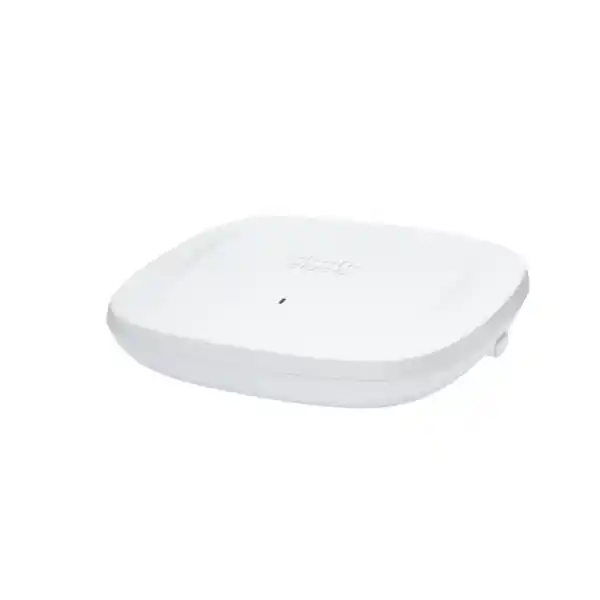
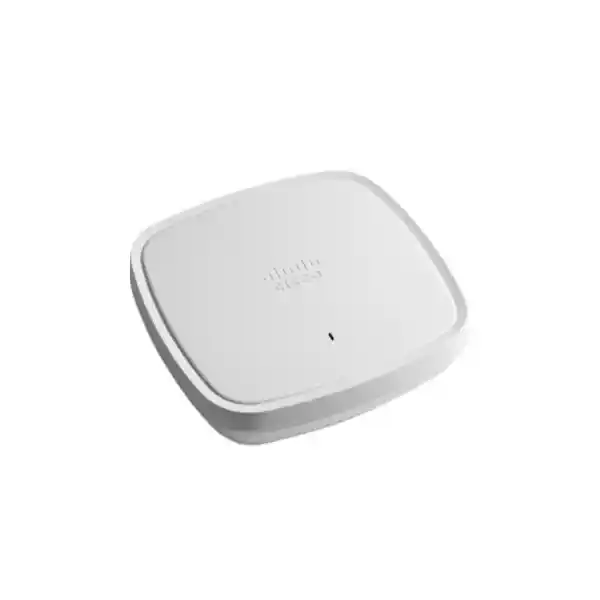
Cisco Catalyst C9136I Wi-Fi 6E Access Point
The Cisco Catalyst C9136I is a high-end indoor enterprise access point built for organizations moving beyond conventional dual-band wireless into a tri-band design that can use 2.4 GHz, 5 GHz and 6 GHz. It is designed for high-density user environments where airtime efficiency, RF visibility, multigigabit wired capacity, controller-based policy, strong authentication and operational telemetry matter as much as peak data rate. In a correctly engineered Cisco Catalyst wireless architecture, the C9136I becomes a platform for predictable client experience, cleaner channel planning, more available spectrum and tighter integration with enterprise security and assurance systems.
Best suited to offices, campuses, universities, healthcare facilities, conference areas, premium hospitality, technology spaces and other locations where Wi-Fi 6E clients and dense 5 GHz populations must coexist efficiently.
Direct answer: what makes the C9136I different?
The practical advantage of the Cisco Catalyst C9136I is that it is not simply a faster access point. It is a multi-radio enterprise platform built to distribute client demand across three Wi-Fi bands while maintaining dedicated visibility for RF analysis and IoT functions. The serving-radio architecture includes a 4×4:4 radio for 2.4 GHz, an 8×8:8 radio for 5 GHz and a 4×4:4 radio for 6 GHz. Cisco also integrates a tri-band scanning function and an IoT radio, giving network teams more telemetry without sacrificing the primary client-serving radios for every monitoring task.
For UAE deployments, the most important design message is that the access point must be treated as part of a complete wired-and-wireless system. Full-performance operation depends on adequate PoE, multigigabit switching, appropriate Catalyst 9800 controller software, correct regulatory configuration and an RF design that accounts for the shorter propagation characteristics of higher frequencies. Installing a premium Wi-Fi 6E access point on an underpowered legacy switch port or without a 6 GHz-capable site design can reduce the value of the hardware. FourTeck therefore approaches the C9136I as an infrastructure project rather than a standalone ceiling device.
Tri-band client service
A 4×4:4 2.4 GHz radio, an 8×8:8 5 GHz radio and a 4×4:4 6 GHz radio provide the foundation for dense mixed-client environments. This gives architects additional freedom to move capable endpoints into cleaner 6 GHz spectrum while retaining strong support for the enormous installed base of 5 GHz devices and necessary 2.4 GHz clients.
Dual 5 GbE multigigabit ports
Two multigigabit Ethernet interfaces support 100 Mbps, 1 Gbps, 2.5 Gbps and 5 Gbps operation. The dual-port design helps prevent the access layer from becoming an obvious bottleneck when aggregate wireless traffic rises, but actual link capability depends on negotiated power mode, switch support, cabling and the selected network design.
802.3bt for full capability
Cisco specifies 802.3bt Cisco UPOE as the mode that exposes the highest radio and uplink capability, with maximum PoE consumption listed at 47.3 W. PoE+ can operate the access point with reduced spatial streams, reduced wired-link capability and no USB power. Basic 802.3af is a staging mode with client-serving radios disabled.
Dedicated scanning and sensing
A dedicated scanning radio supports persistent RF intelligence without requiring the serving radios to spend all of their time off-channel. Integrated BLE/IoT capability and environmental sensing extend the device beyond basic connectivity, supporting richer location, asset and facility use cases when paired with the appropriate Cisco software services.
Built for dense associations
Cisco documentation positions the platform for up to 1,200 associated clients in aggregate, with guidance around 400 clients per serving radio. Association limits should never be confused with recommended active-client design density; real capacity depends on application demand, airtime, channel width, client capability, retry rate and upstream bandwidth.
Internal-antenna indoor AP
The C9136I is an indoor internal-antenna model measuring approximately 25.1 × 25.1 × 5.6 cm without mounting brackets and weighing about 1.65 kg. Integrated omnidirectional antennas simplify common ceiling deployments, while proper bracket selection, mounting height and obstruction analysis remain important parts of RF engineering.
Wi-Fi 6E architecture and why 6 GHz matters
Wi-Fi 6E extends the Wi-Fi 6 feature set into the 6 GHz spectrum. The important point is not that 6 GHz replaces 5 GHz; instead, it creates another high-capacity operating space for compatible clients. In dense offices, universities and conference environments, the 5 GHz band is often asked to carry nearly every performance-sensitive endpoint. Even with careful channel reuse, neighboring basic service sets compete for airtime. By enabling qualified Wi-Fi 6E clients to use 6 GHz, architects can redistribute demand and reduce contention in portions of the network where compatible endpoints are concentrated.
The C9136I preserves enterprise-grade capability across all three client bands. On 2.4 GHz, 4×4 capability provides a strong foundation for legacy and IoT-oriented devices, although many enterprise designs intentionally restrict 2.4 GHz channel widths and transmit power to contain co-channel interference. On 5 GHz, the 8×8 radio is especially useful in high-density areas because it gives the access point a large spatial-stream resource pool and strong receive diversity. On 6 GHz, 4×4 capability supports modern Wi-Fi 6E endpoints using a spectrum environment that was designed without legacy Wi-Fi generations.
OFDMA is central to the efficiency story. Traditional Wi-Fi transmission behavior can waste airtime when many clients are exchanging small packets. OFDMA allows the channel to be divided into resource units so multiple clients can be scheduled more efficiently. In real networks this can improve responsiveness and reduce overhead for environments with many active devices, collaboration applications, transactional traffic and telemetry flows. MU-MIMO complements this by enabling simultaneous multiuser spatial transmission under suitable RF and client conditions.
Target Wake Time can help compatible battery-powered devices coordinate when they wake to transmit or receive, while BSS Coloring and overlapping-BSS packet detection mechanisms help Wi-Fi 6 networks make more informed decisions in dense RF environments. These capabilities should not be marketed as automatic magic. Their benefit depends on the client population, traffic patterns and controller configuration. A well-designed deployment uses them as part of a capacity strategy built around measured requirements rather than simply enabling every feature at maximum channel width.
6 GHz also changes how network teams think about cell size. Higher-frequency signals generally experience more attenuation through common building materials than lower-frequency signals. A 6 GHz cell therefore should not be assumed to mirror the exact usable coverage of an existing 5 GHz cell. In a UAE office fit-out with glass partitions, concrete cores, acoustic panels, metalized surfaces or dense furniture, predictive modelling should be validated with onsite measurements. A design that optimizes only for coverage can still fail on capacity, while a design that optimizes only for theoretical throughput can create roaming or edge-of-cell problems.
Radio engineering: 2.4 GHz, 5 GHz and 6 GHz as one system
A tri-band access point increases design flexibility, but it also increases the number of decisions that must be made intentionally. The 2.4 GHz band offers broad client compatibility and useful propagation, yet it has limited non-overlapping channel resources compared with 5 GHz and 6 GHz. In high-density spaces, an aggressive 2.4 GHz deployment can create excessive co-channel contention. Network teams commonly use lower transmit power, fewer active 2.4 GHz radios or selective band policies so this band remains available for clients that genuinely need it without dominating the RF plan.
The 5 GHz radio remains strategically important because most enterprise laptops, phones and specialized devices support it, and many sites will operate a mixed client base for years. The C9136I 8×8 5 GHz architecture gives the platform substantial capability for dense deployments. However, the number of spatial streams on the access point does not mean an individual client suddenly becomes an 8-stream endpoint. Most mobile devices support fewer streams. The value of an 8×8 enterprise radio includes multiuser capacity, receive performance, scheduling flexibility and the ability to service many lower-stream clients efficiently.
The 6 GHz band is best treated as a new capacity layer. Its usefulness grows as Wi-Fi 6E-capable endpoints enter the fleet. Enterprises replacing laptops on a three-to-five-year cycle can see a steadily increasing proportion of devices capable of using 6 GHz. The access point therefore provides an infrastructure runway even if the first deployment year contains a mixed population. For high-value collaboration areas, engineering floors, auditoriums or training spaces with newer devices, that runway can be immediately useful.
Channel width should be selected by application and density rather than marketing preference. Wider channels can deliver higher peak data rates but consume more spectrum and reduce the number of independent channels available for reuse. In a small low-density office, wider channels may be reasonable. In a large high-density floor, narrower channel widths can often produce better aggregate capacity because more cells can operate without sharing the same channel. The availability of 6 GHz makes wider channels more practical in some areas, but a professional design still models contention and reuse rather than assuming that maximum width is universally optimal.
Transmit power is equally important. Excessive power can make the downlink appear strong while the client cannot answer at the same level, creating asymmetric links, sticky roaming and elevated retries. Too little power produces coverage holes and unnecessarily frequent transitions. Cisco lists available radio power ranges, but the correct operating level for a UAE site should be set through the regulatory domain, controller algorithms and validated RF design. Local compliance, building structure and the intended client type must remain part of the decision.
Dual 5 GbE uplinks and switching design
A high-capacity wireless access point can be constrained by the wired edge if the switch port remains at 1 Gbps. The C9136I provides two multigigabit Ethernet ports capable of negotiating up to 5 Gbps under the appropriate power and platform conditions. That does not imply every deployment requires 10 Gbps of aggregate backhaul, but it gives network architects headroom and supports designs where client demand, multiple radios and local service traffic would otherwise collide with a traditional 1 Gbps ceiling.
Before procurement, verify that the selected access switch supports multigigabit speeds on the intended ports, not merely standard Gigabit Ethernet. Also verify the switch power budget at the chassis and per-port level. A switch can advertise UPOE or 802.3bt support yet still run out of total power when dozens of high-end APs, cameras, phones and other powered devices are connected simultaneously. Capacity planning must therefore consider worst-case and realistic concurrent draw across the entire switch stack.
Cabling should also be reviewed. Existing Category 5e runs can sometimes negotiate multigigabit rates under suitable conditions, but cable age, length, bundles, patching and electromagnetic environment all matter. New enterprise deployments typically benefit from cabling designed and certified for the targeted multigigabit rate. The strongest wireless radio plan cannot compensate for a poor copper plant that flaps, downshifts or accumulates errors.
PoE modes and performance consequences
For full capability, Cisco documents 802.3bt Cisco UPOE operation with 4×4 on 2.4 GHz, 8×8 on 5 GHz, 4×4 on 6 GHz, dual 5 Gbps wired links and USB availability, with maximum PoE power consumption of 47.3 W. This is the performance mode that should be used as the baseline when the organization is purchasing a premium access point specifically for capacity and future growth.
Under 802.3at PoE+, the access point remains operational but is restricted. Cisco’s current data sheet identifies 2×2 on 2.4 GHz, 4×4 on 5 GHz and 2×2 on 6 GHz, one 2.5 Gbps link and no USB power, with maximum consumption around 24.4 W. That can be suitable for staging or constrained environments, but it means the organization is not using the hardware at its complete specification.
Under 802.3af, the radios are disabled and the access point is essentially limited to configuration staging with a 1 Gbps link and approximately 13.95 W maximum consumption. LLDP/CDP should be available for correct power negotiation. The power discussion must therefore happen before installation, especially when replacing older APs that operated comfortably on lower PoE classes.
Controller, assurance and enterprise services integration
The C9136I is designed for controller-based operation with Cisco Catalyst 9800 wireless controllers. Cisco documentation lists support across controller options such as the 9800-L, 9800-CL, 9800-40 and 9800-80. The access point does not support Embedded Wireless Controller operation. That point is important for branch and small-site planning: organizations should not select the C9136I expecting it to become an autonomous embedded controller for the rest of the site.
Controller-based architecture centralizes radio resource management, WLAN policy, authentication integration, mobility, software lifecycle management and operational visibility. In a multi-floor Dubai headquarters or distributed UAE organization, central policy can simplify SSID consistency and security controls while still allowing site-specific RF behaviour. The controller design must be sized for access-point count, client count, throughput, redundancy and mobility requirements rather than selected only on purchase price.
Cisco Catalyst Center can add automation and assurance functions, helping teams correlate client experience, infrastructure health and policy intent. Cisco Spaces can extend the wireless platform toward location and IoT use cases. Cisco Identity Services Engine can integrate identity and policy so access decisions can be based on user, device, posture or role. These surrounding systems are optional architectural components, but they are part of the reason organizations choose a Catalyst platform instead of deploying isolated access points with independent configuration.
Software release planning deserves the same attention as hardware planning. Cisco support information published in 2026 includes a field notice affecting access points that are running, or have run, certain 17.12.4 through 17.12.6a releases, where flash exhaustion can prevent upgrades; Cisco recommends a software upgrade. For production deployments, FourTeck recommends validating the controller/AP release against Cisco’s current recommended and supported release guidance at the time of implementation, testing the upgrade path and avoiding a one-time install mentality. Wireless infrastructure is a continuously maintained software platform.
CleanAir Pro, scanning intelligence and troubleshooting value
High-density wireless problems are not always caused by insufficient signal. They can be caused by interference, excessive retries, poor channel reuse, sticky clients, mis-sized cells, upstream congestion, authentication delays or non-Wi-Fi devices occupying spectrum. The C9136I includes a dedicated scanning architecture intended to improve RF visibility without continually taking a serving radio away from client traffic. This is particularly valuable in environments where the wireless team must distinguish between a coverage problem and an airtime problem.
Cisco CleanAir Pro capabilities can help identify and classify RF conditions so administrators have better information when tuning channels or investigating intermittent client complaints. AI/ML-driven scanning is designed to support continuous intelligence across the radio environment. The operational advantage is not a single dashboard graphic; it is the ability to collect more context before technicians are sent onsite. For UAE organizations with multiple floors or geographically distributed offices, reducing manual RF troubleshooting can translate into faster fault isolation and more consistent service levels.
A dedicated scanning function is also useful for security monitoring because it can observe activity outside the channel currently serving clients. Wireless intrusion detection and rogue analysis still require appropriate controller policies and operational processes. A radio can collect information, but the enterprise needs a response model: who investigates a rogue SSID, how exceptions are documented, whether an unknown AP belongs to a neighboring tenant and how events are correlated with wired switching or identity data.
For troubleshooting, teams should combine RF telemetry with wired metrics. A client showing good RSSI can still experience poor performance because of high channel utilization, packet retries, DNS latency, DHCP delay or WAN congestion. Catalyst assurance workflows are most useful when they connect the user’s complaint to a timeline that includes association, authentication, address assignment, roaming and application reachability. Deploying the C9136I with this operational mindset turns telemetry into actionable service assurance instead of simply collecting more data.
Security architecture for enterprise wireless
Wi-Fi 6E operation brings a stronger security baseline because 6 GHz client operation is associated with modern security requirements such as WPA3. In enterprise deployments, however, radio-layer encryption is only one component. A secure wireless design also includes identity, certificate lifecycle, network segmentation, least-privilege policy, device profiling, management-plane protection, logging and software maintenance.
For corporate devices, WPA3-Enterprise with 802.1X authentication can provide a robust foundation when paired with a properly designed RADIUS and PKI environment. Certificate-based EAP methods can reduce dependence on reusable passwords, but certificate issuance, renewal and revocation must be automated. BYOD and guest access have different requirements and should not simply be placed on the same trust path as managed endpoints. Cisco ISE can be used to create differentiated authorization outcomes based on identity and device context.
Segmentation is especially relevant when the access point carries traffic from employees, guests, voice devices, IoT endpoints and operational technology. The SSID count should be kept purposeful because each additional WLAN has RF overhead, while policy can increasingly be expressed through dynamic VLANs, group-based segmentation or role-driven access controls. The correct architecture balances operational simplicity with security separation rather than creating a unique SSID for every department.
Management interfaces should be protected through restricted administrative access, secure protocols, centralized AAA and monitoring. Wireless controller software and AP images should be patched according to vendor guidance, and configuration backups should be tested. For organizations that want security infrastructure integrated with the wireless rollout, FourTeck can coordinate the access layer with broader controls through the Firewall Dubai platform, keeping WLAN segmentation and upstream security policy aligned instead of treating them as separate projects.
Environmental sensors, BLE and IoT possibilities
The C9136I includes environmental sensing capability for temperature, humidity and total volatile organic compounds. These sensors should not be confused with calibrated building-management instrumentation, but they can provide useful contextual telemetry when integrated into supported workflows. In large offices, education facilities or hospitality environments, wireless infrastructure is distributed widely across occupied spaces, making access points logical collection points for additional environmental observations.
Integrated IoT and Bluetooth Low Energy functions support use cases such as asset visibility, location experiences and beacon-based interactions when combined with Cisco Spaces and compatible endpoints. The business case should be defined before enabling a complex IoT project. Tracking high-value mobile assets, understanding occupancy patterns or supporting indoor wayfinding can deliver value, while collecting data without a defined operational consumer only increases administrative overhead.
The USB 2.0 interface can support approved peripheral scenarios, but full USB power is tied to the access point’s power mode. Under 802.3bt, Cisco documents up to 9 W USB availability; under PoE+ the USB function is not powered. Any project that depends on USB peripherals therefore must include the power requirement in switching design rather than discovering the limitation after installation.
IoT functions also increase the need for policy separation. A wireless access point may become a bridge between user connectivity, BLE sensing and environmental telemetry, yet the surrounding architecture should ensure that management and IoT services do not create unnecessary trust relationships. FourTeck’s broader IT Services UAE capabilities can be used to coordinate WLAN integration, endpoint onboarding, monitoring and operational support where the access point is part of a larger digital-workplace program.
Capacity sizing methodology: design for applications, not association limits
Cisco lists a high aggregate client association scale for the C9136I, but professional design never equates an association limit with a recommended active-client count. A thousand associated devices that are mostly idle can be easier to support than one hundred devices all transmitting video, screen sharing or large engineering files simultaneously. Capacity therefore starts with application behaviour and user concurrency.
A useful sizing exercise begins by identifying the client types expected in each zone. A corporate user may carry a laptop and phone, while a meeting room may add wireless presentation devices, room-control tablets and collaboration endpoints. A university lecture theatre may have one or two personal devices per student. A hotel ballroom can transition from nearly empty to hundreds of active clients during an event. These profiles create very different airtime patterns even when the floor area is similar.
Next, estimate the applications and their quality requirements. Voice requires low latency, low jitter and clean roaming more than raw throughput. Video meetings need consistent bidirectional capacity. Cloud office traffic is bursty. Backup and synchronization jobs can consume large bandwidth if not controlled. Specialized workflows such as CAD, medical imaging or software builds may have unique demands. The RF plan should reserve realistic airtime for the important application mix rather than dividing a theoretical PHY rate by the number of users.
Protocol overhead, contention and client capability significantly reduce the throughput available compared with the advertised modulation rate. A two-stream client cannot use the same spatial capability as a higher-stream infrastructure radio. Distance and obstruction can force lower modulation rates, causing each frame to occupy the channel longer. Retries consume airtime without delivering additional user data. This is why capacity design should target healthy signal-to-noise ratio and controlled cell boundaries, not simply the presence of a detectable SSID.
For 6 GHz, determine how many endpoints actually support Wi-Fi 6E and how quickly that population will grow. If only a small fraction of current devices can use 6 GHz, 5 GHz remains the immediate capacity workhorse. If the organization refreshes to modern laptops and phones, 6 GHz becomes more influential. A multi-year design can justify deploying C9136I now so the physical installation, switching and controller foundation are ready before the client mix reaches peak 6 GHz adoption.
Finally, validate the design after installation. A predictive RF model is a starting point, not the end. Post-deployment validation should check signal, SNR, channel utilization, retry behaviour, roaming boundaries and actual client experience in representative areas. Where possible, test with the same classes of client device that the business uses. A survey performed only with a high-performance test adapter may not represent a low-power handheld scanner or typical smartphone.
FourTeck can combine wireless assessment with switching, server-room and structured infrastructure considerations. Organizations planning broader data-room modernization can also review supporting infrastructure through Server Dubai, helping ensure that wireless growth is matched by adequate switching, compute, virtualization and core-network capacity rather than optimized in isolation.
Corporate offices
Use the C9136I in floors with dense laptop and smartphone populations, collaboration rooms and a growing Wi-Fi 6E client base. Design for roaming consistency across open offices, meeting rooms and circulation zones. Validate wall attenuation carefully in fitted offices where glass, metal partitions and service cores can change 6 GHz propagation.
Education
Lecture halls and training rooms create highly synchronized demand when hundreds of users connect at the same time. Use capacity-driven AP placement, disciplined channel reuse and application-aware QoS. Client association numbers alone are not a design target; active airtime and expected concurrent learning applications determine density.
Healthcare
Healthcare wireless can carry clinical mobility, voice, tablets, workstations and specialized devices. Survey with representative endpoints, map roaming behaviour, separate security roles and consider the impact of walls, equipment and changing room configurations. Change control and software lifecycle management are particularly important for operational continuity.
Hospitality and events
Hotels, ballrooms and conference facilities experience extreme changes in occupancy. A room that is quiet during setup can become a high-density environment minutes before an event. Use flexible RF profiles, sufficient wired backhaul and a guest-access architecture that isolates visitors while preserving predictable performance for staff operations.
Technology and engineering
Engineering users can generate large synchronization, source-code and design-file transfers in addition to normal collaboration traffic. Multigigabit uplinks and 6 GHz capacity can be valuable, but the LAN and WAN must also be sized to avoid moving the bottleneck from the air to the distribution or internet edge.
Premium public spaces
Executive briefing centres, customer experience zones and high-visibility public areas need reliable connectivity and clean aesthetics. Internal antennas simplify installation, while the mounting plan should preserve intended antenna orientation. RF performance, ceiling material, mounting height and visual requirements should be coordinated early with interior design teams.
UAE deployment considerations for 6 GHz
A Wi-Fi 6E project in the United Arab Emirates must account for regulatory-domain behaviour. Cisco uses country-aware regulatory controls to determine which frequencies, channels and transmit powers are permitted. The C9136I product identifier includes a regulatory-domain component, and Cisco also uses Rest-of-World domain mechanisms for a number of countries. Procurement teams should validate the exact orderable PID, intended controller software and current Cisco wireless compliance information for the UAE before purchase. The fact that a hardware radio can operate at 6 GHz does not mean every country permits identical channel sets or power levels.
This validation is especially important when hardware is imported from another market. A unit with an inappropriate regulatory domain can create controller join or operational issues, and using a device outside local approval is not acceptable. FourTeck’s recommendation is to source the correct regional configuration and document the country code as part of the deployment acceptance checklist. That reduces the risk of receiving equipment intended for another market simply because the base model number looks similar.
UAE buildings can also create environmental conditions that matter. Indoor operating temperature for the C9136I is specified from 0°C to 50°C, but Cisco notes that when ambient temperature exceeds 40°C the access point can reduce 5 GHz radio capability and wired uplink performance. Indoor conditioned offices should normally remain well below that threshold, yet ceiling voids, warehouse-adjacent areas or poorly cooled technical spaces can be substantially hotter than the occupied zone. Temperature should therefore be checked at the mounting location, not assumed from the thermostat value at desk level.
Power redundancy is another regional design concern. Where wireless service is business-critical, access switches should be backed by appropriately sized UPS capacity, redundant power supplies and resilient uplinks. A high-density wireless estate can draw meaningful PoE power, so UPS runtime calculations must include the access-point load as well as switch electronics. During generator transitions or prolonged utility incidents, the desired wireless runtime should be an explicit business requirement.
Organizations planning a complete UAE network refresh can engage FourTeck UAE for a coordinated design that covers wireless, switching, routing, security, structured connectivity and implementation services. This is particularly useful when existing access switches were selected for an earlier generation of 1 GbE, lower-power access points and must now support multigigabit 802.3bt endpoints.
Physical installation and mounting strategy
The C9136I uses integrated internal antennas designed for common indoor ceiling-oriented deployments. Physical placement should respect the intended antenna pattern. Mounting the device in an arbitrary vertical or concealed orientation may create coverage different from the predictive model. Architects should coordinate early with ceiling contractors so the AP is not forced behind metal service panels, inside cupboards or immediately adjacent to large obstructions after the RF plan is complete.
Cisco identifies standard mounting bracket options for the platform. The correct bracket depends on ceiling construction and project requirements. The access point also includes physical security provisions such as a Kensington lock slot and a security hasp for padlocking to the mounting bracket. In public or semi-public facilities, these controls can reduce casual tampering or unauthorized removal.
Cable management matters because the device has dual Ethernet ports, console connectivity and USB. Service loops should be sufficient for maintenance without leaving excessive cable exposed. Patch-panel and switch-port documentation should map each AP name to the physical location, cable identifier and switch port. This makes later troubleshooting dramatically faster, especially when an AP has been moved during a refurbishment.
Because the AP weighs approximately 1.65 kg without bracket hardware, installers must mount it to a suitable structural surface according to Cisco guidance and local building practice. Suspended ceilings may require appropriate support. A wireless rollout should include installation quality control, labeling and post-installation visual inspection alongside electronic testing.
Migration from older Wi-Fi 5 or Wi-Fi 6 access points
Replacing an older access point with a C9136I should not be treated as a one-for-one hardware swap unless the underlying design has been revalidated. Previous APs may have used different antenna patterns, lower power requirements, 1 GbE uplinks and dual-band channel plans. The new platform introduces 6 GHz, higher wired potential and a larger power envelope. Those changes can expose weaknesses in the access layer that were invisible in the old deployment.
Start by auditing the existing switch estate. Identify model, software version, multigigabit capability, PoE standard, available power budget, uplink capacity and stacking architecture. Check cable certification and historical error counters. If the switch can supply only PoE+, decide whether operating the C9136I in a reduced mode is acceptable or whether switch modernization is part of the business case. Buying an advanced AP and permanently constraining it can be false economy.
Next, audit clients. Determine how many support Wi-Fi 6, Wi-Fi 6E and WPA3, and identify any legacy devices that may have unusual compatibility requirements. A phased migration can keep existing SSIDs while introducing policies that encourage capable devices toward preferred bands. Where legacy encryption or authentication remains, plan a controlled retirement path rather than carrying obsolete settings indefinitely.
Then revisit AP density. A previous design optimized for 5 GHz coverage may not provide ideal 6 GHz coverage at every edge. In some areas, the same placement may work well; in others, denser placement can be justified by capacity or propagation. Avoid simply increasing transmit power to force identical coverage because that can create client asymmetry and co-channel problems.
Finally, plan controller and software compatibility before touching production. The C9136I requires supported Catalyst 9800 software, and software release choice should reflect Cisco’s current guidance, field notices and the feature set required by the organization. Lab validation is appropriate for critical environments, including authentication, roaming, voice, guest workflows, policy enforcement and monitoring integrations.
When C9136I is a strong fit
Choose the C9136I when the project has meaningful high-density requirements, expects significant Wi-Fi 6E client adoption, values dedicated RF intelligence and has or will deploy multigigabit 802.3bt switching. It is especially compelling where 5 GHz congestion is becoming a design constraint and the organization wants to create a 6 GHz capacity layer rather than merely add more 5 GHz cells.
It is also appropriate for organizations already standardized on Cisco Catalyst controllers, identity, assurance or location services. In that environment the AP fits into an existing operational model, helping teams maintain common monitoring, policy and software processes across the campus.
When a smaller platform may be better
The C9136I can be excessive for small low-density branches where clients are few, internet bandwidth is modest and there is no plan for multigigabit switching or controller-based high-end features. A lower-tier Catalyst access point may deliver the required service at lower power and purchase cost. Product choice should follow requirements, not model hierarchy.
Likewise, organizations wanting an embedded-controller-only topology should consider that the C9136I does not support EWC operation. Controller architecture, licensing and operational ownership should be decided before procurement so the chosen AP family matches the intended management model.
Operational monitoring after go-live
A wireless deployment is not complete when the access points turn green. The first production weeks provide valuable data that should be used to validate assumptions. Monitor client counts by band, channel utilization, retry percentage, interference events, roaming failures, authentication latency and the distribution of client capabilities. If almost no clients join 6 GHz, determine whether the cause is device support, security settings, driver versions, regulatory configuration or RF coverage before changing channel plans.
Baseline the network during normal and peak periods. A floor at 10:00 AM may behave differently at 3:00 PM when meeting rooms fill and synchronization jobs run. Hospitality and education sites can have even sharper occupancy cycles. Baselines help teams distinguish a new fault from normal variation and create evidence for future capacity upgrades.
Track power negotiation as part of monitoring. If an AP unexpectedly operates on PoE+ after a switch change, it can lose radio streams and wired capability without an obvious physical failure. Configuration standards should therefore include LLDP/CDP operation, switch power settings and alarms for unexpected low-power states. The same applies to multigigabit negotiation: a cable issue that downshifts a port can reduce capacity while the AP remains reachable.
Software maintenance should use a formal lifecycle. Review Cisco advisories and field notices, select a supported target release, verify controller/AP interoperability, back up configurations and schedule changes with rollback planning. In critical sites, pilot upgrades on a representative subset before broad deployment. Maintain enough operational documentation that another engineer can understand the controller architecture, RF profiles and intended policies without reverse-engineering the site.
Finally, treat user experience as a service metric. Strong RSSI alone does not prove healthy Wi-Fi. Measure how quickly clients authenticate, whether voice roams cleanly, whether collaboration traffic maintains low packet loss and whether internet or application response times meet expectations. Wireless assurance is most valuable when tied to business outcomes rather than only infrastructure counters.
Technical specification summary
| Product family | Cisco Catalyst 9136 Series indoor access point |
| Primary model | C9136I-x, with regulatory-domain suffix dependent on country approval |
| Wi-Fi generation | Wi-Fi 6E / IEEE 802.11ax across 2.4 GHz, 5 GHz and 6 GHz as permitted by country regulation |
| 2.4 GHz serving radio | 4×4:4 at full 802.3bt power mode |
| 5 GHz serving radio | 8×8:8 at full 802.3bt power mode |
| 6 GHz serving radio | 4×4:4 at full 802.3bt power mode |
| Additional radios | Dedicated tri-band scanning plus IoT/BLE capabilities |
| Ethernet | Two 100/1000/2500/5000 multigigabit Ethernet RJ-45 interfaces |
| Console | RJ-45 RS-232 console interface |
| USB | USB 2.0; up to 9 W USB availability in full 802.3bt mode |
| Power inputs | 802.3bt Cisco UPOE, 802.3at PoE+, 802.3af staging mode, and supported Cisco injector options |
| Maximum PoE consumption | 47.3 W in full 802.3bt mode according to Cisco data-sheet values |
| Memory | 2048 MB DRAM and 1024 MB flash |
| Dimensions | Approximately 25.1 × 25.1 × 5.6 cm without mounting brackets |
| Weight | Approximately 1.65 kg |
| Operating temperature | 0°C to 50°C, with performance changes noted by Cisco above 40°C |
| Controller architecture | Cisco Catalyst 9800 controller-based; Embedded Wireless Controller is not supported |
Licensing and solution planning
Enterprise wireless licensing should be quoted as part of the architecture, not as an afterthought. The exact Cisco licensing entitlement and subscription term can depend on the ordering program, controller software and desired feature tier at the time of purchase. Because licensing offers evolve, FourTeck recommends confirming the currently orderable license with the exact C9136I PID and controller design rather than relying on an old bill of materials copied from a previous project.
The design process should identify which capabilities the organization actually intends to use: basic controller-based WLAN service, advanced assurance, identity integration, location analytics, IoT services, policy automation or other enterprise functions. This keeps the commercial model aligned with the technical architecture. It also makes renewal planning easier because stakeholders understand which services depend on each entitlement.
For large deployments, standardize SKUs and software baselines. Mixing regulatory domains, power capabilities and controller versions across a campus creates avoidable complexity. A controlled bill of materials should capture AP PID, bracket, switch port requirement, license, controller capacity, optical or copper uplink assumptions, UPS impact and any installation accessories. Spare strategy should use the same regional PID where possible so a replacement can be adopted without regulatory surprises.
Commercial evaluation should compare the total solution cost over the intended lifecycle. An access point can remain in service for years, so switching, licensing, support, survey effort, installation and operations may be more significant than the initial hardware price difference between AP tiers. The right model is the one that delivers the required capacity and lifecycle value with a supportable operational model.
Frequently asked technical questions
Does the C9136I support 6 GHz in every country?
No. The hardware is Wi-Fi 6E capable, but 6 GHz operation depends on regulatory approval, country code and software support. Cisco explicitly notes that the 6 GHz radio is disabled in countries where use is not allowed or software support is not available. UAE projects should validate the current Cisco compliance information and exact regulatory-domain PID before purchase and deployment.
Can I power it from a PoE+ switch?
Yes, but with reduced capability. Under 802.3at PoE+, current Cisco data-sheet values show reduced radio spatial streams, one 2.5 Gbps wired link and no USB power. If the objective is to deploy the C9136I at full performance, plan 802.3bt Cisco UPOE power and verify the switch power budget.
Will it work on basic 802.3af PoE?
Cisco supports 802.3af only as a configuration staging mode. The client-serving radios are disabled and the wired connection is limited to 1 Gbps. It should not be considered a production power design for this model.
Do I need a multigigabit switch?
If you want to preserve the access point’s wired headroom and full-performance design, yes. The C9136I provides dual interfaces up to 5 Gbps. A 1 Gbps switch can become a bottleneck in high-demand scenarios and is unlikely to provide the full 802.3bt power profile expected for the platform. Evaluate the switch as part of the AP upgrade.
Can the C9136I operate without a wireless LAN controller?
The platform is intended for Cisco Catalyst controller-based operation and does not support Embedded Wireless Controller functionality. Select and size a Catalyst 9800 architecture, whether appliance or virtual form factor, according to AP scale, client load, throughput, redundancy and service requirements.
Is 8×8 on 5 GHz useful if most clients are 2×2?
Yes. The access point’s 8×8 architecture can improve aggregate multiuser handling, receive diversity and scheduling flexibility even though a typical phone or laptop uses fewer spatial streams. It should not be interpreted as an 8-stream connection to every endpoint.
How many users should I place on one access point?
There is no responsible universal number. Cisco documents high association scale, but recommended active density depends on traffic, device type, channel width, SNR, interference, application QoS and concurrency. Design from airtime and application demand, then validate after installation.
Will 6 GHz cover the same area as 5 GHz?
Not necessarily. Building materials and higher-frequency propagation can reduce 6 GHz reach relative to 5 GHz in some environments. Predictive modelling should be checked by onsite measurements, especially through concrete, coated glass, metal partitions and dense interior structures.
What should be checked before replacing existing APs?
Audit switch model and PoE budget, multigigabit support, cable quality, controller software, license entitlement, client capability, regulatory domain and mounting locations. Then perform a refreshed RF design that includes 6 GHz rather than assuming the old AP positions remain ideal.
Does it include environmental sensing?
Yes. Cisco documents temperature, humidity and TVOC sensing functions. These can provide contextual telemetry for supported applications, but they should not automatically be treated as substitutes for calibrated facilities sensors where regulatory or engineering precision is required.
Procurement guidance for UAE enterprise projects
A correct C9136I quote should capture more than access-point quantity. Start with the exact regional PID and confirm current UAE approval. Add mounting hardware, controller capacity, software entitlement and support. Verify whether new multigigabit switches are required, whether existing switch uplinks can absorb higher traffic, and whether the UPS can sustain the planned PoE load during an outage.
For brownfield deployments, request a switch and cabling audit before final quantities are committed. It is common to discover that some access-layer switches support multigigabit but only on selected ports, or that total PoE budget becomes the limiting factor after high-power devices are added. Identifying these constraints during design protects the project schedule and prevents an installation team from discovering power reductions onsite.
Spare units should match the regulatory and hardware configuration of production. Keep brackets and required patching accessories available. Document serial numbers, physical locations and support entitlements. Where the business depends on wireless for point-of-sale, clinical workflows, operations or executive collaboration, define response procedures and replacement logistics before a failure occurs.
FourTeck can provide the C9136I as part of a complete UAE network solution, including design, supply, installation, controller configuration, validation and integration. The goal is to create an implementation that uses the platform’s capabilities correctly rather than delivering only boxed hardware.
Decision recap: is the Cisco Catalyst C9136I the right AP for your project?
The platform is compelling where dense 5 GHz usage, a growing Wi-Fi 6E client population and high application concurrency justify a premium tri-band radio architecture. It provides more tools for distributing airtime than a conventional dual-band AP.
Full capability expects 802.3bt power and multigigabit Ethernet. If the access layer cannot provide those services, include switching modernization in the project or select an AP whose requirements better match the existing infrastructure.
Dedicated scanning, RF intelligence, Catalyst 9800 control and integration with Cisco enterprise platforms can reduce troubleshooting complexity and support a more mature operational model than isolated AP management.
Confirm the exact regulatory-domain PID, supported software and current UAE 6 GHz allowances before ordering. Channel and transmit-power rules are country specific and should be documented during deployment acceptance.
If these conditions match your environment, the C9136I is a strong foundation for a high-density Cisco wireless refresh. If they do not, a lower-tier AP may deliver better economics. FourTeck’s role is to align model selection with site reality, application demand and lifecycle objectives.
Quotation input checklist
For a more accurate UAE quotation and deployment recommendation, prepare the following information. Supplying these details helps determine AP quantity, switch upgrades, controller capacity, licensing and professional services without relying on generic per-square-metre assumptions.
Building location, floor plans, ceiling heights, wall construction, expected AP mounting positions and any restricted installation areas.
Peak users by zone, devices per user, Wi-Fi 6E-capable endpoint estimate, voice handsets, scanners, IoT devices and guest concurrency.
Video conferencing, cloud applications, voice, large file transfer, VDI, point-of-sale, clinical systems, learning platforms or specialized workloads.
Switch models, port counts, multigigabit support, PoE standard, available power budget, stack design, uplink speed and current software version.
Existing Catalyst 9800 model or virtual controller, current IOS XE release, AP count, redundancy design and planned expansion.
802.1X, WPA3, guest access, certificate authentication, Cisco ISE integration, segmentation and upstream firewall policy expectations.
Final consultation panel
A successful C9136I project combines six disciplines: RF design, wired multigigabit capacity, high-power PoE, controller software, security policy and regulatory compliance. Ignoring any one of them can leave a premium AP operating below its intended capability. FourTeck can assess the existing LAN, create or validate the RF design, map PoE and uplink requirements, confirm controller architecture, coordinate licensing and deliver installation with post-deployment verification.
For new builds, engage the wireless team before ceilings and structured cabling are finalized. This allows mounting positions, cable routes and switch locations to be aligned with the RF model. For existing buildings, begin with a discovery audit that identifies coverage complaints, client density, switch limitations and cabling condition. A targeted modernization plan can then separate must-fix infrastructure from optional enhancements.
The best outcome is not the largest AP count. It is a predictable WLAN where clients attach to the correct band, roam at appropriate boundaries, authenticate quickly and receive sufficient airtime for their applications. That requires measured engineering and disciplined operations after go-live. The C9136I provides a powerful technical foundation, but architecture and execution determine the user experience.
For a UAE-ready proposal, provide floor plans, expected user density, current switch models, controller details and target deployment timeline. FourTeck can return a bill of materials and implementation scope covering the access points, power and multigigabit dependencies, controller or software requirements, mounting, configuration, validation and support handover.
FourTeck UAE enterprise wireless delivery
FourTeck supports enterprise organizations that need wireless procurement tied to real network engineering. The engagement can start with a single-site refresh or expand into multi-floor and multi-location standardization. Deliverables can include discovery, predictive RF design, onsite survey, switch and PoE assessment, controller configuration, SSID and security policy deployment, cutover planning, acceptance testing and operational handover.
Where required, the wireless project can be coordinated with security, server-room, WAN and IT service workstreams so dependencies are addressed in one implementation plan. This reduces the risk that the WLAN is optimized locally but constrained by an undersized access switch, firewall policy, DHCP architecture or upstream transport link.
For organizations moving from Wi-Fi 5 or early Wi-Fi 6 designs, the Cisco Catalyst C9136I offers a path into tri-band Wi-Fi 6E with the RF intelligence and controller integration expected in a mature enterprise network. The recommended next step is to validate the environment against the platform’s power, switching, regulatory and density requirements before finalizing quantities.

Reviews
There are no reviews yet.