
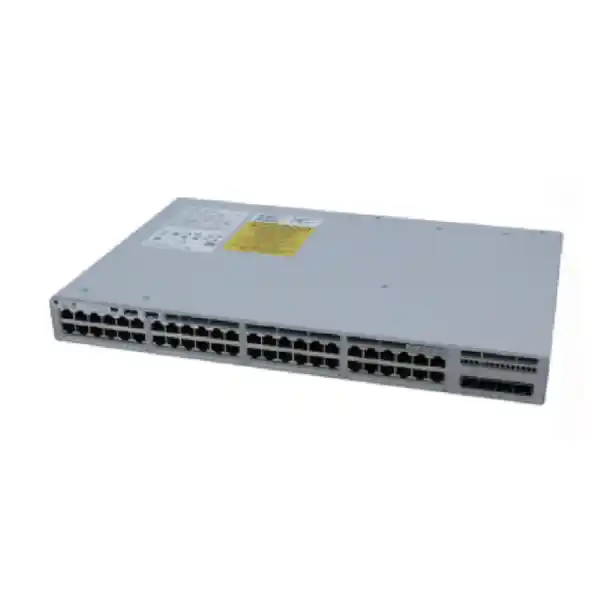
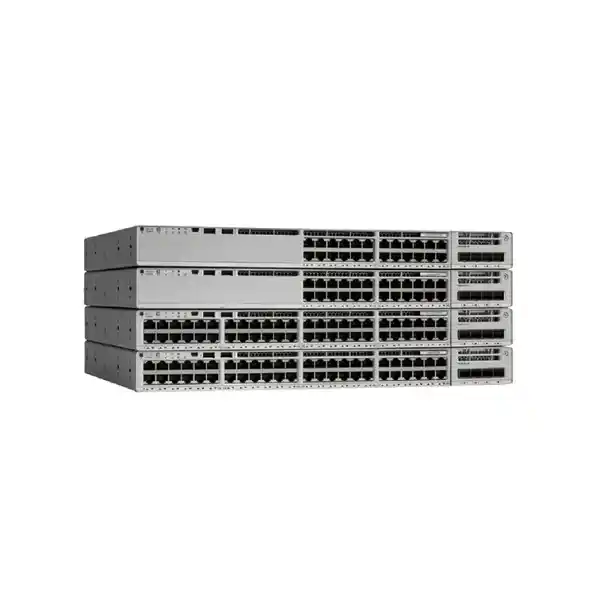
Cisco Catalyst C9200-48PL Network Switch
A resilient 48-port Gigabit Ethernet access switch built for organizations that need partial PoE+, modular uplinks, StackWise-160 scale, Cisco IOS XE operations and enterprise-grade segmentation at the campus or branch edge. The C9200-48PL is particularly well suited to offices, education, healthcare, hospitality, retail, government, logistics and distributed UAE environments where a predictable wired access layer must support users, phones, cameras, access points and IoT endpoints without unnecessary chassis complexity.
Why the C9200-48PL exists
The C9200-48PL addresses a common enterprise design requirement: forty-eight copper access ports with PoE+ support, but without assuming that every connected endpoint needs the maximum PoE budget simultaneously. Cisco positions the model as a partial-PoE+ Catalyst 9200 variant. With the default 600 W AC power supply, it provides a 370 W PoE budget, creating a practical balance between power delivery, rack power draw and acquisition cost for floors where desk phones, cameras and selected wireless access points share the same switch.
Where it fits in the network
This platform is designed primarily as an access-layer switch rather than a data-center leaf or high-density multigigabit aggregation device. It belongs close to users and endpoints, typically in an intermediate distribution frame, branch communications room or compact campus rack. Its role is to terminate Ethernet, enforce access policy, supply PoE+, provide VLAN and routing boundaries where appropriate, and hand traffic to redundant distribution or core switches through modular 1G or 10G uplinks.
Core hardware architecture and verified performance
The C9200-48PL is a full Catalyst 9200 modular-uplink model with forty-eight 10/100/1000BASE-T PoE+ copper interfaces. Unlike the fixed-uplink Catalyst 9200L family, the C9200 platform uses replaceable network modules for uplink flexibility. This distinction matters when a design needs to start with Gigabit fiber and later move to 10 Gigabit Ethernet without replacing the entire access switch. It also matters for lifecycle planning because the C9200 models support StackWise-160 and use field-replaceable fans, while the fixed-uplink 9200L class is architecturally more constrained.
Cisco specifies 176 Gbps of switching capacity for the C9200-48PL in standalone operation and 336 Gbps of switch capacity with stacking considered. The published forwarding rate is 130.95 million packets per second in standalone mode and up to 250 Mpps with stacking. These figures are appropriate for line-rate campus access workloads where many Gigabit edge ports converge into multiple fiber uplinks and where the engineering goal is to avoid an undersized switching fabric becoming the limiting factor during busy periods.
The platform supports a 32,000-entry MAC address table, a 6 MB packet buffer for its 48-port Gigabit Ethernet configuration, 4 GB of DRAM, and up to 16,000 Flexible NetFlow flow entries. Cisco also publishes a total IPv4 route scale of 14,000 entries for C9200 SKUs, composed of direct and indirect route resources according to the platform profile. These capacities make the switch suitable for typical enterprise segmentation, campus routing and operational telemetry tasks, while still positioning it correctly below larger Catalyst 9300 and 9400 platforms intended for greater scale or feature density.
Detailed port map and connectivity design
48 x 1G access interfaces
All forty-eight front-panel access interfaces operate as copper Gigabit Ethernet ports and support PoE+. In a user-access deployment, ports can be divided among desktops, IP phones, printers, video surveillance cameras, room systems, badge readers, wireless access points and other Ethernet endpoints. VLAN assignment, port security, authentication and quality-of-service policy can then be applied per interface or through repeatable templates.
Modular fiber uplinks
The C9200-48PL accepts modular uplink options, including modules that provide 1 Gigabit or 10 Gigabit Ethernet connectivity. This lets the project team align optics and link speeds with the distribution design instead of accepting a permanently fixed uplink block. In practice, dual 10G fiber uplinks are a common choice where forty-eight edge ports must reach a redundant distribution pair with comfortable headroom.
StackWise-160 interfaces
StackWise-160 provides up to 160 Gbps of stack bandwidth and allows multiple compatible C9200 switches to operate as a single logical switching system. Stacking simplifies management, can improve cross-switch link resiliency and supports growth when one communications room expands from forty-eight ports to several hundred ports over time.
Console and management access
Operational deployment includes local console access for staging and recovery, along with in-band management through the production or dedicated management network. A well-designed build separates administrative addressing, AAA, logging and time synchronization from general user traffic, making the switch easier to monitor and safer to operate throughout its lifecycle.
PoE+ engineering: the most important sizing decision
The phrase “48-port PoE+ switch” does not mean that every 48-port model can deliver 30 W to all forty-eight ports at the same time. The C9200-48PL is specifically a partial-PoE+ model. With the default PWR-C6-600WAC power supply, Cisco specifies 370 W of available PoE power. With a second compatible 600 W AC power supply installed, the available PoE budget can rise to 740 W. This is the key engineering distinction between the C9200-48PL and full-PoE models such as the C9200-48P.
A 370 W budget is often sufficient for office floors dominated by 802.3af IP phones and a limited number of 802.3at wireless access points, cameras or room devices. For example, twenty-four phones averaging 7 W consume about 168 W, leaving roughly 202 W for other powered devices before engineering reserve. By contrast, a video-heavy floor with forty cameras drawing 12 W each already requires approximately 480 W, exceeding the default single-supply budget. The same issue arises when many access points need near-30 W allocation. The switch port count may look adequate while the electrical budget is not.
FourTeck therefore treats PoE sizing as a per-device calculation, not a switch-label assumption. The bill of materials should include the number of powered endpoints, each device class, negotiated power, startup behavior, planned growth and the acceptable failure mode if a power supply is removed. If a second supply is being considered purely to expand PoE budget, the design also needs to decide whether that supply is expected to serve as true redundancy. Consuming the combined power capacity heavily can mean that a PSU failure forces the switch to shed PoE load even though the switching control plane remains operational.
For UAE projects, this analysis is especially useful in IP telephony, CCTV, Wi-Fi and smart-building networks where one access switch may power endpoints from multiple disciplines. A port schedule that records device name, location, VLAN, expected wattage and criticality creates a far more reliable procurement baseline than simply ordering one PoE switch for every forty-eight outlets.
Power supplies, redundancy and field serviceability
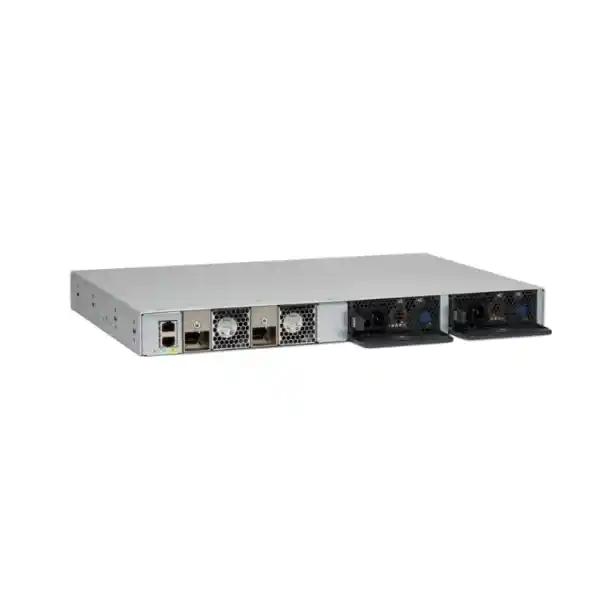
The C9200-48PL chassis has two internal power-supply slots. Cisco identifies a 600 W AC unit as the default supply for this model. The architecture can operate with one installed power supply and a blank in the second slot, or with two compatible supplies where additional power capacity and redundancy are required. Cisco’s hardware guidance states that the power-supply slots should remain properly populated for airflow and chassis integrity; an unused slot is fitted with a blank module rather than left open.
The redundant power-supply design is valuable in business-critical access networks because a failed supply can be replaced without treating the entire switch as disposable hardware. However, redundancy must be engineered at the electrical source as well as inside the chassis. Two supplies connected to the same single power strip do not provide the same resilience as feeds connected to independent UPS-backed circuits or appropriately separated power sources. For high-availability floors, FourTeck recommends documenting both the switch PSU topology and the upstream rack-power topology.
Field-replaceable fan modules are another operational advantage of the modular C9200 platform. Rather than replacing the whole switch because of a fan issue, service teams can stock compatible fan spares and follow controlled replacement procedures. This matters in UAE facilities where edge closets may be distributed across many floors, remote warehouses or branches and where a simple FRU replacement can be more practical than arranging a full switch swap during business hours.
Uplink module selection: 1G versus 10G
The modular uplink architecture is one of the strongest reasons to choose the C9200-48PL over a fixed-uplink access switch. A small branch with modest traffic may be adequately served by Gigabit fiber uplinks, particularly where its WAN circuit is significantly slower than 1 Gbps. A dense office floor, however, can easily aggregate many simultaneous desktop, voice, video and wireless flows, making 10G uplinks a more appropriate design choice. The decision should be based on utilization and growth, not only today’s Internet speed.
For a dual-homed campus access layer, 10G SFP+ uplinks provide comfortable headroom and allow EtherChannel or other resilient topologies depending on the upstream architecture. Optic selection must match fiber type, distance and connector plan. Multimode OM3 or OM4 runs inside a building often use short-reach optics, while longer campus or inter-building paths may require single-mode optics. The patch panel, fiber polarity, transceiver support matrix and upstream port type should all be validated before materials are ordered.
FourTeck also checks whether the customer actually needs four active uplink ports or only two, because this affects optic quantity, patching, spanning-tree or routed-access design, and spare capacity. The objective is to create a clean path from edge port to core rather than to populate every socket merely because it exists.
StackWise-160 and scalable access closets
StackWise-160 lets compatible Catalyst 9200 switches be interconnected into a stack with 160 Gbps of stack bandwidth. In practical terms, the stack is managed as a coordinated system, which can simplify configuration consistency and reduce the number of individually managed devices in a communications room. A stack can also provide better design options for servers, uplinks or downstream devices that use links distributed across different stack members.
Stack design is not simply “connect all switches in a chain.” Resilient deployment uses a ring topology so that the failure of one stack cable does not automatically partition healthy members. Cable length, member order, rack position and maintenance access should be planned before installation. When a floor requires three or four 48-port switches, the physical rack layout should make it possible to replace a member without disturbing unrelated fiber and copper patching.
Stacking also changes failure-domain thinking. A stack may be operationally simpler than several standalone switches, but it becomes a coordinated system with shared software and control characteristics. Change windows, image upgrades, stack master behavior and version compatibility therefore need to be managed deliberately. For sites that value fault isolation over simplified management, standalone switches with independent routed uplinks may still be preferable.
FourTeck evaluates stack topology together with business criticality. A user office with hundreds of similar desks may benefit from a single managed stack, while a control environment or high-value operational zone may justify separate fault domains. The C9200-48PL gives the designer both options rather than forcing a fixed architecture.
Layer 2 services for enterprise access
At the access layer, reliable Layer 2 behavior remains fundamental. The C9200-48PL supports enterprise VLAN segmentation so users, voice devices, cameras, wireless infrastructure, printers, building systems and guest services can be separated into appropriate broadcast and security domains. A clean VLAN plan should use consistent numbering and naming, define trunk allowances explicitly and avoid extending unnecessary VLANs across the campus.
Spanning Tree Protocol remains important wherever the design contains Layer 2 redundancy. Organizations should choose a defined spanning-tree mode and root-bridge strategy rather than relying on accidental defaults. Access ports can be optimized for endpoint attachment with edge behaviors, while protections such as BPDU Guard help reduce the risk of an unmanaged switch or accidental loop destabilizing the network. Root Guard, loop protection and storm-control policies can be introduced where the design requires them.
Link aggregation using EtherChannel can combine multiple physical links into one logical bundle for bandwidth and resiliency. This is useful for uplinks to distribution switches, selected servers or downstream infrastructure, provided both ends are configured consistently. LACP is commonly selected when standards-based negotiation is desired. The important operational point is that aggregated links should be monitored as a bundle and as individual members; a channel that remains “up” with one failed member may still be operating below its intended capacity.
For voice deployments, access ports can be structured with a data VLAN for the attached workstation and a voice VLAN for the IP phone. Quality-of-service classification and trust boundaries should be defined based on the telephony architecture rather than blindly trusting all endpoint markings. This lets the switch preserve voice performance while preventing ordinary traffic from claiming priority treatment.
Layer 3 routing and branch design
Although the C9200-48PL is widely deployed as a Layer 2 access switch, Catalyst 9200 software also supports Layer 3 capabilities that can be used for inter-VLAN routing, routed uplinks and branch segmentation depending on the selected software entitlement. This enables designs where the access layer participates directly in IP forwarding rather than extending every user VLAN back to a central core.
Routed access can reduce spanning-tree scope and create clearer failure boundaries, but it also increases the number of routing adjacencies and demands disciplined IP addressing. Static routing may be sufficient for a small branch, while dynamic routing is more appropriate when multiple paths and rapid convergence are required. The correct architecture depends on the upstream platform, licensing level, operational skill set and whether the network team is standardizing on a campus fabric or conventional three-tier design.
The published C9200 platform scale of up to 14,000 IPv4 routes is ample for many campus and branch roles, but table scale should never be treated as the only sizing criterion. ACL entries, multicast needs, policy, telemetry and routing protocol requirements also influence platform suitability. For very large campus distribution roles, dense VRF requirements or advanced services, a higher Catalyst family may provide a more appropriate resource envelope.
Security at the wired edge
The access switch is one of the first enforcement points encountered by a device joining the corporate network. That makes identity, segmentation and endpoint control as important as raw switching capacity. The C9200-48PL can participate in a structured access-control design using capabilities such as 802.1X, MAC Authentication Bypass where appropriate, RADIUS-based authorization, VLAN assignment and access control lists. The exact feature set and scale should be verified against the chosen software package and current Cisco release.
A mature configuration treats authentication failures and exceptions as design cases, not surprises. Printers, cameras and embedded controllers may not support interactive 802.1X, so they often need controlled alternative onboarding. Guest and contractor access should be separated from trusted corporate endpoints. Administrative switch access should be protected by AAA, role-based privileges, SSH, secure management protocols and centralized logging rather than shared local credentials.
Layer 2 protections also reduce common local-network risks. DHCP snooping, Dynamic ARP Inspection, IP Source Guard, port security, storm control and carefully defined trunk behavior can help contain spoofing, loops and accidental misconfiguration when deployed correctly. These mechanisms require coordinated design because one feature may depend on another. For example, Dynamic ARP Inspection commonly relies on trusted DHCP snooping information, so enabling it without understanding the DHCP path can disrupt legitimate hosts.
Quality of Service for voice, video and business applications
Trust boundary
QoS begins with deciding which markings can be trusted. A managed IP phone may be allowed to mark voice traffic while a general desktop should not automatically receive the same privilege. The switch can classify and remark traffic so priority classes reflect policy rather than endpoint choice.
Queue design
Latency-sensitive voice and interactive video should receive predictable treatment during congestion, while bulk backups and low-priority traffic should not starve critical applications. Queueing policy must be coordinated end to end, including access, distribution, WAN and firewall boundaries.
Capacity first
QoS is not a substitute for adequate bandwidth. If a floor consistently saturates its uplinks, prioritization may protect selected traffic but users will still experience congestion. Utilization data should therefore guide uplink speed, port-channel sizing and upgrade decisions.
Operational validation
After policy deployment, engineers should verify class counters, drops and markings rather than assuming the configuration behaves as intended. Periodic review is useful when collaboration platforms, camera bitrates or wireless traffic patterns change.
Flexible NetFlow and operational visibility
Cisco publishes support for up to 16,000 Flexible NetFlow entries on the 48-port Gigabit Ethernet C9200 platform. Flow telemetry can help the network team understand which hosts communicate, where bandwidth is consumed and what traffic patterns appear during an incident. Used with a collector or analytics platform, flow records can support capacity planning, troubleshooting and security investigation without requiring packet capture at every access closet.
NetFlow should be designed selectively. Exporting every possible field from every interface at high frequency may create unnecessary CPU, bandwidth and collector load. A better approach identifies the operational questions that matter, chooses the appropriate record fields and exports from relevant interfaces. For example, an organization may prioritize ingress visibility from user VLANs and uplinks while excluding noisy infrastructure flows that offer little troubleshooting value.
Visibility should also include SNMP or model-driven telemetry as appropriate, syslog, interface error counters, PoE state, temperature, fan and PSU status, stack health, spanning-tree changes and authentication events. The goal is to move from reactive “is the port green?” troubleshooting to a monitored access layer where degradation can be detected before it becomes a large outage.
Cisco IOS XE operations and lifecycle discipline
Catalyst 9200 switches run Cisco IOS XE, giving network teams a familiar operational model across modern Catalyst platforms. The software environment supports CLI-based administration, structured APIs and integration with Cisco management platforms depending on the organization’s architecture. For engineers migrating from older Catalyst generations, the biggest improvement often comes not from one command but from standardizing software versions, configuration templates, telemetry and change control.
A production deployment should define a preferred IOS XE release train, test it against required features and maintain a documented upgrade path. Newer is not always automatically better for every environment; a release should be selected based on Cisco guidance, security fixes, feature requirements, hardware support and organizational change policy. Mixed versions across a stack or fleet can complicate troubleshooting, so consistency has operational value.
Configuration backups should be automated and versioned. A startup configuration on the switch is necessary but not sufficient as the organization’s only backup. External configuration archiving makes it possible to compare changes, restore a failed replacement unit and audit modifications. Software images, licenses, transceiver inventories and serial-number records should be kept with the site documentation so an emergency replacement can be prepared quickly.
FourTeck deployment services can include staging, base hardening, VLAN and routing configuration, uplink setup, stack provisioning, PoE validation, acceptance testing and as-built documentation. Organizations that require a wider network implementation scope can also use the team’s UAE IT services capability for structured rollout and support.
Licensing: Network Essentials, Network Advantage and subscription planning
The C9200-48PL is available in ordering variants associated with Network Essentials and Network Advantage. Cisco ordering commonly identifies the software level in the product number, such as “-E” for Network Essentials and “-A” for Network Advantage. The hardware platform may be physically similar, but the software entitlement determines which capabilities are available. Procurement teams should therefore avoid treating the switch chassis and license as independent afterthoughts.
Network Essentials is typically appropriate for standard enterprise access requirements, while Network Advantage is selected when advanced routing, policy or segmentation capabilities are required. Cisco licensing models also involve subscription components and account-based license management. Because Cisco packaging evolves, FourTeck validates the current licensing structure at quotation time rather than relying on an outdated bill of materials copied from a previous project.
The practical licensing conversation starts with features. Does the site need only VLANs, access security, basic Layer 3 and standard campus functions, or does it require advanced routing, richer segmentation, software-defined access integration or additional policy features? The correct answer determines whether an Essentials or Advantage package is appropriate and helps prevent paying for capabilities the site will never use.
Smart-account ownership should also be clarified before delivery. The customer should know which Cisco Smart Account and Virtual Account will hold entitlements, who has administrator access, and how renewal responsibility is assigned. This avoids a common post-installation problem in which hardware is deployed successfully but software ownership records are fragmented across reseller, integrator and customer accounts.
Physical specifications and rack planning
The C9200-48PL is a 1RU access switch. Cisco lists chassis dimensions of approximately 1.73 x 17.5 x 13.8 inches, or 4.4 x 44.5 x 35.0 cm. With the fan and front-end power components considered, the depth increases to approximately 15.4 inches, or 39.1 cm. The published switch weight is about 12.12 lb, or 5.5 kg. These dimensions make the unit straightforward to install in conventional 19-inch network racks, but rack design should still account for rear clearance, cable bend radius and PSU access.
Access closets become difficult to service when switches are mounted without a patching plan. A clean layout typically coordinates 48-port patch panels, horizontal cable managers, switch positions and fiber shelves so copper patch cords remain short and ports can be identified visually. Where two or more C9200-48PL units are stacked, arranging members contiguously helps stack-cable routing and maintenance.
Thermal conditions are equally important. Even a reliable enterprise switch can suffer if installed in a sealed cabinet with inadequate ventilation, dust loading or failed room cooling. UAE deployments should account for local ambient conditions, especially in warehouses, guard rooms, temporary structures and remote equipment spaces where HVAC performance may be less controlled than in a central data room. Environmental monitoring and periodic inspection reduce the risk of heat-related faults.
Reliability, maintainability and spare strategy
Cisco publishes a mean time between failures figure of 375,570 hours for the C9200-48PL platform. MTBF is a statistical reliability measure rather than a promise that an individual unit will operate for a specific number of years. In procurement planning, it is best used as one input alongside redundancy, replacement logistics, software support and the business impact of an access-switch outage.
The field-replaceable fans and dual PSU slots improve serviceability because common hardware faults do not always require complete chassis replacement. Nonetheless, many organizations keep one compatible spare switch per site cluster, especially where after-hours operations or remote locations make same-day logistics uncertain. A cold spare should be maintained with a supported software image and documented baseline configuration so it can be introduced rapidly.
Spare strategy should also cover optics, patch leads, stack cables and at least one power supply type used across the fleet. Standardizing a deployment on a small number of compatible C9200 variants can reduce spare complexity. Conversely, mixing many similar but non-identical switch models across a campus may create confusion around uplink modules, fan types, PoE budgets and software feature sets during an emergency.
Use case 1: office floor with IP phones and wireless access points
Consider a Dubai office floor with 120 staff distributed across three communications zones. Each zone requires approximately thirty wired workstations, twenty IP phones, four printers and four wireless access points. A C9200-48PL can serve one zone with enough physical ports for the endpoint count, but PoE sizing still needs attention. If the phones draw approximately 7 W each, twenty phones require about 140 W. If four access points are budgeted at 25 W each, another 100 W is required, creating a working total near 240 W before margin. The default 370 W PoE budget is therefore comfortable for that zone.
The design could use separate data, voice, corporate Wi-Fi management and printer VLANs. Phone ports may carry both access data and a voice VLAN. Wireless AP ports would be trunks or otherwise configured according to the wireless architecture. Dual 10G uplinks can connect the access switch to a redundant distribution pair, while network access control applies user and device policies.
This is a strong C9200-48PL use case because the physical port count is high but the PoE requirement is moderate. Selecting a full 1440 W PoE platform would add capacity that the floor may never use. The partial-PoE model lets the project align switch choice with actual powered-device density while retaining modular uplinks and stacking.
Use case 2: IP surveillance and building systems
A surveillance project requires a different calculation. Forty 4K cameras may each consume 10 to 15 W under normal conditions, while PTZ cameras, heaters or infrared illumination can increase demand. At only 12 W average, forty cameras require 480 W, which already exceeds the 370 W PoE budget of a single default C9200-48PL supply. The switch has enough ports but not enough default PoE capacity for that load.
One option is to install a second compatible 600 W supply, increasing available PoE budget to 740 W. Another is to choose a full-PoE model if the design requires greater redundancy margin or future camera growth. A third is to distribute cameras across more switches, which can reduce fault concentration and simplify cable distances. The correct answer depends on camera power class, rack power, UPS capacity and the business requirement if one PSU fails.
Security networks also need traffic engineering. High-resolution cameras can produce sustained bandwidth rather than user-style bursts. Uplink utilization should therefore be calculated from expected average and peak bitrates, recording server location and retention architecture. A switch that is electrically sufficient but connected upstream by an undersized uplink can still create dropped frames or recording gaps.
Use case 3: branch office with local routing
A branch office may use the C9200-48PL as both the wired access platform and a local Layer 3 boundary. User, voice, guest, CCTV and management networks can be segmented into separate VLANs, with selected routing occurring at the switch while Internet and security policy are enforced by the branch firewall. This reduces unnecessary Layer 2 extension and creates a compact architecture for sites that do not justify a dedicated distribution switch.
The branch design should define default-gateway placement, routing adjacency with the firewall, first-hop redundancy if multiple switches are used, DHCP relay, QoS and failure behavior. Where only one switch exists, the simplicity is attractive but the device is also a single point of failure. Adding a second switch or stack can improve physical port and uplink redundancy, while dual power supplies can improve PSU resilience.
For multi-site organizations, template consistency matters more than individual-site cleverness. VLAN numbering, management addressing, AAA, SNMP, syslog, NTP, interface descriptions and routing conventions should be standardized across UAE branches. A predictable configuration lowers troubleshooting time and makes central monitoring more effective.
Use case 4: education and training campuses
Schools, colleges and training centers frequently combine staff devices, student labs, classroom AV, wireless access points, IP phones, surveillance cameras and building controls on the same physical access infrastructure. The C9200-48PL can segment these groups while providing PoE+ to selected devices. The ability to stack multiple units is useful in floor distributors where classroom density drives large copper port counts.
Education networks also experience sharp traffic changes during exam periods, software updates and class transitions. Uplink design should account for simultaneous wireless and wired use rather than a simple average. Access-control policy should distinguish managed faculty devices, lab computers, student BYOD and infrastructure endpoints. Guest and IoT devices should not automatically share the same trust level as administrative systems.
From an operational perspective, centralized logging and consistent port descriptions are especially valuable because classroom moves happen frequently. A documented switch-port map linked to room numbers and patch-panel positions can save substantial troubleshooting time during term changes. FourTeck can integrate the switching scope with broader UAE infrastructure planning through FourTeck UAE.
Use case 5: hospitality and retail networks
Hotels, restaurants and retail sites often combine point-of-sale systems, guest Wi-Fi, staff devices, IP phones, cameras, digital signage, access control and building automation. A 48-port switch can consolidate these endpoints at an access closet while VLAN policy separates payment, guest, operations and surveillance traffic. The C9200-48PL’s partial-PoE model is attractive when only a subset of ports power devices, but a precise endpoint inventory is essential because camera and Wi-Fi density can increase quickly.
Resilience priorities differ by service. A failed guest-room data port may have limited impact, while a switch outage affecting payment terminals, reception phones and security cameras can disrupt core operations. Critical endpoints can be distributed across two switches or separate stacks so one hardware failure does not remove every service in an area. Uplinks should also be physically diverse where the building allows it.
Retail chains benefit from repeatable staging. Each store can receive a switch preconfigured with a standard template, device VLANs, management addressing and uplink conventions. Local installation then becomes a controlled cabling and validation task rather than full configuration from scratch, reducing deployment variation across many sites.
Sizing methodology: choose the switch from the workload backward
A reliable switch selection process begins with the endpoint schedule. Count wired ports that must be active on day one, add planned growth and identify every endpoint requiring power. Then classify each powered endpoint by expected and maximum wattage. Separate ordinary office devices from high-draw cameras, access points and room systems. This produces both a port-count requirement and a PoE requirement.
Next, calculate uplink demand. Look at user density, Internet usage, east-west application traffic, Wi-Fi throughput, video streams and backup behavior. A 1G uplink may be adequate for a small branch, but a 48-port floor with modern wireless and collaboration traffic often justifies 10G. Consider redundancy at the same time: two independent 10G uplinks to a distribution pair are different from one 20G EtherChannel to a single upstream switch.
Then evaluate feature requirements. If advanced routing, richer segmentation or specific Cisco architecture features are required, choose the correct Network Advantage entitlement rather than assuming Network Essentials is enough. If the switch will be part of a stack, confirm cable length, rack order and compatible members. If the site requires high availability, decide whether dual PSUs are needed and whether the upstream electrical system can support independent feeds.
Finally, validate physical constraints: rack depth, patching, cooling, UPS capacity, fiber type, optic reach and local support logistics. This sequence prevents the common mistake of selecting a model based only on port count and discovering late in the project that PoE, uplinks or licensing are insufficient.
C9200-48PL versus C9200-48P
| Design factor | C9200-48PL | C9200-48P |
|---|---|---|
| Access ports | 48 x 1G PoE+ | 48 x 1G PoE+ |
| PoE positioning | Partial PoE+ | Full PoE+ |
| Default AC supply | 600 W class | 1 kW class |
| Typical single-supply PoE budget | 370 W | 740 W |
| Best fit | Mixed endpoint floors with moderate powered-device density | High-density phones, cameras or APs needing larger PoE headroom |
The switching capacity, stacking class and modular-uplink architecture are broadly aligned, so the decisive difference is frequently power delivery. The C9200-48PL can be the more efficient choice when a floor needs forty-eight ports but only a subset require PoE. The C9200-48P is safer when power demand is high or uncertain. FourTeck compares the endpoint schedule before recommending either platform.
C9200-48PL versus C9200L-48PL
The “L” in Catalyst 9200L is not merely a cosmetic model variation. The fixed-uplink 9200L class uses fixed uplink configurations and StackWise-80, while the modular C9200 family provides replaceable uplink network modules and StackWise-160. The modular C9200 also uses field-replaceable fans, whereas many C9200L models use fixed fans. For projects that value uplink flexibility, stacking bandwidth and field serviceability, the C9200-48PL is the stronger platform.
The C9200L-48PL may still be appropriate where the uplink requirement is known and fixed, the site is cost-sensitive and the lower stacking class is sufficient. The decision should be based on lifecycle needs. If the site is likely to migrate from 1G to 10G uplinks, change fiber architecture or expand its stack, modularity can avoid a later chassis replacement.
Naming similarity makes procurement errors possible, so quotations should list the exact product number, software suffix, uplink module, PSU, stack kit and optics. “Catalyst 9200 48-port PoE switch” is not precise enough for an enterprise bill of materials.
Cabling standards and access-port readiness
Gigabit Ethernet and PoE+ performance depend on the structured cabling system. Category 5e or better is required for standard 1000BASE-T operation, while many new enterprise installations standardize on Category 6 or higher for margin and lifecycle consistency. Cabling should be tested and certified, especially where PoE loads are significant, because resistance, damaged pairs and poor terminations can cause both data errors and power-delivery problems.
Patch leads should be treated as part of the channel, not as disposable accessories. Excessively long, poor-quality or tightly bundled patch cords can make troubleshooting difficult. Labels should identify patch-panel and outlet destinations consistently. For high-density PoE deployments, cable-bundle temperature and installation standards deserve attention because power delivery can increase heat within large bundles.
Fiber uplinks require the same discipline. The selected SFP or SFP+ optic must match fiber mode and distance, and both link ends must support the chosen speed. Cleaning and inspection of fiber connectors before insertion helps prevent intermittent loss that may otherwise be misdiagnosed as a switch fault.
High availability beyond the switch chassis
Dual power supplies and a stack do not automatically create a highly available network. Resilience is end to end. The access layer should have diverse uplinks, redundant upstream switches where justified, independent power feeds, resilient gateway or routing design, and monitoring capable of detecting partial failures. A design that has two PSUs but only one uplink still loses connectivity if that uplink fails.
For a stacked deployment, cross-stack uplinks can reduce dependence on one stack member. Where the upstream layer supports multi-chassis technologies or routed access, links can terminate on separate distribution devices. Spanning-tree or routing behavior should be tested during commissioning by deliberately failing a link, stack member or power feed and observing convergence.
Business requirements should drive the design level. A normal office access closet may accept a short outage during hardware replacement, while a hospital, operations center, logistics hub or hotel may require much stronger continuity. FourTeck maps the technical architecture to the acceptable outage window instead of applying the same redundancy pattern to every site.
Management-plane hardening checklist
Hardening should be applied consistently through templates and validated after every significant software upgrade. A switch is part of the security boundary and should be managed with the same discipline as routers, firewalls and wireless controllers.
Monitoring metrics that matter
Useful monitoring goes beyond simple reachability. Interface utilization should be tracked in both directions and correlated with errors, discards, duplex status and link flaps. High utilization may indicate a need for additional uplink bandwidth, while low utilization with growing errors often points to cabling or optic problems. Port-channel members should be monitored individually so a degraded bundle does not go unnoticed.
PoE telemetry is equally important on the C9200-48PL because the power budget is intentionally lower than a full-PoE 48-port model. Operations teams should alert on budget exhaustion, denied power, PSU failure and unusual device consumption. If new cameras or access points are added over time, historical PoE data can show whether the switch is approaching its electrical limit.
Stack health, fan status, temperatures, CPU, memory, routing adjacency, spanning-tree topology changes and authentication failures should also be visible. Correlating these metrics with configuration changes can shorten incident response. For example, a sudden increase in denied 802.1X sessions immediately after an access-policy change is much easier to diagnose when the monitoring platform retains both event and change context.
FourTeck can align the switching layer with firewall and network-monitoring practices. Customers deploying security platforms around the access network can review related options through Firewall Dubai while keeping switching policy and security enforcement coordinated.
Deployment workflow for UAE projects
A production rollout should begin with design validation, not unboxing. FourTeck reviews the port schedule, PoE load, VLAN map, addressing, uplink topology, optic distances, stack membership, software entitlement and rack power. This confirms whether the C9200-48PL is the correct platform and identifies required accessories before site work begins.
Staging then applies the approved IOS XE release, hostname standards, management addressing, AAA, NTP, logging, SNMP or telemetry, VLANs, trunks, access templates, routing and security features. Stack members can be numbered and cabled logically before delivery. Where the project has many branches, a standard configuration template reduces site-to-site variance while site-specific values are inserted through a controlled parameter set.
Installation includes rack mounting, dual-power connection where ordered, stack and uplink cabling, patching and interface validation. Acceptance testing should confirm management access, uplink redundancy, VLAN reachability, DHCP, DNS paths, PoE device operation, routing convergence and monitoring visibility. If the site has redundant links, one link should be failed deliberately to confirm the expected traffic path.
The final deliverable should include an as-built diagram, port map, IP and VLAN information, switch serial numbers, software versions, license references and configuration backup. This documentation is particularly useful for UAE organizations managing multiple offices from a central IT team.
Procurement considerations in Dubai and the UAE
Enterprise switching quotations should identify more than the base chassis. The exact bill of materials may include the C9200-48PL hardware variant, Network Essentials or Network Advantage entitlement, Cisco subscription term, uplink network module, optical transceivers, stack modules or cables as applicable, secondary power supply, country-specific power cords, rack accessories and support coverage. Omitting one of these items can delay deployment even when the switch itself has arrived.
Availability can vary by product revision, software package and distribution channel, so lead time should be confirmed for the precise SKU rather than for “Catalyst 9200” generally. Organizations with time-sensitive projects should also consider approved alternatives in case a particular software suffix or accessory is temporarily constrained. Substitutions must be reviewed technically because a fixed-uplink 9200L, a modular C9200 and a higher-end C9300 are not interchangeable in every design.
Warranty and support ownership should be clear. The customer should know which entity owns Cisco entitlements, how TAC access is provided, and whether the service model is vendor support, integrator support or both. Serial numbers should be captured at receipt and mapped to their physical site to simplify future RMA and renewal work.
For customers with procurement or deployment requirements outside the UAE, FourTeck can coordinate broader engagement through FourTeck Global while maintaining a consistent technical bill of materials.
Common design mistakes to avoid
Counting ports but not watts
Forty-eight PoE-capable ports do not guarantee 30 W on every port simultaneously. Build a powered-device budget and reserve margin before selecting the C9200-48PL.
Buying uplinks late
The switch needs the correct network module and optics. Choosing the chassis without deciding 1G versus 10G fiber can create last-minute procurement delays.
Ignoring licensing
Network Essentials and Network Advantage are not equivalent. Confirm required routing, segmentation and automation features against the current Cisco package.
No failure test
A redundant diagram is only a theory until links, PSUs and stack scenarios are tested. Commissioning should validate actual convergence and endpoint impact.
Technical specification summary
Published platform values should be interpreted together with the selected IOS XE release, software entitlement, network module and actual deployment configuration. FourTeck validates current ordering and compatibility details when preparing a quotation.
Frequently asked technical questions
Does the C9200-48PL provide PoE+ on all 48 ports?
All forty-eight access ports are PoE+ capable, but the model is designed for partial PoE. Total simultaneous power is limited by the installed power supplies. With the default 600 W AC supply, Cisco specifies 370 W available for PoE.
Can the PoE budget be increased?
Yes. Installing a second compatible 600 W AC power supply can increase available PoE to 740 W. The project must still consider redundancy behavior if the combined load exceeds what one supply can support.
Does it have fixed uplink ports?
No. The C9200-48PL is a modular-uplink Catalyst 9200 model. Suitable network modules provide 1G or 10G uplink options, allowing the deployment to match fiber and aggregation requirements.
Is it stackable?
Yes. It supports StackWise-160 with up to 160 Gbps of stacking bandwidth. Stack architecture, cables and software compatibility should be included in the project design.
Should I choose Network Essentials or Advantage?
Choose based on required routing, segmentation, policy and automation features. Essentials fits many access deployments; Advantage is selected when the project needs advanced capabilities. FourTeck validates the current Cisco licensing package at quote time.
Is the C9200-48PL suitable for Wi-Fi access points?
Yes for APs whose Ethernet speed and power requirements fit the platform. Because the access ports are 1G, Wi-Fi designs requiring multigigabit wired interfaces should consider an appropriate Catalyst mGig model instead.
When the C9200-48PL is the right choice
Choose the C9200-48PL when the requirement is a resilient enterprise access switch with forty-eight Gigabit Ethernet copper ports, a moderate PoE+ workload, modular fiber uplinks and StackWise-160. It is especially compelling when the project does not need multigigabit access ports and does not need the maximum PoE budget available from the full-PoE 48-port model.
It is also a strong fit where serviceability matters. Dual power-supply slots and field-replaceable fans support a more maintainable lifecycle than fixed-component edge switches. Modular uplinks preserve flexibility if the distribution layer changes from 1G to 10G over time. Cisco IOS XE and Catalyst operational tooling provide a familiar foundation for organizations already standardized on Cisco campus infrastructure.
The platform becomes less appropriate when a large percentage of ports require high PoE simultaneously, when Wi-Fi access points need 2.5G or 5G wired interfaces, when the site needs very high VRF or route scale, or when 25G and 40G uplinks are required. In those cases, another Catalyst 9200 variant or a higher Catalyst family should be assessed rather than forcing the C9200-48PL beyond its intended role.
Why purchase through FourTeck UAE
Enterprise network hardware creates the most value when the bill of materials is correct before shipment. FourTeck’s role is not limited to supplying the switch chassis. The team can review the number of access ports, PoE demand, uplink topology, optic type, StackWise requirements, software entitlement, rack power and support plan so the ordered configuration is aligned with the target network.
For Dubai and UAE customers, this reduces the risk of receiving a switch without the required uplink module, ordering the wrong power supply quantity, choosing an insufficient PoE model or selecting a license that does not support the planned architecture. Technical pre-sales review is particularly useful for multi-floor and multi-site deployments where small differences in the bill of materials multiply across many switches.
FourTeck can support a complete lifecycle from design and supply through staging, installation, migration, documentation and ongoing support. The objective is a working access layer with known performance, security and recovery behavior, not simply a delivered cardboard box.
Decision recap: validate five items before ordering
The C9200-48PL is a technically strong choice when its partial-PoE design matches the endpoint mix. Before approving the purchase, confirm the following engineering decisions so the final bill of materials works on day one and remains supportable as the site grows.
Quotation input checklist
Providing the information below allows FourTeck to size the C9200-48PL accurately and quote the required accessories without unnecessary revisions. Exact values are preferable, but approximate counts are enough to begin a technical review.
Consult FourTeck on the exact C9200-48PL build
A correct C9200-48PL quotation should resolve PoE budget, uplink module, optics, software entitlement, secondary power, stacking and support as one integrated design. FourTeck can review an existing network diagram or build the requirement from a simple endpoint count and floor plan. This is particularly useful when replacing older Catalyst 2960, 2960X, 3560 or 3650 access switches, because the modern platform introduces different licensing, uplink and power choices.
For a migration, FourTeck can also map the legacy VLANs, trunks, spanning-tree priorities, QoS, voice configuration, port-security policy, routing and management settings into a controlled IOS XE deployment. The transition plan can be designed to reduce user downtime and preserve rollback options. Where multiple access closets are involved, staged migration by floor or business area helps contain risk.
Use the consultation request to share switch quantity, site locations, approximate PoE device counts and uplink preferences. FourTeck will identify whether the C9200-48PL is the correct model or whether a full-PoE, multigigabit or higher-scale Catalyst platform better matches the requirement.
- 48 x Gigabit access ports
- Moderate PoE+ density
- 1G or 10G modular fiber uplinks
- StackWise-160 requirement
- Enterprise access security
- Dubai and UAE campus or branch deployment
FourTeck provides enterprise networking solutions, project design, supply, implementation and lifecycle services in the UAE and for international requirements. Product specifications, software features and licensing are subject to the exact Cisco SKU, selected release and current vendor program at the time of quotation.

Reviews
There are no reviews yet.