
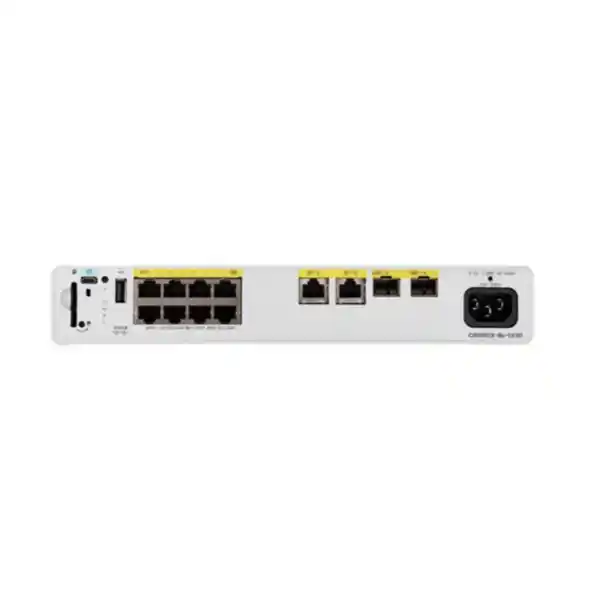
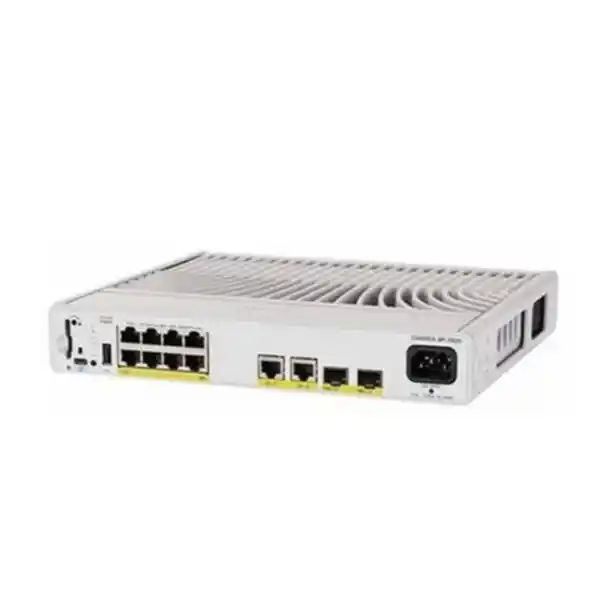
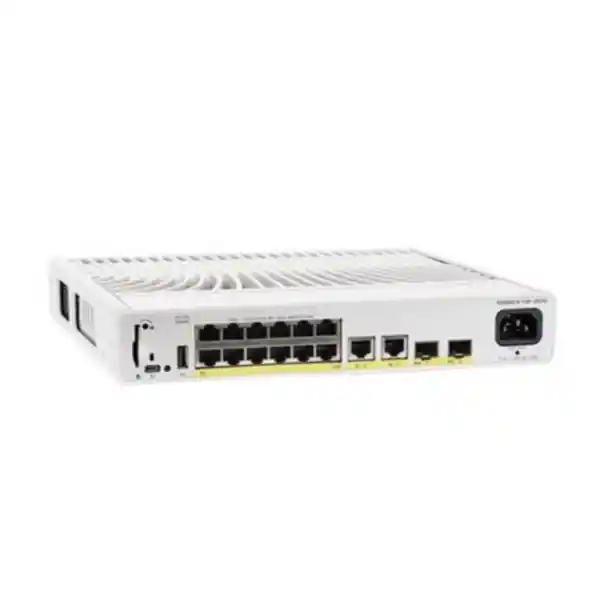
Cisco Catalyst C9200CX-8UXG-2XH Network Switch in Dubai, UAE
The Cisco Catalyst C9200CX-8UXG-2XH is engineered for enterprise access networks that need multigigabit copper, high-power UPOE, 10G optical uplinks, fanless acoustics, and flexible high-voltage AC or DC power in a compact chassis. It is particularly valuable where Wi-Fi access points, video endpoints, cameras, building systems, thin clients, compact servers, or specialized edge devices need more bandwidth and more power than a conventional 1G PoE access switch can provide.
Direct answer: what is the C9200CX-8UXG-2XH designed to do?
It is a compact enterprise access switch for locations where a full-depth, fan-cooled access chassis is unnecessary or difficult to place, but where the network still requires advanced Cisco switching functions, high-power endpoint delivery, and multigigabit Ethernet. The eight copper downlink ports all support Cisco UPOE based on IEEE 802.3bt Type 3 Class 6 power delivery. Four downlinks operate at conventional 10/100/1000 rates, while four multigigabit interfaces can negotiate 10M, 100M, 1G, 2.5G, 5G, or 10G speeds. This makes the platform especially relevant to contemporary wireless access points whose aggregate radio capacity can exceed 1Gbps, as well as edge devices that need more than standard PoE+ power.
The switch uses two fixed SFP+ uplink interfaces capable of 10G operation, giving the network designer a straightforward way to connect the compact edge to a distribution switch, core switch, local aggregation pair, or fiber handoff. The chassis is fanless, so it can be deployed close to occupied areas where acoustic noise must be minimized. Cisco specifies a 315W internal HVDC/AC power supply for this “2XH” model, differentiating it from the related AC-only “2X” model and making it applicable to sites that may use high-voltage DC building power architectures as well as supported high-voltage AC input.
For Dubai and UAE deployments, the practical value is not simply that the unit is small. It is the combination of compact dimensions, silent operation, 10G multigigabit access, 60W-class UPOE capability, dual 10G fiber uplinks, IOS XE operations, and enterprise policy controls. That combination is useful in executive offices, education areas, hospitality floors, retail stores, smart-building zones, healthcare rooms, branch offices, distributed IDF locations, and renovated properties where adding a conventional rack or replacing existing copper cabling may be difficult. FourTeck can position the switch as part of a wider UAE switching, wireless, firewall, server, and managed-services architecture rather than treating it as an isolated hardware purchase.
Verified hardware profile and port map
Four multigigabit UPOE ports
Ports in the multigigabit group support Ethernet rates from 10Mbps and 100Mbps through 1Gbps, 2.5Gbps, 5Gbps, and 10Gbps. These are the ports to prioritize for high-throughput Wi-Fi access points or other devices that can exceed a gigabit on copper. For 10GBASE-T operation, structured cabling design, channel length, patching quality, and Category 6A or better cabling should be evaluated carefully.
Four 1G UPOE ports
The remaining four access ports support 10/100/1000 Ethernet and UPOE. They are appropriate for phones, cameras, building controllers, badge readers, room systems, kiosks, conventional access points, or other powered endpoints that do not require multigigabit data rates. Because the overall PoE budget is shared, the design should account for endpoint power demand across all eight ports.
Two fixed 10G SFP+ uplinks
The switch includes two fixed 10G-capable SFP+ uplinks for fiber or supported transceiver-based connectivity. In practice, the uplinks can be used for resilient paths to upstream switching, link aggregation where the chosen design and software features permit, or separation of local and upstream connectivity roles. Optics must be selected according to distance, fiber type, connector presentation, and Cisco compatibility requirements.
Fanless compact chassis
The C9200CX platform is designed for compact deployments and this model has no fans. Its approximately 4.4 × 26.9 × 24.4 cm chassis is considerably shallower than many rack access switches and weighs about 3.18 kg. Fanless operation helps in spaces such as meeting rooms, retail floors, hospitality cabinets, classrooms, clinics, and architectural network enclosures where mechanical noise is undesirable.
Core specifications for solution sizing
| Access interfaces | 8 copper UPOE downlinks: 4 × 10/100/1000 and 4 × 10/100/1000/2.5G/5G/10G multigigabit |
| Power over Ethernet | 802.3bt Type 3 Class 6, up to 60W class capability per supported downlink, subject to the shared system budget |
| Available PoE budget | Up to 240W |
| Uplinks | 2 × fixed 10G SFP+ uplink ports |
| Switching capacity | 128Gbps |
| Forwarding performance | Approximately 95.23Mpps using 64-byte packets, as specified for the model family table |
| Forwarding silicon | Single Cisco UADP 2.0 mini ASIC architecture for the compact platform |
| Memory platform details | Architecture documentation shows 4GB RAM and 8GB flash for the C9200CX-8UXG platform |
| Power supply | 315W internal HVDC/AC power supply |
| Cooling | Fanless |
| Dimensions | 1.73 × 10.6 × 9.6 in. / approximately 4.4 × 26.9 × 24.4 cm |
| Weight | Approximately 7.0 lb / 3.18 kg |
| Reliability reference | Cisco lists an MTBF figure of approximately 709,660 hours for this model in the current data sheet |
Why multigigabit access matters for UAE enterprise networks
Traditional access switching was built around the assumption that a user or endpoint rarely needed more than a 1Gbps copper interface. Modern wireless designs challenge that assumption. Wi-Fi 6 and Wi-Fi 6E access points can aggregate traffic from many clients, use wider channels, support multiple radios, and require uplinks above 1Gbps to avoid turning the wired connection into a bottleneck. A multigigabit switch such as the C9200CX-8UXG-2XH allows the same twisted-pair cabling environment to support intermediate 2.5G and 5G rates, while selected ports can also reach 10G when the cable category, channel quality, and endpoint capability support it.
This is relevant in Dubai offices where wireless is often the primary user-access medium and where floor layouts may be changed more frequently than the structured cabling system. Instead of replacing an entire access layer to gain a small number of higher-speed ports, an organization can place a compact multigigabit switch close to the endpoints that actually need the bandwidth. A meeting suite might use two multigigabit ports for high-capacity access points, one for a room collaboration appliance, and the remaining ports for phones, control panels, cameras, or conventional 1G devices. A retail flagship might use the faster interfaces for wireless and edge computing while using the 1G UPOE ports for surveillance and point-of-sale infrastructure.
Multigigabit access also helps protect the useful life of existing copper. 2.5GBASE-T and 5GBASE-T were designed to provide faster Ethernet over common installed cabling under appropriate conditions. A site survey should still verify cable category, length, terminations, bundles, patch cords, electromagnetic environment, and certification results. For 10GBASE-T, Category 6A is the preferred enterprise baseline because it provides substantially more predictable channel performance and alien-crosstalk margins than older cabling. FourTeck can combine switch selection with structured cabling validation through its broader UAE IT services capability, helping the project team distinguish a switching requirement from a cabling limitation.
The important design principle is to allocate multigigabit ports to endpoints with a justified traffic profile rather than simply connecting every device at the highest advertised speed. Wireless access points, local content devices, media production endpoints, compact virtualization hosts, analytics appliances, and high-performance workstations are typical candidates. Phones, printers, basic cameras, door controllers, and low-rate IoT equipment rarely need multigigabit bandwidth. By matching each endpoint to the correct port capability, the C9200CX-8UXG-2XH can deliver high edge performance without wasting uplink capacity or PoE budget.
UPOE and the 240W power budget: how to size powered endpoints correctly
All eight access ports on the C9200CX-8UXG-2XH support UPOE capability associated with IEEE 802.3bt Type 3 Class 6, allowing higher-powered devices to request power levels beyond traditional 802.3af and 802.3at designs. Cisco documents a maximum available PoE budget of 240W for the switch. That number is a system budget, not permission to assume eight endpoints can each draw 60W simultaneously. The arithmetic is straightforward: eight devices at a full 60W classification would represent 480W of endpoint demand, which is double the switch budget. A valid design therefore requires an endpoint-by-endpoint power worksheet.
For each powered device, record the manufacturer’s requested PoE standard, maximum power class, typical consumption, worst-case consumption, boot or heater surge where applicable, and operational importance. High-end wireless access points may draw considerably more power when all radios, USB accessories, IoT radios, or scanning functions are enabled. Pan-tilt-zoom cameras can consume more when heaters, infrared illuminators, or motors are active. Video conferencing endpoints may include displays, cameras, microphones, touch controllers, or USB peripherals that change the power profile. Smart-building gateways and edge processors can also have substantial peaks. The switch should be sized for credible worst-case states rather than just idle measurements observed during installation.
A practical example is a compact hospitality or corporate floor serving two premium Wi-Fi access points, two video devices, two cameras, and two phones. If each access point has a maximum requirement of 45W, each video endpoint needs 30W, each camera needs 20W, and each phone needs 10W, the combined design demand is 210W. That falls inside the 240W budget but leaves only 30W of margin. If later firmware enables additional access-point radios or a camera heater, that margin may disappear. In such a case, the network architect could move lower-priority powered devices to another switch, locally power selected endpoints, or split the floor across two compact switches.
Power design must also consider resilience. If a business requires uninterrupted wireless, surveillance, or room systems during a utility outage, the upstream electrical design should place the switch power source on an appropriately sized UPS, centralized DC system, or protected building power architecture. The “2XH” model’s HVDC/AC capability can be relevant to modern building energy designs, but the actual input method, breakers, connectors, grounding, cable routing, and electrical safety requirements must be validated by qualified electrical professionals. PoE is part of an end-to-end power architecture, not an isolated switch feature.
HVDC/AC input: what the “2XH” variant changes
High-voltage AC range
Cisco’s installation specifications list a nominal HVAC range of 100 to 277VAC and a broader full operating range of approximately 90 to 305VAC, with nominal 50/60Hz frequency. For a UAE project, the design team should still confirm the exact regional power feed, plug or terminal implementation, upstream protective devices, UPS output, and compliance requirements for the actual site.
The benefit is flexibility for installations using higher-voltage AC building distribution instead of the more common narrow assumption that compact switching must be limited to a conventional desktop power brick. The internal power supply also reduces dependence on an external adapter that might be difficult to mount securely in a ceiling or furniture enclosure.
High-voltage DC range
Cisco’s HVDC specification lists a DC input range from approximately 120VDC to 418VDC. This capability is relevant to sites exploring DC microgrids, localized energy storage, renewable integration, or building systems that seek to reduce conversion stages. It should never be interpreted as a casual field-wiring option; high-voltage DC requires disciplined electrical engineering, isolation practices, protective devices, labeling, and qualified installation.
Organizations procuring the 2XH variant should identify whether HVDC is an immediate requirement or a future infrastructure strategy. If the site is strictly standard AC and no HVDC transition is planned, the related C9200CX-8UXG-2X model may also warrant commercial comparison. The correct choice depends on power architecture, approved Cisco availability, support policy, and the broader lifecycle plan.
Fanless operation and compact placement in real buildings
Fanless switching changes where an enterprise network device can reasonably be installed. A conventional access switch with multiple high-speed fans is usually placed in a dedicated telecommunications room where noise, heat exhaust, and physical access are controlled. The C9200CX compact platform is intended for environments where those assumptions do not hold. It can be used in space-constrained branches, hospitality locations, retail areas, education spaces, clinics, meeting environments, or distributed edge cabinets where a quiet device is desirable. Removing fans also eliminates a class of moving mechanical components, although the system still depends on correct passive airflow and ambient temperature.
Fanless does not mean ventilation-free. The switch dissipates heat through its chassis and surrounding air, so installers should follow Cisco clearance guidance, avoid blocking ventilation surfaces, and measure the actual temperature close to the unit rather than assuming the room thermostat represents the switch environment. Cisco’s current compact-switch installation guidance lists an operating range for the C9200CX-8UXG-2X and 2XH variants of approximately -5°C to 40°C, with a minimum cold-start ambient of 0°C. In Dubai, ceiling voids, sun-exposed cabinets, decorative millwork, kitchens, plant rooms, warehouse edges, and poorly ventilated wall boxes can exceed comfortable room temperatures even when the occupied space is air conditioned.
Heat planning therefore needs to consider PoE load, adjacent equipment, enclosure material, air path, orientation, solar gain, dust accumulation, and the thermal characteristics of installed SFP or SFP+ optics. Optical modules themselves can impose environmental limits. A compact switch placed in a sealed cabinet beside a UPS and other active devices may experience a far higher local temperature than one mounted in an open, conditioned network room. If the project uses custom furniture, display structures, kiosks, or architectural housings, airflow should be treated as a design requirement from the beginning.
The 1.73-inch chassis height also means the switch can fit in shallow deployments, but the full installation envelope must include cable bend radius, SFP transceiver clearance, power cabling, grounding, service access, and room to disconnect components. A box that technically fits the chassis dimensions can still be operationally unsuitable if technicians cannot see port labels or replace an optic without dismantling the enclosure. FourTeck can plan the device together with racks, cabinets, patching, UPS capacity, and upstream network links through its broader FourTeck UAE infrastructure portfolio.
UADP 2.0 mini ASIC architecture and deterministic access-layer forwarding
Cisco’s architecture documentation identifies the C9200CX-8UXG platform as using a single UADP 2.0 mini ASIC. In practical design terms, the switch is not a collection of independent low-cost Ethernet controllers joined by a general-purpose CPU. Packet forwarding, classification, policy handling, and other data-plane functions are implemented in purpose-built switching silicon. The eight downlinks and uplinks are mapped into the platform’s single-core compact architecture, allowing the switch to provide enterprise Catalyst behavior in a physically smaller and quieter design.
The data plane and control plane perform different jobs. Frames and packets entering an access port are parsed and classified; the forwarding logic determines the appropriate Layer 2 destination, Layer 3 next hop where routing is enabled and licensed, quality-of-service treatment, security policy actions, and egress interface. The CPU is used for control protocols, management, exception traffic, and software functions, while routine line-rate forwarding is handled in silicon. This separation is essential in enterprise access networks because endpoint traffic should not depend on general-purpose CPU processing for every packet.
Cisco lists 128Gbps switching capacity for the C9200CX-8UXG-2XH and a forwarding figure around 95.23 million packets per second for minimum-size packet testing. These figures describe the switching platform’s forwarding envelope, but they should not be treated as an application performance guarantee. Actual user experience depends on port speeds, uplink design, traffic direction, packet size distribution, oversubscription, quality-of-service policy, ACL complexity, encryption features where applicable, endpoint capability, WAN bottlenecks, server response, and wireless airtime. A switch can have substantial internal switching capacity while an application remains limited by a 1G server interface, a congested firewall, an Internet circuit, or a poorly designed WLAN.
For solution sizing, focus on traffic paths. If four Wi-Fi access points each negotiate 5Gbps, their theoretical aggregate access capacity is 20Gbps before considering the four 1G ports. The two 10G SFP+ uplinks can provide meaningful upstream bandwidth, but whether to use one uplink, both uplinks in a port channel, or dual connections to redundant upstream devices depends on the campus architecture and supported resiliency model. The design should account for realistic simultaneous load rather than summing every port’s line rate and assuming all endpoints will transmit bidirectionally at maximum speed forever.
Dual 10G SFP+ uplinks: fiber planning, optics, and redundancy
The two fixed 10G SFP+ uplink ports are central to the usefulness of this compact switch. Multigigabit downlinks only add value if the upstream network can carry the resulting traffic. A single 1G uplink would make a high-performance access layer easy to congest. With 10G uplinks, the switch can connect into modern distribution or core infrastructure using optical fiber or other supported SFP/SFP+ media. The correct optic is determined by link distance, fiber type, connector type, patch-panel presentation, wavelength plan, existing optics at the far end, and Cisco support requirements.
Short multimode links inside a building commonly use 10GBASE-SR optics with suitable OM3 or OM4 fiber, while longer campus or metropolitan paths may require single-mode LR-class optics or another supported transceiver. Exact supported modules should be validated against Cisco’s transceiver compatibility information and the IOS XE release intended for deployment. If an existing fiber path is being reused, technicians should identify both strands, inspect and clean connectors, verify polarity, confirm optical loss, and ensure that patch cords match the installed fiber grade. A surprising number of apparent switching faults are actually contaminated connectors, incorrect fiber types, polarity reversals, or mismatched optics.
Redundancy must also be designed deliberately. Two uplink ports do not automatically create redundancy. The upstream topology, spanning-tree design, EtherChannel or port-channel configuration, first-hop routing architecture, and failure domains determine what happens if an optic, fiber strand, upstream switch, or power source fails. A compact switch in an important conference area might use two diverse fiber routes to separate distribution switches, while a small retail branch might use a single primary 10G uplink and retain the second port for future expansion. The commercial value of the second port depends on the service-availability requirement.
When the C9200CX-8UXG-2XH is integrated with firewalls, servers, wireless controllers, and core switching, FourTeck can evaluate the end-to-end path rather than just the switch port. Organizations planning a wider data-center or branch refresh can also coordinate compute and network dependencies through FourTeck Server Dubai, especially when multigigabit access traffic ultimately terminates on local application, virtualization, storage, or edge-compute systems.
Cisco IOS XE operations, software packages, and lifecycle planning
The Catalyst 9200CX family runs Cisco IOS XE, aligning compact access switching with the operational model used across many Cisco Catalyst campus environments. That consistency matters to administrators who already use standardized configuration templates, AAA systems, SNMP or telemetry monitoring, syslog pipelines, software-image management, VLAN and spanning-tree conventions, network access control, quality-of-service policies, and troubleshooting workflows. A branch or room-level compact switch does not need to become a separate operational island simply because its chassis is small.
Cisco offers the C9200CX-8UXG-2XH in ordering variants associated with Network Essentials and Network Advantage software levels, commonly represented by “-E” and “-A” product suffixes. The base model name alone does not specify which feature tier the buyer intends to purchase. The correct license combination must be chosen according to required routing features, policy capabilities, automation functions, Cisco DNA subscription obligations where applicable, controller integration, lifecycle terms, and the organization’s existing Cisco enterprise agreement or Smart Account structure. Procurement teams should therefore avoid treating the hardware SKU, network software level, and software subscription as interchangeable line items.
Software release selection is also part of implementation. A new switch should not simply be left on whatever image happened to ship from distribution. The deployment team should identify the Cisco recommended or organization-approved IOS XE train, verify feature support, confirm transceiver compatibility, review relevant field notices and security advisories, stage the image, validate boot variables, and document rollback procedures. In a managed environment, configuration backups and software baselines should be captured before the device enters production. If the switch participates in network automation or controller-based management, compatibility should be checked across the whole toolchain.
Lifecycle planning includes Smart Account ownership, entitlement records, serial-number inventory, support coverage, renewal dates, spares strategy, configuration archives, and replacement procedures. Cisco equipment is often deployed for many years, so the operational record created at purchase can matter more than the box label later. FourTeck recommends that the quotation identify the exact Cisco part number, software tier, subscription term, transceiver models, support service, power accessories, mounting accessories, and any implementation scope separately enough that technical and purchasing teams can confirm what is included.
Layer 2 segmentation, security controls, and policy at the compact edge
A compact edge switch often sits physically closer to users and devices than a centralized access chassis, so segmentation and trust boundaries become important. The C9200CX family supports the enterprise switching model expected from Catalyst access infrastructure, allowing administrators to place different endpoint classes into separate VLANs, apply port security and access policies, manage spanning-tree behavior, classify traffic for quality of service, and integrate the device with a broader identity and access architecture. Exact feature availability depends on software version and license tier, so production requirements should be mapped against Cisco’s current feature documentation before ordering.
Consider a hospitality floor. Guest wireless access points, staff wireless, IPTV or room systems, IP cameras, access-control devices, and administrative workstations may all terminate on the same compact switch. Physically sharing a switch should not mean sharing a security zone. VLAN separation, routed policy upstream, DHCP protections, ARP controls, authentication, and monitoring can isolate device groups while keeping the physical deployment efficient. Similarly, a retail location can separate payment devices, corporate endpoints, digital signage, CCTV, guest wireless, and building systems even when cabling converges on one access switch.
The switch should also be hardened as infrastructure. Management interfaces belong on controlled management networks; local credentials should follow enterprise policy; AAA should use resilient centralized authentication where appropriate; unused ports should be administratively disabled or placed into controlled states; secure management protocols should replace legacy clear-text options; and logging, NTP, monitoring, and configuration backup should be standardized. Infrastructure ACLs and control-plane protection should be applied according to the organization’s reference architecture. Port descriptions and documentation may seem minor, but they dramatically reduce troubleshooting time when a switch is mounted in a remote cabinet or behind architectural finishes.
Security architecture extends beyond the switch. East-west segmentation, firewall policy, remote-access controls, DNS security, endpoint posture, identity systems, wireless authentication, and monitoring need coordinated design. Buyers who are refreshing campus access together with perimeter or segmentation controls can review FourTeck’s broader network-security capabilities through the company’s UAE portfolio rather than selecting switching and security independently. A compact switch is most effective when its VLAN, authentication, and telemetry decisions align with the firewall and identity architecture upstream.
Deployment patterns for Dubai offices, hospitality, retail, and smart buildings
Executive office or collaboration suite
Use the multigigabit ports for high-capacity wireless and room collaboration, then allocate the 1G UPOE ports to phones, touch panels, cameras, and control devices. The fanless chassis helps keep the switch near occupied rooms without introducing fan noise. Dual 10G fiber uplinks can connect the suite back to the building distribution layer while keeping local copper runs short.
Hospitality floor or serviced residence
A compact switch can aggregate access points, cameras, room systems, staff devices, and IoT gateways in a distributed floor cabinet. Segmentation separates guest, operations, security, and building traffic. The 240W PoE budget must be modeled carefully because dense wireless and camera deployments can consume power quickly, particularly if premium access points or PTZ cameras are used.
Retail flagship or branch
Retail environments may combine point-of-sale terminals, access points, cameras, digital signage controllers, staff devices, and inventory systems in a small back-office or ceiling location. The compact fanless format supports placement where a full rack is impractical, while enterprise policy lets the network keep payment, corporate, CCTV, and guest traffic logically separated.
Smart building zone
Building management gateways, access control, sensors, cameras, wireless, and room systems can converge on Ethernet, but their security and availability requirements differ. The switch’s UPOE capability and compact form can reduce local power adapters, while upstream segmentation and monitoring preserve separation between operational technology, security systems, corporate IT, and guest services.
Education or training area
Classrooms and training centers often need dense wireless, lecture-capture devices, video systems, phones, and security cameras while keeping acoustic levels low. Multigigabit ports protect high-capacity AP uplinks from 1G bottlenecks, and 10G fiber can return traffic to a central campus distribution system without placing a noisy conventional access chassis inside the room.
Compact edge compute location
Some branches host a small server, analytics appliance, video recorder, or local application device close to endpoints. A 10G-capable multigigabit copper port can provide a short high-speed path to such equipment, while SFP+ uplinks connect the site to upstream switching. Traffic and power calculations should confirm that the compact switch remains the right edge device rather than substituting for a larger aggregation platform.
Structured cabling and 10GBASE-T considerations
The four 10G-capable multigigabit ports are only as reliable as the copper channel connected to them. For new 10G-ready UAE installations, Category 6A is the most predictable structured-cabling choice because it is designed for 10GBASE-T channel performance and provides better control of alien crosstalk. Existing Category 6 or older cabling may support certain multigigabit rates or even 10G under limited conditions, but the outcome depends on length, bundle density, installation quality, patch cords, terminations, electromagnetic environment, and certification results. Network design should avoid promising 10G solely because the switch port supports it.
A professional audit records the permanent-link category, cable manufacturer, patch-panel type, outlet type, cable length, patch-cord grade, grounding and bonding context, pathway fill, and test results. In retrofit environments, poor patch cords are a common hidden bottleneck. A certified Category 6A permanent link can be undermined by an unknown low-quality patch lead. Likewise, tightly bundled high-power PoE cabling can experience additional heat, so cable construction, bundle size, ambient temperature, conductor gauge, and applicable standards should be reviewed when many ports deliver elevated power.
Multigigabit negotiation can also be diagnostically useful. If a capable endpoint consistently negotiates at 1G instead of 2.5G, 5G, or 10G, the issue may be cabling, endpoint NIC configuration, driver capability, switch configuration, or autonegotiation behavior. Troubleshooting should start with the physical layer before changing advanced switch policy. Verify the exact endpoint NIC, supported rates, cable test, port counters, error statistics, and negotiated duplex. Subtle physical faults can create CRC errors, retransmissions, or unstable links that look like application performance problems.
For PoE endpoints, cabling serves both data and power. Voltage drop and thermal behavior become more important at higher power levels. Use standards-compliant copper with documented conductor size and avoid unsupported splitters, couplers, or improvised extensions. Every consolidation point adds insertion loss and another potential failure location. When the switch is used to power mission-relevant wireless or security devices, structured cabling should be documented with the same rigor as the active electronics.
Capacity planning: ports, PoE, uplinks, and oversubscription
Sizing a compact switch starts with four independent questions: how many physical ports are required, what speed does each endpoint need, how much power does each endpoint require, and how much upstream traffic will the group generate. A design can pass three questions and still fail the fourth. For example, eight devices may fit the port count, but their maximum PoE demand could exceed 240W. Or four premium access points may fit the multigigabit ports and power budget, yet a single 10G uplink could become an oversubscription point during concentrated traffic bursts if all four access points serve high-bandwidth applications simultaneously.
Start with a port schedule. Label each intended endpoint, location, VLAN or role, interface speed, PoE class, maximum wattage, required redundancy, and expected traffic profile. Then add at least one spare-port strategy. A switch installed in a difficult ceiling location with all eight ports consumed on day one may be a false economy if a ninth device is likely within six months. Depending on space and budget, the right answer might be two compact switches, a larger Catalyst access model, or a redesigned endpoint layout. Compactness is an advantage only when it matches the port-growth forecast.
Next model uplink use. Normal office traffic is bursty, so theoretical line-rate sums can greatly exaggerate average load, but high-density Wi-Fi, local backups, media workflows, surveillance recording, and edge analytics can create sustained flows. Estimate busy-hour aggregate traffic rather than just average daily usage. If the switch serves cameras that continuously send video to a recorder in another VLAN, that traffic may traverse the uplink continuously. If it serves access points whose controller or Internet path is upstream, nearly all user traffic also uses the uplink. Local switching between devices on the same switch can reduce upstream demand where the Layer 2 topology and policy permit.
Finally, design failure states. If two uplinks are normally active, calculate what happens when one fails. If the remaining path is 10G, can it carry the critical load without severe congestion? If two compact switches share an upstream pair, can a distribution failure shift traffic onto one device or one link? Availability engineering is about the degraded state, not only the normal state. A useful quotation therefore identifies the expected topology and not just the quantity of switches and optics.
Management, monitoring, and operational visibility
A compact access switch can be physically remote, so visibility is essential. Operations teams should monitor interface state, negotiated speed, error counters, PoE consumption, device temperature, CPU and memory health, uplink utilization, spanning-tree events, authentication outcomes, environmental alarms, and software status. The monitoring platform can use SNMP, telemetry, syslog, controller integrations, or Cisco management tools according to the organization’s architecture. The goal is to detect degradation before an occupied area loses wireless, phones, cameras, or room-control services.
PoE telemetry deserves special attention. A switch with a 240W budget can operate normally for months and then become constrained when new endpoints are added or device firmware changes power behavior. Monitoring should track allocated and actual consumption, denied-power events, port resets, and classification changes. When a powered device repeatedly reboots, engineers should distinguish switch power limits from endpoint faults, cabling issues, upstream UPS events, and software crashes. Historical telemetry is far more useful than a single snapshot after the incident.
Interface counters also provide early warning. CRC errors, input errors, output drops, queue drops, link flaps, or unexpected speed renegotiation may indicate cabling faults, congestion, bad optics, dirty fiber connectors, endpoint-driver issues, or duplex and negotiation problems. Baseline the switch after commissioning so future changes are visible. Document optical receive and transmit levels where supported, record fiber paths, and label both ends of every uplink. A silent compact switch hidden in an architectural enclosure can otherwise be difficult to diagnose quickly during an outage.
Configuration management should be automated or at least systematic. Maintain version-controlled templates, backups, AAA policy, management ACLs, VLAN definitions, port descriptions, NTP, DNS, logging destinations, monitoring credentials, and software images. Remote sites should have an out-of-band or recovery plan proportional to business impact. If a switch is placed behind a finished wall panel in a hotel or executive suite, the operational procedure should state who can access it physically and how the location is identified. Good documentation is part of the availability design.
Environmental engineering for Dubai and UAE conditions
Dubai enterprise buildings are heavily air conditioned, but network electronics can still encounter difficult microclimates. Outdoor heat affects plant areas and unconditioned service spaces. Ceiling voids can trap warm air. Decorative cabinets can restrict convection. Construction dust can contaminate connectors and coat surfaces. Small UPS systems and power supplies add heat to enclosures. A fanless switch relies on passive thermal design, so a location that appears convenient architecturally may be poor thermally. The installer should evaluate the local temperature at the device, not just the room set point.
Cisco specifies the C9200CX-8UXG-2XH operating temperature range at approximately -5°C to 40°C, with a 0°C minimum for cold start, and a storage range extending much wider. Relative humidity is specified for non-condensing conditions. These are equipment limits, not recommended room targets. Enterprise practice should maintain comfortable thermal margin so short-term HVAC faults or seasonal conditions do not immediately push the switch to its limit. Transceivers can have their own temperature specifications, and high optical power or certain module types may alter the practical environmental envelope.
Dust management matters during fit-out. Equipment should ideally be installed after major construction dust has settled, and open optical connectors should remain capped until use. Fiber connectors should be inspected and cleaned before insertion. Copper patch panels should be protected from debris, and cabinet cable entries should be sealed or brushed appropriately. In hospitality and retail projects, the networking phase often overlaps with carpentry, ceiling works, painting, and interior finishing; sequencing can have a direct effect on long-term reliability.
Electrical quality is equally important. Confirm protective earthing, upstream breakers, UPS behavior, generator transition characteristics, and compatibility with the chosen AC or HVDC power feed. For critical locations, document the runtime required during outage conditions and calculate UPS capacity using the switch’s actual expected consumption plus PoE load, not merely the chassis idle draw. If the switch powers wireless and surveillance, loss of switch power can simultaneously remove data connectivity and endpoint power, creating a broader outage than a conventional unpowered access switch would cause.
Procurement in the UAE: what must be specified on the quotation
Cisco procurement should be exact. The base product name C9200CX-8UXG-2XH identifies the hardware family and power variant, but the actual order normally needs the applicable network software level and associated licensing. The quotation should state whether the selected ordering SKU is the Network Essentials or Network Advantage variant, identify the software subscription term where required, list support coverage, and separate optics and accessories from the chassis. A low price on an incomplete BOM can become more expensive than a complete design once missing licenses, transceivers, or mounting components are discovered during deployment.
Optics should be specified by exact part number and quantity. “Two 10G SFP+” is not enough because multimode, single-mode, copper, reach, temperature class, wavelength, and interoperability requirements differ. The far-end switch model and optic must be known. If the fiber path includes a patch panel or cross-connect, the connector type and polarity should be confirmed. Spares may be appropriate for remote sites or high-availability locations. Likewise, copper patch cords should match the multigigabit design and power requirements.
Support and lifecycle services should be matched to business impact. A switch serving a single small meeting room may tolerate next-business-day replacement, while a compact switch serving a flagship store, hotel floor, security-camera cluster, or executive facility may justify stronger service coverage or a locally held spare. The practical restoration time includes fault isolation, RMA handling, delivery, physical access, software loading, configuration restoration, and validation. A support contract alone does not replace an operational recovery plan.
For multi-site organizations, standardization can reduce cost. Using the same switch model, optics, configuration template, software train, and spare strategy across many branches simplifies training and replacement. However, do not force standardization where the port count, environment, or PoE profile differs significantly. Some sites may need a larger Catalyst access switch with more ports and redundant field-replaceable power supplies. Others may need an industrialized platform for harsher temperatures. FourTeck can build a site-class standard that defines when the C9200CX-8UXG-2XH is the default and when an alternate is more suitable.
Organizations with regional operations can also coordinate technology standards beyond the UAE through FourTeck’s Africa infrastructure practice, helping maintain consistent switch configurations, optics standards, security policies, and support procedures across offices that may differ in carrier availability, power quality, cabling conditions, and local logistics.
How the C9200CX-8UXG-2XH compares conceptually with other access choices
The most important comparison is not between model numbers but between deployment requirements. The C9200CX-8UXG-2XH is optimized for compact, fanless edge locations that specifically benefit from four multigigabit ports, UPOE across eight access ports, and dual 10G SFP+ uplinks. If a site simply needs eight basic 1G data ports with no PoE, this model may be unnecessarily capable. If it needs 24 or 48 access ports, field-replaceable redundant power supplies, or large stacking domains, a standard Catalyst 9200 or another campus platform may be a better architectural fit. If the site needs ruggedized temperatures or industrial certifications, an industrial Ethernet family may be more appropriate.
Within the C9200CX family, Cisco offers data-only, PoE+, UPOE, AC-powered, HVDC-capable, and PoE-passthrough variants. The 8UXG naming indicates the high-performance multigigabit access profile. The 2X portion identifies the pair of 10G SFP+ uplinks, while the H variant distinguishes the high-voltage power design. Buyers should compare not only purchase price but also endpoint power, uplink needs, cabling readiness, software tier, environment, and expected growth. A model with fewer features may be cheaper but could force an early replacement if high-capacity wireless is introduced later.
A larger switch can appear more economical per port, yet distributed compact switching can reduce copper-run lengths, avoid new rack construction, simplify architectural integration, and place PoE closer to devices. Conversely, distributing many small switches can increase the number of management endpoints, uplinks, UPS connections, and maintenance locations. The right architecture may therefore combine centralized high-density access switching in main telecom rooms with compact C9200CX units only in zones where space, noise, cable distance, or endpoint bandwidth justify them.
FourTeck’s role is to turn the product choice into a bill of materials and topology. That includes checking existing core and distribution capabilities, fiber availability, rack and enclosure constraints, UPS design, endpoint PoE requirements, software licensing, support coverage, and migration sequence. A correct switch chosen in isolation can still create an incomplete project if the upstream network cannot support its 10G links or if the structured cabling cannot carry the intended multigigabit rates.
Implementation methodology for a production rollout
Inventory endpoints, cable types, port speeds, PoE classes, fiber routes, upstream switches, electrical feeds, environmental limits, management systems, VLANs, routing boundaries, authentication methods, and support expectations. Confirm whether HVDC is required immediately or simply preferred for future compatibility.
Create the physical and logical topology, allocate multigigabit ports, calculate PoE demand with margin, select SFP+ optics, define VLAN and security policies, document management addressing, and choose the correct software license tier. Review failure states, not just normal operation.
Verify serials and entitlements, upgrade to the approved IOS XE release, apply baseline configuration, test AAA and management access, validate optics, check PoE behavior, label ports, capture inventory, and save a known-good configuration before the switch is taken to site.
Mount with correct ventilation and service clearance, connect grounding and approved power, inspect and clean fiber, connect copper according to the port schedule, verify negotiated speeds, confirm endpoint power draw, and test both uplinks where redundancy is part of the design.
Test VLAN reachability, routing, authentication, DNS, DHCP, voice and video quality, wireless throughput, camera streaming, uplink failover, monitoring alerts, logging, time synchronization, and access to management systems. Record baseline counters and temperatures after the switch reaches steady state.
Deliver as-built diagrams, port schedules, optic details, support information, software version, license records, configuration backups, admin procedures, and spare strategy. A clean handover ensures the compact switch remains manageable long after the installation team has left the site.
Migration from an older 1G PoE access switch
A migration to the C9200CX-8UXG-2XH is an opportunity to correct inherited access-layer problems rather than copying the old configuration blindly. Begin by exporting the existing switch configuration and mapping every live port to a real endpoint. Identify abandoned VLANs, unused trunk allowances, obsolete voice settings, insecure management protocols, static speed or duplex settings, undocumented port channels, old spanning-tree exceptions, and access ports whose descriptions no longer match the physical device. A compact eight-port switch is small enough that every interface can be deliberately assigned.
Before cutover, test whether high-priority endpoints actually support multigigabit Ethernet. Some access points advertise multigigabit capability but require specific PoE power levels before enabling all radios or maximum link speed. Verify endpoint firmware and NIC settings. Replace weak patch cords. If the old switch supplied PoE+, compare each endpoint’s current draw with the new UPOE design and record expected power class. The new switch’s larger per-port capability does not remove the need to stay within the 240W total budget.
The uplink migration deserves a separate plan. If the previous access switch used 1G fiber and the new design moves to 10G, both ends may need new optics and the fiber path must support the chosen standard. The upstream switch port must be configured correctly, and any port channel must be staged on both sides. Spanning-tree root placement and allowed VLANs should be validated before production traffic moves. If the old and new switches run in parallel during migration, temporary Layer 2 loops must be prevented.
After cutover, compare the new baseline against the old network. Confirm endpoint MAC learning, ARP and routing reachability, DHCP leases, voice registration, wireless controller joins, camera streams, authentication events, and uplink utilization. Check PoE consumption and interface errors after peak business traffic begins. Do not declare the migration complete only because ports show green link LEDs. Application validation and operational monitoring confirm whether the intended improvement has actually been achieved.
Performance validation and acceptance testing
Acceptance testing should reflect business use rather than only synthetic speed tests. A 10G-capable port that negotiates correctly can still experience errors, congestion, or application limits. Start with physical checks: verify negotiated speed and duplex, inspect cable certification, confirm optic type and optical levels, review interface errors, and validate PoE class and draw. Then test Layer 2 and Layer 3 reachability, latency, packet loss, and upstream failover. Only after the infrastructure is stable should application-level performance be measured.
Wireless deployments need special interpretation. A Wi-Fi access point connected at 2.5G or 5G does not mean a single client will achieve that throughput. Wireless performance depends on radio generation, channel width, spatial streams, regulatory domain, RF interference, client capability, distance, airtime contention, security overhead, controller architecture, and application path. The multigigabit Ethernet link removes a potential wired bottleneck; it does not override RF physics. Validate aggregate traffic across multiple clients when the business objective is high-density wireless capacity.
Video and surveillance workloads should be tested for sustained behavior. Record camera bitrates, codec settings, frame rates, resolution, motion patterns, and recorder destinations. Confirm that QoS policy does not unintentionally deprioritize critical streams. For collaboration systems, test real calls during realistic network load and monitor packet loss, jitter, and latency. If the switch carries both real-time and bulk data, confirm that the quality-of-service policy protects voice and video without starving essential business traffic.
A useful commissioning record includes switch serial number, software version, license level, management IP, uplink optic serials, fiber path, endpoint list, negotiated speeds, PoE consumption, temperature, baseline CPU and memory, key interface counters, redundancy test results, and monitoring status. This information becomes the reference point for future troubleshooting. FourTeck can provide deployment and support integration through IT Services UAE while coordinating the switch with the organization’s existing network and security operations.
Common design mistakes to avoid
Assuming 60W on every port at the same time. The switch supports a UPOE class capable of up to 60W on supported ports, but the documented total PoE budget is 240W. Eight endpoints each demanding 60W would exceed the platform budget. Build a power schedule and preserve headroom for endpoint peaks and future additions.
Buying multigigabit switching without checking cabling. The switch can negotiate 2.5G, 5G, and 10G on four ports, but the copper channel still determines what speed is stable. For planned 10GBASE-T use, Category 6A is the preferred new-installation baseline. Certify existing cabling rather than relying on labels or visual inspection.
Treating two uplinks as automatic high availability. Resilience depends on topology, upstream switch design, spanning tree, port channels, routing, power, and physical path diversity. Two fibers in the same tray to the same upstream switch may protect against one optic failure but not against a distribution-switch failure or cable cut.
Placing a fanless switch in a sealed enclosure. Fanless equipment still produces heat. Maintain passive airflow and respect operating limits. Dubai ceiling voids and enclosed millwork can become much hotter than the conditioned room. Confirm the real local ambient temperature under normal PoE load.
Ignoring licensing and software tier. The hardware family is only part of the purchase. Confirm the exact -E or -A ordering variant as appropriate, required Cisco DNA subscription, support contract, Smart Account ownership, IOS XE release, and any feature dependencies before the purchase order is issued.
Using the compact model where growth clearly requires more ports. An eight-port switch is excellent when the endpoint count is known and space is constrained. It is less suitable if the site will likely grow to 12, 16, or 24 wired devices quickly. A larger access switch may lower long-term cost and simplify uplink, power, and management design.
Decision recap: when this Cisco switch is a strong fit
Choose it for compact high-performance access
The model is particularly strong when a location needs only a small number of access ports but several endpoints require more than 1Gbps, higher PoE power, or both. Four multigigabit ports up to 10G create a practical bridge between conventional copper access and modern high-capacity wireless or edge devices.
Choose it where acoustics matter
Fanless operation makes the switch suitable for occupied or noise-sensitive areas that would be uncomfortable with a conventional fan-cooled access chassis. The enclosure still needs ventilation and temperature control, but the absence of fan noise expands the possible installation locations.
Choose it for high-power edge endpoints
UPOE support across eight ports can power advanced access points, cameras, collaboration systems, and other demanding devices. The design must stay within the 240W total budget, so endpoint power calculations remain essential even though each supported port has high-power capability.
Choose the 2XH variant for power flexibility
The integrated 315W HVDC/AC supply is relevant to building designs that need high-voltage AC now or want compatibility with high-voltage DC power architectures. Electrical implementation must be engineered according to Cisco guidance and local site requirements.
Quotation input checklist for the C9200CX-8UXG-2XH
A precise quotation can be prepared faster when the technical inputs below are available. These details reduce revisions and help ensure the switch, optics, licensing, power, and services form a complete bill of materials.
FourTeck UAE consultation and solution integration
FourTeck can supply the Cisco Catalyst C9200CX-8UXG-2XH as part of a complete access-network solution covering switch selection, optics, power design, cabling validation, VLAN and security architecture, software licensing, staging, migration, testing, monitoring, documentation, and support. The objective is to deliver a switch that fits the site technically on day one and remains supportable as wireless, surveillance, collaboration, and smart-building requirements grow.
For UAE projects, the engagement can begin with a port-and-power review. Share the endpoint list, existing switch model, fiber uplink details, cable category, expected wireless platform, and any redundancy requirements. From that information, the engineering team can determine whether the C9200CX-8UXG-2XH is correctly sized, whether the AC/HVDC variant is justified, which optics are required, how much PoE margin remains, and whether a larger Catalyst model would be a safer lifecycle choice.
FourTeck also supports broader infrastructure integration through FourTeck UAE, Server Dubai, and regional engineering resources. This allows switching decisions to be coordinated with firewalls, servers, wireless, cabling, power, and support rather than handled as disconnected purchases.
- 4 × multigigabit UPOE access ports up to 10G
- 4 × 1G UPOE access ports
- 2 × fixed 10G SFP+ uplinks
- 240W shared PoE budget
- 315W internal HVDC/AC power supply
- Fanless compact form factor
- 128Gbps switching capacity
- Cisco IOS XE enterprise operations
- Network Essentials and Network Advantage ordering options
Final technical note before purchase
The Cisco Catalyst C9200CX-8UXG-2XH is a specialist compact access switch, not merely a small version of a conventional campus switch. Its strongest value appears when the deployment genuinely needs high-power UPOE, several multigigabit copper links, silent operation, and high-speed SFP+ uplinks in a physically constrained location. The switch can support demanding edge networks, but the design remains bounded by the 240W PoE budget, eight-port count, environmental limits, and the capacity of upstream links and cabling.
Before issuing a purchase order, confirm the exact Cisco ordering SKU and software tier, optics, support service, power input, installation accessories, copper category, uplink topology, and endpoint power schedule. Validate the site temperature and service access. Decide how the switch will be monitored and backed up. Identify the operational owner and restore process. These checks transform a hardware order into a supportable enterprise deployment.
For Dubai and UAE projects, FourTeck can prepare a model-specific bill of materials and implementation scope based on the actual endpoint list and network topology. The result should be a documented solution with clear responsibilities, validated port and power capacity, compatible transceivers, lifecycle licensing, installation criteria, and a commissioning plan that can be handed cleanly to the customer’s IT operations team.

Reviews
There are no reviews yet.