
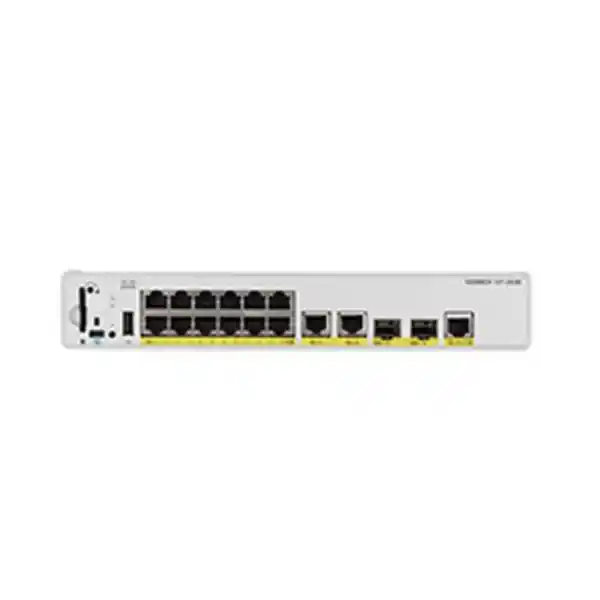
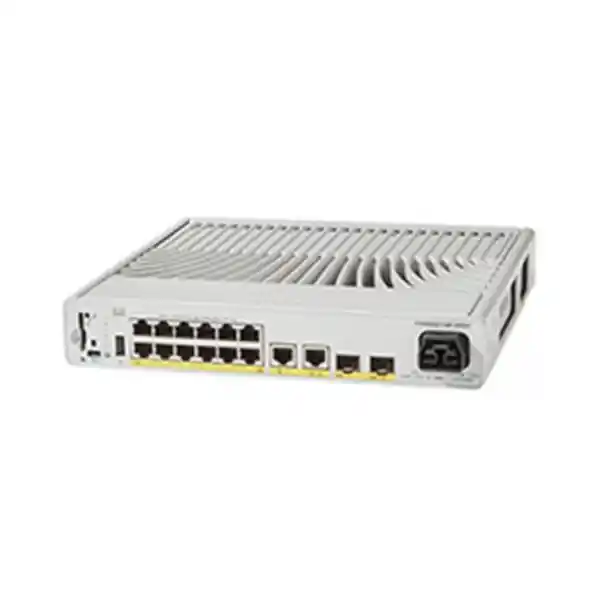
Cisco Catalyst C9200CX-12T-2X2G Network Switch
The Cisco Catalyst C9200CX-12T-2X2G brings enterprise-class Catalyst switching into locations where a conventional 24-port or 48-port access switch is physically oversized, acoustically undesirable, or unnecessarily power-hungry. It is a 12-port, data-only compact switch with silent fanless cooling, fixed high-speed uplinks, flexible upstream powering, and the Cisco IOS XE software foundation used across modern Catalyst campus networks. For UAE businesses designing distributed branches, meeting rooms, retail zones, hospitality floors, clinics, classrooms, industrial offices, security workspaces, and other edge locations, the platform delivers a deliberately small physical footprint without reducing the network to a basic unmanaged or lightly managed access device.
FourTeck can supply the C9200CX-12T-2X2G in Dubai and across the United Arab Emirates with assistance on licensing, optics, copper and fiber uplink design, power-adapter selection, upstream 802.3bt powering, VLAN and routing architecture, migration planning, staging, and deployment. The objective is not simply to place a switch in a quotation; it is to make sure the selected Catalyst variant, software tier, optics, cabling, and powering method fit the actual branch or campus design.
Direct answer: what is the C9200CX-12T-2X2G designed to do?
The C9200CX-12T-2X2G is intended to provide full-featured managed Ethernet access in a compact, quiet form factor. Its twelve 10/100/1000BASE-T downlink interfaces are data-only, which makes this exact model suitable when attached endpoints do not require the switch to supply PoE. Two fixed SFP+ uplinks provide 1G or 10G optical or direct-attach connectivity according to the supported transceiver and cable matrix, while two additional 1G copper uplink interfaces can operate at the same time as the SFP+ uplinks. A separate 1G copper powered-device uplink can accept IEEE 802.3bt Class 6 power from a capable upstream PSE, allowing the compact switch to be powered through network cabling rather than depending exclusively on a local mains socket. An optional 80W AC-DC or DC-DC auxiliary adapter can also power the chassis.
This combination is particularly useful at the edge of a structured network. A conventional access layer often assumes a rack, patch panel, UPS, conditioned equipment room, and enough local users to justify 24 or 48 ports. Real sites are frequently different. A boutique retail zone may need six point-of-sale terminals, two printers, a digital-signage controller, and a few building-system endpoints. A premium meeting suite may need presentation appliances, room-control processors, codecs, and AV-over-IP control interfaces without needing dozens of switch ports. A remote office may require a secure, centrally administered Layer 3 capable switch but have only ten wired devices. The C9200CX addresses those scenarios while preserving the operational model of the wider Catalyst estate.
The important buying distinction is that the C9200CX-12T-2X2G is not the PoE+ version of the compact 12-port platform. Customers needing the switch itself to power access points, cameras, IP phones, sensors, or other powered devices should normally assess the C9200CX-12P-2X2G or another PoE-capable Catalyst model. The 12T model accepts power on its powered-device uplink, but its twelve user-facing downlinks are data ports. Correctly separating “the switch can be PoE powered” from “the switch delivers PoE to endpoints” prevents one of the most common specification errors in compact-switch projects.
Verified hardware and performance profile
Access interfaces
Twelve 10/100/1000 Ethernet RJ-45 downlink ports provide standard copper access connectivity for PCs, printers, thin clients, controllers, appliances, AV devices, building systems, and other non-PoE endpoints. Category 5e or better structured cabling is normally used for Gigabit Ethernet, with the usual 100-metre channel limitation for copper Ethernet.
High-speed uplinks
Two fixed SFP+ interfaces provide high-speed 10G uplink capability and can also support appropriate 1G SFP options. They enable fiber runs to an aggregation or core switch, short direct-attach interconnects where supported, and physically separated redundant uplink designs.
Copper uplink flexibility
Two 1G copper uplink ports complement the SFP+ interfaces. Cisco documents that the copper and SFP+ uplinks can function simultaneously. This is valuable for mixed-media migration, local handoff, temporary cutovers, or designs in which one path remains copper while another uses fiber.
Powered-device uplink
A dedicated 1G copper uplink PD interface can receive IEEE 802.3bt Class 6 power from a compatible upstream PSE. This can eliminate a local outlet and power brick at the edge location, reducing the number of infrastructure dependencies for selected deployments.
Forwarding performance
The published switching capacity for C9200CX-12T-2X2G is 70 Gbps, with a forwarding rate of 52.08 million packets per second. Those figures align with a compact enterprise access role where multiple Gigabit downlinks can aggregate toward 10G uplinks without forcing all traffic through a single 1G trunk.
Fanless mechanical design
The chassis is fanless. Heat is dissipated through the compact enclosure and built-in heat-sink design rather than active fan assemblies. This supports acoustically sensitive placements and removes a rotating component that would otherwise require airflow clearance and accumulate dust.
UADP 2.0 Mini architecture: why the compact switch behaves like a Catalyst platform
The technical significance of the C9200CX is not simply its port count. Cisco builds the compact family around the UADP 2.0 Mini architecture, a reduced-footprint implementation of the Unified Access Data Plane philosophy used to provide programmable forwarding and enterprise feature scale across Catalyst switching. The C9200CX-12T-2X2G uses one UADP 2.0 Mini ASIC, and its twelve 1G downlinks are mapped to the single ASIC core. The fixed uplinks also connect into that forwarding complex. For network architects, this matters because the forwarding path is designed for hardware-assisted policy, classification, queueing, routing, security, and telemetry rather than the simpler switching logic commonly found in small office devices.
Cisco’s architecture documentation describes an integrated control processor with four ARM cores running at up to 500 MHz, 4 GB of DDR3 memory, and 8 GB of flash-on-RAM. Those resources support IOS XE Lite, configuration databases, control-plane protocols, management agents, logging, programmability, software images, and feature operation. The system also provides front-accessible USB Type A storage, a USB Micro-B console interface, an SD card slot, LEDs, a blue beacon, and a reset/mode control. The SD capability is operationally important in distributed estates because it can provide another mechanism for software or configuration handling, subject to the organization’s security policy and standard operating procedure.
At packet level, frames arrive through the physical interface, pass through network-interface processing and security functions, enter shared packet-buffer resources, undergo forwarding lookups, receive QoS treatment, traverse queue and scheduling logic, and are rewritten for egress. The architecture supports MACsec processing in hardware. This design enables the switch to apply sophisticated access-layer behavior without sending ordinary forwarding decisions through the general-purpose CPU. The practical outcome is predictable forwarding under normal enterprise workloads and a control plane reserved for protocol operation, management, exception traffic, and software functions.
For a UAE customer, the architecture offers another benefit: consistency. When headquarters, a major campus, and small remote branches all use Cisco Catalyst, engineers can apply familiar VLAN conventions, spanning-tree policy, AAA, routing practice, monitoring, configuration templates, and security standards across very different physical sites. A compact location therefore does not have to become an operational exception simply because it needs only eight or twelve wired endpoints. That reduction in platform fragmentation can be more valuable over the life of the network than the difference in initial hardware cost between an enterprise compact switch and a basic small-business switch.
Port map and practical traffic engineering
| Interface group | Quantity / speed | Typical role | Design note |
|---|---|---|---|
| Downlinks | 12 × 10/100/1000 RJ-45 | User and device access | Data only; no endpoint PoE output on this SKU. |
| SFP+ uplinks | 2 × 1/10G | Aggregation, core, fiber backbone | Select optics by distance, fiber type, wavelength, compatibility and support matrix. |
| Copper uplinks | 2 × 1G RJ-45 | Local upstream or transition links | Can operate simultaneously with the SFP+ uplinks. |
| PD uplink | 1 × 1G RJ-45, 802.3bt Class 6 input | Network + chassis power from upstream | Upstream PSE must support the required power class; validate distance and cabling. |
The port layout gives engineers several uplink strategies. In a standard branch design, the two 10G SFP+ ports can form redundant trunks toward two upstream aggregation devices, subject to the Layer 2 or Layer 3 topology and the capabilities of the upstream pair. Where the compact switch is installed within a floor zone, a pair of fiber uplinks can preserve bandwidth over longer distances while avoiding copper’s 100-metre limitation. Where only a single upstream switch exists, the second SFP+ interface can be reserved for future resilience, a local high-speed appliance, or a migration phase.
The additional 1G copper uplinks make the platform useful during staged upgrades. A site might begin with a 1G copper uplink because existing containment has no fiber. Later, installers can introduce multimode or single-mode fiber and move the primary path to 10G without replacing the access switch. Similarly, a temporary 1G handoff can maintain service during optical troubleshooting or construction, although the exact operational design should be documented to avoid accidental loops and unmanaged fallback paths.
Traffic engineering should be based on actual endpoint behavior rather than raw port count. Twelve 1G access ports do not automatically require 12 Gbps of sustained uplink traffic. Office clients are usually bursty, while backup devices, imaging stations, AV endpoints, storage-adjacent systems, and large file-transfer workflows may be more demanding. A 10G uplink gives substantial headroom for aggregation and reduces the probability that one busy endpoint or concurrent traffic burst will dominate the branch trunk. Where the site carries only transactional applications and internet-bound office traffic, a 1G uplink may still be operationally sufficient. FourTeck can help size the uplink around measured utilization, application patterns, WAN bandwidth, segmentation design, and growth expectations rather than selecting speed by convention alone.
Power architecture: upstream PoE powering versus the auxiliary adapter
Powering is one of the C9200CX-12T-2X2G’s most distinctive design elements. Unlike most Catalyst access switches, this model does not require an internal mains power supply. It can receive power through its 1G copper powered-device uplink when that interface is connected to an upstream PSE capable of IEEE 802.3bt Class 6 delivery. This allows network and power to reach the compact switch through one structured copper cable. Alternatively, an 80W auxiliary AC-DC adapter or supported DC-DC adapter can supply the chassis. Cisco also provides adapter-related accessories for the platform, and the exact bill of materials should be verified during quotation.
PoE-powered operation can simplify edge installation. Consider a switch mounted above a ceiling-access zone, inside a secure cabinet, beneath a counter, in a modular retail fixture, or near an AV rack. Providing a dedicated electrical circuit and local UPS outlet in every such location can increase project cost and coordination. If the upstream wiring closet already has a suitably sized UPS and a compatible high-power PSE, the access switch can inherit that centralized power protection across the structured cable. During a short upstream power event, the UPS can keep both the upstream switch and the remote compact switch online without requiring a second local UPS.
The upstream power budget must nevertheless be engineered properly. The PD interface requires the relevant IEEE 802.3bt power class; an ordinary 802.3af or 802.3at source is not equivalent. The upstream switch must have enough available PoE capacity, the intended port configuration must support the class, and the copper channel must be installed and tested to the cabling standard. In large distributed deployments, power-budget calculations should include all remote powered switches plus any other PoE loads on the PSE. A design that works in a lab with one switch can fail operationally if dozens of edge units collectively exceed the upstream power-supply budget.
When both the powered-device source and auxiliary adapter are connected, Cisco documents that auxiliary power takes precedence and the PD port becomes disabled for powering. If auxiliary power is then removed, the switch resets so the PD process can perform detection and classification before the upstream source powers the system. This behavior should be considered when attempting to treat the two inputs as seamless redundancy; they are not simply dual hot-swappable PSU feeds. Engineers designing availability-sensitive locations should model the expected transition behavior rather than assuming uninterrupted failover.
For conventional installations, the auxiliary adapter may be preferable because it keeps the upstream port choice independent of power delivery. For distributed micro-edge projects, the PD method can materially simplify infrastructure. FourTeck can include power-adapter selection, upstream PSE validation, and cable-path review in the quotation process. Customers can also discuss wider structured-cabling, implementation and support requirements through FourTeck IT Services UAE.
Performance scale for real enterprise access networks
Raw throughput is only one dimension of switch capacity. Enterprise access switches also need tables for learned MAC addresses, routes, ACL entries, QoS policies, multicast state, and segmentation. Cisco’s current Catalyst 9200 Series specifications list the C9200CX family with a scale of up to 32,000 MAC addresses, 14,000 total IPv4 routes when combining directly connected and learned routes under the documented profile, 4,000 IPv4 routing entries, 2,000 IPv6 routing entries, 1,000 multicast routing entries, 1,000 QoS scale entries, and 1,600 ACL scale entries. Cisco also lists 16 virtual networks for C9200CX. These are platform-scale figures and actual usable scale depends on software release, feature combination, templates, licensing, and configuration.
Why 32,000 MAC entries matter
A 12-port switch will rarely learn tens of thousands of directly attached clients, but the table size matters when the device participates in larger Layer 2 domains, carries trunks containing multiple VLANs, or operates within distributed designs where learned destinations extend beyond the local twelve ports. Adequate table headroom helps prevent the compact switch from becoming the scale-limiting component simply because it is physically small.
Why routing scale matters
A branch access device may need only a few connected VLANs today, but routed access, segmentation, summarized enterprise prefixes, WAN-facing transit networks, and dynamic routing can increase route count. The C9200CX provides a substantially more capable control and forwarding model than unmanaged access switches, enabling designs where the edge participates actively in Layer 3 instead of extending every VLAN back to a central core.
The 70 Gbps switching capacity and 52.08 Mpps forwarding rate should also be interpreted in topology context. The twelve Gigabit downlinks represent 12 Gbps of one-direction access bandwidth, while the multiple fixed uplinks add substantial northbound connectivity. Bidirectional switching-capacity calculations count transmit and receive directions, which is why published fabric numbers do not map one-to-one to the simple sum of front-panel line rates as seen by an application. For procurement, the important conclusion is that the platform is designed to switch its compact port set at enterprise access rates with high-speed uplink headroom.
Sizing should still include feature scale, failure behavior, and oversubscription. If the compact switch is expected to aggregate high-throughput video ingest, local storage traffic, workstation imaging, or other sustained flows, engineers should calculate average and peak throughput by direction and verify the upstream path end to end. Where the attached devices are ordinary office clients and IoT controllers, the platform will typically be constrained by application or WAN capacity before reaching raw switching limits. FourTeck’s UAE technology team can assist with selecting compact, 24-port, 48-port, PoE, and multigigabit Catalyst options according to the actual endpoint mix.
Layer 2 capabilities: stable access, segmentation and loop control
At the access layer, the first responsibility of the C9200CX-12T-2X2G is predictable Ethernet connectivity. VLAN segmentation separates user, server-adjacent, management, voice-control, AV, building-management, security, guest, operational-technology, or other traffic classes according to policy. IEEE 802.1Q trunks carry multiple VLANs across uplinks, while access-port configuration presents the appropriate untagged network to endpoints that do not perform VLAN tagging themselves. In a professionally designed campus, VLAN numbering and naming should be consistent across large and small sites so monitoring, documentation, troubleshooting and identity policy remain understandable.
Spanning Tree Protocol remains important wherever Layer 2 redundancy can produce physical loops. Cisco Catalyst supports standard spanning-tree mechanisms and enterprise operational controls that let engineers define which devices should become roots, which edge interfaces transition rapidly, and which unexpected BPDU conditions should trigger protection. Compact switches are often placed in locations that receive less physical supervision than a main data room, which makes defensive configuration especially important. A spare cable, an unmanaged downstream switch, or an incorrectly patched wall outlet can create a loop just as easily in a twelve-port edge cabinet as in a large access closet.
Link aggregation can be used where the topology, upstream device and software design support multiple member links. EtherChannel-style bundling increases logical bandwidth and can provide path resilience while presenting multiple physical links as one logical relationship to spanning tree. Engineers must choose a compatible negotiation or static method, keep member configuration consistent, and understand how the hashing algorithm distributes flows. A single large flow normally remains on one physical member, while multiple conversations can be balanced across members. In a compact environment, two 10G uplinks often provide more capacity than attached devices need, so redundancy may be a stronger reason for dual links than aggregate throughput.
Quality of Service is another core access function. The switch can classify and mark traffic, apply policy, and schedule egress according to the selected design. This is useful even on a data-only model because applications such as collaboration codecs, real-time control, financial terminals, critical operational traffic and bulk backup do not have equal sensitivity to latency and loss. A disciplined QoS deployment keeps classification close to the source, preserves trusted markings only where appropriate, and avoids turning every business application into an artificial priority class.
Additional Layer 2 controls such as storm protection, port-security techniques, DHCP-related safeguards, ARP inspection mechanisms, and access-policy features can be incorporated according to software and license support. The best configuration is not the one with every possible feature enabled; it is the one aligned to the threat model, endpoint behavior, operational maturity, and troubleshooting capability of the organization. FourTeck can stage the C9200CX using a customer-provided standard template or help translate an existing Catalyst access policy to the compact platform.
Layer 3 routing: moving the boundary closer to the edge
The Catalyst 9200CX family supports Layer 3 capabilities that allow the compact switch to do more than bridge Ethernet segments. Cisco lists routing support including OSPF, EIGRP, IS-IS, RIP and routed-access capabilities, with basic BGP support on C9200CX beginning with IOS XE 17.13.1. Exact feature availability depends on software release and license tier, so the project bill of materials should match the routing requirements rather than assuming every protocol is included identically in every entitlement.
Routed access can simplify fault domains by terminating VLANs or point-to-point links nearer the user edge. Instead of stretching Layer 2 VLANs through multiple closets or buildings, a compact switch can use Layer 3 uplinks and advertise connected prefixes into the campus routing domain. This approach can reduce spanning-tree dependencies, improve convergence behavior, and make topology intent clearer. It is particularly relevant in distributed smart-building or branch deployments where each small edge zone can operate as a defined routed segment.
OSPF is commonly chosen for standards-based enterprise routing because it provides link-state convergence, hierarchical area design, metric control, summarization at appropriate boundaries, authentication capabilities, and broad interoperability. EIGRP remains familiar in Cisco-centric environments and can provide straightforward enterprise route exchange. IS-IS is used in some large-scale or specialized architectures. RIP is normally retained for compatibility rather than preferred for new complex networks. Basic BGP can help selected C9200CX deployments where policy-oriented route exchange is needed at the compact edge, but engineers should validate the intended address-family, feature subset, scale and software release before selecting the model as a BGP node.
Static routing remains completely valid for small sites. A branch with a few VLANs and one upstream next hop may not benefit from introducing a dynamic protocol. Static routes reduce protocol complexity, while tracking or first-hop redundancy can be added where the architecture calls for it. Conversely, hundreds of distributed compact switches are easier to operate when routes can be learned, summarized and withdrawn automatically. The choice should be based on estate size, failure domains, operational tooling and convergence objectives.
IPv6 planning should be included even if the production network remains predominantly IPv4. Cisco publishes IPv6 routing scale for the C9200CX family, and IOS XE provides the mechanisms needed to build dual-stack access. UAE enterprises adopting modern cloud services, segmented IoT, government connectivity requirements or global addressing strategies may increasingly encounter IPv6 dependencies. A migration plan should define addressing, neighbor discovery security, first-hop policy, routing, DNS, telemetry and operational support instead of treating IPv6 as a simple protocol checkbox.
Security architecture: access control, MACsec and trusted infrastructure
A switch at the edge of the network is a security enforcement point. It sees devices when they first connect, carries traffic toward shared services, participates in infrastructure protocols, and is itself a management target. The C9200CX therefore belongs inside the security design rather than being treated as passive cabling infrastructure. Cisco positions the Catalyst 9200 family with policy-based segmentation and trusted-system features, while the C9200CX platform adds hardware-assisted MACsec capability. Cisco’s current platform highlights reference AES-256 MACsec for C9200CX, although actual deployment requires compatible peer interfaces, software support, key management and the relevant configuration.
MACsec, based on IEEE 802.1AE concepts, protects Ethernet frames across a link so traffic between network devices can be encrypted and integrity protected. This can be valuable on building-to-building fiber, service-provider dark-fiber handoffs, exposed riser paths, inter-cabinet connections, or other links where physical interception is part of the threat model. Unlike application-layer encryption, link encryption protects broad categories of Ethernet traffic without requiring every application to implement its own control. It does not replace end-to-end encryption, firewall policy, identity controls or secure application protocols; it adds protection at a different layer.
Access control lists can filter traffic by network criteria, while identity-aware access techniques can tie policy more closely to authenticated users or devices. A mature design typically combines port-level access policy, AAA, secure management, centralized logging and segmentation. Wired 802.1X can authenticate corporate endpoints, with alternative methods used selectively for devices that cannot support supplicant-based authentication. Dynamic authorization and policy assignment can reduce the need to hard-code every endpoint role into static port configurations, but they also introduce dependencies on identity systems, RADIUS availability and well-tested fallback behavior.
Infrastructure hardening should include secure administrative protocols, role-based access, AAA, management-plane filtering, logging, time synchronization, software-image governance, configuration backup and monitored change control. Telnet and unencrypted legacy management methods should not be the default. SNMP deployments should use secure versions and restricted access where possible. SSH keys, certificates and local emergency credentials need an ownership process. Network devices should use trusted NTP sources because accurate time is essential for event correlation, certificate validation and incident investigation.
Layer 2 attack mitigations should be selected deliberately. DHCP snooping can help establish trusted DHCP behavior and binding information. Dynamic ARP Inspection can use binding data to reject suspicious ARP activity. IP source-related controls can reduce spoofing from edge ports. BPDU Guard can protect intended edge interfaces from unexpected switches. Storm-control mechanisms can contain broadcast or multicast anomalies. Port-security features can restrict learned identities in simpler environments. Each control must be tested against real endpoint behavior, especially in AV, industrial, medical, hospitality and building-automation networks where devices may use unusual discovery or boot sequences.
Where the compact switch sits behind a perimeter or segmentation firewall, the switching and firewall layers should reinforce one another. VLAN boundaries, routed interfaces and ACLs determine which traffic reaches the firewall, while the firewall enforces application and threat policy across zones. FourTeck’s Firewall Dubai practice can support projects that combine Catalyst access switching with next-generation firewall segmentation for UAE branches, campuses and data-edge environments.
Cisco IOS XE Lite, automation and operational consistency
The C9200CX runs Cisco IOS XE Lite, giving the compact platform a modern Cisco software architecture rather than a simplified web-only management stack. This matters to network teams already operating Catalyst because configuration concepts, CLI workflows, software lifecycle practices, telemetry methods and controller integration can align more closely with the rest of the enterprise. Engineers can use familiar operational constructs for interfaces, VLANs, routing, AAA, logging, troubleshooting and automation, which reduces the training and tooling gap between headquarters switches and distributed compact devices.
Model-driven programmability is increasingly important as switch estates grow. Manual CLI configuration can be appropriate for a handful of devices, but it becomes difficult to audit and reproduce across tens or hundreds of branches. IOS XE supports structured automation approaches in addition to traditional CLI methods. Enterprises can build templates for base system configuration, management addressing, NTP, DNS, AAA, SNMP or telemetry, VLANs, access ports, uplinks, routing, logging, security controls and standard banners. The goal is repeatability: a branch deployed in Abu Dhabi should follow the same intent as a similar branch in Dubai unless there is an explicit site-specific reason to differ.
Cisco Catalyst Center can provide centralized campus automation, assurance and operational workflows depending on licensing and architecture. Cisco also provides cloud-monitoring or cloud-management choices for supported Catalyst models and variants. Organizations should decide management mode before procurement because controller workflow, licensing, software compatibility and operational ownership can affect the desired SKU. A switch should not be ordered solely by its front-panel model name when the wider network depends on a particular management subscription or automation architecture.
Even without a controller, disciplined CLI and API automation can improve operations. A source-controlled intended configuration, change review, pre-deployment validation and post-change verification provide far better governance than manually editing each switch without a record. Engineers can collect interface counters, optical diagnostics, CPU and memory status, environmental state, MAC tables, routes, spanning-tree state, authentication results, syslog events and other telemetry for centralized monitoring. Thresholds should be meaningful: for example, a single interface error may not matter, while a growing rate of CRC errors on a fiber or copper uplink is a clear physical-layer investigation signal.
Console and removable-media access also remain valuable during staging and recovery. The C9200CX front panel includes USB Micro-B console access, USB Type A storage, and an SD card slot. Those interfaces can simplify image handling or recovery in a controlled process, but they also need physical-security policy. In public or semi-public installations, the switch should be mounted where unauthorized users cannot casually reach console or removable storage. Compact does not mean consumer-grade; the device should receive the same configuration and physical controls as any other enterprise infrastructure node.
Licensing and ordering: Network Essentials versus Network Advantage
Cisco lists the C9200CX-12T-2X2G in both Network Essentials and Network Advantage ordering variants. The commonly referenced base product numbers are C9200CX-12T-2X2G-E for Network Essentials and C9200CX-12T-2X2G-A for Network Advantage. Cisco also publishes Catalyst/DNA subscription SKUs for 12-port C9200CX switches with term options. Because Cisco licensing evolves over time and software features can move or acquire release-specific requirements, FourTeck treats licensing as part of the solution design rather than an afterthought.
Network Essentials is generally positioned for foundational enterprise access capabilities, while Network Advantage targets environments requiring broader advanced networking features. The correct choice depends on routing protocols, segmentation, automation, security functions, controller workflows and software features actually used by the customer. A company that only needs VLANs, secure management, common access security and straightforward static or limited dynamic routing may have a different entitlement requirement from an organization building routed access, policy segmentation or more sophisticated campus services.
The project should therefore start with an entitlement checklist. Which Layer 3 protocols are required? Is BGP expected? Is the network using advanced segmentation? Will Catalyst Center manage the switch? Are there assurance or automation subscription requirements? Does the customer have an existing Cisco Enterprise Agreement? Are subscriptions being co-termed? Is the device replacing an older Catalyst under a standardized license policy? Does the customer need a particular IOS XE release because of controller compatibility or an approved security baseline? Answering those questions before quotation reduces the risk of purchasing correct hardware with an unsuitable software package.
Support entitlement should be considered separately from base software. Enterprise networks need a plan for software updates, technical assistance and hardware replacement. The service level should match the site’s operational criticality. A compact switch supporting a low-priority training room may tolerate next-business-day replacement; the same model supporting a revenue-generating retail zone or a mission-critical operational console may justify local spare strategy or faster replacement coverage. Customers should provide required SLA and support duration when asking FourTeck for a commercial quote.
The safest procurement approach is to quote the complete usable assembly: exact -E or -A hardware variant, required term license, power adapter if not using upstream 802.3bt, adapter bracket if needed, compatible SFP/SFP+ optics or DACs, fiber patch leads, mounting accessories, support service, and implementation scope. This prevents the common situation in which a “switch-only” price appears attractive but excludes the components needed to place the device into production.
Physical design, silent operation and environmental planning in the UAE
The C9200CX-12T-2X2G measures approximately 4.4 cm high by 26.9 cm wide by 16.5 cm deep and weighs about 1.81 kg. That compact geometry creates installation possibilities that are difficult with a conventional 19-inch, full-width access switch. It can fit into smaller telecommunications enclosures, localized cabinets, constrained furniture-integrated spaces and purpose-built edge mounting locations, provided installation clearances, support brackets, cable bend radius, service access and thermal requirements are respected.
Fanless cooling makes the platform attractive in meeting rooms, executive areas, hospitality spaces, classrooms, recording or presentation environments, healthcare consultation rooms and retail zones where fan noise would be distracting. The absence of fans does not mean airflow can be ignored. Passive cooling depends on heat transferring from components into the enclosure and surrounding air. The chassis should not be buried under loose materials, installed in a sealed box without thermal analysis, pressed directly against heat sources or surrounded by cabling that obstructs its intended heat-dissipation surfaces.
Cisco specifies normal operating ranges for the Catalyst 9200 family that include -5°C to +45°C at altitudes up to 1500 metres for applicable models, with derating to +40°C at higher altitude up to 3000 metres; the minimum cold-start ambient is 0°C. UAE indoor installations typically fall within a comfortable temperature envelope when spaces are properly conditioned. The risk arises in ceiling voids, outdoor-adjacent cabinets, warehouses, plant rooms, security booths, rooftop structures, sun-exposed kiosks and poorly ventilated closets where ambient temperature can rise well above normal office conditions. Engineers should measure the temperature where the switch will actually operate, not rely on the building thermostat.
Dust is another regional design factor. A fanless switch does not actively draw dust through fan intakes, which is beneficial, but dust can still settle on surfaces, connectors and surrounding equipment. Enclosures should match the environment, and maintenance schedules should include visual inspection of patching, optics and ventilation. Fiber connectors need particular cleanliness because contamination can increase insertion loss and cause intermittent optical problems that are easily misdiagnosed as switch faults.
Power quality and grounding should follow site electrical standards. When an auxiliary adapter is used, the source circuit should be supported by appropriate UPS infrastructure where business continuity requires it. When the switch is powered over its 802.3bt uplink, resilience moves upstream: the PSE, its power supplies, the UPS supporting it and the copper path become part of the compact switch’s power chain. That can be an advantage because one centralized UPS may protect many edge nodes, but it also makes the upstream power-domain design more consequential.
Mechanical planning should include patch-cord routing. Compact switches are often installed precisely because space is limited, yet SFP+ modules and fiber patch leads need bend-radius clearance, copper patch leads need strain relief, and console access needs service space. The mounting location should allow technicians to read labels, replace an optic, access the mode button, connect console, and trace cables without dismantling surrounding equipment. Good edge design saves installation space without creating an unserviceable installation.
Optics, copper cabling and uplink media selection
The two SFP+ uplinks provide flexibility, but the optical module must be selected as part of an end-to-end link rather than by connector appearance. A 10G SR optic is typically used on suitable multimode fiber for shorter campus distances. LR-class optics are associated with longer single-mode links. Other supported optical families address specialized distance or wavelength requirements. The correct choice depends on fiber type, core size, modal bandwidth, installed connector plant, distance, patching losses, required wavelength, peer optic, temperature environment, Cisco compatibility and software support.
Existing buildings in Dubai often contain several generations of cabling. A customer may describe a link simply as “fiber” while the actual pathway contains OM1, OM2, OM3, OM4 or single-mode strands, different connector panels and intermediate patch points. Before selecting 10G optics, technicians should identify the fiber type and verify the complete optical budget. An old multimode link that carried 1G successfully may not support 10G at the same distance. Testing and documentation are especially valuable in buildings where labeling has changed over multiple fit-outs.
Direct-attach copper can be efficient for very short 10G connections inside a cabinet or adjacent rack, provided the selected DAC is supported by both ends. It eliminates separate optical transceivers and fiber patch leads, but it is physically thicker and distance-limited. Active optical cable can be another option in some environments. The procurement team should confirm the actual topology before ordering because two SFP+ cages do not imply that every SFP+ form-factor cable or third-party module is automatically supported.
The twelve copper downlinks should normally use tested Category 5e or better channels for Gigabit Ethernet. New commercial installations often standardize on higher-category cabling to preserve future options, but switch procurement and structured-cabling design are separate decisions. Patch-cord quality, termination, bundle management and channel length can be more important to reliability than the category label alone. CRC errors, late collisions on mis-negotiated legacy links, pair faults, and intermittent connectors should be investigated at the physical layer before blaming higher-level protocols.
For the powered-device uplink, copper quality has an additional role because the cable carries both data and significant power. Pair resistance, termination quality and installed channel compliance matter to power delivery. A branch design using upstream 802.3bt should be commissioned with appropriate cabling tests and a confirmed upstream power configuration. FourTeck can quote optics and implementation together so that switch, media, transceiver and power assumptions are validated as one system instead of as independent line items.
Where the C9200CX-12T-2X2G fits best
Retail and point-of-sale zones
A compact switch can serve tills, payment-network appliances, printers, digital-signage players, stock terminals and local controllers inside a shop or mall unit. The silent form factor suits customer-facing spaces, while Catalyst management keeps the branch aligned with corporate VLAN, security and monitoring standards.
Meeting and AV environments
Room codecs, presentation gateways, control processors and AV management devices often need reliable wired connectivity without fan noise. High-speed uplinks give the design room for aggregated traffic while QoS and segmentation help isolate real-time and control workloads from ordinary office traffic.
Hospitality and serviced offices
Small floor zones, suites, front-office areas and back-of-house rooms can each require enterprise networking but not a full 24-port switch. Compact Catalyst units allow local breakout while central IT retains standardized configuration, logging and access controls.
Distributed smart-building edge
Controllers, gateways, metering systems, access-control processors and building-management appliances can be grouped into local network zones. Where endpoints have their own power, the 12T provides managed data access without paying for an unused downstream PoE budget.
Branch and micro-office deployments
A small branch may need only eight to twelve wired connections but still require enterprise routing, AAA, monitoring and lifecycle governance. The compact switch avoids deploying a physically larger access chassis simply to retain Catalyst operations.
Industrial office and control-room support
Non-PoE HMIs, engineering workstations, local appliances and controllers can connect to an enterprise-managed edge, provided the physical environment remains within the platform’s environmental specifications and any industrial certification requirements are separately validated.
The platform is less suitable when the primary requirement is powering many endpoint devices. If the site needs PoE+ for phones, cameras or access points, a PoE-capable C9200CX or larger Catalyst model will normally be a cleaner design. It may also be unsuitable where more than twelve access ports are needed immediately, where high-density multigigabit downlinks are required, or where StackWise chassis stacking is mandatory. C9200CX switches do not support StackWise stacking, so availability must be designed using uplink topology, redundant network nodes and distributed architecture rather than assuming the compact units can form a traditional Catalyst stack.
Designing resilience without StackWise
Cisco’s C9200 and C9200L families have models that support StackWise technologies, but the C9200CX compact switches do not provide StackWise stacking. This is a critical architectural point. Two C9200CX units should not be specified with the assumption that they will behave as a single stacked control plane. Instead, resilience must be built using conventional network design: redundant upstream devices, dual uplinks, Layer 2 or Layer 3 convergence, first-hop design where relevant, redundant power upstream, spare strategy and application-level tolerance.
For Layer 2 access, two independent uplinks can connect toward an upstream redundant pair, with spanning tree or a compatible multi-chassis aggregation technology on the upstream side controlling loop-free forwarding. Whether a single C9200CX can form one logical port-channel across two separate upstream chassis depends on the upstream system behaving as a compatible multi-chassis logical peer and on supported configuration. Otherwise, each uplink may be treated independently under spanning-tree policy. The design must be validated rather than inferred from connector count.
For routed access, each uplink can form a Layer 3 adjacency toward different upstream routers or distribution switches. Dynamic routing can then select the preferred path and reconverge after failure. This avoids Layer 2 loops and can create clean failure domains, which is attractive in distributed campus designs. Routing timers, equal-cost behavior, summarization, policy and default-route handling should match the broader enterprise architecture.
Power resilience also requires attention because the 12T’s PD and auxiliary sources do not behave as two seamlessly redundant hot-swap supplies. If remote powering is used, the upstream PSE should itself have resilient power and UPS support appropriate to the service level. A local spare C9200CX may be more cost-effective than trying to eliminate every single-device failure at small branches. In a fleet of dozens or hundreds of units, holding staged spares with standardized configuration can reduce recovery time dramatically.
The right availability target comes from business impact. A switch feeding a noncritical training room does not need the same architecture as one supporting transaction systems. FourTeck can help translate availability requirements into a practical bill of materials rather than automatically duplicating every component. That process includes uplink redundancy, optic diversity, cable-route diversity, upstream switch redundancy, power path, support SLA, spare stock and documented recovery procedures.
Sizing methodology: when twelve data ports are exactly right
Choosing a 12-port switch should start with an endpoint inventory, not an assumption that a small site is automatically a twelve-port site. Count every wired device expected at day one, planned additions, service ports, temporary engineering connections and realistic growth. Separate devices that need switch-supplied PoE from devices with independent power. The C9200CX-12T-2X2G is most efficient when the endpoint set is predominantly data-only. If half the ports will immediately require PoE injectors, a PoE-capable model is usually operationally cleaner.
A useful planning rule is to avoid designing at 100 percent port occupancy unless the site is intentionally fixed. A location with twelve permanent endpoints leaves no access port for growth, replacement testing or temporary maintenance. If the business expects expansion, a 24-port Catalyst may provide better lifecycle value even if the first-day utilization appears low. On the other hand, a purpose-built kiosk, AV rack or retail island with six to eight stable endpoints can benefit from the compact footprint while retaining several spare ports.
Next, classify traffic. Endpoints such as payment terminals and printers generate little sustained bandwidth. Workstations are bursty. Digital signage may receive periodic large media updates. AV systems can create sustained streams. Backup or imaging stations can drive high throughput for long periods. Building controllers may generate small but latency-sensitive traffic. By estimating simultaneous behavior, engineers can decide whether a 1G or 10G uplink is appropriate and whether one or two uplinks are required for capacity or resilience.
Then classify network services. Count VLANs, routed interfaces, expected routes, multicast groups, ACLs, QoS policies and authentication sessions. The C9200CX platform provides enterprise-scale tables for a compact device, but the design should still be checked against the intended software release and feature combination. If the compact switch will participate in sophisticated segmentation or dynamic routing, licensing becomes part of sizing. Hardware capacity without the required entitlement does not satisfy the project.
Powering is the next decision. If an upstream switch with IEEE 802.3bt Class 6 is close enough over compliant copper, PD operation may remove a local power dependency. If the uplink must be fiber, then the compact switch still needs local auxiliary power because fiber does not carry PoE. If the site’s fiber and power arrive in different locations, cabinet design should be settled before equipment ordering. The 80W adapter and its mounting approach should be included where required.
Finally, evaluate physical and support constraints: ambient temperature, enclosure volume, dust, access for technicians, fiber bend radius, lockability, labels, patch-panel proximity, spare strategy and replacement SLA. The best switch is the one that works in the actual installation, not merely the one whose port count matches a spreadsheet.
Migration from legacy Catalyst and small unmanaged switches
The C9200CX is frequently relevant when organizations want to replace older compact or low-density switches without giving up enterprise manageability. Migration should begin by documenting the current device rather than copying its configuration blindly. Export interface status, VLAN assignments, trunks, spanning-tree state, EtherChannels, routing, ACLs, QoS, AAA, management services, SNMP, syslog, NTP, DHCP-related security, port descriptions and learned device information. The objective is to identify business intent and discard obsolete commands that no longer belong in the target design.
Port mapping is especially important. A legacy eight-port switch may have been installed years ago and accumulated ad-hoc changes. Labels may no longer match attached devices. Before the cutover, trace cables and create a source-to-destination mapping: old port, endpoint name, MAC address, VLAN, speed/duplex, special policy, target C9200CX port and verification test. This turns migration night into a controlled procedure rather than a sequence of guesses.
Software should be selected before staging. The target IOS XE release must be supported on the hardware, compatible with the organization’s controller and automation tooling, and approved by the customer’s security process. New switches should be staged with management addressing, credentials or AAA bootstrap, certificates where needed, time services, logging, VLANs, uplinks, routing and monitoring before they arrive at the branch. A rollback image and configuration should be retained according to change policy.
For replacements of unmanaged switches, migration is an opportunity to introduce segmentation. Instead of placing every endpoint into one flat LAN, devices can be grouped by function and security requirement. Printers, building controllers, AV devices, staff clients and management interfaces do not necessarily need unrestricted east-west access. Segmentation should be coordinated with DHCP scopes, firewall policy, DNS, authentication, application dependencies and monitoring so the project improves security without breaking undocumented workflows.
Cutover verification should test more than ping. Confirm interface speed and error counters, VLAN membership, default gateway reachability, DNS, DHCP where applicable, authentication, application access, monitoring visibility, routing adjacency, redundancy, logs and upstream MAC or ARP learning. If using optics, record DOM values where supported so the team has an optical baseline. If powering the switch from an upstream PSE, confirm the negotiated power state and ensure the upstream budget remains within design limits.
After a stable observation period, remove temporary legacy paths and update diagrams, IPAM, asset inventory, configuration repositories, monitoring names and support records. A well-executed migration leaves the network easier to understand than before. FourTeck can provide supply-only or staged implementation support, including configuration loading, bench preparation, branch rollout planning and post-cutover validation.
Operational lifecycle: monitoring, software, backup and troubleshooting
A compact switch can be physically unobtrusive, but it should never become operationally invisible. Monitoring should collect availability, interface state, utilization, errors, discards, CPU, memory, temperature-related alarms, routing or spanning-tree changes, authentication events and system logs. Uplink interfaces deserve particular attention because one degraded link can affect every endpoint behind the switch. Alerting should distinguish between expected endpoint churn on access ports and significant infrastructure events such as an uplink flap or repeated power cycle.
Interface counters provide fast fault isolation. CRC errors often point toward cabling, optics, dirty fiber, damaged connectors or electrical interference. Output drops can indicate congestion or queue pressure. Frequent link transitions may reveal an unstable cable, power issue or endpoint NIC problem. Duplex mismatch is less common with modern autonegotiation but still appears around legacy devices. High broadcast rates can indicate loops or malfunctioning endpoints. Engineers should establish normal baselines rather than reacting to every nonzero counter.
Configuration backup should be automated wherever possible. A current running configuration alone is not enough; organizations should keep version history, know who changed what, and retain a tested recovery procedure. Secrets and certificates require secure handling. If templates generate configuration, the template and variable source should be protected as production infrastructure. The SD card and USB interfaces can assist recovery workflows, but removable media should be controlled to prevent unapproved software or configuration insertion.
Software maintenance should balance security and stability. Running indefinitely on the factory image is poor lifecycle practice, but upgrading every device immediately after a release appears can also introduce risk. Enterprises commonly standardize on approved releases after testing critical features in a representative environment. The release should be checked for hardware support, known defects, resolved vulnerabilities, controller compatibility, routing behavior, optics support and licensing considerations. Change windows should include image verification, configuration backup, rollback criteria and post-upgrade health checks.
Cisco publishes a mean time between failures figure of approximately 960,180 hours for the C9200CX-12T-2X2G in its current data sheet. MTBF is a statistical reliability metric, not a promise that one individual unit will run for that number of hours. Operational resilience still depends on design and replacement readiness. For distributed UAE fleets, holding preconfigured or rapidly configurable spares can provide a more predictable recovery model than relying only on theoretical hardware reliability.
When troubleshooting a remote compact switch, start from dependencies: Is the upstream PSE or auxiliary supply healthy? Does the device boot? Are uplink LEDs and optics present? Is the management route reachable? Are VLAN trunks and routing adjacencies correct? Are interfaces blocked by spanning tree or security policy? Did authentication succeed? Are ACLs or firewalls denying traffic? Structured diagnosis prevents unnecessary hardware replacement and reduces branch downtime.
C9200CX-12T-2X2G compared with nearby design alternatives
| Requirement | C9200CX-12T-2X2G | PoE-capable C9200CX | Larger C9200/C9200L |
|---|---|---|---|
| Downlink density | 12 data ports | 8 or 12 ports depending on model | Typically 24 or 48 ports |
| Endpoint PoE | No | Yes, model dependent | Available on PoE models |
| Fanless compact form | Yes | C9200CX family is fanless | Conventional access-switch form |
| 10G fixed uplinks | 2 × SFP+ | Available on relevant CX models | Model / uplink configuration dependent |
| StackWise | Not supported | Not supported on C9200CX | Available on many C9200/C9200L models |
| Best fit | Small data-only edge | Small edge requiring powered endpoints | Higher density access closets |
The most important comparison is between 12T and 12P. The 12T receives power but does not deliver PoE on its twelve access ports. The 12P version is designed for PoE+ endpoint delivery and uses a different internal-power architecture. A customer deploying phones, cameras or access points should not choose the 12T merely because it is the same 12-port compact family. Conversely, a site with independently powered workstations and appliances may save power-system complexity by selecting the data-only 12T.
The next comparison is compact versus conventional access. If the site is expected to grow beyond twelve ports, needs stack-based operations, needs broad PoE budget, or must host many access points and phones, a 24-port or 48-port model may be more economical over the life of the installation. Where physical size, silence and distributed placement are primary constraints, the C9200CX can be the better engineering fit. FourTeck can compare the final design against broader Cisco and multi-vendor infrastructure options through the FourTeck global technology portfolio.
UAE procurement and deployment considerations
A production quotation for the Cisco Catalyst C9200CX-12T-2X2G should reflect the complete deployment context in the United Arab Emirates. Customers should identify the delivery location, required quantity, preferred license level, subscription term, support requirement, optics, fiber type, powering method and installation scope. Projects spanning Dubai, Abu Dhabi, Sharjah, Ajman, Ras Al Khaimah, Fujairah or Umm Al Quwain may also need centralized staging and phased distribution to branches.
Lead time can differ between the hardware base, license entitlement, power adapter, optics and accessories. For that reason, urgent projects should not assume that every line item shares the same availability. A substitute optic or adapter should never be introduced solely to meet delivery timing without compatibility validation. Where project deadlines are fixed, FourTeck can help separate “must-have for go-live” components from later expansion accessories and can recommend technically equivalent supported options where appropriate.
Organizations with standardized cybersecurity and change-control requirements should share their baseline early. This can include approved IOS XE train, AAA servers, NTP, syslog, SNMPv3, management VRF, VLAN naming, local credential policy, SSH configuration, certificate requirements, routing protocols, interface templates, QoS, spanning-tree settings, access security and controller enrollment. Staging against the real baseline reduces onsite engineering time and catches feature or license gaps before installation.
For multi-country rollouts originating from the UAE, the same compact Catalyst design can be extended to regional branches, subject to country-specific logistics, support and regulatory considerations. FourTeck also supports regional technology projects through its Africa technology operations. Multi-site standards should retain one global design while documenting local variations in WAN provider, IP addressing, power, rack format, fiber plant and support coverage.
Commercial comparisons should therefore normalize the bill of materials. A lower quote that excludes subscription, 10G optics, power adapter or support is not directly comparable with a complete deployment package. FourTeck can provide itemized quotations so procurement teams can see the hardware, licensing, transceivers, accessories, services and support components separately while technical teams verify that each line supports the intended architecture.
Frequently asked technical questions
Does the C9200CX-12T-2X2G provide PoE to phones or cameras?
No. The twelve downlink ports on this exact 12T model are data-only. The switch can itself receive power through its dedicated IEEE 802.3bt Class 6 PD uplink, which is different from providing PoE to connected endpoints.
Can it use 10G fiber uplinks?
Yes. It has two fixed SFP+ uplink ports that support 10G operation with compatible transceivers or supported cabling. The optic must match the fiber type, distance, peer interface and Cisco compatibility requirements.
Can the copper and SFP+ uplinks work at the same time?
Cisco documents that the fixed SFP+ uplink ports and copper uplink ports can function simultaneously, giving engineers useful flexibility for redundant, transitional and mixed-media designs.
Can C9200CX switches be stacked?
No. StackWise stacking is not available on C9200CX switches. Redundancy should be built through network topology, dual uplinks, routing or Layer 2 convergence, upstream redundancy and appropriate spare strategy.
What is the switching capacity?
Cisco publishes 70 Gbps switching capacity and 52.08 Mpps forwarding performance for the C9200CX-12T-2X2G, making it suitable for high-performance compact access with 10G uplink headroom.
Is it silent?
The chassis is fanless, so it has no cooling-fan acoustic output. Installation still needs appropriate passive heat dissipation and environmental conditions.
Which license should be ordered?
Cisco offers Network Essentials and Network Advantage hardware variants plus term software licensing. The correct option depends on routing, segmentation, automation, controller and security requirements. FourTeck can map the license to the requested feature set.
Can it be powered locally?
Yes. In addition to upstream 802.3bt Class 6 PD power, the model supports an optional 80W auxiliary AC-DC adapter and a supported DC-DC adapter. The selected power method should be included in the quotation.
Decision recap: choose this model when compact enterprise data access matters more than PoE density
The Cisco Catalyst C9200CX-12T-2X2G is a strong fit when a site needs a small number of wired data ports but still requires the operational and security characteristics of an enterprise Catalyst network. Its value is concentrated in five areas: a silent fanless compact chassis; twelve Gigabit data access ports; two fixed 10G SFP+ uplinks plus copper uplink options; flexible upstream 802.3bt or auxiliary powering; and IOS XE-based enterprise services for segmentation, routing, security, automation and monitoring.
Choose a different model when the site needs switch-delivered PoE, when more than twelve access ports are expected soon, when multigigabit downlinks are essential, or when StackWise stacking is a mandatory operational requirement. Those are not minor feature differences; they change the most appropriate platform. The C9200CX family includes PoE and multigigabit alternatives, while the broader Catalyst 9200 portfolio provides higher port density and stackable options.
For Dubai and UAE deployments, the compact form factor is particularly useful in distributed offices, retail interiors, meeting environments and smart-building zones where full-size rack infrastructure is impractical. The best result comes from treating the switch, power source, optics, cabling, license, support and configuration as one engineered package rather than independent procurement items.
Quotation input checklist for Cisco C9200CX-12T-2X2G
Commercial and licensing inputs
- Required quantity and UAE delivery location
- Network Essentials or Network Advantage requirement
- Software subscription term and existing Cisco agreement
- Support SLA and support duration
- Target deployment date and staging requirement
Physical and power inputs
- Upstream 802.3bt Class 6 PSE availability
- 80W AC or DC auxiliary adapter requirement
- Mounting location and enclosure dimensions
- Ambient temperature and ventilation condition
- UPS and power-resilience expectation
Network and optics inputs
- 1G or 10G uplink requirement
- Fiber type, connector type and measured distance
- Single or redundant uplink topology
- Required transceiver or DAC type
- Layer 2 trunk or Layer 3 routed uplink design
Configuration and services inputs
- VLAN, routing and IP addressing plan
- AAA, 802.1X and access security baseline
- Catalyst Center or other management workflow
- Approved IOS XE release
- Staging, installation, migration and testing scope
Consult FourTeck UAE for a deployment-ready C9200CX bill of materials
Send FourTeck the switch quantity, desired license level, uplink media, fiber distance, powering method, support requirement and deployment location. The technical team can return a quotation structured around the usable solution: base switch, license, optics, adapter, accessories, support and services. Where the requirement is still being designed, provide the endpoint count and site topology instead of guessing the exact accessories.
For multi-site projects, FourTeck can also help standardize port templates, VLAN conventions, routing, uplink optics, power models and staging so every location is delivered against one controlled engineering baseline. This is especially useful for retail chains, hospitality groups, distributed offices, education networks and smart-building deployments where compact edge switching is repeated across many branches.
Product: C9200CX-12T-2X2G
Region: Dubai / UAE
Type: 12-port data-only compact Catalyst
Uplink: 2×10G SFP+ + copper options

Reviews
There are no reviews yet.