
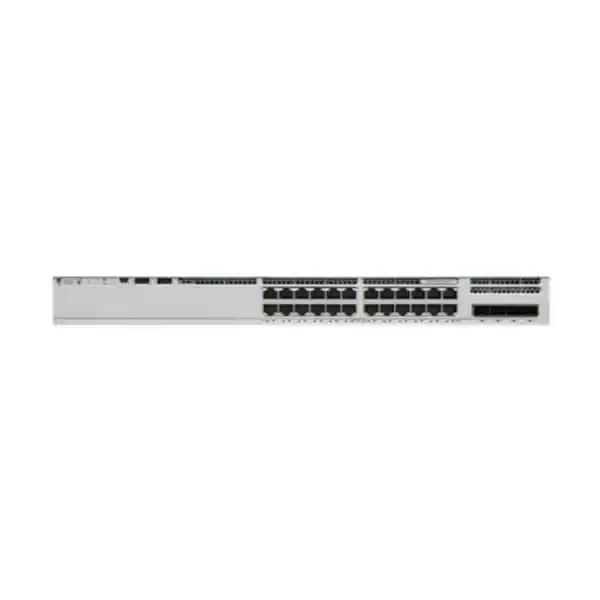
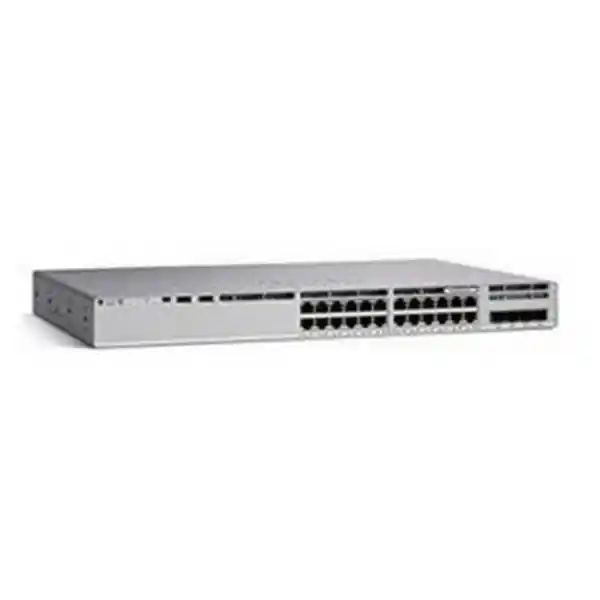
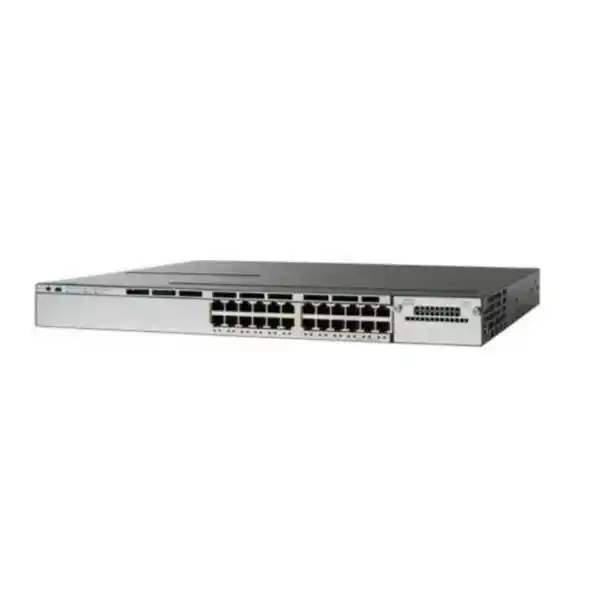
Cisco Catalyst C9200L-24PXG-4X Network Switch
A 24-port Cisco Catalyst 9200L access platform combining sixteen 1 Gigabit Ethernet copper ports, eight multigigabit copper ports that can negotiate up to 10 Gigabit Ethernet, full PoE+ capability, four fixed 1/10 Gigabit SFP/SFP+ uplinks and optional StackWise-80. It is designed for branch, campus access, wireless edge and converged IP environments where predictable performance, policy control and operational consistency matter.
Choose the C9200L-24PXG-4X when a 24-port access switch must serve a mixed population of normal 1G endpoints and high-throughput mGig devices without consuming separate 10G access hardware.
It is particularly relevant for Wi-Fi 6/6E AP uplinks, high-performance edge devices, PoE+ endpoints and access closets that require up to four 10G fiber uplinks toward distribution.
What the C9200L-24PXG-4X actually delivers
The Cisco Catalyst C9200L-24PXG-4X is a fixed-uplink member of the Catalyst 9200L family. Its access-side design is deliberately asymmetric: sixteen copper interfaces target conventional Gigabit Ethernet users and devices, while eight enhanced copper interfaces support multigigabit operation up to 10G. This allows a network architect to reserve the higher-speed ports for endpoints that can genuinely use additional bandwidth, while ordinary office clients remain on efficient 1G access. For many UAE offices, education campuses, healthcare sites, retail branches, hospitality environments and industrial administrative networks, this blend is more economical and easier to operate than making every edge port 10G.
The switch also provides four fixed 1/10G uplink interfaces. These are used to connect the access layer to distribution switches, collapsed-core switches, firewalls, server aggregation, or fiber cross-connects. Because the uplinks can run at 10G, designers can build LACP port-channels for higher aggregate bandwidth or retain physically diverse uplinks for resilience. The appropriate topology depends on traffic flow, oversubscription targets, spanning-tree or routed-access design, and the capabilities of the upstream platform. FourTeck engineers can coordinate the switch with broader UAE infrastructure through FourTeck UAE, including optics, racks, structured cabling, UPS sizing and migration planning.
The platform runs Cisco IOS XE and inherits the operational model familiar to Cisco enterprise administrators: CLI workflows, programmable interfaces, telemetry, quality-of-service controls, security features, routing capabilities, VLAN segmentation and integration with Cisco management ecosystems. It is not simply a dense Layer 2 device; it is an enterprise access switch intended to participate in a managed architecture. That distinction matters when evaluating it against inexpensive unmanaged or lightly managed switches. The value lies not only in port count but in predictable policy enforcement, software lifecycle, stacking, observability and consistency across a Cisco campus.
16× up to 1G plus 8× mGig up to 10G, giving a practical mixed-speed edge for standard and high-performance endpoints.
Fixed SFP/SFP+ uplink interfaces provide flexible fiber or compatible copper-transceiver connectivity to distribution or core layers.
Cisco lists 272 Gbps switching capacity for this model, supporting its blend of multigigabit access and 10G uplink connectivity.
The forwarding specification is appropriate for enterprise access workloads where many simultaneous users, APs and IP devices share the edge.
Port architecture: sixteen 1G ports plus eight multigigabit ports
The most important characteristic of the C9200L-24PXG-4X is its multigigabit access mix. Traditional Gigabit Ethernet was sufficient when most access-layer clients were desktop PCs, printers and IP phones. Modern wireless access points, media workstations, edge servers, hyperconverged appliances, high-resolution video systems and other devices can exceed the practical throughput of a single 1G connection. Replacing all copper cabling with fiber or installing a full 10GBASE-T switch can be unnecessarily expensive. Multigigabit Ethernet addresses this gap by allowing higher negotiated speeds over suitable twisted-pair cabling, depending on cable category, channel length, installation quality and endpoint support.
On this Cisco model, eight access interfaces are the premium mGig ports. They are the ports to allocate to Wi-Fi 6/6E access points with 2.5G, 5G or 10G Ethernet interfaces, content-creation workstations that need faster NAS access, or specialized appliances that can exploit multi-gigabit throughput. The remaining sixteen interfaces are ideal for phones, printers, standard desktops, IoT gateways, building-management controllers, cameras whose encoded traffic remains comfortably below 1G, and other common access endpoints. This separation makes capacity planning explicit: an engineer can map the high-speed device population before procurement and avoid paying for unused 10G access density.
Cabling deserves equal attention. A switch port marked as capable of 10G does not guarantee that an existing copper channel can sustain 10G error-free under real operating conditions. Category, alien crosstalk, patch-panel quality, termination, bend radius, electromagnetic environment and permanent-link length all influence results. In a brownfield Dubai office, a site survey should identify whether mGig is intended primarily for 2.5G/5G operation over existing cable or for full 10GBASE-T on upgraded Category 6A-class channels. When full 10G copper is a firm requirement, validating the structured cabling is part of the network design rather than a post-installation troubleshooting exercise.
The mixed-port arrangement also affects patching discipline. FourTeck normally recommends documenting which switch-port numbers are reserved for high-bandwidth endpoints, matching those ports to labeled patch-panel outlets, and keeping spare mGig capacity for future AP or workstation expansion. That small operational step prevents an expensive mGig port from being consumed by a low-bandwidth endpoint while a new Wi-Fi access point is accidentally connected to a standard 1G port. A good rack elevation and port schedule converts the hardware capability into a repeatable deployment standard.
PoE+ engineering: budget watts before counting ports
All twenty-four access ports are PoE+ capable, but PoE design must be based on aggregate power consumption rather than on the visual fact that every port can supply power. IEEE 802.3at PoE+ supports up to 30 W at the switch port for a compliant endpoint, while the actual power required by a device may be lower. Cisco specifies the C9200L-24PXG-4X with a default 600 W class power supply and an available PoE budget of 370 W with the single primary AC supply. With the supported additional secondary 600 W supply, available PoE power can rise to 740 W. Those figures shape real endpoint density.
A simple example shows why this matters. Twenty-four devices averaging 10 W require about 240 W, leaving healthy headroom on the single-supply configuration. Twelve access points averaging 20 W plus twelve IP phones averaging 7 W require roughly 324 W, which still fits within 370 W but leaves less allowance for startup peaks, future devices or model variation. Twenty-four endpoints each requiring the full 30 W would theoretically demand 720 W, so that profile requires the dual-supply power budget. Actual designs should use the manufacturer power specification for each endpoint, not a generic average, and should account for planned growth.
The second power supply has two design implications. First, it can increase the available PoE budget. Second, it can be used as part of a higher-availability power strategy. Where practical, the two power feeds should originate from separate rack PDUs and appropriately protected UPS paths. A dual-PSU switch connected to the same single PDU is protected from one internal PSU failure but not from that PDU, UPS output or upstream circuit failing. In critical UAE deployments, power-path diversity should be documented alongside network-path diversity.
Cisco also supports operational features such as Perpetual PoE and Fast PoE across the Catalyst 9200 family. Perpetual PoE is useful when endpoints should retain power during selected switch reload scenarios, while Fast PoE is intended to restore endpoint power rapidly after switch power returns instead of waiting for the complete operating-system boot sequence. These features can reduce disruption to cameras, phones, access points and IoT devices, but they should be tested against the specific software release, endpoint behavior and maintenance procedure used by the customer.
PoE sizing should therefore be part of the bill of materials. The quotation input should list endpoint model, quantity, maximum or negotiated power requirement, location and criticality. FourTeck can combine this calculation with wider UAE IT services for rack audits, UPS review, patching, switch configuration and migration execution.
Four 1/10G uplinks: designing the northbound path
The four fixed uplink interfaces are a major reason to select the 4X variant. Each uplink can operate at 1G or 10G with supported optics or transceiver choices. In a new design, 10G is normally the preferred target because the access side can aggregate substantially more than a single Gigabit of traffic. A switch serving multiple mGig access points can easily exceed a 1G upstream path during busy periods, especially when client traffic is local to the campus, when backups run, or when users access high-performance on-premises storage.
The uplink design should start with traffic direction. If most client traffic exits through a 1 Gbps internet circuit, a single 10G campus uplink is not automatically necessary for internet throughput, but it may still provide headroom for local services, east-west traffic and growth. If the site uses a high-speed firewall cluster, private cloud, local virtualization or large file services, multiple 10G links may be justified. LACP EtherChannel can combine physical links for aggregate capacity and link resilience, although a single flow is ordinarily hashed onto one member link rather than being striped packet-by-packet across all members. Capacity expectations should therefore consider both total aggregate load and the size of individual flows.
Optics selection is equally important. Short-reach multimode fiber, longer-reach single-mode fiber and direct-attach options each have different reach, connector, fiber plant and cost implications. Transceiver support must be matched to the switch software release and to the upstream device. A cross-building connection may also need surge, grounding and optical-isolation considerations that differ from an in-rack DAC connection. For Dubai towers and large campuses, the actual riser or backbone fiber type should be verified before selecting SFP+ optics.
Where two distribution switches are present, designers must decide whether the access switch forms a logical dual-homed relationship supported by the upstream architecture, uses independent Layer 3 links, or relies on a Layer 2 redundancy model. The correct answer depends on distribution platform, first-hop redundancy, spanning-tree strategy, stack or virtual chassis design and licensing. The C9200L should not be configured in isolation from these upstream assumptions. A clean topology drawing showing port numbers, optic type, fiber pair, VLAN or routed-interface role, port-channel membership and failure behavior is part of a production-grade deployment.
For environments where access switching terminates close to a security edge, FourTeck can align uplink VLANs and routed handoffs with firewall zones through its Firewall Dubai practice. This is useful when switch segmentation, access-control policy and firewall policy must be designed as one system rather than as disconnected device configurations.
Switching capacity, forwarding rate and what the numbers mean
Cisco specifies 272 Gbps of switching capacity and 214.28 million packets per second of forwarding for the C9200L-24PXG-4X. With stacking included in the published capacity figure, Cisco lists 352 Gbps switch capacity and 262 Mpps forwarding. These numbers are useful, but they should be interpreted in the context of access-layer design rather than treated as isolated marketing values. Switching capacity represents the platform’s aggregate ability to move traffic internally, while packet-forwarding rate indicates how many packets can be processed each second under the vendor’s test assumptions. Neither figure alone predicts application experience.
Real access networks encounter variable packet sizes, bursty traffic, oversubscription, queue contention, asymmetric flows and QoS policies. A video-conferencing endpoint may send a relatively stable stream, whereas a workstation pulling a large file from a local server can burst at line rate. Wireless access points can produce many concurrent client flows, and camera traffic can be continuous. The objective is not necessarily to eliminate all oversubscription; most enterprise access networks are intentionally oversubscribed because not every user transmits at maximum port speed simultaneously. The objective is to choose an oversubscription ratio that matches the workload and failure scenarios.
For example, eight 10G-capable mGig access ports plus sixteen 1G ports represent a theoretical access-side edge far above a single 10G uplink. That is acceptable when the high-speed ports are used by endpoints that rarely peak simultaneously, but less appropriate when several mGig ports connect high-throughput compute or storage systems. Two or more 10G uplinks in an EtherChannel can reduce aggregate contention. Conversely, if the mGig ports mainly serve Wi-Fi access points whose real aggregate client throughput is below their Ethernet link rate, the uplink requirement may be lower than the sum of negotiated access speeds suggests.
The switch’s multigigabit models also use a 12 MB packet buffer according to Cisco’s platform scale table. Buffers can absorb short bursts but are not a substitute for correct capacity planning. Persistently oversubscribed interfaces will still queue, drop or increase latency. Voice and interactive video therefore benefit from appropriate classification, queueing and trust-boundary design. Backups and large file transfers should be allowed to consume spare capacity without starving real-time traffic.
A sound sizing exercise combines user count, AP count, endpoint type, server locality, WAN bandwidth, traffic peaks, projected growth and redundancy mode. FourTeck can produce a port and bandwidth matrix before procurement so that the selected switch topology reflects the actual UAE site instead of relying on port count alone.
StackWise-80: scaling access while keeping one operational system
Catalyst 9200L fixed-uplink models support Cisco StackWise-80 with the appropriate C9200L stacking hardware. Cisco documents support for up to eight compatible C9200L members at the same license level. The stack is arranged as a ring and presents administrators with a unified control and management model. This can reduce the operational burden of managing many independent access switches and can provide resilient stack paths when cabled correctly.
Stacking is not merely a way to increase port count. It changes failure domains, software maintenance planning, uplink design and physical rack layout. If two stacked switches each carry uplinks to the distribution layer, a properly designed EtherChannel can place member links on different physical stack units. That can preserve upstream connectivity when one member fails, depending on the exact design. It is therefore common to distribute critical endpoint connections and uplinks across stack members rather than concentrating every important service on one chassis.
The 80 Gbps stack bandwidth figure should also be considered separately from front-panel switching capacity. East-west traffic that must cross the stack ring consumes stacking resources, while traffic that enters and exits the same member may follow different internal paths. A designer should avoid treating a stack as an infinite backplane. High-volume devices can be positioned intentionally, and uplinks can be spread across members to reduce unnecessary stack transit.
Physical planning matters. The stack cables must reach between the intended switch positions, should be routed without excessive strain, and should preserve serviceability. Power supplies, uplinks, patch cords and stack cables all compete for space at the rear or front of a rack depending on equipment orientation. A clean rack elevation should identify stack-member numbering and planned switch priority so that technicians know which chassis is expected to assume the active role after maintenance or replacement.
Software and license compatibility should be checked before adding a new unit to an established stack. Mixing incompatible software releases or license levels can complicate commissioning. For a new deployment, FourTeck normally treats the stack as one engineered system: common IOS XE release, consistent licensing, labeled stack cables, planned member numbers, uplink distribution, configuration backup and documented rollback steps. That discipline makes StackWise valuable as an operational simplifier rather than another source of uncertainty.
Cisco IOS XE, automation and day-two operations
The C9200L-24PXG-4X operates on Cisco IOS XE, giving enterprise teams a software environment shared across much of the Catalyst 9000 family. For administrators, this means familiar command structures, configuration models, logging, AAA, SNMP, telemetry and programmability approaches. Operational consistency is often a stronger buying reason than a single hardware specification: when support teams already maintain Cisco IOS XE networks, a Catalyst 9200L can fit established procedures for change control, software upgrades, configuration backup and troubleshooting.
Cisco supports model-driven programmability using technologies such as NETCONF, RESTCONF and YANG in the Catalyst 9200 feature set. These interfaces allow infrastructure teams to move beyond manual CLI-only operation. A standardized access-switch template can be generated or validated automatically, reducing configuration drift across branches. Engineers can query interface status, VLANs, routing state and telemetry through structured data rather than screen-scraping CLI output. This is particularly useful for UAE organizations operating many retail, hospitality or branch sites where configuration consistency has direct operational value.
Plug and Play workflows can further simplify initial deployment. A switch can be staged with minimal local interaction and then onboarded into a central operating model. The exact workflow depends on the customer’s Cisco management and licensing environment, but the design goal is straightforward: reduce site-by-site manual configuration, reduce transcription errors and make replacement more repeatable. This is especially valuable when technicians at remote branches are responsible only for physical installation while network engineers centrally control policy.
For customers using Cisco Catalyst Center or current Cisco cloud-management options, the C9200L family can participate in broader inventory, assurance and lifecycle workflows. Management choice should be made during design because it influences licenses, onboarding sequence, telemetry requirements, DNS/NTP reachability, certificate handling and firewall rules. An organization that intends to operate only through CLI and local monitoring may have different needs from one adopting centralized assurance and automated campus workflows.
Day-two operations should also include a software lifecycle standard. That standard should define approved IOS XE versions, maintenance windows, configuration backups, pre-upgrade checks, image validation, stack behavior, rollback plans and post-change health verification. FourTeck can align these activities with the customer’s broader support process so the switch is not simply installed and forgotten but becomes part of a maintainable network platform.
Layer 2 design: VLANs, spanning tree, EtherChannel and endpoint control
At the access layer, the C9200L-24PXG-4X can support conventional enterprise Layer 2 segmentation with 802.1Q VLANs, access ports, trunks, voice VLANs, link aggregation and spanning-tree mechanisms. Cisco’s published platform scale includes up to 4094 VLAN IDs, 128 PVST instances and 512 switched virtual interfaces, although the practical design should be much smaller and easier to operate. A clean enterprise campus rarely benefits from creating thousands of VLANs simply because the hardware can represent them.
Port roles should be explicit. User ports typically need access VLAN assignment, authentication policy, edge-port spanning-tree behavior, storm-control and DHCP security features. IP phone ports may use a data VLAN plus voice VLAN with appropriate QoS trust decisions. Wireless AP links may be access or trunk ports depending on controller and SSID architecture. Camera ports often belong to dedicated surveillance VLANs with restricted northbound access. Printers, building-management systems and IoT devices frequently warrant separate policy because their security posture and communication patterns differ from managed PCs.
Spanning-tree design remains important even when the network is considered modern. Edge ports should be protected against accidental loops, while uplinks should have clear root and path behavior. Features such as BPDU Guard, Root Guard and Loop Guard are not interchangeable; each addresses a different failure condition and should be placed intentionally. A poorly planned layer-2 domain can turn one misplaced cable or unmanaged switch into a site-wide incident. Documentation should state which devices are expected to be spanning-tree roots and how an access switch behaves when one upstream path fails.
EtherChannel provides a way to treat multiple physical uplinks as one logical connection when the upstream architecture supports it. LACP is generally preferred because it includes negotiation and state awareness. The two ends must agree on speed, trunking, VLAN permissions and channel configuration. A mismatch can create partial forwarding, individual suspended links or unexpected spanning-tree behavior. For stacks, distributing channel members across different switch units can improve physical resiliency.
The access design should be translated into reusable port profiles. Instead of configuring every interface ad hoc, define templates such as corporate user, voice-plus-user, Wi-Fi AP, CCTV camera, printer/IoT, server and uplink trunk. Each profile can specify VLANs, authentication, QoS, PoE expectations, security controls, description format and monitoring. This improves consistency and simplifies future troubleshooting when a port behaves differently from the approved standard.
Layer 3 capability and routed-access choices
Catalyst 9200L is not limited to pure Layer 2 switching. Cisco provides Layer 3 capabilities including static routing and routing protocols, with the available feature depth depending on the selected Network Essentials or Network Advantage license. In the current Cisco license matrix, Essentials covers switch fundamentals and selected routed-access functions, while Advantage adds more advanced routing and segmentation functions. Procurement should therefore specify whether the ordered unit is the C9200L-24PXG-4X-E or C9200L-24PXG-4X-A variant rather than treating the unsuffixed hardware model as a complete license definition.
Cisco’s C9200L scale table lists 11,000 total IPv4 routes when ARP/direct and learned routes are combined, 3,000 IPv4 routing entries, 1,500 IPv6 routing entries and 1,000 multicast routes. These capacities are more than sufficient for many branch and access-layer designs, but the topology and license must still be appropriate. The model is not intended to replace every campus core or large-scale data-center routing platform. It is best viewed as an enterprise access switch with useful routed-access capability.
Routed access can reduce Layer 2 failure domains by moving Layer 3 boundaries closer to users, but it changes operational assumptions. DHCP relay, gateway placement, first-hop redundancy, multicast, route summarization, monitoring and security policy must all be considered. In a simple branch, the C9200L may host local SVIs and default routes toward a firewall or router. In a larger campus, it may remain Layer 2 to a distribution pair, depending on the organization’s established design. Neither is universally superior; the right design follows resilience, troubleshooting skill, segmentation and application requirements.
Routing also influences uplink use. A routed point-to-point uplink can simplify spanning tree and isolate failures, while an 802.1Q trunk can carry multiple VLANs toward centralized gateways. When multiple uplinks are used, equal-cost routing or port-channel behavior depends on the chosen architecture. The configuration should be tested for link failure, upstream device failure, stack-member failure and reboot behavior rather than only for normal-state connectivity.
FourTeck’s implementation approach is to document the gateway ownership and traffic path for every user or device VLAN. That prevents common deployment ambiguities such as a switch SVI existing but not being used, redundant gateways operating with the wrong priorities, or firewall policies being written for a path traffic never takes. A clear L3 plan reduces both outage risk and troubleshooting time.
Security at the wired edge
Access switches are part of the security boundary because they are where users and devices physically enter the network. The Catalyst 9200 family supports enterprise controls such as IEEE 802.1X, MACsec capability, first-hop security functions, access control lists, DHCP snooping-related protections and policy integrations. These controls should be selected according to the customer’s identity platform and risk model rather than enabling features in isolation.
802.1X is commonly used to authenticate managed endpoints or users before granting full network access. When combined with a RADIUS service such as Cisco ISE or another standards-based platform, the switch can apply policy based on identity and endpoint posture. MAC Authentication Bypass may be used for devices that cannot perform 802.1X, such as some printers or cameras, but MAB relies on MAC identity and should be treated as weaker evidence. Guest, remediation or restricted VLAN behavior can provide controlled connectivity for unknown devices.
First-hop security mitigates common local-network attacks. DHCP snooping can establish a trusted binding database and help block rogue DHCP servers. Dynamic ARP Inspection can use trusted bindings to reduce ARP spoofing. IP Source Guard can restrict traffic that does not match expected bindings. Port-security controls can limit or learn MAC addresses on selected ports. These features require careful trust-boundary configuration, especially on uplinks, trunks, phone-plus-PC ports and environments with legitimate static addressing.
Cisco lists AES-128 MACsec support for Catalyst 9200-series platforms, enabling link-layer encryption in supported designs. MACsec is relevant where traffic crossing particular Ethernet links needs protection against interception or manipulation. It is not a replacement for end-to-end application encryption or firewall segmentation, and deployment requires compatible peers, key management and performance/design validation. Use it where the threat model justifies it rather than as a checkbox.
Control-plane policing, secure management protocols, AAA, SNMPv3, logging, role-based access and configuration hardening also matter. Management access should be restricted to authorized networks, local fallback accounts should be protected, unused services should be disabled, and NTP should be accurate so logs correlate with firewalls, servers and identity systems. Configuration backups and change logging provide evidence when troubleshooting or investigating an incident.
For UAE organizations implementing segmentation, FourTeck can coordinate access-switch controls with firewall policy. The switch can classify and separate endpoints locally while the firewall enforces application and zone boundaries. Designing both layers together avoids a common problem in which VLANs exist on the switch but have permissive routing or firewall rules that undermine the intended separation.
Quality of service for voice, video and wireless traffic
Converged access networks carry traffic with different sensitivity to delay, jitter and packet loss. Voice packets are small and frequent; interactive video is burstier and bandwidth-heavy; business applications vary; backups and software downloads can tolerate delay. If every packet is treated identically during congestion, large best-effort transfers can impair real-time services. The C9200L platform supports enterprise QoS mechanisms that allow classification, marking, policing, queueing and scheduling to protect important flows.
The first design question is where to trust markings. A managed IP phone may be trusted to mark voice traffic correctly, while an ordinary user PC should not automatically be trusted to assign itself high-priority DSCP values. Wireless systems may classify client traffic according to SSID, application or controller policy. The switch can establish the trust boundary and normalize markings. A consistent end-to-end QoS design must then carry those markings across uplinks, distribution, WAN and firewall paths where appropriate.
Cisco documents eight egress queues per port in the Catalyst 9200 QoS feature set, along with classification based on 802.1p CoS and DSCP and mechanisms for scheduling and rate control. The exact configuration should be aligned with the organization’s enterprise QoS policy. Too many traffic classes can become difficult to verify; too few may fail to protect critical applications. A practical branch design often distinguishes network control, voice, interactive video, critical business applications and best-effort/background traffic.
QoS is most valuable under congestion, so validation must include the interfaces where contention can actually occur. A 1G WAN handoff, a 10G uplink shared by many access ports, or a firewall with lower throughput can be a bottleneck even if the switch fabric is fast. Queue counters, drops and interface utilization should be monitored during busy periods. A policy that looks correct in the configuration but never gets exercised is not evidence of performance.
Wireless APs on the mGig ports are a strong use case. High client density can create short bursts, and Wi-Fi voice/video clients depend on low latency. Mapping wireless markings correctly into wired QoS avoids losing application priority at the Ethernet handoff. FourTeck can validate marking continuity from endpoint to AP, switch, firewall/WAN edge and upstream network as part of a converged deployment.
Telemetry, Flexible NetFlow and troubleshooting visibility
A production network needs evidence, not guesses. Catalyst 9200L provides multiple sources of operational visibility, including interface counters, syslog, SNMP, model-driven telemetry, SPAN/RSPAN and Flexible NetFlow capabilities. Cisco’s current platform scale lists up to 32,000 Flexible NetFlow entries for 24- or 48-port multigigabit C9200L models. That capacity can help teams understand which endpoints and applications are generating traffic, although collector design and software feature support should be confirmed for the intended configuration.
Interface statistics remain the fastest troubleshooting tool for many incidents. CRC errors can point to cabling or physical-layer problems. Input drops, output drops and queue counters can reveal congestion. Speed and duplex negotiation show whether a supposed mGig endpoint actually negotiated above 1G. PoE status identifies whether a device is being powered and at what allocation. Optical uplinks should be monitored for link state and transceiver diagnostics where supported. Baseline values collected immediately after commissioning make later anomalies easier to identify.
Syslog should be centralized and time-synchronized. Link flaps, authentication failures, spanning-tree changes, stack events and power incidents are much easier to diagnose when logs from switches, firewalls, wireless controllers and servers share accurate timestamps. NTP is therefore a security and operations requirement, not a cosmetic setting. SNMPv3 or structured telemetry can feed network-management systems with device health and utilization data. The chosen monitoring platform should alert on actionable conditions rather than generating a flood of low-value notifications.
SPAN and RSPAN allow targeted packet capture when deeper analysis is required. They should be configured carefully so monitoring traffic does not overload the destination interface or create security exposure. Captures are particularly useful for verifying DHCP behavior, 802.1X exchanges, VoIP signaling, retransmissions or application handshake problems. Network teams should have a documented method for enabling and removing temporary mirror sessions.
FourTeck recommends a post-installation monitoring pack that records switch hostname, management IP, stack role, software version, license status, serial inventory, uplink interfaces, PoE consumption, critical VLANs, NTP source and monitoring targets. This turns the switch from a black box into an observable asset and simplifies handover to internal IT or a managed-service team.
Reliability, power supplies, physical dimensions and rack planning
The C9200L-24PXG-4X is a one-rack-unit enterprise switch. Cisco lists a chassis size of approximately 1.73 × 17.5 × 13.8 inches, or 4.4 × 44.5 × 35.0 cm, increasing in depth when the full power/fan elements are considered, and a listed weight of about 12 lb / 5.44 kg. These numbers should be checked against the exact rack, rear clearance and PDU arrangement used at the site. Small wall cabinets that easily hold shallow 24-port switches can become congested when deeper enterprise switches, dual power supplies, stack cables and fiber management are added.
The fixed-uplink C9200L family uses field-replaceable power supply options, while its fan architecture differs from the modular-uplink C9200 models. For this model, the default AC supply is the 600 W class PWR-C5-600WAC. A second compatible supply can be added for additional PoE capacity and resilience. Site power planning should include plug type, UPS load, PDU outlet availability and diversity. In the UAE, rack locations may be in dedicated data rooms, telecom closets, IDF cabinets or mixed-use technical spaces; thermal conditions and power quality can vary substantially.
Cisco publishes a mean time between failures figure of roughly 379,410 hours for the C9200L-24PXG-4X. MTBF is a statistical reliability metric for populations of equipment and should not be interpreted as a guarantee that an individual unit will run for that exact duration. Operational availability depends on far more than chassis MTBF: redundant power, spare hardware, software stability, stack topology, upstream design, environmental conditions and support logistics all contribute.
Thermal management is especially important in Gulf climates. The switch is intended for controlled equipment environments, not for direct exposure to outdoor temperature or dust. Rack airflow should not be obstructed by bundles of patch cords or by solid blanking arrangements that conflict with the equipment’s airflow pattern. Air-conditioning redundancy, filter maintenance and room monitoring are valuable for critical sites. A high ambient temperature can increase fan activity and shorten component life even when it remains within absolute operating limits.
Physical commissioning should include secure rack mounting, power-cable retention, label verification, fiber bend-radius checks, patch-cord management and photographing the completed rack. These practical details reduce accidental outages during later maintenance and make remote troubleshooting easier when an engineer needs to guide onsite staff.
Deployment pattern 1: Wi-Fi 6 and Wi-Fi 6E access layer
One of the strongest reasons to deploy the C9200L-24PXG-4X is a wireless refresh. Modern enterprise access points often use Ethernet interfaces faster than 1G because aggregate wireless radio capacity can exceed Gigabit Ethernet. The eight multigigabit ports allow a 24-port switch to serve a meaningful population of high-performance APs while preserving sixteen 1G ports for other devices. This makes the model well suited to office floors, schools, clinics, hotels and public venues where wireless density is increasing but every wired endpoint does not require mGig.
A wireless-oriented design begins with AP quantity and model. Each AP has a maximum wired rate, power requirement and sometimes specific uplink features. Some APs are adequately served by 2.5G; others may support 5G or 10G. The switch port and cable channel must support the intended rate. PoE+ power should be checked against the AP’s required power mode because an AP can reduce radio capability if insufficient power is available. Eight high-power APs may fit comfortably within 370 W, but a mixed population of APs, cameras and phones still requires a proper total-budget calculation.
Uplink sizing follows wireless demand. Eight APs negotiating at 2.5G do not necessarily generate 20G continuously, but a single 1G uplink would create an obvious bottleneck. At least one 10G uplink is therefore a common baseline, with dual 10G links considered where client load, redundancy or local application traffic justify it. Wireless roaming and controller architecture also matter: traffic may be centrally tunneled, locally switched or use different paths depending on WLAN design.
The access switch must also carry the right VLANs or routed interfaces for AP management and client traffic. QoS markings should survive the AP-to-switch handoff. DHCP, DNS and authentication dependencies should be reachable even during maintenance events. Monitoring should track AP link speed and PoE status so a degraded cable that forces an AP from 5G to 1G is visible before users report poor performance.
For a UAE wireless rollout, FourTeck can combine RF planning, switch-port mapping, cabling certification and PoE calculations. The goal is to avoid a common refresh mistake: buying high-performance APs and then connecting them to an access layer that caps their wired path or supplies insufficient power.
Deployment pattern 2: converged voice, surveillance and business access
The switch is equally useful in converged environments where one access closet serves IP phones, desktops, CCTV cameras, printers, access-control devices and selected high-bandwidth workstations. Here the value of the C9200L-24PXG-4X is not that every device needs mGig; rather, the switch allows a small number of demanding devices to coexist with a larger set of standard endpoints without requiring separate switching platforms.
IP phones generally need modest bandwidth but benefit from PoE, voice VLAN support, LLDP/CDP integration and QoS. A phone may also provide a pass-through Ethernet port to a connected PC. The switch port profile must correctly handle both device roles, authentication and markings. Camera deployments require different thinking: each camera may use far less than 1G, but dozens of continuous streams can create significant aggregate traffic toward recording servers. If video recorders are located elsewhere in the campus, uplink capacity and multicast/unicast behavior matter more than individual camera port speed.
Access-control panels, sensors and building systems are often low-bandwidth but high-importance. They should not share unrestricted user networks simply because they consume little traffic. Dedicated VLANs, ACLs or firewall zones can limit their reach. PoE can simplify their power installation, but critical physical-security systems may require UPS-backed switch power and redundant paths to monitoring servers. The C9200L’s PoE behavior and enterprise security controls make it suitable for such converged designs when the architecture is properly segmented.
High-bandwidth business users can then be placed on the mGig ports. Examples include design workstations, media-production systems, local backup agents or compact edge servers that need faster access to NAS or application infrastructure. Because the switch has only eight mGig ports, allocation should be planned rather than improvised. A port schedule can reserve specific outlets for these users and keep one or two ports free for growth.
A converged switch should be monitored for both bandwidth and PoE. When a new camera or AP is added, the change affects two resource pools: front-panel port capacity and power budget. FourTeck’s commissioning documentation can record both, making future adds, moves and changes more predictable.
Licensing: Network Essentials, Network Advantage and subscription choices
Cisco offers the C9200L-24PXG-4X in Network Essentials and Network Advantage ordering variants, commonly represented by -E and -A suffixes. The hardware port layout is the same, but the network feature entitlement differs. This distinction must be settled before purchase because the appropriate license depends on routing, segmentation, automation and management requirements. A quotation that lists only “C9200L-24PXG-4X” without the license suffix is incomplete for final procurement.
Network Essentials covers the core switching foundation and selected Layer 3 functions suitable for many branch and standard campus access deployments. Network Advantage adds advanced routing and segmentation capabilities. Cisco’s current license matrix also distinguishes perpetual network licensing from subscription software packages and management capabilities. Cisco licensing has evolved over time, so the exact subscription bundle, term and management rights should be checked against the current ordering guide at the date of purchase rather than copied from an old bill of materials.
The correct way to size the license is by use case. If the switch is primarily Layer 2 access with VLANs, 802.1X, QoS, basic routing and common automation, Essentials may be sufficient. If the design requires advanced routing protocols, broader segmentation functions or features explicitly listed under Advantage, the Advantage SKU is appropriate. The network architect should create a short feature matrix and tie each required feature to the Cisco entitlement level. This prevents both overspending and late discovery that the ordered license cannot support the approved design.
Management strategy also affects software planning. Organizations using Cisco Catalyst Center, Meraki Dashboard capabilities available for relevant Catalyst models, assurance, advanced telemetry or other subscription-driven services need to include those rights in procurement. Organizations operating through CLI, Web UI and existing third-party monitoring may have a simpler subscription profile, but still need valid licensing and support consistent with Cisco’s current policy.
Smart licensing should be included in the implementation checklist. Connectivity requirements, account ownership, device registration, policy, offline or restricted-network handling and renewal responsibility should be clear before handover. Licensing is an operational dependency; if no one knows which account owns the entitlement or who renews a subscription, future upgrades and support incidents become harder than they need to be.
FourTeck can prepare the UAE bill of materials with the exact -E or -A hardware-license variant, software subscription term, stacking accessories, secondary PSU, optics and support coverage. That approach produces an orderable system rather than a partial list of chassis model numbers.
C9200L-24PXG-4X versus nearby Catalyst 9200 choices
The C9200L-24PXG-4X is not the right answer for every 24-port site. Its value is strongest when the customer needs multigigabit copper plus 10G uplinks and PoE+. A standard C9200L-24P-4X provides 24 PoE+ Gigabit access ports with four 1/10G uplinks and can be a more economical fit when no endpoint needs mGig. A C9200L-24T-4X is suitable where PoE is unnecessary. At the other end, C9200L models with 25G-capable fixed uplinks may be more appropriate where distribution connectivity needs more than four 10G uplinks or where higher northbound bandwidth is a firm design requirement.
The modular-uplink C9200 family should also be considered when replaceable uplink modules, different stacking bandwidth, field-replaceable fan characteristics or additional platform capabilities are important. Cisco lists StackWise-160 for modular C9200 models versus StackWise-80 for C9200L. The correct family choice therefore depends on more than port count. An access layer that will remain unchanged for many years may value modularity and higher stacking headroom even if the initial cost is higher.
A 48-port model can reduce rack-unit count when endpoint density is high, but it also concentrates more devices into one failure domain. Two 24-port switches can provide more distribution flexibility and may simplify staged migration, while one 48-port switch can reduce hardware count and power consumption. PoE budget must be compared on total watts, not only port count. A 48-port switch with many high-power devices may need larger or dual power supplies.
The C9200L-24PXG-4X therefore sits in a useful middle position: enterprise features, high-speed edge ports and 10G uplinks in a compact 24-port chassis. It makes particular sense when a site has fewer than roughly two dozen wired endpoints but a meaningful subset includes next-generation APs or high-throughput devices. It can also be used as the mGig member in a broader stack, provided stack compatibility, licensing and design constraints are satisfied.
FourTeck’s recommendation process compares port speed, PoE, uplink type, stacking, licensing, rack space and growth rather than defaulting to the largest model. This avoids buying excess capacity in the wrong dimension while under-sizing the one resource—such as mGig ports or PoE watts—that actually constrains the site.
UAE cabling, optics and infrastructure considerations
A high-performance switch can only deliver what the physical layer allows. For the eight mGig copper ports, existing Cat5e or Cat6 channels may support some multigigabit rates depending on length and installation quality, while full 10GBASE-T operation is best planned around suitable Category 6A-class cabling and standards-compliant channel design. Brownfield installations should be tested rather than assumed. A cable that worked at 1G for years can reveal crosstalk, termination or pair-quality issues when asked to operate at higher signaling rates.
Dubai offices often include structured cabling installed across multiple fit-out cycles. Patch panels may be a different category from horizontal cable, outlet modules may have been replaced, and patch cords can become the weakest component. Certification testing of the full channel is therefore more useful than reading the printing on one cable segment. For a wireless refresh, AP locations should be tested at the intended mGig rate and PoE load before the cutover date.
Fiber uplinks require the same discipline. The four SFP/SFP+ slots can connect through appropriate transceivers, but the optic must match fiber type and distance. OM3/OM4 multimode can be suitable for short intra-building 10G links; OS2 single-mode is commonly used for longer backbone links and provides future flexibility. Connector polarity, patch-panel condition and optical loss should be validated. Cross-campus fibers sometimes traverse third-party pathways or building risers, so documentation must identify actual endpoints rather than relying on informal labels.
Rack and power infrastructure should be checked during the same survey. The switch needs suitable rack depth, front/rear service clearance and UPS-backed power. If a second PSU is installed for resilience, use separate power paths where possible. Patch-cord management should leave enough space for airflow and future changes. Fiber cords should not be sharply bent or trapped behind equipment.
For multi-country organizations using UAE as a regional hub, the same architecture can be standardized across offices while adjusting optics, power accessories and local support. FourTeck also coordinates broader regional delivery through its Africa infrastructure practice when customers operate connected branch estates outside the UAE. The design objective remains consistent: use a repeatable bill of materials, interface standard and configuration template while respecting each site’s physical constraints.
A pre-sales survey that produces a cable test summary, rack photograph set, uplink-fiber record, PDU/UPS inventory and endpoint schedule can prevent many deployment delays. Most “switch problems” found on cutover night are actually cable, optic, power, addressing or documentation problems. Resolving them before hardware installation materially reduces migration risk.
Migration from legacy Cisco or third-party access switches
Replacing an older access switch with the C9200L-24PXG-4X should be treated as a controlled migration, not as a cable-for-cable hardware swap. Existing configurations often contain years of accumulated exceptions: unusual VLANs, unused trunks, static MAC entries, local authentication, legacy QoS commands, special camera ports and undocumented uplinks. Copying every line forward can reproduce outdated design mistakes, while rebuilding from scratch without discovery can omit critical dependencies. The correct approach is to translate the old configuration into an approved target standard.
Discovery starts with port state and actual use. Interfaces that are administratively up but have seen no traffic for months may no longer be needed. MAC address tables, CDP/LLDP neighbors, PoE draw and interface descriptions can identify connected devices. Trunk allowed-VLAN lists and spanning-tree state reveal Layer 2 dependencies. Routing tables and SVIs show which networks terminate locally. AAA, SNMP, syslog and NTP settings identify management dependencies. A backup of the current configuration and a clear rollback method should be captured before changes begin.
The target C9200L template should then modernize the configuration. Unsupported legacy commands must be replaced with IOS XE equivalents. Management security can be improved with SSH, AAA and SNMPv3. Edge ports can receive BPDU Guard and appropriate first-hop security. Descriptions can be standardized. QoS should be translated to current policy rather than blindly copied. Port-channel configuration must match upstream switches. License-dependent features should be validated before the maintenance window.
Cutover sequencing matters when phones, APs and cameras depend on PoE. If the old and new switches can coexist temporarily, patching can be migrated in groups and tested. If rack space or cabling requires a hard replacement, the team should pre-stage the new switch with software, license, management and baseline configuration so downtime is mostly physical repatching. Critical services should be listed in the test plan with owners and acceptance criteria.
After cutover, validation should include user network access, DHCP, DNS, internet, internal applications, voice registration, AP status, camera streams, printing, routing adjacencies, uplink redundancy, monitoring and PoE consumption. Interface error counters should be checked after links run at their new speeds. A cable that negotiates at 10G but accumulates CRC errors needs remediation even if initial pings succeed.
FourTeck can execute migration as a staged service, with pre-change discovery, configuration build, lab or bench staging, onsite cutover, rollback plan and post-change report. That approach is particularly useful for business-critical Dubai sites where outage windows are short and access-layer downtime affects multiple building systems at once.
Sizing methodology for a 24-port mGig access switch
The fastest way to determine whether the C9200L-24PXG-4X is the right switch is to build a four-part sizing matrix: port count, speed count, PoE demand and uplink demand. Start with physical endpoints. Count every permanently connected device, then add realistic growth. Do not count only users; APs, phones, cameras, printers, access-control panels, room systems and management appliances all consume ports. If there are already twenty-three permanent endpoints, a 24-port model leaves almost no operational spare capacity and a 48-port alternative may be more sensible.
Second, classify which endpoints need more than 1G. The C9200L-24PXG-4X provides eight mGig interfaces. If the three-year plan includes ten high-performance APs plus two 5G workstations, the switch is already short on premium ports even though total port count looks adequate. Conversely, if only two APs need 2.5G and every other endpoint is 1G, the model may offer more mGig capacity than necessary; a less expensive 24P-4X switch could be considered.
Third, calculate PoE watts. For each powered device, record vendor maximum draw and expected operating draw. Add the values and include headroom. Compare the total to 370 W on the default single 600 W AC supply and 740 W with an additional compatible 600 W supply. If the design depends on the second PSU to meet normal operating load, specify it as mandatory rather than optional. If the second PSU is purchased only for redundancy, check whether the switch can still support the required endpoint load after one supply fails.
Fourth, estimate northbound bandwidth. Add expected traffic, not simply negotiated speed. APs may negotiate at 2.5G while averaging far less; backup workstations may burst at full rate. CCTV is often continuous. Local server access may stay inside the campus while internet traffic exits over a slower WAN. Choose the number of 10G uplinks based on aggregate and failure-state requirements. If two 10G links are needed for capacity and one fails, decide whether temporary 10G capacity is acceptable or whether more uplinks are required.
Finally, test growth against all four dimensions simultaneously. A planned office expansion may have enough physical ports but not enough PoE, or enough PoE but too few mGig ports. The design is only valid when each resource remains within target utilization under normal and failure conditions. This disciplined sizing method prevents late redesigns and produces a clear justification for the selected model.
For procurement, the result can be summarized on one page: 24 access ports used X/Y, mGig ports used X/8, PoE watts used X/370 or X/740, uplinks used X/4, rack units 1, power supplies 1 or 2, stack members planned, license level, optics and support. That document is far more useful than a generic datasheet when approving capital expenditure.
Performance scale and platform limits to understand before deployment
Cisco’s published C9200L scale figures provide useful guardrails for architects. The family supports 16,000 MAC addresses, 11,000 total IPv4 routes when direct and indirect route categories are combined, 3,000 IPv4 routing entries, 1,500 IPv6 routing entries, 1,000 multicast routing entries, around 1,500 ACL scale entries, 4094 VLAN IDs, 512 SVIs and jumbo frames up to 9198 bytes. The multigigabit C9200L models have 12 MB of packet buffer and Cisco lists 32,000 Flexible NetFlow entries for the 24/48-port mGig platforms. DRAM is 2 GB and flash is 4 GB for the C9200L family.
These values are platform maxima or scale guidance, not recommended design targets. Running a switch near every table maximum simultaneously may be unrealistic because features consume shared hardware resources and software behavior can vary with release. Cisco documents should be consulted for the exact IOS XE version and feature combination in a complex design. Standard branch and campus access deployments normally operate far below these limits.
The 16,000 MAC address scale is ample for a typical 24-port access switch, but virtualized, wireless or service-provider-like environments can create unexpectedly large MAC tables. Similarly, 512 SVIs is far more than most access-layer designs require. A good architecture optimizes simplicity and fault isolation rather than attempting to exploit every available identifier. Smaller broadcast domains, clear VLAN naming and route summarization are generally easier to operate.
Jumbo-frame support up to 9198 bytes can be useful for specialized storage, virtualization or research workloads, but jumbo MTU must be end-to-end. Enabling it on one switch does not make an entire path jumbo-capable. Servers, intermediate switches, firewalls and routers must agree on the effective MTU or fragmentation and connectivity problems can occur. For ordinary user access, standard Ethernet MTU is usually appropriate unless the application specifically benefits from larger frames.
The same principle applies to ACL and NetFlow resources. Security policy should not create thousands of one-off entries when a simpler segmentation model could achieve the goal. Flow telemetry should be sampled and exported according to an observability plan so the collector can handle the data volume. Scale is a safety margin, not a design objective.
FourTeck uses these published limits as part of technical validation when the switch is proposed for unusually dense, segmented or high-telemetry environments. If the design approaches platform boundaries, moving to a higher Catalyst family may be better than forcing an entry-level access platform to operate at the edge of its scale.
Operational checklist before the switch goes live
A production-ready C9200L-24PXG-4X should pass a structured commissioning process. Start with identity: verify serial number, SKU suffix, license level, software version, power-supply inventory and any stacking accessories. Confirm that the delivered hardware matches the bill of materials. A surprisingly common deployment problem is receiving the correct base model with the wrong license tier, missing secondary PSU, missing stack kit or inappropriate optics.
Next validate management. The switch should have the correct hostname, management IP, gateway or management VRF design, DNS, NTP, AAA, SSH, SNMP/telemetry and syslog. Confirm that administrators can log in through the intended method and that emergency local access is controlled. Record the configuration backup location and device ownership. If centralized management is used, verify that the switch is fully onboarded and shows healthy telemetry.
Then test uplinks. Confirm negotiated speed, optic type, port-channel membership, trunk VLANs or routed addressing, routing neighbors and redundancy behavior. Physically disconnect one uplink and observe convergence. If a stack is used, confirm the ring is complete and member roles are stable. Test what happens when one member or PSU is removed according to the approved maintenance procedure.
Access ports should be validated by profile. Test a standard user device for authentication, DHCP, DNS and application reachability. Test an IP phone for PoE, voice VLAN, registration and QoS. Test a wireless AP for mGig negotiation and power level. Test a camera or IoT device for restricted segmentation. Check interface errors after each high-speed link runs under load. For mGig ports, verify that speed is not silently falling back to 1G because of cabling.
Security controls need negative testing, not only positive testing. Confirm that an unauthorized endpoint is denied or restricted as designed, rogue DHCP is blocked where appropriate, edge ports react correctly to BPDUs and management services are unreachable from untrusted VLANs. Logging should capture significant events. QoS counters can be checked during test calls or video sessions to confirm traffic is entering the expected classes.
Finally, create handover documentation. Include topology, rack position, management addressing, VLANs, uplinks, optic serials where required, stack members, power feeds, PoE budget, software release, license entitlement, backup procedure, support information and a change record. Good documentation is part of the product deployment because it reduces time-to-repair when the site eventually experiences a fault or expansion.
Buying the C9200L-24PXG-4X in Dubai and the UAE
For UAE procurement, the goal should be to order a complete, supportable switching solution rather than a bare chassis. The final bill of materials should identify the exact Network Essentials or Network Advantage SKU, required Cisco software subscription, primary and secondary power supplies, stacking kit and cables if used, SFP/SFP+ optics or DACs, console or management accessories where required, rack hardware and support coverage. The list should also account for structured-cabling work if the mGig ports are expected to operate above 1G.
Lead time and lifecycle status should be validated at quotation stage because enterprise networking supply can vary. A technically correct design may still need an alternate optic, power accessory or nearby switch model if availability is constrained. Any substitution should be reviewed by an engineer so a logistics change does not silently remove mGig capability, reduce PoE budget or alter uplink speed. Serial-number and entitlement records should be captured when the equipment is delivered.
Customers should also decide whether they need supply only, preconfiguration, onsite installation, migration or ongoing management. Preconfiguration can include software alignment, baseline security, AAA, NTP, SNMP, VLAN templates, routing, port profiles and stack provisioning. Onsite work can include rack installation, power validation, patching, optic installation, cutover, testing and handover. A managed-service scope can add monitoring, configuration backup, software lifecycle and incident response.
FourTeck supports Cisco switching as part of broader infrastructure projects. That matters when the access switch must integrate with firewalls, wireless, IP telephony, servers and structured cabling. A single coordinated design can define VLAN IDs, addressing, QoS, PoE, uplinks and security zones consistently across components. Customers can review the broader technology portfolio at FourTeck Global in addition to the UAE practice.
When requesting a quote, provide the number and model of APs, phones, cameras and other PoE devices; the number of endpoints requiring 2.5G/5G/10G; current and target uplink speed; fiber type and distance; whether stacking is required; desired license tier; rack location; and whether installation is inside or outside normal business hours. With those inputs, the switch, optics, PoE capacity and services can be sized accurately.
Technical specification summary
| Model | Cisco Catalyst C9200L-24PXG-4X |
| Access interfaces | 24 copper PoE+ ports: 16 ports up to 1G and 8 multigigabit ports up to 10G |
| Uplink interfaces | 4 fixed 1/10G SFP/SFP+ uplinks |
| Switching capacity | 272 Gbps standalone; Cisco lists 352 Gbps capacity with stacking |
| Forwarding rate | 214.28 Mpps standalone; Cisco lists 262 Mpps with stacking |
| Stacking | StackWise-80, up to 8 compatible C9200L members with appropriate stack hardware and license alignment |
| Default power supply | PWR-C5-600WAC class supply |
| Available PoE budget | 370 W with single 600 W AC PSU; up to 740 W with additional compatible 600 W PSU |
| Memory | 2 GB DRAM, 4 GB flash |
| Packet buffer | 12 MB on 24/48-port multigigabit C9200L models |
| MAC address scale | 16,000 |
| VLAN / SVI scale | 4094 VLAN IDs; up to 512 SVIs |
| Jumbo frame | Up to 9198 bytes |
| Software | Cisco IOS XE |
| License variants | C9200L-24PXG-4X-E (Network Essentials) or C9200L-24PXG-4X-A (Network Advantage) |
| Approximate chassis dimensions | 1.73 × 17.5 × 13.8 in / 4.4 × 44.5 × 35.0 cm chassis dimensions; verify full installed depth with power components and cabling |
Decision recap: when this switch is a strong fit
Choose it for mGig access
Select the C9200L-24PXG-4X when up to eight endpoints need 2.5G, 5G or 10G copper while the balance of the access population is adequately served by 1G.
Choose it for PoE+ density
The model suits converged IP access when APs, phones, cameras and IoT devices need PoE+, provided the actual watt budget is engineered against 370 W single-PSU or 740 W dual-PSU availability.
Choose it for 10G distribution
Four fixed 1/10G uplinks make it practical for resilient fiber connections, LACP port-channels and higher-bandwidth campus aggregation.
Reconsider it when needs exceed the envelope
Look at 48-port, 25G-uplink or higher Catalyst families when eight mGig ports, 24 total ports, StackWise-80 or the C9200L feature scale will become a near-term constraint.
Quotation input checklist
To receive an accurate UAE quotation and implementation scope, provide the following information. These inputs allow the hardware, licenses, power and optics to be sized together rather than quoted as disconnected line items.
Number of users, APs, IP phones, cameras, printers, IoT devices and any servers or workstations requiring dedicated switch ports.
Models and quantities of devices requiring 2.5G, 5G or 10G copper, plus available cable category and tested channel condition.
Maximum watts per powered endpoint, total expected PoE load and whether one-PSU failure must preserve all critical devices.
Required 1G or 10G uplink count, fiber type, approximate distance, upstream switch model and whether LACP or routed links will be used.
Standalone or StackWise-80, number of members, dual power feeds, UPS arrangement and target behavior during a member or uplink failure.
Network Essentials or Advantage, subscription term, management platform, preconfiguration, onsite migration, documentation and support coverage.
Structured consultation for Cisco Catalyst C9200L-24PXG-4X deployment
FourTeck can convert the switch specification into a complete UAE deployment plan covering exact license SKU, mGig port allocation, PoE budget, secondary power, StackWise-80 accessories, SFP/SFP+ optics, fiber and copper validation, VLAN/routing architecture, security, QoS, monitoring and migration.
For best results, share your current switch model and configuration, endpoint list, rack photos, fiber details and expected growth. The engineering team can then identify whether this 24-port mGig model is the correct fit or whether an alternate Catalyst option would provide better capacity or lifecycle value.

Reviews
There are no reviews yet.