
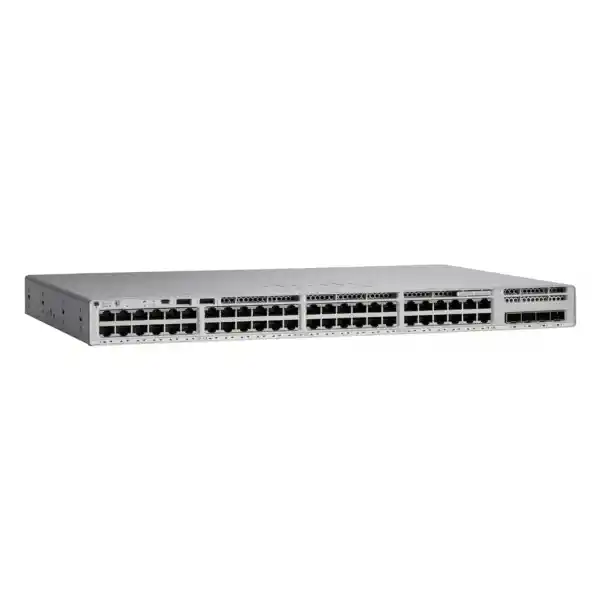
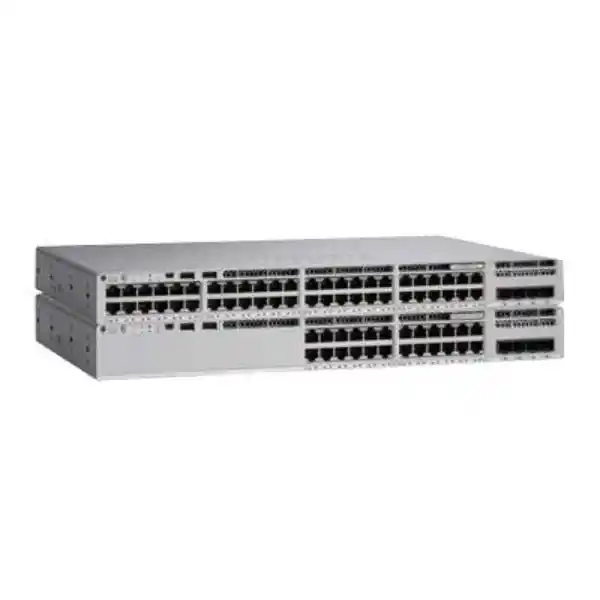
Cisco Catalyst C9200L-48P-4G Network Switch
The Cisco Catalyst C9200L-48P-4G is a fixed-uplink, 48-port Gigabit Ethernet PoE+ switch engineered for dependable enterprise access-layer deployments. It combines forty-eight 10/100/1000 copper access ports with four fixed 1 Gigabit Ethernet uplinks, Cisco IOS XE software, a programmable UADP 2.0 mini forwarding architecture, StackWise-80 stacking, resilient power options, enterprise security controls and automation interfaces. For organizations in Dubai, Abu Dhabi, Sharjah and across the UAE, it provides a practical foundation for user access, IP telephony, wireless AP connectivity, CCTV, access-control systems and other powered edge devices where consistent policy and operational visibility matter.
What the C9200L-48P-4G is designed to solve
Enterprise access networks increasingly carry far more than desktop traffic. A single wiring-closet switch may connect employee workstations, desk phones, Wi-Fi access points, surveillance cameras, biometric readers, meeting-room codecs, printers, IoT controllers and building-management gateways. Each endpoint has different availability, traffic, power, segmentation and security requirements. The C9200L-48P-4G addresses this mixed access-layer role with a dense forty-eight-port PoE+ design and a software stack derived from Cisco’s Catalyst enterprise switching family rather than from a lightly managed small-business platform.
The model is especially relevant when the access layer is predominantly Gigabit Ethernet and the upstream design can be satisfied by four fixed 1G uplink interfaces. Its value is not simply the number of RJ45 ports. The platform adds policy enforcement, routing, quality of service, telemetry, model-driven programmability, stacking, resilient power and centralized management options. These capabilities allow a network team to build repeatable branch and campus standards rather than configure every closet as an isolated device.
For UAE projects, the switch can be used in corporate offices, schools, clinics, hotels, retail estates, light industrial environments and public-facing facilities where access devices need predictable PoE power and operations teams need visibility from a central NOC. FourTeck can assist with switch sizing, stack design, transceiver selection, rack integration, structured cabling coordination, VLAN and IP planning, migration staging and post-deployment support through its UAE technology portfolio and associated network implementation services.
Key hardware and performance specifications
Access interfaces
48 × 10/100/1000BASE-T Ethernet ports with full PoE+ capability, intended for standard Gigabit user and powered-device access.
Fixed uplinks
4 × 1 Gigabit Ethernet fixed uplink ports. The uplink personality is a defining design characteristic and should be validated against aggregation bandwidth requirements.
Switching capacity
104 Gbps standalone switching capacity, with 184 Gbps stated switch capacity when stacking is considered.
Forwarding performance
77.38 million packets per second standalone forwarding rate and up to 137 Mpps in the documented stacked context.
Stacking
StackWise-80 architecture for C9200L systems, enabling a single logical stack and simplified control and management across multiple members.
PoE capacity
A 1 kW AC power supply is the standard primary supply for the full-PoE C9200L-48P-4G. Cisco documentation lists a 740 W PoE budget with one such supply and up to 1440 W with a second matching 1 kW supply, subject to platform configuration.
UADP 2.0 mini architecture and Cisco IOS XE
At the hardware-forwarding level, the C9200L family uses Cisco’s UADP 2.0 mini ASIC architecture. This matters because forwarding, access control, quality of service and other packet-processing functions are implemented in a purpose-built silicon pipeline rather than delegated indiscriminately to a general-purpose CPU. The forwarding architecture supports enterprise policy at line rate while leaving the system CPU available for control-plane functions, management protocols, telemetry and software services. It also gives Cisco a programmable foundation on which features can evolve through software without changing the physical access-switch role.
Cisco IOS XE provides the operating environment. From an operations perspective, IOS XE brings a familiar Cisco CLI while also exposing modern automation and telemetry interfaces. Network engineers can use conventional configuration methods for change-controlled environments, but they are not restricted to manual terminal sessions. NETCONF, RESTCONF, YANG data models, Plug and Play workflows and model-driven telemetry enable the switch to participate in infrastructure-as-code, orchestration and centralized assurance processes. That makes the platform useful in environments that are gradually moving from device-by-device administration toward intent-based or controller-assisted operations.
The architectural advantage is consistency. A branch with one access switch and a campus with multiple stacked access switches can share configuration standards, authentication policies, monitoring templates and software lifecycle practices. This reduces operational variance. It also makes troubleshooting more structured because VLAN, port, PoE, authentication, routing, QoS and logging behavior can be defined through repeatable templates and validated against a known hardware baseline.
48-port PoE+ access design
The forty-eight copper interfaces can provide Gigabit Ethernet connectivity while delivering PoE+ to compatible powered devices. In practical terms, one switch can serve a full office floor, a classroom wing, a hotel zone or a surveillance segment without separate midspan injectors for every endpoint. PoE centralizes power at the wiring closet, so access points, phones and cameras can be backed by the same UPS strategy used for the switch.
PoE planning should be based on actual endpoint draw rather than only on port count. A desk phone may consume modest power, while an advanced access point, pan-tilt-zoom camera or multi-radio device can draw substantially more. Engineers should inventory device class, expected draw, maximum negotiated draw and growth allowance. The full-PoE model is particularly useful where the project expects a large percentage of all forty-eight ports to power endpoints.
Where endpoint power density is lower, a partial-PoE platform may be more economical, but the C9200L-48P-4G gives designers a larger power envelope and therefore more flexibility when tenants, AP generations or camera counts change after the original fit-out.
Four fixed 1G uplinks: design them deliberately
The C9200L-48P-4G provides four fixed 1 Gigabit uplink interfaces. That is adequate for many user-access environments, especially when typical endpoint utilization is bursty and traffic is distributed across local applications, internet breakout or moderate-speed WAN links. Multiple uplinks can also be aggregated where the upstream design and configuration support an EtherChannel, improving logical bandwidth and resiliency.
However, the 4G suffix should never be overlooked. A high-density access layer serving Wi-Fi 6/6E APs, large file-transfer workloads, engineering workstations, media production, high-bitrate surveillance or heavy east-west traffic may justify 10G uplinks instead. Cisco offers related C9200L variants with higher-speed fixed uplinks for that reason. Selecting the 4G model should therefore follow an uplink utilization study rather than a simple port-count match.
For a new building, FourTeck typically recommends considering not only today’s aggregate traffic but also the expected five-year endpoint mix, distribution-switch interfaces, fiber type, optics, oversubscription target and whether stacking will concentrate more users behind the same uplink bundle.
Performance, forwarding scale and what the numbers mean
Cisco specifies 104 Gbps of switching capacity and a 77.38 Mpps forwarding rate for the C9200L-48P-4G in standalone operation. These figures represent the platform’s forwarding capability, but architecture decisions should also consider uplink bandwidth, traffic patterns, packet sizes, policy features and stack topology. An access switch can have ample internal fabric capacity while the uplink bundle becomes the practical bottleneck. For this model, that makes uplink sizing especially important because the access edge can present forty-eight 1G ports to only four fixed 1G uplink interfaces.
| Metric | C9200L-48P-4G | Design interpretation |
|---|---|---|
| Downlinks | 48 × 10/100/1000 PoE+ | Dense 1G edge connectivity for powered and non-powered endpoints. |
| Uplinks | 4 × 1G fixed | Validate oversubscription and growth before standardizing on the 4G version. |
| Switching capacity | 104 Gbps | Internal packet switching capacity for the standalone system. |
| Forwarding rate | 77.38 Mpps | Packet forwarding scale relevant to high packet-rate workloads. |
| Stacking bandwidth | 80 Gbps | Dedicated StackWise-80 ring capacity for supported C9200L stacks. |
| MAC scale | 16,000 addresses | Appropriate for enterprise access layers with normal endpoint aggregation. |
| IPv4 route scale | Up to 11,000 documented routes | Useful headroom for routed access and branch Layer 3 roles, subject to feature templates and software. |
In user-access networks, peak interface speed does not mean every endpoint transmits at 1 Gbps simultaneously. Typical office traffic is bursty, which allows statistically oversubscribed designs to work well. The correct ratio depends on workload. A call-center floor may have modest sustained throughput but stringent latency needs, while a design studio may generate large synchronized transfers. A surveillance floor can produce sustained upstream traffic from cameras. A Wi-Fi-heavy site may aggregate many wireless clients behind a small number of AP ports. Capacity planning should therefore combine measurements, application expectations and failure-state analysis rather than relying on a single theoretical ratio.
StackWise-80: operating multiple switches as one logical system
C9200L models support Cisco StackWise-80, with two rear stack interfaces and up to 80 Gbps of stacking bandwidth per C9200L switch in the documented ring architecture. Stacking is valuable when a wiring closet needs more than forty-eight ports, when expansion must be straightforward, or when operators want a unified management plane instead of handling several independent switches. A correctly built stack can simplify VLAN deployment, configuration consistency, monitoring and uplink design because the members operate as one logical switch.
The stack should be built as a closed ring rather than as a casual daisy chain so that the topology retains an alternate path if one stack cable or member connection fails. Stack cable length and physical rack position matter. The installer should plan member order, cable routing, stack kit requirements, power feeds and distribution uplinks before equipment is mounted. It is also sensible to distribute critical uplink links across different members so that a single member fault does not remove every upstream path.
Stacking is not a substitute for all forms of redundancy. The design still needs resilient upstream connectivity, power, UPS protection and a tested control-plane failure strategy. Maintenance windows should account for software compatibility and upgrade behavior across the entire stack. In environments with strict service windows, a documented rollback plan is as important as the initial stacking configuration.
For a UAE campus or multi-floor office, a stack can be an effective way to standardize access closets while preserving a simple operational model. It also makes port growth easier: additional access capacity can be introduced into the same logical system, provided the stack member, license level and software requirements are aligned with Cisco’s supported combinations.
Power architecture, PoE budget and resilience
The C9200L-48P-4G is a full-PoE model. Cisco lists the PWR-C5-1KWAC as the default primary AC power supply. With a 1 kW supply, the documented PoE budget is 740 W. Installing a second matching 1 kW power supply can raise the maximum available PoE budget to 1440 W while also creating power-supply redundancy options. The exact behavior of a deployment depends on the selected power mode, connected load and configuration, so project sizing should distinguish between the power required for the switch itself and the power allocated to endpoint devices.
A useful design method is to create a PoE worksheet. List every powered endpoint, its nominal draw, its negotiated class or expected maximum, quantity and growth factor. Then group devices by business criticality. Phones, access-control readers and core wireless APs may be considered higher priority than convenience devices. The switch can then be configured and cabled so that the most critical endpoints remain supported if the available power envelope is reduced after a power-supply failure.
Redundant power supplies provide greater value when they are connected to independent upstream power paths. If both power cords terminate on the same single PDU and that PDU fails, the second supply cannot preserve service. In better-equipped UAE data rooms, the two feeds can be split across separate rack PDUs and ideally separate UPS circuits. The rack’s thermal load should also be considered; PoE switching converts a meaningful amount of electrical energy into heat, and higher powered-device density increases the cooling requirement for the communications room.
The C9200L has fixed fans rather than the field-replaceable fan modules used in some modular Catalyst 9200 models. This difference should be documented in sparing and lifecycle plans. The switch still supports redundant fan operation at the platform level, but a service strategy should recognize that the fan units themselves are not treated as field-replaceable components in the same way as on modular C9200 variants.
Layer 2 foundation
At the access layer, the switch supports the enterprise functions expected for segmented Ethernet networks: VLAN-based separation, trunking toward distribution switches, spanning-tree controls, link aggregation, port-security mechanisms, neighbor discovery and policy controls. A well-designed deployment maps physical ports to business roles rather than assigning everything to a flat LAN. Staff, voice, corporate wireless, guest wireless, cameras, printers, building systems and management traffic can be separated into purpose-built VLANs with corresponding security and QoS policies.
Spanning-tree design should be deliberate even when the network aims to avoid Layer 2 loops. Root placement, edge-port settings, BPDU protections and trunk policy affect both convergence and safety. Access ports for endpoints should not be treated the same as switch-to-switch trunks. Consistent templates reduce mistakes during moves, adds and changes.
EtherChannel can combine multiple physical links where supported by the upstream architecture. For a 4 × 1G uplink model, a port-channel can provide additional aggregate bandwidth and link resiliency, although individual flows still follow hashing behavior and do not automatically receive the sum of every link’s speed.
Layer 3 and routed-access capabilities
Catalyst 9200 software can support routed-access designs in addition to conventional Layer 2 access. The perpetual Network Essentials tier includes foundational Layer 3 functions such as static routing and selected routed-access capabilities, while Network Advantage adds a broader set of advanced routing and segmentation functions. The correct license tier should be chosen according to the intended architecture rather than added after deployment as an afterthought.
Routed access can reduce Layer 2 fault domains by terminating networks closer to the edge, but it introduces routing design considerations: address summarization, first-hop behavior, route convergence, multicast needs, policy boundaries and monitoring. It is appropriate where the organization has the operational maturity and distribution/core architecture to support it.
For simpler branches, the switch may operate predominantly as a Layer 2 access platform with routing concentrated upstream. For larger campuses, selected Layer 3 features can help create more deterministic boundaries. FourTeck’s UAE IT services team can support configuration standards, routing-policy design and migration planning where the project includes broader LAN transformation.
Access-layer security: enforce identity and trust at the port
The access switch is one of the first infrastructure components to see a device when it connects to the corporate network. That makes it a useful policy enforcement point. Catalyst 9200 capabilities include 802.1X-based access control, MAC-based methods for devices that cannot perform supplicant authentication, first-hop security mechanisms, control-plane protection, access control lists and MACsec-128 capabilities within the supported feature and license context. These tools allow organizations to move away from the assumption that any device physically connected to an office port should be trusted.
A practical identity architecture can use 802.1X for managed laptops and user devices while applying fallback methods to printers, cameras or specialist appliances. Authentication results can drive VLAN or policy assignment. Network operators should plan for certificate lifecycle, RADIUS availability, guest or remediation behavior and failure scenarios before enforcing authentication globally. A poorly staged 802.1X rollout can cause unnecessary outages; a phased rollout with monitoring, low-risk pilot groups and clear exception handling is safer.
First-hop protections such as DHCP snooping, dynamic ARP inspection and IP source validation are valuable in many campus environments because they help reduce common local-segment attacks. These controls depend on correct trust boundaries. Uplinks toward legitimate DHCP services may be trusted, while user-facing ports remain untrusted. Configuration templates should explicitly identify the direction of trust instead of relying on technicians to remember port-by-port intent.
Control-plane policing and infrastructure access restrictions should protect the switch itself. Management interfaces should be limited to authorized subnets, strong authentication should be used, insecure legacy services should be disabled where operationally possible, and logging should feed centralized monitoring. Network security is strongest when switch controls are integrated with firewalls, identity services and endpoint security rather than treated as an isolated configuration exercise. For perimeter and segmentation projects, FourTeck’s Firewall Dubai practice can be integrated into the broader access-control design.
Quality of Service for voice, video and business applications
The C9200L-48P-4G supports enterprise QoS functions used to classify, mark, queue and schedule traffic. Cisco documents eight egress queues per port as part of the Catalyst 9200 QoS architecture along with classification based on fields such as 802.1p Class of Service and DSCP. QoS is important at the access layer because the switch is where endpoint traffic first enters the managed network and where trust boundaries can be established.
A typical voice design identifies traffic from approved IP phones, trusts or rewrites markings according to policy, and gives delay-sensitive media an appropriate queue without allowing arbitrary endpoints to claim high priority. Video conferencing may need a different treatment from voice media. Business-critical applications can receive preferred service, but over-prioritizing too many classes defeats the purpose of QoS. The policy should be simple enough to audit and consistent from the access switch through the distribution, core, WAN and firewall path.
QoS cannot create bandwidth that does not exist. If a 4G uplink design is persistently saturated, marking packets more carefully will not solve the fundamental capacity problem. Engineers should use interface counters, telemetry and application data to distinguish congestion from loss caused by cabling faults, duplex issues, endpoint problems or upstream limitations. Where utilization shows sustained pressure, the correct response may be a higher-speed uplink model or redistribution of loads rather than increasingly complex queue tuning.
For IP telephony projects, PoE sizing, voice VLANs, LLDP/CDP behavior, authentication, QoS and DHCP options should be designed together. A switch port is not merely power plus Ethernet; it is part of the service path for call signaling and real-time media, so configuration consistency directly affects user experience.
Automation, telemetry and centralized operations
Cisco IOS XE allows the C9200L-48P-4G to fit into both traditional and modern operating models. CLI remains available for engineers who need direct control and familiar change procedures. At the same time, model-driven interfaces enable machine-readable configuration and state retrieval. NETCONF and RESTCONF can be paired with YANG models for structured automation. Plug and Play can simplify initial provisioning, while streaming telemetry can export operational data more efficiently than periodic manual checks.
Centralized management can be provided through Cisco Catalyst Center, depending on licensing and deployment choices. Cisco also documents cloud monitoring or management options through the Meraki dashboard for supported Catalyst workflows. The management platform should be chosen according to the organization’s operational model, compliance requirements, existing licenses, WAN reachability and desired depth of assurance. Buying a switch does not obligate a company to use a controller immediately, but having these options can protect the investment as operations mature.
Telemetry has practical value when it is connected to operating questions. Which uplink is nearing saturation? Which ports have increasing error counters? Are PoE devices approaching the power budget? Which access closets are running inconsistent software? Which endpoints frequently reauthenticate? Which VLAN or interface experiences packet drops? A well-designed monitoring stack converts raw counters into actionable exceptions and trends. This is particularly useful for UAE organizations with multiple branches where dispatching an engineer simply to inspect a switch is inefficient.
Automation should be staged with guardrails. Golden configuration templates, peer review, pre-change backups, syntax validation and post-change verification are more valuable than automation for its own sake. The goal is repeatability and reduced human error, not merely faster configuration. The C9200L provides the interfaces needed to adopt those practices without abandoning established Cisco workflows.
Licensing: Network Essentials, Network Advantage and subscription choices
Cisco Catalyst 9200 ordering combines a perpetual Network Stack license with a term software subscription. Current Cisco ordering guidance lists Essentials and Advantage tiers and term options of three, five or seven years for Cisco Catalyst or Cisco DNA software subscriptions. For new orders, the subscription tier is aligned with the selected network-license tier. This means a quotation should not be evaluated on hardware part number alone; the license level and subscription term are integral parts of a correct bill of materials.
Network Essentials covers foundational switching, Layer 2 functions, static routing, selected routed-access functions, automation interfaces, telemetry and core security capabilities. Network Advantage adds advanced routing, segmentation and other higher-tier functionality. The practical choice depends on whether the switch will simply provide access connectivity or participate in more sophisticated routed and policy-based designs. A site that only needs VLANs, PoE, authentication and upstream Layer 3 may have very different software requirements from a campus using advanced segmentation, additional routing protocols and centralized policy automation.
Subscription features also influence assurance, analytics and controller workflows. Procurement teams should therefore ask the network architect which functions are required during the initial deployment and which may be adopted later. License portability rules, Smart Account ownership and renewal responsibility should be established before purchase. The end customer should retain appropriate administrative control of its Cisco Smart Account rather than discovering after implementation that critical licensing records are tied to an unmanaged account.
A complete FourTeck quotation can separate switch hardware, software term, secondary power supply, stacking kit, stack cables, supported optics, rack accessories, installation, migration and support so that technical reviewers can see exactly what is included. This reduces the risk of comparing a bare hardware price against a production-ready deployment package.
Wireless access-point aggregation
PoE+ ports make the switch suitable for powering many enterprise wireless access points. The network designer should verify the AP’s Ethernet interface speed and power requirement. Modern high-performance APs can exceed 1G traffic under favorable RF and client conditions, so a 1G downlink may become a constraint for certain models even when PoE is sufficient. If the wireless refresh roadmap includes multigigabit AP interfaces, a multigig-capable access switch may be a better long-term platform.
For conventional 1G-connected APs, the C9200L-48P-4G can provide VLAN trunking, QoS, authentication and centralized PoE. Uplink capacity should be assessed across the total number of APs in the closet because wireless aggregates traffic from many clients behind each physical port.
IP phones and collaboration endpoints
The switch can power IP phones while separating voice and user-data traffic through VLAN and QoS policy. Many phones also provide a downstream PC port, allowing a workstation and handset to share one wall outlet while remaining logically segmented. LLDP or Cisco discovery mechanisms can assist endpoint recognition and policy assignment depending on the device ecosystem.
A voice-ready design includes DHCP, DNS, call-control reachability, QoS, PoE headroom and authentication behavior. Where the switch supports dozens of phones, UPS runtime should be calculated for the combined switching and PoE load so that telephony remains available during utility disturbances for the intended duration.
CCTV and physical-security networks
PoE cameras are a common reason to select a forty-eight-port full-PoE switch, but surveillance traffic behaves differently from normal office traffic. Cameras may send continuous upstream video streams, creating predictable sustained load rather than brief user bursts. The aggregate bitrate should be calculated from resolution, frame rate, codec, scene complexity and recording mode. A group of high-resolution cameras can consume meaningful uplink capacity even when each individual port is far below 1 Gbps.
Security networks should be segmented from user access. Camera VLANs, recorder reachability, management access and time synchronization should follow an explicit policy. For large CCTV deployments, it can be advantageous to dedicate access switches or uplinks to surveillance so that user and video traffic do not compete unpredictably.
IoT, access control and building systems
Door controllers, badge readers, intercoms, environmental sensors and building gateways increasingly use Ethernet and PoE. These endpoints can have long service lives and may not support modern endpoint-security software. The switch therefore becomes a useful enforcement boundary: devices can be placed in dedicated VLANs, restricted with ACLs, authenticated through suitable methods and monitored for anomalous behavior.
Operational technology owners and IT teams should agree on responsibility for addressing, firmware, switch-port changes and maintenance windows. A standardized C9200L configuration can help unify these responsibilities by giving each device category a defined port template rather than relying on ad hoc installation practices.
Recommended deployment topologies
A single-switch branch is the simplest topology. The C9200L-48P-4G provides access ports for users and powered devices, with one or more uplinks connected to a branch router, firewall or distribution switch. This model works well when port count is below forty-eight, the PoE budget fits the endpoint set, and WAN or server traffic does not justify faster uplinks. Where two uplinks are used, they can be arranged for redundancy or aggregation according to the upstream device capabilities.
A stacked access closet is appropriate when a floor or building zone needs more ports. Two or more C9200L switches can participate in StackWise-80 with the proper stack kit and cabling. Distribution uplinks can be split across members to reduce dependency on a single unit. The stack is managed as one logical system, simplifying configuration and monitoring. Power feeds should also be distributed so that a single rack PDU failure does not remove the entire access layer.
A dual-distribution campus typically connects access stacks redundantly toward two upstream distribution switches. The exact Layer 2 or Layer 3 topology depends on the organization’s design standard, license tier and convergence requirements. The key objective is to avoid a topology where the access stack has redundant hardware but only one practical path to the rest of the network. Uplink port count, link aggregation, spanning-tree or routing design and failure-state traffic all need to be tested.
In larger multi-building campuses, the C9200L-48P-4G is best positioned at the edge rather than used as a high-capacity aggregation switch. Its fixed 1G uplinks define its role. Distribution and core layers generally require higher interface speeds, greater routing scale and more resilient high-bandwidth architectures. Good network design assigns each platform to the role it is optimized to perform.
Sizing methodology for a UAE project
Start with physical port count. Count active outlets, IP phones, printers, APs, cameras, access-control devices and special systems. Add growth capacity rather than consuming all forty-eight ports on day one. Spare capacity is useful for moves, temporary systems and future endpoint additions. If a closet already needs more than forty-eight ports, compare a stack of C9200L units with alternative chassis or higher-density designs based on operational preference.
Next calculate PoE. Record the expected and maximum draw of every powered endpoint, then add a safety margin. Compare the result to the available PoE budget under normal and failure conditions. If the design depends on the second power supply to meet endpoint demand, understand what happens when one supply fails. Critical endpoints may need priority policies or a more conservative load target.
Then size uplinks. Estimate typical and peak aggregate traffic, but also identify sustained producers such as cameras, backup agents, imaging systems and APs. Check whether four 1G uplinks provide enough normal-state and failure-state capacity. A design that works only when all four links are available may still be too fragile if losing one link causes unacceptable congestion. If higher-speed aggregation is likely, evaluate a C9200L model with 10G uplinks before procurement.
Finally evaluate software and operations. Decide whether the site needs only foundational switching or advanced routing and segmentation. Confirm management platform, telemetry, AAA, logging, configuration backup, image standard and maintenance process. Confirm stack kits, optics, fiber patch cords, rack space, PDUs and UPS capacity. These supporting items are often where otherwise sound switch projects encounter delays.
FourTeck can coordinate the switching layer with broader infrastructure requirements such as rack servers, UPS-connected compute and structured IT environments through its Server Dubai solutions team, which is useful when the access refresh is part of a larger office, server-room or data-room modernization.
Why the 4G model can be the right choice — and when it is not
The C9200L-48P-4G is attractive where the access network is primarily 1 Gigabit Ethernet, endpoints are not continuously bandwidth-intensive, and four 1G uplinks meet the distribution design. This is common in general office environments, schools, clinics, retail sites and many branches. In such locations, operational consistency, PoE density, security and manageability may be more important than high-speed uplinks. The switch can provide enterprise policy without forcing the project to pay for uplink capacity it will not use.
The model is less suitable when the network expects large quantities of multigigabit wireless APs, heavy local storage traffic, engineering workstations, media production, dense camera aggregation or other sustained bandwidth sources. The 4 × 1G uplink ceiling can become the limiting factor before the forty-eight access ports are physically full. The same concern applies to stacks: adding access ports increases the number of users and devices, but the uplink design must scale with them.
A related 4X model provides four fixed uplinks capable of higher speed and may be a more future-ready choice where 10G aggregation is available. The decision should be based on the complete path. Buying a 10G-uplink access switch does not help if the upstream distribution switch lacks compatible interfaces, the installed fiber is unsuitable, or the required optics are not in the bill of materials. Conversely, choosing 1G simply because today’s distribution ports are 1G can create an avoidable refresh later.
FourTeck’s role in a procurement engagement is therefore to match the switch to the topology rather than treat all forty-eight-port PoE models as interchangeable. Port density, uplink speed, PoE budget, stack design, software tier and support coverage should be evaluated as one system.
Optics, cabling and rack integration
The four fixed uplink interfaces are commonly used with compatible 1G SFP transceivers or appropriate copper/fiber connectivity depending on the specific uplink requirement. Optic selection should match fiber type, connector, distance and the upstream switch interface. Multimode fiber is common inside buildings, while single-mode fiber may be used for longer campus links. The project should avoid assuming that an existing transceiver is supported merely because it physically fits the slot; compatibility, wavelength and optical budget should be checked against the intended Cisco platform and peer.
Copper access cabling should be tested to the applicable category standard, especially when the switch is being installed during a broader office fit-out. PoE can expose marginal termination quality because current is delivered over the same cabling used for data. Patch panels, patch cords and horizontal runs should be labeled consistently so that switch-port documentation maps to physical outlets. For CCTV and access-control deployments, route and endpoint labeling significantly reduces maintenance time.
Rack depth, cable management and airflow need attention. Forty-eight copper patch cords can create a dense front-of-rack bundle, so horizontal and vertical organizers should preserve bend radius and service access. Power cables should be routed separately enough to avoid obstructing network patching. The switch’s airflow path must not be blocked by cable bundles or solid rack accessories. In UAE communications rooms, adequate cooling is especially important because ambient conditions outside conditioned spaces can be severe.
Before installation, confirm rack units, PDU socket type, power-cord type, UPS rating, stack cable length and fiber patch-cord length. These details are inexpensive compared with the switch but can stop a deployment if omitted. A production-ready bill of materials includes them explicitly.
Migration from older Cisco access switches
Replacing an older Catalyst access switch should begin with discovery rather than a blind configuration copy. Export the current configuration and inventory active VLANs, trunks, EtherChannels, spanning-tree settings, port descriptions, voice VLANs, authentication policies, ACLs, SNMP settings, syslog destinations, NTP, AAA servers, management addressing, static routes and any locally significant exceptions. Then compare each function against the target IOS XE platform and software release.
Port mapping deserves special attention. A one-to-one cable move is only safe if the target port configuration is also one-to-one. Many legacy closets contain undocumented exceptions: a camera connected to a user port, a printer using a static VLAN, a trunk that was never labeled, or a phone port with a special QoS setting. A pre-migration MAC-address and LLDP/CDP inventory can reveal what is actually connected.
For stacked deployments, stage the stack in advance. Set member roles and priorities, verify software alignment, install stack adapters and cables, preconfigure uplinks and test failover before the maintenance window. If the new switch uses different optics or uplink speed, validate the distribution side in advance. The maintenance plan should define rollback conditions and preserve the old switch configuration until the new environment has passed verification.
Post-cutover tests should cover DHCP, DNS, gateway reachability, authentication, voice registration, AP connectivity, camera recording, critical application paths, uplink redundancy, PoE status, NTP, logging and monitoring. The objective is not simply to see green link lights. It is to prove that the business services dependent on the access layer operate correctly.
Operational hardening and lifecycle practices
A secure production configuration should define administrative access explicitly. Use centralized AAA where available, restrict management reachability to approved networks, prefer secure management protocols, enforce strong credentials or key-based methods as appropriate, configure time synchronization and send logs to a centralized platform. Disable unused services that are not part of the operating standard. Document emergency local access so that the team can recover if centralized authentication is unavailable.
Unused physical ports should not remain as unmanaged open access points. They can be administratively shut down or assigned to a non-routed parking VLAN according to organizational policy. Active ports should have descriptions that map to location or device role. This simple discipline is highly valuable during incidents because engineers can immediately see whether an interface serves a phone, AP, camera, printer or uplink.
Software lifecycle management is equally important. Maintain an approved IOS XE release standard, monitor Cisco advisories, test upgrades on representative hardware where possible and preserve configuration backups. Stacks should be assessed as a complete system before upgrades. A release should be selected for stability and required features rather than simply because it is the newest image visible in a portal.
Configuration backups should be automated and versioned. Monitoring should include switch reachability, temperature, power-supply state, stack health, interface errors, uplink utilization, PoE consumption and authentication failures. Alert thresholds need tuning; an alerting system that generates constant noise will be ignored. Trend data is especially useful for identifying access closets that will need uplink or PoE expansion before users notice service degradation.
Finally, maintain an asset record that includes serial numbers, license tier, subscription term, Smart Account association, site, rack, stack member number, management IP, support coverage and installation date. These records simplify support cases, renewals and future refresh planning.
UAE procurement and deployment considerations
A UAE switch purchase should be evaluated beyond the headline hardware price. Verify the exact model and license suffix, subscription term, power-supply configuration, stack components, transceivers, power cords and support entitlement. Imported gray-market units can create complications around support history, ownership, Smart Account association or replacement processes. For enterprise deployments, traceable sourcing and clearly documented part numbers reduce lifecycle risk.
Lead time is also a design variable. If a site opening has a fixed date, the network bill of materials should be frozen early enough to accommodate hardware, optics and accessories. Stacking kits and secondary power supplies can sometimes have different availability from the base switch. A project should not assume that accessories will automatically ship with the chassis unless they are explicitly listed in the quotation.
Environmental conditions vary significantly across UAE facilities. Modern offices and data rooms are usually conditioned, but telecom closets in warehouses, temporary sites or older buildings may experience elevated temperatures or dust. The switch should be installed within Cisco’s environmental specifications, with clear airflow and adequate room cooling. Rack doors, blanking panels and cable management should not obstruct ventilation. Dust accumulation should be addressed through facility maintenance rather than by operating the equipment beyond its intended environment.
Support planning should define who owns first response. Some organizations want FourTeck to provide onsite diagnosis and escalation; others maintain an internal network team and require only vendor-backed support. Either model can work if responsibilities, replacement procedures and access permissions are documented. The critical point is to establish the process before a failure occurs.
For multi-country organizations headquartered in the UAE, FourTeck’s global technology services presence can help align access-switch standards, documentation and procurement practices across locations while keeping the UAE deployment consistent with the enterprise architecture.
Detailed PoE sizing example
Consider a floor with twenty-four IP phones averaging roughly 7 W, eight wireless APs budgeted at 25 W each, ten fixed cameras budgeted at 12 W each and four door or intercom devices budgeted at 15 W each. A planning estimate would be 168 W for phones, 200 W for APs, 120 W for cameras and 60 W for access-control devices, totaling 548 W before reserve. That sits within a 740 W PoE budget but leaves only 192 W of headroom. If device upgrades are expected, this may be acceptable or may warrant a second power supply depending on business requirements.
The calculation should then be repeated for failure conditions. If a second supply is installed primarily for additional PoE capacity, the design must answer what happens when one supply fails. If the normal powered-device load exceeds the surviving budget, some endpoints could lose power unless the configuration prioritizes essential ports. Critical phone, AP and access-control interfaces can be assigned higher importance than noncritical convenience devices so the reduced power state degrades gracefully.
Engineers should also distinguish nominal device draw from negotiated or maximum allocation. A camera may usually consume 8 W but request more when infrared illumination, heaters or motors activate. An access point may increase power utilization when radios or USB peripherals are enabled. Using realistic maximums for critical devices prevents the design from becoming marginal during precisely the conditions when services are needed most.
This methodology scales better than using a simple rule such as ‘forty-eight PoE ports means forty-eight devices are safe.’ The C9200L-48P-4G has a strong PoE envelope, but correct engineering still requires a load model tied to the actual endpoint estate.
Detailed uplink sizing example
Assume the same switch serves thirty office users, eight APs and ten cameras. Office users may each have a 1G access port but spend much of the day consuming far less than 1G. Their aggregate traffic could still spike during cloud synchronization or large downloads. The APs aggregate many wireless clients, and the cameras generate continuous upstream streams. If each camera averages 12 Mbps, the camera group alone contributes about 120 Mbps before overhead. If AP traffic averages 80 Mbps per AP during busy periods, that adds roughly 640 Mbps. The user population can easily create additional bursts of hundreds of megabits per second.
In that scenario, one 1G uplink would be unnecessarily tight, while a two- or four-link port-channel may provide comfortable aggregate capacity depending on traffic distribution and upstream architecture. But the calculation should consider failure mode. If a four-link bundle normally runs at 2.4 Gbps, losing one link leaves 3 Gbps and may still be acceptable. If the same bundle normally runs at 3.7 Gbps, losing one link immediately creates congestion. Designing only for the normal state hides this risk.
Flow distribution also matters. EtherChannel load balances individual flows using hashing; a single elephant flow does not automatically use all member links simultaneously. A server backup or large transfer may therefore be constrained to one physical link even when aggregate bundle utilization is low. This is another reason to choose higher-speed uplinks when the workload includes large individual flows.
The C9200L-48P-4G remains a strong fit when measured or expected traffic aligns with these constraints. Where not, a 10G-uplink variant is usually a cleaner answer than attempting to engineer around a fundamental bandwidth mismatch.
Configuration blueprint for a disciplined access layer
A production deployment benefits from a repeatable configuration blueprint. Start with system identity: hostname, site code, management interface, default gateway or routing configuration, DNS, NTP and logging. Then configure AAA and management-plane restrictions. Define standard VLANs and trunk allowed lists rather than using unrestricted defaults. Establish spanning-tree root expectations at the distribution layer and edge protections on access ports.
Create role-based interface templates. A user-plus-phone port might include access VLAN, voice VLAN, authentication, QoS trust behavior, PoE, edge spanning-tree settings and security controls. An AP port may be a trunk with a defined native or management VLAN and explicit allowed VLAN list. A camera port may be a dedicated access VLAN with restricted policy and PoE. A printer port may require a different authentication method. Uplink ports should have descriptions, aggregation configuration and monitoring thresholds.
PoE behavior can then be aligned with service priority. Critical endpoints can receive higher priority, while unused ports are shut down. SNMP or telemetry configuration should feed the monitoring platform. Syslog should include enough severity to investigate changes and faults without overwhelming storage. Configuration archives should be taken after successful staging and again after production acceptance.
If the switch participates in routing, define routing protocols and passive interfaces carefully. Summarize routes where the architecture allows. If ACLs are deployed, document their purpose and ownership. Every control should have an operational rationale; unexplained configuration copied from an old template can become technical debt.
The blueprint should conclude with validation commands and expected outputs. Engineers should know how to confirm stack state, power-supply status, PoE allocation, uplink aggregation, spanning tree, routing neighbors, authentication, interface errors and software version. This converts deployment from a sequence of commands into a testable engineering process.
Troubleshooting approach for common field issues
When an endpoint has no connectivity, start with physical state and move upward through the stack. Check link status, speed, errors, port-security or authentication state, VLAN assignment and MAC learning. Then confirm DHCP or static addressing, gateway reachability and policy. Avoid changing multiple variables at once; a structured workflow makes it possible to isolate whether the problem is cabling, endpoint configuration, access policy, switching, routing or an upstream service.
For PoE faults, verify whether the switch detects the powered device, how much power is requested or allocated, and whether the overall budget has sufficient headroom. Test the endpoint on a known-good port and patch lead where practical. Repeated power cycling can indicate cabling problems, device faults or insufficient power negotiation. If many endpoints fail together, examine power-supply and stack events rather than treating every port as an independent fault.
For uplink congestion, compare utilization over time rather than looking only at a single instant. Check discards, queue drops, errors and the health of each port-channel member. A bundle with one failed link may remain logically up but have materially reduced capacity. If users report intermittent slowness during predictable business events, correlate those periods with traffic trends and application behavior.
For stack problems, inspect ring state, member status and stack-port health. Loose or partially secured stack connectors can create intermittent behavior that is harder to diagnose than a clean failure. Physical stack cabling should be documented so engineers can trace the ring without dismantling the rack.
For authentication issues, separate identity-service reachability from credential or certificate problems. Confirm RADIUS communication, policy result, switch authorization state and fallback behavior. The best troubleshooting environments retain synchronized timestamps across switches, identity services, firewalls and controllers so events can be correlated accurately.
Who should select the C9200L-48P-4G?
This switch is a strong candidate for organizations that need a mainstream enterprise access platform with forty-eight Gigabit copper ports, substantial PoE capacity and Cisco’s Catalyst operations model. It fits offices with many phones and PCs, schools with classroom APs and endpoints, clinics with distributed devices, hotels with access points and room systems, retail or branch locations with cameras and POS infrastructure, and facilities that want standardized security and telemetry at the wired edge.
It is particularly sensible where the network’s distribution layer is already based on 1G fiber uplinks or where measured traffic demonstrates that four 1G uplinks provide sufficient headroom. Existing Cisco-skilled operations teams may benefit from IOS XE familiarity, common management practices and the ability to use controller-based workflows without redesigning every access policy.
Organizations should consider alternatives when multigigabit access is required, when APs need more than 1G Ethernet, when the access layer must aggregate sustained high-bandwidth traffic, or when 10G uplinks are an explicit standard. Similarly, buyers should not select the C9200L solely because forty-eight ports are available if the actual project needs modular uplink flexibility or a different power profile.
The best procurement decision is therefore role-specific. The C9200L-48P-4G is not intended to be every switch in the network; it is intended to be a dependable enterprise access switch in the designs that match its fixed 1G uplink and full-PoE architecture.
Specification and quotation items that must be confirmed
Cisco switch part numbers can differ according to license tier and ordering bundle. A project request that says only ‘C9200L-48P-4G’ identifies the hardware family but does not fully define the production bill of materials. The quotation should confirm whether the order uses the Essentials or Advantage network tier, which Cisco Catalyst or Cisco DNA subscription is selected, the subscription term, and whether the customer already has the required Smart Account structure.
Hardware accessories also need explicit confirmation. Is one power supply sufficient or is a second supply required for redundancy or additional PoE budget? Is the switch standalone or part of a stack? If stacked, how many stack kits and which cable lengths are required? Are the uplinks copper or fiber? If fiber, which SFP type, fiber mode, connector and distance apply? Are rack mounting accessories included in the chosen bundle? Which power cord is appropriate for the site PDU?
Service scope should be equally precise. Supply-only pricing is different from staged deployment. A professional rollout may include configuration workshop, IP/VLAN design, preconfiguration, software standardization, rack installation, patching, migration, testing, documentation, training and support handover. If a switch replaces a production unit, the quote should indicate whether after-hours work and rollback support are included.
FourTeck can structure these elements so technical and procurement teams compare equivalent offers. The objective is to avoid surprises such as missing optics, omitted stacking accessories or a license tier that does not match the intended routing and segmentation features.
Decision recap: is this the right Cisco access switch for your UAE network?
Choose it for
Forty-eight 1G edge ports, full PoE+, IOS XE, enterprise access controls, automation, StackWise-80 and environments where four 1G uplinks meet measured capacity needs.
Validate carefully
PoE budget in normal and failed-power states, uplink oversubscription, required license tier, stacking components, optics, UPS runtime and rack cooling.
Consider another model if
You require multigigabit access, 10G uplinks as a baseline, sustained high-volume aggregation, or greater uplink flexibility than the fixed 4 × 1G design provides.
The C9200L-48P-4G is strongest when used as intended: a resilient enterprise access switch for conventional Gigabit Ethernet endpoints with substantial PoE requirements. It provides far more operational depth than a basic managed switch while remaining focused on the branch and campus edge. The UADP 2.0 mini architecture, IOS XE software, security controls, automation interfaces and stacking support make it suitable for organizations that want standardization and lifecycle manageability.
The principal design checkpoint is uplink speed. Four fixed 1G interfaces can be entirely appropriate for many offices, but the choice should be made with traffic and growth in view. A well-sized 4G deployment is cost-effective and dependable; an undersized one can create a bottleneck that is expensive to correct later.
Quotation input checklist
For an accurate UAE quotation and deployment recommendation, provide the project team with the following inputs. Supplying them at the start reduces revisions and helps ensure the ordered SKU, software, power and optics match the actual topology.
Structured consultation for Cisco Catalyst 9200L deployment
A useful switch consultation should produce more than a price. FourTeck can review the endpoint inventory, PoE calculations, uplink requirements, stack topology, fiber path, software tier and support model, then translate that design into a complete bill of materials. For replacement projects, the same process can include discovery of the existing VLAN, QoS, authentication and uplink configuration so migration risk is visible before the maintenance window.
The target outcome is a deployable architecture: the correct C9200L license SKU, subscription term, secondary power option where needed, stack kit, stack cables, SFP optics, rack integration, configuration standard and acceptance checklist. This is particularly important when multiple UAE sites need the same design because small undocumented differences multiply into long-term support complexity.
Contact FourTeck with the planned site count and endpoint mix to confirm whether the C9200L-48P-4G is the best fit or whether a 10G-uplink or multigigabit Catalyst variant would deliver better lifecycle value.
Consultation output
- Validated switch and license SKU
- PoE normal/failure-state calculation
- Uplink and optic recommendation
- Stacking and power accessories
- Migration and acceptance checklist
- Support and lifecycle options

Reviews
There are no reviews yet.