
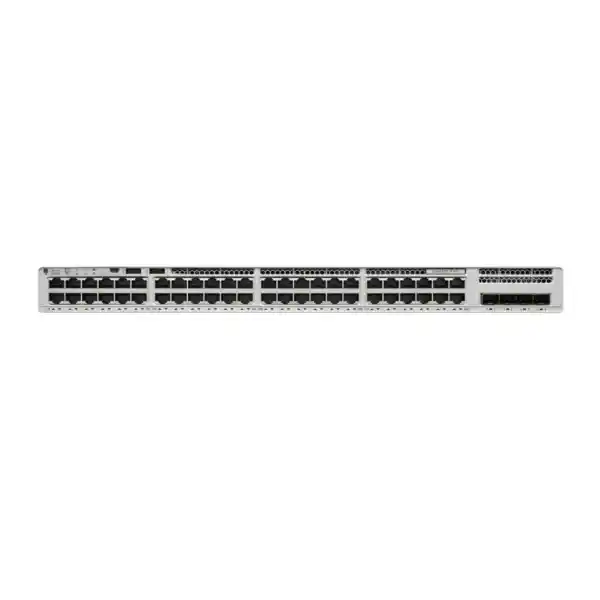
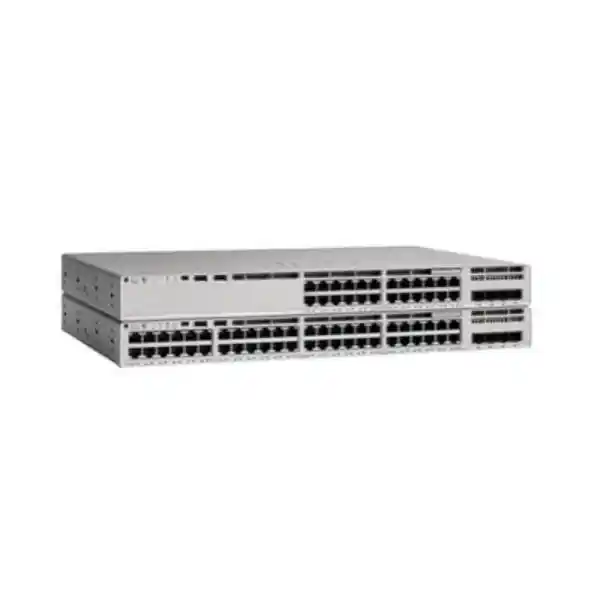
Cisco Catalyst C9200L-48T-4G Network Switch
A fixed-uplink 48-port Gigabit Ethernet access switch for organizations that need dependable wired connectivity, Cisco IOS XE operations, StackWise-80 resiliency, enterprise segmentation, telemetry, and lifecycle consistency without the additional cost or power profile of PoE hardware.
Purpose-built access density
Forty-eight copper Gigabit ports make the C9200L-48T-4G practical for user desks, printers, servers, appliances, building systems, out-of-band devices, and other endpoints that do not require switch-supplied PoE.
Fixed optical uplinks
Four dedicated 1G SFP uplink slots simplify dual-homing, fiber riser links, inter-floor connectivity, distribution connections, and branch handoff designs while preserving every copper access port for endpoints.
StackWise-80 ready
Physical stacking can consolidate multiple access switches into one operational system with a common control and management plane, improving expansion, link aggregation design, and maintenance consistency.
Cisco IOS XE operations
The Catalyst 9200 family brings model-driven configuration, automation interfaces, telemetry, policy controls, troubleshooting tooling, and a familiar enterprise CLI into a cost-conscious campus access platform.
What the Cisco C9200L-48T-4G is designed to do
The Cisco Catalyst C9200L-48T-4G is best understood as a high-density, non-PoE enterprise access switch. It is intended for networks where the primary requirement is dependable wired Gigabit Ethernet for a large number of endpoints, paired with enterprise-class control, visibility, routing, segmentation, resiliency, and lifecycle management. Unlike PoE variants in the Catalyst 9200L family, the C9200L-48T-4G does not allocate power to connected endpoints. That distinction matters because it allows an organization to deploy a more power-efficient data-only access layer when phones, wireless access points, cameras, and other powered devices are served by separate PoE switches, local injectors, independent power sources, or another dedicated edge design.
Each switch provides forty-eight 10/100/1000BASE-T downlink interfaces and four fixed 1 Gigabit SFP uplink interfaces. The downlink density is appropriate for standard office user access, workstation clusters, networked printers, dedicated desktop devices, laboratory systems, digital signage controllers, building management endpoints, edge servers, firewall inside interfaces, storage management ports, console aggregators, industrial gateways, and a wide range of IP-enabled equipment that does not need inline power. Because the four uplinks are separate from the forty-eight access ports, the design does not consume copper user capacity when the switch is connected to fiber distribution or aggregation layers.
For UAE enterprises, the model is especially useful where structured cabling is already based on Category 6 or Category 6A copper from desks to telecommunications rooms and fiber between floors, buildings, warehouses, or campus zones. A typical deployment can use two SFP uplinks in an EtherChannel toward redundant distribution switches, retain additional SFP interfaces for migration or alternate paths, and use the forty-eight copper interfaces for endpoint connectivity. The exact topology should be selected according to oversubscription targets, application traffic, failure domains, uplink diversity, and the capacity of the upstream layer.
The C9200L-48T-4G belongs to Cisco’s Catalyst 9200 platform and uses the UADP 2.0 Mini architecture. This programmable forwarding foundation is important because it separates the switch from entry-level unmanaged or lightly managed products. The platform is designed for policy-driven enterprise networks, not merely packet forwarding. It can participate in structured VLAN designs, Layer 3 routed access, access control, QoS, identity-aware segmentation, telemetry, automation, and Cisco management ecosystems. In practical terms, this makes the switch suitable for organizations that want a stable access-layer standard with predictable operations across multiple sites rather than a collection of unrelated small-business switches.
Verified hardware and performance profile
| Attribute | C9200L-48T-4G specification | Design relevance |
|---|---|---|
| Downlink ports | 48 × 10/100/1000BASE-T data ports | High-density copper access without PoE budget planning |
| Uplinks | 4 × fixed 1G SFP | Fiber or copper SFP uplink options depending on approved transceivers |
| Switching capacity | 104 Gbps standalone; 184 Gbps with stacking | Supports wire-speed access switching within platform design limits |
| Forwarding rate | 77.38 Mpps standalone; 137 Mpps with stacking | Useful for packet-rate sizing and high-volume access workloads |
| Stack bandwidth | 80 Gbps StackWise-80 | Enables a consolidated multi-switch access system |
| MAC address scale | 16,000 | Supports dense enterprise endpoint populations |
| VLAN IDs | 4,094 | Broad segmentation range for campus and branch policy design |
| SVIs | 512 | Supports routed VLAN interfaces within platform scale |
| Jumbo frame support | Up to 9,198 bytes | Useful for selected storage, virtualization, and infrastructure traffic designs |
| Packet buffer | 6 MB | Relevant when evaluating bursts and oversubscription behavior |
| Memory | 2 GB DRAM; 4 GB flash | Platform resources for IOS XE software and operating state |
| Form factor | 1RU; approximately 4.4 × 44.5 × 28.8 cm chassis | Fits standard enterprise racks with shallow access-layer depth |
Performance values should be interpreted in the context of the complete design rather than as isolated marketing numbers. The 104 Gbps switching capacity corresponds well to the port configuration because forty-eight full-duplex 1G access ports plus four full-duplex 1G uplinks create a theoretical aggregate bandwidth requirement that the architecture is designed to handle at the switch fabric level. Actual application performance still depends on packet size distribution, traffic patterns, queues, ACL and QoS policies, routing services, oversubscription at uplinks, upstream congestion, server response behavior, and the architecture of the rest of the network. For procurement, the more important question is whether 1G uplinks are appropriate for the projected traffic concentration. Where users regularly move large files, access high-throughput virtual desktop platforms, use dense video workflows, back up to centralized storage, or aggregate many high-utilization devices, FourTeck may recommend evaluating a 4X variant with 10G uplinks instead.
UADP 2.0 Mini architecture and forwarding behavior
Cisco’s Unified Access Data Plane architecture is one of the main technical reasons the Catalyst 9200L belongs in enterprise networks rather than basic connectivity deployments. The C9200L fixed-uplink Gigabit models use a UADP 2.0 Mini implementation with an integrated CPU. In practical terms, the data plane is designed to execute switching, routing, security classification, access control, QoS marking, forwarding decisions, and policy operations in hardware while the control plane maintains topology, protocol state, management processes, configuration, and software services. This division allows the switch to forward normal production traffic at high speed without forcing every packet through a general-purpose processor.
For an access-layer engineer, ASIC capability translates directly into design confidence. VLAN classification, MAC learning, access control lists, QoS enforcement, routing lookups, multicast behavior, and other functions consume finite hardware resources. The C9200L platform therefore publishes scale values rather than presenting itself as unlimited. For example, the family supports 16,000 MAC addresses on C9200L SKUs, up to 3,000 IPv4 routing entries, 1,500 IPv6 routing entries, approximately 1,000 multicast routes, around 1,000 QoS scale entries, and approximately 1,500 ACL scale entries. These values are important in dense campuses, shared service environments, large branches, or routed-access designs because a switch that is comfortable with forty-eight physical ports can still encounter resource pressure if it is used in an unusually complex routing or policy role.
The 6 MB packet buffer also deserves attention. Buffering absorbs short traffic bursts when multiple ingress interfaces converge on fewer egress interfaces. A common example is forty-eight user ports sending toward one or two 1G uplinks. In a lightly utilized office, the uplinks may remain mostly idle and bursts clear quickly. In a high-throughput environment, sustained oversubscription can create queue growth and packet drops. The appropriate response is not to treat buffering as a substitute for capacity. Engineers should measure utilization, understand traffic peaks, implement suitable QoS policies where business applications require prioritization, and upgrade the uplink architecture when sustained demand approaches link capacity.
This architecture also supports model-driven programmability and telemetry through IOS XE. That is relevant for modern operations teams because configuration can be treated as structured data rather than only as terminal commands. NETCONF, RESTCONF, YANG models, Plug and Play workflows, telemetry, SNMP, syslog, and automation frameworks can help standardize switch deployment across Dubai headquarters, Abu Dhabi offices, Sharjah facilities, warehouses, retail branches, and remote UAE sites. The value is not simply automation for its own sake; the operational benefit is consistency. A well-designed template reduces interface configuration drift, enforces VLAN and security policy, improves auditability, and makes replacement or expansion more predictable.
Port architecture: 48 copper access interfaces and 4 dedicated SFP uplinks
Downlink strategy
The forty-eight RJ45 interfaces negotiate 10, 100, or 1000 Mbps Ethernet and are intended for standard copper access. In most current enterprise deployments, Gigabit Ethernet is the normal operating speed, while 10/100 support primarily assists with legacy equipment, specialized controllers, older building systems, and transitional devices. Auto-negotiation and structured interface templates can simplify mixed estates, but network teams should still document legacy endpoints because duplex mismatches, old cabling, electrical noise, and unusual embedded devices can create troubleshooting cases that are not caused by the switch itself.
Because this is a T model, the switch is data-only. It should not be selected when endpoint power must come from the access switch. If an organization has Cisco phones, wireless access points, CCTV cameras, access-control readers, IoT sensors, or other PoE devices, the C9200L-48P-4G or another appropriate PoE model should be considered. A mixed-floor design can also use one data-only switch for desktops and servers alongside one PoE switch for powered endpoints, which can improve cost and electrical planning when the endpoint mix is stable.
Uplink strategy
The four fixed SFP slots operate at 1 Gigabit Ethernet. They are valuable because they preserve all forty-eight copper interfaces for local devices and support fiber where distance, electromagnetic isolation, building-to-building routing, or structured cabling standards make optical connectivity preferable. SFP selection should match fiber type, connector type, wavelength, reach, and the optic supported by the upstream platform. Multimode links inside buildings commonly use short-reach optics, while longer runs may require single-mode optics.
The fixed nature of the uplinks is both a strength and a design constraint. It lowers platform complexity and makes the switch economical, but the uplink module cannot later be replaced with a 10G module. If traffic forecasts indicate that 1G uplinks could become restrictive, the C9200L-48T-4X with four 1/10G SFP+ uplinks may offer better headroom. FourTeck therefore sizes the uplink tier from real application demand, user count, Wi-Fi architecture, server placement, east-west traffic, backup windows, and business growth rather than selecting a switch only from port count.
StackWise-80: scaling and operational resiliency
The C9200L-48T-4G supports Cisco StackWise-80, providing 80 Gbps of stacking bandwidth. A stack allows multiple physical switches to operate as a single logical switching system with one management and control plane. Cisco positions Catalyst 9200 stacks for up to 384 access ports, which aligns with a maximum of eight forty-eight-port access switches in a fully populated stack. For network administrators, the practical benefit is not merely more ports. Stacking changes the way uplinks, configuration, failover, and lifecycle management can be designed.
In a standalone arrangement, each access switch is independently managed and independently uplinked. In a stack, administrators can create cross-stack EtherChannels so that physical uplink members terminate on different stack members. This improves resilience against a single access-switch failure because the logical bundle can remain operational through the surviving member, provided the upstream topology and configuration are designed correctly. It also lets the access layer present a simpler logical topology to distribution switches, reducing spanning-tree complexity and helping standardize redundancy patterns.
Stacking should still be engineered as a failure domain. A stack is not identical to multiple completely independent switches, and software upgrades, stack-member behavior, ring integrity, power events, and configuration errors can affect more than one physical chassis. The correct architecture depends on business availability requirements. A general office floor may benefit greatly from a single stack, while a highly critical environment may deliberately divide endpoints across separate stacks, separate electrical circuits, and separate distribution paths. FourTeck designs the physical stack ring, member numbering, priority, uplink placement, power redundancy, cable routing, rack layout, and maintenance plan so that the stack contributes to availability rather than simply concentrating ports.
The switch has dual power-supply slots and uses a 125W AC power supply for the data-only C9200L-48T-4G platform. Cisco documentation describes redundant power supply capability for Catalyst 9200 Series switches, and the C9200L-48T-4G uses fixed redundant power architecture with an optional second supply. In a UAE rack deployment, installing the second compatible power supply and feeding it from a separate rack PDU or UPS path can reduce the impact of a single supply or feed failure. This is especially valuable in branch equipment rooms where there may be no on-site network engineer available during an outage.
Operationally, stacking also simplifies inventory and template management because administrators interact with one logical system. However, software compatibility between members, approved stack cables, topology validation, and consistent hardware planning remain essential. A stack expansion should never be treated as plugging in another switch without preparation. The new member should be checked for platform compatibility, intended software version, license tier, stack priority, startup configuration state, and cabling order. Proper change control avoids unexpected elections, mismatched images, or service interruption during expansion.
Layer 2 design: VLANs, spanning tree, EtherChannel and endpoint control
At the access layer, stable Layer 2 design remains fundamental even when a network uses advanced automation. The C9200L platform supports up to 4,094 VLAN IDs and substantial spanning-tree scale, including PVST and MST operation. Those numbers allow extensive segmentation, but good design typically uses far fewer VLANs per access switch. The objective is to create logical boundaries that reflect user groups, device roles, security zones, voice or collaboration services, management networks, guest access, IoT systems, building controls, and other operational needs without introducing unnecessary broadcast domains or configuration overhead.
Access ports should be configured explicitly for their role. User-facing interfaces can receive access VLAN assignment, edge-port behavior, BPDU protection, storm control, DHCP snooping policy, device tracking, 802.1X or MAC Authentication Bypass where required, and QoS trust rules suited to the endpoint. Unused ports should be administratively disabled and placed into a defined parking VLAN or equivalent secure state rather than remaining active in a production user segment. Infrastructure-facing trunks should have an explicit allowed-VLAN list rather than carrying every VLAN by default. This reduces accidental propagation, simplifies troubleshooting, and minimizes the effect of configuration errors.
Spanning Tree Protocol remains relevant in many enterprise access networks. PortFast-style edge behavior is appropriate for endpoint-facing interfaces but should be combined with protection features so an accidentally connected switch does not destabilize the topology. Root placement should be intentional at the distribution or core layer. Where uplinks are aggregated through LACP EtherChannel, the logical bundle can increase usable bandwidth and provide path redundancy while presenting a single spanning-tree interface. With four 1G uplinks, a design may use two links in one port channel and retain two for alternate purposes, or build a four-link bundle where the upstream design supports it. The choice depends on physical path diversity, upstream port availability, and the desired balance between capacity and failure isolation.
The 9,198-byte jumbo frame capability can be useful for selected infrastructure applications, but it should not be enabled without end-to-end planning. An MTU mismatch can produce difficult symptoms when large packets are dropped silently or fragmented unexpectedly. If jumbo frames are required for storage, virtualization, backup, or appliance traffic, the MTU policy should be checked across endpoint NICs, access ports, routed interfaces, distribution switches, firewalls, WAN devices, and the destination system. For normal user access, standard Ethernet MTU is usually simpler.
EtherChannel, VLAN segmentation, STP protections, and endpoint controls should be validated as one design rather than separate checkboxes. The most reliable Catalyst deployments are those where every port type has a documented template and every exception is intentional. FourTeck can build these templates as reusable IOS XE configurations, including naming conventions, descriptions, SNMP or telemetry settings, AAA, NTP, logging, interface policy, VLAN definitions, and uplink standards, supporting consistent rollout across a single UAE site or a multi-branch estate.
Layer 3 routing and routed-access use cases
The Catalyst 9200 family is not limited to Layer 2 access. Depending on license tier and software feature set, the platform supports routed access capabilities that can place the Layer 3 boundary directly on the access switch. This can reduce broadcast-domain size, improve convergence, simplify some campus designs, and support segmented routing closer to users. The C9200L scale includes approximately 3,000 IPv4 routing entries and 1,500 IPv6 routing entries, along with up to 512 switched virtual interfaces. Those figures are sufficient for many branch and campus-edge designs, but they are not intended to turn the access switch into a large Internet routing platform.
Network Essentials provides foundational routing capabilities, while Network Advantage unlocks a broader set of advanced routing and segmentation features. Cisco’s current feature matrix includes static routing and selected routed-access capabilities in the Essentials tier, with advanced protocols and segmentation functions such as expanded OSPF or EIGRP capabilities, HSRP, IS-IS, VRF, VXLAN, LISP, and Security Group Tag-related functions associated with the Advantage tier. The exact software release, license subscription, deployment mode, and feature requirement should be confirmed during quotation because Cisco licensing evolves over time and should not be assumed from hardware part number alone.
In a traditional three-tier campus, the C9200L can operate primarily as a Layer 2 access switch with VLAN trunks toward a distribution pair where SVIs and routing reside. This architecture is familiar, centralized, and often appropriate for smaller and medium networks. In a routed-access design, individual access switches or stacks can run Layer 3 links to distribution switches and host local SVIs. That can reduce dependence on spanning tree in the uplink topology and provide deterministic routed failover. The best architecture depends on operational skill, scale, security policy, multicast requirements, redundancy, and whether the organization uses Cisco Catalyst Center or Software-Defined Access.
For branches, the switch can also provide local inter-VLAN routing while a firewall or WAN router remains the default path for Internet, SD-WAN, MPLS, or cloud traffic. This is useful when local traffic between departments, servers, printers, and infrastructure should not traverse the firewall unnecessarily. However, security policy may require certain east-west traffic to pass through a firewall. The routing topology must therefore be aligned with segmentation and inspection requirements rather than optimized only for performance.
IPv6 support should be included in lifecycle planning even where the present network is IPv4-dominant. A structured Catalyst deployment can define IPv6 management policy, RA Guard, DHCPv6 behavior, first-hop security, and routing readiness before widespread adoption. Treating IPv6 as an unknown or disabled protocol can leave blind spots because modern operating systems often enable IPv6 by default. FourTeck can incorporate dual-stack or IPv6-control requirements into the switch baseline without forcing a premature migration.
Security controls for enterprise access
Identity and admission
802.1X can authenticate users or devices before granting network access, while MAC-based fallback can support endpoints that cannot run a supplicant. When combined with Cisco ISE or another compatible AAA architecture, policies can assign VLANs, authorization profiles, downloadable controls, or role-based access according to identity and device context.
First-hop security
DHCP snooping, Dynamic ARP Inspection, source validation, device tracking, IPv6 protection features, and control-plane policing can reduce common local attack paths. These mechanisms require deliberate trust-boundary design, especially on uplinks, DHCP-server connections, trunk interfaces, and ports connected to legitimate infrastructure.
Segmentation
VLANs, private VLAN capabilities, ACLs, Security Group Tags, and advanced segmentation functions can separate departments, IoT, contractors, guests, infrastructure, printers, building systems, and administrative access. Segmentation is effective only when policy enforcement points and permitted flows are clearly documented.
Management-plane protection
AAA, TACACS+ or RADIUS, SSH, role-based access, secure SNMP, trusted NTP, centralized logging, configuration backups, control-plane policing, and restricted management VRFs or VLANs are core components of a defensible switch baseline. Local credentials should be treated as controlled break-glass access, not the primary operating model.
Cisco documentation lists MACsec support across the Catalyst 9200 family, providing link-layer encryption capabilities for suitable deployments and software combinations. MACsec can protect Ethernet frames on supported links when sensitive traffic traverses infrastructure where physical path exposure is a concern. It is not a replacement for application encryption or end-to-end security, but it can be part of a layered design. Feature eligibility, port support, peer capability, and licensing should be verified against the intended IOS XE release before it is made a mandatory design dependency.
The strongest access-layer security architecture combines preventive controls with operational visibility. Blocking a rogue DHCP server is useful, but the team also needs logs or telemetry that explain why a port stopped passing traffic. Enforcing 802.1X improves admission control, but help-desk processes must accommodate certificate failures, device replacements, guest onboarding, and exception handling. FourTeck therefore approaches switch security as an operational system: baseline hardening, identity integration, logging, policy definition, exception governance, recovery procedures, and troubleshooting all need to be designed together.
QoS, voice, video and business-critical traffic
Although the C9200L-48T-4G does not provide PoE, it can still carry voice, video, collaboration, transactional, industrial, and other latency-sensitive traffic. A desk phone may use a separate power adaptor, a powered patching design, or reside on another switch while its data traverses the C9200L. Quality of Service becomes important when multiple traffic classes compete for a constrained uplink, particularly because this model uses 1G uplinks rather than 10G. QoS cannot create bandwidth, but it can control how congestion is handled and protect selected traffic classes from being overwhelmed by lower-priority transfers.
A practical QoS design begins with trust boundaries. The switch should not automatically trust every marking received from every endpoint. Managed phones, wireless infrastructure, specialized appliances, or trusted servers may legitimately mark traffic, while general user devices may require classification or remarking. Policies can identify traffic using DSCP, VLAN, ACL, application context available elsewhere in the architecture, or interface role. Egress queues then determine how traffic is scheduled and dropped under congestion.
The platform’s published QoS scale is approximately 1,000 entries on C9200L models. That is ample for standard enterprise access templates but should be considered in unusually granular designs. Excessive per-port complexity is rarely necessary. Most organizations benefit from a small number of well-defined traffic classes: control, voice, real-time video, critical business applications, default user data, and scavenger or bulk traffic. The exact model depends on the WAN, wireless, firewall, and upstream campus policy because QoS treatment is most effective when markings and class definitions remain consistent end to end.
For UAE offices connected through MPLS, SD-WAN, DIA, or cloud security services, local access QoS should map into the WAN service classes. A switch that marks voice correctly is only one part of the path. The firewall, WAN edge, service provider, and remote site must interpret or preserve markings consistently. FourTeck can align the C9200L access template with existing Cisco routers, SD-WAN appliances, firewalls, IP telephony, and application requirements so that the switch contributes to an end-to-end service policy instead of applying isolated queuing rules.
Automation, telemetry and day-two operations
Enterprise switching is increasingly judged by operational cost as much as by forwarding capability. A switch that passes packets reliably but requires manual, device-by-device administration can become expensive across dozens or hundreds of sites. Cisco IOS XE provides multiple ways to automate and observe Catalyst switches, including a structured CLI, NETCONF, RESTCONF, YANG data models, Plug and Play capabilities, SNMP, syslog, streaming or model-driven telemetry features, and integration with Cisco management platforms. These interfaces allow the C9200L-48T-4G to fit into both traditional network operations and infrastructure-as-code practices.
Configuration automation starts with source-of-truth discipline. Before generating templates, the organization should know which data uniquely defines each switch: hostname, management address, site code, uplink ports, stack member numbers, VLAN assignments, authentication servers, NTP sources, DNS settings, syslog destinations, SNMP or telemetry collectors, banner text, software policy, and interface roles. A templating system can then render consistent configuration from approved data. This reduces manual typing, but more importantly, it creates a repeatable process that can be reviewed and tested.
Telemetry improves troubleshooting by turning switch behavior into measurable data. Interface counters reveal errors, discards, congestion, negotiation problems, and utilization. CPU and memory metrics provide platform health context. MAC movement can reveal loops or endpoint relocation. Authentication logs expose access-control failures. Spanning-tree events show topology changes. Environmental readings can indicate cooling problems. Stack state, power-supply status, and software alarms support proactive maintenance. Centralized monitoring should convert this information into meaningful alerts rather than simply collecting every metric.
Cisco Catalyst Center can add discovery, inventory, assurance, automation, software image management, and policy capabilities for organizations invested in the Cisco ecosystem. Cisco also offers cloud monitoring and selected management paths for Catalyst hardware. Whether centralized orchestration is justified depends on fleet size, operational maturity, subscription model, and desired workflow. A ten-switch environment may be managed effectively with carefully controlled CLI and monitoring, while a multi-country estate may benefit substantially from centralized assurance and standardized automation.
For UAE enterprises with regional sites in the Gulf or Africa, operational consistency becomes even more important because remote hands, shipping lead times, local ISP differences, and travel constraints can make troubleshooting costly. FourTeck can standardize switch staging, labeling, golden configurations, management access, software versions, remote monitoring, and spare strategy through the FourTeck IT Services UAE practice, helping distributed Catalyst deployments remain supportable after the initial installation.
Licensing: Network Essentials, Network Advantage and subscription planning
The hardware model C9200L-48T-4G is commonly ordered with either a Network Essentials or Network Advantage software tier, reflected in Cisco orderable part numbers such as C9200L-48T-4G-E and C9200L-48T-4G-A. The letter is not cosmetic: it indicates the intended perpetual network feature tier. Cisco’s current licensing model also associates Catalyst purchases with subscription licensing requirements, and new orders generally require a subscription tier aligned with the network license tier. Because licensing terms, minimum subscription periods, renewal options, and feature entitlements can change, procurement should validate the current Cisco commercial model at the time of quotation.
Network Essentials is appropriate where the requirement centers on Layer 2 switching, foundational Layer 3 routing, standard security, telemetry, automation, and core access services. Cisco’s feature matrix includes switch fundamentals such as Layer 2 operations, static routing, routed-access functions, selected dynamic routing scale, policy-based routing, multicast stub functions, private VLAN capabilities, first-hop security, 802.1X, QoS, basic MACsec, control-plane protection, IP SLA responder functions, and model-driven automation interfaces. Network Advantage extends the platform into advanced routing and segmentation functions such as broader dynamic routing capability, HSRP, IS-IS, VRF, and additional policy or fabric features.
The correct tier should be selected from the network architecture, not from a preference to buy the least expensive license. If the switch will be a conventional Layer 2 access device with routed SVIs upstream, Essentials may satisfy requirements. If the design relies on advanced routing, VRFs, software-defined segmentation, richer redundancy protocols, or specific Catalyst Center and SD-Access functions, Advantage may be necessary. Changing license strategy later can create commercial and operational friction, so requirements should be mapped to features before the bill of materials is approved.
Smart Licensing and software entitlement management should also be incorporated into deployment planning. The network team needs an ownership model for Cisco Smart Accounts, virtual accounts, license registration, renewal visibility, and administrative permissions. Licensing should not be left to an individual engineer’s personal account or undocumented credentials. For managed estates, FourTeck can coordinate with the customer’s procurement and network teams to align serial-number inventory, subscriptions, support contracts, software entitlement, and lifecycle records.
Organizations comparing options through FourTeck UAE can request a quotation that separates hardware, software tier, subscription term, optics, stacking accessories, support, professional services, installation, and optional spares. This makes the commercial decision transparent and reduces the risk of receiving a switch that is physically correct but operationally incomplete.
Power, cooling, rack design and UAE environmental planning
The C9200L-48T-4G is a 1RU switch with a compact chassis approximately 4.4 cm high, 44.5 cm wide, and 28.8 cm deep before allowances for cabling, connectors, power hardware, and airflow. Cisco lists a weight of approximately 4.53 kg for the model. Its standard power architecture uses a 125W class power supply and supports a second compatible supply for redundancy. Since this is a non-PoE switch, electrical consumption is driven primarily by the switch electronics, optics, software workload, fans, and operating conditions rather than endpoint power delivery.
In UAE deployments, environmental engineering is critical because outdoor temperatures can be extreme even though enterprise switches are installed indoors. The switch should operate in a conditioned telecommunications room or cabinet where ambient temperature, humidity, dust, and airflow remain within supported limits. Cisco specifies normal operating temperature ranges that vary with altitude and describes short-term exceptional ranges for 9200L/9200 models. These exceptions are not a design target. A network room that routinely approaches the upper limit should be treated as an HVAC or facility risk, not as evidence that the switch can permanently tolerate poor cooling.
Rack airflow should remain unobstructed. Cable bundles should not block exhaust paths, and patch cords should be routed through horizontal and vertical management rather than pressed against fan areas. Equipment rooms in warehouses, factories, retail back rooms, or construction sites need special consideration because fine dust can accumulate in fans and heat sinks, while poorly sealed rooms can experience high humidity or hot air ingress. Preventive maintenance should include visual inspection, environmental monitoring, rack cleaning, and alerting for temperature or fan faults.
Power redundancy is most useful when the two supplies do not depend on the same upstream failure point. Connecting both supplies to the same overloaded extension strip provides limited resilience. For critical sites, each supply can connect to separate PDUs, and where feasible, those PDUs can be fed by separate UPS paths or circuits. The design should consider generator transfer behavior, UPS runtime, battery maintenance, surge protection, and grounding. Network equipment often remains operational during a building power disturbance only if the complete electrical path is engineered for continuity.
Thermal and electrical planning also affects stack architecture. Six or eight access switches concentrated in a rack create a different heat load from one switch. The rack should have adequate power circuits, UPS capacity, cooling airflow, cable-management space, and service access. FourTeck can include rack and power review as part of a deployment assessment, especially for branch sites where networking, CCTV, servers, firewall appliances, and telecom equipment share a small communications cabinet.
Sizing the C9200L-48T-4G correctly
Port count is only the first sizing variable. A forty-eight-port switch is not automatically the correct choice simply because a floor has forty-eight network outlets. Some outlets may remain spare, some users may require two connections, phones may require PoE, access points may need multigigabit Ethernet, printers and meeting rooms may consume additional ports, and future growth should be accommodated without immediately adding another switch. A typical structured design reserves a reasonable percentage of spare ports and maps every active outlet to an endpoint category.
The second variable is PoE demand. The C9200L-48T-4G supplies no PoE. If twenty-five of the planned endpoints are phones, cameras, and access points, selecting a data-only switch would force a parallel power solution and may be economically wrong. Conversely, if nearly every connected device has local power, buying a full-PoE switch may add cost and electrical capacity that provides little value. The endpoint inventory should therefore identify power class, port speed, traffic role, location, and expected lifecycle.
The third variable is uplink demand. Four 1G SFP uplinks are ample for many branches and standard user-access floors, but traffic concentration must be measured. Assume forty users each generate light transactional, SaaS, email, and web traffic: a pair of 1G uplinks may have substantial headroom. Now assume the same forty users are media editors accessing centralized storage, developers pulling large container images, or analysts transferring large data sets. The access ports are still only 1G, but aggregate demand can saturate the uplinks. In those cases, 10G uplink variants deserve consideration.
The fourth variable is feature complexity. Standard VLAN access and moderate routing consume far fewer resources than an unusually large ACL policy, extensive VRF segmentation, dense multicast, or a high number of routes. Published platform scales such as 16,000 MAC addresses, 3,000 IPv4 routing entries, 1,500 IPv6 routing entries, 1,500 ACL scale entries, and 512 SVIs should be compared with the intended design. Enterprises should also consider future policy growth, not only day-one configuration.
The fifth variable is availability. A single switch with one power supply and one uplink can be acceptable in a low-impact office, but a call center, hospital administrative network, airport tenant, financial branch, industrial control environment, or twenty-four-hour logistics facility may require dual power supplies, dual uplinks, a stack, redundant distribution, spare hardware, and formal support coverage. Availability engineering should be based on the business impact of failure rather than the nominal reliability of the hardware.
Finally, lifecycle matters. If the organization expects substantial Wi-Fi 6/6E growth, multigigabit endpoints, 10G access, higher-power PoE, or rapid traffic expansion, a different Catalyst model may create a better five-year architecture. FourTeck evaluates the C9200L-48T-4G against adjacent options rather than treating every enquiry as a request to sell the named SKU. The goal is to ensure that the ordered switch matches the actual network requirement.
Common UAE deployment scenarios
Corporate office floor
Use the C9200L-48T-4G for desktops, printers, docking stations, meeting-room controllers, local servers, and other powered devices, while dedicated PoE switches support phones and wireless access points. Dual fiber uplinks can connect the floor to a resilient distribution layer. This design is cost-efficient when the endpoint mix is clearly separated between powered and non-powered equipment.
Branch office
A branch may use one or two switches with local VLANs, routed uplinks or trunks toward a firewall, and centralized monitoring from headquarters. StackWise can simplify expansion where two or more access switches are installed. Templates can standardize management, AAA, NTP, syslog, VLAN numbering, interface security, and WAN handoff across many UAE branches.
Warehouse and logistics
Data-only switch ports can serve fixed terminals, industrial PCs, label printers, controllers, NVR management interfaces, and wired operational systems. Environmental planning becomes especially important because communications cabinets may be close to loading areas, dust, heat, vibration, or unstable power. Wireless APs and cameras can reside on separate PoE switching where appropriate.
Education and training facilities
Computer labs, classrooms, faculty offices, administrative systems, printers, and shared devices can consume large numbers of 1G ports. VLAN segmentation can separate students, staff, guests, labs, AV systems, and management. Uplink capacity should be checked carefully where many clients simultaneously access cloud learning platforms or local media repositories.
Retail and hospitality back office
POS back-end systems, management workstations, controllers, printers, servers, digital signage systems, and property-management devices can be segmented into policy-specific VLANs. Network teams should carefully separate payment, guest, building, and administrative traffic and integrate switch logging with centralized security monitoring.
Server and appliance management
The switch can provide dense 1G connectivity for server management controllers, hypervisor management ports, backup appliances, monitoring devices, console infrastructure, and firewall management interfaces. Production storage or high-throughput server data networks should be evaluated separately because the 1G uplink architecture may not suit heavy east-west traffic.
Optics, fiber and uplink bill-of-material planning
A switch quotation is incomplete if the uplink media is undefined. The C9200L-48T-4G has four SFP slots, but the correct transceiver depends on the actual cabling plant. Multimode OM3 or OM4 fiber inside a building may use short-reach 1G optics. Single-mode OS2 fiber between buildings or across a campus may require longer-reach optics. Copper 1G SFP options can be useful in selected cases where the upstream interface is RJ45, although thermal, distance, and compatibility rules should be checked. BiDi optics, CWDM, third-party transceivers, and special-reach optics require additional engineering and commercial validation.
The physical connector path should be documented from switch to switch. That includes SFP model, patch-cord connector type, fiber type, patch-panel adapters, polarity, splice points, intermediate distribution frames, and estimated loss budget. A 1G link that appears straightforward can fail commissioning because one end uses multimode and the other single-mode, because connector polish types are mixed, because transmit and receive strands are reversed, or because an existing fiber run has unexpected attenuation. Proper labeling and optical testing reduce these problems.
For redundant uplinks, physical route diversity is as important as logical configuration. Two fibers in the same cable tray, through the same riser, and into the same patch panel may protect against a transceiver failure but not against a cable cut or patch-panel incident. Critical sites should identify whether true path diversity is available. Similarly, upstream uplinks should ideally terminate on separate distribution systems or stack members where the architecture is designed for that failure model.
FourTeck can quote the switch with compatible stacking accessories, optics, patch cords, rack hardware, redundant power supplies, and professional services as a complete bill of materials. Related infrastructure and integration requirements can also be coordinated through the broader FourTeck global technology portfolio, which is useful for organizations standardizing network equipment across UAE and international sites.
Migration from legacy Catalyst and mixed-vendor access switches
Replacing an access switch is deceptively simple when viewed only as hardware. The real migration task is to preserve endpoint connectivity, security behavior, routing, voice services, monitoring, and operational conventions while removing accumulated configuration errors. Before a C9200L-48T-4G is installed, the existing switch should be audited for interface descriptions, active MAC addresses, VLAN assignments, trunk configuration, EtherChannels, spanning-tree settings, DHCP snooping, ARP inspection, ACLs, 802.1X, voice VLANs, QoS policy, SNMP, syslog, NTP, AAA, port security, static routes, routing protocols, and management reachability.
The audit should distinguish intentional configuration from historical residue. Legacy switches often contain unused VLANs, old access lists, disabled trunks, abandoned interface descriptions, stale monitoring communities, local user accounts, and temporary exceptions that became permanent. Copying everything exactly can reproduce old problems. On the other hand, aggressively simplifying the configuration without understanding device dependencies can break specialized systems. The migration plan therefore maps each configuration element to a requirement and determines whether it should be retained, updated, or removed.
Software version selection is equally important. The newest available IOS XE release is not automatically the correct production choice. The organization may standardize on a recommended release, require compatibility with Catalyst Center, depend on a specific feature, or need to avoid a known defect affecting its topology. Release notes, field notices, security advisories, transceiver compatibility, and feature behavior should be reviewed. If the switch joins an existing StackWise stack, software compatibility is mandatory and should be staged before the change window.
During cutover, interface mapping should be pre-labeled so patch cords can move quickly and accurately. Critical devices can be migrated first or last depending on rollback strategy. Uplinks, stack cables, management reachability, routing adjacencies, spanning tree, EtherChannel state, authentication, DHCP, DNS access, and monitoring should be validated before users are moved at scale. A rollback plan should specify the conditions under which the legacy switch is reconnected.
Post-migration validation should continue beyond a successful ping. Engineers should inspect interface errors, duplex and speed, log messages, authentication sessions, DHCP snooping bindings, routing tables, MAC learning, CPU and memory, stack health, power-supply state, optic diagnostics where available, monitoring alarms, and application behavior. A clean handover includes current configuration backup, serial-number inventory, rack documentation, port map, software version, license status, support entitlement, and escalation contacts.
C9200L-48T-4G versus adjacent Catalyst choices
The C9200L-48T-4G is a strong fit when the requirement is forty-eight 1G copper data ports, 1G optical uplinks, enterprise software, and stacking. It is not the universal answer for every access layer. The closest comparison is often the C9200L-48T-4X, which keeps the same general data-only 48-port access concept but replaces the four 1G uplinks with four 1/10G SFP+ uplinks. The 4X version offers significantly more uplink headroom and a higher standalone switching capacity. Organizations expecting sustained traffic growth may justify the additional cost even when current demand fits within 1G links.
PoE variants such as the C9200L-48P-4G are appropriate when the switch must power phones, access points, cameras, or other devices. They introduce power-budget planning, higher-capacity power supplies, and potentially higher thermal load, but simplify edge device installation by eliminating separate power adapters. The partial-PoE variants can be useful when only a subset of ports require power. Endpoint inventory determines whether a data-only, partial-PoE, or full-PoE model is most economical.
The modular-uplink C9200 models offer greater investment protection in environments where uplink requirements may change because network modules can provide different speeds. They may also provide different redundancy and platform characteristics. Higher Catalyst 9300 models extend scale, performance, uplink options, stacking capabilities, and advanced feature capacity for larger campus deployments. Conversely, smaller compact switches may be better for space-constrained branches or low-port-count areas.
The key procurement principle is to size on lifecycle requirements rather than on today’s number of live jacks. An apparently more expensive switch can be less costly if it avoids an early replacement, while a higher-end model can be wasteful if the site will never use its additional capabilities. FourTeck compares access density, PoE, uplink speed, routing scale, stack requirements, software tier, power, rack space, optical reach, growth, and support lifecycle before recommending the final SKU.
For security architecture around the access layer, organizations can also coordinate switching with perimeter and branch security through Firewall Dubai by FourTeck. This is particularly useful when VLAN and routed-access decisions must align with firewall zones, SD-WAN handoffs, VPN design, guest Internet access, or zero-trust segmentation.
Operational standards for a production deployment
A production C9200L deployment should be documented and standardized from the first switch. Hostnames should encode location and function using a convention that scales. Management addresses should come from dedicated infrastructure subnets. AAA should use centralized identity services where available. Local credentials should be unique, protected, and reserved for fallback. NTP should point to trusted time sources because accurate timestamps are essential for correlating logs. DNS configuration should use enterprise resolvers if hostname-based management is required. Syslog should send events to centralized collectors with appropriate severity. SNMPv3 or secure telemetry mechanisms should replace legacy plaintext communities where practical.
Configuration backups should be automated and versioned. A backup is useful only if it can be found and restored during an incident. The organization should define when backups occur, where they are retained, who can access them, and whether sensitive secrets are protected. Changes should be traceable to an approved request or automation commit. Where manual CLI changes are allowed, periodic configuration-drift comparison can detect deviations from the baseline.
Software lifecycle policy should define preferred IOS XE releases, maintenance windows, vulnerability review, upgrade testing, and rollback. Catalyst software upgrades can introduce new features and security fixes, but they also modify the operating environment. A staged process may update a lab or low-risk site first, observe behavior, then proceed through production groups. Stacks and redundant uplinks can reduce outage impact, but upgrade method and release behavior must be understood before assuming hitless maintenance.
Monitoring thresholds should reflect the actual service. Interface utilization alerts around uplinks can reveal growth before users complain. Error counters can identify failing cables or optics. Frequent spanning-tree changes may indicate loops or unstable links. Authentication failure spikes can expose endpoint certificate issues or attacks. High CPU can result from control-plane events, management polling, loops, or defects. Power-supply and fan alarms require different response times depending on redundancy. Temperature alerts should trigger facility investigation before thermal protection becomes necessary.
Spare strategy should also be documented. A critical multi-branch organization may keep a pre-staged spare C9200L with compatible software, licenses, optics, power supplies, and configuration templates. That can reduce recovery time compared with sourcing replacement hardware after a failure. The spare must itself be tracked, updated, and tested periodically so it remains useful. Support contracts, RMA procedures, serial-number records, and escalation paths should be stored with the operational documentation.
Procurement considerations for Dubai and the UAE
Enterprise switch procurement in the UAE should confirm more than price and delivery date. The quotation should state the exact hardware part number, software tier, subscription term, power supply configuration, power cords, stack accessories, optics, support entitlement, and any professional services. Cisco part numbers can look nearly identical while representing materially different uplink or license options. C9200L-48T-4G-E and C9200L-48T-4G-A share the same fundamental hardware profile but are associated with different network license tiers. Similarly, 4G and 4X suffixes distinguish 1G versus 10G-capable uplinks.
Lead time should be evaluated against project milestones and staging requirements. Hardware should ideally arrive early enough for serial-number verification, software preparation, licensing, burn-in, configuration, labeling, and testing before the installation window. For multi-site rollouts, a pilot deployment can validate templates and bill of materials before larger quantities are shipped to branches. This reduces the risk that an overlooked optic, cable, license, or rack accessory affects dozens of locations.
Warranty and support also need to match business expectations. Cisco provides limited hardware warranty terms and basic support conditions, while organizations with critical uptime requirements often purchase Cisco support services or an equivalent managed support arrangement for software access, technical assistance, and hardware replacement commitments. The appropriate service level depends on whether the customer keeps local spares, how quickly a failed switch must be restored, and whether the site operates outside standard business hours.
For UAE organizations with expansion into Africa, the same switch standard can be extended across regions, but procurement should account for country-specific shipping, import, local power standards, support logistics, and lead times. FourTeck can coordinate broader regional supply through its approved network of sites and resources while maintaining a common technical baseline. A consistent configuration standard across countries makes remote support easier even when local commercial arrangements differ.
FourTeck’s role can span supply, configuration, staging, rack installation, fiber and copper validation, switch-stack creation, migration, firewall coordination, monitoring integration, and handover. The objective is to deliver a working access layer, not simply a sealed box. For customers that require integrated compute and network planning, related infrastructure can also be coordinated through Server Dubai by FourTeck, ensuring that switch uplink capacity, server interface speeds, management networks, and rack power are considered together.
Detailed engineering checklist before ordering
Endpoint inventory
Count active and planned wired devices. Separate desktops, laptops, printers, servers, appliances, phones, cameras, access points, controllers, building systems, IoT, and management interfaces. Record whether each endpoint requires PoE, expected port speed, VLAN, authentication type, and business criticality. Include spare capacity rather than designing to one hundred percent port utilization on day one.
Uplink assessment
Measure or estimate aggregate traffic and decide whether four 1G SFP uplinks provide enough headroom. Define how many uplinks will be active, whether LACP is used, which upstream devices they terminate on, whether routes are physically diverse, and whether 10G migration is likely during the switch lifecycle.
Fiber specification
Confirm multimode or single-mode fiber, connector type, route distance, patch-panel format, available strands, optical loss, and upstream interface capability. Select supported SFPs accordingly. Include spare optics or patch cords where operational policy requires immediate replacement capacity.
License requirements
Map routing, segmentation, automation, assurance, and Cisco management functions to Network Essentials or Network Advantage. Confirm current subscription obligations, term length, Smart Account ownership, support entitlement, and renewal responsibilities before purchase order approval.
Resiliency design
Decide standalone versus StackWise-80, single versus dual power supplies, one versus multiple uplinks, upstream redundancy, UPS and PDU diversity, spare hardware strategy, and required recovery time. Availability requirements should be stated in business terms so engineering investment matches impact.
Operational integration
Define management VLAN or VRF, AAA, DNS, NTP, logging, telemetry, SNMP, configuration backup, software standard, naming conventions, IP addressing, security baseline, monitoring ownership, alert routing, and change-control process. A switch should be operationally ready before it carries production users.
Why FourTeck for Cisco Catalyst switching in the UAE
FourTeck approaches Cisco Catalyst projects as network-engineering engagements rather than simple product transactions. The first stage is requirement validation: endpoint count, PoE demand, traffic profile, existing cabling, fiber type, routing architecture, security model, management platform, license tier, stack design, power resiliency, rack environment, and support expectations. This reduces the chance of ordering the correct-looking model with the wrong uplink speed, wrong software tier, missing optics, or insufficient PoE capability.
The second stage is bill-of-material completeness. A production switch may require a secondary power supply, stack cables, SFP transceivers, fiber patch cords, rack accessories, console access, licenses, subscriptions, and support. Each item is mapped to its purpose. For a stack, stack-cable quantity and lengths should reflect the rack arrangement. For dual-homed uplinks, transceiver quantity should include both switch and upstream sides where the customer does not already own compatible optics. For structured deployments, labels and documentation should match the final port map.
The third stage is configuration and staging. Switches can be prepared with approved IOS XE software, hostnames, management settings, VLANs, AAA, NTP, logging, SNMP or telemetry, access-port templates, trunks, EtherChannels, routing, security controls, and stack parameters. Staging can expose hardware faults, optic incompatibility, license issues, configuration errors, and software mismatches before engineers arrive at a live site.
The fourth stage is deployment and validation. FourTeck can assist with rack installation, patching, stack creation, uplink activation, migration from legacy switches, and post-cutover checks. Validation includes interface state, errors, spanning tree, routing, EtherChannels, management reachability, authentication, DHCP behavior, monitoring, power status, and application connectivity. Documentation is updated to reflect the as-built network rather than the intended design.
Finally, operational handover gives internal IT teams the information needed to support the platform. This can include configuration backups, serial numbers, license details, topology notes, port maps, software versions, management access method, monitoring expectations, escalation process, and recommended maintenance actions. The result is a Catalyst access layer that is easier to operate over its lifecycle and easier to extend when new users, sites, or applications are added.
Technical decision recap
Choose C9200L-48T-4G when
You need forty-eight reliable 1G copper data ports, no PoE, four fixed 1G SFP uplinks, StackWise-80, Cisco IOS XE operations, enterprise VLAN and routing services, access security, automation, and a compact 1RU platform. It is particularly suitable for office user access, branch sites, management networks, powered endpoints, printers, and mixed enterprise infrastructure where 1G uplinks provide adequate capacity.
Evaluate another model when
Endpoints require PoE, wireless access points need multigigabit speeds, expected aggregate traffic justifies 10G or faster uplinks, the design needs modular uplink investment protection, advanced routing or segmentation scale exceeds C9200L resources, or availability requirements call for a higher-tier campus platform. In these cases, a C9200L PoE or 4X variant, modular C9200, or Catalyst 9300 family model may be more appropriate.
The decisive sizing question
Do not ask only, “Do we need forty-eight ports?” Ask, “Do we need forty-eight non-PoE Gigabit access ports with 1G uplinks for the full planned lifecycle?” That single change in wording forces the design team to consider endpoint power, uplink growth, software features, redundancy, and long-term traffic instead of focusing only on physical port count.
Quotation input checklist
For the fastest and most accurate C9200L-48T-4G quotation, provide the following information. Even partial answers help FourTeck identify whether this exact SKU is the best match or whether a closely related Catalyst model will reduce cost or increase lifecycle headroom.
Dubai, Abu Dhabi, Sharjah, other UAE emirate, or international destination; quantity of switches; single site or multi-branch rollout.
Number of desktops, printers, servers, appliances, phones, cameras, access points, controllers, IoT systems, and spare ports required.
Confirm whether any device must receive power from the switch. If yes, provide endpoint types and approximate quantities so the correct PoE model can be sized.
Fiber or copper, 1G or 10G requirement, multimode or single-mode, link distance, connector type, and number of redundant uplinks.
Standalone switch or StackWise-80; number of members; rack arrangement; desired stack cable lengths; uplink distribution across members.
Network Essentials or Network Advantage, desired subscription term, Catalyst Center or SD-Access requirement, and Smart Account ownership.
Single or dual power supplies, UPS and PDU availability, criticality of the site, and whether spare power supplies are required.
Supply only, preconfiguration, staging, rack installation, migration, fiber testing, support, monitoring integration, documentation, or managed services.
Plan a production-ready Cisco C9200L-48T-4G deployment
FourTeck can validate whether the C9200L-48T-4G is the correct access switch for your UAE environment, then prepare the hardware, license, optics, stacking, power, configuration, migration, and support bill of materials. This is particularly valuable when the network has mixed endpoint requirements, legacy Catalyst hardware, strict maintenance windows, centralized authentication, redundant fiber uplinks, or a roadmap toward Catalyst Center and policy-based operations.
Bring an existing port map, switch configuration, network diagram, fiber schedule, or simply the number and type of devices. FourTeck can convert that input into a practical design recommendation and quotation. For UAE procurement, regional deployment, and broader enterprise technology requirements, the approved FourTeck network provides a single point of coordination from product selection through implementation and handover.
- Validated Catalyst model and license tier
- Complete optics and stacking accessories
- Power and rack resiliency plan
- Configuration and migration scope
- Support and lifecycle recommendation

Reviews
There are no reviews yet.