
Cisco Catalyst C9300-48H Network Switch
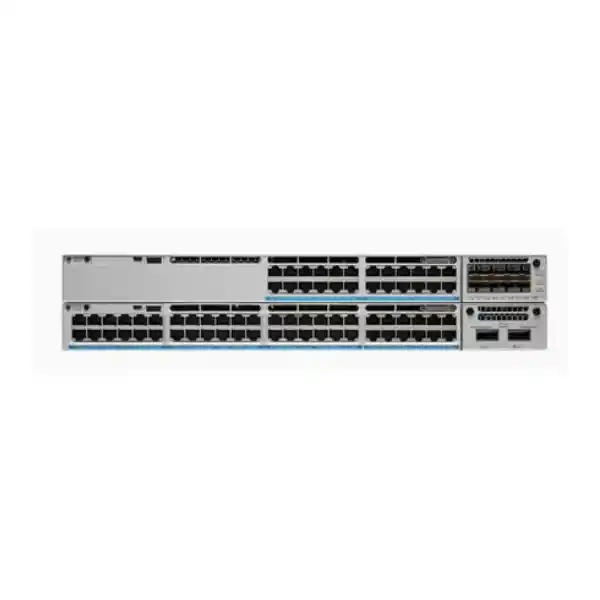
A 48-port Gigabit Ethernet Cisco UPOE+ access platform designed for power-intensive enterprise endpoints, resilient campus access, wired and wireless convergence, and policy-driven operations. The C9300-48H combines up to 90 W power delivery per access port with modular uplinks, StackWise-480, StackPower, Cisco IOS XE, programmable telemetry and a UADP 2.0 forwarding architecture.
Direct answer: what is the Cisco Catalyst C9300-48H?
The Cisco Catalyst C9300-48H is a modular-uplink, stackable enterprise campus access switch in the Catalyst 9300 family. Its defining characteristic is the combination of forty-eight copper 10/100/1000 Mbps access interfaces with Cisco UPOE+ power delivery. UPOE+ extends the amount of power that can be supplied over structured Ethernet cabling beyond conventional PoE+ and earlier UPOE classes, allowing the switch to support devices whose power requirements can reach as high as 90 W on an individual capable port. This makes the model particularly relevant where the access layer must connect not only user computers and IP phones, but also advanced wireless access points, PTZ cameras, digital signage, thin clients, building-management controllers, lighting gateways, occupancy sensors, access-control systems and other IT/OT endpoints that may consume substantially more power than a traditional telephone or basic camera.
The switch is based on Cisco’s UADP 2.0 architecture and is positioned as a full enterprise access platform rather than a simple high-port-count Layer 2 device. It supports the operational model of Cisco IOS XE, including standards-based programmability, structured telemetry, automation frameworks, policy controls, routing, quality of service, security features and integration with Cisco’s campus-management ecosystem. The C9300-48H also supports modular uplink choices, so uplink bandwidth and media can be selected to match the distribution design instead of being fixed permanently at the time the switch is purchased.
For UAE buyers, the most important practical question is usually whether the platform is being selected for its high-power access capability or simply because forty-eight ports are required. If the network only needs normal 1G data connectivity or 30 W PoE+, a different Catalyst 9300 model may be more economical. The C9300-48H becomes compelling when the design needs 1G edge ports but anticipates a significant population of power-hungry endpoints, when a common hardware standard is desired across multiple buildings, or when a project requires enterprise stacking, redundant power options, modular uplinks and policy-rich campus operations. The correct BOM therefore depends on port count, power draw, uplink design, license level, stacking topology and redundancy objectives rather than on the base switch alone.
Core platform specifications at a glance
Why 90 W UPOE+ changes access-layer design
Many network switch comparisons still treat PoE as a binary feature: a port either provides power or it does not. Enterprise engineering is more nuanced. A switch may support forty-eight powered ports yet still be unable to energize every connected device at the device’s maximum requested wattage at the same time. The relevant design variables are the per-port power class, the actual negotiated draw of each endpoint, the total available power budget, the number and rating of installed power supplies, reserve capacity for failover, ambient and rack conditions, and whether StackPower is being used to pool capacity across multiple chassis. The C9300-48H is valuable because it gives the access layer the electrical headroom needed for modern devices while retaining a familiar 1G copper data interface.
A 90 W-capable port can support endpoint categories that may be impractical on 30 W PoE+. Examples include higher-performance wireless access points with multiple radios, intelligent displays, building automation equipment, advanced cameras with heaters or motors, conferencing systems, compact computing devices and OT gateways. The design benefit is not merely fewer local AC adapters. Centralized power means the endpoints can potentially benefit from UPS-backed network-room power, monitored power delivery, standardized cabling, simpler moves and changes, and cleaner endpoint installation. In a hospitality room, classroom, retail floor or smart office, this can eliminate separate electrical work for some low-voltage devices and can simplify maintenance ownership between IT and facilities teams.
The engineering caution is that UPOE+ does not make the switch an unlimited 90 W source on all forty-eight ports simultaneously. The documented 822 W PoE budget with an 1100 WAC supply is the planning anchor for a typical configuration, and the actual project should sum realistic device loads rather than multiply forty-eight by the theoretical port maximum. A design with twenty high-power devices can consume more budget than one with forty-eight phones. FourTeck therefore recommends building a power worksheet that records device model, expected class, normal draw, worst-case draw, quantity, redundancy policy and growth allowance. That worksheet determines whether one switch is sufficient, whether additional power supplies are required, whether load should be distributed between members, or whether the access layer should use more than one chassis for operational resilience.
Port architecture: 48 × Gigabit Ethernet with high-power delivery
The C9300-48H provides forty-eight RJ-45 access ports operating at 10/100/1000 Mbps. This distinction matters because the model is sometimes confused with multigigabit Catalyst variants. The C9300-48H focuses on 1G access bandwidth combined with UPOE+ power. It is therefore a strong fit when connected devices require high electrical power but do not require 2.5G, 5G or 10G data rates at the copper edge. Examples include cameras, controllers, room systems, many IoT gateways and a wide range of enterprise endpoints. If the project requires multigigabit downlinks for high-throughput Wi-Fi access points or workstation use, the selection should instead be compared with C9300 multigigabit models before finalizing the BOM.
From a cabling perspective, the use of 1G access ports can be advantageous in large brownfield sites because it aligns with existing Category 5e or better horizontal cabling where certification and distance limits are satisfied. However, high-power delivery introduces its own cabling considerations. Cable bundle size, conductor gauge, insertion loss, ambient temperature and patch-panel quality affect thermal performance and voltage drop. High-power PoE projects should not assume that a cable plant acceptable for low-power phones is automatically ideal for sustained high-wattage loads. Cable certification, labeling and pathway inspection are particularly important in UAE commercial projects where ceiling void temperatures and dense bundles can differ materially from controlled laboratory environments.
The forty-eight-port format is operationally efficient for access closets because a single 1RU switch can serve a standard forty-eight-port copper patch panel. Engineers can map ports in logical blocks for wireless, CCTV, voice, workstations, room systems or building devices, while policy is applied centrally through VLANs, VRFs, access control, identity-based mechanisms and automation. That density also means failure domains should be considered carefully: if every critical building device on a floor lands on a single chassis, a switch outage affects the entire floor. StackWise designs, dual-homing where endpoint technology permits, spare-port planning and distribution of critical loads across physical members can materially improve recoverability.
Modular uplinks and bandwidth planning
Why modular uplinks matter
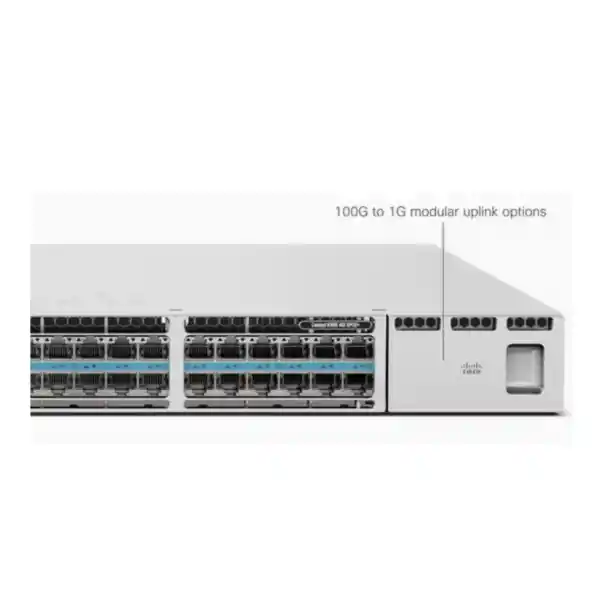
Unlike fixed-uplink access switches, the C9300-48H accepts modular uplink options. Cisco positions the platform with uplink choices that can cover 1G, 10G, 25G and 40G fiber as well as 10G multigigabit copper, depending on the network module selected. This allows the same access-switch model to be standardized across sites while the uplink media and capacity are adapted to each distribution layer.
A branch with modest traffic might use lower-speed fiber, while a dense campus floor may justify higher-capacity uplinks or port-channel designs. The modular approach also allows the uplink strategy to be revisited later without replacing every access chassis.
How to size the uplink
Do not size an uplink by multiplying forty-eight ports by 1 Gbps and assuming every endpoint transmits at line rate continuously. Instead evaluate real traffic profiles, wireless backhaul, camera streams, east-west application flows, backup windows, multicast, voice, cloud usage and peak concurrency. The uplink must also fit the failure design: two 10G links in a port channel do not provide 20G during a single-link outage.
For resilient campus designs, pair bandwidth planning with distribution-switch port availability, optics, fiber type, distance, LACP topology, spanning-tree or routed-access strategy, and the intended use of StackWise Virtual or other aggregation features upstream where applicable.
UADP 2.0 ASIC: predictable enterprise forwarding
At the heart of the C9300-48H is Cisco’s UADP 2.0 forwarding architecture. UADP, or Unified Access Data Plane, is designed to implement switching, routing, quality of service, policy and telemetry functions in hardware rather than treating the switch as a generic software-forwarding appliance. The result is an access platform capable of applying enterprise controls while maintaining wire-speed behavior for normal forwarding operations. Cisco specifies 256 Gbps of standalone switching capacity for the C9300-48H and a forwarding rate of 190.48 million packets per second using 64-byte IPv4 test packets. When Cisco includes the StackWise fabric in the calculation, the published capacity rises to 736 Gbps and 547.62 Mpps.
For network architects, packet-forwarding numbers should be understood in context. User experience is rarely determined by a single chassis throughput figure. Oversubscription may occur on uplinks, endpoint NICs can be the limiting factor, security policies can change the design, and application behavior may be bursty. Packet buffers matter for transient congestion, and the standard Catalyst 9300 modular-uplink 24- and 48-port Gigabit Ethernet platforms are documented with a 16 MB packet buffer per SKU. The switching platform also supports large enterprise forwarding tables: Cisco publishes 32,000 MAC addresses, 32,000 IPv4 routes in its listed profile, 16,000 IPv6 routing entries, 8,000 multicast routing scale, 5,120 QoS scale entries and 5,120 ACL scale entries for the regular Catalyst 9300 modular-uplink category.
These scale figures provide useful guardrails for campus design, but a production configuration should be assessed against the exact feature mix. Features can consume shared hardware resources in different ways, and the right template depends on whether the switch is used primarily for Layer 2 access, routed access, fabric edge services, multicast, segmentation or dense policy enforcement. The platform supports up to 4094 VLAN IDs, 1000 switched virtual interfaces in the published scale profile and jumbo frames up to 9198 bytes. In a simple office these limits may never be approached, but in universities, multi-tenant facilities, hospitals and large campus environments the ability to sustain many logical segments and policy entries can be important for long-term standardization.
StackWise-480: building a single operational stack
C9300 modular-uplink models support Cisco StackWise-480. Up to eight compatible switches can participate in a StackWise-480 stack, creating a high-speed 480 Gbps back-panel stacking fabric with a common management and control construct. In practical terms, stacking lets an access closet behave more like a single logical switch than a collection of independent boxes. This simplifies interface numbering conventions, software lifecycle planning, link aggregation across physical members, monitoring and fault response. It also helps engineers distribute critical devices across members without fragmenting day-to-day management.
A stack should still be engineered as a physical system. Stack cable lengths, member order, ring closure, power-feed diversity, airflow, rack-unit placement and service access must be planned. If two switches that carry the most important endpoints are connected to the same PDU and that PDU fails, the logical stack does not protect the attached devices. Similarly, a stack with multiple uplinks should distribute those uplinks across different members so that an individual chassis failure does not remove all upstream connectivity. The same principle applies to high-power endpoints: distribute critical PoE loads across the stack where the endpoint architecture permits.
Stack compatibility also matters. Cisco’s current platform guidance differentiates standard C9300 models, higher-scale C9300 variants, C9300X and fixed-uplink C9300L/LM platforms. Standard C9300 models stack using StackWise-480, while fixed-uplink models use a different StackWise-320 architecture. Mixed combinations have specific rules. Procurement should therefore avoid treating every product with ‘9300’ in the model name as interchangeable stacking hardware. A FourTeck design review can validate the exact model set, license level, stack cables and intended software release before hardware is ordered. For wider solution assistance in the Emirates, see FourTeck UAE for enterprise network integration services.
StackPower and resilient PoE engineering
Shared power concept
StackPower allows power supplies in compatible Catalyst switches to be pooled as a common resource. This can improve utilization because spare capacity is not necessarily stranded inside one chassis while another chassis approaches its local limit.
Redundancy objective
A power stack can be designed so an additional supply contributes redundancy rather than simply increasing the available wattage. The engineering target should be defined explicitly: maximum PoE density, N+1 power resilience, or a balanced compromise.
Failure modeling
Calculate the power state after loss of one PSU, one PDU feed or one stack member. A design that works only under normal conditions may shed endpoint power during exactly the incident when surveillance, wireless or building controls are most needed.
UAE rack planning
High-power access stacks can impose significant electrical and thermal load in an IDF. Verify circuit rating, UPS autonomy, PDU metering, cooling, rack depth, hot-air clearance and generator-backed runtime before commissioning.
Cisco documents StackPower as a power interconnect in which power-supply capacity can be shared among switches. Up to four switches can be configured in a StackPower group using the dedicated connectivity. The capability is especially useful with high-power C9300-48H deployments because PoE load can dominate access-switch power planning. However, StackPower should not be used as a substitute for an electrical design. The UPS and distribution boards still need enough capacity to support the actual input load, and redundant power supplies only deliver meaningful resilience when their upstream power feeds are also independently protected.
Cisco IOS XE for automation, programmability and telemetry
The C9300-48H runs Cisco IOS XE, a modern operating system designed to support traditional CLI workflows alongside model-driven automation. This matters because enterprise access switching is increasingly managed as infrastructure code rather than as a collection of manually configured interfaces. IOS XE supports API-driven configuration using technologies such as NETCONF, RESTCONF and gNMI with YANG data models. These interfaces allow an orchestration platform or custom automation tool to retrieve operational state, push configuration and validate desired policy in a structured format.
For deployments that use Cisco Catalyst Center, automation can be extended to discovery, inventory, image management, assurance and policy-oriented workflows. For customers using other operational tooling, open APIs make it possible to integrate configuration management systems, source-of-truth databases, service-management workflows and telemetry collectors. The advantage is not simply speed. Automated templates can reduce configuration drift between branches, enforce naming and security standards, and make large-scale changes more repeatable. A properly controlled automation process can also include pre-checks and post-checks that are difficult to perform consistently during manual change windows.
Model-driven telemetry is equally important. Instead of relying only on periodic SNMP polling, IOS XE can stream selected operational data to a collector. This provides higher-frequency visibility into interfaces, queues, CPU, memory and other relevant objects, depending on the configured models and platform support. For an access network supporting wireless, IP telephony, cameras and IoT, richer telemetry can help identify intermittent congestion, link flaps, abnormal error counts, power events and application-impacting conditions before users open support tickets.
Automation introduces governance requirements. Credentials, certificates, role-based access control, API reachability and change authorization should be designed with the same discipline as human administration. Production networks should avoid shared administrator credentials in scripts, uncontrolled configuration repositories and direct API access from general user networks. FourTeck’s IT Services UAE practice can support migration planning, network automation integration and operational handover where the switching rollout is part of a broader infrastructure modernization program.
Security architecture at the access layer
The access switch is a security enforcement point because every endpoint must traverse it before reaching shared network services. The Catalyst 9300 family supports capabilities that can contribute to secure onboarding, segmentation, encrypted links and platform integrity. Cisco documents support for AES MACsec on the Catalyst 9300 Series, including 128-bit and 256-bit AES modes for IEEE 802.1AE link encryption. MACsec is particularly useful on links where confidentiality and integrity are required between network devices, subject to the specific interface, software and design constraints of the deployment.
Platform trust is another component. Cisco describes Trust Anchor mechanisms that include image signing, Secure Boot and hardware-backed authenticity functions. These controls are intended to help verify that the device boots trusted software and that firmware or software has not been altered outside the expected chain of trust. For regulated sectors such as finance, government, healthcare and critical infrastructure, supply-chain assurance and secure boot behavior are increasingly important considerations alongside conventional firewall and endpoint-security controls.
At the network-policy level, the switch can participate in identity-driven access architectures, role-based segmentation and SD-Access designs. Organizations can separate corporate users, contractors, guests, IoT, cameras, building management and voice using combinations of VLANs, VRFs, access control lists and policy frameworks. The best segmentation method depends on operational maturity. A small branch may need only conventional VLAN and ACL separation, while a large campus may benefit from centralized policy and group-based constructs. Complexity should be justified by a measurable security or operational outcome.
The switch does not replace a perimeter or internal segmentation firewall when stateful inspection, advanced threat prevention, application control, VPN termination or Internet security policy is required. The correct architecture combines access-layer controls with dedicated security enforcement at appropriate trust boundaries. UAE organizations reviewing the broader security stack can use Firewall Dubai to align switching segmentation with next-generation firewall, secure remote access and branch-security requirements.
QoS for voice, video, wireless and critical control traffic
A converged access switch has to carry traffic with very different performance characteristics. Voice is sensitive to delay, jitter and packet loss. Interactive video requires steady throughput and low loss. Surveillance can generate persistent upstream streams. Wireless access points aggregate many clients behind a single switch port. Building controls may use little bandwidth but can be operationally critical. Large file transfers and backups can consume available capacity without being latency sensitive. Quality of service is the mechanism that protects important traffic when links become congested.
The C9300 platform provides hardware QoS capabilities that can classify, mark, police and queue traffic according to policy. An effective campus QoS design begins by defining trust boundaries. For example, the switch may trust markings from managed IP phones while remarking traffic from unmanaged user ports. Wireless traffic may already carry class information from the WLAN architecture, while camera traffic may be classified according to source subnet or interface role. The access layer then preserves or rewrites DSCP markings and maps those classes into appropriate queues toward the uplink.
The goal is not to give every application a priority queue. Priority is valuable precisely because it is scarce. Real-time classes should be tightly controlled, business-critical application classes should receive proportionate bandwidth guarantees, and bulk traffic should remain eligible for service without being allowed to starve interactive traffic. High-power endpoint environments can create unusual traffic mixes: a single 90 W-capable device might be a sophisticated conferencing appliance, an AI-assisted camera, a digital-signage computer or a wireless unit. Power class does not indicate traffic class, so QoS policy must be based on application behavior and business importance rather than electrical draw.
During acceptance testing, engineers should validate QoS under congestion rather than only checking that configuration commands exist. Generate controlled load, confirm interface counters, verify queue drops, inspect markings and test call or video quality. This is particularly important when multiple access switches share uplinks or when a WAN circuit is much smaller than the campus switching capacity. QoS works end to end only when each bottleneck has a consistent classification and queuing model.
Layer 2 and Layer 3 deployment patterns
The C9300-48H can be deployed in conventional Layer 2 access networks, routed-access designs or policy-driven campus fabrics, subject to the selected software and license capabilities. In a traditional Layer 2 campus, user and device VLANs extend from the access switch to the distribution layer, where default gateways and routing are provided. This is familiar, operationally straightforward and compatible with a wide range of enterprise practices. Its disadvantages can include larger spanning-tree domains and greater reliance on upstream Layer 2 resiliency mechanisms.
Routed access moves Layer 3 boundaries closer to the edge. Access switches form routed links toward distribution, reducing the amount of Layer 2 extension and often simplifying failure convergence. This model can be attractive for large campuses with disciplined IP addressing and routing operations. However, it can complicate endpoint mobility if subnets are expected to span many closets, and it requires routing features and operational skills to be present in the access layer.
Fabric-based designs can abstract some of these limitations by using overlays and centrally defined policy. Cisco SD-Access, for example, is intended to provide policy-oriented automation and segmentation across wired and wireless access. The value is strongest where a large organization needs consistent identity policy, scalable segmentation and centralized assurance across many buildings. It should not be adopted solely because the switch supports it; successful fabric deployments require design readiness, controller infrastructure, IP planning, identity integration, operational processes and staff training.
Whichever model is selected, the physical C9300-48H remains an access-layer workhorse: it provides endpoint connectivity and power, enforces local policies and forwards traffic toward the rest of the network. The architecture decision determines how much Layer 2 state, Layer 3 routing, policy logic and failure convergence responsibility resides on the switch. FourTeck can help compare these topologies during pre-sales design, especially where an organization is migrating from older Catalyst platforms or consolidating mixed switching vendors.
Licensing: Network Essentials versus Network Advantage
Cisco offers the C9300-48H in Network Essentials and Network Advantage variants. Cisco’s ordering information identifies C9300-48H-E as the Network Essentials version and C9300-48H-A as the Network Advantage version. The physical port architecture remains centered on forty-eight 1G copper UPOE+ access ports with modular uplinks, but the licensed feature set changes. Procurement teams should therefore resist treating the suffix as a minor administrative detail. It affects what network functions are available and can determine whether a design supports the intended routing, segmentation, automation or advanced services.
The appropriate tier should be derived from a feature requirement matrix, not from a generic preference for the ‘higher’ license. List the routing protocols, scale, policy functions, automation platform, telemetry, fabric requirements and observability integrations the environment actually needs. Then validate those requirements against the Cisco software release and licensing guide intended for deployment. This avoids two common mistakes: buying Advantage where Essentials already satisfies the design, or buying Essentials and discovering during implementation that a required capability is licensed only at a higher tier.
Cisco subscription packaging has evolved over time, and enterprise quotations may include term-based software components associated with management, automation and analytics functions. The exact commercial structure can depend on date, buying program and Cisco ordering policies. The safest approach is to treat the hardware SKU, network license, subscription term, support entitlement and management requirements as separate BOM lines that are validated together. Do not assume that an existing entitlement from an older Catalyst generation automatically transfers to a new C9300-48H purchase.
For multi-site customers, standardizing one license tier can reduce operational variation, but standardization should still be justified. A headquarters campus may need advanced routing and segmentation while small branches do not. Conversely, a common high-tier standard can simplify templates and future expansion if the organization expects branches to adopt richer services. The procurement decision should include the total lifecycle cost of change, not only the acquisition price of each individual license.
Power-supply sizing and PoE budget methodology
| Planning item | What to record | Why it matters |
|---|---|---|
| Endpoint count | Quantity by exact device model | Power planning is model-specific; forty cameras can draw less than ten complex room systems. |
| Normal power | Measured or vendor-published typical draw | Helps estimate normal UPS loading and heat. |
| Maximum power | Worst-case negotiated or rated PoE draw | Prevents oversubscription when endpoints enter high-power operating states. |
| Failure condition | Available budget after PSU or feed loss | Defines whether critical devices remain powered during a fault. |
| Growth reserve | Planned spare watts and spare ports | Avoids redesign when new devices are added. |
Cisco lists an 822 W PoE budget for the C9300-48H with an 1100 WAC power supply. That figure is a useful baseline but should not be mistaken for total input power or for an assurance that every port can simultaneously supply its maximum UPOE+ rating. The switch itself consumes power, the power conversion path has efficiency losses, installed network modules affect consumption, and redundancy strategy changes how much capacity can be safely committed to endpoints.
A conservative design typically allocates the required endpoint load, then verifies that the remaining capacity is sufficient during the defined failure case. If the business requires every connected device to stay operational after losing one power supply, the post-failure budget is the true engineering limit. If noncritical loads may be shed, document the priority order. This is especially important for CCTV, wireless and access-control deployments where losing PoE can simultaneously remove communications, monitoring and security functions.
Physical installation, rack depth and cooling
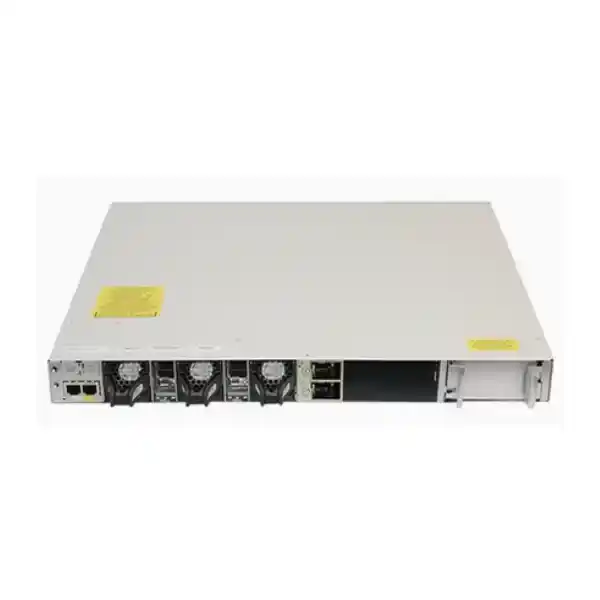
The C9300-48H is a 1RU-class enterprise switch. Cisco publishes chassis dimensions of approximately 1.73 inches high by 17.5 inches wide by 16.1 inches deep for the chassis itself, with greater installed depth depending on the power-supply configuration and rear cabling. Rack selection should therefore account for more than the nominal chassis depth. The rear of the switch needs clearance for power supplies, fan modules, StackWise cables, StackPower cables and bend radius of connected power cords. Front access needs sufficient room for copper patching and the uplink module.
The platform uses field-replaceable fan modules and is designed with fan redundancy. Cisco lists three field-replaceable fans with N+1 behavior for the Catalyst 9300 modular platform. Even with resilient fans, airflow must not be obstructed. Blank panels, cable managers and dense copper bundles should be positioned so they do not block the intake or exhaust path. In UAE facilities, the IDF environment is often more challenging than a central data center: ceiling-level rooms, localized hot spots, dust ingress, overloaded split AC systems and inconsistent maintenance can shorten equipment life if environmental conditions are ignored.
High-power PoE increases thermal planning importance because part of the electrical load is ultimately converted to heat in the switch, cabling and powered devices. A stack of several C9300-48H switches can represent a substantial steady load. The room cooling requirement should be calculated from actual equipment power, not from rack-unit count. UPS systems should be evaluated for both load capacity and runtime under realistic PoE draw. Generator transfer time, PDU outlet density and dual-feed availability are also relevant to resilience.
Good installation practice includes labeling both ends of every copper and fiber cable, documenting stack-member numbers, securing StackWise cables without excessive tension, separating A and B power feeds where redundancy is intended, keeping firmware and serial records, and leaving service loops that permit component replacement. These details reduce mean time to repair when a power supply, fan, uplink optic or switch member needs attention.
Wireless access: where C9300-48H fits and where it does not
The C9300-48H is described by Cisco as being optimized for wired and wireless converged access. Its high-power capability is attractive for wireless access points that need more than conventional PoE+. However, engineers must separate two dimensions: electrical power and Ethernet data rate. The downlink ports on the C9300-48H are 1G. A modern access point can benefit from 90 W power yet also be capable of more than 1 Gbps of aggregate wireless throughput. In that situation, the C9300-48H may satisfy the power requirement but impose a 1G wired bottleneck.
For this reason, Wi-Fi projects should map every AP model to both its PoE requirement and its preferred Ethernet interface. If the AP has a 2.5G, 5G or 10G multigigabit Ethernet interface and traffic models indicate that more than 1G wired capacity is valuable, a multigigabit Catalyst access model may be more appropriate. If the AP is deployed in a low-density area where 1G is adequate, the C9300-48H can still be a rational choice, especially when high power is required for full radio functionality.
This analysis is critical in long-lifecycle deployments. The switch may stay in service through several wireless refresh cycles. A 1G access design that is adequate today could constrain a future generation of access points. On the other hand, buying multigigabit ports everywhere can add unnecessary capital cost if only a small subset of locations will ever use the capacity. A mixed access strategy is often efficient: deploy C9300-48H where 1G plus high power matches the endpoint mix, and multigigabit models where wireless density or workstation requirements justify faster copper.
Uplink sizing must also consider wireless concentration. Forty-eight APs each connected at 1G do not need forty-eight gigabits of continuous upstream capacity, but user concurrency, local application usage, guest traffic, cloud access and large software updates can create significant peaks. Combine AP radio planning with switching and distribution design so that RF capacity, wired access and uplink bandwidth are balanced.
High-value deployment scenarios in the UAE
Hospitality and mixed-use towers
Use high-power ports for room-control gateways, wireless, surveillance, digital signage and converged building endpoints. StackWise helps consolidate floor or zone access while maintaining a common operational model.
Healthcare campuses
Supports dense wired access and high-power devices where uptime, segmentation and monitored power delivery are important. Designs should include strict change control, redundant uplinks and carefully modeled failure states.
Education
Classrooms and labs may combine phones, APs, smart displays, cameras and room systems. Forty-eight powered ports provide flexible density while modular uplinks support different building backbones.
Government and enterprise offices
A strong fit for standardized secure campus access where Cisco IOS XE automation, segmentation, QoS and resilient stacking are integrated into broader governance and monitoring processes.
Retail and large venues
Can aggregate cameras, POS-related peripherals, signage, APs and operational systems. Power-budget planning is essential when endpoints combine motors, displays, radios or local processing.
Smart building and IT/OT convergence
UPOE+ enables centralized powering of a wider range of building devices, while network segmentation and telemetry help keep operational technology visible and logically separated from user networks.
C9300-48H compared with nearby Catalyst 9300 options
The strongest way to choose the C9300-48H is to compare it with models that solve adjacent problems. The C9300-48P provides forty-eight 1G copper ports with PoE+ rather than UPOE+. Cisco lists a lower power budget for the 48P when paired with its typical 715 WAC supply. It is well suited when endpoint requirements fit conventional 30 W PoE classes. The C9300-48U provides forty-eight 1G copper UPOE ports, positioned around 60 W class power. The C9300-48H steps up to UPOE+ with up to 90 W per port, while retaining 1G data rates.
For bandwidth-driven edge designs, the C9300-48UXM and C9300-48UN families are more relevant comparisons because they offer multigigabit copper. Those models target high-speed wireless and other devices that need 2.5G, 5G or 10G access depending on the SKU. The question is therefore not simply ‘Which switch is faster?’ A C9300-48H may be the better design for a 1G high-power camera or room system, while a multigigabit model may be preferable for a Wi-Fi 6E or later AP that can exceed 1G throughput.
The C9300X family extends performance further, including higher-speed multigigabit access, larger stack bandwidth and higher-capacity uplinks on relevant models. It can be appropriate for aggregation, lean branch cores or access layers with 10G edge requirements. However, higher hardware capability typically increases cost and can be unnecessary for ordinary 1G endpoint populations. The C9300-48H occupies a useful middle ground: mainstream Catalyst 9300 switching performance with unusually high PoE capability.
A project should therefore classify ports into four groups: data only, up to 30 W PoE+, up to approximately 60 W UPOE, and up to 90 W UPOE+. Then identify which groups also need multigigabit data. That matrix usually reveals the right mix of switch models more clearly than a brand-level comparison. It can also reduce wasted power-supply capacity by concentrating high-power endpoints on the switches specifically purchased to serve them.
Designing for CCTV, access control and smart-building endpoints
Security and building systems are among the strongest use cases for high-power access switching because they increasingly combine sensors, motors, radios and local compute. A PTZ camera may need more power than a fixed camera. An outdoor device may include a heater. A video intercom can combine camera, display, audio and door-control functions. Smart-building gateways may power downstream peripherals. High-power PoE provides flexibility, but the network design must treat these devices as critical infrastructure rather than as ordinary desktop endpoints.
Start by separating logical security zones. CCTV cameras, video-management servers, access-control panels and building automation should not automatically share the same broadcast domain as user PCs. Use VLANs or stronger segmentation according to risk and scale. Apply least-privilege ACLs or policy so devices can reach only required controllers, DNS, NTP, logging, management and update services. Where devices do not need Internet access, do not provide it by default. Where remote vendor support is necessary, control it through authenticated, logged pathways.
Next, design power continuity. A camera network that loses PoE when a single power supply fails may create a surveillance blind spot. A door-control network that loses edge power can affect building access. Calculate the post-failure PoE budget and identify which endpoints must remain powered. Use UPS-backed feeds, appropriate StackPower design, redundant supplies and equipment distribution to achieve the required availability. The switch should be monitored for power consumption and PoE events so operations teams can identify abnormal endpoint behavior.
Finally, plan lifecycle replacement. Building devices often remain deployed longer than user IT equipment. Maintain a port map, physical location, firmware ownership, vendor support path and expected replacement year for each device category. When the endpoint estate grows, the C9300-48H’s spare ports and power reserve should be treated as a planned capacity asset rather than unused inventory.
Operations: software maintenance, monitoring and configuration discipline
A production access switch should be operated as part of a lifecycle, not installed once and forgotten. Establish a standard Cisco IOS XE software train, validate hardware and feature compatibility, define a patching cadence and maintain a pre-production test process for significant changes. Stacked switches make software consistency easier, but they also concentrate the impact of a flawed upgrade if the entire stack is changed without staged validation. Maintenance plans should include configuration backups, current topology diagrams, rollback procedures and console or out-of-band access.
Monitoring should cover more than device reachability. Track interface errors, CRCs, duplex or speed anomalies, PoE draw, denied power events, PSU state, fan state, temperature, stack ring health, stack member changes, CPU, memory, uplink utilization, queue drops, routing adjacency state and critical log messages. In high-power deployments, PoE telemetry is especially valuable because endpoint failure can appear as an electrical issue before it becomes an application issue. Sudden increases in draw may indicate a device entering a different operating mode or a hardware problem.
Configuration standards reduce operational risk. Define interface templates for users, phones, access points, cameras and building devices. Include descriptions that reference location and service. Disable unused ports or place them in a restricted state. Apply consistent storm-control, spanning-tree edge behavior, authentication or port-security settings according to policy. Document exceptions rather than allowing every closet to evolve independently.
For organizations operating across the GCC or Africa, common templates and centralized inventory simplify support. FourTeck’s regional footprint can help coordinate multi-country rollouts; see FourTeck Africa for regional infrastructure engagement alongside UAE delivery. A common C9300-48H standard can be particularly effective where branches share similar endpoint, power and security requirements, but local electrical, cabling and support conditions should still be validated site by site.
Structured cabling requirements for high-power PoE
High-power PoE makes the physical copper plant part of the power-delivery system. That changes how cabling should be evaluated. Ethernet standards define supported cable categories and channel lengths for data, but sustained power also introduces conductor heating. Large cable bundles can accumulate heat, especially in enclosed pathways and warm ceiling spaces. Smaller-gauge conductors have greater resistance than larger conductors, increasing voltage drop and heat. Patch cords, connectors and patch panels must be rated and installed correctly so that the entire channel remains reliable under the expected current.
During a C9300-48H rollout, survey the existing cabling before assuming it can support widespread UPOE+ use. Confirm cable category, conductor material, installation quality, certification results, maximum channel length, bundle density and pathway conditions. Copper-clad aluminum or other noncompliant conductors should not be treated as equivalent to standards-compliant solid copper structured cabling. Where older cabling is retained, select representative high-load circuits for detailed testing.
Labeling is equally important. The switch port should map to the patch-panel port, telecommunications outlet, endpoint location and service owner. High-power ports may deserve explicit documentation so technicians understand that disconnecting or moving a patch cord can affect a critical device. In mixed office and OT environments, color-coded patching can help distinguish cameras, APs, building systems and user ports, though color should supplement documentation rather than replace it.
Finally, maintain cabling headroom. A channel that works at installation can become marginal after repeated patch changes, connector wear or environmental change. Certification records, periodic visual inspections and standardized patch cords reduce avoidable faults. When troubleshooting a powered endpoint, check both link performance and PoE negotiation; a marginal copper pair can manifest as intermittent data errors, power instability or both.
UAE procurement and BOM planning
An accurate C9300-48H quotation requires more than the base chassis. The first decision is license level: C9300-48H-E for Network Essentials or C9300-48H-A for Network Advantage. Next comes the uplink network module, selected according to fiber type, speed, distribution platform and redundancy. Optics or DAC/AOC components must match the module and upstream interface. StackWise cables are required when switches will operate as a physical stack, and StackPower cabling is required if a power stack is part of the design. Power supplies, power cords and any redundant PSU strategy must be specified according to the expected PoE load.
Support entitlement and software subscription requirements should be included at the same stage. Organizations should confirm the desired support response, software access and lifecycle coverage. Spare strategy is also important. A campus with dozens of identical switches may justify keeping a preconfigured spare chassis, power supply, fan and optics locally. A smaller organization may prefer a higher support tier rather than holding inventory. The correct balance depends on outage cost, logistics and site criticality.
For UAE projects, logistics planning should account for delivery location, secure storage, rack readiness, structured cabling completion and change-window availability. Hardware arriving before the IDF is cooled, powered and secured can create avoidable handling risk. Pre-staging can reduce onsite time: record serial numbers, confirm ordered parts, install approved software, apply baseline configuration, validate licenses and test stack formation before moving equipment to production sites.
FourTeck can coordinate switching with adjacent infrastructure such as servers, racks, UPS, firewalls and managed IT services. For projects where campus switching is part of a wider compute or data-room refresh, Server Dubai provides a related route for server and infrastructure planning. Keeping the switching BOM aligned with compute, security and power design reduces late changes during implementation.
Sizing example: a 48-port smart-office floor
Consider a notional office floor with twelve wireless access points, sixteen IP cameras, six room-conferencing endpoints, six IP phones, four access-control or building gateways and four spare ports. The port count totals forty-eight, which appears to fit perfectly on one C9300-48H. But port count alone is not sufficient. Suppose the APs are capable of higher power modes, the conferencing devices can approach UPOE+ levels, and some cameras have PTZ functions. The power worksheet may reveal that the total worst-case draw is close to or beyond the switch’s available PoE budget in the installed PSU configuration.
The engineering response is not automatically to buy a second switch. First calculate realistic maximum power based on the actual endpoint data sheets and negotiated classes. Next reserve capacity for growth and the desired failure scenario. If a redundant power supply will be installed, determine whether its purpose is to increase available PoE or to preserve operation after a PSU failure. If the design still has insufficient margin, split the floor across two switches. This may also improve availability because a single hardware fault no longer removes every endpoint.
Then inspect bandwidth. If the twelve APs have multigigabit Ethernet interfaces and are expected to support heavy wireless usage, a 1G access link may be the limiting factor. In that case, a mixed switch strategy could be better: place wireless access points on a multigigabit Catalyst model and use the C9300-48H for high-power 1G cameras, room systems and building devices. This demonstrates why switch selection should be endpoint-driven rather than model-driven.
Finally, design uplinks. Two resilient uplinks to separate distribution switches can provide both bandwidth and fault tolerance, but the upstream architecture determines whether they operate as routed links, a port channel or another supported topology. The final BOM therefore includes access switches, licenses, uplink modules, optics, stack cables, power components and support. The switch is only one component of the engineered result.
Migration from older Catalyst access switches
Replacing an older access layer with C9300-48H switches should be treated as a service migration rather than a hardware swap. Start by exporting the existing configuration and inventorying active ports. Identify VLANs, trunks, port channels, voice VLANs, authentication policy, spanning-tree settings, ACLs, QoS, multicast, SNMP, logging, NTP, DHCP snooping, routing protocols and any device-specific exceptions. Many old configurations contain years of accumulated workarounds; some should be carried forward, some should be redesigned, and some are no longer needed.
Build a clean template for the new platform and translate intent rather than copying commands blindly. IOS XE syntax and default behavior may differ from legacy IOS releases. Features may also have new recommended implementations. Validate the template in staging with representative phones, APs, cameras and user devices. Confirm PoE negotiation, authentication, DHCP, DNS, voice registration, multicast and management reachability before the production window.
Physical migration sequencing should minimize confusion. Label every patch cord, capture the current port map, and decide whether the new switch will reuse the same rack location. If the new stack changes port numbering, prepare a cross-reference sheet. Critical services should be moved in a defined order and tested immediately. Avoid moving all forty-eight links first and troubleshooting afterward; staged groups make fault isolation easier.
After cutover, monitor not only whether links are up but whether they are operating at the expected speed, duplex and PoE level. Compare error counters and power draw against the old environment. Validate routing and application paths, then preserve the migration record as part of the as-built documentation. A clean handover should include final configs, software versions, serial numbers, stack-member roles, IP addresses, uplink details, power design, support entitlements and escalation contacts.
Performance, buffering and congestion behavior
Cisco publishes wire-speed nonblocking performance for the Catalyst 9300 family under its stated conditions. For the C9300-48H, the 256 Gbps switching-capacity figure provides substantial internal bandwidth relative to the forty-eight 1G access ports plus modular uplink options. The 190.48 Mpps forwarding figure is measured with 64-byte IPv4 packets, a common benchmark designed to stress packet-processing rate. Real application traffic normally uses a mix of packet sizes, so operational throughput can look very different from a synthetic minimum-frame test.
Congestion occurs when traffic arrives faster than an egress interface can transmit it. The switch buffers packets temporarily, applies QoS policy and eventually drops traffic if congestion persists. Cisco lists a 16 MB packet buffer for 24- and 48-port Gigabit Ethernet models in the standard C9300 modular-uplink category. That buffer supports short bursts but cannot compensate for an undersized uplink indefinitely. If many 1G endpoints simultaneously send toward a 10G uplink, sustained aggregate traffic above 10G will produce queueing and loss regardless of the chassis switching capacity.
This is why monitoring egress queues and uplink utilization is more useful than simply checking CPU. A switch can have low CPU and still drop traffic because a physical egress port is congested. Cameras can create persistent upstream loads, backup traffic can create scheduled peaks, and wireless APs can create bursts as many clients synchronize or download updates. QoS protects critical traffic but does not create bandwidth; persistent congestion should trigger capacity expansion or traffic-engineering changes.
When planning an upgrade, measure existing traffic over several weeks if possible, including month-end processing, backup windows, large meetings, software distribution and other known peaks. Use percentiles rather than only averages. A link averaging 20 percent utilization can still experience microbursts or short saturation intervals that affect real-time applications. Telemetry and interface counters on the Catalyst 9300 can help expose these patterns.
MACsec, secure boot and supply-chain confidence
Security requirements now extend below network policy into the integrity of the platform itself. Catalyst 9300 Series switches include Cisco Trust Anchor capabilities intended to establish hardware and software authenticity. Image signing helps ensure software packages have not been modified. Secure Boot anchors the startup sequence so that untrusted modifications are detected before normal operation. Hardware-backed identity provides an additional basis for validating that the device is genuine.
These controls are relevant for procurement because counterfeit or tampered network equipment represents a systemic risk. Enterprise buyers should source through authorized channels, verify serial and support entitlement information, preserve delivery records and avoid untraceable grey-market hardware for critical networks. A lower acquisition price can be outweighed by uncertain firmware provenance, inability to obtain software updates or unsupported components.
MACsec adds link-layer confidentiality and integrity where required. Cisco documents support for AES-128 and AES-256 MACsec on Catalyst 9300 Series switches. A common use is protecting switch-to-switch links inside a campus or over provider infrastructure where Layer 2 Ethernet is extended. Whether MACsec is appropriate depends on the network topology, key-management model, performance requirements, interface capabilities and the adjacent device. It should be designed as part of the end-to-end security architecture rather than enabled without operational planning.
Secure switching still depends on management hygiene. Use AAA, role-based access, encrypted management protocols, restricted management subnets, centralized logging and time synchronization. Disable insecure legacy protocols. Protect SNMP credentials, API tokens and automation accounts. Keep IOS XE within a maintained release strategy and follow Cisco security advisories. The platform provides the controls; operational discipline determines whether they deliver value.
When the C9300-48H is the right choice
Choose the C9300-48H when the design needs forty-eight Gigabit Ethernet access ports and a meaningful subset of connected devices requires power beyond standard PoE+. It is especially suitable when the organization already uses Cisco Catalyst campus architecture and wants consistent IOS XE operations, modular uplinks, StackWise stacking, StackPower, field-replaceable components, enterprise security controls and automation-ready management. High-power IoT, smart-building, conferencing, surveillance and selected wireless use cases are natural matches.
The switch is also a strong candidate when a standardized 1G high-power platform can be deployed across many closets. Standardization reduces spare complexity and makes configuration templates easier to maintain. If each access switch has a different power class or uplink format, support teams need more BOM knowledge and a wider spare inventory. A common C9300-48H architecture can simplify that operational burden, provided its 1G downlinks meet endpoint bandwidth requirements.
Do not choose it solely because 90 W sounds more future-proof. If most ports serve low-power phones and workstations, the additional PoE capability may never be used. If future access points require multigigabit Ethernet, the 1G downlink can become the limiting factor even though power is sufficient. The best design is the one that matches both data and power requirements with appropriate headroom, not the one with the largest single specification number.
When another Catalyst model may be better
A different model may be more economical when high-power PoE is unnecessary. For data-only copper access, the C9300-48T is a natural comparison. For conventional PoE+ endpoints, the C9300-48P can provide forty-eight 1G powered ports without paying for 90 W capability. For approximately 60 W UPOE requirements, the C9300-48U may align better. In each case, verify the power budget, uplink needs and license tier.
If the requirement is multigigabit downlink performance, examine C9300-48UXM, C9300-48UN or other current Catalyst options. These models provide faster copper speeds for Wi-Fi and high-throughput devices, though their per-port power and total PoE characteristics differ. If the requirement is very high-speed access or aggregation, the C9300X family may be a better architectural fit. The objective is to avoid overbuying power while underbuying bandwidth, or vice versa.
Fixed-uplink C9300L or C9300LM platforms may fit smaller branches where modular uplink flexibility is not required. They use a different stacking architecture, so they should not be selected as drop-in stack members for a standard C9300-48H StackWise-480 design. The exact platform choice should consider current Cisco lifecycle status, supported software release, optics, stack compatibility and long-term support requirements at the time of purchase.
Implementation checklist for a production rollout
1. Validate endpoints
Record device quantity, link speed, PoE class, normal and maximum draw, VLAN, security policy, QoS class and criticality.
2. Calculate power
Model the total PoE budget, PSU redundancy, UPS load and failure-state capacity. Reserve realistic growth margin.
3. Select uplinks
Choose network module, optics, fiber type and redundancy according to distribution ports, distance and measured bandwidth needs.
4. Choose licenses
Map required routing, automation, segmentation and observability functions to Network Essentials or Network Advantage.
5. Design stacking
Confirm StackWise compatibility, cable lengths, member placement, ring closure, StackPower groups and physical power-feed diversity.
6. Stage and test
Load approved IOS XE, validate licensing, test endpoint PoE, form the stack, test uplink failover and capture baseline configs before deployment.
Decision recap for Cisco Catalyst C9300-48H
The C9300-48H is not simply a forty-eight-port switch with a larger power supply. It is a high-power access platform whose value comes from combining UPOE+, modular uplinks, StackWise-480, StackPower, IOS XE programmability, enterprise-scale forwarding and security controls in a single standardized architecture. Used in the right endpoint mix, it can reduce local power adapters, simplify access closets and support a wide range of IT and OT devices. Used without power and bandwidth modeling, its capabilities can be underutilized or misapplied. The procurement decision should therefore follow a detailed endpoint, uplink, licensing and resilience assessment.
Quotation input checklist
To obtain an accurate UAE quotation for the Cisco Catalyst C9300-48H, provide the information below. This prevents a base-switch-only quote from omitting essential modules, power components, licenses or optics.
Consult FourTeck for a validated C9300-48H UAE bill of materials
A production-ready BOM should match the exact endpoint power profile, uplink architecture, stack design, license tier and resilience objective. FourTeck can assist with switch selection, network modules, optics, redundant power, StackWise and StackPower components, staging, migration planning and integration with security and infrastructure services.
For organizations standardizing across the Emirates or extending a common architecture into other markets, FourTeck can also help maintain consistent configurations and procurement baselines while adjusting to local site conditions. The final quotation should always be validated against Cisco’s current ordering and software guidance at the time of purchase.

Reviews
There are no reviews yet.