
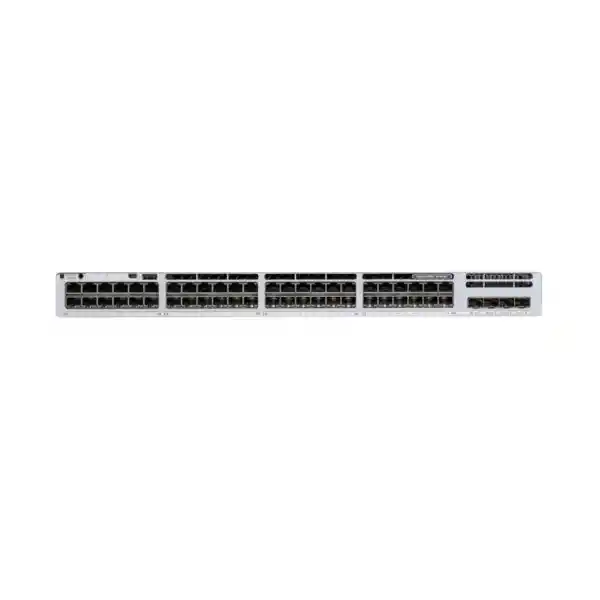
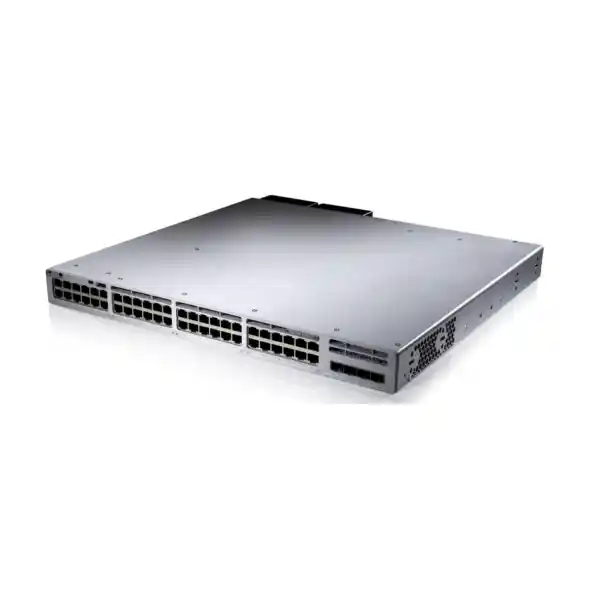
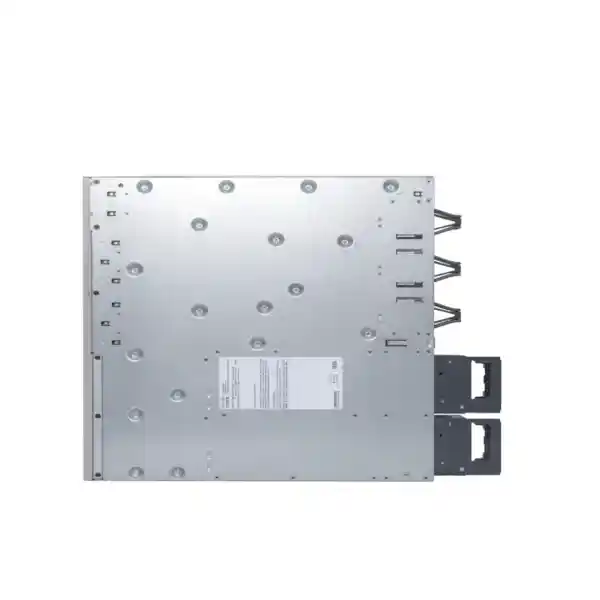
Cisco Catalyst C9300-48P Network Switch
A 48-port Gigabit Ethernet PoE+ access-layer platform for resilient enterprise LAN designs, modular fiber uplinks, StackWise-480 operations, policy-driven segmentation, application visibility and Cisco IOS XE automation.
Modular uplink architecture
715W AC PSU standard
StackWise-480 capable
Direct answer: what is the Cisco Catalyst C9300-48P?
The Cisco Catalyst C9300-48P is a 1RU-class, stackable enterprise access switch in the Catalyst 9300 family. It is designed for campus access closets, branch offices, distributed enterprise sites and other environments that need forty-eight copper Gigabit Ethernet access ports with IEEE PoE+ delivery. The platform combines traditional Layer 2 and Layer 3 campus switching with Cisco IOS XE, programmable network operations, modular uplink choices, StackWise-480 data stacking and StackPower-based power pooling. In a typical UAE deployment, it sits at the access layer between user and device endpoints on one side and the campus distribution or collapsed core layer on the other.
For the C9300-48P specifically, Cisco lists 48 PoE+ access ports, a modular uplink configuration and a 715W AC power supply as the default hardware arrangement. With that default supply, the available PoE budget is 437W. Organizations that need additional powered-device capacity can evaluate alternate or secondary power-supply combinations, including an 1100W supply option. This distinction matters when a switch must power a large mix of wireless access points, IP phones, surveillance cameras, badge readers, conferencing endpoints or other edge devices. Port count by itself is not enough; the project must also calculate the simultaneous PoE draw and reserve operational headroom.
The C9300-48P is not a fixed-uplink 9300L variant. Its uplink personality is selected through a field-replaceable network module, enabling designs that may require 1G, 10G, 25G or 40G uplink options depending on module, optics, software support and topology. That flexibility is one of the reasons the model remains useful in long-lived enterprise LANs: the access switch can remain in service while the uplink architecture evolves. FourTeck can help UAE buyers map the base switch, power supplies, uplink module, transceivers, stacking accessories and software tier into one consistent bill of materials rather than treating the chassis as a standalone purchase.
Core C9300-48P hardware specifications
Copper 10/100/1000 Ethernet access connectivity with PoE+ for powered edge devices.
Cisco-published standalone switching capacity for C9300-48P.
Published packet forwarding rate for the standalone switch.
High-bandwidth physical stacking for unified control and resilient access-layer operation.
One AC power supply is supplied by default; a second can be added for power resiliency or PoE expansion.
Available PoE with the standard 715W primary supply, before alternate secondary-supply combinations.
Access-layer role in a modern enterprise campus
An enterprise access switch is the point at which endpoint behavior, security policy, power delivery and application experience become physical. The C9300-48P is therefore more than a forty-eight-port patch-panel companion. It can provide the first-hop switching and policy enforcement that connects employee workstations, thin clients, IP telephony, Wi-Fi access points, cameras, printers, room systems, IoT devices and building-technology endpoints into the wider corporate network. In a correctly designed campus, each access switch participates in segmentation, identity control, quality of service, telemetry, fault isolation and resilient upstream forwarding.
For Dubai offices and UAE multi-site organizations, this model often fits floor distribution rooms where copper horizontal cabling terminates at 1G and the uplink must be sized separately. A small office may use a pair of uplinks to a collapsed core, while a larger campus may use redundant fiber links into separate distribution switches. The modular uplink slot lets the architect choose a module that matches the current core while preserving a path to higher-speed optics. This is particularly useful when the access layer is refreshed before the distribution layer, or when a new building is connected into a mixed-generation campus.
The correct architectural choice depends on more than user count. Designers should consider endpoint bandwidth patterns, Wi-Fi access-point generations, voice traffic, multicast, surveillance streams, east-west application flows, uplink oversubscription, failure domains and expected growth. A forty-eight-port switch populated mainly with phones and office PCs may run comfortably on moderate uplinks; the same port count populated with cameras, high-throughput wireless access points and media endpoints may justify a different uplink strategy. FourTeck’s UAE network team can structure this assessment before quotation through FourTeck IT Services UAE, aligning hardware selection with cabling, rack, fiber and operational requirements.
PoE+ engineering: why the 437W default budget needs real sizing
PoE design should be calculated from actual endpoint classes and expected simultaneous draw, not from the fact that every copper port is PoE-capable. Cisco specifies 437W of available PoE for the C9300-48P when equipped with its standard 715W power supply. That budget is shared across powered ports. As a simple planning example, forty-eight endpoints drawing an average of 7W would consume about 336W and leave comfortable margin. Forty-eight endpoints drawing 15W would require about 720W, which exceeds the standard supply’s available PoE budget and therefore needs a different power strategy. The precise design must use the powered-device specifications, maximum negotiated draw, redundancy target and operating reserve.
Wireless projects need particular attention. Modern access points may support multiple radios, USB accessories, IoT functions and higher transmit capability, creating power requirements that differ from a legacy office AP. IP cameras can add heaters, infrared illuminators, PTZ motors or analytics loads. Collaboration endpoints can combine a phone, touchscreen and peripherals. Door-control systems and sensors may use very little power individually but become significant in dense deployments. For each device class, the bill of materials should document quantity, nominal requirement, maximum PoE requirement and whether reduced functionality occurs at lower delivered power.
Cisco also supports alternate power-supply arrangements. With the 1100W primary power-supply option, Cisco lists up to 822W of available PoE for this model. Adding a secondary supply can raise total available PoE further, subject to platform limits, while also changing the redundancy design. A power plan must explicitly state whether the goal is full N+1 power redundancy, increased PoE capacity, or both. A stack can also use StackPower to pool power among participating members, improving how capacity is shared across the access-layer group.
The rack power feed must match the switch design. UAE projects should verify the available circuit, socket type, UPS allocation, PDU headroom, cooling, generator-backed load and total cabinet wattage. A switch configured for a high PoE budget can become one of the larger contributors to an IDF cabinet’s electrical load. Reserving a second power supply is useful only when the facility provides a genuinely independent or appropriately protected source. The final quotation should therefore cover the switch, the intended PSU combination, power cords, stacking power cables where used, rack PDUs and UPS capacity rather than assuming that the chassis alone completes the powered-access requirement.
Modular uplinks: build the C9300-48P around the distribution layer
The C9300-48P uses a modular uplink architecture rather than fixed uplink ports. Cisco lists several network-module families for the non-X Catalyst 9300 platform, including C9300-NM-4G for four 1G interfaces, C9300-NM-4M for four multigigabit interfaces, C9300-NM-8X for eight 10G/1G interfaces, C9300-NM-2Q for two 40G interfaces and C9300-NM-2Y for two 25G/10G/1G interfaces. The appropriate module is a design decision and should be ordered intentionally. A base chassis without the intended network module does not provide the finished fiber-uplink personality expected by most production campus designs.
For a conventional enterprise access closet, dual 10G uplinks are common because they provide a practical balance of bandwidth, optic availability and compatibility with existing distribution switches. An eight-port 10G-capable module may be chosen when a stack needs multiple routed or EtherChannel uplinks, or when the organization wants spare high-speed interfaces for expansion. A 25G module can be attractive in a modernized distribution design where higher access-to-core bandwidth is needed without moving the entire access layer to multigigabit copper. A 40G module may fit specific aggregation architectures or legacy core designs that already standardize on QSFP-based 40G links.
The optic type must then be matched to distance and fiber plant. Short-reach multimode links, longer single-mode links, direct-attach cabling and breakout designs each have different cost, reach and operational implications. The fiber connector type, patch panels, polarity, loss budget and available strands should be validated before hardware is ordered. When migrating an existing site, the switch quote should not assume that every installed optic is reusable; transceiver compatibility, supported speed, fiber type and licensing or software conditions must be checked against the target platform and IOS XE release.
A modular uplink slot provides investment protection only when the architecture is documented. FourTeck can combine the C9300-48P with the correct network module and optics, coordinate rack-side fiber work, and align the access switch with upstream servers, firewalls and core switching. For environments where switching is part of a broader compute or data-center refresh, the FourTeck Server Dubai team can help coordinate server-side network interface speeds and aggregation requirements with the campus design.
StackWise-480 and access-layer resiliency
The C9300-48P supports Cisco StackWise-480, allowing compatible Catalyst 9300 members to operate as a physical stack with a high-speed backplane connection and a unified management plane. Cisco publishes 736 Gbps of switching capacity and 547.62 Mpps of forwarding rate for the C9300-48P when stacking is included in the bandwidth specification. In operational terms, a stack lets multiple physical switches be administered as one logical switching system, which can simplify VLAN deployment, uplink design, link aggregation and software operations compared with managing every access switch independently.
Stacking is especially valuable when endpoints are distributed across several switch members in the same rack. Cross-stack EtherChannel can connect the access stack to two upstream devices or to a logical upstream pair, reducing dependency on a single uplink or a single stack member. If one member fails, devices connected to that physical member lose their local ports, but the rest of the stack can continue forwarding. Cisco’s Stateful Switchover and Nonstop Forwarding architecture is designed to reduce control-plane interruption in supported stack configurations and software designs, although the exact behavior still depends on protocol, topology and release.
A resilient stack requires more than stack cables. The design should define ring topology, stack member priorities, software version consistency, active and standby roles, power redundancy, uplink distribution and maintenance procedures. A stack cable disconnected at one point may leave a partial path; two faults can create a split stack. Cables should therefore be sized to the rack arrangement, physically routed to avoid accidental disturbance, and labelled so engineers can identify stack ports during maintenance. StackPower cables, if used, need similar discipline and should not be confused with StackWise data cables.
There is also a design tradeoff between stacking and independent access switches. A stack reduces management objects and enables cross-member features, but it creates a shared software lifecycle and a larger logical failure domain. Some organizations prefer independent switches with Layer 3 uplinks; others prefer stacks for operational simplicity. FourTeck can assess which model aligns with the organization’s change process, support staffing, outage tolerance and network architecture rather than assuming that stacking is always mandatory.
UADP 2.0 architecture, memory, buffers and forwarding scale
The standard Catalyst 9300 platform is based on Cisco’s UADP 2.0 ASIC architecture. This programmable forwarding design is important because enterprise access switching must handle more than MAC learning and basic VLAN forwarding. The hardware pipeline allocates resources for Layer 2 tables, Layer 3 routes, access control lists, quality-of-service entries, telemetry and policy features. Cisco uses configurable templates so administrators can tune hardware resource allocation for the role of the switch. A campus access device has different scaling priorities from a routing-heavy distribution node, and the configuration should reflect the intended function.
Cisco lists 8 GB of DRAM and 16 GB of flash for Catalyst 9300 models in this class. The x86-based control-plane environment supports Cisco IOS XE and application-hosting capabilities, while the data plane remains ASIC accelerated. For 24- and 48-port Gigabit Ethernet Catalyst 9300 models, Cisco lists a 16 MB packet buffer. Buffer size is only one part of congestion behavior; queue design, QoS policy, traffic burstiness and uplink oversubscription determine how effectively the switch absorbs microbursts. The C9300-48P is designed as a mainstream enterprise access model rather than a specialized deep-buffer switching platform.
The platform supports 4094 VLAN IDs, up to 1000 switched virtual interfaces in Cisco’s published scale table, 9198-byte jumbo frames and hardware IPv6 forwarding. Cisco also lists up to 64,000 Flexible NetFlow flow entries for the 24- and 48-port Gigabit Ethernet Catalyst 9300 models. These figures provide useful sizing boundaries, but an engineering design should never attempt to use every published maximum simultaneously. Hardware resources are shared, feature templates affect capacity, and software release notes can impose additional conditions.
For ordinary enterprise access deployment, the value of the ASIC is not simply the maximum table size. It is the ability to apply segmentation, ACLs, QoS, telemetry and routing functions at hardware speed while maintaining deterministic forwarding. This is why the C9300-48P can operate as part of a policy-driven campus rather than as a basic unmanaged edge. The chosen configuration should still be validated in a lab or staged environment when the design relies on unusually high route scale, large ACLs, extensive multicast state, dense NetFlow telemetry or advanced policy features.
Cisco IOS XE: automation, programmability and operational control
Cisco IOS XE provides the operating environment for the Catalyst 9300 family and brings modern automation interfaces alongside familiar enterprise switching workflows. Cisco documents model-driven programmability through NETCONF, RESTCONF and YANG, along with streaming telemetry and on-box Python scripting. These capabilities allow the C9300-48P to participate in infrastructure-as-code processes instead of depending only on manual command-line changes. For organizations operating many UAE branches or a large campus, programmatic configuration can reduce variation, improve auditability and accelerate repeatable rollout.
Automation does not mean that every environment must immediately deploy a full controller. A network team can begin with configuration templates, version-controlled snippets and API-based inventory collection, then progress toward orchestrated provisioning. Plug and Play can streamline device onboarding. Streaming telemetry can publish operational state to monitoring and analytics platforms. NETCONF and RESTCONF can expose structured configuration data that is easier to validate than parsing unstructured CLI output. Python can support local or remote automation workflows where permitted by the organization’s operations policy.
The operational benefit is strongest when governance is included. Each automated change should have source control, peer review, pre-change validation, a rollback path and monitoring. Credentials should use role-based access, centralized authentication and protected secret storage. Automation accounts should not receive unrestricted privilege unless required. Configuration state should be backed up, and intended state should be compared with actual state so drift can be identified before it becomes an outage or compliance problem.
IOS XE lifecycle planning is also part of switch ownership. A procurement decision should identify the organization’s preferred software train, feature requirements, hardware support, security-fix policy and maintenance windows. A newly purchased switch does not automatically mean that the factory-installed software is the organization’s chosen release. Staging should include image validation, upgrade if required, license registration, base hardening, interface templates, monitoring integration and recovery documentation before the switch is introduced into production.
Layer 2 design, VLANs and loop prevention
At the access layer, Layer 2 configuration determines how endpoints are grouped and how faults propagate. The C9300-48P supports standard enterprise VLAN operations, trunking and spanning-tree technologies including MSTP and Rapid-PVST+. In a conventional campus, access ports should be assigned through consistent templates that define the expected VLAN, voice VLAN where applicable, authentication policy, storm control, spanning-tree edge behavior and security features. Trunks should carry only the VLANs required by the topology, and native VLAN behavior should be explicit rather than left to assumptions.
Spanning Tree Protocol remains relevant whenever the physical topology can form Layer 2 loops. Rapid-PVST+ offers per-VLAN rapid convergence and familiar Cisco operational behavior. MST can reduce spanning-tree instance count in larger environments by mapping groups of VLANs to common instances. The correct choice should be consistent with the upstream network and operational knowledge. Edge interfaces should use appropriate protections so accidental loops, rogue bridges or topology changes from user-connected devices do not destabilize the access layer.
Where possible, organizations increasingly move the Layer 3 boundary closer to the access layer to reduce large Layer 2 domains. The C9300-48P can support routed interfaces and SVIs, but the exact design depends on licensing and architecture. A routed-access or fabric design can reduce spanning-tree dependency and improve fault containment. A traditional Layer 2 access design may be simpler for smaller sites or for applications that still depend on VLAN stretch. There is no single correct topology for every campus.
Migration planning should document current VLAN IDs, DHCP scopes, gateway placement, voice requirements, wireless tunnelling or local switching, multicast dependencies, printers, building systems and any static-address devices. Endpoint discovery before cutover prevents surprises. The new switch should not simply copy every legacy trunk and VLAN without review; a refresh is an opportunity to remove unused configuration, enforce naming standards and reduce unnecessary broadcast exposure.
Layer 3 routing and resilient upstream design
The Catalyst 9300 family supports Layer 3 functionality appropriate to enterprise campus environments, with capability depth depending on the selected software tier and release. At minimum, organizations may use static routing and foundational routing features for branch or access-layer connectivity. Network Advantage expands advanced routing, segmentation, multicast, scale and security capabilities compared with Network Essentials. The procurement team should therefore align the hardware order with the actual protocol set rather than assuming that every advanced Layer 3 function is included in every software option.
A routed access design can use point-to-point Layer 3 links from the C9300-48P toward a distribution pair. This constrains Layer 2 failure domains and can use equal-cost paths depending on topology and protocol. In other designs, the switch terminates user VLAN gateways locally and routes upstream. Traditional deployments may keep the default gateway at distribution and use the access switch primarily for Layer 2. Each approach changes convergence behavior, operational complexity and policy placement.
Upstream resiliency should account for both physical and logical failure. Two fiber links connected to the same upstream switch do not protect against that upstream chassis failing. Two links to different upstream switches may provide device redundancy, but only if the upstream devices operate in a topology that supports the intended port-channel or routing behavior. StackWise at the access layer can provide cross-member uplink placement so a failure of one access member does not remove every upstream path for the stack. Power feeds and fiber paths should also be diverse where the building design allows.
Routing design needs clear summarization, addressing and fault-isolation boundaries. UAE enterprises with multiple offices may combine the campus LAN with SD-WAN, MPLS, internet VPN or cloud interconnects. The C9300-48P is normally an access device in that wider architecture, so route redistribution and WAN policy usually belong elsewhere. Keeping role boundaries clear reduces troubleshooting complexity and helps the team understand whether an incident originates at the endpoint, access switch, distribution layer, firewall, WAN edge or application service.
Security at the wired edge
A campus access switch is one of the most effective enforcement points for controlling which devices can connect to the enterprise network. The C9300-48P supports Cisco identity and segmentation workflows that can integrate with Cisco Identity Services Engine and Software-Defined Access designs. Even outside a full fabric deployment, access ports can use authentication, authorization, access-control lists and traffic controls to limit the blast radius of compromised or unmanaged endpoints.
A secure baseline should start with management-plane protection. Administrative access should use SSH rather than insecure legacy protocols, centralized AAA where possible, dedicated management addressing, role separation, secure SNMP versions, logging, NTP and configuration backup. Unused switch ports should be shut down or placed into a restricted state. Trunks should be explicitly configured. Device discovery protocols should be limited according to operational need. The control plane should have appropriate policing and management access controls so user VLANs cannot freely reach administrative services.
At the access port, technologies such as 802.1X and MAC Authentication Bypass can help classify employees, phones, printers, cameras and non-802.1X devices. DHCP snooping, Dynamic ARP Inspection and IP Source Guard can reduce common Layer 2 spoofing risks when deployed with careful trust-boundary design. Port security can limit unexpected MAC behavior in simpler environments. QoS trust should also be explicit so endpoints cannot arbitrarily mark ordinary traffic as high priority and displace voice or critical applications.
Segmentation should align with business risk. Corporate users, guest access, voice, security cameras, building management, payment devices, lab systems and server-management interfaces often require different policies. In an SD-Access design, group-based policy can reduce dependence on large sets of topology-bound ACLs. In a traditional campus, VLAN and ACL design can still enforce meaningful separation. The access switch is not a replacement for perimeter or internal firewalls, but it can stop unnecessary lateral communication before traffic ever reaches them.
For projects where the access-layer refresh is tied to firewall segmentation or internet-edge modernization, FourTeck can coordinate switching with broader security work through FourTeck UAE. The objective is to make port authentication, VLAN policy, routing and firewall zones part of one consistent security architecture rather than independent configuration exercises.
Quality of service for voice, video and business applications
A PoE access switch frequently carries the exact traffic types most sensitive to delay, jitter and loss. IP phones may share switch ports with PCs, conference endpoints can generate sustained high-definition video, Wi-Fi access points aggregate many client flows, and security cameras can create continuous upstream streams. Cisco Catalyst 9300 QoS capabilities allow traffic to be classified, marked, queued and scheduled so congestion is handled according to business priority rather than by simple arrival order.
Cisco documents eight egress queues per port and support for CoS and DSCP-based classification. In practice, the QoS policy should define where markings are trusted and where they are rewritten. A managed Cisco phone may be trusted differently from an arbitrary endpoint. Real-time voice normally receives strict priority within carefully bounded limits, while interactive video, business-critical data, bulk backups and scavenger traffic use different classes. The policy must be consistent across access, distribution, WAN and wireless domains; local prioritization on one switch cannot compensate for an upstream link that treats every packet identically.
Oversubscription is the usual place where QoS matters. Forty-eight 1G access ports do not all transmit at line rate simultaneously in a typical office, so uplinks are intentionally shared. When bursts converge on a smaller uplink bundle, buffers absorb temporary congestion and QoS determines which packets are delayed or dropped first. A well-sized uplink reduces chronic congestion, while QoS manages short contention events. Using QoS as a substitute for inadequate uplink capacity usually produces poor results.
A deployment should baseline traffic before and after migration. Interface utilization, drops, queue counters, application telemetry and user-experience data show whether the intended policy is working. Voice quality complaints should be correlated with packet loss and latency rather than assumed to be a handset problem. Video stutter should be checked against wireless, switching, WAN and application conditions. The C9300-48P provides the policy tools, but operational observability is what turns those tools into reliable service delivery.
Flexible NetFlow, telemetry and application visibility
Visibility is one of the major differences between an enterprise access platform and a simple port-density device. Cisco Flexible NetFlow can export flow records that show communicating endpoints, protocol information, byte and packet volumes and timing. Cisco lists up to 64,000 FNF flow entries on 24- and 48-port Gigabit Ethernet Catalyst 9300 models. The useful operational question is not the maximum number by itself, but which flows need to be observed, at what sampling or record granularity, and where the collector will store and analyze the data.
NetFlow can support capacity planning by showing which applications and users consume uplink bandwidth. It can help incident response by identifying unexpected destinations or sudden communication patterns. It can support migration validation by showing whether critical services remain reachable after a VLAN or routing change. Combined with interface counters, SNMP, streaming telemetry and centralized logs, it gives the operations team multiple ways to determine whether a problem is local to a port, systemic across a stack, upstream in the network or application related.
Cisco also supports application-recognition capabilities in the Catalyst 9000 family. Classification can be used for visibility and policy decisions, though the exact feature set depends on software licensing and release. Application awareness should be deployed with a clear purpose. Exporting every possible record without retention planning can overwhelm collectors and increase operational noise. The monitoring architecture should define which data is required for availability, performance, security, compliance and troubleshooting.
For UAE organizations with multiple branches, centralized telemetry helps small network teams operate more effectively. A switch replacement program is an opportunity to standardize naming, site codes, interface descriptions, syslog targets, NTP, SNMPv3, telemetry subscriptions and alert thresholds. This creates consistent operational evidence across locations and reduces dependence on manual CLI checks when a user reports that “the network is slow.”
Licensing: Network Essentials, Network Advantage and current subscription choices
The base name C9300-48P describes the hardware platform, but production orders are normally tied to a software entitlement. Cisco has historically offered C9300-48P-E with Network Essentials and C9300-48P-A with Network Advantage, and the Catalyst 9300 family also supports Cisco DNA subscription tiers. Cisco’s current licensing documentation further describes unified switching licensing through Cisco Networking Subscription, with Switching Essentials and Switching Advantage tiers on supported software releases. Because licensing models evolve, the quotation must identify the exact software, term and support arrangement being purchased rather than using “licensed” as a generic description.
Network Essentials provides foundational Layer 2 and Layer 3 switching, automation, visibility and security capabilities. Network Advantage adds advanced routing, segmentation, multicast, scale and security features. Cisco DNA Essentials and Advantage historically added automation, management, visibility and assurance capabilities in corresponding tiers. Under the current Cisco Networking Subscription model, Cisco describes Switching Essentials as foundational switching, automation, health monitoring, software-image management and provisioning, while Switching Advantage adds advanced automation, analytics, segmentation, assurance, security, application visibility and fabric management.
The correct tier should be determined from required features. A branch using VLANs, PoE, standard routing and basic automation may not need the same entitlement as a large SD-Access campus using advanced segmentation, assurance and routing. Buying a higher tier without a deployment plan can waste budget, while buying a lower tier and discovering a missing protocol late in implementation can delay the project. The bill of materials should therefore include a licensing feature checklist before the purchase order is issued.
Smart Licensing and account ownership should also be planned. The customer should know which Cisco Smart Account or current licensing account will own the entitlement, who can assign subscriptions, who receives renewal notices and how licenses are handled during hardware replacement. For managed projects, FourTeck can coordinate entitlement details with the customer’s existing Cisco account structure. Buyers should confirm the exact licensing option quoted at the time of order because software packaging and eligible releases can change over the lifecycle of the Catalyst 9300 platform.
Software-Defined Access and identity-based segmentation
Cisco positions the Catalyst 9300 family as a foundational platform for Software-Defined Access. SD-Access creates a campus fabric in which automation, identity, segmentation and assurance are coordinated through the wider Cisco architecture. Instead of tying every security rule directly to IP subnet location, an organization can build group-based policy that follows user or device identity. This is particularly valuable for large campuses where employees, contractors, IoT devices and operational technology move between access switches and wireless networks.
The switch does not create that architecture in isolation. A complete SD-Access design typically involves Cisco Catalyst Center, Cisco Identity Services Engine, fabric roles, control-plane and border functions, underlay routing, overlay virtual networks and security-group policy. The C9300-48P may act as a fabric edge switch where endpoints connect, but the surrounding infrastructure, licenses and software versions must support the intended design. A project should not purchase access switches under the assumption that “SD-Access ready” automatically means the fabric is deployed.
For organizations not ready for full fabric adoption, the same hardware can still be used in a traditional campus and later integrated into more automated workflows if requirements and licensing permit. This staged approach can protect capital investment while allowing the operations team to mature its identity system, IP plan, authentication coverage and change processes. It also reduces the risk of attempting an architecture transition and hardware replacement at the same time across every site.
A successful segmentation project begins with business classification. Which users need access to finance systems? Which IoT devices need internet only? Which cameras should communicate only with video recorders? Which contractor devices belong in restricted networks? Which support teams need administrative access? Once those communication requirements are known, the C9300-48P can enforce the relevant edge policy as part of either conventional VLAN/ACL design or an identity-driven fabric architecture.
Wireless access-point aggregation and Wi-Fi lifecycle planning
The C9300-48P is frequently deployed alongside enterprise Wi-Fi, but its 1G downlink ports should be matched to the actual AP model and traffic objective. Many wireless access points can operate effectively on a 1G wired connection, especially where radio capacity, client density or internet bandwidth is the limiting factor. Higher-end Wi-Fi generations may offer multigigabit Ethernet to prevent the wired uplink from becoming a bottleneck. If a planned AP fleet requires 2.5G, 5G or 10G copper, a multigigabit Catalyst 9300 variant may be a better choice than the C9300-48P.
PoE is equally important. The AP’s maximum power requirement should be compared with the switch budget and intended feature set. Some APs reduce radio or accessory capability when only lower power is available. A switch may technically power an AP but not at the level required for full performance. Every WLAN bill of materials should therefore pair port speed and PoE requirement together. Forty-eight available PoE+ ports do not necessarily mean forty-eight target-generation APs can be powered at maximum draw from the default 437W budget.
Uplink design should consider aggregate wireless traffic. Several APs can create synchronized bursts toward internet services, cloud applications, video platforms and local servers. If a switch serves a dense wireless area plus wired users, uplink utilization can rise quickly. Dual 10G uplinks are often a practical design point, but the correct number depends on AP count, expected concurrency, local services and redundancy requirements. Monitoring after deployment should verify whether the engineered oversubscription ratio remains appropriate.
The access switch and wireless system also meet at policy boundaries. Voice SSIDs, guest traffic, corporate identity, IoT networks, location services and multicast may traverse the same physical switch. Standardized VLAN and QoS design prevents the wired and wireless teams from creating inconsistent service classes. If the project includes a wireless refresh, it is preferable to size the C9300-48P against the next AP generation rather than only the currently installed devices.
Physical installation, dimensions, rack depth and environmental planning
Cisco lists the C9300-48P at approximately 4.4 × 44.5 × 40.9 cm in the chassis dimension table for the base depth configuration, with greater effective depth possible depending on installed power-supply and network-module combinations. Published weight is approximately 7.59 kg. In a standard 19-inch rack, the physical installation should reserve adequate front and rear clearance for copper patching, fiber bend radius, stack cables, power cords and airflow. Cabinet depth is often overlooked when replacing older compact access switches with modern redundant-power platforms.
The IDF should be treated as infrastructure rather than simply a place to mount equipment. Cable managers should keep forty-eight patch leads from blocking the switch face. Fiber uplinks should be routed separately from copper bundles where practical and should respect bend radius. Stack cables need enough slack for service but not so much that they hang across power supplies. Power cords should be labelled at both ends and mapped to the correct PDU and UPS source. A second power supply is most useful when it can be connected to a separately protected feed.
Thermal planning matters in UAE facilities. Indoor network rooms should remain within the environmental conditions defined for the platform, with air conditioning, clean airflow and temperature monitoring. PoE-heavy switches generate additional heat because the cabinet is delivering significant power to endpoints. Dust accumulation, blocked vents and poorly sealed building spaces can increase fan duty and reduce reliability. The rack should not be placed where direct sunlight, moisture or uncontrolled construction dust can reach the equipment.
Before delivery, the site survey should record rack units available, cabinet depth, PDU sockets, UPS rating, grounding, ambient temperature, patch-panel layout, fiber termination, access for technicians and whether lifting or restricted-site procedures apply. Enterprise switching projects often encounter delays not because the switch configuration is difficult, but because a network room lacks the power, cooling or cable management needed for a clean installation.
Migration from Catalyst 2960, 3650, 3850 and older access platforms
A C9300-48P refresh is often triggered by an aging access-switch estate, software support requirements, new PoE demands or a move toward automation. The migration should begin with discovery. For every existing switch, record model, software version, serial number, port utilization, VLANs, trunks, EtherChannels, spanning-tree role, routed interfaces, DHCP relay, authentication, PoE draw, optics, stack topology and connected endpoint classes. Interface descriptions and MAC-address tables can help identify what is actually connected before any port is moved.
Configuration should then be normalized rather than copied blindly. Legacy switch configurations may contain obsolete VLANs, unused ACLs, old SNMP communities, weak ciphers, abandoned QoS policies and interface settings created years earlier for equipment that no longer exists. A refresh is an opportunity to create a hardened standard template. That template can include AAA, SSH, SNMPv3, logging, NTP, banner, management VRF or VLAN, switchport policy, port authentication, spanning-tree protections, DHCP snooping, QoS and telemetry.
Hardware mapping is equally important. Existing uplink optics should be validated for support and distance. Stack cables from another generation should not be assumed compatible. Power budgets should be recalculated against the current endpoint inventory. A legacy switch with an oversized PoE supply may have been powering devices comfortably even though the new switch’s default supply would not. Rack depth and PDU availability may also differ. These details should be resolved before the change window.
Cutover planning can use staged configuration and pre-labelling. The new switch should be upgraded to the approved software release, licensed, configured, tested and backed up before arriving at site. Copper ports can be mapped old-to-new so technicians move patch cords in a controlled sequence. Critical endpoints such as WAN routers, access points, phones, cameras and building systems should have verification tests. Rollback criteria should be defined rather than improvised during an outage.
For multi-site refresh programs, a pilot site is valuable. It exposes gaps in templates, port mapping, licensing, shipping, remote-console access and change documentation. Once the pilot is stable, the deployment process can be standardized across additional UAE locations. FourTeck can support this rollout model with project staging, logistics and field implementation, with regional coordination available through the broader FourTeck Africa network when customers operate connected sites outside the UAE.
High-availability design beyond the switch itself
Redundancy should be evaluated end to end. Adding a second power supply protects against one PSU failure, but not against a single building circuit, a failed UPS, a disconnected PDU or a complete stack outage. Adding two uplinks protects against one link, but not if both fibers use the same patch panel, conduit or upstream switch. A resilient C9300-48P deployment therefore examines power path, stack path, fiber path, distribution devices, routing convergence, controller dependencies and operational access.
In a two-member stack, user ports can be distributed so critical systems are not all attached to one member. Uplinks can be split across members. Power supplies can be connected to separate PDUs where facility design supports this. The stack ring should be closed and physically protected. Upstream links can terminate on redundant distribution devices. Monitoring should alert on a failed stack cable, PSU, fan or uplink before the remaining redundancy is consumed by a second failure.
Maintenance is another availability factor. The organization should document how IOS XE upgrades are performed, which releases support the desired reduced-impact upgrade functions, and what applications can tolerate. Cisco documents extended fast software upgrade capabilities with reduced traffic impact in supported scenarios, but production behavior depends on configuration and release. Every upgrade should be reviewed against release notes, bug advisories and hardware compatibility rather than assumed nondisruptive.
Recovery documentation should include console access, switch replacement procedures, stack member numbering, configuration backup, license reassignment, spare optics, spare power supplies and contact paths. In distributed organizations, a remote engineer may need an onsite technician to replace a failed member. Clear labels and diagrams reduce the risk of unplugging the wrong uplink or stack cable when the site is under incident pressure.
When the C9300-48P is the right model—and when it is not
The C9300-48P is a strong fit when the project needs forty-eight copper Gigabit access ports, PoE+ delivery, modular high-speed uplinks, enterprise stacking and Cisco IOS XE features. Typical use cases include office floors with IP phones and PCs, schools or universities with mixed endpoint density, healthcare or hospitality areas with cameras and wireless access points, branch campuses that need resilient switching, and enterprise environments standardizing on the Catalyst 9000 operating model.
It may not be the best fit when endpoint bandwidth requirements exceed 1G. If the next Wi-Fi generation, engineering workstations or specialized devices require 2.5G, 5G or 10G copper, a multigigabit Catalyst 9300 model should be evaluated. Likewise, if devices require Cisco UPOE or UPOE+ power levels beyond PoE+, the P/U/H class of Catalyst 9300 models should be compared carefully. Selecting the lowest-cost chassis that technically powers on can create a forced replacement when endpoint requirements grow.
A fixed-uplink 9300L may be appropriate when the customer does not need modular uplinks or StackWise-480 characteristics and wants a simpler bill of materials. A C9300X model may be appropriate when significantly higher uplink performance, higher-speed access, encryption capabilities or StackWise-1T features are required. The C9300-48P sits in a practical middle ground: mature 1G PoE+ access with modular uplink flexibility and the richer stacking architecture of the standard Catalyst 9300 line.
The choice should therefore be driven by a five-year endpoint and uplink plan. Count ports, but also forecast how many endpoints will become multigigabit, how much PoE each device class may need, what uplink speed the core will support, whether the network will use advanced segmentation, and whether the software tier meets planned features. FourTeck can provide a model comparison before quotation so customers do not overbuy capabilities they will never use or underbuy the electrical and bandwidth headroom required for the next refresh cycle.
UAE procurement, authenticity and bill-of-material discipline
Enterprise switch procurement should be treated as a complete system purchase. The headline chassis is only one line. A deployable C9300-48P solution may also need the chosen software entitlement, network module, SFP/SFP+/SFP28/QSFP optics as applicable, secondary power supply, StackWise cables, StackPower cables, rack accessories, spare transceivers, console access, support coverage and professional services. Omitting one accessory can delay a change window even when the main switch has arrived on time.
Customers should request exact part numbers on quotations. “C9300-48P” may be used conversationally, but the order should clarify whether the platform is quoted with Essentials or Advantage licensing, what subscription term applies, what power supply is included and what uplink module is selected. Optic descriptions should include speed and reach. Stack cables should include length. Power cords should suit the destination and facility. Support should state coverage terms rather than being described only as “warranty.”
UAE projects also benefit from staging before site delivery. Equipment can be visually inspected, serial numbers recorded, software checked, configuration loaded and uplink optics validated. For a large order, a sample unit or pilot stack can be used to confirm the standard build before dozens of devices are configured. This reduces onsite time and makes field installation more predictable, especially where data-center or office access windows are short.
FourTeck supports customers that need switching as part of a wider infrastructure program. Procurement can be coordinated with firewalls, wireless, structured cabling, servers and implementation services. Customers can review broader UAE capabilities through FourTeck UAE and technical deployment services through IT Services UAE. For organizations operating across African subsidiaries as well as the Gulf, regional coordination is available through FourTeck Africa.
Commercial availability, lead time, software packaging and support options can change, so the final quotation should be considered the authoritative statement of what is included at the time of purchase. FourTeck can prepare a project-specific bill of materials from the switch count, port map, PoE requirement, stack topology and uplink design rather than relying on a generic online configuration.
Deployment sizing methodology for 48-port access switches
Port sizing starts with the number of physical endpoints, but a well-designed project includes spare capacity. If an office has forty-four known copper endpoints, using one 48-port switch leaves only four spare ports and may be operationally tight once meeting rooms, printers or temporary users are added. Two switches may provide the correct resilience and growth even when a raw port count suggests one. Conversely, a floor with twenty-five endpoints may still justify one 48-port model if rack space, future expansion and standardization make it more efficient than mixing 24-port and 48-port hardware.
Next calculate PoE. Create a spreadsheet or worksheet with every powered endpoint category and its maximum required wattage. Multiply the device count by its engineering value, then add reasonable headroom. Compare that total with the 437W default budget and with alternate power-supply options. If a design depends on every device drawing significantly below its stated maximum, document that assumption and understand whether the switch can still power the site during reboot events, firmware upgrades or cold starts when devices may temporarily draw more.
Then size uplinks. Estimate busy-hour traffic rather than summing forty-eight gigabit port rates. Office PCs may average low utilization, cameras may generate consistent streams, access points can burst, and backups can temporarily dominate. A redundant pair of 10G uplinks may be sufficient for many floors, while high-density media or wireless deployments may justify 25G. The architecture should also consider whether a stack shares uplinks across several members. A four-switch stack has far more edge capacity than a single member and may need proportionally more upstream bandwidth.
Finally size operations. Decide whether switches are independent or stacked, where management addresses live, what monitoring platform is used, how software is upgraded, how configuration is backed up, what spares are held and who responds after hours. A design that maximizes port density but leaves no maintenance strategy creates operational cost. Standardizing on a repeatable C9300-48P template can make support easier, but only when that template covers hardware, software and documentation.
FourTeck can convert this methodology into a quotation worksheet for Dubai and wider UAE sites. Customers can provide floor plans, endpoint counts, existing switch exports or a simple port inventory. The resulting bill of materials can include appropriate uplink modules, transceivers, stacking, power supplies and implementation support rather than producing a chassis-only quote that later requires multiple revisions.
Operational checklist after installation
1. Hardware health
Confirm both intended power supplies, all fans, stack links, uplink optics and PoE status. Record serial numbers and rack location. Verify that the switch reports no unexpected environmental or hardware alarms.
2. Software baseline
Validate IOS XE release against the approved standard, confirm boot variables, save configuration, register licensing and document the selected feature tier.
3. Layer 2 and Layer 3
Check VLANs, trunks, spanning-tree root expectations, EtherChannels, routing neighbors, default route or gateway, SVIs and DHCP relay where used.
4. Edge security
Verify authentication, ACLs, DHCP snooping trust boundaries, DAI, source guard, unused-port shutdown and management-plane access controls according to policy.
5. QoS and PoE
Review per-port power draw, total PoE headroom, phone and AP power status, DSCP trust boundaries, queue drops and uplink utilization during a representative busy period.
6. Monitoring and backup
Confirm syslog, NTP, SNMPv3 or telemetry, NetFlow where required, alerting, configuration backup, topology diagrams and support escalation records.
A deployment should not be considered complete simply because users can reach the internet. Post-installation validation proves that redundancy, security and observability work as intended. The baseline counters captured during acceptance are useful later because engineers can compare future incidents against a known-good state. For managed environments, acceptance documentation should be stored alongside network diagrams, switch configurations, software images and license records.
Technical FAQ for Cisco Catalyst C9300-48P buyers in Dubai
Does the C9300-48P have forty-eight PoE ports?
Yes. Cisco lists the model with forty-eight 10/100/1000 Ethernet PoE+ access ports. The total simultaneously deliverable PoE power depends on the installed power-supply configuration, so endpoint count and wattage must be checked separately.
What is the default PoE budget?
With the standard 715W primary AC power supply, Cisco lists 437W of available PoE for the C9300-48P. Higher power-supply and secondary-supply combinations can increase available PoE, subject to platform limits.
Are uplinks included in the base switch?
The C9300-48P uses a modular uplink slot, and Cisco notes that the default switch configuration does not include the network module. The chosen C9300 network module should be specified in the bill of materials together with matching optics or cabling.
What uplink speeds can be selected?
Cisco offers C9300 modules covering 1G, 10G, 25G and 40G uplink choices, with specific modules such as C9300-NM-4G, C9300-NM-8X, C9300-NM-2Y and C9300-NM-2Q. Module and optic compatibility should be validated for the intended IOS XE release.
Does the C9300-48P support stacking?
Yes. The standard C9300 family supports StackWise-480. Stacking cables and any StackPower accessories should be included separately according to rack layout and resilience requirements.
What are its switching and forwarding figures?
Cisco publishes 256 Gbps switching capacity and 190.47 Mpps forwarding rate for the standalone C9300-48P, with 736 Gbps and 547.62 Mpps respectively when stacking is included in the bandwidth specification.
Should I order Essentials or Advantage?
That depends on features. Network Essentials covers foundational switching and routing functions, while Network Advantage adds advanced routing, segmentation, multicast, scale and security capabilities. Current Cisco subscription packaging should be verified in the final quote.
Can it be managed through automation tools?
Yes. IOS XE supports model-driven programmability including NETCONF, RESTCONF and YANG, plus streaming telemetry and Python-based workflows. Controller-based management options depend on software, licensing and architecture.
Is it suitable for Wi-Fi 6 or newer access points?
It can power many enterprise APs, but the model provides 1G copper downlinks. If the AP requires multigigabit wired throughput or higher power than PoE+ for full functionality, a multigigabit or higher-power Catalyst variant should be evaluated.
Can FourTeck supply and deploy the switch in the UAE?
FourTeck can support product selection, bill-of-material preparation, uplink and PoE sizing, staging, migration planning, rack installation and network integration in Dubai and wider UAE projects, subject to project scope and final commercial quotation.
Decision recap: choose the C9300-48P with the complete architecture in mind
Choose the Cisco Catalyst C9300-48P when you need forty-eight reliable 1G PoE+ access ports, modular uplink flexibility, StackWise-480, enterprise IOS XE operations and room to integrate advanced policy, telemetry and automation. Do not select it based only on “48 ports.” Validate PoE capacity, uplink speed, software tier, redundancy and the next generation of endpoints. If Wi-Fi or edge devices are moving to multigigabit or higher-power requirements, compare other Catalyst 9300 variants before finalizing the purchase.
Strong fit
1G office access, IP telephony, standard PoE+ endpoints, camera networks, campus user access, resilient stacks and modular fiber uplinks.
Recheck the model
2.5G/5G/10G endpoint needs, UPOE/UPOE+ requirements, exceptionally high PoE density or a design needing substantially higher uplink and stacking performance.
Quotation input checklist for FourTeck UAE
To prepare a technically accurate C9300-48P quotation, provide as many of the following details as possible. Missing information can be resolved during consultation, but early answers reduce revisions and help identify hidden accessory requirements.
Number of switches, Dubai/UAE site locations, rack locations and intended floor or branch assignment.
PCs, phones, APs, cameras, printers, access control, IoT and any devices with unusual speed or power requirements.
Powered-device model numbers, maximum wattage, expected simultaneous count and whether full power redundancy is required.
Required 1G/10G/25G/40G speed, multimode or single-mode fiber, link distance, connector type and upstream switch model.
Standalone or StackWise design, number of stack members, rack arrangement, desired stack cable lengths and StackPower requirement.
Essentials or Advantage requirements, routing protocols, SD-Access, assurance, segmentation, NetFlow and automation expectations.
Available PDU sockets, UPS feed, secondary circuit availability, cabinet depth, cooling and environmental monitoring.
Supply only, staging, configuration, migration, onsite installation, structured cabling, post-cutover testing or managed support.
Consult FourTeck for Cisco Catalyst C9300-48P design and supply in Dubai
The strongest C9300-48P deployment is one in which chassis, uplinks, PoE budget, stacking, licensing and operations are designed together. FourTeck can help translate a port list or existing switch configuration into a complete UAE bill of materials, including the correct network modules, optics, redundant power supplies, stacking accessories and implementation scope. This approach reduces the risk of receiving a switch that is technically correct by model number but incomplete for the actual network.
For greenfield offices, the design can start from floor plans and endpoint counts. For migrations, the existing switch estate can be reviewed for VLANs, uplinks, PoE usage and software dependencies. For multi-site organizations, FourTeck can standardize the deployment pattern so each branch uses consistent hardware, configuration, monitoring and support processes. Where access switching intersects with server infrastructure, security or broader IT operations, the project can be coordinated across relevant FourTeck technical teams.
Request a project-specific quotation with your required quantity, software tier, uplink speed and PoE load. If those details are not yet finalized, provide the endpoint and topology information available today and the solution can be sized around growth, redundancy and operational requirements.

Reviews
There are no reviews yet.