
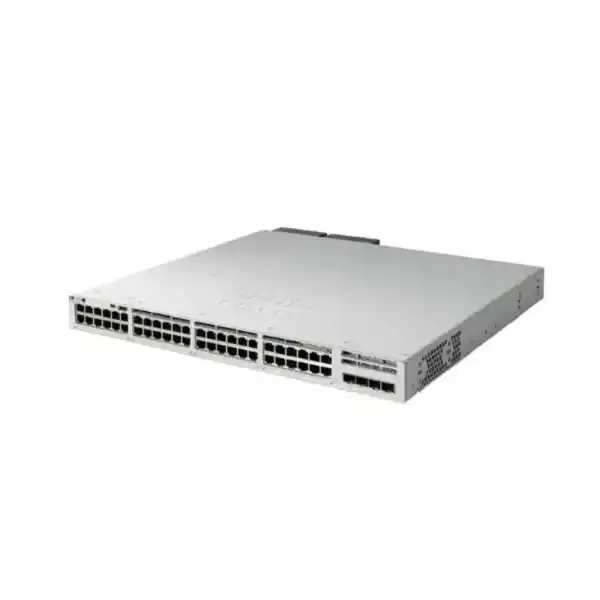
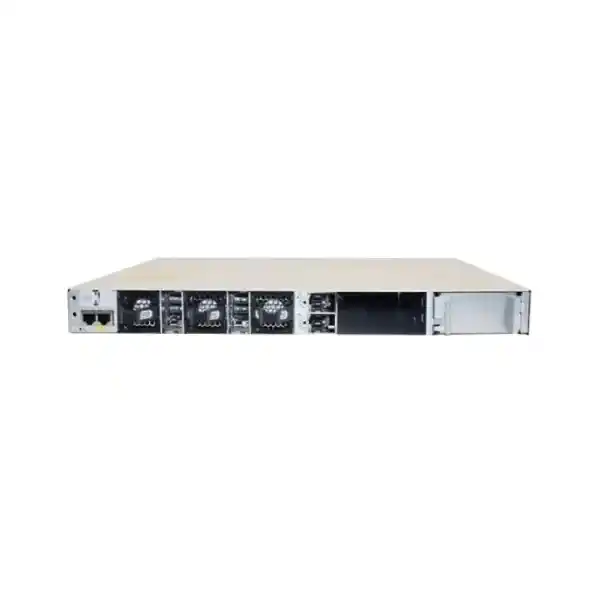
Cisco Catalyst C9300L-48P-4G Network Switch
A 48-port stackable Gigabit PoE+ access switch with four fixed 1G SFP uplinks, a 505 W default PoE budget, StackWise-320 capability, and Cisco IOS XE for dependable campus, branch, voice, wireless, surveillance, and building-network access.
Choose the C9300L-48P-4G when you need forty-eight 1G PoE+ user or device ports and your distribution design can operate effectively with 1G fiber uplinks. If the access block needs 10G uplinks, multigigabit edge ports, higher per-port power, or StackPower, another Catalyst 9300 variant is the better fit.
What the C9300L-48P-4G is designed to do
The Cisco Catalyst C9300L-48P-4G sits in the enterprise access layer: the part of the wired network that directly connects employees, IP phones, wireless access points, cameras, printers, room systems, building controllers, badge readers, thin clients, point-of-sale devices, and other Ethernet endpoints. Its defining design decision is straightforward: provide a dense bank of forty-eight Gigabit copper ports with standards-based PoE+ while retaining a fixed and cost-controlled uplink architecture built around four 1G SFP ports. For many UAE offices and operational sites, that combination is a practical balance between enterprise software capability and predictable access-layer economics.
The model belongs to the Catalyst 9300 family and uses Cisco’s UADP 2.0 forwarding architecture. Unlike entry-level unmanaged or basic smart switches, it is intended for environments that need policy enforcement, routed access, segmentation, authentication, telemetry, resilient operation, and lifecycle management through Cisco IOS XE and supported Cisco management platforms. It is therefore not simply a power-delivery device with many Ethernet sockets. Its value is in combining physical access density with enterprise control: VLANs can separate business functions, access policies can identify and restrict endpoints, quality-of-service can protect voice and interactive applications, and routing functions can be used when the architecture places Layer 3 boundaries at or near the access layer.
For buyers in Dubai, Abu Dhabi, Sharjah, Ajman, Ras Al Khaimah, Fujairah, and Umm Al Quwain, the practical question is not whether forty-eight ports sound sufficient. The correct sizing exercise examines endpoint count, average and peak PoE draw, fiber paths, oversubscription, redundancy expectations, software feature requirements, rack depth, thermal conditions, spare-port policy, and growth. FourTeck can align this switching platform with broader UAE infrastructure requirements through FourTeck UAE, including coordinated network, security, power, cabling, and deployment planning.
Hardware architecture and forwarding performance
UADP 2.0 data plane
The switch is based on one Cisco UADP 2.0 ASIC. That matters because packet forwarding, quality-of-service treatment, access control, telemetry support, and many policy functions are implemented in hardware rather than depending on a general-purpose CPU for every packet. The result is deterministic enterprise switching behavior under normal supported configurations. The hardware data plane is one reason Catalyst 9300 platforms can support richer campus policies without turning every security or segmentation decision into a software bottleneck.
104 Gbps switching capacity
Cisco lists 104 Gbps of switching capacity for the C9300L-48P-4G and 77.38 Mpps of forwarding performance using 64-byte IPv4 packets. With stacking included in Cisco’s platform calculation, the figures rise to 424 Gbps switching capacity and 315.48 Mpps forwarding. These values describe the platform’s forwarding resources; they should not be confused with uplink bandwidth. The four fixed uplinks remain four independent 1G interfaces, so northbound design must still be sized around real traffic patterns.
Cisco specifies wire-speed nonblocking operation for the platform under its published IPv4 and IPv6 performance methodology. In practice, access-layer performance planning still needs to distinguish local east-west forwarding from traffic that must leave the switch. Forty-eight connected endpoints can communicate at Gigabit rates inside the switching fabric, but a design that sends most of that traffic through one or several 1G uplinks can become uplink-limited long before the ASIC reaches its internal capacity. This distinction is especially important for camera aggregation, backup windows, large file transfers, virtual desktop environments, centralized storage, and dense wireless deployments where aggregate northbound demand can rise quickly.
Port map: understanding every connection type
48 × 10/100/1000BASE-T PoE+
The front access interfaces auto-negotiate conventional Ethernet speeds up to 1 Gbps. They are ideal for standard enterprise endpoints that do not need 2.5G, 5G, or 10G copper. PoE+ allows power delivery to compatible devices over the same structured cabling that carries data.
4 × fixed 1G SFP uplinks
The uplinks accept supported 1G SFP optics or transceivers according to Cisco’s compatibility guidance. They are fixed rather than modular. Buyers should therefore confirm the 1G ceiling before purchase because a later change to 10G uplinks requires a different switch model rather than simply replacing an uplink module.
Stack interfaces
C9300L systems support StackWise-320 when equipped with the appropriate stack hardware. Data stacking creates a single logical system across compatible fixed-uplink C9300L members, simplifying management while providing high-bandwidth inter-switch connectivity independent of the four network uplinks.
Out-of-band and service interfaces
Enterprise deployment normally includes dedicated management and console access for staging, recovery, and operations. Exact cabling and management-plane design should be documented during commissioning so technicians can reach the switch even when production VLANs or uplinks are unavailable.
PoE+ engineering: why the 505 W budget matters
The C9300L-48P-4G ships around a 715 W AC power-supply class and Cisco publishes a 505 W default PoE budget for the standard single-supply configuration. That number is more useful to a designer than the simple statement that all forty-eight access ports are PoE+. PoE capability describes what individual interfaces can negotiate; the system PoE budget describes how much aggregate power is available for connected powered devices after the switch reserves energy for its own operation. A successful design must satisfy both constraints.
A fast first-pass calculation divides 505 W by the number of powered endpoints, but real designs should not use average wattage alone. Suppose a site has forty IP phones drawing modest power, several access points with higher negotiated demand, and cameras with infrared illuminators that consume more power at night. The switch may appear comfortable during daytime observation while approaching its budget during peak conditions. A proper bill of materials therefore records the maximum negotiated power class or vendor design draw for every endpoint, adds a sensible engineering reserve, and considers whether future devices will replace current models with higher-power variants.
The model is PoE+, not a UPOE or high-power multigigabit platform. That makes it well matched to many phones, conventional Wi-Fi access points, cameras, sensors, and compact edge devices, but some modern radios, displays, lighting systems, or specialized endpoints can demand more power than this platform is intended to provide per port. Where full high-power delivery across a dense 48-port block is required, the C9300L-48PF family or UPOE-capable alternatives deserve consideration. Likewise, a secondary supported power-supply configuration can change available system headroom, but the exact achievable PoE budget should be validated against the selected Cisco power supplies and the intended redundancy policy rather than assumed from the chassis alone.
For UAE projects, PoE sizing should be coordinated with UPS sizing, cabinet power distribution, room cooling, and generator-backed circuits. The electrical load seen by the facility is not identical to the power delivered to endpoints because conversion efficiency and switch consumption must be considered. If the project also includes security appliances, storage, or compute equipment, FourTeck’s Server Dubai infrastructure team can help align rack-level power and environmental planning across the wider equipment set.
Uplink sizing: the most important limitation to validate
The “4G” suffix is operationally significant: this model has four fixed 1 Gigabit SFP uplinks. It does not provide four 10G SFP+ uplinks. In many branch and office designs, four 1G fiber paths are entirely adequate. In others, particularly dense wireless or surveillance environments, 1G northbound links can become the dominant constraint. Procurement teams should therefore avoid choosing the model only because the access port count and PoE budget look correct.
When 4 × 1G works well
Typical office endpoints generate bursty traffic rather than forty-eight simultaneous 1G streams. A pair of 1G or multiple aggregated 1G uplinks can serve many user-access blocks when applications are cloud-hosted, WAN bandwidth is lower than campus uplink capacity, and local heavy data flows are limited. Redundant fibers can also be split across distribution switches according to the campus design.
When to move to a 4X model
If the expected sustained northbound load can exceed a few gigabits, if Wi-Fi access points collectively aggregate high throughput, if dozens of cameras record centrally at high bit rates, or if access users frequently move large datasets to central servers, a C9300L variant with 10G-capable fixed uplinks can provide substantially more design margin.
Link aggregation can combine multiple 1G uplinks into a larger logical channel, but it does not turn a single flow into a 4G flow. Hashing normally distributes different conversations across member links. A single source-destination flow typically remains limited to one physical member’s capacity. Network engineers should therefore model flow distribution, not just headline aggregate bandwidth. Redundant uplinks can also be used without placing every interface in one port-channel, depending on the distribution architecture and the desired Layer 2 or Layer 3 design.
StackWise-320 and access-layer resiliency
Cisco lists StackWise-320 for the C9300L fixed-uplink platform. Stacking connects compatible switches through dedicated stack interfaces so the members operate as a coordinated logical system. This is useful when a wiring closet requires more than forty-eight ports, when operations teams want one control and management construct instead of several independent switches, or when uplink and gateway designs benefit from links distributed across multiple physical stack members.
The stack connection is distinct from ordinary Ethernet uplinks. Cisco publishes 320 Gbps as the supported data-stack bandwidth for C9300L fixed-uplink models, and the performance table for this SKU lists 424 Gbps switching capacity with stacking included. To deploy a stack, the correct C9300L stack adapters, compatible stack kit, and appropriate cable lengths must be included in the bill of materials. Cisco’s documentation also differentiates older and newer stack-kit part numbers, so replacement or expansion projects should verify compatibility rather than assuming that any Catalyst 9300 stacking accessory will fit.
There is another important distinction: Cisco StackPower is supported on modular-uplink C9300 and C9300X models, not on the C9300L fixed-uplink platform. Data stacking and power stacking are separate concepts. The C9300L can participate in StackWise data stacking, but its power architecture should be planned per chassis with supported power supplies and facility feeds. This matters for resilient PoE design because a stack does not create a shared power pool across C9300L members in the same way a StackPower-capable design could.
A resilient stack design should distribute uplinks, access devices, and critical endpoints across members where practical. For example, redundant wireless infrastructure or paired network appliances can be connected to different physical switches so a single member failure does not remove every path. Stack topology, election behavior, software consistency, cabling order, and maintenance procedure should all be documented before commissioning.
Layer 2 scale and campus segmentation
The C9300L/LM fixed-uplink class supports up to 32,000 MAC addresses, 4,094 VLAN IDs, 300 PVST instances, and up to 1,000 switched virtual interfaces according to Cisco’s current Catalyst 9300 data sheet. It also supports jumbo frames up to 9,198 bytes. Those limits are far beyond the needs of a typical single 48-port closet, but they become relevant when multiple members are stacked, when the access layer participates in large campus segmentation designs, or when the switch is used as a routed or policy-aware access node rather than as a simple Layer 2 endpoint concentrator.
Good VLAN design should not attempt to use the platform’s maximum scale simply because it is available. VLANs should map to meaningful operational or security boundaries such as corporate users, voice, surveillance, guest access, building systems, printers, management interfaces, and specialized devices. Excessively granular VLAN creation without a policy model can increase operational complexity while providing little additional security. Conversely, placing every endpoint in one flat broadcast domain makes incident containment, traffic control, and troubleshooting harder.
Spanning Tree remains important when Layer 2 loops are possible. The platform’s high PVST and virtual-port scales provide design flexibility, but modern campus architectures often reduce Layer 2 failure domains through routed access, EtherChannel, disciplined root placement, or policy-based designs. Whichever topology is selected, the switch should be configured with explicit edge-port behavior, loop protection, root-control mechanisms where appropriate, storm control, and documented trunk allow-lists instead of broad defaults. The goal is not just connectivity; it is a deterministic fault domain in which an accidental patch cable or misconfigured downstream switch cannot destabilize an entire site.
Routing scale, Layer 3 access, and IPv6 readiness
Cisco’s scalability table for C9300L/LM fixed-uplink models lists up to 32,000 total IPv4 routes, including direct and indirect entries, along with 16,000 IPv6 routing entries and an 8,000 multicast routing scale. These are platform-scale figures, and usable features depend on the selected software package and Cisco IOS XE release. They nevertheless illustrate that the C9300L is not limited to traditional Layer 2 access. It can participate in routed access designs where Layer 3 boundaries are moved closer to users and devices.
Routed access can reduce the size of Layer 2 failure domains and make uplink behavior more deterministic. Instead of extending VLANs through several wiring closets, each access block can terminate local networks and exchange routes northbound. This architecture can simplify convergence and reduce spanning-tree dependence, but it requires disciplined IP addressing, routing policy, gateway redundancy or stack design, monitoring, and operational competence. Network Advantage may be required for advanced routing capabilities beyond the base feature set, so license selection should be treated as part of the architecture rather than an afterthought.
IPv6 should also be included in commissioning even if the current production network is primarily IPv4. Enterprises increasingly encounter IPv6 through operating systems, cloud applications, ISP services, guest networks, and dual-stack projects. A secure deployment therefore considers IPv6 neighbor discovery, first-hop security, ACL policy, routing, DHCPv6 or SLAAC behavior, monitoring, and management-plane controls. Ignoring IPv6 while endpoints actively use it can create visibility gaps. The platform’s published IPv6 scale provides ample room for most access-layer deployments, but configuration and security policy remain the decisive factors.
Quality of service for voice, video, wireless, and critical applications
A 48-port PoE+ switch is frequently used for IP telephony and wireless access, which makes quality-of-service design more important than raw port count. Voice packets are small and latency-sensitive. Interactive video and collaboration can be bursty. Backup traffic, software distribution, surveillance uploads, and large downloads can fill queues. The switch therefore needs classification, marking, policing, and queuing policies that reflect actual business priorities.
Cisco lists 5,120 QoS scale entries for the C9300L/LM fixed-uplink class and a 16 MB packet buffer for its 24- and 48-port Gigabit Ethernet models. Buffer capacity is not a substitute for correct congestion design. If forty-eight access ports converge on a much smaller uplink aggregate, bursts can still create queue pressure. QoS determines which traffic should receive preferential treatment during those moments, but it cannot manufacture bandwidth. If sustained demand continuously exceeds uplink capacity, the engineering solution is a higher-bandwidth uplink design rather than increasingly aggressive queue tuning.
Trust boundaries also matter. An IP phone can be trusted to mark voice appropriately when deployed according to policy, but an arbitrary user workstation should not be allowed to declare every packet as high priority. A mature configuration identifies device roles, remarks untrusted traffic, protects control traffic, and maintains consistent DSCP treatment across access, distribution, WAN, and wireless infrastructure. This end-to-end consistency is especially important in multi-site UAE organizations where applications traverse MPLS, SD-WAN, internet VPN, or cloud security services after leaving the campus.
Access security and identity-aware controls
Enterprise access switches are a security enforcement point because almost every wired device must cross them before reaching business systems. The C9300 platform supports a broad set of Cisco IOS XE access-security functions, with exact availability depending on software level and release. Common designs use IEEE 802.1X for authenticated access, MAB for devices that cannot perform 802.1X, downloadable or local access policy, DHCP snooping, Dynamic ARP Inspection, IP Source Guard, port security, storm control, ACLs, and segmentation mechanisms. These features are strongest when integrated into a coherent identity and device-classification strategy rather than enabled individually without operational context.
For example, an access port serving a corporate workstation can authenticate the user or device before providing production access, while a camera can be identified through MAB and placed into a tightly restricted surveillance segment. A printer can be allowed to reach print services but not sensitive application networks. An IP phone can receive voice policy and the attached workstation can be treated separately. This approach turns the wiring closet into a policy boundary, reducing reliance on physical location as a proxy for trust.
The switch itself also needs protection. Management should use encrypted protocols, role-based administration, centralized AAA where appropriate, restricted management-plane access, synchronized time, secure logging, configuration backups, and tested software-upgrade procedures. Unused interfaces should be administratively disabled or placed into a safe state. Native VLAN assumptions should be removed from trunks. Discovery protocols should be enabled only where operationally useful. Credentials and shared secrets must follow enterprise handling rules.
FourTeck can coordinate switching with perimeter and segmentation controls through Firewall Dubai, helping ensure that access-layer identity, VLAN design, and firewall policy form one consistent architecture rather than separate projects.
Cisco IOS XE, automation, telemetry, and operations
Cisco IOS XE provides the operating environment for Catalyst 9300 systems ordered with Cisco network licensing. It separates many system services into a modern software architecture while retaining the command-line and operational concepts familiar to enterprise Cisco teams. Day-to-day operations can include CLI configuration, structured APIs, model-driven telemetry, automation workflows, event handling, centralized management, and software lifecycle controls. The exact feature set depends on release, hardware support, and licensing.
Automation is particularly valuable when many access switches must follow the same baseline. Instead of manually creating VLANs, AAA settings, NTP, logging, SNMP, interface templates, and security controls on every closet switch, organizations can standardize configuration through controller-based or infrastructure-as-code methods. The benefit is not merely speed. Standardization reduces configuration drift, makes audits easier, and allows a failed or replaced unit to be restored consistently.
Telemetry also changes troubleshooting. Flexible NetFlow support, interface counters, environmental sensors, event logs, and management-platform analytics can help operations teams understand who is using the network, where congestion appears, which ports are flapping, whether PoE endpoints are drawing unexpected power, and how application paths behave. Cisco lists up to 64,000 Flexible NetFlow entries for the 24- and 48-port Gigabit fixed-uplink class, giving substantial visibility scale for an access platform when licensed and configured appropriately.
A sound operating model defines what data will actually be collected and retained. Sending every possible event to every tool can create noise without insight. Monitoring should focus on actionable indicators such as uplink utilization, errors and discards, PoE budget, spanning-tree changes, authentication failures, route changes, stack health, CPU and memory, temperature, fan state, power-supply status, and software compliance. Alert thresholds should reflect site criticality and normal baselines.
Licensing: Network Essentials, Network Advantage, and subscriptions
The C9300L-48P-4G is available in Network Essentials and Network Advantage ordering variants, commonly represented by “-E” and “-A” suffixes on the full orderable SKU. Cisco’s current ordering information lists C9300L-48P-4G-E for Network Essentials and C9300L-48P-4G-A for Network Advantage. The hardware port configuration is the same core model, but the perpetual network feature package differs. Network Advantage is selected where the architecture needs advanced capabilities beyond the Essentials baseline.
Cisco’s current licensing guidance also states that Catalyst 9300 models ordered with Network Essentials or Network Advantage require a Cisco Catalyst or Cisco DNA subscription license at the time of configuration. Subscription terms are offered for multiple durations, including three, five, and seven years. The perpetual Network Essentials or Network Advantage base license does not expire, while the subscription component is term-based. When a subscription expires, renewal preserves the associated add-on capabilities and support benefits; organizations can also operate with the underlying base entitlement according to Cisco’s rules after deactivating the expired add-on and reloading where required.
This is an area where price-only comparisons often fail. Two quotations for “C9300L-48P-4G” may not be equivalent if one includes Network Essentials and a shorter subscription while another includes Network Advantage, a longer term, support coverage, optics, stacking accessories, a secondary PSU, or deployment services. Procurement should compare the complete line-item architecture rather than only the chassis model string.
Before purchase, document which routing, segmentation, telemetry, automation, and management functions are required. Then map those requirements to Cisco’s current licensing matrix and the organization’s management approach. Cisco revises software packaging over time, so the quote should be checked against the current ordering guide rather than copied from an old bill of materials.
Physical design, rack depth, cooling, and reliability
The C9300L-48P-4G is a 1RU-class enterprise switch. Cisco lists the chassis dimensions at approximately 4.4 cm high by 44.5 cm wide by 40.9 cm deep in its base physical configuration. Depth increases when longer power-supply configurations are installed, with Cisco publishing values up to roughly 44.9 cm or 48.8 cm depending on the fitted supply arrangement. The listed weight is about 7.03 kg. These details matter in compact wall cabinets, shallow telecommunications enclosures, and crowded racks where rear cable bend radius and PDU clearance can be limited.
The Catalyst 9300 family uses field-replaceable fan modules, and Cisco specifies three fans with N+1 redundancy for the platform. Cooling should never be treated as an incidental rack detail. PoE switches dissipate heat from their own electronics and from power conversion used to energize endpoints. UAE equipment rooms can also experience high ambient temperature if air conditioning is undersized, interrupted, or poorly distributed. Cabinet doors, blanking, cable bundles, dust, and nearby UPS systems can all influence airflow.
Cisco publishes a mean time between failures figure of approximately 314,140 hours for this SKU under the manufacturer’s methodology. MTBF is a statistical reliability metric, not a guarantee that an individual unit will operate for that duration. Operational resilience still comes from architecture: redundant uplinks, multiple stack members where needed, spare optics, documented configurations, protected power feeds, tested backups, monitoring, and a replacement process.
Before installation, verify rack units, rail or mounting hardware, earth bonding, patch-panel position, copper cable category, fiber termination, transceiver reach, power connector type, UPS capacity, air path, and service clearance. A technically correct switch can still become an operational problem if technicians cannot safely remove a PSU, trace a fiber, or access stack cables after the rack is fully populated.
Optics and fiber planning for the four 1G SFP uplinks
The four fixed uplinks are SFP interfaces operating at 1 Gigabit. Fiber selection should start with the physical path: multimode or single-mode fiber type, link distance, connector presentation, patch-panel design, and the optics supported for the target Cisco IOS XE release. Typical 1G campus designs may use short-reach multimode optics within a building or longer-reach single-mode optics between floors, buildings, or remote cabinets, but the exact transceiver must be validated against Cisco’s current compatibility information.
Do not treat “SFP” as a generic promise that any inexpensive transceiver will behave identically. Optic coding, digital diagnostics, temperature rating, wavelength, fiber type, receive sensitivity, transmit power, connector cleanliness, and vendor support all matter. For critical production networks, supported optics simplify troubleshooting because both hardware and software compatibility are documented. Third-party optics may be technically workable in some environments, but support policy and operational risk should be assessed before standardizing them.
Redundant fiber paths should be physically diverse where the building allows it. Two logical uplinks that travel through the same riser, tray, or patch panel can fail together when a cable is damaged or maintenance work affects the shared route. Where distribution switches are redundant, consider splitting fibers across different upstream devices and, where practical, different physical paths. The Layer 2 or Layer 3 design then determines whether those links form a port-channel, separate routed connections, or another resilient topology.
Remember that the fixed 1G uplinks are a lifetime characteristic of this exact model. If the fiber backbone is already 10G or the organization expects to upgrade soon, purchasing the 4X variant may avoid an early chassis replacement. The cost difference should be compared against the expected service life, not only the first-year budget.
What this model does not provide
No 10G fixed uplinks
The 4G variant is limited to four 1G SFP uplinks. Choose a 4X or other higher-speed model when distribution links require 10G.
No multigigabit access
The forty-eight copper ports top out at 1G. They do not provide 2.5G, 5G, or 10GBASE-T for high-throughput access points or specialized endpoints.
No UPOE class positioning
This is a PoE+ model. High-power devices should be checked carefully against per-port and total power requirements.
No StackPower
C9300L fixed-uplink models support data stacking through StackWise-320, but Cisco reserves StackPower for modular-uplink C9300 and C9300X platforms.
These are not defects; they define the product’s intended position. The C9300L-48P-4G is attractive precisely when an organization wants enterprise Catalyst software, dense 1G PoE+ access, and stacking without paying for uplink or edge speeds the design does not require. Correct selection means matching those constraints to the real network.
Deployment scenario: corporate office floor
A common UAE deployment is an office floor with IP phones, user workstations, meeting-room systems, printers, and several wireless access points. In this scenario, the switch can provide one Gigabit access port per desk or device group while delivering PoE+ to phones and access points. Voice VLANs, corporate data VLANs, guest wireless termination, management networks, and building services can be separated logically. QoS policies protect voice and collaboration traffic during congestion, while 802.1X or MAB can enforce endpoint identity.
The design should reserve spare ports. Filling all forty-eight interfaces on day one leaves no easy capacity for a new meeting room, replacement endpoint, test connection, temporary device, or migration overlap. Many enterprises target an operational spare ratio rather than purchasing exactly one port per known endpoint. Spare capacity is also useful when a particular cable run develops a fault and a technician needs an immediate alternate port.
Uplink traffic in a user office is often less intense than the total edge capacity suggests because SaaS and internet-bound traffic may be limited by WAN bandwidth and because employees rarely transmit at line rate simultaneously. Even so, cloud backup, video conferencing, large file sync, virtual desktops, and Wi-Fi 6 clients can increase aggregate demand. Monitoring should establish actual utilization and growth trends. If the design shows sustained peaks near the available 1G uplink capacity, the correct response may be to use additional uplinks or select a 10G-uplink model.
For multi-floor projects, standardizing closet templates can accelerate rollout: consistent VLAN numbering, port descriptions, uplink conventions, authentication, management addressing, logging, NTP, software release, and monitoring reduce troubleshooting time across the building.
Deployment scenario: IP surveillance and physical security
Forty-eight PoE+ ports make the C9300L-48P-4G relevant to surveillance networks, but camera deployments require more careful arithmetic than simple port counting. Each camera has a maximum power profile and a traffic profile. Fixed cameras may draw modest power, while devices with infrared illumination, heaters, analytics, PTZ motors, or accessories can consume substantially more. A 505 W default PoE pool must be checked against worst-case simultaneous demand, not daytime averages.
Bandwidth planning is equally important. Multiply the expected average and peak camera bit rate by the number of streams crossing each uplink, then include viewing, management, and failover behavior. Forty-eight cameras at several megabits per second each may fit comfortably within 1G, while high-resolution, high-frame-rate, low-compression, multi-stream, or analytics-heavy deployments can drive greater demand. Recording topology matters: cameras writing to a local recorder connected to the same access switch produce different uplink demand from cameras sending every stream to a centralized data center.
Security VLANs should be isolated from ordinary users. Cameras generally need access to specific NVR, VMS, DNS, NTP, update, and management services—not unrestricted access to corporate networks. ACLs, firewall policy, secure management, device authentication where supported, and restricted east-west communication can limit the impact of a compromised IoT endpoint. Switch management should be separated from the camera data plane.
For critical sites, distribute cameras across more than one physical switch or PoE power domain so a single chassis or supply issue does not blind an entire area. UPS autonomy should be calculated from the combined switch and camera load, particularly where surveillance must continue during a utility outage.
Deployment scenario: schools, healthcare, hospitality, and retail
Education environments can use the switch for classroom phones, access points, teacher stations, digital signage, security cameras, attendance devices, and administrative endpoints. Segmentation helps separate students, faculty, guest services, IoT, voice, and security systems. The design should account for rapid wireless growth because dense classrooms can drive much more aggregate traffic than a conventional office even when each wired access point is connected at 1G.
Healthcare and clinical environments emphasize availability and controlled access. Nurse stations, voice endpoints, workstations, cameras, building systems, and specialized devices may coexist in one telecommunications room but require strict policy separation. Change control, validated software, resilient power, careful maintenance windows, and detailed port documentation become more important than maximum feature count. Procurement teams should also verify any sector-specific requirements that apply to the wider solution; a general enterprise switch specification alone does not establish compliance for a clinical system.
Hotels and hospitality sites often combine guest wireless, IP telephony, IPTV-related infrastructure, cameras, access control, back-office systems, and building management. The C9300L-48P-4G can serve an access closet where these devices are mostly 1G or lower, but uplink planning must reflect the possibility that dozens of rooms or access points share the same northbound capacity. Redundant distribution and clear operational separation between guest and corporate traffic are essential.
Retail branches can use the platform for POS devices, phones, access points, cameras, digital signage, and back-office systems. In smaller branches, the C9300L may provide more capability than needed; in large flagship stores or regional hubs, its enterprise policy and stacking capabilities can be valuable. The right choice depends on scale, availability targets, support model, and whether the site is managed as part of a standardized national network.
Migration from older Cisco Catalyst access switches
Organizations replacing older Catalyst 2960, 3560, 3750, 3850, or previous-generation access platforms should treat migration as an architecture review rather than a direct port-for-port copy. Legacy configurations often contain years of accumulated exceptions: unused VLANs, broad trunks, obsolete QoS commands, old AAA methods, inconsistent port security, stale SNMP communities, and undocumented spanning-tree changes. Copying that history onto a newer Catalyst platform can preserve technical debt.
Start with discovery. Export the current running configuration, interface status, MAC table, LLDP/CDP neighbors, PoE draw, uplink utilization, VLAN inventory, spanning-tree roles, routing neighbors, transceiver information, software version, and monitoring dependencies. Map every live port to a device owner where possible. Then classify settings into required, obsolete, risky, and unknown. Build the new configuration from an approved baseline and deliberately reintroduce only the features that remain justified.
Hardware differences must also be addressed. A legacy switch may have 10G uplinks while the chosen C9300L-48P-4G has only 1G uplinks, or the old design may rely on a type of stacking or power sharing that is not equivalent. Transceivers, stack cables, console access, rack depth, and power supplies may differ. Do not assume accessories can be reused without verification.
Migration should include a rollback plan, pre-staged software, license readiness, configuration validation, spare optics, labeled patching, and a defined acceptance test. Validate DHCP, DNS, authentication, voice, wireless, routing, internet access, management, monitoring, and critical applications before closing the change. For larger refreshes, FourTeck’s IT Services UAE team can support staging, cutover planning, documentation, and post-change verification.
High-availability design beyond the switch itself
A reliable access layer is a system property. Installing a premium enterprise switch does not create high availability if both uplinks terminate on the same upstream device, both power supplies connect to one PDU, the stack cables form an invalid topology, the rack has one cooling source, or the configuration backup is missing. Resilience needs independent failure domains.
At the network layer, consider dual distribution switches or a resilient upstream stack or virtual pair. Spread physical uplinks across upstream nodes. Use port-channels or routed links according to the target design and failure behavior. At the access layer, distribute critical systems across stack members or separate switches where possible. At the power layer, use separate UPS or PDU paths when the site supports them. Remember that C9300L does not provide StackPower, so each member’s power strategy remains local to that chassis.
Operational availability requires software discipline as well. Keep switch members on compatible releases, monitor stack state, test image distribution, understand upgrade modes supported by the chosen release, maintain current backups, and schedule changes with clear rollback criteria. A spare switch that has never been staged may not be an effective spare if its software, license, stack accessories, or optics do not match the production environment.
Finally, define what “available” means to the business. A site may tolerate a five-minute user interruption but not a camera outage, or may require voice service during a WAN failure. Those requirements determine whether one switch, a two-member stack, dual uplinks, local survivability, redundant power, or more extensive architecture is justified. The product should follow the availability requirement, not the other way around.
Capacity planning methodology for a 48-port access block
A repeatable sizing method prevents both underbuying and unnecessary overspecification. First, count physical endpoints and classify them by device type. Second, record data speed: 100M, 1G, multigigabit, or higher. Any endpoint that truly needs more than 1G immediately challenges the fit of this model. Third, record PoE requirement, including maximum draw and standard. Fourth, determine which endpoints are business-critical and whether they need to be split across hardware failure domains.
Next, calculate uplink demand. Estimate average and peak northbound traffic by application group instead of multiplying forty-eight ports by 1G. User desktops may be bursty, cameras more continuous, access points highly variable, and backup systems schedule-driven. Add protocol overhead and growth. Evaluate both total traffic and single-flow requirements because a link aggregation group distributes flows rather than increasing the speed of one flow beyond a member interface.
Then check scale and policy. Count VLANs, routed interfaces, authentication sessions, ACL needs, telemetry, routing protocols, and management requirements. Most ordinary sites will remain well below the C9300L platform scales, but license selection can still be decisive. Finally, evaluate rack, power, cooling, optics, stacking accessories, support, and lifecycle.
A useful output is a one-page access-block worksheet listing endpoint count, spare-port target, total worst-case PoE, required uplink bandwidth, redundancy method, software tier, optics, stack hardware, secondary PSU decision, rack location, UPS load, and acceptance tests. This turns procurement from a model-name exercise into an auditable engineering decision.
UAE procurement and lifecycle considerations
Enterprise networking procurement in the UAE should consider more than immediate stock. Validate the exact Cisco orderable SKU, license tier, subscription term, power-supply configuration, UAE-compatible power cord, required SFPs, stack kits, cable lengths, rack accessories, and support level. A chassis-only quote can look attractive until essential line items are added later.
Lead time matters for phased projects. If a rollout includes multiple buildings or emirates, standardize the bill of materials early and reserve critical accessories with the switch. Stacking adapters and specific optics can be just as schedule-sensitive as the chassis. Keep a controlled list of approved substitutions so procurement does not replace a 1G SFP with an incompatible optic or substitute a different Catalyst variant without understanding uplink and power consequences.
Lifecycle planning should include software support, security advisories, renewal dates, spare strategy, and an eventual refresh trigger. A switch can remain functional long after its original subscription term, but operational risk rises if software and hardware support no longer align with enterprise policy. Maintain serial-number records, Smart Account or licensing ownership, support entitlements, rack location, software baseline, and configuration backups from day one.
FourTeck can structure a UAE quotation around the complete deployment requirement rather than an isolated hardware price. The quotation should clearly separate switch hardware, network license tier, subscription, optics, stack accessories, secondary power, support, configuration, installation, testing, and documentation so technical reviewers can confirm equivalence between options.
Technical specification summary
Specifications should be validated against the current Cisco data sheet, release notes, compatibility matrix, and project-specific bill of materials at time of order because software packaging and supported accessories can change.
C9300L-48P-4G versus nearby alternatives
Versus C9300L-48P-4X
Both provide forty-eight 1G PoE+ access ports and the same 505 W default PoE budget, but the 4X model replaces the four 1G uplinks with four 10G/1G SFP+ uplinks. Choose 4X when the access block needs materially more northbound capacity or is being connected to a modern 10G distribution layer.
Versus C9300L-48PF-4G
The 48PF-4G retains 1G uplinks but uses a higher-power 1100 W class supply and Cisco publishes a substantially larger default PoE budget. It is appropriate when the primary requirement is delivering more PoE across a dense 48-port access block without moving to faster uplinks.
Versus multigigabit C9300L models
UXG variants add multigigabit copper and higher-power UPOE capabilities on selected ports, better matching modern high-throughput wireless access points and power-hungry edge devices. They also use faster fixed uplink options. The tradeoff is higher cost and a different power profile.
Versus modular-uplink C9300
Modular-uplink C9300 models provide a different flexibility and resiliency profile, including support for StackPower and interchangeable uplink network modules. Choose them when long-term uplink adaptability or power stacking is a design requirement rather than accepting the fixed-uplink architecture of C9300L.
Commissioning checklist for a production deployment
A successful installation includes verification at physical, Layer 2, Layer 3, security, application, and management layers. Before patching users, confirm the chassis model, serial number, license entitlement, software image, stack member order, stack cabling, power-supply state, fan state, time source, hostname, management address, DNS, AAA, logging, and configuration backup destination. Verify that every optic is recognized and that fiber receive levels are within expected ranges.
For access ports, validate VLAN assignment, voice VLAN behavior, PoE negotiation, LLDP/CDP policy, authentication, spanning-tree edge settings, storm control, QoS trust boundary, and unused-port treatment. For trunks and uplinks, validate native VLAN policy, allowed VLANs, EtherChannel membership, routing neighbors, MTU, error counters, redundancy behavior, and convergence after a link failure. Deliberately test a failover instead of assuming redundancy works because both links show “up.”
For PoE, capture the actual power draw after all endpoints are online and during a representative peak period. Compare the total against the engineered budget and reserve. Confirm that critical devices do not unexpectedly renegotiate power after software upgrades or reboots. If cameras use night-mode illumination, test or model night consumption rather than recording only daytime values.
Finally, test real services: DHCP, DNS, corporate authentication, internet, voice calls, wireless roaming, camera recording, printing, application access, monitoring, backups, and remote administration. Record baseline interface utilization, CPU, memory, temperature, PoE consumption, route counts, and error rates so future troubleshooting has a known-good reference.
Operations and maintenance over the switch lifecycle
After deployment, the switch becomes part of a living production system. Maintain an approved Cisco IOS XE release strategy based on security advisories, feature requirements, compatibility, and organizational change windows. Avoid both extremes: upgrading every time a new image appears without qualification can create unnecessary change risk, while leaving infrastructure on an obsolete release for years can expose known vulnerabilities and support limitations.
Back up configurations automatically and test restoration. A backup that cannot be located, decrypted, or applied to replacement hardware is not useful. Keep a golden baseline separate from periodic running-config snapshots so operations can identify drift. Where automation is used, treat the automation repository as a controlled production asset with versioning and review.
Monitor physical health and traffic trends. Rising CRC errors may indicate cabling or optic problems. Increasing output drops can reveal congestion. Repeated spanning-tree changes can point to loops or unstable links. Growing PoE usage can indicate endpoint expansion. Temperature and fan alerts can reveal airflow degradation before a shutdown. Authentication failures can be either user-impacting configuration issues or security signals. Correlating these indicators is more valuable than viewing each one in isolation.
Schedule periodic capacity reviews. A switch selected correctly in year one can become constrained after wireless upgrades, camera expansion, office densification, or application changes. The fixed 1G uplinks are the most likely architectural limit to revisit. If utilization trends justify 10G, plan the replacement or redistribution before users experience persistent congestion.
Why the C9300L-48P-4G can be a strong fit in UAE networks
The strongest case for this model is a network that needs enterprise-grade access control and operations but does not need multigigabit edge ports or 10G uplinks in every wiring closet. Its forty-eight PoE+ ports can consolidate phones, access points, cameras, and user devices in one rack unit. StackWise-320 provides an expansion path for multi-switch closets. Cisco IOS XE and the UADP 2.0 architecture provide the policy, telemetry, routing, and automation foundation expected in managed enterprise networks.
The model also supports a sensible tiered campus strategy. High-density or high-throughput areas can use faster Catalyst variants, while ordinary office floors use C9300L-48P-4G where 1G access and 1G fiber uplinks meet the application profile. Standardizing on the Catalyst 9300 family can keep operating procedures, management concepts, and security policy more consistent across those tiers.
Its suitability ultimately depends on four questions: Are forty-eight 1G ports enough for the endpoint plan? Is a 505 W default PoE budget sufficient with growth and reserve? Can the access block operate with four 1G uplinks? Does the selected Network Essentials or Network Advantage licensing package support the required feature set? If all four answers are yes, the C9300L-48P-4G is a technically coherent access-layer choice. If any answer is no, it is better to select a different Catalyst variant before purchase than to engineer around an avoidable platform constraint.
Decision recap: use this model when the design matches these conditions
Access requirement
You need up to forty-eight standards-based 10/100/1000 copper access connections and do not require multigigabit edge speeds.
PoE requirement
PoE+ is sufficient per device and the complete endpoint plan fits inside the engineered system budget with reserve.
Uplink requirement
Four fixed 1G SFP uplinks provide enough bandwidth and resiliency for the distribution design across the switch lifecycle.
Operations requirement
You want Cisco IOS XE, StackWise-320, enterprise segmentation, identity controls, telemetry, routing options, and managed lifecycle operations.
Quotation input checklist
Provide these details with the RFQ so the final Cisco bill of materials is technically complete and comparable.
1. Port and endpoint schedule
Number of users, phones, access points, cameras, printers, IoT devices, building systems, spare ports, and any endpoint requiring more than 1G.
2. PoE power schedule
Maximum power requirement of every powered endpoint, expected expansion, required reserve, and whether redundant power supplies are needed.
3. Fiber and uplinks
Number of uplinks, fiber type, distance, connector type, optic requirement, upstream switch model, and whether 1G remains acceptable for the full project life.
4. Stack requirement
Number of C9300L members, rack layout, required stack kit, stack cable lengths, member numbering, and physical redundancy expectations.
5. Software and licensing
Network Essentials or Advantage feature requirement, Cisco Catalyst/DNA subscription term, management platform, routing, telemetry, and policy needs.
6. Site services
Delivery emirate, rack readiness, UPS, cabling, configuration, installation, migration window, testing, documentation, training, and support expectations.
Validate the switch, optics, PoE budget, licensing, and deployment scope before you order
A production Cisco quotation should reflect the network you are actually building. FourTeck can review endpoint density, PoE calculations, 1G uplink suitability, stacking, routing and security requirements, subscription terms, optics, rack power, migration, and testing. This reduces the risk of receiving a technically correct chassis that is incomplete for the intended site.
For broader UAE infrastructure procurement, visit FourTeck UAE. For switch-adjacent security architecture, see Firewall Dubai. For implementation, migration, and managed technical work, use IT Services UAE. For rack, compute, storage, and supporting data-center infrastructure, see Server Dubai.
Best-fit summary
The C9300L-48P-4G is best for enterprise closets where 48 × 1G PoE+ access, 505 W default PoE, fixed 1G fiber uplinks, and StackWise-320 align with the design.
Move to another variant when you need 10G uplinks, multigigabit edge ports, higher PoE density, UPOE, or StackPower.
Final engineering note
Cisco Catalyst C9300L-48P-4G is not a generic forty-eight-port PoE switch. It is an enterprise access platform whose value comes from combining dense 1G PoE+ connectivity with Cisco IOS XE policy, routing, telemetry, automation, and stacking. The model is particularly compelling when the organization has standardized on Cisco Catalyst operations and can confidently remain within its 1G access and 1G uplink boundaries.
Before issuing a purchase order, validate the exact -E or -A license variant, subscription term, optic list, stack accessories, power-supply arrangement, PoE reserve, rack depth, software release, and upstream topology. That final validation turns a model selection into a deployable solution and prevents expensive substitutions during installation.

Reviews
There are no reviews yet.