
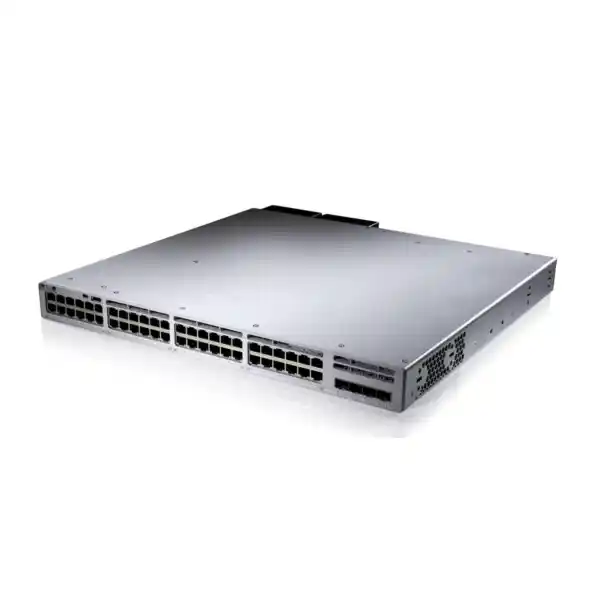
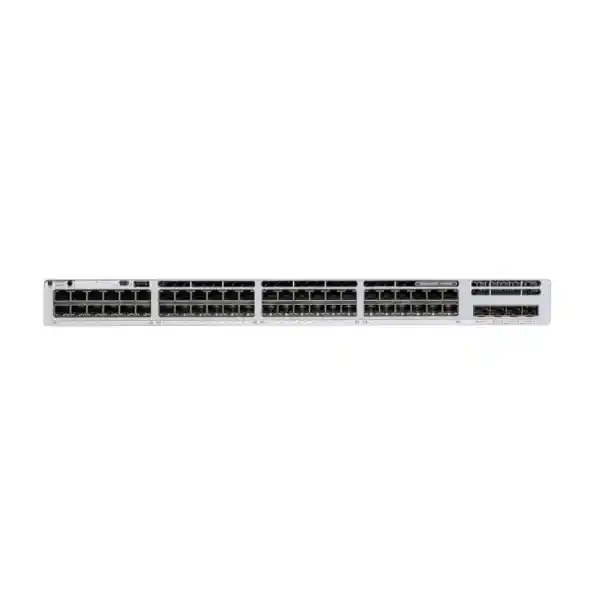
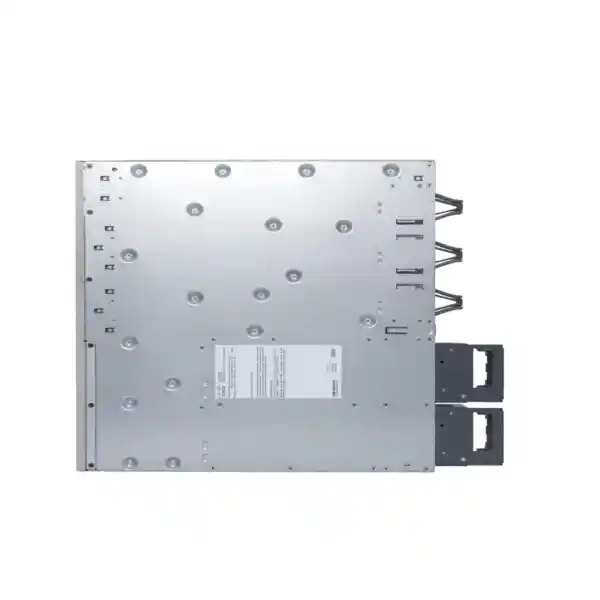
Cisco Catalyst C9300L-48P-4X Network Switch
The Cisco Catalyst C9300L-48P-4X is a fixed-uplink member of the Catalyst 9300L family built for enterprise access layers that need forty-eight 1 Gigabit Ethernet PoE+ edge ports, four fixed 1G/10G SFP+ uplinks, resilient stacking and the operational capabilities of Cisco IOS XE. It is a practical fit for UAE organizations standardizing office floors, branch campuses, education blocks, hospitality sites, healthcare facilities, retail headquarters, logistics centers and other environments where wired endpoints, IP telephony, surveillance and wireless infrastructure converge on a common access platform.
Why the C9300L-48P-4X fits modern enterprise access networks
An access switch is no longer simply a concentration point for desktop Ethernet. In a current enterprise LAN it becomes the local attachment platform for users, VoIP handsets, wireless access points, cameras, building systems, printers, sensors, thin clients and increasingly specialized operational technology. The C9300L-48P-4X addresses that mixed workload by combining a dense set of 1G copper interfaces with standards-based PoE+ and four 10G-capable SFP+ uplinks. For many organizations this is an effective balance: the access edge remains cost-efficient at 1G while the uplink layer can be designed with 10G fiber or direct-attach connectivity to avoid bottlenecks between floors and the distribution or core layer.
The “L” designation is important for network architects. Catalyst 9300L models use fixed uplinks rather than the modular uplink architecture of selected Catalyst 9300 models. That simplifies bill-of-materials planning where four 10G/1G SFP+ interfaces already match the intended design. It also makes the C9300L-48P-4X easy to standardize across repeated access closets because each chassis presents the same port map. If a project needs different uplink modules, substantially higher uplink speeds or a broader modular strategy, another Catalyst 9300 or 9300X variant may be more appropriate. The goal is to choose the platform whose physical architecture matches the real topology, rather than paying for flexibility that will not be used.
For procurement teams in Dubai and the UAE, this model is especially relevant when an existing campus uses Cisco switching and wants to expand access capacity without creating a separate operating model. Standard Cisco operational concepts, VLAN design, spanning-tree controls, routed access options, 802.1X access policy, telemetry and stacking can be incorporated into an enterprise standard. FourTeck can align the switch selection with upstream routing, firewalling, structured cabling, optics, wireless and endpoint power requirements so that the resulting design is evaluated as a complete system rather than as an isolated switch purchase.
Verified hardware profile and performance
| Item | C9300L-48P-4X profile |
|---|---|
| Access interfaces | 48 × 10/100/1000 Mbps copper ports with PoE+ |
| Fixed uplinks | 4 × 1G/10G SFP+ interfaces |
| Default AC supply | 715W AC |
| Available PoE power with default PSU | 505W |
| Switching capacity | 176 Gbps standalone; 496 Gbps with stacking bandwidth included in Cisco performance figures |
| Forwarding rate | 130.95 Mpps standalone; 369.05 Mpps including stacking figures |
| Stack architecture | StackWise-320; up to eight compatible Catalyst 9300L/9300LM units subject to Cisco stacking compatibility and license-level rules |
| MAC address scale | Up to 32,000 MAC addresses for Catalyst 9300L/LM fixed-uplink family scale |
| Memory | 8 GB DRAM and 16 GB flash for Catalyst 9300L/LM fixed-uplink family |
| Chassis height / width | Approximately 4.4 cm × 44.5 cm; 1RU class chassis |
| Weight with default PSU | Approximately 7.03 kg |
Performance values should be interpreted in the context of Cisco’s published test methodology and software release. Feature availability, scale values and licensing behavior can depend on the selected license tier and Cisco IOS XE release. The design process should validate the exact ordering code, software entitlement and optics before deployment.
Port architecture: forty-eight powered access ports plus four 10G uplinks
The C9300L-48P-4X is fundamentally a high-density Gigabit Ethernet access switch. Each of the forty-eight front-panel copper access ports can negotiate 10, 100 or 1000 Mbps and can deliver PoE+ to compatible endpoints. In practical campus design, this gives one switch enough copper density for a typical forty-eight-port patching block while retaining dedicated optical uplinks instead of consuming access interfaces for aggregation. That separation helps keep cabling documentation simple: copper ports serve local endpoints, while the SFP+ interfaces connect toward distribution switches, core switches, server aggregation, or a pair of redundant upstream devices.
The four fixed SFP+ uplinks support both 1G and 10G operation, allowing staged migration. A site can initially connect to an existing 1G fiber distribution layer and later migrate the same switch to 10G uplinks when upstream equipment and optics are upgraded. This is useful in brownfield UAE installations where vertical fiber infrastructure may already exist but the distribution layer is refreshed in phases. It also supports link aggregation strategies where two or more uplinks are combined into an EtherChannel, providing greater aggregate throughput and link-level resiliency when the upstream topology supports it.
Because the uplink ports are fixed, the project team should confirm the intended optical reach and connector ecosystem early. Short intra-rack or adjacent-rack connections may use supported direct-attach or short-reach options where appropriate, while building risers commonly use multimode fiber and longer campus links may require single-mode optics. The switch model determines the physical SFP+ interface, but the transceiver choice determines wavelength, reach and fiber type. FourTeck can help align the switch, optics and structured cabling through the FourTeck UAE network portfolio so the uplink path is specified as one interoperable design.
PoE+ engineering: understanding the 505W default power budget
A forty-eight-port PoE+ switch should not be sized only by port count. The available power budget is equally important. With its default 715W AC power supply, Cisco lists 505W of available PoE power for the C9300L-48P-4X. That power is shared across attached powered devices. The correct engineering question is therefore not “does the switch have forty-eight PoE ports?” but “does the aggregate endpoint load fit comfortably within the available PoE budget under both normal and peak conditions?” The answer depends on the device mix, negotiated power class, boot behavior and planned growth.
Consider a representative office-floor example. Suppose twenty-four IP phones draw approximately 7W each in normal operation, eight wireless access points are budgeted at 20W each, and eight cameras are budgeted at 12W each. The estimated load is 168W for phones, 160W for access points and 96W for cameras, producing a total of 424W. That fits inside a 505W budget, but it leaves about 81W of headroom. Whether that margin is adequate depends on growth, maximum device draw and project policy. If several access points can request close to PoE+ maximum power or if additional cameras may be added, a higher-PoE configuration such as the C9300L-48PF-4X may be more appropriate, or the power design may need a supported secondary supply arrangement.
Cisco’s published power table shows that the C9300L-48P-4X can support greater available PoE power when supported secondary power supplies are added, subject to the platform’s port-rating limits. For example, Cisco lists 855W with a 350W secondary supply, 1220W with a 715W secondary, and up to the port-limited 1440W value with a 1100W secondary. These figures illustrate why the physical chassis can scale beyond the default 505W deployment profile. However, power-supply selection should not be treated as an afterthought. It affects rack power allocation, UPS sizing, heat output, spare strategy and the maximum endpoint load the access layer can sustain.
For UAE deployments, where IP telephony, Wi-Fi and video surveillance often share the same access closet, a formal PoE worksheet is recommended. List every endpoint type, quantity, nominal draw, worst-case draw and growth reserve. Separate business-critical devices such as phones and APs from lower-priority endpoints so power policies can be planned. If the calculated load approaches the switch budget, select the higher-power configuration or distribute endpoints across more switches rather than running continuously near the ceiling. A properly sized PoE design improves predictability during cold starts, maintenance events and device replacement.
StackWise-320: turning access switches into a resilient system
320 Gbps stack bandwidth
Catalyst 9300L models support Cisco StackWise-320. Dedicated rear stacking connections create a high-speed stack fabric that is separate from ordinary front-panel uplinks, preserving the uplink interfaces for northbound connectivity.
Up to eight members
Cisco supports stacks of up to eight compatible Catalyst 9300L/9300LM members when model and license-level compatibility requirements are respected. This provides scalable port density while presenting a coordinated system.
Dedicated stack kit
The optional C9300L stack kit supplies the adapters and cable needed for StackWise-320. Cable length must be chosen to match rack placement and physical stack arrangement.
Operational consistency
A stack can simplify management, uplink design and failure-domain planning compared with operating multiple independent access switches, while still requiring disciplined stack-power, software and maintenance procedures.
Stacking is especially useful in dense communication rooms where two, three or more switches serve the same floor. Instead of designing each switch as a standalone island, the network can use a common stack architecture and distribute uplinks across members. A carefully designed stack can continue forwarding during certain member or link failures and can make expansion easier because a new member joins an established access block. However, stacking should be planned, not assumed. Compatible hardware, compatible license levels, stack kits, software versions, stack priorities, ring cabling and maintenance procedures all need to be defined. Fixed-uplink C9300L models are not intended to stack with modular-uplink C9300 models, so mixed-family proposals must be checked before procurement.
Standalone performance and oversubscription planning
Cisco publishes 176 Gbps of switching capacity and 130.95 Mpps of forwarding performance for the C9300L-48P-4X in standalone operation. These values are consistent with a platform designed to forward traffic across a full complement of Gigabit access ports and multiple 10G uplinks without forcing the architect into a low-capacity access edge. Cisco also publishes higher capacity and forwarding values when stack bandwidth is incorporated into the platform calculation. For day-to-day design, the standalone numbers are useful for understanding the per-chassis data plane, while the StackWise figure becomes relevant when multiple members are operating as a stack.
Uplink oversubscription is still a design decision. Forty-eight access ports can theoretically present 48 Gbps of one-way edge traffic if every port transmits at line rate simultaneously. Four 10G uplinks provide substantial northbound capacity, but the actual topology might use only two 10G links for redundancy or reserve other interfaces for separate paths. This is not automatically a problem. Office access networks are typically bursty rather than continuously saturated, and many endpoints consume far less than 1 Gbps. The correct ratio depends on application behavior, Wi-Fi aggregation, backup traffic, storage flows, video, voice and any local east-west traffic.
A useful sizing process begins with measured utilization from the existing network. Review busy-hour uplink peaks, 95th-percentile use, microburst indicators, interface discards and application patterns. Then model the new topology with growth. A conventional office floor may be comfortable on dual 10G uplinks, while a media-production environment, high-density Wi-Fi deployment or edge-compute site could justify a different access platform with faster uplinks or multigigabit edge ports. Choosing the C9300L-48P-4X is therefore strongest when the access traffic profile genuinely matches 1G endpoints and 10G aggregation.
Cisco IOS XE and the programmable enterprise access layer
The Catalyst 9300 family runs Cisco IOS XE, bringing a modern software architecture to campus switching. For operations teams, that means familiar CLI-based configuration can coexist with structured automation, telemetry and controller-assisted workflows where licensing supports them. The switch can participate in traditional VLAN and routed-access designs, but the same hardware platform can also be integrated into larger Cisco enterprise architectures. This protects the organization from being locked into a purely manual operating model when automation requirements mature.
Cisco documents telemetry and visibility features such as model-driven telemetry, sampled NetFlow, SPAN and RSPAN across the license tiers, with additional capabilities available in higher software tiers. Network Advantage expands the feature set into advanced routing, segmentation and automation functions such as BGP, full OSPF capabilities, VRF, VXLAN, LISP, Cisco TrustSec, NETCONF, RESTCONF, gRPC, YANG-based management and on-box programmability. This distinction matters during procurement: two physically identical C9300L-48P-4X switches can deliver different logical capabilities depending on the ordered license and active software entitlement.
For an organization planning a simple Layer 2 access design with limited routed-access requirements, Network Essentials may be sufficient. For a site that expects advanced dynamic routing, segmentation, Cisco TrustSec, richer automation or SD-Access roles, Network Advantage may be necessary. The correct license should therefore be derived from the target architecture rather than chosen only on purchase price. FourTeck can review the intended protocols, segmentation model, monitoring requirements and controller integrations before the order is finalized.
Layer 2 design: VLANs, trunks, loop prevention and edge control
In many deployments the C9300L-48P-4X functions primarily as an access-layer Layer 2 switch. User ports are placed into data VLANs, phones can receive voice VLAN assignments, access points may use trunks, and the uplink layer carries one or more VLANs toward distribution switches. This architecture remains widely used because it is straightforward to operate and integrates cleanly with centralized routing, firewalling and network services. The switch supports enterprise controls such as 802.1Q trunking, spanning-tree mechanisms, link aggregation, private VLAN options and quality-of-service policy features, allowing the access edge to enforce structure rather than simply bridge everything together.
Loop prevention deserves particular attention. User-facing access ports should normally be protected using edge-port behavior and appropriate safeguards so an accidentally connected unmanaged switch or patching loop does not destabilize the campus. Uplink paths should be designed so spanning tree, EtherChannel and first-hop resiliency operate intentionally rather than emerging from default behavior. In a stacked access design, cross-stack EtherChannel can be used to distribute uplink members across physical switches where supported by the target topology, reducing dependence on a single chassis or cable path.
VLAN design should also avoid unnecessary broadcast-domain growth. A forty-eight-port switch can host several logical groups—corporate users, voice, cameras, wireless infrastructure, guest-service equipment, printers or building systems—without requiring each category to share the same subnet. Segmentation improves policy control and can reduce the blast radius of misconfiguration or endpoint compromise. The switch is only one part of that architecture: routing, ACLs, firewalls and identity controls determine how those VLANs communicate. When a project includes perimeter or internal segmentation requirements, the switching plan can be aligned with FourTeck Firewall Dubai solutions so access segmentation and firewall policy are designed together.
Identity, access security and encrypted links
Modern enterprise security starts at the point where users and devices attach to the network. The Catalyst 9300 platform supports 802.1X access control, allowing organizations to authenticate users or endpoints before granting normal network access. In a well-designed identity architecture, authenticated sessions can receive VLAN, policy or security-group treatment based on who or what is connecting. This is more scalable than relying only on static port assignments when users move between desks or when many device classes share the same access switch.
Cisco documents MACsec support across the Catalyst 9300 family, with MACsec-128 available in core switching capabilities and MACsec-256 associated with Network Advantage in the current feature matrix. MACsec is a Layer 2 encryption technology and can be valuable on links where organizations need protection against interception or tampering at the Ethernet layer. As with any cryptographic feature, the complete link must be designed for compatible peers, supported interfaces, keys and operational procedures. Feature entitlement and software release should be checked before a security control is written into a compliance requirement.
Other access security mechanisms include first-hop security features, control-plane policing, port-security style controls, DHCP snooping and source-validation techniques depending on the intended configuration. These help protect against common local-LAN problems such as rogue DHCP behavior, spoofing and accidental or malicious control-plane overload. Security design should prioritize layered controls: physical port security, identity, segmentation, secure management, monitoring and upstream firewall policy all reinforce each other.
For regulated UAE environments, it is useful to document which controls are enforced directly on the switch and which are provided by identity platforms, firewalls, SIEM tooling or endpoint security. This avoids a common procurement mistake where a hardware capability is assumed to equal a complete operational security outcome. The C9300L-48P-4X provides a strong enforcement point, but successful access security still depends on policy architecture, certificates or credentials, logging, software lifecycle management and continuous monitoring.
Quality of Service for voice, video and business applications
The presence of PoE+ often indicates that a switch will power IP phones, cameras or wireless access points, all of which can generate traffic with different latency and loss sensitivity. Quality of Service is therefore a central part of the access design. Voice traffic benefits from predictable latency and jitter, real-time video can consume sustained bandwidth, while ordinary data applications may tolerate short queues. A Catalyst access switch can classify, mark, police and queue traffic so the uplink does not treat every packet identically when contention occurs.
QoS should be based on a trust model. It is risky to accept any priority marking sent by an arbitrary endpoint. Instead, the network can trust markings from controlled devices such as managed IP phones or rewrite markings at the access edge according to policy. Voice VLAN design, endpoint discovery and QoS policy then operate together. When a phone has a downstream PC connection, the switch can distinguish the voice endpoint from the attached workstation and apply the appropriate access policy.
For wireless access points, QoS planning becomes more complex because one physical access port aggregates many wireless users and application classes. The access switch must preserve useful markings while ensuring that uplink queues cannot be monopolized by one class. The correct template depends on the enterprise collaboration platform, wireless design, WAN policy and upstream queuing. FourTeck can include access-layer QoS in a broader IT services and network implementation engagement, covering staging, configuration standards, migration and validation rather than treating QoS as a collection of isolated commands.
Flexible NetFlow, telemetry and troubleshooting visibility
The access layer is an important observation point because almost every wired endpoint enters the network there. Cisco’s Catalyst 9300 family supports Flexible NetFlow and modern telemetry capabilities that can help operations teams understand traffic behavior, identify top conversations, investigate unusual flows and build capacity trends. Cisco’s current platform scale table lists up to 64,000 Flexible NetFlow entries on 24- and 48-port Gigabit Ethernet Catalyst 9300L/LM models, subject to software and configuration constraints. This provides meaningful visibility for enterprise access environments without requiring every troubleshooting question to start with a packet capture.
Model-driven telemetry can stream structured operational data to collectors more efficiently than periodic polling for some use cases. Combined with SNMP, syslog, interface counters and flow data, it creates a richer operations picture. Teams can track interface errors, packet drops, PoE events, stack state, uplink utilization and environmental conditions. The value comes from integrating those signals into a monitoring workflow with baselines and alert thresholds rather than merely enabling every telemetry feature.
SPAN and RSPAN remain useful when packet-level analysis is required. A suspect endpoint or VLAN can be mirrored to a diagnostic sensor or capture device, helping engineers validate application behavior, retransmissions or protocol anomalies. In distributed sites, remote mirroring can reduce the need to place an analyzer physically next to the source interface. Again, operational discipline matters: mirror sessions should be controlled so they do not create unnecessary load or expose sensitive traffic.
For large UAE enterprises, the strongest design is to define the telemetry architecture during rollout. Decide which counters, flows and events are required, where they will be retained, who owns alert response and how the data supports incident management. The C9300L-48P-4X can serve as a capable measurement point, but the monitoring platform and response process determine whether those capabilities translate into faster resolution.
Routing choices: traditional Layer 2 access or routed access
Not every campus should extend VLANs from access switches to a centralized distribution layer. Routed access is an alternative in which Layer 3 boundaries move closer to the edge. Cisco’s Network Essentials capabilities include basic routed-access functions such as RIP, EIGRP Stub and OSPF with a documented route scale limit in the feature matrix, while Network Advantage extends the platform with broader routing protocol support including BGP, EIGRP, HSRP, IS-IS and more complete OSPF capabilities. This gives architects flexibility to use the same physical model in several network designs, provided the selected license tier matches the routing requirement.
A routed-access design can reduce Layer 2 failure domains and simplify some convergence scenarios because uplinks become Layer 3 links instead of trunks carrying many VLANs. It can also make topology more deterministic. On the other hand, it requires careful IP addressing, routing policy, first-hop design and operational maturity. Services that assume Layer 2 adjacency may need different handling, and the organization must be comfortable troubleshooting routing at the access edge.
The decision should be architectural rather than product-driven. The C9300L-48P-4X can support either a conventional access role or a routed role. FourTeck recommends defining the failure domains, gateway placement, routing convergence targets, segmentation model and operations tooling first. The switch is then configured to implement that architecture. This avoids copying a legacy design onto new hardware simply because the old network used it.
Licensing: Network Essentials, Network Advantage and ordering clarity
Cisco currently lists the C9300L-48P-4X with multiple order variants. The “-E” ordering form maps to Network Essentials, the “-A” form maps to Network Advantage, and Cisco also lists a “-M” form for Meraki Advanced or Enterprise operating modes in the current portfolio. These are not cosmetic suffixes. They influence the software features and management model available on the switch. Procurement documentation should therefore include the complete desired ordering code rather than only the base chassis name.
Network Essentials covers core switching functions and basic routed access, including common Layer 2 features, QoS, 802.1X, first-hop security capabilities, control-plane protection and telemetry fundamentals. Network Advantage adds advanced routing, broader segmentation, Cisco TrustSec and SGT capabilities, automation interfaces, advanced resiliency features and MACsec-256 according to Cisco’s current feature matrix. Cisco Catalyst and Cisco DNA subscription entitlements can add further management, visibility and controller functionality. Licensing policies evolve, so the exact subscription term and entitlement should be validated against the current Cisco quote at the time of purchase.
The practical rule is simple: write a feature requirements list before asking for price. If the network design includes BGP, VRFs, VXLAN, LISP, TrustSec, advanced automation or SD-Access, specify those requirements explicitly. If the switch only needs enterprise Layer 2 access with modest routed features, do not automatically over-license. A correct license mapping prevents both under-buying, which blocks the required architecture, and over-buying, which spends budget on capabilities the project will not use.
Deployment pattern 1: corporate office floor
A typical office floor is one of the strongest use cases for the C9300L-48P-4X. Copper drops terminate in the floor communication room, with user desks, phones, printers and a small number of wireless access points connected to the switch. Data and voice VLANs can be assigned by policy, while AP ports operate as trunks when the wireless architecture requires multiple VLANs. Two 10G SFP+ links can connect to redundant distribution switches, leaving additional uplink ports available for design flexibility.
In a two-switch floor, StackWise-320 can combine the units into a coordinated access block. Uplinks can be distributed across both physical members so a single member failure does not remove every northbound path. PoE endpoints can also be spread across members to avoid concentrating critical phones or APs on one chassis. The rack design should include redundant power feeds where available, suitable UPS capacity, airflow clearance, labeled patching and a stack cable arrangement that remains serviceable.
Before installation, measure the current floor utilization rather than assuming every forty-eight-port switch needs forty-eight active drops on day one. A well-designed port map reserves capacity for growth and separates special-use ports such as building systems or conference-room equipment. The switch configuration template can predefine access security, QoS, logging, NTP, AAA, management ACLs and interface descriptions so deployment is repeatable across floors.
Deployment pattern 2: IP telephony and collaboration access
Because every access port supports PoE+, the C9300L-48P-4X is well suited to dense IP telephony environments. A common design connects an IP phone directly to the switch and a workstation through the phone’s integrated Ethernet pass-through port. The access switch can distinguish voice and data traffic using voice VLAN configuration, discovery protocols and endpoint policy. This reduces the number of physical switch ports required per desk while still preserving logical separation between the phone and the PC.
Power sizing remains critical. Many desk phones consume modest power, but video phones, conference devices and accessories can draw more. Build the PoE budget from the specific handset models rather than using a generic phone estimate. If the switch will also power wireless access points or cameras, those loads must be combined. Voice resilience also depends on the electrical design: if the switch loses power, phones lose service. Rack UPS runtime should therefore be aligned with business continuity requirements, and upstream call-control, DHCP, DNS and gateway dependencies should be reviewed.
Quality of Service should be configured end to end. Marking voice packets at the access edge is useful only if the distribution, core, WAN and firewall paths preserve a compatible policy. For organizations deploying IP telephony alongside the C9300L-48P-4X, FourTeck can align access switching with the wider voice and collaboration architecture instead of treating the phone network as an isolated overlay.
Deployment pattern 3: surveillance and physical security networks
IP cameras create a different traffic profile from office desktops. Each camera may send a sustained video stream for long periods, so aggregate uplink load can be much more predictable and persistent. A C9300L-48P-4X can power and connect a large camera population, but the design must model both PoE draw and encoded video bandwidth. High-resolution cameras, high frame rates and less aggressive compression increase uplink utilization. Recording architecture also matters: if every camera sends traffic to centralized recorders across the uplink, the northbound links carry nearly all camera traffic continuously.
For this reason, camera deployments should calculate Mbps per camera at the chosen codec and image settings, then multiply by the active camera count and add growth. Dual 10G uplinks may provide ample capacity for many surveillance environments, but the answer should come from the video design. The network should also isolate camera traffic in dedicated VLANs or segments, control which systems can manage cameras, restrict unnecessary internet access and monitor unusual traffic patterns. Cameras are embedded devices and should not receive the same unrestricted access as corporate user endpoints.
PoE budgeting follows the same principle. Outdoor PTZ cameras, heaters, illuminators and specialized units can draw far more than fixed indoor cameras. If a forty-eight-camera design approaches or exceeds 505W, use a higher-power configuration or split the load. The “48P” model is a PoE+ switch, but it is not synonymous with full 30W delivery to every port simultaneously under the default power supply. That distinction should be clearly captured in the quotation and bill of materials.
Deployment pattern 4: wireless access point aggregation
Wireless access points increasingly place pressure on the wired access layer because a single AP aggregates traffic from many users. The C9300L-48P-4X provides 1G access ports, so it is best matched to APs whose wired Ethernet requirement fits within Gigabit Ethernet. If the wireless design uses high-end access points that expect 2.5G, 5G or 10G multigigabit Ethernet, a C9300L multigigabit model or another Catalyst variant is a better choice. Selecting the switch after the AP model is finalized prevents a common mismatch where the wireless radio capacity exceeds the wired port speed.
For 1G-attached APs, the four 10G uplinks provide a useful aggregation ratio. Multiple APs can connect across the forty-eight edge ports while northbound bandwidth is carried on one or more 10G links. AP ports may need VLAN trunks, PoE+ and QoS treatment. The switch should also be configured to protect the infrastructure VLAN used for AP management from ordinary user access.
The design should include AP power draw, especially where radios or USB accessories push power requirements upward. Confirm the exact AP’s power mode and features at the expected PoE class. Some APs may reduce functionality when insufficient power is negotiated. A PoE worksheet combined with a wireless capacity plan makes sure the switch provides both the electrical and data-path resources needed by the WLAN.
Power, UPS and rack engineering for UAE installations
A network switch with a 715W power supply should be incorporated into the rack’s complete electrical design. The rated power supply capacity is not the same as constant wall consumption, but it defines an upper envelope that matters when sizing PDUs, circuit breakers and UPS systems. Add the switch load to firewalls, routers, wireless controllers, servers, storage, NVRs and other rack equipment, then apply an engineering reserve. In PoE-heavy deployments, remember that part of the switch’s input power is delivered outward to endpoints, so a large camera or AP population can materially increase the rack’s electrical demand.
UPS sizing should consider both watts and runtime. A UPS that can support the instantaneous load for only a few minutes may not meet business continuity targets. Determine whether the objective is graceful shutdown, short outage ride-through or continued network service during generator start. Voice and wireless services often need the access switch to remain available even if user PCs are not protected for the same duration. Where critical endpoints depend on PoE, the switch becomes part of the life-cycle planning for those services.
Heat and airflow also matter in Dubai’s climate, even when equipment is installed in air-conditioned technical rooms. Cooling failures can raise rack temperatures quickly. Maintain front-to-back airflow according to platform requirements, avoid obstructed vents, use blanking panels where appropriate and monitor room conditions. The published chassis depth changes depending on power-supply configuration, so cabinet depth and rear clearance should be checked, especially when larger secondary power supplies or stack adapters are installed.
For mixed network and compute rooms, rack planning can be coordinated with FourTeck Server Dubai infrastructure services. This helps align PDU capacity, UPS architecture, cabinet dimensions, patching, power redundancy and environmental monitoring across switching and server equipment.
Optics, fiber and 10G uplink planning
The four SFP+ uplinks are among the most important reasons to choose the C9300L-48P-4X over the 4G uplink variant. A 10G uplink gives the access layer enough headroom for multiple Gigabit endpoints to communicate northbound without creating an immediate 1G choke point. However, SFP+ does not describe a single cable type. The optical module must be selected according to distance, fiber plant, wavelength and the peer device. A short multimode building riser and a long single-mode campus link require different transceivers.
When reusing existing fiber, verify the strand type and condition. Older multimode cabling may have different distance limitations at 10G than at 1G. Confirm connector type, patch-panel path, splice count and measured loss if the link is critical. For redundant uplinks, route fibers through diverse pathways where the physical facility allows it; two logical links placed in the same conduit do not provide strong protection against a cable cut.
Link aggregation can combine multiple 10G interfaces into one logical bundle, but the upstream switch must support a compatible configuration. If the access switch is stacked, uplink members can be physically distributed across stack members so the port-channel does not depend on one chassis. Use consistent optics, monitor receive/transmit levels where supported and label both ends of every fiber pair. Small documentation choices greatly reduce troubleshooting time when a link fails months after installation.
If the current distribution layer only provides 1G SFP, the 4X model can still operate uplinks at 1G where supported. That offers a migration path, but the long-term value of buying the 4X model is realized when the upstream infrastructure can move to 10G. A network refresh should therefore consider both ends of the uplink instead of refreshing access switches while leaving the aggregation layer as a permanent bottleneck.
High availability: beyond a single switch
Availability is produced by architecture, not by one product specification. The C9300L-48P-4X supports stacking and can be equipped with redundant power options, but a resilient service also requires redundant uplinks, diverse upstream paths, stable software, protected power and operational procedures. A switch stack connected by two uplinks to the same upstream chassis still has an upstream single point of failure. Likewise, dual upstream switches powered from the same unprotected circuit can fail together during an electrical event.
Start by defining the failure events that the business expects to survive: loss of one access member, one power supply, one uplink, one distribution switch, one PDU, one UPS or an entire communications room. Then map the physical and logical topology to those requirements. Stacking can reduce the operational impact of individual access-member failures, but only if endpoints and uplinks are distributed sensibly. Redundant PSUs are useful only when fed from appropriately designed power sources.
Software lifecycle is another availability factor. Standardize on a supported IOS XE release, review Cisco advisories, test upgrades in a representative environment, back up configurations and maintain rollback procedures. Advanced software features such as graceful insertion/removal and specific high-availability capabilities vary by license tier and release. Maintenance windows should account for the actual software behavior of the deployed stack rather than assuming zero-impact upgrades under every condition.
Cisco publishes an MTBF figure of approximately 309,020 hours for the C9300L-48P-4X. MTBF is useful for comparative reliability engineering, but it is not a guarantee that one device will run for that many hours without failure. Real availability depends on environment, power quality, component failures, software events and recovery design. The best use of the metric is as one input to a broader resilience strategy.
C9300L-48P-4X versus nearby Catalyst 9300L choices
| Model | Access | Uplinks | Default PSU | Best fit |
|---|---|---|---|---|
| C9300L-48P-4X | 48 × 1G PoE+ | 4 × 10G/1G | 715W | Balanced 48-port PoE+ access with 10G uplinks |
| C9300L-48P-4G | 48 × 1G PoE+ | 4 × 1G | 715W | Sites that only require 1G uplinks |
| C9300L-48PF-4X | 48 × 1G PoE+ | 4 × 10G/1G | 1100W | Higher default PoE demand, up to 890W available PoE with default PSU |
| C9300L-48T-4X | 48 × 1G data only | 4 × 10G/1G | 350W | Data-only access where endpoint powering is not needed |
The key comparison is between uplink speed and PoE budget. If the project needs PoE+ and 10G aggregation, the C9300L-48P-4X is a natural baseline. If nearly every port may need close to the maximum PoE+ allowance simultaneously, the “PF” variant’s 1100W default power supply and 890W default available PoE budget offer more headroom. If no powered endpoints exist, a data-only “T” model avoids buying PoE capability that will not be used. If the distribution layer cannot exceed 1G, the “4G” model may be sufficient, though 10G uplinks usually provide more useful life for a new enterprise access deployment.
When the C9300L-48P-4X is not the right switch
Good network design includes knowing when not to use a product. The C9300L-48P-4X is not a multigigabit access switch. If high-performance Wi-Fi access points require 2.5G, 5G or 10G copper connections, choose a Catalyst model with appropriate multigigabit interfaces. It is also not the ideal choice when the access layer needs 25G or 40G uplinks; in that case a different Catalyst 9300L/9300LM/9300X variant should be evaluated according to the topology.
Likewise, 505W of default PoE power may be too small for forty-eight high-draw endpoints. If a design expects every port to deliver close to 30W, the theoretical requirement approaches 1440W, far beyond the default budget. Cisco’s secondary power-supply options can expand the C9300L-48P-4X budget, but projects that know they need high PoE from the outset may find the C9300L-48PF-4X a cleaner starting point.
Fixed uplinks are another architectural limitation. They are excellent when the four SFP+ ports match the design, but they cannot be replaced by a different uplink module later. Organizations that expect uncertain uplink evolution may prefer modular-uplink Catalyst 9300 models. Finally, a switch should not be chosen simply because it belongs to a familiar family. Port speed, power, uplinks, license, routing scale, automation requirements, stack compatibility and lifecycle all need to align with the real requirement.
This kind of fit assessment is where a structured pre-sales process adds value. FourTeck can compare the C9300L-48P-4X against higher-PoE, multigigabit or modular-uplink alternatives before the quotation is locked, reducing the risk of expensive post-purchase changes.
Migration from older Cisco access switches
Many C9300L projects are refreshes rather than greenfield installations. The existing estate may include older Catalyst 2960, 3560, 3750 or 3850 families, mixed software generations, 1G uplinks and inconsistent access policies. A successful migration should use the hardware refresh to improve operational consistency rather than copying legacy configuration line for line. Start by inventorying active VLANs, trunk assignments, port channels, voice VLANs, authentication methods, DHCP snooping, spanning-tree settings, QoS policies, routing protocols, management services and monitoring dependencies.
Then identify obsolete commands and implicit assumptions. Some historical configurations contain features that are no longer needed, security exceptions created for retired applications, or port descriptions that do not match current cabling. Build a clean C9300L template from actual requirements. Apply consistent AAA, SSH, SNMP or telemetry, NTP, syslog, management ACLs, banners, interface defaults and edge security. Where automation is available, use a structured source of truth rather than manually cloning every old switch.
Physical migration should be planned port by port. Record existing patch-panel mappings, device MAC addresses where useful, PoE requirements and any special trunk configurations. Pre-stage the new switch, load the approved software release, apply licenses and base configuration, test uplinks, and verify monitoring before moving user connections. For high-density closets, migrating in logical batches reduces troubleshooting complexity. Keep rollback options for critical services.
One important compatibility note is stacking. Cisco documentation states that fixed-uplink C9300L models are not stack-compatible with modular-uplink C9300 models or older Catalyst 3850/3650 switches. A migration that relies on extending an old stack with a new C9300L member is therefore not a valid design. Plan the new stack as its own platform and migrate services accordingly.
UAE procurement and deployment considerations
Enterprise switching projects in Dubai and the wider UAE often involve more than the chassis. A complete quotation may require the exact Cisco licensing tier, power supplies, stacking kits, stack cables, supported SFP/SFP+ optics, patch cords, rack accessories, UPS capacity, structured cabling work, configuration services, migration assistance and support coverage. Treating these as one bill of materials reduces the risk that installation stops because a small but critical accessory was omitted.
Country and site conditions also affect planning. Branches may have shallow cabinets, limited cooling or single power feeds. New office towers may use centralized riser fiber with strict facilities coordination. Warehouses may have long copper runs and high camera density. Hospitality and education sites may need large numbers of PoE endpoints and segmented guest traffic. The same C9300L-48P-4X chassis can serve each scenario, but the optics, power, license and topology around it change significantly.
For multi-site organizations, standardization is usually more valuable than buying each switch independently. Define two or three approved access profiles—for example a standard 48-port PoE+ 10G-uplink profile, a high-PoE profile and a multigigabit wireless profile. Pair each with a known license, stack kit, optics set, configuration template and monitoring policy. This simplifies spares, training, troubleshooting and future expansion.
When regional expansion extends beyond the UAE, FourTeck can also coordinate architecture and sourcing through the FourTeck global technology platform, while preserving a consistent design standard across sites. The goal is not merely to deliver a switch, but to deliver a repeatable enterprise access layer with clear support ownership.
Configuration baseline for enterprise deployment
A production C9300L-48P-4X should be delivered with a deliberate baseline rather than factory defaults plus a few VLAN commands. The baseline begins with secure management. Use centralized AAA where the enterprise supports it, disable unnecessary services, use SSH instead of insecure management protocols, define role-appropriate privileges, synchronize time from approved NTP sources and send logs to central collectors. Management traffic should originate from a defined management interface or VRF where the architecture requires it, with ACLs restricting access to trusted administration networks.
Layer 2 controls should be explicit. Define the spanning-tree mode, root placement, edge-port behavior, BPDU protection, trunk allow-lists and native VLAN policy. Avoid leaving user access ports as dynamic trunks. DHCP snooping, Dynamic ARP Inspection and source-validation mechanisms can strengthen first-hop security when implemented consistently. Port security or identity-based access can limit unauthorized attachment according to business policy.
PoE policy should also be documented. Critical phones or APs can be given appropriate priority, while unused ports can be administratively shut down. Interface descriptions should identify patch-panel location and endpoint role. Logging of link changes and PoE events supports troubleshooting. For trunked AP or server-facing ports, record allowed VLANs rather than permitting every VLAN by default.
Uplink port channels require matching configuration on both sides. Use consistent hashing and LACP settings where chosen, and verify each member link before putting the bundle into production. In stacked designs, distribute physical uplinks across members where the architecture is intended to survive one member failure. Document the stack member numbering and priority so replacement procedures remain predictable.
Finally, monitoring should be built into the baseline. Configure syslog, SNMP or model-driven telemetry as required, NetFlow exports if used, and alerting for stack changes, power-supply events, high temperature, interface errors and sustained uplink utilization. A switch that is fully monitored from day one is far easier to operate than a device that becomes visible only after an outage.
Capacity planning and growth strategy
Switch capacity should be planned over the expected service life rather than only for the installation date. Begin with physical port utilization. If a floor already consumes forty-four of forty-eight ports, the switch technically fits today but leaves very little room for expansion, temporary devices or moves. A healthier design might use two switches or reserve a defined percentage of ports. The right margin varies by site, but port exhaustion should be treated as a predictable capacity event rather than an emergency.
Next assess PoE growth. A floor may start with desk phones and later add higher-power access points, room panels, cameras or IoT gateways. The 505W default budget can become the real limit before copper ports run out. Track actual PoE consumption from the switch after deployment and compare it with the design model. This produces evidence for when a secondary PSU, higher-power switch or additional chassis is needed.
Uplink growth should be monitored in parallel. If dual 10G links regularly approach high utilization during busy periods, the access layer may need traffic redistribution, additional uplinks or a higher-speed platform. Do not wait for packet drops to become a user-facing problem. Trend utilization and interface queues over months. For sites with large backup jobs or software distribution events, distinguish predictable short peaks from chronic congestion.
Finally, consider the endpoint-speed roadmap. The C9300L-48P-4X delivers 1G to edge devices. If the organization expects widespread adoption of multigigabit APs or high-performance workstations during the switch’s intended life, a multigigabit model may provide better long-term value even if 1G is adequate today. Capacity planning is therefore not only about quantities; it is about anticipating which resource—ports, watts, uplinks or per-port speed—will become the first constraint.
Operational troubleshooting framework
Endpoint cannot connect
Check physical link, VLAN assignment, authentication state, port security, DHCP exchange, ARP behavior and upstream reachability. Verify that the interface has not been err-disabled by an edge protection feature.
PoE device will not power
Review port PoE state, negotiated class, remaining switch power budget, cable condition and endpoint compatibility. Compare requested power with the available budget and any configured power priority.
Uplink congestion
Inspect interface utilization, queue drops, errors, port-channel balance and flow records. Determine whether the problem is sustained demand, a microburst, a failed bundle member or uneven hashing.
Stack instability
Check stack topology, member state, software consistency, stack cables and adapters, member priorities, reload history and platform logs before replacing hardware.
A structured troubleshooting process is faster than random command execution. Start at the symptom and identify whether the failure is physical, Layer 2, Layer 3, power, policy or upstream service related. Use counters and logs to form a hypothesis, then test it. The C9300L’s telemetry, flow visibility and mirroring features are most valuable when engineers already know which question they are trying to answer.
Lifecycle, software and change management
Enterprise switching is a multi-year lifecycle. After deployment, the organization needs a process for software advisories, vulnerability review, maintenance windows, configuration backup, hardware sparing and license administration. Cisco IOS XE releases evolve over time, and new features or fixes may require planned upgrades. Rather than allowing each access switch to drift onto a different software version, define an approved release strategy and exceptions process.
Change management should treat stack upgrades and access-layer modifications as service-impacting events. Even when a feature offers reduced-downtime behavior, application dependencies and edge devices may react differently to link transitions. Test representative phones, APs, cameras and user workflows in a pilot environment or low-risk site before large-scale rollout. Record pre-change health, perform the change, then validate stack state, uplinks, routing, VLAN reachability, PoE state, authentication and monitoring.
Maintain a configuration source of truth. Backups should be automatic and versioned, and the documented design should explain why important settings exist. When a switch is replaced under support, the replacement process should include software alignment, license restoration, stack-member configuration, interface mapping and validation. A spare chassis without a recovery procedure is only a partial resilience strategy.
Lifecycle planning also includes capacity and end-of-support milestones. Review port growth, PoE utilization and uplink bandwidth annually. Track Cisco lifecycle announcements for the exact SKU and software train. This creates a controlled refresh cycle rather than an emergency replacement triggered by unsupported hardware or exhausted capacity.
Technical FAQ for the Cisco C9300L-48P-4X
Does every port support PoE+?
Yes, the forty-eight copper access ports are PoE+ capable. The aggregate power available with the default 715W PSU is 505W, so the switch cannot provide 30W to all forty-eight ports simultaneously under the default power configuration.
Are the uplinks 10G?
Yes. The model provides four fixed SFP+ uplink interfaces that support 10G and 1G operation with compatible transceivers.
Can it stack?
Yes. Catalyst 9300L fixed-uplink models support StackWise-320 using the appropriate stack kit and cables, with up to eight compatible members subject to Cisco model and license-level stacking rules.
Can I stack it with a modular C9300?
No. Cisco states that fixed-uplink C9300L models are not stack-compatible with modular-uplink C9300 models. Plan separate stack domains.
Does it support multigigabit copper?
No. This specific model provides 10/100/1000 Mbps copper access ports. Choose a Catalyst multigigabit variant if endpoints need 2.5G, 5G or 10G over copper.
Which license should I order?
Choose based on architecture. Network Essentials covers core enterprise switching and basic routed access; Network Advantage adds advanced routing, segmentation, automation and additional security/resiliency capabilities. Validate the current Cisco licensing model at quotation time.
Decision recap: is this the right 48-port access switch?
Choose it when
You need forty-eight 1G copper access ports, PoE+ for a mixed endpoint population, four fixed 10G uplinks, enterprise IOS XE capabilities and optional StackWise-320. It is especially strong for office floors, branch campuses, education and similar access environments.
Reconsider when
You require multigigabit endpoint ports, higher-speed uplinks than 10G, a modular uplink architecture or a very high default PoE budget. Those requirements point toward another Catalyst variant.
Validate before ordering
Confirm the exact license suffix, primary and optional secondary power supplies, PoE load, stack kits, stack cable length, SFP/SFP+ optics, fiber type, rack depth, support entitlement and software strategy.
Plan as a system
Match the switch with upstream distribution, firewalls, wireless, voice, structured cabling, UPS and monitoring. A correct access switch still needs a correct surrounding architecture.
Quotation input checklist
For an accurate Cisco Catalyst C9300L-48P-4X quotation in Dubai or elsewhere in the UAE, provide the project team with the following information. This turns a chassis request into a deployment-ready bill of materials and avoids hidden assumptions around power, licensing or optics.
Consult FourTeck for a deployment-ready Cisco access design
The Cisco Catalyst C9300L-48P-4X is a strong enterprise access platform when the requirement is clearly defined: forty-eight 1G PoE+ edge ports, four fixed 10G uplinks, StackWise-320, IOS XE and a default 505W PoE budget. The quality of the final network, however, depends on how those capabilities are integrated. Uplink topology, optics, PoE math, licensing, stack design, redundancy, VLAN architecture, identity policy, monitoring, UPS capacity and migration sequencing all influence the result.
FourTeck can prepare a project-specific bill of materials and implementation scope for Dubai and UAE sites, including switch selection, licensing alignment, SFP/SFP+ optics, stack accessories, power options, configuration templates and migration support. For multi-floor or multi-site projects, the design can be standardized into repeatable access profiles so every closet is built from the same engineering principles.
Before ordering, share the endpoint count, PoE load, uplink distances, existing distribution switch model, license requirements and desired resiliency level. With those inputs, the C9300L-48P-4X can be validated against nearby Catalyst alternatives and quoted as a complete solution instead of an isolated chassis.

Reviews
There are no reviews yet.