
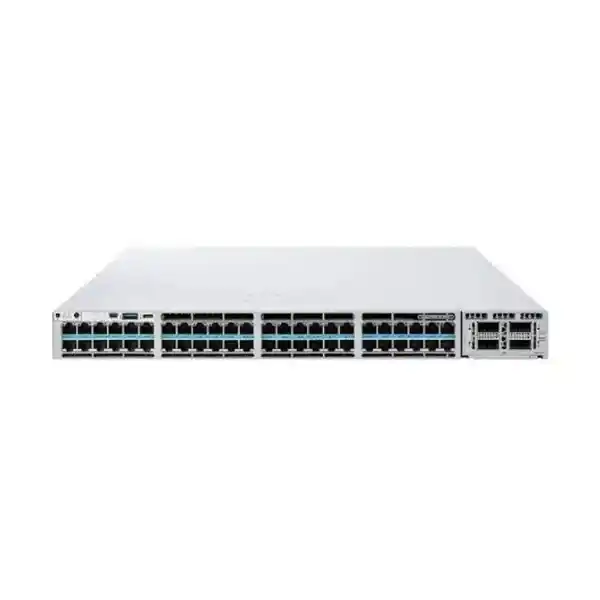
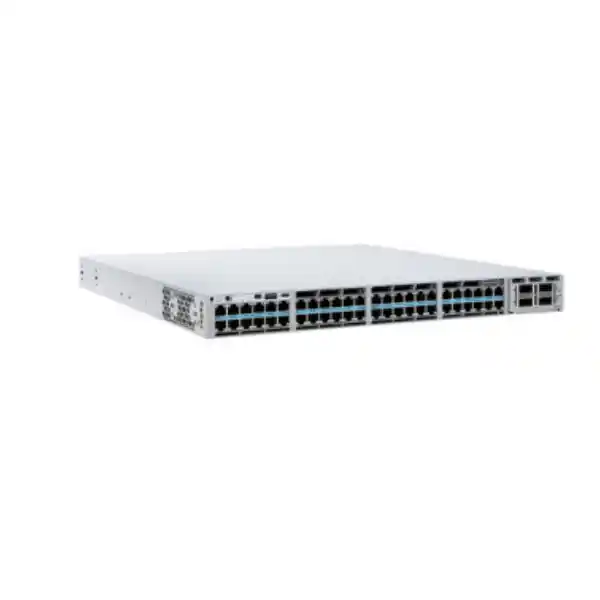
Cisco Catalyst C9300X-48HXN Network Switch
A high-density 48-port UPOE+ multigigabit access platform for organizations that need faster wireless backhaul, resilient stacking, modular high-speed uplinks and security capabilities built directly into the campus switching layer.
Direct answer: who should deploy the C9300X-48HXN?
The Cisco Catalyst C9300X-48HXN is designed for enterprise access-layer networks where standard 1 Gigabit Ethernet is no longer enough for every edge device and where power delivery, uplink headroom, operational consistency and security must be engineered as a single system. Its 48 copper UPOE+ access interfaces are divided into 40 multigigabit ports supporting 100 Mbps, 1 Gbps, 2.5 Gbps and 5 Gbps, and eight higher-rate multigigabit ports that additionally support 10 Gbps. That port mix is particularly valuable for organizations rolling out Wi-Fi 6, Wi-Fi 6E and other high-throughput wireless access points while also supporting cameras, phones, building controls, IoT gateways, thin clients, workstations and specialized edge appliances from the same access stack.
For UAE buyers, this model is especially relevant to new headquarters, hotels, hospitals, universities, government facilities, logistics campuses, retail estates, financial offices, production environments and smart-building projects that require a longer lifecycle than a basic Gigabit switch can comfortably provide. The platform combines multigigabit copper, Cisco UPOE+, modular 10/25/40/100G uplink options, StackWise-1T, StackPower+, Cisco IOS XE, hardware-assisted encryption and policy controls. The correct design is not simply a choice of one chassis; it includes power-supply sizing, redundant power strategy, uplink module selection, optics, transceivers, stacking cables, licensing tier, software subscription, rack cooling, endpoint power profiles and an acceptance test plan.
40 × up to 5G mGig
Forty access ports support 100M, 1G, 2.5G and 5G Ethernet, allowing existing copper infrastructure to deliver more bandwidth where cabling quality and distance permit.
8 × up to 10G mGig
Eight access ports add 10GBASE-T capability, useful for the highest-demand wireless APs, media stations, specialist workstations and local appliances.
Cisco UPOE+
All 48 access ports support Cisco UPOE+ capability, enabling high-power endpoints while preserving centralized power policy and access-layer operational control.
Modular uplinks
C9300X network modules let designers choose high-speed fiber or multigigabit uplinks instead of locking the access switch to one fixed uplink pattern.
C9300X-48HXN technical architecture in practical terms
The C9300X family is built around Cisco’s UADP 2.0sec switching architecture. In the C9300X-48HXN, the access ports map to a single ASIC/core design, which is important when interpreting the platform’s uplink behavior and performance. Cisco positions the UADP 2.0sec generation as a security-focused evolution of the Unified Access Data Plane, combining programmable packet processing with a dedicated hardware encryption engine. The result is an access switch that can perform traditional campus forwarding and policy functions while also supporting high-throughput cryptographic use cases that historically required a separate WAN or security appliance for every scenario.
Cisco documents the UADP 2.0sec architecture with 500 Gbps packet bandwidth/switching throughput at the ASIC level, forwarding performance up to 238 million packets per second for the architecture, 16 MB packet buffering, dedicated Flexible NetFlow resources and a 100G encryption engine for supported protocols such as IPsec. The practical benefit is less about a single headline number and more about having enough on-chip capability to support dense multigigabit access, high-speed uplinks, telemetry, segmentation and security services without treating the edge as a collection of simple unmanaged forwarding ports.
For design teams, the single-ASIC nature of the C9300X-48HXN also explains why uplink module utilization differs from some other C9300X chassis. Cisco’s hardware guidance should be checked against the exact IOS XE train and chosen network module. On supported current software, the C9300X-48HXN can use the C9300X-NM-2C with both 40/100G ports, while the C9300X-NM-8Y and C9300X-NM-8M have model-specific usable-port limits. This is a critical procurement detail: buying an eight-port module does not automatically mean all eight physical ports are active on this exact chassis.
Access-port design: 40 × 5G plus 8 × 10G multigigabit
The port map is one of the strongest reasons to select the C9300X-48HXN instead of a conventional 48-port PoE access switch. Forty RJ-45 access interfaces support 100 Mbps, 1 Gbps, 2.5 Gbps and 5 Gbps operation. Eight RJ-45 interfaces extend that range to 10 Gbps. This lets the same switch serve a mixed endpoint population without forcing every device onto a 10G-capable port and without limiting high-performance devices to 1 Gbps. A university floor, for example, might connect dozens of phones, cameras and room controllers at 1G while allocating 2.5G or 5G to wireless access points and reserving the 10G-capable group for the densest conference zones, high-end APs or specialist endpoints.
Multigigabit Ethernet is also a cabling-preservation technology. Many UAE buildings have substantial installed copper that is expensive to replace because of ceiling access, civil works, occupied office constraints, fire-stopping requirements or operational downtime. Where the installed cable category, termination quality and channel length meet the relevant Ethernet requirements, 2.5G and 5G provide a useful migration path beyond Gigabit without immediately converting the entire horizontal plant to fiber. The switch can auto-negotiate a rate supported by the endpoint and link conditions, which helps staged refresh projects where new Wi-Fi access points are deployed before all wiring closets or floors are renovated.
The eight 10GBASE-T capable ports should be treated as strategic capacity rather than as ordinary general-purpose access. An architect can assign them to AP clusters expected to aggregate high wireless traffic, local servers or appliances that genuinely need copper 10G, AV-over-IP endpoints with large flows, engineering workstations or temporary high-bandwidth devices. Because 10G copper imposes stricter channel and thermal considerations than lower rates, the project should validate cable category, patching, bundling and distance before assuming every legacy outlet can sustain 10G reliably.
UPOE+ and power-budget engineering
Cisco UPOE+ is central to the C9300X-48HXN value proposition. The platform can support high-power endpoints up to the 90W class on access ports, but switch-level power budgeting must still be engineered carefully. Cisco’s current hardware documentation lists a PoE budget of approximately 690W with the default 1100W AC power supply for this model. That number makes an important point: per-port capability and total available PoE budget are different. Forty-eight ports may each be capable of negotiating a high-power class, but the switch cannot necessarily deliver the maximum to every port simultaneously using a single default supply.
A professional bill of materials therefore starts with endpoint power rather than with port count. Build a worksheet containing every powered device, its IEEE or Cisco power class, typical draw, maximum negotiated draw, startup behavior and business criticality. High-power Wi-Fi access points, PTZ cameras with heaters or illuminators, digital signage, thin-client systems, access-control components, building gateways and compact computing devices can create very different power profiles. Add design margin for replacement endpoints, software-enabled radio features and future AP generations. Then determine whether the chosen supply combination, redundancy objective and StackPower+ design can satisfy the resulting load.
For mission-critical UAE environments, power planning should also include UPS runtime and branch-circuit capacity. A switch delivering hundreds of watts to endpoints transfers a meaningful electrical load into the telecom room. If the switch is connected to UPS power, the UPS must support not only the chassis but the downstream PoE load during an outage. Where a closet has two independent electrical feeds, redundant switch power supplies can be mapped to separate protected circuits. StackPower+ can improve resiliency and pool power resources across compatible designs, but it should be documented as part of the failure-domain plan rather than treated as a substitute for electrical engineering.
FourTeck can help UAE project teams translate an endpoint schedule into the switch, power-supply, StackPower and UPS requirements. For wider infrastructure integration, see FourTeck IT Services UAE for structured deployment and implementation support.
Modular uplink choices for the C9300X-48HXN
The C9300X-48HXN uses field-replaceable C9300X network modules rather than a permanently fixed uplink set. This is an architectural advantage when the access layer must evolve from 10G or 25G aggregation toward 40G or 100G connectivity. The most relevant options include C9300X-NM-2C for 40/100G QSFP-class uplinks, C9300X-NM-8Y for 1/10/25G SFP28-family connectivity and C9300X-NM-8M for multigigabit uplink interfaces. Cisco network modules are designed for online insertion and removal, which improves serviceability, but maintenance procedures, software support and redundancy should still be reviewed before changes are made in production.
The exact usable port count matters specifically on the C9300X-48HXN. Cisco’s current installation documentation states that, on IOS XE Cupertino 17.8.1 and later releases, ports 1 through 6 are usable on the C9300X-NM-8Y and C9300X-NM-8M when installed in the 48HXN; ports 7 and 8 are permanently disabled on this switch. For the C9300X-NM-2C, both 40/100G ports are usable, with model- and software-specific breakout behavior. This restriction should appear explicitly on quotations so customers do not purchase optics for physical module ports that the chassis cannot activate.
A common campus design uses two high-speed fiber uplinks from each access stack toward a pair of distribution or core switches. The link speed depends on oversubscription targets, expected east-west traffic, wireless growth, storage or media use, and the aggregation layer’s supported optics. Two 25G links may be sufficient for many access blocks, while 2 × 100G can be justified in very high-density campuses, collapsed-core designs or secure-edge use cases. The correct answer comes from a traffic model, not from selecting the highest available optic by default.
When requesting a quote, specify fiber type, connector type, distance, patch-panel topology, required redundancy, remote platform model and whether breakout is expected. These details determine the correct transceiver and cable selection and avoid a common project failure where switch ports are purchased correctly but the optics do not match the distribution platform or fiber plant.
StackWise-1T: treating multiple access switches as one resilient system
Cisco positions Catalyst 9300X modular-uplink switches with StackWise-1T, providing up to 1 Tbps of stacking architecture bandwidth. In an access design, stacking is valuable because it simplifies management, supports cross-member link aggregation, and creates a unified switching system from multiple physical units. Instead of connecting every switch independently to the distribution layer with separate spanning-tree and management behavior, a properly designed stack can present a more consolidated logical topology while still distributing ports and power across multiple chassis.
Stack design should be physical as well as logical. Use a closed-ring stack cabling pattern wherever supported and practical so a single stack-cable failure does not divide the system. Document member numbering, preferred active/standby roles, switch priorities, cable lengths and rack position. Keep stack links clear of sharp bends and cable stress. In taller racks, choose stack cable lengths that reach without excessive slack. During commissioning, verify the stack ring state and confirm that the expected StackWise bandwidth is available.
Mixed stacking requires additional discipline. Cisco supports combinations across certain Catalyst 9300 and 9300X models, but stack behavior can change to maintain compatibility. Cisco notes that StackWise-1T capable platforms operate at 480G when stacked with appropriate Catalyst 9300 models. A mixed stack can be useful for lifecycle transitions, yet new greenfield deployments generally benefit from homogeneous hardware because port maps, power behavior, software support and maintenance spares are easier to standardize. If mixed stacking is proposed, validate the exact hardware and software combination rather than assuming every 9300-family switch can be combined without restrictions.
For large UAE campuses, the operational benefit of standard stack templates can be substantial. A repeatable closet design might define six access switches, dual uplinks, standard VLAN/SDA policy, standardized power supplies, labeled stack cables and a preapproved spare strategy. That repeatability reduces commissioning variation and accelerates replacement during a fault.
Security architecture: IPsec, MACsec, TrustSec and encrypted traffic visibility
The C9300X generation extends the role of the campus switch beyond simple Layer 2 and Layer 3 forwarding. Cisco documents a dedicated 100G encryption engine in the UADP 2.0sec architecture and hardware-based IPsec on Catalyst 9300X. With appropriate software, licensing and configuration, this enables secure Layer 3 connectivity for use cases such as site-to-site transport, connectivity to cloud infrastructure, secure internet gateways, colocation environments and other encrypted edge designs. Cisco documents AES-256-based IPsec capabilities and up to 100G throughput for supported cryptographic modes on the platform architecture.
IPsec on a campus switch should not be interpreted as a universal firewall replacement. Encryption, stateful firewalling, application security, secure web gateway policy and advanced threat prevention are different functions. The correct architecture may still include dedicated firewalls or cloud-delivered security depending on threat model, compliance and segmentation requirements. For organizations in Dubai evaluating perimeter or segmentation security alongside the access layer, Firewall Dubai by FourTeck can be used as a complementary planning resource.
MACsec is another important capability. Cisco Catalyst 9300 Series supports AES-256 MACsec options, allowing link-layer encryption in supported topologies. This can protect sensitive Ethernet links where traffic crosses shared or less-trusted transport. TrustSec extends segmentation by classifying users and devices with Security Group Tags and applying role-based policy that is less dependent on topology than large ACL matrices. When integrated with identity services and campus policy, this creates a more scalable model for separating employees, contractors, building systems, IoT, cameras and operational technology.
Encrypted Traffic Analytics and Flexible NetFlow capabilities add visibility. Rather than decrypting every flow at the switch, telemetry can help security systems identify behavior and anomalies. Successful deployment depends on a complete architecture including telemetry collectors, identity, SIEM/SOC integrations, retention strategy and incident-response workflows. The switch supplies high-value context, but the operational process determines whether that context improves detection and response.
Cisco IOS XE and enterprise network services
Cisco IOS XE provides the software foundation for the Catalyst 9300X platform. For enterprise architects, the value lies in consistency across campus switching, a structured feature and release lifecycle, programmability interfaces, telemetry, routing features, QoS, multicast, security policy and automation integrations. Mature campus networks rely on far more than VLAN creation. They require standardized templates, deterministic routing behavior, endpoint authentication, high availability, change control, observability and a well-defined path for software upgrades.
The platform supports traditional campus deployment as well as Cisco Software-Defined Access architectures when used with the necessary components and licensing. In a conventional design, engineers can deploy access VLANs, routed uplinks, EtherChannel, first-hop security, 802.1X, MAB, DHCP snooping, Dynamic ARP Inspection, IP Source Guard, QoS, multicast controls and routing according to the selected license tier. In an SDA environment, the access switch participates in a policy-driven fabric where identity and segmentation are orchestrated through Cisco Catalyst Center and related identity services.
Automation can be implemented through controller-driven workflows or through IOS XE APIs and programmable interfaces. For organizations with NetDevOps practices, configuration data can be generated from source-of-truth systems and validated before deployment. Telemetry can feed observability platforms for trend analysis. This matters in multi-site UAE estates where manual device-by-device configuration creates drift and inconsistent security posture. The switch should be treated as an API-capable infrastructure component, even if the first deployment uses conventional CLI methods.
Software release selection should follow an enterprise standard. Avoid treating the newest available image as automatically suitable for production. Validate hardware support, feature dependencies, interoperability, known caveats and the organization’s preferred Cisco recommended release. Maintain rollback procedures, configuration backups and out-of-band recovery access before upgrades.
Licensing: Network Essentials, Network Advantage and subscription planning
Catalyst procurement includes both hardware and software entitlement decisions. Cisco commonly offers the C9300X family with Network Essentials or Network Advantage licensing, while ordering choices can also reflect cloud-management experiences and subscription requirements. The appropriate tier should be selected from the feature set the network will actually use, not from a generic rule that every enterprise must purchase the highest package. Routing scale, advanced segmentation, automation, assurance, policy and security features can depend on the chosen entitlement.
Cisco DNA or related subscription elements can enable controller-driven capabilities, assurance, ThousandEyes entitlements and additional operational features depending on the package and current Cisco program. Because Cisco software packaging changes over time, quotations should state the precise hardware PID, perpetual network license level, subscription term, management mode and renewal responsibility. Procurement teams should record the organization’s Cisco Smart Account and Virtual Account requirements before equipment is delivered so licenses can be assigned without delaying commissioning.
A useful design process starts with a feature matrix. List requirements such as routed access, BGP or advanced routing, SDA fabric roles, TrustSec policy, IPsec, application hosting, telemetry, assurance, ThousandEyes visibility, cloud management and automation. Map each to the current Cisco license requirement and software version. This prevents both under-licensing, which blocks planned functionality, and over-licensing, which creates unnecessary lifecycle cost.
Organizations with strict governance should also plan for renewal dates and software-support alignment. A switch may remain physically operational long after a subscription term, but the organization can lose management, visibility or entitlement capabilities that were part of the intended operating model. Treat licensing as part of network lifecycle management rather than as a one-time procurement accessory.
High-density Wi-Fi 6 and Wi-Fi 6E access design
Wireless uplink headroom
Modern access points can aggregate more than 1 Gbps under high client density, wide channels and multi-radio operation. The 2.5G, 5G and 10G access speeds on the C9300X-48HXN prevent the wired edge from becoming an artificial bottleneck when the wireless layer is upgraded.
AP power requirements
Higher-end APs may require more power than traditional PoE+ when all radios, USB functions or IoT features are enabled. UPOE+ provides substantial endpoint power capability, but total closet power must still be calculated from the AP schedule and redundancy target.
Aggregation bandwidth
Fast access ports only improve performance when uplinks and the distribution layer are sized accordingly. A dense floor with dozens of multigigabit APs can justify 25G, 40G or 100G uplinks depending on traffic profile, oversubscription and redundancy design.
Identity and segmentation
Wireless traffic often includes employees, guests, IoT and building systems. Campus access policy should map SSIDs and endpoint identity into a segmentation strategy using VLAN/VRF, ACL, TrustSec or SDA mechanisms rather than relying on wireless encryption alone.
In UAE hospitality and enterprise projects, Wi-Fi refreshes often expose weaknesses elsewhere in the infrastructure. New APs may negotiate at 2.5G or 5G while uplinks remain 10G, or power budgets may be exceeded after radio features are enabled. The C9300X-48HXN gives the access layer enough flexibility to avoid these obvious bottlenecks, but the complete wireless design still requires a predictive and preferably on-site RF assessment, AP placement, channel planning, power calculations, uplink modelling and authentication design.
Smart buildings, IoT and operational technology at the access edge
The access switch is increasingly the electrical and policy foundation for smart-building systems. Cameras, occupancy sensors, environmental controllers, badge readers, lighting gateways, room systems, digital signage and IoT edge devices can all converge onto Ethernet. A 48-port high-power multigigabit switch reduces the number of parallel network infrastructures required, but convergence increases the importance of segmentation and resilience. A failure in one wiring closet can affect not only office data users but also physical security and building operations.
Design these environments by service criticality. Identify life-safety systems that must remain on dedicated certified infrastructure, business-critical devices that require UPS-backed switching, and noncritical IoT that can tolerate short outages. Apply separate VLANs or scalable policy groups, restrict east-west communication, authenticate devices where possible, and monitor traffic baselines. Use PoE schedules and power telemetry to identify abnormal device behavior and to coordinate planned maintenance.
High-power PoE can also simplify remote device placement by eliminating local AC adapters, but cable temperature and bundle loading must be considered in dense pathways. UAE ambient conditions make telecom-room cooling especially important. Even when the room is inside an air-conditioned building, cooling failure can raise temperature quickly because switch electronics, optics, UPS systems and PoE conversion all generate heat. Temperature alarms should feed centralized monitoring, and facilities teams should understand that a network closet with hundreds of powered endpoints is a critical technical room, not a passive patching space.
A smart-building switching design should therefore connect IT, cybersecurity, facilities and physical-security teams before procurement. The C9300X-48HXN supplies the ports, power and policy capabilities, but governance determines whether converged infrastructure becomes easier to operate or merely concentrates risk.
Physical specifications and rack planning
The C9300X-48HXN is a 1RU-class rack switch. Cisco’s current installation guide lists dimensions of approximately 1.73 × 17.5 × 17.6 inches, or 4.4 × 44.5 × 44.7 cm, and a weight around 17.5 lb or 7.93 kg with the documented fan and default power-supply configuration. These dimensions make it suitable for standard enterprise racks, but depth planning should include front and rear cable bend radius, power cords, stacking cables, uplink optics, patch leads and service access.
Rack elevation should be designed before delivery. Position switches close enough to patch panels to keep copper patching orderly while retaining clear airflow. High-density 48-port access switches can become difficult to service when every front port is occupied and patch cords cross uplink or management connections. Horizontal and vertical cable managers, short correctly sized patch leads, color coding and permanent labels reduce troubleshooting time. Reserve space for a second power supply, StackPower cables and future uplink changes even if the initial build uses a minimal configuration.
Cooling is not optional. Confirm airflow direction, room HVAC capacity, rack door perforation and equipment placement. Do not place high-heat UPS units immediately where their exhaust raises switch inlet temperature. In dusty industrial locations, cabinet filtration and maintenance frequency may need adjustment. Dubai construction and fit-out projects should protect telecom equipment from dust until civil work is complete; fine gypsum and construction particles can shorten fan life and obstruct cooling.
Power outlets should be secured and labelled by circuit and UPS source. If dual supplies are installed for redundancy, connect them to separate protected sources where the electrical design supports it. Document the expected behavior for loss of one PSU, one circuit and the upstream UPS so facilities staff can test the system without creating an unplanned outage.
Traffic sizing and oversubscription methodology
A 48-port multigigabit switch can theoretically connect endpoints whose aggregate line rates far exceed a typical pair of uplinks. This is normal in access networks; not every endpoint transmits at maximum speed simultaneously. The engineering task is to choose an oversubscription ratio appropriate to application behavior and business risk. Office web traffic may burst briefly and remain low most of the day, while media production, backup, imaging, wireless client aggregation or local compute workflows can sustain much higher utilization.
Start with measured traffic if an existing network is available. Collect interface utilization, 95th percentile usage, peak bursts, application flows and seasonal events. For a new build, estimate per-user demand, AP aggregate capacity, surveillance bitrates, AV streams, local server traffic and cloud usage. Separate north-south flows that traverse the uplinks from local east-west traffic that remains within a VLAN or stack. Add growth for at least the expected refresh cycle, not merely the first year.
Then size uplinks. A pair of 25G links provides 50G aggregate raw capacity when both are active in a supported design. A pair of 100G links provides much greater headroom but may require more expensive optics and higher-capacity distribution interfaces. The right choice is determined by expected traffic, redundancy, cost and the aggregation platform. Consider whether one uplink must carry the entire load during failure; if so, steady-state utilization should leave enough margin that losing one path does not trigger congestion.
QoS remains necessary even with fast links. Voice, video, control traffic, backups and bulk data have different latency and loss requirements. Define classification and queueing consistently from the endpoint through access, distribution and WAN. More bandwidth reduces contention but does not replace an end-to-end policy when multiple traffic classes share the same infrastructure.
Layer 2 resilience and routed-access options
The C9300X-48HXN can operate in classic Layer 2 access designs, routed-access architectures or controller-driven fabric deployments depending on software and license requirements. A traditional Layer 2 design often extends user VLANs from access to distribution and relies on spanning tree plus first-hop redundancy at the distribution layer. This remains common and well understood, but it can create larger failure domains and more dependency on spanning-tree topology as networks grow.
Routed access moves Layer 3 boundaries closer to the edge and can reduce spanning-tree scope. Each access stack forms routed adjacencies to distribution switches, while endpoint VLAN gateways may reside locally depending on the design. This can improve convergence and make equal-cost paths easier to use, but it requires routing features, address planning, automation and operational capability. Not every network benefits from routed access, especially where legacy Layer 2 adjacency requirements remain.
Cisco Software-Defined Access takes a different approach by using a fabric to separate underlay transport from overlay endpoint policy. The C9300 family is a major platform in Cisco campus fabric designs. SDA can simplify identity-based segmentation across large estates, but it also introduces controller, identity-service and operational dependencies that must be architected properly. Organizations should evaluate operational maturity and lifecycle cost rather than selecting SDA solely because the switches support it.
Whichever model is chosen, document the failure behavior. Test loss of one distribution link, one stack member, one power feed and one routing neighbor. Verify that voice and critical applications recover within acceptable objectives. A design is only resilient when the failure mode has been demonstrated, not when redundancy is merely visible in a diagram.
Endpoint authentication and zero-trust access
Enterprise access switching is a primary enforcement point for identity. The C9300X platform can participate in 802.1X and MAC Authentication Bypass workflows, integrate with RADIUS identity systems, apply downloadable or local policy, and combine authentication state with VLAN, ACL or TrustSec assignments. This is essential when one physical switch serves users, printers, cameras, IoT sensors, access points and building controllers that require different permissions.
A mature zero-trust access project starts with endpoint classification. Build a device inventory, identify which endpoints support certificates or 802.1X supplicants, and define fallback methods for devices that do not. Avoid broad MAB policies that simply allow any known MAC address without further controls. Where possible, pair device identity with profiling, switch-port context, security-group policy and monitoring so a cloned or moved endpoint does not automatically receive inappropriate access.
Operational exceptions need the same attention as the ideal policy. Conference-room devices may be replaced by AV vendors, printers may be swapped after service calls, and building systems may have limited authentication support. Define onboarding and emergency procedures before enforcement is enabled. Otherwise, support teams may respond to access problems by creating permanent bypass rules that gradually weaken the security architecture.
The switch can also apply first-hop security mechanisms such as DHCP snooping, Dynamic ARP Inspection, IP source validation and control-plane protection where supported by the design. These features help contain common local network attacks and configuration errors. They should be deployed through tested templates because inconsistent trust-port configuration can disrupt legitimate DHCP or gateway traffic.
Application hosting, ThousandEyes and operational visibility
Catalyst 9300X adds application-hosting resources beyond the base Catalyst 9300 generation. Cisco highlights additional RAM, Intel QuickAssist Technology and 2 × 10G AppGig interfaces for supported application-hosting use cases. The concept is to place selected operational or security functions close to the network edge without installing a separate appliance in every wiring closet. Actual supported applications, resource requirements and software compatibility should be validated for the intended IOS XE release.
Cisco ThousandEyes Network and Application Synthetics can extend visibility from campus users toward SaaS, cloud, internet and data-center destinations when included through the appropriate subscription. This is valuable because many modern application complaints are not caused by the access switch itself. DNS, ISP routing, cloud provider paths, secure web gateways and remote application infrastructure can all affect experience. Edge-based synthetic testing provides a viewpoint inside the branch or campus that can help distinguish local problems from upstream conditions.
Traditional telemetry remains equally important. Export flow data where appropriate, monitor interface errors and discards, track power consumption, alert on temperature and fan status, record stack events, collect syslog centrally and synchronize time with resilient NTP sources. SNMP can still serve many monitoring systems, while streaming telemetry and APIs support more modern observability platforms. The goal is a baseline that allows operations teams to answer whether a condition is normal before users report an outage.
For service providers and enterprise IT teams, monitoring design should be part of commissioning. Define dashboards and alerts before handover, not after the first incident. Assign owners for switch hardware health, uplink utilization, authentication failures, PoE alarms and software lifecycle. A high-capability switch produces extensive telemetry; value appears only when someone is responsible for using it.
Campus use cases in Dubai and the wider UAE
In a corporate headquarters, the C9300X-48HXN can consolidate wireless APs, IP phones, meeting-room systems, user docking stations, cameras and smart-building devices into a standardized access block. High-power PoE and multigigabit rates let the organization deploy newer endpoints without replacing the switch during each technology refresh. Dual high-speed uplinks and stacking support resilient connectivity to a campus core.
Hotels and mixed-use developments can use the platform for dense guest Wi-Fi, IPTV or AV endpoints, IP telephony, surveillance and building systems. Here, power and segmentation design are especially important because multiple operational departments share the same physical infrastructure. Separate logical policy groups can prevent guest, staff, camera and facility traffic from mixing while maintaining a common switching platform for easier support.
Universities and schools benefit from multigigabit AP connectivity in lecture halls, libraries, labs and student areas. A stack can aggregate many high-density wireless zones while retaining consistent access control and telemetry. Education environments also face device diversity: managed laptops, student devices, lab instruments, printers, cameras and IoT. Identity-based access and strong monitoring are therefore as important as port speed.
Healthcare and financial environments may prioritize segmentation, encryption, deterministic change control and high availability. The C9300X platform’s security and telemetry capabilities can support these objectives, but compliance still depends on the overall architecture, operational procedures and audit controls. Switch features should be mapped explicitly to organizational policy rather than described generically as making a network compliant.
For broader UAE sourcing and project integration, visit FourTeck UAE for networking, security, communication and infrastructure solutions.
Optics, fiber and uplink compatibility checklist
The switch chassis and network module are only part of a high-speed uplink. Fiber type, transceiver wavelength, connector, reach and peer compatibility must all match. Multimode OM3, OM4 and OM5 fiber is common inside buildings, while single-mode OS2 is preferred for longer campus distances and offers a long lifecycle. The specific optic choice depends on distance, fiber availability, patching and whether the link is 10G, 25G, 40G or 100G.
Before ordering, record the exact model at both ends of every uplink, the selected network module, fiber strand count, patch-panel connector type and measured distance. If an existing structured cabling system is reused, inspect patch panels and clean fiber connectors. High-speed optical links are sensitive to contamination; a link may appear to work during installation yet develop errors when connectors are dirty or optical margin is low.
Breakout designs require extra attention. Cisco documents specific breakout support behavior for the C9300X-NM-2C on the C9300X-48HXN depending on software release and physical port. Do not assume a generic QSFP breakout cable will be supported in every port or IOS XE version. Match the intended breakout topology to Cisco’s current compatibility documentation and validate the receiving platform as well.
For production projects, list optics as individual line items with source and destination labels. Include spare optics for critical links, especially where the selected module is not locally stocked. A spare transceiver can reduce outage duration significantly compared with waiting for an international shipment after a failure.
Power redundancy, StackPower+ and failure-domain design
The C9300X-48HXN supports redundant power-supply design and StackPower+ architecture. Redundancy should be defined with explicit failure objectives. If one PSU fails, must every connected PoE endpoint remain powered? If one branch circuit fails, is there an independent second circuit? If one switch fails within a stack, can critical endpoints reconnect through a secondary physical path, or are they single-homed by design? These questions determine whether additional PSUs and power-pooling components create meaningful resilience or only additional hardware.
In a high-power closet, dual power supplies can provide both resiliency and additional PoE budget depending on the design. However, connecting both supplies to one UPS outlet strip protects against PSU failure but not against UPS or circuit failure. Critical deployments should map each supply to a separately protected feed where facilities architecture supports it. StackPower can pool available power among stack members and support power resiliency, but cable topology and power mode need to be documented and monitored.
Model degraded states as part of acceptance testing. Disconnect one power supply and verify that priority endpoints remain powered. Confirm that PoE policing or priority settings protect phones, critical APs and security devices before lower-priority loads if the available budget drops. Test alarms and ensure the NMS receives a clear event when a supply or StackPower path fails.
UPS runtime calculations must include downstream PoE consumption. A closet with 600W of active PoE plus switching and conversion losses may require a significantly larger UPS than one sized from chassis wattage alone. Facilities, network and security teams should agree on which services must survive generator transfer or extended utility interruptions.
Migration from 1G access switching
Many organizations evaluating the C9300X-48HXN are replacing older Catalyst 2960, 3650, 3850 or early 9300-generation deployments. A successful migration begins with discovery. Export current switch configurations, VLAN databases, spanning-tree state, port descriptions, authentication profiles, PoE consumption, interface utilization, EtherChannels, routing adjacencies and monitoring dependencies. Identify undocumented static IP devices and ports using nonstandard speed or duplex settings.
Create a port-mapping schedule that assigns each old interface to a new switch, port and policy template. This is particularly important because the 48HXN has a differentiated 40-plus-8 multigigabit port map. Allocate 10G-capable ports intentionally rather than simply copying port numbers from the legacy chassis. Reserve several high-rate ports for growth if the immediate project does not require all eight.
Validate cabling before assuming multigigabit performance. Existing Cat5e and Cat6 infrastructure can support different rates depending on channel conditions, but real installations may include poor terminations, excessive bundling, low-quality patch cords or undocumented extensions. Test critical AP outlets at the target speed. Remediate borderline links before cutover so wireless performance problems are not misdiagnosed as switch software issues.
During migration, stage the new switch with production-equivalent software, licensing, authentication and monitoring. Test one representative endpoint from each class—phone, AP, camera, printer, user device, IoT controller—before migrating a full floor. Keep console access and rollback plans available. After cutover, compare interface error counters, PoE draw, authentication logs and uplink utilization against the expected baseline.
A staged migration is usually safer than replacing an entire building overnight. Standardize a repeatable method for each closet, incorporate lessons from the first wave, and update documentation after every completed area.
UAE procurement considerations
Enterprise switching procurement in the UAE should confirm more than price and delivery. Request the complete Cisco part number including license suffix, power-supply configuration, power cords, fan modules, uplink network module, transceivers, stack cables, StackPower components, software subscription and support entitlement. Two quotations that both say “C9300X-48HXN” may represent materially different usable systems if one excludes uplinks, optics or required licenses.
Confirm warranty and support path. Organizations with strict SLA requirements may need Cisco support services with defined replacement and technical-assistance coverage. Record serial numbers and Smart Account information during acceptance. Verify that all accessories are genuine, correctly matched and recognized by the platform. For large projects, establish a golden configuration and hardware BOM so every closet is assembled identically unless a documented exception exists.
Lead time can vary for switches, network modules, power supplies and optics. Order critical accessories together and maintain installation spares. A spare switch without the correct uplink module or power supply may not restore service quickly. For multi-building campuses, consider storing a preconfigured cold spare with compatible software and licenses, plus common optics and cables.
FourTeck can support UAE sourcing, staging, installation and integration planning. For projects that span multiple regional operations, FourTeck Africa provides a related regional reference point for organizations standardizing infrastructure across UAE and African locations.
Commissioning and acceptance testing
A production-ready switch should pass a formal acceptance test before handover. Begin with hardware inventory: verify chassis PID, serial number, installed power supplies, fan status, uplink module, stack cables and transceivers. Confirm the expected IOS XE image and boot variables. Check that licensing is registered or otherwise in the intended operational state and that the switch is associated with the correct management account or controller.
For stacks, verify every member, ring state, role, priority and stack bandwidth. Reboot during staging to ensure member numbering remains stable. Test failure of one stack link if the change window permits. Confirm that cross-stack EtherChannels remain functional after a member or path failure. For dual distribution uplinks, test each link independently and verify routing or spanning-tree convergence.
Validate representative access ports at 1G, 2.5G, 5G and 10G where applicable. Confirm PoE negotiation for several endpoint classes, including the highest-power device. Check LLDP/CDP discovery, voice VLAN behavior, 802.1X/MAB authentication and DHCP services. Review interface counters for CRC, alignment, drops or excessive retries that may indicate cabling problems.
Test management services: SSH, TACACS+/RADIUS administrator authentication, NTP, DNS, syslog, SNMP or telemetry, configuration backup and controller reachability. Verify alerting for PSU or fan failure. Confirm that the monitoring platform shows accurate port, stack, temperature and power status. If flow telemetry is required, validate that collectors receive the expected records.
Finally, capture a baseline configuration, software version, license state and hardware inventory. Store diagrams and rack elevations with interface labels. Acceptance documentation should be usable by the operations team during an outage months later, not written only to close the installation project.
Performance tuning without creating unnecessary complexity
High-performance access networks benefit from disciplined defaults more than from aggressive tuning. Begin with correct physical speeds, sufficient uplink capacity, clean cabling and stable routing. Avoid changing queueing, buffer or low-level ASIC settings unless measurements show a real problem. The UADP architecture is designed to handle enterprise access workloads efficiently, and unnecessary deviations from validated Cisco defaults can make troubleshooting harder.
Use QoS where service requirements justify it. Trust markings only from controlled devices or remark them at the access edge. Reserve priority treatment for real-time traffic such as voice where appropriate, and avoid assigning excessive traffic to priority queues. Monitor drops during peak periods to determine whether congestion is transient, a result of microbursts or evidence that uplinks are undersized.
Tune spanning tree and routing deliberately. Configure the intended root placement in Layer 2 designs and use portfast/edge behavior only on true endpoint ports. Apply BPDU guard and related protections according to policy. In routed designs, tune routing timers only when convergence objectives require it and after testing scale and CPU impact. Consistency across access stacks is more valuable than isolated optimizations.
Measure after change. Collect before-and-after utilization, error, loss and latency data. A tuning change without evidence can mask the real issue. Treat configuration as code where possible: peer review templates, version changes and record rollback steps. This operational discipline is what allows advanced hardware to remain stable across hundreds or thousands of ports.
C9300X-48HXN versus standard Gigabit PoE switching
A conventional 48-port Gigabit PoE+ switch remains appropriate where endpoints are low-bandwidth and low-power, uplinks are modest and refresh cycles are short. The C9300X-48HXN is justified when the access layer must support multiple generations of faster endpoints and higher-power devices without immediate replacement. Its mix of 5G and 10G copper access, UPOE+, modular high-speed uplinks, advanced stacking and security features raises both capability and design responsibility.
The financial comparison should consider avoided cabling and refresh cost. If an organization can reuse suitable copper while migrating APs from 1G to 2.5G or 5G, the multigigabit premium can be offset by avoiding major recabling. If the switch remains in service across two wireless refresh cycles, 10G-capable access ports and 100G uplink options may extend useful life. Conversely, deploying this platform in a small branch where every endpoint is a basic phone or printer may be unnecessary.
Power is another differentiator. High-power UPOE+ enables devices that cannot operate at full capability from standard PoE+. But higher available power also increases UPS, cooling and electrical design requirements. Treat this as an infrastructure decision, not merely a switch feature. The right switch is the one whose bandwidth, power, security and lifecycle characteristics match the endpoint roadmap.
FourTeck can provide a comparison BOM that includes lower-cost Catalyst options where the 48HXN would be oversized. This avoids designing every site to the highest specification and supports tiered standards for headquarters, large branches, small branches and specialized high-density areas.
Security hardening baseline for deployment
A secure C9300X deployment should start with management-plane controls. Use centralized administrator authentication, role-based privilege, SSH rather than insecure legacy protocols, restricted management subnets and access control on management interfaces. Synchronize time securely enough for audit consistency, forward logs centrally, and protect configuration backups. Disable unused services and review Cisco security advisories as part of normal lifecycle operations.
At the access layer, disable unused ports or place them in a restricted state, apply endpoint authentication, enable suitable first-hop security, and restrict trunk negotiation. Explicitly configure trunk ports and permitted VLANs rather than relying on broad defaults. Protect spanning-tree edge ports with guard features. Where DHCP snooping or DAI is deployed, maintain a precise trust boundary so upstream infrastructure functions correctly.
For segmentation, avoid large flat VLANs that mix unrelated device classes. Use separate policy domains for corporate users, voice, wireless infrastructure, cameras, building systems, guests and operational technology. Enforce least-privilege communication between segments through ACLs, TrustSec, SDA policy or firewalls as appropriate. Encryption features such as MACsec and IPsec protect data in transit, but they do not replace segmentation or authorization.
Hardening should be validated after every major software upgrade because commands, defaults and feature interactions can change. Keep a tested baseline template for each approved IOS XE train. Security policy should be reproducible across the fleet rather than dependent on one engineer remembering a checklist.
Operations, spares and lifecycle management
Enterprise switch ownership extends far beyond installation day. Maintain an asset record containing serial number, location, rack unit, stack member, software version, license, power-supply PIDs, uplink module, optics and support contract. Tie the record to the organization’s configuration-management database or asset platform. Accurate inventory accelerates security response and support cases.
Define a software lifecycle with lab validation, maintenance windows, backup, prechecks, upgrade sequencing and rollback. For stacked access switches, choose an upgrade method that matches availability requirements and supported Cisco capabilities. Monitor release advisories and security notices. Avoid letting each closet drift to a different image because ad hoc upgrades make troubleshooting and automation more difficult.
Hold spares based on business impact and lead time. A large campus may justify one preconfigured C9300X-48HXN spare per site or region, while smaller estates may hold one centralized spare plus common PSUs, fans, stack cables and optics. Verify that the spare has compatible licensing and software. Periodically power on and test long-stored spares so failures are discovered before an emergency.
Monitor environmental trends. Rising inlet temperature, fan speed or power draw can indicate cooling degradation or increasing PoE load. Capacity planning should track the number of ports moving from 1G to 2.5G/5G and the growth of uplink utilization. Use these trends to plan upgrades before congestion or power exhaustion becomes a user-facing incident.
For organizations that operate outside the UAE as well, FourTeck Global provides a broader point of contact for multi-country technology requirements while maintaining local UAE implementation coordination.
Recommended design patterns
High-density office floor
Use a two-to-six member stack, allocate 5G/10G access ports to wireless APs, retain 1G for standard endpoints, deploy dual fiber uplinks to redundant distribution and size PoE for AP plus collaboration loads with N+1 power where required.
Smart-building closet
Segment cameras, access control, lighting and IoT from corporate users. Prioritize critical PoE loads, provide UPS-backed power, monitor temperature and power, and use redundant uplinks so a single fiber fault does not isolate building services.
Wireless-first campus
Reserve multigigabit access capacity primarily for APs, model aggregate traffic by radio density, use 25G/40G/100G uplinks according to oversubscription targets, and integrate authentication, QoS and telemetry with the wireless architecture.
Secure edge / branch aggregation
Use hardware IPsec capabilities only after validating software, license and cryptographic requirements. Maintain firewall and secure-web-gateway functions where policy requires them, and test encrypted throughput with realistic traffic rather than relying solely on headline values.
Common design mistakes to avoid
Assuming every access port is identical. The C9300X-48HXN has 40 ports up to 5G and eight ports up to 10G. Create a deliberate port allocation plan, especially for APs and high-performance endpoints.
Confusing per-port UPOE+ capability with total PoE budget. A port may support a high power class while the chassis-level available budget remains finite. Calculate total maximum endpoint demand and failure-mode demand before selecting power supplies.
Buying an eight-port network module and expecting eight usable uplinks. The C9300X-48HXN has model-specific port limitations on C9300X-NM-8Y and C9300X-NM-8M. Check current IOS XE support and usable-port tables.
Ignoring the peer device. A 100G uplink module provides no benefit if the distribution switch, optic, fiber path or licensing cannot support the selected link mode. Design the connection end to end.
Undersizing UPS capacity. Include downstream PoE draw, not just switch chassis consumption. High-power AP and IoT estates can dominate the electrical load in a closet.
Skipping cabling validation. Multigigabit links can expose marginal terminations that worked at 1G. Test representative channels at target rates before large-scale migration.
Treating advanced security features as automatic protection. IPsec, MACsec, TrustSec and telemetry require architecture, licensing, configuration and operational monitoring. Features only deliver value when integrated into policy and processes.
Model specification summary
Specifications and software behavior should be validated against the Cisco documentation applicable to the quoted PID, IOS XE release, selected license and network module before final procurement.
Frequently asked technical questions
Does the C9300X-48HXN provide 10G on all 48 access ports?
No. Cisco documents 40 access ports supporting up to 5G and eight access ports supporting up to 10G. All are multigigabit copper interfaces, but only the designated eight add the 10G rate. Port allocation should therefore reserve those interfaces for endpoints that need 10G.
Can every port deliver 90W at the same time?
The access ports support the UPOE+ high-power class, but total simultaneous delivery depends on chassis power budget and installed power supplies. Cisco documents a roughly 690W PoE budget with the default 1100W supply. Add up maximum endpoint power and choose the PSU architecture accordingly.
Can the switch uplink at 100G?
Yes, with the supported C9300X network module such as C9300X-NM-2C and compatible optics/cabling. The peer device must also support the selected link speed and transceiver. Validate IOS XE and breakout requirements for the exact topology.
Is the C9300X-48HXN stackable?
Yes. It supports Cisco StackWise-1T architecture and StackPower+. Proper stack-ring cabling, member priorities, power design and software compatibility should be included in staging.
Is this a suitable switch for Wi-Fi 6E?
Yes. Cisco specifically positions the model for secure Wi-Fi 6/6E high-speed access and beyond. Its multigigabit access and UPOE+ capabilities align well with high-performance AP requirements, but actual AP speed and power depend on the selected wireless model.
Does it replace a firewall?
Not automatically. Hardware IPsec and security capabilities extend what the switch can do, but perimeter firewalling, secure web access, application inspection, threat prevention and regulatory controls may still require dedicated security platforms. Architect functions according to the security policy.
Why source the C9300X-48HXN through a solution-led supplier?
The cost of an enterprise switch project is influenced by design errors more than by small differences in unit price. Incorrect uplink modules, incompatible optics, insufficient PoE budget, missing licenses or undersized UPS systems can delay a deployment and create change orders. A solution-led quotation should therefore include the complete operating system around the chassis.
FourTeck can scope access port requirements, power loads, stacking, uplink architecture and integration with existing distribution or core switching. For refresh projects, this includes reviewing the current switch inventory and mapping existing VLAN, routing and authentication requirements. For greenfield projects, the design can be aligned with the wireless, voice, surveillance, security and server infrastructure from the beginning.
Staging can reduce risk further. Equipment can be inventoried, updated to an approved software image, assembled into stacks, labeled and loaded with base configuration before site installation. This shortens on-site work and creates a known starting point for acceptance testing. Large projects can use a golden template so each access closet is consistent.
The objective is not merely to deliver hardware; it is to deliver a switch configuration that matches the building, applications and operational model. That is particularly important for the C9300X-48HXN because its value depends on using multigigabit access, high-power PoE, modular uplinks and advanced software capabilities correctly.
Decision recap: when the C9300X-48HXN is the right choice
Choose it when
Your access layer needs a dense mix of 2.5G, 5G and selected 10G copper, high-power PoE, modular high-speed uplinks, stack-based resiliency, Cisco IOS XE enterprise services and a lifecycle that can support future wireless and smart-building growth.
Reconsider when
The site is a small branch with basic 1G endpoints, minimal PoE, fixed low-speed uplinks and no requirement for advanced segmentation, stacking or security. A lower-tier Catalyst platform may provide better economics without sacrificing required functionality.
Engineer before ordering
Endpoint power, 10G port allocation, uplink module, optics, stack size, StackPower, redundant PSUs, UPS capacity, licensing, IOS XE release, management platform, rack cooling, cabling condition and support contract.
Validate before handover
Hardware inventory, stack ring, power failure behavior, mGig negotiation, PoE classes, uplink failover, authentication, routing, telemetry, alerting, software state, license assignment and configuration backup.
Quotation input checklist
Provide the following information with your RFQ so FourTeck can build a complete and correctly sized C9300X-48HXN solution rather than quoting a bare chassis that still requires design decisions.
Plan your Cisco Catalyst C9300X-48HXN deployment with FourTeck UAE
Send your switch quantity, endpoint list, PoE requirements, existing core/distribution model, uplink distance, preferred redundancy and software-management requirements. FourTeck can prepare a solution-oriented bill of materials covering the chassis, power, stack, network module, optics, licensing and implementation scope.
For Dubai and UAE projects, the design can also be coordinated with wireless, firewall, server, telephony and structured IT infrastructure so the access switch is sized as part of the whole environment rather than in isolation.

Reviews
There are no reviews yet.