
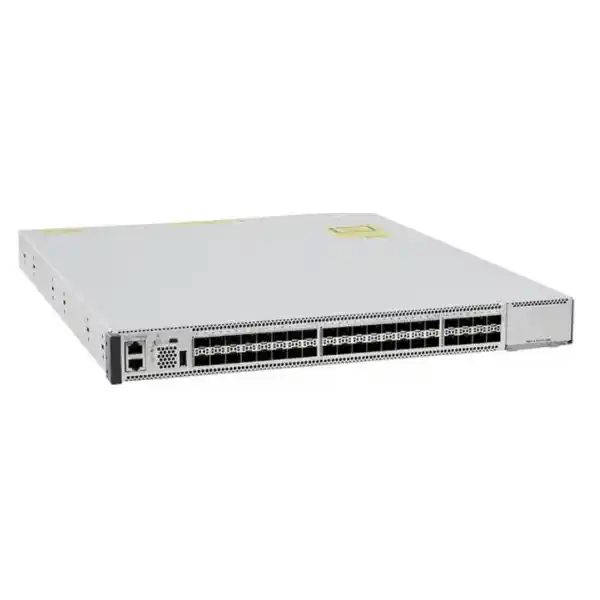
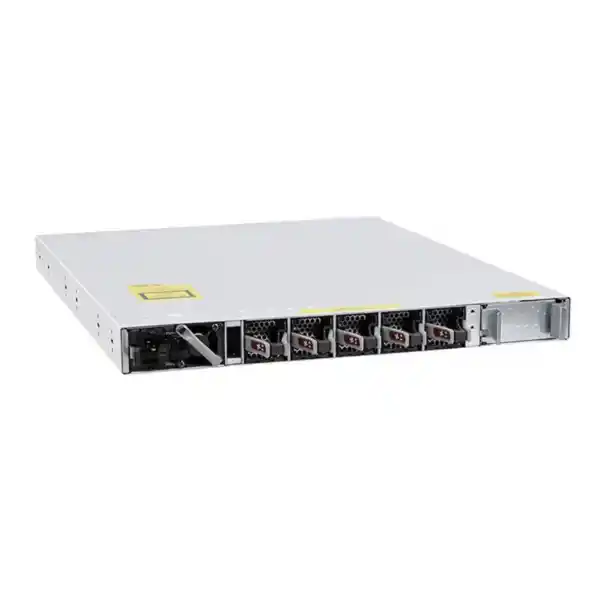
Cisco Catalyst C9500-40X Network Switch in UAE
The Cisco Catalyst C9500-40X is a fixed enterprise core and distribution platform engineered around forty 1/10 Gigabit Ethernet SFP/SFP+ ports, optional modular uplinks, Cisco IOS XE and a programmable UADP 2.0 XL forwarding architecture. For organizations in Dubai and across the UAE, the model is especially relevant when a design needs dense 10GbE fiber aggregation, mature routing, policy enforcement, high-availability options and operational continuity without moving immediately to a higher-speed 25/100GbE core.
FourTeck supports the complete lifecycle: bill-of-material validation, optics selection, power and airflow planning, software and licensing alignment, staging, configuration, migration, StackWise Virtual design, routing integration, security policy implementation, monitoring and post-deployment support.
Best fit: enterprise campus core, distribution, routed aggregation and 10GbE fiber concentration where forty native SFP/SFP+ ports are the right density. Uplink choice: add eight 1/10GbE ports with C9500-NM-8X or two 40GbE QSFP+ ports with C9500-NM-2Q. Platform: Cisco IOS XE on dual UADP 2.0 XL ASICs.
C9500-40X at a glance: what the platform actually delivers
The most important characteristic of the C9500-40X is not simply that it belongs to the Catalyst 9500 family; it is the specific combination of port density and forwarding architecture. The chassis presents forty native 1/10GbE SFP/SFP+ interfaces. Those ports can be used for fiber-based distribution links, access-switch uplinks, server or appliance connections, routed point-to-point links, Layer 2 trunks, port-channels or a mix of these roles. A dedicated network-module bay allows the design to be extended with either the C9500-NM-8X, providing eight additional 1/10GbE SFP/SFP+ interfaces, or the C9500-NM-2Q, providing two 40GbE QSFP+ interfaces. This creates practical options for organizations that need a 10GbE-dense core today but still require higher-bandwidth northbound connections or additional aggregation capacity.
| Design item | C9500-40X detail | Why it matters in a UAE deployment |
|---|---|---|
| Native interfaces | 40 × 1/10GbE SFP/SFP+ | High 10GbE fiber density for campus aggregation, server links and routed distribution. |
| Optional module | C9500-NM-8X: 8 × 1/10GbE SFP/SFP+ | Useful when additional 10GbE density is more valuable than 40GbE uplinks. |
| Alternative module | C9500-NM-2Q: 2 × 40GbE QSFP+ | Creates higher-bandwidth uplinks toward a core pair, data center edge or backbone. |
| Forwarding silicon | Dual Cisco UADP 2.0 XL ASIC architecture | Hardware forwarding is designed for enterprise routing, switching, policy and telemetry functions. |
| Operating system | Cisco IOS XE | Supports mature CLI operations plus APIs, automation and model-driven management capabilities. |
| Memory class | 16 GB DRAM and 16 GB flash for UADP 2.0 Catalyst 9500 class | Supports the control-plane, image management and enterprise feature set associated with the platform. |
| High availability | Dual power-supply capability and StackWise Virtual support | Helps eliminate single-switch and single-PSU dependency in critical aggregation designs. |
Where the C9500-40X fits in modern enterprise network architecture
The C9500-40X is best understood as a fixed core and distribution switch for networks that are still heavily standardized on 1GbE and 10GbE optical connectivity. Many enterprise environments do not need every core port to operate at 25GbE, 40GbE or 100GbE. Instead, they require a large number of resilient 10GbE links from access-layer stacks, wireless aggregation blocks, security appliances, server zones, building distribution frames or branch concentration points. Forty native SFP/SFP+ interfaces provide a useful balance because the chassis can consolidate many independent fiber paths without introducing a modular chassis, while the optional network module can be selected according to the uplink strategy.
In a traditional three-tier campus, the switch can sit at the distribution layer, receiving dual 10GbE uplinks from multiple access switches and routing toward a separate core. In a collapsed-core campus, a resilient pair of C9500-40X switches can combine distribution and core responsibilities, terminating VLAN gateways, running dynamic routing, applying policy and presenting northbound links toward firewalls, WAN routers or data-center switching. In a fiber-heavy industrial, education, hospitality, healthcare or government environment, the high SFP+ count can also be valuable because physical distance, electromagnetic conditions or structured-cabling standards may favor optical connectivity over copper.
The design decision should therefore begin with traffic topology rather than with model hierarchy. If the network has dozens of 10GbE links and only modest requirements for 25/100GbE, the C9500-40X can be a very efficient aggregation point. If the organization expects a near-term transition to 25GbE server connectivity, 100GbE spine links or substantially larger routing and buffering scale, a newer high-performance Catalyst 9500 or Catalyst 9500X model may be a better long-term target. FourTeck designs around the actual traffic matrix, port-speed roadmap and resiliency objective so the selected model fits the expected service life rather than just the present-day port count.
UADP 2.0 XL architecture: why the forwarding silicon matters
The C9500-40X uses two Cisco UADP 2.0 XL application-specific integrated circuits. UADP, the Unified Access Data Plane, is Cisco’s programmable enterprise switching architecture. The architectural value is that switching, routing, access control, quality of service, telemetry and other packet-processing functions are implemented in hardware rather than being handled as software-only tasks by the general-purpose CPU. The UADP 2.0 XL generation is a dual-core 28-nanometer design with approximately 240 Gbps of packet bandwidth per ASIC, so a two-ASIC C9500-40X design is aligned with an aggregate switching class around 480 Gbps. This architecture is particularly appropriate for a 40-port 10GbE platform because traffic can be forwarded at high speed while preserving the policy and observability features expected from an enterprise campus core.
The practical benefit of programmable silicon is feature integration. A core switch is rarely asked to perform only simple Layer 2 forwarding. It may need to terminate hundreds of VLANs, maintain ARP and neighbor information, route IPv4 and IPv6 traffic, enforce access-control entries, classify traffic into QoS classes, export flow records, maintain multicast state, support tunneling or security-tag functions, and continue processing packets at deterministic latency. UADP provides dedicated hardware tables and pipelines for these functions. Cisco also uses Software Database Manager templates to change how hardware resources are allocated, allowing the administrator to optimize table space toward distribution, core, NAT-oriented or other deployment needs depending on software release and supported template options.
For the C9500-40X class, this makes sizing important. Published platform scale values are maximums under defined templates and software conditions, not a promise that every maximum can be reached simultaneously. A design that needs a very large MAC table, a large number of host routes, extensive ACL policy and high NetFlow scale should be reviewed as a combined resource requirement. FourTeck treats those resources as a shared design budget. Before migration, route counts, ARP and IPv6 neighbor counts, active VLANs, multicast groups, ACL entry counts and telemetry requirements can be collected from the existing environment and compared with the proposed hardware template. This avoids the common mistake of validating only port speed while ignoring forwarding-table scale.
Forty 1/10GbE SFP/SFP+ ports: building the physical port map correctly
A production C9500-40X deployment should start with a port map that is more detailed than a simple list of connected devices. Each of the forty native interfaces can support 1GbE or 10GbE operation with supported SFP or SFP+ optics, which makes the switch highly flexible for mixed-generation fiber estates. In an upgrade project, some legacy access switches may still present 1GbE fiber uplinks while newer access stacks operate at 10GbE. The same aggregation platform can accommodate both, allowing the migration to be phased building by building instead of requiring every downstream device to change simultaneously.
Port planning should document interface number, local role, remote device, remote interface, link speed, optic type, fiber type, fiber count, patch-panel route, VLAN or routed-interface role, channel-group membership, routing adjacency, expected traffic and resiliency partner. The objective is to create a deterministic mapping that can be staged before the maintenance window. For dual-homed access switches or firewall clusters, the plan should also show which C9500-40X peer terminates each path and whether the connection is a conventional independent link, Layer 3 routed link, cross-stack EtherChannel or multichassis EtherChannel over StackWise Virtual.
Fiber compatibility deserves special attention. SFP/SFP+ ports do not imply that any transceiver can be inserted without qualification. The selected optic must match the required Ethernet rate, wavelength, reach, fiber type and connector standard, and it must be supported for the relevant switch software release. Short-range multimode, long-range single-mode, extended-reach and direct-attach options solve different problems. The existing cabling plant should be audited for OM3, OM4, OS2 or other fiber characteristics, and patch leads should be checked for polarity, cleanliness and connector quality. A switch migration that overlooks optical budget or cabling condition can produce intermittent errors that are harder to diagnose than a complete link failure.
Choosing between C9500-NM-8X and C9500-NM-2Q uplink modules
C9500-NM-8X: maximize 1/10GbE density
The eight-port network module extends the chassis with eight additional SFP/SFP+ interfaces. It is attractive when the design needs more independent 10GbE connections: additional access-layer stacks, server links, service appliances, routed interconnects, firewall interfaces or cross-campus fiber circuits. A C9500-40X populated this way can act as a very dense 10GbE aggregation node. When counting capacity, however, the designer should still evaluate the ASIC path and expected traffic profile instead of assuming that every port will sustain simultaneous maximum utilization without considering oversubscription and internal architecture.
C9500-NM-2Q: create 40GbE uplinks
The two-port QSFP+ network module is useful when the native 10GbE interfaces are primarily southbound and the switch needs higher-speed northbound links. Two 40GbE ports can be used for resilient backbone connections, a high-bandwidth port-channel, inter-switch connectivity or other supported topologies. This can reduce uplink oversubscription compared with multiple 10GbE links and can simplify the transition between a 10GbE distribution domain and a faster core. The optical and cabling plan must be built around supported QSFP+ modules and the desired reach.
The module decision should be made during architecture design, not treated as an afterthought during procurement. FourTeck normally models the number of downstream links, aggregate busy-hour traffic, failure-state traffic, future growth and required northbound bandwidth. If each access block is dual-connected and the network must continue operating during one uplink or one chassis failure, the failure-state load becomes the critical number. An uplink design that is comfortable in normal operation can become oversubscribed when all traffic is forced through the surviving path. The selected module should therefore support both today’s normal load and the expected degraded-mode load.
Layer 3 routing for campus core and distribution roles
A Catalyst 9500 deployment gains much of its value when Layer 3 boundaries are deliberately designed. Instead of extending large Layer 2 domains across the campus, the C9500-40X can terminate SVIs and routed links, contain failure domains and use dynamic routing to select resilient paths. Common enterprise designs use OSPF for internal routing, BGP for policy-oriented route exchange or external connectivity, and static routes for tightly controlled simple paths. The exact feature set depends on the installed Cisco network license and IOS XE release, so the bill of materials should identify not only the base switch PID but also the intended license level and subscription entitlement where applicable.
For a collapsed-core pair, each access block can be connected using Layer 2 port-channels toward a StackWise Virtual pair or, in a routed-access architecture, by independent Layer 3 links. Routed access can improve convergence behavior and reduce spanning-tree dependency, but it requires an addressing plan and a clear method for gateway placement and policy. Traditional distribution designs may keep user gateways on the C9500 pair while routing from the distribution block toward a dedicated core. Both approaches are valid; the better design is the one that matches the organization’s operational skill, redundancy target, segmentation requirements and migration constraints.
Routing scale should be assessed using realistic prefix and adjacency numbers. The UADP 2.0 Catalyst 9500 group supports configurable SDM templates. In the distribution template, published values for the C9500-40X class include up to 64,000 IPv4 longest-prefix-match entries, 32,000 IPv6 LPM entries, 48,000 IPv4 host routes and 24,000 IPv6 host routes, along with large NetFlow and ACL resources. Those values change by template, and actual usable combinations depend on prefix characteristics and shared hardware allocation. In practical campus networks the numbers are often more than sufficient, but a switch used as an Internet-edge route collector or extremely large data-center router should be evaluated against the specific routing table rather than assumed suitable merely because it supports BGP.
High availability with redundant power and StackWise Virtual
Core and distribution switching must be designed around failure, not around the assumption that hardware remains healthy forever. The Catalyst 9500 family supports dual power supplies, and two C9500 switches can be deployed using Cisco StackWise Virtual technology to operate as a highly available logical switching system. In a properly designed pair, downstream devices can build multichassis EtherChannels across both physical switches. This reduces dependence on spanning tree for active/standby link selection and allows both chassis to forward traffic while preserving resilience if one member, one path or one power source fails.
A resilient design includes more than buying two switches. Each chassis should receive independent power feeds where the facility supports them, ideally from separate UPS or PDU paths. Power supplies should be mapped to those independent feeds so a single electrical failure does not remove both PSUs simultaneously. Fiber paths should be physically diverse where practical. Access switches should be dual-homed in a way that prevents both uplinks from sharing the same patch panel, riser or conduit if the business requires infrastructure-level resilience. The StackWise Virtual link and dual-active detection design should also follow Cisco’s supported topology and bandwidth guidance for the selected release.
Operationally, high availability must be tested. During commissioning, FourTeck can validate single-uplink failure, member reload, PSU removal simulation where permitted, routing-neighbor loss, port-channel member loss and restoration. Application impact should be measured rather than inferred. The final handover can include expected convergence behavior, maintenance procedure, software-upgrade approach and rollback steps. This matters in UAE enterprises with 24×7 operations, where a nominally redundant network may still contain hidden single points of failure in power, optics, upstream firewalls, routing policy or physical fiber paths.
Segmentation, TrustSec, ACL policy and MACsec considerations
Enterprise core switches are security enforcement points as well as forwarding devices. The C9500 platform supports hardware-based access control, segmentation functions and Cisco security capabilities that can be integrated into a broader campus architecture. Traditional ACLs can filter traffic by protocol, source, destination and port. Policy-based routing can steer selected flows toward inspection or service nodes. Cisco TrustSec capabilities can help represent user or device groups with security group tags in supported designs, separating identity-oriented policy from a purely subnet-oriented model. MACsec capabilities can encrypt Ethernet links where supported optics, interfaces, topology, license and IOS XE release align with the required deployment.
The C9500-40X class uses hardware tables for security ACL entries. Cisco’s published standard template values list up to 18,000 security ACL resources for the C9500-40X/16X/12Q/24Q group, with allocation behavior depending on IPv4, IPv6, ingress, egress and the exact policy structure. This is why policy sizing cannot be reduced to a raw line count in a configuration file. Object expansion, address families, direction and interface placement affect the number of hardware entries consumed. During a migration from older Catalyst platforms, large ACLs should be analyzed and tested in a lab or staging environment rather than copied without resource validation.
Security architecture should also preserve a clean division of responsibility between switch policy and firewall inspection. The campus core can efficiently enforce segmentation boundaries, route controls and infrastructure ACLs, while next-generation firewalls handle threat inspection, application policy, VPN and Internet security. FourTeck’s Firewall Dubai solutions can be integrated with the switching design so routed interfaces, VLANs, port-channels, high-availability links and security zones are engineered as one system rather than as disconnected projects.
QoS engineering for voice, video, wireless and business-critical applications
Quality of service becomes most important when a network is experiencing congestion or when business applications have different tolerance for delay, jitter and packet loss. A C9500-40X at the distribution or core layer may carry unified communications, video conferencing, virtual desktop traffic, wireless client traffic, backups, file transfers, SaaS access, application replication and Internet flows simultaneously. Without a documented QoS policy, bursts from high-throughput applications can compete with real-time traffic at a congested egress interface. The switch’s UADP architecture provides hardware classification, marking, policing and queuing capabilities that can be used to implement a consistent enterprise policy.
The correct design begins with a traffic taxonomy. Voice bearer, voice signaling, interactive video, network-control protocols, critical transactional applications, default user data, scavenger traffic and bulk backup flows should be identified by DSCP markings or classification rules. The campus should then define trust boundaries so endpoints cannot arbitrarily claim priority. Access switches typically perform initial classification and marking, while the C9500 core preserves or enforces those markings and applies queue policies at congestion points. Policing can prevent one class from consuming more bandwidth than intended, but aggressive policing can also create application problems if configured without traffic baselines.
For UAE organizations consolidating voice, video, Wi-Fi 6/6E aggregation and data services, QoS should be validated under failure conditions. When a 40GbE or 10GbE uplink fails, traffic may be redirected to a surviving link with less aggregate capacity. That is exactly when queue behavior matters. FourTeck can build test traffic, inspect queue counters, validate DSCP preservation and confirm that high-priority applications remain stable during link failure. This turns QoS from a configuration template into a measured service objective.
Flexible NetFlow, telemetry and operational visibility
High-performance switching is only useful when the operations team can understand what the network is doing. Cisco IOS XE on Catalyst 9500 supports a broad observability model that can include SNMP, syslog, streaming telemetry, model-driven interfaces and Flexible NetFlow depending on software configuration and licensing. Flexible NetFlow is particularly valuable at aggregation points because it summarizes who is communicating, which protocols are being used, where traffic enters and leaves, and how much data is moving. The C9500-40X class has substantial hardware NetFlow resources, but record structure, monitor placement and sampling strategy should still be designed carefully.
Telemetry should answer operational questions. Which access block is creating the largest burst? Which subnet suddenly increased Internet usage? Are backups crossing an unexpected path? Did a routing change move traffic from the primary to the secondary core? Are interface errors rising on one optic? Is a QoS queue dropping packets? Does an application rely on a legacy VLAN that the migration team intended to retire? A central monitoring platform can combine interface counters, routing state, environmental alarms, syslog and flow telemetry to produce those answers before a user ticket becomes the first indication of a problem.
FourTeck can integrate C9500 monitoring with existing enterprise tooling and can also help organizations modernize operational workflows through its IT Services UAE practice. The objective is not to collect every possible metric. It is to collect the right signals, define thresholds, preserve time-series history and establish escalation procedures. For core switching, useful alerts typically include uplink state changes, port-channel member loss, routing adjacency transitions, high CPU, memory pressure, temperature, fan status, power-supply status, optical receive levels where available, CRC or input errors, interface utilization, NetFlow anomalies and repeated authentication or security events.
Cisco IOS XE operations, automation and change control
Cisco IOS XE combines familiar IOS-style network configuration with a modern Linux-based software architecture and model-driven management. For network teams that already operate Catalyst environments, the C9500-40X preserves a recognizable CLI while enabling automation through NETCONF, RESTCONF, YANG models and other programmable interfaces supported by the installed release. This can reduce configuration drift and make large-scale change more repeatable, especially when the same policy must be applied across core, distribution and access devices.
Automation should begin with source-controlled configuration standards rather than with ad-hoc scripts. Interface descriptions, NTP, DNS, AAA, TACACS+, syslog, SNMP or telemetry, routing policy, QoS, VLAN naming, port-channel conventions and management-plane ACLs can all be represented as reusable templates. Pre-change validation can confirm that the intended ports exist, that the peer device is expected, that required VLANs are present, and that routing neighbor counts match the baseline. Post-change validation can verify interface state, packet loss, routing convergence and critical service reachability. This approach is particularly useful when multiple branches, campuses or data rooms across the UAE need to follow the same operating standard.
Software lifecycle management is equally important. A production switch should not be upgraded solely because a newer image exists; the target release should be selected based on Cisco guidance, security advisories, feature requirements, known caveats, hardware support and interoperability with the rest of the estate. The C9500-40X continues to appear in current Cisco IOS XE 17.18 release documentation, but individual feature behavior still changes across releases. FourTeck therefore treats software selection as part of the design and change-control process. Images, ROMMON dependencies, configuration compatibility and rollback procedures are reviewed before the maintenance window.
Licensing: Network Essentials, Network Advantage and subscription alignment
The C9500-40X has historically been available in Network Essentials and Network Advantage variants, reflected in product identifiers such as C9500-40X-E and C9500-40X-A. The correct entitlement depends on the routing, segmentation, high-availability and advanced feature requirements of the deployment. Cisco licensing and subscription packaging has evolved across the Catalyst 9000 lifecycle, so procurement should not assume that an older bill of materials can be copied unchanged into a new order or renewal. A clean quotation identifies the exact hardware PID, network license level, any required Cisco subscription term, support entitlement and software requirements.
Feature mapping should be done from requirements backward. If the organization needs only standard campus switching and routing, a different license level may be sufficient than a deployment that requires advanced routing, virtualization, policy or automation functions. Some capabilities also depend on both the perpetual network tier and a subscription component. Licensing should be verified for the intended IOS XE release, not inferred from a configuration built on another platform. This is especially important for organizations subject to audit, where the operational configuration and purchased entitlement must remain aligned.
FourTeck can review the intended design before quotation so the customer is not forced to resolve a licensing mismatch during implementation. The output can include the base switch, network module, power supplies, fans where applicable, optics, cables, support coverage and license items. For organizations purchasing multiple Cisco platforms through a common infrastructure program, the broader FourTeck UAE portfolio can be used to coordinate switching, routing, firewall, wireless, server and professional-service requirements under one technical design.
Optics and cabling: translating port count into reliable fiber connectivity
A switch with forty SFP/SFP+ ports creates a substantial optics requirement, and transceivers can represent a meaningful part of the total project cost. The procurement team should therefore receive an optics schedule rather than a generic line item. Each link should be categorized by speed, media, distance and redundancy role. A short 10GbE link within the same data room may use a direct-attach cable or short-range optical transceiver, while a campus fiber link between buildings may require single-mode optics with a different wavelength and optical budget. Existing fiber attenuation and patch-panel losses should be considered, particularly on older inter-building runs.
The supported transceiver matrix should be checked against the selected IOS XE software before ordering. Cisco updates transceiver support over time, and a physically compatible SFP+ module is not automatically equivalent to a validated supported optic. If third-party optics are being considered for budget reasons, the organization should understand support implications and operational policy. Mission-critical cores often standardize on vendor-qualified optics to reduce compatibility ambiguity during TAC troubleshooting. Less critical links may have a different procurement policy, but that choice should be explicit.
Cable hygiene matters as much as part numbers. Fiber connectors should be inspected and cleaned during installation. Patch cords should be labeled at both ends. Slack should be managed without violating bend-radius limits. Duplex polarity should be verified. Unused optical ports should remain capped. For 40GbE QSFP+ links, the team should decide whether the connection is native 40GbE, whether breakout is supported in the desired topology and how the remote device will be configured. A structured port-and-optics plan reduces maintenance risk and makes future troubleshooting far faster because the physical path is documented before the first packet is carried.
Power, airflow and rack design for UAE data rooms
Data-room engineering has a direct effect on switch reliability. Catalyst 9500 platforms support redundant power-supply architectures, and the C9500-40X should be installed with power redundancy when the network role is critical. The rack elevation should show switch location, patch-panel adjacency, power-feed assignment, cable-management route and clearance for airflow. Facilities teams should verify that the rack has sufficient power headroom and that the UPS system can carry both normal load and the failure scenario in which one electrical path is unavailable.
Cooling is particularly relevant in the Gulf climate, not because the switch is directly exposed to outdoor temperature, but because cooling-system resilience and data-room environmental control are essential. Airflow should not be obstructed by dense cable bundles or improperly placed blanking material. Fan and PSU orientation must match the supported chassis airflow. Rack inlet temperature should remain within Cisco environmental specifications, and monitoring should alert on temperature or fan anomalies before protective shutdown becomes a risk. During maintenance, technicians should avoid leaving a required network-module bay open; Cisco hardware guidance specifies that supported switch models must operate with either the network module or the designated blank installed to maintain proper airflow.
A complete infrastructure design can also align switching with compute and storage equipment. Customers building or refreshing a server room can coordinate the C9500 core with Server Dubai infrastructure solutions so rack power, uplink density, NIC speeds, virtualization hosts, storage networks and firewall interfaces are designed together. This prevents the common situation in which a server project arrives with 25GbE or 40GbE interface requirements after the network bill of materials has already been finalized around 10GbE.
Sizing methodology: how to decide whether C9500-40X is the right model
Port count is the first filter, not the final sizing method. A proper C9500-40X assessment considers six dimensions: interface speed and density, aggregate throughput, forwarding-table scale, feature-table scale, resiliency capacity and growth horizon. The existing network should be measured during representative busy periods. Interface utilization should be collected at fine enough intervals to expose peaks rather than only daily averages. Traffic flows should reveal which access blocks communicate heavily with local services, the Internet, data-center applications and each other. Routing tables, ARP entries, IPv6 neighbors, MAC counts, VLAN counts, spanning-tree instances, ACL size and NetFlow requirements should also be recorded.
Next, model failure. Suppose two 40GbE uplinks normally split traffic across a resilient pair, but one chassis becomes unavailable. Can the surviving path carry the full busy-hour load with sufficient headroom? If thirty access switches each have dual 10GbE links, what proportion of them can realistically transmit simultaneously, and what is the northbound bottleneck? Is most traffic north-south toward the firewall, or east-west between local VLANs and server zones? If an access layer is being upgraded from 1GbE endpoints to multi-gigabit wireless and high-performance workstations, how will that change aggregation demand over three to five years?
Then consider lifecycle. The C9500-40X remains documented in recent IOS XE release notes, but it belongs to the UADP 2.0 generation and is optimized around 1/10GbE rather than newer 25/50/100/400GbE core speeds. That can be exactly right for a stable 10GbE campus, especially when the organization values mature compatibility and reuse of existing SFP/SFP+ optics. It can be less attractive for a new greenfield campus expected to adopt 25GbE access uplinks or 100GbE core interconnects soon. FourTeck can compare the C9500-40X with higher-performance Catalyst 9500 models so the customer sees both capital cost and migration implications.
Finally, validate the design against the selected license and software release. Feature support can change by image and entitlement. A product page can describe platform capability, but a production bill of materials must tie each desired function to a supported release, hardware path and license. This prevents deployment-day surprises such as a routing feature requiring a different tier, an optic needing a later release, or an HA capability imposing topology constraints that were not considered during cabling.
Common C9500-40X deployment topologies
Collapsed campus core
Two C9500-40X switches form the resilient core/distribution layer. Access blocks connect redundantly, user and infrastructure VLAN gateways reside on the pair, and routed northbound links lead toward firewalls, WAN routers or data-center switching. This reduces device count and can simplify medium-size campus architecture while preserving high availability.
Dedicated distribution pair
The switch aggregates numerous access-layer uplinks and routes toward a separate core. This is appropriate for larger campuses where each building or zone has its own distribution block. Forty 1/10GbE ports allow many access switches to be dual-homed without requiring a modular chassis.
Server and appliance aggregation
The C9500-40X can aggregate 10GbE links from virtualization hosts, backup appliances, security devices, load balancers or management platforms where enterprise routing and policy are required. This should be distinguished from a low-latency data-center leaf use case; the traffic model and feature requirements determine suitability.
Metro or building fiber aggregation
Multiple fiber-connected buildings, warehouses or remote technical rooms can terminate on the switch using supported 1G or 10G optics. Dynamic routing can be used to isolate failure domains, while QoS and policy controls support mixed voice, surveillance, business and operational traffic.
Migration planning from legacy Catalyst cores
Replacing a core or distribution switch is a dependency migration, not a device swap. The first stage is discovery. Existing configurations should be parsed for VLANs, SVIs, HSRP or VRRP, spanning-tree root roles, port-channels, trunk allowed lists, routing protocols, route maps, prefix lists, ACLs, multicast configuration, QoS, DHCP relay, NTP, AAA, SNMP, syslog, NetFlow, management VRFs and special features. Interface counters reveal which links are actually active. MAC and ARP tables reveal hidden dependencies. Configuration lines that look obsolete may still support a device that was never documented.
The second stage is normalization. A migration is an opportunity to remove dead VLANs, standardize descriptions, convert fragile Layer 2 extensions to routed links where appropriate, simplify spanning-tree topology and rationalize ACLs. However, cleanup should not be mixed blindly with the cutover. Every intentional design change increases the number of variables. FourTeck typically separates mandatory migration equivalence from optional optimization, then decides which improvements can be safely introduced during the same window and which should follow after stability is confirmed.
The third stage is staging. The C9500-40X can be configured offline with management, AAA, routing policy, VLANs, SVIs, port-channels and telemetry. Software is aligned to the approved release. Optics and modules are installed and inventoried. Redundancy is tested. Port labels are prepared. When possible, a lab or temporary connection is used to validate routing adjacencies and application reachability before the final cutover. Configuration diffs are reviewed by a second engineer.
The fourth stage is execution and rollback. The maintenance plan should specify the order in which links move, the expected state after each step, the validation command set, application test owners, decision points and the exact condition that triggers rollback. A complete backup of the old switch configuration is retained. The old hardware is kept powered and recoverable until the acceptance criteria are met. This disciplined approach is far more reliable than moving forty fiber links at once and troubleshooting the resulting topology under time pressure.
Routing, switching and feature-scale planning in UADP hardware
One of the most technical but important aspects of Catalyst 9500 design is understanding that ASIC resources are allocated across different functions. Cisco publishes standard SDM template values for the UADP 2.0-based C9500-40X group. In the distribution template, the platform can allocate substantial space to MAC addresses, security ACLs and flow monitoring. A core template shifts emphasis toward unicast and multicast routing. A NAT-oriented template can increase policy-based routing or NAT-related hardware allocation. These are not merely software labels; they influence how finite forwarding resources are divided inside the ASIC.
For example, Cisco documents up to 64,000 MAC addresses in the distribution template for the C9500-40X/16X/12Q/24Q group, while the core template reduces the MAC allocation and increases multicast routing capacity. Published NetFlow resources can reach 128,000 entries per ASIC/template context for the group, and security ACL resources are listed at 18,000 entries. QoS ACL allocation varies by template, including a lower value in the NAT template. Tunnel and MACsec resources, LISP resources, SPAN resources, spanning-tree instances and CoPP entries also consume defined hardware spaces. The values are useful for planning, but the actual configuration must consider shared resource behavior and software-specific implementation.
This becomes critical in networks that combine multiple functions on one collapsed-core pair. A switch may simultaneously carry 30,000 learned MAC addresses, tens of thousands of routed prefixes, thousands of ACL rules, large NetFlow tables and numerous tunnels. Each individual requirement may look safe when compared with a separate maximum, yet the combination can pressure shared resources. FourTeck can review the current hardware utilization on an existing Catalyst platform, select the appropriate C9500 SDM template and perform post-implementation verification to ensure entries are being programmed in hardware rather than unexpectedly punted to the CPU.
The same principle applies to IPv6. IPv6 routes and ACLs often consume more hardware resources than comparable IPv4 entries because address width is larger. An organization planning dual-stack growth should therefore size against future IPv6 adoption rather than current IPv4 counts alone. This is particularly relevant to long-lived campus cores, which may remain in service across several application and addressing transitions.
UAE procurement and implementation factors
Enterprise switching procurement in the UAE often involves more than selecting a chassis SKU. Customers may need confirmed lead time, Cisco support coverage, locally coordinated delivery, optics, rack accessories, power cords, network modules, professional services and migration support under one commercial schedule. A technically incomplete quotation can appear less expensive while omitting the second PSU, required uplink module, optics, subscription licensing or installation work. The resulting change orders can delay the project and complicate approval. FourTeck’s approach is to build the bill of materials from the topology so every physical and software dependency has a reason.
Country-specific infrastructure also affects installation. UAE enterprises frequently operate across multiple sites connected by MPLS, SD-WAN, dark fiber, carrier Ethernet or Internet VPN. A C9500-40X core may therefore need routing integration with provider edge devices, firewalls and branch networks. Data rooms can vary widely in rack depth, power availability and cooling maturity. Existing fiber may span modern OS2 single-mode, older multimode grades or undocumented patching. A site survey can identify these risks before equipment arrives.
Service windows are another factor. Banks, hospitals, hotels, logistics operations, contact centers, retail environments and industrial sites may have narrow periods for core changes. Migration design must therefore minimize uncertainty. Pre-staging, labeled patch plans, cable-by-cable execution sheets, remote console access, on-site spares and agreed rollback criteria can reduce exposure. Where the change affects firewalls, wireless controllers, servers and WAN routers, representatives for those systems should be included in the validation plan.
Customers outside Dubai but within the UAE can use the same structured delivery model. Remote preconfiguration can be combined with site-specific installation and acceptance. For broader multi-country projects, FourTeck can coordinate the network architecture centrally while adapting logistics and support arrangements to each location. The goal is a consistent technical standard without forcing every site into an identical physical design when local requirements differ.
Operational hardening checklist for a production C9500-40X
A newly installed core switch should not be considered complete when interfaces come up. Management-plane hardening is required. Administrative access should use centralized AAA where available, with local emergency credentials protected and audited. SSH should replace insecure remote-access methods. Management interfaces should be restricted by source address using infrastructure ACLs. SNMP should use secure versions and community-free credentialing where the management platform supports it. NTP should be configured so logs and authentication events have consistent timestamps. Syslog should be exported to a central system with sufficient retention for troubleshooting and security investigation.
Control-plane protection should be reviewed as well. Routing protocols should authenticate peers when supported and practical. Unused interfaces should be administratively disabled and clearly described. Layer 2 trunks should carry only required VLANs. Native VLAN behavior should be intentionally defined. Spanning-tree roots should be deterministic. Port-channel settings must match peer configurations. DHCP relay addresses should be verified. Default routes should have explicit next hops and tracking behavior where needed. Static routes should include descriptions in engineering documentation even if the CLI syntax does not embed rich metadata.
Configuration backup is part of hardening because recoverability is a security and availability function. The running and startup configuration should be archived after every approved change. Software images and package state should be documented. Device serial numbers, module serial numbers, optics inventory and support entitlement should be captured in the asset system. Gold configuration standards should be reviewed periodically so newly introduced features do not create inconsistency between the two members of an HA pair.
Finally, alerts must be actionable. A monitoring platform that generates hundreds of non-priority messages will hide real failures. Core switching alerts should distinguish informational transitions from conditions that need immediate response: both members losing the same uplink class, repeated routing flaps, power-feed loss, rising error counters, high temperature, fan failure, stack or virtualization peer instability, configuration changes outside the maintenance window and CPU spikes sustained beyond a threshold. The operational objective is fast diagnosis with enough context to decide whether the issue is physical, routing, policy, software or application-related.
Performance interpretation: throughput, packet rate and oversubscription
Switch performance is often oversimplified into one number. For the C9500-40X, the underlying two-ASIC UADP 2.0 XL architecture is built from 240 Gbps-class ASICs, producing an aggregate platform switching class around 480 Gbps. That number should be interpreted together with port placement, packet size, forwarding rate, feature use and the optional network module. Forty 10GbE ports represent 400 Gbps of nominal one-direction interface bandwidth before optional module capacity is considered. Enterprise traffic, however, is rarely a perfectly synchronized all-ports-at-line-rate workload. Real networks exhibit burstiness, asymmetric flows and locality.
The correct question is whether the switch has enough performance for the expected traffic matrix and failure states. A campus distribution switch may have forty 10GbE access uplinks but most user traffic ultimately traverses only a pair of 40GbE northbound links. In that topology, the uplink is the obvious oversubscription point. A server aggregation design may have more east-west traffic between local interfaces, changing the internal load. A routed campus may send traffic through different ASIC paths depending on interface placement. These details are why Cisco architecture diagrams and port mappings should be considered during high-utilization designs.
Packet rate matters when traffic consists of small packets. A network processing 64-byte packets generates far more packets per second than one moving the same bandwidth in large frames. Security appliances, DNS infrastructure, certain telemetry systems and attack traffic can create small-packet profiles. Jumbo-frame support is also relevant for server and storage environments; Cisco documents jumbo frames up to 9,198 bytes for the UADP 2.0 Catalyst 9500 class. Both ends of the path and every intermediate system should share a compatible MTU plan to avoid fragmentation or black-hole behavior.
FourTeck evaluates throughput from measured data where possible. Existing interface statistics, NetFlow and application behavior provide a stronger basis than a theoretical maximum. The design then reserves capacity for growth and failure. This produces a defensible answer to whether C9500-40X is adequate, rather than relying on a generic statement that the model is a high-performance core switch.
Integration with firewalls, WAN, wireless and servers
The core switch exists at the intersection of other infrastructure domains, so interface design must be coordinated. Toward next-generation firewalls, the C9500-40X may use routed links, VLAN trunks, port-channels or multiple security-zone interfaces. Routed point-to-point links generally provide simple failure domains, while trunks may be preferred when many zones terminate on a firewall pair. High-availability firewalls introduce their own requirements for link monitoring, LACP behavior and state synchronization. The switch and firewall teams should agree on MTU, routing protocol, static route tracking, VLAN IDs, port-channel mode and failover tests before installation.
Toward the WAN, the core may exchange routes with SD-WAN edges, provider-managed routers or MPLS customer-edge devices. BGP or OSPF design should prevent accidental route redistribution loops. Default routes should have an intentional preference structure. If the campus has dual carriers, failure testing should include circuit loss and upstream router loss rather than only switch-port shutdown. QoS markings may need to be translated to the provider’s service classes at the WAN boundary.
Wireless networks can create substantial burst traffic because hundreds or thousands of client devices aggregate through controllers or access-switch uplinks. A Wi-Fi refresh can therefore change campus core utilization even when no wired endpoint speed changes. The C9500-40X design should account for controller connectivity, CAPWAP traffic where applicable, guest Internet routing, authentication dependencies and segmentation between corporate, guest, IoT and operational wireless networks.
Server connectivity requires the same coordination. If virtualization hosts use bonded 10GbE NICs, their LACP and VLAN design must match the switch. If storage traffic shares those links, QoS and MTU need deliberate treatment. If the server environment is moving to 25GbE, that may be a signal that a 10GbE-centric C9500-40X should aggregate only the campus while a separate higher-speed data-center fabric serves compute. Good architecture uses each switch where its port speeds and buffering profile are strongest instead of forcing one model to satisfy every role.
When to choose C9500-40X and when to step up to a newer model
Choose C9500-40X when
Your network is primarily 1/10GbE fiber, you need dozens of SFP/SFP+ interfaces, you value IOS XE operational familiarity, your route and policy scale fits the UADP 2.0 class, your northbound requirement can be served with 10GbE or 40GbE, and the expected service life does not demand broad native 25/50/100GbE port density. It is especially compelling in migrations that can reuse a large installed base of supported 10GbE optics and cabling.
Consider newer Catalyst 9500 options when
You are building greenfield infrastructure with 25GbE or faster downlinks, require substantial 100GbE or 400GbE uplink density, need much larger routing or MAC scale, expect deeper buffers, want newer silicon architecture for long lifecycle, or anticipate data-center-style east-west traffic beyond the intended design point of a 10GbE campus aggregation switch. Higher-speed models can reduce future forklift upgrades even when their first-year utilization is lower.
The decision should be economic as well as technical. Reusing existing 10GbE optics, patching and downstream interfaces can materially reduce migration cost. Conversely, purchasing a 10GbE core shortly before a server, wireless or access refresh demands 25/100GbE can create a second migration. FourTeck can model both paths: a cost-optimized C9500-40X design and a higher-speed alternative, with a clear statement of what each option gains or gives up.
Recommended bill-of-material logic for a complete deployment
A reliable quotation should be topology-driven. Start with the number of C9500-40X chassis and whether the design is a single switch, resilient pair or multiple distribution blocks. Select the appropriate Network Essentials or Network Advantage variant based on features. Decide whether each chassis needs the C9500-NM-8X, C9500-NM-2Q or a supported blank module arrangement. Add the second compatible power supply when redundant power is required. Verify fan and airflow configuration. Count SFP, SFP+ and QSFP+ optics link by link rather than applying a rough percentage. Include fiber patch leads or direct-attach cables where needed.
Then add software and support. The selected IOS XE release should be supported by the hardware and required features. Cisco support coverage should match the customer’s desired response and replacement model. License and subscription lines should be validated against the planned feature set. If the switch will participate in a centrally managed campus architecture, include the required management-platform licensing and integration effort. If third-party monitoring is used, confirm SNMP, telemetry or NetFlow collector capacity.
Professional services should be scoped explicitly. A basic installation may include rack mounting, power-up, software validation, management configuration and interface turn-up. A migration project may require discovery, design workshops, configuration conversion, staging, HA testing, routing migration, firewall coordination, out-of-hours cutover, application validation, documentation and post-change monitoring. Travel to remote UAE sites, console-server access, spare optics and contingency hardware may also be relevant. These are not hidden extras; they are elements that determine how safely the change can be executed.
For customers who want a single accountable infrastructure partner, FourTeck can combine the switching requirement with related routing, security, server and support services while preserving a clear bill of materials. This is useful when the C9500-40X is one component of a broader campus refresh rather than an isolated hardware purchase.
Decision recap: is the Cisco Catalyst C9500-40X right for your network?
The C9500-40X is a strong choice when the technical problem is dense, resilient 1/10GbE aggregation with enterprise routing and policy rather than maximum next-generation port speed. Its forty native SFP/SFP+ interfaces fit established campus fiber estates particularly well. The optional eight-port 1/10GbE module extends that density, while the two-port 40GbE module creates a straightforward path to higher-bandwidth uplinks. Cisco IOS XE provides the operational environment expected by Catalyst teams, and the dual UADP 2.0 XL architecture supplies hardware forwarding for enterprise switching, routing, ACL, QoS and telemetry workloads.
Quotation input checklist: what FourTeck needs to size the C9500-40X correctly
A precise quotation can usually be prepared much faster when the customer supplies topology information with the request. Even approximate values are useful because they allow the engineering team to identify missing optics, modules, redundancy components and licensing before commercial submission.
FourTeck consultation for Cisco Catalyst C9500-40X in Dubai and UAE
FourTeck can supply the Cisco Catalyst C9500-40X as part of a complete engineered deployment rather than as an isolated hardware line. Our scope can include topology review, port and optics schedules, C9500-NM-8X or C9500-NM-2Q selection, power redundancy, Cisco licensing alignment, IOS XE release planning, staging, configuration, migration, StackWise Virtual design, routing integration, firewall connectivity, monitoring and documentation. This is particularly valuable for core-switch replacements where a small configuration or cabling error can affect the entire campus.
For the fastest technical quotation, provide the number of switches, required 10GbE ports, desired 40GbE uplinks, fiber distances, current core model and whether the new platform will operate as a standalone switch or resilient pair. FourTeck will use those inputs to build a bill of materials and deployment approach appropriate for the UAE environment.
A correctly sized switch, the right optics and module combination, validated licensing, resilient cabling and a migration plan that protects application availability.

Reviews
There are no reviews yet.