
Enterprise Core • Distribution • UAE
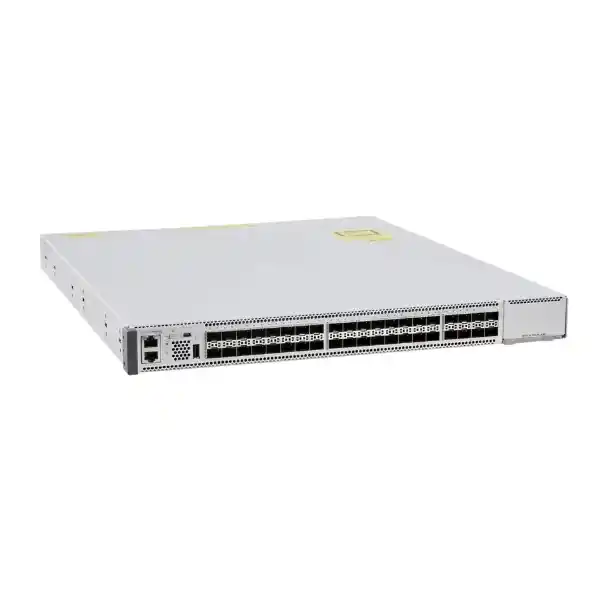
Cisco Catalyst C9500-48Y4C Network Switch
A dense 1/10/25G fiber aggregation platform with four 40/100G uplinks, Cisco UADP 3.0 forwarding, IOS XE programmability, advanced routing and high-availability capabilities for demanding campus and enterprise networks in Dubai and across the United Arab Emirates.
Platform snapshot
48 × 1/10/25G SFP28
4 × 40/100G QSFP28
Up to 3.2 Tbps switching capacity
Up to 1 Bpps forwarding rate
Direct answer: what the C9500-48Y4C is designed to do
The Cisco Catalyst C9500-48Y4C is a high-performance fixed-form-factor switch intended primarily for enterprise campus core and distribution roles where a network requires many high-speed fiber interfaces without moving to a modular chassis. Its front-panel architecture is straightforward but powerful: forty-eight SFP28 interfaces can operate at 1, 10 or 25 Gigabit Ethernet depending on the supported optic and configuration, while four fixed QSFP28 uplink interfaces provide 40 or 100 Gigabit Ethernet. This combination is particularly useful when dozens of access, aggregation, server, security or building-network connections converge into a pair of resilient distribution switches.
For a UAE enterprise, the practical value is density and architectural flexibility. A single 1 RU switch can terminate forty-eight fiber links, allowing 10G estates to migrate progressively toward 25G without replacing the switching chassis. The four 100G-capable uplinks provide a clean path toward high-bandwidth core connectivity, data-center aggregation, firewall clusters, WAN edge routers or another Catalyst 9500 peer. This makes the platform well suited to headquarters campuses, financial institutions, universities, healthcare environments, hospitality groups, government offices, large commercial buildings and distributed organizations that need deterministic performance and mature Cisco operational tooling.
The platform runs Cisco IOS XE and uses Cisco UADP 3.0 silicon. That matters because purchasing a core switch is not only a port-count exercise. Forwarding table allocation, routing scale, telemetry, automation, segmentation, encryption, high availability, software lifecycle and operational observability all influence whether the network will remain manageable for years. FourTeck approaches the C9500-48Y4C as an infrastructure design component rather than a standalone box. The correct bill of materials should account for optics, fiber type, licensing tier, redundant power, rack depth, airflow, software release, Smart Account requirements, support entitlement, StackWise Virtual design and the actual traffic profile of the campus.
Key hardware architecture and verified platform capabilities
Access-facing density
Forty-eight SFP28 cages support 25G, 10G and 1G operation with appropriate supported transceivers. The port density is ideal for fiber-heavy aggregation designs and allows phased bandwidth migration.
Core uplinks
Four QSFP28 ports support 40G or 100G connectivity, giving architects high-capacity links for upstream core, data-center, WAN, security or peer-switch interconnection.
UADP 3.0 ASIC
The C9500-48Y4C uses a single Cisco UADP 3.0 ASIC. The platform supports up to 3.2 Tbps switching capacity and up to 1 billion packets per second of forwarding performance.
Enterprise control plane
A multicore x86 CPU, 16 GB DRAM and 16 GB internal flash support IOS XE services, programmability, telemetry, software management and application-hosting capabilities.
Packet buffering
UADP 3.0 provides a 36 MB shared packet buffer. Correct QoS engineering remains important where many 25G ingress streams can converge toward fewer uplinks or lower-speed destinations.
1 RU fixed design
The high-performance chassis occupies one rack unit and combines dense front-panel bandwidth with replaceable power and cooling components, supporting compact redundant campus designs.
Understanding the 48 × 1/10/25G SFP28 port design
The most important characteristic of the C9500-48Y4C is the forty-eight-port SFP28 access and aggregation field. Every one of these ports is designed for multiple Ethernet rates, allowing the same physical switch to support generations of fiber connectivity. In a brownfield campus, many distribution links may still operate at 10G. When an access layer, data-center leaf, wireless aggregation point or server block is upgraded, selected ports can move to 25G while other connections remain at their original speed. That protects switching investment and reduces the pressure to refresh every optical endpoint simultaneously.
SFP28 is physically compact and particularly useful for 25G Ethernet because it delivers more bandwidth per lane than 10G SFP+. In an enterprise distribution design, 25G can be an efficient intermediate step between 10G and 100G. It allows access stacks or specialized high-throughput systems to increase bandwidth without consuming a 40G or 100G port for every downstream node. It also supports higher aggregation density in one rack unit. With forty-eight interfaces available, architects can construct balanced dual-homed designs where two C9500-48Y4C switches each receive redundant uplinks from large access blocks.
Port-rate flexibility does not eliminate the need for optical engineering. The selected Cisco-supported transceiver must match wavelength, distance, fiber type, connector, patching method and the capabilities of the remote device. A 25G multimode link within a building has different engineering constraints from a single-mode inter-building link, a 10G legacy connection or a long-reach metropolitan fiber path. Before ordering optics, FourTeck recommends documenting each circuit by source port, destination port, required speed, physical distance, fiber standard, connector type and redundancy role. This avoids one of the most common implementation problems: purchasing a correct switch with an incomplete or mismatched optical bill of materials.
The front-panel architecture connects these SFP28 lanes directly into the UADP 3.0 forwarding system. Cisco documents 25-Gbps single-flow processing on the downlink interfaces. For enterprise traffic engineering, this means the switch is not merely offering nominal cage compatibility; it is built as a native high-performance 25G distribution platform. Nevertheless, end-to-end application performance depends on all intermediate devices, transceiver quality, fiber condition, packet size, QoS policy and oversubscription. Core design should therefore be based on actual traffic matrices rather than the theoretical sum of port labels.
Four 40/100G QSFP28 uplinks: designing the northbound path
The four fixed QSFP28 ports are central to the C9500-48Y4C’s role as a distribution switch. A design can use them as high-capacity uplinks toward an enterprise core, as interconnects between major network blocks, as links to firewalls or routers, or as part of the StackWise Virtual architecture. Each port can operate at 40G or 100G with a supported transceiver, giving the switch a clean migration path from previous-generation 40G backbones into 100G campus architectures.
When engineers see four 100G interfaces, it is tempting to reserve all of them only for upstream connectivity. In practice, resilient design may allocate those interfaces differently. A pair of switches could dedicate high-speed links to StackWise Virtual and use remaining capacity for northbound EtherChannels. Another architecture may keep the switches independent and use routed point-to-point links with equal-cost multipath. The correct model depends on failure domains, convergence objectives, operational preference and whether downstream devices need a multichassis EtherChannel presentation.
The port plan should also consider physical diversity. Two nominally redundant 100G links are not resilient if they share the same fiber tray, building riser, patch panel, optic batch, upstream line card or electrical feed. UAE campus environments frequently span multiple floors, towers, data rooms or buildings. The switching design should therefore map logical redundancy onto physical separation wherever possible. This includes using separate pathways, labeling circuits clearly, documenting optical power levels and maintaining spare transceivers appropriate for the critical links.
At 100G, small configuration errors can have a large operational effect because many downstream services may depend on one interface. Change control should include pre-change counters, optical telemetry, MTU verification, EtherChannel consistency, routing-adjacency validation and post-change traffic checks. For networks that connect switching and security layers, FourTeck’s firewall engineering resources can be combined with the switching design so link speed, LACP behavior, routing, segmentation and failover expectations are aligned end to end.
Performance characteristics that matter in real networks
3.2 Tbps switching capacity
The platform is rated for up to 3.2 Tbps of switching capacity. This capacity is aligned with the high-density multi-rate front panel and enables the C9500-48Y4C to operate as an enterprise distribution platform rather than a simple access switch. Capacity planning should still model east-west versus north-south traffic and expected oversubscription.
Up to 1 Bpps forwarding
Forwarding performance reaches up to one billion packets per second. Packet-per-second capacity matters when workloads consist of small packets, because a high bit-rate figure alone does not describe the processing requirement generated by transactional, voice, telemetry or security traffic.
36 MB shared buffer
The UADP 3.0 ASIC provides a 36 MB shared packet buffer. Buffer behavior is relevant during microbursts and speed transitions, such as several 25G sources sending toward a single lower-speed destination. Appropriate QoS and traffic engineering remain essential.
9,216-byte jumbo frame support
High-performance Catalyst 9500 models support jumbo frames up to 9,216 bytes. Jumbo MTU can be valuable for storage, virtualization and encapsulated services, but every device and link in the path must be engineered consistently.
A useful sizing method separates bandwidth, packets per second and forwarding-table scale. Two networks can each peak at 100 Gbps yet place very different stress on hardware. One may carry large sequential backup flows with relatively modest packet rates; another may carry millions of short-lived application transactions, telemetry streams and encrypted sessions. Similarly, a campus with only a few thousand endpoints may have extensive segmentation, route leaking, multicast and policy requirements. FourTeck therefore evaluates expected link utilization, burst patterns, route counts, MAC counts, VLAN and SVI requirements, multicast groups, ACL complexity, NetFlow scale and encapsulation overhead before finalizing the design.
UADP 3.0: why the ASIC matters
Cisco’s Unified Access Data Plane architecture is a major part of the Catalyst 9500 value proposition. The C9500-48Y4C uses one UADP 3.0 ASIC with a programmable forwarding architecture, configurable hardware tables and dedicated resources for Layer 2 switching, Layer 3 routing, ACL enforcement, QoS and telemetry features. This hardware-centric design allows the switch to perform many enterprise functions at forwarding-plane speed rather than relying on the general-purpose CPU for normal packet switching.
The distinction between control plane and data plane is important. The x86 CPU runs IOS XE processes, routing protocols, management, automation and other control functions. Once forwarding entries are programmed into hardware, the ASIC performs packet lookup and forwarding at high speed. Stable core design therefore requires both sides to be sized correctly: the ASIC needs enough table and ACL resources for the intended services, while the control plane needs appropriate software configuration, protocol timers and operational protection. Features such as Control Plane Policing should be treated as part of core hardening rather than optional tuning.
UADP 3.0 also supports flexible table allocation through SDM templates. This is particularly useful because a distribution switch in a large Layer 2 campus has different requirements from a routed core, a segmentation border or a collapsed-core WAN edge. Cisco provides standard templates and custom allocation capabilities in supported IOS XE releases. Selecting the correct template is a design decision: allocating more hardware resources to MAC addresses may reduce resources available elsewhere, while a route-heavy core may prioritize Layer 3 tables. Engineers should examine current and projected utilization before changing templates, and they should validate the restart or maintenance implications of any platform-wide configuration change.
For migration projects, FourTeck normally captures baseline commands from the existing network and translates them into target resource requirements. This includes MAC address-table counts, ARP and IPv6 neighbor counts, unicast routes, multicast routes, VLANs, SVIs, VRFs, ACL entries and flow-monitoring requirements. A raw device configuration is not enough because dormant configuration may overstate needs while hidden operational scale may not appear in a configuration file. Real counters and operational-state data provide a more reliable sizing basis.
Routing scale, SDM templates and the core-versus-distribution decision
Catalyst 9500 high-performance models can allocate forwarding resources according to deployment role. Cisco’s standard SDM profiles include distribution, core, NAT and SD-Access-oriented allocations. For the C9500-48Y4C family, the distribution template emphasizes MAC and security resources, while the core template emphasizes unicast and multicast routing. This is one reason the same hardware can serve different architectural roles, but it also means published maximum values must be interpreted in context. No single number describes every simultaneously achievable scale because several functions draw from shared hardware resources.
In standard template examples, Cisco documents large IPv4/IPv6 forwarding allocations, multicast capacity, thousands of IGMP/MLD snooping entries, tens of thousands of MAC addresses, substantial NetFlow resources and configurable ACL space. Later IOS XE releases also allow custom SDM resource allocation within defined limits. A network architect should use these capabilities deliberately. If the switch is primarily aggregating Layer 2 access segments and applying segmentation policies, a distribution-oriented profile may be appropriate. If it is terminating many routed adjacencies, VRFs and summary routes, the core profile may be more suitable. A collapsed-core design performing NAT or edge services may need a different balance again.
Protocol selection also influences design. The Catalyst 9500 platform supports mature enterprise routing options including OSPF, EIGRP, IS-IS and BGP according to license and software feature requirements. In a conventional campus, OSPF or EIGRP may connect distribution blocks to the core. In larger organizations, BGP may be preferred for policy isolation or data-center and WAN integration. EVPN/VXLAN and SD-Access designs introduce additional control-plane and encapsulation considerations. The correct answer is not simply to enable every available protocol; it is to choose the smallest architecture that meets convergence, segmentation and growth requirements.
FourTeck recommends recording a three-year scale forecast before final purchase. Count present and planned buildings, access stacks, routed links, endpoint segments, VRFs, prefixes, multicast applications, telemetry exporters and security policies. Then add realistic growth margin. This avoids both under-sizing and unnecessary complexity. Organizations that also need server and virtualization infrastructure can coordinate switching capacity with FourTeck Server Dubai so NIC speeds, virtualization uplinks, storage traffic and campus aggregation are planned as one system rather than independent purchases.
StackWise Virtual and high-availability campus design
The C9500-48Y4C supports Cisco StackWise Virtual, which allows two physical switches to operate as a logical network system for many operational purposes. This can simplify downstream multichassis EtherChannel designs and provide stateful high-availability behavior. On the high-performance C9500-48Y4C, Cisco supports StackWise Virtual links on the downlink 10/25G interfaces or the fixed 40/100G uplinks, with Dual Active Detection available on supported interfaces. The ability to use high-speed front-panel ports gives architects flexibility in how they allocate bandwidth between virtualization links and production uplinks.
A StackWise Virtual deployment should be engineered, not simply enabled. The two chassis should have independent power feeds where possible, diverse uplinks, appropriately sized StackWise Virtual bandwidth and a correctly designed Dual Active Detection mechanism. The objective is to prevent a single cable, power event or upstream failure from disabling both logical paths. Downstream access switches can use multichassis EtherChannel so one link terminates on each C9500 member while appearing as a single port channel from the access device’s perspective.
Stateful Switchover and nonstop-forwarding capabilities can reduce disruption during certain supervisor or control-plane events, but they do not remove the need for application-level resiliency. Every maintenance plan should distinguish between data-plane continuity, routing-adjacency behavior, Layer 2 convergence, upstream failover and application session impact. Testing should include link failures, chassis power-off, control-plane switchover and upstream loss. A design considered highly available only because every component is duplicated may still have correlated failure modes.
Some customers prefer two independent routed C9500-48Y4C switches instead of StackWise Virtual. That architecture can create smaller failure domains and straightforward Layer 3 convergence, especially when downstream devices support ECMP or routed uplinks. Other customers value the operational simplicity of multichassis EtherChannel and a logical pair. FourTeck can model both approaches against the customer’s topology, maintenance process and support skills. The decision should be based on operational outcomes rather than a universal assumption that one design is always superior.
Security capabilities for a trusted enterprise backbone
MACsec encryption
Catalyst 9500 supports 256-bit AES-GCM MACsec capabilities for protecting Ethernet links. MACsec can be valuable across exposed building, campus or provider-managed fiber where link-layer confidentiality is required. Compatibility, licensing and key-management design should be verified end to end.
Secure platform foundation
Platform security features include signed software images, secure boot and Cisco Trust Anchor capabilities. These controls help establish hardware and software integrity before network policy is considered.
Segmentation and policy
ACLs, VRFs, security-group technologies and SD-Access integration allow organizations to separate users, systems and application zones. Effective segmentation requires a policy model that remains understandable during incidents and change windows.
Telemetry and visibility
Flexible NetFlow, model-driven telemetry and standard monitoring interfaces can expose traffic and health information to management platforms. Visibility is essential for baselining, anomaly detection and capacity planning.
The switch should not be treated as a firewall replacement. Its security features protect the switching and routing infrastructure, enforce segmentation and improve trust in transport. Stateful inspection, threat prevention, remote-access security and internet-edge controls remain functions of dedicated security platforms. A well-designed UAE enterprise architecture integrates core switching and firewall policy so zones, routes, MTUs, link aggregation and failover states match on both sides.
Cisco IOS XE operations, automation and observability
Cisco IOS XE provides the software foundation for the C9500-48Y4C. For experienced Cisco teams, the CLI remains familiar, but modern operation increasingly extends beyond manual command entry. IOS XE supports model-driven programmability using YANG models and management interfaces such as NETCONF, RESTCONF and gNMI. This lets enterprises integrate switch configuration and state into automation pipelines, source-controlled templates and observability systems.
Streaming telemetry is particularly useful in high-speed networks because traditional polling can miss short-duration events. An interface may experience microbursts, queue drops or transient errors between five-minute monitoring polls. Model-driven telemetry can stream selected operational data at shorter intervals, allowing engineers to build more responsive dashboards and anomaly detection. The practical requirement is to choose metrics carefully; collecting every possible counter at very high frequency can overwhelm collectors and create noise instead of insight.
Zero Touch Provisioning, Plug and Play workflows and automated software deployment can reduce manual effort during large campus refreshes. Automation is most valuable when the desired state is standardized. Before automating deployment, organizations should define naming conventions, management addressing, AAA, NTP, DNS, syslog, SNMP or telemetry, routing policy, interface templates and software versions. A consistent golden configuration makes automation predictable; automating inconsistent legacy practices only reproduces inconsistency faster.
Application hosting capabilities also allow supported containerized tools to execute using reserved resources on the switch with optional SSD storage. This can support specialized monitoring or operational use cases near the network edge. It should be planned conservatively in core environments: the primary job of the C9500-48Y4C remains switching and routing. Any on-box application should have a defined business purpose, support model, resource allocation and lifecycle owner.
Organizations building a broader operational transformation can combine switching deployment with FourTeck IT Services UAE for migration planning, configuration standardization, monitoring integration, documentation and ongoing support. The objective is not simply to install new hardware; it is to create a repeatable operational model that engineers can troubleshoot quickly during real incidents.
QoS engineering, congestion and microburst behavior
High port speed does not make congestion disappear. In fact, dense 25G access can make short-duration congestion more pronounced because many sources can transmit large bursts toward fewer destinations. The C9500-48Y4C’s 36 MB shared buffer, scheduling capabilities and hierarchical QoS tools give engineers mechanisms to manage congestion, but those tools must reflect actual traffic priorities and oversubscription points.
A typical distribution switch carries several traffic classes at once: real-time voice, interactive applications, video, storage, backup, internet access, software distribution, management and bulk transfers. Markings may arrive from trusted access ports or need to be rewritten at network boundaries. The distribution layer should enforce a clear trust model so a low-priority application cannot simply mark itself as priority traffic. Policies should define classification, queuing, bandwidth guarantees, policing and drop behavior in a way that is consistent across access, distribution, WAN and security layers.
Speed transitions deserve special attention. Multiple 25G interfaces can send into a 10G destination, or many downstream ports can converge on a 100G uplink. Even when average utilization is modest, synchronized applications can produce bursts that temporarily exceed egress capacity. Engineers should monitor queue-drop counters rather than relying only on interface utilization. An interface averaging 20 percent utilization can still discard packets during microbursts if the instantaneous arrival rate and queue configuration create contention.
For low-latency applications, the best solution is often architectural: reduce oversubscription, increase destination bandwidth, distribute workloads or schedule large transfers. QoS cannot create bandwidth; it controls which traffic is protected when bandwidth becomes scarce. FourTeck therefore treats QoS design as part of capacity planning rather than a configuration template applied at the end of a project.
Power, cooling, physical installation and UAE environmental planning
The C9500-48Y4C is a 1 RU switch designed for standard enterprise racks. Physical planning remains important because core and distribution devices often operate in densely populated rooms. The high-performance C9500 chassis is approximately 1.73 inches high and 17.5 inches wide; the C9500-48Y4C family uses an approximately 18-inch chassis depth in Cisco’s hardware documentation, with overall rack planning also accounting for power cords, fiber bend radius and rear service access. Before installation, verify rack rail compatibility, front and rear clearance, PDU outlet type, grounding and cable-management space.
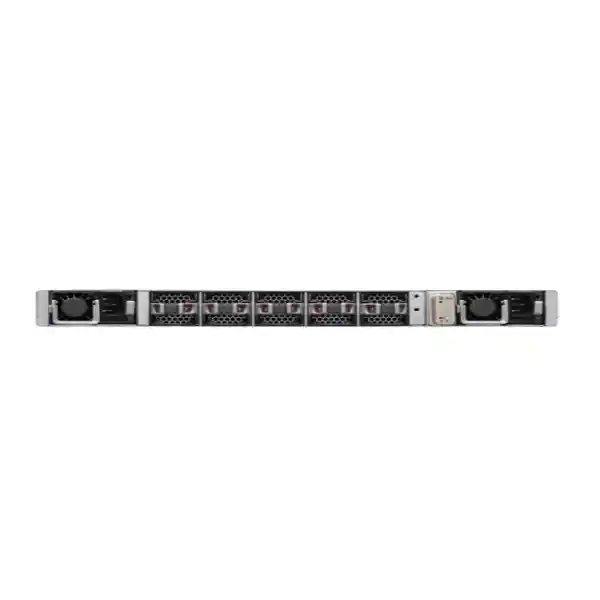
The switch supports dual power supplies for 1+1 redundancy, with supported AC and DC options depending on the exact bill of materials. Cisco documentation lists the 650W AC family and 930W DC option for the C9500-48Y4C. A second power supply should be included when the network role requires power redundancy. For genuine resilience, each supply should connect to a different PDU and preferably a different UPS or electrical feed. Installing two PSUs into the same single point of failure does not deliver full electrical redundancy.
Cooling is equally important in the UAE. Cisco specifies operating limits for the platform, but enterprise design should maintain data-room conditions comfortably within the rated range rather than treating the maximum temperature as a normal target. The C9500 high-performance models use field-replaceable fan trays and front-to-back airflow configurations. Airflow direction must align with the cabinet’s hot-aisle/cold-aisle arrangement. Blank panels, obstructed intakes and unmanaged patch cords can create recirculation hotspots even when the room thermostat appears acceptable.
Dubai and other UAE deployments also need to consider dust ingress, humidity control, generator transfer events and UPS runtime. Core switches should be installed in conditioned technical spaces with maintained filtration. Preventive maintenance should include checking fan health, power-supply status, inlet temperature, optical receive levels and hardware alarms. Environmental telemetry belongs in the monitoring platform alongside link and routing status because a slowly rising inlet temperature can provide early warning before equipment reaches a critical threshold.
Where the project includes rack servers, storage or virtualization nodes, physical capacity can be coordinated with FourTeck’s server infrastructure team so rack U-space, PSU loading, cooling, network optics and cable routing are documented together. This reduces installation-day surprises and improves serviceability after handover.
Optics, fiber and cabling: the most important part of the bill of materials
Choose by distance
Short multimode links, intra-building single-mode links and long-reach campus fibers require different transceivers. Do not select optics by speed alone. Document link distance and physical fiber before ordering.
Validate fiber plant
Existing patch panels, splice loss, connector cleanliness and multimode generation can determine whether a proposed speed is practical. Certification testing is valuable before a major backbone upgrade.
Plan spares
Critical 25G and 100G links should have an appropriate spare strategy. A small inventory of commonly used optics can reduce mean time to repair when a transceiver fails.
Control cleanliness
High-speed optical systems are sensitive to contamination. Cleaning and inspection procedures, dust caps and disciplined patching should be part of the installation method statement.
For each C9500-48Y4C, the optical bill of materials may represent a significant portion of the total project cost. That is why FourTeck separates chassis selection from port-population planning. A customer may require only a subset of ports at initial deployment, with additional optics purchased as new access blocks are connected. This phased approach can control budget while preserving the switching capacity required for growth.
Engineers should also consider receive and transmit power, not only distance labels. Link loss is the sum of fiber attenuation, connector loss, splice loss and engineering margin. Long or complex paths should be tested. Where providers hand off services on third-party optical equipment, confirm whether the connection is Ethernet over dark fiber, a managed wavelength, an NNI or another service type. The switch optic must be compatible with the actual handoff specification.
Licensing: Cisco Networking Subscription, Switching Essentials/Advantage and legacy DNA choices
Cisco’s current Catalyst 9500 documentation describes two licensing approaches: unified switching licenses through the Cisco Networking Subscription and Cisco DNA licensing models. Under unified licensing, Cisco provides Switching Essentials and Switching Advantage tiers. The exact capabilities depend on platform, software release and management system. New subscription orders have term requirements, so licensing must be treated as a design and commercial decision rather than an accessory selected after the hardware has arrived.
Switching Essentials is positioned around foundational switching, automation, health, visibility, provisioning and software-management capabilities. Switching Advantage adds more advanced automation, analytics, segmentation, assurance, security, application visibility and fabric functions. Organizations using earlier Cisco DNA models may encounter Network Essentials or Network Advantage perpetual tiers paired with DNA Essentials or DNA Advantage subscriptions. The exact orderable SKU and entitlement should be validated against the software release and procurement route at the time of quotation.
The technical team should define features before the commercial team chooses a license. Required features may include advanced routing, MPLS, segmentation, SD-Access, assurance, application visibility or particular automation capabilities. If a bill of materials is built only around a low initial price, a missing entitlement can delay deployment or force a later licensing change. Conversely, purchasing the highest tier without a feature requirement may increase cost unnecessarily.
FourTeck can align the intended design with the relevant current Cisco license tier and subscription term during quotation. Because Cisco licensing models evolve, final ordering should always use the current product and licensing matrix rather than assumptions from an older Catalyst deployment. Smart Account ownership, virtual account structure, support association and renewal responsibility should also be documented before handover so future software upgrades are not blocked by administrative uncertainty.
Campus core, distribution and collapsed-core deployment patterns
Distribution pair: In a classic three-tier campus, a pair of C9500-48Y4C switches can aggregate multiple access-layer switches while providing high-speed routed uplinks to a separate core. The 48-port SFP28 field gives a distribution block enough density to connect many access stacks at 10G or 25G. Routing at the distribution layer can reduce Layer 2 failure domains and allow fast convergence. This pattern works well where the campus has multiple buildings or large floors that justify dedicated distribution blocks.
Collapsed core: Medium and large sites often combine core and distribution functions in one resilient pair. The C9500-48Y4C is well suited when the site needs many 10/25G access uplinks plus 100G connections to data center, firewall or WAN infrastructure. The design must ensure that the four QSFP28 interfaces are sufficient for the required northbound and inter-switch connections. If a site needs a much larger number of 100G ports, another Catalyst 9500 model may be more appropriate.
Data-center or server aggregation handoff: Although the Catalyst 9500 family is positioned primarily for enterprise campus core and distribution, the C9500-48Y4C can also aggregate high-speed server or appliance connections in suitable enterprise designs. Engineers should compare buffer behavior, feature set and operational model against data-center-specific switching requirements before using it as a general leaf switch. The right platform depends on workload characteristics, storage protocols, latency sensitivity and fabric architecture.
Security services aggregation: The 25G and 100G interfaces are useful for connecting firewall clusters, internet-edge routers, load balancers and service appliances. Routed links and port channels can be built with clear failure domains. MTU, LACP timers, routing protocol behavior and failover convergence should be tested jointly with the security platform. For complex deployments, the switching and firewall teams should share one interface matrix and one migration runbook.
Multi-building fiber hub: Campuses with many remote telecom rooms can use the switch as a dense fiber convergence point. In this pattern, optics and outside-plant fiber condition may become more important than switch capacity. Engineers should document cable routes, fiber cores, splice points and building-entry protection, then map each circuit to redundant switch ports. This is especially important where a campus has grown organically and legacy fiber documentation is incomplete.
How to size the C9500-48Y4C correctly
A disciplined sizing exercise begins with the physical topology. Count every downstream connection and classify it by current and target speed. If a site has thirty access switches using dual 10G uplinks to two distribution switches, each C9500-48Y4C may terminate thirty links and still retain capacity for growth. If every downstream access block will use dual 25G uplinks to the same distribution device, the bandwidth grows considerably even though the port count stays the same. Document both port quantity and traffic expectation.
Next, calculate northbound capacity. Total downstream interface bandwidth is not the same as expected concurrent traffic. Access uplinks are often oversubscribed by design because not every endpoint transmits at line rate simultaneously. The correct oversubscription ratio depends on workload. Office productivity networks may tolerate significant statistical multiplexing; research, media, backup or virtual-desktop environments may need more conservative ratios. Measure current peaks where possible, then apply expected growth and application changes.
Third, evaluate forwarding resources. Collect operational MAC, ARP, neighbor, route, multicast, VRF, VLAN and ACL counts from the existing network. Add projected new segments and services. If using SD-Access, EVPN/VXLAN, MPLS or extensive policy, include those feature-specific resources. Choose the SDM template only after this analysis. Avoid sizing to the documented theoretical maximum of a single table while ignoring shared resource relationships.
Fourth, identify resilience requirements. Determine whether two switches will run StackWise Virtual or independent Layer 3 control planes. Count the interfaces consumed by inter-switch links, Dual Active Detection, upstream links and management. Ensure the remaining port density still meets the project requirement. Include redundant PSUs and power feeds in the physical design.
Fifth, build the optic matrix. For every port, record speed, wavelength, fiber type, distance and remote transceiver. Include patch cords, adapters if required, spare optics and cleaning supplies. Confirm whether any links need MACsec, specialized timing or jumbo MTU support. This matrix becomes both the procurement list and the implementation reference.
Finally, validate software and licensing. Record target IOS XE release, feature tier, Smart Account, management platform and support entitlement. Review recommended releases and known caveats through Cisco’s current support channels before production deployment. FourTeck can combine these inputs into a quotation and deployment plan through the FourTeck UAE team.
Migration from older Catalyst cores and distribution switches
A switch refresh succeeds when the migration preserves services, not merely when the new chassis boots. Older campus networks may use 10G distribution uplinks, spanning-tree roots, first-hop redundancy protocols, EtherChannels, static routes, dynamic routing, multicast rendezvous points, VRFs and hundreds of VLANs. Before migration, the team should create a dependency map showing which business services rely on each interface and protocol. This prevents an apparently minor port from becoming an unexpected outage source.
The first technical step is discovery. Capture running configuration, startup configuration, software version, license state, inventory, interface status, transceiver details, port-channel membership, spanning-tree state, routing neighbors, route counts, MAC tables, ARP and neighbor tables, multicast state, QoS policy counters, environmental state and recent logs. Take optical receive-power readings on critical links if the existing platform exposes them. This creates a baseline for both design and rollback.
The target configuration should be built from intent rather than copied line for line. Legacy configurations often contain unused VLANs, retired ACL entries, old logging destinations and obsolete workarounds. Migrating these blindly carries technical debt onto the new platform. Instead, classify each configuration block as required, modified or retired. Where command syntax has changed between software trains, validate the target behavior in a lab or staging environment.
During the change window, use a port-by-port migration sheet with source device, source interface, destination interface, optic, patch path, VLAN or routed subnet, expected protocol neighbor and validation test. Large changes fail when technicians rely on memory. Structured labels and checklists make parallel work possible and create an audit trail. Move one logical service group at a time where the topology permits, validating traffic before continuing.
A rollback plan must be physically possible. If old fiber is repatched into the new switch, make sure cables can be restored quickly and labels remain visible. Save final snapshots before starting. Define objective rollback triggers such as inability to establish critical routing adjacency, unacceptable packet loss or failure of a named business service after a defined troubleshooting window. The team should not improvise rollback criteria under pressure.
After cutover, monitor at least interface errors, discards, optical levels, routing stability, CPU, memory, environmental sensors, queue drops and application response. Compare these values against the pre-change baseline. A migration is complete only after operations teams have updated diagrams, backup configurations, monitoring, support records and rack documentation.
Multicast, timing, AV and specialized enterprise requirements
Large campuses increasingly carry more than standard client and server traffic. Video distribution, building management, financial applications, industrial systems and collaboration platforms can rely on multicast or precise timing. The Catalyst 9500 platform supports enterprise multicast routing capabilities such as PIM modes and IGMP/MLD functions, with the exact resource scale dependent on SDM allocation and software feature set. Multicast networks should be designed around actual group counts, source counts, receiver behavior and rendezvous-point architecture rather than simply enabling PIM everywhere.
Precision Time Protocol support can help networks distribute accurate time where applications require tighter synchronization than conventional NTP provides. Audio Video Bridging capabilities are also part of the Catalyst 9500 feature family. Specialized timing and media networks need end-to-end design because one unsupported intermediate device can undermine the entire service. Boundary clock, transparent clock or other timing roles should be verified against the exact release and application requirements before deployment.
Multicast also changes troubleshooting. Unicast connectivity tests can succeed while a business video stream fails due to IGMP snooping state, PIM neighbor loss, RPF issues or missing multicast routes. Monitoring should therefore include multicast-specific state and traffic counters. The operational team should know which groups are business critical and where sources reside. Documentation is especially valuable in hospitality, education and large-event environments where multicast may support IPTV or distribution systems.
When specialized services share the same physical core as office and internet traffic, QoS and failure-domain design become more important. A bulk backup should not interrupt time-sensitive media, and a multicast flood should not consume an entire campus. The C9500-48Y4C provides the platform tools to build controlled services, but engineering discipline determines the result.
Operational lifecycle: software, backup, monitoring and support
Core switches have long service lives, so lifecycle planning matters as much as day-one installation. The production IOS XE release should be selected according to Cisco’s current recommendations, feature requirements, security advisories and interoperability needs. Organizations should avoid unnecessary software churn but also avoid leaving core infrastructure indefinitely on an obsolete train. A regular review cycle can identify critical vulnerabilities, bug fixes and feature changes before they become urgent.
Configuration backup should be automated. At minimum, capture configuration after every approved change and retain historical versions. Mature environments store intended configuration in source control and compare it against device state. This helps identify drift, unauthorized changes and incomplete rollbacks. Backup processes should also record license and inventory information so replacement hardware can be commissioned quickly after a major failure.
Monitoring should extend beyond simple ping reachability. Track interface utilization, errors, drops, optical power, port-channel state, routing adjacency, route counts, CPU, memory, temperature, fan and power-supply state, spanning-tree changes, NetFlow or telemetry anomalies and log events. Establish thresholds based on normal operating ranges rather than generic defaults. A 30 percent uplink that is normally 5 percent may indicate a major change even if it is still far below line rate.
Spares strategy should match business criticality. Organizations with multiple identical C9500 units may maintain shared spare optics, power supplies or a cold spare chassis. Others may rely on vendor support replacement commitments. The decision should be based on acceptable recovery time, not only purchase price. For a campus where the core supports thousands of users, waiting for an international shipment may be unacceptable.
Support documentation should include serial numbers, Smart Account ownership, support contract, software entitlement, rack location, management address and escalation contacts. FourTeck can help build these handover records and can align UAE support with broader regional requirements through FourTeck Africa for organizations operating across multiple countries.
Detailed specification summary for the C9500-48Y4C
| Platform role | High-performance fixed enterprise core and distribution switching |
| Downlink / front-panel ports | 48 × SFP28 supporting 1/10/25 Gigabit Ethernet with supported optics |
| Fixed uplink ports | 4 × QSFP28 supporting 40/100 Gigabit Ethernet |
| Forwarding ASIC | 1 × Cisco UADP 3.0 |
| Switching capacity | Up to 3.2 Tbps |
| Forwarding rate | Up to 1 Bpps |
| Packet buffer | 36 MB shared UADP 3.0 buffer |
| System memory | 16 GB DRAM |
| Internal flash | 16 GB |
| CPU | 2.4 GHz multicore x86 architecture for Catalyst 9500 high-performance models |
| Jumbo frames | Up to 9,216 bytes |
| Rack form factor | 1 RU fixed chassis |
| High availability | StackWise Virtual, SSO/NSF capabilities, redundant PSU support, field-replaceable cooling |
| Security | Secure boot, image signing, Trust Anchor, ACL/security functions and 256-bit MACsec support |
| Operating system | Cisco IOS XE |
Exact supported optics, features, table scale, license requirements and software behavior depend on the selected IOS XE release, license tier and validated Cisco compatibility matrix. Final quotation should use the current Cisco ordering guide.
Frequently asked technical questions
Can all 48 SFP28 ports run at 25G?
The model is designed with 48 multi-rate SFP28 interfaces supporting 1/10/25G operation with compatible supported optics. The actual port state depends on optic, configuration and peer compatibility.
Does the switch support 100G?
Yes. Four fixed QSFP28 uplink ports support 40G or 100G Ethernet, providing high-capacity upstream, peer or service connections.
Is it suitable for the campus core?
Yes, particularly for a collapsed core or a core design where 48 multi-rate 25G ports plus four 100G interfaces match the topology. If a design needs significantly more native 100G density, another Catalyst 9500 model may fit better.
Can two switches operate as one logical pair?
The C9500-48Y4C supports StackWise Virtual. This can support multichassis EtherChannel and stateful high-availability designs when configured according to Cisco requirements.
Does it require a subscription?
Cisco’s current ordering model includes unified switching subscription choices and legacy DNA licensing combinations. The exact required term and tier should be confirmed against the current Cisco licensing matrix at quotation time.
What else must be ordered?
A complete deployment commonly needs optics, fiber patch cords, licensing, support, a second PSU for redundancy, rack accessories and possibly SSD storage or specialized cables. The exact list depends on topology and procurement scope.
UAE procurement and project planning considerations
Enterprise network procurement in the UAE often involves more than delivering hardware to a site. Projects may require asset tagging, serial-number records, staging, software standardization, configuration templates, rack-and-stack work, fiber patching, testing, change-window support and formal handover. These tasks should be reflected in the project scope before purchase so responsibilities are clear between the customer, integrator, cabling contractor and vendor support.
Lead time should be considered for both the chassis and optics. A switch can arrive before a specialized long-reach transceiver, leaving the project incomplete. Build the complete BOM first, then check availability of every critical component. For sites with fixed go-live dates, consider ordering spare optics and redundant PSUs at the same time as the chassis rather than treating them as later additions.
Commercial evaluation should compare like-for-like configurations. Two quotations with the same C9500-48Y4C chassis may differ substantially if one includes a higher software tier, longer subscription, support entitlement, redundant PSU and Cisco optics while another does not. The customer should review the line-level bill of materials instead of comparing only the headline switch price.
FourTeck can provide a UAE-focused bill of materials and implementation scope through FourTeck UAE, including design validation, compatible accessory planning and integration with wider IT infrastructure. For organizations with sites outside the Emirates, regional standards can be documented so switching configurations, monitoring and support processes remain consistent.
Design comparison: when the C9500-48Y4C is the right model—and when it is not
The C9500-48Y4C is especially compelling when a project needs high density at 10G or 25G and only a limited number of 100G uplinks. Forty-eight SFP28 ports create an efficient distribution layer for campuses where dozens of access switches connect over fiber. The four QSFP28 ports then provide upstream bandwidth without using valuable SFP28 slots. In a 1 RU form factor, this is a strong balance of density and operational simplicity.
It may not be the best choice when the core itself requires many 100G interfaces. Cisco offers other Catalyst 9500 high-performance models with greater native QSFP28 density. Likewise, very large modular environments may require line-card flexibility, supervisor architecture or port counts beyond a fixed switch. The right question is therefore not whether the C9500-48Y4C is powerful; it is whether its exact port mix matches the network’s connection matrix for the next several years.
Another consideration is 50G, 200G or 400G growth. The C9500-48Y4C was designed around 1/10/25G and 40/100G. Organizations planning an immediate transition to higher-speed campus fabrics may want to compare newer Catalyst 9500X options. By contrast, a customer with a large installed base of 10G access that expects to move to 25G gradually can extract substantial value from the C9500-48Y4C because it aligns well with that migration path.
FourTeck’s role is to map requirements to the appropriate platform, not to force a predetermined model. During presales sizing, the team can compare C9500 variants based on port density, uplink speed, forwarding scale, licensing and expected lifecycle. This prevents overspending on bandwidth that will never be used while also protecting the customer from a platform that becomes constrained soon after deployment.
Implementation methodology for a production deployment
1. Discovery: Collect topology, configurations, interface inventories, optics, routing state, VLANs, VRFs, ACLs, multicast, QoS, monitoring dependencies and change constraints. Validate business-critical applications and maintenance-window expectations.
2. Low-level design: Define port assignments, interface speeds, IP addressing, routing protocols, StackWise Virtual or independent chassis design, management services, AAA, NTP, DNS, SNMP or telemetry, logging, QoS, security controls, SDM template, software release and licensing.
3. Bill of materials validation: Confirm switch SKU, license tier, subscription term, support, redundant PSUs, optics, patch cords, rack accessories and spares. Match every transceiver to its remote peer and fiber path.
4. Staging: Inspect hardware, record serial numbers, install target software, apply baseline configuration, validate licensing, test management connectivity and, where possible, simulate routing and port-channel behavior before the change window.
5. Physical installation: Rack the switches, install redundant power, verify airflow, label fiber and power, connect management, clean optical connectors and confirm environmental state before production links are moved.
6. Controlled migration: Follow a port-by-port runbook, validate each logical service group, monitor logs and counters, and use objective rollback criteria. Keep old equipment available until key services are confirmed.
7. Handover: Save final configurations, update diagrams and asset records, integrate monitoring, record support details, provide test results and transfer operational knowledge. A successful deployment leaves the customer with a maintainable system, not only an installed switch.
Why organizations choose FourTeck for Cisco switching projects
Enterprise switching touches every application in the business. FourTeck approaches Cisco Catalyst projects with an emphasis on dependency mapping, compatibility, staged migration and operational handover. The objective is to reduce hidden assumptions before the maintenance window. This includes checking whether existing optics can be reused, whether fiber supports target speeds, whether licensing matches required features and whether upstream security or WAN equipment can support the proposed links.
For customers already operating Cisco networks, FourTeck can preserve familiar design patterns while modernizing areas that benefit from routed access, telemetry or automation. For customers migrating from another vendor, the process includes translating concepts rather than simply converting commands. Spanning-tree behavior, port channels, VRFs, first-hop redundancy, routing policy and QoS semantics differ across platforms; a correct migration requires understanding the intent behind the old configuration.
The wider FourTeck ecosystem allows projects to connect switching with server, security and IT-service requirements. Customers can use FourTeck IT Services UAE for implementation and support coordination, Server Dubai for compute infrastructure planning, and FourTeck Africa for broader regional projects. This helps multi-site organizations standardize architecture and documentation across different locations.
A quotation can be prepared for hardware supply only or for a complete project including design, configuration, staging, migration and handover. The best starting point is a simple port and topology inventory: how many downstream links exist, their speeds, how many 100G uplinks are required, whether a redundant pair will be deployed, what routing protocols are used and which Cisco license functions are required.
Decision recap
Choose the C9500-48Y4C when the design centers on dense 1/10/25G fiber aggregation with a smaller number of high-speed 40/100G uplinks.
- 48 × multi-rate SFP28 ports
- 4 × 40/100G QSFP28 ports
- UADP 3.0 hardware forwarding
- StackWise Virtual support
- Cisco IOS XE routing, security, telemetry and automation
Confirm before ordering
A correct quotation should confirm more than the chassis part number.
- Required SFP28 and QSFP28 optics
- Fiber type, reach and connector
- Second power supply and feed diversity
- Cisco licensing tier and term
- Target IOS XE release and support entitlement
Quotation input checklist
Quantity: Number of C9500-48Y4C switches, including any spare.
Redundancy: Standalone, independent pair or StackWise Virtual pair.
25G/10G optics: Quantity, reach, multimode or single-mode requirements.
100G/40G optics: Uplink quantity and destination equipment.
Licensing: Required routing, segmentation, assurance and automation functions.
Services: Supply only, staging, migration, onsite installation or managed support.
Plan your Cisco Catalyst C9500-48Y4C deployment with FourTeck UAE
Send the existing topology, required port speeds, fiber distances, redundancy model and licensing requirements. FourTeck can prepare a technically aligned bill of materials for Dubai and UAE deployments, including the switch, optics, redundant power, licensing, support and migration services. For broader company information and enterprise infrastructure capabilities, visit FourTeck UAE.
Best fit
Dense enterprise fiber distribution, collapsed core and high-speed campus aggregation requiring 25G access and 100G uplinks.

Reviews
There are no reviews yet.