
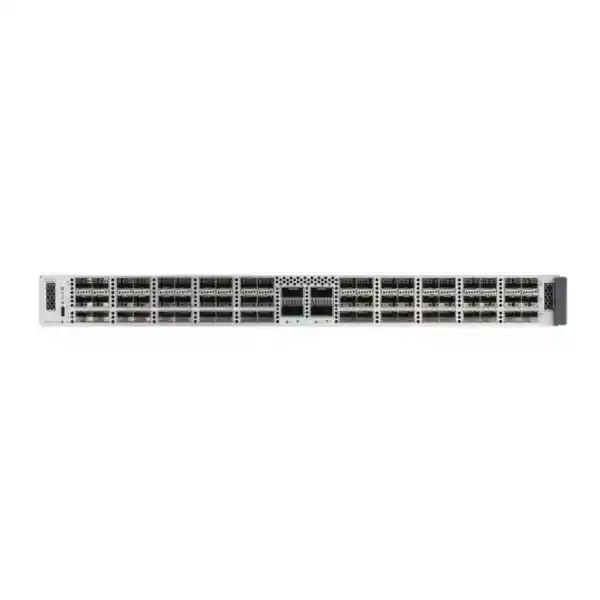
Cisco Catalyst C9500X-60L4D Network Switch
A high-density 1RU fixed core and distribution platform for organizations that need a large concentration of 10/25/50GbE server, access, firewall, leaf, or distribution links together with 40/100/200/400GbE uplinks. The C9500X-60L4D combines Cisco Silicon One Q200 forwarding, deep buffering, enterprise routing, MACsec, StackWise Virtual, programmable IOS XE operations, and scalable campus-fabric functions in a chassis built for demanding network cores.
FourTeck UAE can supply the chassis, compatible transceivers, redundant power, software subscriptions, rack accessories, migration services, configuration, testing, and implementation support for Dubai and nationwide UAE deployments.
Direct answer: who should deploy the C9500X-60L4D?
The Cisco Catalyst C9500X-60L4D is best suited to medium and large enterprises, government organizations, universities, hospitals, hospitality groups, financial institutions, industrial campuses, logistics hubs, multi-building corporate estates, and service-rich branch aggregation environments that are moving beyond 10GbE and need a compact 25/50GbE distribution platform with 100/200/400GbE uplink capability. It is particularly attractive when the network design requires many high-speed fiber ports in a single rack unit and when routing, segmentation, encryption, resiliency, and automation must coexist on the same fixed platform.
For a Dubai headquarters, for example, sixty SFP56 interfaces can aggregate stacks of access switches, firewalls, compute clusters, Wi-Fi controllers, storage systems, building networks, security zones, and high-bandwidth WAN handoffs without consuming the rack space associated with a modular chassis. The four QSFP-DD interfaces can then be used for 100G, 200G, or 400G inter-building, data-center, core-to-core, or high-capacity upstream connectivity, depending on the selected optics, cabling, software design, and port-group rules.
The platform is not a basic access switch and it should not be selected solely by counting copper edge ports. Its value appears when an organization needs high forwarding density, large routing scale, strong redundancy, high-speed optical aggregation, deep packet buffering, campus fabric roles, and operational consistency with the Cisco Catalyst 9000 ecosystem. FourTeck can help validate whether the C9500X-60L4D is the correct fit, or whether another Catalyst 9500/9600 architecture is more appropriate for the required port speeds, growth profile, redundancy model, software features, and budget.
Key technical specifications
Cisco Silicon One Q200: why the architecture matters
The C9500X family is differentiated from earlier Catalyst 9500 high-performance models by its Cisco Silicon One Q200 forwarding ASIC. For network architects, the important point is not simply the name of the silicon; it is the operational consequence of having a modern, programmable pipeline with the throughput, forwarding scale, buffer architecture, and feature integration needed for contemporary enterprise cores. Cisco positions the Q200 as an enterprise forwarding platform capable of high-speed switching and routing without relying on the same external-memory design assumptions seen in many older architectures.
In practice, a campus core is rarely limited by one isolated specification. A design may simultaneously need large IPv4 and IPv6 tables, MAC address scale, security access lists, QoS classification, MPLS labels, EVPN/VXLAN functions, multicast replication, NetFlow visibility, encryption, and high-bandwidth uplinks. The Q200 platform allows these functions to coexist at high speed while preserving the deterministic behavior expected from a campus core or distribution tier. This makes the C9500X-60L4D a useful option for designs where the aggregation layer is no longer just a Layer 2 concentration point but an active policy, routing, telemetry, segmentation, and resiliency boundary.
Cisco documents an ASIC capability of up to 12.8 Tbps for the Q200 family, while the C9500X-60L4D platform itself is specified for up to 9.2 Tbps switching capacity and 8 Bpps forwarding. Those numbers need to be interpreted correctly. The platform capacity is the relevant chassis figure for sizing the 60L4D, whereas the higher ASIC figure describes the underlying silicon capability. Good network design therefore avoids marketing shorthand and instead examines the actual port mode, traffic direction, oversubscription assumptions, breakout configuration, packet sizes, features enabled, and growth path.
For UAE projects, this distinction becomes especially important when multiple high-speed services are consolidated in one rack. A core may carry user traffic, IP telephony, CCTV backhaul, guest networks, building-management systems, Wi-Fi aggregation, private cloud traffic, internet edge paths, inter-site routing, and backup flows. A high-capacity forwarding architecture reduces the chance that a future application, a 50G access refresh, or a 400G interconnect immediately forces a chassis replacement. The goal is not to overbuy capacity, but to build sufficient architectural headroom so that the network can absorb planned growth without redesigning the entire core.
60 × SFP56 ports: flexible 10G, 25G and 50G aggregation
The defining front-panel characteristic of the C9500X-60L4D is its bank of sixty SFP56 ports. Each port is designed to support 10, 25, or 50 Gigabit Ethernet operation with the appropriate Cisco-supported transceiver, direct-attach solution, cabling, and software configuration. This flexibility gives architects a practical migration path: existing 10G optical links can coexist with newer 25G server or access uplinks, while 50G links can be introduced where bandwidth requirements justify the step up. The result is a distribution switch that can serve both current and next-generation connectivity instead of forcing every attached device to migrate at the same time.
For campus distribution, 25G and 50G are increasingly useful when downstream access layers are aggregating dense Wi-Fi 6E or Wi-Fi 7 deployments, multigigabit access ports, surveillance workloads, large media transfers, AI-enabled applications, high-resolution imaging, virtualization clusters, or converged operational-technology traffic. The C9500X-60L4D can terminate these uplinks directly rather than consuming QSFP breakout ports for every intermediate speed. This simplifies patching and makes the front panel easier to operate because individual SFP56 links remain independently addressable.
Cisco also lists limited 1G capability on the C9500X-60L4D, with specific SFP-1G-SX/LH optics and a platform limit of eight 1G interfaces. That detail matters during brownfield migrations. A project team should not assume that every historical 1G SFP in a legacy core can simply be moved into the new chassis. The exact optic type, number of 1G links, port placement, and transceiver support matrix should be validated before the maintenance window. FourTeck can prepare an optics inventory and migration matrix so that unsupported or physically incompatible modules are identified before cutover.
The right way to size the sixty SFP56 ports is to map them to actual business services rather than filling a spreadsheet with device counts alone. Reserve ports for redundant links, future access stacks, temporary migration connections, firewall HA pairs, test environments, out-of-band paths where appropriate, and planned building expansions. A switch that appears to have twenty spare ports on day one can become constrained quickly if every downstream block requires two or four uplinks. FourTeck recommends designing a port allocation plan that includes normal-state use, failure-state bandwidth, maintenance paths, and at least one growth cycle.
Four QSFP-DD ports for 40G, 100G, 200G and 400G uplinks
The four QSFP-DD ports provide the high-capacity side of the C9500X-60L4D. Depending on supported optics and configuration, they can operate at 40, 100, 200, or 400 Gigabit Ethernet. This makes the switch suitable for architectures where dozens of 25G or 50G distribution links converge into a smaller number of high-bandwidth core, data-center, metro, or inter-building connections. A pair of 400G links can provide substantial aggregate capacity while preserving two additional high-speed interfaces for growth, peer connectivity, or alternate paths.
QSFP-DD also creates options for breakout designs. Cisco documents breakout-based port densities that can increase the number of 10/25G, 40G, 50G, or 100G logical interfaces depending on hardware capability, supported software, and port-group restrictions. Breakout should be treated as a design tool rather than a way to maximize a marketing port count. The practical questions are whether the downstream devices support the required breakout mode, whether the cabling plant can accommodate it cleanly, whether failure domains remain acceptable, and whether operators can troubleshoot the resulting fan-out topology under pressure.
For Dubai campus projects, 100G is still a common choice for building aggregation and core interconnects because it offers broad optic availability and a mature operational model. 400G becomes compelling for large campuses, data-center adjacencies, traffic-heavy research or media environments, very dense distribution layers, and long-term core refreshes where the fiber plant and transceiver budget support it. 200G can also be useful as an intermediate step. The key is to match the link speed to actual peak demand, failover demand, growth, optic reach, fiber type, redundancy topology, and cost per transported gigabit.
FourTeck can help calculate the uplink requirement from downstream committed and burst bandwidth, not just from the sum of port line rates. Most enterprise traffic is statistically multiplexed, but backup windows, east-west application flows, Wi-Fi concentration, video, replication, and security inspection can create synchronized peaks. We model both normal and degraded states so that losing one uplink or one peer switch does not silently push the surviving path into sustained congestion.
Performance and forwarding scale
| Metric | C9500X-60L4D value / design meaning |
|---|---|
| Switching capacity | Up to 9.2 Tbps. This is the platform-level capacity used when evaluating aggregate high-speed traffic across the chassis. |
| Forwarding rate | Up to 8 Bpps, supporting high packet-rate environments where small packets can be more challenging than bulk throughput alone. |
| MAC addresses | Up to 256,000 on the Catalyst 9500X platform, subject to resource template and feature allocation considerations. |
| IPv4 routes | Up to 2,000,000 indirect routes are documented for the platform, enabling substantial routed-core scale when configured appropriately. |
| IPv4 host routes / ARP | Up to 256,000, relevant to dense routed environments and designs with large endpoint or adjacency populations. |
| IPv6 routes | Up to 1 million indirect routes with up to 128,000 IPv6 host routes, supporting dual-stack transition and IPv6-first design strategies. |
| VLAN IDs | 4,094, with extensive spanning-tree and SVI scale for large enterprise segmentation designs. |
| Jumbo frames | Up to 9,216 bytes, useful where storage, virtualization, overlays, or specialized application paths have validated larger MTU requirements. |
Scale values should never be treated as a promise that every maximum can be achieved simultaneously. Modern switching ASICs allocate finite resources among routing, MAC, ACL, QoS, tunnel, label, telemetry, and other functions. Cisco provides configurable resource templates for different deployment priorities. Before selecting a template, engineers should quantify the expected number of routes, endpoints, VLANs, ACL entries, VRFs, multicast states, tunnels, and policy objects, then leave a practical margin for growth and transient convergence states.
Deep buffering for burst-heavy enterprise traffic
High-bandwidth links do not eliminate congestion; they change where congestion appears. When several 25G or 50G ingress ports send traffic toward a smaller set of egress links at the same moment, microbursts can build faster than software monitoring tools can observe them. The Catalyst 9500X architecture addresses this problem with dedicated low-latency buffering and high-bandwidth-memory resources intended for deeper buffering. Cisco documents 80 MB of dedicated low-latency buffer and up to 8 GB of HBM buffer capability across the Catalyst 9500X architecture.
This is relevant in enterprise environments that move large files, perform virtual-machine replication, synchronize storage, aggregate multiple wireless controllers, back up hundreds of endpoints, carry surveillance video, or route high-volume traffic toward firewalls and WAN appliances with lower interface speed. Deep buffers cannot compensate for a permanently undersized link, but they can absorb transient bursts and reduce avoidable packet loss when congestion is short-lived.
QoS design remains essential. The platform supports classifying traffic, policing, shaping, strict-priority treatment, and queue management, so critical voice, control, routing, and real-time traffic can be protected from bulk data during congestion. FourTeck can translate business applications into a practical QoS policy, validate markings at trust boundaries, map classes to available hardware queues, and test behavior under saturation rather than assuming that a default configuration will protect latency-sensitive services automatically.
Layer 3 routing for enterprise core, campus border and aggregation
The C9500X-60L4D is designed as a routing-capable enterprise platform rather than a simple Layer 2 fiber concentrator. Cisco IOS XE on Catalyst 9500X supports mainstream enterprise routing protocols including OSPFv2, OSPFv3, EIGRP, EIGRP for IPv6, IS-IS, BGP for IPv4 and IPv6, and PIM multicast modes. The switch can therefore participate in routed-access, collapsed-core, campus-core, data-center-border, WAN-aggregation, and service-provider-inspired enterprise designs where dynamic routing is essential.
In a modern campus, routed access or routed distribution can reduce the size of Layer 2 failure domains and improve convergence by pushing Layer 3 boundaries closer to users and devices. The C9500X-60L4D provides sufficient 25/50G density to terminate many routed links while the QSFP-DD interfaces provide scalable northbound connectivity. For organizations operating multiple buildings in Dubai, this can make each building distribution block an independently routed domain connected to a resilient campus core.
BGP becomes increasingly relevant when the enterprise network connects to multiple internet providers, private clouds, colocation facilities, large data centers, EVPN fabrics, SD-WAN hubs, or route-rich WAN environments. The large route capacity of the Catalyst 9500X platform provides headroom for designs that exceed the scale of traditional campus switches. Nevertheless, route-table size is only one part of the decision. Engineers must also examine convergence, policy complexity, prefix filtering, route summarization, VRF count, BFD requirements, control-plane protection, and operational skill.
For multicast, the platform can support PIM-based designs used by IPTV, market data, video distribution, industrial systems, and specialized real-time applications. Multicast is highly sensitive to topology and state scale; it should be engineered intentionally, with rendezvous-point design, boundary controls, receiver behavior, and failover tested before production.
FourTeck network engineers can review the existing Layer 2 and Layer 3 topology, propose a migration path, build an addressing and routing plan, define summarization boundaries, create first-hop and core redundancy, and document expected convergence behavior. For broader UAE infrastructure integration, customers can also coordinate switching and engineering services through FourTeck IT Services UAE.
MPLS, EVPN and VXLAN capabilities
Organizations that have outgrown flat campus designs often need stronger segmentation and transport options. The Catalyst 9500X platform supports MPLS Layer 3 VPN functions, Ethernet over MPLS, MPLS traffic engineering, and EVPN/VXLAN capabilities with platform- and software-dependent feature details. This allows the same physical core to carry multiple logically isolated services while preserving scalable routing and policy control.
EVPN with VXLAN is particularly useful when an enterprise wants a standards-based control plane for overlay networks. In supported roles, the platform can participate as a fabric spine, leaf, or border and support Layer 2 and Layer 3 VNIs with symmetric integrated routing and bridging. These functions can be valuable for campus fabrics, private data centers, multi-tenant environments, and organizations that need to extend logical segmentation without extending uncontrolled Layer 2 domains.
MPLS remains relevant for large enterprises, transportation networks, energy and utility environments, managed campuses, and organizations that already operate service-provider-style internal backbones. MPLS L3VPN can provide clean separation between business units, operational networks, guest services, security domains, and third-party tenants. However, advanced transport features should be selected because they solve a defined architectural problem, not because they appear on a feature list. They increase configuration depth and require disciplined monitoring, troubleshooting, and lifecycle management.
FourTeck can help decide whether conventional VRF-Lite, SD-Access segmentation, EVPN/VXLAN, or MPLS is the appropriate mechanism. The decision should consider the number of segments, the need for Layer 2 extension, inter-VRF policy enforcement, multi-site requirements, operations capability, automation tooling, and integration with firewalls and WAN services. Customers planning integrated security paths can review complementary services on the FourTeck Firewall Dubai portal.
High availability with StackWise Virtual and redundant hardware
Core switching is valuable only when it remains available through failures and planned maintenance. Cisco StackWise Virtual allows two compatible Catalyst switches to operate as a virtualized system from the perspective of the surrounding network. This enables multichassis EtherChannel designs so downstream or upstream devices can connect to both physical switches while using a single logical port channel. The benefit is that a cable, interface, line card equivalent, or entire switch failure does not necessarily require spanning-tree reconvergence or manual intervention.
StackWise Virtual also supports stateful high-availability functions, including SSO in supported software releases and ISSU support on Catalyst 9500X beginning with the applicable IOS XE release. Software capability must be checked against the exact target release because high-availability feature support has evolved over time. A production design should establish a validated software version, boot mode, configuration synchronization method, upgrade procedure, rollback plan, and maintenance test before the first live change.
At the hardware level, Catalyst 9500X supports dual 1+1 redundant AC or DC power supplies. The second PSU should be included for any serious core or distribution deployment unless the site has a very specific risk acceptance. Ideally, each PSU connects to a separate protected power feed or PDU backed by independent UPS paths. Installing two power supplies on one shared upstream breaker provides less resilience than the chassis configuration alone may suggest.
Fan redundancy also matters in the UAE, where equipment-room thermal conditions must be tightly managed. Catalyst 9500X uses field-replaceable fan trays and supports airflow-direction choices. Airflow must match the data-center hot-aisle/cold-aisle plan. Mixing airflow directions or placing intake against an exhaust zone can reduce cooling efficiency and create avoidable thermal alarms even when room temperature appears acceptable.
FourTeck can design the entire failure domain: dual switches, cross-connected port channels, redundant PSUs, UPS feeds, physically diverse fiber paths, gateway redundancy where required, routing convergence, StackWise Virtual links, dual-active detection, monitoring, and maintenance procedures. High availability is achieved by the architecture around the switch, not simply by buying two units.
MACsec and trustworthy enterprise security
The Catalyst 9500X platform includes hardware support for 256-bit IEEE 802.1AE MACsec and WAN MACsec capabilities. MACsec protects Ethernet frames on supported links, providing confidentiality and integrity at Layer 2 without forcing every application to implement its own encryption. This can be useful for inter-building fiber, data-center cross-connects, metro Ethernet handoffs, and internal high-value links where traffic should remain encrypted even if physical media is accessed.
Encryption is only one control. The platform also participates in Cisco trustworthy-system mechanisms such as image signing, secure boot, and trust-anchor functions intended to help validate platform integrity. Combined with access control lists, segmentation, routing policy, control-plane protection, and centralized identity or fabric policy, these capabilities allow the core to become an active security enforcement and trust boundary rather than a passive transit device.
The design challenge is deciding where to enforce policy. An enterprise can put every inter-zone flow through a firewall, apply distributed ACLs on routed interfaces, use VRF segmentation, deploy SD-Access policy, or combine these approaches. The correct model depends on application dependencies, traffic volume, compliance requirements, east-west inspection needs, and operational maturity. A 50G or 100G path can easily exceed the throughput of an undersized firewall, so security architecture must be sized alongside the switching fabric.
FourTeck can map traffic classes and trust zones, identify which flows require inspection, determine where MACsec is appropriate, define ACL and routing policy, and coordinate the switching platform with next-generation firewalls. This is particularly important for healthcare, government, finance, aviation, hospitality, education, and industrial networks in the UAE where segmentation must support both compliance and day-to-day operations.
Cisco IOS XE programmability, telemetry and operations
Cisco IOS XE gives the C9500X-60L4D a modern operational framework with model-driven programmability, streaming telemetry, APIs, automation interfaces, on-box scripting support, and the familiar Cisco CLI. This combination is useful because large networks cannot be operated reliably through manual command entry alone. As the number of ports, VRFs, policies, and sites grows, configuration consistency and machine-readable state become essential.
Streaming telemetry can export high-frequency operational data to monitoring and assurance platforms, allowing teams to observe interface utilization, queue behavior, environmental conditions, route state, errors, and other metrics with more detail than periodic SNMP polling alone. The value is not telemetry volume; it is the ability to create actionable alerts and capacity trends. A useful monitoring design distinguishes a transient spike from persistent congestion, identifies asymmetric paths, notices optic degradation before failure, and tracks the health of redundant components.
Model-driven configuration through NETCONF, RESTCONF, YANG, or higher-level orchestration can standardize repetitive tasks. For example, an enterprise can generate consistent interface descriptions, routing policies, AAA settings, NTP, logging, QoS templates, and security baselines across multiple core switches. Automation reduces typing errors but can also propagate a bad template quickly, so change control, validation, version control, pre-checks, and rollback remain mandatory.
Cisco Catalyst Center can provide centralized automation, assurance, inventory, image management, and fabric workflows depending on licensing and architecture. Cisco also provides cloud monitoring options in parts of the Catalyst portfolio. Organizations should choose the management model that matches operational processes, security requirements, internet connectivity, and existing tooling rather than forcing every environment into the same controller pattern.
FourTeck can provide a clean operational handover including as-built diagrams, port maps, IP plans, software versions, license records, configuration backups, monitoring points, escalation paths, and change procedures. Customers can also explore broader UAE networking and infrastructure support through FourTeck UAE.
Software licensing and subscription planning
A complete C9500X-60L4D quotation should include the software tier and subscription term, not only the hardware SKU. Cisco Catalyst licensing has evolved, and current ordering can involve perpetual network capability tiers plus subscription-based management, automation, assurance, and advanced feature entitlements. Cisco documentation identifies Network Essentials and Network Advantage capability tiers and Cisco DNA Essentials or Advantage subscription options, while newer unified licensing models may apply depending on software generation and ordering program.
Network Essentials is generally aligned with foundational Layer 2 and Layer 3 functionality, automation, visibility, and security, while Network Advantage adds advanced routing, segmentation, multicast, scale, and security capabilities. Cisco DNA Essentials and Advantage add management, assurance, policy, analytics, and automation functionality according to tier. For the C9500X-60L4D, procurement should confirm the exact supported license combination, term length, desired controller features, renewal responsibility, and whether advanced features such as MPLS or particular fabric functions require the higher tier.
The operational risk is buying hardware that technically supports a feature while the ordered software entitlement does not. Another common risk is allowing a subscription to expire without understanding what functionality remains in the base network license and what controller or analytics capabilities stop. FourTeck can build a bill of materials that associates each hardware chassis with the correct software SKU, support contract, Smart Account destination, and subscription term.
For project budgeting, we recommend separating one-time hardware and optics costs from recurring software and support costs. This produces a realistic multi-year total cost of ownership and prevents renewal charges from appearing unexpectedly after deployment.
Physical, power and environmental engineering
Rack footprint
The C9500X-60L4D is a 1RU chassis measuring approximately 1.73 inches high, 17.5 inches wide, and 21.8 inches deep including fan or tray handles. Verify usable rack depth, rear clearance, cable bend radius, PDU position, and front/rear service access.
Weight
Cisco lists approximately 28.10 lb (12.75 kg) for the C9500X-60L4D with two power supplies and built-in fan configuration. Rack loading should include adjacent equipment, cable managers, and power systems, not just the switch.
Power redundancy
The Catalyst 9500X supports 1+1 redundant 1500W-class AC or DC power supplies. The actual consumption depends on configuration, optics, features, environment, and load, so UPS sizing should use a documented engineering allowance.
Thermal design
Cisco specifies different operating-temperature limits depending on fan direction. Reverse-airflow configurations can support higher sea-level temperature limits than the alternative airflow option, so airflow selection must match the room design.
In Dubai and the wider UAE, environmental design deserves particular attention because external climate, dust ingress, and cooling-system outages can raise the risk around network equipment rooms. Enterprise switches should operate in controlled indoor spaces with filtered cooling, monitored temperature and humidity, clear airflow, and adequate UPS runtime. A core switch should not be installed in an unconditioned utility room simply because it is physically compact.
Power planning should include both the switch chassis and optical modules. High-speed 100G, 200G, and 400G optics can add meaningful power and heat. When multiple switches, firewalls, servers, and storage devices share a rack, the aggregate thermal load can exceed expectations. FourTeck can coordinate network power planning with rack, UPS, PDU, and server requirements; related data-center infrastructure is available through FourTeck Server Dubai.
UAE deployment design: from MDF to multi-building core
A typical UAE enterprise may have a main equipment room in the headquarters building, one or more secondary data rooms, remote warehouses, retail or branch sites, a disaster-recovery location, cloud connectivity, and redundant internet circuits. The C9500X-60L4D can sit at the campus core or distribution layer where these domains converge. Its high SFP56 density is well suited to fiber-rich designs, while the QSFP-DD ports create a path for high-speed backbone growth.
In a multi-building campus, each building can be connected to a redundant pair of C9500X switches using dual 25G or 50G routed uplinks. Critical buildings may use four links, split across physically diverse fiber routes. The core pair can then connect to data-center switches, firewalls, WAN routers, internet edges, or another core pair using 100G, 200G, or 400G connections. Routing protocols can provide rapid convergence while StackWise Virtual or an independent dual-core design can reduce single points of failure.
For headquarters with dense Wi-Fi and multigigabit access, the access layer may aggregate hundreds or thousands of wireless clients into each distribution block. It is therefore important to size uplinks using real peak utilization and expected wireless growth rather than current average traffic. Wi-Fi 7 can increase access-layer capacity significantly, but the core only benefits if DHCP, DNS, authentication, firewalls, internet paths, and application infrastructure scale with it.
Industrial and logistics environments have different priorities. They may need deterministic routing, strict segmentation between IT and OT, large CCTV streams, long fiber runs, redundant control-system paths, and careful maintenance windows. The C9500X-60L4D can provide the aggregation capacity, but the design should also account for ruggedized edge switches, industrial protocols, timing requirements, security inspection, and environmental boundaries.
Hospitality and mixed-use developments can use the platform to aggregate guest networks, corporate IT, IP telephony, IPTV, property-management systems, access control, surveillance, building automation, digital signage, and tenant services while keeping these functions separated by VLANs, VRFs, ACLs, or fabric policy. The same physical switch can support many service domains, but only if the logical design is documented and monitored carefully.
Sizing methodology: how many ports and how much uplink capacity?
The safest way to size the C9500X-60L4D is to start with traffic domains rather than switch counts. Build a table for each downstream block showing the number of uplinks, current speed, average utilization, 95th-percentile utilization, peak bursts, projected growth, redundancy requirements, and whether traffic remains local or traverses the core. Then add northbound services such as firewalls, WAN routers, storage, data-center fabrics, internet edges, and inter-site links.
Suppose eight access blocks each use two 25G uplinks. That consumes sixteen SFP56 ports and provides 400G of aggregate full-duplex link capacity, but the actual traffic reaching the core may be far lower because local VLANs, endpoint behavior, and access oversubscription reduce simultaneous demand. If the architecture then includes four firewall links at 25G, four data-center links at 50G, two wireless-controller links at 25G, and several spare migration ports, the switch still retains significant port headroom. The QSFP-DD interfaces can then provide high-capacity peer or upstream connectivity.
Failure-state sizing is critical. If a dual-homed building normally uses two 25G links but can lose one link, the remaining 25G link must carry the entire building load during failure. If two core switches operate in parallel, each must be able to absorb the redistributed traffic when the other is unavailable. The same principle applies to 100G or 400G upstream links: design for the bandwidth that remains after the largest credible failure, not just the bandwidth available when everything is healthy.
Port headroom should be intentional. Reserve capacity for temporary parallel migration, troubleshooting, new buildings, new firewall appliances, cloud on-ramps, and unplanned business growth. Filling sixty ports to near 100 percent on the initial bill of materials may minimize day-one cost per port but increases future disruption. A healthier design often begins with 20 to 30 percent physical port headroom, adjusted for project certainty and the cost of adding another chassis later.
Routing and policy scale also need to be forecast. Count expected VRFs, IPv4 and IPv6 prefixes, multicast groups, ACL entries, MAC addresses, connected endpoints, telemetry flows, and overlay objects. If the network is adopting EVPN/VXLAN or SD-Access, include fabric-specific resources. If it connects to full internet routing tables, validate exact software, memory, and policy design rather than relying only on headline route scale.
FourTeck can turn this information into a capacity worksheet and a recommended bill of materials. The output can include port mapping, optics, breakout cables, power supplies, rack kits, support, license terms, software release, and migration accessories so procurement receives an engineering-based quotation rather than a single chassis price without the components required to deploy it.
Optics, fiber and cabling considerations
A high-speed fiber switch is only as successful as the transceiver and cabling plan around it. The C9500X-60L4D supports SFP56 and QSFP-DD form factors, but each speed and reach requires a compatible optic, connector type, fiber grade, patching method, and optical budget. The bill of materials should therefore specify the exact link purpose and distance for every port rather than using a generic description such as “50G optic.”
Short intra-rack links may be served by supported direct-attach copper or active optical assemblies where appropriate. Data-room links often use multimode fiber with short-reach optics, while campus and metro distances generally require single-mode fiber and longer-reach modules. 400G links introduce additional choices around parallel versus duplex optical interfaces, wavelength technology, connector type, and breakout. Existing fiber infrastructure should be tested before assuming it can support the target speed.
Patch-panel quality and cleanliness become more important as speeds increase. Dirty connectors, poor splices, excessive reflections, wrong polarity, and undocumented intermediate panels can produce intermittent errors that are difficult to reproduce. Pre-deployment testing should include fiber loss measurements and, for critical long links, OTDR traces. Optic DOM values should be recorded after installation so future degradation can be compared against a known baseline.
Cisco also documents physical cautions for certain SFP module types on the C9500X-60L4D because some module levers or RJ-45 cable protection caps can interfere mechanically in the dense front panel. This is another reason to validate exact transceiver part numbers, not only electrical speed. Dense switching platforms leave less mechanical clearance than older low-density equipment.
FourTeck can produce an optics matrix showing switch port, remote device, speed, wavelength or media type, connector, fiber count, distance, expected optical budget, and spare requirement. This becomes one of the most valuable documents during migration because the network team can verify every physical path before changing the production configuration.
Common deployment patterns
1. Campus core pair
Two C9500X-60L4D switches form a resilient core for multiple buildings. Each building distribution block is dual-homed at 25G or 50G. Firewalls, data-center switches, and WAN routers connect redundantly. High-speed QSFP-DD links connect the core pair or upstream infrastructure. Routing or StackWise Virtual provides convergence based on the chosen design.
2. Collapsed core / distribution
A smaller enterprise can combine core and distribution functions in one resilient pair. The sixty SFP56 ports aggregate access layers directly, while QSFP-DD ports connect critical data-center or edge devices. This reduces equipment count while preserving routing and policy capability, but the failure domain must be engineered carefully.
3. Data-center or private-cloud aggregation
Where the enterprise needs many 25G/50G links and high-capacity northbound connectivity, the C9500X-60L4D can aggregate server-leaf, firewall, storage-adjacent, or private-cloud networks. Suitability depends on required data-center features, latency targets, buffer behavior, and existing architecture; dedicated Nexus platforms may be preferable for some data-center designs.
4. High-speed WAN / security aggregation
Multiple SD-WAN edges, provider circuits, firewalls, DDoS appliances, and cloud links can aggregate on routed SFP56 interfaces. Segmentation through VRFs and routing policy keeps services isolated. MACsec may protect selected Ethernet transport links where both endpoints and service characteristics support it.
5. EVPN/VXLAN fabric role
The platform can participate in supported EVPN/VXLAN spine, leaf, or border roles. This is suitable for organizations that want scalable overlays and distributed routing but should be implemented with a clearly defined control plane, underlay, route-target policy, MTU, redundancy, and automation model.
6. Migration bridge between 10G and 50/400G eras
Because the SFP56 ports support 10/25/50G modes, organizations can retain selected 10G assets while progressively introducing 25G and 50G. QSFP-DD uplinks allow the backbone to move toward 100G or 400G without replacing the distribution switch during each speed transition.
Migration from an existing Catalyst core
Replacing a core switch is one of the highest-risk changes in an enterprise network because many unrelated services converge on the same device. A successful migration therefore begins with discovery. Export the current configuration, routing table, ARP and MAC tables, spanning-tree state, EtherChannels, interface descriptions, transceiver inventory, VLAN database, VRFs, ACLs, QoS policy, multicast state, monitoring configuration, and physical patching. Compare documentation against the live network because old diagrams often miss years of incremental changes.
The next step is classification. Every existing port should be labeled as retain, upgrade, remove, consolidate, or investigate. Legacy 1G links are especially important because the C9500X-60L4D has limited 1G support and only with specific optics. Copper dependencies should be identified because this is fundamentally a fiber-oriented platform. Any incompatible legacy connection needs a planned transition through an access switch, media converter only if justified, alternate platform, or direct device refresh.
Routing migration can be performed by parallel operation where rack space and topology allow. New core switches can be introduced with temporary links to the old core, routes exchanged in a controlled way, and downstream blocks moved in stages. This reduces the size of each cutover but increases temporary complexity. A forklift replacement is faster but concentrates risk. The correct method depends on outage tolerance, available ports, physical space, software interoperability, and ability to test.
A rollback plan must be physically realistic. It is not enough to say “reconnect the old switch.” Engineers should know which cables return to which ports, whether the old configuration remains intact, which routing adjacencies need restoration, and how long the rollback takes. Critical stakeholders should know the decision point after which rollback becomes more disruptive than completing the new deployment.
FourTeck can provide pre-staging, software normalization, base configuration, optics installation, rack mounting, cable labeling, migration scripts, on-site cutover support, post-change validation, and as-built documentation. The objective is to convert a core replacement from an improvised maintenance window into a rehearsed engineering change.
Operational best practices after deployment
Once the C9500X-60L4D is live, the operational baseline should be captured immediately. Record software image and ROMMON versions, license state, serial numbers, power-supply state, fan state, temperature, interface speed, optic transmit and receive levels, error counters, routing neighbors, FHRP or StackWise Virtual state, CPU, memory, buffer events, queue drops, and redundancy status. A clean baseline gives the support team a reference when behavior changes later.
Back up the configuration automatically and store copies outside the switch. Use centralized AAA with local emergency access, secure management protocols, restricted management-plane ACLs, NTP, DNS where appropriate, syslog, SNMPv3 or telemetry, and role-based operational accounts. Management services should live in a dedicated VRF or secure management network where practical.
Track interface utilization at high resolution. Average five-minute graphs can hide microbursts and short saturation events, so combine utilization trends with queue-drop counters and telemetry when diagnosing application complaints. Optic receive power should also be trended because gradual degradation may reveal dirty connectors, fiber stress, or transmitter aging before a link fails completely.
Software lifecycle management deserves a formal process. Cisco publishes recommended releases, security advisories, field notices, and release notes. The newest image is not automatically the best production image; the target release should match required features, hardware support, known defects, and enterprise qualification. Test upgrades on a representative device or lab environment when possible.
Finally, test failure scenarios periodically. Pull one uplink, remove a redundant power feed under controlled conditions, fail a routing adjacency, and validate that monitoring detects the event while applications continue within expectations. Redundancy that has never been tested is an assumption, not an availability guarantee.
When the C9500X-60L4D is a better fit than lower-speed alternatives
The C9500X-60L4D makes the strongest case when the distribution layer needs many 25G or 50G links. A traditional core with mostly 10G or 25G ports and a few 100G uplinks may be less expensive for a smaller environment, but it can become restrictive when downstream stacks begin using dual 25G or 50G uplinks, when Wi-Fi and server traffic grow quickly, or when the core must connect to 400G infrastructure.
The switch also offers value when a business wants to consolidate multiple network roles without moving to a large modular chassis. One rack unit can provide substantial port density, routing scale, encryption, fabric features, and high availability. This reduces rack consumption and can simplify sparing, but fixed platforms have finite port counts. If the design requires a large number of additional line cards, service modules, or radically different interfaces over time, a modular Catalyst 9600 architecture may offer a better expansion model.
For pure data-center leaf-and-spine deployments, Cisco Nexus may be a more natural operational choice depending on the existing environment and feature requirements. For ordinary campus access, Catalyst 9300-class switches may be more appropriate. The C9500X-60L4D should sit where its high-speed fiber density and core-class feature set are actually useful.
FourTeck can compare alternatives based on port mix, forwarding scale, software requirements, redundancy, lifecycle, rack constraints, energy, optics, and five-year cost rather than simply recommending the highest model.
Procurement guidance for Dubai and the UAE
A production-ready quotation for the Cisco Catalyst C9500X-60L4D should specify much more than “one switch.” The exact chassis ordering SKU, software tier, subscription term, support level, power-supply quantity and type, fan airflow direction, rack kit, optics, direct-attach cables, breakout assemblies, patch cords, spare transceivers, console or management accessories, and implementation services should be listed clearly. This prevents the common situation where a switch arrives but cannot be installed because a second PSU, correct C21 power lead, optical module, or rack accessory was omitted.
For critical UAE projects, stock availability and lead time should be checked for the complete bill of materials, not only the chassis. A core switch without the required 400G optics has limited deployment value. Procurement teams should also ensure that serial numbers and licenses are registered to the correct organization or Smart Account, and that support entitlement becomes active at the intended time.
Spares strategy depends on business impact. Some organizations keep spare optics only and rely on vendor hardware replacement. Others maintain a cold spare chassis because the cost of an extended core outage exceeds the capital tied up in spare equipment. A hybrid strategy can keep the most failure-prone and lead-time-sensitive components locally while using support contracts for the rest.
FourTeck can provide an integrated UAE quotation covering hardware, software, optics, racks, UPS coordination, firewalls, servers, and implementation. For multinational deployments or sourcing coordination beyond the UAE, customers can also reference FourTeck Global.
Before purchase, share the existing topology, target uplink speeds, fiber distances, required redundancy, software features, preferred support level, and target go-live date. That information is enough for an initial architecture review and a much more accurate bill of materials.
Frequently asked technical questions
Is the C9500X-60L4D a Layer 3 switch?
Yes. It is an enterprise core and distribution platform with extensive IPv4, IPv6, multicast, MPLS, EVPN/VXLAN, and dynamic-routing capabilities. Supported protocols include OSPF, EIGRP, IS-IS, and BGP. The exact feature entitlement and software release should be validated for the target deployment.
How many 50G ports does it have?
The chassis provides sixty SFP56 ports that support 10/25/50GbE operation with compatible optics or cables. This makes the model attractive for high-density 25G and 50G aggregation where a conventional 48-port 25G platform would be too small or would lack sufficient growth headroom.
Does it support 400G?
Yes. Four front-panel QSFP-DD interfaces support high-speed modes including 40/100/200/400GbE with the appropriate supported transceivers and configuration. These ports are commonly used for core interconnects, high-capacity uplinks, or connections to data-center and backbone infrastructure.
Can the switch support 1G optics?
Limited 1G support is available on the C9500X-60L4D. Cisco specifies support for a maximum of eight 1G interfaces using particular SFP-1G-SX/LH optics. Brownfield designs with many legacy 1G SFP links should therefore plan an explicit migration rather than assuming full backward compatibility.
What is the switching capacity?
Cisco specifies up to 9.2 Tbps switching capacity for the C9500X-60L4D and an 8 Bpps forwarding rate. The underlying Silicon One Q200 ASIC architecture has a higher family-level capability, but platform sizing should use the model-specific 9.2 Tbps figure.
Does it support StackWise Virtual?
Yes, Catalyst 9500X supports StackWise Virtual in applicable IOS XE releases. This allows two switches to be virtualized for simplified operation and multichassis EtherChannel resilience. SSO and ISSU support depend on the software release, so the target version must be confirmed during design.
Does it support MACsec?
The Catalyst 9500X platform provides hardware support for 256-bit 802.1AE MACsec and WAN MACsec functionality. This can encrypt selected Ethernet links between compatible endpoints. A proper design must validate optic type, software version, peer capability, keying method, and performance expectations.
What software does it run?
The platform runs Cisco IOS XE. Cisco lists IOS XE 17.10.1 as the minimum release for the C9500X-60L4D, while later recommended releases may be preferred for production. Feature support, defect history, and lifecycle status should be checked before choosing the deployment version.
How much memory does the switch have?
Cisco lists 32 GB DRAM and 32 GB flash for Catalyst 9500X performance specifications. The platform also uses a high-performance multi-core x86 control-plane architecture. Packet-buffer memory is separate from system DRAM and is part of the ASIC forwarding architecture.
Is it suitable for a data center?
It can be suitable for enterprise data-center aggregation, border, or interconnect roles, especially where IOS XE and Catalyst operational consistency are desired. For dedicated data-center leaf/spine architectures, compare the requirements with Cisco Nexus platforms before finalizing the design.
Does it include redundant power supplies?
Catalyst 9500X supports dual 1+1 redundant power supplies. Ordering should explicitly verify how many PSUs are included in the selected configuration and whether AC or DC is required. For critical cores, connect the two supplies to independent protected power paths whenever possible.
What rack space is required?
The chassis occupies one rack unit and is approximately 21.8 inches deep including fan or tray handles. The rack still needs additional front and rear clearance for optical cables, airflow, power cords, and service access, so usable depth matters more than nominal rack depth alone.
Decision recap: when the C9500X-60L4D makes sense
Choose it when
- You need many 25G or 50G fiber aggregation links in 1RU.
- 100G to 400G backbone connectivity is part of the growth plan.
- Large routing, segmentation, telemetry, or fabric requirements are expected.
- MACsec, MPLS, EVPN/VXLAN, StackWise Virtual, or advanced IOS XE operations are relevant.
- You want a fixed platform with core-class capability and high forwarding density.
Re-evaluate when
- Most required ports are copper access interfaces rather than fiber uplinks.
- The network is unlikely to exceed 10G/25G and has modest routing needs.
- You need large modular expansion with many future line-card types.
- A dedicated data-center switching operating model is more important than Catalyst consistency.
- Software, optics, and support cost exceed the value of the performance headroom.
The correct decision comes from topology, traffic, growth, and operational requirements. FourTeck can compare the C9500X-60L4D with other Catalyst 9500, Catalyst 9600, Nexus, or alternative enterprise-switching options and provide a design that meets the actual use case rather than over-specifying the platform.
Quotation input checklist
To receive an accurate Cisco Catalyst C9500X-60L4D quotation for Dubai or anywhere in the UAE, provide the following information. Even partial details are useful; FourTeck can validate the rest during the technical review.
Plan your Cisco C9500X-60L4D deployment with FourTeck UAE
FourTeck supports Cisco enterprise switching projects from initial sizing through implementation and lifecycle operations. Our scope can include topology review, bill of materials, optics selection, license mapping, rack and power validation, core redundancy, migration design, configuration, on-site cutover, testing, documentation, and support coordination.
For a fast technical review, send the current topology, interface-speed requirements, fiber distances, software features, resilience target, and expected growth. We will use that information to determine whether the C9500X-60L4D is correctly sized and to build a deployment-ready UAE quotation.

Reviews
There are no reviews yet.