
Cisco Catalyst C9606R Network Switch
A modular, high-availability core switching platform designed for enterprises that need dense high-speed connectivity, deterministic resiliency, long service life, and a controlled path from 1G and 10G aggregation to 25G, 50G, 100G, 200G and 400G network architectures.
FourTeck UAE supplies and engineers the C9606R as a complete solution rather than treating the chassis as a standalone box. A production design normally includes the chassis, one or two supervisor engines, line cards selected around actual access and uplink requirements, redundant power supplies, optics or direct-attach media, software licensing, rack and power validation, and a migration plan that preserves routing and policy continuity.
C9606R at a glance
Why the Cisco Catalyst C9606R matters in a modern campus core
The campus core is no longer just a fast Layer 3 transit point. In large UAE enterprises it increasingly has to carry east-west application traffic, high-resolution collaboration streams, Wi-Fi 6E and Wi-Fi 7 aggregation, building systems, security telemetry, virtualized server traffic, high-capacity internet edge handoffs, cloud connectivity and traffic exchanged between multiple distribution blocks. The Cisco Catalyst C9606R addresses this requirement with a modular architecture that allows the forwarding capacity, port mix, redundancy level and lifecycle strategy to be designed independently rather than forcing the organization into a fixed-port appliance.
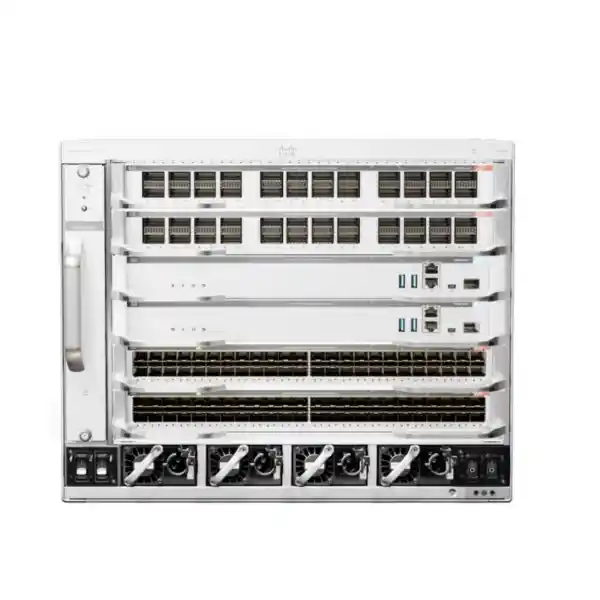
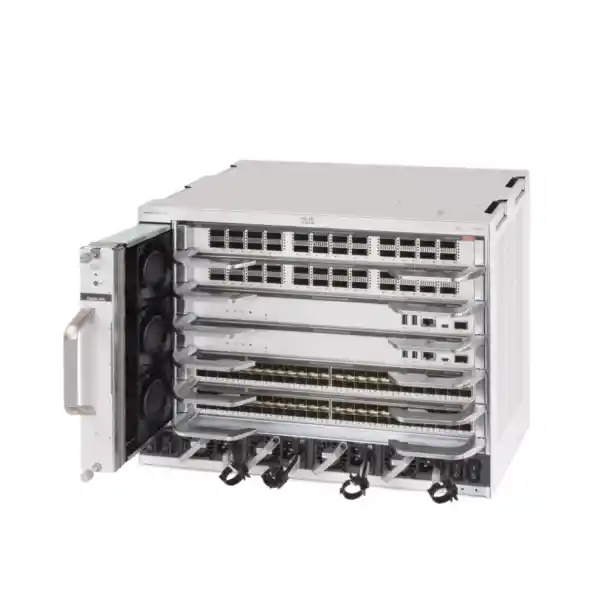
The chassis contains six physical slots. Slots 3 and 4 are dedicated to supervisor engines, while slots 1, 2, 5 and 6 accept line cards. This separation is useful because it makes the design intent visible: supervisory control and centralized forwarding are treated as a resilient system function, while physical interfaces remain modular. A deployment can start with the interface density required today and add line cards later, subject to supported hardware and software combinations. It can also be designed with dual supervisors from day one when the operational requirement is to remove a single supervisor as a failure domain.
With the C9600X-SUP-2, the platform can provide up to 6.4 Tbps of bandwidth per line-card slot and up to 25.6 Tbps of chassis switching capacity. The older C9600-SUP-1 remains an important option in environments whose interface strategy is centered on 1G, 10G, 25G and 100G rather than the newest 50G and 400G combinations. Supervisor selection therefore should not be reduced to choosing the highest number. The correct decision depends on desired line cards, software compatibility, optics, feature requirements, oversubscription targets, migration timing and expected life of the core.
For UAE organizations with multiple sites, a well-designed C9606R core can also simplify standardization. Headquarters, a large campus, a command center or a major branch can use a common operating model based on Cisco IOS XE, consistent routing policy, familiar automation interfaces and a shared operational toolset. FourTeck can integrate the switching layer with broader enterprise infrastructure delivered through FourTeck UAE, including network architecture, implementation and lifecycle support.
Chassis architecture and physical engineering
Six-slot modular layout
Four slots are reserved for line cards and two central slots are reserved for supervisors. The physical organization supports a clean modular bill of materials and allows line-card capacity to be expanded without replacing the entire platform.
8RU footprint
The chassis measures about 35.43 × 44.2 × 40.9 cm and occupies eight rack units. Its depth is modest for a high-capacity modular core, but rack rail, cable bend radius and front/rear service clearance still need to be checked before installation.
Four PSU bays
The platform supports four power-supply bays and multiple AC/DC power-supply options. Redundancy mode, line-card population, supervisor choice, input voltage and future expansion all affect the correct power design.
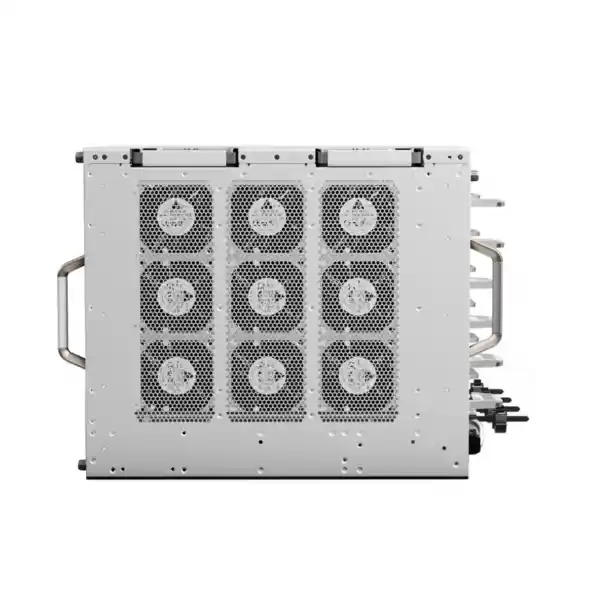
Nine-fan tray
A hot-swappable fan tray uses nine redundant fans. The chassis is engineered for side-to-side airflow and front accessibility to major field-replaceable components, which can simplify maintenance in enterprise racks.
Physical design is a significant part of a successful modular switch deployment. The C9606R chassis with fan tray and two AC power supplies is roughly 31.31 kg, so the rack must be structurally appropriate and installation should be planned for safe handling. The chassis without fan tray and power supplies is approximately 25.36 kg. In a production environment, engineers should reserve enough vertical space not only for the 8RU chassis itself but also for horizontal or vertical cable management, fiber slack management, rack PDUs, and the service envelope needed to replace modules without disturbing adjacent equipment.
Power planning deserves equal attention. The chassis accepts 3000W AC, 2000W AC and 2000W DC supply options. Cisco documents a minimum of two power supplies in many configurations, while a fully populated system operating from 110V input may require at least three. In UAE data rooms that use 230V nominal utility feeds, the electrical design should still be validated against the actual configured load, redundancy policy and PDU topology. For meaningful resilience, power supplies should be distributed across independent PDUs or UPS-backed circuits where the facility design allows it. Installing redundant PSUs into the same upstream electrical failure domain does not provide end-to-end power resiliency.
Thermal design is equally important in Dubai and the wider UAE because equipment-room ambient temperature can rise quickly during a cooling incident. Cisco specifies normal operation down to -5°C and up to 45°C at lower altitudes, with the upper operating limit reducing at higher elevations. The practical design objective is not to run near the maximum. Data-room cooling should maintain stable inlet temperature and adequate airflow with no recirculation of hot exhaust air. Blanking panels, rack containment, cable placement and clearance around the chassis can materially affect thermal behavior.
The platform also includes embedded RFID tags in key removable components, supporting inventory workflows where organizations use compatible RFID readers. This detail can be valuable in large estates where chassis, supervisors, line cards, power supplies and fan assemblies are tracked as separate assets for lifecycle, sparing and compliance purposes.
Supervisor engines: C9600-SUP-1 versus C9600X-SUP-2
The supervisor engine is the most consequential design choice in a Catalyst C9606R build because the platform uses a centralized forwarding architecture. The supervisor contains the forwarding silicon, route processor resources and system intelligence that determine the bandwidth available to line-card slots and the family of line cards that can be used. A correct quotation must therefore start with the target architecture, not simply with a chassis SKU.
| Design factor | C9600-SUP-1 | C9600X-SUP-2 |
|---|---|---|
| Forwarding silicon | Cisco UADP 3.0 ASIC architecture | Cisco Silicon One Q200 architecture |
| Bandwidth per line-card slot | Up to 2.4 Tbps | Up to 6.4 Tbps |
| Memory | 16 GB DRAM | 32 GB DRAM |
| Typical positioning | Mature campus designs centered on 1/10/25/100G requirements | Higher-density 50/100G and 400G-ready core designs |
Supervisor Engine 1 is based on Cisco UADP 3.0 and has a long-established role in Catalyst 9600 deployments. Cisco describes the architecture as using multiple UADP ASICs connected by high-bandwidth interconnects. It supports the original Catalyst 9600 line-card family and is suitable when the network requirement does not depend on the newest 400G line cards. It remains a rational choice in many campus environments because a large percentage of enterprise access aggregation still terminates at 10G or 25G, while routed or internet-edge handoffs frequently use 40G or 100G.
Supervisor Engine 2 substantially raises the ceiling. It uses a Cisco Silicon One Q200 ASIC and increases maximum line-card slot bandwidth to 6.4 Tbps. This is the supervisor to examine when a customer needs the C9600X-LC-32CD for 400G/200G/100G/40G connectivity, the C9600X-LC-56YL4C for dense 50G/25G/10G SFP56 connectivity, or simply wants a longer runway for core bandwidth growth. Because C9600X-SUP-2 does not provide dedicated front-panel uplink ports, uplinks are normally delivered from the selected line cards. That is an important bill-of-materials consideration: a design that assumes the supervisor itself provides uplink optics can end up missing required interfaces.
A dual-supervisor design provides in-chassis redundancy with Stateful Switchover and Non-Stop Forwarding capabilities where supported and correctly configured. The objective is to preserve control-plane continuity and forwarding behavior during a supervisor failure or planned event. This does not remove every failure domain. Chassis power, line cards, optics, upstream devices, software defects and cabling remain part of the overall availability model. For highly critical campuses, engineers should decide whether one resilient chassis is sufficient or whether a dual-chassis architecture using technologies such as StackWise Virtual is appropriate.
Supervisor choice must also be mapped to the target Cisco IOS XE release. C9600-SUP-1 was introduced with the original C9606R software support, while C9600X-SUP-2 requires later IOS XE software. A production rollout should use a Cisco-supported release aligned with the selected hardware, features and organizational software lifecycle policy, rather than selecting an arbitrary image solely because it is the newest available build.
Line-card planning from 1G access aggregation to 400G core connectivity
The C9606R can support a wide range of interface profiles, but line-card compatibility varies by supervisor and software release. FourTeck therefore treats line-card selection as a topology and traffic-engineering exercise rather than simply counting ports.
C9600X-LC-56YL4C
Designed for C9600X-SUP-2, this high-density line card provides 56 SFP56 ports supporting 50G, 25G or 10G, plus four QSFP28 ports supporting 100G or 40G. It is well suited to dense campus distribution aggregation where numerous downstream 10/25/50G links coexist with higher-speed upstream connectivity.
C9600X-LC-32CD
This C9600X-SUP-2 line card targets the highest-speed core and interconnect roles, combining thirty QSFP28 ports for 100G/40G with two QSFP-DD ports that can support 400G, 200G, 100G or 40G depending on the qualified transceiver and software combination.
C9600-LC-40YL4CD
A flexible combo option that provides a substantial population of SFP-family ports for 1/10/25G plus high-speed QSFP-family uplinks. It can be attractive for transition designs that need a broad range of established enterprise optical speeds.
C9600-LC-24C
A QSFP-based line card focused on 40G and 100G aggregation. It is commonly evaluated where existing distribution systems already use 40G links and the organization wants a migration route toward higher 100G density.
C9600-LC-48YL
A 48-port SFP-family option suitable for dense 1G, 10G and 25G aggregation. With supported supervisor and software combinations, it can also participate in higher-speed migration strategies where existing fiber plant is retained.
C9600-LC-48TX / C9600-LC-48S
The 48TX provides multigigabit RJ-45 copper connectivity through 10G, while the 48S provides 1G SFP density and is associated with Supervisor Engine 1. These cards serve specific legacy or aggregation needs and require compatibility review before quotation.
Port density numbers must be interpreted carefully. Marketing-scale figures generally assume specific line cards, supervisors and breakout modes. For example, Cisco documents chassis capabilities including up to 128 native 40G or 100G QSFP28 interfaces and up to eight native 400G QSFP-DD interfaces in supported combinations. Other combinations can provide very high SFP-family density. However, a real design is rarely uniform. One line card may terminate four distribution blocks at 100G, another may aggregate dozens of 25G fiber links, and another may reserve 400G links for a data center or high-capacity campus interconnect.
The sizing process should begin with a port map. For every required connection, record the local device, remote device, current speed, desired future speed, media type, fiber type, connector, distance, redundancy role, VLAN or routed purpose and expected utilization. Then group the interfaces by line-card compatibility. This avoids a common procurement error: buying enough raw ports but discovering that the chosen card lacks the required combination of breakout, optic type, speed or supervisor compatibility.
Optics deserve their own validation. SFP, SFP+, SFP28, SFP56, QSFP28 and QSFP-DD form factors are not interchangeable merely because they fit related cages or support adjacent speeds. Transceiver power, wavelength, reach, fiber grade, breakout behavior, digital optical monitoring, Cisco qualification and thermal limits matter. High-power copper SFP modules can have placement restrictions on dense cards. A complete FourTeck quotation should therefore list the exact optics or DAC/AOC assemblies per interface instead of leaving media selection until installation day.
High availability: designing beyond a single redundant component
The C9606R is built for high-availability campus roles. Dual supervisor slots enable a 1+1 supervisor design, and Cisco supports Stateful Switchover, Non-Stop Forwarding and In-Service Software Upgrade capabilities in supported configurations. Four power-supply bays allow redundant electrical design, while the fan tray contains redundant fans. These features establish a strong platform foundation, but high availability depends on how the entire network is constructed.
Start by mapping failure domains. A single C9606R with two supervisors removes the active supervisor as a single point of failure, yet the chassis is still one physical system. A facility event, catastrophic chassis fault, maintenance accident, rack PDU issue or environmental incident can affect the whole switch. When the business impact of a campus-core outage is very high, two C9606R systems can be deployed as a logical redundant pair using an architecture such as StackWise Virtual where supported by the intended software and interface design. StackWise Virtual allows two physical switches to operate with a simplified logical topology and can support multi-chassis EtherChannel designs, reducing the dependence on spanning tree for first-hop distribution connections.
Dual-chassis designs should physically separate dependencies where possible. If both core chassis are in the same rack, connected to the same PDU, the same UPS and the same fiber tray, the architecture may still be vulnerable to common-mode failures. Larger campuses may distribute the pair across adjacent racks, separate power feeds or separate equipment rooms, depending on latency, cabling and facility constraints. The correct arrangement is driven by business continuity objectives, not simply by a diagram template.
Routing design is another part of availability. Campus networks increasingly use routed access or routed distribution boundaries to reduce Layer 2 fault domains. OSPF, IS-IS, BGP and multicast routing may be employed depending on the architecture and organizational standard. First-hop redundancy, ECMP, route summarization, fast convergence, Bidirectional Forwarding Detection and policy control should be designed together. The C9606R has the control-plane and forwarding scale for sophisticated enterprise routing, but using every available protocol is not the objective. Simplicity, determinism and operational familiarity normally produce better uptime than unnecessary feature density.
Maintenance strategy matters as much as fault recovery. With redundant supervisors and a supported software combination, ISSU can reduce disruption for some software upgrades. Engineers must still review release-specific restrictions, feature interactions and recommended upgrade paths. A maintenance window should include prechecks, configuration backups, image and package validation, redundancy-state verification, post-upgrade testing and rollback criteria. High availability should never be interpreted as permission to upgrade production systems without change control.
For organizations that need design, implementation and ongoing engineering support beyond hardware supply, FourTeck’s IT Services UAE capability can be aligned with the switching project to cover assessment, migration, configuration standards, testing, documentation and post-deployment support.
Performance architecture, forwarding behavior and oversubscription discipline
The Catalyst 9600 family uses a centralized architecture in which forwarding, security processing and queueing are performed on the supervisor, while line cards primarily provide the physical interfaces and associated control logic. This is strategically important because the supervisor can upgrade the system’s forwarding capability without forcing replacement of every supported line card. It also contributes to consistent policy behavior across ports because forwarding intelligence is centralized.
With C9600X-SUP-2, the chassis can deliver up to 25.6 Tbps of switching capacity and up to 6.4 Tbps per line-card slot. Cisco describes the corresponding full-duplex values separately in some documents, so architects should compare like-for-like figures when evaluating platforms from different vendors. The practical question is whether the combination of interfaces on a selected line card can forward at the required rate under expected traffic patterns. Supported C9600X high-density cards are designed to provide non-blocking operation in their intended configurations, but the end-to-end network can still be oversubscribed at aggregation points by design.
Oversubscription is not inherently bad. A campus distribution layer with forty-eight 10G downstream connections does not usually require 480G of continuous upstream bandwidth because access-switch links rarely run at 100 percent simultaneously. A sensible ratio can dramatically reduce optic and port cost. The mistake is using a generic ratio without measuring application behavior. Video production, high-performance research, VDI, storage replication, backup windows and large east-west data transfers can create traffic profiles very different from ordinary office access.
For a core refresh, FourTeck recommends capturing interface utilization and flow patterns from the existing environment over representative business cycles. Record 95th-percentile bandwidth, short peaks, error rates, packet drops, queue behavior and growth trend. Then classify interfaces by criticality. A business-critical distribution block may justify dual 100G or 400G uplinks even when current utilization is low because the objective is resilience and lifecycle headroom. A low-density branch aggregation block may remain perfectly efficient on dual 10G or 25G.
Latency is also relevant, especially for voice, collaboration, industrial control and high-frequency transaction environments. Cisco documentation for the platform family reports sub-five-microsecond forwarding latency between ports in supported configurations. In a campus, however, total application latency includes endpoint processing, wireless contention, access switching, firewall inspection, WAN transport, server response and other network stages. The C9606R core should therefore be seen as a low-latency building block rather than the sole determinant of user experience.
Queueing and QoS design become more important as link speeds increase because a short microburst can contain a large amount of data. Class maps, policy maps, marking boundaries and queue allocation should reflect actual business priorities. Real-time voice and critical control traffic may need low-latency treatment, while backups and bulk replication should yield during congestion. The modular core provides advanced QoS capabilities, but policy should be consistent across access, distribution, WAN and security layers to prevent contradictory treatment.
Routing, segmentation and security capabilities for enterprise networks
A Catalyst C9606R deployment typically sits at a point where many network policies converge. It may provide Layer 3 boundaries for user, voice, wireless, server, building-management and guest networks; exchange routes with a data-center fabric; connect to internet or firewall blocks; and participate in campus segmentation. The Network Advantage software tier provides the advanced Layer 2 and Layer 3 feature foundation expected in this role, while the Catalyst or Cisco DNA Advantage subscription adds automation, analytics and policy-oriented capabilities associated with Cisco’s broader campus architecture.
Traditional routing remains central. OSPF is widely used for enterprise interior routing because it is standards-based and familiar. BGP is increasingly used inside large enterprises for policy separation, scalable route exchange and data-center interconnection. Multicast protocols are relevant for IPTV, financial feeds, video distribution and specialized operational systems. VRF-based segmentation allows multiple routing domains to share the same physical core while maintaining logical separation. The correct choice depends on the operational team and architecture, not on the maximum number of protocols supported by the switch.
Cisco Software-Defined Access can use the Catalyst 9600 as a campus-core building block in larger policy-driven environments. This introduces fabric concepts, centralized policy and automation through Cisco Catalyst Center. Organizations considering SD-Access should evaluate the full operational model including identity, IP addressing, underlay routing, fabric roles, integration with wireless, policy administration, monitoring and troubleshooting. Deploying a powerful chassis does not by itself create an automated campus; the surrounding design and operational process determine whether the architecture delivers value.
Security at the core should be layered. Access-control lists can enforce deterministic filtering at routed boundaries. VRFs can isolate business units or security zones. Infrastructure protection policies should restrict management-plane access and protect routing protocols. AAA integration can centralize administrator authentication, authorization and accounting. Secure management protocols, SNMPv3 where SNMP is needed, certificate management, encrypted transport, logging and time synchronization should be standardized. Unused services should be disabled and management access should come from dedicated administrative networks whenever possible.
The core also needs secure integration with firewalls and internet edges. In many UAE enterprise designs, the C9606R terminates high-speed routed links toward next-generation firewalls rather than performing perimeter security itself. The handoff design should identify inside, outside, DMZ, guest, remote-access and cloud connectivity zones, decide whether routing is static or dynamic, and define clear ownership of route filtering and failover. FourTeck’s Firewall Dubai practice can align firewall sizing and HA design with the Catalyst core so that a 100G-capable switching layer is not constrained by an undersized security edge.
Telemetry should be designed from the start. A core switch produces logs, interface counters, routing-state changes, environmental status, hardware alarms and application-related telemetry that can materially improve incident response. Monitoring platforms should collect only what the operations team can meaningfully use. Alerts need thresholds and suppression logic that distinguish actionable degradation from routine state transitions. Core devices should be backed up automatically, configuration changes should be attributable, and lifecycle reporting should include software version, module inventory, serials, license state and support status.
For environments where the C9606R provides aggregation toward virtualization hosts, storage, private cloud or rack servers, FourTeck can coordinate the switching design with Server Dubai requirements so NIC speeds, LACP design, VLAN/VRF boundaries, MTU, transceivers and redundancy are engineered as one system instead of separate purchasing decisions.
Software licensing and subscription planning
Cisco’s current ordering model makes licensing a mandatory part of the bill of materials rather than an optional administrative detail. New Catalyst 9600 orders include Network Advantage as the perpetual network stack license, while a Catalyst Software Subscription or Cisco DNA Advantage subscription is selected for the required term. Cisco commonly offers three-, five- and seven-year term choices in its ordering documentation. Subscription packaging evolves, so the exact SKU and entitlement set should be validated at quotation time.
Network Advantage provides the core switching and routing feature foundation, including advanced routing, segmentation, multicast and security capabilities. The Advantage subscription layer is associated with higher-level automation, analytics, assurance, segmentation and application-visibility functions, particularly when the deployment is managed through Cisco Catalyst Center. Customers should determine which capabilities they will operationally use, but they should not attempt to omit a mandatory subscription from a new system quote simply because the initial deployment will be CLI-managed.
Cisco has also been evolving unified networking subscriptions. Current ordering documentation describes Cisco Switching Advantage within a Cisco Networking Subscription model, while Cisco DNA licensing remains relevant for existing and transitional procurement. The correct commercial route depends on the order date, agreement structure, Cisco account, software release and customer entitlements. FourTeck should therefore produce a quote with clear line-item separation between perpetual network entitlement, term subscription, support coverage and hardware components.
Smart Licensing should be included in the deployment plan. The customer needs a Cisco Smart Account and an internal process for assigning entitlements, registering devices and maintaining visibility into license consumption. In regulated environments, account ownership should be tied to the organization rather than to a departing employee or third-party integrator. Access to the Smart Account, Cisco support portal and software downloads should be documented as part of handover.
Support coverage also requires explicit decisions. Hardware warranty terms, subscription support and enhanced support services are not interchangeable. A mission-critical core may justify a support level with fast hardware replacement and direct vendor escalation. Organizations with spares on site may choose a different model. UAE delivery logistics, customs processes for replacement parts, maintenance windows and the organization’s own ability to swap modules should all influence the SLA choice.
The procurement objective is clarity. A buyer should be able to see exactly which chassis, supervisors, SSDs if selected, line cards, power supplies, power cords, fan tray, optics, patch leads, licenses and support contracts are included. This prevents the common situation in which an apparently low chassis price becomes an incomplete project because critical modules were assumed rather than quoted.
Migration from Catalyst 6500, 6800 and older modular cores
The C9606R is frequently considered as a modernization platform for organizations still operating Cisco Catalyst 6500 or 6800 systems. Those older platforms have served enterprises for many years, but aging supervisors, legacy line cards, old optics, discontinued software trains and rising support risk can make continued operation increasingly difficult. A successful migration is not a chassis replacement exercise; it is an opportunity to simplify topology, increase link speeds, reduce Layer 2 fault domains and update operational standards.
Begin with discovery. Export the complete current configuration, inventory all modules and optics, collect routing tables, spanning-tree state, EtherChannel membership, VLAN databases, HSRP or VRRP configuration, multicast state, ACLs, QoS policies, SNMP and logging settings, AAA, management VRFs, DHCP relay, policy routing and any embedded services. Then identify which features are still necessary. Legacy core switches often contain years of configuration that no longer serves an active application.
Next build a dependency matrix. Every physical port should map to a connected device and business service. Determine whether the link can be moved independently, whether the remote device supports LACP, whether the optic can be reused, whether the VLAN can be routed elsewhere and whether the application can tolerate a brief adjacency reset. High-risk dependencies such as building-management systems, voice gateways, legacy firewalls and storage appliances should be tested before the main migration window.
The new C9606R design does not have to replicate the old topology. If the existing core carries hundreds of stretched VLANs because that was historically convenient, the refresh may be the right time to move Layer 3 boundaries closer to distribution. If the old chassis uses 1G uplinks, replacing them with 25G or 100G can remove bottlenecks. If the current core uses a single chassis with dual supervisors, the business may now justify a dual-chassis StackWise Virtual architecture. Conversely, organizations with a simple network should resist adding complexity solely because the new platform supports it.
A staged migration is usually safer than a one-shot cutover. Install the C9606R in parallel, establish routed adjacency to the existing core, validate management and monitoring, then move distribution blocks or services in planned groups. Dual-homing can be used where the remote platform and spanning-tree/routing design permit it. Each group should have explicit validation tests and rollback steps. The team should know in advance how to recognize success: routing adjacencies stable, interface errors absent, application paths reachable, voice registered, wireless controllers accessible, internet traffic normal and monitoring green.
Optic migration needs care. Older multimode fiber may not support the reach required at 40G or 100G. MPO/MTP cabling may be required for some parallel-optics designs, while modern single-mode LR optics can simplify longer campus links. Before ordering high-speed optics, verify fiber type, connector, path loss, patch-panel cleanliness and actual distance. A fiber certification exercise is inexpensive compared with diagnosing intermittent high-speed links during a production cutover.
Finally, decommissioning should be controlled. Keep the old core powered and isolated for an agreed rollback period if change governance allows it. Archive final configurations, serial numbers and support data. Remove old routing and VLAN dependencies from adjacent systems, update diagrams and CMDB records, and sanitize storage according to organizational policy before disposal or resale.
UAE deployment considerations: rack, power, cooling, optics and support logistics
Enterprise networking in the UAE has practical constraints that should be resolved during design rather than after delivery. The C9606R is a high-capacity modular switch and should normally be installed in a controlled data-room or data-center environment with stable power, adequate cooling, grounding, structured cabling and physical access control. A site survey should confirm these conditions before shipment when the rack environment is unknown.
Rack depth and service clearance are the first checks. Although the chassis depth is approximately 40.9 cm, rear cable bundles, rack PDUs and adjacent equipment can reduce usable space. The chassis uses side-to-side airflow, which differs from front-to-back airflow common in many server platforms. Rack placement and containment should ensure that cool inlet air reaches the switch and exhaust is not immediately recirculated. This is especially important in mixed network/server rooms where cooling was originally designed around front-to-back server airflow.
Power circuits should be documented by voltage, plug type, breaker rating, UPS source and PDU position. Redundant switch power supplies should ideally land on independent upstream paths. The design should calculate the maximum expected draw for the selected supervisor and line-card population, not use chassis maximums blindly and not assume that two PSUs always deliver full redundancy in every operating condition. If future line cards will be added, reserve both electrical and thermal capacity now.
Fiber infrastructure in UAE campuses can vary widely. Newer buildings often have OS2 single-mode backbone fiber, while older facilities may rely on OM2, OM3 or OM4 multimode. Some links pass through multiple patch panels and building distribution frames. High-speed optics should be selected using the entire optical path. Distance alone is insufficient; connector loss, splice loss, fiber grade and cleanliness affect margin. For 100G and 400G upgrades, a predeployment optical budget and certification report can eliminate costly surprises.
Sparing strategy should reflect local business impact. Keeping one spare fan tray, selected power supplies and a small pool of common optics can materially reduce recovery time. Whether a spare supervisor or line card is justified depends on support SLA and network redundancy. If two core chassis are designed so either can carry the entire campus temporarily, the second chassis effectively provides hardware resilience and may reduce the need for expensive cold spares. If the core is a single chassis serving a critical site, on-site sparing becomes more important.
Documentation should be bilingual or operationally appropriate where teams require it, and it should include rack elevations, power mapping, port maps, optic types, logical diagrams, IP addressing, routing design, redundancy roles, software versions, Smart Account ownership and escalation contacts. FourTeck can provide this documentation as part of a structured UAE deployment rather than leaving the operations team with only a vendor packing list.
Sizing methodology for a C9606R quotation
The fastest way to produce an accurate C9606R configuration is to separate business requirements from hardware selection. Begin with availability: can the site tolerate a core outage, and for how long? If downtime is highly constrained, dual supervisors may be mandatory and dual chassis may be appropriate. Then define port requirements by speed and media. Count current links and add realistic growth. Do not add a blanket 100 percent headroom unless the business has a corresponding expansion plan; modularity already allows line cards to be added later.
Supervisor sizing comes next. If the port plan requires C9600X-only line cards or 400G QSFP-DD interfaces, C9600X-SUP-2 becomes the natural choice. If the environment is centered on supported legacy line cards and does not need the additional bandwidth, C9600-SUP-1 may remain viable. The supervisor decision should also reflect lifecycle: a core expected to remain in service for seven to ten years may benefit from higher-speed capability even if the first deployment uses lower-speed optics.
Line-card mapping follows. Assign every required interface to a physical card and reserve enough free ports for maintenance, replacement and growth. Avoid concentrating all critical uplinks on one line card if a card failure would isolate the whole site. In a dual-chassis topology, distribute downstream connections symmetrically so that each chassis can preserve service. Check whether breakout is required and ensure the line card, optic and software support the intended breakout mode.
Power calculations should use the actual hardware bill. Determine how many power supplies are needed for normal operation and how many are required to preserve redundancy after a PSU or input-feed failure. Match power-cord types to the site PDU. Confirm that the rack can accommodate all cable bends and that structured fiber paths can reach the chassis without violating bend radius.
Licensing and support are then added. Select the current required Advantage subscription term, associate the customer Smart Account and choose a support service appropriate to business risk. Finally, produce a complete optics schedule and installation services scope. This order of work produces a quote that maps cleanly to the architecture and is much less likely to need emergency additions during implementation.
When requesting a quote from FourTeck, provide the current switch model, number of connected distribution/access switches, desired uplink speed, fiber type, redundancy requirement and whether the project is a new deployment or migration. These six data points are usually enough to create a strong first-pass design.
Example deployment patterns
Large enterprise campus core
Two C9606R chassis can form the resilient core, each with redundant supervisors where the business requires the highest level of control-plane redundancy. Distribution switches connect to both chassis with high-speed links. Routed or multi-chassis EtherChannel designs reduce single points of failure. Firewall, data-center and WAN blocks connect redundantly.
High-density distribution aggregation
A C9606R with C9600X-SUP-2 and dense SFP56 line cards can aggregate many downstream 10G, 25G or 50G links while reserving QSFP28 ports for 100G upstream connections. This pattern is attractive where many access stacks are being refreshed and the organization expects Wi-Fi and endpoint bandwidth to grow significantly.
400G-ready core interconnect
C9600X-LC-32CD with C9600X-SUP-2 can provide QSFP-DD 400G interfaces for very high-capacity core or data-center interconnection while maintaining a larger set of 100G/40G interfaces. This pattern suits organizations consolidating traffic onto fewer, faster optical paths.
Legacy modernization
The platform can replace Catalyst 6500/6800-era modular cores while preserving a staged transition. Existing 1G, 10G, 40G or 100G links can be migrated in controlled groups, with new higher-speed capacity introduced where fiber and remote devices support it.
These are patterns, not fixed bundles. The correct bill of materials can only be produced after identifying the number, speed and redundancy role of actual interfaces. FourTeck avoids presenting a chassis as if it were a complete switch because the C9606R depends on supervisor, line-card, power, optic and licensing choices.
Operations, automation and lifecycle management
A campus core should be managed as infrastructure code and operational data, not as a device that is only touched during outages. Cisco IOS XE supports programmable interfaces and automation workflows that can help organizations standardize configuration and reduce manual error. The exact toolset may include Cisco Catalyst Center, NETCONF/YANG, RESTCONF, APIs, configuration management platforms and external observability systems.
Automation should begin with repeatable standards: hostname, management VRF, AAA, NTP, DNS, SNMP, syslog, interface descriptions, routing authentication, banner policy, SSH, logging and telemetry. These controls can be expressed as templates and validated consistently. More advanced automation can provision VRFs, routing policy, VLANs and interface profiles, but high-impact changes should still pass through review and testing.
Configuration compliance is particularly valuable on a modular core. A small unauthorized change to route filtering or spanning-tree behavior can affect a large portion of the organization. Automated comparison against a golden configuration or intent model can detect drift quickly. Backup systems should retain version history, not just the latest file, so engineers can correlate an incident with a specific change.
Software lifecycle needs a formal cadence. Track Cisco security advisories, recommended releases, end-of-maintenance notices and hardware compatibility. Do not upgrade solely because a new train appears; evaluate feature needs, field experience, vulnerabilities, bug exposure and support guidance. In environments using advanced features such as StackWise Virtual or ISSU, test the intended upgrade path in a lab or lower-risk site whenever practical.
Capacity lifecycle is also important. A modular chassis can remain in service while bandwidth demand grows, but only if free slots, power and supervisor headroom exist. Quarterly or semiannual reviews should examine port consumption, average and peak utilization, optical errors, CPU and memory, routing-table growth, TCAM-related scale, environmental history and PSU load. A line card should be ordered before all ports are consumed, not after the last available interface is placed into production.
Asset lifecycle should record serial numbers for chassis and replaceable modules, purchase date, warranty or support entitlement, rack location, software train, Smart Account mapping and assigned business owner. This supports both audit requirements and rapid fault handling. The C9606R’s modularity is an operational advantage only when the organization knows exactly which module is installed where and which spare can replace it.
Technical specification summary
| Product model | Cisco Catalyst C9606R |
| Chassis size | 8 rack units |
| Dimensions | Approximately 35.43 × 44.2 × 40.9 cm (H × W × D) |
| Total slots | 6 |
| Line-card slots | 4 — slots 1, 2, 5 and 6 |
| Supervisor slots | 2 — slots 3 and 4 |
| Supported supervisors | C9600-SUP-1 and C9600X-SUP-2 |
| Maximum switching capacity | Up to 25.6 Tbps with supported C9600X-SUP-2 configuration |
| Maximum bandwidth per line-card slot | Up to 6.4 Tbps with C9600X-SUP-2; up to 2.4 Tbps with C9600-SUP-1 |
| Power-supply bays | 4 |
| Power-supply families | 3000W AC, 2000W AC and 2000W DC options |
| Cooling | One hot-swappable fan tray with nine redundant fans; side-to-side airflow |
| Input voltage | AC 90–264V, 47–63 Hz; DC -40V to -72V |
| Normal operating temperature | Up to 45°C at lower altitude ranges, with altitude-dependent limits per Cisco specifications |
| Representative interface range | 1G, multigigabit copper, 10G, 25G, 40G, 50G, 100G, 200G and 400G depending on supervisor, line card, optic and software |
| High-availability features | Redundant supervisors, SSO, NSF, ISSU in supported configurations, redundant power and fans, and StackWise Virtual architecture options |
Specifications are configuration-dependent. Exact port scale, breakout support, transceiver compatibility, power requirements, feature availability and software minimums must be validated against the selected supervisor, line cards and Cisco IOS XE release at order time.
Frequently asked technical questions
Is the C9606R a complete switch by itself?
No. The chassis must be configured with at least one supported supervisor, line-card connectivity, fan tray and sufficient power supplies, plus optics or copper media as required. A second supervisor and additional PSUs are typically selected for resilient enterprise deployments.
Can it support 400G?
Yes, with C9600X-SUP-2 and compatible 400G-capable line cards such as C9600X-LC-32CD, together with supported QSFP-DD optics and software. 400G should be selected only where the fiber path and remote endpoint are also compatible.
Does it support dual supervisors?
Yes. Slots 3 and 4 are dedicated supervisor slots and can be populated for redundancy. Software and hardware compatibility must be checked so that SSO/NSF and upgrade behavior match the intended availability design.
Which supervisor is best?
C9600X-SUP-2 is the stronger choice for maximum bandwidth, 400G capability and newer high-density line cards. C9600-SUP-1 remains appropriate for supported environments where the established interface portfolio and 2.4 Tbps per-slot ceiling meet the lifecycle requirement.
Can it replace a Catalyst 6500?
Yes, it is a common modernization path for large campus cores, but migration requires feature, interface, routing, optic and topology mapping. Configurations should be redesigned where appropriate rather than copied line-for-line from legacy hardware.
What license is required?
Cisco’s current ordering guidance includes Network Advantage with the hardware and requires an Advantage subscription for new orders under the applicable Catalyst Software Subscription, Cisco DNA or unified subscription model. Exact commercial SKUs should be validated at quotation time.
Decision recap: when the Catalyst C9606R is the right platform
Choose the Cisco Catalyst C9606R when the network needs a modular campus-core or high-capacity distribution platform, not simply a fixed-port aggregation switch. Its strongest use cases involve a requirement for redundant supervisors, multiple line-card types, dense high-speed optical interfaces, long lifecycle expansion, advanced enterprise routing and a controlled evolution toward 100G or 400G core connectivity.
Quotation input checklist
To receive a technically accurate C9606R quotation, provide the information below. Incomplete chassis-only requests can be priced, but a complete system quote is more useful because it prevents missing supervisors, line cards, optics, licenses or power components.
Existing core/distribution models, topology, software versions, number of sites and whether this is a greenfield deployment or migration.
Count of 1G, 10G, 25G, 40G, 50G, 100G, 200G and 400G ports, including required breakout modes.
Single-mode or multimode, approximate distance, connector type, existing optics to be reused and remote-device transceiver capability.
Single/dual chassis, single/dual supervisor, desired PSU redundancy, existing UPS/PDU design and acceptable outage duration.
OSPF, BGP, multicast, VRFs, StackWise Virtual, SD-Access, Catalyst Center, QoS, ACL and telemetry requirements.
Required subscription term, support SLA, installation, configuration, migration, documentation, training and post-cutover support.
Plan the C9606R as a complete core architecture
FourTeck UAE can prepare a bill of materials and deployment architecture covering the chassis, supervisor engines, line cards, optics, redundant power, software subscriptions, support and migration services. The most useful starting point is a current network diagram or a simple list of existing uplinks and required future speeds.
The result should be a platform that has enough headroom for the expected lifecycle without paying for unused capacity that has no business case. A modular core is most valuable when physical capacity, failure domains, licensing, software lifecycle and operational processes are designed together.
Enterprise switching, firewall integration, server connectivity, structured migration and post-deployment engineering for UAE organizations.

Reviews
There are no reviews yet.