
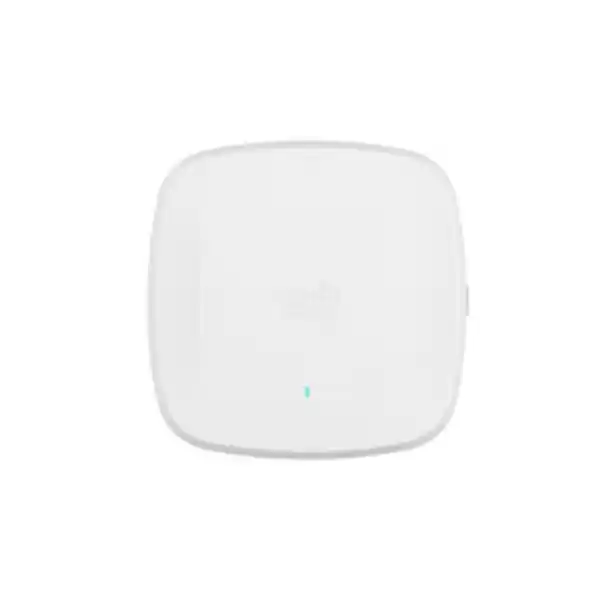
Cisco Catalyst CW9166D1 Wi-Fi 6E Access Point
The Cisco Catalyst CW9166D1 is purpose-built for organizations that need focused, high-capacity wireless coverage without adding external antenna assemblies. It combines tri-band Wi-Fi 6E, three 4×4 radio chains, integrated directional antennas, a 5 Gbps multigigabit Ethernet uplink, enterprise security, RF intelligence, environmental sensors and flexible Cisco management choices in a single indoor access point platform. For UAE projects, it is especially relevant to warehouses, distribution centres, auditoriums, high-ceiling halls, long aisles, exhibition spaces, industrial offices and other areas where controlled RF energy is more useful than an omnidirectional pattern.
What the CW9166D1 is designed to solve
Many enterprise wireless projects fail for reasons that have little to do with the headline Wi-Fi generation. A site may have enough nominal radio capacity yet still suffer from weak aisle-end coverage, excessive co-channel overlap, poor roaming boundaries, high retry rates, inconsistent 6 GHz reach, uplink bottlenecks or access points installed in positions that were convenient for cabling but unsuitable for RF. The CW9166D1 addresses a specific part of that problem: it gives network architects a Wi-Fi 6E access point with an integrated directional antenna system, allowing energy to be aimed toward the intended service area rather than distributed broadly in all directions.
That distinction matters in high-ceiling facilities, warehouse aisles, auditoriums, large halls and corridor-style deployments. Instead of treating every room as a conventional office grid, the designer can build RF cells around traffic flow, rack geometry, seating zones, work areas and client density. The access point still requires a proper predictive design and post-install validation, but its antenna pattern offers a more appropriate starting point for focused coverage than a ceiling-mounted omnidirectional AP in many challenging spaces.
Core platform capabilities
Tri-band 4×4 Wi-Fi 6E
The platform provides 4×4 operation across the 2.4 GHz, 5 GHz and 6 GHz bands. This gives a network architect a strong foundation for high-density enterprise WLANs, while Wi-Fi 6/6E mechanisms such as OFDMA, MU-MIMO, BSS coloring and Target Wake Time improve how airtime is shared among modern clients.
Integrated directional antennas
The CW9166D1 uses a directional antenna system rather than the omnidirectional pattern of the CW9166I. Cisco specifies approximately 6 dBi peak gain with a 70 by 70 degree pattern for the 2.4 and primary 5 GHz operation, and approximately 8 dBi with a 60 by 60 degree pattern for 6 GHz and the relevant XOR 5 GHz operation.
5 Gbps multigigabit uplink
A 100M/1G/2.5G/5G RJ-45 Ethernet interface helps prevent the wired uplink from becoming an artificial ceiling for aggregate wireless traffic. This makes the AP a natural companion for multigigabit access switching and appropriate PoE budgets.
Dedicated RF intelligence
Cisco CleanAir Pro and the dedicated scanning architecture support continuous RF visibility, interference awareness and operational troubleshooting across the Wi-Fi spectrum. This is valuable in UAE enterprise buildings where neighboring WLANs, AV systems, wireless peripherals and industrial devices may change the RF environment over time.
IoT and environmental sensing
Integrated Bluetooth Low Energy and environmental sensing broaden the AP beyond basic connectivity. Cisco documents sensors for temperature, humidity and total volatile organic compounds, enabling customers to consider location, telemetry and workplace monitoring use cases without deploying a completely separate overlay at every location.
Enterprise security foundation
WPA2 and WPA3 options, 802.1X authentication, AES encryption, Enhanced Open and common enterprise EAP methods support segmented corporate, guest, voice, scanner, IoT and BYOD designs. Security architecture should still be matched to identity, policy and client capability requirements rather than relying on a single SSID template.
Radio architecture: understanding what 4×4 tri-band means in practice
The CW9166D1 is not simply a faster version of a conventional dual-band access point. Its radio architecture is intended for modern enterprise WLANs where legacy devices, Wi-Fi 6 clients and Wi-Fi 6E clients may coexist for years. The 2.4 GHz radio remains important for older handhelds, IoT endpoints and specialized equipment. The 5 GHz radio continues to carry a large percentage of enterprise traffic because the installed client base is extensive and the available channel plan is familiar. The 6 GHz radio creates a cleaner spectrum opportunity for compatible clients, with additional channel capacity and less historical interference from legacy Wi-Fi generations.
Each band should therefore be treated as a different design resource. A successful deployment does not copy the same transmit power, minimum data rate, channel width and coverage assumptions from 2.4 GHz to 5 GHz and 6 GHz. The propagation characteristics differ, the client populations differ and the regulatory conditions differ. Six-gigahertz coverage normally needs closer scrutiny because the higher frequency attenuates more quickly through distance and building materials, while the client transmit power and device antenna characteristics can make the return path more restrictive than the AP downlink.
The advantage of the CW9166D1 is that directional gain helps the architect focus RF energy where it is useful. This does not remove the need for balanced transmit power. Increasing AP output power beyond what clients can return can create a one-way link problem: a phone may hear the AP clearly while the AP receives the phone poorly. FourTeck therefore recommends designing around actual client capabilities, required modulation rates, roaming behavior and application needs rather than maximizing power simply because the hardware can support higher settings.
Integrated directional antenna: why it changes placement strategy
An omnidirectional access point is usually placed near the center of the intended coverage cell so its energy can spread around the installation point. A directional access point changes that assumption. The CW9166D1 can be mounted and aimed so that the main lobe covers a defined area. In a warehouse this may mean aiming down an aisle or from an aisle-end position toward scanners and terminals. In an auditorium it may mean directing RF from a wall or structural location toward seating. In a high-ceiling hall it may mean mounting at a practical elevation and mechanically tilting the antenna toward the user plane rather than broadcasting much of the available energy above or behind the target area.
Cisco offers mounting accessories that support these placement models, including an articulating wall or pole mount kit used with the appropriate AP bracket. The installation design should account for the mechanical aiming angle, cable routing, service accessibility and obstruction clearance. A directional pattern is valuable only when the installer can reproduce the intended orientation accurately. Small changes in tilt or azimuth can change where the strongest signal arrives, particularly at longer distances.
The integrated antenna also simplifies some procurement and compliance concerns compared with platforms that rely on detachable antennas, pigtails and separate RF components. There are fewer antenna SKUs to coordinate, fewer connector loss calculations, fewer opportunities to install an incorrect antenna type and less exposed RF hardware. For Wi-Fi 6E, where regulatory rules around 6 GHz operation can be more restrictive than older bands, the integrated design is a deliberate part of the platform concept. Country approval and the correct regulatory-domain SKU must still be verified for every UAE order before deployment.
Wi-Fi 6E and the 6 GHz design opportunity
Wi-Fi 6E extends 802.11ax operation into the 6 GHz band. For enterprise designers, the primary benefit is not a marketing speed number; it is additional spectrum that can be used by capable clients without the historical population of legacy 2.4 GHz and 5 GHz devices. This can improve channel reuse, reduce contention and make wider channel plans practical in selected high-throughput zones. The actual benefit depends on client support, local regulatory permissions, channel-width choices, building attenuation and the number of APs in the RF domain.
In a UAE enterprise rollout, the first planning question should be client readiness. New premium laptops, smartphones and selected industrial or mobile devices may support 6 GHz, while many installed endpoints will remain 5 GHz only. A tri-band design should therefore preserve strong 5 GHz service while creating a deliberate 6 GHz layer for newer devices. This avoids treating 6 GHz as a replacement band before the client estate is ready. It also enables a gradual migration approach in which high-capability devices move to cleaner spectrum and release airtime for legacy devices on 5 GHz.
Channel width deserves particular attention. An 80 MHz or wider channel can deliver high peak throughput, but every increase in width consumes more spectrum and reduces the number of non-overlapping cells available for reuse. In a sparse auditorium or a defined high-throughput zone, wider channels may make sense. In a dense enterprise floor or warehouse with many APs, 20 MHz or 40 MHz channels can often deliver better aggregate capacity because more cells can operate independently. The correct answer comes from capacity math, not a universal setting.
Security is also different in the 6 GHz ecosystem. WPA3 and Enhanced Open are central to modern Wi-Fi 6E operation, so organizations should review endpoint compatibility, RADIUS integration, certificate lifecycle, guest access workflows and IoT onboarding before enabling 6 GHz SSIDs. A migration plan that considers authentication is as important as the RF plan.
Wi-Fi 6 efficiency technologies and their enterprise effect
OFDMA
Orthogonal Frequency-Division Multiple Access divides a channel into smaller resource units so the scheduler can serve multiple clients more efficiently. In dense environments with many small transactions, this can reduce contention overhead compared with giving the entire channel to one client for each transmission opportunity. The benefit becomes noticeable when the WLAN has a significant population of Wi-Fi 6 or 6E clients and the traffic pattern is compatible with scheduled multiuser operation.
MU-MIMO
Multiuser MIMO allows spatial streams to be allocated across clients instead of serving only one endpoint at a time. The CW9166 family supports a high spatial-stream count across its radio architecture, but real-world gains depend on client stream capability, RF conditions and scheduling. Many handhelds are 2×2 devices, so capacity planning should not assume every endpoint can consume a four-stream link.
BSS coloring
BSS coloring helps modern clients differentiate overlapping basic service sets and can improve spatial reuse when neighboring cells are detectable but not equally relevant. It is not a substitute for good channel planning, yet it is useful in dense enterprise environments where complete RF isolation between cells is unrealistic.
Target Wake Time
Target Wake Time allows compatible battery-powered clients to coordinate sleep and wake periods more efficiently. This is valuable for selected IoT and mobile use cases where conserving device power matters. WLAN engineers should still validate application latency and vendor behavior before depending on TWT as an operational requirement.
Wired uplink and PoE engineering
High-performance WLANs can be constrained by the access layer if the wired infrastructure is left at legacy assumptions. The CW9166D1 provides a multigigabit Ethernet interface supporting 100 Mbps, 1 Gbps, 2.5 Gbps and 5 Gbps link rates. For new installations, a 5 Gbps-capable switch port provides the cleanest headroom for aggregate traffic. Existing Cat5e or better cabling may support multigigabit rates depending on cable quality, length, bundling, termination and electromagnetic environment, but a structured cabling test is recommended rather than assuming every existing run will negotiate at the maximum speed.
Power design is equally important. With 802.3bt or Cisco UPOE, the AP can operate its three 4×4 radios at full capability and support USB power, with Cisco documenting maximum PoE consumption around 30.5 W. With 802.3at PoE+, the three 4×4 radios can still operate and the 5 Gbps Ethernet capability is retained, while USB power is unavailable and Cisco documents maximum consumption around 25.5 W. The 802.3af state is intended only for staging with radios disabled, not as a normal production power design.
This means switch selection should not be based on port count alone. A 48-port access switch may have enough physical ports but an inadequate PoE budget to power a dense group of CW9166D1 units plus phones, cameras and other powered devices. The project should calculate worst-case PoE draw, power-supply redundancy, stack-level budgets and future growth. LLDP or CDP should be enabled where appropriate so the AP and switch can negotiate power correctly.
Organizations upgrading a wireless network should also check uplink oversubscription. Ten access points each capable of multigigabit service can overwhelm a small access-switch uplink if the distribution path remains at an old 1 Gbps or low-capacity architecture. The WLAN bill of materials should therefore be reviewed together with switching, fiber uplinks and core capacity. FourTeck can align the wireless design with broader network infrastructure through the FourTeck IT Services UAE practice.
Management flexibility: Catalyst and Meraki operating models
A major architectural value of the Catalyst 9166 family is management flexibility. Cisco positions the platform for organizations that may prefer controller-based enterprise networking or cloud-managed operations, with the ability to change management approach as requirements evolve under supported software and licensing models. This is especially relevant to regional organizations that operate a mix of headquarters, warehouses, branches and remote sites.
In a Catalyst-oriented architecture, the design may integrate with Cisco wireless controllers and broader Catalyst management, assurance and policy systems. This approach appeals to teams that want detailed enterprise WLAN control, centralized policy and integration with the rest of the campus network. In a Meraki-oriented architecture, cloud management emphasizes operational simplicity, dashboard visibility, rapid provisioning, centralized configuration and health analytics. The best model depends on existing licenses, IT skills, security policy, WAN connectivity, change-control processes and the organization’s preferred operating model.
The key procurement rule is to treat management and licensing as part of the AP design, not as an afterthought. A hardware quote should identify the intended management platform, subscription or license term, required support level, compatibility with existing controllers or dashboard organizations, and migration path. Cisco’s licensing models continue to evolve, so quotations should be based on the currently orderable options at the time of purchase rather than relying on an old WLAN bill of materials.
For broader Cisco network procurement and UAE deployment planning, organizations can engage FourTeck UAE for solution sizing, access switching, WLAN design, installation and support coordination.
Enterprise security design around the CW9166D1
Wireless security is a system property. The access point provides the radio and encryption capabilities, but the final security posture depends on identity, authentication, segmentation, firewalling, endpoint posture, certificate lifecycle, guest policy and operational monitoring. The CW9166D1 supports WPA2 and WPA3 security modes, 802.1X enterprise authentication, AES encryption, Enhanced Open and multiple EAP methods including certificate-based and tunneled authentication approaches.
For corporate users, EAP-TLS is often preferred where the organization has a mature public key infrastructure because it uses certificate-based authentication and can reduce exposure to password theft. For mixed environments, PEAP or other supported EAP methods may remain necessary. The identity design should map users and devices to appropriate network policy so that a warehouse scanner, employee laptop, voice handset and contractor device are not granted the same privileges simply because they share a physical AP.
Guest access should be isolated from production resources, with appropriate firewall and DNS controls. IoT networks should use the narrowest practical policy and should not become a lateral movement path to business applications. Management interfaces should reside on protected network segments, administrative access should follow least-privilege principles, and configuration changes should be auditable.
RF security also matters. Dedicated scanning and Cisco’s wireless intrusion capabilities can help identify rogue infrastructure and suspicious wireless behavior. However, operational teams need documented incident handling so an alert leads to a meaningful investigation rather than becoming dashboard noise. For projects that need alignment between the WLAN and perimeter security, FourTeck also supports enterprise firewall architecture through Firewall Dubai.
Six-gigahertz adoption should include a client-security readiness assessment. Some legacy authentication methods and old endpoint drivers may not be suitable for modern 6 GHz deployment. A pilot with representative laptops, phones, scanners and specialist devices can expose compatibility issues before a full-site cutover.
CleanAir Pro, RF visibility and operational assurance
A WLAN can be correctly designed on installation day and still degrade months later. New neighboring networks appear, AV systems are added, wireless cameras change channels, industrial equipment creates noise, racks are reconfigured and user density changes. Cisco CleanAir Pro is designed to improve visibility into interference across the 2.4 GHz, 5 GHz and 6 GHz spectrum. Combined with the scanning architecture and management analytics, it gives network teams more context when a performance problem is caused by the RF environment rather than by IP routing or application servers.
The practical value is faster fault isolation. When users report that “Wi-Fi is slow,” the root cause could be weak RSSI, poor SNR, channel contention, non-Wi-Fi interference, excessive retries, sticky clients, authentication delay, DHCP failure, DNS latency, WAN congestion or an application problem. Effective operations therefore correlate client experience with RF metrics, switch-port statistics, identity logs and application performance. The access point is only one observation point in that chain.
For large UAE sites, it is useful to establish a baseline after commissioning: channel utilization, retry rates, client counts, RSSI distribution, SNR, roaming events, uplink utilization and authentication success should be recorded under normal load. Future incidents can then be compared against a known-good state rather than judged by a single momentary speed test.
Where the CW9166D1 fits best
Warehouses and distribution centres
Directional coverage is well suited to aisles, picking lanes and defined work zones. The design can focus RF along traffic corridors while limiting unnecessary energy behind racking. Device types may include rugged scanners, tablets, laptops, voice-picking units and automated systems. A survey should test signal behavior with representative rack loading because metal shelving and inventory can change propagation significantly.
Auditoriums and training halls
Large seating areas create high client counts in a predictable physical zone. Directional antennas allow APs to be aimed toward audience sections rather than radiating evenly into walls, ceilings and service areas. Capacity must be designed around concurrent devices and application demand, not merely whether every seat receives a signal.
High-ceiling indoor spaces
Exhibition halls, logistics facilities and industrial buildings often force APs to be installed above the normal office ceiling height. A directional pattern and articulating mount can help project the main lobe toward the client plane. Mechanical orientation becomes a critical commissioning parameter and should be documented in the as-built design.
Long corridors and focused zones
Hotels, hospitals, academic buildings and enterprise campuses may contain long corridors or narrow service zones. Directional APs can provide deliberate longitudinal coverage, although room penetration and roaming boundaries still require measurement. The model should not be used simply because a corridor is present; a predictive and onsite design should determine whether directional or omnidirectional cells are more appropriate.
Warehouse design methodology for UAE logistics sites
Warehouse WLANs deserve a separate design methodology because the RF environment can change dramatically between an empty commissioning period and a fully stocked operating state. High metal racks create waveguide effects, shadowing and reflections. Pallet contents may absorb or reflect radio energy differently. Forklifts move through aisles and temporarily obstruct links. Handheld scanners may use small antennas and lower transmit power than laptops. Voice or real-time scanning applications may require tighter roaming and latency performance than general internet access.
The first step is to define the client device profile. Record radio support, number of spatial streams, supported bands, roaming behavior, maximum transmit power, authentication method and the application each device runs. If the operational estate contains 5 GHz-only scanners, a 6 GHz-heavy design will not solve the primary requirement. If a planned hardware refresh introduces Wi-Fi 6E clients, the designer can build a dual objective: stable 5 GHz coverage today and a 6 GHz capacity layer for newer endpoints.
Next, model the physical geometry. Rack height, aisle width, ceiling height, mounting locations and material density determine whether aisle-end, overhead or side-mounted directional cells are appropriate. The CW9166D1’s antenna pattern can be used to focus service along a lane, but adjacent-cell overlap must still be controlled. Too little overlap can create dead zones during roaming; too much overlap can increase contention and encourage clients to remain associated with distant APs.
Capacity should be calculated per work area. Count concurrent clients, estimate application throughput, include management overhead and consider burst behavior. Barcode transactions use little bandwidth but are operationally sensitive to latency. Video inspection tablets use far more throughput. Voice picking needs reliable roaming. Autonomous or semi-autonomous systems may generate continuous telemetry. A warehouse is therefore not a single traffic profile.
After installation, validate with a survey while the facility is as close as possible to normal operating conditions. Test both downlink and client return path, roam between cells, run the actual warehouse application, measure retries and confirm that mounting angles match the design. Document the final orientation of each directional AP so future maintenance does not inadvertently change the RF plan.
Auditorium and high-density event design
Auditoriums present a different challenge from warehouses: the clients are usually concentrated, stationary for long periods and highly bursty. Before a session starts, hundreds of devices may associate at once. During breaks, users may initiate video calls, uploads and application updates. During an event, live polling and collaboration tools may produce synchronized traffic. Designing only for average throughput can therefore underestimate peak airtime demand.
Directional APs can divide the seating area into defined RF sectors. The objective is not to maximize received signal at every seat; it is to create enough independent channel capacity and predictable client distribution. Channel reuse, transmit power, minimum data rates and AP placement should work together so clients associate with a nearby sector rather than a distant AP whose signal remains unnecessarily strong.
Six-gigahertz service can be particularly useful when a meaningful share of attendees have Wi-Fi 6E devices, because it creates additional spectrum for capable clients. However, the design should not assume all personal devices support 6 GHz. Five-gigahertz capacity remains essential. Two-point-four gigahertz may be retained for compatibility but often needs conservative channel and power planning to prevent it from becoming an interference-dominated layer.
A pre-event validation should test association, DHCP, DNS, captive portal behavior if used, identity services, internet breakout, application response and wired uplink capacity under simulated load. The WLAN cannot deliver a high-density experience if the upstream firewall, internet circuit or authentication server becomes the bottleneck.
Environmental sensing and IoT considerations
The Catalyst 9166 family incorporates environmental sensors for temperature, humidity and total volatile organic compounds. This can add operational value in buildings where the WLAN footprint already provides broad physical coverage. Rather than installing an independent sensor network at every AP location, organizations can evaluate whether the built-in telemetry contributes useful environmental context to facilities and workplace operations.
The access point also includes Bluetooth Low Energy capability for location-related and IoT use cases. Possible applications include asset visibility, wayfinding and telemetry integrations, depending on the management platform and broader solution architecture. These functions should be treated as part of an IoT solution design rather than assumed to become active business applications automatically. Beacon density, tag specifications, calibration, privacy policy and application integration can all influence results.
The USB interface creates additional application-hosting possibilities under supported designs. With 802.3bt or appropriate DC power, USB power is available; with 802.3at, Cisco documents USB as unavailable even though the primary radios remain operational. This is another reason to identify future IoT requirements before finalizing switch PoE budgets.
Physical specifications and installation implications
Cisco specifies the CW9166D1 enclosure at approximately 241.3 mm by 241.3 mm by 57.9 mm and a weight of about 1.59 kg without mounting brackets. This is compact enough for many indoor wall, pole and ceiling-related installations, but the structural fixing must still be selected for the surface material and expected load. In directional designs, the bracket is more than a mounting accessory because it determines whether the installer can reproduce the intended azimuth and downtilt.
The CW9166D1 has a published operating temperature range of approximately -20°C to 50°C with 10% to 90% noncondensing humidity. That wider lower-temperature rating does not make it an outdoor AP. Cisco positions the 9166D1 as an indoor access point, and 6 GHz regulatory rules are a key reason for the integrated antenna and indoor deployment model. In UAE facilities, designers should avoid placing the unit in unconditioned outdoor-equivalent locations, direct sun, wet areas or spaces that exceed environmental limits.
Cable routing should allow service access without pulling against the AP or forcing a change to its aim. Structured cabling should be certified to the intended multigigabit rate, especially for long runs through electrically noisy industrial spaces. Where the site uses containment, trays or conduit, bend radius and service loops should be planned before the AP bracket is fixed.
The status LED and management interfaces support installation and troubleshooting workflows, but the final acceptance test should be based on network performance rather than LED state alone. A green operational indication cannot prove that channel plans, roaming and capacity objectives have been met.
UAE regulatory and 6 GHz planning
Wireless equipment is country-regulated, and 6 GHz introduces additional conditions that vary by jurisdiction. Cisco explicitly requires customers to verify approval for the country in which an access point will operate and to order the correct regulatory-domain model. For UAE procurement, the exact orderable CW9166D1 regulatory SKU, allowed channels, transmit power and software support should therefore be confirmed against current Cisco and local requirements at the time of quotation.
This matters because a generic global specification table is not a substitute for local authorization. The number of available 6 GHz channels, maximum EIRP and permitted operating mode can differ between countries and can change as regulations evolve. A design completed for another country should not be imported unchanged into a Dubai, Abu Dhabi or other UAE site.
The regulatory check should be part of procurement approval, not left to the installer after equipment arrives. The project file should record the AP part number, country approval, software release, intended management platform and expected channel plan. This reduces the risk of purchasing the wrong domain or designing around spectrum that the deployed software cannot use.
For multinational projects, FourTeck Global can help coordinate a consistent architecture while keeping country-specific regulatory and procurement differences visible in each site bill of materials.
RF design process recommended before ordering quantities
- Define applications and service levels. Identify voice, scanning, collaboration, video, ERP, guest internet, location, IoT and other workloads. Establish whether the requirement is basic coverage, high-density capacity, low-latency roaming or a combination.
- Profile clients. Record supported bands, channel widths, spatial streams, roaming capabilities, transmit power and authentication methods. The weakest important client often determines the practical cell design.
- Build or validate floor plans. Include wall types, rack dimensions, ceiling heights, large machinery, doors, glass, metal surfaces and potential AP locations. For warehouses, model inventory geometry rather than using an empty architectural shell.
- Create a predictive RF model. Use the correct directional antenna patterns and realistic attenuation values. Model 5 GHz and 6 GHz independently; do not assume one heat map represents both bands.
- Perform an onsite validation survey. Measure actual attenuation and noise at representative positions. A pre-deployment AP-on-a-stick survey is particularly useful where wall materials, high racks or unusual construction make predictive assumptions uncertain.
- Calculate capacity. Estimate active clients per cell, expected throughput, protocol overhead and application burst behavior. Keep enough channel reuse to meet aggregate demand instead of simply widening every channel.
- Validate wired infrastructure. Confirm cable qualification, multigigabit switching, PoE budget, switch uplinks, controller or cloud connectivity, RADIUS, DHCP, DNS and firewall throughput.
- Commission and document. Verify AP aim, final channel and power behavior, roaming, authentication, client distribution, retry rates and application performance. Record bracket orientation and cable identifiers in the as-built documentation.
- Monitor after occupancy. Compare operational telemetry against the commissioning baseline and re-evaluate RF when inventory, furniture, users or applications change.
Sizing methodology: why AP count should not be guessed from square metres
A common procurement shortcut is to divide floor area by an assumed coverage radius. That approach can be misleading for enterprise Wi-Fi because usable capacity, wall attenuation, directional geometry, client sensitivity and channel reuse determine the real design. Two sites with the same square metres may require very different AP counts. A carpeted office with low partitions behaves differently from a warehouse with metal racks; an auditorium with 600 concurrent phones behaves differently from a storage hall with 30 scanners.
Coverage sizing begins with the minimum acceptable signal and SNR for the most important client application. Capacity sizing begins with the number of active clients and the airtime they consume. The final design must satisfy both. If the capacity requirement demands more cells than the coverage requirement, AP transmit power may need to be reduced so cells become smaller and channels can be reused. If coverage is the limiting factor, directional placement may allow a CW9166D1 to serve a long or focused zone more effectively than a centrally mounted omni AP.
Roaming also affects cell size. Voice, real-time scanning and mobile applications need enough overlap for clients to discover and transition to the next AP before the current link becomes unusable. Excessive overlap is not desirable either because clients may remain attached to a distant AP and consume more airtime at lower rates. The aim is a controlled transition zone, validated with the actual client devices where possible.
For this reason, FourTeck recommends treating the access-point quantity as an output of design rather than an input. The quotation should be finalized after the team has enough information to defend each AP location, antenna direction, cable drop and switch port.
Channel width and capacity strategy
The CW9166D1 can participate in high-throughput channel plans, but wider channels are not automatically better. A channel is a shared medium. Doubling channel width can increase the peak physical rate for a client, yet it also consumes more spectrum and can reduce the number of independent cells. In a dense WLAN, total site capacity may improve when the design uses narrower channels and reuses them more often.
Twenty-megahertz channels remain useful for dense 5 GHz deployments, voice-sensitive networks and facilities with many APs. Forty megahertz can be a reasonable balance for moderate density. Eighty megahertz can be appropriate in selected high-throughput areas with enough available spectrum. Six gigahertz expands the channel-planning toolbox because additional spectrum is available for compatible clients, but the architect should still calculate reuse rather than applying maximum width by default.
The correct design also considers DFS behavior on 5 GHz, local channel availability, neighboring networks and the dedicated scanning capability. Cisco’s Zero Wait DFS-related capabilities can reduce disruption when radar events require channel changes under supported configurations, but regulatory channel behavior still needs to be incorporated into the plan.
A post-deployment review should verify whether channel utilization is evenly distributed. If some cells run persistently hot while others are lightly used, the team may need to adjust channel width, power, AP location or client steering policy rather than simply adding more transmit power.
Roaming, voice and mobile workflow design
Enterprise users experience Wi-Fi as a continuous service, not as individual access points. A warehouse picker walking between aisles, a clinician moving through a corridor or an employee carrying a voice call expects the session to continue while the client changes APs. The wireless infrastructure can assist roaming, but the client makes critical roaming decisions, which means endpoint driver behavior and signal thresholds must be considered.
Fast and reliable roaming requires consistent SSID and security configuration, stable identity services, appropriate cell overlap and low authentication delay. Certificate-based authentication can improve security but still depends on healthy RADIUS and PKI infrastructure. DHCP scopes should be sized correctly and avoid unnecessary subnet changes during a normal roam. QoS policy should preserve latency-sensitive traffic across both the wireless and wired paths.
Directional cells can create excellent roaming boundaries when carefully aimed, but they can also create abrupt transitions if adjacent coverage is under-designed. A survey should therefore follow real user paths, not only static measurement points. Test with the same scanner, handset or laptop models that will be used in production.
For voice or safety-critical workflows, success criteria should include roam interruption, packet loss, jitter and application behavior, not only RSSI. A network can show strong signal yet still provide poor voice quality if interference, retries or upstream congestion are present.
CW9166D1 versus CW9166I and CW9164I
| Design factor | CW9166D1 | CW9166I | CW9164I |
|---|---|---|---|
| Primary antenna model | Integrated directional | Integrated omnidirectional | Integrated omnidirectional |
| Typical use | Focused coverage, aisles, high ceilings, halls | High-performance general enterprise coverage | Midrange enterprise deployments |
| Radio class | 4×4 on 2.4, 5 and 6 GHz | 4×4 on 2.4, 5 and 6 GHz | 2×2 on 2.4 GHz, 4×4 on 5 and 6 GHz |
| Wired uplink | Up to 5 Gbps multigigabit | Up to 5 Gbps multigigabit | Typically up to 2.5 Gbps multigigabit |
The most important distinction is not that one model is universally better. The CW9166D1 is the specialist choice when a directional pattern improves the RF design. The CW9166I is often a better fit for open enterprise areas where an omnidirectional cell is desirable. The CW9164I can be more cost-efficient where the full 9166 radio and uplink profile is unnecessary. A mixed deployment may use different models in the same campus based on room geometry and capacity requirements.
Migration from Wi-Fi 5 or earlier Wi-Fi 6 access points
A refresh to CW9166D1 should not be treated as a one-for-one physical replacement unless the RF analysis proves that the old locations remain appropriate. A legacy AP may have used a different antenna pattern, different transmit power, different channel widths and a 1 Gbps uplink. Installing a new directional Wi-Fi 6E AP in the same position can create unexpected coverage if the antenna is not aimed and modeled correctly.
The migration plan should start with a current-state survey. Identify dead zones, overloaded cells, interference, cabling constraints, switch PoE capability and the locations where users actually experience problems. Then create the new-state design using the CW9166D1 pattern. Some legacy locations may be removed, others shifted, and new cable drops added to create better cell boundaries.
Switching is often the hidden project dependency. If an older WLAN is attached to 1 Gbps PoE+ ports, the new AP may operate but the network will not fully exploit the 5 Gbps uplink opportunity. A phased upgrade can still be valid, but the limitation should be explicit. Similarly, if a site uses older RADIUS servers, captive portals or certificate policies, test them with WPA3 and 6 GHz client requirements before production migration.
A staged cutover reduces risk. Pilot a representative zone, validate real applications and collect telemetry before repeating the design across the site. This is especially important for warehouses and 24×7 operations where an RF change can affect logistics workflows immediately.
Operations, monitoring and troubleshooting framework
After deployment, operational maturity determines whether the WLAN continues to perform. The network team should monitor AP availability, client association success, authentication failures, DHCP timing, DNS response, RF channel utilization, retries, interference, roaming behavior and switch-port errors. Alerts should be prioritized according to business impact. A single client with a weak signal may be a device issue, while an entire zone showing rising retries may indicate an RF or interference problem.
When troubleshooting, start with scope. Determine whether the problem affects one client, one AP, one band, one SSID, one switch, one site or the entire organization. Check whether the affected device is using 2.4 GHz, 5 GHz or 6 GHz and whether it is associated to the expected directional AP. A client attached through the side or rear of a directional pattern may indicate that roaming or power settings need adjustment.
Then examine RF health. Signal strength without SNR is incomplete because a strong signal can still be unusable in a noisy environment. Retry percentage and channel utilization provide additional context. Look for interference events and verify that the channel plan has not become congested. For mobile complaints, review roaming history and authentication timing.
Next, inspect the wired path. A bad cable, port errors, incorrect negotiation, exhausted PoE budget or congested switch uplink can mimic a wireless problem. Validate VLANs, gateway reachability, DHCP, DNS and upstream firewall policy. Only then move toward application-layer diagnosis.
Good documentation shortens this process. The as-built file should include AP names, locations, directional aim, switch ports, cable IDs, regulatory SKU, management platform, software version, WLAN policy and survey results. When a bracket is moved during maintenance, the change should be recorded because physical orientation is part of the RF configuration.
Licensing, support and lifecycle planning
Cisco’s current 9166 documentation describes unified wireless licensing through Cisco networking subscription models as well as Cisco DNA licensing pathways. Because licensing names, bundles and entitlements can change over the commercial life of a platform, the safest procurement method is to quote the AP together with the exact management and support requirement at the time of purchase. Avoid reusing an old license line item without checking its current orderability and entitlement.
The customer should decide whether the WLAN will be managed in a Catalyst-oriented environment, through Meraki cloud management or as part of a planned migration between supported modes. That decision influences subscription selection, controller requirements, feature availability, operational workflow and support processes. A multi-site organization should standardize the management choice where practical so configuration, firmware and incident handling do not fragment across incompatible practices.
Cisco lists a limited lifetime hardware warranty for the Catalyst 9166 family, but enterprise buyers often need more than base warranty coverage. Business-critical sites may require support services that provide faster replacement, software access and technical assistance. The service level should reflect operational impact. A warehouse that cannot pick orders due to WLAN failure has a different support requirement from a small training room.
Lifecycle planning should also include software maintenance. Wireless infrastructure interacts with constantly changing client drivers and security requirements, so firmware cannot remain static indefinitely. Establish a validation ring, maintenance process and rollback procedure for updates. Where 24×7 operations are involved, pilot new releases on representative APs before broad deployment.
Procurement guidance for Dubai and the wider UAE
A complete CW9166D1 quotation should contain more than the access point quantity. The project team should verify the exact country-approved AP part number, mounting brackets, any articulating mount requirements, switch PoE capability, multigigabit port availability, subscriptions or licenses, support coverage and implementation services. If existing switching will be retained, record the available PoE standard and link speed for every planned AP port.
For new sites, structured cabling should be included in the wireless design. Directional APs may require wall or pole positions that differ from generic ceiling-grid drops. Cable routes, containment and mounting access can influence the final RF location. Moving an AP several metres merely to reach an existing outlet may compromise the antenna geometry and cost more in troubleshooting than a new cable run would have cost during construction.
Spare strategy depends on site criticality. Large operations may hold one or more spare APs and mounting components so a failed unit can be replaced without waiting for procurement. The spare should be compatible with the site’s management mode and regulatory domain. Configuration templates and AP naming conventions should make replacement predictable.
FourTeck can support the engagement as a wireless infrastructure project rather than only a hardware purchase: discovery, design, AP and switch sizing, procurement, deployment, testing, handover and ongoing support can be aligned under one scope. This approach is particularly useful for multi-floor, high-density and warehouse environments where RF performance depends on decisions made well before the AP is unpacked.
Technical specification summary
Common design mistakes to avoid
Treating directional as omnidirectional
Mounting the CW9166D1 flat in a location designed for an omni AP without modeling its antenna pattern can place the strongest energy in the wrong area. Direction and tilt must be part of the design documentation.
Designing only for AP transmit power
Clients generally transmit at lower power than enterprise APs. If the AP is configured too aggressively, the downlink may look good while the client return path is weak. Design for two-way communication.
Using 80 MHz everywhere
Wider channels can raise peak rate but reduce channel reuse. Dense sites often achieve better total capacity with narrower channels. Choose width per band and density objective.
Ignoring PoE and switching
A modern AP attached to an undersized power budget or old uplink architecture may operate below the intended infrastructure capability. Validate switch ports, total PoE and upstream bandwidth.
Assuming 6 GHz client support
Wi-Fi 6E requires compatible endpoints. Inventory the device estate before designing a 6 GHz-dependent service level, especially for scanners, specialty terminals and older corporate laptops.
Skipping post-install validation
Predictive design is essential but not sufficient. Physical construction, inventory, interference and installer orientation can differ from the model. Survey and application testing are required for acceptance.
Why a directional Wi-Fi 6E design can reduce total project complexity
In difficult indoor spaces, designers have traditionally combined enterprise access points with separate external directional antennas. That architecture can be valid, but it introduces additional part numbers, cable loss, connectors, mounting hardware and opportunities for mismatch. The CW9166D1 integrates the antenna pattern into the AP platform, simplifying the relationship between radio and antenna while retaining enterprise features.
The benefit is not only fewer components. Predictive models can use a defined integrated pattern, installers do not need to select between multiple antenna SKUs at each position, and there are no external antenna cables whose losses must be included in the link budget. The physical result is cleaner in public areas and easier to document in repeatable deployments.
However, integration does not remove the need for mechanical alignment. The access point itself becomes the directional antenna assembly, so changing the bracket orientation changes the RF pattern. Maintenance teams should understand this before removing or reattaching an AP. A photographed or measured reference angle can be useful in high-ceiling or aisle deployments.
Frequently asked technical questions
Is the CW9166D1 an outdoor AP?
No. It is an indoor directional Wi-Fi 6E access point. Its environmental operating range should not be confused with weather resistance. Use an outdoor-rated Cisco platform where exposure to rain, dust or outdoor environmental conditions is expected.
Does it require 802.3bt?
802.3bt or Cisco UPOE provides the fullest power profile including USB support. Cisco also documents full 4×4 radio operation over 802.3at PoE+, with USB unavailable. Standard 802.3af is intended only for staging with radios off.
Can it use 5 Gbps Ethernet?
Yes. The RJ-45 multigigabit interface supports up to 5 Gbps where the switch port and cabling can negotiate that rate. The end-to-end network must also have enough uplink capacity to make that headroom useful.
Is 6 GHz always active?
No. Six-gigahertz operation depends on country authorization, regulatory-domain approval and supported software. Orders for UAE projects should be checked against current Cisco compliance information before shipment.
Is it suitable for a normal office?
It can be, but an omnidirectional model may be a more natural fit for open office cells. The D1 model is most valuable where the physical geometry benefits from a directional pattern. Model selection should follow RF design.
Can it support legacy clients?
Yes. The platform supports 802.11a/b/g/n/ac/ax families as applicable to the operating band. Legacy compatibility should still be managed carefully because very old data rates can consume excessive airtime and reduce capacity.
Implementation workflow with FourTeck UAE
A production deployment normally moves through discovery, design, bill of materials, installation, commissioning and handover. During discovery, FourTeck gathers floor plans, user counts, client types, application requirements, existing switching information, rack or ceiling geometry and site constraints. The design stage converts those inputs into proposed AP locations, directional orientation, channel strategy, switch-port requirements and a project-specific acceptance plan.
The bill of materials then includes the exact regulatory-domain APs, mounts, switch power requirements, subscriptions or licenses and any related cabling or implementation services. During installation, engineers verify physical orientation and cable labeling. Commissioning checks management adoption, software state, SSIDs, security, VLANs, DHCP, DNS, internet access and application behavior.
The most important handover item is a validated as-built record. It should show where each AP was installed, how the directional antenna is aimed, which switch port supplies it, what power state is negotiated and what survey results were observed. This information makes future moves, additions and changes safer.
Organizations looking for broader network engineering can combine wireless work with switching, firewalling and infrastructure services through FourTeck’s approved UAE and global service channels rather than managing each layer as an isolated purchase.
Decision recap: when to shortlist Cisco Catalyst CW9166D1
Strong fit
Shortlist the CW9166D1 when the site needs focused indoor Wi-Fi 6E coverage, high-capacity tri-band 4×4 radios, directional service to aisles or seating zones, multigigabit Ethernet, enterprise security and a management platform that can align with Cisco Catalyst or Meraki operational models.
Validate first
Do not choose it solely because it is a high-end Wi-Fi 6E model. Validate antenna geometry, UAE regulatory domain, client 6 GHz support, switch PoE, 5 Gbps uplink capability, licensing, mounting positions and the operational need for directional rather than omnidirectional coverage.
The model’s greatest value appears when the RF geometry is deliberate. In those projects, the integrated directional pattern can improve cell control and reduce external antenna complexity while preserving the capabilities expected from a modern enterprise Cisco WLAN.
Quotation input checklist
For an accurate UAE quotation and design recommendation, provide the following project inputs. More complete inputs reduce the risk of over-ordering APs, selecting the wrong mount or discovering a switching limitation after installation.
PDF, CAD or clear drawings showing dimensions, ceiling heights, rack layouts, walls and available mounting points.
Approximate device count by type, supported Wi-Fi bands, critical scanners or voice devices and expected Wi-Fi 6E adoption.
Voice, scanning, video, collaboration, ERP, guest access, IoT and any application with strict latency or roaming requirements.
Switch models, available multigigabit ports, PoE standard, remaining PoE budget, uplink speeds and redundancy arrangement.
Existing Cisco controller environment, Catalyst management stack, Meraki organization or requirement for a future migration path.
RADIUS or ISE integration, certificate requirements, guest authentication, segmentation needs and firewall policy dependencies.
Working hours, access permits, lift requirements, warehouse operations, ceiling restrictions and areas where cabling cannot be added.
Required warranty or support level, spare strategy, replacement expectations and whether the site operates 24×7.
Plan the CW9166D1 as an RF system, not just an access point purchase
The Cisco Catalyst CW9166D1 is a technically strong choice for focused enterprise Wi-Fi 6E coverage, but the quality of the final network depends on antenna placement, power design, channel reuse, client capability, wired uplinks, licensing and validation. FourTeck UAE can help convert those requirements into a deployment-ready bill of materials and implementation plan.
For complex projects, the recommended next step is a short technical discovery covering floor plans, client types, current switching and the target management model. From there, the team can identify where CW9166D1 is appropriate and where an omnidirectional Catalyst model would produce a better RF cell. This mixed-model approach often delivers a cleaner network than standardizing on one AP type across every room.
Suitable for Dubai, Abu Dhabi, Sharjah and wider UAE enterprise projects, subject to site survey and current country regulatory approval.

Reviews
There are no reviews yet.