
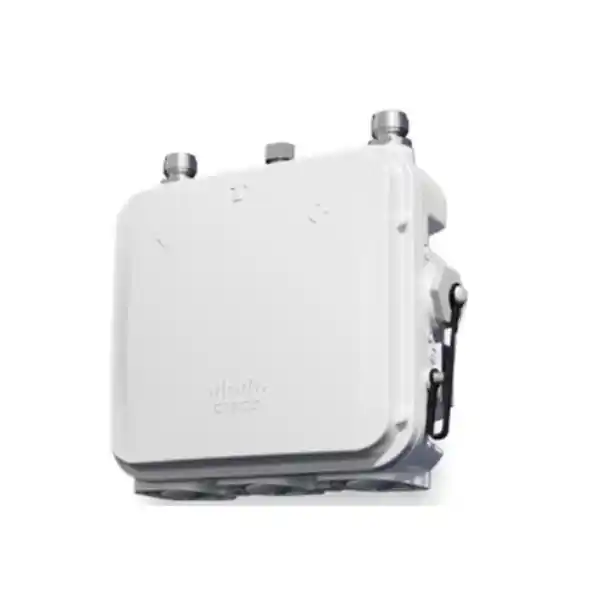
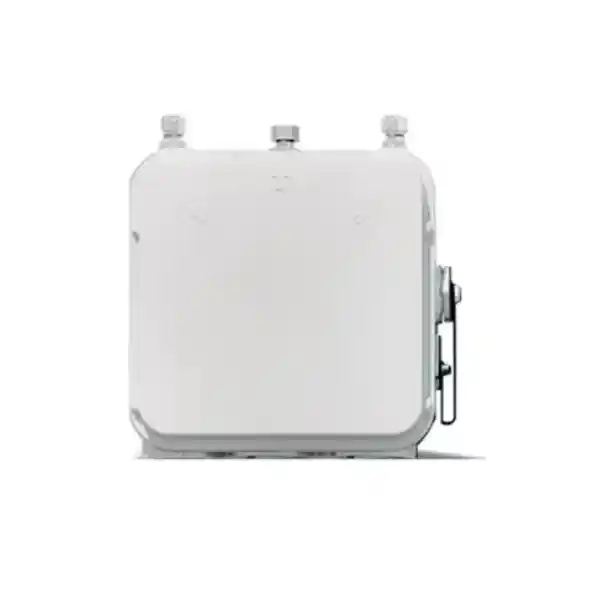
Cisco Catalyst IW9165D Industrial Access Point in UAE
The Cisco Catalyst IW9165D is a purpose-built heavy-duty industrial access point for organizations that need resilient wireless connectivity beyond the controlled conditions of an office. It combines dual 2×2 802.11ax radios, a built-in high-gain directional antenna, optional external antenna connectivity, Multigigabit Ethernet, industrial power options and Cisco Ultra-Reliable Wireless Backhaul in a compact IP66/IP67 platform. For UAE operators, this means one platform can address fixed wireless links, outdoor access, trackside connectivity, industrial mobility backhaul and difficult locations where trenching fiber may be slow, expensive or operationally disruptive.
FourTeck UAE positions the IW9165D as an engineered infrastructure component rather than a generic outdoor access point. Correct results depend on regulatory domain, software mode, license tier, antenna selection, channel plan, power budget, mounting geometry, line of sight, interference conditions and upstream switching design. Our project approach therefore starts with application requirements and RF engineering before hardware quantity is finalized.
Direct answer
Choose the IW9165D when the design requires outdoor or industrial durability, directional long-range wireless capability and the option to use Cisco URWB or Wi-Fi access-point operation on the same hardware family.
For Dubai and UAE projects, confirm permitted channels and the exact regulatory-domain SKU before ordering. Wi-Fi 6E capability is subject to country approval and should never be assumed solely from the radio specification.
One 5 GHz radio plus one 5/6 GHz radio, supporting up to two spatial streams per radio.
Dual-polarized directional antenna with approximately 30° azimuth and 30° elevation beamwidth.
Multigigabit primary Ethernet plus a secondary 1 Gigabit Ethernet interface for flexible integration.
Heavy-duty enclosure designed for wet, dusty and demanding outdoor industrial locations when installed correctly.
What the Cisco Catalyst IW9165D is designed to solve
Industrial wireless projects often fail when a standard enterprise access point is forced into a job that is fundamentally about transport, mobility, weather exposure or deterministic application behavior. The IW9165D addresses a different class of problem. It is intended for wireless infrastructure in locations such as manufacturing yards, ports, logistics facilities, mining and energy sites, rail corridors, outdoor campuses, parking and transportation environments, perimeter zones and inter-building links. In these settings, the design goal is not simply to provide a Wi-Fi signal. The goal is to create a dependable communications path that survives challenging RF conditions, long distances, vibration and weather exposure while integrating with the same operational processes used for the wired industrial network.
The integrated directional antenna is central to that design philosophy. Instead of depending only on an omnidirectional coverage pattern, the IW9165D can concentrate RF energy in a defined direction. This can improve link-budget efficiency for point-to-point, point-to-multipoint and wayside architectures when the device is aligned correctly. At the same time, two N-type external antenna ports give the network architect another option when the built-in pattern is not suitable. A project can therefore standardize on the IW9165D hardware while varying the antenna strategy according to mounting height, corridor geometry, asset movement, obstruction, coverage target and local RF restrictions.
The platform is also differentiated by Cisco Ultra-Reliable Wireless Backhaul. URWB is designed for applications where conventional best-effort Wi-Fi behavior may not be adequate, especially when moving assets or critical operational traffic must maintain connectivity. Cisco describes URWB as providing seamless handoffs, ultra-low latency below 10 milliseconds and zero packet loss during handoff under the intended architecture. Those capabilities make the technology relevant to automated industrial movement, transportation, video, process control, vehicle connectivity and other use cases in which interruption has a direct operational cost.
Hardware and radio architecture
The IW9165D uses a dual-radio architecture. One radio operates in the 5 GHz band and supports 20, 40 and 80 MHz channel widths. The second radio can operate in 5 GHz or, where regulation and software support permit, 6 GHz, with 20, 40, 80 and 160 MHz channel widths. Each radio is a 2×2 MIMO design supporting up to two spatial streams. Cisco documents the IW9165 family as capable of up to a 3.6 Gbps aggregate PHY data rate under supported configurations. Real application throughput is lower because PHY rate is not payload throughput and because channel width, modulation, contention, signal quality, protocol overhead, client capability and regulatory power limits all influence the result.
The platform includes 2048 MB of DRAM and 1024 MB of flash according to Cisco product specifications. Those resources support the industrial wireless software stack, radio functions, management, telemetry and security services. Cisco does not publish a discrete switch-ASIC or RF-ASIC part number for this model in the product data sheet, so a responsible technical specification should not invent silicon details. For solution design, the important architectural facts are the two 2×2 radios, available frequency bands and channel widths, wired port capacities, memory, software mode and power profile.
From a sizing perspective, the dual-radio design allows the AP to participate in more than one wireless role or band strategy, but it should not be treated as equivalent to a high-density indoor 4×4 or 8×8 access point. Its strength is industrial reach, flexibility and backhaul capability. Network planners should therefore size IW9165D quantities from coverage geometry, path reliability, mobility requirements and traffic classes rather than from a simple users-per-AP ratio.
Integrated and external antenna strategy
The built-in directional antenna operates across approximately 4900 to 5925 MHz, with a published peak gain of 15 dBi, dual polarization and approximately 30-degree beamwidth in both azimuth and elevation. This relatively narrow pattern is useful when the objective is to project energy down a corridor, across a yard, between fixed locations or toward a defined coverage sector. A directional pattern also helps control where RF energy is sent, which can improve spatial reuse and reduce unwanted coverage outside the target area when the network is engineered carefully.
Two N-type external antenna interfaces let designers select an approved antenna when a different pattern is required. Cisco documents support for approved external antennas up to 15 dBi gain in 5 GHz, subject to regulatory restrictions and the specific certified antenna list. The unit also has a TNC GNSS antenna port and integrated Bluetooth Low Energy functionality. These interfaces must be protected and installed according to Cisco instructions, including the correct glands or adapters where required to maintain the IP rating.
Antenna choice should follow a path calculation, not visual intuition. For long-range fixed links, planners evaluate distance, free-space path loss, antenna gain, cable loss, transmit limits, receive sensitivity, Fresnel-zone clearance, fade margin and environmental variation. For mobile corridors, planners additionally evaluate handoff overlap, velocity, mounting orientation and changes in vehicle body obstruction. FourTeck can combine these variables into an RF design rather than treating antenna gain as an isolated purchasing specification.
Cisco Ultra-Reliable Wireless Backhaul: where the IW9165D changes the design conversation
URWB is the feature that moves the IW9165D beyond the normal outdoor-AP category. Conventional enterprise Wi-Fi is designed to support a broad client ecosystem and generally prioritizes standards-based compatibility, aggregate capacity and flexible mobility. Industrial backhaul may have a different requirement: moving vehicles, machines, cameras or controllers must maintain a communication path while transitioning between infrastructure nodes, and the application may be highly sensitive to interruption. Cisco URWB addresses this by creating a specialized wireless backhaul architecture for fixed and mobile industrial networks.
Cisco documents seamless handoffs with less than 10 ms latency and zero packet loss during the handoff behavior targeted by URWB. This is especially relevant to automated guided vehicles, autonomous mobile systems, transportation networks, industrial video, robotics, remote control and operational telemetry. The value is not simply a faster association event. It is the ability to design the wireless transport around continuity, redundancy and deterministic treatment of critical traffic. Cisco also supports Multipath Operations in URWB mode, where high-priority traffic can be duplicated across multiple paths to improve availability and reduce the impact of interference or hardware failure.
For a UAE industrial project, the URWB decision should be made at architecture stage because it affects software image, licensing, topology and test methodology. A warehouse automation deployment has different success criteria from an outdoor guest Wi-Fi deployment. The engineering team should document allowed outage duration, packet-loss tolerance, target application latency, vehicle speed, path redundancy, roaming zones, upstream switching behavior and failure scenarios. Only then can the designer decide whether standard Wi-Fi AP operation is sufficient or whether URWB should be the principal mode.
FourTeck can support this requirement definition through its UAE infrastructure practice. Organizations combining wireless backhaul with switching, firewalling, server connectivity and operational network services can also engage FourTeck IT Services UAE for broader integration planning. The objective is to make the wireless transport one engineered layer in the industrial network, not an isolated radio installation.
Wi-Fi 6 and Wi-Fi 6E readiness
The IW9165D implements IEEE 802.11ax capabilities on its industrial radio platform. On the dedicated 5 GHz radio, Cisco supports 20, 40 and 80 MHz channels. On the 5/6 GHz radio, 20, 40, 80 and 160 MHz channel widths are supported where permitted. The 802.11ax feature set brings the efficiency benefits associated with Wi-Fi 6, including improved scheduling and spectrum utilization compared with earlier generations. In industrial environments, the most important benefit is not a marketing maximum speed. It is the ability to use modern radio techniques while still selecting conservative channel widths and modulation targets appropriate to interference, distance and reliability.
Wi-Fi 6E extends 802.11ax into the 6 GHz spectrum, but availability is country specific. Cisco explicitly states that 6 GHz operation is subject to approvals and regulations for each country. Therefore, a UAE quotation should identify the correct Cisco regulatory domain and verify current permitted operation before a 6 GHz design is committed. The product may be 6 GHz-capable at the hardware level while a particular channel plan, power level or operating mode remains limited by local authorization. Procurement and RF design should treat regulatory approval as a design input, not an administrative task performed after hardware arrives.
Channel width should also be selected deliberately. A 160 MHz channel can deliver high PHY rate under clean spectrum conditions, but it consumes far more spectrum and is more vulnerable to interference across a wide band. Industrial networks frequently benefit from narrower channels because they provide more reuse opportunities, reduce the probability of overlapping interferers and may improve link robustness at range. The best channel width is therefore application specific. A fixed short-range high-throughput backhaul may justify 80 or 160 MHz; a large outdoor mobile network may prioritize 20 or 40 MHz to create more controlled cells.
For general Cisco networking and enterprise wireless procurement in the Emirates, FourTeck UAE can align the IW9165D with the upstream switching, segmentation and security architecture rather than specifying radio settings in isolation.
Port map and wired integration
| Interface | Published capability | Design implication |
|---|---|---|
| Primary Ethernet | 100M/1G/2.5G Multigigabit Ethernet, RJ45 or M12 X-code via supported conversion, PoE input capability | Use 2.5GbE where traffic aggregation and full radio capability justify it; validate switch port, cable category and PoE budget. |
| Secondary Ethernet | 100M/1G Ethernet, RJ45 or M12 X-code with supported adapter | Provides additional wired integration flexibility; the exact topology should follow supported software-mode guidance. |
| Console | RJ45 management console | Useful for commissioning, recovery and local troubleshooting where remote management is unavailable. |
| DC power | 24 to 48 VDC nominal, with Cisco-documented extended input range | Suitable for industrial DC distribution; surge, grounding and power-supply selection remain essential. |
| RF | Two N-type external antenna ports plus internal directional antenna | Choose integrated or approved external antenna architecture based on path and coverage requirements. |
| GNSS | One TNC GNSS antenna port | Supports location/time-related platform functions where the deployed software feature set uses GNSS. |
The 2.5 Gigabit primary port matters because aggregate wireless PHY capacity can exceed 1 Gbps, but a Multigigabit uplink does not automatically guarantee application throughput. The access switch, optics or copper path, PoE capability, VLAN design, QoS, firewall policy and upstream bottlenecks must all be sized consistently. If the AP is powered from a switch, the switch must supply the appropriate PoE class and retain power budget under failure conditions. If it is powered from a local industrial DC system, the design must account for voltage drop, protection, grounding and environmental enclosure practice.
PoE+ / DC at full function
Cisco lists a 20 W power budget when the IW9165D is powered by 802.3at PoE+ or 24–48 VDC, allowing both 2×2 radios, the 2.5GbE interface and the secondary Ethernet interface to be available according to the documented power table. This is the preferred baseline when the design needs the full hardware capability.
802.3af reduced-power behavior
With 802.3af PoE, Cisco documents a 12.95 W power budget, radios reduced to 1×1 operation, the primary Ethernet limited to 1 Gbps and the secondary RJ45 unavailable. This is a critical design detail: an AP can power up on lower PoE yet operate below the intended performance profile.
Surge and grounding
Cisco publishes surge protection ratings for the DC input and Ethernet ports, but site protection should still be engineered as a system. Outdoor copper runs, pole installations and industrial grounds require bonding, cable routing, shield practice and upstream surge strategy consistent with local electrical and safety standards.
IP rating depends on installation
Cisco notes that the correct PG 13.5 glands or M12 adapters are required on Ethernet and power interfaces to maintain the IP67 rating. Environmental certification should therefore be treated as a complete installation requirement, not only an enclosure label.
Environmental engineering for UAE outdoor installations
The UAE creates a demanding combination of heat, direct sun, dust, humidity, salt exposure in coastal zones and large temperature changes between conditioned and unconditioned areas. The IW9165D is built for harsh environments, but environmental ratings still need to be translated into a site-specific mounting and power plan. Cisco specifies normal operation from -40°C to +60°C with solar load and still air. With DC power and without solar loading, it supports an extended operating range from -50°C to +75°C, with cold start limited to -40°C. The product is also specified for non-condensing humidity up to 95 percent, high altitude operation and sustained wind resistance up to 160 mph / 257 km/h.
These values should not be simplified into a statement that the AP can be mounted anywhere. Solar loading can raise enclosure temperature significantly above ambient air temperature, especially on exposed steel structures. Cable glands, Ethernet patching, connector weatherproofing, mast stability and grounding all influence long-term reliability. A correct outdoor design considers shade where practical, drainage orientation, service loops, UV-rated cable, corrosion-compatible mounting hardware and safe technician access. In coastal environments, material selection and maintenance intervals may need additional attention because salt contamination can accelerate corrosion.
The physical unit measures approximately 18.3 × 9.1 × 18.0 cm and weighs about 2.0 kg. Cisco documents pole mounting with vertical tilt and slant adjustment, which is important for aligning the directional beam. Mechanical design must account for the AP, bracket, antenna accessories if any, cable forces and local wind loading. A stable radio mount is not only a safety requirement; even small changes in directional antenna alignment can alter the link margin on long paths.
Projects that also require perimeter security appliances, site-to-site VPN, segmentation and north-south policy enforcement can coordinate the industrial wireless layer with FourTeck Firewall Dubai, helping the radio network connect into a controlled enterprise or OT security architecture.
Security foundation and trusted software
Industrial wireless security has two layers: platform integrity and network policy. Cisco documents Trust Anchor technologies in the IW9165 family, including image signing and Secure Boot, to help establish a trustworthy hardware and software foundation. These mechanisms are important because an industrial AP may be physically exposed, installed far from IT staff and expected to run for years. Secure boot processes reduce the risk that unauthorized firmware can be introduced during the startup chain, while signed software helps validate image authenticity.
That platform security does not replace network segmentation. The IW9165D should participate in a deliberate VLAN, routing and firewall architecture. Separate management traffic from operational user or machine traffic. Define which industrial endpoints may talk to controllers, application servers and internet services. Apply least-privilege rules across zones, and ensure the wired switch ports connected to the AP use the expected trunk or access configuration. In critical environments, management access should be restricted to dedicated administration networks and authenticated through enterprise identity controls.
Wireless encryption, authentication and certificate choices depend on the software mode and client ecosystem. In Wi-Fi AP mode, enterprise authentication can be integrated into the broader Cisco wireless architecture. In URWB deployments, the design follows the Cisco industrial wireless security model for the selected release. The correct approach is to establish a configuration standard before field rollout, including device naming, management addressing, NTP, logging, SNMP or telemetry policy, credential handling, software image version and configuration backup.
Security operations should also include lifecycle planning. A radio installed on a warehouse roof or rail corridor still needs software updates, vulnerability monitoring and periodic configuration review. A strong deployment therefore includes remote reachability, documented maintenance windows and a clear responsibility matrix between the network team, OT team, site maintenance team and security operations center.
Software modes and licensing
Cisco publishes separate software and orderable modes for the IW9165D. The IW9165DH-AP variant uses Cisco IOS XE software and supports Wi-Fi access-point operation, while the IW9165DH-URWB variant uses Cisco Unified Industrial Wireless software for standalone URWB operation. Cisco documents IOS XE 17.14.1 or later for the AP software line and Unified Industrial Wireless 17.12.1 or later for URWB on the IW9165D. Release selection should always follow the currently supported compatibility matrix, controller requirements and project feature set rather than merely choosing the newest version available.
For Wi-Fi licensing, Cisco lists Industrial Wireless Cisco DNA Essentials and Industrial Wireless Cisco DNA Advantage. For standalone URWB, the published licensing tiers include IW9165 Cisco URWB Network Essentials, Network Advantage and Network Premier, along with corresponding industrial wireless service options. The correct license is determined by the required functions, management model, redundancy features and service expectations. FourTeck recommends defining the target operating mode before finalizing the BOM because license omissions can delay commissioning even when the physical hardware is already on site.
Cisco has also introduced the ability to enable URWB capabilities in Wi-Fi mode on supported software releases, giving customers another path when they want standard Wi-Fi services and an additional reliability layer from the same platform. Because software capabilities evolve by release, the exact feature combination must be validated against the intended IOS XE release during solution design. This is especially important for long project cycles where hardware is specified months before commissioning.
A correct quotation should therefore list hardware part number, regulatory domain, software mode, license tier, support entitlement, mounting components, antenna accessories if required, power accessories, glands or M12 adapters, surge and cabling components and any controller or management dependencies. Quoting only the AP chassis creates an incomplete project cost.
Typical UAE deployment topologies
Point-to-point wireless bridge
Use a pair of directionally aligned nodes to bridge Ethernet between two locations where fiber is unavailable or uneconomic. This can connect warehouses, temporary offices, utility structures, perimeter facilities or remote operational zones. Engineering focuses on line of sight, Fresnel clearance, channel plan, link margin, mounting rigidity, lightning protection and failover expectations.
Point-to-multipoint sector
A central infrastructure location can serve multiple remote nodes when the geometry and supported topology permit. The design must allocate airtime, assess aggregate throughput, avoid hidden-node behavior, control antenna patterns and ensure each remote link has enough fade margin. Capacity is shared, so each endpoint cannot be sized from the headline PHY rate.
Trackside or wayside mobility
Infrastructure APs are positioned along a defined vehicle path so moving assets can maintain connectivity while transitioning between cells. URWB is particularly relevant here. Cell overlap, antenna orientation, vehicle speed, handoff thresholds and path redundancy become the primary design variables rather than conventional office roaming assumptions.
Outdoor Wi-Fi coverage
In AP mode, the IW9165D can extend 802.11ax coverage into exposed locations. The directional antenna is useful for yards, lanes, gates or defined service areas. Client device capability, allowed bands, device mounting height and the client return path must be tested because strong AP transmit power alone does not guarantee a balanced link.
Industrial mesh extension
Where a direct wired path is difficult, supported mesh or backhaul designs can extend connectivity through multiple infrastructure points. Each additional hop affects capacity and fault behavior, so designers should minimize unnecessary hops, create alternate paths where required and verify application performance under node or path failure.
Temporary and phased infrastructure
Construction sites, events, remote compounds and phased industrial expansions may need connectivity before permanent fiber is ready. The IW9165D can provide a controlled wireless transport layer, then remain as a resilient backup or be redeployed as the physical network evolves.
RF sizing methodology: how many IW9165D units are actually required?
There is no reliable universal answer such as “one AP covers a certain number of meters.” Industrial RF design is geometry dependent. A fixed point-to-point path can often cover a much longer distance than a mobile client cell because both ends may use optimized antennas and clear line of sight. A ground-level handheld client in a container yard faces a completely different link budget. The first sizing step is therefore to define endpoints, traffic direction, distance, mounting height, available structures, obstacles, expected interference and application service level.
For fixed links, FourTeck calculates the link budget using transmit power, antenna gain, cable and connector losses, free-space path loss, receiver sensitivity at the target modulation and an engineering fade margin. Fresnel-zone clearance is checked against buildings, cranes, terrain, racks or other obstructions. At microwave-like frequencies, a visually clear path can still suffer if a significant portion of the Fresnel zone is blocked. The final design chooses a modulation and channel width that leaves enough margin for rain, interference, alignment drift and changing environmental conditions.
For mobile deployments, the process shifts from a single path to a sequence of cells. The designer maps the vehicle route, determines antenna orientation on both infrastructure and moving asset, estimates cell edges, creates controlled overlap and tests handoff performance at operational speed. It is important to model the vehicle body, payload, surrounding machinery and seasonal changes because they can alter RF propagation. The target is not maximum RSSI everywhere; it is a predictable signal and interference profile that supports stable mobility.
Capacity sizing then overlays the coverage model. Estimate application traffic by class: control, voice, telemetry, video, file transfer, software update and general user access. Add concurrency and burst factors. Critical applications should be evaluated during worst-case events, such as multiple cameras transmitting while a vehicle hands off and a redundant path changes state. The number of radios is then chosen to satisfy both coverage and airtime requirements. In industrial wireless, the higher of those two counts usually determines the final AP quantity.
A physical RF survey remains valuable because analytical modeling cannot perfectly predict reflections from metal, moving equipment, stacked containers, glass, concrete, water tanks or machinery. FourTeck can use the model to establish a design baseline and then validate critical paths in the real site environment before the project is considered complete.
Channel planning, interference and the practical meaning of 160 MHz
The IW9165D supports multiple channel widths, including up to 160 MHz on the 5/6 GHz radio. That specification is useful, but it is not a recommendation to use the widest channel everywhere. Wider channels aggregate more spectrum and can increase PHY rate, yet they also reduce the number of independent channels available for reuse. In an outdoor industrial environment with multiple links, neighboring networks and reflected energy, a wide channel may become a liability because interference anywhere inside the occupied bandwidth can affect the transmission.
Twenty- or forty-megahertz channels often provide a better starting point for large mobile or multi-cell systems because they allow more frequency reuse and can create cleaner RF boundaries. Eighty-megahertz channels may make sense for fixed backhaul where throughput is more important and spectrum is controlled. One hundred sixty megahertz can be appropriate in a clean environment for a short, high-capacity path, but the design must verify that regulatory rules, available spectrum, interference conditions and the remote radio all support the mode.
Transmit power also needs discipline. Cisco lists available conducted power settings that vary by radio, modulation and regulatory domain. The highest transmit power is not always best. Excessive power can enlarge contention domains, create asymmetric links when clients transmit at lower power and raise interference for neighboring cells. Directional antennas help by shaping energy, but power should still be tuned so each link or coverage cell is strong enough without dominating the surrounding RF environment.
For regulated or shared spectrum, FourTeck designs against the channel set permitted for the actual country and SKU. The UAE deployment should be validated against Cisco’s current compliance matrix at ordering time. This avoids a common project mistake: designing in simulation with channels that the delivered regulatory-domain unit cannot legally or technically enable.
Throughput, latency and application sizing
Cisco documents up to a 3.6 Gbps PHY data rate for the IW9165 family with its two 2×2 radios. PHY rate is the raw radio signaling rate, not an application speed guarantee. Net throughput is reduced by MAC overhead, acknowledgments, contention, retries, encryption, TCP or application overhead, channel utilization and the half-duplex nature of a shared wireless medium. In a multi-hop or multi-client topology, airtime is shared again. A responsible design therefore works from required application throughput and validates the resulting architecture under load.
For video backhaul, start with actual camera bitrate rather than resolution alone. A group of 4K cameras may produce very different traffic depending on codec, frame rate, scene motion, quality target and VBR settings. Add recording bursts and management traffic. For control systems, throughput may be small but latency and loss requirements can be much stricter. For mobile robots, the most important metric may be continuity during handoff rather than peak throughput while stationary. URWB becomes relevant where those timing characteristics are operationally critical.
The wired network must be included in the same end-to-end calculation. A 2.5GbE uplink is valuable only if the access switch, uplink trunks, firewall, routing path and server interface can accept the traffic. If several IW9165D units aggregate into one industrial switch, the switch uplinks may need 10GbE or greater depending on traffic profiles. If traffic is encrypted through a firewall or VPN, security appliance throughput and session behavior must also be verified.
Latency objectives should be measured from application endpoint to application endpoint. A wireless radio may contribute only part of the total. Switching queues, WAN links, security inspection, server processing and protocol timers can dominate. FourTeck therefore recommends baseline tests before deployment and repeatable acceptance tests after commissioning, including normal load, peak load, roaming or path transition, link failure and recovery.
Installation engineering
A good IW9165D design can be undermined by a poor installation. Pole location should provide the intended radio path, mechanical stability, safe service access and separation from high-noise electrical equipment. The bracket should be tightened according to manufacturer instructions after alignment. For directional paths, record azimuth and tilt so the orientation can be audited later. Avoid mounting where large metal objects move directly in front of the antenna unless the design has specifically accounted for that obstruction.
Outdoor Ethernet should use suitable cable and connector protection. Drip loops, cable strain relief and water ingress prevention matter. If M12 conversion is required for an industrial connector standard, include the correct Cisco-supported adapters. If the installation depends on the IP67 environmental rating, use the specified glands or adapters and ensure unused interfaces are sealed correctly.
Commissioning should record serial number, MAC addresses, installed software, license status, regulatory domain, mounting coordinates, antenna configuration, switch port, VLANs, IP address, RSSI or link metrics, channel and power. Those details create a serviceable asset record rather than an undocumented field installation.
Power and upstream switch design
Use 802.3at PoE+ or suitable DC power when the project requires both radios at 2×2 operation, 2.5GbE and the secondary Ethernet interface. Cisco’s power table shows reduced capabilities under 802.3af, so relying on legacy PoE can silently constrain the AP. When switches are backed by UPS, calculate the PoE load for all radios plus reserve margin so failover or battery operation does not force unexpected power loss.
Industrial networks may prefer local 24–48 VDC from a protected control power system. In that design, cable length and conductor size affect voltage drop. The power source must remain inside the supported input range under start-up and worst-case load. DC circuits should follow local electrical practice for over-current protection, isolation, grounding and surge protection.
The upstream switch should support the required VLANs, QoS and Multigigabit speed if 2.5GbE is part of the design. Port monitoring and alerting are useful because a remote AP may otherwise fail silently until an operational team reports loss of coverage.
Industrial mobility design for AGVs, vehicles and moving assets
A moving-asset network is one of the most demanding uses for industrial wireless because the RF path changes continuously. Vehicles move through shadow zones, change orientation, pass metal racks, drive beside other vehicles and may carry loads that obstruct antennas. A stationary survey can identify baseline coverage, but acceptance testing must include realistic movement. The IW9165D is typically deployed as infrastructure along the path, while the moving asset uses a compatible industrial client platform suitable for the chosen URWB or Wi-Fi architecture.
Cell design should avoid both underlap and excessive overlap. Underlap creates dead zones where the mobile radio loses one node before it acquires another. Excessive overlap can keep the client attached to a distant cell or increase co-channel contention. Directional patterns can help create defined service zones along a corridor, but antenna height and downward tilt are important. The best geometry depends on aisle width, vehicle antenna height, traffic direction and obstruction density.
The application team should define failure behavior. If a robot loses communications for 100 milliseconds, does it stop? If it stops, does that create a production bottleneck or safety event? If video freezes for one second, is that acceptable? These answers determine whether conventional Wi-Fi roaming is adequate or whether URWB features such as seamless handoff and multipath traffic duplication are justified. The project can then set measurable acceptance criteria rather than relying on a generic “good signal” threshold.
For large facilities, FourTeck recommends a pilot zone that represents the hardest part of the site. Test real vehicles, payloads, application traffic, handoffs, interference and failure events there before mass deployment. This reduces the risk of discovering a topology problem only after dozens of poles and cables are already installed.
UAE regulatory-domain and 6 GHz procurement guidance
Cisco offers the IW9165D in regulatory-domain variants and a Rest-of-World structure for countries not mapped to a dedicated domain. The exact orderable SKU is therefore not merely a logistics code; it controls permitted frequencies and transmit behavior. Cisco explicitly makes customers responsible for verifying country approval and the applicable domain. For UAE procurement, FourTeck validates the intended use against Cisco’s current wireless compliance information before placing a final order.
This step is particularly important for Wi-Fi 6E. The hardware platform is designed for 6 GHz capability, but 6 GHz spectrum rules can differ in permitted frequency ranges, indoor versus outdoor use, power categories and client behavior. A product page should not claim that every 6 GHz feature is available outdoors in every country. The correct engineering statement is that the IW9165D is Wi-Fi 6E ready and the 5/6 GHz radio can support 6 GHz operation subject to local approvals and the installed software/regulatory configuration.
Regulatory verification should happen before detailed RF planning. If a simulation assumes a particular 6 GHz channel or power level that is unavailable in the UAE deployment, the resulting coverage model is invalid. FourTeck therefore locks the country/domain assumption, then performs channel and capacity planning on the approved set. This produces a bill of materials and RF design that agree with each other.
For multi-country programs, the same process must be repeated for each destination because a design approved in the UAE cannot automatically be copied into another jurisdiction. FourTeck’s broader regional capabilities can be coordinated through FourTeck Global when a project spans multiple markets.
Managing interference in ports, factories, logistics yards and campuses
Industrial sites frequently have RF conditions that change throughout the day. Shipping containers move, doors open, cranes rotate, machinery starts, temporary Wi-Fi networks appear and maintenance teams introduce new radio devices. The wireless design must therefore tolerate change rather than optimize only for a single survey snapshot. Directional antennas help by reducing reception and transmission outside the target angle, but they do not eliminate interference from strong sources inside the beam.
Spectrum analysis should identify both 802.11 contention and non-Wi-Fi energy. Co-channel interference consumes airtime because devices defer to each other. Adjacent-channel interference can be more destructive because transmissions overlap without clean coordination. Narrower channels often improve reuse in dense industrial areas. Different links should use separate channels where topology and regulations permit, and power levels should be tuned to the distance required rather than left at maximum.
Metal-rich environments create multipath. Modern MIMO systems can benefit from controlled multipath, but severe reflections can also produce deep fades in specific locations. Antenna polarization, mounting height and orientation influence the effect. During a site validation, moving an antenna by a relatively small physical distance can materially alter the path. That is why a final alignment test is more valuable than relying solely on a desktop design.
Interference management should continue after go-live. Record baseline channel utilization, noise floor, retry rate and signal levels. When performance later changes, operations teams can compare current metrics with the baseline and determine whether the cause is RF, wired network congestion, an application change or hardware. A managed industrial wireless network is measured, not guessed.
Manufacturing
Connect production zones, moving carts, robots, vision systems and temporary lines where industrial resilience and controlled mobility are more important than conventional office coverage. Pair the wireless design with VLAN and QoS policy so machine traffic remains isolated from corporate endpoints.
Ports and logistics
Support yard vehicles, checkpoints, cameras, scanners and remote operational buildings across open spaces that may be costly to trench. Directional links and URWB can be combined according to fixed and mobile traffic requirements.
Rail and transportation
Deploy infrastructure along wayside or trackside routes to maintain communications with moving assets. These projects require strict alignment, handoff validation, path redundancy and coordination with signaling or operational safety requirements.
Energy and utilities
Extend secure IP transport to remote yards, substations, field buildings or process areas. Environmental protection and surge design are especially important where radio equipment is mounted on exposed structures.
Large campuses
Bridge buildings, perimeter systems and outdoor operational zones while avoiding civil work in areas where fiber installation is disruptive. Use the wireless path as primary or backup according to availability targets.
Construction and temporary sites
Create rapidly deployable connectivity during phased construction or expansion. The same infrastructure can be repositioned as the site changes, provided every new path is revalidated for alignment, interference and regulatory compliance.
How the IW9165D fits into a segmented industrial network
An industrial AP should not become a flat bridge between every device on the site. The logical architecture should define security zones and traffic flows before radio commissioning. A common structure separates management, industrial control, cameras, corporate access, contractor access and guest or public services. The IW9165D then carries only the VLANs or services required for its location and mode. Upstream switches enforce port and trunk configuration, while firewalls and routing devices control communication between zones.
Quality of Service is equally important. Control packets may be low bandwidth but time sensitive; video may be high bandwidth but tolerant of small variations; software downloads may be large but non-critical. A good QoS policy classifies and prioritizes traffic consistently across the wireless and wired path. URWB features can add reliability for selected high-priority streams, but prioritization should reflect actual operational importance. Marking all traffic as critical simply removes the benefit of prioritization.
Management traffic should use a predictable addressing and authentication model. Operators need centralized logs, alerts and performance metrics. If an AP becomes unreachable, the monitoring system should show whether the problem is power, switch port, wired uplink, radio path or software. Network diagrams should include AP names, mount locations, channel assignments, Ethernet switch ports and power sources so a technician can trace a fault without reverse engineering the installation.
This integration approach improves cybersecurity and operations at the same time. It lets the organization treat industrial wireless as infrastructure with defined owners, maintenance processes and change control rather than as a collection of isolated radios.
Availability engineering and failure scenarios
Reliability claims become meaningful only when they are tied to failure scenarios. Ask what happens if one AP loses power, one Ethernet cable fails, one switch reboots, a channel becomes noisy or a vehicle passes through a coverage shadow. A resilient architecture should have a defined answer for each event. In fixed wireless, this may mean alternate URWB paths. In mobile networks, it may mean overlapping infrastructure cells connected through different switches. In critical locations, it can mean redundant power or diverse wired backhaul.
Cisco Multipath Operations in URWB mode can duplicate high-priority traffic across multiple paths. Duplication consumes additional airtime and network capacity, so it should be applied to traffic that warrants the resilience. The architect needs to identify which flows are mission critical and how much duplicated load the design can sustain. Availability is therefore not a single feature switch; it is a capacity and topology decision.
Power is a frequent hidden single point of failure. If two redundant APs are connected to the same access switch and the same electrical circuit, their radio redundancy disappears when that common source fails. The same principle applies to mounting structures and wired paths. A formal high-availability design maps shared dependencies and removes the ones that conflict with the required service level.
Acceptance testing should intentionally trigger failures. Disable a radio node, disconnect an uplink, create load and observe application behavior during transition. Measure packet loss, latency and recovery time. Testing proves whether the redundancy architecture works in practice and gives operations teams a baseline for future troubleshooting.
GNSS, Bluetooth Low Energy and supporting radio functions
The IW9165D includes a TNC connector for an external GNSS antenna and integrated Bluetooth Low Energy / IoT radio capability. These features can support platform location, timing or operational functions depending on the installed software and the specific Cisco feature set in use. They should be treated as architectural resources rather than assumed applications. If a project needs GNSS, the antenna must be placed where satellite visibility is adequate and cable losses remain within the supported design.
Bluetooth Low Energy can contribute to IoT or management-related workflows, but an industrial deployment should define whether BLE is required and how it fits security policy. Unused radios or features should be managed according to organizational standards. Where BLE is used for location or sensors, the design needs to consider 2.4 GHz coexistence, endpoint density and the management platform that consumes the resulting data.
This broader set of capabilities illustrates why the IW9165D should be specified through a complete solution BOM. The chassis provides multiple interfaces and radio options, but each project activates only the functions required. A fixed point-to-point backhaul may use the directional antenna and URWB but not GNSS. A transport installation may need GNSS, external antenna accessories and industrial M12 connectivity. A campus outdoor AP deployment may focus on IOS XE, Wi-Fi licensing and integration with the enterprise wireless architecture.
FourTeck documents the selected feature set in the quotation so installation teams know what is included, what is optional and which items must be supplied by the site contractor.
IW9165D versus a conventional outdoor access point
A conventional outdoor access point is often the right choice when the primary requirement is user Wi-Fi coverage. The IW9165D becomes attractive when the requirement includes industrial backhaul, directional fixed links, mobile asset connectivity, harsh-environment mounting and URWB. It is a specialized platform, and that specialization matters. The integrated 15 dBi directional antenna creates a focused coverage pattern that is very different from the broad pattern of a typical omnidirectional outdoor AP. The two external N-type ports provide additional antenna flexibility without changing the entire hardware family.
The decision should also consider radio architecture. The IW9165D is dual 2×2, while some enterprise outdoor APs use 4×4 radios designed for dense client capacity. If the site is a stadium-like outdoor crowd area, a higher-order MIMO access point with sectorized client design may be more appropriate. If the site is a rail corridor where moving vehicles need highly reliable backhaul, the IW9165D is much closer to the target architecture. Selecting by the “Wi-Fi 6” label alone ignores these fundamental differences.
Power and connectivity are also industrialized. The IW9165D supports PoE, PoE+, DC power, Multigigabit Ethernet and M12 conversion options. Environmental protection reaches IP66/IP67 with correct installation. Those features make it suitable for places where standard enterprise cabling and weatherproof enclosures would otherwise be required.
FourTeck uses a requirements matrix covering coverage pattern, mobility, application criticality, throughput, environmental exposure, wired infrastructure, power and management. This avoids both over-specifying an industrial platform for simple outdoor Wi-Fi and under-specifying a conventional AP for a mission-critical transport role.
Procurement checklist for Dubai and UAE projects
Industrial wireless quotations require more detail than a model number. Start with the exact IW9165D orderable variant, software mode and regulatory domain. Cisco lists IW9165DH-x-AP for Wi-Fi AP operation and IW9165DH-x-URWB for URWB operation, where the domain character varies by country approval. Verify whether the project requires Cisco DNA Essentials or Advantage for Wi-Fi, or a URWB Network Essentials, Advantage or Premier tier. Then add support coverage aligned with the organization’s replacement and software-maintenance policy.
Next, list installation hardware. Confirm pole or wall arrangement, mounting bracket, adapter requirements, cable glands, M12 converters if industrial connectors are required, external antennas when the integrated directional pattern is unsuitable, GNSS antenna if needed and weatherproof RF accessories. Cabling must include outdoor-rated Ethernet where appropriate, fiber or copper uplinks from the field switch, patching, labeling and grounding components.
Power items can change the BOM significantly. Decide whether the AP is powered by a PoE+ industrial switch, Cisco injector or local 24–48 VDC supply. If existing infrastructure provides only 802.3af, account for the documented reduced radio and Ethernet capability. Include surge protection, UPS runtime and environmental enclosure requirements where power equipment is exposed.
Finally, budget engineering services. RF survey, path design, spectrum analysis, configuration, controller or management integration, switch configuration, security policy, alignment, commissioning and acceptance testing are part of the solution. Hardware without those services may be cheaper on the purchase order but more expensive after field rework.
FourTeck can provide the IW9165D as part of a complete UAE project with documented scope, BOM and commissioning deliverables instead of a chassis-only quote.
Lifecycle, support and operational ownership
Cisco lists a one-year limited hardware warranty for the Catalyst IW9165 Series, including the vendor’s stated advance replacement terms under that warranty. Enterprise customers frequently add support services because industrial wireless downtime can affect operations and because access to software updates and technical support may be part of the lifecycle plan. The correct entitlement should match the site’s criticality, spare strategy and internal support capability.
Operational ownership should be defined before handover. The network team may own software and RF settings, facilities may own poles and power, OT may own machine applications and cybersecurity may own segmentation policy. Without a responsibility matrix, simple faults can take too long to resolve because each team waits for another. FourTeck recommends documenting escalation paths, monitoring thresholds, maintenance windows and configuration backup procedures as part of commissioning.
Keep at least one known-good spare strategy for sites where downtime is costly. A spare can be a cold standby device pre-licensed and stored locally, or a service-level arrangement that delivers replacement hardware within an agreed period. In either case, store configuration templates, software image references, license records and mounting details so replacement does not require rebuilding the design from memory.
Lifecycle management also means periodically checking whether spectrum conditions, client mix or application requirements have changed. A network designed for ten vehicles and standard-definition cameras may need retuning when the site adds thirty vehicles and 4K video. Capacity and RF health should be reviewed when operations change, not only when a fault occurs.
Commissioning and acceptance test plan
A production IW9165D deployment should finish with measurable acceptance tests. First verify physical installation: correct mount, torque, weather sealing, grounding, cable labeling and power source. Confirm the regulatory-domain SKU, software version, license status and configured mode. Validate Ethernet speed and PoE class or DC voltage. For each AP, record management reachability, radio channel, channel width, transmit setting and antenna configuration.
For fixed links, measure RSSI, signal-to-noise ratio, modulation behavior, packet loss, latency and sustained throughput in both directions. Run tests during realistic site activity rather than only at a quiet maintenance time. For redundant URWB paths, fail one path and observe application continuity. For mesh, test a node failure and confirm the alternate route performs within the defined service level.
For mobile networks, drive the actual route at minimum, typical and maximum operational speed. Measure handoffs, packet loss, latency and application behavior. Repeat with representative payload and site traffic because vehicle loading or obstruction can change RF performance. Test every known difficult area, including doors, corners, container stacks, lifts or dense machinery zones. If the application has a safety-related stop behavior, the operational safety team should be present for validation.
For Wi-Fi access-point deployments, test representative client classes rather than one laptop. Industrial scanners, tablets, cameras and specialized devices may have very different antenna and roaming behavior. Validate authentication, VLAN assignment, DHCP, DNS, firewall policy and access to required applications. Confirm that prohibited traffic is blocked.
Handover documentation should include final drawings, RF plan, AP inventory, switch-port mapping, IP addressing, software versions, backup configurations, license records, acceptance results and any known operational constraints. This turns the deployed network into a maintainable production system.
Frequently asked technical questions
Does the IW9165D support Wi-Fi 6E?
Yes, the hardware supports 802.11ax with a 5/6 GHz radio and is Wi-Fi 6E ready. Actual 6 GHz operation depends on local country approval, regulatory domain and software configuration. A UAE design should verify the current permitted channels before ordering.
Is the built-in antenna directional?
Yes. Cisco specifies a peak gain of 15 dBi with dual polarization and approximately 30° beamwidth in azimuth and elevation over the published 4900–5925 MHz range. Alignment is therefore an important installation step.
Can external antennas be used?
Yes. The IW9165D has two N-type external antenna ports and supports Cisco-approved antenna options. Antenna gain and model must comply with the certified configuration and local regulatory limits.
Does it run from standard PoE?
It can operate from 802.3af PoE, but Cisco documents reduced 1×1 radio operation, 1GbE on the primary port and loss of the secondary Ethernet port. Use 802.3at PoE+ or suitable DC power for the documented full-function profile.
Can it replace fiber?
It can provide high-throughput wireless backhaul where fiber is unavailable or too costly, but it should not be treated as universally equivalent to fiber. Capacity, interference, latency, weather exposure and line-of-sight conditions must be engineered for the required service level.
What is URWB best for?
URWB is best suited to industrial wireless transport where seamless mobility, low latency, packet-loss resilience and redundant paths are important, including moving vehicles, rail, automation and critical operational traffic.
Is the IW9165D weatherproof?
Cisco rates it to IP66 and IP67 when installed correctly. Correct glands, adapters, sealing, mounting and cable practices are required to preserve the rating at the interface points.
What licenses are required?
Wi-Fi operation uses Industrial Wireless Cisco DNA Essentials or Advantage licensing. Standalone URWB uses the IW9165 URWB Network licensing family in Essentials, Advantage or Premier tiers, selected according to the required feature set.
Why organizations use FourTeck for Cisco industrial wireless projects
Industrial wireless purchasing is frequently fragmented: one supplier provides radios, another installs poles, a third configures switches and the OT team discovers performance problems after handover. FourTeck’s value is to connect those workstreams into a single technical design. We start with the application and site requirements, determine whether the IW9165D is the correct platform, verify the regulatory-domain and software mode, produce the supporting BOM and coordinate the network functions that must exist around the radio.
That scope can include RF planning, outdoor path calculations, channel and power strategy, industrial switching, PoE or DC design, VLAN and routing integration, firewall segmentation, controller or management integration, configuration templates, installation guidance, commissioning and acceptance testing. For projects that span headquarters, branch, industrial and cloud-connected environments, this end-to-end view reduces interface risk between teams.
The organization also benefits from clearer procurement. Instead of receiving a quote that lists only a chassis and leaves licensing, mounting, power and antenna requirements undefined, the project receives an itemized design. Optional components can be separated from mandatory components, making commercial comparison easier and reducing last-minute additions during installation.
FourTeck can support enterprise technology programs through its UAE and global operations, allowing the IW9165D deployment to be integrated with broader network, security and IT infrastructure services while maintaining a single technical design language across the project.
Design example: warehouse-to-yard industrial wireless
Consider a Dubai logistics facility with a main warehouse, outdoor loading lanes and a remote security building. Fiber reaches the warehouse but not the remote building, and autonomous vehicles need continuous connectivity across the yard. A practical design could use an IW9165D directional pair or URWB backhaul for the remote fixed building while additional IW9165D infrastructure nodes cover the vehicle route. The fixed path and mobile path can use separate channel assignments so the high-throughput building backhaul does not consume the same airtime as the vehicle network.
The warehouse switch provides 802.3at PoE+ and 2.5GbE to infrastructure APs. Outdoor nodes near the yard may use protected DC power where local industrial supplies already exist. Each node is mounted to provide a clear radio path, with the directional beam aligned down the relevant lane. The design verifies that the remote building has adequate Fresnel clearance and that vehicles see controlled overlap between adjacent cells.
Traffic is segmented into vehicle control, video and maintenance VLANs. Critical vehicle control receives prioritized treatment and, if required by the service level, URWB multipath features. Cameras use a different class so high-bitrate video cannot starve control packets. Management remains in a dedicated network reachable only by authorized administrators. Firewall rules limit the remote security building and vehicle networks to approved application servers.
The project is accepted only after drive testing at full vehicle speed, fixed-link throughput validation and failure tests that remove one radio path. This example shows why the IW9165D is most effective when its industrial radio features are designed together with switching, security and application requirements.
Design example: inter-building link where trenching is impractical
A campus may need to connect an operations building across a road, service yard or leased area where trenching fiber requires permits and civil work. Two IW9165D units can be evaluated as a directional wireless bridge. The first design task is not to order two radios; it is to verify the path. Engineers measure distance, mounting heights, obstructions and Fresnel-zone clearance, then calculate expected receive level at a conservative modulation. The target includes fade margin rather than designing at the minimum usable signal.
If the path supports the required capacity, each endpoint is mounted on a stable structure and aligned precisely. PoE+ or DC power is selected according to the local infrastructure. The wired switch ports are configured for the required VLANs and QoS. If the link carries several business services, the aggregate traffic is measured so the wireless backhaul and wired uplinks have sufficient headroom.
A high-availability requirement may add a second wireless path or retain an existing low-bandwidth carrier circuit as failover. The architecture should avoid placing both supposedly redundant paths on the same switch, breaker or pole if those components are considered credible failure points. URWB can provide additional resiliency mechanisms when supported by the topology and license.
The business case compares the full wireless project cost—including radios, mounts, power, cabling, engineering and support—with civil works, fiber termination, permits and restoration costs. In some UAE sites, the schedule advantage of a wireless bridge is as important as capital cost because deployment can proceed without opening roads or operational surfaces.
Total cost of ownership considerations
The purchase price of the IW9165D is only one part of lifecycle cost. A complete TCO model includes licensing, support, mounting, antennas, power, switching, cabling, installation labor, survey, configuration, monitoring and future maintenance access. Wireless can reduce civil construction costs compared with new fiber, but it introduces RF operations that must be managed. The best option is the one that meets the required availability and capacity over the project life, not simply the one with the lowest initial hardware cost.
Maintenance access matters in industrial settings. An AP mounted high on a mast may require a lift, permit or shutdown to service. Designing stable mounts, reliable power and remote diagnostics can therefore reduce recurring cost. Spare strategy is also important: one preconfigured spare held at a critical site may be cheaper than repeated emergency service visits.
Energy consumption is modest for the platform, with Cisco documenting a 20 W power budget under PoE+ or DC for the full-feature profile. However, a network of many radios plus outdoor switches, heaters or enclosures can still create a meaningful UPS requirement. Battery runtime calculations should include every powered device and expected aging margin, not only the AP nameplate.
Finally, consider the cost of operational disruption. If a failed mobile link stops robots or interrupts loading operations, the financial impact can exceed the hardware cost quickly. That is why URWB, redundant paths, environmental engineering and acceptance testing can be justified even when they add upfront cost. Reliability should be valued against the process it protects.
Decision recap: when the Cisco Catalyst IW9165D is the right platform
Choose it for industrial backhaul
The IW9165D is a strong fit when fiber is unavailable, expensive or slow to deploy and the site needs a rugged directional wireless link with industrial software options.
Choose it for demanding mobility
URWB makes the platform relevant to moving assets where handoff continuity, low latency and high availability are central requirements rather than optional enhancements.
Choose it for exposed environments
IP66/IP67 construction, industrial power options and a wide operating temperature envelope suit outdoor and heavy-duty installations when the complete installation follows Cisco environmental requirements.
Do not choose it only for a headline speed
Its value comes from architecture, ruggedness and wireless backhaul flexibility. Dense public Wi-Fi may call for a different radio platform with higher-order MIMO or a different antenna strategy.
Quotation input checklist
For an accurate Cisco Catalyst IW9165D quotation in the UAE, provide the engineering details below. A complete response allows FourTeck to recommend the correct regulatory-domain SKU, license, accessories and deployment scope without oversizing or omitting critical components.
Final consultation panel: build the IW9165D as a complete industrial wireless system
The Cisco Catalyst IW9165D is most valuable when its radio, antenna, power, software and industrial reliability features are engineered as one system. FourTeck UAE can prepare a project-specific design covering the correct regulatory-domain SKU, Wi-Fi or URWB software mode, Cisco licensing, antenna architecture, RF path calculations, channel plan, Multigigabit switching, PoE+/DC power, VLAN and firewall integration, environmental accessories, installation scope and acceptance testing.
For fixed wireless, send the two endpoint locations, approximate distance and available mounting heights. For mobile or trackside networks, send the route drawing, vehicle type, speed, application traffic and allowed outage target. For outdoor Wi-Fi, send the coverage area, client types and expected concurrency. With those inputs, FourTeck can determine whether the IW9165D is the correct platform and how many units, licenses and accessories belong in the solution.
The result is a procurement-ready design that connects product selection to deployment reality. That reduces regulatory risk, avoids under-powered installations, prevents antenna mismatches and gives the commissioning team measurable performance targets. For enterprise-wide planning beyond a single radio project, FourTeck can coordinate networking, cybersecurity and infrastructure requirements under the same technical scope.

Reviews
There are no reviews yet.