
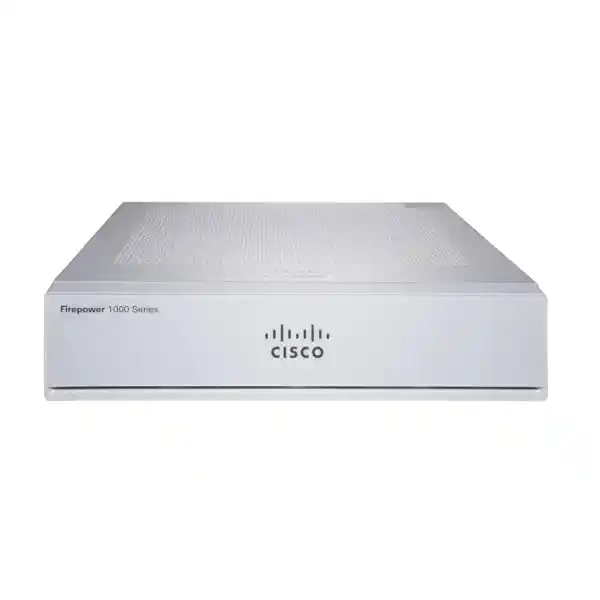
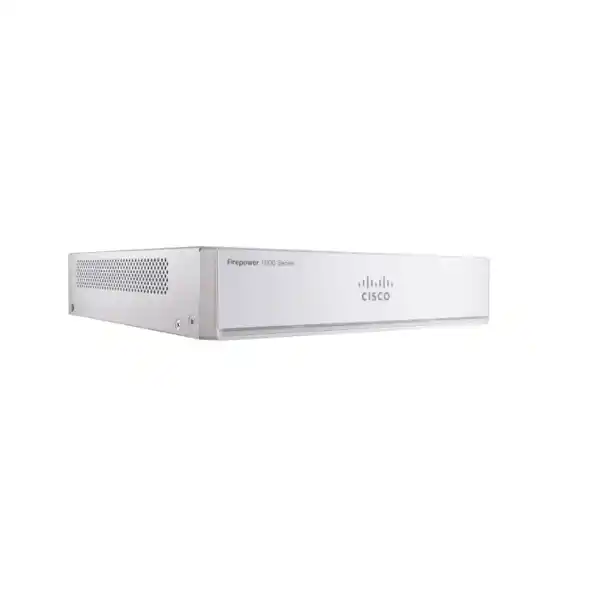
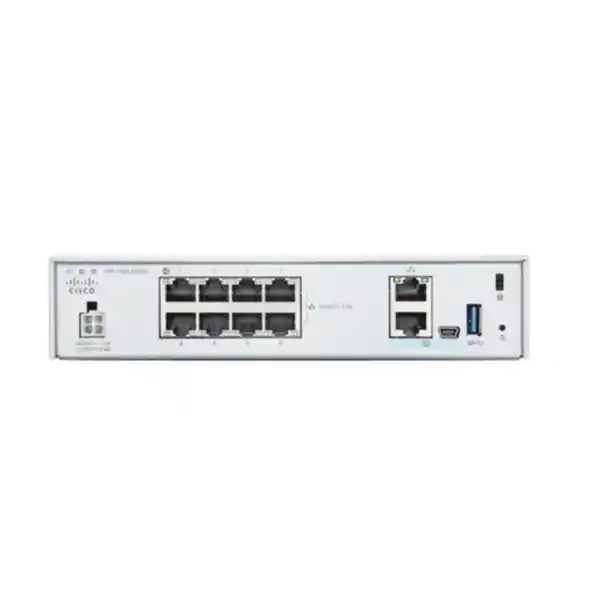
Cisco Firepower 1010 Firewall in Dubai, UAE
The Cisco Firepower 1010 is a compact desktop firewall appliance for organisations that need a practical security gateway at a small office, retail branch, professional-services site, remote location or other edge where rack space and power consumption matter. The platform provides eight Gigabit Ethernet copper interfaces, supports Cisco Threat Defense or Cisco ASA software, and can be ordered with security and remote-access licensing matched to the required deployment model.
The important buying decision is not simply whether the appliance is called a Firepower 1010. The correct quotation depends on the software image, intended security services, management architecture, VPN requirements, interface design, expected inspected traffic, subscription term, resilience plan and whether the two PoE+ capable ports are part of the design. A properly scoped 1010 can be a clean branch-security platform; an undersized or incorrectly licensed unit can create avoidable operational limits.
Direct answer: what is the Cisco Firepower 1010 and who should consider it?
What exactly is it?
The Firepower 1010 is a compact Cisco security appliance in the Firepower 1000 family. Cisco publishes it as a desktop and wall-mount platform with eight 10/100/1000BASE-T network interfaces, a dedicated Gigabit management interface, console connectivity, USB, local solid-state storage and PoE+ capability on network ports 7 and 8.
What is it mainly used for?
It is primarily used as an internet-edge or branch firewall, VPN gateway and security-policy enforcement point for smaller networks. Depending on software and licensing, it can provide application-aware firewalling, intrusion-prevention related services, URL controls, malware-related security capabilities and remote-access functions.
Who should consider it?
Small businesses, branch offices, clinics, retail sites, professional offices, warehouses, satellite sites and distributed organisations may consider the 1010 when their traffic, port, VPN and resilience requirements fit the platform. It is especially relevant where a compact fanless appliance and copper Gigabit interfaces suit the physical environment.
What must be confirmed first?
Confirm the required software path and management design before ordering. Threat Defense and ASA are not interchangeable descriptions of the same operational experience. They differ in policy model, security subscriptions, management choices and high-availability licensing details.
What can FourTeck determine?
FourTeck can help map the internet bandwidth, inspected-traffic profile, user and device count, network segmentation, VPN requirement, licensing term, management approach, high-availability objective and installation scope to a practical Cisco 1010 bill of materials or to a larger alternative if the 1010 is not the right fit.
Understanding the Firepower 1010 platform before you buy
The Cisco Firepower 1010 occupies the compact end of the Firepower 1000 family. That positioning matters because the appliance is designed around branch and small-business edge requirements rather than the much higher traffic levels, optical-interface density and rack-centric deployments handled by larger models. Cisco publishes the 1010 with eight Gigabit Ethernet RJ-45 network interfaces, while higher Firepower 1000 models add SFP connectivity and substantially more throughput. The 1010 chassis is approximately 4.62 cm high, 19.94 cm wide and 20.50 cm deep, and Cisco lists the chassis weight at about 1.36 kg. It is therefore physically suited to a desk, shelf, wall-mount arrangement or a properly planned rack shelf rather than a conventional full-width 1U appliance installation.
The hardware is fanless. That is useful in a quiet office or front-of-house location, but it does not remove the need for careful placement. Cisco’s current hardware guidance notes that the internal system temperature is significantly higher than the ambient operating temperature because there is no fan. Rubber feet are part of the cooling arrangement and should not simply be removed to make the chassis sit differently. For Dubai and UAE installations, where equipment is often placed in small communications cupboards, the practical concern is not outdoor climate but the actual conditioned temperature and airflow inside the cabinet. A compact appliance still needs space around it, stable power and an environment within Cisco’s published operating range.
The 1010 also differs from a simple four-port broadband firewall because its eight network interfaces can be used flexibly. In Cisco’s supported configurations, interfaces can be treated as routed firewall interfaces or, where the software and design allow, as Layer 2 switch ports. Ports 7 and 8 support PoE+ on the Firepower 1010, allowing the appliance to power compatible endpoint equipment within the platform’s power budget. That can be convenient for an IP phone, wireless access point or another suitable powered device, but PoE should be viewed as a deployment aid rather than a reason to treat the firewall as a replacement for a properly sized access switch. A branch with multiple phones, cameras and wireless access points will usually benefit from a dedicated PoE switch with appropriate power budget, VLAN design and operational visibility.
Software selection is central to the platform identity. Cisco documentation supports Firepower 1010 deployments with Firewall Threat Defense and with ASA software. Threat Defense is the path associated with Cisco’s application-aware firewall and security-services architecture and can be managed locally, by a management center, or through supported cloud-delivered management options depending on release and deployment design. ASA provides the familiar Cisco ASA policy and management model and has its own licensing requirements. A buyer who asks only for “Cisco Firepower 1010” without specifying the software image risks receiving a quotation that is technically valid but operationally wrong for the intended project.
Published platform specifications that matter to buyers
The figures below summarise buyer-relevant characteristics published by Cisco for the Firepower 1010. Performance figures are test results under defined conditions, not guarantees that every production deployment will achieve the same result. Real-world throughput changes with packet size, enabled inspection functions, encrypted traffic, VPN use, policy complexity, software version and traffic mix.
| Specification | Cisco Firepower 1010 | Buyer interpretation |
|---|---|---|
| FW + AVC throughput | 890 Mbps at Cisco’s stated test profile | Do not size directly from ISP speed alone; inspection features and growth headroom matter. |
| FW + AVC + IPS throughput | 880 Mbps at Cisco’s stated test profile | Useful for rough comparison, but encrypted inspection and complex policy can change production performance. |
| IPS throughput | 900 Mbps published family figure | Assess the actual threat-policy and traffic mix rather than treating IPS throughput as internet speed. |
| IPsec VPN throughput | Approximately 0.4 Gbps in Cisco’s platform summary | Important for branch-to-head-office tunnels and remote-site designs carrying substantial encrypted traffic. |
| Network interfaces | 8 x 10/100/1000BASE-T RJ-45 | Excellent for copper-only small-site designs; buyers needing native SFP uplinks should compare larger platforms. |
| PoE+ | Ports 7 and 8 support PoE+ under supported software | Convenient for one or two endpoints; confirm power budget and endpoint requirements. |
| Management interface | 1 x Gigabit Ethernet RJ-45 | Plan the management network, addressing and access controls as part of the installation. |
| Storage | 200 GB internal M.2 SATA SSD used by system software | The internal drive is not a user service disk and is not field replaceable. |
| Form factor | Compact desktop / wall-mount | Suitable for branch cabinets and offices; rack use may require the appropriate shelf or accessory plan. |
| Maximum VPN peers | Cisco platform summary lists up to 75 VPN peers | Remote-access entitlement and deployment method still need to be selected correctly. |
Performance sizing: why a 1 Gbps internet line does not automatically mean a 1 Gbps firewall requirement
Firewall sizing is one of the most common places where otherwise sensible projects go wrong. The internet circuit rate is an important input, but it is only one input. Cisco’s published Firepower 1010 figures include 890 Mbps for firewall plus application visibility and control and 880 Mbps for firewall, application visibility and control plus intrusion prevention under the vendor’s defined 1024-byte test conditions. Those values are useful for comparing models, but they should not be interpreted as a promise that every production workload can run at approximately 880 or 890 Mbps with every desired function enabled.
A production firewall sees mixed packet sizes, bursts, concurrent sessions, encrypted applications, DNS traffic, SaaS flows, operating-system updates, video conferences, cloud backups and often site-to-site VPN traffic at the same time. The security policy may also perform different levels of inspection on different traffic classes. If TLS decryption is part of the design, the computation and policy effect can be materially different from simple stateful forwarding. The correct sizing conversation therefore asks how much traffic must be inspected, what percentage is encrypted, which advanced services will be active, how much growth is expected and what utilisation level is acceptable during busy periods.
For a small site with a 100, 200 or 300 Mbps internet connection, the 1010 may provide comfortable headroom when the feature set and traffic profile are modest. A site with a connection approaching the platform’s published inspected-throughput figures deserves closer analysis. The issue is not that the appliance suddenly stops working at a particular number; the issue is that buyer expectations around latency, burst handling, software updates, security services, VPN use and future bandwidth upgrades can consume the headroom that made the original design comfortable. An office expected to move from 300 Mbps to 1 Gbps during the life of the firewall should be sized for the intended future state, not only today’s contract.
VPN traffic requires separate attention. Cisco’s Firepower 1000 platform summary lists approximately 0.4 Gbps IPsec VPN throughput for the 1010. That can be entirely adequate for many branch tunnels, but a backup site that continuously replicates large datasets through IPsec may have a very different requirement from a branch that sends normal business application traffic to head office. Similarly, the maximum VPN peer count is not the same thing as a recommended number of simultaneously busy users for every use case. Authentication systems, Secure Client licensing, internet upload capacity, security policy and user application patterns all influence the result.
A practical quotation should therefore include a small sizing profile: current WAN speed, planned WAN speed, average and peak utilisation, approximate users and devices, site-to-site tunnel count, remote-access user count, expected encrypted traffic, security services to be enabled, and an estimate of growth over the planned service life. If those figures show that the 1010 would operate too close to its practical limits, a higher Firepower 1000 model or a newer Cisco Secure Firewall platform should be evaluated before the purchase is locked in.
Eight Gigabit ports, PoE+ and the integrated switching design
Copper interface density
The Firepower 1010 has eight Gigabit Ethernet RJ-45 10/100/1000BASE-T network ports. This suits many small sites because the internet handoff, LAN uplink, guest network, server segment and one or two special-purpose networks can all be connected without immediately requiring fibre optics or media converters.
The limitation is equally clear: there are no native SFP network interfaces on the 1010. A buyer whose ISP presents fibre through an SFP module, or whose internal network requires fibre uplinks, should not assume an external converter is automatically the best answer. Larger Firepower 1000 models provide SFP interfaces and may create a cleaner, more supportable design.
Ports 7 and 8 with PoE+
Cisco documents PoE+ capability on Ethernet ports 7 and 8 for the Firepower 1010, with support beginning in Threat Defense 6.5 and ASA 9.13. In a branch office, that may allow the firewall to power a suitable access point, IP phone or other compatible powered device without a separate injector.
PoE should be planned against the appliance and power-supply budget. It should also be considered from an operational perspective: if the firewall is rebooted or replaced, the attached powered endpoint is affected at the same time. Critical voice, wireless or surveillance designs are usually better served by a dedicated PoE switch and UPS arrangement.
Firewall interfaces versus switch ports
On the 1010, interfaces can be used in configurations that take advantage of integrated Layer 2 switching. Cisco documentation explains that switch ports in the same VLAN can forward traffic in hardware and that same-VLAN switch-port traffic is not subject to the firewall security policy in the same way as routed inter-VLAN traffic.
That behaviour matters when a buyer expects the firewall to inspect traffic between devices connected to different physical ports. Network segmentation should be designed with VLAN interfaces, routed interfaces or appropriate upstream switching so that security policy is applied where intended. Physical port separation alone does not automatically equal security segmentation.
Threat Defense or ASA: choose the operating model before the purchase order
The Firepower 1010 can run Cisco Firewall Threat Defense or Cisco ASA software. A quotation that ignores this choice is incomplete because the operating system determines the administration experience, security-service model, management architecture and licensing path. The right option depends on the organisation’s existing Cisco estate, security requirements, administrator skill set and desired policy capabilities.
Threat Defense is the natural choice when the project is built around next-generation firewall controls and Cisco’s broader Secure Firewall policy framework. Cisco’s 2026 getting-started documentation for the Firepower 1010 provides paths for local Firewall Device Manager, an on-premises Firewall Management Center and cloud-delivered management. That gives small organisations the ability to start with local management, while distributed organisations can use a more centralised architecture when it better matches operations. Threat Defense licensing includes the required base entitlement and optional security feature subscriptions such as IPS, Malware Defense and URL Filtering, while remote access uses Cisco Secure Client entitlements as applicable.
ASA software is relevant where an organisation deliberately wants the Cisco ASA feature and configuration model, perhaps because it has established ASA operational processes, migration requirements or network engineers who maintain a consistent ASA policy environment across multiple sites. Cisco’s 2026 Firepower 1010 ASA guidance identifies an Essentials entitlement as required and a Security Plus licence for Active/Standby failover. Remote-access licensing is handled through Cisco Secure Client as appropriate. ASA should therefore be selected as an architectural decision, not simply because the buyer is more familiar with the ASA name.
Reimaging between supported software families can be possible under Cisco’s documented procedures, but a project should not rely on reimaging as a substitute for correct procurement. Reimaging changes the configuration workflow and may require rebuilding or migrating policies, validating versions, backing up data and planning an outage. An organisation with an existing Firewall Management Center, for example, may prefer to keep branch devices on Threat Defense to centralise objects, policies, events and updates. A smaller independent site may prefer local management if it does not need a central manager. Conversely, a business standardised on ASA may value consistency more than the additional Threat Defense security workflow.
The useful pre-sales question is: “How will this firewall be administered on day one and across its full operating life?” That question leads naturally to the correct image, software version, manager, licence set, administrator access design, logging destination and support plan. It also helps prevent a common deployment problem where the hardware arrives correctly but the intended security services or central-management architecture were not included in the commercial scope.
Management options and operational ownership
A firewall is not finished when the interfaces pass traffic. It requires a management model that defines where policies are created, who can change them, how software is upgraded, where events are reviewed and how configuration backups are handled. The Firepower 1010 supports several management approaches under Threat Defense, while ASA has its own familiar administration workflow. Buyers should select the management design with the same care as the hardware because recurring operations generally cost more over the firewall’s lifetime than the physical appliance itself.
Local Device Manager
Local management can suit a standalone small site where one appliance is administered directly and the organisation does not need central policy orchestration across many firewalls. It simplifies the infrastructure footprint, but administrators should still plan backup, access control, software maintenance, logging and documented change procedures.
Firewall Management Center
Central management becomes valuable when the organisation wants shared policy objects, central event analysis, coordinated updates and administration across multiple Cisco firewalls. The manager itself has capacity, software, licensing and deployment considerations that should be included in the solution design rather than assumed to be available.
Cloud-delivered management
Cisco publishes a cloud-delivered management path for the Firepower 1010 under supported Threat Defense releases. This can be attractive to distributed businesses that want central administration without hosting the management appliance locally, but connectivity, supported releases, identity, subscription structure and operational responsibilities still need to be confirmed.
Whichever option is selected, the management network should not be treated as an afterthought. The dedicated Gigabit management interface needs addressing, routing and access controls appropriate to the chosen architecture. Administrative accounts should follow least-privilege practices, changes should be logged, and recovery access through the console should be planned. A firewall that is secure in its data-plane policy but casually administered from an unrestricted management network remains an avoidable operational risk.
Licensing: build the quotation around functions, not around a vague “full licence” request
Cisco licensing is a functional part of a Firepower 1010 design. Buyers often request “the firewall with licence” without identifying which security services, term or remote-access capabilities are required. That wording is insufficient because the appliance can be deployed with different software families and optional services. A good quotation translates business requirements into specific entitlements and clearly separates the hardware, required base entitlement, security subscriptions, remote-access licensing, management components and support.
For Threat Defense, Cisco’s current Firepower 1010 licensing guidance identifies a required base entitlement and optional feature licences for IPS, Malware Defense and URL Filtering. Cisco also publishes a combined Threat, Malware and URL subscription PID family for the 1010 with one-year, three-year and five-year term options. The names used in Cisco portals can evolve with licensing programs and software releases, so the final commercial bill of materials should be validated against the intended software version and Cisco Commerce configuration at the time of ordering.
These optional security functions solve different problems. IPS-related licensing enables intrusion-prevention capabilities intended to identify and block malicious or policy-violating network activity using Cisco’s supported inspection framework. Malware Defense licensing relates to advanced file and malware security functions. URL Filtering provides category and reputation-based controls that can help govern web access. A buyer may need all three, only selected services, or a different security approach depending on policy. The correct decision is based on the organisation’s threat model and security operations, not on buying the longest list of features available.
Remote access is another separate commercial decision. Cisco Secure Client licensing applies where employees, contractors or administrators need remote-access VPN capability. The platform summary lists a maximum of 75 VPN peers for the Firepower 1010, but that is a platform limit rather than a statement that remote-access licensing is included for 75 users. The required Secure Client entitlement should be selected according to the organisation, deployment model and Cisco ordering rules. Identity integration, multi-factor authentication, split-tunnel policy and endpoint posture requirements may also affect the design even though they are not physical firewall options.
For ASA deployments, Cisco’s Firepower 1010 guidance identifies the Essentials entitlement as required. Security Plus is the key licence when Active/Standby failover is needed, and Cisco’s documentation specifies Security Plus on both Firepower 1010 units for that failover configuration. This is a critical procurement detail because buying two appliances without the appropriate failover licensing does not produce the intended resilient pair. Strong encryption availability is also linked to Cisco account and export-compliance settings, so the ordering organisation’s Smart Account and regional compliance status should be correct.
Before purchase, the quote should answer six licensing questions in plain language: which software image will run; which base entitlement is required; which security services are needed; for what subscription term; how many remote-access users or VPN capabilities are required; and whether high availability or a management platform changes the licence set. If any of those answers are “to be decided later,” the project has a higher risk of post-purchase changes, delays or unexpected recurring cost.
Security services: what the appliance can contribute and what still depends on policy
A next-generation firewall is useful because it can make policy decisions using more context than a basic source-address, destination-address and port rule. With Threat Defense and the relevant licences, a Firepower 1010 deployment can participate in application-aware policy enforcement, intrusion prevention, URL controls and malware-related security workflows. The hardware alone does not make those outcomes automatic. The security benefit depends on which services are licensed, how the access-control policy is written, whether encrypted traffic can be inspected where appropriate, how events are reviewed and how quickly signatures, software and intelligence are maintained.
Application visibility is useful when organisations need policy that distinguishes business applications from generic port usage. Many modern applications use common web ports, so a rule that only permits TCP 443 is not the same as a rule that understands which application is running over that port. Intrusion-prevention functions add another layer by evaluating traffic against detection logic and policy. The objective should be selective, risk-based protection rather than enabling every possible signature and accepting the operational noise that follows.
URL filtering can help an organisation implement acceptable-use and risk-reduction policy around categories of websites, but it should not be treated as the only web-security control. SaaS access, user identity, endpoint security, DNS security and browser controls may all contribute to the final posture. Malware-related services similarly fit into a layered security model. A firewall can inspect and control network-borne content within the supported architecture, while endpoint detection, email security and cloud application controls address other paths.
For smaller UAE businesses, the most valuable outcome is often a policy that is easy to understand and maintain: internet access rules mapped to business groups, a clear inbound-services policy, separate guest and corporate networks, a documented VPN configuration, security services enabled where they add value, and logging that someone actually reviews. Buying advanced subscriptions without assigning operational ownership produces less security value than a simpler configuration that is properly maintained.
VPN planning for branches, remote users and hybrid work
The Firepower 1010 is often selected for a branch because it can act as the secure boundary between a local office and the wider corporate network. Site-to-site IPsec VPN can connect the branch to headquarters, a data centre, a cloud edge or another location. The important design questions are not only the number of tunnels but the traffic volume, routing method, failover behaviour, authentication model, encryption policy and what happens if one WAN path is unavailable.
Cisco’s public platform material lists roughly 0.4 Gbps IPsec VPN throughput for the Firepower 1010 and up to 75 VPN peers. These numbers are useful screening metrics. A branch sending ordinary office traffic through one or two encrypted tunnels may be well within the platform’s intended use. A site performing large continuous backups, high-resolution media transfer or significant east-west traffic through multiple tunnels can place a very different load on the firewall. The same is true when a remote workforce connects to the 1010: the number of users, authentication exchanges, application mix and upstream bandwidth all matter.
Remote-access VPN also requires the correct Cisco Secure Client licensing. Procurement should identify whether remote access is for a few administrators, a full office during contingency operations, regular hybrid workers or third-party contractors. Those populations can need different authentication, group policy and split-tunnelling rules. Integration with Microsoft Entra ID, RADIUS, multi-factor authentication or another identity service should be validated against the chosen software version and authentication architecture rather than assumed from the firewall model alone.
A well-scoped VPN requirement for quotation includes the number of site-to-site tunnels, expected aggregate encrypted throughput, dynamic or static routing needs, number of remote users, authentication source, MFA requirement, client platforms, whether traffic is full-tunnel or split-tunnel, and any business-critical applications that are sensitive to latency. This level of detail makes it possible to determine whether the Firepower 1010 is a comfortable fit or whether a higher-capacity platform is the safer choice.
High availability and resilience: two appliances are not automatically a complete HA solution
Some branch offices can tolerate a single firewall because internet access is not business critical or a spare device can be brought online within an acceptable recovery time. Other locations require a planned high-availability architecture. The Firepower 1010 can participate in supported high-availability designs, but the exact implementation depends on the software path and licensing. Under ASA, Cisco specifically requires the Security Plus licence on both Firepower 1010 units for Active/Standby failover.
Resilience needs to be evaluated end to end. Two firewalls do not remove a single point of failure if both use one ISP router, one unmanaged switch, one power circuit or one upstream core port. A serious HA design identifies redundant firewall hardware, the state/failover links required by the chosen software, WAN connectivity, LAN switching, power, monitoring and change procedures. It also defines how software upgrades will be carried out and how failover will be tested before the site relies on it.
For a small site, the cost and complexity of HA may exceed the value of the downtime it prevents. In that case, a cold spare, documented backup, support contract and tested replacement procedure may be more appropriate. For a revenue-generating branch, healthcare site, call centre or operation with always-on cloud applications, planned failover can be justified. FourTeck can help compare the commercial and operational implications rather than defaulting every buyer to the same design.
Deployment journey: from requirements to a supportable production firewall
1. Capture the traffic and security requirement
Document the existing and planned internet speeds, user/device count, important applications, guest access, server publishing, VPN requirements, VLANs, cloud connectivity and security services. Record peak rather than average requirements where possible. This gives the sizing process an evidence base.
2. Choose Threat Defense or ASA
Select the software image based on policy requirements, existing standards, management architecture and administrator skills. If Threat Defense is chosen, decide whether the appliance will be managed locally, by an on-premises management center or through a supported cloud-delivered model.
3. Build the licence and support set
Map the required IPS, malware, URL, Secure Client, base entitlement, high-availability and management requirements to the current Cisco ordering structure. Choose the subscription duration and support level according to the organisation’s procurement and lifecycle policy.
4. Design interfaces and addressing
Determine which physical ports are routed firewall interfaces, which may operate as switch ports, which VLAN interfaces are needed, how the WAN is presented, and where management resides. Confirm whether any PoE+ ports are intended to power endpoints and whether separate switching is still required.
5. Prepare migration and rollback
Export or document the existing firewall rules, NAT, objects, VPN definitions, public IPs, DHCP settings, routes and service dependencies. Decide which rules should be cleaned up rather than copied. Prepare a rollback method and a maintenance window that matches business risk.
6. Validate before handover
Test internet access, DNS, critical SaaS applications, published services, site-to-site VPN, remote access, logging, security-event visibility, management access, backup and any failover process. Record software versions and administrator access in the handover documentation.
Deployment quality is especially important on a compact branch firewall because the device often performs several roles at once: internet gateway, VPN endpoint, policy enforcement point, local switch interface and sometimes PoE power source for an endpoint. A change in one area can affect another. A documented deployment plan reduces the likelihood that an urgent cutover becomes a sequence of improvised configuration changes that are difficult to audit later.
Compatibility and integration checks for UAE business networks
The Firepower 1010 is rarely deployed in isolation. It connects to an ISP or SD-WAN device on one side and to switches, wireless networks, servers, cloud services, identity systems and user endpoints on the other. Compatibility review should therefore cover both physical connectivity and operational integration.
At the physical layer, all eight network interfaces are copper Gigabit Ethernet. Confirm the ISP handoff type and speed. If the carrier presents a copper Ethernet handoff at up to 1 Gbps, the connection is straightforward. If the service is delivered through fibre optics, a separate carrier device, supported media solution or a firewall with appropriate native optical interfaces may be cleaner. The 1010’s lack of SFP network ports is a real model-selection consideration, not a minor accessory issue.
On the LAN side, confirm VLAN tagging, link design and the role of the upstream switch. Because the 1010 can use hardware switch ports, administrators need to understand which traffic is actually traversing a firewall policy boundary. If security segmentation is required between corporate users, guest Wi-Fi, IP phones, cameras and servers, that segmentation should be represented in the logical interface and VLAN design rather than assumed from physical cabling.
Identity and authentication are equally important. Remote-access VPN may integrate with RADIUS, directory services or a cloud identity provider depending on the selected software and release. Administrative access may use local accounts or external authentication. Logging may be sent to a SIEM or monitoring platform. DNS and NTP dependencies should be available from the management network. Every one of these integrations should be tested during commissioning, because a firewall policy can be technically correct while a failed identity, time or name-resolution dependency prevents the business service from working as expected.
Software compatibility should be validated before upgrades as well. Cisco publishes compatibility guidance for both Threat Defense and ASA software, including management versions. An organisation should not upgrade one component in isolation if the selected manager, client, plugin or operational tool requires a corresponding release. For managed environments, establish a tested software-maintenance sequence and keep configuration backups before changes.
Migration from an older firewall: preserve intent, not configuration clutter
Replacing an older firewall is not simply a matter of copying the existing rules into a new chassis. Old configurations often contain unused objects, duplicate NAT entries, temporary rules that became permanent, VPN profiles for departed staff and broad access that was created to solve an urgent incident years earlier. A Cisco Firepower 1010 migration is an opportunity to preserve the business intent while removing configuration debt.
The first task is inventory. Record the current WAN addressing, gateway, public IP range, LAN interfaces, VLANs, static routes, dynamic routing, DHCP scopes, DNS settings, NAT rules, inbound port forwards, site-to-site VPNs, remote-access configuration, certificates, authentication servers, logging destinations and management access. Identify each rule owner where possible. If a rule cannot be linked to a current application or business owner, it should be investigated before automatic migration.
Next, classify the migration path. An ASA-to-ASA move has different tooling and policy considerations from ASA-to-Threat-Defense, a third-party firewall replacement or a greenfield Threat Defense installation. Vendor migration tools can reduce manual work, but they do not replace validation. Object naming, service groups, NAT precedence, inspection behaviour, VPN parameters and unsupported legacy features need review. The goal is a policy that behaves correctly on the target platform, not a textually similar policy.
The cutover plan should include pre-staged configuration, software and licence registration, management reachability, rollback conditions and an agreed test checklist. Business owners should identify applications that must be tested immediately after the cutover. Common examples include Microsoft 365, ERP access, payment terminals, cloud backups, VoIP, site-to-site ERP traffic, CCTV viewing, remote desktop gateways and public web services. The team should also verify that logs and security events are reaching the expected monitoring destination.
For a UAE branch moving from a consumer-grade or unmanaged gateway, migration may be simpler technically but more significant operationally. The organisation is moving from basic NAT and internet access to a managed security control. That transition should include named administrative ownership, documented credentials, change control, regular backup, software maintenance and a process for reviewing blocked traffic or security events. The value of the new firewall comes from the operating discipline around it as much as the hardware itself.
Where the Cisco Firepower 1010 fits well
Small professional office
A law firm, consultancy, design studio or accounting office with moderate internet bandwidth may use the 1010 as the primary internet security gateway. Separate corporate and guest networks, remote access for staff, site-to-site connectivity and security inspection can be designed within a compact footprint.
Distributed retail branch
A retail outlet can use the appliance to separate business systems, guest Wi-Fi and operational devices while maintaining a secure tunnel to head office. The design should account for payment, inventory, CCTV viewing and cloud applications without assuming that all traffic needs identical inspection.
Clinic or specialist practice
A small healthcare location may need separate staff, guest and device networks, controlled cloud connectivity and secure remote support. The 1010 can be considered when traffic volumes and port requirements fit, but availability, compliance procedures and logging ownership should be treated as design requirements.
Warehouse or satellite office
A remote warehouse can use the firewall for secure connectivity to central applications and to enforce policy between operational and office networks. Environmental placement should be planned carefully; a communications cabinet in a hot service area requires adequate conditioned airflow even though the chassis itself is fanless.
Branch in a centrally managed estate
Organisations with many sites can use 1010 appliances where individual branch traffic is modest while managing policy through the appropriate Cisco management architecture. Central objects, coordinated policy and consistent logging can reduce configuration drift compared with manually administering every branch independently.
When the Firepower 1010 may be the wrong choice
The Firepower 1010 should not be recommended automatically just because the office is small. A twenty-person engineering company can move very large files and require high-bandwidth VPN, while a hundred-person administrative branch may generate comparatively light traffic. Model selection should follow workload and architecture.
The first warning sign is capacity. If the organisation expects sustained inspected traffic close to the appliance’s published performance figures, or plans a significant WAN upgrade, a larger model can provide healthier operating headroom. Security appliances are generally easier to operate when normal peaks are comfortably below the ceiling. Sizing too tightly can force administrators to disable inspection or delay bandwidth upgrades later.
The second warning sign is interface type. The 1010 provides eight copper Gigabit Ethernet network ports and no native network SFP interfaces. If fibre handoffs, multiple optical uplinks or higher-speed interfaces are a firm requirement, choosing a platform designed with those interfaces is usually preferable to constructing the solution around media converters. Likewise, eight ports may sound generous, but a branch with several physical zones, HA links and dedicated uplinks can consume interfaces quickly.
The third warning sign is resilience and growth. A critical location that needs more sophisticated high-availability architecture, greater VPN capacity or room for substantial future traffic may justify a larger platform from the beginning. Cisco’s newer Secure Firewall 1200 family should also be compared for new designs where its performance, port options, software requirements or lifecycle alignment better fit the project. Cisco publishes current getting-started documentation for both the Firepower 1010 and newer Secure Firewall 1210/1220 platforms, so buyers should evaluate the current Cisco portfolio rather than assume one older model is the only small-site option.
Finally, do not choose the 1010 when the operational model is unclear. If the organisation has no one responsible for policy changes, licences, software updates, backups and security-event review, the priority may be a managed firewall service rather than simply buying hardware. A correctly managed smaller appliance is more valuable than a larger appliance that receives no operational attention.
Comparison points: Firepower 1010, larger Firepower 1000 models and newer Cisco options
The right comparison is based on the constraints that drive the design. The 1010 is compact and copper-centric. Firepower 1120, 1140 and 1150 models provide higher throughput and add SFP connectivity, while newer Secure Firewall platforms provide another path for organisations planning a fresh Cisco deployment. The following comparison is intentionally focused on buyer decisions rather than presenting every platform specification.
| Decision | Firepower 1010 | Consider a larger / newer platform when… |
|---|---|---|
| Physical format | Compact desktop or wall-mount appliance | The site standard requires rack-native equipment, redundant design elements or greater interface density. |
| Network ports | Eight Gigabit RJ-45 interfaces | Native fibre or higher-speed interfaces are required, or the physical-zone design consumes more ports. |
| Published firewall class | About 0.9 Gbps in Cisco’s platform summary | Internet bandwidth, VPN or inspected traffic leaves too little operational headroom. |
| PoE convenience | PoE+ available on ports 7 and 8 under supported software | The site needs a substantial PoE power budget; use a dedicated access switch rather than upsizing the firewall for PoE alone. |
| Growth horizon | Good fit for modest branch requirements that remain within capacity | A near-term WAN upgrade, new cloud workload or site expansion is likely to change the traffic profile. |
| Portfolio strategy | Still documented by Cisco in current 2026 getting-started and compatibility material | A greenfield project benefits from evaluating newer Secure Firewall 1200 family options and their lifecycle alignment. |
Dubai and UAE procurement considerations
A reliable UAE quotation should identify more than the chassis part number. Cisco products can be ordered with region, software, licence and support choices that affect the usable solution. The buyer should specify whether the deployment is new or a replacement, the desired operating system, subscription duration, management model, remote-access requirement and installation scope. If the organisation has an existing Cisco Smart Account or Virtual Account, that information should be available so licences can be assigned to the correct ownership structure.
Power and physical installation also deserve attention. The Firepower 1010 uses an external AC power supply and is a compact chassis rather than a full-width rack appliance. If the unit will be installed in a 19-inch cabinet, confirm the required shelf or accessory arrangement and cable management. If PoE+ on ports 7 and 8 is part of the design, ensure the supplied power configuration supports the intended powered devices. If the site uses a UPS, include the firewall, ISP termination equipment and the required upstream switch in the backup-power calculation so internet access does not fail because an adjacent dependency loses power.
Warranty and support should be matched to the business impact of failure. A small office that can operate for a day using mobile connectivity has a different service requirement from a clinic, retail store or remote site where the firewall is the only path to critical systems. Procurement should define the required Cisco support coverage, access to software updates, replacement expectations and whether FourTeck installation or managed support is part of the commercial scope.
For local buying and project assistance, customers can use FourTeck UAE for broader technology procurement and infrastructure requirements. Organisations that need ongoing administration, monitoring or infrastructure assistance can also review FourTeck IT Services UAE. For multi-country projects or group procurement, FourTeck provides an additional group-level resource.
The final purchase order should make the deliverables explicit: exact Cisco model, software image, licence terms, support coverage, power accessories, mounting requirements, quantity, configuration services, migration tasks, testing responsibilities and handover documentation. This avoids the situation where the hardware is delivered correctly but the project still lacks the subscriptions, management components or implementation work needed to put the firewall into production.
Installation details that influence reliability
The Firepower 1010’s compact size makes installation easy to underestimate. The appliance still needs a controlled environment, stable electrical supply, proper cable routing and enough physical access for maintenance. Cisco lists an operating temperature range of 0 to 40 degrees Celsius for the 1010 and notes that the fanless design results in internal temperatures that are significantly higher than ambient. In an office cabinet, do not pack the unit against power bricks, patch leads and other heat-producing devices in a way that blocks natural convection.
If the appliance is placed on a shelf, retain the rubber feet because Cisco identifies them as necessary for proper cooling. If wall mounting or a rack shelf is planned, use a supported mechanical arrangement and consider where the external power adapter will sit. A tidy installation leaves the serial or USB console path accessible for recovery and labels the WAN, LAN, management and special-purpose interfaces so future technicians do not have to infer the topology from cable colours.
The dedicated management interface should connect to the intended management network if that is part of the software architecture. Administrative access should not simply be exposed to a broad user VLAN because it is convenient during setup. Use the organisation’s management addressing, restrict source networks, apply secure administrator authentication, and document out-of-band or console recovery procedures. If the firewall is centrally managed, verify DNS, routing, NTP and reachability to the manager or cloud service before the cutover.
For PoE+ use, confirm the endpoint’s standard and power requirement. Cisco documents PoE+ on ports 7 and 8, but the total power budget is still finite. A wireless access point that requires high power, or two devices operating near their maximum draw, should be checked against the supported supply and software. The operational coupling also matters: powering an access point from the firewall means a firewall maintenance reboot also restarts that access point.
Finally, installation should end with a baseline record: photos of cabling, interface assignments, software version, licence status, management address, backup method, support details and the test results for internet access, VPNs and critical services. That record makes later troubleshooting substantially faster and reduces dependency on the memory of the engineer who performed the original cutover.
Lifecycle, software maintenance and ownership after installation
A firewall should be treated as an actively maintained security system. Cisco continues to publish 2026 getting-started, compatibility and hardware documentation for the Firepower 1010, but buyers should still verify current ordering status, recommended software release, support eligibility and lifecycle dates at the time of quotation. Product portfolios evolve, and a device that remains technically supported may not always be the preferred platform for a new multi-year standardisation project.
Software maintenance should have an owner and a schedule. Security appliances receive feature updates, bug fixes and vulnerability corrections. Before upgrading, review Cisco release notes, supported upgrade paths and compatibility with the chosen manager. Keep a usable configuration backup and define rollback conditions. In centrally managed environments, the manager version and device versions should be planned together rather than upgraded independently.
Subscriptions also have lifecycle consequences. IPS, URL and malware-related services depend on valid licensing and the associated content/update mechanisms. Remote-access users depend on their Secure Client entitlements and compatible client software. Procurement teams should record subscription end dates and renewal ownership rather than discovering an expiry during an audit or security incident.
Operational ownership completes the picture. Define who approves firewall-rule changes, who reviews security events, who checks backups, who renews licences, who contacts Cisco or the support partner, and who verifies that the appliance still matches the site’s bandwidth and architecture. A small firewall can remain effective for years when those responsibilities are clear; the same hardware becomes a risk when nobody knows whether it is patched, licensed or backed up.
Buyer questions about the Cisco Firepower 1010
Is the Firepower 1010 suitable for a 1 Gbps internet connection?
It can connect through Gigabit Ethernet, but connectivity speed is not the same as inspected application throughput. Cisco publishes 890 Mbps for firewall plus application visibility and 880 Mbps with IPS added under a defined test profile. If a business expects to use most of a 1 Gbps circuit while running advanced inspection, VPN and future services, a larger platform should be evaluated so the design has practical headroom.
Does the Firepower 1010 have fibre ports?
No native network SFP ports are listed for the 1010. Its eight network interfaces are 10/100/1000BASE-T RJ-45 copper. If the ISP handoff or LAN architecture requires native fibre, compare a larger Firepower 1000 model or another Cisco Secure Firewall platform with the required optical interfaces rather than assuming a converter is the best long-term design.
Can the 1010 power an IP phone or wireless access point?
Ports 7 and 8 support PoE+ on the Firepower 1010 under supported software, so compatible powered devices can be connected when the power budget permits. Confirm the endpoint’s required PoE standard and wattage. For several phones, cameras or access points, a dedicated PoE access switch is usually a better operational and power-design choice.
Can it run Cisco ASA software?
Yes. Cisco publishes Firepower 1010 getting-started and compatibility documentation for ASA software as well as Threat Defense. The correct software should be chosen before deployment because ASA and Threat Defense use different policy models, licensing details and management workflows. Reimaging is a project activity, not a substitute for making the choice during design.
Do I need Firewall Management Center?
Not for every Threat Defense deployment. Cisco provides a local Device Manager path for the 1010 and also supports management through Firewall Management Center and supported cloud-delivered management architectures. A standalone small office may value local management; multi-site organisations often benefit from central policy and event administration. The management method should be selected based on operational needs, not habit.
Are IPS, URL filtering and malware functions included automatically?
The hardware supports a licensing model in which a required base entitlement is combined with optional security services. Cisco’s current 1010 guidance lists IPS, Malware Defense and URL Filtering as feature licences for Threat Defense and provides term-based ordering options. The quotation should state the selected subscription term and exactly which services are included.
How many VPN users can the 1010 support?
Cisco’s platform summary lists a maximum of 75 VPN peers for the Firepower 1010. That figure should not be treated as a guaranteed user-experience target for every remote-access workload. Remote-user activity, authentication, upstream bandwidth, Secure Client licensing and other security services affect practical capacity. Size for the expected simultaneous workload and contingency scenario.
Can I build an Active/Standby pair?
Supported high-availability options depend on the selected software and licensing. For ASA, Cisco specifically states that both Firepower 1010 units require the Essentials and Security Plus entitlements before failover is configured. The wider HA design must also include upstream and downstream connectivity, power and management so the network does not retain another single point of failure.
Is it suitable for a branch with several VLANs?
Yes, within the platform and software limits, but the logical design matters. The 1010 can use routed interfaces, VLAN interfaces and hardware switch ports depending on configuration. Traffic between switch ports in the same VLAN is not treated the same as routed inter-VLAN traffic, so segmentation policy should be designed deliberately. A managed access switch may still be required for port density and clean VLAN architecture.
What information is needed for an accurate Dubai quotation?
Provide the required quantity, current and planned WAN speed, approximate users and devices, chosen software or management preference, needed security subscriptions, subscription duration, number of site-to-site tunnels, remote-access users, HA requirement, interface or fibre requirements, installation location, rack or shelf needs, migration scope and desired support coverage. With those inputs, the bill of materials can be scoped rather than guessed.
Decision recap: the six points that determine whether the 1010 is the right firewall
1. Capacity fit
Compare current and future traffic with realistic inspected-throughput and VPN requirements. Preserve headroom for growth, updates and changing security policy.
2. Interface fit
Confirm that eight copper Gigabit interfaces match the ISP and LAN design. Native fibre requirements are a reason to compare another model.
3. Software fit
Choose Threat Defense or ASA before procurement. The policy model, manager, licences and HA details depend on that decision.
4. Licensing fit
Specify security services, remote-access entitlement, term and any HA requirement. Avoid an ambiguous “full licence” line item.
5. Deployment fit
Plan power, cooling, mounting, management addressing, VLANs, upstream switching and migration. Compact hardware still needs an engineered installation.
6. Lifecycle fit
For a new long-term standard, compare the 1010 with larger Firepower models and newer Cisco Secure Firewall platforms before finalising.
What FourTeck needs from the buyer for a precise quotation
A useful quotation starts with a few operational facts. Supplying these inputs allows the hardware, licences and services to be matched to the actual environment instead of selecting a generic bundle.
How many firewalls, and at which UAE or international sites?
Current internet speed, planned upgrade and approximate peak utilisation.
Approximate counts and any unusually heavy applications or backups.
Threat Defense or ASA; local, central or cloud-delivered management preference.
IPS, URL, malware-related services and desired one-, three- or five-year term.
Site-to-site tunnels, remote-access users, MFA and approximate encrypted throughput.
Copper or fibre handoff, VLAN count and whether ports 7–8 will power endpoints.
Single unit, spare strategy or high-availability pair, plus power and WAN redundancy.
Existing firewall, rules, NAT, VPNs, public IPs, maintenance window and rollback needs.
Cisco coverage, FourTeck installation, handover, managed support or monitoring expectations.
Scope the Cisco Firepower 1010 around your network, not around a generic bundle
For the right small-office or branch requirement, the Firepower 1010 combines a compact fanless chassis, eight Gigabit copper ports, optional PoE+ on two ports, Cisco firewall software choices and a flexible security-licensing model. The purchase should still be based on inspected traffic, VPN load, interface needs, software path, management architecture, subscription term and resilience. That is the difference between simply buying a firewall and deploying a security platform that remains supportable as the site changes.
Send FourTeck the WAN speed, user/device estimate, required subscriptions, VPN details, management preference and installation scope. The resulting quotation can then identify whether the 1010 is the right fit or whether a larger or newer Cisco platform offers a safer capacity or lifecycle match.

Reviews
There are no reviews yet.