
Cisco Firepower 1120 Firewall Dubai
A practical next-generation firewall for UAE businesses that need 1U rack deployment, mixed copper and SFP connectivity, application-aware security, IPS capability, site-to-site or remote-access VPN options, and a clearer growth path than an entry desktop firewall. The critical buying decision is not the headline throughput alone; it is whether the Firepower 1120 still has enough inspection, decryption, VPN and connection headroom for your real traffic profile.
Direct answer: what the Cisco Firepower 1120 is and who should consider it
What exactly is it?
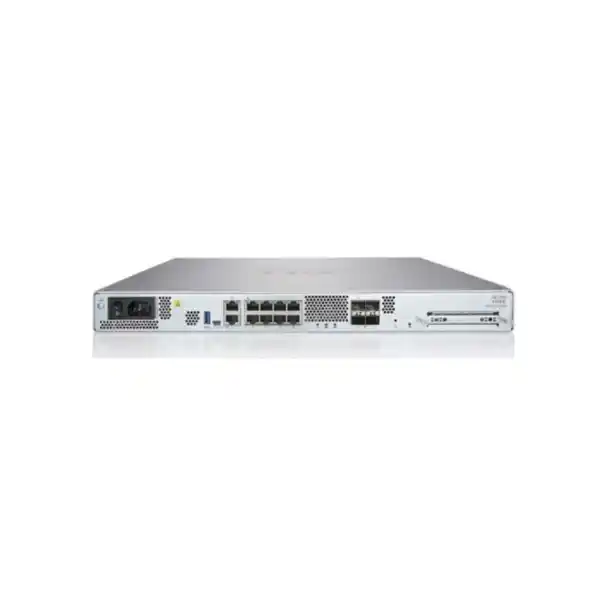
The Firepower 1120 is a Cisco Firepower 1000 Series security appliance. Cisco positions the 1000 Series for small offices, small and midsize businesses, and remote branches. The 1120 is a 1U rack-mount model that can run Cisco Secure Firewall Threat Defense software or Cisco ASA software. Those software choices matter because their feature sets, management workflows and published performance metrics are not identical.
What is it mainly used for?
Typical roles include an internet-edge firewall for a branch or small business, secure inter-site VPN gateway, application-aware policy enforcement point, intrusion prevention platform, segmented perimeter between user, server, guest or voice networks, and a managed branch firewall connected to a centralized Cisco security-management environment.
Who should consider it?
Organizations that need more capacity, fibre flexibility and rack integration than a basic desktop firewall should evaluate the 1120. It is particularly relevant where the expected inspected traffic is within the platform’s practical range, the number of concurrent sessions is comfortably below the published ceiling, and a single-gigabit-class or low-multi-gigabit branch design can be accommodated by its fixed 1G interface mix.
What is the most important factor to confirm?
Confirm the security-enabled workload, not only the ISP circuit speed. TLS decryption, IPS inspection, application visibility, malware controls, logging, VPN encryption, packet size and connection rate can change effective performance. Cisco explicitly notes that performance varies with enabled features, protocol mix, packet size and software release.
What can FourTeck help determine?
FourTeck can help translate your WAN bandwidth, user and device count, application mix, encryption requirements, site-to-site VPNs, remote-user demand, interface requirements, management preference, license term and migration scope into a more defensible model and licensing choice before quotation.
Why the Firepower 1120 occupies a useful middle position in the 1000 Series
The Firepower 1120 is easy to misunderstand if it is considered only as “the model above the 1010.” Its real value is the combination of rack-mount form factor, increased security throughput, a larger connection envelope and four SFP ports while remaining within the branch-oriented 1000 Series. Cisco publishes 890 Mbps for firewall plus application visibility and control on the 1010, while the 1120 is rated at 2.3 Gbps for the same workload. The 1120 also moves from the 1010’s desktop format to a 1U rack chassis and expands the network-interface options from eight copper ports to eight RJ-45 plus four SFP ports. For businesses operating a proper communications rack, fibre uplinks or multiple routed zones, this physical difference can matter as much as the throughput increase.
Above the 1120, the 1140 and 1150 offer further performance. Cisco lists the 1140 at 3.3 Gbps for firewall plus application visibility and control and 3.5 Gbps for NGIPS; the 1150 rises to 5.3 Gbps for firewall plus application visibility and control and 6.1 Gbps NGIPS. The 1150 also introduces 10G-capable SFP+ interfaces. That means the 1120 should not be selected simply because today’s internet service is below 2 Gbps. A buyer expecting near-term upgrades to multi-gigabit access, heavy east-west inspection, extensive encrypted-traffic visibility or substantial growth may be better served by evaluating the 1140, 1150 or a newer Cisco Secure Firewall platform before placing an order.
Conversely, over-sizing has a cost and operational consequence. A small office with a few hundred megabits of internet, modest connection counts and no demanding decryption requirement may not need the 1120. The 1010 or another compact platform could meet the requirement with a simpler physical footprint. Good firewall selection is therefore a workload-matching exercise: enough capacity and interfaces for the security policy, enough headroom for growth, but not a larger platform merely because a larger number looks safer on paper.
Verified Cisco Firepower 1120 performance and hardware specifications
The values below are useful as design anchors, but they are not promises of identical application performance in every network. Cisco states that performance varies with enabled features, traffic protocol mix, packet-size characteristics and software releases. For procurement, treat these numbers as published platform ratings and then validate whether your intended inspection policy leaves sufficient operational margin.
| Specification | Cisco published value for Firepower 1120 | Buyer interpretation |
|---|---|---|
| FW + AVC throughput | 2.3 Gbps | Relevant when application visibility and control are part of the deployed policy. |
| FW + AVC + IPS throughput | 2.3 Gbps | A more security-relevant reference than raw stateful firewall throughput for many Threat Defense deployments. |
| NGIPS throughput | 2.6 Gbps | Indicates IPS processing capability under Cisco’s stated test conditions; production traffic may differ. |
| TLS inspection | 850 Mbps | Important for organizations planning broad encrypted-traffic inspection. It can become the practical sizing constraint before the firewall headline figure. |
| IPsec VPN throughput | 1.2 Gbps, 1024B TCP with Fastpath | Use as a rated reference for encrypted site connectivity; tunnel count and real traffic still need separate consideration. |
| Maximum concurrent sessions with AVC | 200,000 | High-session applications, guest networks, dense Wi-Fi or NAT-heavy environments should be assessed against this ceiling with reserve capacity. |
| New connections per second with AVC | 15,000 | Useful when workloads create many short-lived sessions rather than a small number of long sessions. |
| Maximum VPN peers | 150 | Tunnel and user licensing or architecture must still be checked; a peer maximum does not define the entire remote-access design. |
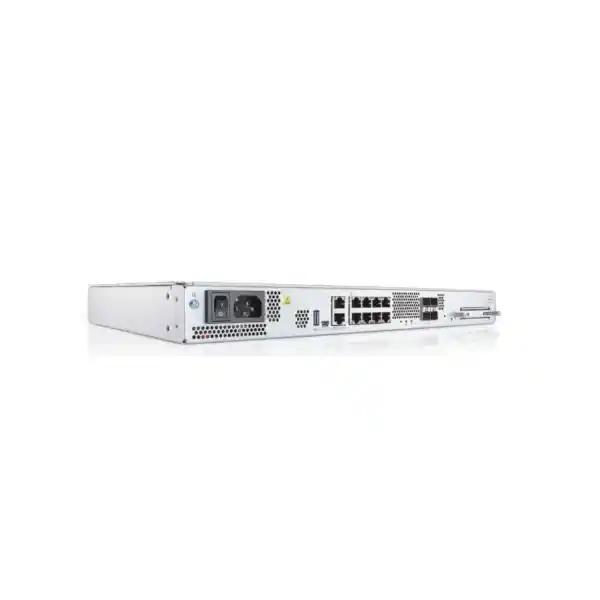
| Network interfaces | 8 x RJ-45, 4 x SFP | Useful for segmented copper networks and fibre uplinks, but there are no integrated 10G SFP+ ports on the 1120. |
| Dedicated management | 1 x 1000BASE-T plus serial console | Plan an out-of-band or dedicated-management path where operational policy requires it. |
| Storage | 200 GB | Local storage does not remove the need to design centralized logging, retention and monitoring appropriately. |
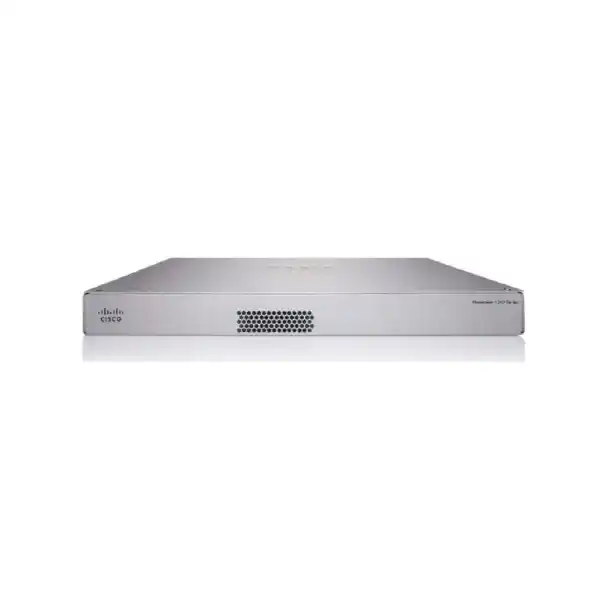
| Form factor | 1U rack mount | Fits standard rack deployments; Cisco lists two-post mounting brackets as included. |
| Power | Integrated single AC input, 100–240V AC, up to 100W maximum draw | The single integrated power input is an important resilience consideration for sites that require power-supply redundancy at the appliance level. |
Sizing the Firepower 1120 correctly for a Dubai internet edge
A common sizing mistake is to match the firewall to the purchased internet bandwidth and stop there. Suppose an office has a 1 Gbps business internet circuit. At first glance, a firewall with a 2.3 Gbps FW + AVC + IPS rating appears to offer generous headroom. That can be true, but the conclusion changes if the organization expects to decrypt and inspect a large share of TLS traffic, because Cisco publishes 850 Mbps for TLS inspection on the 1120. The same office may also have encrypted site-to-site traffic, guest Wi-Fi bursts, cloud backups, remote users, voice traffic and many short web sessions. The combined workload is more informative than the ISP label.
For a defensible design, begin with peak traffic rather than monthly averages. Identify how much traffic crosses the firewall in the busiest operational periods, whether large internal VLAN flows also traverse the appliance, and whether backup or replication jobs coincide with user demand. Then decide which flows require IPS, application control, URL policy, malware inspection or TLS decryption. Some traffic can legitimately be excluded from decryption for privacy, technical compatibility or risk reasons; other traffic may need deep inspection. The percentage that receives expensive inspection functions has a direct effect on capacity planning.
Next examine session behavior. A branch with 300 users does not necessarily produce the same firewall load as another branch with 300 users. Modern browsers, cloud services, collaboration platforms, mobile devices, IoT endpoints and API-driven applications can each create multiple simultaneous sessions. A guest network may introduce devices the organization does not manage. A retail, hospitality or education environment can therefore consume connection resources rapidly even if average throughput looks moderate. The 1120’s published limit of 200,000 concurrent AVC sessions and 15,000 new connections per second should be treated as capacity boundaries, not normal operating targets.
Growth should be explicit. If a business plans to move from 500 Mbps to 1 Gbps internet, consolidate two branches into one site, enable broad TLS decryption, add a second ISP or increase VPN dependency, those changes belong in the original sizing model. Buying precisely for today can create an avoidable refresh after the security policy becomes more ambitious. At the same time, theoretical five-year growth that is unlikely to materialize should not automatically push the design to an oversized appliance. A useful forecast usually separates committed changes, probable growth and optional future projects.
Finally, remember that published performance can change with software evolution and differs by feature combination. Cisco itself advises detailed sizing guidance because protocol mix, packet size and features affect results. FourTeck can use the published numbers as a baseline, but an accurate recommendation should be built around your actual security policy and operational pattern.
Interfaces, fibre uplinks and physical network design
Eight RJ-45 interfaces
The fixed copper ports can be used for common routed or switched-to-routed connections such as WAN handoff, LAN core, DMZ, guest, server, voice or dedicated partner networks, subject to the chosen software configuration. Port count should be mapped before purchase so a design does not depend on interfaces that are not actually available.
Four 1G SFP interfaces
The SFP ports are valuable for fibre connections to distribution switches, service-provider equipment or separated network zones. The transceiver type must match the fibre medium, wavelength, connector and distance. SFP optics should be treated as a separate compatibility decision rather than assumed to be included with the appliance.
No built-in 10G SFP+ on the 1120
This is a meaningful boundary. If the firewall must connect to a 10G core, aggregate multiple gigabit links in a way that requires 10G interfaces, or support a near-term multi-gigabit design, compare a platform with appropriate higher-speed interfaces instead of trying to solve a physical limitation through licensing.
Dedicated management planning
Cisco lists a dedicated 1000BASE-T management interface and a serial console connection. In environments with formal operations procedures, placing firewall management on a protected network can reduce dependence on the production data path and simplify controlled administration, troubleshooting and recovery.
The physical topology should also consider failure behavior. For example, two ISP circuits may terminate directly on the firewall, or upstream provider equipment may present Ethernet handoffs through switches. Downstream, a core or distribution switch may carry multiple VLANs over one trunk or use separate physical interfaces. Those choices affect port consumption, failure domains and maintenance procedures. If high availability is planned, every important production path must be designed for two appliances, not just copied from a single-firewall drawing at the end of the project.
Threat Defense versus ASA software: confirm the operating model before ordering and migration
Cisco’s Firepower 1000 hardware can run Secure Firewall Threat Defense software or Cisco ASA software. That flexibility is useful, but it also creates a procurement and migration question that should be answered explicitly. A business replacing a legacy ASA may be tempted to treat the 1120 as a faster drop-in ASA. Another organization may be buying it specifically to use Threat Defense capabilities such as application visibility, modern IPS, URL controls and centralized threat-focused management. The chosen software path affects management tools, licensing, feature workflow, migration planning and the performance figures that are most relevant.
With Threat Defense, Cisco publishes the 1120 at 2.3 Gbps for FW + AVC and 2.3 Gbps for FW + AVC + IPS, with 2.6 Gbps NGIPS throughput and 850 Mbps TLS inspection. The data sheet separately publishes ASA-mode figures, including 4.5 Gbps stateful inspection under Cisco’s stated test conditions and 2.5 Gbps multiprotocol stateful inspection. These numbers must not be mixed into a single “firewall speed” claim because they represent different software and test workloads. A buyer who plans to deploy Threat Defense should size using the Threat Defense workload, not the larger ASA stateful inspection number.
Management strategy should also be chosen early. Local device management can be appropriate for a small standalone deployment, while centralized management becomes more compelling as the number of firewalls, policy objects, events and operational users grows. Cisco documents centralized configuration, logging, monitoring and reporting through Firewall Management Center for Threat Defense, and its platform ecosystem also includes cloud-based management options. The right answer depends on how many sites exist, whether policy consistency is required, where logs should be retained, how changes are approved and what skills the internal team already has.
For a migration project, the operating-system decision belongs before detailed configuration conversion. If the old firewall uses features that are implemented differently in Threat Defense, or if the organization wants a new security policy rather than a literal configuration copy, the project should be treated as a controlled redesign. Interfaces, NAT, routing, VPNs, object groups, access policy, inspection exclusions, certificates and logging destinations should each be validated against the target software before cutover.
Cisco licensing and subscriptions: what must be confirmed
Licensing is one of the most important parts of a Firepower 1120 quotation because the hardware alone does not define the security functions the buyer intends to use. Cisco’s 2026 Firepower 1100 Threat Defense getting-started guidance identifies a required base entitlement and then lists IPS, Malware Defense, URL Filtering and Cisco Secure Client as licensing areas. Cisco Smart Licensing is used to organize entitlements, devices and subscriptions. The exact commercial bundle, term and entitlement names offered at quotation time should be confirmed against the intended software release and Cisco ordering system.
Base firewall entitlement
Cisco’s current getting-started material describes a required Essentials entitlement for Threat Defense. Older Cisco documents may use different base-license terminology, so an up-to-date quote should follow the current ordering and software guidance rather than assume an older bundle name.
IPS
Intrusion-prevention capability is relevant when the firewall must inspect network traffic for exploit patterns and enforce IPS policy. If IPS is part of the business requirement, the quote needs the corresponding subscription and a term aligned with the support and renewal strategy.
Malware Defense
Malware-focused functionality should be included only when it is part of the required security design. The procurement team should understand whether the chosen security subscription covers the inspection and update services expected by the administrator.
URL Filtering
URL controls can support policy by category or reputation. A buyer who needs web-use controls should include the relevant entitlement and should also plan exceptions, identity integration and logging so the feature is operationally useful rather than simply licensed.
Cisco Secure Client
Remote-access VPN requirements should be quantified separately from site-to-site VPN. Number of named or concurrent users, endpoint platforms, authentication design and remote-access features influence the Secure Client licensing choice and deployment work.
Cisco’s March 2026 guidance for the 1120 and 1140 also lists combined term-based subscription ordering for IPS, Malware Defense and URL functions in one-, three- and five-year options. That does not mean every quote should automatically use a single combination. Contract structure, renewal date alignment and existing enterprise agreements can affect what is commercially sensible. If the organization already owns Cisco security subscriptions or has a Smart Account with pooled licenses, that information should be available before the quote is finalized.
The practical rule is simple: describe the security functions first, then map them to current Cisco licensing. Avoid ordering a hardware-only appliance under the assumption that every advanced function is permanently included, and avoid buying subscriptions that the planned policy will not use.
TLS decryption can be the decisive performance constraint
Most modern application traffic is encrypted. That improves privacy in transit, but it creates a challenge for a security appliance that must inspect threats inside HTTPS or other encrypted sessions. The Firepower 1120 has a published TLS inspection figure of 850 Mbps, which is materially lower than its 2.3 Gbps FW + AVC + IPS rating. This is not a defect; cryptographic inspection is computationally intensive. It does mean that a buyer planning broad decryption should size around the encrypted-inspection requirement rather than the largest number on the specification table.
A decryption policy also has operational dependencies that are separate from throughput. Client devices must trust the certificate authority used for outbound inspection. Applications that use certificate pinning, mutual TLS or specialized cryptographic behavior can fail when intercepted. Financial, healthcare, government or privacy-sensitive categories may require bypass rules based on organizational policy and applicable requirements. Cloud services change frequently, so exception lists need maintenance. A deployment team should therefore identify what will be decrypted, what will be bypassed and how failures will be diagnosed before turning on broad inspection.
Performance headroom becomes especially important during busy hours. If an office has an 800 Mbps internet connection and expects to decrypt almost all eligible traffic, a platform rated at 850 Mbps TLS inspection would leave little theoretical margin even before accounting for real-world packet mix and other functions. If only a controlled subset is decrypted and most high-volume trusted services are handled differently, the same appliance might be acceptable. The answer depends on policy, not only bandwidth.
For this reason, the quotation discussion should include a rough percentage of traffic expected to be decrypted, the types of users and applications involved, and whether the organization intends to expand inspection later. Where encrypted inspection is central to the security strategy, comparing the 1120 with a higher-capacity model is often more prudent than relying on optimistic assumptions.
VPN design: site-to-site tunnels, remote access and peer limits
Cisco publishes 1.2 Gbps IPsec VPN throughput for the Firepower 1120 using a 1024-byte TCP Fastpath test and lists a maximum of 150 VPN peers. Those values are useful but answer different questions. Throughput is about encrypted data volume under a specified test method, while peer count is about how many VPN relationships the platform supports. A branch with ten high-bandwidth site-to-site tunnels may stress throughput before peer count. A network with many small remote sites may approach peer limits while using modest bandwidth.
Site-to-site VPN planning should identify every current and planned endpoint, routing approach, overlapping address space, encryption policy and failover expectation. If two internet providers are used, determine whether tunnels must fail over between them and how routing converges. If dynamic routing is used over VPN, confirm the software and design support. Cloud connectivity to environments such as public-cloud virtual networks may add multiple tunnels per region or per redundancy domain, so counting “sites” is not always the same as counting tunnel peers.
Remote-access VPN is a separate workload. The design should include expected concurrent users, authentication source, multi-factor authentication, endpoint operating systems, split-tunnel or full-tunnel policy, DNS behavior, address pools and user-support processes. Remote users can increase substantially during business continuity events, travel peaks or temporary work-from-home policies. Licensing for Cisco Secure Client should therefore be planned from the user requirement, not inferred from the appliance’s 150-peer platform maximum.
Security inspection may also apply to VPN traffic after decryption. A tunnel can terminate on the firewall and then traverse IPS, URL or application policies depending on the design. Capacity estimates should include that internal inspection path instead of treating VPN encryption as an isolated feature. When a branch both encrypts outbound site traffic and decrypts inbound traffic from remote sites, the combined processing demand may be significant.
For a UAE organization with regional offices, the Firepower 1120 can be a strong branch VPN gateway when the tunnel count and encrypted traffic fit comfortably within its envelope. If the location acts as a hub for many branches or carries a large share of corporate traffic, a larger firewall or a different hub architecture should be compared.
High availability and resilience: what the hardware can and cannot solve
Cisco lists active/standby high availability for Firepower 1000 Threat Defense deployments. For businesses where internet access, cloud applications, IP telephony, payment systems or branch connectivity are operationally critical, two Firepower 1120 appliances can reduce the risk of a single firewall hardware failure. However, buying a pair is only one part of a resilient design. Upstream ISP handoffs, downstream switching, power feeds, rack power distribution, transceivers, cables and routing must also be designed so that a firewall failover does not expose another single point of failure.
The 1120 uses an integrated single AC input. That means appliance-level power-supply redundancy is not provided by dual hot-swappable power supplies. In a high-availability pair, resilience can be improved by connecting the two appliances to different UPS or PDU paths where available, but the site power architecture must support that approach. A buyer requiring redundant power inputs within each appliance should evaluate a platform designed for that requirement rather than assuming HA pairs and redundant PSUs are the same thing.
Failover testing should be part of acceptance. It is not enough to see two devices marked healthy. The implementation should validate what happens to internet traffic, VPN tunnels, dynamic routing, NAT state, management access and critical applications during a controlled failover. Some sessions may reset depending on configuration and feature behavior, so application owners should understand the expected impact. Monitoring should also alert when the pair has lost redundancy; an unnoticed standby failure can leave the site operating normally until the active unit later encounters a problem.
For smaller branches where brief downtime is tolerable, a single appliance with a defined replacement or recovery process may be economically reasonable. For headquarters or revenue-critical sites, a pair is more often justified. The resilience decision should be based on business impact and recovery objectives, not on a generic rule that every firewall must be duplicated.
Management choices for one firewall, multiple UAE branches or a distributed estate
The right management approach depends on operational scale. A single branch firewall can often be managed locally when the security team is small and the policy is straightforward. As the environment grows to several Firepower devices, centralized management becomes more valuable because it helps administrators apply consistent objects and policies, see events across sites, coordinate software maintenance and reduce configuration drift.
Cisco documents local device management for the 1120 and centralized configuration, logging, monitoring and reporting through Firewall Management Center for Threat Defense. Cisco also offers cloud-based security-management capabilities in its broader firewall portfolio. The selection should reflect who administers the network, where those administrators are located, whether change control requires central approval, how much log history is needed, and whether the organization wants to standardize multiple branch firewalls under one policy framework.
Local management can fit
A standalone site, limited policy complexity, a small administrative team and no requirement for centralized event correlation can make local management practical. The trade-off is that policies and operational views remain more device-centric.
Centralized management can fit
Multiple branches, shared security standards, larger operational teams, centralized logging and regular policy reuse strengthen the case for Firewall Management Center or an appropriate centralized Cisco management architecture.
Operational governance still matters
A management platform does not define who can approve changes, how emergency rules expire, how configuration backups are handled or who reviews security events. Those processes need ownership regardless of tooling.
For buyers building a multi-site UAE network, it is worth deciding the management architecture before the first firewall is deployed. Retrofitting centralized management later is possible in many cases, but designing object naming, site templates, logging and administrator roles from the beginning usually produces a cleaner environment.
Logging, monitoring and security operations
A next-generation firewall creates value only when its alerts and telemetry become part of an operational process. The Firepower 1120 can enforce application, intrusion and access policy, but an organization still needs to decide which events are retained, who reviews them and how incidents are escalated. Excessive logging can overwhelm operators and storage; insufficient logging can make investigations difficult. The goal is not to record everything forever but to retain the events that support security, troubleshooting, audit and incident response requirements.
Start with firewall access decisions, administrative changes, VPN events, IPS alerts, malware-related detections, system health and high-availability status where applicable. Then map those events to the organization’s monitoring environment. Some businesses rely primarily on Cisco management tools, while others forward relevant events to a SIEM or managed SOC. Time synchronization is fundamental because events from the firewall, identity platform, endpoint tools and servers must correlate accurately during investigation.
Retention should be driven by operational and compliance needs. Local appliance storage is finite and should not be treated as the only long-term evidence repository. If the business needs months of searchable history, centralized retention is usually more appropriate. The architecture should account for event volume, backup requirements, access control and the cost of retaining high-volume logs.
Monitoring should include platform health as well as security detections. Interface errors, CPU or memory pressure, licensing status, failed updates, degraded HA, VPN failures and certificate expiry can cause operational incidents without being attacks. A successful Firepower deployment therefore combines preventive policy with routine health monitoring and a clear owner for response.
Migration from an existing firewall: a controlled path to the Firepower 1120
Inventory the current firewall
Document interfaces, VLANs, routes, NAT, access rules, VPNs, objects, certificates, authentication, logging destinations, public IP addresses, ISP details and any unusual application dependencies. Remove obsolete assumptions before copying them into the target design.
Choose the software and management model
Confirm Threat Defense or ASA and whether the firewall will be locally or centrally managed. This decision influences configuration structure, licensing, migration tools and the operational skills required after cutover.
Validate model capacity
Use peak inspected throughput, connection rate, concurrent sessions, VPN demand and decryption policy to confirm the 1120 still provides suitable margin. If the old firewall is being replaced because it is saturated, do not carry forward the same capacity problem.
Rebuild and test policy
Converted configuration should be reviewed, not trusted blindly. Confirm object references, NAT order, rule intent, inspection actions, route reachability, VPN cryptography, DNS, DHCP dependencies and management access in a controlled pre-cutover test.
Plan cutover and rollback
Define the maintenance window, business owner, test sequence, escalation contacts and rollback trigger. Keep the old configuration, credentials and cabling information available until the new firewall has passed the agreed validation tests.
Observe after migration
Monitor denied traffic, application performance, VPN stability, interface errors, resource utilization and unexpected inspection events. Post-cutover tuning is part of deployment, not evidence that the project failed.
A migration is also an opportunity to reduce rule sprawl. Old firewalls often contain temporary rules that became permanent, duplicate objects, expired vendor access and NAT entries for decommissioned systems. Carrying every historical rule into a new appliance preserves technical debt. The safer approach is to retain business-required connectivity, verify ownership and document exceptions. This produces a smaller policy that is easier to review and reduces the chance that an obsolete access path survives merely because it existed before.
Branch segmentation, VLANs and policy design
The Firepower 1120 is frequently deployed at a network boundary, but the boundary does not have to be only “LAN versus internet.” A branch may contain corporate users, servers, voice systems, guest Wi-Fi, building-management devices, CCTV, printers, development systems and third-party equipment. Segmentation can reduce the impact of a compromised endpoint by limiting which zones can communicate and by applying different security controls to different traffic classes.
Before assigning interfaces and VLANs, identify trust relationships. Corporate users may need internet access and selected server services but should not necessarily reach management interfaces. Guest users normally need internet access without access to internal networks. CCTV cameras may need to reach a recorder and time service but not arbitrary corporate endpoints. Voice systems may require specific call-control and media paths. These requirements can be expressed as a matrix before they become firewall rules.
Physical ports do not need to map one-to-one with every security zone if VLAN trunks are appropriate, but the design should consider failure domains and troubleshooting. A single trunk can carry multiple zones efficiently while creating dependence on one physical link. Separate interfaces can simplify isolation while consuming ports. The 1120’s combination of copper and SFP ports gives useful flexibility, yet any design that expects 10G uplinks or extensive high-speed east-west inspection should evaluate a higher platform.
Segmentation policy should be explicit and maintainable. Broad “allow any” rules between internal zones may defeat the reason the zones were created. At the same time, extremely granular rules without ownership can become unmanageable. A practical policy groups systems by business function, allows documented dependencies, logs meaningful denies and is reviewed when applications change.
Firepower 1120 use cases that make sense — and cases that deserve another model
Small-business internet edge
A rack-based office with business internet, several VLANs, controlled application access and moderate IPS requirements can be a good fit when peak inspected traffic remains comfortably within the 1120’s capacity.
Regional branch with VPN
The 1.2 Gbps published IPsec figure and 150-peer limit can support many branch designs, provided tunnel count, encryption workload and post-VPN inspection are all included in sizing.
Fibre-connected rack deployment
Four SFP ports can be useful where the firewall connects to fibre-based switching or provider handoffs. Optic compatibility and link speed must be confirmed separately.
High-TLS-inspection site
A site that intends to decrypt close to a gigabit or more of encrypted traffic should compare higher-capacity models because the 1120’s published TLS inspection rate is 850 Mbps.
Multi-gigabit core or WAN
If 10G physical connectivity is a requirement, the 1120’s fixed 1G RJ-45 and SFP interface design becomes a direct limitation. A platform with 10G interfaces should be considered.
Large central VPN hub
A hub carrying many branches or high encrypted aggregate traffic may exceed the practical envelope even if each remote site is small. Hub sizing should use aggregate tunnel demand and failover scenarios.
Comparing Firepower 1010, 1120, 1140 and 1150
The closest comparison is within the same Firepower 1000 family. Model selection should consider throughput, interface speed, TLS inspection, VPN demand, rack requirements and future growth. The table below focuses on the published numbers most likely to influence a buyer’s shortlist.
| Model | FW + AVC | NGIPS | TLS | IPsec VPN | Interfaces |
|---|---|---|---|---|---|
| Firepower 1010 | 890 Mbps | 900 Mbps | 195 Mbps | 400 Mbps | 8 x RJ-45 |
| Firepower 1120 | 2.3 Gbps | 2.6 Gbps | 850 Mbps | 1.2 Gbps | 8 x RJ-45, 4 x SFP |
| Firepower 1140 | 3.3 Gbps | 3.5 Gbps | 1.2 Gbps | 1.4 Gbps | 8 x RJ-45, 4 x SFP |
| Firepower 1150 | 5.3 Gbps | 6.1 Gbps | 1.4 Gbps | 2.4 Gbps | 8 x RJ-45, 2 x SFP, 2 x 10G SFP+ |
The 1010 is appealing where desktop placement, lower bandwidth and lower cost are priorities. The 1120 is a substantial step up for rack environments and adds SFP connectivity. The 1140 keeps the same broad port mix while increasing security and TLS performance. The 1150 offers the strongest 1000 Series performance and adds 10G SFP+ connectivity, which can be decisive for higher-speed aggregation. A buyer expecting 10G uplinks should not choose the 1120 solely because its current internet circuit is below 1 Gbps; physical interface strategy can outlive the original WAN contract.
Rack, power and environmental planning in UAE deployments
The Firepower 1120 is a 1U appliance measuring approximately 1.72 x 17.2 x 10.58 inches and weighing about 8 lb, or 3.6 kg. Cisco lists two-post mounting brackets as included. Its integrated AC power input supports 100 to 240V AC at 50 to 60 Hz, with a published maximum power draw of 100W. These specifications make the appliance straightforward to integrate into many communications racks, but the site still needs suitable rack space, power distribution and ventilation.
Cisco specifies an operating temperature range of 0 to 40°C. In Dubai and the wider UAE, this makes room cooling and rack airflow a serious infrastructure consideration rather than a formality. A properly conditioned office or data room should keep the firewall within the manufacturer’s operating envelope even when external temperatures are high. The design should account for HVAC outages, overcrowded cabinets, hot-air recirculation and racks placed in utility spaces that were not designed for continuous IT loads.
The 1120 has an integrated fan and is not a silent desktop appliance. Cisco’s hardware table lists 34.2 dBA at 25°C and up to 56.8 dBA at highest system performance for the 1120. This is another reason to place it in a rack or communications room rather than on a desk near staff. Noise is rarely the primary buying factor for a firewall, but it becomes relevant in small offices where the communications rack is located in an occupied workspace.
Power protection should match the site’s availability objectives. A UPS can help the appliance ride through short interruptions and allow controlled shutdown during longer outages. For a high-availability pair, separate power distribution paths are beneficial where the building infrastructure supports them. Because each 1120 has a single integrated AC input, a single appliance cannot achieve dual-power-supply resilience by itself.
Cabling should be planned at the same time. Copper patch leads, SFP transceivers, fibre patch cords and console access are small items compared with the firewall, yet missing or incompatible components can delay deployment. The final bill of materials should include the exact interfaces used in the target topology rather than treating accessories as an afterthought.
Security policy design: application visibility, IPS, URL controls and malware functions
A Firepower 1120 purchase is most valuable when the organization knows what it expects the security policy to do. Application visibility and control can identify traffic beyond simple IP addresses and ports, which helps when modern applications use shared cloud infrastructure or dynamic destinations. IPS can inspect for exploit patterns and malicious behavior. URL filtering can apply policy by site category or reputation. Malware-focused functions can add another layer of inspection. Each capability has licensing, tuning and operational implications.
Application policy should be linked to business use. Blocking every unknown application may disrupt legitimate services; allowing all applications defeats the purpose of visibility. A practical approach identifies critical business applications, high-risk categories, remote-access tools, file-sharing services and unsanctioned cloud applications, then applies controls that the business can support. Visibility reports can be used during an observation phase before stricter enforcement is introduced.
IPS policy also benefits from context. Aggressive signatures can catch more suspicious patterns but may create false positives in unusual applications. Conservative settings reduce disruption but can miss some attack behavior. The best policy reflects exposed services, endpoint vulnerability, patching maturity and the organization’s tolerance for false positives. Critical IPS events should feed an incident-response process rather than disappear into a dashboard.
URL filtering is often associated with employee web-use policy, but it can also reduce exposure to newly observed or known malicious destinations. Exceptions need governance because users may request access to blocked business sites. A temporary bypass should have an owner and review date so policy does not gradually erode. Identity integration can make user-aware controls more meaningful than rules based only on source IP addresses.
The key point is that enabling every checkbox is not automatically the strongest security posture. Security controls have performance cost, licensing cost and operational cost. The intended policy should be defined, tested and monitored so each enabled function provides a clear benefit.
Procurement details that make a Cisco Firepower 1120 quotation accurate
A request that says only “Cisco Firepower 1120 price” is usually incomplete. The appliance model is only one line in a working security solution. An accurate quotation depends on software, subscriptions, support, optics, quantity, high-availability requirements and deployment scope. Providing the following information reduces the chance of comparing offers that contain different entitlements or omit required components.
Quantity and HA requirement
State whether the project needs one appliance per site or an active/standby pair. Multi-site quantities can change the management and subscription structure.
Threat Defense or ASA
Confirm the intended software image. If undecided, describe the features and management workflow you need so the choice can be evaluated rather than guessed.
Subscription functions and term
Identify IPS, malware, URL filtering and remote-access requirements, plus the desired one-, three- or five-year commercial term where applicable.
Internet and inspected throughput
Provide current circuit speeds, expected upgrades and whether high-volume internal traffic crosses the firewall. Include a rough TLS-decryption requirement.
Interfaces and optics
List copper and fibre connections, SFP types, fibre mode, distance and any 10G requirement. The 1120 does not provide 10G SFP+ ports.
VPN requirement
Give site-to-site tunnel count, remote-access user count, expected encrypted bandwidth, MFA requirements and any cloud VPN connectivity.
Management architecture
State whether the firewall will be standalone or centrally managed, and whether an existing Firewall Management Center or Cisco Smart Account is already in use.
Migration and installation
Describe the existing firewall, number of rules, NAT, VPNs, public IPs, maintenance window, rack readiness and whether onsite implementation is required.
A quote built from these inputs is easier to compare because every supplier can be evaluated against the same technical scope. It also helps expose when the 1120 is not the right model before hardware is purchased.
Availability, lifecycle and support considerations for UAE buyers
Cisco’s current support listing shows the Firepower 1000 Series as available to order, and Cisco continues to publish current product and getting-started documentation for the 1100 models. That is useful when evaluating the platform in 2026, but an individual Dubai or UAE quotation should still confirm distributor availability, lead time, exact hardware identifier, subscription entitlement and support coverage at the time of purchase. Availability can vary by channel and contract even when a series remains orderable.
Lifecycle planning should consider the expected operational period of the firewall. A business buying for three to five years should check software-support plans, required subscription terms, renewal procedures and whether planned applications or ISP upgrades could outgrow the appliance. Cisco’s portfolio evolves, so a newer platform may sometimes provide a more future-oriented interface or performance profile even when the 1120 meets today’s requirement. That comparison is particularly relevant where 10G connectivity, substantially higher TLS inspection or faster internet is already on the roadmap.
Support is more than hardware replacement. Firewall incidents can involve configuration, VPN interoperability, software bugs, security-policy behavior, certificates or licensing. The support model should identify who opens Cisco cases, who has access to the relevant Smart Account, where configuration backups are stored and who can make emergency changes. If an external integrator operates the appliance, responsibilities for after-hours incidents and renewal notices should be documented.
For organizations seeking local guidance, FourTeck UAE can support broader infrastructure discussions around the firewall project, while FourTeck IT Services UAE is relevant where the requirement includes implementation, support or wider IT operations. For multi-country procurement or general corporate information, buyers can also review FourTeck.
Frequently asked buyer questions about the Cisco Firepower 1120
Is the Firepower 1120 suitable for a 1 Gbps internet connection?
Often, but not automatically. Cisco rates FW + AVC + IPS at 2.3 Gbps, which gives theoretical margin above a 1 Gbps circuit. However, TLS inspection is rated at 850 Mbps, and real performance varies with traffic mix and enabled features. If the site expects heavy decryption, high session rates or substantial VPN processing, the design should be checked more closely.
Does the Firepower 1120 have 10G ports?
No. Cisco lists eight RJ-45 interfaces and four SFP interfaces for the 1120. The Firepower 1150 is the 1000 Series model in Cisco’s data sheet that includes two 10G SFP+ interfaces. If 10G connectivity is required, choose a platform designed for it rather than relying on adapters or assumptions.
Can the 1120 run Cisco ASA software?
Yes. Cisco states that Firepower 1000 platforms run Threat Defense or ASA software. The performance tables differ by software image, so the intended operating model should be stated clearly during sizing and quotation.
Is IPS included automatically?
The appliance supports IPS, but Threat Defense licensing must be aligned with the features used. Cisco’s current licensing guidance lists a required base entitlement and separate licensing areas for IPS, Malware Defense, URL Filtering and Cisco Secure Client. The exact bundle and term should be confirmed on the quote.
How many VPN peers does the Firepower 1120 support?
Cisco lists a maximum of 150 VPN peers for the 1120 and publishes 1.2 Gbps IPsec VPN throughput under its stated test conditions. Remote-access licensing, concurrent user expectations and site-to-site architecture still need separate design.
Can it be used in a high-availability pair?
Yes. Cisco lists active/standby high availability for Threat Defense on the 1000 Series. A resilient design should also provide redundant upstream and downstream paths where required. The 1120 itself uses a single integrated AC input, so power architecture needs separate consideration.
Does the appliance include SFP transceivers?
Do not assume the required optics are included. The appliance provides SFP interfaces, but the correct transceiver must match the intended fibre medium, wavelength, connector, distance and supported Cisco compatibility. The bill of materials should list optics explicitly.
Should I buy the 1120 or 1140?
The 1140 offers higher published FW + AVC, IPS and TLS performance while keeping a broadly similar eight-RJ-45/four-SFP interface mix. If the 1120 would run close to its limits after decryption and IPS are enabled, the 1140 may provide more sensible headroom. If the workload is comfortably lower, the 1120 may be sufficient.
What information is needed for a Dubai quotation?
Provide quantity, site location, software choice, current and expected WAN speed, user and device count, estimated TLS decryption, VPN requirements, interface and SFP needs, subscription features and term, high-availability requirement, management platform, migration scope and installation expectations.
A practical sizing example for a growing UAE branch
Consider a branch with 180 employees, two internet circuits, corporate and guest Wi-Fi, several cloud applications, site-to-site VPN links to headquarters and a small set of published services. Current peak internet utilization is around 600 Mbps, but the organization expects a move to 1 Gbps within a year. The security team plans to use application visibility, IPS and URL controls, while TLS decryption will initially cover managed corporate endpoints but exclude selected privacy-sensitive and technically incompatible services.
The Firepower 1120’s 2.3 Gbps FW + AVC + IPS rating gives a reasonable initial reference point, and the 200,000 concurrent AVC session limit may be ample for this user count. However, the decision should not stop there. If TLS decryption grows toward the majority of a 1 Gbps circuit, the 850 Mbps published TLS figure becomes significant. If the branch also becomes a VPN aggregation point for other sites, the 1.2 Gbps IPsec reference and 150-peer maximum need to be considered. If a 10G core refresh is planned, the 1120’s fixed 1G ports could create a physical bottleneck even before processing capacity is exhausted.
In this example, the 1120 could be a credible option if decryption remains selective, VPN demand is moderate and 1G interfaces align with the LAN architecture. The 1140 should be compared if the organization expects broader TLS inspection or wants more throughput margin. The 1150 or a newer platform should be evaluated if 10G interfaces are part of the target architecture. This comparison is more useful than simply declaring the 1120 “good for 180 users,” because user count alone does not determine firewall load.
The same logic applies in reverse. A 50-user office with an 800 Mbps circuit can still have demanding security requirements if it runs high-volume cloud workloads, extensive decryption and many VPN sessions. Another 300-user site can have modest throughput if most applications are low bandwidth. Sizing requires traffic and policy information, not generic users-per-firewall tables.
Implementation details that are easy to miss
Firewall projects often fail on small dependencies rather than headline hardware. The IP addressing plan may be incomplete, an ISP may need to change a handoff, a public certificate may not be available, or nobody may know which legacy rule permits an important application. A disciplined implementation identifies these dependencies before the maintenance window.
Routing and ISP handoff
Confirm static or dynamic routing, provider gateway, public address blocks, secondary ISP behavior and whether the carrier handoff is copper or fibre. If the ISP changes addressing during cutover, the rollback plan must account for it.
DNS, DHCP and identity
A firewall migration can affect DHCP relays, DNS forwarding, identity mapping and authentication paths. These services should be listed explicitly because a basic ping test does not prove that users can authenticate or resolve applications correctly.
Certificates and decryption trust
Remote-access VPN, management interfaces and TLS inspection may each depend on certificates. Issuance, renewal, private-key handling and endpoint trust distribution should be planned before deployment.
Change access and credentials
The project team needs authorized access to the old firewall, switches, ISP portals, DNS services, Cisco Smart Account and management platform. Missing credentials can turn a routine migration into a prolonged outage.
Application validation
Business owners should define what must work after cutover: ERP login, payment processing, cloud applications, inbound services, voice calls, remote access and branch connectivity. Technical tests should map to business outcomes.
Documentation and handover
Record interface assignments, diagrams, policy ownership, VPN details, management URLs, backup procedure, support contacts and renewal dates. A firewall that only the installer understands is an operational risk.
When the Firepower 1120 may be the wrong purchase
A balanced product page should identify limitations as clearly as strengths. The Firepower 1120 may be unsuitable when the network requires 10G physical interfaces, because the model’s fixed ports are 1G RJ-45 and SFP. It may also be undersized when broad TLS decryption approaches or exceeds its published 850 Mbps figure, when high aggregate VPN traffic approaches the 1.2 Gbps IPsec reference, or when projected security-enabled throughput leaves little margin below the 2.3 Gbps FW + AVC + IPS rating.
Connection scale can be another reason to move up. Cisco lists 200,000 concurrent AVC sessions and 15,000 new connections per second. Very dense guest environments, proxy-like workloads, high-volume web applications or networks with large numbers of short-lived sessions should validate these limits carefully. A firewall can have enough Mbps while still being constrained by session behavior.
Resilience requirements may influence platform choice. The 1120 supports active/standby high availability in Threat Defense, but each appliance has a single integrated AC input. Organizations that require dual redundant power supplies per chassis may need a different appliance family. Similarly, buyers expecting modular interface expansion should note that the 1120’s port configuration is fixed.
The opposite is also true: the 1120 may be more than a small site needs. A modest branch with low throughput, few VLANs, minimal VPN use and no requirement for rack-mounted fibre connectivity may be adequately served by a smaller platform. Capital cost, subscription cost, support and power should all be considered in the model choice.
Finally, the organization may prefer a newer Cisco Secure Firewall generation if long-term interface speed, cloud management or platform evolution is a priority. The right comparison should include current Cisco options at the time of purchase, not only the historical 1000 Series lineup.
Buying from Dubai: practical commercial and deployment questions
For a Dubai or UAE buyer, the technical model selection is only one part of the project. Confirm whether the quotation is hardware-only or includes subscriptions, Cisco support, configuration, onsite installation, migration, HA setup, VPN work, policy tuning and post-cutover support. Two quotations that both say “Firepower 1120” can represent very different scopes and should not be compared only by the final price.
Ask for the exact appliance identity and all subscription terms to appear on the quote. If SFP optics are needed, list them separately with quantity and type. For HA, confirm that two appliances and the required licenses or entitlements are included. For remote access, state the user requirement so Cisco Secure Client licensing is not omitted. If Firewall Management Center is already present, provide its version and management capacity; if it is not present, decide whether local management or a new centralized-management component is appropriate.
Installation scope should identify the site, rack readiness and permitted maintenance window. Dubai offices in shared commercial buildings may have restricted after-hours access, security-pass procedures or limitations on work in common telecom rooms. Data centers may require method statements or remote-hands coordination. These operational details can affect implementation scheduling even though they do not change the firewall hardware.
For a wider firewall and network-security discussion, the specialist Firewall Dubai by FourTeck resource can help frame local deployment options. The goal of the quotation process should be a complete, comparable scope: correct model, correct subscriptions, correct interfaces and a clear plan for installation and support.
Where price is important, ask suppliers to separate mandatory components from optional services. That makes it easier to see whether a lower quote is genuinely more competitive or simply excludes licenses, optics or implementation work that will be needed later.
Operational ownership after deployment
The firewall’s lifecycle begins at cutover. Someone must own policy changes, software maintenance, license renewals, event review, configuration backups, certificate expiry and user-access administration. If these responsibilities are unclear, the firewall can gradually become harder to manage even when the original implementation was technically correct.
Policy changes should have a lightweight but auditable process. Every new allow rule should identify the requesting service, source, destination, ports or application, business owner and expected duration. Temporary access should have an expiry or review date. Emergency changes should be documented after the incident. This prevents a clean initial rule base from turning into an unreviewed collection of exceptions.
Software upgrades deserve planning because security appliances combine operating-system code, threat engines and management dependencies. Review Cisco release guidance, compatibility with the management platform, maintenance-window requirements and rollback procedures. In an HA pair, the upgrade method should preserve service as much as supported by the target release and design. Configuration backups should be tested for restore procedures rather than assumed to be usable.
Licenses and subscriptions need calendar ownership. IPS, malware, URL and support services may have different commercial implications when they expire. Renewal reminders should reach both procurement and technical owners early enough to review whether the organization still needs the same feature set and whether a hardware refresh is approaching.
Finally, review capacity periodically. Internet upgrades, cloud migrations, new branches, more remote users and wider TLS decryption can change the suitability of the 1120 long after installation. Baseline throughput, sessions, VPN utilization and inspection policy after deployment, then compare future usage against that baseline. Capacity management is cheaper when it identifies pressure months before a firewall becomes a bottleneck.
Decision recap: is the Cisco Firepower 1120 the right fit?
Model fit
Best considered for branch and small-business rack deployments that need more capacity and fibre flexibility than an entry desktop firewall.
Capacity
Size against 2.3 Gbps FW + AVC + IPS, 2.6 Gbps NGIPS, 850 Mbps TLS inspection, 200,000 AVC sessions and 15,000 new AVC connections per second.
VPN
Cisco publishes 1.2 Gbps IPsec throughput and up to 150 VPN peers. Separate remote-user licensing and aggregate tunnel demand still need design work.
Interfaces
Eight RJ-45 and four SFP ports support mixed copper/fibre branch designs, but no integrated 10G SFP+ is provided.
Licensing
Define required IPS, malware, URL and remote-access functions, then map them to current Cisco subscriptions and terms rather than assuming hardware includes every advanced service.
Growth
Compare 1140, 1150 or newer platforms when decryption, multi-gigabit connectivity, VPN aggregation or long-term capacity could put the 1120 near its limits.
What FourTeck needs from you for an accurate Firepower 1120 quotation
The following information is enough to turn a generic product request into a useful technical and commercial scope. Exact figures are helpful, but estimates are acceptable where the project is still being planned.
Dubai or other UAE location, number of sites, one appliance or HA pair.
Existing brand/model, age, current problems and whether configuration migration is required.
Current ISP speeds, planned upgrades, dual-WAN requirement and expected peak traffic.
IPS, application control, URL filtering, malware functions and estimated TLS decryption coverage.
Employee count, guest devices, servers, IoT and any unusually high-session applications.
Site-to-site peers, remote-access users, MFA, cloud tunnels and expected encrypted bandwidth.
Copper ports, SFP requirements, fibre type and whether 10G connectivity is required now or soon.
Local management, existing Firewall Management Center, centralized branch policy or cloud-management preference.
Required security services and preferred one-, three- or five-year term where applicable.
Supply only, remote configuration, onsite installation, migration, policy cleanup, testing and support.
Confirm the Firepower 1120 against your real UAE workload before you buy
Share your WAN speed, user and device count, VPN scope, security subscriptions, interface requirements, decryption plan and migration needs. FourTeck can help determine whether the Cisco Firepower 1120 has suitable operational headroom or whether the 1140, 1150 or another Cisco Secure Firewall platform should be shortlisted instead.

Reviews
There are no reviews yet.