
Cisco ISA-3000-4C Industrial Firewall Dubai
A hardened industrial security appliance for organizations that need firewall segmentation, controlled connectivity and VPN services at the boundary between production zones, remote industrial sites and enterprise networks. The important purchasing decision is not only the hardware name: the exact ASA or Threat Defense software variant, licenses, software release, power design and lifecycle condition must match the intended deployment.
Direct answer: what the Cisco ISA-3000-4C is and what to confirm
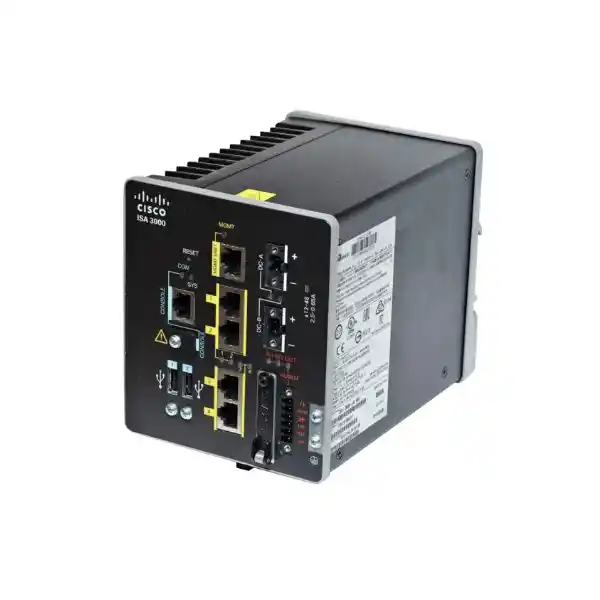
The Cisco ISA-3000-4C is a ruggedized industrial firewall platform in the ISA 3000 family. Cisco documents the four-copper hardware as a DIN-rail appliance with four 10/100/1000Base-T data interfaces, a dedicated Gigabit management interface, dual DC power inputs, alarm I/O, industrial-temperature design and hardware bypass capability on the copper data ports. It is built for operational technology and industrial control environments where a conventional office firewall may not be appropriate because the equipment must sit in cabinets, substations, production areas or remote field locations.
Its main uses are to segment industrial zones, control traffic between production cells, create a protected boundary between IT and OT, secure WAN links to distributed sites, provide site-to-site or remote-access VPN functions where the selected software and licensing support them, and inspect industrial traffic using Cisco security capabilities. The platform can operate with Cisco ASA software or Cisco Threat Defense software, but those are not interchangeable commercial assumptions. Cisco lists separate orderable variants for the four-copper chassis, so a quotation should identify the required software path rather than treating “ISA-3000-4C” as a complete order code.
Organizations that should consider it include utilities, manufacturing operators, oil and gas facilities, water and wastewater organizations, transport environments, mining operations, remote infrastructure operators and other businesses that need security controls physically close to industrial assets. It can also be relevant when a company already has ISA 3000 devices and needs a compatible replacement, expansion unit or standardized spare.
The most important factor to confirm is the complete deployment identity: exact product ID, software image, target software release, required subscriptions or feature licenses, expected traffic with security inspection enabled, number of security zones, VPN requirements, high-availability design and the condition of any existing hardware being reused. Performance figures are test-profile values and should not be treated as a guaranteed production result under every packet size, inspection policy, encryption mix or logging configuration.
FourTeck can help determine whether the four-copper model is the right physical variant, whether the two-copper/two-fiber ISA 3000 variant is a better interface match, whether the required ASA or Threat Defense capabilities are supportable in the intended software path, and what information is needed for a technically accurate UAE quotation or migration plan.
Exact model identity: why “ISA-3000-4C” needs one more decision
Cisco’s hardware documentation describes the ISA 3000 family with two main physical port arrangements: the ISA3000-4C copper SKU and the ISA3000-2C2F mixed copper/fiber SKU. The 4C designation therefore tells you something very specific and useful: this is the version with four copper Gigabit Ethernet data ports rather than two copper data ports and two SFP fiber interfaces. For buyers working from a bill of materials, an installed-base label, a consultant’s drawing or an old quotation, that distinction is important because the interface plan determines what can be connected directly without external media conversion.
However, Cisco’s ordering information separates the four-copper platform by base software. The ISA-3000-4C-K9 is listed with ASA base software, while the ISA-3000-4C-FTD is listed with Threat Defense. That means a request that contains only “ISA-3000-4C” should be treated as a platform-level requirement until the software expectation is confirmed. The same physical port count does not automatically imply the same management model, licensing behavior, inspection workflow or operational procedures.
For a new purchase, the safest procurement approach is to write the required outcome first. If the environment must match an installed ASA policy set, existing failover pair, ASA operational process or a defined ASA software standard, the quotation must reflect that. If the objective is a Threat Defense architecture managed through the appropriate Cisco management platform, then the FTD path must be specified. If the device is being bought as a replacement for an existing unit, collect the product ID, serial number, version ID, software version, license state and configuration role from the installed appliance before asking for a like-for-like unit.
This distinction also protects against a common purchasing mistake: ordering based on the front-panel format alone. The appliance can be reimaged between ASA and Threat Defense in supported scenarios, but reimaging is an operational project, not a reason to leave the intended software undefined. Configuration migration, feature mapping, licenses, management integration and change-control windows should all be considered before the hardware is delivered.
Model confirmation checklist
- Is the required orderable variant ASA-based or Threat Defense-based?
- Are all four production interfaces intended to be copper RJ-45?
- Does the site require fiber uplinks that would favor the 2C2F variant?
- Is this a new deployment, expansion, spare, or replacement of an installed ISA3000?
- What software release is approved by the customer’s OT change process?
- Which subscriptions, VPN features, VLAN scale and HA functions are required?
- Does an existing unit need serial-number, version-ID or field-notice validation?
Where the ISA-3000-4C fits in an industrial security architecture
The value of an industrial firewall is defined by placement and policy, not by the appliance name alone. The ISA-3000-4C is most useful when the organization can describe the industrial zones that need separation, the flows that must remain available and the operational consequences of blocking, inspecting or bypassing traffic.
Cell and zone segmentation
A plant may contain packaging lines, process cells, robot systems, safety-related infrastructure, engineering stations and supervisory systems with very different risk profiles. Placing an industrial firewall between defined zones allows security policy to be based on necessary communications rather than broad layer-2 reachability. The design should document source, destination, application or protocol, required direction and operational owner for each allowed flow.
IT-to-OT boundary
Industrial environments often need controlled communication with directory services, patching infrastructure, historians, security tools, remote support systems or enterprise applications. A firewall at the IT/OT boundary can enforce policy and provide logging, but its rule set must account for dependencies that are easy to miss. Discovery before migration is therefore as important as the final rule configuration.
Remote industrial sites
Substations, pumping stations, roadside infrastructure, utility enclosures and distributed production assets may need a local security boundary even when there is no conventional server room. The rugged DIN-rail format, DC power options and wide environmental tolerance are relevant here. WAN type, VPN throughput, management reachability, local bypass requirements and on-site recovery procedures must be designed together.
Industrial DMZ
A small industrial DMZ can provide a controlled location for systems that exchange information between enterprise and production networks. Depending on the architecture, an ISA3000 may participate in that separation. The design must still account for capacity, redundancy, inspection features and the number of logical interfaces. A device suitable for a remote cabinet is not automatically the right choice for a high-throughput central data-center DMZ.
Secure maintenance access
Remote engineering and vendor support can be necessary for industrial uptime, yet permanent broad access creates unnecessary exposure. The firewall can contribute VPN and access-control functions where supported by the selected software and license set. Strong identity, time-bounded access processes, jump-host design, monitoring and explicit authorization remain separate architectural requirements.
Legacy asset containment
Some production assets cannot be patched or replaced on an enterprise timetable. Network segmentation can reduce unnecessary exposure around those systems by limiting who can communicate with them and which protocols are permitted. This is risk reduction rather than a substitute for lifecycle management. The firewall policy should be built from verified operational traffic so security controls do not interrupt required machine communications.
Cisco ISA-3000-4C hardware and published platform specifications
The table below focuses on facts that materially affect selection and installation. It describes the four-copper ISA3000 platform and should be read together with the selected software release and licensing. Software features can change by release, while physical characteristics such as port format, power range and enclosure requirements define what the appliance can physically support at the site.
| Specification | Published platform detail | Buyer relevance |
|---|---|---|
| Data interfaces | 4 × 10/100/1000Base-T copper, with bypass capability | Choose this variant when all four data links are intended to terminate on copper Ethernet. |
| Management interface | Dedicated 10/100/1000Base-T management port | Plan a management network, IP addressing and secure administrative access separately from production traffic. |
| Processor / memory | 4-core industrial-temperature Intel Atom processor; 8 GB DRAM | Useful for platform identity; sizing should still use published inspected-throughput and session figures rather than CPU assumptions. |
| Storage | 16 GB onboard flash, 64 GB mSATA, 1 GB removable industrial SD flash | Existing units should be checked against relevant Cisco field notices and firmware guidance before reuse. |
| Power | Dual internal DC inputs; nominal ±12 VDC, 24 VDC or 48 VDC; 9.6–60 VDC maximum input range; 24 W published consumption | The cabinet power design, protective device, grounding and redundancy scheme must be confirmed before installation. |
| Dimensions | 11.2 × 13 × 16 cm (W × H × D) | Verify DIN-rail cabinet space, cable bend radius and surrounding clearance. |
| Weight | Approximately 1.9 kg | Relevant for mounting, enclosure planning and shipping documentation. |
| Ingress protection | IP30 appliance rating | The surrounding enclosure must provide the protection demanded by dust, moisture and hazardous-location conditions. |
| Alarm I/O | Two alarm inputs and one Form C alarm output relay | Can support operational monitoring workflows when integrated into the site design. |
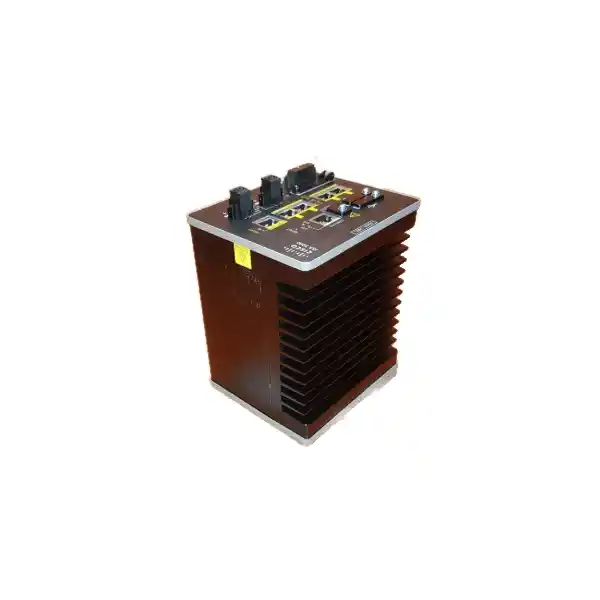
| Mounting / cooling | DIN-rail mounted, fanless, hardened industrial design | Appropriate for industrial cabinets when installation and environmental limits are respected. |
Cisco publishes an MTBF figure of 398,130 hours for the ISA-3000-4C. MTBF is a statistical reliability metric rather than a promise that an individual unit will operate for that period. Practical reliability planning still requires correct environmental installation, clean DC power, grounding, supported software, appropriate maintenance and review of field notices that apply to the exact product ID and hardware revision.
Rugged construction is a deployment feature, not permission to ignore the enclosure
The ISA3000 is designed for industrial environments, and Cisco publishes an operating temperature envelope that varies with enclosure conditions. The data sheet lists -40°C to +74°C as an operating range, with specific limits for vented, sealed, and fan- or blower-equipped enclosures. That detail matters in Dubai and across the UAE because an outdoor or poorly conditioned cabinet can become much hotter than ambient air. A rugged firewall must still be installed inside an enclosure that keeps the appliance within its permitted operating conditions.
Cisco lists IP30 for the appliance itself. IP30 is not an outdoor weatherproof rating. If the site is exposed to dust, windblown contamination, moisture, washdown, saline air or hazardous-location requirements, the cabinet or system enclosure must provide the appropriate protection. For certain hazardous-location certifications, Cisco documentation also specifies deployment conditions such as use with an IP54 enclosure. The firewall should therefore be selected as one component in a complete industrial cabinet design, not as a standalone environmental enclosure.
The platform is specified for 5% to 95% relative humidity, noncondensing, and its documentation references industrial shock, vibration, rail, marine, smart-grid and corrosion standards. Those characteristics explain why the product is different from a typical office branch firewall. They do not eliminate the need for engineering judgment. Cable routing, electromagnetic environment, grounding, surge protection, power quality and thermal load from adjacent equipment all influence serviceability.
For UAE projects, the practical installation question is usually not “can the firewall handle heat?” but “what temperature will exist at the firewall mounting position during the hottest operating condition, after considering solar load, enclosure material, nearby heat-generating equipment, ventilation and any cabinet cooling system?” That is the temperature that should be compared with the permitted operating condition.
Environmental checks for a Dubai site
- Measure or calculate expected internal cabinet temperature, not only outdoor ambient temperature.
- Confirm whether the enclosure is vented, sealed, cooled or fan-assisted.
- Verify dust and moisture protection at the enclosure level.
- Check grounding, DC source quality and protective devices.
- Allow physical clearance for wiring, alarm connectors and service access.
- Review hazardous-area certification requirements if the location is classified.
- Document installation conditions so future maintenance teams understand the design assumptions.
Four copper ports and hardware bypass: understand both the convenience and the risk
The ISA-3000-4C provides four copper data ports, and Cisco identifies the copper interfaces as bypass-enabled. Hardware bypass is particularly relevant in industrial networks because some operators prioritize continuation of process traffic if the security appliance loses power or is intentionally placed into bypass. On the ISA3000, the data ports can be configured in bypass pairs, allowing traffic to pass through the physical path under defined conditions.
Bypass should not be described as “automatic high availability” or as protection that remains active during failure. Cisco explicitly states that when hardware bypass is enabled, firewall, VPN and IPS functions do not take effect for the bypassed traffic. In other words, bypass can support traffic continuity but trades away enforcement while it is active. That is a deliberate operational choice. For a process where communication loss can cause a costly shutdown, that trade-off may be acceptable. For a boundary that must fail closed for security or compliance reasons, it may be inappropriate.
The deployment team should therefore record bypass behavior in the security design and operating procedure. It should be clear which port pair is used, what traffic will flow if bypass occurs, how an alarm is raised, how the security team detects loss of inspection, and who is authorized to restore normal enforcement. A change-control test should validate that the industrial process behaves as expected during a controlled bypass event. The test should also confirm that monitoring systems recognize the state change.
The four-copper format also has a simple interface-planning implication: it is ideal when the protected devices, switches or routers all present copper Ethernet. If two of the required links are fiber, the 2C2F version may be cleaner than introducing media converters. Media converters add power supplies, connectors, fault points and troubleshooting complexity. The correct physical SKU can therefore improve reliability even before any security policy is configured.
Finally, the dedicated management interface should be planned as a management path, not casually reused as another production data link. Secure administration, software maintenance, logging, backup and incident response all benefit from a management design that remains reachable when production interfaces are being changed or troubleshot.
Performance and sizing: use the published numbers correctly
Cisco publishes performance figures for the ISA3000 under defined FTD test conditions. They are valuable for shortlisting, but industrial firewall sizing should be based on the security services that will actually be enabled, the packet profile, number of sessions, encrypted traffic, VPN use, logging and expected growth. A design that looks comfortable using one headline figure can become constrained when multiple inspection services operate together.
Cisco also publishes up to 50,000 concurrent sessions with AVC, 2,700 new connections per second with AVC and 25 maximum VPN peers for the referenced FTD performance table. These limits describe platform scale, but they should not be read independently. A small remote site with moderate deterministic traffic can be a very different workload from a central industrial DMZ with thousands of short-lived sessions, internet-bound flows, TLS inspection, malware controls and intensive logging.
Start sizing with the expected protected traffic, not with WAN circuit speed alone. An industrial firewall may sit between two local Gigabit switches even though the actual process traffic is only tens of megabits per second. Conversely, a 100 Mbps WAN does not guarantee that a 350 Mbps inspected-throughput platform has abundant headroom if there are bursts, multiple local zones, VPN encryption, backups, firmware transfers or future network convergence. Measure present traffic where possible and define a growth margin that reflects the expected equipment lifecycle.
Packet size matters because packets-per-second processing can become important for control protocols with many small messages. Security policy complexity also matters. Intrusion prevention, application identification, URL filtering, file or malware services, TLS decryption and event logging can add processing work. Not every feature is available or licensed in every software path, so the final sizing model should mirror the intended configuration rather than an abstract “full security” label.
VPN sizing needs separate attention. If the appliance will terminate site-to-site tunnels for remote plants or secure maintenance connections, identify expected simultaneous tunnels, encrypted throughput and failover requirements. If the design depends on sustained encrypted bandwidth significantly above the platform’s published VPN figure, a larger or newer platform should be evaluated rather than relying on best-case assumptions.
For critical projects, treat the ISA-3000-4C as suitable only after the traffic model has been documented. Useful quotation inputs include average and peak throughput, packet-size characteristics if known, concurrent connections, number of protected zones, number of VPN peers, inspection features, logging destinations and a realistic growth horizon. This produces a more defensible decision than simply matching the interface speed printed on the front panel.
OT and industrial protocol visibility: valuable when policy is based on real process traffic
A defining characteristic of the ISA3000 family is its industrial security focus. Cisco documentation lists support for recognizing a range of OT and industrial protocols in Firepower software, including BACnet, Modbus, DNP3, EtherNet/IP, CIP, IEC 60870-5-104, IEC 61850 MMS, GOOSE, GSE, OPC-UA, Omron FINS, Siemens S7 and other industrial communications. Depending on the protocol and software capability, the system can use application identification and, for certain protocols, command or payload detection to create more context than a simple source-IP, destination-IP and TCP/UDP-port rule.
That capability is most useful after the organization understands what normal traffic looks like. Industrial protocols often contain operational transactions that are legitimate only between particular engineering stations, controllers, servers or field devices. A policy that recognizes the protocol can help distinguish expected communications from unexpected application use. For example, a plant may decide that a specific engineering workstation is allowed to communicate with a controller using an industrial protocol while other systems in the same network are not. The security goal is not to block “industrial traffic” generically; it is to permit the minimum operational communications that have an authorized purpose.
Protocol support also needs version awareness. Cisco’s dedicated ISA3000 industrial-protocol document states the protocols it could inspect for particular Firepower software capabilities as of the publication context of that document. Buyers should therefore verify the exact protocol, application detector, software release and inspection behavior needed for a project. A protocol name appearing on a support list does not automatically mean every vendor-specific extension, command, encryption mode or application behavior will be parsed in the way the project expects.
In brownfield OT environments, discovery and staged enforcement are important. Start by collecting known communication requirements from control engineers, network teams, OEM vendors and existing firewall logs. Where the software supports passive learning or monitoring, use that information to compare observed flows with documented flows. Investigate unexpected communications rather than immediately blocking them. Legacy systems may rely on services that were never documented, and sudden enforcement can disrupt production.
Industrial protocol visibility should also complement, not replace, standard security controls. Management access, DNS, NTP, authentication, syslog, backup traffic, patch repositories, historians and remote support channels may use conventional enterprise protocols. A well-designed OT firewall policy therefore combines industrial application awareness with normal layer-3 through layer-7 controls, identity information where appropriate, network segmentation and strong operational procedures.
For buyers, the practical quotation question is: which exact protocols and industrial applications must cross the firewall, and what control is required for each? Supplying that list allows the proposed software and license set to be checked against the real process requirement instead of assuming that every ISA3000 deployment needs the same inspection package.
Security capabilities in practical buyer terms
Stateful segmentation
The firewall can enforce stateful policy between defined network zones. In industrial designs, this is the foundation for limiting lateral movement while retaining necessary controller, supervisory, historian and maintenance communications. Rules should be based on verified flows, not broad “any-to-any” exceptions that reproduce the flat network behind a new appliance.
Threat inspection
Threat Defense and Firepower-related capabilities can add intrusion prevention and threat intelligence. These functions affect throughput and may require subscriptions. A buyer should define which zones truly require deep inspection and which traffic paths prioritize deterministic continuity, then size and license the device accordingly.
Application control
Application visibility can identify more than port numbers alone, including industrial applications where supported. This can make policy more expressive, but the design still needs clear ownership of allowed business and process functions. Application signatures are a control layer, not a substitute for accurate asset and flow inventories.
VPN services
The ISA3000 can support secure site-to-site and remote-access connectivity in appropriate software and license configurations. The critical questions are peer count, encrypted throughput, authentication method, route design, redundancy, split-tunneling policy and whether remote users should terminate directly on an industrial boundary at all.
NAT and routing
Cisco documents routing, NAT, DHCP, DNS and related network functions. In brownfield industrial environments, NAT can help integrate overlapping address spaces or isolate vendor networks, but it can also complicate troubleshooting and protocol behavior. The network design should treat NAT as an intentional architecture choice rather than a default fix.
Logging and context
The platform can send logs and integrate with management and security-analysis workflows. Logging is valuable only when timestamps, retention, alert ownership and incident procedures are defined. Excessive logging can also consume bandwidth and storage, so event strategy should reflect operational value rather than enabling every possible message.
ASA, Threat Defense and licensing: avoid “hardware-only” thinking
The ISA3000 hardware can run Cisco ASA software or Threat Defense software, and Cisco’s ordering table identifies separate four-copper product numbers for those base-software choices. A buyer replacing an installed device should first determine what is running today. A new project should determine which management and security architecture is intended. The answer changes configuration workflows, feature availability, operational skills, update processes and licensing.
Cisco’s ISA3000 data sheet historically lists a Security Plus option for ASA-based deployments that enables capabilities such as high availability, SSL VPN, higher connection counts and VLAN trunking. It also lists threat/application, malware and URL-filtering subscription options for Firepower or Threat Defense use cases. The exact commercial license names, ordering availability and entitlements can evolve, so a current quotation should be checked against Cisco’s active licensing and software policy rather than copying an old bill of materials.
VLAN scale is a good example of why licensing matters. The published data sheet lists five VLANs in the base ASA context and up to 100 with Security Plus, while it lists 100 for FTD. If an industrial project requires many logical zones on a small number of physical interfaces, the difference can determine whether the proposed license and software path are viable. The same principle applies to high availability and remote-access features.
Software release compatibility is equally important. Cisco has published end-of-sale and end-of-life notices for specific older ISA3000 software releases, and newer support documentation continues to list ISA3000 installation and upgrade resources. This means buyers should not simplify lifecycle status into a single “old” or “new” label. The exact software version, support contract, management platform and upgrade path need to be checked at the time of the project.
For a quotation, provide the current software version if replacing an installed appliance, the target release if the organization has an approved standard, whether centralized management is required, the desired threat subscriptions, VPN requirement, HA requirement and number of logical zones. That information turns licensing from an afterthought into part of the security design.
Licensing questions to answer
- ASA or Threat Defense?
- How many VLANs or logical interfaces are required?
- Is active/standby high availability required?
- Will remote-access VPN be used?
- Are IPS/threat, malware or URL-filtering services required?
- Which management platform will administer the device?
- What license term and support term does procurement require?
- Does an existing entitlement need transfer, renewal or replacement?
High availability, bypass and resilience are three different design tools
Cisco documents active/standby failover for the ISA3000 platform, subject to the applicable software and licensing. A failover pair is designed to preserve firewall service through a device or path failure by moving the active security role to a standby peer. Hardware bypass, by contrast, can preserve physical traffic continuity through a bypass pair while security enforcement is not active on that path. Dual DC power inputs improve power resilience to an individual source failure. These mechanisms solve different failure scenarios and should not be treated as interchangeable.
A critical industrial site may need all three layers: redundant DC feeds, an active/standby firewall pair and a defined bypass philosophy for specific process links. Another site may intentionally choose a single appliance with dual power and bypass because maintaining traffic during a firewall outage is more important than preserving inspection. A high-security boundary may choose fail-closed behavior and redundant firewalls instead of bypass. The correct design depends on process safety, availability targets, cyber risk, operational staffing and the physical topology.
Before ordering two units for HA, verify interface count on both paths, cabling, switch topology, software alignment, licenses, management addressing, state synchronization requirements, maintenance procedures and cabinet space. Redundancy that is not tested can create false confidence. Commissioning should include controlled failover, power-loss and management-reachability tests that are approved by the plant’s change-control process.
Common ISA-3000-4C deployment patterns
Manufacturing cell firewall
Placed between a production cell and the wider plant network, the appliance can restrict traffic to approved engineering, supervisory and data flows. The four-copper model is convenient when both sides of the firewall and any additional local zones use copper Ethernet. A successful cell-segmentation project begins with asset and flow discovery, because production traffic may include vendor services, time synchronization and controller communications that are not visible in ordinary IT documentation.
Utility substation boundary
A rugged firewall can separate substation networks from field WAN or utility backbone connectivity. Industrial environmental ratings, DC power, alarm I/O and protocol visibility are relevant. The design should also account for deterministic protection traffic, time synchronization, remote engineering, bypass philosophy and applicable utility security requirements. The firewall must not be inserted into a critical path without validated latency and continuity assumptions.
Water or pumping station
Remote water infrastructure often combines PLCs, telemetry, local operator interfaces and WAN connectivity in compact cabinets. The ISA3000’s form factor can fit that environment when power and temperature conditions are engineered correctly. Useful design questions include how the site is managed if the WAN fails, whether local process traffic must continue through bypass, how alarms are surfaced and how configuration backups are protected.
Oil and gas cabinet security
Industrial security equipment in oil and gas environments may be installed close to process systems, pipeline infrastructure or remote facilities. Environmental and hazardous-location requirements are therefore central to the bill of materials. The appliance’s certifications do not replace enclosure design. Confirm the area classification, enclosure rating, DC source, grounding, temperature, corrosion exposure and maintenance-access procedures with the relevant engineering team.
Industrial remote-access gateway
Where policy permits remote maintenance, the ISA3000 can participate in a secure VPN architecture. A good design does not simply expose the industrial subnet to anyone with a VPN account. Use strong authentication, limited authorization, jump systems where appropriate, logging, maintenance windows and explicit routes. Confirm encrypted-throughput needs against the platform’s published VPN performance before using it for a large number of concurrent users or high-volume transfers.
Brownfield segmentation retrofit
A retrofit can be more difficult than a greenfield deployment because undocumented traffic already exists. The firewall may need to begin in a transparent or observation-oriented role while engineers identify flows. Hardware bypass can be relevant to change-risk planning. The migration should include baseline capture, rule design, staged enforcement, rollback criteria and tests with the actual control-system owners rather than relying only on network diagrams.
Installation planning: the firewall is one part of the cabinet and network change
Industrial firewall installation should be treated as an engineering and operational change, not merely a rack-and-stack task. The ISA3000 mounts on DIN rail and uses DC power, so the installation team needs access to the cabinet design, DC distribution, grounding arrangement, network drawings and change procedure. The physical work should be coordinated with the team that owns the process network because disconnecting a single cable can affect production even before the firewall is powered.
Confirm cabinet space, DIN rail, power sources, grounding, temperature, enclosure type, cable paths, switch ports and management reachability.
Capture network topology, addresses, VLANs, routes, current traffic flows, protocol dependencies, VPNs and existing security rules.
Prepare software, management settings, time sources, logging, access control, interfaces, NAT and approved security policies in a controlled environment where possible.
Test expected flows, blocked flows, management, alarms, bypass behavior where used, failover where used, VPNs and log delivery.
Power deserves specific attention. Cisco publishes dual internal DC inputs and a 9.6 VDC to 60 VDC maximum input range, with common nominal systems at 12, 24 and 48 VDC. The installation guide also specifies protective-device and grounding requirements. A designer should not select a DIN-rail power supply only by voltage. Check available current, temperature derating, redundancy, upstream protective devices, cable gauge, terminal requirements and the power needs of other devices sharing the enclosure.
Network preparation is equally important. Label each data interface by security zone and physical destination before the cutover. Confirm which switch ports are access or trunk links, which VLAN tags are expected, whether spanning tree or link aggregation is involved, and whether the firewall is operating routed or transparent. If NAT is introduced, document the translated addresses and identify industrial applications that embed IP addressing in payloads or depend on peer identity.
Management design should include an IP address, gateway if required, DNS, NTP, administrator authentication, role assignments, configuration backup, software image repository, logging destination and remote-support path. In critical OT environments, a local recovery method should exist in case centralized management is unreachable. Configuration access should be restricted to authorized administrators and separated from general production traffic wherever practical.
A commissioning plan should identify success criteria and rollback criteria. “The firewall is pingable” is not sufficient. Verify each critical process flow with the actual system owner, confirm expected application behavior, test alarms and monitoring, validate time synchronization, review logs for unexpected denies and retain a signed record of the change. This reduces the chance that an undocumented dependency becomes an emergency after the installation team leaves the site.
Integration with Cisco and enterprise security tools
Cisco positions the ISA3000 as part of a wider IT/OT security workflow. Its documentation describes integration points with technologies such as Cisco Cyber Vision for industrial context, Cisco Identity Services Engine for identity and Security Group Tag information, NetFlow-based visibility tools and Cisco security management platforms. The practical value is the ability to make firewall policy and incident analysis more informed by asset identity and network behavior.
Integration should still begin with a compatibility matrix. Confirm the exact software release on the ISA3000, the management platform version, any Cyber Vision or ISE versions, supported APIs, required licenses, network reachability and certificates. Industrial environments often use long software qualification cycles, so the “latest” version in one product family may not be approved with the rest of the stack. A current support matrix is more useful than assuming all Cisco-branded products interoperate identically.
Logging integration also deserves planning. Decide which events go to a SIEM, which remain in the firewall management platform, how long logs must be retained and who responds to alerts outside office hours. OT teams may need a different severity model from enterprise IT because a blocked control-system connection can be operationally significant even when it is not a conventional malware event.
For mixed-vendor plants, do not require every surrounding component to be Cisco. The firewall’s role is to enforce network policy around whatever industrial systems exist. Compatibility should be evaluated at the protocol, interface and management level. A Siemens, Rockwell, Schneider, Omron or other automation environment can still be segmented; what matters is whether the required traffic and operational behavior have been identified and whether the selected inspection features support them.
Integration evidence to collect
- Firewall software release and management mode
- Management Center / management application version
- Identity, certificate and authentication dependencies
- Cyber Vision or asset-visibility requirements
- SIEM destinations and log formats
- NTP, DNS and management-network reachability
- Automation vendors and industrial protocol list
- Change-window and rollback requirements
Migration from an existing firewall or an older ISA3000
A migration should begin by separating three questions: what the old appliance is physically connected to, what security policy it is enforcing, and what software/licensing services it provides. These are often mixed together in legacy documentation. The replacement project should reconstruct them independently so the new design does not inherit obsolete rules or undocumented assumptions.
For an existing ISA3000, capture the full product ID, serial number, hardware version ID, installed software release, licenses, interface configuration, VLANs, routing table, NAT, VPNs, access-control policy, object groups, users or identity integration, logging settings, time configuration and any bypass settings. Also record physical cable destinations. Photographs of the front panel and cable labels can be surprisingly valuable during a remote planning exercise, provided sensitive information is handled according to the customer’s security policy.
Do not assume a configuration can be copied unchanged between ASA and Threat Defense. Cisco provides feature-mapping and reimaging guidance because the platforms use different operational models. If a migration includes changing the software family, treat it as a policy migration project. Identify features that map directly, features that require redesign, and features that are not supported in the target configuration. Test the result in a representative environment before the production cutover where practical.
Brownfield rule sets usually contain historical access that is no longer needed. A migration is an opportunity to reduce that exposure, but removing rules without evidence can interrupt production. Use current traffic logs, asset inventories and interviews with system owners to distinguish active dependencies from obsolete entries. Rules with no clear owner should be investigated, not automatically preserved or deleted.
The rollback plan should be physically executable. If the old firewall must be reconnected, ensure it remains available, labeled and configuration-complete until the new system is accepted. If hardware bypass is part of the cutover strategy, verify that its behavior has been tested and approved. A controlled migration is one where the team knows how to return to a known-good state without improvisation.
Lifecycle and field-notice checks are essential for ISA3000 procurement
Industrial appliances often remain deployed far longer than ordinary office devices, so current lifecycle verification is especially important. Cisco continues to publish ISA3000 support documentation, including installation, upgrade and field-notice resources, while also publishing end-of-life notices for specific older ISA3000 software releases. The safe interpretation is not to label the entire platform from one software bulletin. Instead, verify the exact product ID, software release, support entitlement and intended upgrade path at the time of quotation.
Existing or secondary-market hardware requires additional scrutiny. Cisco Field Notice FN64250, updated in May 2025, identifies certain ISA-3000-4C-K9 units with earlier hardware version IDs as potentially affected by a clock signal component issue that can cause a nonrecoverable failure after extended operation. The notice identifies V04 as the fixed version ID for the listed product. If a buyer is reusing, purchasing used stock or evaluating an installed ISA-3000-4C-K9, the hardware version ID should therefore be checked against Cisco’s current field-notice guidance rather than assuming all units with the same product name are equivalent.
Cisco has also published a separate ISA3000 field notice regarding certain internal SSDs used with FTD or ASA with Firepower Services. The documented remediation is an SSD firmware upgrade for affected units. This is another reason to collect serial number, storage/firmware information and installed software state before recommissioning an older appliance. ASA-only use has different exposure to that particular SSD issue because Cisco notes that the SSD is not used to store information for ASA-only operation.
These notices should not be turned into generalized claims that every ISA3000 is defective. Field notices normally apply to defined hardware populations, software conditions or component versions. The procurement lesson is more precise: model number alone is insufficient for an older industrial appliance. Version ID, serial number, firmware, software release, support status and service history can materially affect suitability.
For a new quotation, ask whether the requirement is for current authorized supply, a compatibility replacement, a spare for an installed base or a project that could use a newer alternative. If the objective is simply “an industrial firewall with four copper ports,” a current-generation option may deserve comparison. If the objective is exact compatibility with an ISA3000 estate, the replacement and lifecycle requirements carry more weight.
Procurement guidance for a technically accurate quotation
Industrial firewall quotations are often delayed because the request contains only a model string. For the Cisco ISA-3000-4C, a complete requirement should identify not only quantity but also the software path, license expectations, support term, physical environment and migration scope. That information prevents a low-price quote from becoming expensive later when missing subscriptions, power components, services or compatibility work are discovered.
Hardware identity
Specify ISA-3000-4C platform requirement, preferred exact PID if known, quantity, whether units are for production, HA, spares or replacement, and whether all data interfaces must be copper. For installed replacements, include current PID and hardware version ID.
Software and licenses
State ASA or Threat Defense, approved target release, required threat or URL services, VPN use, high availability, number of VLANs, management platform and desired subscription term. Do not rely on a previous license description without current entitlement validation.
Performance profile
Provide average and peak protected traffic, security services enabled, VPN throughput, concurrent sessions, number of sites or peers, number of zones and expected growth. This allows the ISA3000 to be compared against alternatives on real workload rather than port speed.
Power and environment
Identify DC voltage, redundant-feed requirement, enclosure type, maximum cabinet temperature, hazardous-area status, grounding standard and available DIN-rail space. Confirm whether an external DIN-rail power solution or cabinet modification is required.
Services and migration
State whether the scope includes survey, configuration, policy migration, rack/cabinet work, testing, HA setup, VPN migration, logging integration, documentation, training or after-hours cutover. Hardware pricing alone does not define the total implementation cost.
For organizations that want local consultation rather than a simple part-number quote, FourTeck UAE can be used as a broader infrastructure contact point, while FourTeck IT Services UAE is relevant when installation, migration, support or surrounding IT/OT infrastructure work is part of the scope.
When the ISA-3000-4C may fit — and when to compare another option
The ISA-3000-4C is a strong fit when the project specifically needs the Cisco ISA3000 industrial platform, all four data interfaces should be copper, the performance envelope suits the inspected traffic, the required software and licensing are supportable, and the rugged DIN-rail form factor is useful at the deployment location. It is also relevant when an organization has an existing ISA3000 standard and wants compatible operational behavior across remote industrial sites.
Compare the ISA-3000-2C2F variant when the physical design requires two fiber links. Using native ruggedized SFP interfaces can be preferable to adding media converters, particularly in distributed industrial cabinets where each extra powered component becomes another maintenance item. The choice should be based on fiber type, distance, optics compatibility and bypass requirements.
Evaluate a larger or newer industrial-security platform if the requirement exceeds the ISA3000’s published inspected throughput, VPN scale, logical-interface requirements or desired software lifecycle. A central industrial DMZ aggregating many plants may have very different capacity needs from a single remote station. Similarly, a project with a long new-build lifecycle may prioritize a current-generation hardware roadmap even when the ISA3000 can technically handle today’s traffic.
Consider a smaller or simpler security architecture if the requirement is only basic segmentation at very low traffic and the advanced Cisco security features, rugged certifications or management integrations are unnecessary. Purchasing complexity that will never be used can increase operational burden. The correct firewall is the smallest platform that safely meets current and forecast requirements with adequate resilience and lifecycle support.
The key comparison is therefore not “is the ISA-3000-4C good?” but “does this exact platform solve the site’s physical, security, performance, lifecycle and operational requirements better than the alternatives available for this project?” That is the question a technical consultation should answer before a purchase order is raised.
Dubai and UAE deployment considerations
Industrial firewall projects in Dubai and the wider UAE can span air-conditioned control rooms, outdoor cabinets, manufacturing zones, utility facilities, logistics sites, oil and gas environments and remote infrastructure. The environmental design therefore varies significantly from one project to another. A unit that operates comfortably in a conditioned electrical room may need a much more carefully engineered enclosure when mounted outdoors or close to heat-generating industrial equipment.
Quotation accuracy improves when the deployment location is described technically: emirate and site, indoor or outdoor, cabinet type, maximum internal temperature, dust or moisture exposure, hazardous-area classification if applicable, DC supply, network handoff types and whether on-site installation is needed. This is more useful than assuming every UAE deployment has the same environmental conditions.
Organizations with multiple regional sites should also consider standardization. Using the same firewall platform, software baseline, naming convention, logging policy and configuration template can simplify operations, but only if the platform fits every site’s interface and performance requirement. Standardization should not force a copper-only model into a fiber-heavy location or a small appliance into a central aggregation role.
For broader regional technology requirements, buyers can also review FourTeck for general solutions and services. Product availability, commercial terms, licensing and support should be confirmed against the exact project at quotation time rather than inferred from website content.
Buyer questions about the Cisco ISA-3000-4C
Is ISA-3000-4C the complete Cisco order code?
Not by itself. It identifies the four-copper ISA3000 hardware variant, but Cisco documentation lists separate product numbers for ASA-based and Threat Defense-based ordering. A commercial quote should therefore confirm the exact PID and the intended software. If you are replacing an installed device, read the product ID from the unit or inventory output rather than assuming the software variant from the chassis name.
Does the four-copper model include fiber interfaces?
No SFP data interfaces are listed for the 4C model. Cisco identifies it with four copper 10/100/1000 data ports. The ISA3000-2C2F variant provides two copper and two SFP fiber data interfaces. If the site has fiber uplinks, compare the mixed-interface model before adding external media converters.
Can the ISA3000 run ASA or Threat Defense?
Cisco documents support for ASA or Threat Defense software on the ISA3000 hardware and provides reimaging guidance. However, changing software families is not a casual setting change. It affects management, configuration, licensing and feature mapping. The intended software should be confirmed before purchase and deployment.
What firewall throughput should I use for sizing?
Use the figure that corresponds most closely to the services you will enable, then add engineering margin. Cisco’s FTD table publishes 375 Mbps for firewall plus AVC and 350 Mbps for firewall plus AVC plus IPS using a 1024-byte test profile. Real deployments vary with packet size, policy, encrypted traffic, logging and other enabled functions, so do not treat either number as a guaranteed site result.
What is the published VPN throughput?
Cisco’s referenced FTD performance table lists 50 Mbps IPsec VPN throughput under its stated 1024-byte TCP/Fastpath test conditions and a maximum of 25 VPN peers. If the project needs larger sustained encrypted throughput, many tunnels or significant growth, compare a higher-capacity platform.
What does hardware bypass do?
Bypass can allow traffic to continue through configured copper port pairs when the firewall is in a bypass state. Cisco warns that firewall, VPN and IPS functions do not protect that bypassed path while bypass is active. It is therefore a continuity mechanism with a security trade-off, not a substitute for an active/standby firewall pair.
Can it be used outdoors in Dubai?
The appliance is ruggedized but has an IP30 rating, so it should not be treated as a weatherproof outdoor device by itself. The surrounding enclosure must provide the protection and temperature control required by the site. Calculate the internal cabinet temperature under worst-case conditions and verify that it stays within Cisco’s permitted operating range for the enclosure type.
Does it support industrial protocols?
Cisco publishes industrial protocol visibility for a broad set of OT protocols in Firepower software, including examples such as Modbus, DNP3, EtherNet/IP, CIP, IEC 60870-5-104, IEC 61850-related traffic, OPC-UA, Omron FINS and Siemens S7. Verify the exact protocol, required command visibility and software release for your project because support depth is not identical for every protocol.
Is high availability supported?
Cisco documents active/standby failover for the ISA3000, but the exact feature availability depends on software and licensing. An HA design needs two appropriately matched units, correct licenses, a supported topology, synchronized software, management design and a tested failover procedure.
What should be checked on a used or existing ISA-3000-4C?
Collect the exact PID, serial number, hardware version ID, software release, license status, SSD/firmware information where relevant, support entitlement and service history. Review Cisco field notices against that exact hardware population. This is especially important because Cisco has published field notices that affect certain ISA3000 hardware revisions or storage firmware conditions.
What information is needed for a UAE quote?
Provide quantity, exact software preference, required licenses and term, support term, average and peak traffic, VPN requirement, number of zones/VLANs, HA requirement, interface media, DC power details, installation location, cabinet environment and whether migration or on-site commissioning is required. For a replacement, add the existing PID, software version and hardware version ID.
Should every industrial site use deep inspection?
Not automatically. Security services should match risk and operational requirements. Some boundaries benefit from IPS and application control; others may prioritize deterministic traffic and use more limited enforcement. The design should state which flows are inspected, what performance impact is expected, what licenses are required and how the team will respond to detected events.
Decision recap: six points to settle before selecting the ISA-3000-4C
Use the 4C variant when four copper data interfaces match the physical network. Compare 2C2F if fiber should terminate directly on the firewall.
Size against the inspected traffic profile, VPN load, sessions, packet characteristics and growth rather than Gigabit port speed.
Confirm ASA or Threat Defense and the target supported release. A chassis name alone does not define the operating model.
Specify HA, VPN, VLAN scale and threat subscriptions so the commercial bill of materials matches the intended feature set.
Verify DC power, grounding, DIN-rail space, cabinet temperature, environmental protection, cable path and management connectivity.
Check current software support and any applicable field notices, especially when reusing or replacing older ISA3000 hardware.
What FourTeck needs from the buyer for an accurate consultation or quotation
A short request with the model name is enough to begin, but the following information allows the proposed configuration to be checked against real site requirements and avoids assumptions that can change price or suitability later.
Confirm the right ISA-3000-4C configuration before you order
For an ISA3000 project in Dubai or elsewhere in the UAE, the most useful next step is to confirm the exact software variant, licensing, traffic profile, interface plan, environmental conditions and whether this is a new deployment or an installed-base replacement. FourTeck can use those details to help identify a technically appropriate bill of materials and implementation scope without assuming that every four-copper ISA3000 requirement is identical.

Reviews
There are no reviews yet.