
Cisco Secure Firewall 1210CP Dubai
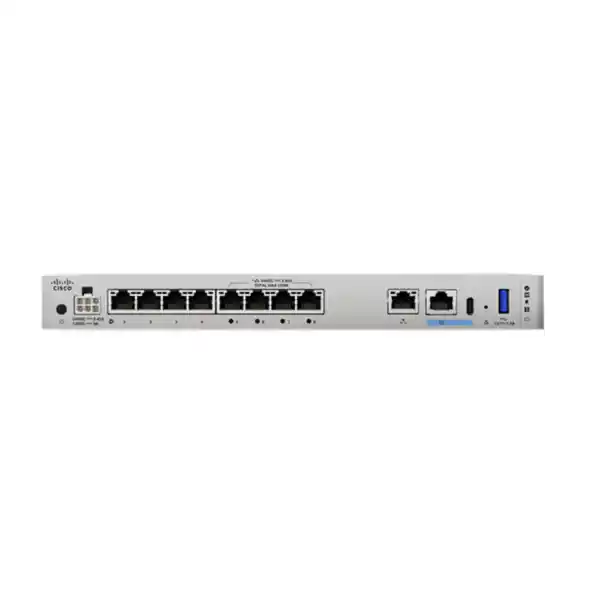
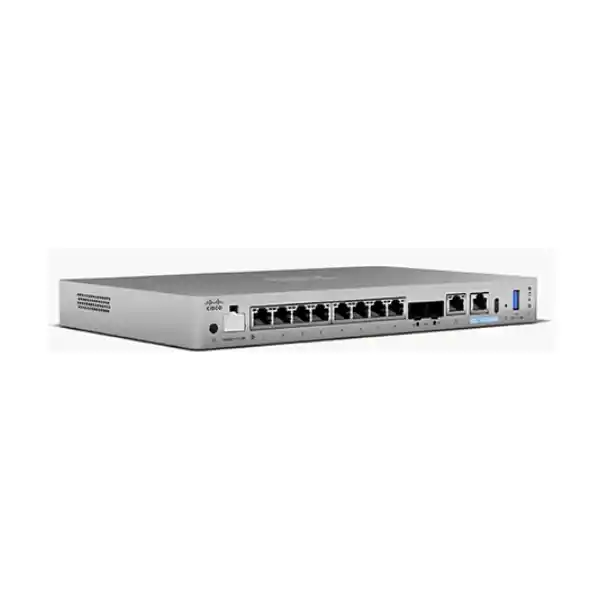
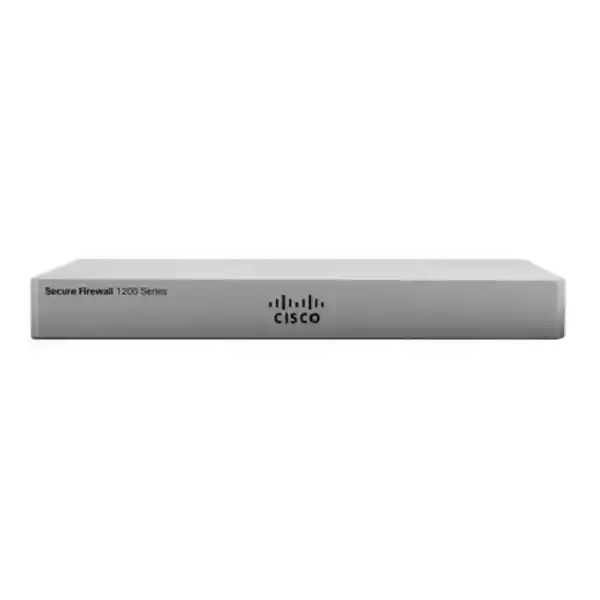
The Cisco Secure Firewall 1210CP is the PoE-equipped compact member of the Secure Firewall 1200 family. It combines eight Gigabit Ethernet data ports, four PoE-capable ports, branch-class threat inspection, VPN capability and flexible Cisco management choices in a desktop form factor that can also be wall- or rack-mounted with optional accessories.
For a UAE buyer, the important decision is not simply whether the appliance fits on a desk. The practical questions are whether its inspected throughput fits the real traffic profile, whether the four-port PoE budget is sufficient, whether Threat Defense or ASA is appropriate, which subscriptions are required, and how the firewall will be managed across one or many sites.
Direct answer: what is the Cisco Secure Firewall 1210CP?
Why the 1210CP exists in the Cisco Secure Firewall 1200 family
Cisco positions the Secure Firewall 1200 Series for the distributed enterprise, particularly branch offices and smaller sites that need policy enforcement and threat inspection closer to users and devices. Within the compact part of that family, the 1210CP is not simply a faster or slower variant chosen by one headline throughput number. Its most important hardware role is to combine the 1210 performance tier with integrated PoE on four data interfaces. That distinction can simplify a small branch where the firewall sits near wireless access points, IP phones, cameras or another modest set of compatible powered devices and where eliminating a separate local injector or PoE switch is operationally useful.
The adjacent 1210CE uses the same general compact desktop concept and the same eight 1000BASE-T data-port count, but it does not provide the 1210CP’s PoE capability. The 1220CX moves the compact platform upward in performance and adds SFP+ connectivity, so it becomes a relevant comparison when a branch needs 1/10-Gigabit optical or direct-attach uplinks or simply has more demanding inspected traffic. The rack-mount 1230, 1240 and 1250 models extend the family further for larger branches that need more performance or a conventional 1U deployment.
This family position matters because buyers sometimes choose a firewall only by raw internet circuit speed. The better approach is to start with architecture. If the branch has several PoE endpoints but ordinary Gigabit copper WAN/LAN connectivity, the 1210CP can be especially tidy. If the design requires SFP+ uplinks, significantly more TLS decryption headroom or a larger growth envelope, the 1220CX or a 1U model may be more appropriate even if the 1210CP’s basic firewall figure appears adequate. Conversely, if no PoE devices will connect to the appliance, the 1210CE can deserve comparison because paying for the 1210CP’s distinguishing power-delivery function may not produce operational value.
Verified 1210CP performance figures and what they mean
| Cisco metric | 1210 value | Buyer interpretation |
|---|---|---|
| Firewall model summary | 6.5 Gbps | A high-level platform figure; do not use this alone for a production sizing decision. |
| FW + AVC, 1024-byte traffic | 6.0 Gbps | A more useful Threat Defense reference when application visibility and control are part of the policy. |
| FW + AVC + IPS, 1024-byte traffic | 6.0 Gbps | Useful for discussing inspected branch traffic, while still remembering that production traffic rarely matches a single laboratory profile. |
| IPsec VPN, 1024-byte TCP with Fastpath | 5.0 Gbps | Relevant to branch-to-headquarters or branch-to-cloud encrypted connectivity, but the actual tunnel design and traffic pattern still matter. |
| TLS decryption | 1.0 Gbps | Often the most important constraint in environments intending to decrypt a substantial portion of encrypted internet traffic. |
| Maximum new connections per second with AVC | 35,000 | Useful where branch applications create many short-lived sessions; connection rate can matter independently of Mbps or Gbps. |
| Maximum concurrent sessions with AVC | 200,000 | A platform scalability reference for active connections, not a recommendation to operate continuously at the maximum. |
| Maximum VPN peers | 200 | Relevant for organizations with many site-to-site relationships; actual remote-access licensing and design must be checked separately. |
| Maximum virtual router instances | 5 VRFs | Important when the branch needs routing separation for multiple network domains. |
Cisco states that performance changes with enabled features, protocol mix, packet size and software releases. This warning should be treated as a sizing rule rather than a footnote. A branch with a 1 Gbps internet service may still need careful assessment if most traffic is decrypted, inspected, logged and sent through several security controls. On the other hand, a branch with multiple WAN links does not automatically require a larger model if normal aggregate inspected demand remains comfortably below the appliance’s practical envelope. The aim is to size around the busiest realistic policy state, not the cleanest benchmark.
Eight Gigabit ports plus four PoE ports: where the 1210CP is genuinely different
The Cisco Secure Firewall 1210CP provides eight 1000BASE-T Gigabit Ethernet data interfaces operating at 10/100/1000 Mbps. Four of those ports support IEEE 802.3at Power over Ethernet, with Cisco specifying up to 30 W per PoE port and up to 120 W total. That combination lets the appliance play two roles at a compact site: it is the security edge, and it can provide power to a limited set of compatible powered devices. This can reduce equipment count in a very small installation, but it should not be confused with the flexibility of a full PoE access switch.
The key purchasing calculation is the PoE power budget, not merely the number of powered ports. A buyer planning to connect four devices should add each endpoint’s actual maximum power requirement and compare that total with both the 30 W per-port limit and the 120 W system budget. A device that needs more than the supported power class should not be assumed compatible merely because it uses an RJ45 Ethernet connector. Equally, a branch expecting eight powered endpoints will still need an external PoE switch or another power design, because only four of the eight data ports are intended to deliver PoE.
The 1210CP does not provide the SFP+ slots found on the 1220CX. That matters when the firewall must connect directly to fibre handoffs, high-speed aggregation or 10-Gigabit switch uplinks. A media-conversion workaround may add complexity and another failure point. If the network design already calls for 10-Gigabit optical connectivity, it is usually cleaner to compare the 1220CX or a suitable rack-mount model rather than force the 1210CP into a topology it was not built to provide directly.
There is also a dedicated 1000BASE-T management Ethernet interface, separate console access through USB Type-C and Cisco RJ45 serial options, and a USB Type-A port. These interfaces support practical commissioning and management workflows without consuming every production data port. For quotation accuracy, the physical cabling plan should identify which links are WAN, LAN, HA, management and PoE, because the right appliance is the one whose interface map works cleanly before configuration begins.
Hardware, power and physical deployment details
| Form factor | Compact desktop appliance; optional accessories support rack or wall mounting. |
|---|---|
| Dimensions | 1.11 × 10.8 × 6.8 in (2.82 × 27.43 × 17.22 cm), excluding rubber feet. |
| Weight | 3.17 lb (1.44 kg) for the 1210CP. |
| Integrated storage | 480 GB SSD. |
| Cooling | Integrated blower with side exhaust; it requires clear ventilation around the chassis. |
| Operating temperature | 0 to 40°C, with Cisco specifying altitude-related derating above 6,000 ft. |
| Operating humidity | 5% to 85%, non-condensing. |
| AC input | 100–240 V AC, 50–60 Hz through an external power supply. |
| Power consumption | Cisco lists 32 W typical, 40 W maximum excluding PoE, and 165 W maximum including PoE load. |
These figures affect more than cabinet planning. In a Dubai deployment, the appliance should be installed in a ventilated, temperature-controlled location rather than treated like an unmanaged consumer router that can be hidden inside a crowded cabinet. The external power brick, PoE draw and UPS requirement should be considered together. If the 1210CP will power critical access points or phones, the UPS is effectively supporting both the firewall and those powered endpoints. That changes runtime calculations during a mains outage and can make a higher-capacity UPS worthwhile even though the firewall chassis itself is compact.
Threat Defense or ASA: order the software mode deliberately
Cisco lists separate 1210CP appliance product IDs for Threat Defense and ASA software: CSF1210CP-TD-K9 for the Threat Defense variant and CSF1210CP-ASA-K9 for the ASA variant. This is a fundamental procurement choice because the management model, feature set, subscriptions and operational workflow differ. A buyer should not order a chassis on the assumption that the software decision can be postponed without consequence. Reimaging may be technically possible in supported scenarios, but it introduces work, change control and potential migration complexity that should be avoided when the target operating model is already known.
Secure Firewall Threat Defense
Threat Defense is the natural choice when the project is centered on Cisco’s current next-generation firewall capabilities, including application-aware policy, intrusion prevention, optional malware defense and category/reputation-based URL filtering. Cisco supports centralized management through Secure Firewall Management Center, local on-box management through Firewall Device Manager, and cloud-delivered management through Cisco Security Cloud Control.
The important buying work is to define which security services are required and then align the subscription package and term. A branch that only needs stateful access control and routing has a different commercial profile from one that needs IPS, malware inspection and URL controls across every site.
Adaptive Security Appliance software
ASA remains relevant to organizations with established ASA operational practices, compatibility requirements or migration plans that specifically call for the ASA software model. Cisco documentation for the 1210/20 family includes ASA getting-started workflows, so the platform is not limited to Threat Defense.
ASA should be selected because it matches the intended architecture, not because it is assumed to be a simpler default. Existing configurations, required VPN functions, management tools, security-service expectations and administrator skills should all be reviewed before the order is finalized.
For greenfield branch security where inspection, policy consistency and centralized security operations are primary goals, many buyers will evaluate Threat Defense first. For a project tied closely to existing ASA standards, the ASA orderable may be appropriate. The correct answer depends on the environment, and the quotation should state the software variant explicitly so there is no ambiguity at delivery.
Licensing and subscriptions: define the security outcome before choosing the SKU bundle
Cisco uses Smart Licensing for Secure Firewall entitlements. Current Cisco documentation states that Secure Firewall 1200 purchases obtain an Essentials entitlement for Threat Defense, while additional security services are provided through term subscriptions. The ordering guide lists 1210CP Threat Defense options for IPS, Malware Defense and URL Filtering in different combinations, with 1-year, 3-year and 5-year subscription terms. This structure means a product quote should not stop at the appliance PID. It should identify the security services that the branch will actually use, the term, and how those services align with the organization’s renewal cycle.
IPS is the subscription that enables intrusion detection and prevention functions, file control and Security Intelligence filtering according to Cisco’s current licensing descriptions. Malware Defense adds malware-oriented capabilities and requires IPS. URL Filtering provides category- and reputation-based URL control and also has an IPS prerequisite in Cisco’s licensing model. A combined subscription can therefore be commercially cleaner than ordering features separately when the policy is intended to use all three services.
Licensing also has an operational side. The organization should have the correct Cisco Smart Account and virtual account structure, and the people responsible for renewal should know which devices consume which entitlements. In multi-branch deployments, poor license administration can become a larger problem than the initial purchase. The procurement team should therefore capture the Smart Account details, subscription term, renewal owner and expected management platform as part of the deployment record.
Management choices for one branch or a distributed estate
The 1210CP can fit very different operating models because Cisco supports several management approaches with Threat Defense. Firewall Device Manager provides local on-box management and can be attractive for a small standalone site. Secure Firewall Management Center provides centralized policy, monitoring and administration for organizations that want a dedicated management platform. Cisco Security Cloud Control provides a cloud-delivered management path and can be useful when the organization wants centralized cloud-based control without placing a local manager at every branch.
The number of firewalls is not the only deciding factor. A single strategically important branch may still benefit from centralized management if security operations, logging and policy governance are handled centrally. Conversely, a very small isolated deployment may not justify the operational overhead of a dedicated management platform. The buyer should consider who will change policy, where logs must be retained, whether configuration should be standardized across sites, how administrators connect during an outage, and whether the management plane itself must be reachable through a separate path.
For a distributed enterprise, consistent management can reduce drift. Common objects, repeatable access policies, synchronized rule changes and centralized visibility make it easier to operate a fleet of branches than treating each appliance as a separate island. This is especially important when local sites have no dedicated network engineer. Zero-touch and remote deployment workflows can reduce onsite effort, but they still depend on disciplined pre-staging, internet reachability, licensing and a well-defined registration process.
Management should therefore be designed before the firewall is shipped. Decide which interface and path the manager will use, how initial addressing is assigned, whether the branch can recover if management connectivity fails, and how credentials are secured. A compact firewall does not mean the operational model can be casual; centralized policy and secure administrative access are part of the security architecture.
Security capabilities and the conditions behind them
Application-aware access control
Threat Defense can identify users and applications as policy inputs rather than relying only on IP addresses and ports. The buyer relevance is better policy intent, but accurate application control still depends on current software, visibility and properly designed rules.
Intrusion prevention
With the appropriate IPS subscription, the appliance can inspect traffic for known attack patterns and suspicious behavior. IPS adds security value but also becomes part of the real performance profile, so sizing should assume the intended inspection policy is enabled.
Malware defense
Cisco offers Malware Defense as an optional subscription capability. It is relevant where file inspection and malware-oriented analysis are part of the branch security requirement. Cisco identifies IPS as a prerequisite, so this must be reflected in the license selection.
URL filtering
Category and reputation-based URL filtering can help enforce acceptable-use and risk policies. The value depends on the organization’s policy goals and inspection design, and Cisco’s current license documentation also ties URL Filtering to an IPS prerequisite.
TLS decryption
The 1210 performance table lists 1.0 Gbps TLS decryption. Because encrypted traffic dominates modern internet use, organizations intending broad decryption should treat this metric as a major sizing input and should also plan certificate deployment, privacy exceptions and bypass rules.
Security Intelligence and file control
These controls can complement access policy by using reputation intelligence and file-oriented decisions. They are most effective when ownership, tuning and event response are defined; enabling a feature without an operational process does not automatically improve security.
VPN, SD-WAN and branch connectivity considerations
Cisco designed the Secure Firewall 1200 family for branch connectivity as well as security. The platform supports site-to-site VPN designs and Cisco promotes the series for secure direct internet access and SD-WAN use at distributed sites. The 1210 Threat Defense performance table lists 5.0 Gbps IPsec VPN throughput under Cisco’s stated test conditions and a maximum of 200 VPN peers. These are useful planning figures, but a production design must account for the number of active tunnels, encryption settings, packet characteristics, routing design and the amount of inspected traffic that enters or leaves those tunnels.
For a branch-to-headquarters design, decide whether all internet traffic should backhaul to the central site or whether the branch will use local internet breakout. Local breakout can reduce latency and WAN consumption, but it also means the branch firewall becomes directly responsible for internet security policy. That is one reason the 1210CP’s inspection and management capabilities matter even at a location with relatively few users.
Remote-access VPN needs should be treated as a separate design exercise from site-to-site peer capacity. User concurrency, authentication, MFA integration, address pools, split tunneling policy, client platform support and Cisco Secure Client licensing all affect the final solution. A quote that includes only the firewall and a generic “VPN” line item is not enough for a business that expects dozens or hundreds of remote users to connect reliably.
High availability and resilience: active/standby is supported, but architecture still matters
Cisco states that Secure Firewall 1200 Series Threat Defense appliances support active/standby high availability. For branches where internet access, cloud applications, voice or payment systems are business-critical, a second 1210CP can therefore be considered to reduce the firewall as a single point of failure. High availability does not, however, make every other dependency redundant. A resilient design also looks at ISP circuits, upstream modem or router, switches, power feeds, UPS capacity, management access and whether both firewalls connect to shared components that could still fail.
The PoE function adds another resilience consideration. If the active unit is powering endpoints directly, the HA design must consider how those endpoints remain powered during appliance or power-supply failure. In many highly available networks, dedicated PoE access switching is preferable because endpoint power should not depend on which firewall is active. The 1210CP can still be valuable, but the integrated PoE feature should be used in a way that matches the desired failure behavior.
Licensing and management must also be prepared for both members of an HA pair. Cisco licensing documentation notes that devices in an HA pair must be registered appropriately. The project plan should include both serial-number records, software compatibility, synchronized configuration, failover testing and a documented maintenance procedure. Purchasing two appliances without designing the surrounding redundancy only duplicates hardware; it does not automatically create a resilient branch.
Sizing the Cisco Secure Firewall 1210CP for a real Dubai branch
A sensible sizing conversation starts with traffic and policy, then moves to interfaces and growth. WAN bandwidth alone is only the first input. Record each internet and private WAN circuit, the expected busy-hour utilization, whether links are active/active or active/standby, and how much east-west or inter-VLAN traffic the firewall will inspect. If the firewall is also routing between local security zones, its workload may be much greater than the internet circuit suggests.
Next, define the security stack. Will application visibility be enabled on most traffic? Is IPS applied broadly? Is malware analysis required? Will URL filtering classify web sessions? How much encrypted traffic will be decrypted? TLS inspection often changes the model decision because the 1210’s listed decryption figure is 1.0 Gbps, significantly below its headline firewall throughput. A branch with a 2 Gbps internet service that intends to decrypt most eligible outbound traffic may therefore need a larger model even though ordinary stateful firewall throughput would appear comfortable.
Connection behavior is another dimension. A user count of 50 means little by itself if those users run cloud applications that create thousands of short connections, while a branch with hundreds of predictable IoT sessions may have a different profile. The 1210’s 35,000 new connections per second and 200,000 concurrent session references help frame this discussion, but production headroom is important. Firewalls should not be chosen with the expectation that normal busy-hour operation will sit continuously at a published maximum.
Then check VPN demand. Count site-to-site peers, remote-access users and any cloud or partner tunnels. Decide whether encrypted traffic is also inspected and logged. For organizations using dynamic routing, segmentation or multiple VRFs, document the routing requirement as well. The 1210 supports up to five virtual router instances according to Cisco’s Threat Defense scalability table, so a design requiring more logical routing domains should be moved to a more appropriate platform.
Finally, add a growth horizon. Branches often gain new wireless access points, cameras, guest networks, SaaS traffic, additional VPNs and higher-speed ISP links over a three- to five-year period. If the present requirement already consumes most of a 1210CP’s practical decryption, interface or session capacity, purchasing the next model up can be less expensive than replacing the firewall early. Conversely, choosing a much larger firewall without a clear capacity driver ties up budget without improving the policy outcome. Sizing is about evidence, not prestige.
- Current and planned WAN speeds, including secondary circuits.
- Busy-hour traffic and whether the firewall inspects local inter-zone traffic.
- Expected TLS decryption percentage and policy exceptions.
- IPS, malware and URL-control requirements.
- Concurrent sessions, connection-rate pattern and user/device counts.
- Site-to-site VPN peers, remote-access users and routing design.
- Required growth headroom for the intended service life.
Where the 1210CP can fit well
Small corporate branch
A branch with Gigabit-class copper connectivity, centralized security policy and a modest number of directly attached PoE devices can use the 1210CP as a compact edge. The value is strongest when the PoE function removes equipment without creating a resilience problem.
Retail or service location
Distributed shops, showrooms and service sites can benefit from consistent security policy, VPN back to headquarters and local internet security. PoE may support a few access points or phones, while segmentation can separate staff, guest and operational devices.
Clinic or professional office
A compact office with sensitive business data may need stronger inspection and VPN controls than a typical small-business router can provide. The 1210CP can fit where the network remains modest but enterprise policy, logging and management are required.
Warehouse or remote facility
A warehouse or operational site may need secure connectivity for corporate systems, wireless devices and selected IoT endpoints. The compact chassis and optional wall/rack mounting can simplify placement where a full data-room footprint is unavailable.
Managed multi-site rollout
Organizations deploying the same branch template repeatedly can pair the 1210CP with centralized or cloud-delivered management. Repeatable configuration, licensing records and remote operations can reduce dependence on technical staff at each location.
PoE-constrained micro-site
Where only a few compatible powered devices are needed, the integrated four-port PoE capability can reduce injectors and cable clutter. It is less suitable when the site needs many powered endpoints or a large PoE reserve for future expansion.
PoE planning deserves its own design check
Power over Ethernet is the feature that separates the 1210CP from the 1210CE, so it should be planned deliberately. Cisco specifies four 1000BASE-T ports with IEEE 802.3at delivery up to 30 W on each port and a total PoE budget up to 120 W. This makes it possible to power four compatible devices at the full per-port limit in principle, but actual endpoint behavior, cable quality and deployment standards should still be confirmed.
List each powered device by exact model. Record its PoE standard, maximum draw and whether it has unusual startup requirements. Do not rely on the average running consumption printed in a dashboard when calculating worst-case capacity. Wireless access points can increase power use when radios, USB accessories or advanced features are enabled. Cameras may draw more with infrared illumination or heaters. Phones can require different power levels when expansion modules are attached. The design must fit the maximum supported endpoint demand, not only a normal idle reading.
Also decide whether powering an endpoint from the firewall is operationally desirable. A firewall reboot would remove both network security and electrical power from that endpoint. For a noncritical access point in a tiny office, this may be acceptable. For a voice gateway, critical camera or access-control device, a dedicated PoE switch on resilient power may provide a cleaner failure model. Integrated PoE is convenient, but convenience should not override service continuity.
Finally, include PoE in UPS sizing. Cisco lists 165 W as maximum appliance power consumption including PoE. A UPS selected only around the firewall’s 32 W typical consumption could provide much less runtime once several powered devices are drawing energy through the appliance. The expected PoE load, external power supply efficiency and required outage runtime belong in the same calculation.
Migration from an older Cisco firewall or another vendor
A firewall refresh should not be treated as a direct cable swap. Begin by inventorying the current policy: interfaces, VLANs, zones, static and dynamic routes, NAT rules, access rules, VPNs, certificates, objects, authentication integrations, logging destinations and any special inspection settings. Separate rules that are still required from historical entries that no longer serve a business purpose. Migration is an opportunity to reduce policy debt rather than copy it blindly into a new platform.
If moving from an older ASA to Threat Defense, the operational model changes as well as the hardware. Administrators should understand the target manager, deployment workflow, event model and subscription-driven features before the cutover. If moving from another firewall vendor, syntax and feature names may not map one-for-one. A rule that sounds equivalent can behave differently because of object definitions, NAT order, application identification or asymmetric routing. Validation must therefore be based on business flows rather than configuration-line counts.
Plan the cutover around dependencies that are easy to overlook. Public IP addresses, ISP modem mode, BGP or static routing, DNS, DHCP relay, site-to-site VPN peer coordination, remote-access profiles, certificate trust, MFA, monitoring, syslog and ticketing integrations can all determine whether the change is smooth. Where possible, stage the 1210CP before the maintenance window, register licenses, update to the approved software release, load the target policy and test representative traffic in a controlled environment.
Rollback also needs a clear trigger. Define how long validation will run, which services must pass, who can authorize rollback and how the previous firewall will be preserved until the new design is accepted. A well-planned migration is not measured only by whether the internet comes back; it is measured by whether critical applications, VPNs, security controls, logging and management continue to operate as designed.
Logging, monitoring and day-two operations
The value of a branch firewall continues after installation. Decide which events must be retained, where they are stored and who reviews them. Security teams may need connection events, intrusion events, malware findings, VPN status, configuration changes and health information. Excessive logging can create storage and noise problems, while insufficient logging makes incident investigation difficult. Policy should therefore define both what is blocked and what evidence is retained.
Central management becomes especially valuable when many 1210CP appliances are deployed. Teams can monitor health and policy consistency across sites rather than waiting for a branch user to report a problem. Operational standards should include configuration backup, software lifecycle review, certificate expiry tracking, license renewal, periodic rule recertification and testing of VPN or HA failover. These routines reduce the chance that a correctly installed firewall gradually becomes an unmanaged risk.
Change control should be proportionate to business impact. A small branch can still support revenue, customer service or critical operations. Rule changes should have an owner, purpose, expiry where appropriate and validation step. Temporary access rules are especially likely to become permanent if they are not documented. The better the operational process, the more useful the firewall’s security capabilities become.
Dubai and UAE installation considerations
The 1210CP is specified for operation from 0 to 40°C and 5% to 85% non-condensing humidity. In the UAE, that makes indoor environmental control an important deployment condition. The appliance should be installed in a cooled IT space, communications cabinet or office location with reliable ventilation. It should not be exposed to outdoor heat, direct sun, dusty construction areas or a sealed cabinet where exhaust air recirculates around the chassis.
Power quality and outage planning are equally practical. Use a correctly rated UPS and include any PoE-powered devices in the load calculation. If the branch has two WAN circuits but only one power source, a power interruption can still defeat the network’s logical redundancy. Where business continuity justifies it, consider separate power paths for network switches, ISP equipment and management components as well as the firewall.
Physical installation should also preserve serviceability. Leave access to the console, management and data ports, label WAN and LAN cables clearly, avoid tight cable bends around the external power connector, and maintain the side-exhaust airflow path. Optional rack- and wall-mount kits can improve physical security and cable management compared with leaving the appliance loose on a shelf. A neat branch installation reduces accidental disconnection and makes future troubleshooting substantially faster.
A practical 1210CP deployment journey
Document WAN circuits, VLANs, routing, security zones, PoE endpoints, VPN requirements, management method and growth expectations. This is where the model fit should be challenged before purchase.
Select the Threat Defense or ASA appliance PID. For Threat Defense, map IPS, Malware Defense and URL Filtering needs to the required subscription package and term, and prepare Smart Licensing details.
Confirm cooled placement, rack or wall accessory if needed, UPS capacity, cable lengths, PoE load, console access and ISP handoff. Do not discover an SFP+ requirement after the copper-only 1210CP has arrived.
Verify the installed software release, register licensing, connect the target manager, create baseline objects and load approved policy before the production cutover wherever the project allows pre-staging.
Test internet access, DNS, business applications, NAT, inter-zone flows, site-to-site VPNs, remote access, logging and PoE endpoints. Validate security events as well as basic connectivity.
Record software version, license term, manager, backup method, administrator access, support process and renewal owner. Schedule periodic policy and lifecycle review rather than treating deployment as the finish line.
Procurement checklist: what belongs in a complete 1210CP bill of materials
The appliance is only one part of the purchase. Start with the exact software orderable: CSF1210CP-TD-K9 for Threat Defense or CSF1210CP-ASA-K9 for ASA. If Threat Defense is selected, add the required term subscription package. The Cisco ordering guide lists combinations covering IPS, Malware Defense and URL Filtering for the 1210CP, with 1-, 3- and 5-year terms. State the chosen term in the quote rather than leaving it as a post-order assumption.
Then check physical accessories. Cisco identifies a 1210CP-specific external PoE-capable power supply and optional compact rack-mount and wall-mount kits. Confirm whether a spare power supply is required, whether the appliance will sit on a desktop, and whether a mounting kit is needed for the actual cabinet. If console work is expected, include the correct console cable in the onsite toolkit instead of assuming one will be available during an outage.
Network accessories depend on the surrounding design. Copper patch leads, WAN handoff cables, UPS capacity and PoE endpoint cabling may be part of the project even though they are not firewall SKUs. If the network requires fibre or 10-Gigabit uplinks, that is a signal to compare another model because the 1210CP itself does not provide SFP+ ports. Avoid adding external converters merely to preserve an appliance selection that no longer matches the topology.
Finally, decide whether the quotation includes installation, migration, policy configuration, VPN setup, testing, documentation and post-deployment support. Hardware price is easy to compare; project completeness is not. Two quotes that both say “Cisco 1210CP” can represent very different deliverables if one includes subscriptions and deployment services while the other is appliance-only.
1210CP versus nearby Secure Firewall 1200 options
| Model | Data interfaces | PoE | FTD FW+AVC | TLS decryption | Best comparison reason |
|---|---|---|---|---|---|
| 1210CE | 8× 1G copper | No | 6.0 Gbps | 1.0 Gbps | Compare when PoE is unnecessary but the 1210 performance tier fits. |
| 1210CP | 8× 1G copper | 4 ports, up to 120 W total | 6.0 Gbps | 1.0 Gbps | Best fit when integrated limited-port PoE adds real branch value. |
| 1220CX | 8× 1G copper + 2× 1/10G SFP+ | No in Cisco’s current data sheet summary | 9.0 Gbps | 1.5 Gbps | Compare for SFP+ requirements or more inspection/decryption headroom. |
| 1230 | 8× 1G copper + 4× 1/10G SFP+ | No | 13 Gbps | 2.5 Gbps | Compare when a 1U form factor and materially higher capacity are preferable. |
The comparison is not a recommendation to step up automatically. The 1210CP is compelling when four-port PoE is useful and the copper interface and security-performance envelope fit the branch. The 1220CX is stronger where optical or 10-Gigabit uplinks matter, while the 1230 becomes more relevant as throughput and rack integration requirements grow. The 1210CE deserves attention when the same 1210 security tier is enough but integrated PoE will not be used.
When the Cisco 1210CP may be the wrong choice
The 1210CP should not be selected merely because it is compact and has attractive headline throughput. It may be undersized if the branch expects sustained TLS decryption demand above the platform’s 1.0 Gbps reference, needs substantially more concurrent or new connections, requires more than five VRFs, or is likely to outgrow the 1210 performance tier during the planned service life. In those cases, a 1220CX, 1230 or higher 1200 Series model should be evaluated based on the exact bottleneck.
It may also be the wrong interface choice when the topology requires SFP+ or 10-Gigabit connectivity directly on the firewall. The 1210CP’s eight data interfaces are Gigabit copper. A network built around fibre aggregation can often be designed more cleanly with the 1220CX or a rack-mount model rather than external media conversion.
Integrated PoE should not be overvalued. If the branch already has a managed PoE switch, the 1210CE could deliver the same 1210 security tier without duplicating power capability. If the site needs more than four powered devices or wants redundant PoE switching, the 1210CP cannot replace a proper access-switch design. Likewise, if PoE endpoints are business-critical and must remain powered independently of firewall maintenance, connecting them directly to the firewall may create an unnecessary operational dependency.
Finally, the platform can be excessive for a very small site that has minimal security requirements, no centralized policy needs and low operational complexity. Enterprise security appliances deliver their value through policy, visibility, management and support discipline. If those capabilities will not be used, the project should revisit its actual requirements rather than buying on brand alone.
Frequently asked buyer questions about Cisco Secure Firewall 1210CP
How many Ethernet ports does the 1210CP have?
It provides eight 1000BASE-T Gigabit Ethernet data ports operating at 10/100/1000 Mbps. Four of those ports support PoE. It also has a separate 1000BASE-T management Ethernet interface, so management does not have to consume one of the eight production data ports. Buyers should map the intended WAN, LAN, HA and PoE connections before ordering to make sure the copper-only interface layout fits cleanly.
What is the PoE capacity?
Cisco specifies IEEE 802.3at PoE on four ports, with up to 30 W delivered per port and up to 120 W in total. The endpoint count alone is not enough for planning. Check the exact powered-device models, their maximum draw and power standard. If the branch needs more than four powered devices, more than 120 W, or endpoint power that remains independent of firewall maintenance, use an appropriate PoE switch design.
What firewall throughput should I use for sizing?
Cisco’s model summary lists 6.5 Gbps firewall throughput, while its Threat Defense performance table lists 6.0 Gbps for FW + AVC and 6.0 Gbps for FW + AVC + IPS using the documented 1024-byte test profile. The correct sizing approach is to use the metric closest to the intended policy and then leave practical headroom. Cisco explicitly states that feature activation, protocol mix, packet size and software release affect actual performance.
Is the 1210CP suitable for TLS decryption?
It supports TLS decryption, and Cisco lists 1.0 Gbps for the 1210 tier under its stated test conditions. Whether that is sufficient depends on the volume of encrypted traffic you intend to decrypt. Because modern web and SaaS traffic is heavily encrypted, decryption can become the practical sizing limit long before ordinary stateful firewall throughput. Define the percentage of eligible traffic, bypass categories and growth requirement before deciding.
Does the Cisco 1210CP support high availability?
Cisco documents active/standby high availability support for the Secure Firewall 1200 Series with Threat Defense. A complete resilient design still requires duplicated or resilient WAN, LAN, power and management components as appropriate. If critical PoE endpoints are powered directly by one firewall, consider how they remain powered if that unit is rebooted or fails.
Can it be rack-mounted?
Yes. The 1210CP is a compact desktop appliance, and Cisco lists optional compact rack-mount and wall-mount accessories for the 1210CE, 1210CP and 1220CX. The final installation method should be chosen around airflow, cable access, physical security and serviceability. For a branch communications cabinet, a proper mount is usually preferable to leaving the appliance loose on a shelf.
Does it use Threat Defense or ASA?
Cisco sells the 1210CP with either software family. The orderable CSF1210CP-TD-K9 is the Threat Defense appliance, while CSF1210CP-ASA-K9 is the ASA appliance. The quote should state the intended software explicitly. Threat Defense is generally considered when next-generation inspection and centralized security operations are the focus; ASA may fit environments with established ASA architecture or specific compatibility requirements.
Which licenses are commonly relevant with Threat Defense?
Cisco’s current licensing model provides Essentials with the appliance and offers term subscriptions for IPS, Malware Defense and URL Filtering. The ordering guide lists 1210CP bundles for different combinations and 1-, 3- and 5-year terms. Malware Defense and URL Filtering have IPS prerequisites in Cisco’s licensing documentation. Remote-access VPN can also involve Cisco Secure Client licensing, so VPN user requirements should be quoted separately rather than assumed.
How can Threat Defense be managed?
Cisco supports local on-box Firewall Device Manager, centralized Secure Firewall Management Center and cloud-delivered management through Cisco Security Cloud Control. The right choice depends on the number of sites, security operations model, logging requirements, administrative access and whether policy must be standardized across a fleet. Management should be selected before rollout because it affects staging, registration and day-two operations.
How does the 1210CP differ from the 1220CX?
The 1210CP focuses on PoE within the lower compact performance tier: eight Gigabit copper ports with four PoE-capable ports. The 1220CX raises Threat Defense performance to 9.0 Gbps FW + AVC, lists 1.5 Gbps TLS decryption and adds two 1/10-Gigabit SFP+ interfaces. Buyers should compare the 1220CX when they need optical or 10-Gigabit uplinks or more inspection headroom; compare the 1210CP when limited integrated PoE is the stronger requirement.
Can the 1210CP replace a PoE switch?
Only in very small, carefully defined scenarios. It has four PoE-capable ports and a 120 W total budget, while a proper access switch may provide many more ports, larger aggregate power, switching features and different redundancy options. Integrated PoE is best viewed as a compact convenience for a few compatible endpoints, not as a universal substitute for managed access switching.
Is it suitable for a 1 Gbps internet connection?
Often it can be, but the answer depends on security policy. Ordinary firewall and IPS figures are well above 1 Gbps in Cisco’s published tests, while TLS decryption is listed at 1.0 Gbps. If most traffic will be decrypted and the branch expects growth beyond 1 Gbps, the design may be closer to the 1210’s decryption ceiling than the headline firewall number suggests. Use the real inspection profile for sizing.
What should I provide for a Dubai quotation?
Provide quantity, preferred Threat Defense or ASA software, subscription features and term, WAN bandwidth, expected TLS inspection, VPN peers and remote users, PoE endpoint models and power demand, mounting preference, HA requirement, management method and whether migration or installation services are needed. These details allow the quotation to represent a deployable solution rather than just a chassis.
UAE availability, support and specialist resources
FourTeck can support UAE buyers that need help identifying the correct 1210CP software variant, subscription package, term, accessories and deployment scope. For general infrastructure and procurement information, visit FourTeck UAE. For broader company information and international coordination, see FourTeck.
Projects that require firewall installation, network integration, migration planning, operational handover or ongoing infrastructure support can also use FourTeck IT Services UAE as a specialist service resource. Availability, lead time, subscription pricing and Cisco commercial terms should be confirmed at quotation time because these can vary by date, license term and supply conditions.
Decision recap before you shortlist the 1210CP
What FourTeck needs from you for an accurate Cisco 1210CP quotation
Build the right Cisco 1210CP branch package, not just an appliance order
Share your WAN speeds, inspection goals, PoE endpoints, VPN requirements, management preference, license term and installation scope. FourTeck can use those inputs to determine whether the Cisco Secure Firewall 1210CP is the right fit, whether a nearby 1200 Series model should be compared, and what belongs in the final UAE quotation.

Reviews
There are no reviews yet.