
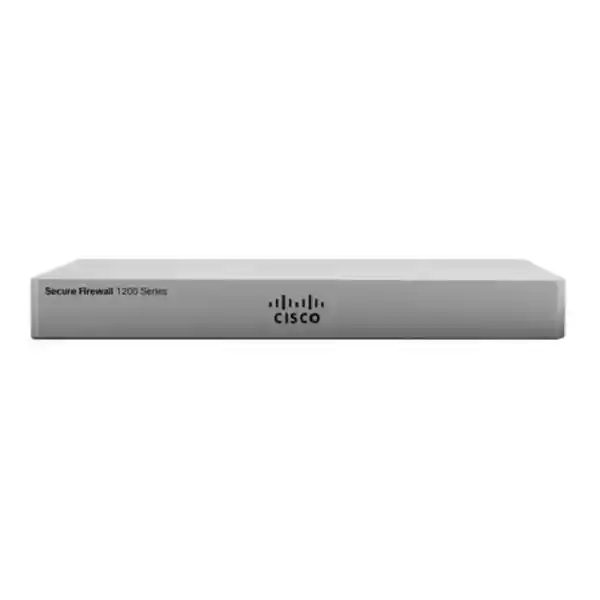
Cisco Secure Firewall 1220CX Dubai
A compact Cisco Secure Firewall 1200 Series platform for branch offices and smaller sites that need high security throughput, two 1/10Gbps SFP+ interfaces, centralized or local management choices, and a clear path to enterprise policy consistency.
Direct answer: what is the Cisco Secure Firewall 1220CX?
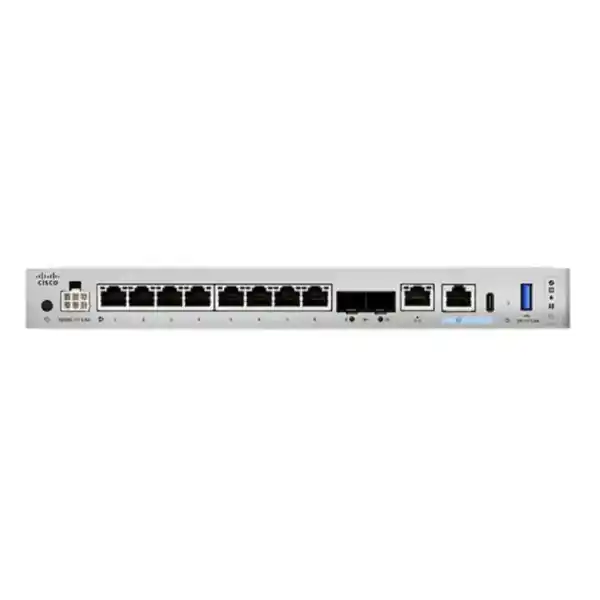
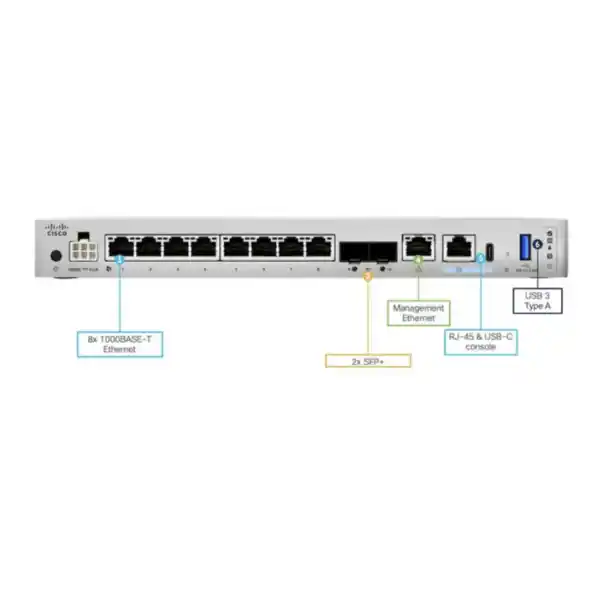
The Cisco Secure Firewall 1220CX is a compact desktop-class security appliance in the Cisco Secure Firewall 1200 Series. It is intended for distributed enterprise branches and smaller sites that need enterprise security controls without the space and physical footprint of a larger rack appliance. The 1220CX stands out inside the compact 1200-series group because it adds two SFP+ interfaces that support 1Gbps or 10Gbps transceivers alongside eight 10/100/1000BASE-T copper data ports.
Protect and connect branch users, business applications, direct internet links, VPN traffic and routed network segments while applying Cisco firewall and threat-defense policy.
Organizations that want compact branch hardware, 10Gbps-capable uplinks, Cisco security integration and higher performance than the entry 1210 compact models.
The required security software, inspection features, real traffic profile and management method. Published lab throughput should not be treated as guaranteed production throughput for every policy set.
Whether the 1220CX is correctly sized, which software and subscriptions fit, which SFP/SFP+ modules are appropriate, and whether mounting, migration, high availability or managed implementation should be included.
Why the 1220CX occupies a useful position in the 1200 Series
The 1220CX is not simply a faster version of an entry firewall. Its practical value comes from combining a compact chassis with interface flexibility that can suit modern branch designs. Cisco places the 1210CE, 1210CP and 1220CX in its compact group, while the 1230, 1240 and 1250 move to a 1U rack form factor. That distinction matters when a buyer is deciding whether a branch needs a small appliance that can sit on a desktop, mount to a wall or use an optional rack shelf, or whether the branch is better served by a larger rack platform with more headroom and more SFP+ interfaces.
Within the compact trio, the 1210CE emphasizes straightforward eight-port copper connectivity. The 1210CP adds Power over Ethernet capability on four copper ports, which can be attractive when a branch wants the firewall to power compatible endpoints. The 1220CX takes a different direction: it does not provide PoE, but it adds two 1/10Gbps SFP+ slots. That makes the 1220CX particularly relevant when the WAN handoff, aggregation switch, metro link, data-center interconnect, dark-fibre design or internal uplink strategy benefits from optical or 10Gbps connectivity.
This distinction is important for Dubai and UAE deployments because branch networks are not uniform. One office may receive a copper internet handoff and need only Gigabit Ethernet, while another may terminate a carrier service on fibre, connect to a 10Gbps distribution switch, or use separate high-speed paths for internet and private WAN traffic. Selecting the 1220CX only because its performance number is higher misses that architectural point. The model should be evaluated as a combined security, interface and deployment choice.
The 1220CX can be ordered with Cisco Secure Firewall Threat Defense software or ASA software. Those software choices change the functional emphasis and the relevant performance figures. A buyer migrating from an established ASA estate may evaluate an ASA-based deployment differently from an organization standardizing on Cisco Secure Firewall Threat Defense, intrusion prevention, application visibility and centralized policy. The hardware model can therefore remain the same while the software architecture, subscription requirements, operational workflow and migration plan differ substantially.
Cisco Secure Firewall 1220CX verified specification snapshot
| Specification | Cisco 1220CX detail | Buyer relevance |
|---|---|---|
| Form factor | Compact desktop appliance; optional wall and rack mounting accessories | Fits branches where full-depth 1U hardware is unnecessary or space is constrained. |
| Copper data ports | 8 × 10/100/1000BASE-T Gigabit Ethernet | Useful for WAN, LAN, DMZ or segmented branch connectivity, subject to the chosen configuration. |
| SFP+ interfaces | 2 × SFP+ supporting selected 1Gbps and 10Gbps transceivers | The defining connectivity advantage over the 1210 compact models. |
| Dedicated management | 1 × 1GbE RJ-45 management port | Separates management access from normal data-port planning. |
| Console | Cisco RJ-45 serial and USB Type-C console | Supports local commissioning and recovery workflows. |
| Storage | 480GB integrated M.2 NVMe SSD, not field-replaceable | A failed internal SSD is a chassis service consideration rather than a simple field swap. |
| Threat Defense FW + AVC + IPS | 9.0 Gbps, Cisco published test metric | Useful sizing reference, not a blanket production guarantee. |
| Threat Defense IPsec VPN | 10 Gbps published metric | Relevant for encrypted branch-to-hub or branch-to-branch architectures. |
| Threat Defense TLS decryption | 1.5 Gbps published metric | Critical when substantial encrypted traffic will be inspected rather than passed without decryption. |
| Concurrent sessions with AVC | Up to 300,000 | Session count can matter as much as raw Mbps in busy branches with many cloud applications and devices. |
| Maximum VPN peers | Up to 300 | Provides a scale reference; topology and operational design still need validation. |
| Chassis size | 1.11 × 10.8 × 6.8 in / 2.82 × 27.43 × 17.22 cm, excluding feet | Compact enough for branch cabinets where depth and rack space are limited. |
| Weight | 3.09 lb / 1.40 kg | Supports flexible wall, desktop or shelf-based placement when installed correctly. |
| Typical / maximum power | 32W typical / 40W maximum | Useful for UPS sizing, cabinet heat planning and branch power budgeting. |
Performance figures are vendor-published test values. Cisco states that real performance varies with enabled features, traffic protocol mix, packet size and software release. Production sizing should therefore be based on expected inspection policy and traffic, not a single headline number.
Threat Defense performance: how to interpret the numbers
Cisco publishes several different performance metrics for the 1220 platform because a modern firewall does not perform one task. With Threat Defense software, the 1220 is listed at 9.0 Gbps for firewall plus application visibility and control, 9.0 Gbps for next-generation intrusion prevention, and 9.0 Gbps for the combined firewall, application visibility and IPS test. Cisco also lists 10 Gbps IPsec VPN throughput using its stated test method, 1.5 Gbps TLS decryption and up to 50,000 new connections per second with application visibility. These numbers show substantial capability for a compact branch platform, but each measures a specific workload under defined conditions.
The TLS figure deserves particular attention. Most business traffic is encrypted, and organizations that decrypt a large percentage of HTTPS sessions are asking the firewall to perform cryptographic work as well as policy inspection. A branch with a 2 Gbps internet circuit does not automatically fit a firewall simply because its basic firewall throughput exceeds 2 Gbps. If that branch intends to decrypt a large portion of internet traffic, apply intrusion inspection, run URL and application controls, maintain multiple VPN tunnels and log heavily, the effective design requirement is more complex. The 1.5 Gbps published TLS metric becomes a much more meaningful sizing signal than the 9 Gbps combined firewall and IPS figure.
Session scale is another dimension. Cisco lists up to 300,000 concurrent sessions with AVC for the 1220 and a maximum of 300 VPN peers. A branch with hundreds of users, IP phones, cameras, printers, wireless access points, IoT devices, cloud-connected applications and guest traffic can create a large number of simultaneous connections even when bandwidth utilization is moderate. The right firewall must therefore have headroom for both throughput and connection behavior. High connection churn can also matter when applications open many short-lived sessions.
For buyers comparing the 1220CX with a larger 1230 or 1240, the question should not be framed as whether the office currently exceeds 9 Gbps. Instead, consider how much inspected bandwidth is expected over the service life, how much TLS traffic will be decrypted, what growth is planned, whether additional security services will be enabled later, and whether a future ISP upgrade would consume the available headroom. The 1230 and 1240 also introduce a 1U form factor and four SFP+ interfaces, which may be architecturally more appropriate even before throughput becomes the limiting factor.
Conversely, choosing a larger platform without a requirement can create unnecessary capital, space and power overhead. If a branch has modest circuits, predictable device counts, limited TLS inspection and no need for more than two SFP+ uplinks, the 1220CX may provide a balanced footprint. Sound sizing is about matching the inspection workload and interface plan to the hardware, not selecting the highest available number.
Interface planning: where the 1220CX becomes especially useful
Eight copper Gigabit ports
The eight 10/100/1000BASE-T data interfaces can be assigned according to the network design for WAN, LAN, DMZ, transit or segmented connectivity. Their value is flexibility, but port count should not be confused with switching design. Larger branches may still use dedicated access and distribution switching rather than treating the firewall as a replacement for the switching layer.
Two 1/10Gbps SFP+ slots
The 1220CX supports selected 1Gbps and 10Gbps optical or copper transceivers in its SFP+ ports. This can simplify fibre handoff, high-speed switch uplinks or service-provider integration. The transceiver type, distance, fibre standard, connector, wavelength and peer equipment all need to match.
Dedicated management Ethernet
A separate 1GbE management interface allows management connectivity to be planned independently from data-path ports. This is particularly useful when the organization has an out-of-band management network, centralized operations model or restricted administrative segment.
Local console options
Cisco provides RJ-45 serial and USB Type-C console access. Local console connectivity remains important for first-time setup, troubleshooting and recovery, especially where a branch has no working management path during commissioning.
No PoE on the 1220CX
The 1220CX does not provide Power over Ethernet. If the requirement is to power endpoints directly from the firewall, the 1210CP has a different hardware emphasis. For most enterprise designs, PoE may instead remain the responsibility of access switches, which can make the 1220CX’s SFP+ capability more valuable.
Transceiver support must be checked
Cisco lists multiple supported 1G and 10G transceivers for the fixed SFP ports and advises using validated optics. A quotation should specify the exact module rather than treating an SFP+ port as a complete fibre connection. Third-party optics can introduce support and interoperability risk.
SFP and SFP+ selection is part of the firewall design, not an accessory afterthought
A common procurement mistake is to order a firewall with SFP+ interfaces and assume that the physical connection is solved. The slot is only one component of the link. The selected transceiver must match the media and the device at the other end. For a multimode fibre link inside a building, the appropriate module may be different from a single-mode link across a campus or service-provider circuit. A copper 10GBase-T module has different cabling, distance, heat and peer requirements from an optical 10G module. Direct-attach cables and active optical cables are another category again.
Cisco’s hardware documentation for the 1220CX lists supported examples across 1G and 10G classes, including common short-range and long-range optics as well as supported copper and cable options. The exact compatibility list should be checked against the software release and Cisco transceiver guidance at the time of deployment. This is especially important in projects where the firewall connects to an existing switch estate, a carrier optical network terminal, a media converter or third-party equipment.
The procurement input should therefore include the requested speed, media type, cable length or fibre distance, fibre mode, connector type and the model of the peer interface wherever possible. If the service provider supplies the customer-premises equipment and presents Ethernet over copper, the SFP+ slot may not be required for the WAN at all. If the provider presents single-mode fibre directly, the correct optical handoff details should be obtained before the quote is finalized.
This is one reason the 1220CX can be a better architectural fit than the 1210CE for some locations even when both would satisfy the immediate bandwidth requirement. The extra value is not purely higher security throughput; it is the ability to terminate or uplink with SFP+ media directly. That benefit only materializes when the optics and network design are correctly matched.
Software choice: Threat Defense or ASA
Cisco offers the 1220CX hardware with different software options. The published product IDs include CSF1220CX-TD-K9 for a Threat Defense appliance and CSF1220CX-ASA-K9 for an ASA software appliance. This should be decided deliberately because the operational model, feature set, performance references, licensing and migration work are not identical.
Threat Defense orientation
Threat Defense is the natural choice for organizations seeking the modern Cisco Secure Firewall feature set with application-aware controls, intrusion-prevention capabilities and contemporary management choices. Cisco documents centralized management through Firewall Management Center, on-box management through Firewall Device Manager, and cloud-delivered management through Cisco Security Cloud Control, subject to software and licensing requirements.
When the buying objective includes advanced threat inspection, application visibility, URL policy, malware-related capabilities or centralized security operations, the required subscriptions should be explicitly mapped to the intended controls rather than assumed to be included merely because the hardware is called a Secure Firewall.
ASA orientation
ASA software can be relevant for organizations with an established ASA operating model, specific configuration dependencies or a migration path that favors ASA behavior. Cisco publishes different ASA performance metrics for the same 1220 hardware, including higher stateful firewall figures because the workload and software model differ from Threat Defense.
A buyer should not compare ASA and Threat Defense throughput numbers as though they represent the same inspection stack. The decision should start with required functionality and operations, then use the correct software-specific sizing data.
Licensing and subscription planning
Firewall hardware is only one part of a production security platform. Cisco’s ordering framework distinguishes base functionality from optional or subscription-based security services. The precise licensing names and bundles can evolve, so an accurate quotation should be built from the desired security outcomes rather than copied from an old bill of materials. Buyers should identify which controls are required on day one and which may be added during the planned lifecycle.
For a Threat Defense deployment, that conversation commonly includes intrusion prevention, malware-related protection, URL filtering, management and support coverage. The correct combination depends on the organization’s policy objectives, whether another Cisco security service already covers part of the requirement, the chosen management platform and the subscription term. A one-year purchase can reduce initial commitment, while longer terms may simplify renewal planning and procurement; commercial evaluation should use the current Cisco offer and business requirement.
Management licensing also deserves attention. A single small branch may be manageable locally in some designs, while an organization with many firewalls generally benefits from centralized policy, shared objects, coordinated change control and enterprise visibility. Cloud-delivered management may suit organizations that do not want to operate an on-premises management appliance, while Firewall Management Center remains relevant in many established Cisco environments. The availability and capability of each management option should be checked against the target software release and feature requirements.
Support coverage should be included in the lifecycle discussion rather than treated as an administrative add-on. Security appliances require software updates, vulnerability remediation, operational troubleshooting and potentially hardware replacement. The appropriate Cisco support entitlement depends on the service expectations and organizational standards. Where a branch is business-critical, the desired hardware replacement response and operational support model should be defined before purchase.
The cleanest procurement approach is to separate the bill of materials into hardware, power and mounting items, transceivers or cables, software image, security subscriptions, management requirement, support coverage and professional services. That structure makes omissions easier to spot and prevents a low headline hardware price from hiding essential deployment components.
Management architecture choices
Firewall Management Center
Centralized management is often the strongest fit for organizations operating multiple Cisco Secure Firewalls or requiring consolidated policy governance, logging and operational workflow. Existing FMC architecture, version compatibility, capacity and licensing should be reviewed before adding the 1220CX.
Firewall Device Manager
On-box management can reduce infrastructure requirements for suitable standalone deployments. It should be selected only after confirming that the required functions and operational model are available in the chosen software release.
Security Cloud Control
Cisco’s cloud-delivered management option can support organizations looking for centralized control without hosting the management plane locally. Licensing, supported features, connectivity prerequisites and organizational security policy should be checked.
The choice among these approaches affects more than the day-one setup. It shapes how upgrades are coordinated, how policy is audited, how remote branches are onboarded, how configuration changes are approved and how troubleshooting is performed. If the organization already operates Cisco firewalls, preserving a consistent management model can be more valuable than optimizing a single branch in isolation. If the 1220CX is the first unit in a broader rollout, the management decision should be made with the expected future fleet in mind.
High availability: supported, but design it as a system
Cisco documents active/standby high availability support for the 1200 Series with Threat Defense. That can make a pair of 1220CX appliances appropriate for branches where a single firewall failure would create unacceptable business interruption. High availability, however, is not achieved simply by purchasing two identical boxes. The network paths, WAN services, switching, addressing, management, licenses, software versions, state synchronization and physical power design all need to support the intended failure model.
A pair of firewalls cannot compensate for a single upstream carrier router, one power circuit, one access switch or one fibre path if those remain unprotected single points of failure. The useful design question is therefore: what failure scenarios must the branch survive? If the answer includes loss of a firewall chassis, active/standby HA may address that layer. If it includes loss of the ISP, the design may also need dual circuits or SD-WAN path diversity. If it includes loss of local power, UPS capacity and possibly separate electrical feeds become relevant.
Interface count should also be evaluated in an HA design. The two SFP+ ports may be sufficient for the intended northbound and southbound connectivity, but a more complex branch with several fibre segments, multiple carriers or dedicated high-speed paths could fit a 1230 or 1240 more naturally because those 1U models provide four SFP+ slots. Hardware selection should therefore reflect the complete redundant topology, not only the throughput of one active appliance.
For procurement, an HA quote should clearly identify the quantity of appliances, equivalent software and licenses, transceivers for both units, required patch leads or DACs, mounting kits, support coverage and any switching changes. This avoids a common situation where the secondary firewall is purchased but the surrounding infrastructure is not duplicated sufficiently to deliver the expected resilience.
Deployment use cases in Dubai and the UAE
Corporate branch with fibre WAN
A branch receiving a fibre service or connecting to a 10Gbps-capable aggregation layer can use the 1220CX SFP+ interfaces to avoid unnecessary media conversion. The security policy can combine internet edge controls, site-to-site VPN, segmentation and centralized management, while the eight copper ports remain available for suitable local connections.
Retail or multi-site rollout
Organizations operating many stores or service locations may value the compact form factor, centralized policy and repeatable branch templates. The larger decision is management and onboarding consistency: addressing, circuit handoff, local switch integration, logging and upgrade workflow should be standardized before deploying at scale.
Professional-services office
A legal, consulting, financial or engineering office may need strong segmentation, controlled internet access, secure remote connectivity and inspection of cloud application traffic. TLS decryption planning becomes important when the organization needs visibility into encrypted sessions while maintaining policy exceptions for sensitive categories.
Warehouse or operational site
A warehouse may combine office users, scanners, cameras, wireless infrastructure, building systems and operational devices. The firewall can provide policy boundaries, but the full design must consider device counts, session behavior, IoT segmentation and the role of access switches. If PoE is required, it is normally handled by the switching layer unless the smaller 1210CP model is deliberately chosen for its PoE capability.
Secure SD-WAN branch
The 1200 Series is positioned for distributed enterprise connectivity and security, making it relevant where WAN path control and security policy need to operate together. Circuit diversity, routing design, application priorities, SLA measurements and central operations should be included in the architecture discussion.
Migration from older Cisco branch firewalls
The 1220CX can be evaluated when replacing aging Cisco branch hardware, but a migration should not be reduced to copying configuration. Existing NAT, VPNs, access rules, routing, object groups, certificates, authentication dependencies, monitoring and logging should be reviewed so obsolete policy is not carried into the new platform.
Installation and physical planning
The 1220CX is physically compact, but installation still requires deliberate planning. Cisco lists a chassis size of approximately 2.82 cm high, 27.43 cm wide and 17.22 cm deep, excluding rubber feet, with a weight around 1.40 kg. It uses an external 12 V power supply, has an integrated blower and supports desktop installation by default. Optional wall-mount and rack-mount accessories are available. These characteristics make it flexible for small communications rooms, branch cabinets and wall installations, but they also change how cables, airflow and power should be arranged.
Cisco documents right-to-left airflow when viewed from the I/O side. The side intake and exhaust path should not be blocked by cabinet walls, cable bundles or adjacent equipment. Compact branch cabinets often become crowded over time, so the installation should leave enough space for ventilation and service access rather than fitting the appliance into the smallest possible gap. Environmental control matters in UAE conditions because building plant rooms and poorly ventilated closets can become much warmer than normal office space.
Cisco specifies an operating temperature range of 0 to 40°C and 5 to 85 percent non-condensing humidity for the compact models. That rating is a hardware boundary, not an invitation to operate permanently at the upper limit. Good practice is to maintain a controlled environment with thermal margin, monitor cabinet temperature and avoid direct exposure to dust or unconditioned outdoor air. The firewall should be located where technicians can safely access the power switch, console, management interface and network connections.
Power planning should include the external adapter, local plug standard, UPS capacity and expected runtime. Cisco lists 32W typical and 40W maximum power consumption for the 1220CX. The UPS should also account for the switches, carrier equipment and other devices that must stay online if keeping only the firewall powered would not preserve connectivity. For HA deployments, power diversity may be as important as appliance redundancy.
If rack mounting is required, the correct accessory should be included in the bill of materials. The compact platform can be mounted using Cisco’s compatible rack shelf kit rather than improvised hardware. Wall mounting similarly requires the appropriate kit and suitable surface. These small procurement details are easy to overlook when focusing on firewall licenses, yet they can delay installation if they are not identified before shipment.
A practical sizing framework for the 1220CX
Document current circuit speeds, planned upgrades, private WAN links and backup circuits. Size for realistic growth, not only the contract speed in service today.
Identify whether traffic will receive firewall policy only, application control, IPS, URL filtering, malware inspection, TLS decryption or combinations. These functions create different workloads.
Estimate how much TLS traffic will be decrypted. The 1.5 Gbps published TLS figure may become the main constraint long before basic firewall capacity is reached.
Count employees, guests, servers, phones, wireless devices, cameras, printers and IoT endpoints. Cloud applications can create many sessions per user.
Record site-to-site tunnels, remote connectivity requirements, encryption settings, hub relationships and anticipated growth. VPN performance should be checked using the relevant software and traffic model.
Map every required physical connection. A firewall with enough throughput can still be the wrong model if it lacks the right number or type of high-speed interfaces.
After these inputs are documented, compare the resulting requirement with the 1220CX rather than beginning with the product name. That approach may confirm the 1220CX, identify the lower-cost 1210 as sufficient, or show that a 1230/1240 offers better lifecycle headroom. It also produces a more defensible quotation because the selected hardware is tied to measurable assumptions.
When the 1220CX may be a strong fit
The 1220CX is a compelling candidate when a business wants a compact branch firewall but cannot accept the connectivity limitations of an all-copper entry model. Its two SFP+ ports can support high-speed fibre or copper transceivers, the eight Gigabit copper interfaces cover common branch segmentation patterns, and the Threat Defense performance is substantial for its physical size. A branch that expects multi-gigabit encrypted WAN traffic, centralized policy and a moderate session count can reasonably include it on the shortlist.
It is also a practical choice when a company wants to standardize a Cisco security stack across many sites without putting a 1U appliance at every branch. The optional wall and rack mounting paths give deployment teams flexibility, while management can remain centralized. Organizations with mixed property types—offices, stores, clinics, depots or project sites—may value that repeatable compact footprint.
The model is particularly interesting where 10Gbps-capable uplinks are required for architectural reasons even though average internet usage is lower. For example, a branch may connect to a distribution switch over 10Gbps fibre to remove an internal bottleneck, while the external WAN circuits remain below that rate. In this case, the 1220CX provides interface flexibility that the 1210CE and 1210CP do not.
A final fit indicator is operational alignment. If the organization already uses Cisco Secure Firewall Management Center, Cisco security subscriptions and Cisco troubleshooting processes, deploying another Cisco Secure Firewall can reduce platform fragmentation. That operational benefit should still be weighed against technical fit, commercial terms and the lifecycle of the wider security architecture.
When another model should be evaluated
The 1220CX should not be recommended automatically. If the branch needs PoE directly from the firewall and does not need SFP+, the 1210CP has a different hardware design that may be more aligned with the requirement. If only basic copper connectivity and lower performance are required, the 1210CE may be sufficient. Buying additional capacity and optical interfaces that have no foreseeable use can increase cost without improving the design.
At the other end, the 1230, 1240 and 1250 deserve attention when the branch needs more performance, more SFP+ interfaces, greater growth headroom or a conventional 1U rack platform. The 1230 and 1240 each provide four SFP+ interfaces rather than two. Larger models also raise published throughput and scalability ceilings. A regional office with several high-speed network zones, multiple carriers, a significant TLS inspection requirement or rapid growth may therefore be better served by moving up the family.
The 1220CX also does not support multi-instance operation according to Cisco’s 1200-series feature summary. Organizations that require firewall virtualization through multiple independent instances should not assume the compact platform will satisfy that architecture. The precise segmentation and multi-tenancy requirement needs to be reviewed against supported software capabilities.
Finally, any design that depends on a feature, VPN mode, routing behavior, integration or management function should be validated against the planned software version. Security platforms evolve across releases. Product selection should not rely on a feature remembered from a different Cisco family, an older ASA appliance or a newer release than the organization is permitted to run.
Migration planning from an existing firewall
Replacing an existing branch firewall is a security change project, not a hardware swap. The first step should be inventory. Record interfaces, VLANs, IP addressing, static routes, dynamic routing, NAT rules, access-control policy, remote-access configuration, site-to-site VPNs, certificates, identity integrations, logging destinations, monitoring, DNS dependencies, NTP, SNMP, administrative authentication and any policy exceptions. This creates a baseline for deciding what needs to be recreated, what should be redesigned and what can be retired.
Policy cleanup is often one of the biggest benefits of migration. Old firewalls accumulate objects and rules for applications that no longer exist. Copying every rule into a new 1220CX can preserve unnecessary exposure and make future administration harder. A structured review should identify unused objects, shadowed rules, temporary exceptions, broad any-to-any policies and stale VPN peers. Business owners should validate critical flows before the change window.
The physical interface plan also needs translation. If the old firewall used copper interfaces but the new design intends to use SFP+ uplinks, switch ports and cabling must be prepared in advance. If IP addressing or VLAN boundaries change, downstream switches, servers and carrier equipment may need updates. If the new firewall introduces high availability, the topology can change even when the logical policy remains similar.
Testing should cover more than internet access. Validate inbound services, outbound applications, DNS, SaaS authentication, voice, video, payment or ERP systems, remote access, site-to-site tunnels, monitoring, logging and failover where applicable. A rollback plan should define how the previous firewall can be restored if critical services fail. Change windows should allow enough time to identify policy errors without creating pressure to leave an unstable configuration in production.
For ASA-to-Threat-Defense migrations, the operational difference deserves additional planning. Teams may need new workflows for policy deployment, object management, logging and troubleshooting. Training and runbook updates can be as important as the configuration conversion itself. A technically successful migration can still create operational risk if the support team is unfamiliar with the new management model.
Branch security architecture beyond the appliance
A well-sized 1220CX should sit within a broader security design. The firewall controls traffic crossing defined interfaces and policy boundaries, but endpoint protection, identity, email security, DNS controls, SaaS governance, backup, vulnerability management and monitoring remain separate responsibilities. Buyers should avoid treating any single firewall as a complete security program.
Segmentation is a practical example. The 1220CX can enforce policy between routed segments, but the organization still needs to define which devices belong together and which communication is allowed. A branch might separate corporate users, guest Wi-Fi, voice, cameras, building systems and server resources. The access switching and wireless infrastructure must carry the required VLANs or routed networks consistently. Poorly documented segmentation creates complexity regardless of firewall capability.
Identity integration can improve policy context, but it introduces dependencies on directory systems, authentication services and time synchronization. Logging can improve visibility, but retention and analysis require storage, management capacity and operational ownership. TLS inspection can reveal threats hidden inside encryption, but it requires certificate deployment, careful exceptions and consideration of applications that use certificate pinning or sensitive categories that should not be decrypted.
The practical takeaway is that appliance selection should be followed by an implementation design. That design should state the traffic zones, routing, NAT, inspection, VPN, logging, identity, management, certificate and operational requirements. Doing this before configuration reduces rework and makes the security intent understandable to auditors and future administrators.
TLS decryption planning for modern branch traffic
The 1.5 Gbps published TLS decryption performance of the 1220 is one of the most important numbers for security-conscious buyers. Encrypted web traffic now dominates many branch networks, and applying only outer-session controls can leave less visibility into threats carried inside HTTPS. Decryption can therefore improve inspection, but it is computationally expensive and operationally sensitive.
A TLS decryption project begins with scope. Not every encrypted session should necessarily be decrypted. Organizations commonly create policy exceptions for categories involving personal privacy, regulated data or applications that technically resist inspection. Business applications may also require testing because some use certificate pinning or custom trust behavior. The resulting decrypt-versus-bypass ratio affects firewall workload.
Certificate trust is another requirement. Managed endpoints must trust the certificate authority used by the firewall for inspected sessions. That may be straightforward in a domain-managed Windows environment and more complex for unmanaged devices, BYOD, Linux systems, mobile devices or operational technology. Guest networks may be intentionally excluded from decryption if certificate distribution cannot be controlled.
When evaluating the 1220CX, estimate the peak bandwidth of traffic that will actually undergo decryption rather than using total ISP speed alone. If a 2 Gbps internet circuit carries 70 percent HTTPS and the organization intends to decrypt most of it, the 1.5 Gbps published benchmark may leave limited headroom once traffic growth and other inspection services are considered. A larger model may be justified even if ordinary firewall throughput looks ample.
TLS policy should also have an operational process. When an application breaks because of inspection, administrators need a controlled method to diagnose the issue, define a narrow exception and document the reason. Without that process, troubleshooting pressure can lead to overly broad bypass rules that erode the security objective.
VPN design considerations
Cisco lists up to 10 Gbps IPsec VPN throughput for the 1220 with Threat Defense under its stated test conditions and up to 300 VPN peers. This positions the appliance well for encrypted branch connectivity, but real VPN design depends on topology and encryption settings. A hub-and-spoke architecture, full mesh, cloud tunnel, partner VPN and remote-access use case can place different demands on the firewall.
For site-to-site VPNs, collect the peer addresses, local and remote networks, encryption standards, routing method, failover behavior and monitoring requirements. If the branch uses two ISPs, determine how tunnels should move between paths and whether dynamic routing or SD-WAN features influence path selection.
Remote-access requirements require a separate review of the current Cisco software and licensing model, identity provider, multi-factor authentication, endpoint posture and user population. The maximum number of branch-to-branch VPN peers is not a substitute for validating remote-access scale or feature entitlement.
A migration should include tunnel-by-tunnel testing. It is common for legacy VPN configurations to contain mismatched lifetimes, older cryptographic settings or unused peer definitions. Moving to new hardware is an opportunity to modernize these parameters where the peer environment allows it.
Logging, monitoring and operational visibility
A branch firewall can generate large volumes of events. The useful question is not whether logging is enabled, but which events are retained, where they are stored, who reviews them and how long they remain available. A policy that logs every allowed connection may create unnecessary volume, while a policy that logs too little can leave incident responders without evidence. The management and monitoring architecture should define the right balance.
For centralized Cisco deployments, Firewall Management Center or cloud-delivered management can contribute to visibility depending on the chosen architecture. Organizations may also forward events to a SIEM or SOC platform. In that case, confirm the supported logging method, event fields, retention expectations, network path and time synchronization. Accurate NTP is essential when correlating events across firewalls, servers, identity systems and endpoint tools.
Monitoring should include health as well as security events. Interface status, CPU and memory behavior, VPN state, high-availability status, disk conditions, deployment failures and connectivity to management services can all affect operations. A remote branch should have clear escalation procedures because a firewall problem may also cut off the management path used to troubleshoot it.
The 1220CX’s dedicated management port can help create a structured management network, but the benefit depends on the surrounding design. If that port ultimately rides the same provider path as production traffic, a carrier outage may still remove remote management. Some critical locations use a separate out-of-band path or cellular management solution for this reason.
Software lifecycle, updates and field notices
Security appliances should be managed as actively maintained systems. Cisco continues to publish software updates, upgrade guides and product notices for the Secure Firewall 1200 Series, including the 1220CX. Buyers should plan an upgrade process from the beginning rather than leaving software maintenance until a vulnerability or support case forces an urgent change.
Upgrade planning includes release selection, configuration backup, management compatibility, maintenance windows, HA sequencing where applicable and post-upgrade validation. A version that introduces a desired feature may also have prerequisites or behavior changes. Enterprise environments often standardize an approved release after testing rather than automatically moving every branch to the newest build.
Cisco field notices are another lifecycle input. They can identify software defects, interoperability issues or required configuration changes. Operational teams should have a process for reviewing notices that apply to their hardware and software combination. That process may be handled internally, through a managed service, or as part of vendor support operations.
The internal 480GB M.2 NVMe storage in the compact 1220CX is not field-replaceable according to Cisco hardware documentation. If an internal component such as the SSD or blower fails, the service path may involve replacing the chassis rather than swapping the component on site. Support entitlement and spare strategy should reflect the business criticality of the branch.
Procurement details that affect quotation accuracy
A meaningful Cisco Secure Firewall 1220CX quote needs more than the model name. The first decision is the software variant: Threat Defense or ASA. The second is the security subscription requirement. The third is physical connectivity—especially whether the SFP+ ports need 1G optics, 10G optics, copper modules, DACs or no transceivers at all. The fourth is installation format: desktop, wall or rack shelf. The fifth is the support and management model.
Quantity matters because it can signal high availability or a multi-site rollout. Two appliances at one branch may require paired licenses, matched optics and HA configuration services. Ten appliances across ten branches may require standardized templates, central management capacity, naming conventions, IP planning and staged deployment. A product quotation can therefore turn into a rollout design if the quantity is large.
Location within the UAE can affect installation logistics and service planning, but it should not be used as a substitute for technical requirements. A Dubai office and an Abu Dhabi office can have identical firewall needs, while two Dubai offices can require very different designs. The useful location information is site access, cabinet readiness, carrier handoff, change window, local contact, equipment-room conditions and whether after-hours work is required.
Existing infrastructure should be documented. Switch models, available SFP/SFP+ ports, routing protocols, ISP devices, VLAN design, identity services and management platforms can influence compatibility. If a customer already owns a Cisco Firewall Management Center, its capacity and supported software versions should be checked before assuming the 1220CX can simply be added.
Finally, define whether the request is supply-only or includes design, migration, installation, testing, documentation and handover. These services are materially different. A supply-only quote may be appropriate for an experienced internal team, while a branch with business-critical VPNs and limited local IT staff may benefit from a managed implementation.
1220CX vs nearby Cisco Secure Firewall 1200 Series options
| Model | Form | Threat Defense FW+AVC+IPS | High-speed interfaces | Best comparison question |
|---|---|---|---|---|
| 1210CE | Compact | 6 Gbps | 8 × 1GbE copper | Do we actually need SFP+ or the extra performance of 1220CX? |
| 1210CP | Compact | 6 Gbps | 8 × 1GbE; 4 PoE ports, 120W total | Is PoE more valuable than 10G SFP+ capability? |
| 1220CX | Compact | 9 Gbps | 8 × 1GbE + 2 × 1/10G SFP+ | Is a compact chassis with two SFP+ uplinks enough for the lifecycle? |
| 1230 | 1U | 9 Gbps | 8 × 1GbE + 4 × SFP+ | Do we need four SFP+ ports, rack format or higher NGIPS headroom? |
| 1240 | 1U | 12 Gbps | 8 × 1GbE + 4 × SFP+ | Will higher inspection or TLS demand justify more performance margin? |
The 1230 is an interesting comparison because Cisco lists the same 9 Gbps FW+AVC+IPS figure as the 1220, yet the 1230 moves to a 1U chassis and four SFP+ interfaces and publishes higher NGIPS and TLS performance. A buyer whose main constraint is interface density or encrypted inspection may therefore prefer 1230 even when the headline combined throughput appears similar.
Security policy design for a new 1220CX
Good firewall policy starts with business flows, not with a blank rule table. Identify which user groups and systems need to communicate, over which protocols, in which direction and for what purpose. Then define security zones that reflect those trust boundaries. A simple branch may have outside, inside and guest zones; a larger branch may separate servers, voice, cameras, IoT, management and partner networks.
Default-deny principles are easiest to apply when applications are understood. Broad permit rules may solve deployment problems quickly but reduce the value of the firewall. During migration, temporary logging can help identify legitimate flows before tightening policy. Object groups and naming conventions should make the configuration readable, especially across many branches.
Application visibility can add context beyond ports, but it should complement—not replace—network understanding. Security teams still need to know which source and destination systems are expected to communicate. Intrusion policy should be selected with performance and false-positive management in mind. Enabling every inspection option without tuning can create operational noise or unnecessary workload.
Outbound filtering deserves the same attention as inbound protection. Branch endpoints can become compromised, and outbound controls can restrict command-and-control traffic, unwanted categories or unauthorized applications. URL and DNS controls may form part of a layered strategy depending on the organization’s subscriptions and security architecture.
Policy should also be documented. For each important rule, record the business owner, purpose, change reference and review date where practical. This makes later cleanup easier and prevents the next hardware migration from carrying another generation of unexplained legacy rules.
Common buying mistakes to avoid
TLS decryption, IPS, session count and traffic mix can become limiting factors before a basic firewall benchmark does.
The module, media, distance and peer compatibility must be specified. A slot is not a finished fibre link.
Hardware, software, subscriptions, management and support should be itemized so the delivered capability matches the security objective.
A rack or wall installation may need optional hardware, while UPS and cabinet airflow should be planned for the real site.
Migration is the right moment to remove stale rules, unused objects, outdated VPNs and unnecessary exceptions.
If four SFP+ ports, rack format or more encrypted-inspection headroom are required, moving up can reduce redesign later.
Operational handover after installation
A firewall project is incomplete until the operating team knows what has been deployed. Handover should include a network diagram, interface map, IP addressing, VLAN and zone definitions, routing design, NAT rules, VPN inventory, management method, licensing summary, software version, backup process, administrator access method and support details. Credentials should be transferred through an approved secure process rather than embedded in ordinary documentation.
The team should know how to verify appliance health, confirm tunnel status, review security events, identify policy deployment failures and obtain diagnostics. For HA deployments, operators should understand which unit is active, how failover is monitored and what maintenance steps are safe. For centralized management, the location and ownership of the management platform should be clear.
Backup and recovery procedures should be tested. A configuration backup that has never been restored is an assumption, not a recovery plan. The organization should know how to replace a failed chassis, what information is needed for RMA, how licenses are re-associated where required and how quickly a replacement can be configured.
A post-change review can capture lessons from the migration, confirm that temporary rules have been removed and validate that monitoring is receiving the expected events. For multi-site rollouts, these lessons should feed back into the standard template before the next branch is deployed.
Buyer questions about Cisco Secure Firewall 1220CX
Does the 1220CX have 10Gbps ports?
Yes. Cisco lists two SFP+ interfaces that support selected 1Gbps and 10Gbps transceivers. The appliance also has eight 1GbE copper data ports.
Does it provide PoE?
No. The 1220CX does not provide PoE. The compact 1210CP is the 1200-series variant with four PoE ports and a 120W total PoE budget.
Can it run Threat Defense or ASA?
Cisco offers specific 1220CX product IDs for Threat Defense and ASA software. The correct choice depends on required capabilities, management, licensing and migration architecture.
Is 9 Gbps the real production speed?
It is a Cisco published benchmark for specific Threat Defense tests, not a guarantee for every production policy. Performance varies with features, traffic mix, packet size and software release.
Can the 1220CX be rack mounted?
Yes. Cisco documents desktop use by default and optional wall-mount and rack-mount accessories for the compact models.
Does it support high availability?
Cisco lists active/standby HA support for the 1200 Series with Threat Defense. A complete HA design must also address redundant paths, switching, power and matching licenses.
How many sessions can it handle?
Cisco publishes up to 300,000 concurrent sessions with AVC for the 1220 Threat Defense platform. Actual design should consider both peak sessions and new-connection rate.
What is the TLS decryption figure?
Cisco lists 1.5 Gbps TLS decryption for the 1220. This is a critical sizing number when the branch will decrypt a substantial amount of HTTPS traffic.
Are the SFP+ modules included?
The required optics or cables should be confirmed as line items in the quotation. They depend on the peer device, speed, media and distance.
Is the internal SSD field replaceable?
No. Cisco documents the 480GB M.2 NVMe storage as an internal component that is not field-replaceable on the compact models.
UAE availability and service planning
For Dubai and UAE buyers, availability should be understood as a quotation-time commercial question rather than assumed from a web page. Cisco hardware, software subscriptions, optics and support services can have different lead times. The exact product ID matters because a Threat Defense unit and an ASA unit are not interchangeable line items. Mounting kits and transceivers may also ship separately.
FourTeck can prepare a bill of materials after the technical requirements are known. Buyers can review broader infrastructure capabilities through FourTeck UAE, while firewall-specific enquiries can use Firewall Dubai by FourTeck. Organizations that also need implementation, support or wider infrastructure coordination can review FourTeck IT Services UAE. For broader group information, see FourTeck.
For an accurate quote, provide the required quantity, software preference if known, security services, subscription term, management method, WAN speeds, user/device count, SFP/SFP+ requirements, mounting preference, HA requirement and whether installation or migration is included. If some of these are unknown, they can be established during solution sizing rather than guessed.
Decision recap before buying the Cisco 1220CX
Choose 1220CX when compact form factor and two SFP+ interfaces match the branch architecture. Compare 1210 or 1230/1240 if that balance is different.
Use the inspection profile, TLS workload, VPN traffic, sessions and growth forecast. Do not size from internet bandwidth alone.
Confirm Threat Defense or ASA before ordering because the operational model, feature emphasis and published performance data differ.
Map required security outcomes to current Cisco licenses and subscription terms, including management and support needs.
Specify each SFP/SFP+ module, cable, speed, media and peer interface. Include copper, fibre or DAC details in the BOM.
Confirm desktop, wall or rack placement, airflow, UPS, cabinet temperature, cabling and access for maintenance.
What FourTeck needs for an accurate 1220CX quotation
One unit, HA pair or multi-branch rollout.
Threat Defense or ASA, if already decided.
Current circuits and planned upgrades.
Including guest, voice, IoT and server traffic.
IPS, URL, malware, TLS inspection and other controls.
Site-to-site peers, remote access and redundancy.
Speed, media, distance, peer model and cable type.
FMC, on-box or cloud-delivered approach.
Desktop, wall, rack, UPS and site constraints.
Existing firewall, rules, NAT, VPN, routing and change window.
Confirm whether the Cisco Secure Firewall 1220CX is the right branch platform
The 1220CX combines compact deployment, two 1/10Gbps SFP+ interfaces and strong published Threat Defense performance, but the correct purchase depends on inspection load, software choice, licensing, optics, management and lifecycle growth. A requirement-led review can confirm the model or identify a better-fitting 1210, 1230 or 1240 before the bill of materials is finalized.

Reviews
There are no reviews yet.