
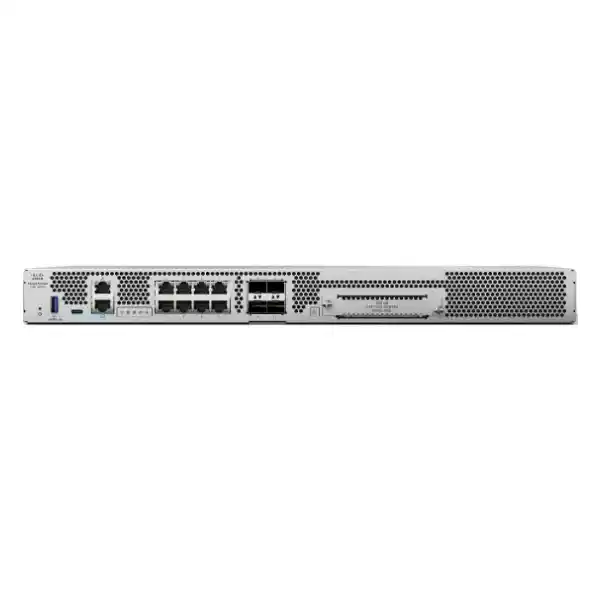
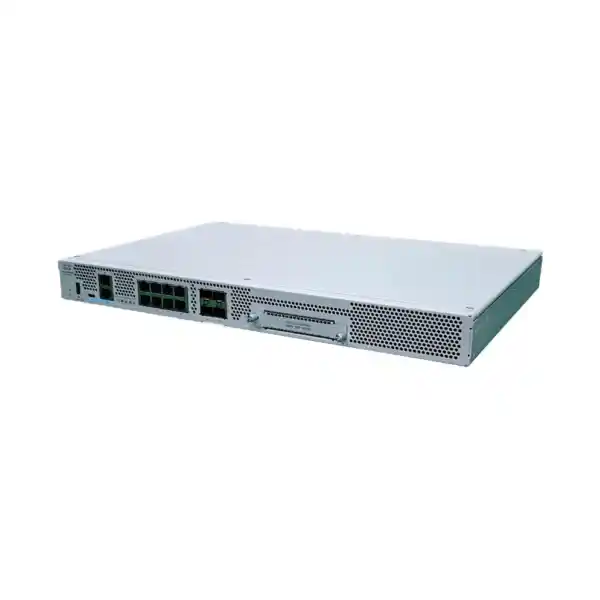
Cisco Secure Firewall 1240 Dubai
A mid-range 1U model in Cisco’s Secure Firewall 1200 Series for branch, distributed-enterprise and smaller-site deployments that need materially more security throughput, VPN capacity and connection scale than compact edge appliances, while retaining straightforward rack deployment and multiple management choices.
Direct answer for buyers evaluating the Cisco Secure Firewall 1240
Where the 1240 sits in the Secure Firewall 1200 Series
The Cisco Secure Firewall 1240 occupies an important position in the 1200 Series because it is the middle 1U model rather than one of the compact desktop appliances. Cisco’s family starts with compact models aimed at smaller branches and then moves into the rack-mount 1230, 1240 and 1250. That makes the 1240 especially relevant when a buyer has outgrown entry-level branch hardware but does not automatically need the highest-capacity model in the family. It offers the same basic 1U format and the same pattern of eight copper interfaces plus four SFP+ slots as the 1230, but with a higher published performance envelope. Compared with the 1250, it retains 1GbE integrated copper ports rather than the 1250’s 2.5GbE multigigabit copper ports, which is a practical distinction for LAN design.
For Dubai businesses, that family position matters because appliance selection is often driven by more than the current internet service. A branch may have a 1 or 2 Gbps internet connection today but also carry site-to-site VPN, inter-VLAN routing, application inspection, guest traffic, backup replication and traffic to cloud services. The firewall can become a concentration point for several traffic classes at once. If a security policy also decrypts a meaningful portion of TLS traffic, the sizing headroom required can be very different from a basic stateful firewall deployment.
The 1240 is therefore best treated as a sizing candidate, not an automatic recommendation. A smaller 1230 can be financially sensible where expected inspected traffic and connection growth fit comfortably within its envelope. The 1250 deserves evaluation when an organization expects substantially higher threat-defense throughput, more session growth or a need for 2.5GbE integrated copper interfaces. The goal is to buy enough headroom for the intended security policy and lifecycle without paying for capacity or interface characteristics that the environment will not use.
Cisco Secure Firewall 1240 key specifications
| Specification | Cisco Secure Firewall 1240 |
|---|---|
| Form factor | 1U rack-mount appliance |
| Threat Defense FW + AVC throughput | 18 Gbps, based on Cisco’s published 1024-byte test profile |
| NGIPS throughput | 15 Gbps |
| FW + AVC + IPS throughput | 12 Gbps |
| IPsec VPN throughput | 18 Gbps with Cisco’s published 1024-byte TCP Fastpath test profile |
| TLS decryption | 3.2 Gbps under Cisco’s stated test conditions |
| New connections per second with AVC | Up to 70,000 |
| Concurrent sessions with AVC | Up to 600,000 |
| Maximum VPN peers | Up to 1,000 |
| Maximum VRF instances with Threat Defense | 10 |
| Integrated data interfaces | 8x 1000BASE-T Gigabit Ethernet |
| SFP+ transceiver slots | 4x 1/10Gbps Ethernet; compatible transceivers must be selected for the link design |
| Management Ethernet | 1x 1000BASE-T management port |
| Console | USB Type-C and RJ-45 Cisco serial console |
| USB | USB 3 Type-A |
| Storage | Field-replaceable 960 GB SSD |
| Power supply | Single integrated power supply, 100-240V AC, 50-60 Hz |
| Maximum power consumption | 69W |
| Dimensions | 1.72 x 11.22 x 17.25 in / 4.37 x 28.49 x 43.81 cm |
| Weight | 9.35 lb / 4.24 kg |
| Cooling | Integrated blower, front-to-back airflow with port-side intake |
Performance figures are laboratory results published by Cisco and are useful for comparison, not guarantees for every production network. Enabled security services, traffic composition, packet sizes, encrypted traffic, software release and policy complexity can materially change achieved throughput.
How to interpret the 18 Gbps firewall figure correctly
The headline 18 Gbps figure for the 1240 is the Threat Defense FW + AVC result in Cisco’s 1024-byte test profile. It tells a buyer that the appliance has substantial processing capacity, but it should not be translated directly into a recommendation such as “suitable for any 18 Gbps internet link.” A production firewall rarely performs only one operation. A typical policy can include application visibility and control, intrusion prevention, URL categorization, malware-related services, identity-based rules, VPN encryption, NAT, logging and selective TLS decryption. Each enabled service consumes resources differently, and real traffic includes a mix of packet sizes and protocols rather than one controlled test condition.
Cisco publishes 12 Gbps for FW + AVC + IPS on the 1240, which is often a more useful starting point for buyers planning a modern next-generation firewall policy. Even that number should be treated as one input in a sizing exercise. If the site has 5 Gbps of internet connectivity and another 4 Gbps of routed internal traffic that crosses firewall zones, the appliance can inspect more than the WAN rate alone. Backups, cloud synchronization, software distribution, video, voice, guest networks and data-center replication can all create peaks. Session rate can matter as much as bandwidth for environments with many users, devices or short-lived web connections.
TLS decryption deserves separate attention. Cisco lists 3.2 Gbps for the 1240 under a defined TLS 1.2 test profile. A company intending to decrypt most outbound HTTPS traffic should size around expected encrypted traffic, certificate-policy exclusions, application behavior and user experience rather than assuming the larger firewall-throughput number applies. For many UAE customers, the right approach is to provide peak internet use, percentage of traffic expected to be decrypted, VPN requirements, number of users and expected growth so the appliance can be evaluated under a realistic security policy.
Interfaces: where the Cisco 1240 fits physically into a network
Eight 1GbE copper interfaces
The integrated copper ports are useful for conventional 1GbE handoffs, LAN zones, dedicated server or service networks, WAN circuits delivered on copper and direct connections to switches. Buyers should count how many physical zones are really required and avoid assuming every logical network needs a dedicated port; VLAN design can reduce physical-port consumption where appropriate.
Four 1/10GbE SFP+ slots
The SFP+ slots allow higher-speed fibre or DAC-based connectivity where supported transceivers are used. These ports are a strong reason to consider the 1240 for distribution-layer or data-center-edge designs with 10GbE uplinks. The required optics are not something to guess: media type, fibre distance, connector type and the switch-side transceiver must be confirmed before ordering.
Dedicated management and console access
A 1000BASE-T management interface, USB Type-C console, RJ-45 Cisco serial console and USB 3 Type-A port support deployment and operations. Management-plane addressing, out-of-band network availability and remote-access procedures should be planned before installation, especially for sites where an engineer will not always be physically present.
The integrated copper interfaces on the 1240 are 1GbE, not 2.5GbE. That detail can influence model choice. If an organization needs multigigabit copper handoffs without using SFP+ media, the 1250 should be examined because Cisco lists eight 2.5GBASE-T integrated interfaces on that model. Conversely, if the design already uses 10GbE fibre or DAC uplinks and the required threat throughput fits the 1240, the absence of 2.5GbE copper may not matter. Interface selection should be driven by the real demarcation, switch architecture and cabling standard rather than by headline bandwidth alone.
Software image is a purchasing decision, not a minor setup detail
Cisco makes the 1200 Series available with Cisco Secure Firewall Threat Defense or ASA software. The 1240 therefore has different ordering identities depending on the intended software, and the published performance tables also distinguish Threat Defense from ASA operation. For a new next-generation firewall deployment, Threat Defense is typically evaluated when the buyer wants Cisco’s broader application visibility, intrusion prevention and security-services ecosystem. ASA software remains relevant in environments where operational requirements, feature compatibility or migration strategy call for the ASA software model.
The choice should be made before the purchase order is finalized because it affects licensing, management, migration planning, configuration methods and feature mapping. A buyer replacing an older ASA should not assume every legacy behavior maps one-for-one into Threat Defense. The firewall team should identify critical functions such as site-to-site VPN, remote-access VPN, NAT behavior, routing protocols, security contexts, ACL logic, failover, logging destinations and any unusual inspections. That feature inventory can then be checked against the selected software release and management platform.
For procurement, request a quote that explicitly names the software variant rather than simply “Cisco Firewall 1240.” This prevents ambiguity and makes it easier to verify the correct license bundles, service coverage and deployment work. It also ensures the implementation plan is built around the software that will actually be operated after installation.
Threat Defense management choices
With Threat Defense, Cisco documents three broad management approaches for the 1200 Series: centralized management through Cisco Secure Firewall Management Center, on-box management through Firewall Device Manager, and cloud-delivered management through Cisco Security Cloud Control. The right choice depends on the number of firewalls, operational maturity, feature requirements, change-control process and whether the organization wants local, centralized or cloud-based administration.
Firewall Management Center
A strong fit for organizations managing multiple Threat Defense devices or needing deeper centralized policy, visibility and operational workflows. It can sit at a central location and manage branch appliances remotely, which is useful for distributed UAE or multi-country environments.
Firewall Device Manager
On-box management reduces dependency on a separate central manager and can suit a single device or a small number of firewalls where the required feature set fits FDM. Cisco positions FDM for smaller or mid-size networks and recommends Management Center when larger fleets or more complex features are needed.
Cloud-delivered management
Cisco Security Cloud Control can support cloud-managed workflows. This can appeal to distributed organizations that want centralized operational access without hosting the management plane in the same way as an on-premises manager. Connectivity, onboarding and high-availability design still need to be planned carefully.
Management selection should be documented as part of the architecture, not postponed until the appliance arrives. It affects policy ownership, backup processes, administrator access, remote troubleshooting, event visibility, upgrade procedures and how new sites are brought online. If a customer already operates Cisco Secure Firewall Management Center, adding a 1240 into that operating model can be more straightforward than introducing a separate on-box management practice. If the site is standalone, FDM may reduce infrastructure overhead. The important point is to choose based on operational requirements and supported features rather than convenience during first boot.
Licensing and subscriptions: what should appear in the quotation
A Cisco Secure Firewall 1240 purchase is not complete merely because the hardware line item is present. For Threat Defense, Cisco documents a required base entitlement and additional security capabilities such as IPS, Malware Defense, URL Filtering and Cisco Secure Client. Cisco also publishes 1-year, 3-year and 5-year term options for combined threat, malware and URL subscriptions associated with the 1240. The exact commercial bundle should be validated against the current Cisco ordering guide at quotation time because product identifiers, packaging and entitlement names can change.
The practical buying question is what the security policy must do on day one and throughout the subscription term. If the organization wants intrusion prevention, web-category controls, malware-focused capabilities or remote-access client licensing, these requirements should be listed explicitly. A hardware-only comparison can make one proposal appear cheaper while leaving out the subscriptions needed to deliver the intended security outcome. For that reason, compare like-for-like configurations with the same software image, subscription scope, term length and support coverage.
Remote-access VPN deserves its own check. Cisco documents up to 1,000 VPN peers for the 1240 platform, but Cisco Secure Client licensing is a separate consideration. The number of employees who may connect concurrently, required client tier, authentication method, MFA integration and endpoint posture requirements should be captured during design. Site-to-site VPN needs should also be counted, particularly for organizations connecting branches, cloud networks, partner networks and disaster-recovery sites.
For ASA software, the licensing model differs. Cisco documents Essentials as included and optional licensing for additional security contexts as well as Cisco Secure Client. If ASA is selected, context requirements, VPN licensing and export-related encryption entitlement should be checked in the exact software and commercial environment. The main procurement principle is simple: the quote should describe the operational license outcome, not just a collection of part numbers.
Security inspection, application control and encrypted traffic
The reason to deploy a next-generation firewall is not merely to route packets between interfaces. Threat Defense can apply security policy based on applications, users, network attributes and threat intelligence, while intrusion prevention adds inspection intended to identify and block malicious activity. The 1240’s published numbers show that Cisco expects this platform to carry meaningful inspected traffic at branch and smaller-site scale. However, the organization still needs a policy strategy: which applications are allowed, which are restricted, where intrusion rules are applied, what traffic is logged, and how encrypted sessions are treated.
TLS decryption is often the biggest difference between a simple firewall design and a demanding security design. A large percentage of modern business traffic is encrypted. Without decryption, some security engines have less visibility into the payload. With decryption, the firewall must perform cryptographic operations and the organization must manage certificates, exceptions and privacy implications. Cisco publishes 3.2 Gbps TLS decryption for the 1240 under its stated test conditions. That number should be compared with the volume of traffic the business actually intends to decrypt, not with total link speed in isolation.
Certain applications, certificate-pinned services or regulated data flows may need to bypass decryption. The bypass list should be intentional and reviewed rather than built reactively after users complain. Likewise, intrusion policies should be tuned to the network rather than enabled with no operational follow-up. False positives, unnecessary logging and overly broad rules can create administrative noise even when the appliance has enough raw processing capacity.
A good 1240 deployment therefore combines hardware sizing with policy engineering. The appliance provides the processing platform; the security result depends on how inspection, identity, logging, exceptions and response processes are designed. Buyers asking for installation should specify whether they need basic commissioning or a full policy migration and optimization project, because those are materially different scopes of work.
VPN capacity and branch connectivity
Cisco lists 18 Gbps IPsec VPN throughput for the 1240 with Threat Defense under its published Fastpath test profile and up to 1,000 VPN peers. These figures make the appliance relevant for organizations that use encrypted site-to-site connectivity heavily, but the design still depends on topology. A hub firewall terminating tunnels from dozens or hundreds of branches behaves differently from a branch firewall with two data-center tunnels. Internet-facing remote-access VPN, cloud VPNs and third-party partner tunnels add additional connection and policy considerations.
When the 1240 is used as a VPN hub, collect the number of current tunnels, expected three-to-five-year growth, aggregate encrypted bandwidth, routing design, failover behavior and whether dynamic routing will run across tunnels. Consider what happens during a circuit failover: traffic that is normally spread across two paths may converge onto one firewall interface or one ISP connection. Encryption performance should be sized for that degraded-but-operational state if continuity is important.
Remote-access VPN adds user experience and identity requirements. The firewall platform can support a substantial number of peers, but the final design may include Cisco Secure Client licensing, MFA, identity provider integration, split-tunneling policy, DNS behavior and access controls that differ by user group. Some customers need only a small emergency-administration VPN, while others intend the appliance to support hundreds of remote workers. Those are different projects even if they use the same 1240 hardware.
For UAE deployments with multiple offices, the 1240 can also serve as a strong regional aggregation point where the traffic profile fits. If the same appliance is expected to terminate VPN, inspect internet traffic and route internal segments simultaneously, all of those workloads should be considered together. Avoid sizing the VPN requirement and internet-security requirement as though they will occur at different times unless the traffic pattern proves that assumption.
High availability: supported, but architecture still matters
Cisco documents active/standby high availability for Secure Firewall 1200 Series appliances running Threat Defense. This is important for buyers that cannot accept a single firewall as a single point of failure. A pair, however, is not automatically a resilient service. Both appliances need appropriate licenses and matching configuration, and the surrounding network must also support failover. Upstream and downstream switches, ISP handoffs, VLANs, routing, management reachability and power should all be reviewed as part of the HA design.
The 1240 uses a single integrated power supply per appliance. In a high-availability design, separate appliances can be connected to independent power distribution where the site provides it, reducing the risk that one device failure or one power path removes the firewall service. If the rack itself has only one power source, the firewall pair cannot compensate for a complete rack-power failure. Similar logic applies to network switches: two firewalls connected to one access switch do not create end-to-end redundancy if that switch fails.
Failover links and state synchronization should use a deliberate interface plan. The eight 1GbE copper ports and four SFP+ slots offer options, but interface availability must be reserved for actual production requirements, HA connections and management. A port map prepared before implementation prevents last-minute compromises. If 10GbE links are used for production data, the transceiver and switch configuration on both members of the pair should be identical where practical.
High availability also requires an operational runbook. Administrators should know how to verify active and standby health, perform upgrades, test failover, interpret alarms and recover from a failed unit. Buying two appliances without planning those workflows provides hardware redundancy but not necessarily operational resilience.
Physical installation, rack planning and environmental requirements
The Cisco Secure Firewall 1240 is a 1U rack-mount appliance measuring approximately 4.37 x 28.49 x 43.81 cm and weighing about 4.24 kg. Those dimensions make rack placement straightforward in many communications rooms, but depth, cable routing and front-to-back airflow should still be checked. Cisco describes the 1U models as using an integrated blower with front-to-back airflow and port-side intake. Rack orientation should therefore preserve the intended intake and exhaust path rather than forcing hot exhaust air back into the intake side.
Cisco specifies an operating temperature range of 0 to 40°C and 5% to 85% non-condensing humidity for the 1U models. In Dubai and elsewhere in the UAE, the ambient outdoor climate makes proper air-conditioned equipment space particularly important. The firewall should not be treated as office furniture simply because its electrical load is modest. A communications rack with predictable cooling, dust control, suitable UPS capacity and access for service is the safer deployment environment.
Maximum published power consumption for the 1240 is 69W. Power planning should include the firewall, any paired unit, switches, routers, management appliances and optics rather than considering the 69W figure alone. UPS runtime calculations should be based on the complete protected load and the business’s required outage tolerance. The firewall’s single integrated power supply also reinforces the value of an HA pair for critical sites.
The appliance includes a field-replaceable 960 GB SSD. Storage replacement should follow Cisco procedures and support guidance rather than generic server-storage practices. Installation scope can include rack mounting, power and grounding checks, console access, interface labeling, cable management, management IP configuration and connectivity validation. If the site is remote, record console access and out-of-band recovery options before the engineer leaves.
Sizing the 1240 for a Dubai or UAE site
A reliable sizing exercise starts with the traffic the firewall must inspect, not with employee count alone. Two companies with 300 employees can require very different appliances. One may use mostly SaaS applications over a 1 Gbps internet connection; the other may operate 10GbE server segments, encrypted backups, multiple VPNs and heavy TLS decryption. The number of users is useful context, but bandwidth, connection rate, session count, feature mix and growth determine the firewall workload more directly.
1. Measure real peak traffic
Collect WAN utilization, inter-zone routing volumes and VPN traffic during busy periods. Use peak and sustained patterns rather than monthly averages. If the firewall will replace a router or segmentation device, include traffic that does not currently cross the existing firewall.
2. Define inspection policy
Estimate how much traffic will use IPS, application control, URL controls, malware-related services and TLS decryption. The more security work performed per connection, the more important the lower “services enabled” throughput figures become.
3. Count connections and VPN peers
High-volume web environments, guest networks, IoT estates and large user populations can drive session rate independently of bandwidth. Include site-to-site and remote-access VPN peers, especially if the firewall will act as a hub.
4. Add growth and failure scenarios
Size for planned internet upgrades, new offices, cloud projects and the traffic that may shift during circuit or site failover. Headroom is valuable when the appliance is expected to remain in service for several years.
If projected security-service throughput approaches the 1240’s limits too closely, the 1250 or a larger Cisco Secure Firewall platform should be considered. If the required workload sits comfortably below the 1230’s capacity and no special interface requirement pushes the design upward, a 1230 may be enough. The right answer is the model that preserves operational margin under the real policy, not the one with the most attractive headline number.
When the Cisco Secure Firewall 1240 may not be the right choice
The 1240 is a capable appliance, but a good product page should also explain where it can be the wrong fit. First, its integrated copper data interfaces are 1GbE. A site that depends on multiple 2.5GbE copper handoffs may find the 1250’s multigigabit copper interfaces more natural. The 1240 does provide four 1/10GbE SFP+ slots, so a fibre- or DAC-based 10GbE architecture may still fit well.
Second, the 1200 Series is designed for branch offices and smaller sites. A large data-center perimeter, very high-volume internet edge or environment requiring much greater inspected throughput may belong on a larger Secure Firewall family. The 1240’s 3.2 Gbps published TLS decryption figure can also be a limiting consideration if the organization expects to decrypt several gigabits per second of HTTPS traffic continuously. Sizing must use the security-service workload, not only stateful firewall throughput.
Third, Threat Defense on the 1200 Series supports active/standby high availability but Cisco’s compatibility guidance does not list hardware clustering for the 1200 Series. If the architecture requires multi-node firewall clustering rather than an HA pair, a different platform family should be evaluated. Similarly, Cisco lists multi-instance as not supported for the 1200 Series with Threat Defense. Customers that require multiple independent firewall application instances on the same physical appliance should not assume the 1240 provides that design model.
Finally, the management method and software image need to fit the customer’s operations. An organization standardized on a particular Cisco management workflow should confirm feature support for the intended release before purchase. These limitations are not defects; they are architecture boundaries that help distinguish the correct use case from an unsuitable one.
1240 versus nearby 1200 Series models
| Decision point | Secure Firewall 1230 | Secure Firewall 1240 | Secure Firewall 1250 |
|---|---|---|---|
| Form factor | 1U | 1U | 1U |
| FW + AVC | 13 Gbps | 18 Gbps | 24 Gbps |
| FW + AVC + IPS | 9 Gbps | 12 Gbps | 18 Gbps |
| TLS decryption | 2.5 Gbps | 3.2 Gbps | 4.1 Gbps |
| Concurrent sessions with AVC | 400,000 | 600,000 | 1,000,000 |
| Maximum VPN peers | 500 | 1,000 | 1,500 |
| Integrated copper | 8x 1GbE | 8x 1GbE | 8x 2.5GbE |
The 1240 becomes attractive when the 1230 leaves too little inspection or session headroom but the environment does not need the 1250’s higher threat-defense capacity or 2.5GbE copper ports. That makes the 1240 a balanced candidate for many multi-gigabit branch and regional-office designs. The correct comparison should include the same subscription level and HA assumptions for all models, because comparing a fully licensed 1240 pair with a hardware-only 1250 single unit would not be meaningful.
Migration from an existing firewall
Replacing a firewall is a configuration and business-continuity project, not just a hardware swap. Before moving to the Cisco Secure Firewall 1240, export or document the existing interface map, IP addressing, routes, VLANs, NAT rules, access policies, VPN definitions, objects, certificates, DHCP functions, logging destinations and administrative access rules. Then classify each item as “must migrate,” “should redesign” or “can retire.” This prevents old technical debt from being copied automatically into the new platform.
For migrations from ASA to Threat Defense, pay particular attention to feature mapping. Some familiar concepts have different workflows, and a direct syntactic translation is not always the best operational result. VPNs need peer coordination, certificates may require planned export or re-enrollment, and NAT behavior should be tested carefully. If the old firewall also acts as a router, evaluate routing adjacencies and convergence during the cutover. If public IP addresses change, external DNS, allowlists and partner configurations may need advance notice.
A staged migration is usually safer than rewriting everything on the change night. Build and review the target policy, validate management access, load licenses, test software version compatibility, configure interfaces and prepare rollback steps before production traffic is moved. For an HA pair, validate member communication and failover state before placing the pair in path. Where practical, test critical application flows using a representative pre-production segment or maintenance window.
The final acceptance test should include internet access, inbound published services, DNS, business-critical SaaS, site-to-site VPN, remote-access VPN, voice, application-specific ports, monitoring, logging and failover. A firewall migration is successful when business flows and security controls both operate as intended, not merely when the device responds to ping.
Practical deployment scenarios for the 1240
Large branch internet edge
A branch with multi-gigabit internet, hundreds of users and a meaningful security policy may need more than a compact firewall. The 1240’s 1U form, 12 Gbps published FW + AVC + IPS throughput and 600,000-session scale can provide room for growth when the actual traffic profile fits.
Regional VPN aggregation
Organizations linking multiple offices may use the 1240 as a VPN concentration point. The published 18 Gbps IPsec and 1,000-peer ceiling are relevant, but the actual design should account for simultaneous internet inspection, routing, tunnel growth and failover traffic.
Segmentation firewall
The four 1/10GbE SFP+ slots can connect to distribution or data-center switches for inter-zone security. Internal segmentation sizing must include east-west traffic volumes, not only internet usage, and the 10 VRF maximum published for Threat Defense should be checked against routing segmentation needs.
HA perimeter pair
Two 1240 appliances can form an active/standby Threat Defense pair for sites that require firewall continuity. This design is strongest when upstream switching, power, ISP paths and management are also made resilient rather than leaving hidden single points of failure.
Managed distributed estate
A company with several Cisco firewalls can centralize policy through Firewall Management Center or use cloud-delivered management where appropriate. Standardized templates, logging and change control often become more important than the configuration of a single branch appliance.
Logging, monitoring and operational visibility
The security value of a firewall depends partly on what the operations team can observe after deployment. Policy events, intrusion alerts, VPN status, interface health, failover state, resource utilization and administrative changes should feed a defined monitoring process. A 1240 deployed with excellent preventive controls but no one reviewing critical alerts can still leave the organization blind to important activity.
Before rollout, decide where logs will be retained, how long they must be kept and who will investigate them. Some organizations rely on Cisco management tooling for day-to-day visibility and also forward relevant events to a SIEM or SOC platform. Others use an external managed security service. The correct approach depends on compliance requirements, incident-response maturity and the volume of events. Excessive logging can consume storage and analyst attention, while insufficient logging can make investigations difficult.
Monitoring should also include infrastructure health. Interface errors, tunnel flaps, packet drops, CPU or memory pressure, certificate expiration and HA state changes can indicate operational issues before users report an outage. Baseline normal utilization after commissioning so future changes can be compared with known-good behavior. If traffic grows substantially after a new cloud project or office expansion, the original sizing assumptions should be revisited.
For support handover, document administrator roles, escalation contacts, maintenance windows, configuration-backup procedures and the process for opening Cisco support cases when the applicable service contract is in place. Operational discipline turns a firewall from a one-time installation into a maintained security control.
Software release, compatibility and upgrade planning
Cisco Secure Firewall software evolves, and features, support boundaries and management compatibility can change by release. A new 1240 should therefore be deployed on a software version that is supported by the chosen management platform and appropriate for the organization’s operational standard. Avoid assuming the factory-loaded image is automatically the version you want to run in production.
If Firewall Management Center is used, confirm compatibility between the appliance’s Threat Defense version and the manager version before onboarding. For cloud-delivered management or FDM, confirm the chosen release supports the required features and deployment method. The same principle applies when integrating with identity systems, Secure Client, SIEM platforms, routing peers and automation tools. Compatibility is an architecture property, not only a firmware question.
Upgrade planning should include configuration backup, change review, release-note review, maintenance window, HA sequencing and rollback procedures. In an active/standby pair, software upgrades can often be planned to reduce service interruption, but the exact procedure depends on release and deployment design. Test critical VPNs and applications after the change rather than assuming a successful reboot proves full functionality.
Lifecycle planning should also consider subscription renewal and support coverage. Hardware can continue running after a procurement milestone, but expired security subscriptions or support can change the practical capability and risk position of the deployment. Keeping a simple asset record with serial numbers, software release, license term, support expiry and responsible owner prevents avoidable operational surprises.
Optics, cables and accessories that are easy to miss
The 1240’s four SFP+ slots support a range of 1Gbps and 10Gbps transceivers, but the correct optic depends on the link. Fibre type, wavelength, distance, connector, switch model and the transceiver used on the opposite end all matter. A quotation that says only “four SFPs” is incomplete. Specify whether each connection uses short-range multimode fibre, long-range single-mode fibre, copper direct-attach cable or another supported medium, and validate compatibility against Cisco’s current transceiver guidance.
Console access is another small detail that can become important during installation. The 1200 Series provides USB Type-C and RJ-45 Cisco serial console connectivity. If the implementation team requires a particular console cable or USB adapter, include it in the deployment kit rather than relying on whatever is available on-site. Label console, management, WAN, LAN and HA connections clearly, especially in racks containing similar appliances.
The 960 GB SSD in the 1U models is field replaceable, and Cisco lists a replacement SSD accessory for the series. A buyer does not normally need to purchase a spare SSD with every unit, but organizations with strict spare-part policies can consider it as part of lifecycle support. For critical remote sites, keeping an approved spare appliance may be more valuable than keeping individual internal components, depending on support response expectations.
Rack hardware, power cords appropriate to the delivery region, patch leads, fibre jumpers, optics and cable-management items should be confirmed with the final bill of materials. These items are inexpensive relative to the firewall but can delay a deployment if omitted.
Procurement guidance for UAE buyers
A useful Cisco Secure Firewall 1240 quotation should be easy to compare and difficult to misunderstand. It should identify the exact appliance software variant, quantity, subscription package and term, support level, required optics and any professional services. If high availability is required, the proposal should make clear that two appliances are included and describe the assumptions for HA interfaces and deployment. If only one appliance is quoted, the buyer should know that the design contains a firewall hardware single point of failure.
Do not compare proposals solely on the total price line. Check whether one quote includes three years of security subscriptions and another includes one year, whether one contains Cisco Secure Client licensing, whether support coverage differs and whether optics are included. Installation can also vary widely: “installation” may mean rack-and-power only, basic interface configuration, complete policy migration, or a fully tested change with rollback and documentation. Ask suppliers to state the service scope.
Lead time and product availability can vary, so project dates should be confirmed at the time of order rather than inferred from a generic product page. The same applies to exact Cisco commercial part numbers. Cisco ordering structures evolve; a current quote should be built against the valid ordering guide and the customer’s Cisco account requirements. Where Smart Licensing is used, confirm who owns the smart account or virtual account and how licenses will be assigned.
FourTeck can prepare a UAE-focused bill of materials once the network requirement is known. For broader company information, visit FourTeck UAE. For specialist firewall information and deployment enquiries, Firewall Dubai by FourTeck is the most directly relevant resource.
A sensible implementation journey
Discovery and sizing
Capture bandwidth, peak traffic, current firewall statistics, security services, VPNs, users, sites, interface media and growth. Decide whether the 1240 has the right margin or whether the 1230 or 1250 should be compared.
Architecture and bill of materials
Select Threat Defense or ASA, management method, HA or standalone design, subscription term, Secure Client requirement, support, optics, rack and cabling assumptions. Resolve these items before the purchase order.
Pre-configuration
Prepare management addressing, software release, licensing, objects, routing, NAT, access policy, VPN and logging configuration. Build a port map and rollback plan. For migrations, review legacy rules rather than blindly copying them.
Rack, connect and validate
Install the appliance with correct airflow, power and cable labeling. Validate console and management access, interface negotiation, routing adjacency, HA state and reachability before moving production traffic.
Cutover and acceptance
Move traffic during an approved change window, test business applications, inbound services, VPN, DNS, monitoring and failover, and retain a rollback path until the new firewall has passed acceptance criteria.
Handover and operations
Document the final configuration, administrative access, license term, support status, backup process, monitoring and escalation path. Review utilization after the first weeks of normal traffic to validate the sizing assumptions.
Common buyer questions about Cisco Secure Firewall 1240
Is 18 Gbps the real production throughput?
It is Cisco’s published FW + AVC benchmark for the 1240 under a defined test profile. Production throughput depends on traffic, packet sizes, enabled services and software. For a security-enabled design, the 12 Gbps FW + AVC + IPS figure and the 3.2 Gbps TLS decryption figure may be more relevant than the headline number.
Does the 1240 have 10GbE ports?
Yes. It has four SFP+ slots supporting 1/10Gbps Ethernet, in addition to eight integrated 1GbE copper interfaces. The required SFP or SFP+ transceivers must be selected to match the switch, fibre type and distance. The integrated copper ports themselves are 1GbE.
Can the 1240 be used in high availability?
Cisco lists active/standby HA support for the Secure Firewall 1200 Series with Threat Defense. A complete HA design needs two appliances, suitable licensing, failover connectivity and redundant consideration for switching, power, ISP handoffs and management.
Does the 1240 support firewall clustering?
Cisco’s Threat Defense compatibility guidance lists high availability for Secure Firewall 1200 hardware but not hardware clustering. If the requirement is a multi-node clustered firewall design rather than an active/standby pair, a different Cisco Secure Firewall family should be evaluated.
How many VPN peers can it support?
Cisco publishes a maximum of 1,000 VPN peers for the 1240. The practical design also depends on aggregate VPN bandwidth, encryption profile, authentication, Secure Client licensing for remote access and the other security workloads running on the appliance.
Can it be managed without Firewall Management Center?
Yes. Cisco documents on-box Firewall Device Manager and cloud-delivered management through Cisco Security Cloud Control in addition to centralized Firewall Management Center. Feature requirements and the size of the firewall estate should drive the choice.
Is IPS included automatically?
Do not assume the base hardware price includes every security subscription required for your policy. Threat Defense has a required base entitlement and separate subscription considerations for IPS, Malware Defense, URL Filtering and Cisco Secure Client. Ask for the intended security bundle and term to be listed explicitly.
Should we buy 1240 or 1250?
Choose based on required inspected throughput, session growth and interfaces. The 1250 publishes higher threat-defense figures and has eight 2.5GbE integrated copper ports. The 1240 can be a better-value fit if 12 Gbps FW + AVC + IPS, 600,000 sessions and 1GbE copper plus 10GbE SFP+ connectivity meet the lifecycle requirement.
Should we buy 1230 instead?
The 1230 should be considered when its lower capacity still provides comfortable headroom. Cisco publishes 9 Gbps FW + AVC + IPS, 400,000 sessions and 500 VPN peers for the 1230. If the organization expects growth beyond those levels, the 1240 may reduce the risk of an early replacement.
Can FourTeck migrate an existing firewall configuration?
Migration scope can be included, but it should be defined. A proper migration reviews interfaces, NAT, policies, routing, VPN, certificates, logging, HA and business-critical flows. The work is different from simple rack installation and should be quoted according to rule count, VPN count, complexity and cutover requirements.
Regional availability, support and related FourTeck resources
FourTeck supports firewall procurement and project scoping for Dubai and the wider UAE. Availability, exact Cisco part numbers, subscription bundles and delivery schedules should be confirmed at quotation time because stock and commercial packaging can change. Customers planning deployment outside the UAE can also use FourTeck global for broader company coverage.
Firewall projects often touch switching, servers, identity, monitoring and ongoing operations. Buyers that need broader infrastructure or managed support can review FourTeck IT Services UAE. This is particularly relevant when the firewall replacement is part of a larger office move, network redesign, server migration or support-contract transition rather than a standalone appliance purchase.
For Cisco 1240 planning, it is useful to decide whether you need supply only, supply plus basic commissioning, complete migration, high-availability implementation, or ongoing support. Those choices have a larger effect on project scope than the physical rack installation itself.
Decision recap before ordering the Cisco Secure Firewall 1240
What FourTeck needs from you for an accurate 1240 quotation
Build the right Cisco Secure Firewall 1240 configuration for your UAE network
Send FourTeck your bandwidth, VPN, interface, security-service and high-availability requirements. We can help determine whether the 1240 has the right lifecycle headroom, identify the required subscriptions and optics, and define a quotation that separates hardware, licensing, implementation and support clearly.

Reviews
There are no reviews yet.