
Cisco Secure Firewall 3105 Dubai
A compact 1RU Cisco security appliance for growing enterprise branches that need high inspection performance, flexible copper and 1/10G fibre connectivity, VPN capability and a clear path into Cisco Secure Firewall management and security subscriptions.
Direct answer: what is the Cisco Secure Firewall 3105?
The Cisco Secure Firewall 3105 is the entry model in Cisco’s Secure Firewall 3100 appliance family. Cisco positions it for enterprise branch offices with room to grow. It is mainly used to enforce network-security policy at a branch or distributed enterprise edge, inspect applications and threats, terminate site-to-site or remote-access VPN traffic, and integrate those controls into a Cisco firewall-management architecture.
Organizations should consider the 3105 when they need more capacity, interface flexibility and enterprise security functionality than small-branch appliances typically provide, but do not require the higher throughput, higher connection rate or clustering support available on the 3110, 3120, 3130 or 3140.
The most important factor to confirm is not the headline 10 Gbps figure by itself. Real sizing depends on the traffic mix, enabled inspection services, TLS decryption, VPN load, connection rate, future growth, software mode and availability design. FourTeck can help translate those conditions into a practical model, license, optics, network-module and implementation bill of materials.
Where the 3105 sits in the Cisco Secure Firewall 3100 family
The 3100 family spans five appliance models: 3105, 3110, 3120, 3130 and 3140. They share a 1RU enterprise-hardware approach, but their performance ceilings, connection rates, memory, interface options and scale characteristics increase as you move up the range. The 3105 is therefore best understood as a deliberate entry point into the 3100 architecture rather than as a cut-down small-office firewall.
Cisco describes the 3105 as suited to enterprise branch offices that have potential to grow. That positioning matters because many Dubai buyers operate branches that are no longer simple internet-access sites. A modern branch may aggregate hundreds of users, IP phones, Wi-Fi access points, building systems, cameras, SaaS traffic, SD-WAN underlays, cloud VPNs and private-application access. The security edge has to cope with more sessions and more encrypted traffic even when the raw WAN bandwidth looks modest.
The 3105 provides published Firewall + AVC and Firewall + AVC + IPS performance of 10 Gbps with the test conditions specified by Cisco, and up to 1.5 million concurrent sessions with AVC. Cisco also lists up to 90,000 new connections per second with AVC. These figures make the appliance interesting for busy branches and smaller enterprise edge locations, but they should be treated as engineering reference points, not automatic guarantees for every production policy.
If the design requires substantially more throughput, a higher connection creation rate, more memory, 25/40G interface options, or multi-chassis clustering, the buyer should compare the 3110 or larger models before locking the purchase. In particular, the 3105 does not support the up-to-eight-chassis clustering capability available on other 3100 models. High availability is supported, but clustering is not, so resilience and horizontal scale must be considered separately.
Cisco Secure Firewall 3105 key specifications
| Specification | Cisco Secure Firewall 3105 | Buyer interpretation |
|---|---|---|
| Form factor | 1RU | Designed for standard enterprise rack deployment. |
| Firewall + AVC throughput | 10 Gbps | Reference performance; production throughput varies with policy and traffic mix. |
| Firewall + AVC + IPS | 10 Gbps | Useful for threat-inspected branch traffic, subject to real workload conditions. |
| TLS throughput | 3.2 Gbps | Critical when decrypted inspection is a major part of the security design. |
| IPsec VPN throughput | 5.5 Gbps in Cisco’s listed FTD test profile | Validate tunnel count, encryption profile and traffic pattern. |
| Maximum VPN peers | 2,000 | A platform maximum, not a substitute for remote-access concurrency sizing. |
| Concurrent sessions with AVC | 1.5 million | Important for highly connected branches and application-heavy estates. |
| New connections/sec with AVC | 90,000 | Relevant to bursty web, SaaS and high-session-rate applications. |
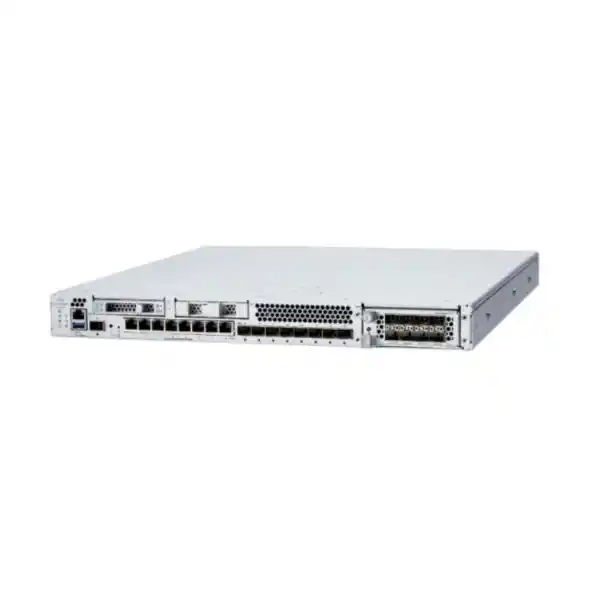
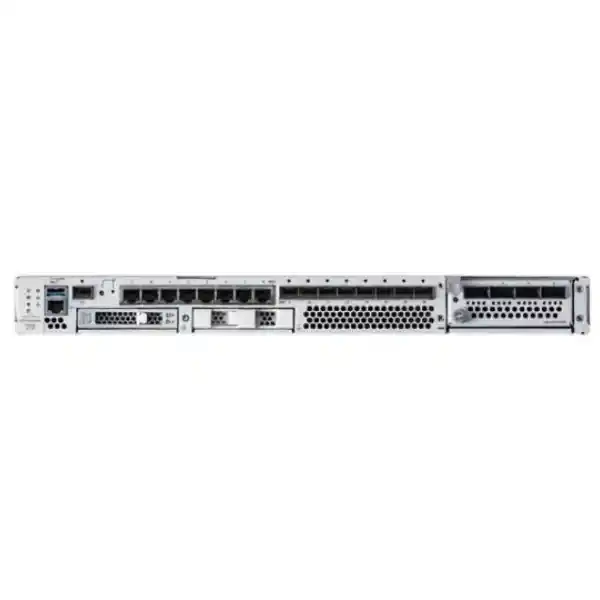
| Integrated copper ports | 8 × 10/100/1000BASE-T RJ-45 | Convenient for direct copper handoffs and local routed segments. |
| Integrated fibre ports | 8 × 1/10G SFP+ | Optics and DAC choices must match distance and switch/provider handoff. |
| Optional network module | 8 × 1/10G SFP+ option | Can raise total port flexibility; confirm exact module PID and required optics. |
| System memory | 64 GB | Lower than the 3110/3120 and part of family-position sizing. |
| Storage | 1 × 900 GB, with one spare slot | Supports appliance operation and local functions; log architecture should still be planned centrally where required. |
| High availability | Supported | A two-appliance design can address resilience; licenses and topology must be quoted correctly. |
| Clustering | Not supported on 3105 | Choose a larger 3100 model if multi-chassis cluster scale is a requirement. |
Performance: how to read the 10 Gbps figure correctly
Firewall sizing is frequently distorted by one number. A buyer sees “10 Gbps” and compares it directly with a 1, 2 or 5 Gbps internet circuit. That is a useful first check, but it is not enough. Cisco’s performance tables are measured with defined packet sizes and test profiles. Production traffic is more complicated: packet sizes vary, protocols vary, users open many simultaneous sessions, cloud applications create large numbers of short-lived connections, inspection engines analyse application context, and encrypted sessions may need decryption before content can be inspected.
For the 3105, Cisco publishes 10 Gbps for Firewall + AVC and 10 Gbps for Firewall + AVC + IPS using the stated 1024-byte test profile. That is strong for an enterprise branch platform, but the design team should also inspect the 90,000 maximum new connections per second with AVC and 1.5 million maximum concurrent sessions. A branch hosting many users, guest networks, IoT devices, public-facing services or high-volume SaaS traffic may hit session or connection-rate pressure before it hits simple WAN bandwidth.
TLS decryption is another separate capacity domain. Cisco lists 3.2 Gbps TLS performance for the 3105 under its specified TLS 1.2 conditions. If a security policy intends to decrypt and inspect most outbound web traffic, the encrypted-traffic design can become a more meaningful sizing constraint than the basic firewall number. Some traffic may also need to bypass decryption for privacy, application compatibility or certificate-pinning reasons, which changes both the policy design and actual load.
Growth should be included as a real engineering input. If a Dubai branch has a 2 Gbps WAN today but expects 5 or 10 Gbps connectivity, adopts more cloud applications, introduces additional site-to-site VPNs, or consolidates multiple security zones onto one appliance pair, the 3105 may be perfectly appropriate today yet leave limited headroom later. In such cases the 3110 should be evaluated before purchase, because appliance replacement costs far more than comparing models during design.
A good sizing discussion therefore collects WAN bandwidth, east-west traffic that will traverse the firewall, expected inspection level, encrypted-traffic ratio, peak concurrent sessions, connection bursts, VPN profiles, high-availability design and three-year growth assumptions. FourTeck can use those inputs to determine whether the 3105 is comfortably sized or merely capable under a narrow test condition.
Interfaces and physical network design
Eight copper data interfaces
The integrated 10/100/1000BASE-T RJ-45 interfaces suit ordinary copper handoffs, routed LAN segments, lower-speed WAN circuits, management-adjacent networks and branch environments where switch or carrier demarcation is already copper. They also reduce the need to consume SFP+ ports for 1G copper links.
Eight fixed 1/10G SFP+ interfaces
The fixed fibre-capable ports are valuable when the firewall connects to core or distribution switches at 10G, receives fibre carrier handoffs, uses data-centre-style DAC cabling, or separates multiple routed security zones. The port alone does not define the link; compatible optics, fibre type, connector, wavelength and distance still need to be specified.
Optional 1/10G network-module expansion
Cisco lists an 8-port 1/10G SFP+ network-module option for the 3105. This can improve physical segmentation or reduce reliance on downstream VLAN trunks. The bill of materials should state whether the module is required from day one, because adding interfaces later may affect optics, rack cabling, maintenance windows and budget.
Port count is not just a convenience issue. It is an architecture decision. A firewall may need dedicated interfaces for two internet providers, MPLS or private WAN, core-switch uplinks, DMZs, management, HA links, guest traffic, server segments and migration overlap. Some of these can be carried as VLAN subinterfaces on high-speed trunks, while others may be kept physically separate for operational clarity or provider constraints. The right choice depends on failure domains and troubleshooting preferences as much as pure port availability.
For fibre connections, confirm whether the adjacent device uses SFP or SFP+, single-mode or multimode fibre, SR or LR optics, and whether a direct-attach copper cable is allowed. A firewall quote that lists only the chassis can be incomplete if the deployment requires multiple transceivers. The same applies to patch leads, rack PDUs and console access; these small items can delay implementation when left until installation day.
Threat Defense or ASA: decide the software mode before ordering
The Secure Firewall 3100 hardware family can operate with Cisco Secure Firewall Threat Defense or ASA software, and Cisco lists separate chassis part numbers for those software choices. For the 3105, the ordering guide identifies FPR3105-NGFW-K9 for the Threat Defense appliance and FPR3105-ASA-K9 for the ASA appliance. That distinction should be explicit in every quotation because the operational model, feature licensing and management workflow differ.
Threat Defense is the natural choice when the requirement includes next-generation firewall functions such as application visibility, IPS, malware-related controls, URL filtering and integrated modern threat policy. Cisco’s licensing documentation identifies Essentials as required and lists additional capabilities such as IPS, Malware Defense, URL Filtering and Cisco Secure Client, depending on what the organization intends to use. These entitlements must be mapped to the actual security policy rather than purchased as generic labels.
ASA remains relevant for organizations with established ASA operational practices, particular configuration dependencies, migration plans or feature requirements aligned to ASA. Cisco lists Essentials, security contexts, carrier functions and Cisco Secure Client among ASA licensing areas. A buyer migrating from an older ASA should not assume that preserving familiar syntax is automatically the best long-term choice; equally, a buyer should not move to Threat Defense without checking the feature and management implications of the migration.
The right software image is therefore a design decision, not a formatting choice in the purchase order. FourTeck can scope the existing firewall, required features, policy migration, remote-access requirements, logging architecture and operations model to recommend whether a Threat Defense or ASA 3105 configuration is appropriate.
Licensing and subscriptions: what the hardware price does not answer
Enterprise firewall procurement should separate the appliance from the security subscriptions that enable the intended inspection outcome. Cisco uses Smart Licensing and publishes distinct license PIDs for the 3105. Current Cisco documentation states that Essentials is required for Threat Defense, with additional capabilities such as IPS, Malware Defense, URL Filtering and Cisco Secure Client selected according to use. Cisco’s ordering guide also lists combinations covering threat protection, malware and URL features with subscription terms such as one, three and five years.
This means two quotations for a “Cisco Secure Firewall 3105” can differ materially while both appear to contain the same firewall. One may include only a chassis and base requirement; another may include a three-year or five-year security bundle, support, optics, redundant power, management components and implementation. Buyers should compare line-item scope rather than only the headline appliance price.
The licensing decision should start with policy. If the security team expects intrusion prevention, the quote must include the appropriate entitlement. If URL-category controls form part of acceptable-use or threat policy, URL Filtering must be covered. If malware inspection or advanced file protection is part of the target state, the relevant entitlement must be present. If remote-access users will connect with Cisco Secure Client, client licensing and the planned user model need separate attention. Not every environment needs every service, and over-licensing is as avoidable as under-licensing.
Subscription term also matters operationally. A one-year term can suit a short budget cycle or evaluation window, while a three- or five-year term may align better with a standard firewall lifecycle and reduce annual renewal administration. The commercial preference should be balanced against the organization’s refresh schedule, subscription budgeting, support policy and expected architecture changes.
Before placing an order, confirm the customer’s Cisco Smart Account and licensing process. Cisco notes that licenses are associated with Smart Software licensing accounts and may require registration through Cisco’s management workflow. The technical team responsible for deployment should know who controls the Smart Account, who can create tokens, and how the firewall or management platform will reach the licensing service if the environment has restricted internet connectivity.
Management architecture and operations
The appliance is only one part of a firewall operating model. Cisco supports local and centralized approaches depending on software image and deployment design. For Threat Defense, organizations commonly use Cisco Secure Firewall Management Center for centralized configuration, logging, monitoring and reporting, while Cisco’s evolving cloud-management options may also be relevant depending on current feature support and policy. For ASA, centralized or cloud-oriented management choices differ, and local management remains a consideration in smaller or established environments.
For a single branch, local management can look simpler at first. However, many Dubai organizations eventually deploy multiple firewalls across the UAE or wider region. Centralized policy then becomes important because administrators need consistent object definitions, access-control policies, software posture, event review and change governance. A branch firewall that is purchased in isolation today may become part of a larger management domain next year.
Logging is equally important. Decide where connection, intrusion, malware, URL, VPN and administrative events will be retained and who will review them. Security teams often integrate firewall events with a SIEM or SOC workflow. The design should consider event volume, retention expectations, time synchronization, DNS, directory integrations and whether management traffic will traverse a dedicated out-of-band network or a production interface.
Administrative access should also be designed deliberately. Define management IP addressing, AAA integration, role separation, multifactor requirements where supported by the management workflow, backup procedures and change-control responsibilities. A high-capacity firewall is not operationally mature if one shared local administrator account is the only way to manage it.
Organizations that already run Cisco firewalls should identify the target management version and feature compatibility before migration. A new appliance can introduce software-version dependencies, object naming conflicts, unsupported legacy commands or policy-behaviour differences. Factoring these into the project avoids discovering them during the outage window.
High availability: resilience without 3105 clustering
The 3105 supports high-availability designs, but Cisco explicitly states that chassis clustering is not available on the 3105. This is a significant model-selection boundary. A pair of 3105 appliances can be designed for resilience, but the model is not the right choice when the requirement is to scale a firewall service across a multi-chassis 3100 cluster.
For branch environments, an HA pair may be more relevant than clustering anyway. The business question is whether a single hardware failure, software event or maintenance action can be allowed to interrupt connectivity. If the answer is no, the design should evaluate two appliances, redundant switching paths, dual power, separate upstream links where possible, and failover behaviour for dynamic routing, VPNs and stateful sessions.
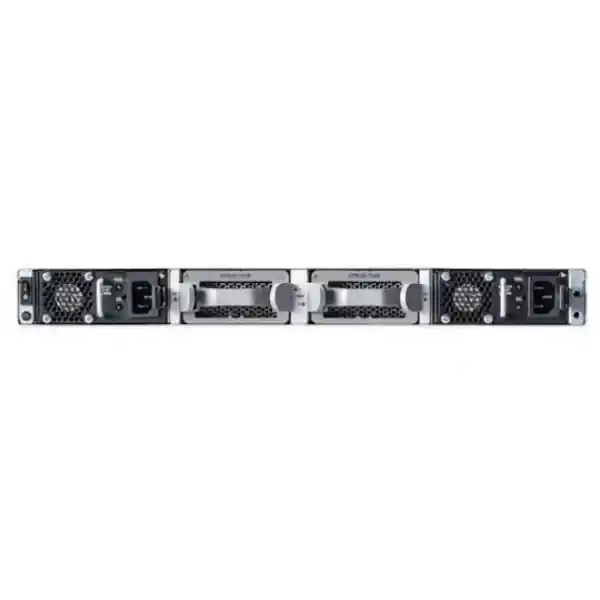
Hardware redundancy must extend beyond the appliance count. Cisco lists the 3105 with a single 400W AC power supply as standard and dual 400W AC optional; dual supplies can provide 1+1 power redundancy. In a serious HA design, each firewall should ideally connect its redundant power supplies to independent PDU or UPS feeds where the site provides them. Two firewalls powered from one circuit are not resilient to a power-path failure.
Network topology also determines whether HA works as expected. Uplink and downlink switches need appropriate redundancy, VLANs and routing. Interface-monitoring and failover criteria should reflect real failure modes. Maintenance procedures need to define how policy changes, software upgrades and failover tests are carried out. The availability target is an end-to-end property, not a feature checkbox on the firewall.
If the organization expects future scale beyond what a single 3105 can deliver and wants cluster-based scale-out, compare the 3110 or larger models early. Purchasing a 3105 pair today and discovering that clustering is required later may force a platform change rather than an incremental expansion.
VPN planning for site-to-site and remote connectivity
Cisco publishes 5.5 Gbps IPsec VPN throughput for the 3105 in the listed Threat Defense test profile and a maximum of 2,000 VPN peers. Those numbers indicate substantial VPN capability for a branch-class appliance, but they are not a complete remote-access sizing answer. VPN performance depends on encryption choices, packet size, tunnel topology, inspection after decryption, internet-path quality and whether the same appliance is simultaneously handling high volumes of ordinary inspected traffic.
For site-to-site use, identify every tunnel endpoint, expected bandwidth, routing model, overlap risk, failover behaviour and whether tunnels terminate directly on the 3105 or through an upstream design. A UAE head office may connect branches in Abu Dhabi, Sharjah or other countries; a regional branch may connect to cloud VPCs or a private data centre. Each tunnel can introduce route, NAT and policy dependencies that should be mapped before configuration.
For remote-access use, the user count is only one input. Determine the expected concurrent user population, split-tunnel or full-tunnel policy, posture requirements, authentication source, multifactor integration, DNS handling and which applications need access. Cisco Secure Client licensing should be included where relevant. If most users backhaul internet traffic through the firewall, WAN bandwidth and inspection load can grow considerably compared with split-tunnel designs.
High availability changes VPN design as well. Site-to-site peers, remote users and routing protocols must behave predictably during failover. Public IP addressing, provider circuits and DNS may constrain what is possible. Testing should include active sessions during failover, not just the ability to form a new tunnel afterward.
A practical quotation therefore needs tunnel count, remote-user count, encryption requirements, authentication architecture and expected VPN bandwidth. Without these details, the chassis may be correct while the surrounding license and configuration scope remains incomplete.
Encrypted traffic inspection and TLS design
Encrypted traffic is one of the most important reasons to size a modern firewall beyond internet-circuit speed. A large share of web and SaaS traffic is encrypted, and threats can travel inside those sessions. To inspect application content, the firewall may decrypt selected connections, inspect them according to policy, and then re-encrypt traffic toward the destination. That process consumes significantly more resources than simply forwarding a stateful flow.
Cisco lists 3.2 Gbps TLS performance for the 3105 under its stated test conditions. The number provides a useful reference, but production performance depends on cipher suites, certificate handling, connection rate, application mix and concurrent inspection features. If the organization intends to decrypt a high percentage of a multi-gigabit internet connection, a larger model may offer better headroom even when the ordinary 10 Gbps firewall figure appears sufficient.
Policy design is equally important. Some applications should not be decrypted because of privacy, legal, business or technical constraints. Banking, healthcare, certificate-pinned applications and specific cloud services may need bypass rules depending on organizational policy and applicable requirements. Exclusions reduce load, but they also reduce visibility, so the security team should define them deliberately rather than simply exempting traffic that breaks during rollout.
Endpoint trust is another deployment issue. Outbound decryption commonly requires client devices to trust an enterprise certificate authority used by the security device. That means coordination with endpoint-management tools and directory teams. unmanaged devices, guest users and BYOD networks may need different decryption treatment. The firewall project can therefore involve more than network configuration.
During sizing, estimate the percentage of traffic that will be decrypted and the applications that dominate bandwidth. During implementation, stage decryption gradually, monitor failures and user impact, and maintain explicit bypass categories. This produces a more reliable security outcome than turning on broad decryption during one cutover window.
Typical Dubai and UAE deployment scenarios
Growing regional branch
A branch with hundreds of users, dual internet links, 10G switching, segmented corporate/voice/guest/IoT networks and increasing SaaS usage can use the 3105 as a high-capacity security edge. The design should validate TLS load and future WAN growth.
Distributed enterprise site
Organizations with multiple offices can standardize branch security policy while using central management and site-to-site VPNs. Consistent naming, templates, logging and software standards become as important as appliance throughput.
Branch with fibre-heavy segmentation
Eight fixed 1/10G SFP+ ports and an optional additional 1/10G SFP+ module can suit sites with multiple fibre uplinks, core-switch links or physically separated zones. The optics bill of materials must be planned carefully.
Internet and private-WAN convergence
The appliance can sit at a location where DIA, MPLS/private WAN and cloud VPN connectivity converge. Routing, NAT, failover and security-zone design need to be engineered together rather than configured as separate tasks.
Resilient branch edge
Two 3105 appliances can form a high-availability design where business continuity matters. This should be paired with redundant power, switching and carrier paths where the site architecture supports them.
Security refresh from older Cisco platforms
The 3105 can be evaluated during an ASA or earlier-generation firewall refresh, but policy conversion, management version, VPN behaviour, licensing and feature differences should be assessed before choosing the final software image.
When the Cisco Secure Firewall 3105 may not be the best fit
The 3105 should not be recommended simply because it belongs to an enterprise product family. A sound shortlist also identifies its boundaries. The first is cluster scale. Cisco explicitly excludes the 3105 from 3100-series chassis clustering. If multi-chassis scale-out is a firm requirement, start with the 3110 or larger models rather than hoping to add that capability later.
The second boundary is performance headroom. The 3105’s 10 Gbps inspected-performance figures are strong for many branches, but the 3110 and 3120 offer materially higher throughput and connection rates. A branch expected to adopt 10G internet, perform extensive TLS decryption, host heavy east-west inspection or serve as a regional VPN hub may be better served by moving one model up.
The third boundary is interface speed. The 3105’s fixed and optional data ports focus on 1/10G. Larger 3130 and 3140 models add higher-speed 25G and 40G network-module options. If the firewall must connect directly into a high-speed data-centre fabric, the 3105 may create an interface-speed constraint even before packet-processing capacity becomes the issue.
Conversely, some sites may not need a 3105 at all. A small office with a modest internet circuit, limited sessions, few VPNs and no near-term growth may be more cost-effectively served by a smaller Cisco platform. Oversizing adds hardware and subscription cost without improving security policy by itself.
The objective is therefore not to make every requirement fit the 3105; it is to determine whether the 3105 offers appropriate headroom and feature alignment for the specific site. That is what separates product selection from product promotion.
3105 vs 3110 vs 3120: a practical shortlist
| Decision point | 3105 | 3110 | 3120 |
|---|---|---|---|
| Firewall + AVC + IPS | 10 Gbps | 17 Gbps | 21 Gbps |
| Concurrent sessions with AVC | 1.5 million | 2 million | 4 million |
| New connections/sec with AVC | 90,000 | 130,000 | 170,000 |
| TLS throughput | 3.2 Gbps | 4.8 Gbps | 6.7 Gbps |
| Clustering | No | Up to 8 chassis | Up to 8 chassis |
| Best-fit discussion | Growing enterprise branch where 10G-class inspected performance and 1/10G interfaces provide enough headroom. | Midsize edge needing more throughput, connection capacity and cluster eligibility. | Higher-load midsize environment with stronger session and TLS headroom. |
This comparison shows why model choice should be based on the workload rather than a simple price ladder. The 3110 does more than add raw throughput: it also raises session capacity, connection creation rate and clustering options. The 3120 raises those limits again. A buyer expecting growth may find that the incremental cost of a larger model is smaller than the operational cost of an early refresh.
Hardware, rack, power and environmental planning
The Cisco Secure Firewall 3105 is a 1RU appliance measuring approximately 1.75 × 17 × 20 inches, or 4.4 × 43.3 × 50.8 cm. Cisco lists a chassis weight of about 23 lb / 10.5 kg in the specified configuration. These are ordinary enterprise-rack dimensions, but installation planning should still check rack depth, rail compatibility, front-to-rear airflow and cable management.
Cisco documents front-to-rear airflow, from the I/O side toward the non-I/O side, following a cold-aisle to hot-aisle pattern. In a server room or data centre, the rack orientation should match that airflow. Placing equipment in a cabinet with poor exhaust clearance or recirculating hot air undermines reliability even when ambient room temperature looks acceptable.
For the 3105, Cisco lists a single 400W AC power supply with dual 400W AC optional, and DC supply options are also available. AC input is 100 to 240V at 50 to 60 Hz. In Dubai offices, the practical question is usually how the firewall will connect to the rack PDU and UPS, whether IEC power leads match the installed PDU outlets, and whether redundant feeds exist for a dual-supply configuration.
The operating temperature range published by Cisco is 0 to 40°C, with non-condensing humidity limits specified for operation. UAE deployments should not interpret this as permission to run the appliance in an unconditioned communications room. Consistent cooling, dust control and clean power are basic infrastructure requirements for enterprise network equipment.
The appliance uses hot-swappable fan modules, and Cisco documents fan redundancy. Serviceability is valuable, but maintenance access requires physical clearance and correct spare-part planning. If the site is mission-critical or remote, the support strategy should account for replacement logistics rather than assuming a failed component can be sourced locally on demand.
Rack readiness should therefore be part of the pre-install survey: available RU space, cabinet depth, rail type, power outlets, UPS capacity, grounding, cooling, cable routes, fibre patching and console access. A correct firewall model can still produce a poor implementation if the physical environment is treated as an afterthought.
Migration from an existing firewall
A firewall replacement is rarely a direct hardware swap. Even when the current platform is Cisco, the configuration may contain years of accumulated rules, NAT statements, VPNs, object groups, static routes, dynamic routing, authentication settings, certificates, logging targets and exceptions created for specific applications. Moving them safely requires an inventory and validation process.
Start by classifying what exists. Identify active interfaces and VLANs, address objects, services, access rules, NAT policies, site-to-site tunnels, remote-access profiles, routing, DHCP functions, identity integrations, public certificates, syslog/SIEM destinations and administrative AAA. Remove or mark obsolete rules before migration where possible; copying years of unused policy into a new firewall wastes the opportunity to improve security posture.
Next, map the old interfaces to the 3105 physical and logical design. A migration from a device with fewer ports may allow cleaner segmentation, while a migration from a larger appliance may require VLAN consolidation or an optional network module. ISP handoffs need special attention because a change from copper to fibre, or from 1G to 10G, may require new optics or provider coordination.
Software mode affects the migration method. ASA-to-ASA migration can preserve more familiar operational concepts, while ASA-to-Threat-Defense migration may involve policy conversion and a change in management workflow. Feature parity must be verified for the specific source version and target version. Automated migration tools can accelerate work, but they do not replace testing of application behaviour, NAT ordering, VPN negotiation and logging.
The cutover plan should define a rollback point. Record the old firewall’s physical cabling, export configurations and certificates, preserve public IP information, and confirm who can revert routes or switch ports if the new appliance cannot pass a critical application. Schedule application owners for validation, not just network staff.
A successful migration ends with verification: internet access, inbound services, DNS, core applications, each site-to-site VPN, remote access, security logging, time synchronization, HA state, routing convergence and monitoring. It should also include a short post-cutover observation period and documentation update so the new design is supportable by the operations team.
A practical implementation journey
Capture circuits, IP addressing, users, applications, VPNs, current rules, traffic peaks, growth, management and availability requirements.
Compare ordinary throughput, IPS, TLS, sessions, connection rate and VPN workload. Decide whether 3105 headroom is sufficient.
Select FTD or ASA chassis, subscriptions, support, network module, optics, redundant power and any management components.
Prepare management connectivity, software level, objects, routing, NAT, access policy, security profiles, VPN and logging.
Execute a documented cable and routing transition, test critical services, validate failover, and retain a practical rollback path.
Confirm alerting, backups, log retention, Smart Licensing, upgrade process, administrator access and support escalation procedures.
The order matters. Buying hardware before discovery can force compromises into the interface design or licensing scope. Discovery before procurement allows the quote to reflect the actual operating model and reduces change orders later.
Security policy design beyond basic allow and deny rules
A next-generation firewall creates value when policy reflects business intent. Simply importing a large legacy rule base and enabling every inspection feature does not produce a mature design. The 3105 should be configured around identifiable trust zones, application requirements, user or device context where appropriate, threat controls and logging priorities.
Start with segmentation. Corporate users, servers, voice, guest Wi-Fi, IoT/building systems, partner networks and DMZ services often have different trust levels. Some segments can be separated by VLANs and filtered on the firewall; others may be routed elsewhere to avoid pushing unnecessary east-west traffic through the security edge. The routing design should reflect which flows actually need inspection.
Application control can then refine broad port-based access. Many modern applications share TCP/443, so port numbers alone reveal little about business intent. Cisco’s application visibility capabilities allow policies to recognize applications beyond simple ports, but the organization still needs to decide which applications are allowed, monitored or restricted and how exceptions are handled.
Intrusion policy should be selected with performance and risk in mind. A branch with standard user internet traffic may prioritize broad coverage, while a site hosting industrial, development or public-facing systems may need tuned controls for specific protocols. Security teams should monitor false positives and policy impact rather than treating the default profile as permanently correct.
Logging should support investigation without generating unmanageable noise. Record high-value connection and security events, send them to the appropriate management or SIEM platform, and define retention based on operational and compliance requirements. Excessive event volume can obscure meaningful alerts; insufficient logging can make an incident impossible to reconstruct.
Policy maturity is therefore an ongoing operational process. The appliance provides the enforcement capacity, but security outcomes depend on rule governance, review cycles, change control, threat-update processes and the team’s ability to interpret alerts.
Procurement details that should be explicit on a Cisco 3105 quotation
The safest way to compare firewall quotations is to compare the exact bill of materials. “Cisco Secure Firewall 3105” is not sufficiently precise by itself. At minimum, the quote should identify the software image, subscription term, support coverage, interface module, optics and whether the design is one appliance or an HA pair.
- Chassis PID: confirm whether the order is the FPR3105-NGFW-K9 Threat Defense appliance or FPR3105-ASA-K9 ASA appliance.
- Security subscriptions: list the exact threat, malware, URL or combination entitlement and its term where required.
- Cisco Secure Client: include licensing separately if remote-access use requires it.
- Support: state the service level and duration rather than assuming support is included with the hardware.
- Network module: specify the 8-port 1/10G module if additional physical SFP+ ports are required.
- Optics and cables: itemize SFP/SFP+, DAC or fibre patching based on each interface handoff.
- Power: identify whether a second power supply is included for redundancy and confirm PDU lead requirements.
- HA quantity: a resilient pair needs two correctly licensed appliances and a validated topology.
- Management: identify whether an existing Firewall Management Center or other management architecture will be used, and include required components if not.
- Implementation: separate hardware supply from configuration, migration, cutover, testing, documentation and support services so responsibilities are clear.
A line-item quote also improves future support. When the operations team knows which exact subscriptions, optics and support contract were purchased, renewals and replacement requests become much easier to manage.
UAE deployment and commercial considerations
Dubai and UAE firewall projects often combine international product sourcing with local implementation requirements. Delivery planning should therefore consider stock status, lead time, exact Cisco part numbers, optics availability and subscription activation rather than only whether “a 3105” can be sourced. Enterprise security appliances are configuration-driven products, and a small mismatch in software image or module can change the deployment plan.
Local implementation can also involve coordination with telecom providers, managed WAN suppliers, building IT teams and data-centre operators. If the firewall terminates two internet circuits, the project may require public IP details, BGP or static routing information, provider handoff media and planned maintenance windows. Data-centre cross-connects can require separate lead times from the firewall itself.
For organizations operating several UAE sites, standardization is worth planning at the beginning. A consistent firewall model, software release, object naming convention, management domain, VPN template and logging policy can reduce operational variation. Where smaller and larger branches need different models, the 3100 family allows a common architectural approach while capacity changes by site.
FourTeck supports UAE buyers through FourTeck UAE for broader infrastructure requirements and through the specialist firewall team for security-focused scoping. Projects that also include rack, switching, server or support changes can be coordinated as one implementation rather than separate disconnected purchases.
For ongoing operational coverage, FourTeck IT Services UAE can be relevant when the requirement extends beyond product supply into broader IT support or managed infrastructure. The appropriate service scope depends on whether the internal team wants project-only implementation, recurring support, or a shared operational model.
Support, software lifecycle and change management
A firewall is a long-lived security control, but its software is not static. Threat signatures, application detectors, vulnerability coverage and platform software evolve continuously. The operational plan should therefore include more than reactive break/fix support. It should define who monitors advisories, who approves software upgrades, how configurations are backed up, and how changes are tested.
Software versions matter because management platforms, firewall images and features have compatibility requirements. Before a major upgrade, review Cisco release notes for supported upgrade paths, resolved defects, known limitations and behaviour changes. In HA environments, follow the documented sequence to preserve availability as far as the platform and change type allow.
Security updates also depend on active licensing for the subscribed services. Renewal tracking should begin before expiry, particularly in organizations where procurement approvals take time. The team should know which subscriptions expire when, which Smart Account contains the entitlements and who owns the vendor or partner relationship.
Hardware support should reflect business criticality. A non-critical branch with alternate connectivity may accept a different replacement SLA from a revenue-generating site that cannot operate without the firewall. The support contract, HA design and local spares strategy should be considered together rather than purchased independently.
Good documentation closes the loop. Maintain interface maps, IP addressing, routing neighbours, VPN peers, certificates, HA design, licensing, software versions, support contract references and recovery procedures. This reduces dependence on one administrator and makes future refreshes far easier.
Buyer questions about the Cisco Secure Firewall 3105
Is the 3105 a 10 Gbps firewall?
Cisco publishes 10 Gbps for Firewall + AVC and Firewall + AVC + IPS under its stated test profile. Production sizing should still account for traffic mix, session rate, TLS decryption, VPN workload and enabled features.
Does the 3105 support 10G interfaces?
Yes. It includes eight fixed 1/10G SFP+ interfaces in addition to eight 1G RJ-45 interfaces. An optional 8-port 1/10G SFP+ network module can add further fibre-capable ports.
Can the 3105 be deployed as an HA pair?
Yes, high availability is supported. The complete design should include two appliances, correct licensing, redundant power where required, and a switch/provider topology that does not leave a hidden single point of failure.
Does the 3105 support clustering?
No. Cisco explicitly states that the 3105 does not support the multi-chassis clustering capability available on other Secure Firewall 3100 models. If cluster scale is required, compare the 3110 or above.
Can it run ASA instead of Threat Defense?
Yes. Cisco lists both Threat Defense and ASA 3105 appliance PIDs. Choose the software mode according to required features, management approach, migration constraints and long-term operational strategy.
Are threat subscriptions included automatically?
Do not assume so. The ordering scope must explicitly identify the required security entitlements and term. Threat, malware and URL capabilities are licensed according to the chosen package and intended policy.
How many VPN peers does Cisco list?
Cisco lists a maximum of 2,000 VPN peers for the 3105. Actual remote-access sizing should consider concurrency, traffic volume, authentication design, inspection and client licensing.
When should I choose the 3110 instead?
Evaluate the 3110 when you need more throughput, more sessions, higher connection creation rate, greater TLS headroom or eligibility for multi-chassis clustering. Expected growth can justify moving up even if today’s WAN is modest.
Information needed for accurate 3105 sizing
A reliable firewall recommendation starts with measurable inputs. The following items have the greatest effect on model, license and implementation scope:
Current and planned WAN bandwidth, inter-zone traffic and peak utilization.
Employee count, guest devices, servers, IoT, cameras and other connection-heavy systems.
IPS, malware, URL control, application policy and expected TLS decryption percentage.
Site-to-site tunnel count, remote users, concurrent users and expected encrypted throughput.
Copper/fibre handoffs, 1G/10G links, optics, VLAN trunks and optional module needs.
Single appliance or HA pair, dual power, switch redundancy and carrier diversity.
Sizing examples: why context changes the answer
Consider three organizations with the same 2 Gbps internet circuit. The first is a standard office with 250 users, moderate SaaS traffic, limited site-to-site VPN and selective TLS decryption. The 3105 may offer generous headroom. The second is a software company with hundreds of developers, cloud build systems, large numbers of short-lived TLS connections and broad decryption. Even at the same WAN speed, connection rate and TLS processing may justify closer analysis. The third is a regional hub backhauling VPN traffic from multiple branches while also hosting a public DMZ; VPN and east-west load may dominate sizing.
This is why user count alone is also insufficient. A 500-user call centre using a controlled set of web applications can behave very differently from a 200-user development site running containers, cloud APIs and high-concurrency testing. Likewise, a branch with thousands of IoT sensors may generate many sessions but little bandwidth. The appliance must be matched to traffic behaviour, not a generic employee ratio.
Future projects should be included. If the business plans an ERP cloud migration, new video collaboration, SD-WAN adoption, internet breakout for previously private traffic, or replacement of 1G links with 10G, the firewall may face a step change in load. Budgeting only for today’s topology can create an early bottleneck.
A practical design therefore uses at least three scenarios: current measured peak, expected near-term peak, and a growth case. The chosen model should have reasonable headroom under the growth case after the required security services are enabled. That approach leads to a more defensible 3105 recommendation than comparing datasheet numbers with the nominal ISP contract.
What should be tested before production go-live?
A pre-production test plan should prove both connectivity and security behaviour. Basic ping and web browsing are not enough. Validate critical applications from every major user and server zone, confirm NAT translations, test inbound services from an external network, establish all site-to-site VPNs, and verify remote-access authentication with representative user groups.
Routing should be tested during both normal operation and failure. If the site uses two ISPs, simulate loss of each uplink. If dynamic routing is used internally, verify adjacency and route withdrawal. In an HA pair, force appliance failover and confirm that expected sessions, VPNs and routes recover according to design.
Security controls require their own tests. Confirm that application policy classifies representative applications correctly, IPS events reach the management platform, URL rules behave as intended, malware controls trigger in a safe test workflow, and TLS decryption is applied only to the correct categories. Review false positives and certificate errors before expanding enforcement.
Operational readiness should also be tested. Confirm backups, administrator authentication, Smart Licensing status, NTP, DNS, syslog or SIEM delivery, alerting and monitoring. Document the software version, configuration baseline and recovery path.
The goal of testing is not to demonstrate that the firewall powers on; it is to demonstrate that the business can operate through it, security teams can see what it is doing, and predictable recovery exists when a component or link fails.
Operational monitoring after deployment
The first weeks after deployment provide the best opportunity to validate sizing assumptions. Monitor interface utilization, connection counts, CPU and memory behaviour, VPN load, event rates and the impact of decryption. Compare production peaks with the assumptions used during procurement. If the appliance is consistently far below expected load, there is no problem; headroom is part of the design. If peaks approach operational limits, the team should adjust policy or capacity before users experience degradation.
Security event quality matters as much as system health. Review intrusion, malware and URL events for false positives, overly broad exemptions and rules that never match. A newly migrated policy often contains legacy allowances that can be tightened once traffic patterns are understood. Use the firewall’s visibility to improve the rule base rather than freezing the cutover configuration indefinitely.
Certificate and VPN monitoring deserves a calendar. Public certificates, identity certificates and tunnel pre-shared keys can cause outages when they expire unnoticed. Maintain renewal ownership and alerting. The same principle applies to subscriptions and support contracts.
Configuration drift should be controlled. Define who can change policy, require change records for production modifications, and schedule periodic rule reviews. In centrally managed environments, use consistent deployment procedures so one branch does not become an exception that nobody understands later.
Finally, review capacity annually or when the business changes materially. New cloud platforms, office expansions, mergers, ISP upgrades and application migrations can all alter firewall load. A 3105 chosen correctly today should be revalidated against tomorrow’s traffic rather than assumed to remain appropriate forever.
Related FourTeck resources
For buyers comparing the 3105 with a wider infrastructure refresh, FourTeck provides broader technology coverage beyond a single UAE product page. This can be useful when the firewall change is part of a multi-country project, hardware standardization initiative or wider network-security procurement.
Within the UAE, the firewall can also be scoped alongside switching, servers, Wi-Fi, endpoint requirements and operational support through the FourTeck teams linked above. Keeping dependencies visible during design reduces the risk that the firewall is ordered correctly but cannot be integrated cleanly into the surrounding environment.
Decision recap for Cisco Secure Firewall 3105 buyers
What FourTeck needs from you for an accurate quotation
Even partial information is useful. For an early budgetary quote, FourTeck can identify the missing decisions and separate assumptions from confirmed requirements. For a final production bill of materials, those assumptions should be resolved before order placement.
Confirm the right Cisco Secure Firewall 3105 configuration for your Dubai site
Share your bandwidth, user/device profile, VPN requirements, security subscriptions, interface handoffs and availability target. FourTeck can prepare a model-specific bill of materials covering the appliance, licenses, optics, optional module, support and implementation scope—and can tell you when moving to a 3110 or larger model would be the safer engineering choice.

Reviews
There are no reviews yet.