
Cisco Secure Firewall 6160 Dubai
Ultra-high-end firewall capacity for large UAE data centers, telecom environments, cloud interconnects and security perimeters that need very high inspected throughput without giving up modular connectivity, clustering and enterprise policy control.
Direct answer: what is the Cisco Secure Firewall 6160?
The Cisco Secure Firewall 6160 is one of the two models in Cisco’s Secure Firewall 6100 Series, alongside the higher-capacity 6170. Cisco positions this family for ultra-high-end data-center and telecommunications environments where security inspection must operate at hundreds of gigabits per second. The 6160 is not a branch firewall or a general small-enterprise appliance. Its design, interface density, power profile, 2RU rack requirement and published session scale place it in a different class from conventional office perimeter firewalls.
Its main use is to enforce security policy at large network boundaries, data-center edges, high-bandwidth internet gateways, inter-data-center links, telecom security gateways and other aggregation points where firewalling, application control, intrusion prevention, encrypted traffic handling and VPN services must scale together. Buyers should consider it when current or forecast inspected traffic is sufficiently high to justify the platform, when 100/200/400 Gigabit connectivity is important, or when clustering and modular interfaces are part of the architecture.
The most important factor to confirm is the required security workload rather than the raw line rate of the interfaces. Cisco publishes different figures for firewall plus application visibility, NGFW with IPS, IPsec VPN, TLS decryption and ASA stateful inspection. Real performance depends on enabled services, packet size, traffic protocol mix, encryption profile, policy complexity, logging and software release. A correct shortlist therefore starts with a workload profile, not with a single headline throughput number.
FourTeck can help determine whether the 6160 is the right capacity point, which software mode is appropriate, which licenses or subscriptions are needed, what transceivers and network modules match the cabling design, how many power feeds and rack resources are required, and whether the 6170 or another Cisco Secure Firewall platform should be evaluated instead.
Where the 6160 fits in the Cisco Secure Firewall portfolio
The 6160 belongs to the Secure Firewall 6100 Series, a family Cisco introduced for extremely high-capacity environments. The series currently contains the 6160 and 6170. Both share the same 2RU physical form factor, fixed high-speed interface layout, two network-module slots, management interface arrangement and modular power and cooling approach. The principal difference for most buyers is performance and scale: the 6170 publishes higher FTD throughput for firewall plus application visibility, IPS, IPsec VPN and TLS decryption, and it supports a larger concurrent-session figure with AVC. That makes the 6160 a substantial platform in its own right rather than a reduced-feature chassis.
A buyer should not treat the 6160 as the automatic choice simply because its published figures are lower than the 6170. Oversizing has cost, power, cooling and licensing implications, while undersizing can leave insufficient headroom for encrypted traffic growth, inspection services or future east-west and north-south traffic. The correct decision is based on projected sustained and peak inspected throughput, new connection rates, concurrent sessions, VPN requirements, TLS decryption percentage, interface speeds, redundancy design and lifecycle growth. In a large UAE data center, power and rack design may be just as important as the difference in nominal firewall throughput.
The 6160 supports both Cisco Secure Firewall Threat Defense and Cisco Adaptive Security Appliance software. That distinction matters because the two software modes are aimed at different operational requirements and Cisco publishes different performance tables for them. FTD is the route to Cisco’s modern next-generation firewall functions, including intrusion prevention and broader application-centric security. ASA software focuses on the familiar stateful firewall and VPN operating model and can achieve a higher published stateful-inspection throughput. A procurement request should state the intended software mode and should not assume that a chassis quote alone defines the finished security solution.
For many organizations, the most useful portfolio comparison is not only 6160 versus 6170. It can also be 6160 versus a smaller Secure Firewall platform that may satisfy the same practical workload with lower rack power and cost. Conversely, designs with unusually high TLS decryption, very aggressive growth, large carrier workloads or additional resilience margins may justify comparing the 6170 from the outset. FourTeck’s role is to translate the network and security requirement into a configuration rather than to force a particular model.
Strong fit
High-throughput data-center edges, large enterprise internet perimeters, security aggregation points, telecom mobility infrastructure and designs requiring multiple 100/200G links with the option to add 400G interfaces through network modules.
Needs careful validation
Environments where TLS decryption, large rule sets, heavy logging, unusual packet mixes, CGNAT or telecom protocol inspection dominate. Published lab figures are useful references, but the complete traffic profile should drive sizing.
Potentially oversized
Conventional branch, small office or modest enterprise perimeter deployments that do not need hundreds of gigabits per second, dense high-speed optics or carrier-grade scale. A smaller Cisco platform may be more economical and easier to power.
Published performance and what the figures mean
| Metric | Cisco 6160 published value | Buyer interpretation |
|---|---|---|
| FTD Firewall + AVC, 1024B | 600 Gbps | Useful for high-level capacity planning when application visibility is active, but it is not the same as full IPS-enabled NGFW throughput. |
| FTD AVC + IPS / NGFW, 1024B | 550 Gbps | More relevant for deployments where intrusion prevention is a core part of the policy. |
| FTD IPsec VPN, 1024B TCP with Fastpath | 450 Gbps | A reference for encrypted site-to-site or large VPN aggregation designs; tunnel mix, crypto settings and traffic behavior still matter. |
| FTD TLS decryption | 100 Gbps | Critical when decrypted inspection is expected. This figure should be compared with the percentage of encrypted traffic actually selected for decryption. |
| FTD concurrent sessions with AVC | 75 million | Relevant to large data-center, cloud, internet-scale and service-provider environments with very high flow counts. |
| FTD new connections per second with AVC | 1.5 million | Important for short-lived connections, internet gateways, service-provider traffic and large application estates. |
| Maximum VPN peers | 60,000 | A platform ceiling that should be considered together with throughput and the operational design of the VPN service. |
| ASA stateful inspection, 1500B UDP / HTTP 1024B | 650 Gbps | Shows the higher stateful-firewall capacity available under ASA software; it is not directly interchangeable with FTD NGFW figures. |
| ASA IPsec VPN, 450B UDP L2L test | 300 Gbps | Use the test definition when comparing designs. Packet size and mode can significantly change practical throughput. |
Performance data should be read as a set of workload-specific references rather than a promise that every deployment will sustain the largest number simultaneously. Cisco itself notes that performance varies with enabled features, protocol mix and packet size and can change with software releases. A security design that enables IPS, application controls, malware-related functions, extensive logging and selective TLS decryption will behave differently from a simple stateful firewall rule base. The more accurately those functions are described during sizing, the more useful the platform figures become.
For Dubai and UAE data centers, another practical issue is the ratio between nominal circuit capacity and inspected traffic. A pair of 100G links does not necessarily mean the firewall must be sized for exactly 200 Gbps, because routing architecture, active/standby behavior, east-west traffic, asymmetry, growth targets and failure scenarios all change the peak load. Conversely, a design with a single high-speed internet handoff may still need much more headroom if large internal service flows traverse the firewall or if the organization expects rapid bandwidth growth.
Interface architecture: fixed high-speed ports plus two expansion slots
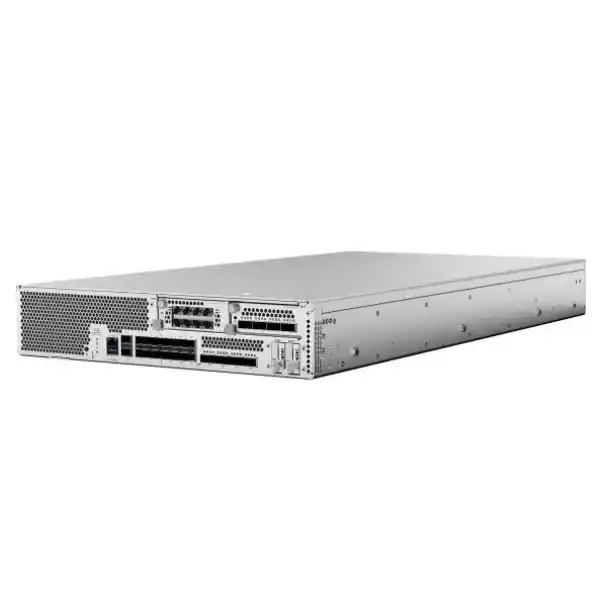
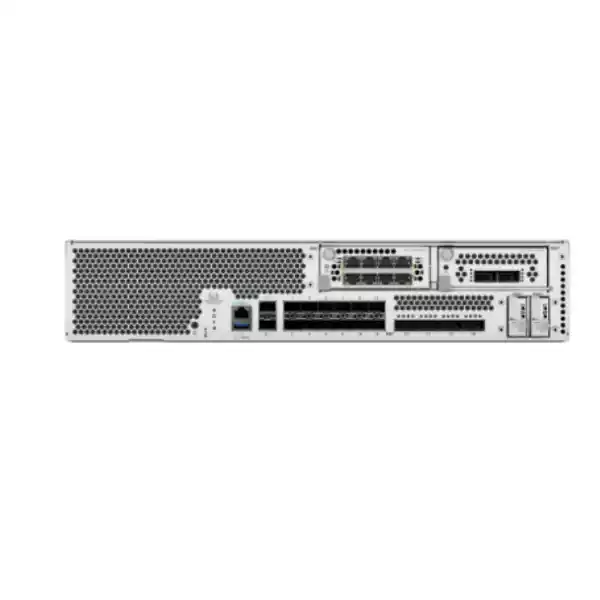
The Cisco Secure Firewall 6160 includes twelve fixed 1/10/25/50 Gigabit Ethernet SFP56 ports and four fixed 40/100/200 Gigabit Ethernet QSFP56 ports. It also provides two 1/10/25 Gigabit Ethernet SFP28 management ports, one RJ-45 console port and one USB 3.0 port. Two network-module slots extend the data-plane interface options. This layout is important because it lets a single 2RU chassis connect to a mix of lower-speed and very high-speed network fabrics while preserving separate high-speed management connectivity.
The twelve fixed SFP56 data ports are especially noteworthy because Cisco states that native 50G is supported only on those fixed ports. The listed SFP28 expansion modules top out at 25G. If a design calls for a specific number of 50G links, the engineer should allocate those links to the fixed ports rather than assuming that additional 50G density can be added with an SFP28 module. This is exactly the kind of detail that can be missed when a bill of materials is built from interface counts alone.
For higher speeds, the fixed QSFP56 ports support 40, 100 and 200 Gigabit Ethernet. Network modules can add 40G, 100G and 200G ports, and a QSFP-DD module option can provide 400G interfaces. Cisco’s published maximum count indicates up to four 400G ports when two 2-port QSFP-DD modules are installed. The presence of 400G capability does not mean optics, cabling, breakout configuration or upstream switch compatibility are automatically included. Those elements must be specified as part of the design.
Fixed SFP56 data ports
12 ports supporting 1/10/25/50G. These are the native 50G-capable ports in the platform specification.
Fixed QSFP56 data ports
4 ports supporting 40/100/200G, useful for high-capacity uplinks and data-center fabric connections.
Expansion capability
2 network-module slots support several Ethernet and fail-to-wire module options, including a 2-port 200/400G QSFP-DD module.
Management
2 dedicated 1/10/25G SFP28 management interfaces plus serial console and USB provide operational access without consuming normal data ports.
Cisco lists standard network modules with 8-port SFP+, 8-port SFP28, 4-port QSFP+, 4-port QSFP56, 2-port QSFP28 and 2-port QSFP-DD options. It also lists fail-to-wire modules for 1G copper, 1G SX fiber, 10G SR/LR and 25G SR/LR connectivity. Fail-to-wire modules are relevant where maintaining physical connectivity during a data-plane failure is part of the resilience objective. Their use changes interface counts and should be considered deliberately rather than treated as a generic expansion choice.
The maximum interface count varies by interface type. Cisco’s table indicates up to 28 ports in the 1/10/25 class when the twelve fixed ports are combined with two eight-port SFP28 modules, up to 12 ports in the 40/100/200 class with two four-port QSFP56 modules, and up to four 400G ports with two two-port QSFP-DD modules. These are configuration maxima for particular module choices, not simultaneous maxima across every speed category. Selecting modules is therefore a capacity-planning exercise: a slot used for 400G cannot at the same time host an eight-port 25G module.
Optics and cables should be designed from the physical path outward. Confirm fiber type, distance, connector, switch-side transceiver support, breakout requirements, wavelength, redundancy path and spare strategy. Do not assume that a transceiver fitting mechanically is supported for the intended port speed or software release. Cisco directs buyers to the Secure Firewall 6100 hardware installation and transceiver documentation for supported optics. For procurement in the UAE, a validated optics schedule can prevent last-minute installation delays that would otherwise leave a fully delivered firewall unable to connect to the production fabric.
Chassis, rack, power and cooling planning
The 6160 is a 2RU appliance designed for a standard 19-inch rack and Cisco specifies a fully loaded chassis weight of about 66 lb, or 29.94 kg. Chassis dimensions are approximately 3.5 inches high, 16.9 inches wide and 32.5 inches deep. The depth matters. Data-center teams should validate cabinet usable depth, rail clearance, rear access, cable bend radius and front-to-rear airflow before the unit arrives. The platform uses front-to-rear airflow, corresponding to a cold-aisle to hot-aisle arrangement in a conventional data center.
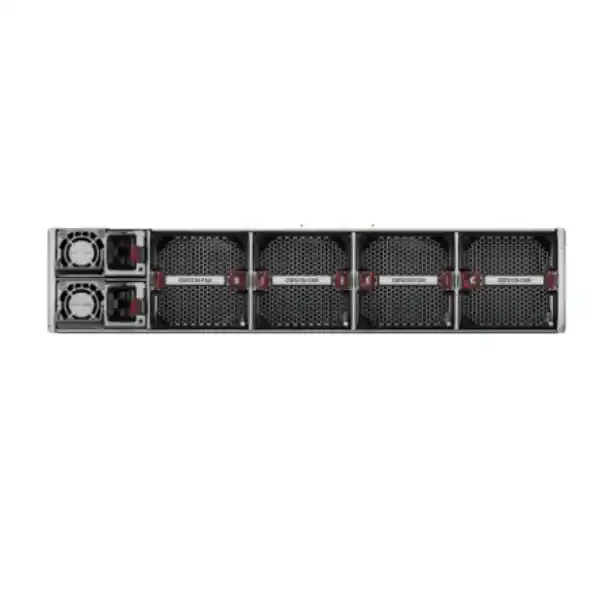
Cooling is handled by four field-replaceable fan modules, each containing two fans. High-end security appliances should be treated as infrastructure equipment with defined thermal requirements rather than as ordinary network devices that can be placed wherever rack space is available. The published operating temperature range is 0°C to 40°C, with 5% to 90% non-condensing humidity. UAE facilities with strong data-center cooling will normally operate well within those limits, but the design should still account for hot-aisle containment, rack density, maintenance access and the effect of neighboring high-power equipment.
Cisco publishes 1740 W typical and 2440 W maximum input power consumption for the 6160. That is material for rack power budgeting. A redundant design requires more than simply installing two supplies: the input type and feed arrangement determine whether power-supply redundancy is actually available. Cisco states that the appliance supports 1+1 redundancy with dual high-line AC, high-voltage DC or dual-input low-voltage DC arrangements. Low-line AC and single-input DC operation do not provide the same redundancy. For an enterprise procurement team, that means the electrical design must be documented alongside the appliance configuration.
The high-voltage AC/DC power supplies can be hot-swappable and load sharing under the supported redundant arrangement. In a critical facility, the preferred design generally places each power supply on a separate protected power path when the site infrastructure supports it. The goal is to avoid a single PDU, UPS path or circuit becoming the hidden single point of failure. The firewall quotation should therefore identify the required power option, cable type, facility voltage and redundancy expectation rather than leaving those items for installation day.
Rack loading also deserves attention. A fully loaded 29.94 kg chassis plus rails, optics and cable management should be installed according to data-center handling procedures. Cisco includes rails for a four-post EIA-310-D rack, but the exact cabinet type and available mounting depth should still be validated. High-density fiber can add substantial cabling around the front I/O area. Maintaining organized port labeling and bend radius is especially important when the chassis uses a mixture of SFP56, QSFP56 and expansion-module connections.
Power and cooling capacity should be included in total cost of ownership, especially when comparing 6160 and 6170 or when evaluating a pair of appliances for high availability. A redundant pair can represent several kilowatts of typical rack load before adjacent switching or optical equipment is counted. In Dubai, where data-center power and cooling are professionalized but still finite resources, confirming rack capacity early can prevent a network-security purchase from creating an unexpected facilities project.
Threat Defense or ASA: choose the operating model before the order
Cisco offers the Secure Firewall 6160 as a Threat Defense appliance and as an ASA appliance, with separate hardware product IDs: CSF6160-A-TD-K9 for Threat Defense and CSF6160-A-ASA-K9 for ASA. This is not merely a naming preference. The operating software defines the security capabilities, management workflow, performance interpretation and licensing requirements of the deployed system. The order should therefore be tied to the intended architecture from the start.
Threat Defense is the natural choice when the objective is a modern NGFW deployment combining stateful firewalling with application visibility, intrusion prevention and broader advanced security functions. Cisco’s FTD table is the basis for the 600 Gbps firewall-plus-AVC figure, 550 Gbps NGFW figure, 450 Gbps IPsec VPN figure and 100 Gbps TLS decryption figure used on this page. Those figures represent different workloads. A design that will decrypt a high percentage of traffic and then inspect it must pay particular attention to the decryption figure rather than focusing only on the 600 Gbps number.
ASA software may be appropriate for organizations that need the established ASA operating model, specific stateful firewall or VPN behavior, or operational continuity with an existing ASA environment. Cisco publishes 650 Gbps of stateful inspection firewall throughput for the 6160 under its stated ASA test profiles and 300 Gbps for the ASA IPsec L2L test profile. The ASA figure should not be used to represent Threat Defense IPS performance, and the FTD NGFW figure should not be used to size an ASA-only design.
Management is another architectural decision. Cisco’s current 6100 materials reference Firewall Management Center and cloud-delivered management options in the wider Secure Firewall ecosystem. The exact management platform, software release, device count, logging design, event retention, change-control process and integration requirements should be defined during solution design. Large enterprises may need centralized administration across many firewalls, role-based operational separation, policy templates and integration with security operations processes. Those requirements can influence subscription selection and implementation scope even though they are not physical characteristics of the appliance.
For a migration, software mode can also change the work involved. Moving from an existing ASA environment into ASA on the new chassis is not the same project as moving from ASA to Threat Defense with a redesigned next-generation policy stack. The second path may involve application rules, IPS policies, URL or malware-related controls, identity integration, certificate handling, TLS decryption policy, logging changes and operational training. A quotation should separate appliance supply from migration engineering so the buyer can see what is being purchased and what implementation outcome is expected.
Licensing and subscriptions are part of the solution, not an afterthought
Cisco’s 6100 Series data sheet explicitly directs buyers to the Cisco Network Security Ordering Guide for licenses, subscriptions and other options associated with the appliance. That is important because the hardware product ID alone does not describe the complete security entitlement. Required licensing depends on the selected software mode and the security services the organization intends to operate. Subscription term, management choice, support entitlement and service features should be confirmed against the current ordering guide at quotation time.
For Threat Defense, the buyer should list the functions that must be active in production rather than asking for a generic “full license.” That functional list can include intrusion prevention, application visibility, malware-related controls, URL-related policy, VPN, encrypted traffic inspection and any management or analytics capabilities required by the security team. The exact commercial package names and entitlement rules can change over product life, so they should be validated against the current Cisco ordering and licensing documentation instead of being hard-coded into an old bill of materials.
Term length is a procurement decision as well as a technical one. A longer subscription can align with budgeting and lifecycle plans, while a shorter term may match a staged migration or contract cycle. Organizations operating multiple Cisco security products may also have enterprise agreements or support arrangements that affect the final commercial structure. FourTeck should be given enough information to check the intended term and support coverage rather than quoting only the chassis.
Licensing is also a sizing issue when a service materially changes the workload. TLS decryption is a good example: enabling a security capability can move the relevant capacity reference from a general firewall figure toward the published decryption performance. The best licensing discussion therefore combines commercial entitlements with the traffic model, so the purchased services and the appliance capacity remain aligned.
Scalability, VRFs, high availability and clustering
With Threat Defense, Cisco publishes a maximum of 75 million concurrent sessions with AVC and 1.5 million new connections per second with AVC for the 6160. The model supports up to 60,000 VPN peers and up to 250 virtual router instances. These numbers illustrate why the appliance is aimed at very large environments. They are not a substitute for architecture, however. A high session ceiling does not guarantee that every policy, inspection feature, logging configuration and encryption workload can be driven to its own maximum at the same time.
High availability can be implemented as Active/Standby, and Cisco also lists Active/Active with clustering for Threat Defense. Clustering scales to as many as 16 units in the published table. The operational significance is substantial: clustering can increase resilience and capacity, but it introduces design questions around switching, routing, state synchronization, failure domains, software compatibility, maintenance, licensing and traffic symmetry. A sixteen-unit technical maximum should never be interpreted as a recommendation to deploy that many nodes by default.
ASA software has its own scale table. Cisco publishes up to 4.5 million new connections per second and 180 million concurrent firewall connections for the 6160 under ASA, up to 60,000 VPN peers, Active/Active and Active/Standby high availability, ten included security contexts with a maximum of 250, and clustering up to 16. Again, those ASA figures apply to the ASA operating model and should not be combined indiscriminately with FTD performance figures.
Resilience should be designed at several layers. Appliance HA protects against a node failure, redundant power protects against a supported power-supply or feed failure, modular fans address cooling-component failures, diverse links protect against interface or switch failures, and appropriate routing design protects against path failure. Fail-to-wire modules can be relevant in specialized topologies where maintaining a physical path through a data-plane failure is necessary. A robust architecture considers all of these layers instead of treating the HA pair as the only availability mechanism.
A practical UAE deployment may also span two data halls or two data centers. In that case, latency, L2/L3 architecture, state synchronization requirements and disaster-recovery behavior must be assessed before deciding where firewall cluster members reside. The appliance offers the scale to support sophisticated designs, but physical placement and failure-domain planning remain architectural decisions outside the hardware specification.
Security capability translated into buyer outcomes
Application-aware enforcement
Application visibility and control helps policy teams identify applications rather than relying only on ports and addresses. That can make large internet and data-center policies more expressive, but it also means the firewall must inspect traffic deeply enough to classify what is actually being used.
Intrusion prevention
IPS adds threat inspection beyond stateful access control. Buyers should size against the NGFW/IPS workload when IPS is central to the design and should plan tuning, exception handling and security-operations ownership rather than enabling rules without an operational process.
Encrypted visibility
TLS decryption can expose threats hidden inside encrypted sessions, but it is one of the most demanding workloads and has legal, privacy, certificate and application-compatibility implications. Selective decryption policy is often more practical than indiscriminate decryption.
Large-scale VPN
The published IPsec capacity and VPN peer scale make the 6160 relevant to large site-to-site and service-provider designs. Tunnel counts, routing, crypto suites, failure behavior and key-management operations should be included in the architecture.
Telecom and carrier workloads
Cisco positions the 6100 Series for carrier-grade security, including scenarios that involve CGNAT and inspection of telecom protocols such as GTP, SIP and Diameter. Service-provider buyers should map required feature licenses and traffic scale explicitly.
High-speed segmentation
Multiple 100/200G links and VRF scale can support segmentation at high-capacity aggregation points. Policy boundaries should be designed around application trust, routing ownership and operational responsibility instead of creating segmentation only because the chassis can support it.
The value of the 6160 is therefore not simply “a fast firewall.” It is the ability to apply security controls at data-center and carrier speeds while integrating those controls into a broader policy, management and operations model. That is why requirements gathering should include the SOC, network team, application owners, data-center operations, procurement and facilities. Each group supplies part of the information needed for a successful deployment.
TLS decryption deserves its own sizing conversation
Encrypted traffic is now normal across internet, SaaS, cloud and internal application environments, so the decryption figure can be more important than the raw firewall figure for some buyers. Cisco publishes 100 Gbps of TLS decryption for the 6160 under a defined test profile. That number is much lower than the 600 Gbps firewall-plus-AVC figure, which illustrates the computational cost of terminating, inspecting and re-establishing encrypted sessions. A design that expects to decrypt a large share of hundreds of gigabits of traffic should therefore model decryption separately.
Not every flow should necessarily be decrypted. Policy can exclude categories where privacy, regulation, certificate pinning, application behavior or business risk makes decryption inappropriate. The target decryption percentage should be based on traffic classification rather than an arbitrary number. For example, an organization may prioritize unknown internet traffic and selected SaaS flows while bypassing sensitive financial or health categories under its governance policy. The technical design then sizes the appliance around the subset that is actually subject to TLS inspection.
Certificate infrastructure is another dependency. Forward-proxy style decryption generally requires an internal trust model so managed endpoints accept the firewall’s signing certificate. Unmanaged clients, third-party devices, servers and embedded systems may require a different treatment. Teams must also plan certificate lifecycle, key protection, change windows and exception handling. If the deployment is in a service-provider or shared environment, the governance questions can be even more significant.
Application compatibility testing should be part of the rollout. Some applications react poorly to interception because of certificate pinning, mutual TLS, unusual protocol behavior or proprietary security controls. A phased deployment helps identify these cases before a large production cutover. The correct operational outcome is not to “decrypt everything”; it is to decrypt the traffic that adds security value, with explicit exceptions and a controlled process for reviewing them.
From a purchasing perspective, FourTeck should be told the approximate encrypted-traffic percentage, expected TLS versions, key application groups, projected throughput and whether decryption is mandatory at day one. This information helps determine whether the 6160’s 100 Gbps published decryption figure provides adequate headroom or whether the 6170, which has a higher published decryption figure, should also be examined.
Storage, logging and operational visibility
Cisco lists two 3.6 TB storage devices for the 6160. Local storage is part of the appliance architecture, but a large enterprise should not equate local disk capacity with a complete logging strategy. Security-event volume at hundreds of gigabits per second can be substantial. The organization needs to determine what is logged, where logs are retained, how long they are kept, how events are searched, which data is forwarded to a SIEM, and what happens during a management or WAN outage.
A practical logging policy balances forensic value with operational noise and infrastructure cost. Logging every permitted connection at extreme scale can create a large data stream, while logging too little can make investigations difficult. The policy should distinguish security events, blocked connections, high-value allowed flows, configuration changes, authentication events, VPN activity and system health. Retention periods may differ by data category and organizational governance requirements.
Management-network design should also be explicit. The 6160 has two 1/10/25G SFP28 management ports, which offers substantial bandwidth for operational connectivity. However, bandwidth alone does not create a secure management plane. Administrators should separate management access from normal user traffic, control which systems can reach the device, integrate authentication and authorization, define break-glass access, and ensure that monitoring remains available during partial failures.
Change control becomes increasingly important as the firewall sits at a high-capacity aggregation point. A small policy error can affect many applications simultaneously. Enterprises should use staged changes, peer review, testing, documented rollback and maintenance windows appropriate to the service criticality. When centralized policy templates are used across multiple firewalls, teams should understand which settings are global and which remain device-specific.
Operational readiness should be considered part of the purchase. A technically correct appliance that the security team cannot manage confidently is not a complete solution. Training, migration validation, monitoring integration, runbooks and support escalation should be planned alongside the hardware and licenses, especially when the 6160 replaces older ASA, Firepower or third-party perimeter systems.
Migration planning: protect the service, not just the rule base
A firewall migration is successful when applications continue to work, intended security controls remain effective and the operations team can support the new environment. Copying rules is only one part of that outcome. The discovery phase should identify interfaces, VLANs, VRFs, routing protocols, static routes, NAT, VPNs, access rules, object groups, inspection policies, certificates, authentication dependencies, logging destinations, high-availability behavior and monitoring integrations. The 6160’s very high capacity does not simplify those dependencies automatically.
Existing configurations often contain years of accumulated rules. A migration is an opportunity to identify unused objects, expired temporary access, duplicate rules and broad permits that no longer reflect application needs. Cleaning policy before or during migration can reduce complexity, but changes should be controlled carefully so the project does not become an unbounded security redesign. Critical applications need validated owners and test plans.
Interface mapping deserves special attention on the 6160 because the new platform may use much higher-speed links than the firewall being replaced. Aggregated links, port channels, 40/100/200G connections and breakout designs can change the physical topology. Upstream and downstream switches may need new optics, line cards or configurations. The migration schedule should include both firewall and switching changes rather than treating the firewall as an isolated device.
For ASA-to-FTD migrations, security policy structure and management workflow may change. Application-aware rules, intrusion policies and decryption controls introduce concepts that are not represented by a simple one-to-one translation of legacy ACLs. Teams should decide which legacy behavior must be preserved exactly for cutover and which new controls will be introduced after stability is confirmed. This staged approach reduces the number of variables changed at once.
High availability should be tested under failure conditions, not merely shown as “up” in a console. Test link failure, node failure, power-feed failure where permitted, route reconvergence, management loss and recovery. VPN failover behavior and long-lived application sessions may deserve dedicated tests. The results should be documented so the operations team understands what a real event will look like.
A rollback plan must be operationally possible within the maintenance window. That means preserving the previous firewall configuration and physical path, having the necessary switch changes documented, maintaining administrator access and defining clear criteria for rollback. For a high-capacity data-center firewall, the cost of an extended cutover failure can far exceed the effort spent on rehearsal.
Deployment journey for a Cisco Secure Firewall 6160 project
Collect traffic baselines, peak throughput, session rates, encryption percentage, VPN requirements, current topology, policy count, routing, rack constraints and growth targets.
Map each workload to the relevant Cisco metric. Use NGFW/IPS and TLS decryption figures where those services are active instead of sizing from interface speed alone.
Choose Threat Defense or ASA, network modules, optics, cabling, power option, subscription term, management, support and any required implementation services.
Confirm rack depth, rail position, power feeds, cooling, switch ports, optical levels, addressing, routing, certificates, management access and maintenance windows.
Load the target software, establish management, build policy, validate interfaces, test representative applications, exercise HA and confirm logging before production cutover.
Move traffic according to the approved runbook, monitor flows and security events, validate business services, resolve exceptions and retain rollback capability until stability is proven.
The sequence is deliberately broader than “rack, cable and configure.” On a platform of this scale, the firewall may sit on critical paths for thousands of applications or large carrier services. The project should be governed like a production infrastructure change. Early discovery reduces procurement mistakes; staging reduces cutover risk; post-cutover monitoring prevents small policy differences from becoming prolonged application incidents.
Use cases in Dubai and the UAE
Large UAE enterprises increasingly interconnect private data centers, public cloud, SaaS platforms, partner networks and high-speed internet services. A 6160 can be considered when the firewall becomes an aggregation point for those flows and the required inspection capacity rises beyond conventional enterprise appliances. Examples include financial-services data centers, large government environments, telecom operators, cloud and hosting providers, aviation and logistics networks, universities with large research or campus backbones, and major digital platforms.
At a data-center internet edge, the platform can combine high-speed routing interfaces with application-aware security and IPS. The sizing exercise should separate inbound and outbound traffic, encrypted traffic selected for decryption, DDoS architecture, upstream provider diversity, NAT behavior, remote-access or site-to-site VPN load, and failure-state traffic. A dual-firewall design may need each node capable of carrying the full production load during maintenance or failure, which changes the headroom calculation.
For inter-data-center segmentation, the high-speed ports can support very large links without forcing the security appliance to become the obvious bandwidth bottleneck. However, east-west traffic can have different characteristics from internet traffic: large storage transfers, replication, backup, database connections and API calls may create sustained load with fewer but heavier flows. Security policy should be designed around the real application zones and not around arbitrary VLAN boundaries.
In telecom and mobility infrastructure, Cisco specifically markets the 6100 Series for carrier-grade firewalling and protocol-aware security. These projects may involve CGNAT, GTP, Diameter, SIP and very large numbers of sessions. Carrier environments should validate any specialized license packages, high-availability architecture and operational integration with network-management systems before ordering. They may also have strict NEBS-style, power-feed or cabinet practices that differ from enterprise data centers, so the physical design needs the same level of scrutiny as throughput.
Cloud connectivity is another possible use. Organizations with very high-capacity private cloud on-ramps can use a physical firewall to enforce policy before traffic reaches cloud interconnects or to protect workloads entering and leaving an on-premises cloud exchange. The design must account for route scale, asymmetry, multi-cloud traffic engineering and whether inspection is centralized or distributed. A single large appliance may simplify control in some architectures but can become an oversized failure domain in others.
FourTeck provides UAE procurement and consultation through FourTeck UAE, while broader infrastructure and support requirements can be explored through FourTeck IT Services UAE. The objective is to align the firewall with the actual environment, not to present every high-capacity network as a reason to buy the largest available appliance.
When the Cisco Secure Firewall 6160 may not be the best fit
The 6160 can be technically impressive and still be the wrong commercial or architectural choice. If the real inspected traffic is far below the platform’s capacity, a smaller firewall can reduce acquisition cost, subscription cost, rack power, cooling and implementation complexity while still providing appropriate security. Oversizing also makes future refresh planning less efficient because the buyer may pay for capacity that is never used during the appliance lifecycle.
The 6170 may be a better comparison when the 6160 is close to its projected limits, especially for designs with heavy TLS decryption or very large session growth. Cisco publishes 150 Gbps of TLS decryption for the 6170 versus 100 Gbps for the 6160, as well as higher NGFW and VPN throughput and a larger concurrent-session figure with AVC. The extra headroom can be meaningful where encrypted-traffic inspection is forecast to grow aggressively.
Interface requirements can also push the decision. The 6160 and 6170 share the same general interface architecture, so moving to the 6170 does not create a fundamentally different port layout. If the design requires a port type that is not supported, more expansion slots than the chassis provides or a form factor unsuitable for the facility, another platform architecture may be necessary rather than simply choosing the larger 6170.
Operational maturity matters. A very high-capacity firewall with advanced controls can produce more policy and event complexity than a small security team can manage effectively. If the organization does not have a process for IPS tuning, decryption exceptions, certificate management, SIEM integration, change review and high-availability testing, those capabilities can be difficult to operationalize. Managed or co-managed services may be appropriate, but they should be planned rather than assumed.
Finally, some architectures are better served by distributed enforcement instead of a single enormous centralized firewall. Cloud-native controls, segmentation firewalls, virtual firewalls and smaller physical appliances can complement or replace centralized inspection depending on traffic paths. The correct security architecture minimizes unnecessary tromboning and failure concentration while preserving visibility and policy consistency.
Procurement checklist for a quotation that can actually be deployed
Threat Defense or ASA, plus target software release and management approach.
Sustained and peak traffic, IPS use, TLS decryption percentage, VPN throughput and session behavior.
Required counts at 1/10/25/50/40/100/200/400G, module choices and breakout expectations.
Fiber type, distance, connector, supported transceivers, switch-side optics and spares.
Facility voltage, redundant feeds, PDU type, rack depth, rail compatibility and thermal budget.
Required security services, term length, support entitlement and any existing Cisco agreements.
Single appliance, HA pair or cluster, failure-state traffic target and link diversity.
Existing firewall vendor/model, rule base, NAT, VPNs, routing, certificates, testing and cutover support.
A quote built from these inputs is much more likely to include the correct hardware and services. Without them, the buyer risks receiving a chassis that is technically valid but incomplete for the intended deployment. Common omissions include optics, network modules, subscription entitlements, correct power supplies, professional services and the management components required to operate the firewall.
Frequently asked buyer questions
Is the Cisco Secure Firewall 6160 a 600 Gbps NGFW?
Cisco’s detailed FTD data table lists 600 Gbps for firewall plus AVC at a 1024-byte profile, and 550 Gbps for AVC plus IPS / NGFW throughput. Those are different workloads. For an IPS-enabled design, the 550 Gbps figure is the more relevant published reference. Always preserve the test definition when comparing products.
How much TLS decryption can the 6160 handle?
Cisco publishes 100 Gbps of TLS decryption for the 6160 under its stated test conditions. Real deployments depend on cipher mix, TLS versions, session behavior, policy and the proportion of traffic selected for decryption. Buyers expecting heavy encrypted inspection should make this a primary sizing metric.
Does the 6160 support 400 Gigabit Ethernet?
Yes, through supported expansion network modules. Cisco lists a 2-port 200/400G QSFP-DD module, with a maximum of four 400G ports when two such modules are used. The fixed ports do not provide 400G. Optics, cabling and upstream support must be checked separately.
How many 50G ports are available?
The chassis has twelve fixed SFP56 data ports that support 1/10/25/50G. Cisco specifically notes that native 50G is supported only on these fixed ports; the listed SFP28 network modules top out at 25G. If the project needs more than twelve native 50G links, the topology should be reassessed.
Can the 6160 run ASA instead of Threat Defense?
Yes. Cisco publishes separate appliance product IDs for Threat Defense and ASA. The software mode changes the features, management approach and performance references, so the intended mode should be identified before ordering.
How much rack space and power should be reserved?
The appliance is 2RU and about 32.5 inches deep. Cisco publishes 1740 W typical and 2440 W maximum input power for the 6160. Redundant power behavior depends on the input arrangement, so the facility design should validate the exact power option and two-feed strategy.
Is an HA pair always required?
Not by the hardware itself, but most critical data-center perimeter deployments need resilience. Whether that is Active/Standby, clustering or another design depends on the uptime objective, traffic architecture, maintenance model and budget. The failure-state load should be included in sizing.
Are optics included automatically?
They should not be assumed. The appliance offers multiple SFP and QSFP interface types, and supported transceivers depend on speed and deployment requirements. A complete quotation should identify the required optics or cables separately and validate switch-side compatibility.
Should I choose the 6170 instead?
Choose based on measured and forecast workload. The 6170 has higher published figures for FTD throughput, TLS decryption and sessions, so it is worth comparing when the 6160 would run close to its target capacity or when additional growth headroom is important. If the 6160 has ample headroom, the larger model may not add enough value to justify the cost.
Can FourTeck assist with installation and migration?
FourTeck can scope supply, interface and optics selection, rack and power requirements, software and subscription choices, policy migration, staging, cutover and support based on the project requirement. The implementation statement of work should specify exactly which of those activities are included.
Technical specification summary
| Specification | Cisco Secure Firewall 6160 |
|---|---|
| Form factor | 2RU, standard 19-inch four-post rack |
| Fixed data ports | 12 x 1/10/25/50G SFP56 and 4 x 40/100/200G QSFP56 |
| Management Ethernet | 2 x 1/10/25G SFP28 |
| Network-module slots | 2 |
| Maximum 1/10/25-class ports | Up to 28 with two 8-port SFP28 modules, noting native 50G is limited to the 12 fixed SFP56 ports |
| Maximum 40/100/200G ports | Up to 12 with two 4-port QSFP56 modules |
| Maximum 400G ports | Up to 4 with two 2-port QSFP-DD modules |
| Console / USB | 1 x RJ-45 console; 1 x USB 3.0 |
| Storage | 2 x 3.6 TB |
| FTD Firewall + AVC | 600 Gbps, 1024-byte test profile |
| FTD NGFW / AVC + IPS | 550 Gbps, 1024-byte test profile |
| FTD IPsec VPN | 450 Gbps, 1024-byte TCP with Fastpath |
| FTD TLS decryption | 100 Gbps under Cisco’s published test profile |
| FTD concurrent sessions with AVC | 75 million |
| FTD new connections/sec with AVC | 1.5 million |
| Maximum VPN peers | 60,000 |
| VRFs | Up to 250 |
| Clustering | Up to 16 |
| Dimensions | 3.5 x 16.9 x 32.5 inches (8.89 x 42.93 x 82.55 cm) |
| Weight | 66 lb / 29.94 kg fully loaded |
| Typical / maximum power | 1740 W typical; 2440 W maximum |
| Operating temperature | 0°C to 40°C |
| Airflow | Front to rear, cold aisle to hot aisle |
These specifications are intended for solution selection and should be validated against the current Cisco data sheet, hardware installation guide, compatibility documentation and ordering guide when the final bill of materials is prepared. Software releases can change supported features, and Cisco states that performance varies with traffic and feature conditions.
Commercial and lifecycle considerations
The Cisco Secure Firewall 6100 Series is currently listed by Cisco as available for order, with the series release dated February 2026. That makes the 6160 a relatively new platform, which may be attractive to buyers who want to avoid investing in a product already deep into its lifecycle. Nevertheless, lifecycle planning should always include the intended software train, support contract, subscription duration, upgrade policy and internal refresh horizon. A new chassis does not remove the need to manage software lifecycle over several years.
Support response requirements should be chosen according to business impact. A firewall protecting a large data center or telecom service may justify stronger hardware replacement and technical assistance commitments than a noncritical test environment. The buyer should document site access, spare strategy, escalation contacts and change authority so a hardware or software incident can be handled efficiently. Support is most valuable when operations processes are prepared to use it.
Spares deserve consideration for optics, cables and possibly other field-replaceable components depending on the deployment. High-speed transceivers can be specific to distance and fiber type, so a generic spare may not cover every link. Critical sites often benefit from a small, validated spare set that matches the actual production ports. This is especially useful when replacement lead time could otherwise extend an outage.
Software upgrades should be treated as ongoing operational work. Security appliances need updates for new capabilities, fixes and security improvements, but upgrades on a high-capacity perimeter must be planned carefully. HA can reduce service interruption, yet compatibility, cluster behavior, policy changes and rollback paths still need review. Organizations should establish a regular maintenance cadence rather than allowing the firewall to remain indefinitely on the version installed at deployment.
For multinational projects, FourTeck also maintains a broader presence through FourTeck global. Regional procurement, warranty handling and support logistics should still be confirmed for the exact destination, because commercial terms and service availability can differ by country even when the hardware model is the same.
Decision recap: the six questions that determine whether the 6160 fits
Size from NGFW, decryption, VPN and connection behavior, not merely circuit speed.
Choose Threat Defense for the modern NGFW stack or ASA where that operating model is specifically required.
Map every 1/10/25/50/40/100/200/400G link to fixed ports, modules, optics and switch compatibility.
Define HA or clustering, full-load failover capacity, redundant power feeds and diverse network paths.
Reserve 2RU, sufficient rack depth, appropriate power, cooling and cable-management space.
Compare smaller platforms when underutilized and the 6170 when growth or decryption pushes close to the 6160 envelope.
What FourTeck needs from you for an accurate Cisco Secure Firewall 6160 quotation
Provide as many of the following inputs as possible. Missing information does not prevent an initial discussion, but accurate detail helps eliminate avoidable revisions and makes the final bill of materials more dependable.
For specialist firewall procurement and deployment resources, visit Firewall Dubai by FourTeck. For broader UAE infrastructure planning, use FourTeck UAE or FourTeck IT Services UAE.
Build the Cisco Secure Firewall 6160 around your real traffic, not a headline number
A reliable 6160 quotation should connect Cisco’s published performance to your inspected traffic, encryption, VPN, interface, power, licensing, resilience and migration requirements. Share the existing topology and growth target, and FourTeck can help turn those requirements into a reviewable bill of materials for Dubai and the UAE.

Reviews
There are no reviews yet.