
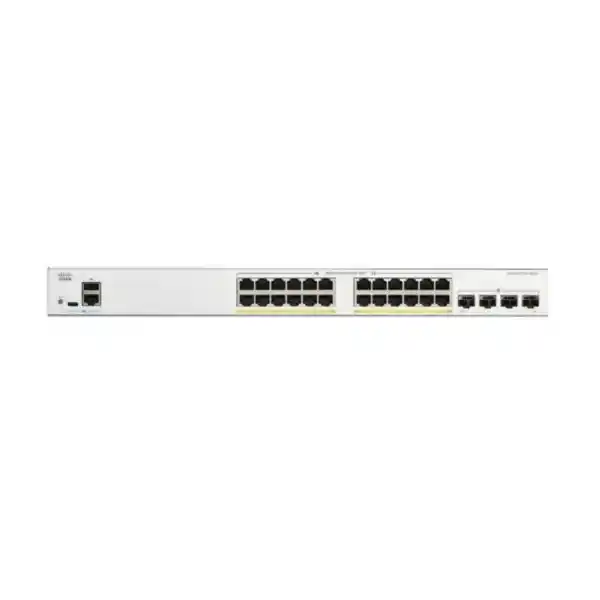
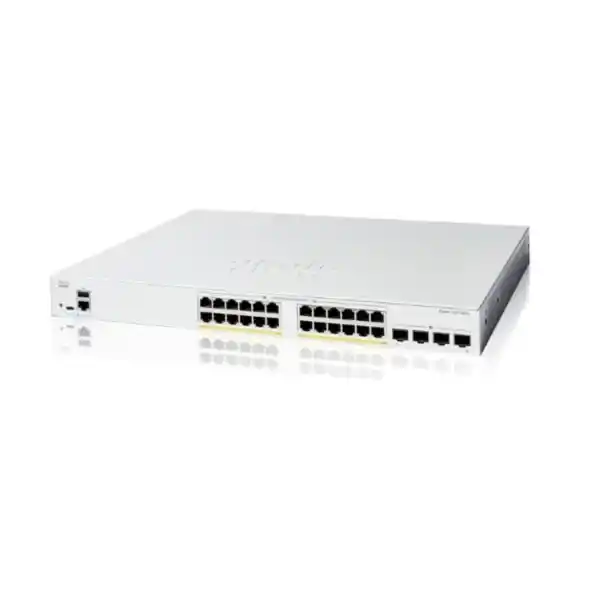
Cisco Catalyst 1200 Series • Full-PoE 24-Port Smart Switch
Cisco Catalyst C1200-24FP-4G Network Switch in Dubai, UAE
A 24-port Gigabit PoE+ access switch with a 375W PoE budget and four 1G SFP uplinks, designed for small and medium-sized business networks that need to power phones, access points, cameras and other Ethernet devices while keeping VLAN, QoS, security and management under administrative control.
375W PoE budget
4 × 1G SFP uplinks
Rack-mountable 1RU
Direct answer: what is the Cisco C1200-24FP-4G?
The Cisco Catalyst C1200-24FP-4G is a smart managed Gigabit Ethernet switch in the Catalyst 1200 family. Its exact hardware profile is 24 copper 10/100/1000 ports that can supply IEEE 802.3af PoE and 802.3at PoE+ power, plus four dedicated 1 Gigabit SFP uplink ports. The model has a 375W total PoE power budget and can deliver up to 30W to an individual Gigabit Ethernet PoE port while the overall switch power budget is not exceeded.
It is mainly used as an access-layer switch for offices, clinics, schools, retail sites, hospitality locations, warehouses, small campuses and branch environments where data connectivity and electrical power need to travel over the same Ethernet cabling. Typical powered endpoints include VoIP phones, wireless access points, fixed or PTZ surveillance cameras and other standards-based PoE devices. Businesses that need VLAN segmentation, Quality of Service, security controls, monitoring and some static inter-VLAN routing without the cost or operational complexity of a larger enterprise switching platform should consider this class of switch.
The most important factor to confirm before ordering is not simply the number of ports. The buyer should validate the total PoE requirement of all connected devices, the maximum power demand of each endpoint, the uplink bandwidth requirement and the fibre or copper medium used to connect the switch upstream. A 375W budget is generous for a 24-port PoE+ model, but 802.3at remains a maximum of 30W per supported port and the four uplinks on this specific C1200-24FP-4G model operate at 1 Gigabit. Sites expecting high aggregate traffic toward a core, server cluster, recording platform or high-density wireless environment should compare the 10G-uplink C1200-24FP-4X before finalizing the design.
FourTeck can help determine whether the port count, PoE headroom, uplink type, SFP optics, VLAN plan, rack conditions and management method match the actual Dubai or UAE deployment rather than selecting the switch from a product name alone.
Why this exact model attracts business buyers
High PoE budget for 24 ports
The 375W PoE budget is the defining difference between the C1200-24FP-4G and lower-power 24-port variants. It gives a designer considerably more room for power-hungry endpoint mixes than the 195W C1200-24P-4G, while keeping the switch at 24 access ports.
Dedicated fibre uplinks
Four 1G SFP ports let the switch connect to upstream network infrastructure over supported fibre or copper SFP media without consuming the 24 PoE access ports. This is useful for structured cabling and distributed wiring closets, provided 1G uplink capacity is appropriate.
Managed control without a large-campus platform
The Catalyst 1200 family includes a browser interface, CLI, SNMP, Cisco Business Dashboard support, VLANs, QoS, ACLs, 802.1X and static routing. That combination suits organizations that need purposeful network policy and monitoring but do not require every capability of a higher-tier enterprise campus architecture.
One access switch for voice, Wi-Fi and surveillance
A properly sized PoE+ access layer can consolidate several endpoint categories on one structured network. Voice VLAN features, LLDP-MED, QoS, multicast controls and PoE scheduling make the model particularly relevant where phones, access points and cameras share switching infrastructure but require different traffic and power policies.
Clear boundaries make it easier to shortlist correctly
This is not a 10G-uplink switch and it is not an 802.3bt PoE++ model. Those limits are useful because they make the buying decision concrete: choose it when 24 Gigabit access ports, PoE+ and 1G uplinks fit; compare another model when higher uplink throughput, multigigabit access or more than 30W per endpoint is required.
Cisco C1200-24FP-4G verified specification profile
The table below focuses on the exact C1200-24FP-4G values that influence design, installation and purchasing. Where the Catalyst 1200 data sheet states a family-wide feature, the wording is kept distinct from model-specific hardware values.
| Specification | C1200-24FP-4G detail |
|---|---|
| Access ports | 24 × 10/100/1000 Gigabit Ethernet RJ-45 ports with PoE/PoE+ support |
| Uplink ports | 4 × dedicated 1 Gigabit SFP ports |
| PoE standards | IEEE 802.3af PoE and IEEE 802.3at PoE+, plus Cisco prestandard legacy PoE support as listed by Cisco |
| PoE budget | 375W total power dedicated to PoE across 24 supported ports |
| Maximum PoE per port | Up to 30W on a Gigabit Ethernet port, subject to the overall PoE budget and powered-device negotiation |
| Switching capacity | 56 Gbps |
| Forwarding rate | 41.67 million packets per second for 64-byte packets |
| Packet buffer | 1.5 MB aggregate, dynamically shared across ports |
| MAC address table | 8,000 addresses |
| Jumbo frames | Frame sizes up to 9,000 bytes; Cisco lists a 2,000-byte default MTU |
| Processor | Dual-core ARM CPU at 1.4 GHz |
| Memory | 1 GB DDR4 DRAM and 512 MB flash |
| Console / USB | Cisco-standard RJ-45 console and USB Type-C; front USB Type-C supports file/image management and console use |
| Dimensions | 445 × 345 × 44 mm (17.5 × 13.59 × 1.73 in) |
| Weight | 4.6 kg (10.14 lb) |
| Input power | 100–240V AC, 50–60 Hz, internal universal power supply |
| Cooling / acoustics | 1 fan; Cisco lists 34.8 dBA at 25°C |
| Operating temperature | -5°C to 50°C for this model family group |
| Operating humidity | 10% to 90% relative, noncondensing |
| MTBF at 25°C | 698,220 hours as listed by Cisco |
| Warranty | Cisco lists a limited lifetime warranty for the Catalyst 1200 Series; applicable regional terms should be checked for the supplied unit |
PoE planning: where the 375W budget matters
The letters FP in the C1200-24FP-4G model identify the high-PoE-budget 24-port option in this part of the Catalyst 1200 range. Cisco specifies 375W dedicated to PoE, compared with 195W on the C1200-24P-4G. That difference can materially change a deployment. A switch may have 24 PoE-capable sockets and still be unable to supply the theoretical maximum to every connected device at the same time if its total power budget is lower than the combined demand. For that reason, port count and PoE budget should always be designed together.
A simple way to estimate demand is to list every powered endpoint, record its relevant maximum or engineered PoE requirement, add the figures, then preserve operational headroom rather than designing the switch at its absolute limit. An office with mostly standard IP phones may have a modest aggregate load. A surveillance project with several PTZ cameras, infrared illumination or heated enclosures can be much more demanding. Wireless access points also vary substantially by generation, radio configuration and feature set. The C1200-24FP-4G can be attractive when these endpoint types are mixed because the 375W budget reduces the likelihood that the switch becomes the first power constraint.
The per-port ceiling remains important. Cisco states that Catalyst 1200 PoE+ models can provide up to 30W to a Gigabit Ethernet port under 802.3at until the switch’s power budget is reached. This does not make the C1200-24FP-4G an 802.3bt PoE++ switch. A device that requires more than the supported PoE+ level, or relies on a higher-power proprietary method, needs a different power design. The endpoint’s data sheet should be checked before assuming that a large total switch budget automatically guarantees compatibility.
The switch supports PoE controls that can be useful in operations. Cisco documents configurable port power limits, class-based behavior, usage thresholds and PoE monitoring. The Catalyst 1200 family also supports time-based PoE, which can turn power on or off according to an administrator-defined schedule, and perpetual PoE, which is intended to maintain PoE to connected powered devices while the switch is rebooting. Those functions can be valuable in locations where phones, cameras or access points should not be unnecessarily power-cycled during routine maintenance, although the behavior should be validated in the intended firmware and operational procedure.
Step 1: classify endpoints
Separate phones, cameras, access points and other devices. Use the manufacturer’s maximum or design-stage PoE figure rather than relying only on average consumption observed during light use.
Step 2: check the per-port standard
Confirm each powered device operates within IEEE 802.3af or 802.3at limits supported by this switch. Higher-power 802.3bt requirements are a reason to evaluate another platform or power method.
Step 3: preserve headroom
Size against the 375W total budget with allowance for expansion and worst-case device behavior. A design with no spare power budget can become fragile as endpoints are changed or upgraded.
Access ports and uplinks: the bandwidth decision behind the model name
The C1200-24FP-4G combines 24 Gigabit copper access ports with four dedicated Gigabit SFP uplinks. The access ports support 10/100/1000 Mbps operation, which makes them suitable for common office and edge endpoints. The SFP interfaces are separate from the 24 copper access ports, so using fibre uplinks does not reduce the available PoE access-port count. For a business with one wiring closet and a Gigabit upstream connection, this layout is straightforward. In a multi-switch design, several SFP ports can also provide physical options for uplink, aggregation or redundant Layer 2 topology subject to the network design.
The critical design point is the letter G in 4G. These are 1 Gigabit SFP uplinks, not 10 Gigabit SFP+ uplinks. The switch itself has 56 Gbps of switching capacity and is designed for wire-speed, nonblocking operation, but traffic leaving the switch through an individual 1G uplink is naturally constrained by the line rate of that uplink. If many access ports are simultaneously sending data toward centralized storage, internet security appliances, virtualization hosts, a video recording server or another network segment, uplink utilization can become the practical bottleneck before access-port capacity does.
This distinction is especially important for Wi-Fi. A switch can have enough PoE budget to power a set of access points while still being poorly matched to the aggregate data they generate. The C1200-24FP-4G access ports are Gigabit Ethernet, so it is not intended as a multigigabit access switch for APs that require 2.5G, 5G or higher wired interfaces. Even when each AP uses no more than 1G, a group of busy APs can create significant upstream traffic. A buyer should therefore size both power and data rather than treating PoE budget as the only constraint.
Cisco lists several supported 1G transceiver families for Catalyst 1200, including multimode fibre, single-mode fibre and copper SFP options. Examples in Cisco’s data sheet include MGBSX1, MGBLX1, MGBLH1, MGBT1, GLC-SX-MMD, GLC-LH-SMD, GLC-BX-U, GLC-BX-D and GLC-TE. Exact optic selection depends on fibre type, connector plant, distance and the device at the far end. It is poor procurement practice to order “an SFP” without specifying these conditions. A multimode link inside a building, a single-mode link between distant facilities and a copper handoff in the same rack require different modules even though all may run at 1 Gigabit.
If 10G uplinks are necessary, the nearby C1200-24FP-4X deserves comparison. Cisco lists the same 24 Gigabit PoE+ access ports and 375W PoE budget for that model, but four 10 Gigabit SFP+ uplinks instead of four 1G SFPs. That can be the cleaner long-term choice when a high-throughput upstream path is required. The C1200-24FP-4G remains attractive when Gigabit uplinks are adequate and the purchasing priority is strong PoE capacity at the access layer.
Switching, VLAN and static Layer 3 capabilities
Cisco rates the C1200-24FP-4G at 56 Gbps switching capacity and 41.67 mpps forwarding for 64-byte packets. These figures align with the port architecture of 24 Gigabit access interfaces plus four Gigabit uplinks operating in full duplex. For the intended small and medium business role, the goal is a nonblocking local switching fabric rather than a chassis-scale campus core. The practical performance experienced by applications still depends on cabling, endpoint negotiation, uplink utilization, traffic patterns, configuration and the capabilities of connected routers, firewalls and servers.
VLAN support is one of the strongest reasons to choose a managed switch instead of an unmanaged desktop product. Cisco documents support for up to 255 active VLANs simultaneously, with port-based and IEEE 802.1Q tag-based VLANs. A business can use this to separate corporate users, voice endpoints, guest wireless traffic, cameras, building systems and management interfaces. Segmentation does not automatically create security—the VLAN design must be paired with appropriate routing and filtering—but it provides the logical structure on which those controls depend.
The Catalyst 1200 family supports a management VLAN, guest VLAN, Auto Surveillance VLAN and voice-oriented features. Voice VLAN behavior and LLDP-MED can simplify IP phone deployments by identifying and treating voice traffic appropriately. For surveillance, multicast and traffic-control features can help prevent video flows from consuming unnecessary bandwidth on ports that do not need them. These functions are most effective when the switch configuration is designed around the actual endpoint estate rather than enabled generically.
For loop prevention and resilient Layer 2 topology, Cisco lists traditional STP, Rapid STP, Multiple STP and Cisco-oriented PVST+/Rapid PVST+ support. Link aggregation via IEEE 802.3ad LACP is also supported. Cisco states up to four link aggregation groups and up to eight ports per group, with candidate-port parameters for dynamic LAGs. Aggregation can improve capacity or resilience between compatible devices, but it should not be interpreted as making a single traffic flow faster than one physical member link. The upstream device must support and be configured for the same aggregation design.
Layer 3 functionality is deliberately limited compared with an enterprise routing switch. Cisco documents wire-speed IPv4 and IPv6 routing, up to 32 IPv4 static routes and up to 16 IP interfaces, along with Layer 3 interfaces on physical ports, LAGs, VLAN interfaces or loopback interfaces. DHCP relay and UDP relay functions are available. This can be useful for straightforward inter-VLAN routing in a small network, reducing the need to send every local VLAN-to-VLAN packet through a separate router.
The word static matters. A network that depends on sophisticated dynamic routing, large route tables, complex policy-based forwarding or high-availability campus control-plane features should not be designed around the Catalyst 1200’s basic Layer 3 feature set. In that situation, the switch can still operate as an access-layer device, but routing should be assigned to a platform built for the required scale and resiliency.
Security controls for a managed access layer
The C1200-24FP-4G is not a firewall, and it should not be positioned as a substitute for a security gateway. Its security value is at the access layer: deciding which devices can use switch ports, limiting inappropriate traffic, protecting management access and reducing common Layer 2 or local-network risks. That distinction is useful in procurement because it keeps responsibilities clear. A firewall controls and inspects traffic according to a security architecture; the access switch enforces port and segmentation policy close to connected devices.
Cisco lists IEEE 802.1X authenticator support with RADIUS authentication, guest VLAN functions and several host/session modes. In an organization with a compatible identity and RADIUS infrastructure, 802.1X can make network access conditional on authentication rather than merely on physical access to an Ethernet socket. Deployment requires planning: supplicant behavior, phone-plus-PC ports, printers, cameras and devices that cannot authenticate interactively may need distinct treatment. A successful rollout therefore starts with endpoint discovery and exception design, not with enabling 802.1X globally.
Access Control Lists are another important tool. Cisco specifies support for up to 512 rules, with matching criteria that can include MAC addresses, VLAN IDs, IPv4 or IPv6 addresses, protocols, TCP/UDP ports, traffic-class fields and other packet characteristics. ACLs can be applied to ingress and egress directions, and time-based ACLs are supported. In a small segmented network, these controls can help reduce lateral access—for example, limiting management interfaces to an administrator subnet or constraining IoT devices to specific services. Rule order and operational testing matter because an overly broad deny statement can disrupt legitimate traffic.
Port security can bind or limit source MAC addresses learned on a port. Storm control covers broadcast, multicast and unknown-unicast traffic. DoS prevention and loop-related protections provide additional safeguards against events that can degrade network availability. Cisco also describes Secure Core Technology, sensitive-data handling and trustworthy-system mechanisms. These features strengthen the platform, but the operational baseline still depends on practical configuration: use HTTPS and SSH rather than insecure management protocols, restrict administrative access, maintain current firmware, back up configuration, use SNMPv3 where appropriate and centralize logs when the organization has monitoring infrastructure.
For a Dubai business that already uses a perimeter firewall, the switch should be integrated into the same segmentation plan. User, guest, voice, camera and management VLANs should map coherently to firewall zones, DHCP scopes, routing and access policy. Where a firewall or security appliance is part of the project, Firewall Dubai by FourTeck provides a relevant specialist route for broader security design, while the C1200-24FP-4G remains the access switching component.
Management, monitoring and day-two operations
Cisco positions the Catalyst 1200 Series as manageable through several methods rather than one proprietary interface. The built-in web user interface supports browser-based configuration, wizards, system dashboards, maintenance and monitoring. This can be useful for smaller IT teams that prefer a visual workflow. Cisco also supports a scriptable CLI, including full and menu-based command-line modes, with defined privilege levels. Administrators who standardize switch configuration through repeatable command sequences therefore have a more scalable option than clicking through each device individually.
Cisco Business Dashboard is supported, including an embedded probe capability that can remove the need to install a separate probe appliance or virtual machine at the site. Cisco also lists Cisco Business mobile app support and a Network Plug and Play agent. These tools can simplify onboarding and visibility for organizations using the broader Cisco Business ecosystem. The exact management model should be chosen before rollout so that credentials, IP addressing, firmware processes, backups and monitoring are consistent across every switch rather than improvised device by device.
SNMP support includes versions 1, 2c and 3, with SNMPv3’s User-Based Security Model listed by Cisco. For a production environment, SNMPv3 is generally preferable when the monitoring system supports it because it can provide authentication and privacy controls absent from older community-string approaches. The switch also supports syslog, RMON groups, ping, traceroute, SNTP, cable diagnostics, port mirroring and other familiar operational tools. These functions make the switch easier to integrate with monitoring and troubleshooting workflows used by managed IT teams.
Firmware resilience is another operational consideration. Cisco documents browser, TFTP and SCP-based upgrade methods along with dual images for resilient firmware upgrades. Dual-image capability can reduce recovery risk when an update does not behave as expected, but it does not remove the need for a maintenance plan. Before upgrading a production switch, back up configuration, read the relevant release notes, confirm dependencies, schedule a suitable window and know how powered devices will be affected.
Configuration consistency becomes especially important when multiple C1200 switches are deployed. Cisco supports editable configuration files and mechanisms intended to simplify deployment. In practice, administrators should establish a baseline that covers management VLAN, secure administrative protocols, NTP/SNTP, syslog, SNMP, port descriptions, VLAN trunking, STP settings, PoE policy and unused-port handling. Deviations can then be documented for specific rooms or devices instead of allowing every switch to drift into a unique configuration.
Businesses that want installation, monitoring, maintenance or broader infrastructure assistance can use FourTeck IT Services UAE as one of the support resources available within the FourTeck group. The operational scope should be defined separately from the hardware purchase so the quotation is clear about supply, configuration, installation, migration and ongoing support.
QoS, voice and real-time traffic
When IP telephony and normal data share a switch, delay-sensitive traffic should not be treated exactly like bulk transfers. The Catalyst 1200 family includes eight hardware queues, strict-priority and weighted round-robin scheduling, classification based on port, 802.1p, DSCP and other fields, plus rate-control and shaping functions. These controls can help preserve voice or other real-time service quality during contention, but QoS is an end-to-end discipline. Marking and queueing on one access switch cannot compensate for unmanaged congestion elsewhere in the path.
Voice VLAN capability is useful because an IP phone may share a physical access port with a user’s PC. LLDP-MED helps endpoints exchange information relevant to voice deployment, and Cisco Discovery Protocol can also advertise and learn device characteristics in Cisco environments. A clean design defines the data VLAN, voice VLAN, authentication behavior and QoS trust boundary for each port type. This avoids the common problem of manually configuring every phone while also avoiding an overly permissive policy that trusts markings from any device.
The 375W PoE budget can support a substantial phone population alongside selected cameras or access points, but actual device power should be calculated. Many desk phones consume far less than the 30W PoE+ ceiling; some video phones or peripherals can require more. If a project involves compatible SIP endpoints, FourTeck IP Phones is a relevant specialist resource for endpoint selection. The switch and phone procurement should be coordinated so that PoE class, VLAN behavior, LLDP-MED support and the intended call-control environment are understood together.
For voice quality, buyers should also examine uplink design. Twenty-four access ports can generate more than one Gigabit of aggregate traffic, even though voice itself is usually modest bandwidth. If the switch also carries surveillance or large file transfers, the 1G uplink can become the shared contention point. A 10G-uplink model may be justified even if the PoE budget and access-port count remain the same.
Wireless access point deployments
PoE switches are commonly purchased during Wi-Fi refresh projects because modern access points need both data and power at ceiling or wall locations. The C1200-24FP-4G can be a good fit for access points that use 1 Gigabit Ethernet and operate within IEEE 802.3at PoE+. Its large 375W budget gives significant aggregate power headroom for a 24-port platform. The important word is compatible: many newer high-performance APs use multigigabit Ethernet or may request more power than standard PoE+ under certain feature configurations. Those devices can make another access-switch family more appropriate.
When an AP negotiates only 1G to a switch port, the radio system may still work perfectly for the intended user density and internet connection. There is no universal rule that every modern AP needs multigigabit Ethernet. Capacity planning should instead consider client density, expected application mix, WAN speed, local traffic, radio channel width and how many APs share each uplink. A small branch with several APs can be well served by Gigabit access; a dense office or education environment with high-throughput wireless may not be.
VLAN trunking is another design point. An access point that broadcasts corporate, guest and IoT SSIDs may need multiple VLANs carried on its wired switch port. The Catalyst 1200’s 802.1Q VLAN support allows this, but the trunk configuration must match the AP or controller design, and the upstream firewall/router must have corresponding interfaces, DHCP scopes and security policy. If guest traffic should be isolated from corporate networks, simply creating a guest SSID is insufficient without proper wired segmentation.
PoE scheduling can be useful in some wireless environments, but it should be applied cautiously. Turning AP power off overnight can reduce energy use in a site that is genuinely unoccupied, yet it also eliminates after-hours coverage, monitoring and remote management. Perpetual PoE behavior may be more valuable during firmware maintenance because it can avoid unnecessarily rebooting powered endpoints while the switch itself restarts. The operational policy should reflect business hours, security requirements and support procedures.
Video surveillance and camera networks
A full-PoE 24-port switch is an obvious candidate for IP surveillance because cameras are frequently mounted where local electrical outlets are undesirable. The C1200-24FP-4G can power standards-based cameras within its 802.3af/802.3at capabilities and offers enough aggregate power to accommodate more demanding mixes than a 195W model. However, camera design must account for both startup and maximum operating power, especially for PTZ movement, infrared illumination, heaters or other accessories that can raise consumption above a camera’s idle figure.
Bandwidth planning is equally important. Twenty-four cameras do not necessarily create a bandwidth problem; their combined bit rate depends on resolution, frame rate, codec, scene complexity and recording settings. Yet video traffic is often continuous, unlike normal office traffic. If all streams travel from the access switch to a centralized NVR or server through a single 1G uplink, the aggregate should be calculated with margin for bursts, management traffic and future camera changes. Multiple uplinks or a 10G-uplink switch may be justified in high-bit-rate deployments.
IGMP snooping and multicast controls can matter where video is distributed to multiple viewers or multicast is used for other media. Storm control and VLAN segmentation can also prevent camera traffic from affecting unrelated user networks. A common design is to put cameras in their own VLAN, restrict their access to required recording and management systems and prevent arbitrary lateral communication. That policy should be enforced consistently on the switch, firewall and server side.
The switch does not replace video-system design. Camera compatibility, NVR capacity, retention storage, redundancy, time synchronization, secure credentials and remote access all remain separate decisions. The switch’s job is to provide a controlled, powered network edge. That is precisely why its 375W budget and management features are valuable, but they should be evaluated as one layer of the surveillance architecture rather than the entire solution.
Physical installation, power and cooling
The C1200-24FP-4G is a rack-mountable 1RU-class switch with a 445 mm width, 345 mm depth and 44 mm height. Cisco lists a unit weight of 4.6 kg. Those dimensions are easy to overlook when a buyer is replacing a shallower data-only switch. The full-PoE model is deeper because its internal power and cooling requirements are higher. Before ordering, confirm usable rack depth, rear clearance, cable-management space and the location of adjacent equipment.
The switch uses an internal universal 100–240V AC, 50–60 Hz power supply. Cisco lists worst-case system consumption without PoE at approximately 28.9W on 110V and 29.8W on 220V, and much higher overall input when PoE is fully loaded—443.5W at 110V and 429.9W at 220V in the current data sheet. These figures matter for UPS sizing, power-distribution planning and cooling. A 375W PoE budget does not mean the switch draws only 375W from the wall; conversion losses and the switch’s own electronics add to the input requirement.
Cisco lists heat dissipation of 1512.3 BTU/hr for this model under its worst-case power table. In a small enclosed cabinet, thermal design is therefore not optional. The C1200-24FP-4G uses one fan and Cisco specifies 34.8 dBA acoustic noise at 25°C. Unlike several lower-power Catalyst 1200 models that are fanless, this full-PoE model should be treated as actively cooled equipment. It is better suited to a communications room, rack area or other location where fan noise and heat are acceptable than to a quiet desk-side environment.
Cisco specifies an operating temperature range of -5°C to 50°C for models other than the compact C1200-8T-D, along with 10% to 90% noncondensing relative humidity. These values describe product environmental limits, not a recommendation to run a network cabinet continuously at the highest permissible temperature. Cooler, clean, well-ventilated conditions generally give infrastructure more operating margin. In Dubai and the wider UAE, particular attention should be paid to air-conditioning reliability, dust management and closets located near roofs, external walls or utility spaces where temperature can rise sharply.
A UPS should be sized for the switch’s realistic maximum load plus required runtime, not for the switch electronics alone. If the switch powers cameras, phones and access points, an outage affects all of those devices at the same time. A UPS that was adequate for a previous non-PoE switch can be undersized after migration. The same applies to generator circuits and power-distribution units. The project should calculate total rack load, not just add the C1200-24FP-4G to an existing assumption.
Cisco lists a mounting kit in the package contents and notes that 24- and 48-port models include 19-inch mounting brackets. Site-specific rack hardware, patch panels, cable organizers, fibre trays and power arrangements remain project items. A quotation should identify whether FourTeck is supplying only the switch or a complete installed rack component set.
Cabling and SFP optic selection
Cisco specifies Category 5e or better UTP for 1000BASE-T copper connectivity. In a new installation, Cat6 or the cable category required by the broader structured-cabling design may be preferred, but the switch itself does not turn poor cabling into a reliable Gigabit link. Existing horizontal cable runs should be tested when there are negotiation problems, intermittent errors or PoE instability. PoE adds current to the same conductors used for data, so cable quality, termination quality and bundle conditions matter.
The SFP uplinks introduce a different set of choices. Multimode and single-mode fibre are not interchangeable simply because both use an SFP form factor. Cisco lists MGBSX1 and GLC-SX-MMD for multimode 1G applications, single-mode options such as MGBLX1 and GLC-LH-SMD, bidirectional GLC-BX variants and copper 1G modules such as MGBT1 or GLC-TE. The transceiver at each end of a fibre link must be compatible with the fibre plant and with the far-end equipment.
Distance is part of the selection. Cisco’s current Catalyst 1200 data sheet lists examples ranging from hundreds of metres on multimode optics to 10 km or more on various single-mode options, with MGBLH1 listed for up to 40 km. Those maximums should not be treated as automatic design distances. Optical budgets, connector loss, patch panels, splice loss and the far-end module must all be considered in a real fibre link. Long-distance optics can also have minimum-receive-power considerations on very short links.
BiDi optics are a special case because they use different transmit and receive wavelengths over one fibre strand and are normally deployed as matched complementary pairs. Ordering two identical BiDi modules can be incorrect. The switch model does not solve that procurement detail; the exact fibre design does. This is one reason FourTeck should be given the origin, destination, distance, fibre type and far-end device when optics are included in a quote.
Copper SFP can be useful for a 1G RJ-45 handoff on an uplink slot, but it should not be purchased merely to gain another ordinary access port without considering topology and switch-port roles. The C1200-24FP-4G already has 24 copper PoE access interfaces; the four SFP ports are most valuable when reserved for upstream or inter-switch connectivity that benefits from dedicated uplink resources.
Management-plane design and configuration baseline
A switch can be technically capable yet operationally difficult if its management design is neglected. Before deploying the C1200-24FP-4G, determine the management IP addressing method, management VLAN, administrator authentication approach, DNS and time sources, logging destination, monitoring protocol and firmware-maintenance responsibility. This baseline should be documented before the switch enters service, particularly when multiple sites or branches are involved.
HTTPS and SSH provide secure alternatives to plain HTTP and Telnet. Cisco documents SSH v1 and v2 support, but modern deployments should use current secure protocol choices and disable unnecessary legacy access where supported by the organization’s configuration standard. SNMPv3 should be preferred over earlier SNMP versions when the monitoring system can support it. Administrative interfaces should be reachable only from defined management networks rather than exposed broadly to every user VLAN.
Time synchronization has operational significance beyond displaying the correct clock. Syslog entries, authentication records, security events and troubleshooting timelines are much easier to correlate when switches, firewalls, servers and endpoints agree on time. The Catalyst 1200 family supports SNTP. A deployment checklist should verify synchronization after the switch is installed and before relying on event logs during an incident.
Configuration backup is equally basic and equally important. Cisco supports multiple transfer and upgrade mechanisms and dual firmware images. Administrators should save a known-good configuration after commissioning and after major changes. A replacement switch is much faster to recover when VLANs, trunks, LAGs, PoE policies, ACLs and management settings can be restored from controlled documentation rather than reconstructed from memory.
For organizations without in-house switching expertise, hardware supply can be combined with a defined configuration and support scope. The distinction should be explicit: a switch purchased as a boxed item is not the same commercial deliverable as a switch installed, configured, tested, documented and monitored. FourTeck UAE can be used as a broader UAE point of reference for technology supply and project discussions.
Typical deployment patterns in Dubai and the UAE
SMB office floor
The switch can serve desks, IP phones, printers and access points from one communications rack. VLANs separate user, voice, guest and management traffic while PoE removes local power adapters from phones and compatible APs.
Retail or hospitality site
POS terminals, phones, wireless APs, cameras and back-office devices can share the physical switching layer while logical segmentation keeps payment, guest and operational traffic separated according to the wider security design.
Camera aggregation
A 375W PoE budget can support a meaningful group of standards-based cameras. Recording-server bandwidth, retention design and uplink utilization must be calculated rather than assumed from the number of ports.
Clinic or education branch
Managed access switching can separate staff, guest, voice, camera and device networks. The switch provides enough policy controls for a structured SMB environment, while routing or advanced security can remain on a dedicated firewall or higher-layer device.
Distributed wiring closet
Four SFP uplinks are useful where an access switch connects back to a central room over fibre. The 1G line rate should be tested against expected aggregate traffic; higher-throughput closets may justify the 4X variant with SFP+ uplinks.
When the C1200-24FP-4G is a good fit
This model makes sense when the design needs approximately 24 copper access ports, many or most endpoints require PoE, total powered-device demand can fit comfortably inside 375W, and Gigabit Ethernet is appropriate both at the edge and on the planned uplinks. It is particularly logical where the business wants a manageable network with VLANs, QoS, access controls and static routing but does not need the scale, dynamic routing or controller architecture of a larger campus switching platform.
It can also be a better choice than the lower-power C1200-24P-4G when future endpoint changes are uncertain. A phone-only network might fit comfortably within 195W, but adding cameras or higher-power wireless APs can consume headroom quickly. The 375W version reduces that risk. The buyer still needs to check per-port power class; a higher total budget does not change the 30W PoE+ maximum per supported port.
The switch is also appropriate where fibre is needed but 10G is not. A remote office floor connected to a central rack over a Gigabit fibre backbone may not benefit from 10G if its WAN, server traffic and user count are modest. Buying the 4G model can then keep the architecture aligned with actual requirements. The decision should be based on traffic estimates rather than a general assumption that higher uplink speed is always necessary.
Finally, the Catalyst 1200 can suit organizations that value Cisco’s small-business management approach. Web UI, Cisco Business Dashboard, CLI, SNMP and PnP options provide multiple ways to operate the device. Teams already familiar with Cisco switching concepts may also find the VLAN, STP, LACP, ACL and discovery terminology familiar, although the platform should not be assumed to be feature-identical to Catalyst enterprise IOS-XE switches.
When another switch should be evaluated
A good product page should identify disqualifiers as clearly as benefits. The first is uplink speed. If the site needs 10 Gigabit connections to a core, aggregation switch, server, storage system or high-throughput firewall, the C1200-24FP-4G is not the ideal match because its uplinks are 1G SFP. The C1200-24FP-4X is a close family alternative with the same 24-port full-PoE concept but four 10G SFP+ uplinks.
The second is access-port speed. All 24 copper ports on this model are Gigabit Ethernet. An access point, workstation, NAS or server that requires 2.5G, 5G or 10G access cannot realize that speed on a C1200-24FP-4G port. If a Wi-Fi upgrade specifically depends on multigigabit wired backhaul, a multigigabit switch family should be shortlisted instead of forcing the AP down to 1G.
The third is endpoint power. The switch supports PoE+ with up to 30W per port; it is not a higher-power 802.3bt PoE++ model. Devices that require Type 3 or Type 4 PoE, or more power than 802.3at can supply, should trigger a different switching or power design. This can apply to particular advanced APs, displays, building devices or other specialized equipment.
The fourth is port count. If the planned rack already needs more than 24 access ports, buying one 24-port unit with no growth room can be false economy. A 48-port model or a deliberately stacked/dual-switch topology may be cleaner. Cisco lists the C1200-48P-4G with 48 PoE+ ports and a 375W total PoE budget, but note that the same 375W budget spread over 48 potential powered ports is a different power-density profile from the 24FP model. Port count and power budget still need to be evaluated together.
The fifth is routing and high availability. Catalyst 1200 supports useful static Layer 3 functions, but it is not designed as a large dynamic-routing core. If the project requires advanced routing protocols, large route tables, modular redundancy, sophisticated campus automation or a feature set tied to enterprise Catalyst architecture, a higher product family is more appropriate.
The sixth is acoustic placement. This full-PoE model has one fan and Cisco lists 34.8 dBA at 25°C. A switch that will sit next to employees in a very quiet room may be better chosen from a fanless lower-power range if the PoE load allows. The physical environment is therefore part of the model-selection decision, not an afterthought.
C1200 family comparison for nearby buying choices
| Model | Access ports | PoE budget | Uplinks | Best comparison reason |
|---|---|---|---|---|
| C1200-24P-4G | 24 × 1G PoE+ | 195W | 4 × 1G SFP | Consider when 195W is sufficient and the higher 375W budget is unnecessary. |
| C1200-24FP-4G | 24 × 1G PoE+ | 375W | 4 × 1G SFP | Strong power density where Gigabit uplinks meet the traffic requirement. |
| C1200-24FP-4X | 24 × 1G PoE+ | 375W | 4 × 10G SFP+ | Compare when the same access/PoE profile needs substantially faster uplinks. |
| C1200-48P-4G | 48 × 1G PoE+ | 375W | 4 × 1G SFP | Compare when port count is the bigger constraint, while recalculating PoE demand across 48 ports. |
The closest “upgrade” is not automatically the 48-port switch. If the existing 24-port count is correct but upstream throughput is the concern, the 24FP-4X is a more direct comparison because it preserves the 375W PoE profile while changing uplink capability. Conversely, if the network needs many more edge devices but total PoE load is moderate, the 48-port model may make more sense. Buyers should compare the resource that is actually constrained.
Migration from an unmanaged or older PoE switch
Replacing an unmanaged switch with the C1200-24FP-4G is more than a hardware swap because the new device introduces configuration choices that did not previously exist. The first task is inventory. Record every connected device, its port, VLAN requirement, PoE need, MAC address where relevant and upstream dependency. A photograph of the old patching is useful, but a written port map is better. Unknown cables should be traced before the maintenance window rather than discovered during cutover.
Next, identify the existing network topology. If the old switch simply extends one flat subnet, migration can begin with a matching access configuration and segmentation can be introduced later. If VLANs already exist, confirm tag/untag behavior on each port and the trunk configuration to the router or firewall. A mismatch in native VLAN or allowed VLAN lists can make a physically connected switch appear completely offline to selected services.
PoE migration should use measured or documented endpoint demand. Some older switches provide proprietary prestandard power, some endpoints use passive power methods and some installations contain injectors that may no longer be needed. Cisco states Catalyst 1200 PoE models support 802.3af, 802.3at and Cisco prestandard legacy PoE, but this should not be generalized to every proprietary device. Passive-PoE equipment in particular requires careful checking because standards-based PoE negotiation is not the same as simply applying voltage to Ethernet conductors.
Management IP and credentials should be planned before cutover. Decide whether the new switch will take over the old management address, receive a new address or be introduced on a dedicated management VLAN. If remote teams depend on reaching the device after migration, test routing, ACLs, DNS and time synchronization before the local engineer leaves site. Configuration backup should be saved immediately after the final state is verified.
A move from an older PoE switch can also affect the UPS. The C1200-24FP-4G may be chosen precisely because it can deliver more endpoint power. The new switch plus the devices it powers may therefore create a higher AC load than the equipment being removed. Battery runtime should be recalculated; otherwise a “more capable” network can produce a shorter outage survival time than expected.
Finally, use the migration to remove accidental dependencies. Unused ports can be disabled, port descriptions can identify attached systems, management protocols can be secured, VLANs can separate trust zones and monitoring can be enabled. The value of a managed switch is not realized by leaving it in a default flat configuration forever.
Implementation journey for a new deployment
1. Discover
Count data and powered endpoints, identify VLANs, map fibre/copper uplinks, document existing gateway and DHCP services, and record any availability constraints for the cutover.
2. Size
Calculate PoE budget with margin, estimate uplink utilization, confirm port growth, and compare 1G versus 10G uplink models before hardware is committed.
3. Prepare
Confirm rack depth, UPS capacity, cooling, patching, transceivers, management addressing and the firmware/configuration baseline before the switch is installed.
4. Configure and migrate
Build VLANs, trunks, LAGs, QoS, security and management settings in a controlled sequence. Migrate endpoints in groups when possible and verify data link, IP addressing, PoE negotiation and application reachability after each stage.
5. Validate and document
Check port errors, negotiated speeds, PoE consumption, uplink utilization, STP state, management reachability and logs. Save the final configuration and update rack, port and support documentation.
Procurement guidance for Dubai and UAE buyers
Cisco states that Catalyst 1200 Series products are available through distributors and that end users should order through preferred partners rather than directly from Cisco. For a UAE buyer, that makes the quotation process important because the switch itself is only one line item. The commercial scope may also need optics, patch leads, rack accessories, UPS capacity, configuration, installation, migration and support.
Use the exact product ID C1200-24FP-4G in the request. The Catalyst 1200 family contains similar-looking 24-port models with different PoE budgets and uplink speeds. A quote that says only “Cisco 24-port PoE switch” is not specific enough. The difference between 24P and 24FP is important for total PoE capacity, while the difference between 4G and 4X is important for uplink speed.
If fibre uplinks are required, specify the transceiver requirement rather than assuming optics are included. State the fibre type, connector, approximate distance and far-end equipment. If copper uplinks are planned, state that as well. This avoids receiving a switch that is technically correct but cannot be connected to the existing backbone on installation day.
Warranty and support terms should be written into the quote with the actual supplied SKU and source. Cisco’s data sheet lists a limited lifetime warranty for the series and references support provisions, but local entitlement, return process and any additional service should be confirmed for the unit being supplied. Organizations with formal procurement procedures may also want serial-number records, delivery documentation and configuration handover.
For wider infrastructure sourcing and regional engagement, buyers can review FourTeck global alongside the UAE-specific resources. The product quote itself should remain precise about delivery location, quantity, lead-time expectation and whether services are required.
Stock and pricing can change, so a product page should not imply permanent availability or a fixed market price. A current quotation is the appropriate place to confirm supply status and commercial terms for Dubai, Abu Dhabi, Sharjah or another UAE destination.
Operational considerations after installation
Once the switch is live, the most useful health checks are not complicated. Watch interface errors and negotiated speeds, confirm PoE consumption remains below the planned threshold, observe uplink utilization during business peaks, review temperature and system events, verify time synchronization, and make sure monitoring still receives expected data after firmware or configuration changes. A network that is never observed can quietly accumulate capacity problems until users report symptoms.
PoE utilization should be monitored whenever endpoints change. Replacing several ordinary phones with video phones or upgrading wireless APs can materially increase load without changing port count. The C1200 CLI and management interface provide PoE visibility and control, including usage thresholds. Setting an alerting threshold below the absolute budget can provide warning before the switch runs out of allocatable power.
Uplink utilization deserves similar attention. A design may begin comfortably within one Gigabit and then add cloud backups, new cameras, faster internet, local NAS traffic or more wireless users. Because the C1200-24FP-4G has 1G SFP uplinks, the growth signal is easy to define: if sustained utilization or recurring congestion approaches the practical limit, the business should evaluate aggregation, topology changes or a 10G-uplink model rather than simply adding more access devices.
Configuration change control is another day-two requirement. A small network can still be business critical. Changes to STP, VLAN trunks, ACLs or LAGs can disrupt many users immediately. Keep dated configuration backups, record the reason for changes and, where possible, test unfamiliar modifications outside production. Dual firmware images help with software resilience but do not protect against every configuration mistake.
Finally, remember that the switch participates in the whole network lifecycle. Firewall policy, DHCP scopes, wireless SSIDs, voice systems, camera servers and monitoring platforms may all depend on its VLAN and port configuration. Documentation should therefore describe not only what each port does, but what business service depends on it.
Frequently asked buyer questions
Is the C1200-24FP-4G a managed switch?
Yes. Cisco positions Catalyst 1200 as a smart managed series with browser-based configuration, CLI, SNMP, Cisco Business Dashboard support, VLANs, QoS, ACLs, 802.1X and static Layer 3 routing functions. It offers substantially more control than an unmanaged switch while remaining aimed at small and medium business networks.
Does every one of the 24 ports support PoE+?
Cisco lists all 24 Gigabit RJ-45 access ports on this model as PoE+ capable. The overall PoE allocation is 375W, and Cisco specifies a maximum of 30W to an individual Gigabit Ethernet port while the total budget remains available.
Is 375W enough for 24 PoE devices?
Often, but not automatically. Twenty-four devices averaging 10W would be well inside the budget; twenty-four devices requesting close to 30W would exceed it. Calculate the engineered requirement of the actual endpoint mix and preserve growth headroom. Also confirm that every endpoint fits the PoE/PoE+ per-port standard.
Does it support PoE++?
No. The C1200-24FP-4G is specified for IEEE 802.3af PoE and 802.3at PoE+. Buyers with devices that require 802.3bt Type 3 or Type 4 power should evaluate a switch specifically designed for those higher power levels.
Are the four uplinks 10 Gigabit?
No. This exact 4G model has four 1 Gigabit SFP uplinks. If four 10G SFP+ uplinks are required, compare the C1200-24FP-4X, which retains the 24-port PoE+ and 375W concept while increasing uplink speed.
Can I use it for Wi-Fi access points?
Yes, when the AP’s Ethernet speed and power requirements match the switch. The access ports are 1G and support PoE+. An AP requiring multigigabit Ethernet or higher-power PoE may work only with reduced capability or may require a different switch; confirm the AP specification before purchase.
Can the switch route between VLANs?
The Catalyst 1200 family supports static Layer 3 routing, including IPv4 and IPv6 functions. Cisco lists up to 32 IPv4 static routes and up to 16 IP interfaces. This is suitable for straightforward local routing but should not be confused with a full dynamic-routing campus core.
Is the switch fanless?
No. Cisco lists one fan for the C1200-24FP-4G and 34.8 dBA acoustic noise at 25°C. This is a meaningful difference from some lower-power Catalyst 1200 models that are fanless, so installation in a communications rack or equipment area is generally more appropriate than a quiet desk-side location.
What SFP should I order?
There is no single correct SFP for every project. Specify whether the link uses multimode fibre, single-mode fibre or copper; state the approximate distance and the far-end equipment. Cisco lists multiple compatible 1G modules, and the transceiver pair should be chosen for the actual optical or copper link.
What is the main reason to choose the FP model over the P model?
PoE headroom. The C1200-24FP-4G is specified with 375W dedicated to PoE, while the C1200-24P-4G is listed at 195W. Both have 24 Gigabit PoE+ access ports and four 1G SFP uplinks, so the FP model is most compelling when the endpoint mix requires more aggregate power.
Does it include rack mounting hardware?
Cisco lists a mounting kit in the package contents and states that 24- and 48-port models include 19-inch mounting brackets. Site-specific rack hardware, cage nuts, cable managers, patch panels and any fibre-management accessories should still be checked in the installation scope.
Can FourTeck supply and configure it in the UAE?
A FourTeck quotation can be scoped for hardware supply alone or for a broader project that includes configuration, rack installation, optics, migration and support. Provide the exact model, quantity, endpoint count, PoE requirements, uplink media and deployment location so the commercial scope can be defined accurately.
Detailed buyer checklist before ordering
The C1200-24FP-4G is easy to understand at a headline level, but several project details determine whether it is the correct switch. Use the following checklist as a pre-quotation technical review rather than discovering gaps after delivery.
Port quantity
Count current devices plus realistic growth. If 24 ports leaves no spare capacity, compare a 48-port switch or a deliberate two-switch architecture.
PoE demand
Calculate endpoint maximums and keep margin beneath the 375W budget. Verify no device requires more power than PoE+ can supply per port.
Uplink speed
Confirm whether 1G SFP is sufficient. If the site needs 10G aggregation, compare the 4X model before purchase.
Optics and fibre
State fibre type, connector, link distance and far-end device so a suitable SFP pair can be selected.
Rack and cooling
Allow for the 345 mm chassis depth, 4.6 kg weight, fan airflow, patching and safe service clearance.
UPS capacity
Size power backup for the switch and its powered endpoints. A full-PoE access switch can materially change rack load and runtime.
Decision recap: the six points that matter most
What FourTeck needs for an accurate C1200-24FP-4G quotation
A useful quote can be prepared faster when the technical inputs are complete. The exact model is already known, so the remaining information should describe how the switch will be used and what should be included around it.
Number of switches and the Dubai/UAE site or sites where they are required.
Phones, APs, cameras and other PoE devices with quantities and model numbers where possible.
1G copper or fibre, link distance, fibre type and far-end switch/router/firewall information.
Whether the request is for supply only or includes VLANs, IP addressing, security policy, installation, testing and migration from an existing switch.
Required handover documentation, monitoring, maintenance, response terms or ongoing managed support.
Confirm the right Cisco C1200-24FP-4G design before you order
The C1200-24FP-4G is a strong choice when a 24-port Gigabit access layer needs substantial PoE+ capacity and 1G SFP uplinks are sufficient. The purchasing decision should still validate endpoint power, uplink traffic, optics, rack conditions and the management plan. FourTeck can quote the exact switch and, where required, build the surrounding supply, configuration and installation scope for a Dubai or UAE deployment.
For switch supply, deployment and broader network projects, use the contact scope to state whether you need hardware only, optics and accessories, configuration, installation, migration or ongoing support.

Reviews
There are no reviews yet.