
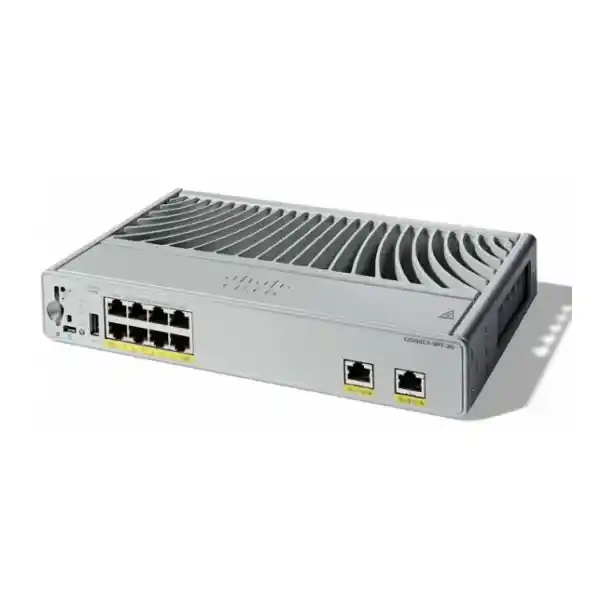
Cisco Catalyst C9200CX-8PT-2G Network Switch
A fanless, space-efficient Catalyst 9200CX access switch with eight 1 Gigabit PoE+ downlinks and two 1 Gigabit Class 8 powered-device uplinks, engineered for flexible PoE pass-through at the distributed edge. It brings Cisco IOS XE, UADP 2.0 Mini forwarding, enterprise segmentation, telemetry, automation and Layer 3 capability to locations where a conventional wiring-closet switch may be impractical.
Choose the C9200CX-8PT-2G when you need enterprise switching in a quiet or space-limited zone and want the switch itself to be powered through capable upstream UPOE+ links, with optional auxiliary power to increase available downstream PoE.
What the Cisco C9200CX-8PT-2G is designed to solve
The Cisco Catalyst C9200CX-8PT-2G is purpose-built for access-layer locations where standard rack switches are too large, too noisy or too dependent on local mains power. Traditional access switching assumes a telecommunications room with a rack, dedicated AC feeds, environmental control and enough copper runs to reach every endpoint. Modern buildings increasingly break that assumption. Cameras, badge readers, phones, sensors, digital signage, Wi-Fi access points and small user clusters may sit in ceilings, corridors, kiosks, retail zones, hospitality areas, branch offices or modular workspaces that do not justify a full intermediate distribution frame. The C9200CX-8PT-2G gives network architects a compact enterprise switch that can extend managed Ethernet and PoE closer to those endpoints while still participating in a Cisco Catalyst operational model.
Its defining feature is the power architecture. The switch provides eight 10/100/1000 PoE+ downlink ports for powered devices and two 1G copper uplink interfaces that can operate as high-power powered-device inputs. Instead of requiring a conventional internal AC supply, the C9200CX-8PT-2G can receive power from suitable upstream IEEE 802.3bt/UPOE+ power-sourcing equipment. Optional external 80W or 150W adapters can supplement the input. This allows design teams to place the switch where local AC is inconvenient while centralizing power at an upstream access or distribution switch, or to combine upstream power and an auxiliary adapter when downstream PoE demand is higher.
For UAE deployments, this architecture can simplify edge design in new offices, malls, hospitality properties, education spaces, smart-building zones and branch environments where aesthetic, acoustic and electrical constraints matter. It does not eliminate the need for engineering discipline: uplink bandwidth, PoE class, cable quality, thermal conditions, redundancy expectations and licensing must all be validated. However, when those elements are sized correctly, the model can reduce the amount of local infrastructure required at the edge while maintaining managed enterprise capabilities.
Eight 10/100/1000BASE-T downlinks provide data plus IEEE 802.3at PoE+ for endpoints such as IP phones, cameras, access-control devices and other powered edge equipment.
The two 1G copper uplinks are also Class 8 powered-device interfaces, enabling the switch to receive high-power PoE from compatible upstream power-sourcing equipment.
Cisco specifies up to 240W of PoE budget when the supported 150W auxiliary adapter is used together with both Class 8 PD uplinks under the appropriate power conditions.
Passive cooling avoids fan noise and removes a mechanical fan as an operational dependency, making the switch well suited to occupied or acoustically sensitive areas.
Port architecture: eight PoE+ edge ports and two powered uplinks
The port layout is intentionally simple, but it has a different engineering purpose from a conventional eight-port desktop switch. Ports 1 through 8 are 1 Gigabit Ethernet PoE+ access interfaces. They are intended to serve endpoint connections at the local edge, and each can deliver up to the PoE+ level supported by the platform and available aggregate power budget. The practical endpoint mix can include desk phones, surveillance cameras, door controllers, intercoms, compact wireless devices, building sensors, terminals, kiosks or any other standards-based Ethernet endpoint that fits within the switch’s data and power capabilities. Because all eight access interfaces are gigabit, designers can provide a predictable wired access profile without mixing legacy Fast Ethernet ports into the edge design.
The two additional 1G copper interfaces serve a more strategic role. They are uplinks and Class 8 powered-device ports. In a pass-through design, the C9200CX-8PT-2G behaves as a powered device toward an upstream power-sourcing switch while simultaneously acting as power-sourcing equipment toward its own downstream clients. This dual role is what makes the product useful in distributed building designs. An upstream switch installed in a controlled telecom room can carry both data and significant power over structured cabling to the compact switch. The compact switch then locally fans out the connection to multiple PoE+ endpoints, potentially reducing the requirement for individual home-run cables back to the central closet.
The design must still respect Ethernet cabling rules and the limitations of the 1G uplinks. Eight gigabit edge devices share the uplink capacity available from the selected topology. For voice, cameras, building systems and ordinary office endpoints, aggregated throughput is often well below line rate on every port simultaneously. For high-throughput servers, storage targets or dense modern wireless deployments, a different C9200CX model with 10G or multigigabit interfaces may be more appropriate. FourTeck engineers therefore treat the C9200CX-8PT-2G as a purpose-built distributed access platform, not as a universal substitute for higher-capacity wiring-closet switching.
Dual uplinks can also support network design objectives such as path diversity, VLAN trunking, link aggregation where supported by the chosen configuration, or separation of traffic roles. The exact resilient topology should be designed around the upstream switches and failure domains. Since C9200CX compact models do not provide StackWise backplane stacking, redundancy is achieved through network topology and protocol design rather than by treating multiple compact units as one physical stack. That distinction is important during architecture reviews because it affects convergence planning, management boundaries and maintenance procedures.
PoE pass-through power engineering
Power is the central sizing question for this model. A quote should never be based only on the statement that the switch has eight PoE+ ports. The total downstream power available depends on how the C9200CX-8PT-2G itself is powered. Cisco documents the ability to use its high-power PD uplinks and an optional external adapter in combination. With the supported 80W adapter plus UPOE+ powered uplinks, Cisco lists a maximum PoE budget of 180W. With the 150W auxiliary adapter and both Class 8 PD uplinks, Cisco lists a maximum PoE budget of 240W, which aligns with eight PoE+ downlinks at up to 30W each. These figures are platform maximums for supported powering combinations, not a promise that every installation will receive the same power without upstream design validation.
The upstream power-sourcing equipment must negotiate the required power class, have sufficient remaining PoE budget, and use a supported cabling path. If an upstream switch cannot deliver the expected high-power class, the downstream power budget of the compact switch will be lower. Cabling quality, conductor gauge, patching, distance, bundle conditions and connector integrity matter because high-power PoE increases current on the cable plant. In UAE buildings, especially retrofits, it is common to discover mixed cable categories, legacy patch panels or undocumented intermediate connections. A PoE pass-through design should therefore include cable certification and a power-budget worksheet rather than assume that every existing run is suitable.
Endpoint demand should be sized using actual device maximums rather than nominal averages. A fixed camera may draw little power during daytime operation but consume more when infrared illumination and heaters are active. An access-control panel may increase draw when locks or peripheral modules are energized. A phone with expansion modules can exceed the base handset draw. A wireless access point may negotiate a higher class to enable all radios or USB features. The correct methodology is to list each endpoint, its required IEEE power class, its maximum consumption, and any startup surge behavior, then reserve appropriate margin. Where the eight ports could all reach PoE+ demand, the 240W design point becomes relevant.
Power redundancy requires additional thought because the model’s powering method differs from a dual-PSU rack switch. If two upstream PD feeds are used, they should ideally originate from failure domains aligned with the availability target, and the auxiliary adapter should be protected by the building’s UPS strategy when continuous operation is required. The exact failover behavior and available PoE after a source is lost should be tested against the intended configuration. The network may remain logically reachable after losing a power source while some downstream endpoints lose power because the reduced budget no longer supports all loads. Critical device prioritization and per-port PoE policy can help control that situation.
This model is particularly attractive when central UPS-backed PoE power can be extended to an edge zone. Instead of installing a small local UPS beside every compact switch, the upstream telecom-room UPS can protect the power-sourcing switch, and the powered Ethernet path can carry energy to the C9200CX. That can simplify maintenance and battery replacement programs. The business case varies by building layout, however, so FourTeck evaluates cable distance, local electrical availability, uptime targets and downstream load before recommending a pass-through architecture.
Power scenario A: upstream PoE only
Use this pattern where local AC is unavailable or deliberately avoided. The two Class 8 PD uplinks receive power from compatible upstream PSE ports. The exact downstream PoE budget depends on negotiated input power and system consumption. This is ideal for lightweight endpoint clusters where central power is preferred and where the upstream switch has enough high-power PoE capacity. Engineers should verify both upstream port class and aggregate upstream chassis PoE capacity.
Power scenario B: 80W adapter plus PD uplinks
Cisco documents a maximum downstream PoE budget of up to 180W for the supported 80W external adapter combined with UPOE+ powered uplinks. This can fit mixed voice, camera and IoT zones where full 30W demand across all eight ports is not expected. Device-level maximum consumption should still be totaled and reserved with operating margin.
Power scenario C: 150W adapter plus dual Class 8 PD
Cisco lists up to 240W of downstream PoE when the 150W auxiliary adapter is used with both Class 8 PD uplinks under the documented conditions. This is the key design for environments that may need all eight PoE+ interfaces operating near their maximum class. It also requires careful upstream power planning and appropriate protection for the auxiliary adapter.
Power scenario D: resilience-aware budgeting
For critical sites, calculate both normal and degraded-state budgets. Determine what remains available after one upstream PSE path or the auxiliary source is removed. Reserve the most important ports for critical cameras, access controls or communications devices and validate behavior during a controlled failure test before production handover.
UADP 2.0 Mini architecture and forwarding performance
The C9200CX platform uses Cisco’s UADP 2.0 Mini architecture with an integrated CPU. The importance of this is not the ASIC name alone; it is the consistency it provides with the Catalyst 9000 operating and forwarding model. Hardware-based forwarding allows common Layer 2, Layer 3, access-control and quality-of-service decisions to be applied in the data plane rather than pushing ordinary packet handling into a general-purpose processor. Cisco describes the programmable pipeline and configurable allocation of forwarding resources as part of the platform architecture, helping the Catalyst 9200 family support enterprise policy at access-layer economics.
For the C9200CX-8PT-2G specifically, Cisco publishes a switching capacity of 20 Gbps and a forwarding rate of 14.88 million packets per second using 64-byte packet measurements. Those figures are consistent with the physical role of the switch: eight gigabit downlinks plus two gigabit uplinks in a compact edge topology. The platform is therefore suitable for ordinary enterprise access traffic, voice, video endpoints, building systems, sensor aggregation and many branch use cases. It is not intended to replace a high-density distribution switch or a storage-oriented aggregation platform.
Architects should assess traffic in terms of oversubscription, not only port count. An eight-camera deployment may appear demanding because every port is active, but the actual aggregate bit rate of modern compressed video streams can still be well within a gigabit uplink. Conversely, a small number of users moving large files to local servers may create bursty traffic that makes a 1G uplink the dominant constraint. Voice and control traffic are typically low bandwidth but sensitive to delay and loss, so QoS design matters more than raw throughput. This is why an access switch must be selected against the application profile rather than simply the number of Ethernet sockets required.
Where higher uplink capacity is mandatory, other C9200CX variants with fixed 10G SFP+ uplinks should be considered. The C9200CX-8PT-2G is differentiated by its powered-uplink pass-through role. Selecting it for the wrong reason can produce unnecessary bottlenecks; selecting it for the right reason can solve difficult physical deployment constraints elegantly. FourTeck’s sizing process therefore treats power topology and application traffic as equally important inputs.
Cisco IOS XE: enterprise operations on a compact switch
The C9200CX-8PT-2G is part of the Catalyst 9200 family and runs Cisco IOS XE. That matters for organizations that already operate Catalyst campus networks because the compact edge does not have to become an isolated management island. Teams can use familiar CLI workflows while also taking advantage of programmatic interfaces, telemetry, automation and centralized management functions supported by the applicable software release and license. Cisco also positions the Catalyst 9200 family for management through Cisco Catalyst Center and supports cloud monitoring or management pathways associated with the Meraki dashboard, depending on the current software and deployment model.
IOS XE provides a structured operating environment for configuration management and repeatable deployment. At scale, the goal should be to avoid hand-building every compact switch. Standardized templates can define management VLANs, uplink trunks, access VLANs, 802.1X policy, QoS, DHCP snooping, spanning-tree controls, logging, NTP, AAA, SNMP or model-driven telemetry settings. A branch or smart-building rollout can then use staged configurations and documented acceptance checks. The benefit is operational consistency: a compact switch installed behind a reception desk, in a ceiling zone or near a building-control cabinet can still follow the same policy framework as the wider enterprise campus.
The platform also supports Plug and Play capabilities to simplify new-device rollout. In a properly designed lifecycle process, the switch is received, asset-tagged, installed, connected to a prepared upstream network, discovered and brought under the organization’s configuration and assurance framework. This reduces configuration drift and makes the operational state more visible to the central network team. For UAE organizations with multiple branches across Dubai, Abu Dhabi, Sharjah and the Northern Emirates, standardization can be as important as the hardware itself because it reduces differences between sites and simplifies remote support.
Software selection should always be tied to the customer’s current standard. The fact that the platform supports a feature does not mean every feature is available in every license tier or software release. FourTeck therefore recommends documenting the intended feature set first, then matching the switch ordering suffix, entitlement and IOS XE train to those requirements. This is especially important for advanced routing, segmentation, assurance, security and fabric capabilities.
Layer 2 design for access, voice, cameras and building systems
Most C9200CX-8PT-2G deployments begin as Layer 2 access designs. Each endpoint port is assigned to an appropriate VLAN or role, while the uplink carries one or more VLANs toward the upstream switching infrastructure. A corporate user port may require data and voice segmentation, while a camera port may belong to a dedicated surveillance VLAN with restricted access to recording infrastructure. Door controllers and building-management endpoints can be isolated into operational-technology segments. This separation reduces broadcast scope, improves policy clarity and allows firewalls or routed policy points to control communication between device groups.
Spanning Tree remains important even in a small switch because physical topology errors can create loops. Edge ports should be configured with the organization’s preferred edge behavior and guard features, while uplinks should participate in the chosen spanning-tree design. If both uplinks are connected, architects must deliberately decide whether they form an EtherChannel, carry independent paths, or serve different roles. The implementation must match the capabilities of the upstream switches and the desired failure behavior. Randomly connecting both uplinks without a topology plan is not resilience; it can create unnecessary Layer 2 complexity.
Link aggregation can be useful where two gigabit uplinks terminate on a supported logical upstream construct, increasing aggregate capacity and providing link-level redundancy. In other designs, dual homing to separate upstream devices may be preferred, with first-hop routing and spanning-tree roles engineered accordingly. Because the compact model does not use a backplane stacking system, the redundancy model must be understood at the network layer. During quotation, FourTeck can help map the compact switch to the customer’s existing Catalyst distribution or access layer so that the uplink design aligns with the rest of the campus.
For endpoint ports, good practice includes disabling unused interfaces, applying port-security or identity policy as required, constraining allowed VLANs, setting appropriate PoE limits, enabling storm-control where suitable and documenting the connected-device role. The result is a compact edge that behaves like a disciplined enterprise access node rather than an unmanaged extension device.
Layer 3 capability and routed-access options
Cisco positions the Catalyst 9200 family with Layer 3 capabilities, and the C9200CX platform supports routed-access use cases. Depending on license tier and software release, capabilities can include static routing and dynamic routing protocols such as OSPF, with advanced protocol support associated with higher licensing tiers. Cisco also documents basic BGP support on C9200CX from IOS XE 17.13.1 for more versatile compact deployments. These capabilities allow the switch to participate in designs that move the Layer 3 boundary closer to the edge rather than carrying every endpoint VLAN through a broad Layer 2 domain.
Routed access can be useful in distributed buildings and branches because it limits failure domains and reduces spanning-tree dependence between access and upstream layers. A compact switch can terminate local VLANs and exchange routes with upstream infrastructure. The benefit becomes more significant when many similar edge zones exist across a large site. Each zone can have a clearly defined IP summary, deterministic routing behavior and local policy. However, the design must consider routing scale, licensing, operational skills and the requirement for gateway redundancy. A single compact switch serving a small endpoint cluster may not justify an advanced routed design if a simple VLAN trunk already meets the business need.
For organizations using dynamic routing, the choice of protocol should match the wider network architecture. OSPF is common in standards-based enterprise environments. EIGRP or IS-IS may be appropriate in Cisco-centric or more advanced designs where supported by entitlement. Basic BGP on C9200CX can help in specialized edge scenarios, but it should not be interpreted as turning the product into a full-scale internet edge router. The forwarding scale, interface architecture and feature positioning remain those of a compact access switch.
FourTeck recommends defining the routing requirement before selecting Network Essentials or Network Advantage variants. The product family offers C9200CX-8PT-2G-E and C9200CX-8PT-2G-A ordering choices for Network Essentials and Network Advantage. The correct quote should reflect the intended feature set rather than choosing a license solely on price.
Network Essentials fit
Appropriate when the project requires foundational Layer 2 and Layer 3 switching, standard access security, automation and visibility without the complete advanced feature set. It is often a strong fit for conventional branch access, device aggregation and straightforward routed-access requirements. Exact protocol and scale requirements should be checked against the current Cisco licensing matrix.
Network Advantage fit
Choose when the architecture calls for more advanced routing, segmentation, multicast, scale or security capabilities supported by the platform. Advantage is also more relevant when the compact switch must participate in broader policy-driven campus designs. Entitlement should be aligned to the organization’s Cisco subscription and management strategy.
Security architecture at the distributed edge
Distributed switches are often physically closer to users and third-party devices than wiring-closet equipment, so edge security must be deliberate. The Catalyst 9200CX family includes enterprise access-control and segmentation capabilities designed to protect both the integrity of the platform and the traffic flowing through it. Cisco documents AES-256 MACsec capability for C9200CX models, policy-based segmentation and trustworthy-platform functions across the Catalyst 9200 family. The practical value is that the compact form factor does not require the organization to abandon enterprise security controls when extending switching beyond the traditional telecom room.
Identity-based access is especially relevant for mixed endpoint environments. IEEE 802.1X can authenticate managed users and devices before granting normal network access. MAC Authentication Bypass can support devices that do not implement an 802.1X supplicant, such as many cameras or building controllers, though it should be combined with appropriate profiling and policy because MAC addresses are not strong credentials by themselves. Guest or remediation behavior can be designed through the organization’s NAC platform. In Cisco environments, Identity Services Engine may be used to centralize identity and policy decisions, subject to the customer’s solution architecture and licensing.
Layer 2 threat controls also matter. DHCP snooping can build trusted bindings and help prevent unauthorized DHCP servers. Dynamic ARP Inspection can use validated bindings to reduce ARP spoofing. IP Source Guard can restrict source addresses on access ports. BPDU Guard and root-protection features help prevent accidental or malicious spanning-tree changes. Storm-control can limit excessive broadcast, multicast or unknown-unicast traffic. Port security and unused-port shutdown reduce exposure where identity-based access is not deployed. These controls should be applied through standardized templates so that every compact switch follows the same baseline.
MACsec can protect Ethernet links against unauthorized observation or manipulation when both endpoints and the selected design support it. Cisco lists AES-256 MACsec for C9200CX models, making encrypted link protection available in compact deployments where the threat model justifies it. It is important to distinguish MACsec from IPsec: MACsec protects Layer 2 Ethernet links and is generally used hop by hop, whereas IPsec protects IP traffic. The correct choice depends on where encryption is required and what upstream device participates in the secure link.
Physical security should not be overlooked. A compact switch may be mounted in a location with more human access than a locked rack. Installation design should consider enclosures, cable strain relief, tamper exposure, console access, removable storage and asset tracking. Cisco’s blue beacon and passive RFID support on the C9200CX platform can assist with identification and inventory workflows, but site security and operational procedures remain essential.
Quality of Service for voice, video and control traffic
A compact access switch may carry several traffic types with very different performance expectations. Voice signaling and media use modest bandwidth but are sensitive to delay, jitter and packet loss. Surveillance video can create steady downstream or upstream loads, particularly when multiple high-resolution cameras transmit to centralized recorders. Building-control traffic is usually low bandwidth but may be operationally important. User traffic is bursty and can include large file transfers, cloud synchronization or software updates. Quality of Service allows the network to classify, mark, queue and schedule these traffic classes so that congestion does not affect them equally.
The first design step is trust. The switch should not blindly trust every endpoint’s DSCP or CoS markings. Managed IP phones and approved infrastructure devices may be trusted according to policy, while ordinary user ports can have markings rewritten or constrained. Classification can then place real-time voice, interactive applications, business-critical control traffic and best-effort data into the appropriate treatment. The uplink is the most likely congestion point on this model because eight access ports aggregate toward 1G uplink interfaces, so queue design should focus on preserving priority traffic when bursts exceed available uplink capacity.
For camera deployments, QoS is not a substitute for bandwidth planning. If the aggregate video bit rate approaches the uplink’s sustained capacity, the correct answer is to reduce traffic, redesign recording paths or select a model with higher uplink bandwidth. QoS can manage short congestion periods and protect critical classes, but it cannot create capacity. For voice, reserving an appropriate low-latency queue and controlling trust boundaries usually provides meaningful benefit because voice consumes relatively little bandwidth.
A production configuration should document the expected endpoint markings, the switch policy, the upstream QoS model and the WAN or firewall behavior beyond the local access layer. End-to-end consistency matters: a packet prioritized on the compact switch may lose that treatment if the upstream network does not preserve markings.
Fanless design, placement and thermal engineering in the UAE
Fanless operation is one of the strongest practical reasons to select a C9200CX model. In conference rooms, classrooms, reception areas, hospitality zones, retail spaces and open offices, fan noise can be unacceptable. Passive cooling eliminates the acoustic signature of active fans and also removes a moving component that can collect dust or fail mechanically. The trade-off is that installation airflow and ambient temperature become even more important because the chassis relies on passive heat dissipation.
UAE environmental conditions require particular attention. The switch may operate in an air-conditioned building, but ceiling voids, wall boxes, cabinets and utility spaces can be considerably warmer than the occupied room. Direct solar heating near glass facades, rooftop service areas or poorly ventilated enclosures can push temperatures beyond what a designer expects from the thermostat. Cisco publishes environmental ranges for the platform, but the project engineer should validate the exact installation location, altitude, enclosure ventilation and heat generated by adjacent equipment. A fanless switch should never be sealed into a small unventilated box simply because it does not contain a fan.
Dust is another factor. Passive cooling can reduce fan-driven dust ingestion, yet dust accumulation around vents and heat-transfer surfaces still affects thermal performance. Facilities teams should include compact network devices in inspection schedules, particularly in retail fit-outs, warehouses, construction-adjacent spaces and locations with suspended ceilings. Cable bundles should not cover ventilation openings. Power adapters should have their own airflow and should not be stacked against heat-producing equipment.
The compact chassis measures approximately 1.73 × 10.6 × 6.5 inches and weighs about 4.3 pounds, allowing flexible mounting compared with a full-width rack switch. Installation still needs a secure mechanical method, service access, cable bend-radius allowance and labeling. The two powered uplinks and eight endpoint cables can create significant cable mass relative to the chassis. Proper strain relief prevents connectors from carrying the mechanical load.
For mission-critical UAE environments, FourTeck recommends a site survey that records ambient temperature, enclosure dimensions, cable routes, available power, upstream PSE type and service accessibility. This turns the compact switch from a convenient hardware choice into a properly engineered part of the building network.
Hospitality and guest areas
Use compact fanless switching near room clusters, digital signage, IP phones, access points, IPTV endpoints or security devices where a standard rack is impractical. The design can centralize power upstream and keep local installations quiet. VLAN separation between guest, voice, building and security systems should be planned from the outset.
Retail and branch offices
A small shop, kiosk or branch can use the eight PoE+ ports for phones, cameras, access control and user endpoints without installing a conventional noisy access switch. Remote management and standardized IOS XE configuration help central IT operate many locations with consistent policy.
Smart buildings and IoT zones
The pass-through topology is well suited to distributed building zones where sensors, controllers and security devices are physically concentrated far from the main closet. Local port fan-out can reduce cable congestion when the structured-cabling and regulatory design permits it.
Education and meeting spaces
Classrooms, laboratories and collaboration rooms often need several powered devices but cannot tolerate fan noise. A compact Catalyst edge can support phones, room schedulers, cameras, control panels and other endpoints while remaining under centralized enterprise administration.
Surveillance deployment sizing
Video surveillance is a common fit for an eight-port PoE+ compact switch, but camera projects should be engineered using both power and bandwidth. Start with the camera data sheet. Record maximum PoE consumption, expected codec, resolution, frame rate, target bit rate, infrared behavior and any heater or motor requirements. Eight fixed cameras drawing 10W each represent a very different power profile from eight PTZ or multisensor units approaching PoE+ limits. The C9200CX-8PT-2G can support a high aggregate PoE budget with the appropriate input-power design, but the project must still map each camera to a port and preserve operating margin.
Bandwidth calculations should use realistic worst-case stream settings rather than average marketing values. Multiply each camera’s configured maximum bit rate by the number of streams crossing the uplink, then add headroom for protocol overhead, management traffic, burst behavior and future changes. If local multicast or edge recording changes the traffic path, model that separately. A 1G uplink can carry a substantial number of ordinary camera streams, but high-resolution, high-frame-rate or lightly compressed video can make capacity more significant than port count.
Security segmentation is essential because cameras are specialized appliances, not general user devices. Place them in dedicated VLANs, restrict management access, allow video flows only to required recorders or services, and apply identity or port policy where practical. Disable unused services on the cameras, use strong credentials and maintain firmware. The switch can enforce network boundaries, but endpoint hardening remains part of the solution.
Power continuity must be aligned to security requirements. If cameras are expected to remain active during a mains outage, the upstream PSE and any external adapter need UPS coverage according to the desired runtime. If the switch relies on both PD power and an auxiliary adapter for the full 240W budget, test what happens to the camera set when one source is unavailable. Critical perimeter cameras can be prioritized over lower-priority views so that degraded power still preserves the most important coverage.
IP telephony and collaboration deployments
IP phones are another natural workload. Most enterprise handsets require modest PoE, so an eight-phone cluster can fit comfortably within many supported power scenarios. The more important design issues are voice VLAN assignment, QoS, identity policy, DHCP options, call-control reachability and power continuity. Where PCs connect through phone pass-through ports, each physical switch port may carry both voice and data roles, and the access configuration should follow the organization’s established Cisco campus standard.
A meeting area may also include room schedulers, conferencing bars, touch controllers or other collaboration devices. These can increase aggregate power consumption and may have different VLAN or security requirements from ordinary phones. Before assuming one compact switch can power the entire room technology stack, list every device and its maximum PoE requirement. Some collaboration appliances use higher power classes or dedicated adapters and should not be treated like a desk handset.
Voice quality depends on the path beyond the compact switch. The uplink should carry voice markings into the campus or branch network, and WAN circuits should preserve the intended QoS policy. Call-control traffic must reach the relevant Cisco Unified Communications, cloud calling or SIP infrastructure. Resilient call processing does not help if local access switching loses power, so the PoE source and UPS strategy should be included in telephony continuity planning.
For organizations designing integrated switching and communications, FourTeck can align the network layer with broader UAE infrastructure services. Customers can explore FourTeck IT Services UAE for deployment and support context, while the switch page remains focused on the C9200CX-8PT-2G hardware and network architecture.
Wireless edge considerations
The switch can power 1G Ethernet wireless access points that fit within PoE+ power and bandwidth limits, but the access-point generation must be considered carefully. Modern Wi-Fi 6 and Wi-Fi 6E access points can exceed 1 Gbps of aggregate wireless throughput and may support multigigabit Ethernet or require higher PoE classes for full radio capability. In such cases, the C9200CX-8PT-2G may not be the optimal access model even if the device can physically connect. Cisco offers other C9200CX variants with multigigabit and UPOE interfaces specifically for higher-performance wireless requirements.
For smaller access points, IoT gateways or low-density wireless zones, gigabit connectivity may be sufficient. The correct design compares expected client density, radio capability, wired uplink speed, PoE class and application profile. A conference room access point serving dozens of high-performance clients has a different requirement from a low-density IoT access point in a service corridor. The switch should be chosen to avoid artificially constraining the wireless layer.
If a mixed endpoint cluster contains one wireless AP plus phones, cameras and controls, the C9200CX-8PT-2G can be attractive because the other endpoints rarely consume heavy bandwidth simultaneously. QoS and VLAN policy can separate the traffic roles while the powered uplink architecture simplifies placement. Again, the total 1G uplink capacity is the design boundary. If wireless traffic alone can sustain near-gigabit throughput, a 10G-uplink compact model may offer better headroom.
Cisco documents SD-Access support for C9200CX compact models and support for fabric-enabled AP access tunnels subject to software requirements. Organizations using Cisco Catalyst Center and SD-Access should validate the current software release, virtual-network scale and wireless architecture before selecting the exact compact SKU. The C9200CX platform does not support SD-Access Embedded Wireless Controller functionality, so wireless control-plane design remains a separate consideration.
Operations, telemetry and troubleshooting
A distributed switch that is physically difficult to reach must be easy to operate remotely. IOS XE provides the instrumentation expected in an enterprise Catalyst environment: command-line diagnostics, syslog, SNMP support, structured telemetry and programmable interfaces according to the software release. The C9200CX hardware also includes status LEDs and a blue beacon for physical identification. In a building with many identical compact switches, the ability to correlate the logical device name, serial information and physical beacon can significantly reduce technician time.
Monitoring should include more than interface up/down state. Track PoE consumption per port, total available power, error counters, uplink utilization, packet drops, CPU and memory trends, temperature, authentication failures, spanning-tree changes and routing adjacencies where used. An edge switch often reveals endpoint problems before users report them. Rising CRC errors can indicate cabling faults. Repeated PoE negotiation can point to power or cable issues. A saturated uplink can explain voice or video symptoms even when every access port is technically up.
Configuration backups and software-image management are critical. Distributed devices are easy to forget during maintenance windows, which can leave them on inconsistent releases. A central lifecycle process should identify every C9200CX, track its software state, validate compatibility and deploy images through a controlled procedure. The switch supports removable storage on the C9200CX platform, and USB storage can also be relevant for field operations. However, removable media should be handled under the organization’s security policy.
Remote troubleshooting must be complemented by good physical documentation. Record mounting location, upstream patch-panel port, upstream switch and interface, power-source method, auxiliary-adapter circuit, connected endpoint labels and cable identifiers. A switch installed above a ceiling or behind architectural panels can be operationally expensive if technicians cannot find it. The blue beacon helps after arrival, but asset documentation gets them to the right location.
FourTeck can provide broader network lifecycle support through the FourTeck UAE platform, including solution planning around switching, security, structured infrastructure and managed IT requirements.
Precision Time Protocol and industrial-style timing use cases
Cisco documents IEEE 1588v2 Precision Time Protocol support on C9200CX models, with the platform positioned for accurate clock synchronization. PTP can be relevant in environments where ordinary NTP accuracy is insufficient, including certain industrial, media, measurement or coordinated-control systems. The presence of PTP capability on a compact fanless switch expands its potential beyond ordinary office access, particularly when a distributed edge device must participate in a time-sensitive architecture.
PTP design should not be reduced to enabling a command. The network architect must understand grandmaster placement, clock roles, path asymmetry, VLAN or routed topology, hardware timestamp behavior, redundancy and monitoring. The required accuracy of the application determines how strict the design must be. A building-control system that merely needs consistent timestamps has different requirements from a production environment that relies on sub-microsecond synchronization.
The C9200CX-8PT-2G is still a gigabit access device, so application fit must be considered holistically. If a time-sensitive endpoint also requires 10G data transport, this model would not match the bandwidth requirement even if PTP support is available. Conversely, low-bandwidth synchronized endpoints can benefit from a compact platform that provides managed timing, security and PoE in one location.
Projects involving PTP should document the exact IOS XE release, license tier and timing design during the technical submittal. The goal is to avoid assuming that a family-level feature automatically satisfies every specialized timing requirement without validation.
Why the C9200CX-8PT-2G is different from the C9200CX-8P-2X2G
The model names are similar, but the design priorities are different. The C9200CX-8P-2X2G provides eight 1G PoE+ downlinks plus two 1G copper and two 10G SFP+ fixed uplinks, and it uses a fixed internal 315W AC power supply. That makes it suitable when local AC power is available and 10G fiber uplinks are desirable. The C9200CX-8PT-2G, by contrast, focuses on PoE pass-through: eight 1G PoE+ downlinks, two 1G copper Class 8 PD uplinks and optional auxiliary adapter support. Its switching capacity is correspondingly lower because it does not include the same 10G uplink set.
If the customer says only, “We need an eight-port fanless Cisco switch,” the next questions should be about uplinks and power. Is fiber required? Is 10G required? Is local AC available? Does the switch need to be powered from upstream PoE? How much downstream PoE is required? The answers separate these compact variants. Choosing the pass-through model when local AC and 10G fiber are readily available may add unnecessary power-design complexity. Choosing the AC 10G model when no local outlet exists may create a facilities problem. The correct SKU follows the physical architecture.
There are also C9200CX multigigabit UPOE variants for access points and high-performance edge devices. Those models provide higher-speed copper interfaces and 10G uplinks but use a different power architecture. The C9200CX family should therefore be treated as a toolkit of compact form factors rather than one uniform specification.
FourTeck’s quotation process can compare these variants against endpoint count, local power, uplink medium, PoE requirement, license tier and installation environment so that customers do not overbuy one capability while missing another that is essential.
UAE structured cabling and powered-edge planning
A pass-through switch changes the physical-cabling conversation. In a traditional star topology, every endpoint cable runs to the telecom room. A compact edge switch allows one or more higher-value uplink runs to reach a local zone, and short local cables connect the endpoints. Whether this is appropriate depends on project standards, consultant specifications, authority requirements, redundancy targets and maintenance access. Some enterprise standards insist on direct home runs for specific systems, while other smart-building designs embrace distributed switching to reduce cable volume.
High-power PoE deserves particular cabling attention. Use certified structured cabling and connectivity suited to the required Ethernet and PoE class. Channel length, conductor temperature, bundle size, patch-panel quality and termination integrity affect both data and power. In UAE installations, ceiling spaces can be warm, and cable bundles carrying power may operate at higher temperatures than data-only bundles. Cable selection and installation practice should follow the project consultant’s standards and applicable codes.
The uplink path should be documented end to end. Identify the C9200CX powered uplink port, local patching, horizontal cable, telecom-room patch panel, upstream PSE interface and the upstream switch’s power allocation. If two powered uplinks are used, document each separately. This becomes vital during troubleshooting because a port can appear as a network uplink and a power source at the same time.
For refurbishment projects, do not assume old Cat 5e cabling is automatically suitable just because 1000BASE-T is supported over Cat 5e in normal circumstances. Age, workmanship, intermediate joins, damaged conductors and unknown patch cords can undermine both gigabit data and high-power PoE. Certification testing provides evidence that the channel meets the required electrical performance. Thermal inspection may also be appropriate in dense high-power installations.
A successful distributed-switch design joins network engineering, electrical planning and structured cabling into one scope. Treating the compact switch as a standalone box misses the value of the architecture and creates avoidable project risk.
Branch-office architecture
Small UAE branches often need fewer than ten local Ethernet endpoints, making a 24-port access switch excessive. The C9200CX-8PT-2G can provide an enterprise-managed alternative when the branch endpoint set includes PoE devices and when pass-through powering is useful. A typical branch might use ports for two IP phones, two cameras, an access-control unit, a printer, a workstation and one low-bandwidth wireless or IoT device. The uplink connects to the local router, firewall or upstream campus switch according to topology, while VLANs separate corporate, voice, camera and facilities traffic.
The branch design should decide whether the compact switch remains Layer 2 or participates in local routing. Layer 2 is simpler when the branch firewall or router terminates all VLAN gateways. Routed access can be appropriate when the wider enterprise uses a standardized Layer 3 campus pattern. Either way, the management plane should be reachable securely from central IT, and device configuration should be backed up automatically.
Power topology is often the deciding factor. In a tiny branch with reliable local AC, an internally powered compact model may be simpler. In a modular booth, kiosk, remote counter or architecturally constrained branch zone, upstream PoE power can avoid local electrical work. If the branch requires extended uptime, the upstream PSE and WAN equipment should share an appropriately sized UPS strategy. It is not useful to keep the switch powered if the firewall, WAN handoff or call-control path fails immediately.
Security policy should mirror the main enterprise. Use AAA, role-based administration, secure management protocols, logging, NTP, identity control and endpoint VLAN policy. Branch switches are often physically exposed and operationally neglected; centralized monitoring helps prevent them from becoming blind spots.
Organizations operating across multiple countries can also align procurement and architecture through FourTeck Africa where regional projects extend beyond the UAE and require consistent switching standards across branch locations.
Smart-building architecture and OT segmentation
Smart buildings increasingly connect systems that were once isolated: access control, occupancy sensors, lighting gateways, environmental controllers, cameras, room-booking panels, elevator interfaces and energy-management equipment. These devices may share the same physical Ethernet infrastructure while requiring strict logical separation. The C9200CX-8PT-2G can serve as a local aggregation point for a small building zone, but the architecture should treat operational technology as a distinct security domain rather than simply placing every device into one “IoT VLAN.”
Segmentation begins with inventory. Identify device owner, protocol, management server, update method, internet requirement, lateral communication requirement and criticality. Cameras may need access only to VMS servers and NTP. Door controllers may need to reach an access-control server but not user subnets. Room panels may require specific cloud destinations. Building controllers may use protocols that should be tightly constrained. The switch provides the access enforcement point, while upstream firewalls, routing policy or software-defined segmentation can control communication between zones.
PoE can simplify facilities deployment because endpoint power is centrally controlled. An operator can remotely cycle a port to recover a device, measure consumption and observe whether a powered endpoint is drawing abnormal current. This operational visibility is more valuable than using inexpensive unmanaged PoE injectors scattered around a building. It also allows maintenance teams to correlate network events with building-system incidents.
However, centralized control creates dependencies. A switch maintenance window can affect several building systems at once. Network changes should therefore follow coordination procedures with security, facilities and OT stakeholders. Critical door or life-safety systems may have regulatory or vendor requirements that determine whether they are suitable for connection through a shared enterprise switch. Those requirements must supersede general convenience.
For sites where cybersecurity policy requires an upstream security enforcement point, FourTeck can coordinate the switching design with dedicated firewall architecture through Firewall Dubai. The objective is a complete traffic-control design rather than an isolated access-switch purchase.
Licensing, ordering and lifecycle considerations
Cisco lists two principal ordering variants for this hardware: C9200CX-8PT-2G-E with Network Essentials and C9200CX-8PT-2G-A with Network Advantage. The physical switch platform is closely related, but the software entitlement determines the feature set available to the organization. Cisco’s current licensing approach also includes switching subscription options and Cisco DNA licensing paths, with exact entitlement depending on purchase model, software release and management environment. Because licensing evolves, quotes should be tied to the customer’s Cisco Smart Account strategy and the requirements current at the time of purchase.
Network Essentials generally covers foundational switching, Layer 2 access and baseline Layer 3 capabilities. Network Advantage adds more advanced routing, segmentation, multicast, scale and security functions. Customers should avoid selecting Advantage automatically when the network only needs basic VLAN access and static or simple dynamic routing. They should also avoid selecting Essentials purely for cost if the design requires a feature that belongs to the higher tier. A feature matrix reviewed against the actual design is the safest approach.
The software release is equally important. The C9200CX-8PT-2G was introduced with Cisco IOS XE 17.18.1, so organizations with older standardized software trains must check platform support before adding the model to an existing estate. A new hardware model can force a minimum software version that is newer than the rest of the network. That may be acceptable, but it should be understood before procurement. Change-control, template compatibility, automation tools and security baselines may need testing with the required release.
Lifecycle planning should include support entitlement, replacement procedure, software maintenance and spare strategy. Compact switches may be deployed in larger quantities across many zones, so keeping one compatible spare can be more effective than relying only on urgent replacement shipping. The spare should include the mounting hardware and power adapter required by the site’s dominant design. Configuration restoration should be automated or documented well enough that a technician can replace a failed unit without rebuilding policy manually.
FourTeck can prepare the bill of materials around the exact licensing suffix, auxiliary power adapter, mounting requirements and related network components. Product availability, lead time and entitlement details should be confirmed in the commercial quotation because they can vary with distributor stock and Cisco ordering programs.
High-availability design without physical stacking
C9200CX compact models do not provide the backplane stacking support available on other Catalyst 9200 form factors. This means redundancy should be engineered through uplinks, routing, spanning tree, endpoint architecture and power sources rather than through a multi-chassis StackWise system. For many compact deployments, that is acceptable because the device serves a small local failure domain. If the switch fails, only the endpoint cluster connected to that unit is affected. The design goal is then rapid recovery and appropriate upstream diversity rather than building a local stack at every zone.
Dual uplinks can improve path resilience, but they must terminate into a network that supports the intended topology. If both links connect to one upstream chassis, they protect against a cable or port failure but not against that chassis failing. If they connect to separate upstream switches, the Layer 2 or Layer 3 design must provide a valid multi-device redundancy mechanism. The details vary widely based on the upstream platform, so the compact switch should be drawn into the topology diagram rather than treated as an independent endpoint.
Power resilience is separate from data resilience. Two data paths do not provide continuity if both depend on one power source. Conversely, two powered uplinks can provide energy diversity while traffic still depends on one logical path. The design should identify independent failure domains: upstream switch, PSE budget, UPS, patch panel, cable route, auxiliary power circuit and network path. Only then can the claimed availability be evaluated.
For a camera or access-control zone, redundancy may be better achieved by distributing critical endpoints across two compact switches rather than placing all eight on one unit. For an ordinary office zone, a single switch with a prepared spare and documented replacement procedure may be sufficient. Availability is a business requirement, not a product checkbox.
A procurement specification should therefore state the acceptable outage duration, not merely request “redundant uplinks.” FourTeck can convert the uptime objective into a practical topology, power design and spare strategy appropriate to the site.
Installation and commissioning methodology
A production deployment should begin before the switch is physically mounted. Create the logical device record, hostname, management IP, VLAN plan, uplink design, software version, license entitlement, authentication method and monitoring profile. Confirm that the upstream PSE ports are capable of the required power class and that their aggregate PoE budget is sufficient. If an auxiliary adapter is part of the design, confirm the exact part number, input supply, bracket or mounting arrangement and UPS requirement. This pre-staging step eliminates most installation-day surprises.
At the site, inspect the mounting location for temperature, ventilation, service clearance and cable path. Verify that the chassis will not be hidden behind equipment that blocks access to the console, LEDs or connectors. Label every cable at both ends. If the unit is powered through Ethernet, connect one power path at a time during commissioning so the engineer can observe negotiation and confirm the expected system power. Add the second PD path and auxiliary adapter according to the planned configuration, then verify the resulting PoE budget from the switch.
Bring up downstream endpoints incrementally. For each port, check speed and duplex negotiation, PoE class, assigned VLAN, authentication state, IP address, reachability and application function. A camera should be verified at the recorder, not merely by link light. A phone should register and make a test call. An access-control device should be confirmed by the security system. This end-to-end validation catches upstream policy and application issues that interface-level checks miss.
Test resilience deliberately if the design depends on it. Remove one uplink and observe traffic convergence. Remove one power source and confirm which endpoints remain powered. Reconnect the source and verify recovery. If a 240W maximum design is used, test representative high-load endpoints while monitoring PoE consumption. Document the result so operations teams know what degraded mode looks like.
Finally, collect a baseline: running configuration, software release, license state, serial details, temperature, PoE budget, interface counters, neighbor information and monitoring registration. Update the network diagram and asset database. The switch should not be considered commissioned until both the logical and physical records match reality.
For multi-site rollouts, repeat this process through a standardized checklist and template. Consistency is what turns dozens of compact switches into a manageable enterprise platform.
Capacity planning: when 20 Gbps switching and 1G uplinks are enough
Switching capacity is often misunderstood. The published 20 Gbps figure describes the internal switching capability of the C9200CX-8PT-2G, while the 14.88 Mpps figure describes packet-forwarding performance under the vendor’s 64-byte packet measurement. In real deployments, the more immediate constraint is usually the external uplink bandwidth. Eight 1G access ports can theoretically generate more aggregate traffic than a single 1G uplink can carry. This is normal in access networking because endpoint traffic is statistically multiplexed; not every port transmits at line rate at the same time.
To size correctly, classify the workload. IP phones may use tens or hundreds of kilobits per second during a call. Building sensors may use tiny periodic packets. Cameras can use several megabits or tens of megabits each depending on codec and quality. General user devices can burst to hundreds of megabits during downloads but often remain idle. If the expected aggregate sustained traffic stays comfortably below uplink capacity and short bursts can be handled by buffers and QoS, the model is a good fit.
Applications that routinely push large datasets should be treated differently. Network-attached storage, media-production workstations, high-speed Wi-Fi access points, local backup targets or server clusters can saturate 1G uplinks quickly. In those cases, choose a compact model with 10G uplinks or move the workload to a conventional access switch. The pass-through power architecture should not outweigh an obvious bandwidth mismatch.
Dual uplinks can increase aggregate path capacity in some EtherChannel designs, but this depends on hashing and flow distribution. A single flow normally uses one physical member and does not become a 2 Gbps flow simply because two 1G links are bundled. Capacity planning should therefore consider the number and size of flows, not just the nominal sum of interfaces.
A practical design target is to keep normal utilization well below saturation and monitor trends after deployment. If a distributed zone grows beyond the original assumptions, the monitoring data provides evidence for migration to a higher-capacity compact or wiring-closet platform.
Management-plane security and operational governance
Every network device is part of the security perimeter, including small switches mounted far from the main data room. Management access should be placed on a dedicated management VLAN or routed management segment, limited by ACLs, and authenticated through centralized AAA when the organization has RADIUS or TACACS+ infrastructure. Use SSH and secure management protocols; disable legacy insecure services that are not required. Administrative roles should follow least privilege so that routine monitoring does not require full configuration rights.
Logs should be exported to a central system with synchronized time. Without NTP and centralized logging, troubleshooting a distributed incident becomes difficult because timestamps cannot be correlated across switches, firewalls, identity systems and endpoints. Configuration changes should be attributable to named administrators rather than shared credentials. Where automation platforms modify devices, service accounts should be controlled and audited like human accounts.
Software images must be obtained through trusted channels and validated according to the organization’s lifecycle policy. Cisco Catalyst platforms include trustworthy-system mechanisms designed to protect hardware and software integrity, but operational governance remains essential. A secure boot process cannot prevent an administrator from deploying an unsafe configuration or leaving weak credentials in place. Security is the combination of platform capability, software hygiene and disciplined operations.
The physical console deserves special attention on compact switches because the unit may be accessible outside a locked telecom room. Mount the device so that casual access is difficult, use secure enclosures where necessary, and maintain facility access controls. If removable Micro-SD or USB media are used, track them as assets and avoid leaving sensitive configurations on uncontrolled storage.
A secure baseline should be documented before rollout and validated automatically where possible. The same baseline can then be applied to C9200CX units across branches, hotels, retail stores or building zones, reducing policy drift and making compliance evidence easier to produce.
Sustainability and distributed power considerations
Compact switching can contribute to infrastructure efficiency when it reduces unnecessary equipment, cable runs or localized power systems. The C9200CX family supports Energy Efficient Ethernet behavior on RJ-45 interfaces, allowing unused or lightly utilized links to operate in reduced-power states where appropriate. Per-port PoE monitoring and power controls also give administrators visibility into endpoint consumption. These features are useful for operational efficiency, though they should not be presented as a substitute for a formal energy model.
The pass-through architecture can centralize power conversion and UPS protection. Instead of installing small UPS units throughout a building, an upstream PoE switch backed by a central UPS can feed remote C9200CX-8PT-2G switches. This may reduce the number of batteries requiring periodic replacement and can simplify maintenance. The actual benefit depends on cable distances, upstream PSE efficiency, adapter usage and the building’s electrical design, so it should be calculated rather than assumed.
Fanless operation also removes fan energy and replacement requirements, though the power saved by a small fan is not usually the main business case. More important is the ability to place enterprise switching in occupied areas without acoustic treatment and without a fan maintenance point. Compact hardware can also reduce enclosure size and material use in locations that do not require a full rack.
For organizations pursuing sustainability goals, the best approach is to include network equipment in the broader facilities energy inventory. Measure actual power draw, monitor PoE consumption, shut down unused ports and endpoints where operationally safe, and right-size switches to the number of devices required. An eight-port compact switch can be more appropriate than a lightly utilized 48-port chassis in a small remote zone, provided the lifecycle and management model supports the distributed architecture.
Procurement guidance for Dubai and the UAE
A correct Cisco switch quotation should include more than the base chassis name. First confirm whether the required ordering variant is C9200CX-8PT-2G-E or C9200CX-8PT-2G-A. Then define the licensing or subscription term appropriate to the customer’s Cisco environment. Next, determine whether the switch will be powered only through its PD uplinks or whether an 80W or 150W auxiliary adapter is required. If the 150W design is needed, include the applicable adapter and mounting hardware in the bill of materials rather than treating them as afterthoughts.
The upstream power source is part of the bill of materials even when it already exists. Confirm the exact upstream switch model, available PSE standard, per-port power class and remaining chassis PoE budget. A project can purchase the correct C9200CX yet fail commissioning because the upstream switch cannot supply the expected class on both uplinks. This is especially relevant in retrofit projects where the upstream access layer may be several generations old.
Cabling and accessories should be included in the quote scope. Confirm copper patch cords, cable category, mounting method, labeling, console-access requirements and spare adapters. If the compact switch is installed in an enclosure, specify the enclosure dimensions, ventilation and service clearance. If the project requires a dedicated UPS-backed adapter circuit, facilities scope should be coordinated before installation.
Commercial planning should also consider support, lead time, warranty handling and spare strategy. UAE stock availability can change, particularly for newly introduced or specialized compact models. The C9200CX-8PT-2G entered the software support matrix with IOS XE 17.18.1, making software compatibility an important pre-order check for organizations with established Catalyst standards. Delivery should not be treated as complete until the customer knows the required minimum software and has a deployment plan.
For wider enterprise procurement, customers can review the FourTeck global technology portfolio while keeping UAE delivery, configuration and local project requirements aligned through the regional team.
Frequently asked technical questions
Can the C9200CX-8PT-2G power eight PoE+ devices at 30W each?
Cisco documents a maximum PoE budget of 240W with the supported 150W auxiliary adapter and both Class 8 PD uplinks under the specified powering arrangement. That corresponds mathematically to eight 30W PoE+ ports. The actual deployment must still verify upstream power negotiation, cable plant, adapter inclusion, system software and endpoint demand.
Does it have 10G uplinks?
No. This specific C9200CX-8PT-2G model uses two 1G copper uplink/PD ports. Other C9200CX models provide 10G SFP+ uplinks. Select the 8PT model when PoE-powered pass-through architecture is the priority, not when 10G uplink bandwidth is mandatory.
Is the switch fanless?
Yes. Cisco lists the C9200CX-8PT-2G as fanless. This supports deployment in quiet occupied areas, although passive cooling means enclosure ventilation and ambient temperature must still be engineered properly.
Can it be stacked?
C9200CX compact models do not provide the backplane stacking support shown for larger Catalyst 9200 form factors. Multiple units can still participate in the same network, but resilience and management must be designed through normal network topology and platform-management tools rather than a physical switch stack.
Does it support Layer 3 routing?
Yes, the Catalyst 9200CX platform supports Layer 3 functions, with exact protocols and scale depending on software release and licensing. Cisco documents static and dynamic routing capabilities across the Catalyst 9200 family and basic BGP on C9200CX from IOS XE 17.13.1. The C9200CX-8PT-2G itself is introduced with IOS XE 17.18.1.
Does it support MACsec?
Cisco documents AES-256 MACsec capability on C9200CX models. Whether MACsec should be used depends on the threat model, upstream peer compatibility, software and license requirements. It is a link-encryption capability, not a replacement for firewall policy or application-layer security.
What is the switching performance?
Cisco publishes 20 Gbps switching capacity and 14.88 Mpps forwarding performance for the C9200CX-8PT-2G. The deployment should also consider the 1G uplink architecture because aggregate edge traffic can oversubscribe an individual uplink even when the internal switching fabric has capacity.
Which license should I order?
Cisco lists C9200CX-8PT-2G-E for Network Essentials and C9200CX-8PT-2G-A for Network Advantage. Essentials is appropriate for foundational switching and routing needs; Advantage adds more advanced routing, segmentation, multicast, scale and security capabilities. The correct selection should be confirmed against the current feature matrix and the customer’s Cisco subscription strategy.
Decision recap: where this model delivers the strongest value
The Cisco Catalyst C9200CX-8PT-2G is strongest when a project needs enterprise-grade managed access switching close to a small cluster of PoE endpoints and the physical environment favors a fanless, compact, remotely powered device. Its eight 1G PoE+ ports are sufficient for many camera, phone, access-control, IoT and branch-edge combinations. The two 1G Class 8 PD uplinks make it unusual within the compact-switch market because they can deliver both network connectivity and substantial power into the switch. With the optional power adapter strategy, Cisco documents aggregate PoE budgets up to 240W.
The model should not be selected merely because it is small. Its 1G uplinks are a deliberate trade-off for the pass-through power architecture. If the project requires 10G fiber uplinks, multigigabit access points, physical stacking or a high-density port count, another Catalyst model is likely a better fit. If the project requires silent operation, no convenient local AC, centralized UPS-backed PoE, eight or fewer gigabit powered endpoints and enterprise policy consistency, the C9200CX-8PT-2G can be an excellent design choice.
The final bill of materials must include licensing and power accessories appropriate to the site. FourTeck recommends validating the upstream PSE, endpoint PoE classes, uplink traffic model, IOS XE standard, mounting method and resilience target before issuing the purchase order. That engineering step prevents the most common mismatch: buying the right chassis but omitting the power, software or topology elements needed to make it perform as intended.
Quotation input checklist
- Required quantity and deployment emirate or site location
- Network Essentials or Network Advantage requirement
- Current Cisco subscription / Smart Account environment
- Upstream switch model and available PoE class
- Whether one or both PD uplinks will provide power
- Requirement for 80W or 150W auxiliary adapter
- Number and maximum PoE draw of each endpoint
- Expected aggregate traffic and resilience requirement
- Mounting position, enclosure and ambient environment
- Support, installation, configuration and testing scope
Recommended engineering checks before purchase
- Confirm that eight 1G access ports meet the endpoint count and growth plan.
- Confirm that 1G copper uplinks meet sustained and burst traffic requirements.
- Calculate normal and degraded-state PoE budgets.
- Validate cable category, distance and high-power PoE suitability.
- Select the correct C9200CX-8PT-2G-E or -A license variant.
- Verify IOS XE 17.18.1-or-later support in the customer’s operating standard.
- Confirm mounting, temperature and ventilation.
- Define management, AAA, logging and monitoring before rollout.
- Perform failover and endpoint validation during commissioning.
Plan the C9200CX-8PT-2G around power, uplink and endpoint reality
For a production-ready UAE design, provide FourTeck with the endpoint list, upstream Cisco switch model, expected PoE load, required license tier, site environment and resilience objective. The engineering team can then confirm the switch variant, power adapter, upstream PSE requirement, cabling assumptions and deployment scope.
This approach is particularly valuable for smart-building and branch projects where the compact switch may be physically distributed across multiple zones. A consistent bill of materials and configuration standard reduces installation variance and simplifies long-term support.

Reviews
There are no reviews yet.