
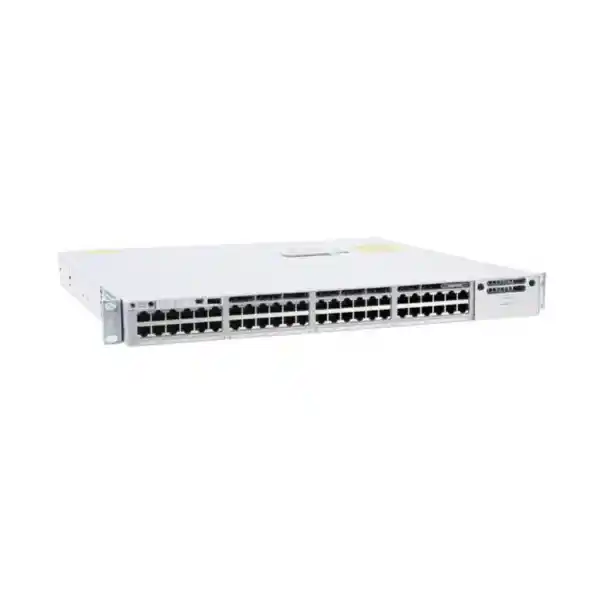
Cisco Catalyst C9300L-48T-4X Network Switch
A 48-port data-only Catalyst 9300L access switch with four fixed 10G/1G SFP+ uplinks, Cisco IOS XE, StackWise-320 capability and enterprise-grade security, segmentation, automation and operational visibility for modern UAE campus and branch networks.
4 × 10G/1G SFP+ fixed uplinks
176 Gbps switching capacity
130.95 Mpps forwarding rate
320 Gbps StackWise technology class
350W AC default power supply
What the Cisco Catalyst C9300L-48T-4X Is Designed to Do
The Cisco Catalyst C9300L-48T-4X is built for organizations that need a predictable, high-density wired access layer without Power over Ethernet. Its 48 copper access interfaces provide standard 10/100/1000 Mbps connectivity for desktops, workstations, printers, servers, storage interfaces, security appliances, building systems, industrial controllers, uplinked small switches and other powered endpoints. Four fixed SFP+ interfaces provide a straightforward path to 10 Gigabit Ethernet aggregation, typically using fiber toward a distribution or core layer, or direct-attach connectivity where distance and platform compatibility permit. Because the uplinks are fixed rather than modular, the switch is particularly attractive when the required uplink design is already known and four 10G ports provide adequate headroom for the intended access block.
The platform belongs to Cisco’s Catalyst 9300 family and runs Cisco IOS XE, placing it in the same operational ecosystem used across many enterprise campus networks. That matters for UAE organizations with existing Cisco standards because configuration models, security controls, software operations, telemetry, automation workflows and troubleshooting practices can remain consistent across sites. A branch office in Dubai, a headquarters floor in Abu Dhabi, a warehouse in Jebel Ali, a school campus in Sharjah or a hospitality property in Ras Al Khaimah can use a common switching design while adapting port density, uplink optics, licensing and redundancy to each site.
This is specifically the data-only 48-port model. It does not provide PoE, PoE+ or UPOE on its user-facing interfaces. That distinction is important during bill-of-material preparation. If an access closet must directly power IP phones, Wi-Fi access points, surveillance cameras, access-control readers or other IEEE-powered devices, the C9300L-48T-4X should not be substituted for a PoE-capable C9300L variant merely because the port count and uplink count appear similar. For environments where powered endpoint requirements are handled separately, however, the non-PoE design can be a clean and efficient choice.
Why 48 Data Ports Matter
A 48-port access switch can consolidate a full office floor, rack row or department into a single managed switching unit while preserving structured cabling discipline. For organizations using separate PoE switches for phones and wireless infrastructure, the C9300L-48T-4X can concentrate user PCs, printers, servers, out-of-band appliances and fixed wired devices. That separation can simplify power budgeting and reduce the need to purchase high-wattage PoE power supplies where endpoint power is unnecessary. The design also provides useful density for server-room management networks, laboratory environments and legacy copper estates where Gigabit Ethernet remains the appropriate edge speed.
Why Four 10G Uplinks Matter
Four fixed SFP+ uplinks allow architects to build resilient northbound connectivity without consuming user ports. Common designs include two 10G links in an EtherChannel toward a distribution pair, dual independent uplinks with spanning-tree or routed access control, or additional 10G connections for specialized services. The ability to operate the fixed uplink ports at 10G or 1G also supports staged migrations where older aggregation equipment is replaced over time. Correct optical selection remains essential: transceiver type, wavelength, fiber mode, connector type, link distance and Cisco compatibility should all be matched to the actual physical path.
Verified Hardware and Performance Profile
| Access interfaces | 48 × 10/100/1000 Mbps copper data ports |
| Uplink interfaces | 4 × fixed 10G/1G SFP+ ports |
| Base switching capacity | 176 Gbps |
| Switching capacity with stacking | 496 Gbps |
| Base forwarding rate | 130.95 Mpps using 64-byte IPv4 packets |
| Forwarding with stacking | 369.05 Mpps |
| Memory | 8 GB DRAM and 16 GB flash for the Catalyst 9300L/LM fixed-uplink class |
| Packet buffer | 16 MB for 24- and 48-port Gigabit Ethernet C9300L/LM models |
| MAC address scale | 32,000 |
| IPv4 route scale | 32,000 total, including 24,000 direct and 8,000 indirect routes |
| IPv6 routing entries | 16,000 |
| Multicast routing scale | 8,000 |
| QoS / ACL scale | 5,120 QoS entries and 5,120 ACL entries |
| Flexible NetFlow scale | 64,000 flows for 24- and 48-port Gigabit Ethernet C9300L/LM models |
| VLAN IDs / SVIs | 4,094 VLAN IDs and up to 1,000 switched virtual interfaces |
| Jumbo frame size | 9,198 bytes |
| Default power supply | PWR-C1-350WAC-P, 350W AC; no PoE budget |
| Approximate weight | 15.41 lb / 7.0 kg |
| Published MTBF | 380,080 hours for C9300L-48T-4X |
Switching Architecture, Forwarding Capacity and Real-World Headroom
A switch should be sized on more than port count. The C9300L-48T-4X publishes 176 Gbps of switching capacity and 130.95 million packets per second of forwarding performance in its standalone configuration. Cisco specifies wire-speed nonblocking performance for the Catalyst 9300 family in both IPv4 and IPv6, while the forwarding figures are measured with 64-byte IPv4 packets. For architects, this means the platform is designed to move traffic across its supported interfaces without relying on oversubscription inside the switching fabric under the published operating model. At the access layer, where dozens of 1G endpoints typically converge onto 10G northbound links, these figures provide a meaningful foundation for predictable throughput.
The more important design question is where congestion will actually occur. Forty-eight users do not generally transmit at 1 Gbps continuously, and most office traffic is bursty. A pair of 10G uplinks in a port-channel can therefore support a substantial access population, especially when local traffic remains within the same VLAN or switching block. Workloads such as engineering file transfer, backup windows, video production, virtual desktop infrastructure, scientific data transfer or dense east-west server traffic can change that assumption. In such environments, designers should measure sustained and peak utilization, packet rate, application sensitivity and growth rather than applying a generic oversubscription ratio.
The four 10G/1G SFP+ uplinks provide useful flexibility for resiliency and load distribution. Two or more uplinks can participate in EtherChannel where the upstream design supports it. Cross-stack EtherChannel can also be relevant when multiple C9300L switches operate as a logical stack, because member diversity can reduce the impact of a single switch or link failure. Link aggregation does not make every individual flow run at the sum of all member speeds; traffic distribution follows hashing behavior. For capacity planning, FourTeck recommends evaluating the number of large flows, the mix of source and destination addresses, and the distribution algorithm alongside the raw aggregate bandwidth.
Packet buffer size is another operational factor. The 48-port Gigabit C9300L class uses a 16 MB packet buffer. Buffering can absorb transient bursts, but it does not replace correct bandwidth engineering. Persistent oversubscription should be corrected by adding uplink capacity, distributing traffic, shaping specific sources, applying well-designed QoS or moving bandwidth-intensive workloads to a more appropriate topology. This is especially important when low-latency collaboration, voice transit, control systems or business-critical application traffic share the same uplinks with large data transfers.
StackWise-320: Resilient Access Without Treating Every Switch as an Island
The Catalyst C9300L family supports StackWise-320 through the appropriate C9300L stack kit and stack cables. In practical terms, stacking allows multiple physical switches to operate with a unified control and management model, reducing the number of independently administered devices in a wiring closet. Cisco publishes 496 Gbps switching capacity and 369.05 Mpps forwarding rate for the C9300L-48T-4X when stacking is included. The platform class supports up to 416 routed ports per Catalyst 9300L stack, a figure that illustrates its suitability for relatively large access blocks when architecture and licensing are correctly planned.
Stacking is particularly useful in UAE campus deployments where resilience must be achieved without constructing a full independent routing design for every access switch. Member switches can be distributed across patch-panel groups while sharing one logical configuration domain. Uplinks can be placed on different stack members so that a single member failure does not necessarily remove all upstream connectivity. Similarly, user VLANs and access policies can be standardized across the stack, reducing configuration drift between neighboring units. Operational teams gain a more consolidated view of interfaces, software state and topology.
The physical stack must be treated as infrastructure, not an accessory added after installation. Correct stack adapters, cable lengths, physical routing, rack placement and ring topology should be planned before deployment. Cable tension and service access matter in dense racks. If switches are separated across distant cabinets, standard StackWise cabling may not be the right architecture; a routed or fiber-based distribution design can be more appropriate. Stack members should also be aligned on supported software and configuration requirements before joining a production stack.
A critical distinction is that C9300L stacking should not be confused with Cisco StackPower. Cisco’s current Catalyst 9300 documentation restricts StackPower to modular-uplink C9300 and C9300X SKUs. Therefore, a C9300L-48T-4X design should treat each chassis power system independently. If power redundancy is required, specify the appropriate redundant power-supply approach for the chassis and provide UPS-backed feeds according to the site’s electrical strategy. This distinction prevents a common procurement error in which data-stack capabilities are incorrectly assumed to imply shared stack power.
MAC, Route and VLAN Scale
The fixed-uplink C9300L/LM class supports 32,000 MAC addresses, 32,000 total IPv4 routes, 16,000 IPv6 routing entries, 8,000 multicast routes, 4,094 VLAN IDs and 1,000 SVIs. These values are generous for conventional access-layer use, but they should still be mapped to the intended architecture. Large routed-access designs, many VRFs, dense IoT estates or unusually large Layer 2 domains can consume resources differently from a standard office deployment. Route scale should also be considered alongside licensing because advanced routing features may require Network Advantage rather than Network Essentials.
ACL, QoS and Flow Visibility
The platform class provides 5,120 ACL entries, 5,120 QoS scale entries and up to 64,000 Flexible NetFlow entries on 24- and 48-port Gigabit Ethernet models. These resources matter when the switch participates in segmentation, security enforcement, classification and traffic visibility. Access control policy should be designed deliberately rather than by accumulating exceptions. QoS policy should classify only traffic that needs differentiated treatment, preserve markings where appropriate and avoid making every application “high priority.” Flexible NetFlow can support capacity analysis and incident investigation when collectors, templates and retention are properly planned.
Cisco IOS XE: Operational Consistency for Enterprise Switching
Cisco IOS XE provides the software foundation for the Catalyst 9300L platform. For enterprise teams, the value is not simply a familiar command-line interface. IOS XE supports programmable operations, structured telemetry, model-driven interfaces and modern software lifecycle practices while retaining the network behaviors and control-plane features expected in a Catalyst campus environment. This combination allows organizations to automate repetitive changes without abandoning well-understood routing, switching and security concepts.
Configuration standards become particularly important when dozens or hundreds of switches are deployed across branches. A baseline can define management access, AAA, NTP, DNS, logging, SNMP or telemetry, interface templates, VLAN policy, spanning-tree behavior, QoS, DHCP snooping, device tracking, 802.1X, routing, syslog destinations and configuration backup practices. Automated validation can then confirm that switches continue to match the intended state. Teams using APIs or orchestration platforms should maintain the same governance expected for traditional configuration: peer review, staged deployment, rollback planning, secure credential handling and change records.
Software selection is also a design decision. A version should be chosen based on Cisco’s supported release guidance, feature requirements, security advisories, bug exposure and interoperability with the rest of the network. Upgrading just because a newer image exists is not an adequate strategy, nor is leaving access switches permanently on an old release. Organizations should define maintenance windows, laboratory validation, upgrade sequencing and rollback procedures. Stacked switches need additional consideration because the maintenance behavior affects multiple access ports simultaneously.
For UAE businesses that want help integrating switching with broader network operations, FourTeck’s IT Services UAE practice can align access switching, addressing, VLAN design, routing, monitoring, documentation and support processes as one operational system rather than treating the switch as an isolated hardware purchase.
Network Essentials vs Network Advantage: License for the Architecture You Actually Need
The C9300L-48T-4X can be ordered in licensing variants that align with Cisco’s feature tiers. The underlying physical switch remains a 48-port data-only platform with four fixed 10G/1G SFP+ uplinks, but software capability changes according to the selected network license. Cisco lists fundamental Layer 2 and routed-access functions within Network Essentials, including features such as RIP, EIGRP Stub, limited-scale OSPF, policy-based routing, private VLANs, VRRP, QoS, first-hop security, 802.1X, MACsec-128, Control Plane Policing, SXP and related access features. This tier can be appropriate for straightforward enterprise access designs where advanced routing and segmentation are not required.
Network Advantage expands the design envelope. Cisco associates advanced switching and routing functions such as BGP, broader EIGRP and OSPF capabilities, HSRP, IS-IS and additional multicast control features with the higher tier. It also enables advanced segmentation technologies including VRF, VXLAN, LISP, Cisco TrustSec, Security Group Tags, MPLS and mVPN. The practical implication is that licensing must be selected from the intended topology, not from a generic “standard versus premium” assumption.
For a traditional Layer 2 access closet with VLAN trunks toward a distribution layer, Network Essentials may cover the technical requirement. For routed access, complex segmentation, fabric designs, advanced dynamic routing or organizations standardizing on TrustSec-based policy, Network Advantage may be necessary. Procurement teams should specify the exact desired part-number suffix and current subscription requirements rather than ordering a bare base model and assuming all feature sets are interchangeable.
FourTeck recommends building a feature matrix before quotation. List routing protocols, route scale, first-hop redundancy, segmentation model, identity integration, telemetry, automation, assurance and management platform. That matrix can be mapped to Cisco licensing and software requirements so the bill of materials reflects the actual network intent. This approach is especially useful for multi-site UAE deployments where headquarters, branch, warehouse and guest environments may require different feature depth.
Security at the Wired Access Edge
The wired access layer is a security enforcement point because it is where users, endpoints, printers, appliances and unmanaged devices physically enter the network. The C9300L-48T-4X supports enterprise security controls that can help authenticate endpoints, restrict unauthorized services, reduce spoofing and apply policy close to the source. 802.1X can integrate switch ports with an identity service so access is based on user or device credentials rather than simply the presence of a cable. Where 802.1X is not practical, MAC-based or alternative onboarding methods may be used according to policy, but exceptions should be documented and monitored.
First-hop security features are equally important. DHCP snooping can establish trusted and untrusted interfaces and build bindings that support protections against rogue DHCP behavior. Dynamic ARP Inspection and IP Source Guard can use validated endpoint information to reduce certain spoofing attacks. Port security, storm control, BPDU Guard, Root Guard and carefully chosen spanning-tree settings can protect the access topology from accidental or malicious Layer 2 disruptions. These controls work best as part of an integrated template rather than as isolated commands applied reactively after incidents.
MACsec-128 capability in the fundamental feature set can help protect Ethernet links in supported designs by encrypting frames between capable peers. Whether MACsec is required depends on the threat model, link type, transceiver support, neighboring device and operational complexity. It may be valuable for high-sensitivity uplinks crossing shared pathways or untrusted facilities, but it should be validated end to end before rollout. Security features can affect forwarding behavior, troubleshooting and interoperability, so design testing remains important.
The switch is not a replacement for a next-generation firewall. It enforces access and segmentation controls inside the LAN, while perimeter and inter-zone inspection still belong to the security architecture. Organizations modernizing campus access alongside firewall policy can reference FourTeck’s Firewall Dubai practice to coordinate VLAN boundaries, routed interfaces, security zones and north-south controls without creating unnecessary policy duplication.
Segmentation Strategy
Segmentation should follow business and security requirements, not merely organizational charts. Typical groups include corporate users, privileged administration, servers, printers, building systems, CCTV infrastructure, guest services, voice, wireless management and vendor devices. VLANs provide Layer 2 separation, while VRFs, TrustSec or fabric technologies can provide broader policy boundaries where licensed and architected. The C9300L-48T-4X can participate in these designs, but the right model depends on which advanced features are required and whether the switch is intended to operate at Layer 2, routed access or as part of a software-defined fabric.
Control-Plane Discipline
Access switches should have protected management planes. Restrict SSH and API access to dedicated administration networks, use centralized AAA, disable unused services, synchronize time, export logs, protect credentials and maintain configuration backups. Control Plane Policing helps protect the device CPU from excessive control traffic. Routing adjacencies, if used, should be authenticated where supported and filtered to the minimum necessary prefixes. Infrastructure ACLs can further reduce exposure. These practices are more valuable than relying on obscurity or assuming internal networks are inherently trusted.
Uplink Optics, Fiber Design and 10 Gigabit Aggregation
The four fixed SFP+ uplinks are a defining characteristic of the C9300L-48T-4X. They support 10G or 1G operation with appropriate transceivers, giving the switch a cleaner aggregation profile than the 4G variants that provide only 1G fixed uplinks. The uplink choice should begin with the physical medium. Multimode fiber is common inside buildings and campuses where distances are moderate and existing OM3 or OM4 infrastructure is available. Single-mode fiber is typically selected for longer inter-building links, future distance flexibility or sites standardizing on OS2 cabling. Copper direct-attach cables can be suitable for short in-rack or adjacent-rack links where supported by both devices.
Optics cannot be selected by speed alone. A 10G SFP+ part must match wavelength, fiber mode, connector type and reach. Both ends of the link require compatible optical standards. Patch panels, couplers, splice loss, dirty connectors and excessive bends can reduce optical margin even when nominal distance is within specification. For long or mission-critical links, recording transmit and receive optical levels at commissioning provides a baseline that can accelerate future troubleshooting. Spare optics should match the installed standard, not simply the chassis model.
Resilient distribution commonly uses links toward two upstream switches. If the upstream pair operates as a logical system or supports multichassis link aggregation, the access stack can often use a port-channel that spans physical upstream members. In other designs, routed uplinks with equal-cost paths may provide better fault isolation. Traditional spanning-tree topologies remain valid but must be designed so root placement, blocked links and failure convergence are intentional. The C9300L-48T-4X can participate in each approach, but the broader network architecture determines which is appropriate.
Four uplinks also create room for phased modernization. A site can initially use two 10G links, reserving the remaining ports for future distribution connectivity, dedicated services or migration. The planning discipline is to document which uplinks are production, standby, aggregated, routed or reserved. Unused optical ports should remain administratively controlled, and installed transceivers should be included in asset records because optics are frequently the hidden cause of mismatched bills of materials.
Power, Cooling, Rack Design and UAE Environmental Planning
Cisco specifies a 350W AC default power supply for the C9300L-48T-4X and explicitly lists no PoE budget for this model. Because user ports do not supply endpoint power, electrical planning is focused on switch operation rather than aggregate device wattage. This can simplify closet power design when endpoints are self-powered, but it does not eliminate the need for redundancy. Critical sites should consider secondary power-supply strategy, independent UPS-backed feeds where available, rack PDU capacity and electrical maintenance procedures. The switch power design should align with the availability target for the room, not merely the nominal wattage on the label.
The chassis uses three field-replaceable fans and supports N+1 fan redundancy. Airflow must remain unobstructed. Cable managers, bundled patch cords, blanking panels and neighboring equipment should be arranged so that intake and exhaust paths remain clear. In UAE environments, ambient heat and dust make mechanical-room quality especially important. Network closets should be conditioned spaces with maintained cooling, controlled humidity and appropriate filtration. A reliable switch cannot compensate for a room that repeatedly exceeds environmental limits or collects conductive dust.
The chassis is 1RU high and approximately 17.5 inches wide. Cisco lists the C9300L-48T-4X at about 15.41 lb or 7.0 kg, and the published depth varies depending on power-supply configuration. With the default supply, planning around roughly 17.7 inches of depth is prudent, while cable bend radius and rear access require additional clearance. Racks should not be sized exactly to chassis depth. Leave space for stack cables, power cords, fiber management and technician access.
For new facilities, the switching bill of materials should be coordinated with rack, UPS, PDU, patch-panel and server infrastructure. FourTeck’s Server Dubai practice can help align rack-level compute, switching, power and structured connectivity so that the access switch is installed into an infrastructure design with adequate space, cooling and serviceability.
High Availability: Designing Beyond a Single Chassis
High availability at the access layer is the result of multiple design decisions. A switch can have redundant fans and optional power resiliency yet still be a single point of failure if all uplinks terminate on one upstream device. Conversely, dual uplinks provide limited protection if the switch itself is the only chassis serving a critical department. The C9300L-48T-4X supports stack-based designs that can distribute endpoint and uplink connectivity across multiple members. This enables architectures where an individual switch failure affects only the directly attached endpoints on that member rather than the entire access block.
Cross-stack EtherChannel is especially useful when uplink members are placed on different stack switches. A cable, transceiver or member failure can then leave another path active. The upstream topology must support the selected aggregation method and failure behavior. Engineers should test actual convergence, not only diagram it. Pull one uplink, reboot one member, remove power from an upstream switch and observe application impact. For sensitive environments, measure interruption time and confirm that routing, spanning tree, link aggregation and application timeouts behave as expected.
Power redundancy also needs physical diversity. Installing two supplies into one device does not achieve the intended result if both power cords connect to the same non-redundant PDU or UPS. Where infrastructure permits, feeds should originate from appropriately independent protected sources. Maintenance bypass arrangements, generator coverage and UPS runtime should be documented. In smaller offices, absolute electrical independence may not be possible, but the limitation should be known rather than assumed away.
Finally, configuration resilience matters. Maintain current backups, track software images, record stack member priorities, document interface labels and keep spare transceivers and stack components appropriate to the installed design. A failed component becomes a long outage when the replacement path is unclear. High availability therefore includes operational preparation, not just hardware redundancy.
Where the C9300L-48T-4X Fits Best
Corporate Office Floors
Ideal for dense user data connectivity where phones and APs are powered by separate infrastructure or connected to dedicated PoE switches. Forty-eight Gigabit ports can support desktops, printers, docking stations, room controllers and administrative devices while dual or aggregated 10G uplinks provide resilient distribution connectivity.
Server and Management Networks
Useful for 1G management interfaces on servers, hypervisors, storage systems, UPS units, KVMs, console servers and appliances. The data-only design avoids paying for unused PoE capacity, while 10G uplinks provide aggregation headroom toward the management core or services layer.
Education and Training Labs
Computer labs often require many wired Gigabit ports but little or no endpoint power. VLAN segmentation can separate student, instructor, administration and laboratory traffic, while stacking can consolidate multiple high-density rooms under a consistent operational model.
Warehouses and Industrial Offices
Suitable for powered terminals, workstations, controllers and local IT devices when the closet is environmentally controlled. Fiber uplinks can bridge longer distances to the main distribution layer while preserving electrical isolation between buildings where the optical design is appropriate.
Government and Regulated Sites
The platform’s 802.1X, first-hop security, ACL, QoS, telemetry and advanced segmentation options can support disciplined access-control architectures. Procurement should map exact license requirements and approved software versions to organizational standards before ordering.
Hospitality Back-of-House
A strong fit for non-PoE back-office systems, property-management endpoints, administrative PCs and wired service equipment. Guest Wi-Fi APs and IP phones should remain on appropriate PoE switching if direct power delivery is required.
When This Is the Wrong Model
The C9300L-48T-4X is not the correct choice when the access switch must power endpoints. A 48-port IP phone deployment, Wi-Fi access layer, CCTV floor or IoT environment commonly depends on PoE. In those cases, a PoE-capable Catalyst 9300L model should be evaluated with enough power budget for the actual device mix. Counting PoE ports is not sufficient: engineers must calculate endpoint wattage, simultaneous draw, reserve margin, power-supply redundancy and growth. A non-PoE switch plus midspan injectors can technically power some devices, but widespread injector use often adds cabling complexity and more points of failure.
The model may also be too limited when multigigabit copper is required. Modern high-performance Wi-Fi access points and certain workstations can exceed 1 Gbps on the wired side, creating demand for 2.5G, 5G or 10G copper access. The C9300L-48T-4X provides standard Gigabit Ethernet on its 48 access ports. If multigigabit edge speeds are required, another Catalyst model should be selected rather than assuming the 10G SFP+ uplinks make user ports multigigabit.
The fixed-uplink design can also be restrictive for organizations that expect to change uplink media or speed substantially. The four SFP+ ports are excellent when 10G/1G fiber is the planned standard, but they are not modular uplink bays. Environments anticipating 25G, 40G or other uplink transitions may benefit from a different Catalyst platform with the required interface flexibility. Future bandwidth planning should therefore be part of the purchase decision.
Finally, organizations that require shared StackPower should not choose C9300L on the assumption that StackWise data stacking includes power pooling. Cisco documents StackPower for modular-uplink C9300 and C9300X models, not C9300L. If power pooling is a mandatory architectural requirement, the switch family selection must reflect that requirement from the start.
Sizing Methodology for UAE Campus and Branch Deployments
A reliable switch quotation begins with endpoint inventory. Count active wired devices by function: corporate users, printers, servers, appliances, building systems, cameras, access points, phones, meeting-room devices and reserved ports. Separate devices that require PoE from those that do not. The C9300L-48T-4X should serve the non-PoE population unless external power is intentionally part of the design. Apply a growth reserve to account for desk additions, new rooms and service expansion. A closet that needs 46 ports on day one has little practical room for changes even though it technically fits within 48 ports.
Next, characterize bandwidth. Identify internet-facing usage, local server access, backup traffic, collaboration, CAD or media workflows and any sustained high-volume transfers. Determine whether two 10G uplinks provide adequate redundancy and capacity or whether all four uplink ports are needed. Remember that aggregated links distribute flows; they do not merge into one single-flow channel. For branch sites, WAN bandwidth may be the limiting factor, while in campus environments east-west traffic and local data centers can drive higher uplink demand.
Then define Layer 2 and Layer 3 boundaries. Decide whether the switch will operate primarily as Layer 2 access, host SVIs locally, participate in routed access or join a more advanced fabric. This directly affects license selection, routing scale, redundancy protocols and configuration complexity. Build VLAN and subnet plans before switch deployment so port templates can be created consistently. If 802.1X or identity-based access is planned, include authentication infrastructure, endpoint supplicants, certificate requirements and fallback policy in the project scope.
Finally, size operations. Determine who will monitor the switches, how logs are retained, what alert thresholds matter, how configurations are backed up, how software is upgraded and what spare strategy exists. A technically capable switch can still become difficult to manage if operational ownership is unclear. FourTeck’s UAE main site can serve as the starting point for broader network procurement, implementation and support requirements across switching and adjacent infrastructure.
For multi-site projects, repeat this sizing exercise per site category instead of copying one bill of materials everywhere. Headquarters, branch, warehouse and retail locations often have different endpoint density, rack conditions, uplink distance and redundancy needs. Standardization is valuable, but it should standardize validated patterns rather than force every site into the same hardware regardless of requirement.
Layer 2 Design: VLANs, Spanning Tree and EtherChannel
In a traditional campus design, the C9300L-48T-4X commonly operates as an access switch with user VLANs extending toward distribution. VLAN assignment should correspond to security and operational boundaries. Native VLANs should be controlled, unused VLANs should not be allowed broadly on trunks and unused ports should be shut down or placed into an isolated state according to policy. Trunk allowed lists can reduce accidental Layer 2 extension and make troubleshooting easier because every VLAN has an intentional path.
Spanning Tree remains important even when links are aggregated. Organizations should choose the appropriate STP mode, define root placement at the distribution layer and protect edge ports with BPDU Guard where applicable. Root Guard can prevent unexpected root election in selected parts of the topology. Loop Guard and UDLD can add protection in suitable designs. The objective is deterministic behavior: when a link fails or a loop is introduced, engineers should already know which path becomes active and which protection mechanism reacts.
EtherChannel groups multiple physical links into one logical interface, improving aggregate capacity and providing member-level redundancy. LACP is often preferred because it negotiates bundle participation and can identify mismatched links. Configuration must be consistent across members, including speed, trunking, allowed VLANs and other relevant attributes. A misconfigured port-channel can create forwarding problems that are harder to diagnose than a simple single uplink. Documentation should record which physical interfaces belong to each logical channel and where they terminate upstream.
In a stack, cross-stack EtherChannel can spread uplink members across different physical C9300L switches. This improves resilience because a single stack-member failure does not necessarily remove the full logical uplink. Endpoint connections can also be distributed across members for critical systems when host-side teaming supports it. The architecture should be validated with actual failover tests because application behavior and upstream topology can introduce dependencies not visible in the switch configuration alone.
Layer 3 and Routed Access Considerations
Routed access can reduce Layer 2 failure domains by placing Layer 3 boundaries closer to users. The C9300L family has meaningful route scale, but the available routing features depend on licensing. Network Essentials covers fundamental routed-access capabilities, while Network Advantage introduces advanced protocols and larger design flexibility. Before using the C9300L-48T-4X as a routed access device, engineers should decide which protocol will carry reachability, how default routes are originated, where route summarization occurs and how first-hop gateway services are delivered.
OSPF is common in enterprise campus designs, but route scale and feature depth differ by license tier. EIGRP, BGP or IS-IS may be selected in environments with established standards or more advanced topology requirements. The best protocol is the one that fits the organization’s design and operations model, not the one with the longest feature list. Fast convergence should be balanced against stability; aggressive timers can create additional control-plane load or sensitivity to transient events.
SVI count and route table size should be tracked as the network grows. The platform class supports up to 1,000 SVIs and 32,000 total IPv4 routes, but an access switch rarely needs to approach these numbers. Excessive segmentation without a clear policy can increase operational complexity. A smaller number of well-defined network zones often provides better security and supportability than hundreds of poorly documented VLANs.
Where VRFs are required for stronger routing separation, verify Network Advantage requirements and end-to-end support. VRFs can isolate management, corporate, guest, operational-technology or tenant traffic, but they also affect routing, firewall policy, monitoring and troubleshooting. Route leaking between VRFs should be explicit and controlled. The switch configuration, upstream routing and firewall architecture must therefore be designed together.
QoS Engineering for Mixed Business Traffic
Quality of Service is most valuable when it protects sensitive traffic during contention. On a lightly loaded access switch, elaborate QoS policy may have no visible effect. During congestion, however, classification, marking, queueing and policing determine which packets experience delay or loss. The C9300L platform provides enterprise QoS capability and a published scale of 5,120 QoS entries for the fixed-uplink class. This supports sophisticated policy, but sophistication should not become complexity for its own sake.
A practical policy starts by identifying real service classes. Voice signaling, real-time media, business-critical transactions, network control, standard data and scavenger traffic may warrant different treatment. Trust boundaries should be explicit. A switch should not blindly trust every DSCP value from user endpoints, because misconfigured or malicious devices could mark ordinary traffic as high priority. Markings can be trusted from validated phones, infrastructure devices or controlled applications while user traffic is remarked according to policy.
Queue allocation should reflect measured traffic. Giving too much bandwidth to priority queues can starve normal applications, while giving too little can undermine voice and video quality. Large backup flows may be scheduled or shaped so they do not dominate uplinks during business hours. When upstream WAN links are much slower than campus uplinks, WAN edge QoS frequently has a greater impact than access switching QoS, but access classification still establishes the markings used later in the path.
QoS should be documented end to end. Record which devices mark traffic, which interfaces trust markings, how classes map to queues and where policing occurs. During troubleshooting, verify counters rather than assuming policy is working because the configuration is present. Application owners should be involved in identifying business-critical traffic so technical prioritization corresponds to actual service importance.
Telemetry, Flexible NetFlow and Troubleshooting Visibility
Operational visibility is one of the major benefits of deploying a managed enterprise switch instead of basic unmanaged access hardware. The C9300L fixed-uplink class supports up to 64,000 Flexible NetFlow entries on Gigabit Ethernet models. Flow telemetry can show which hosts communicate, how much traffic they generate, which protocols dominate and where unusual patterns emerge. This information supports bandwidth planning, incident response and application troubleshooting. The collector architecture should be sized for the number of switches, exported records and retention period.
Interface counters remain equally valuable. Errors, drops, discards, link flaps, duplex anomalies and optical diagnostics often reveal physical problems before users can describe them clearly. Baseline healthy ports so that abnormal behavior is easier to identify. For fiber uplinks, monitor optical receive levels when supported. For copper ports, investigate rising CRC or input errors, especially after cabling changes. Replacing switches without first examining counters can waste time when the actual fault is a patch lead, transceiver, fiber connector or upstream interface.
Centralized logging and time synchronization are essential for event correlation. All switches should use reliable NTP, send logs to a collector and use consistent device names and interface descriptions. When a user reports a brief outage at a specific time, correlated logs from access switch, distribution, firewall, wireless and authentication systems can reveal whether the event was a port flap, spanning-tree transition, authentication failure or upstream path change.
Model-driven telemetry and automation can add richer monitoring than periodic polling, especially in large estates. The goal should be actionable visibility rather than collecting every metric indefinitely. Define thresholds for uplink utilization, CPU, memory, stack health, temperature, fan status, power state, interface errors and authentication failures. Tie alerts to clear ownership and response procedures so monitoring results in faster resolution instead of a growing queue of ignored notifications.
Deployment Workflow: From Receiving to Production
A controlled deployment starts before the switch is powered on. Verify the received part number, license tier, power supplies, stack kits, rack hardware, SFP/SFP+ optics and cables against the approved bill of materials. Record serial numbers and asset tags. Inspect packaging and hardware for damage. Confirm that the rack location has adequate power, cooling and patch capacity. If the switch will join a stack, decide member numbering, stack priority and physical cable topology before installation.
During staging, load the approved Cisco IOS XE release and apply the organization’s baseline configuration. Configure secure management, AAA, NTP, logging, management addressing and infrastructure services first. Then apply VLAN, trunk, access-port, routing, QoS and security templates. Do not copy an old configuration blindly from a different model. Interface numbering, hardware capabilities and licensing can differ. Validate the running configuration against the design document and run preproduction tests before shipment to site where possible.
At installation, label every uplink, stack cable, power feed and significant patch connection. Verify link speed and duplex, optical type, LACP state, spanning-tree role, routing adjacency and gateway reachability. Test management access from the approved network. Confirm that monitoring systems discover the new switch and that logs reach the collector. If 802.1X is used, test both compliant and exception endpoints. If ACLs or segmentation are applied, validate permitted and denied traffic with actual test cases.
Before handover, simulate at least the most important failures. Disconnect one uplink, restart a stack member where the change window permits, verify redundant power behavior if configured and confirm that application traffic follows the expected alternate path. Capture the final configuration, software version, serial numbers, stack membership, optics, IP addresses and rack location. Update diagrams so operations staff receive an accurate as-built record rather than only the original design.
The completed handover should also include support ownership, escalation contacts, warranty or support entitlement details and spare strategy. In a multi-site environment, standard commissioning checklists produce more consistent outcomes than relying on each technician’s preferred sequence.
UAE Procurement Considerations
Enterprise switch procurement in the UAE should distinguish between the hardware model, software entitlement, support coverage and accessories. “C9300L-48T-4X” describes the physical platform family, but the complete order can include Network Essentials or Network Advantage variants and may have subscription or management components depending on the selected Cisco commercial model. Ask for the exact ordered SKU rather than comparing quotations only by the base chassis name.
Optics and stacking are common sources of quotation mismatch. One vendor may quote the chassis alone while another includes four SFP+ modules, stack kits, redundant power supplies and longer support. The lower line-item price may therefore produce a more expensive complete project. A technically normalized comparison should list access switch, license, power supplies, stack accessories, transceivers, patch leads, support coverage, rack hardware and professional services separately.
For imported infrastructure, lead time matters. If a site opening depends on a specific switch and optic combination, verify supply availability early and consider approved alternatives before the installation date. Standardize spare transceivers and stack components across sites where practical. Maintaining one spare access switch for a large installed base can reduce outage duration, but the spare must have compatible licensing, software and accessories.
Warranty and Cisco support entitlement should be matched to business criticality. A switch serving a small noncritical office may tolerate longer replacement windows than a hospital, airline facility, financial institution or 24×7 operations center. Support decisions should therefore follow service impact and recovery objectives. FourTeck can structure UAE quotations so hardware, licensing, optics, stacking and service assumptions are visible rather than embedded ambiguously in one total.
Comparison Logic: C9300L-48T-4X vs Nearby Catalyst Choices
The closest alternatives are not simply “faster” or “slower”; each addresses a different requirement. A C9300L 48-port model with 4 × 1G fixed uplinks may suit low-bandwidth branches but provides much less northbound capacity than the 4X version. The C9300L-48T-4X is preferable when the access ports remain 1G but aggregation should be 10G. This is a common modernization path because structured copper cabling can stay in place while the distribution layer moves to higher-speed fiber.
A PoE-capable C9300L is the right comparison when phones, APs or cameras need switch-delivered power. The network architecture can remain similar, but the chassis power supply, PoE budget and thermal considerations change. Selecting the data-only model solely to save initial cost can become expensive if dozens of external injectors are later required. Conversely, buying PoE when almost no endpoints need it can add unnecessary cost and power-supply capacity.
A modular-uplink C9300 may be more appropriate when uplink flexibility or StackPower is important. Modular models can support different network modules and Cisco documents StackPower for that family. The tradeoff is typically higher platform cost and potentially different power and accessory requirements. Organizations with a stable 4 × 10G uplink design often choose C9300L because fixed uplinks simplify the bill of materials.
C9300X and newer higher-performance variants address environments demanding more uplink bandwidth, higher multigigabit density or advanced scale. They should not automatically replace a C9300L in standard office access deployments; excess capability can increase cost without improving user experience. The best switch is the lowest-complexity platform that meets port, bandwidth, power, resilience, feature and lifecycle requirements with appropriate headroom.
Detailed Design Example: 96-Port Office Access Block
Consider a UAE office floor requiring around 80 active wired data ports, none of which require PoE. Two C9300L-48T-4X switches provide 96 copper ports and leave capacity for growth. The two switches can be equipped with the appropriate StackWise-320 kit and operated as a logical stack. Endpoint ports can be distributed across both members, while uplinks are split so that one or more 10G connections originate from each physical switch. This reduces the likelihood that a single member failure removes all connectivity from the floor.
The uplink design might use two 10G links in a cross-stack LACP EtherChannel toward a resilient distribution pair, provided the upstream system supports the topology. The remaining SFP+ interfaces can be reserved for migration, monitoring or additional capacity. Alternatively, four 10G links can be bundled when traffic measurements justify the bandwidth and hashing behavior provides useful distribution. If routed access is preferred, each stack can use routed uplinks and participate in the chosen dynamic routing protocol.
Users can be separated into business VLANs based on policy, with printers and building devices placed into their own controlled segments. 802.1X authenticates managed endpoints, while approved exception workflows handle devices without supplicants. DHCP snooping and related first-hop security controls protect against common local spoofing scenarios. QoS preserves collaboration traffic during transient congestion. Flexible NetFlow and interface telemetry feed the monitoring platform so capacity and anomalies are visible.
The rack design includes separate power feeds where infrastructure permits, UPS protection, labeled stack cables and adequate rear clearance. The switches run the organization’s approved IOS XE release and configuration template. Before handover, engineers test a stack-member failure and an uplink failure, confirm remaining reachability and record convergence behavior. This example illustrates why a switch purchase should be treated as a small system design: chassis count, stacking, uplinks, licensing, segmentation, power and operations all contribute to the outcome.
If future wireless expansion will introduce many PoE access points on the same floor, those devices can remain on dedicated PoE switching or the access design can be refreshed with PoE-capable models. Making that decision in advance avoids consuming the data-only switch ports and then discovering an unexpected external power requirement.
Operations, Maintenance and Lifecycle Management
A Catalyst switch should enter production with an ownership model. Define who approves configuration changes, who monitors alerts, who performs software upgrades and who manages Cisco support cases. Device naming should reveal site and function without exposing sensitive information. Interface descriptions should identify endpoint type or upstream destination. Standardized descriptions reduce troubleshooting time because engineers can understand topology from configuration and monitoring tools without opening multiple spreadsheets.
Configuration backups should be automatic and versioned. A backup is valuable only if it can be found and restored. Keep records of startup configuration, running configuration, software image, ROMMON state where relevant, license information and stack member inventory. Before major changes, take a fresh backup and capture the current operational state. After changes, verify both functionality and saved configuration so an unexpected reboot does not revert the device.
Hardware health monitoring should include temperature, fan state, power-supply status, stack health, CPU, memory and interface errors. The C9300L-48T-4X has a published MTBF of 380,080 hours, but MTBF is a population reliability metric rather than a guarantee that an individual device will not fail. Operational resilience still depends on redundancy, spares and support. Fan or power alarms should be investigated promptly because a degraded system has reduced tolerance for the next failure.
Software lifecycle management should track Cisco security advisories and supported releases. Organizations should avoid both extremes: constant untested upgrades and indefinite stagnation. A sensible process stages candidate software in a lab or low-risk site, validates critical features, schedules maintenance and retains rollback options. Multi-member stacks deserve additional testing because software operations affect more ports at once.
At end of service, erase configurations and credentials according to policy before decommissioning hardware. Update asset records and network diagrams. Reclaim compatible optics, stack accessories and spare power supplies when they remain supported, but do not assume accessories from older Catalyst generations are interchangeable. Lifecycle discipline protects both security and capital investment.
Frequently Asked Technical Questions
Does the C9300L-48T-4X provide PoE?
No. It is a data-only model. Cisco lists a 350W AC default power supply and no PoE budget. Use a PoE-capable Catalyst model when the switch must power phones, access points, cameras or other powered devices.
How many uplinks does it have?
Four fixed SFP+ uplink ports supporting 10G or 1G. They are not modular network-module slots, so future uplink requirements should be considered before ordering.
Can the switch be stacked?
Yes. The Catalyst 9300L family supports StackWise-320 with the appropriate stack kit and cables. Cisco publishes 496 Gbps switching capacity and 369.05 Mpps forwarding for this model with stacking.
Does it support StackPower?
No. Cisco documents StackPower for modular-uplink C9300 and C9300X SKUs. C9300L can be data-stacked, but power should be designed independently per chassis.
What is the switching capacity?
Cisco publishes 176 Gbps standalone switching capacity and 130.95 Mpps forwarding rate for the C9300L-48T-4X, with higher aggregate values when StackWise is included.
Which license tier should I choose?
Use Network Essentials for fundamental switching and routed-access needs, and evaluate Network Advantage when advanced routing, VRF, VXLAN, LISP, TrustSec, SGT, MPLS or similar capabilities are required.
Can the 10G uplinks run at 1G?
Yes, Cisco specifies the fixed uplinks as 10G/1G SFP+. Select appropriate supported optics for the desired speed, fiber type, wavelength and distance.
Is it suitable for a server room?
Yes for 1G data and management connections where PoE is unnecessary. For high-throughput server production traffic requiring 10G or faster access interfaces, a higher-speed switching platform may be more appropriate.
Interoperability and Migration Planning
The C9300L-48T-4X is frequently introduced into environments that already contain older Catalyst switches or equipment from other vendors. Interoperability should be approached through standards and tested behavior. Ethernet, VLAN tagging, LACP, spanning tree, IP routing and standard optics provide a broad foundation, but vendor-specific extensions can differ. When connecting to third-party distribution switches, validate link aggregation mode, spanning-tree compatibility, transceiver support, routing timers and MTU settings before production cutover.
Migration from older 1G-uplink access switches is usually straightforward because endpoint cabling can remain Gigabit copper while uplinks move to 10G. The challenge is often not hardware but configuration. Legacy networks may have undocumented VLANs, broad trunk lists, static routes, obsolete ACLs and spanning-tree assumptions that accumulated over years. A migration is an opportunity to clean these items rather than copy them unchanged. Audit active VLANs, MAC addresses, neighbor tables and interface descriptions before removing the old switch.
For minimal downtime, stage the new switch or stack in advance. Preconfigure trunks, routing, management, security and endpoint templates. If rack space permits, install new hardware alongside the old switch and migrate patch cords in controlled groups. Validate each group before continuing. Critical endpoints should have identified rollback ports. For sites where physical access is limited, photograph and label patch panels before work begins so remote teams can understand the final state.
Migration to Meraki management is a separate architectural choice. Cisco’s current portfolio includes Meraki-mode options and migration paths for supported Catalyst 9300 models. Organizations considering cloud-managed operations should validate exact model compatibility, licensing, feature parity and workflow differences before conversion. A cloud management objective should not be assumed to preserve every IOS XE campus feature exactly as currently used.
Documentation Standards That Improve Supportability
Network documentation should be created as part of installation, not after the project is considered complete. For each C9300L-48T-4X, record site, room, rack, rack-unit position, serial number, management address, software release, license tier, stack member number, power-supply configuration and support entitlement. For each uplink, record local interface, remote device, remote interface, optic part number, fiber type and port-channel membership. This information allows a support engineer to understand the physical and logical path quickly.
Interface descriptions should follow a common syntax. A useful description identifies destination, service and sometimes circuit or patch-panel reference. Avoid meaningless labels such as “uplink1” when a more precise name can be used. Access ports connected to fixed infrastructure such as printers, CCTV recorders or building systems should also be documented. Dynamic user desks may use broader templates, but special exceptions should remain visible.
Diagrams should show stack membership, uplink diversity and Layer 3 boundaries. A logical diagram explains VLANs, routing and security zones, while a physical diagram shows racks, links and power. Combining every detail into one drawing often makes it unreadable. For large sites, maintain both. Revision control matters: a technically perfect diagram from two years ago can be more dangerous than no diagram if engineers assume it is current.
Change records should reference documentation updates. If an uplink is moved, a VLAN is retired or a stack member is replaced, update the as-built data during the same change window. This discipline reduces troubleshooting time and makes future refresh projects easier because engineers can trust the source material.
Pre-Quote Engineering Checklist
Ports and Endpoint Power
Count required copper ports, confirm that attached endpoints do not need PoE from this switch, and reserve reasonable growth capacity. If phones, APs or cameras require power, identify a PoE switching design instead of assuming external adapters will be acceptable.
Uplink Media and Reach
Specify 1G or 10G uplink speed, multimode or single-mode fiber, connector type, approximate distance and upstream switch model. Include transceivers and patch cords in the quotation so the chassis can be commissioned without missing optics.
Stacking
Define the number of C9300L members, physical rack arrangement and required stack cable lengths. Include C9300L stack kits where needed. Do not specify StackPower as a C9300L feature.
License Tier
List routing protocols, VRF, TrustSec, VXLAN, LISP, MPLS and other advanced requirements. Map them to Network Essentials or Network Advantage before the purchase order is issued.
Power and Resiliency
Confirm default and optional power-supply requirements, UPS feeds, redundant circuits where available, fan and cooling conditions, and how much downtime the site can tolerate during a hardware fault.
Support and Services
Define desired Cisco support coverage, installation scope, configuration, migration assistance, testing, documentation, remote support and onsite response expectations. Align commercial support with the actual business impact of an outage.
Why FourTeck for Cisco Catalyst Switching in the UAE
A switch purchase is most successful when the hardware, optics, software, licenses, rack design and implementation plan are engineered together. FourTeck approaches the Cisco Catalyst C9300L-48T-4X as an access-layer component inside a wider network rather than as a standalone box. That means confirming endpoint power requirements, uplink architecture, StackWise accessories, fiber standards, routing model and support expectations before finalizing the quotation.
For organizations operating multiple offices, FourTeck can help standardize repeatable access designs while preserving site-specific requirements. A headquarters may use stacked switches with dual 10G distribution paths, while a smaller branch may use one chassis with two uplinks. Both can share configuration templates, monitoring practices and documentation standards. This pattern reduces operational complexity without forcing every location to purchase identical hardware.
Procurement support also includes bill-of-material normalization. Cisco model names can look deceptively similar, especially across data-only, PoE, uplink and license variants. FourTeck can separate the chassis, license tier, power supplies, transceivers, stack kits and professional services so buyers understand exactly what is included. This is particularly important when comparing quotations from multiple sources.
For regional organizations expanding beyond the UAE, FourTeck’s Africa technology practice can support broader infrastructure standardization across selected markets while maintaining a consistent engineering baseline for switching, security and data-center connectivity.
Decision Recap: Is the C9300L-48T-4X Right for Your Network?
Choose the Cisco Catalyst C9300L-48T-4X when the requirement is a resilient enterprise access switch with 48 standard Gigabit Ethernet data ports, four fixed 10G/1G SFP+ uplinks, Cisco IOS XE, strong Layer 2 and routed-access capabilities, enterprise security controls and StackWise-320 support. It is particularly well matched to corporate user networks, computer labs, management networks, powered endpoint environments and branch or campus access blocks where direct PoE delivery is not required.
Its strongest technical advantages are predictable 1G access density, four high-speed uplinks, mature Catalyst software, stackability, substantial MAC and routing scale, Flexible NetFlow visibility, 802.1X and first-hop security, and the ability to select licensing appropriate to either fundamental or advanced campus designs. Cisco publishes 176 Gbps standalone switching capacity and 130.95 Mpps forwarding, with 496 Gbps and 369.05 Mpps figures when stacking is included.
Do not choose it when the switch must deliver PoE, when multigigabit user ports are required, when the uplink plan needs faster than 10G fixed SFP+ interfaces, or when Cisco StackPower is a mandatory requirement. Those needs point to other Catalyst variants. Making these distinctions before quotation avoids costly redesign during installation.
Quotation Input Checklist
To prepare an accurate UAE quotation for the Cisco Catalyst C9300L-48T-4X, provide the project team with the information below. Complete answers allow the bill of materials to include the correct licensing, optics, stacking and power components rather than only the base switch.
Number of switches, site names, rack locations and whether hardware is for new deployment, expansion, spare stock or replacement.
Approximate number of wired devices and confirmation that PoE is not required from these access ports.
Required 1G or 10G uplinks, upstream switch model, fiber type, link distance and desired redundancy.
Routing protocols, VRFs, TrustSec, advanced segmentation, assurance or other features that determine license tier.
Standalone or stacked deployment, number of members, rack layout and required stack cable lengths.
Redundant PSU expectations, UPS architecture, desired support level, installation and commissioning scope.
Plan the Switch, Optics, Licensing and Stack as One System
FourTeck can help validate whether the C9300L-48T-4X is the correct Catalyst platform for your UAE deployment, then prepare a normalized bill of materials covering software tier, SFP/SFP+ optics, stack kits, power redundancy, installation and support. This approach reduces mismatched accessories and ensures the switch is engineered for the intended topology rather than purchased on port count alone.
Confirm fiber type and distance
Confirm Essentials vs Advantage
Confirm standalone vs StackWise
Confirm redundant PSU strategy
Confirm Cisco support requirement

Reviews
There are no reviews yet.