
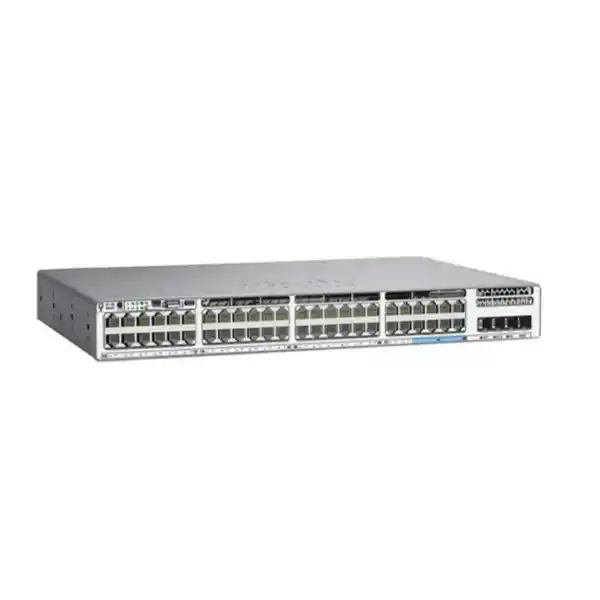
Cisco Catalyst C9300LM-48U-4Y Network Switch
A compact 48-port Cisco UPOE access-layer platform with four fixed 25G SFP28 uplinks, StackWise-320 scalability, a 790 W default PoE budget and Cisco IOS XE intelligence for branch, campus and distributed enterprise networks across Dubai and the UAE.
What the C9300LM-48U-4Y is designed to solve
The Cisco Catalyst C9300LM-48U-4Y addresses a specific enterprise edge requirement: deliver the operational model, resiliency and policy depth expected from the Catalyst 9300 family in spaces where full-depth access switches can be difficult to deploy. UAE organizations often have a mixture of modern data rooms and physically constrained distribution locations. A headquarters may have a conventional 800 mm or 1000 mm rack, while a retail branch, school building, warehouse mezzanine, hospitality floor, clinic, remote office or legacy telecom room may have a wall-mounted enclosure with much less usable depth. The C9300LM family is engineered for these distributed access environments. The 48U-4Y model combines forty-eight Gigabit copper access ports, Cisco UPOE, four fixed SFP28 uplinks capable of 25 Gigabit Ethernet operation, a shallow 1U form factor and StackWise-320 support.
The result is a switch that can serve as a serious enterprise access node instead of a compromise branch appliance. It can aggregate ordinary desktops and printers, power IP telephony devices, support PoE-powered security cameras, connect building systems and provide power to suitable wireless access points while maintaining high-speed uplink capacity toward the distribution or core layer. In a correctly designed architecture, the four fixed 25G uplinks give network teams options for dual-homed fiber paths, link aggregation, resilient distribution connectivity and gradual migration away from 1G or 10G uplink bottlenecks. Because the uplinks are fixed, there is also no requirement to select a separate field-replaceable network module merely to obtain the basic high-speed uplink interface set.
For enterprises standardizing on Cisco IOS XE, the model fits into a broader Catalyst operating model that can include centralized policy, telemetry, automation, segmentation and consistent configuration practices. Feature availability depends on the ordered license level, software release and architecture, so the correct procurement decision should not be based only on physical ports. FourTeck recommends sizing the switch around endpoint count, PoE draw, required Layer 3 functions, segmentation strategy, stack topology, uplink optics, redundancy targets and the enterprise’s chosen management model.
Verified hardware profile
48-port UPOE access layer: more than a port-count decision
Forty-eight copper access ports make the C9300LM-48U-4Y a natural fit for conventional enterprise wiring closets, but the letter U in this model is important: the switch supports Cisco Universal Power over Ethernet rather than being a data-only platform. This changes how the switch should be evaluated. A 48-port switch can be electrically full long before all forty-eight ports are populated if the attached devices have high power requirements. Conversely, a branch filled with desktops, low-power phones and intermittent PoE endpoints may use only a fraction of the available budget. Good design therefore starts with a port-by-port power worksheet rather than a simple statement that the switch has forty-eight UPOE ports.
Cisco positions the C9300LM-48U-4Y with 60 W PoE capability per supported port and a 790 W available PoE budget when operating with the default 1000 W AC power supply. The system can accept additional power supply configurations that raise the available PoE budget; Cisco documentation lists up to 1790 W with a secondary 1000 W AC supply, with practical total delivery still constrained by port count, port ratings and actual platform limits. This distinction matters for organizations deploying access points, pan-tilt-zoom cameras, thin clients, badge systems, digital signage, small edge devices or other equipment that may draw significantly more than a traditional IP phone.
For a realistic UAE deployment, the bill of materials should record the maximum PoE classification or design draw for every endpoint category, not merely the average power observed during normal operation. Wireless access points can consume additional power when all radios and features are active. Cameras can draw more when heaters, infrared illuminators or motors are engaged. Collaboration endpoints can increase consumption when attached accessories are enabled. Engineering with margin reduces the risk that a later firmware change or device refresh unexpectedly pushes the switch beyond the intended power envelope.
Power planning is also tied to redundancy. A second PSU can be introduced for power resilience and, depending on the chosen combination, additional PoE capacity. The design team must decide whether the goal is N+1 system power, maximum endpoint power, or a specific behavior after a PSU failure. For critical access closets, FourTeck typically recommends documenting the expected PoE state after losing one feed or one power supply. A switch that operates perfectly with two supplies but sheds essential cameras or access points after a single power event has not met a true resilience requirement.
Why four 25G uplinks matter
The four SFP28 uplinks provide substantially more aggregation headroom than the classic access-switch pattern of a pair of 10G links. In a dual-distribution design, ports can be allocated across independent upstream devices, EtherChannel bundles or redundant paths. The available bandwidth is especially useful when the access switch supports many APs, surveillance streams, local servers or high east-west traffic within a building.
Why fixed uplinks simplify procurement
The uplink ports are integrated into the chassis. This eliminates the separate choice of an uplink network module for the standard interface set. Procurement still requires correct SFP28 or compatible lower-speed optics, fiber type, connector type and upstream-port compatibility, but the switch itself already includes the physical uplink cages.
25G SFP28 uplinks and fiber design
High-speed uplinks only produce value when the optical design is correct. The C9300LM-48U-4Y offers four 25 Gigabit Ethernet SFP28 fixed uplink ports, enabling a dense access switch to connect to modern distribution platforms without forcing all forty-eight access ports through a small aggregate pipe. The practical design depends on the upstream switch, supported transceivers, installed fiber, distance and resilience objectives. An organization with existing multimode fiber may select short-reach optics if the channel length and fiber grade meet the transceiver requirements. A building-to-building run may need single-mode optics. In either case, transceiver compatibility should be confirmed against Cisco’s current support matrix and the exact IOS XE release.
Do not size uplink bandwidth by dividing forty-eight users by a theoretical oversubscription ratio alone. Modern edge traffic is bursty and application-dependent. A floor with ordinary office endpoints may rarely approach even one 10G uplink, while a media team, Wi-Fi-heavy training facility, surveillance deployment or distributed storage environment can generate large sustained flows. The four 25G interfaces let architects choose an uplink model appropriate for the site instead of accepting a low ceiling imposed by the chassis. They also create space for staged upgrades: a network may begin with 10G-compatible optics where supported and later transition specific paths to 25G after upstream refreshes, subject to the exact optic and software compatibility requirements.
For resilient campus access, an uplink design often uses two logical paths toward a distribution pair. Depending on the wider architecture, these may be independent routed links, Layer 2 port channels, multi-chassis designs provided by upstream technologies, or links from a Catalyst stack that presents a single logical access system. The correct method depends on spanning-tree boundaries, first-hop routing location, control-plane design and failure domains. The most important purchasing point is that four high-speed cages give the engineer multiple architectural choices; they do not by themselves create redundancy.
Transceiver selection should be part of the quotation, not an afterthought. A complete UAE bill of materials should identify every uplink speed, optic type, fiber type, expected reach, patch cord, connector and upstream interface. If the switch will be stacked, stack hardware should be itemized separately as required. For organizations replacing older Catalyst models, FourTeck can help check whether existing optics and fiber plant are reusable or whether the migration is an opportunity to standardize on 25G.
Switching and forwarding performance in practical terms
Cisco lists the C9300LM-48U-4Y at 296 Gbps of switching capacity in standalone operation and 616 Gbps when stacking capacity is included. The published forwarding rate is 220.22 million packets per second standalone and 458.30 Mpps with stacking. These figures indicate the platform’s internal forwarding capability, but they should not be interpreted as an application throughput guarantee. Real traffic performance is influenced by packet size, feature set, topology, oversubscription, policy, queueing, endpoint behavior and upstream design.
For an enterprise access switch, the practical objective is predictable line-rate forwarding across the intended port mix while retaining hardware-accelerated policy and telemetry. The C9300LM-48U-4Y is based on one Cisco UADP 2.0 ASIC. Cisco’s UADP architecture integrates forwarding resources for switching, routing, access control, quality of service and telemetry into an application-specific data plane rather than forcing ordinary packet handling through the general-purpose CPU. This separation is central to Catalyst design: the x86 CPU runs the control and management plane, while the UADP ASIC performs high-speed packet operations.
The platform’s 1.8 GHz quad-core x86 CPU, 8 GB DRAM and 16 GB internal flash support IOS XE control-plane processes and operational functions. Capacity planning should still account for the intended configuration scale and enabled features. Route tables, ACLs, telemetry subscriptions, NetFlow records, multicast states and endpoint tracking all consume finite hardware or software resources. Very large segmentation or routing requirements should therefore be reviewed against the current Cisco scale tables for the selected IOS XE release rather than inferred from raw switching capacity.
UADP 2.0 architecture and why it matters at the edge
Cisco’s Unified Access Data Plane, or UADP, is one of the architectural reasons the Catalyst 9300 family behaves like an enterprise policy platform rather than a simple Ethernet fan-out device. The C9300LM-48U-4Y uses a single UADP 2.0 ASIC for its 1G access ports and high-speed uplinks. In Cisco’s published architecture for the UADP 2.0 family, the ASIC provides dedicated forwarding resources, packet buffering, security TCAM, route lookup capacity and a NetFlow block. These resources enable functions such as classification, access control, routing decisions, telemetry and quality of service to occur in hardware at the data plane.
This matters when the switch becomes a policy enforcement point. Many UAE enterprises now connect a mixture of corporate laptops, IP phones, wireless APs, CCTV, printers, building-management controllers, IoT gateways, guest devices and vendor equipment to the same physical access layer. The security requirement is no longer simply to place each group in a VLAN. Mature designs use identity, dynamic authorization, ACL policy, segmentation, secure management and visibility to reduce lateral movement. A capable forwarding ASIC allows the switch to apply these controls without treating security as an overlay that dramatically changes basic packet handling.
The architecture also influences queueing and congestion behavior. At access speed, bursts can occur when many 1G endpoints send toward one or two uplinks simultaneously. Buffering and QoS mechanisms help protect critical traffic, but configuration is important. Voice, video, control traffic and bulk data should be classified according to a deliberate policy. Simply marking everything as high priority defeats queueing logic. FourTeck can align interface templates, DSCP trust boundaries, access policies and uplink queueing with the organization’s collaboration, surveillance and application requirements.
For buyers comparing the C9300LM-48U-4Y with unmanaged, web-managed or entry-level Layer 3 switches, the ASIC discussion explains why a like-for-like port-count comparison is incomplete. The enterprise value is in the combination of deterministic forwarding, software lifecycle, security integration, automation, telemetry, redundancy and consistent operations. Those features are especially important when dozens or hundreds of access switches must be managed across multiple Emirates or across regional operations.
StackWise-320: scale, resiliency and operational simplicity
The C9300LM-48U-4Y supports Cisco StackWise-320. In the Catalyst 9300 fixed-uplink architecture, StackWise-320 connects compatible switches through dedicated rear stacking interfaces and allows the group to operate as a single logical switch. Cisco supports stacks of up to eight compatible members, subject to model, license and software rules. The 320 Gbps designation reflects the architecture’s aggregate bidirectional stack bandwidth using spatial reuse. The physical ring includes multiple internal forwarding rings and is designed so traffic can use the available path efficiently while providing resilience when a stack link is lost.
For network operations, the most visible benefit is management consolidation. Instead of treating every 48-port switch in a closet as a separate logical system, a stack can present a common control and management plane, shared configuration context and cross-member link aggregation. This makes it possible to build port channels with member links on different physical switches, reducing the impact of a single member failure on an uplink or downstream device that supports multiple connections. It also simplifies day-to-day tasks such as VLAN changes, software planning and monitoring.
Stacking is not a substitute for correct failure-domain design. A large eight-member stack can be operationally convenient, but it also creates a larger shared control domain and may concentrate many users in one logical system. Some organizations prefer smaller two- or three-member stacks per wiring closet. Others use the full stack size to maximize port density. The right answer depends on maintenance windows, physical layout, uplink diversity, power feeds, cable routing and acceptable blast radius. In healthcare, hospitality or 24-hour operations, smaller fault domains can be more important than minimizing the number of managed objects.
The C9300LM models use the StackWise-320 family of stacking hardware and are designed to stack with supported Catalyst 9300L and 9300LM members under Cisco’s compatibility rules. The exact stack kit, cable length and supported mixed-model combination should be confirmed before ordering. License levels across the stack also matter; Cisco documents permitted combinations, and software compatibility must be maintained. A quotation that lists only the switches and omits the required stack hardware is incomplete if physical stacking is part of the design.
For a branch refresh, a practical migration can be staged. The first C9300LM-48U-4Y is installed and validated, the second member is added to create redundancy, and endpoint groups are moved in phases. In a new build, stack members can be preconfigured, labeled and tested before site deployment. FourTeck’s UAE deployment services can include rack planning, stack cabling, software alignment, template configuration and acceptance testing through FourTeck IT Services UAE.
Shallow-depth chassis for constrained telecom rooms
Physical dimensions are one of the strongest reasons to choose the C9300LM variant. Cisco lists the C9300LM-48U-4Y at approximately 1.73 inches high, 17.5 inches wide and 13.17 inches deep, or about 4.4 × 44.5 × 33.5 cm with the documented configuration. The height is conventional 1U, while the reduced depth makes the switch suitable for many wall-mount and compact rack installations that would be awkward for a deeper enterprise access chassis.
Shallow does not mean installation can ignore airflow and service clearance. Engineers should verify front and rear access, power-cord bend radius, fiber bend radius, stack-cable clearance and the ability to remove or service power supplies where applicable. A rack may be nominally deep enough for the chassis but still become unusable once a closed door, rear PDU, fiber manager or cable bundle is included. In hot UAE environments, thermal design is equally important. The room should maintain the environmental conditions specified by Cisco, and the enclosure should not trap exhaust air or place the intake beside a heat source.
For retail, clinics, schools and branch offices, the shallow form factor can enable enterprise-standard switching where teams previously accepted smaller SMB equipment solely because of rack limitations. This is a major operational advantage: the organization can maintain common IOS XE procedures, security policy and support processes without redesigning every compact site around a different switch family.
Cisco IOS XE, Network Essentials and Network Advantage
The physical model is only part of the product definition. Cisco offers C9300LM-48U-4Y variants aligned with Network Essentials and Network Advantage license levels. Those license choices determine the set of network functions available to the deployment, while additional software subscriptions may enable broader management, automation and assurance capabilities. Buyers should therefore specify the intended routing, segmentation, telemetry and automation use cases before asking for a final SKU. Selecting the least expensive license and discovering later that a required feature sits in a higher tier can create avoidable rework.
Network Essentials is suited to many enterprise access deployments that primarily require robust Layer 2 switching plus selected Layer 3 and enterprise functions. Network Advantage adds more advanced capabilities appropriate to complex routing and segmentation use cases. Because Cisco periodically evolves packaging across IOS XE releases and subscription terms, procurement should reference the currently supported feature matrix rather than an old comparison chart. FourTeck can quote the hardware together with the intended license tier and software term so the commercial package matches the technical design.
IOS XE also provides an operational framework familiar to Cisco enterprise teams. Configuration can be performed through CLI and supported management platforms; software images, telemetry, programmable interfaces and model-driven automation can be integrated into broader network operations. This is useful for UAE organizations with dozens of branches because consistency becomes a measurable engineering objective. Templates can define interface behavior, authentication, voice VLANs, DHCP protections, spanning-tree policy, QoS and logging. Sites can then be deployed from an approved baseline rather than configured manually from scratch.
Software lifecycle planning deserves the same attention as hardware choice. Organizations should select a Cisco-recommended IOS XE release aligned with their feature requirements and support policy, validate upgrades in a representative environment and maintain configuration backups. When stacks are used, all members must be maintained at compatible software levels. An enterprise switch purchase is therefore best treated as a lifecycle platform with hardware, software, support and operational standards rather than a one-time box purchase.
Campus access
Use the switch in wiring closets serving office users, phones, cameras and wireless access points. The combination of 48 UPOE ports and 25G uplinks supports dense edge connectivity with ample aggregation bandwidth.
Branch and retail
The shallow chassis is suited to compact racks in stores, clinics and remote offices while preserving Catalyst enterprise software, stacking and policy capabilities.
Education
Classrooms and labs often combine wired endpoints, APs, phones, cameras and access control. UPOE and stackability make the platform suitable for distributed school or university buildings.
Hospitality and mixed-use
Floor telecom rooms can benefit from compact depth and centralized enterprise policy, particularly where APs, surveillance and building systems share the same physical access infrastructure.
Security architecture at the wired edge
The modern access switch is a security enforcement point. Endpoints enter the enterprise through physical ports, so the C9300LM-48U-4Y can participate in a layered architecture that identifies devices, limits unauthorized access, separates trust zones and provides visibility into traffic. The exact functions available depend on software and license selection, but Catalyst IOS XE supports an enterprise approach that can include 802.1X authentication, MAC Authentication Bypass for devices without supplicants, role-based policy, access control lists, DHCP snooping, Dynamic ARP Inspection, IP Source Guard, port security and secure management protocols.
A common design error is to enable every security feature independently without considering the access workflow. For example, a printer may need MAB while an employee laptop uses 802.1X; an IP phone can authenticate differently from the workstation connected behind it; a camera may require a static policy; and a contractor device may need restricted internet-only access. The switch configuration, identity infrastructure and endpoint behavior must work together. This is why network access control projects should be piloted with real endpoint types before broad enforcement.
Segmentation can be implemented through VLAN and routed boundaries, ACLs and more advanced Cisco policy architectures depending on licenses and the wider environment. The objective is to reduce unnecessary reachability. CCTV cameras generally do not need to communicate with finance workstations. Building controllers should not have unrestricted access to user subnets. Guest devices should be isolated from internal resources. Printers and IoT equipment can be placed into controlled segments with only the services they require. The C9300LM-48U-4Y provides the access-layer hardware foundation for those controls.
Operational security is equally important. Management interfaces should be placed in a protected network, administrative access should use secure protocols, credentials should be centrally controlled where possible, unused ports should be disabled or assigned to an isolated state, logs should be exported, and software updates should follow an approved vulnerability-management process. For organizations standardizing firewall and segmentation services around the switching layer, FourTeck’s Firewall Dubai practice can help align campus access policy with perimeter and internal security controls.
Quality of service for voice, video and business applications
A 48-port access switch often carries many traffic classes simultaneously: voice calls, Teams or Webex meetings, camera streams, wireless tunnels, application traffic, backups, print jobs and operating-system updates. Congestion may be rare, but when it occurs the network must protect latency-sensitive flows. Cisco Catalyst QoS functions allow traffic to be classified, marked, policed and queued according to enterprise policy. The engineering objective is not to maximize priority traffic; it is to reserve deterministic treatment for flows that genuinely need low loss, low jitter or bounded latency.
Trust boundaries should be deliberate. An IP phone may be trusted to mark voice correctly, while an ordinary user workstation should not necessarily be allowed to claim the highest priority. Wireless APs may carry multiple QoS classes within an encapsulated tunnel or locally switched design. Cameras can produce sustained streams that require bandwidth but do not always need strict priority. Uplink interfaces should have queueing policy aligned with the downstream distribution layer so markings are preserved consistently.
The four 25G uplinks reduce the probability of simple uplink congestion, but they do not remove the need for QoS. Congestion can occur at any oversubscribed point, including a lower-speed WAN, a server interface or a downstream 1G edge port. An end-to-end QoS design should therefore map business applications to a small, understandable set of classes and verify treatment across switches, routers, wireless and WAN devices.
Layer 2 design: VLANs, spanning tree and loop protection
The C9300LM-48U-4Y can operate as a high-density Layer 2 access switch, but Layer 2 should still be engineered. VLANs should correspond to security and operational boundaries rather than being created without purpose. Voice, corporate users, cameras, guest access, building systems and management may be placed in separate logical segments. Trunk ports toward APs or downstream devices should allow only required VLANs. Native VLAN use should be deliberate, and unused VLANs should not be propagated automatically through the entire environment.
Spanning Tree Protocol remains relevant in many campus designs. Root placement should be controlled at the distribution layer, and access ports should use appropriate edge settings so endpoints do not wait unnecessarily for convergence. Protection mechanisms such as BPDU Guard can reduce the chance that an unauthorized or accidental switch connection alters the topology. Root Guard and loop protection may be appropriate in specific links. The exact template should reflect the network’s architecture; copying commands from a different campus without understanding the intended topology can create outages.
Where the C9300LM devices operate as a stack, cross-member EtherChannels can improve resiliency. A server, appliance or downstream switch with dual links can connect to separate stack members while presenting one logical port channel to the stack. If one physical member fails, the remaining link can keep the device connected. The upstream design can use the same principle. This is one of the reasons StackWise is more than a convenient management feature: it can materially change physical redundancy options.
For greenfield designs, some organizations move Layer 3 boundaries closer to the access layer to reduce spanning-tree scope and improve deterministic routing. Whether that is appropriate depends on licenses, routing design and operational maturity. The C9300LM-48U-4Y can participate in such architectures when equipped and licensed for the required functions, but the overall campus should be designed as a system rather than one switch at a time.
Layer 3 and routing considerations
Enterprise access networks increasingly use routed access, local gateway functions or dynamic routing at distribution boundaries. Catalyst IOS XE supports Layer 3 capabilities that vary with license level and software release. Before selecting Network Essentials or Network Advantage, engineers should list every required routing protocol, route scale, multicast function, policy feature and segmentation mechanism. A hardware purchase should not rely on an assumption that all Catalyst routing capabilities are included in every license tier.
The UADP 2.0 ASIC provides hardware forwarding tables for IPv4 and IPv6 routes, connected hosts and access control entries. These are finite resources. A standard branch with a handful of VLAN interfaces may use only a tiny portion, while a large routed campus or policy-heavy environment can consume significantly more. Cisco publishes verified scale values by platform and software release; these should be reviewed when the design pushes beyond ordinary access-layer use. This is particularly important for organizations intending to use the switch in nonstandard aggregation roles.
IPv6 should be considered even if the present network remains predominantly IPv4. New applications, cloud services and service-provider environments increasingly require dual-stack capability. Security policies, RA Guard, DHCPv6 behavior, monitoring and addressing plans should be designed with the same discipline as IPv4. The C9300LM-48U-4Y provides a modern IOS XE foundation, but successful IPv6 deployment depends on architecture and operational readiness rather than switch hardware alone.
Automation, telemetry and operational consistency
Large access networks are expensive to operate when every change is performed manually. IOS XE supports programmable and model-driven interfaces that can be integrated with automation platforms, configuration management systems and monitoring tools. The practical benefit is repeatability. A branch switch can receive a validated baseline for AAA, NTP, syslog, SNMP or streaming telemetry, interface templates, VLANs, spanning-tree policy and security controls. Deviations can be detected rather than discovered during an incident.
Telemetry is especially useful for PoE and uplink planning. Instead of guessing whether a closet requires another switch, network teams can observe port utilization, PoE consumption, errors, optic status and traffic trends. Capacity decisions then become evidence-based. A switch with many unused ports may still need a higher-power PSU because its connected endpoints are power hungry. Another closet may have modest PoE draw but consistently saturated uplinks. Both conditions require different corrective actions.
Configuration standardization also improves incident response. When interface behavior is predictable, support engineers can compare a problem port against a known template. If one branch has a unique manual configuration, every troubleshooting step takes longer. Enterprises should therefore treat the C9300LM-48U-4Y as part of a fleet and define naming, software, configuration, logging and monitoring standards before mass rollout.
Organizations that need help integrating switching, Wi-Fi, routing and security operations can engage FourTeck UAE for architecture, supply, deployment and lifecycle support. The aim is to deliver a repeatable platform rather than a collection of individually configured devices.
PoE sizing methodology for a 48-port deployment
A disciplined PoE worksheet is one of the most valuable steps in sizing the C9300LM-48U-4Y. Start by creating endpoint groups: phones, Wi-Fi access points, fixed cameras, PTZ cameras, door controllers, digital signage, thin clients and any other powered equipment. For each group, record the quantity, expected negotiated PoE class, typical operating draw, maximum design draw and whether the endpoint is mission critical. Multiply the design draw by device count, then add a planning margin for future devices and unexpected peaks.
Consider a hypothetical branch with twenty IP phones at 12 W each, ten cameras at 18 W, six access points engineered at 30 W and four specialist endpoints at 40 W. The design load would be approximately 760 W before margin, already close to the 790 W default budget. Even though only forty of the forty-eight ports are in use, power is nearly exhausted. The correct response may be to add a secondary PSU, redistribute high-power endpoints across two switches, select a different model or adjust the endpoint plan. Port count alone would not reveal the constraint.
A different office might have forty phones drawing 7 W and four APs at 20 W, for only 360 W. That site has plenty of PoE headroom despite using forty-four ports. This comparison shows why simple rules such as one 48-port switch per 48 outlets are not enough. The engineering model should combine port occupancy, PoE draw and uplink traffic.
Power resilience requires a second calculation. If two PSUs are fitted, determine how much PoE remains available after one supply fails. Cisco lists available PoE values for supported PSU combinations; the failure-state budget may differ from normal operation. Critical devices can also be prioritized through configuration so that lower-priority endpoints are shed first if power becomes constrained. This can help keep phones, key APs or security devices operating during a power event, but the policy should be tested.
Finally, include UPS capacity and runtime. The switch may have redundant PSUs, but if both are connected to the same unprotected power strip the site still has one power failure domain. Ideally, critical closets use protected feeds and an appropriately sized UPS. PoE load contributes directly to UPS demand because the switch is powering downstream devices. A 790 W PoE deployment can require a substantially larger UPS than a data-only switch installation.
Wireless access point aggregation
The C9300LM-48U-4Y is well suited to many wireless access deployments where AP Ethernet interfaces operate at 1G or where the design prioritizes power and high-speed uplink aggregation over multigigabit copper. Every downlink on this model is 1G, so it should not be selected for APs that require 2.5G, 5G or 10G wired connectivity to achieve the intended throughput. In that case, the C9300LM-48UX-4Y or another multigigabit Catalyst model may be the better fit. This distinction is important because modern Wi-Fi standards can exceed 1G of practical aggregate radio capacity under the right conditions.
Where 1G AP uplinks are acceptable, the 48U-4Y offers strong PoE density and 25G fiber uplinks. A building may connect many APs across the switch while sending wireless traffic toward controllers, gateways or the core over one or more 25G paths. PoE sizing should use the AP manufacturer’s maximum design requirement, especially if USB accessories, multiple radios or advanced features are enabled.
Network teams should also verify VLAN and QoS requirements for the selected wireless architecture. Centrally tunneled WLANs may place different traffic characteristics on the wired uplink than locally switched SSIDs. AP management, control and user traffic should be incorporated into the wider segmentation and monitoring plan.
IP surveillance, physical security and smart-building endpoints
Surveillance networks are a strong use case for a high-density UPOE access switch because cameras combine predictable port occupancy with sustained traffic and sometimes significant power draw. A 48-port switch can support a large camera zone, but both uplink bandwidth and PoE must be calculated. A camera configured for high resolution, high frame rate and low compression can generate much more traffic than a lightly configured unit. PTZ models may also draw more power than fixed cameras.
For uplink sizing, multiply the expected average bitrate by camera count, then account for peaks, management traffic and growth. A local network video recorder can change traffic flow substantially compared with a centralized recorder in another building. The four 25G uplinks provide ample architectural room, but the receiving server, firewall and storage network must also be sized. Simply installing a fast switch cannot fix a recorder or storage system that is under provisioned.
Security segmentation is particularly important. Cameras and building systems may have weaker endpoint security than managed user computers. They should therefore reside in dedicated VLANs or policy segments and communicate only with authorized management servers, time services, DNS, recording systems and other required resources. Internet access should be restricted to what the devices genuinely need. The access switch can enforce parts of this policy through Layer 2 protections and ACLs, with firewalls handling broader zone boundaries where appropriate.
For sites combining switching with server or recording infrastructure, FourTeck can also support compute and storage planning through Server Dubai, helping ensure the camera access layer, uplinks and recording platform are sized as one end-to-end system.
Branch architecture example
Consider a UAE branch with eighty wired users, twenty IP phones, twelve access points, twenty cameras and several building-management devices. Two C9300LM-48U-4Y switches could be installed as a StackWise-320 pair. Endpoints would be distributed across both members so the failure of one switch affects only the devices physically connected to that member. Uplink port channels could use interfaces on both switches toward a redundant distribution pair or suitable core, while the stack presents a single logical control plane.
The access VLAN design might separate corporate users, voice, cameras, AP management, guest services, IoT and network management. Authentication policies could apply 802.1X to employee devices and MAB to approved non-supplicant endpoints. DHCP snooping and ARP protections could reduce common Layer 2 attacks. Voice traffic could receive QoS treatment while bulk backups remain best effort. Critical cameras and APs could receive higher PoE priority than convenience devices.
Each switch’s default 790 W PoE budget should be checked against the actual endpoint distribution. If the design is close to the limit or requires survival after a PSU failure, secondary power supplies should be included. The stack should be connected to protected power, ideally with feeds distributed across UPS or PDU paths when the site infrastructure supports that arrangement.
The uplink optics should be selected based on fiber distance and type. If the branch core supports SFP28, 25G links provide strong headroom. If the installed core supports only 10G, a compatibility-verified interim optic strategy may be used until the core is refreshed. The site acceptance test should verify stack state, uplink redundancy, PoE behavior, endpoint authentication, routing, monitoring, failure recovery and configuration backup.
This example illustrates the key principle: the C9300LM-48U-4Y is most valuable when deployed as part of an engineered access architecture. The hardware supplies port density, PoE, forwarding performance and uplink capacity; the design determines whether those capabilities produce a resilient service.
Campus wiring closet example
In a multi-floor office tower, each floor may have one or two telecom rooms serving horizontal copper cabling. A shallow-depth switch can be useful where the enclosure is mounted in a narrow services area or where legacy racks were installed before modern enterprise switches became deeper. Two or three C9300LM-48U-4Y units can provide 96 or 144 access ports while remaining within a compact physical envelope.
Stacking the floor switches simplifies management and supports cross-member uplinks. However, the engineer should still distribute endpoints sensibly. Wi-Fi access points and critical phones can be spread across stack members; cameras can be balanced by power draw; high-traffic devices can be distributed to avoid localized port or ASIC hotspots. Even with a shared stack fabric, good physical distribution improves resilience.
Fiber diversity deserves attention. If both uplinks follow the same riser and terminate on the same distribution switch, link redundancy does not protect against a riser cut or upstream chassis failure. Where building infrastructure permits, diverse fiber routes and dual distribution systems provide stronger availability. Four 25G uplink cages make this possible without sacrificing all connectivity to one logical bundle.
The final design should also reserve ports for growth. Running every switch at forty-eight active ports leaves no simple capacity for a new AP, camera or desk. A planning target of 10 to 20 percent spare ports is common, though the right figure depends on site growth. Spare PoE and uplink capacity should be tracked alongside spare physical ports.
Data center edge or server access: when this model fits and when it does not
The C9300LM-48U-4Y can connect local appliances, management interfaces and low-speed servers, but it is primarily an enterprise access switch rather than a dedicated data center leaf platform. All forty-eight copper downlinks are 1G. If the requirement is dense 10G, 25G or 100G server access, a data center switching family is more appropriate. The presence of 25G uplinks should not be interpreted as forty-eight high-speed server-facing interfaces.
It can nevertheless be useful in server rooms for out-of-band management, IPMI/iDRAC/iLO access, KVM devices, environmental sensors, console infrastructure, appliances or other 1G Ethernet equipment. UPOE can power selected devices where supported. In a branch server room, it may serve both users and local infrastructure, provided the design separates management and production traffic appropriately.
When used around servers, validate MTU requirements, LACP behavior, spanning-tree design, redundancy and security policy. If storage traffic requires specialized low-latency or lossless features, confirm suitability before design. Product family selection should follow workload needs rather than choosing the switch solely because it has spare ports.
Power redundancy and electrical planning in UAE sites
Cisco documents the C9300LM-48U-4Y with a default PWR-C6-1KWAC 1000 W AC power supply and 790 W of available PoE power. Supported secondary supply choices can raise the available PoE budget, with Cisco’s table showing 1390 W when combined with a 600 W AC secondary, 1505 W with a 715 W DC secondary and up to 1790 W with a second 1000 W AC supply, subject to the platform’s port and power-delivery constraints. These values are useful for design, but the quotation must use supported Cisco part numbers and the correct AC or DC power architecture.
A redundant PSU is most valuable when it is connected to a genuinely independent power path. In many branch offices, both PSUs are accidentally connected to the same UPS or PDU. That protects against a single PSU failure but not a PDU, UPS or circuit failure. Critical sites should map power feeds from the switch all the way back to the electrical source and decide which failure scenarios the design is expected to survive.
UPS sizing must include PoE endpoint load. If a switch is delivering 600 W to cameras, phones and APs, the UPS is supporting those endpoints indirectly. During a utility outage, the combined switch and PoE load can reduce runtime significantly. Engineers should use measured or worst-case power, desired runtime, UPS efficiency and battery aging assumptions to choose capacity. Where generator backup is present, UPS runtime may only need to bridge generator start; standalone branches may require a longer period.
Thermal impact should also be considered. Electrical power consumed by the switch and attached PoE devices eventually becomes heat somewhere in the environment. The telecom room needs sufficient cooling and ventilation for the switch, UPS and other equipment. UAE summer conditions can expose poorly ventilated closets to extreme temperatures even inside otherwise air-conditioned buildings.
Optics, cabling and physical layer checklist
Copper access ports use standard twisted-pair Ethernet cabling appropriate to 10/100/1000 Mbps operation. Existing Category 5e or better structured cabling is commonly sufficient for Gigabit Ethernet within standards-based distance limits, but the physical plant should be tested if faults, poor termination or unknown legacy cable are present. PoE adds another dimension because cable resistance and bundle heating can affect high-power delivery. Large bundles carrying substantial PoE should follow relevant cabling standards and local installation practices.
The four uplinks use SFP28 cages. A 25G design requires compatible SFP28 transceivers and fiber infrastructure. Short-reach multimode optics, long-reach single-mode optics or direct-attach solutions may be appropriate depending on distance and topology. The exact optic must be validated for the C9300LM platform and installed software release. Third-party optics may create support implications unless explicitly approved under the organization’s Cisco policy.
Fiber cleanliness is critical at 25G. Contaminated connectors can cause errors, instability or reduced optical margin that appears as an intermittent switch problem. New deployments should include inspection and cleaning, correct polarity, labeling and optical power checks when needed. Patch cords should have sufficient slack without violating bend radius.
Stack cables also need physical planning. The rear of the rack must accommodate cable routing without sharp bends or interference with power connections. In compact wall-mount enclosures, rear service space can be tighter than expected. Review the full installed depth including connectors, not just the chassis specification.
Comparison within the C9300LM family
| Model | Access ports | Uplinks | Typical reason to select |
|---|---|---|---|
| C9300LM-48U-4Y | 48 × 1G UPOE | 4 × 25G | High-density 1G powered edge access |
| C9300LM-48UX-4Y | 40 × 1G + 8 × multigigabit UPOE | 4 × 25G | Sites needing several 2.5/5/10G copper AP or endpoint connections |
| C9300LM-24U-4Y | 24 × 1G UPOE | 4 × 25G | Smaller powered-access closets |
| C9300LM-48T-4Y | 48 × 1G data only | 4 × 25G | High-density access with no PoE requirement |
The 48U-4Y is the balanced choice when the requirement is forty-eight powered 1G endpoints and high-speed fiber aggregation. If even a modest number of access points need multigigabit copper, review the 48UX-4Y before finalizing the design. If the site has no powered endpoints, the 48T-4Y avoids paying for unused PoE capability.
Migration from older Catalyst access switches
Replacing an older Catalyst stack is not a one-for-one hardware swap unless the existing environment has been carefully documented. Start with a discovery of current port usage, VLANs, trunks, spanning-tree roles, EtherChannels, PoE draw, authentication methods, QoS, ACLs, DHCP protections, routing, monitoring, transceivers and stack topology. Identify obsolete commands and features whose IOS XE syntax or behavior differs from the old platform.
Port mapping should be planned before the maintenance window. Critical devices can be moved first or last depending on rollback strategy. Label every patch cord and preserve a mapping from old switch/port to new switch/port. If the C9300LM is installed in a shallower rack, verify power and uplink cable reach. New SFP28 optics may require fiber changes even when the existing 1G copper cabling remains untouched.
Configuration migration is an opportunity to remove years of accumulated exceptions. Instead of copying the entire old configuration, create a clean baseline and reintroduce only required settings. Standardize interface templates for users, phones, APs, cameras and uplinks. Confirm AAA access before removing console access. Test monitoring and backups. Verify that security policies still match the intended architecture.
For stacked replacements, confirm the required C9300L-STACK-KIT2 hardware and cable lengths, software compatibility and license alignment before the site visit. A successful migration ends with documented tests for stack health, power status, uplinks, routing, endpoint reachability, PoE, authentication and management access.
Operations and troubleshooting readiness
A switch should be deployed with enough observability to troubleshoot it months later. Baseline monitoring should include CPU and memory trends, interface utilization, error counters, link state, PoE usage, power supply health, temperature, stack status, optic diagnostics where supported and configuration changes. Logs should be sent to a central system with synchronized time so events can be correlated across firewalls, wireless controllers, servers and endpoints.
Interface errors deserve interpretation rather than automatic cable replacement. CRC errors can indicate physical layer issues, while drops may reflect congestion or queueing. Repeated link flaps can come from cabling, endpoint NICs, power events or autonegotiation issues. PoE faults can involve endpoint classification, cable resistance, power budget or hardware. A good operational runbook maps common symptoms to validation steps.
Stack incidents require special awareness because one logical system contains multiple physical members. Engineers should know how to identify the active control-plane role, member state, stack link status and effects of a member reload. Spare strategy can include an appropriately licensed chassis, power supply, stack cable and common optics depending on criticality.
Configuration archives and tested restore procedures are essential. Automation can help, but even a manual backup is useful if it is current and stored securely. Before major changes, record the current state and establish a rollback point. This operational discipline often contributes more to availability than any single feature in the hardware datasheet.
UAE procurement considerations
Enterprise switch procurement in the UAE should include more than the base chassis. A complete quote can include the correct Network Essentials or Network Advantage variant, software subscription term, Cisco support entitlement, secondary power supply if required, stack kits and cables, SFP28 optics, fiber patching, rack accessories and implementation services. Leaving these decisions until after the hardware arrives can delay deployment.
Lead time and lifecycle status should be checked at the time of order because Cisco supply availability changes. Organizations planning multi-site refreshes can standardize a small number of approved configurations: for example, a single-switch branch, a redundant two-member stack and a higher-density three-member campus closet. Each standard can have a predefined license, PSU, optic and stack BOM. This reduces design variation and simplifies spares.
Support coverage should reflect site criticality. A noncritical training room may tolerate hardware replacement on a normal business schedule, while a hospital or 24-hour distribution center may need more aggressive service. The support strategy can combine Cisco entitlements with local engineering and spare-unit planning.
FourTeck supports customers in the UAE and across regional markets. Enterprises with multi-country networks can coordinate standards through FourTeck Africa while maintaining the same core design principles, documentation and product families across sites.
Frequently asked engineering questions
Does the C9300LM-48U-4Y provide multigigabit copper?
No. Its forty-eight access ports operate at 10/100/1000 Mbps. If 2.5G, 5G or 10G copper is required on selected access ports, evaluate the C9300LM-48UX-4Y or another suitable Catalyst model.
Are the four 25G uplinks modular?
No. They are fixed SFP28 uplinks integrated into the chassis. Optics or cables are still selected separately according to distance and upstream compatibility.
What is the default PoE budget?
Cisco lists 790 W of available PoE power with the default 1000 W AC supply. Additional supported power supplies can raise the available budget.
How many switches can be stacked?
Cisco’s StackWise-320 architecture supports up to eight compatible members, subject to software, model and license compatibility requirements.
Is the model suitable for shallow racks?
Yes. The chassis depth is about 13.17 inches / 33.5 cm, but installations must still account for rear cables, airflow, power connectors and service clearance.
Which license should I order?
That depends on routing, segmentation, automation and feature requirements. Define the target architecture first, then select Network Essentials or Network Advantage and the appropriate software subscription.
Decision recap: when the C9300LM-48U-4Y is the right fit
Choose it when
- You need forty-eight 1G copper access ports with Cisco UPOE.
- A shallow 1U chassis is valuable for the rack or enclosure.
- You want four fixed 25G SFP28 uplinks for resilient aggregation.
- You require StackWise-320 and a consistent Catalyst IOS XE operating model.
- You need an enterprise access platform for users, phones, APs, cameras and IoT devices.
Review alternatives when
- Your APs or endpoints need 2.5G, 5G or 10G copper.
- You require dense 10/25G server-facing ports rather than 1G access ports.
- Your PoE requirement exceeds the planned PSU configuration.
- A data-only switch would meet the need more economically.
- You need different stacking or uplink architecture than StackWise-320 with fixed 25G cages.
Quotation input checklist
To build an accurate Cisco C9300LM-48U-4Y UAE quotation, provide the following project details. The checklist helps prevent missing optics, stack hardware, power components or licenses.
Number of locations, rack depth, available U-space, front/rear access, cooling and power-feed arrangement.
Count of users, phones, access points, cameras, printers, IoT devices and any special high-power endpoints.
Typical and maximum draw per device, required redundancy behavior and expected future growth.
Required speed, fiber type, distance, upstream switch model, optic preference and path diversity.
Number of members, stack cable lengths, member distribution and desired cross-member uplink topology.
Network Essentials or Advantage requirements, subscription term, Cisco support level and preferred IOS XE standard.
Plan the switch as part of the access architecture, not as an isolated SKU
The Cisco Catalyst C9300LM-48U-4Y is a strong fit for UAE organizations that need forty-eight powered Gigabit access ports, high-speed 25G fiber uplinks, StackWise-320 and enterprise IOS XE capabilities in a compact chassis. The best outcome comes from matching the hardware to PoE demand, rack constraints, fiber infrastructure, endpoint security, license requirements and redundancy targets.
FourTeck can support product supply, design validation, licensing, optics, stacking, migration and deployment. For wider regional sourcing or multi-site standardization, visit FourTeck Global.

Reviews
There are no reviews yet.