
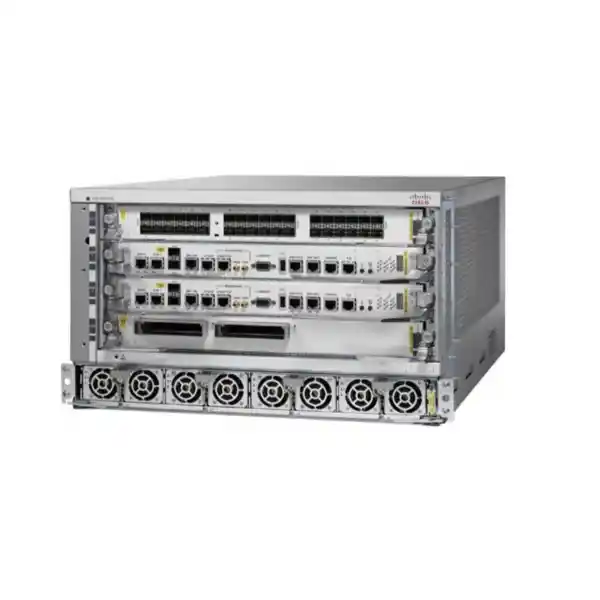
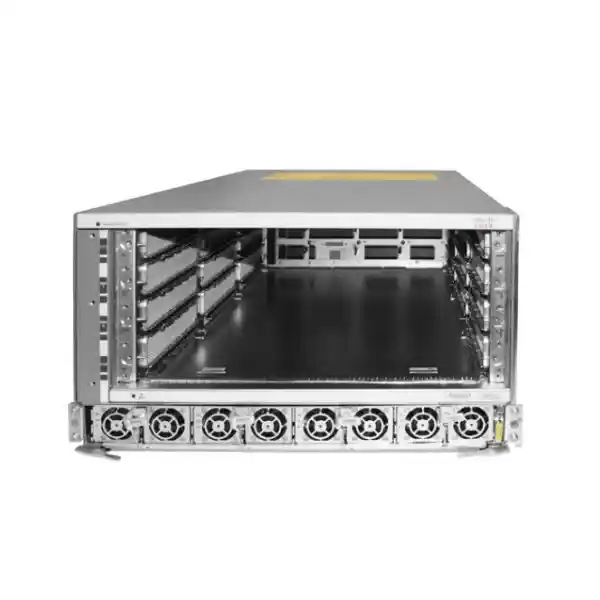
What is the Cisco ASR 9904, and where does it fit?
The Cisco ASR 9904 is not a small branch router and it is not simply a high-port-count Ethernet switch. It is a modular carrier-routing platform intended to sit at important aggregation and service boundaries where large routing tables, MPLS services, deterministic quality of service, resilient control planes and operational continuity are required. Typical placements include provider metro aggregation, broadband or business-service edge, peering or core-facing aggregation, mobile backhaul and fronthaul aggregation, converged enterprise WAN hubs, high-throughput internet edge designs and data-center interconnect nodes.
The chassis is physically compact compared with larger ASR 9900 systems, but its architecture follows the same service-provider principles: distributed forwarding on line cards, redundant control resources, an integrated switching fabric on the RSPs, modular power, robust timing support and Cisco IOS XR software. This combination gives architects a useful middle ground. It can deliver much more routing scale and operational sophistication than fixed enterprise routers while avoiding the rack, power and capital profile of a very large chassis. The exact performance envelope is determined by the installed RSP generation, line cards, optics, software release and licenses, so a production design should always be sized as a complete bill of materials rather than from chassis name alone.
Cisco ASR 9904 at a glance
| Chassis format | 6RU modular chassis, approximately 10.38 in high, 17.57 in wide and 25.02 in deep |
| Line-card capacity | Two horizontal ASR 9000 line-card slots; interface density depends on selected line cards and software support |
| Control and fabric | Two RSP slots with integrated switch-fabric functionality; redundant RSP designs support high availability and active/active fabric operation |
| Software | Cisco IOS XR 64-bit on supported configurations, with modular routing, management and system-administration functions |
| Power architecture | Single Version 2 AC or DC power-entry module; 3 kW AC and 2.1 kW DC module families are associated with the V2 design; AC and DC are not mixed in one system |
| Cooling | One high-efficiency fan tray with variable-speed fans; airflow planning must be checked against rack and baffle arrangement |
| Nominal environment | 5°C to 40°C nominal operating range; documented short-term operation for the ASR 9904 extends from -5°C to 55°C under applicable conditions |
| Best-fit roles | IP/MPLS aggregation, metro edge, business services, mobile transport, DCI, internet edge, large enterprise WAN hub and resilient high-speed aggregation |
Important: line-card and controller interoperability varies by IOS XR release and hardware generation. Final ordering should be based on a validated chassis, RSP, line-card, optics, power and license matrix.
Compact chassis, carrier-class construction
The ASR 9904 chassis is centered on a pair of RSP slots and two line-card slots. That layout is important because it maximizes the percentage of rack space devoted to packet interfaces while retaining controller redundancy. A fully equipped chassis is heavier than the bare shelf because RSPs, the fan tray and power components contribute significant mass; rack engineering should therefore consider static load, rail or mounting hardware, service clearance and cable-management paths rather than treating the device like an ordinary 6RU appliance.
It can be installed in common telecommunications and equipment-rack formats, including 19-inch environments, with additional mounting options available for other rack widths. For UAE facilities, the practical check is not only whether the rack is nominally compatible. Engineers should confirm post spacing, front and rear clearance, intake and exhaust paths, overhead or underfloor cable entry, fiber bend radius, power-feed location and whether neighboring equipment will create a thermal recirculation pocket. A compact chassis only saves space when its installation does not force inefficient blanking or cable congestion around it.
Why two line-card slots can be enough
Two modular line-card slots may appear modest when compared with a large core chassis, but the design is useful for networks where the real requirement is a focused combination of high-capacity uplinks and dense service-facing ports. One slot can be used for a high-speed core or DCI-facing interface set while the second carries aggregation-facing ports, or both slots can be selected symmetrically for operational consistency. The precise combination depends on supported hardware generation, desired port speeds, buffering, feature scale and forwarding personality.
This is why the ASR 9904 often fits regional POPs, metro rings, large campus or industrial aggregation nodes, mobile aggregation locations and customer-edge consolidation points. The platform can provide service-provider routing behavior in a shelf that does not require the space and power of a much larger system. If growth is expected to exceed two slots quickly, however, architects should compare the business case with larger ASR 9900 chassis rather than overloading the 9904 with an unnecessarily complex breakout strategy.
Switch fabric and Route Switch Processor architecture
The most important technical point when specifying an ASR 9904 is that chassis capacity is controller-dependent. The RSP performs control-plane, timing, chassis-management and switch-fabric functions, and Cisco has released multiple RSP generations for the ASR 9000 family. A modern bill of materials may use RSP5 or RSP5-X variants where supported by the intended line cards and IOS XR release. Older deployed systems may use earlier controllers. Because the fabric lives on the RSP in the ASR 9904, upgrading the controller can materially change the bandwidth available to each line-card slot and the aggregate switching envelope of the chassis.
Cisco documentation for current RSP5-class designs shows high-capacity figures for the ASR 9904, including up to 4.2 Tbps per line-card slot in a non-redundant fabric calculation and up to 8.4 Tbps per router in the corresponding non-redundant mode. Redundant capacity is lower because the architecture preserves forwarding capability when a fabric resource is lost; published RSP5 data lists 3.6 Tbps per router and 1.8 Tbps per line-card slot for the relevant redundant operating model. These numbers should not be copied into a procurement specification without the exact RSP part number, because earlier controller generations have different per-slot fabric rates.
Inside the forwarding path, the switch fabric is packet-based and built to move traffic between line cards. The fabric itself does not replace distributed forwarding intelligence on the line cards. This separation is useful for scale: line cards perform the forwarding lookup and packet-processing work, while the fabric moves frames or packet cells across the chassis under arbitration. Virtual Output Queue mechanisms help manage congestion and reduce head-of-line blocking. In a dual-RSP system, fabric resources can operate in an active/active model so traffic is distributed across the available fabric capacity, while redundancy allows service to continue through a failure scenario.
For design review, the question is not simply “How many terabits does the chassis support?” A better set of questions is: what RSP generation will be used, which two line cards are required, what traffic pattern exists between local and fabric-switched ports, what oversubscription ratio is acceptable, which services require heavy packet recirculation or features, and what capacity must remain after a single component failure? FourTeck can help model this complete path rather than quoting an isolated marketing maximum. For broader UAE network architecture and procurement support, visit FourTeck UAE.
Line-card strategy: build the router around traffic, not around a generic port count
The ASR 9904 accepts ASR 9000 family line cards according to controller generation, software release and hardware compatibility. Over the life of the platform, Cisco has introduced multiple generations covering 1 Gigabit Ethernet, 10 Gigabit Ethernet, 40 Gigabit Ethernet, 100 Gigabit Ethernet and higher-speed modular or fixed combinations, including selected 400 Gigabit Ethernet capabilities on newer hardware families. The correct line card is therefore determined by more than the number printed on the faceplate. Network architects must evaluate forwarding scale, queue resources, service features, interface breakout requirements, optics form factors, route scale, packet-buffer behavior and feature-specific restrictions.
Access and aggregation density
For dense enterprise, wholesale or metro aggregation, a design may prioritize many 10G or mixed 1G/10G handoffs. The engineering focus becomes port fan-out, optics cost, VLAN or bridge-domain scale, LAG design and service separation.
100G core-facing design
For provider edge or high-capacity campus aggregation, 100G interfaces can consolidate many lower-speed links. Pay attention to fabric headroom, ECMP design, optics reach, coherent versus client optics where relevant, and failure-state utilization.
High-speed modular growth
Newer ASR 9000 line-card families can support substantially greater interface density. Compatibility must be verified against RSP model and IOS XR release before assuming that a newer card is valid in an older installed chassis.
Service edge personality
Some deployments value deep service scale, QoS, subscriber functions or complex MPLS more than maximum raw port density. Select cards based on the required feature set and scale profile, not only interface speed.
A useful sizing exercise starts with a port map. List every physical handoff, speed, fiber type, reach, redundancy relationship and projected three-year growth value. Then map each logical service to the physical topology: Layer 3 routed link, Layer 2 trunk, L2VPN attachment circuit, EVPN service, MPLS core adjacency, internet peering connection, mobile transport interface or management link. The resulting matrix often makes the line-card choice obvious and prevents expensive late-stage changes.
Optics also deserve equal attention. Transceiver choice affects reach, power draw, thermal load, fiber plant, patching, FEC behavior and interoperability. Where third-party optics are being considered, operational policy and support implications should be agreed before procurement. FourTeck can provide the router, compatible optics planning and deployment services through its UAE networking and infrastructure practice; related technical deployment support is available through FourTeck IT Services UAE.
Cisco IOS XR 64-bit: software architecture built for operational continuity
The ASR 9904 is supported in the Cisco IOS XR 64-bit software family. IOS XR is designed for large routing systems where process isolation, modularity, controlled upgrades, telemetry, high availability and predictable service behavior are core operational requirements. On the 64-bit architecture, system-administration functions and routing functions operate in separate virtualized environments over a Linux host layer. This separation creates a clearer boundary between low-level platform management and the XR routing environment and supports a more modular operational model than traditional monolithic router software.
For network teams, the practical benefit is not merely “64-bit” branding. The architecture is designed around protected processes, independent protocol functions, distributed system components and fault containment. A failure or restart of one software process should not automatically imply a complete chassis reboot. Redundant RSP deployment adds another layer: the standby controller maintains synchronized state so that a control-plane switchover can occur while forwarding is preserved by the distributed data plane. Exact behavior depends on feature, release and failure type, but the design intent is clear—reduce the blast radius of faults and maintenance activities.
Software release planning is critical. The ASR 9000 family has a long lifecycle and a broad hardware matrix, which means the newest IOS XR release supported on the chassis is not automatically the right release for every installed line card, optic or feature. A controlled upgrade plan should compare current release, target release, RSP generation, line cards, ROMMON or firmware dependencies, licenses, feature behavior and known caveats. It should also define rollback and maintenance-window procedures. Current Cisco release documentation continues to list the ASR 9904 among supported ASR 9900 chassis, reinforcing its relevance in existing and refreshed deployments.
For UAE operators running regulated, revenue-generating or 24×7 environments, the recommended operational model is to qualify software in a staging environment or representative lab, validate routing convergence and service behavior, capture configuration backups, verify management and telemetry integrations, and perform post-upgrade health checks on both control and forwarding planes. This approach turns IOS XR modularity into an operational advantage rather than relying on software features without process discipline.
IP/MPLS, Segment Routing and modern service-provider roles
The ASR 9904 is fundamentally at home in IP/MPLS networks. Depending on the selected IOS XR release, licenses and hardware, the platform can participate in sophisticated routed transport and service architectures using protocols such as IS-IS or OSPF for underlay reachability, BGP for interdomain and service routing, MPLS label distribution mechanisms and modern Segment Routing approaches. In a metro or national network, the 9904 can aggregate access or regional nodes, provide high-capacity uplinks toward a core, host business or wholesale services and maintain resilient paths across multiple rings or routed fabrics.
Segment Routing is particularly relevant for operators simplifying transport control. By encoding path intent into segment identifiers, a network can reduce dependence on per-flow state in intermediate nodes and integrate traffic-engineering behavior with a centralized controller or distributed routing policy. The exact SR-MPLS or related capabilities must be validated against the target IOS XR release and feature licenses. The design should consider label scale, IGP area or level structure, BGP policy, fast-reroute requirements, path-computation strategy and the operational model for controller-driven changes.
Traditional MPLS L3VPN and L2VPN services remain common in enterprise and carrier networks. An ASR 9904 at a provider edge can terminate or aggregate customer-facing services and maintain VPN separation while connecting to a shared MPLS transport. For Ethernet services, the platform can be used in architectures that require pseudowires, bridge domains, Ethernet VPN technologies or routed handoffs. Exact feature scale depends heavily on line-card generation and software. A service provider should therefore quantify route targets, VPN routes, MAC addresses, attachment circuits, pseudowires, bridge domains and QoS policies as separate scale dimensions.
The most resilient designs avoid creating one enormous failure domain. The 9904 can be deployed as one half of a redundant pair with diverse fiber paths and separate power feeds. Multi-chassis Link Aggregation, routed ECMP, BGP multihoming, EVPN multihoming or service-specific redundancy mechanisms can then be used according to the architecture. In a Dubai metro environment, this approach can separate path diversity between carrier hotels, data centers, enterprise campuses or access rings while preserving a consistent IOS XR operational model.
BGP edge, internet aggregation and data-center interconnect
At the internet or peering edge, the ASR 9904 can provide the control-plane scale, policy framework and interface flexibility needed for multiple upstreams, internet exchanges, private interconnects and downstream enterprise or service-provider domains. A production BGP design should be built around expected IPv4 and IPv6 route scale, policy complexity, number of peers, route-reflector relationships, convergence targets, RPKI or route-validation architecture where implemented, and the memory and forwarding resources of the selected RSP and line cards. “Supports BGP” is far too broad a specification for an internet-edge purchase.
For data-center interconnect, the ASR 9904 can serve as a routed DCI gateway, MPLS transport node or service edge between data-center fabrics and WAN infrastructure. The compact 6RU form factor is useful when colocation rack space is expensive. High-speed 100G connectivity can consolidate multiple inter-site services while redundant RSPs and power feeds protect the control layer. DCI architects should calculate not only average bandwidth but burst behavior, east-west replication traffic, backup windows, storage flows, cloud on-ramp requirements and disaster-recovery scenarios. These traffic patterns often drive buffer and QoS requirements that a simple utilization average does not reveal.
When the router connects Ethernet fabrics at both ends, it is important to decide where Layer 2 should stop. Extending large Layer 2 domains across cities can increase operational coupling and failure impact. Routed DCI or EVPN-based approaches can provide cleaner fault boundaries depending on application requirements. The ASR 9904 is strongest when used as part of a deliberate service architecture rather than as an oversized trunk device.
FourTeck can coordinate the routing platform with adjacent security and WAN services. For organizations building secure perimeter and edge architectures in Dubai, the Firewall Dubai practice can be referenced alongside the routing design so that firewall throughput, routing convergence, BGP policy, NAT boundaries and redundant connectivity are engineered as one service chain rather than separate procurement exercises.
Metro Ethernet and business services
A metro aggregation router must handle more than raw packet throughput. Business services require clear tenant separation, predictable QoS, resilient customer handoffs, operational visibility and a service model that can be automated. The ASR 9904 can aggregate many access nodes or high-value customer links into an MPLS or EVPN transport while applying service policies at the correct edge.
Before selecting hardware, define service templates: internet access, L3VPN, point-to-point Ethernet, multipoint Ethernet, cloud connect, managed WAN and mobile transport may each consume different route, MAC, queue and policy resources. This template-driven method produces a more accurate sizing model than multiplying port counts alone.
Large enterprise aggregation
Large enterprises, utilities, transport operators, universities and industrial groups can use the ASR 9904 where multiple campuses, data centers or WAN providers converge. The attraction is not only capacity. IOS XR brings service-provider style operational controls, routing policy, high availability and telemetry that are useful when the enterprise network behaves more like a private carrier backbone.
A private backbone design should still remain simple where possible. Use routed point-to-point links, summarization, clear IGP boundaries, structured BGP policy and standardized interface profiles. The router is capable of complex services, but complexity should be introduced only when it solves an actual connectivity, segmentation or resiliency requirement.
Quality of Service: engineer congestion before it happens
The ASR 9000 architecture is designed for service-aware forwarding, making QoS a central part of many deployments. A high-capacity router can still experience congestion at speed transitions, fan-in points or failure states. For example, several access links may aggregate into fewer core-facing interfaces, or a redundant path failure may move traffic onto a surviving link that normally runs below capacity. QoS protects critical traffic during these exact moments.
A proper QoS design starts with a traffic model rather than a list of command-line features. Classify the business requirements into a small number of forwarding behaviors such as network control, real-time voice, interactive video, mission-critical transactional traffic, business data and scavenger or backup traffic. Define where classification occurs, whether customer markings can be trusted, how markings are translated across MPLS domains, what policing applies at service ingress and how shaping should be used on physical or logical egress interfaces.
Queue resources and policy scale vary by line-card generation. That means a QoS-heavy deployment must validate the actual card rather than assuming every ASR 9000 interface behaves identically. Hierarchical policy, subinterface scale, queue depth, scheduler behavior and interface speed are all relevant. For mobile networks, synchronization and control traffic may require explicit protection. For enterprise WANs, voice and collaboration usually need bounded latency and jitter. For DCI, storage replication may consume huge bursts and should not starve routing control or interactive services.
The best acceptance test is a failure-state traffic test. Drive representative load, fail an uplink or LAG member, and verify that control, voice and critical applications retain their expected behavior. This proves the actual chassis, line card, configuration and optics combination instead of relying on a design spreadsheet alone.
High availability from component level to network topology
The ASR 9904 supports a carrier-oriented redundancy model that includes redundant RSPs, fabric redundancy, feed redundancy, power-module redundancy and software resiliency. A dual-RSP design is the normal choice for production environments because it provides a standby control resource and redundant integrated fabric capability. Cisco IOS XR stateful switchover mechanisms maintain synchronized system and protocol information between active and standby control components, allowing the standby to assume control if required while distributed forwarding continues.
Component redundancy is only the first layer. A single chassis can still be affected by rack power loss, a maintenance mistake, fiber damage, environmental failure or an upstream outage. Critical UAE deployments should therefore consider two routers, preferably separated by rack, row, room or site according to the service availability objective. Each router should have independent power feeds where facility design permits, and network links should use physically diverse pathways rather than two fibers in the same duct being called redundant.
Control-plane redundancy should also be reflected in protocol design. IGP adjacency, BGP peering, BFD timers, LAG behavior, first-hop gateway functions, MPLS fast-reroute or Segment Routing protection and service-layer convergence all contribute to restoration time. Aggressive timers can cause unnecessary instability if they are not matched to the actual platform and transport conditions. A controlled convergence design is better than simply selecting the shortest possible timer values.
Maintenance procedures are equally important. Teams should document RSP switchover tests, line-card replacement processes, power-supply replacement, software upgrade sequencing, configuration rollback and telemetry checks. High availability is achieved when hardware design, software behavior, routing protocols, facility engineering and operating procedures reinforce one another.
Timing and synchronization for mobile and critical transport
Synchronization is a major design requirement in mobile backhaul and other timing-sensitive networks. ASR 9000 RSP families provide centralized timing capabilities and can support technologies such as IEEE 1588 Precision Time Protocol, BITS interfaces and Synchronous Ethernet depending on the controller and line-card combination. Newer RSP generations also add enhanced timing features intended for modern mobile networks. The exact clock class, port type and supported timing profile must be verified against the chosen RSP and IOS XR release.
A mobile transport design should identify the primary and secondary time sources, the intended PTP telecom profile, boundary-clock or transparent-clock roles, SyncE distribution, holdover expectations and failure behavior. Engineers should track packet-delay variation and asymmetry across the transport because a PTP design can be logically correct yet fail accuracy targets if the physical network introduces excessive or asymmetric delay.
For 4G and 5G aggregation, the router may carry user-plane data, management, signaling and timing across the same physical infrastructure. QoS policies therefore need to protect synchronization packets, while the routing architecture must provide deterministic convergence. Where microwave, leased wavelengths or third-party transport are involved, timing support should be validated end to end rather than assumed from the router alone.
In UAE deployments, this can be relevant not only to mobile operators but also to private 5G, transport, utilities and industrial networks that use precise timing for distributed systems. FourTeck can help define a timing bill of materials alongside the routing and optics design so that clock inputs, RSP capability, line-card support and transport media are verified as one solution.
Telemetry, automation and operational visibility
Large networks cannot be operated efficiently by logging into every router and reading CLI output. IOS XR supports modern management and telemetry approaches that can integrate the ASR 9904 into centralized monitoring, configuration and assurance workflows. Depending on release and feature set, operators can use model-driven interfaces, streaming telemetry, structured configuration APIs and traditional SNMP or CLI mechanisms. The goal should be to collect high-frequency operational data without creating unnecessary polling load or an unmanageable volume of metrics.
A good telemetry design starts with questions. Which signals predict customer impact? Which data is required for capacity planning? Which alarms need immediate action? Interface errors, optical power, packet drops, queue occupancy, route churn, BGP session state, CPU, memory, RSP redundancy state, fabric health, power modules, fan status and environmental sensors are obvious candidates. For MPLS and service networks, LSP health, VPN route state and service-level probes may be equally important.
Automation should use a source-of-truth model. Device intent can be derived from inventory, site, role, circuit and service databases, then rendered into validated configuration. Changes should pass syntax and policy checks before deployment. This reduces configuration drift and makes it easier to replace a failed router or build a second site with consistent behavior. For critical networks, the automation platform should also capture pre-change and post-change state so that unintended routing or interface differences are detected quickly.
The ASR 9904 is suitable for both CLI-centric operations and more automated environments, but the highest value comes when hardware standardization and operational tooling are planned together. A smaller number of standardized RSP, line-card, optics and software combinations dramatically simplifies spares, testing, telemetry parsing and change management across a fleet.
Security design around the ASR 9904
A carrier router should be hardened even when a separate firewall handles application security. The ASR 9904 control plane is a critical infrastructure component, so management access, routing protocols, infrastructure addressing and software lifecycle must be protected. A baseline design typically separates management traffic, restricts administrative source networks, uses centralized authentication and authorization, applies secure management protocols, disables unnecessary services and filters traffic destined to the router itself.
Routing security is equally important. BGP and IGP sessions should use appropriate authentication and neighbor filtering. Prefix policies should prevent route leaks, default-route mistakes and accidental advertisement of infrastructure space. Where internet routing is involved, operators may incorporate route-validation and RPKI workflows in the surrounding architecture. Infrastructure ACLs should be designed carefully so they protect the control plane without blocking legitimate routing, timing or management traffic.
Software integrity and patching require process discipline. Maintain an accurate inventory of chassis, RSPs, line cards, optics and IOS XR versions. Review vendor advisories against that inventory. Lab-test important upgrades and keep rollback plans. Restrict who can install packages or modify the boot environment. Back up configuration and operational state before major maintenance.
Finally, do not use the router as a substitute for a security appliance when deep inspection, threat prevention, application control or large-scale NAT security is required. The clean architecture is often a resilient ASR 9904 routing layer feeding appropriately sized security platforms. This separation makes routing convergence, firewall policy and capacity planning easier to reason about.
Power architecture and UAE facility planning
The ASR 9904 uses a Version 2 power architecture with a single power-entry module configured for either AC or DC. Cisco documentation associates the V2 design with 3 kW AC modules and 2.1 kW DC modules. The power system is designed for load sharing and supports redundancy models appropriate to the selected feed type. AC and DC modules are not mixed within the same chassis. Input ranges are designed for common telecom and data-center environments, including 200–240V AC and -40 to -72V DC ranges for the documented power modules.
Actual draw is configuration-dependent. A chassis with high-capacity RSPs, two dense line cards and long-reach optics will consume more power than a lightly populated system. Never size UPS capacity, PDU outlets or DC plant from the maximum rating printed on a power module alone. Use Cisco power-calculation guidance for the exact BOM, add growth and redundancy margin, then confirm facility derating, breaker size, connector type and feed diversity.
Dubai data centers usually provide strong cooling, but inlet temperature and airflow still matter. The ASR 9904 nominal operating range is documented from 5°C to 40°C, with short-term operation extending higher under defined conditions. Short-term tolerance is not a target operating temperature. Continuous high inlet temperatures can reduce margin, increase fan speed and complicate reliability. Rack blanking, containment and cable management should preserve the required airflow path.
Power redundancy also needs to be physically real. If two power modules are supplied from the same PDU, UPS or upstream breaker, a common failure may defeat the intended redundancy. Critical deployments should trace each feed all the way back through PDU, UPS, panel and generator topology. In DC plants, confirm A/B bus design and grounding. Label feeds clearly so maintenance teams can replace a module without removing the surviving power path.
For broader server-room and data-center infrastructure coordination, FourTeck also supports adjacent compute and rack requirements through Server Dubai, allowing routing, rack, power and supporting infrastructure to be discussed within the same deployment plan.
Cooling, airflow and rack integration
The ASR 9904 uses a high-efficiency fan tray with variable-speed fans. Chassis airflow documentation must be followed carefully because service-provider routers do not always match the front-to-back airflow assumptions of typical enterprise servers. Cisco documentation for the ASR 9904 describes right-to-left airflow behavior with front-to-back accommodation using a baffle. This makes rack layout and baffle selection part of the technical design, especially in contained hot-aisle or cold-aisle facilities.
Before installation, verify the precise airflow kit, rack depth and adjacent equipment. Leave adequate access to replace the fan tray and power components. Avoid dense fiber bundles blocking intake or exhaust openings. If high-count MPO, breakout or patch-panel cabling is used, route it so that service loops do not collapse into the chassis airflow path. Velcro and horizontal or vertical management are generally preferable to tight cable ties that can damage fiber or make maintenance difficult.
Optics contribute heat at the line-card face. High-speed and long-reach modules may dissipate significantly more power than short-reach optics. When both line-card slots are heavily populated, thermal planning should therefore include the optical module mix. Cleanliness is equally important: dust accumulation can raise fan speed and thermal stress. UAE environments can experience fine airborne dust, so filters, room pressurization, housekeeping and periodic inspection should follow the facility’s environmental plan.
A commissioning checklist should record inlet temperature, fan state, power-module load, optical receive and transmit levels, interface errors and environmental alarms after the router has reached steady state. Capturing this baseline provides a reference for future troubleshooting and can identify abnormal airflow or optics conditions before customer traffic is affected.
How to size a Cisco ASR 9904 correctly
Sizing should be done in layers. Start with physical interfaces, then forwarding capacity, route scale, service scale, QoS, high availability, software compatibility, optics and growth. This prevents a common procurement failure: selecting a chassis that appears powerful enough by aggregate bandwidth but is wrong for the required service mix or hardware generation.
- Build the port inventory. Record current and future interfaces, speed, media, connector, distance, LAG membership and redundancy.
- Model steady-state and failure-state bandwidth. Include growth, traffic bursts and the load that moves when an uplink, LAG member, router or path fails.
- Define the route scale. Count IPv4, IPv6, VPN, BGP, IGP and labeled routes. Include expected growth and route-policy complexity.
- Define service objects. Quantify VRFs, bridge domains, MAC entries, pseudowires, EVPN routes, subinterfaces and customer attachments as applicable.
- Specify QoS. Count policies, queues, hierarchical levels and shaping or policing requirements per interface type.
- Select the RSP generation. Match required fabric capacity, control-plane scale, timing and software release.
- Select line cards. Confirm port density, feature compatibility and fabric bandwidth against the chosen RSP.
- Validate optics. Confirm reach, fiber type, FEC, breakout, power draw and support policy.
- Calculate power and cooling. Use the exact BOM, not a generic chassis estimate.
- Lock the software and license matrix. Ensure all hardware and required features are supported by the intended IOS XR release.
For example, a network may need only 600 Gbps of day-one traffic but require full internet routes, large L3VPN scale, tight QoS and multiple 100G uplinks. Another network may need far higher raw throughput but relatively simple routing. These two cases can require different RSP and line-card choices despite using the same ASR 9904 chassis.
Always preserve headroom. Designing every surviving link and fabric path to run at 95–100 percent after a failure leaves no room for microbursts, reconvergence or growth. A realistic engineering target depends on traffic characteristics, but explicit failure-state headroom should be part of the acceptance criteria.
Deployment topology 1: redundant metro aggregation pair
A common design uses two ASR 9904 routers as a redundant aggregation pair. Access routers, switches or provider nodes connect to both devices where practical. The two 9904s then connect through diverse high-capacity paths toward the MPLS core or regional backbone. Each router has dual RSPs and redundant power modules, while network-level redundancy protects against complete chassis or site-level failures.
The logical topology can use routed ECMP, link aggregation, EVPN multihoming or service-specific redundancy depending on the access technology. Routed designs are often easier to troubleshoot because they avoid large spanning-tree domains. MPLS or Segment Routing protection can provide fast restoration in the transport. BFD may be used for rapid failure detection, but timers should be tuned to actual platform and link conditions.
This topology fits metro rings, enterprise aggregation hubs, utilities and regional service-provider POPs. It also enables maintenance without a complete outage if traffic can be drained from one router before upgrades. Capacity planning must confirm that one router can carry the intended protected load when the peer is unavailable.
Operationally, keep the two routers as similar as possible: same RSP generation, same line-card models, same optics families and aligned IOS XR releases. Standardization simplifies spares, automation, testing and failover behavior.
Deployment topology 2: internet and cloud edge
In an internet-edge role, the ASR 9904 can aggregate upstream transit providers, internet exchange connections, private peers and downstream firewall or data-center networks. One line card may be dedicated primarily to external 100G links while another carries internal or service-facing interfaces, although the best arrangement depends on desired fault domains and port density.
BGP policy should be built from explicit objectives: which prefixes are accepted from each peer, which routes are advertised, how local preference and MED are used, how communities drive policy, what maximum-prefix limits apply and how default routes are handled. Full-table designs need control-plane and forwarding resources sized for current and future IPv4 and IPv6 growth. Route-reflector topology and graceful maintenance procedures should also be defined.
The router normally sits outside or alongside dedicated firewalls rather than replacing them. This creates a clean separation: the ASR handles carrier routing, peering and path selection, while the security layer performs deep inspection and policy enforcement. Use routed links between the platforms where possible to make failure boundaries and troubleshooting clear.
Cloud connectivity can be incorporated through carrier circuits, internet VPN underlays, cloud exchange providers or data-center fabrics. The edge architecture should consider route limits, overlapping customer networks, VRF design, NAT location, DDoS response and failover between local and remote cloud on-ramps.
Deployment topology 3: mobile transport and converged services
A mobile transport node may aggregate multiple cell-site or access domains and connect them toward regional mobile core infrastructure. The ASR 9904 can combine routed transport, MPLS services, QoS and timing functions in one carrier platform. The design must treat timing as an end-to-end service, not simply enable PTP on an interface and assume success.
Traffic classes can include user plane, signaling, network management, synchronization and enterprise services sharing the same transport. Each needs a defined QoS behavior. Failure-state analysis is especially important because a reroute can double load on surviving paths. If low-latency traffic is mixed with large best-effort flows, queue and scheduler behavior should be validated under congestion.
The physical transport may include fiber, microwave or third-party leased capacity. Every segment should be checked for MTU, QoS transparency, timing behavior and protection switching. Segment Routing or MPLS can provide scalable path control, while BGP or IGP policy defines reachability and convergence.
For private mobile networks in ports, airports, energy, logistics or industrial campuses, the same principles apply at smaller scale. The ASR 9904 can serve as a resilient aggregation node where strict operations and timing requirements justify service-provider-grade routing.
Migration from older aggregation platforms
Replacing an existing edge or aggregation router requires more than copying configuration. Legacy systems often contain years of accumulated policy, unused interfaces, obsolete route maps, inconsistent naming and one-off workarounds. A migration to the ASR 9904 is an opportunity to normalize the design while preserving required customer behavior.
Begin with discovery. Export running configuration, interface descriptions, routing neighbors, ARP and ND tables, MAC information, VRFs, QoS policies, ACLs, MPLS services, telemetry settings and management dependencies. Compare this data with circuit records and customer documentation. Differences reveal undocumented services that could otherwise be missed during cutover.
Next create a service migration matrix. For each interface or customer service, define old port, new port, optic, VLAN or subinterface, IP addressing, routing protocol, QoS, expected traffic, maintenance owner and rollback procedure. Group migrations so that failures can be isolated. Avoid moving every critical service in one uncontrolled window when phased cutover is possible.
Configuration should be translated into the intended IOS XR model rather than copied line for line from a different operating system. Routing policy syntax, interface hierarchy, commit behavior and service constructs may differ. Validate the new policy in a lab or staging chassis. Perform control-plane and data-plane tests, including MTU, QoS, failover and management access.
After cutover, compare live state with the pre-migration baseline. Check routes, neighbors, optical levels, errors, traffic volumes, queue drops, CPU, memory and redundancy. Keep the old platform available for rollback until agreed stability criteria are met.
Lifecycle, software and hardware compatibility planning
The ASR 9000 family spans many years and hardware generations. This longevity is valuable, but it makes lifecycle management a design task of its own. A chassis may physically accept a card that is not supported with the installed RSP or intended software release. Likewise, a new IOS XR release may support the ASR 9904 chassis while dropping support for an older accessory in the same system. The only safe approach is to validate the complete hardware matrix.
Create an inventory with exact product IDs for chassis, RSPs, line cards, power modules, fan tray and optics. Record current IOS XR version, target version and licenses. Compare each component with Cisco release notes and supported-hardware documentation. For new purchases, standardize on the fewest practical combinations. For an existing fleet, identify components that constrain software upgrades and decide whether to refresh them before they become operational blockers.
Spares planning should reflect failure impact and lead time. RSPs, critical line cards, power modules and selected optics may justify local spare stock in the UAE if the network cannot tolerate extended replacement delays. Spares should be periodically tested and stored within environmental requirements. Software images and configuration backups should be maintained independently of the router so that a hardware replacement can be restored rapidly.
A lifecycle plan should also define when the architecture itself needs to change. If traffic growth requires more than two line-card slots, or if new interface speeds exceed the practical limits of the chosen RSP and line-card generation, moving to a larger or newer platform can be more economical than forcing the 9904 beyond its intended role. Good lifecycle planning protects investment by using the router where it fits best, not by keeping it indefinitely in every role.
Licensing and feature validation
Licensing on the ASR 9000 platform varies with hardware generation, software release and feature requirements. Some line cards or feature sets may have capacity or service licenses, and modern Cisco licensing programs can introduce entitlement and subscription considerations. A quotation should therefore state exactly which software and feature rights are included rather than presenting the chassis as a complete functional package.
The correct process is to build a feature matrix from the intended services. List BGP scale, MPLS, L2VPN, L3VPN, EVPN, Segment Routing, multicast, timing, telemetry, encryption or security-related functions as applicable. Then validate which licenses are required on the selected IOS XR release and hardware. This avoids discovering after delivery that the physical ports are present but a required capability is not entitled or supported in the chosen software train.
Organizations with an existing Cisco estate should also check whether their enterprise agreement, support contract or licensing portal changes the commercial model. Support coverage matters because access to software updates, security advisories and replacement services can be as important as the hardware itself for a carrier-class router.
FourTeck can structure quotations with separate line items for chassis, RSPs, line cards, optics, power, licenses, support and professional services. This makes the commercial package easier to audit and gives procurement teams a clear basis for comparing alternative BOMs.
UAE procurement factors: what should be confirmed before ordering?
For Dubai and UAE projects, availability and lead time can vary significantly by RSP, line card, optic and support SKU. The ASR 9904 chassis alone is only one part of the solution. Procurement should confirm every component, whether items are new or approved replacement stock, warranty status, support eligibility, delivery lead time and country-specific commercial terms.
Power type must be decided before ordering because AC and DC systems use different power-entry arrangements and should not be mixed. Rack environment must be confirmed so the correct mounting and airflow accessories are included. Optics should be specified by reach and fiber plant rather than generic speed. If the project connects to an existing DWDM system, verify optical compatibility and whether client optics or coherent interfaces are required.
Support coverage should match the criticality of the service. A regional aggregation router carrying customer or mobile traffic may justify a higher response level than a lab or backup device. Determine whether onsite replacement, software support and technical assistance are required. If local spares are part of the resilience strategy, include them in the original budget instead of waiting for a failure.
Commercial comparison should be based on a normalized BOM. Two quotations that both say “ASR 9904” may differ radically if one includes dual modern RSPs, high-capacity line cards, optics and support while another includes only a chassis and minimal controllers. Ask for exact part numbers and quantities.
FourTeck serves UAE and international network projects, and cross-region requirements can also be coordinated through FourTeck Global where organizations need a consistent sourcing and engineering approach across multiple countries.
Recommended ASR 9904 bill-of-materials structure
1. Chassis and mechanicals
ASR 9904 chassis, rack-mount hardware, required baffle or airflow accessories, grounding items and any cable-management components.
2. Dual RSPs
Matched RSP generation and personality selected for fabric capacity, route scale, timing, software support and service requirements.
3. Two line-card slots
Line cards selected from a validated compatibility matrix, including future interface growth and failure-state bandwidth requirements.
4. Optics and fiber
Transceivers, breakout assemblies, patch cords and fiber types with reach, FEC, connector and power requirements verified end to end.
5. Power and facility
Correct V2 AC or DC PEM arrangement, sufficient power modules for the design, feed cables, PDU or DC plant coordination and redundancy.
6. Software and support
IOS XR target release, required feature licenses, support entitlement, software access and optional professional services for staging and migration.
Pre-deployment staging and acceptance testing
Staging is the safest place to find compatibility mistakes. Assemble the actual chassis, RSPs, line cards, power modules and representative optics before field deployment where possible. Load the intended IOS XR release and confirm that every card reaches the expected operational state. Record inventory and firmware details so the installed baseline is known.
Next test management access, AAA, NTP, DNS, logging and telemetry. Verify redundant RSP state and perform a controlled switchover. Confirm power-feed redundancy by testing one feed or module at a time under safe conditions. Check fan and environmental sensors. Exercise console and out-of-band recovery procedures so engineers know how to reach the device when in-band routing is unavailable.
Build a representative routing topology. Establish IGP and BGP neighbors, MPLS or Segment Routing functions, VPN services and QoS policies. Validate MTU end to end, especially if MPLS labels, QinQ or overlays increase frame size. Test ECMP or protection paths. Where timing is required, validate the clock state and accuracy using appropriate instrumentation.
Traffic testing should include normal utilization, burst conditions and failure scenarios. Measure packet loss, latency and queue drops during an uplink failure and during RSP switchover. If customer SLAs depend on rapid convergence, test the actual timers and protocols rather than assuming published platform capability guarantees the full network behavior.
Finally, create a golden configuration, software image set, inventory record and acceptance report. These artifacts reduce future mean time to repair and make it easier to reproduce the deployment at another UAE or regional site.
Operational best practices after go-live
Once the ASR 9904 is carrying production traffic, operations should focus on baseline, capacity, hygiene and repeatability. Capture normal CPU, memory, interface utilization, fabric state, queue drops, optical levels and route counts. Monitor trends rather than only threshold alarms. A slow increase in optical attenuation or route-table growth is easier to handle before it reaches a hard limit.
Configuration changes should use a documented workflow with peer review for critical routing policy. IOS XR commit behavior supports controlled change management, but process still matters. Use meaningful commit comments where available, maintain external backups and compare intended configuration with device state. For large fleets, automation can enforce templates and detect drift.
Review capacity at least quarterly for fast-growing networks. Examine not only physical interfaces but failure-state paths, LAG member utilization, QoS drop counters, route growth and service-object scale. If a surviving link would exceed its safe utilization after a failure, add capacity before it becomes an outage risk.
Schedule redundancy tests. A standby RSP that has never been tested is only theoretical redundancy. Likewise, a second power feed should be verified through controlled maintenance. Document expected alarms so NOC teams can distinguish a planned failover from a real incident.
Keep software lifecycle visible. Track Cisco advisories, release maintenance status and hardware support dependencies. Plan upgrades early enough to test them rather than forcing emergency changes when a security or support deadline arrives.
Common specification mistakes to avoid
Quoting chassis capacity without RSP context
Fabric bandwidth changes with controller generation. Always state the RSP part number and redundant operating target beside any throughput figure.
Selecting line cards only by port count
Feature scale, fabric bandwidth, queue resources, optics and software support can be more important than the number of physical ports.
Ignoring failure-state traffic
A design that looks comfortable in normal operation may overload surviving links when one uplink, router or path fails.
Treating optics as accessories
Wrong reach, FEC, connector or fiber assumptions can delay commissioning even when the router BOM is otherwise correct.
Assuming every IOS XR release supports every card
The ASR 9000 family spans many hardware generations. Validate the complete matrix before locking software.
Buying one chassis for a service that needs site resilience
Dual RSPs protect the control plane inside a chassis; they do not protect against rack, room, fiber-path or site-level failures.
When the ASR 9904 is the right choice—and when it is not
Choose the ASR 9904 when you need a compact modular router with service-provider routing behavior, dual control resources, strong MPLS and BGP capabilities, scalable high-speed interfaces and the operational maturity of IOS XR. It is particularly compelling for a regional or metro aggregation node where two line-card slots are enough, but a fixed router would be too constrained in service scale, interface flexibility or lifecycle options.
It is also a good fit when an organization already operates ASR 9000 platforms and wants common software, operational practices, optics knowledge and spares across sites. Standardizing on an IOS XR environment can reduce training and automation complexity. For a large enterprise, the platform makes sense when the WAN has carrier-like requirements such as full internet routing, many VRFs, MPLS, large-scale BGP, deterministic QoS or very high-speed redundant aggregation.
The ASR 9904 may not be the best answer if the requirement is simply a handful of WAN ports, basic BGP and enterprise VPN. A smaller router can deliver lower cost and operational simplicity. At the other extreme, if a site is expected to require many high-capacity line cards, a larger ASR 9900 chassis can offer better growth economics and reduce the number of separate shelves.
The decision should therefore compare at least three dimensions: day-one requirement, protected failure-state requirement and three-to-five-year growth. The best platform is the one that meets all three with reasonable headroom and operational simplicity—not necessarily the platform with the largest headline capacity.
FourTeck UAE engineering and supply approach
For a Cisco ASR 9904 project, FourTeck can support the complete requirement rather than treating the chassis as an isolated item. The engagement can begin with a port and service inventory, then move through RSP and line-card selection, optics, power, rack requirements, IOS XR release validation, licensing and support coverage. This is especially useful when a customer is refreshing an older ASR 9000 estate or integrating the router with firewalls, data centers, carrier circuits and cloud connectivity.
Technical staging can include inventory verification, software loading, baseline configuration, management integration and selected routing or resiliency tests. For migration projects, FourTeck can help create a service mapping and cutover method so circuits move in controlled groups with rollback steps. Documentation should include the final BOM, interface map, software baseline, management addresses, routing adjacencies and acceptance results.
Procurement teams benefit from exact part-number quotations because ASR 9000 pricing is highly configuration-dependent. The chassis price alone does not represent a working system. Dual RSPs, line cards, optics, power modules, software entitlements and support may represent most of the solution value. A transparent BOM also makes it easier to compare alternate controller or interface options.
For UAE projects, the goal is a router that arrives ready to fit the actual network and facility constraints. This avoids the common delays caused by missing optics, wrong power types, incompatible hardware generations or licensing discovered only after delivery.
Technical FAQ
How many line-card slots does the ASR 9904 have?
It has two horizontal line-card slots. The supported card combinations depend on RSP generation and IOS XR release, so compatibility must be checked for the exact BOM.
Does the ASR 9904 support redundant route processors?
Yes. The chassis is designed around two RSP slots. A dual-RSP design provides control-plane redundancy and redundant integrated fabric resources.
What is the switching capacity?
It depends on the installed RSP. Current RSP5-class documentation shows up to 8.4 Tbps non-redundant chassis capacity and 4.2 Tbps per slot in that mode, with lower capacity in the corresponding redundant operating design. Earlier RSPs have different limits.
Can it run IOS XR 64-bit?
Yes, supported ASR 9904 configurations operate with Cisco IOS XR 64-bit. Hardware support still needs to be validated against the chosen release.
Is it suitable for 100G aggregation?
Yes, with appropriate supported line cards and optics. The required number of 100G ports, service features and failure-state utilization determine the correct card and RSP combination.
Does it support 400G?
The broader ASR 9000 family includes newer line cards with 400G capability, but support in an ASR 9904 must be checked against the exact RSP, card and IOS XR release. Do not assume all 400G ASR 9000 cards work in every chassis combination.
Can it be used for MPLS L3VPN and L2VPN?
Yes, the ASR 9000 family is widely used for MPLS service-edge functions. Exact scale and feature support should be confirmed for the intended software and hardware.
Is it suitable for mobile transport?
Yes. With the correct RSP and line cards, the platform can support packet timing, SyncE and PTP-related functions alongside IP/MPLS transport and QoS.
Does it support AC and DC power?
Yes, the ASR 9904 V2 power architecture is available for AC or DC. AC and DC module types are not mixed in the same power arrangement.
What information is needed for a quotation?
At minimum: target port speeds and quantities, RSP preference or required throughput, AC/DC power, optics reach, software features, licenses, support level, redundancy requirements and delivery location.
Decision recap: who should shortlist the Cisco ASR 9904?
Regional aggregation
Two line-card slots are sufficient, but carrier-class routing scale, redundancy, QoS and MPLS are mandatory.
Internet or DCI edge
High-speed 100G-class connectivity, BGP policy, resilient control planes and compact rack usage are priorities.
Mobile transport
Timing, MPLS, QoS and deterministic availability are required in a compact aggregation shelf.
Very large growth plans
If more than two high-capacity line-card slots will be needed soon, compare a larger ASR 9900 chassis before committing.
The strongest reason to buy the ASR 9904 is not a single throughput number. It is the combination of compact modularity, IOS XR operational maturity, redundant RSP and fabric design, broad service-provider feature depth and the ability to select line cards around the exact traffic model. When engineered as a complete solution, it can deliver an excellent balance of rack efficiency, service scale and resilience for Dubai and UAE aggregation networks.
Quotation input checklist
To receive an accurate Cisco ASR 9904 quotation, provide as much of the following information as possible. Exact data reduces BOM revisions and helps ensure that RSP, line card, optics, power and software are compatible from the first proposal.
Required 1G, 10G, 25G, 40G, 100G or 400G ports; copper or fiber; breakout requirements; current and three-year growth.
Fiber type, connector, distance, SR/LR/ER or other reach class, DWDM involvement and any existing optic standards.
Full internet tables or partial routes, IPv4/IPv6, number of BGP peers, VRFs, IGP routes and expected growth.
MPLS L3VPN, L2VPN, EVPN, Segment Routing, multicast, internet edge, DCI, mobile transport or enterprise backbone.
Dual RSP requirement, dual routers, link diversity, convergence target, spare strategy and support response level.
AC or DC power, rack type, available RU, airflow arrangement, PDU or DC feeds and installation location.
Current Cisco estate, desired IOS XR release, feature licenses, management tools, telemetry and automation requirements.
Supply only, staging, configuration, migration, onsite installation, acceptance testing, documentation and knowledge transfer.
Plan the ASR 9904 as a complete routing system
For the best result, send FourTeck your port map, target services, preferred power type and expected traffic growth. The engineering team can translate those requirements into a compatible chassis, dual-RSP, line-card, optics, software, licensing and support BOM for Dubai or other UAE locations.
This avoids the two most expensive mistakes in ASR 9000 procurement: selecting hardware generations that do not align with the intended IOS XR release, and sizing only for day-one bandwidth without considering redundant failure-state capacity.
Recommended consultation output
- Validated ASR 9904 hardware BOM
- RSP and line-card compatibility review
- Optics and fiber mapping
- Power and rack requirements
- IOS XR and license baseline
- Redundancy and growth recommendations
- Optional staging and migration scope

Reviews
There are no reviews yet.