
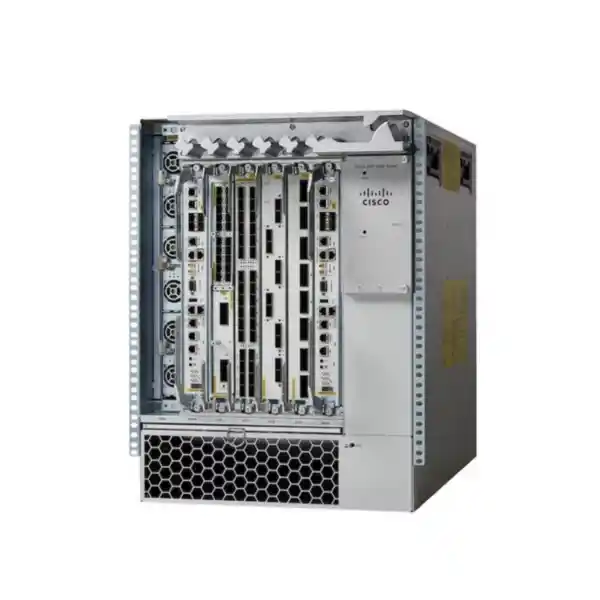
Cisco ASR 9906 Aggregation Services Router
A modular, resilient ASR 9000 platform for high-density metro aggregation, service-provider edge, IP/MPLS transport, data-center interconnect and mobile infrastructure. The ASR 9906 combines four line-card slots, redundant route switch processing, scalable switch-fabric architecture and Cisco IOS XR software in a 14RU chassis engineered for long-lived network roles where forwarding scale, service separation and operational continuity matter.
Four vertical line-card slots, two RSP positions, five fabric-card positions and two fan trays support dense carrier aggregation without moving to a much larger chassis.
Two fabric functions can reside on the RSP pair while five dedicated fabric cards extend capacity and allow highly resilient all-active switching designs.
A modular carrier operating system designed for large routing tables, service-provider protocols, process isolation, telemetry and staged operational change.
Version 3 power architecture supports up to three AC modules or four DC modules in the ASR 9906 power tray, with redundancy engineered into the platform.
What the Cisco ASR 9906 is designed to solve
The Cisco ASR 9906 is not a fixed-port branch router and it should not be sized like one. It is a modular aggregation and service-edge system intended for networks in which the chassis must remain useful while interface speeds, optics, traffic engineering practices and service models evolve. In practical terms, a buyer selects the chassis as a forwarding and control-plane foundation, then builds the required personality with route switch processors, switch-fabric cards, line cards, power modules, optics and software entitlements. That modularity is the reason a correct quotation needs more engineering detail than simply asking for “one ASR 9906.”
In a UAE carrier, enterprise backbone or large-scale cloud interconnect environment, aggregation design usually involves several simultaneous concerns: the peak and sustained traffic load, the number and speed of northbound and southbound links, resiliency during maintenance, protection against a single fabric or control-plane failure, route scale, MPLS or Segment Routing requirements, service separation, multicast behavior, synchronization, and the operational model used by the NOC. The ASR 9906 is attractive when these requirements have outgrown compact routers but the site does not justify a 30RU or 44RU core chassis. Its 14RU envelope creates a useful middle point between dense fixed platforms and very large modular systems.
Current Cisco model information positions the ASR 9906 at up to 32 Tbps maximum system capacity with four line-card slots and up to 4 Tbps of bandwidth per slot. That headline should be treated as a platform ceiling rather than a promise that every combination of older RSP, fabric and line card will reach the same rate. Cisco has evolved the ASR 9000 family through multiple generations of silicon and line cards, so an engineered bill of materials must verify that the selected forwarding cards, fabric cards and software release are mutually supported. FourTeck approaches ASR 9906 design as a complete system exercise: define traffic and service requirements first, select a supported hardware generation second, then confirm optics, licensing, power, rack depth, cooling and operational dependencies before procurement.
Physical architecture
The ASR 9906 chassis is approximately 24.39 inches high, 17.60 inches wide and up to 31.45 inches deep when the cable-management system is included. The 14RU form factor is important in real deployments because carrier racks may already contain optical transport shelves, patching, timing equipment, DC distribution and legacy routers. The chassis depth also means rack selection cannot be reduced to checking RU height; front and rear clearances, bend radius, airflow and service access must be reviewed.
Cisco places four vertical line-card slots in the chassis, along with two reserved RSP positions and five dedicated fabric-card positions. Two fan trays support the cooling architecture. The physical layout is intended to separate serviceable modules and make high-availability operation practical, but field replacement still requires a disciplined method of procedure so that the active redundancy state, fabric loading and software compatibility are checked before any module is removed.
Why four line-card slots matter
Four slots can be more useful than the number suggests because modern ASR 9000 line cards can present very high port density and multiple speed classes. A slot can be dedicated to 100G aggregation, a high-density 400G role, mixed-speed connectivity through supported breakout modes, or service-specific connectivity. The result is a design space in which a 14RU chassis can aggregate a significant set of metro rings, PE adjacencies or DCI links while retaining slot-level separation between traffic domains.
The line-card decision should therefore be driven by an interface matrix, not just an aggregate throughput figure. Engineers should count physical ports, expected breakout use, spare ports, optic form factors, per-port queue and service requirements, line-card generation, MACsec requirements where applicable, and the effect of a single line-card outage. A design with exactly the number of ports needed on day one may be technically valid but operationally weak if it leaves no clean migration path for a second transit provider, another metro ring or 400G growth.
Switch-fabric design: capacity with failure tolerance
A defining feature of the ASR 9906 is the way its switching fabric is distributed across multiple parallel fabric planes. In supported configurations, two fabric functions are associated with the redundant RSPs and the chassis can accept five dedicated fabric cards. This creates a design with up to seven fabrics participating in the system. Cisco describes the fabric as a packet-based, nonblocking architecture with virtual output queuing and arbitration used to manage congestion and prevent head-of-line blocking from dominating unrelated traffic flows.
The practical value of this architecture is not merely a larger throughput number. A carrier router must remain predictable when a component is removed for maintenance or fails unexpectedly. With a 6+1 fabric model, all seven fabrics can participate in forwarding while the system retains capacity to continue when one fabric is unavailable. Cisco documentation for the ASR 9906 and related platforms describes hardware support for lossless fabric-card online insertion and removal under supported conditions. That makes the fabric layer a central part of the platform’s maintenance strategy rather than a hidden backplane detail.
Fabric generation matters. Older line cards may use fewer fabric planes or deliver lower slot bandwidth than newer cards, while newer 100G and 400G-oriented line cards can require newer RSP and fabric combinations to reach their intended performance. A procurement BOM must therefore avoid mixing a modern high-density line card with an older fabric assumption. The correct calculation maps each proposed line card to its supported RSP, fabric-card generation and IOS XR release, then checks the resulting redundant and nonredundant bandwidth.
For network architects, this also changes how oversubscription should be discussed. Oversubscription is not inherently wrong; many aggregation networks intentionally rely on statistical multiplexing. The goal is to make it explicit. FourTeck can help model traffic after a fabric or line-card failure, ensuring that the quoted hardware is aligned with the organization’s actual resilience objective instead of simply matching day-one average traffic.
Redundant RSPs
Two RSP slots allow active and standby control-plane design. The RSP provides system processing, route computation, management interfaces and integrated fabric capability. Both processors should be selected as a matched, supported pair to maintain a clean redundancy model.
Dedicated fabric cards
Five fabric-card positions allow the ASR 9906 to scale beyond the fabric capability embedded in the RSPs and support a 6+1 style all-active forwarding design when the selected generation and configuration support it.
Distributed forwarding
Forwarding intelligence on line cards allows traffic to remain distributed rather than forcing every packet through a central CPU. This is fundamental to scale, deterministic packet handling and service-provider convergence behavior.
Field-replaceable design
RSPs, line cards, fabric cards, power components, fan trays and optics are serviceable modules. Proper spares strategy should focus on the exact PIDs deployed, not a generic statement that the chassis is modular.
Routing scale, MPLS and Segment Routing roles
Internet and service-edge BGP
When the ASR 9906 is used as a provider edge or internet-facing aggregation platform, BGP design must account for full or partial routing tables, IPv4 and IPv6 policy, maximum-prefix controls, route-policy complexity and convergence behavior. RSP memory selection can be significant because service-edge configurations may hold substantially more control-plane state than transport-only roles.
Cisco has historically offered transport-optimized and service-edge-optimized RSP variants with different memory resources. A quote should identify whether the device is primarily an IP transport node or whether it must terminate large service and routing state, then select the processor SKU accordingly.
MPLS provider edge
The platform fits PE roles where L3VPN, L2VPN, pseudowire, traffic engineering and QoS functions need to coexist at high interface rates. The design should distinguish core-facing label-switched traffic from customer-facing service termination and verify whether the chosen line card has the required scale and service profile.
A PE sizing exercise should include VRF count, routes per VRF, VPNv4 and VPNv6 tables, MAC scale for Layer 2 services, pseudowire count, subinterface count, ACL entries and queueing requirements rather than relying on aggregate throughput alone.
Segment Routing
Segment Routing can reduce dependence on per-tunnel signaling while enabling deterministic path selection and traffic-engineering strategies. On the ASR 9000 family, support varies with IOS XR release and exact hardware, so the intended SR-MPLS or related architecture should be checked against Cisco release documentation before locking the BOM.
The network design should define IGP domain size, SID plan, fast-reroute targets, controller integration if used, and operational fallback. Hardware procurement and routing architecture should be reviewed together because performance is only one part of a stable SR deployment.
IPv6 readiness
Large aggregation platforms are frequently installed for many years, so dual-stack and IPv6 scale should be treated as current design inputs rather than future assumptions. FIB allocation, ACL entries, BGP policy, telemetry and management addressing should all be reviewed under IPv6.
An ASR 9906 migration can also be used to simplify legacy IPv4-only operational practices by standardizing dual-stack management, infrastructure addressing and route-policy templates from the start.
EVPN, DCI and high-capacity interconnection
Data-center interconnect is one of the situations in which a modular platform becomes valuable quickly. A DCI router may need a relatively small number of very fast interfaces today, then require additional 100G or 400G connections as east-west traffic, replication, cloud on-ramp demand and disaster-recovery workflows grow. The ASR 9906 provides a chassis model in which the interface mix can evolve by line card rather than forcing the operator to replace the entire platform when port density changes.
EVPN can be used to build control-plane-driven Layer 2 and Layer 3 service models across a provider or data-center transport fabric. On an ASR 9906, the design must still be explicit about what the router is terminating. A pure routed DCI border has different scale and policy requirements from an EVPN PE that carries many bridge domains, MAC addresses, integrated routing and bridging instances, or multihoming relationships. The engineer should collect expected MAC and ARP/ND state, VRF count, route-target scale, bandwidth per tenant, MTU, QoS and failure-domain requirements before selecting line cards and software.
For UAE deployments spanning multiple facilities, the optics and transport layer deserve equal attention. A 100G or 400G port specification is incomplete without the fiber type, approximate distance, patch-panel loss, connector type, expected optical budget and whether the link is direct, over passive muxing, or presented by a coherent optical transport system. Some ASR line cards support specific pluggable optics or coherent options, while others are optimized for standard client optics. The interface BOM must match the actual optical path.
FourTeck can coordinate ASR 9906 hardware with broader infrastructure planning through the FourTeck UAE portfolio, helping ensure that the router, optics, cabling and surrounding data-center requirements are treated as one implementation rather than disconnected purchases.
Line-card strategy: build the port map before the BOM
The ASR 9906 has supported multiple generations of ASR 9000 line cards, including modern high-density 100G and 400G families. Cisco’s compatibility information lists third-, fourth- and fifth-generation options for applicable IOS XR releases, while the ASR 9906 specifically excludes certain older Trident- and Typhoon-based hardware. This is one of the most important procurement details: a line card that physically belongs to the broader ASR 9000 ecosystem is not automatically valid in every ASR 9900 chassis.
Start the design with a port map. For every required interface, record the speed, media, transceiver form factor, fiber reach, LAG or ECMP relationship, service role, expected day-one utilization and growth target. Then group interfaces by line card while reserving enough ports for failure recovery and migration. If two upstream carriers are both critical, consider whether putting them on different line cards improves the operational failure domain. If four metro rings must remain independent, spreading them across cards may be preferable to packing every circuit onto one high-density card even when the dense option is cheaper.
High-density 400G design also needs a breakout policy. A single physical port may support breakout into multiple lower-speed interfaces on specific hardware and optics, but the supported lane mapping and optical modules must be verified against Cisco transceiver and line-card documentation. Breakout can be useful for migration from 100G to 400G, but it can also make labeling, sparing and fiber management more complex. The intended operational model should be decided before shipment.
Finally, check forwarding features on the exact line-card PID. Advanced queueing, MACsec, telemetry behavior, ACL scale, tunnel termination or service profiles may differ between cards that look similar from a port-count perspective. FourTeck’s role is to turn the port map into a supportable ASR 9906 configuration rather than simply choosing the highest-density card available.
Optics and fiber planning
A carrier router quote without optics engineering is incomplete. Specify whether each link is multimode or single-mode, the nominal reach, patch-panel count, connector format, attenuation margin and whether existing fiber has been tested. High-speed links are more sensitive to optical budget, cleanliness and polarity errors than traditional low-speed Ethernet.
For 100G and 400G deployments, confirm the exact transceiver support matrix for the selected line card and IOS XR release. Do not assume that a module supported on another Cisco platform is automatically supported here. Where third-party optics are considered, define the support policy clearly before purchase because TAC workflows and fault isolation can be affected.
Cabling density and maintenance
The physical concentration of 100G and 400G links can make cable management a reliability issue. Route jumpers so they do not obstruct front intake or rear exhaust, retain service loops without violating bend radius, and label both ends using a consistent scheme tied to the logical interface name and remote device.
Plan for module removal. A line card that cannot be extracted without disturbing several neighboring patch cords turns a routine maintenance procedure into a service risk. Good rack design leaves enough horizontal and vertical organization around the ASR 9906 to isolate the component being serviced.
QoS, buffering and congestion engineering
High forwarding capacity does not remove congestion; it changes where congestion appears. An aggregation router often combines many bursty access links into fewer core links, which means queueing behavior and service policy are part of the forwarding design. IOS XR provides modular QoS mechanisms for classification, marking, policing, shaping and scheduling, while the underlying line card determines the physical resources available to implement those policies.
The first step is to document traffic classes and business intent. Voice or mobile control traffic may require low latency, enterprise VPN classes may have contractual bandwidth commitments, internet transit may be best effort, and replication traffic may be high volume but tolerant of delay. Mapping every class to a strict priority queue is not a design; it can starve other traffic. The policy must define rate boundaries, burst behavior, queue limits and how traffic is treated during link or member failure.
LAG and ECMP design also influence congestion. Hashing can create hot members even when aggregate utilization appears comfortable. For very large flows, especially DCI or backup traffic, engineers should inspect per-link utilization and flow distribution rather than relying on bundle averages. If a 4x100G bundle loses one member, the remaining 300G must absorb the traffic without violating the service objective. That failure-state capacity belongs in the sizing calculation.
The ASR 9906 switch fabric uses virtual output queuing and centralized arbitration concepts to reduce head-of-line blocking inside the system, but line-card egress queues still need correct policy. FourTeck can help translate a service catalogue into hardware and configuration requirements, including the number of queues, hierarchical shaping needs, subinterface scale and expected behavior during protection events.
High availability: design for maintenance, not only failure
Control-plane redundancy
Use two supported, matched RSPs and validate the active/standby behavior for the intended IOS XR release. Test switchover during commissioning so that management access, routing protocols and service continuity are observed before production traffic depends on them.
Fabric redundancy
Populate fabric capacity according to the selected line-card generation and redundancy target. A design that reaches the throughput target only with every fabric healthy may not meet a carrier-grade requirement if one fabric must be removable without congestion.
Power redundancy
The Version 3 ASR 9906 power system supports up to three AC or four DC modules and is designed for N+1 operation. The site feed arrangement must still be reviewed so that a breaker, PDU or rectifier failure does not defeat chassis-level redundancy.
Operational redundancy
Keep current configuration backups, spare optics, documented console access, known-good software images and tested rollback procedures. Hardware redundancy is weakened if a change cannot be recovered quickly or if replacement modules are not compatible with the running software.
A robust ASR 9906 architecture should be able to lose one important component without creating a second hidden bottleneck. That means checking traffic after a line-card outage, a fabric outage, an RSP switchover and a power module loss. The relevant question is not only “does the router stay up?” but “does it still meet the forwarding, convergence and service objective while degraded?” This is particularly important in telecom and managed-service environments where an outage may affect many customer circuits at once.
Timing and synchronization for mobile and transport networks
Synchronization is a significant differentiator between enterprise routing and carrier transport. ASR 9906 RSP architecture supports network timing functions including BITS, IEEE 1588 Precision Time Protocol and Time-of-Day related interfaces. These capabilities are relevant to mobile backhaul, RAN aggregation, TDM migration and other environments in which frequency or phase synchronization must be distributed across the packet network.
A timing design should define the source hierarchy, acceptable holdover, PTP profile, boundary-clock or transparent-clock behavior where applicable, synchronization monitoring and the failure response when a primary reference disappears. The router cannot compensate for an undefined timing architecture. Engineers should confirm the clocking capabilities of the selected RSP and line cards, the intended IOS XR release, and any external grandmaster or BITS equipment involved.
In UAE mobile and wholesale networks, this planning can be especially important during modernization from legacy synchronization methods to packet timing. A staged migration may require the new router to coexist with existing clock distribution before the old equipment is retired. The ASR 9906 should therefore be quoted with the timing interfaces, cables, software and test plan required by the target network—not simply with Ethernet ports.
Power, cooling and UAE data-center readiness
The ASR 9906 uses a Version 3 power architecture. Cisco documentation identifies a single power tray that can accept up to three Version 3 AC modules or four Version 3 DC modules, with N+1 power redundancy supported. The chassis must use one input type; mixed AC and DC power in the same system is not the intended configuration. Actual power draw depends heavily on the installed RSPs, fabric cards, line cards and optics, so capacity planning should use the exact hardware bill rather than a generic chassis figure.
For AC deployments, verify available branch circuits, plug and receptacle type, PDU capacity and whether redundant supplies land on independent distribution paths. For DC telecom environments, confirm the -48/-54V plant design, breaker sizes, conductor sizing, return path and grounding practice with the facility engineer. The goal is to preserve redundancy beyond the router. Two power modules connected to the same upstream breaker do not protect against that breaker failing.
Airflow is front to back, so cold-aisle and hot-aisle orientation must match the rack. Cisco lists a nominal operating range of 5 to 40 degrees Celsius for the ASR 9906, with short-term operation specified beyond that range under defined conditions. In UAE facilities, environmental design should target a stable conditioned inlet temperature rather than relying on short-term high-temperature tolerance. Dust filtration, blanking panels, room pressure and unobstructed front intake are equally important, especially in telecom rooms that are not built to hyperscale data-center standards.
For installation planning, reserve enough depth for the approximately 31.45-inch chassis envelope including cable management, plus the manufacturer-recommended service clearance. Check floor loading and lifting method for a populated chassis, because route processors, fabric cards, power modules and line cards add significant weight. A pre-installation survey should verify rack width, rail compatibility, vertical RU availability, grounding point, PDU placement, fiber entry and console access before equipment arrives on site.
Metro aggregation
Use the ASR 9906 as a concentration point for multiple access or metro rings, with high-speed uplinks toward a core or peering layer. The design can combine L2 and L3 services while retaining room for 100G and 400G evolution.
Size around failure-state traffic. If one metro ring or upstream core path fails, determine where traffic reconverges and whether the surviving interfaces and fabric remain within the required utilization threshold.
Service-provider edge
For PE roles, include VRF, route, pseudowire, MAC and policy scale in the BOM discussion. A service-edge processor profile may be more suitable than a transport-only profile when the control plane must hold extensive per-customer state.
Plan management isolation, route-policy standards, DDoS edge strategy and telemetry from the start. A PE router is both a forwarding device and a policy enforcement point.
Mobile transport
High interface rates, strict QoS, fast convergence and packet timing make mobile aggregation a natural ASR 9906 use case. Collect synchronization requirements alongside IP and MPLS requirements so the timing design is not left to commissioning.
For converged xHaul or transport roles, confirm latency expectations, packet-loss targets, multicast needs, QoS hierarchy and the failure domains between radio, aggregation and core.
Data-center edge and DCI
The chassis can consolidate high-speed routed interconnects and EVPN-related services while providing a modular upgrade path. Port and optic planning should be tied to actual fiber routes, not just Ethernet speed labels.
Where internet, cloud and private DCI circuits share the chassis, isolate policies and failure domains so an event in one service class cannot unintentionally consume resources reserved for another.
Security and control-plane protection
An aggregation router is part of the security boundary even when it is not a next-generation firewall. The ASR 9906 should be deployed with an explicit infrastructure-security policy that protects the control plane, restricts management access, authenticates routing peers and separates operational traffic from customer forwarding. Common measures include infrastructure ACLs, control-plane policing, authenticated routing protocols where appropriate, strict AAA, SSH-based administration, SNMPv3 or secure telemetry, logging to protected collectors and dedicated management routing.
DDoS strategy should distinguish traffic that the router can classify or rate-limit locally from traffic that requires upstream scrubbing or a dedicated mitigation platform. A high-capacity chassis can forward large attack volumes, but that does not mean it should be the sole mitigation device. Network architects should decide where FlowSpec, RTBH, ACL automation, scrubbing redirection or provider coordination sits in the overall architecture, then verify the intended feature set against the IOS XR software release.
For encrypted transport, capabilities such as MACsec can depend on exact line-card hardware and software support. Treat encryption as a line-card-specific requirement in the quotation rather than a generic platform assumption. The same applies to ACL scale and advanced packet-processing features. Security requirements should be written in measurable terms: number of protected links, required cipher or feature, expected line rate, key-management model and operational ownership.
Organizations that need a broader perimeter and segmentation stack can also coordinate router deployment with Firewall Dubai solutions so that ASR 9906 routing roles and firewall inspection roles are clearly separated and sized for their respective workloads.
Management, telemetry and network automation
Large routers become difficult to operate when monitoring is limited to interface up/down state and periodic CLI snapshots. The ASR 9906 and IOS XR ecosystem support a more structured approach built around model-driven telemetry, structured configuration data and programmatic state retrieval. Depending on the deployed software release, operators can use YANG models, NETCONF, gRPC-based mechanisms and streaming telemetry to collect interface, routing, platform and environmental data at a higher resolution than traditional polling alone.
A useful telemetry design starts with questions, not protocols. Which events need sub-minute visibility? Which counters predict congestion? How will operators detect fabric degradation, power-module failure, optic errors, BGP instability or queue drops? Which data belongs in the NMS, a time-series platform, a SIEM or an observability pipeline? The answer determines what to stream, how often, and how long to retain it.
Configuration automation should similarly focus on repeatability. Templates can standardize interface descriptions, BGP policies, QoS classes, VRF naming, route targets and management controls. Pre-check scripts can validate redundant RSP state, available fabric capacity and route counts before maintenance. Post-checks can confirm adjacency recovery, traffic levels and alarm clearance. This reduces the risk that a routine change on a high-impact router depends entirely on manual command sequences.
FourTeck can align the ASR 9906 rollout with wider operational services through FourTeck IT Services UAE, including implementation planning, structured handover and support workflows that fit the customer’s existing NOC practices.
Software release and lifecycle discipline
ASR 9000 hardware spans multiple generations, so software selection is a design decision rather than an afterthought. The ASR 9906 has supported IOS XR 64-bit from early platform releases, but modern line cards, RSPs and fabric cards can require later software. Before procurement, the planned hardware PIDs should be checked against Cisco’s release notes and supported-hardware matrix for the intended software train. This avoids a common deployment problem in which new hardware arrives but cannot be activated on the customer’s existing release without a major software change.
The reverse problem also occurs: an operator upgrades to a newer release without checking whether every legacy card remains supported. Mixed-generation environments require a compatibility map that includes RSP, fabric, line cards, optics and feature dependencies. If the upgrade is part of a chassis migration, lab or staging validation should reproduce the target control-plane configuration, important services and representative traffic before the maintenance window.
A release strategy should also define patching and rollback. Carrier networks often prefer an extended maintenance or long-lived train rather than adopting every feature release. The correct choice depends on the required features, security fixes, hardware enablement and internal certification process. A change plan should include configuration backup, software image integrity verification, free storage, ROMMON or FPD dependencies, expected reload or switchover steps, and a rollback trigger based on measurable health checks.
For procurement, licenses and subscriptions should be quoted against the intended feature set and software model in effect for the selected release. Licensing evolves over product lifecycles, so a historical SKU list should not be treated as current commercial guidance. The final quote should name the hardware, software entitlement, support coverage and service term explicitly so the customer understands what is included at handover.
Migration from legacy aggregation
A migration should map every existing interface, VLAN, pseudowire, VRF, routing adjacency, ACL, QoS policy, multicast dependency and management service before cutover. Configuration translation is not enough; the team should identify obsolete behaviors that should not be carried into the new platform.
Use a phased plan where possible: install and burn in the ASR 9906, establish management and routing adjacencies, migrate low-risk circuits, validate monitoring, then move high-impact services. Temporary inter-chassis links may be required to support staged cutover.
Commissioning baseline
Before production acceptance, capture inventory, serial numbers, software versions, FPD status, RSP redundancy, fabric state, power status, fan state, temperature, optic diagnostics, interface errors and route counts. This baseline becomes the reference for future troubleshooting.
Test planned failure events in a controlled window: RSP switchover, one power-module loss, selected link failure and, where policy permits, fabric-card maintenance. Record convergence time and alarms so NOC teams know what normal protection behavior looks like.
Sizing methodology for an ASR 9906 deployment
A reliable sizing process begins with traffic and services, then works inward to hardware. First, collect a twelve- to twenty-four-month view of traffic if available: average, busy hour, 95th percentile, short bursts and growth. Split traffic by interface and service role so the design can identify whether the constraint is a specific metro ring, a peering bundle, a DCI path or the total chassis. Apply the organization’s target utilization under normal and failure conditions. Some networks aim to stay below 60 or 70 percent during a single failure; others accept higher values. The important point is to define the policy before choosing ports.
Second, build the physical port matrix. Count every 10G, 25G, 40G, 100G or 400G need supported by the candidate line cards, including migration ports and spares. Document the optical reach and transceiver type. If breakout is planned, map the physical lane relationships. Then decide how to distribute critical circuits across line cards to reduce failure concentration.
Third, size control-plane and service scale. Record IPv4 and IPv6 route counts, BGP peers, IGP neighbors, MPLS labels, VRFs, bridge domains, MAC entries, ARP/ND entries, pseudowires, ACLs, multicast state, QoS policy instances and telemetry load. Compare those numbers against the supported scale of the exact RSP and line-card combination. Add growth headroom rather than designing to a published maximum.
Fourth, validate fabric and redundancy. Calculate traffic after one fabric, line card, RSP or uplink is unavailable. Confirm that the chosen fabric-card population supports the required line-card generation and failure-state throughput. This is where a design can diverge from the headline 32 Tbps platform figure: an older or partially populated configuration may have a lower practical ceiling.
Finally, add facilities and operations: rack depth, power feed, cooling, grounding, optics spares, RMA coverage, software version, licenses, TAC support, console access, monitoring integration and implementation services. The resulting document is no longer a shopping list; it is a deployment specification that can be quoted, reviewed and handed to the implementation team with far less ambiguity.
Capacity planning example: from 100G aggregation to 400G core uplinks
Consider a hypothetical metro aggregation site with twelve 100G access-facing links, two 400G core-facing links and a requirement to keep the router below a defined utilization threshold after losing one core path. The first mistake would be to compare 1.2 Tbps of access capacity with an 800G core bundle and assume the design is automatically oversubscribed. Real traffic may be far below port rate, and the organization may intentionally provision access bandwidth above the expected busy-hour demand. The engineering task is to use measured or forecast traffic, not simply add interface labels.
Suppose busy-hour traffic is 520G and is expected to grow 25 percent annually. The team should test at least normal operation, one 400G core-link failure and a high-growth scenario. If a single remaining 400G path cannot carry the projected failure-state load, the correct solution may be a third 400G path, more aggressive traffic engineering, a second chassis, or a different protection policy. Installing a router with a 32 Tbps platform ceiling does not solve an under-provisioned external topology.
Line-card placement also matters. If all twelve 100G links sit on one card, a single line-card failure removes the entire access side. Distributing them across two cards may reduce the blast radius, even if it consumes more slots. The same reasoning applies to core links. A design that keeps both 400G uplinks on the same card has a common hardware failure domain that may be unacceptable for a critical aggregation node.
This example illustrates why FourTeck asks for traffic, port and redundancy information before finalizing a BOM. The ASR 9906 provides substantial forwarding headroom, but the system must be designed around the topology and failure model in which it will actually operate.
UAE procurement considerations
Enterprise and telecom buyers in the UAE often need more than a unit price. A production router may require approved support coverage, documented country of supply, lead-time visibility, serial-number traceability, matching optics, power cords or DC accessories, rack hardware, spare modules and implementation support. The procurement document should separate included components from optional items so there is no uncertainty about whether a quoted “ASR 9906” is a bare chassis or a complete operational configuration.
Lead time can vary sharply by line-card and optic PID. High-density cards and certain coherent or long-reach optics may have different availability from the base chassis. For project scheduling, the critical path should be identified at BOM level. If a long-lead line card is essential to cutover, receiving the chassis early does not make the project ready. Conversely, if the network can begin with two cards and expand later, a staged procurement may reduce initial cost without compromising the architecture.
Support planning should match business impact. A carrier PE or DCI router may justify stronger replacement and technical-assistance coverage than a lab or spare chassis. The quote should state support term, response level and any software entitlement assumptions. For imported equipment, validate that the source and support model meet the customer’s governance requirements rather than relying on grey-market availability.
FourTeck can also support regional standardization where a UAE design will be replicated into Africa. The FourTeck Africa presence can help customers keep a consistent design vocabulary across sites while still adjusting optics, power, support and logistics to local requirements.
Technical specification summary
| Platform class | Cisco ASR 9000 Series modular aggregation / service-provider edge router |
| Rack size | 14RU |
| Dimensions | Approximately 24.39 in high × 17.60 in wide × up to 31.45 in deep including cable management |
| Line-card slots | 4 |
| RSP slots | 2, supporting redundant route switch processor deployment |
| Dedicated fabric-card slots | 5, with additional fabric capability integrated into supported RSPs |
| Maximum platform capacity | Up to 32 Tbps in current Cisco platform positioning; realized capacity depends on installed hardware generation |
| Bandwidth per slot | Up to 4 Tbps with appropriate supported hardware |
| Fabric redundancy | Up to seven fabric planes; supported configurations can provide 6+1 all-active redundancy |
| Power system | Version 3; up to 3 AC or 4 DC modules in the ASR 9906 power tray, supporting N+1 redundancy |
| Airflow | Front to back |
| Nominal operating temperature | 5°C to 40°C; Cisco specifies short-term conditions outside this range under defined limits |
| Operating system | Cisco IOS XR |
| Typical roles | Metro aggregation, provider edge, MPLS / Segment Routing, DCI, EVPN services, peering, mobile transport and converged IP infrastructure |
Compatibility caution: ASR 9000 is a family, not one interchangeable hardware pool
Cisco has shipped ASR 9000 products over many years, and the family includes multiple chassis, route processors, fabric generations and forwarding architectures. That breadth is valuable for lifecycle planning but creates a procurement risk: an older ASR 9000 card listed in a secondary-market catalogue may not be supported in the ASR 9906. Cisco documentation specifically notes that the ASR 9906 does not support certain Trident- or Typhoon-based line cards, while modern compatibility matrices identify selected third-, fourth- and fifth-generation cards for current deployments.
The same caution applies to RSP and fabric-card combinations. A system built around one generation of RSP can have different switching capacity and software requirements from a system using a newer RSP generation. Mixing parts without a support matrix can create a chassis that powers on but does not meet the intended bandwidth or cannot run the required software. Always quote exact product IDs and verify them as a complete set.
Refurbished or spare hardware should be screened with the same discipline. Check hardware revision, supported software, field-programmable device requirements, installed memory where relevant, optic compatibility and support entitlement. For production use, a “compatible” label from a reseller is not a substitute for Cisco platform compatibility documentation tied to the exact ASR 9906 configuration.
Recommended acceptance tests
A production-ready router should be accepted against a documented checklist rather than a simple ping test. Begin with physical verification: confirm chassis and module PIDs, serial numbers, power module count, fan trays, RSP pair, fabric-card population, line cards and transceivers. Check that every module is recognized without critical alarms and that firmware or FPD levels match the target software release.
Next validate control-plane functions. Confirm management VRF reachability, AAA, console access, NTP or PTP, syslog, telemetry, SNMP if used, DNS, routing neighbors and expected route counts. Verify that route policies and filters match the approved design. Trigger an RSP switchover in a controlled test and measure protocol and management recovery.
Then validate forwarding. Test MTU, LAG member distribution, ECMP, QoS marking and queue behavior, MPLS labels, EVPN or L2VPN services, IPv6 and any multicast functions that are in scope. Check optic levels and interface errors under load. Where test equipment is available, run traffic at representative utilization and introduce a link or member failure to observe convergence and loss.
Finally, capture a clean baseline and handover package. Include as-built topology, rack elevation, power-feed mapping, interface schedule, optic inventory, software and license information, configuration backup, support contract references, monitoring targets, spare strategy and rollback procedure. This turns acceptance into an operational asset rather than a one-time project milestone.
Common design mistakes to avoid
Buying only the chassis
A modular router requires the correct processors, fabrics, line cards, power, optics and software. A low chassis price is not a complete project cost.
Using headline capacity as sizing
The 32 Tbps platform position does not describe every hardware combination. Calculate capacity for the actual RSP, fabric and line cards, including failure state.
Ignoring optics
Port speed alone does not define a usable link. Reach, fiber, connector, optical budget and the supported transceiver PID all need to match.
No growth ports
Filling every usable port on day one can make the first expansion disruptive. Reserve practical headroom for new transit, metro or DCI links.
Single upstream failure domain
Redundant router hardware cannot protect two uplinks that share the same line card, fiber route, PDU or remote failure domain.
Software checked too late
Hardware enablement can depend on IOS XR release. Validate software, hardware and feature compatibility before issuing the purchase order.
Why FourTeck for Cisco ASR 9906 projects in the UAE
A high-end routing platform creates value only when the BOM, topology and operating model are aligned. FourTeck focuses on that alignment. We can work from a customer port matrix, traffic forecast or high-level topology and convert it into a practical list of chassis components, processors, fabrics, line cards, optics, power items, software and support requirements. The engineering conversation includes the details that affect production reliability: failure domains, spare capacity, rack environment, migration sequence and monitoring.
For organizations replacing older aggregation routers, FourTeck can help structure the discovery process so hidden dependencies are captured before cutover. That includes legacy VLAN and pseudowire inventory, MPLS and BGP relationships, management services, QoS policies, timing, route-policy logic and optical paths. The objective is to reduce last-minute changes during the maintenance window.
The result is a procurement and implementation package that reflects how the ASR 9906 will actually be used. Customers can engage FourTeck for hardware sourcing, design validation, implementation coordination and lifecycle support while retaining clear ownership of the network architecture and change process.
Decision recap: when the ASR 9906 is the right platform
Choose the Cisco ASR 9906 when the network needs modular high-speed aggregation in a chassis smaller than the largest ASR 9900 systems, but with substantially more expansion and service flexibility than a fixed router. It is a strong fit when four line-card slots are enough for the planned failure domains, when 100G and 400G growth is expected, when the control plane must run carrier protocols and large service state, and when redundant RSP, fabric and power architecture are meaningful operational requirements.
The ASR 9906 is also appropriate when longevity matters. Instead of replacing an entire fixed platform to change interface density, the operator can evolve the line-card mix within Cisco’s supported hardware generations. The chassis can participate in metro aggregation, provider-edge, DCI, mobile transport and IP/MPLS roles while IOS XR provides a consistent operational foundation.
It may be the wrong choice when the requirement is small, fixed and unlikely to grow, when rack space is extremely limited, or when the service can be met by a compact platform without sacrificing required redundancy. It can also be undersized if more than four independent line-card failure domains are required. In that case, a larger ASR 9900 chassis or a multi-chassis design may be more appropriate.
The purchase decision should therefore be based on a documented port map, service-scale model, redundancy objective and facilities check. FourTeck can review those inputs and identify whether the ASR 9906 is the right chassis before the configuration is finalized.
Quotation input checklist
A complete response is fastest when the request includes the technical inputs below. Approximate values are acceptable at the first stage; FourTeck can help refine them during design review.
List current and planned 10G, 25G, 40G, 100G and 400G connections, including expected breakout.
Provide fiber type and approximate distance for each link, plus any DWDM or transport-system handoff.
Share busy-hour traffic, growth estimate and target utilization under normal and degraded operation.
State whether the router is PE, P, internet edge, aggregation, DCI, mobile transport or a mixed role.
Estimate BGP peers, route tables, VRFs, bridge domains, MAC/ARP state, pseudowires and multicast needs.
Define which component or path failures must be tolerated without service impact or capacity breach.
Identify AC or DC plant, available feeds, PDU or rectifier constraints and required power redundancy.
Confirm available RU, rack depth, airflow orientation, grounding and service-clearance constraints.
Provide existing IOS XR release if this router must join an installed ASR 9000 environment.
State the required support term, replacement expectation and whether onsite implementation is required.
Structured consultation: convert the requirement into a deployable ASR 9906 BOM
The fastest way to reach an accurate Cisco ASR 9906 configuration is to send FourTeck the topology and interface requirement, even if the final part numbers are not yet known. Our team can map the requirement to the chassis, RSP pair, fabric-card population, line cards, optics, power modules, software and support options. Where several valid configurations exist, we can separate the day-one recommendation from expansion alternatives so the commercial comparison remains clear.
For an existing network, include a simple diagram or the model and interface inventory of the router being replaced. We can identify likely migration constraints, capacity changes and hardware-generation compatibility questions that should be resolved before cutover. For a new network, provide northbound and southbound port counts, target services and redundancy policy; this is enough to begin a structured design.
FourTeck will not treat the ASR 9906 as a single generic appliance. The quotation can identify each major module so engineering and procurement teams understand the complete solution, including the items needed to make high-speed interfaces operational. That transparency is particularly useful for carrier and large-enterprise projects where optics, support and licensing can materially affect both cost and project readiness.
For UAE deployments, the final design can also account for rack and power readiness, front-to-back cooling, implementation sequencing, acceptance testing and handover. The objective is a router that arrives as part of a defined network change—not a collection of hardware waiting for compatibility decisions on site.
Final engineering note
Cisco’s published ASR 9906 specifications have evolved as newer RSP, fabric and line-card generations were introduced. Current Cisco platform material advertises up to 32 Tbps maximum capacity and up to 4 Tbps per line-card slot, while individual processor or fabric documents may show lower values for earlier generations. For that reason, every serious ASR 9906 quotation should be tied to exact product IDs and a defined IOS XR release. The safest technical statement is always the capacity of the proposed configuration, not the largest number ever associated with the chassis family.
FourTeck can provide a configuration-focused response for your UAE project covering hardware compatibility, interface density, optics, resiliency and implementation scope. Supplying the port map and required services is enough to begin the design process.

Reviews
There are no reviews yet.