
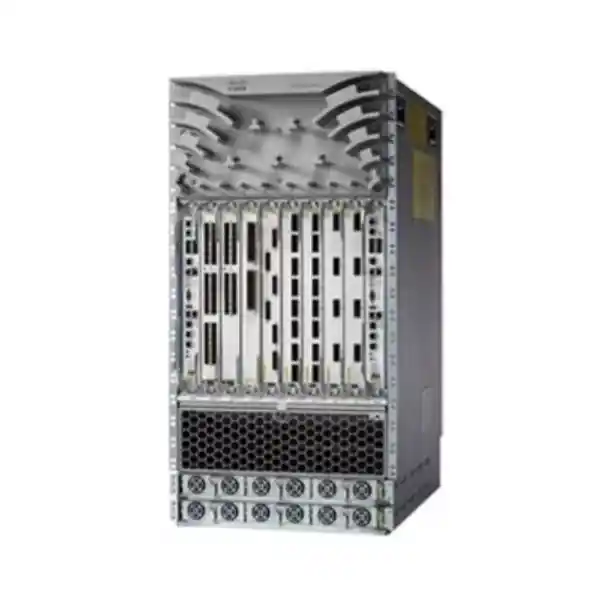
Cisco ASR 9910 Aggregation Services Router in UAE
A high-density 21RU routing chassis for service-provider edge, metro aggregation, peering, data-center interconnect, mobile transport and large backbone environments that need modular 100G and 400G scale, resilient forwarding and the operational depth of Cisco IOS XR.
FourTeck supports UAE organizations that are designing or refreshing high-capacity IP infrastructure with platform selection, line-card planning, optics alignment, rack and power assessment, migration sequencing, implementation services and lifecycle support. The ASR 9910 should be engineered as a complete system rather than purchased as an isolated chassis; route processors, switch-fabric generation, line cards, optics, power modules, cooling, software release and feature licensing must all be aligned to the intended traffic model.
What the Cisco ASR 9910 Is Designed to Do
The Cisco ASR 9910 is a modular member of the ASR 9000 family positioned for networks where a fixed-form-factor router can no longer provide the interface density, slot-level growth path, hardware redundancy or service scale required by the design. The chassis provides eight line-card slots and two route-switch-processor positions, with additional rear fabric positions that can be populated according to the generation of fabric and line cards selected. Cisco lists 4 Tbps of bandwidth per slot and a maximum platform capacity of 64 Tbps for the ASR 9910. Those figures make the chassis relevant to large metro aggregation layers, provider edge locations, internet peering nodes, regional core roles, high-throughput enterprise backbones and data-center interconnect environments.
The important engineering point is that the ASR 9910 is not one immutable forwarding configuration. It is a chassis system. Its real capacity, port mix and service behavior are determined by the installed route switch processors, switch fabric cards, line-card generation, optics, software train and enabled feature set. A design using high-density fifth-generation 100G or 400G line cards has very different power, cooling, optics, oversubscription and software considerations from a design carrying a large installed base of 10G or earlier-generation 100G interfaces. Capacity claims therefore need to be interpreted at the system level rather than reduced to a single marketing number.
For UAE buyers, this modularity is useful when traffic growth is uneven. A service provider may initially deploy the ASR 9910 with a limited number of line cards for metro handoff and peering, then add higher-speed interfaces as wholesale IP transit, cloud exchange, 5G transport, enterprise VPN or content traffic grows. Large enterprises can use the same approach when consolidating campus-core, private-cloud, WAN-edge or data-center routing functions into fewer high-capacity nodes. FourTeck can help translate a traffic forecast into a slot plan, optic plan and bill of materials rather than selecting parts solely from headline bandwidth.
Core Hardware Architecture
Eight Modular Line-Card Slots
Eight service slots provide the physical foundation for building a port mix that matches the role of the router. Depending on supported hardware and IOS XR release, deployments can combine generations of 10G, 100G and 400G-capable line cards, fixed-port or flexible interface designs, and service-edge or transport-oriented variants. The value of the slot architecture is not simply density; it allows capacity to be added in controlled increments while preserving a common chassis and operational model.
Dual Route Switch Processors
The ASR 9910 uses dual route-switch-processor positions for control-plane redundancy, system management and switching-fabric functions. A properly engineered redundant system allows software, control and hardware maintenance procedures to be planned with less dependence on a single control component. The route processor generation also affects software compatibility, memory resources and line-card support, so BOM validation must include processor and software release alignment.
Multi-Plane Switch Fabric
Cisco’s ASR 9900 fabric architecture uses parallel switching planes. With supported third-generation fabric hardware, the ASR 9910 can use the fabric integrated into the two route switch processors together with as many as five dedicated rear fabric cards, creating seven active fabric planes and a 6+1 resilient arrangement. This is central to sustaining high throughput while preserving forwarding during a fabric-component event or maintenance operation.
High-Capacity Slot Connectivity
Cisco lists 4 Tbps per slot for the ASR 9910. This slot bandwidth is what allows newer high-density line cards to bring large amounts of interface capacity into the chassis without treating every service slot as a legacy low-speed bus. The practical design requirement is to pair high-speed line cards with the fabric generation and software that can support their intended operating mode.
Switch Fabric: Why It Matters More Than the Chassis Name
In high-end modular routers, the line card does not forward traffic to another slot by simply placing packets on a shared backplane. The ASR 9900 architecture uses switching fabric planes to transport traffic between line cards. Cisco describes the fabric as a single-stage, packet-based, non-blocking architecture with centralized virtual output queue arbitration. The architecture is engineered to minimize head-of-line blocking and to distribute traffic across multiple active fabric planes.
For the ASR 9910, the fabric arrangement is distinctive because two fabric functions can be integrated with the pair of route switch processors and additional dedicated fabric cards can be installed at the rear. With the supported third-generation A99-SFC3-S architecture, up to five dedicated fabric cards complement the two RSP-resident fabric planes. A fully built seven-plane system operates with six active planes sufficient to carry the designed traffic load while the seventh provides redundancy. If one fabric plane is lost or removed under supported conditions, the remaining planes continue forwarding.
This architecture affects procurement. It is not sufficient to request “an ASR 9910 with 400G” without defining the fabric and line-card generation. Fifth-generation 400G and dense 100G cards require the appropriate fabric generation, route processors and IOS XR software. When FourTeck prepares a configuration, the fabric calculation should be tied to the exact card list, not copied from a generic platform maximum.
Fabric Design Questions
- Which line-card generation will be installed now and over the next three to five years?
- Does every planned high-speed card have validated compatibility with the chosen RSP, fabric and IOS XR release?
- What failure state must the router carry without oversubscription?
- Are maintenance procedures expected to include online insertion and removal of fabric or line-card components?
- Does the rack layout provide rear access for fabric servicing without disturbing adjacent power or cabling?
Interface and Line-Card Strategy
The most important commercial decision after selecting the chassis is the line-card strategy. The ASR 9910 has been supported across multiple generations of ASR 9000 line cards, including options for high-density 10G, 100G and 400G designs. Cisco documentation for fifth-generation hardware includes 10-port 400 Gigabit Ethernet cards and 32-port 100 Gigabit Ethernet cards that are compatible with the ASR 9910 when the broader system requirements are met. Earlier card families provide additional combinations of 1G, 10G, 40G and 100G connectivity. This broad hardware history allows the ASR 9910 to serve both brownfield expansion and greenfield high-capacity projects, but it also creates a requirement for disciplined compatibility checking.
A port-count exercise should distinguish physical ports from usable service capacity. For example, a provider may need many 100G customer or network handoffs but only a smaller number of 400G core uplinks. Another deployment may need 400G coherent or data-center interconnect connectivity in specific slots while retaining large 10G fan-out elsewhere. The right design groups traffic according to failure domains, oversubscription targets, optical reach, protection strategy and anticipated upgrade path. Port breakouts can be valuable where supported, but a breakout design changes fiber presentation, patching density, optic selection and operational troubleshooting, so it should be documented explicitly.
For internet peering, it is often useful to reserve high-speed slots for exchange fabrics, transit providers and content networks while retaining independent capacity for customer aggregation. For mobile transport, line-card selection may be driven by 25G, 100G and 400G progression, timing requirements and deterministic quality-of-service behavior. For enterprise data centers, the primary concern may be scalable routed DCI, EVPN edge, cloud on-ramp and high-bandwidth north-south traffic. Each use case may lead to a different card arrangement even though the chassis is identical.
FourTeck recommends preparing a slot map before ordering. The slot map should show the proposed card part number, port speed, optic family, cable or breakout requirement, expected average and peak load, protection peer, software dependency and planned future role. This turns the ASR 9910 into an engineered platform instead of a collection of compatible parts.
100G Aggregation
Dense 100G line cards can consolidate large volumes of metro uplinks, provider interconnects and data-center connections. They are especially useful where many remote nodes are moving from multiple 10G links to native 100G. The engineering focus should include optic reach, per-slot load, protection capacity and the expected transition toward 400G uplinks.
400G Growth
Fifth-generation 400G line-card support makes the ASR 9910 relevant for core-facing and DCI designs where a small number of very high-capacity interfaces are more efficient than large bundles of 100G links. System fabric, software and optics must be checked as one compatibility chain, particularly in mixed-generation chassis.
Brownfield 10G / 100G Mix
Many UAE networks are not greenfield. Existing 10G customer handoffs and earlier 100G circuits may need to coexist with newer high-speed core links. The chassis can support a staged migration strategy, but slot occupancy, hardware generation and power density should be modeled before assuming that every legacy card should remain in service indefinitely.
Cisco IOS XR Operational Model
The ASR 9910 runs Cisco IOS XR, Cisco’s carrier-oriented network operating system for high-scale routing platforms. IOS XR is designed around modularity, process isolation, transactional configuration and service-provider operational requirements. Cisco provides 64-bit IOS XR support for the ASR 9910, with platform support dating from the 6.2.1 software train and continuing into later releases. Exact feature and hardware support varies by release, so a production deployment should pin an approved software version before hardware is ordered or migrated.
Transactional configuration is particularly important in large routing systems. Operators can stage changes, review them and commit them as a controlled set rather than relying only on a sequence of immediately applied commands. This can reduce the risk associated with multi-line policy, BGP, MPLS or interface changes, especially where automation systems are involved. Rollback and commit history also help operations teams reason about what changed during an incident.
IOS XR supports an extensive service-provider routing feature set, including BGP, IS-IS, OSPF, MPLS, multicast, QoS, Segment Routing and EVPN capabilities on supported hardware and releases. The practical advantage is architectural convergence: a single ASR 9910 can participate in an underlay IGP, label-switched transport, provider-edge VPN services, internet BGP, route reflection or EVPN-based service delivery according to the network design. However, not every use case should be collapsed into a single box. Failure domains and operational ownership still matter. A carrier may deliberately separate internet edge, subscriber edge and MPLS core roles even when a platform can technically support several of them.
For UAE operations teams, software lifecycle planning should cover maintenance releases, security advisories, feature dependencies, line-card minimum releases and interoperability with existing NMS, telemetry and automation tooling. FourTeck can assist with release planning and pre-change validation as part of broader FourTeck IT services in the UAE.
Routing, MPLS and Segment Routing Roles
IP Core and Provider Edge
The ASR 9910 can operate in high-scale IP and MPLS domains where the requirement is not just packet throughput but policy-rich routing. In an internet-edge role, design work normally focuses on full-route BGP scale, multiple transit and peering adjacencies, route-policy control, graceful maintenance and large traffic swings caused by content networks or DDoS events. In a provider-edge role, the focus shifts toward VRFs, MPLS label transport, route distinguishers, route targets, QoS, service separation and customer-facing operational processes.
The physical capacity of the chassis does not automatically define the safe routing scale. Route scale depends on the selected RSP generation, software release, feature combination and memory consumption. A responsible design therefore validates the target route table, VRF count, BGP neighbor count, policy complexity and anticipated growth against Cisco release documentation for the exact hardware.
Segment Routing Evolution
Segment Routing can simplify MPLS transport by encoding an intended path as an ordered set of segments while reusing an IGP-based control plane. In a service-provider network, this can reduce dependence on additional signaling protocols for some traffic-engineering designs and can integrate well with centralized path computation and automation. The ASR 9000 family has extensive Segment Routing capabilities in modern IOS XR releases, making the ASR 9910 a candidate for networks moving from traditional MPLS traffic engineering toward SR-MPLS architectures.
Migration should be staged. Operators should define coexistence with LDP or RSVP-TE where those protocols are already deployed, establish SID allocation, determine fast-reroute behavior, validate policy steering and document troubleshooting workflows. The objective is not merely to enable Segment Routing but to produce an operational model that NOC engineers can diagnose under failure conditions.
EVPN and Modern Service Edge Design
Ethernet VPN has become a major control-plane technology for modern Layer 2 and Layer 3 service delivery. On supported IOS XR releases and compatible ASR 9000 hardware, EVPN can be used for provider Ethernet services, data-center interconnect and routed service architectures. EVPN replaces some data-plane learning behaviors with BGP-distributed reachability, giving operators more explicit control over MAC and IP information and enabling modern multihoming mechanisms.
For a metro provider, EVPN can support business Ethernet, multi-site connectivity and migration from older VPLS service models. For a data-center environment, the ASR 9910 may sit at the boundary between a data-center EVPN fabric and a wide-area IP/MPLS transport layer. The design should clearly define where EVPN routes are originated, imported and summarized, and whether the ASR 9910 is acting as a pure transport node, a service edge, a border gateway or a DCI router.
Multihoming is another key design area. When customer equipment or downstream aggregation nodes connect redundantly, the EVPN design can use Ethernet segments and designated-forwarder behavior to avoid inefficient active/standby topologies. But resiliency is only useful when failure behavior is predictable. Lab validation should include link failure, line-card reset, peer reload, route-processor switchover, IGP reconvergence and maintenance withdrawal so that operations teams understand both control-plane and data-plane convergence.
FourTeck can help customers decide whether the ASR 9910 should terminate EVPN services or simply carry them, and how that decision affects line-card scale, BGP policy, redundancy and monitoring. This is particularly important when connecting UAE data centers, cloud exchange locations and regional sites through a mix of dark fiber, carrier wavelength and wholesale IP/MPLS circuits.
Quality of Service and Traffic Engineering
High-capacity routers are often judged by aggregate throughput, but real service quality depends on behavior during contention. The ASR 9000 family is designed for provider-class QoS functions, allowing networks to classify, mark, police, queue and schedule traffic according to service policy on supported line cards. The exact scale and hierarchy vary by hardware generation, so QoS requirements need to be defined before selecting cards.
A UAE enterprise aggregation network may use QoS to protect voice, video conferencing, trading, industrial telemetry and critical application replication from bulk backup traffic. A service provider may use hierarchical policies to enforce customer committed rates while preserving provider-level traffic classes. A mobile transport design may require strict prioritization for timing-sensitive or control traffic. In each case the configuration should be derived from an explicit service model rather than copied from a generic template.
Traffic engineering should also account for asymmetric traffic patterns. Internet and content delivery traffic can be heavily inbound. Backup and cloud migration can produce bursts that do not resemble average utilization. DCI environments can see synchronized replication peaks. Capacity planning should therefore use 95th-percentile, peak and failure-state measurements, not only monthly averages. A 40 percent average link can still congest during a maintenance event if the redundant path must absorb the full load.
The ASR 9910 provides the hardware headroom to build large links, but the network architecture decides whether that headroom is usable. FourTeck sizing workshops can map application classes, service-level targets, policer requirements, oversubscription ratios and failure scenarios to the intended physical topology.
High Availability and Failure-Domain Engineering
Control-Plane Redundancy
Dual route switch processors can remove the control plane as a single hardware dependency when deployed and configured correctly. Software maintenance and failover behavior still need validation, because redundancy is an architecture, not simply the presence of two cards. Change procedures should document switchover state, protocol expectations and management-path continuity.
Fabric Resilience
With a fully engineered seven-plane fabric using compatible components, the ASR 9910 can continue forwarding when a fabric plane is unavailable. This allows the system to sustain a component event without collapsing the switching path. The remaining fabric capacity under failure must still be sufficient for the installed line-card traffic model.
Line and Node Protection
Chassis redundancy does not protect against a complete node failure, rack power loss or fiber cut. Critical networks normally use paired routers in separate failure domains, dual-homed downstream devices, diverse optical paths and routing convergence. A high-availability design must therefore extend beyond the internal components of one ASR 9910.
Maintenance Without Surprises
Online insertion and removal capabilities on supported cards are valuable, but operational success depends on draining traffic before maintenance, verifying redundant capacity, reviewing alarms and validating post-change state. A maintenance plan should identify which component can be removed, what the chassis is expected to do and how success will be measured.
Telemetry, Automation and Programmable Operations
At ASR 9910 scale, manual CLI-only operations become increasingly difficult to govern. A platform may contain hundreds of high-speed interfaces, thousands of routing adjacencies and many service policies. Modern IOS XR releases provide programmatic management and streaming telemetry mechanisms that can integrate with network controllers, orchestration platforms and monitoring systems. The exact interfaces and feature maturity depend on the release, but the architectural direction is clear: large routing systems should be managed through repeatable workflows backed by machine-readable state.
Telemetry is valuable because it allows operators to collect structured operational data at higher frequency than traditional polling alone. Interface utilization, queue occupancy, errors, routing state and system health can feed time-series analytics or event-driven automation. For service providers, this helps correlate customer-impacting events with underlying resource conditions. For enterprises, it improves capacity forecasting and can expose congestion before users report an application problem.
Automation should begin with low-risk tasks. Configuration compliance, interface description standards, NTP, AAA, logging, telemetry subscriptions and inventory collection are good candidates. More advanced workflows can handle BGP policy deployment, service provisioning and maintenance drain procedures after the organization has developed testing, approval and rollback practices. The transactional model of IOS XR supports disciplined automation because a change can be staged and committed as a unit.
FourTeck can integrate the router with existing monitoring and operations practices rather than forcing an entirely new toolchain. The objective is to reduce configuration drift and mean time to repair while preserving change governance. For organizations that require broader managed infrastructure assistance, the FourTeck UAE technology portfolio can be used as the starting point for network, security and infrastructure coordination.
Use Case 1: UAE Service-Provider Metro Aggregation
A metro aggregation router collects traffic from access rings, business service nodes, broadband aggregation points, mobile sites or smaller edge routers and forwards it toward service edges, internet gateways or regional cores. The ASR 9910 is well suited to this role when aggregation has moved beyond the capacity of smaller fixed platforms and the operator needs many 100G interfaces with a planned progression toward 400G.
The engineering priority is failure-state capacity. A metro node may be dual-homed to two core routers, but if one upstream path is lost the surviving path must carry the full metro load. The ASR 9910’s modular slots allow the operator to allocate physically independent interfaces and card resources to diverse paths. Where topology permits, distributing redundant links across different line cards avoids turning one card failure into the loss of both primary and backup connectivity.
Service scale is equally important. The node may carry L3VPN, EVPN, business Ethernet, internet transit, management and mobile transport simultaneously. Route policy, QoS and label scale should be modeled against the exact hardware and software release. The design should also reserve ports for future access-ring upgrades; otherwise the chassis may have forwarding capacity available but no convenient interface layout for expansion.
In the UAE, metro designs often connect facilities in Dubai, Abu Dhabi and other emirates through a mixture of owned fiber, carrier wavelengths and leased services. The router configuration should therefore be coordinated with the optical and transport plan. A 100G or 400G router port is only one layer of the circuit: optic reach, patching, wavelength service handoff, protection path and demarcation responsibilities must all be clear before commissioning.
Use Case 2: Internet Edge and Peering
Internet-edge routing combines high bandwidth with complex control-plane policy. An ASR 9910 can terminate high-speed transit, internet-exchange and private-network-interconnect links while running BGP policies that determine which prefixes are accepted, preferred, advertised or rejected. The chassis is particularly useful when an organization expects interface growth that would otherwise require several smaller routers or repeated platform replacement.
The design starts with route scale and policy behavior. Full internet tables, multiple peers, internal BGP, route reflectors and policy copies all consume control-plane resources. Engineers should define expected IPv4 and IPv6 table sizes, growth horizon, number of peers and policy complexity. Route processor choice and memory are therefore central to the BOM. The line-card side must then be sized for traffic, not merely for neighbor count. A small number of major content providers can drive very large data volumes even when the BGP configuration is simple.
DDoS response is another consideration. The ASR 9910 is not a substitute for a dedicated scrubbing platform or security architecture, but internet-edge routing should integrate with mitigation workflows. Operators may use BGP communities, remotely triggered black hole policies, FlowSpec or upstream-provider procedures where supported by policy and service contracts. The goal is to keep mitigation mechanisms controlled and auditable rather than allowing emergency changes to bypass governance.
Peering designs should also consider maintenance. If every transit and exchange circuit is concentrated in one chassis, the node becomes a major failure domain even with internal redundancy. Critical internet edges commonly use two routers in diverse racks or rooms, with sessions and links distributed so that one node can be isolated without disconnecting the organization. The ASR 9910’s capacity makes that dual-node model practical for very large traffic volumes.
Use Case 3: Data-Center Interconnect
Routed DCI
A routed DCI keeps failure domains comparatively small and is often the preferred model for modern applications that do not require stretched Layer 2. The ASR 9910 can provide large 100G or 400G links between facilities and participate in BGP or an IGP to advertise site prefixes. ECMP can distribute traffic across multiple parallel paths where the design allows.
Capacity planning should include replication bursts, backup windows, storage traffic and disaster-recovery exercises. These flows can produce higher peaks than day-to-day application traffic, particularly when a large data set is reseeded or a storage cluster resynchronizes after a failure.
EVPN DCI
Where selected workloads require Layer 2 extension or EVPN-based inter-site service, the ASR 9910 can be positioned as a service edge or transport boundary on supported software and hardware. The operational model should define route-type handling, MAC mobility expectations, split-horizon behavior, multihoming and route-policy boundaries.
The temptation to stretch every VLAN between sites should be resisted. DCI is most resilient when the network team and application team agree which services genuinely require extension and which can use routed failover. The router has to support the architecture, not compensate for an undefined one.
UAE customers building DCI between colocation facilities, private data centers or cloud-adjacent sites should include cross-connect lead times, optical service specifications and demarcation responsibilities in the project plan. FourTeck can coordinate network design with the wider Firewall Dubai infrastructure practice when routing projects also require perimeter, segmentation or secure interconnect planning.
Use Case 4: Mobile Backhaul and Transport
Mobile networks place unusual demands on aggregation infrastructure because they combine rapid traffic growth, strict availability targets, timing requirements and geographically distributed endpoints. An ASR 9910 can serve as a high-capacity aggregation or regional transport node where large numbers of downstream routers or packet-transport systems converge into 100G and 400G core-facing interfaces.
Traffic growth should be modeled per site cluster rather than averaged across the network. Busy-hour mobile traffic can vary significantly by geography, season and event. A transport node serving a stadium district, airport, dense business area or tourism zone may experience peaks unlike a residential region. The slot plan should therefore preserve the ability to add interfaces to the specific aggregation domains most likely to grow.
Timing and synchronization requirements must be validated against the exact platform configuration, line cards, optics and software. Network teams should document whether SyncE, PTP or external timing sources are required and how timing redundancy behaves during maintenance. This is especially important when a router is part of a wider radio-access transport chain; packet forwarding can remain healthy while poor synchronization affects downstream radio performance.
QoS policies should protect control, timing and latency-sensitive classes under congestion. Rather than relying on oversized links indefinitely, a mobile transport architecture should define class behavior in failure conditions, including what happens when one high-capacity upstream link is unavailable and traffic is rerouted over a reduced set of interfaces.
Physical Specifications and Data-Center Planning
The ASR 9910 is a substantial chassis and should be treated as a data-center infrastructure project, not merely a network-device installation. Cisco lists the chassis at approximately 36.69 inches high, corresponding to 21 rack units. Its width is approximately 17.60 inches. Depth is approximately 30.41 inches without the air reflector and approximately 39.63 inches with the air reflector. Cisco lists about 170 lb for the chassis with two power entry modules and about 302.25 lb for a more heavily equipped configuration containing fan trays, route switch processors, fabric cards and power entry modules. Exact shipping and configured weights depend on components.
Those dimensions affect cabinet selection, rear clearance, cable-management planning and floor loading. A nominally deep cabinet can still become difficult to service if rear PDU placement blocks access to switch fabric cards or power components. The installer should confirm usable rail depth, door clearance, cable bend radius and the physical path for inserting and removing line cards. For large optics counts, front cable management becomes a design task in its own right.
Because the chassis occupies 21RU, two redundant ASR 9910 systems can consume a large portion of a standard rack before patch panels, optical transport, console servers and management switches are considered. Many operators therefore place paired routers in separate racks or separate rooms, which improves failure-domain diversity while simplifying cable organization. If the network requires a high density of cross-connects to carrier meet-me rooms or data-center fabrics, patch-panel placement should be drawn in the rack elevation before deployment.
FourTeck can review rack drawings, physical clearances and equipment placement before delivery. This reduces the risk of discovering after arrival that the intended cabinet cannot provide the required depth, rear access or power distribution.
Power Architecture and Capacity Planning
Power planning for a modular router must be based on the complete bill of materials. Chassis consumption varies substantially with line-card generation, port count, optic type, route processors, fabric cards and redundancy configuration. A lightly populated ASR 9910 has a different draw from a system filled with high-density 400G line cards. The correct method is to calculate component-level power using Cisco’s published power data and planning tools for the selected hardware, then apply the data-center’s redundancy model and growth margin.
A resilient installation normally uses independent power feeds so that the loss of one source, PDU or upstream UPS path does not shut down the router. The exact feed arrangement depends on AC/DC configuration, power entry modules and facility standards. Engineers should define whether the site is designed for N, N+1, 2N or another power-resiliency model and ensure the router’s supply layout matches that intention. Merely plugging redundant supplies into adjacent sockets on the same PDU does not create true feed diversity.
Optics also contribute to the power budget, especially at 100G and 400G. Long-reach, coherent and higher-performance optical modules can consume meaningfully more power than short-reach modules. Dense configurations therefore need a combined router-and-optics thermal model. This is one reason the optic BOM should be finalized before the data-center team approves rack power.
For UAE sites, cooling and power cost are material operational considerations. High-capacity routing equipment should be placed where cold-aisle supply, hot-air exhaust and facility monitoring are appropriate. Power sizing with comfortable headroom is preferable to running close to breaker or PDU limits, because future line-card additions can otherwise require disruptive electrical work.
Cooling, Airflow and UAE Environmental Considerations
The ASR 9910 uses high-capacity fan assemblies to move air through a dense modular chassis. Cisco documents normal and short-term operating environmental limits for components in the ASR 9900 ecosystem, but the practical target for a data center should remain stable, clean and well inside maximum boundaries. Operating near a short-term thermal limit should be viewed as an abnormal condition, not a normal design point.
In the UAE, outside ambient temperatures can be extreme, but well-designed data centers isolate IT equipment from those conditions. The more relevant risk is facility cooling disruption, blocked airflow, recirculation from adjacent high-density equipment or a poorly sealed hot aisle. Because the ASR 9910 can host multiple high-wattage line cards, local rack heat density may be significant even when the room’s average temperature appears acceptable.
The deployment team should verify airflow direction, blank unused rack spaces where appropriate, maintain the required front and rear clearances and avoid placing loose cable bundles where they obstruct intake or exhaust paths. Temperature sensors should be monitored at the rack level. If the data center provides only room-level readings, adding rack or inlet telemetry can reveal localized hot spots that would otherwise remain invisible.
Dust control is another practical concern for facilities exposed to frequent construction activity or desert dust ingress. Data-center filtration and positive-pressure practices should be maintained, and maintenance intervals should reflect actual site conditions. The router should not be treated as an environmental appliance; it depends on the facility delivering the conditions for which the equipment was designed.
Optics, Fiber and Cabling Design
An ASR 9910 project can contain more complexity in optics than in the chassis itself. Each port must be matched to the desired Ethernet rate, fiber type, connector, distance, patch-panel path and peer device. At 100G and 400G, incorrect optic assumptions can create expensive procurement changes or commissioning delays. The network team should therefore build an optic matrix alongside the line-card matrix.
Short-reach data-center links may use multimode optics where distances and infrastructure suit them, while metro and inter-building links commonly require single-mode optics. Longer spans may be delivered through carrier-managed wavelength services or coherent optical systems. Where a router-facing coherent option is used, the design must confirm hardware and software support, optical parameters and interoperability with the line system. The presence of a physically compatible form factor does not guarantee supported operation.
Breakout also deserves careful planning. Some line cards and optic combinations can present a higher-speed physical port as multiple lower-speed logical interfaces. Breakout can be highly efficient for migration because it allows one slot to serve several 10G, 25G or 100G endpoints, depending on the card. But it increases front-panel cable density and requires clear labeling. A technician troubleshooting a single customer circuit should be able to identify the corresponding lane, patch-panel port and optic without reverse-engineering the entire harness.
Fiber cleanliness is essential. High-speed optics are sensitive to contamination and poor connector condition. Deployment procedures should include inspection and cleaning before insertion, not only after an error is observed. Optical receive and transmit levels should be captured at commissioning and stored as a baseline. This makes future degradation easier to diagnose.
FourTeck can help develop the optic and fiber BOM together with the router configuration, including spares. Strategic spares should reflect operational risk: a high-value core link may justify an on-site spare optic even when the probability of failure is low because the business impact of waiting for replacement is high.
Security and Control-Plane Protection
A carrier-class router sits at a highly trusted point in the network and should be hardened accordingly. Security begins with management-plane separation. Dedicated out-of-band management is preferable for critical systems so that a routing incident does not remove the only path used to troubleshoot it. Administrative access should use centralized AAA, role-based controls, strong authentication, encrypted protocols and detailed accounting. Local emergency credentials can be retained under documented break-glass procedures rather than used for routine access.
The control plane should be protected from excessive or malformed traffic. Infrastructure ACLs, control-plane policing and routing-protocol authentication should be designed according to the topology. BGP sessions should be restricted to known peers, TTL-based protections may be considered where appropriate, and route-policy controls should prevent accidental acceptance or advertisement of invalid prefixes. Internet-edge deployments should also implement route filtering aligned to peer contracts and organizational policy.
Software security is a lifecycle responsibility. Operators should track Cisco security advisories, approved IOS XR maintenance releases and feature-specific caveats. Patching a core router requires more planning than patching an access switch, which makes a predictable maintenance cadence important. Redundant nodes and tested traffic-drain procedures allow security updates to be applied without creating avoidable outages.
Network security should be coordinated with firewalls, DDoS controls and logging infrastructure rather than handled independently. For architectures where the ASR 9910 feeds protected enterprise or data-center zones, FourTeck can align routing with the broader security stack through the Firewall Dubai solution team.
Sizing Methodology: From Traffic Forecast to Chassis Configuration
- Define the current traffic matrix. Document peak traffic between access, core, internet, cloud and data-center domains. Use measured peak and percentile data rather than interface-speed totals. A 100G circuit carrying 20G peak traffic should not be treated the same as a 100G circuit consistently approaching saturation.
- Model growth by traffic class. Internet, cloud backup, mobile, enterprise VPN and DCI traffic do not necessarily grow at the same rate. Apply separate growth assumptions and build at least a three-year view for major interfaces. Where business plans are uncertain, preserve empty slots or deploy higher-speed uplinks earlier.
- Calculate failure-state load. Assume a core link, line card, peer node or path is unavailable and recalculate utilization. A design that is comfortable in normal operation may overload during maintenance. The required headroom should be agreed as an engineering policy rather than discovered during an outage.
- Choose line-card generation. Select cards that provide the required interface speeds and service features, then confirm compatibility with the RSP, fabric and IOS XR release. Do not mix generations merely because a card physically fits; evaluate operational lifecycle and support status.
- Build the fabric configuration. Determine the fabric-card count and generation required to support the chosen line cards and the desired failure-state capacity. For the ASR 9910, newer fabric designs can combine RSP-resident fabrics with up to five dedicated cards.
- Validate route and service scale. Document BGP routes, VRFs, EVPN routes, MPLS labels, multicast state, ACL entries and QoS policy requirements. Hardware forwarding capacity and control-plane scale are separate dimensions.
- Complete the optical design. Match every physical port to a supported optic, fiber medium, reach and peer. Reserve spares according to criticality and expected lead time.
- Confirm rack, power and cooling. Convert the final component list into a physical installation plan including rack units, depth, weight, feeds, PDU connectors, cooling and maintenance access.
Migration Planning from Existing Core or Edge Routers
A migration to the ASR 9910 should separate physical installation from traffic cutover. The chassis can be racked, powered, cabled and tested before any production route is moved. Management access, AAA, logging, NTP, telemetry and software baseline should be validated first. Next, the routing adjacencies can be brought up in a controlled manner with policies that prevent unintended forwarding until the network team is ready.
For BGP migrations, the team should identify which sessions can be moved independently and how local preference, MED, communities and route advertisement will change during coexistence. For MPLS or Segment Routing migrations, the plan must account for IGP metrics, label distribution, traffic engineering and service reachability. For EVPN, multihoming and designated-forwarder behavior may require careful sequencing to avoid duplicate forwarding or unexpected MAC movement.
Optical migration is often the hidden constraint. If the new router uses different optics or port speeds, the peer side may also need a change. A 100G-to-400G upgrade may require a new line card at the far end, new wavelength service or updated patching. A complete method of procedure should include both ends of every critical circuit, not only the ASR 9910 side.
Rollback must be practical. A rollback that requires physically repatching dozens of fibers by memory is not a safe plan. Cable labeling, pre-staged patch leads and documented old/new port mappings reduce risk. Configuration rollback should be equally explicit, with known checkpoints and route-policy states.
FourTeck can support migration workshops, staging, implementation and post-cutover verification. The objective is to preserve service continuity while moving traffic in manageable groups rather than attempting a single high-risk all-at-once cutover.
Operations, Monitoring and Troubleshooting Practices
Baseline Before Production
Capture chassis inventory, software version, power status, fan state, fabric status, interface optics, routing neighbors, route counts, CPU, memory and error counters before carrying production traffic. A known-good baseline turns later fault isolation into a comparison rather than a guessing exercise.
Monitor the Fabric
Do not limit monitoring to interface utilization. Fabric-plane health, hardware alarms and card state are central to a modular chassis. A degraded fabric may not immediately cause an outage if redundancy is working, but it reduces protection and should trigger maintenance before another fault occurs.
Track Optics Trends
Receive-power drift, increasing corrected errors or intermittent link flaps can indicate fiber contamination, aging optics or transport problems before a hard failure. Store optical telemetry over time, particularly for long-reach or business-critical links.
Change with Evidence
Define pre-checks and post-checks for every major change. Route count, adjacency state, interface errors, traffic levels and customer probes should be compared before and after. Transactional commits and configuration history help, but operational validation is still required.
Software, Feature Licensing and Support Planning
The ASR 9910 hardware purchase is only one part of the lifecycle. IOS XR feature availability, entitlement, software release selection and support coverage need to be understood before deployment. Cisco licensing models have evolved over time, and the required entitlement depends on the feature set, platform generation and commercial program in effect for the chosen hardware. A procurement team should avoid relying on an old bill of materials from another project without validating current licensing.
Support coverage is especially important for a core platform because faults can involve hardware replacement, software defect investigation or compatibility questions across multiple components. The organization should define required replacement SLA, access to software updates and escalation path. For UAE operations, local spare strategy can complement vendor support for the most business-critical items, particularly optics and selected field-replaceable units.
Software release choice should balance feature need against operational maturity. The newest release is not automatically the best production release if the organization does not need its features. Conversely, staying on an old train solely because it is familiar can block newer line cards or security fixes. The correct baseline should be selected by checking hardware support, feature requirements, recommended maintenance releases, known defects and organizational change windows.
FourTeck can help map the desired functions to the software and support components in the quotation so that the commercial proposal reflects the intended production architecture rather than only the physical chassis.
ASR 9910 Compared with Smaller and Larger ASR 9900 Chassis
Within the ASR 9900 family, the ASR 9910 occupies a useful middle ground. Cisco lists eight line-card slots for the ASR 9910, compared with fewer slots in models such as the ASR 9904 and ASR 9906, and more slots in the ASR 9912 and ASR 9922. The choice should not be based only on total chassis capacity. Rack space, expected port count, node diversity, growth pattern and operational standardization all influence the result.
A smaller chassis can be preferable when traffic is moderate and the organization wants more nodes for geographic or failure-domain diversity. Two smaller routers in separate sites can sometimes provide better resilience than one very large chassis, even if the aggregate port count is similar. Conversely, the ASR 9910 can reduce device count and simplify interconnection when a single site already requires many high-speed interfaces.
The larger ASR 9912 and ASR 9922 provide more line-card slots and substantially larger maximum capacity, but they also consume more rack space and may exceed what a regional site requires. The ASR 9910’s eight slots can be a practical fit for major metro or regional nodes where the organization wants chassis-class redundancy and 400G growth without committing to the physical scale of the largest platforms.
A sizing discussion should therefore start with the target topology. If the roadmap shows that all eight service slots are likely to be occupied within the first deployment phase, a larger chassis may deserve evaluation. If only two or three slots are needed and growth is modest, a smaller platform may be more efficient. FourTeck can compare the alternatives at the system level using projected port counts, capacity, rack space and support lifecycle.
UAE Procurement Considerations
Large routing projects in the UAE typically involve more than a product price. Lead time, hardware revision, software entitlement, optics availability, data-center access, staging, installation and support response all affect the project schedule. A chassis can arrive before its optics or line cards and remain unusable, so the bill of materials should be treated as a dependency set.
Organizations should define whether equipment is for a greenfield build, capacity expansion, hardware refresh or emergency replacement. Greenfield projects allow more freedom to standardize on a new line-card generation. Brownfield expansion may need compatibility with installed cards and existing IOS XR releases. Emergency replacement emphasizes exact part compatibility and delivery speed. FourTeck can structure quotations differently according to the project type rather than applying one generic configuration.
Spares policy should be explicit. Keeping a full spare chassis is not always necessary, but critical networks may justify spare optics, fan modules, power components or selected cards on site. The decision depends on vendor replacement SLA, business impact and installed base. Operators with several ASR 9910 systems can often build a shared strategic-spares pool, reducing cost while improving recovery time.
Documentation should also be part of delivery. Rack elevation, cable schedule, IP plan, interface mapping, optic matrix, power-feed map, software baseline and acceptance test results are operational assets. A well-documented router is easier to support than an identically configured router whose design exists only in the memory of the deployment engineer.
For projects that extend from the UAE into regional operations, FourTeck can coordinate broader sourcing and infrastructure planning through its Africa technology practice where relevant to multi-country network rollouts.
Recommended Pre-Sales Discovery for the ASR 9910
Traffic and Interfaces
- Current and three-year peak traffic by domain
- Required 10G, 25G, 40G, 100G and 400G ports
- Expected breakout use
- Normal and failure-state utilization targets
Routing and Services
- BGP route counts and neighbor scale
- VRF, EVPN and MPLS requirements
- QoS hierarchy and policing needs
- Segment Routing or legacy MPLS coexistence
Physical Environment
- Rack type, depth and available RU
- Power feed type and redundancy
- Cooling capacity and airflow
- Front/rear service access and cable management
Optical Layer
- Fiber type and connector standard
- Distance for every high-speed circuit
- Carrier wavelength or DCI handoff details
- Spare optic and patching requirements
Detailed Engineering Notes for a Production-Ready Bill of Materials
A production ASR 9910 quotation should be reviewable as a system. The chassis line item should be followed by route switch processors, switch fabric cards, line cards, power components, fan assemblies where applicable, software or licensing entitlements, optics, cable accessories, rack hardware, support coverage and professional services. Each item should map to a design requirement. This makes it easier for the technical and procurement teams to verify that nothing critical has been omitted.
For example, a project asking for sixteen 400G interfaces should not stop at multiplying port count by a card density. The engineer should determine how those ports are distributed across slots, whether redundant paths are on separate cards, how much aggregate traffic can reach each slot, what fabric configuration supports the cards, which optic types are required, what the peer equipment supports and how much power the full configuration consumes. The same discipline applies to 100G-heavy designs.
Software compatibility is part of the BOM review. A modern line card may require a minimum IOS XR release that is newer than the customer’s current operating standard. If the router is joining an installed ASR 9000 estate, the project may need a software upgrade before or during deployment. That upgrade can affect change windows and testing even if the hardware installation itself is straightforward.
Support contracts should match the business role. A lab or non-critical aggregation node may tolerate next-business-day replacement, while an internet edge carrying high revenue traffic may require a more aggressive service level and local spares. The optimal support plan depends on outage cost, not only equipment cost.
FourTeck can consolidate these dependencies into a single pre-sales review so that the final proposal is technically coherent. This is particularly valuable when the customer’s initial requirement is expressed only as “ASR 9910 with 100G/400G,” because the difference between a valid architecture and an incomplete order is in the supporting components.
Acceptance Testing Before Carrying Production Traffic
A newly installed ASR 9910 should pass structured acceptance testing before production cutover. The first stage is hardware validation: verify that every route processor, fabric card, line card, power module and fan assembly is recognized and healthy. Confirm that the chassis reports the expected redundancy state and that no environmental or power alarms are present. Inventory output should be matched against the purchase order so that any incorrect part or revision is discovered before deployment.
The second stage is interface validation. Each optic should be recognized, optical levels should be within expected ranges and interfaces should remain error-free under test traffic where possible. Breakout ports should be tested lane by lane. LAG or bundle configurations should be tested for member failure and recovery. Where the far end is controlled by another provider, the acceptance plan should include contact details and an agreed test window.
The third stage is routing and service validation. Establish IGP, BGP, MPLS and EVPN adjacencies as required, then verify route exchange against an expected prefix set. Test route policy with representative allowed and denied routes. For VPN services, verify VRF isolation and end-to-end reachability. For QoS, test classification and policing behavior rather than merely checking that a policy is attached.
The fourth stage is resilience. Where the maintenance policy allows, simulate the loss of a redundant uplink, route processor, fabric component or peer node and verify that traffic reconverges as designed. These tests reveal assumptions that are difficult to see in static configuration review. Results should be captured as part of the commissioning record.
Finally, monitoring systems should be confirmed before handover. A router is not operationally complete until alarms, interface telemetry, routing state, syslog and time synchronization are visible to the NOC. Acceptance should therefore include the management plane, not only packet forwarding.
Lifecycle Strategy and Capacity Expansion
The ASR 9910 is most valuable when its modularity is incorporated into a lifecycle plan. Instead of waiting until interfaces are nearly saturated, operators can define upgrade triggers based on utilization, route scale and available slots. For example, a policy may require action when an uplink exceeds a specified 95th-percentile threshold for several weeks or when failure-state utilization would exceed the organization’s engineering limit.
Slot reservation can be intentional. A chassis with eight line-card slots does not need to be filled at launch. Leaving selected slots open for a future 400G card can be more efficient than populating every slot with lower-speed hardware and later replacing it. On the other hand, an operator with many legacy circuits may choose to reuse compatible cards temporarily while constructing a longer-term consolidation plan.
Software lifecycle and hardware lifecycle should be synchronized. New line cards often depend on newer software, while old cards may approach support limits before the chassis itself. Maintaining a hardware compatibility matrix allows the network team to see which components constrain future upgrades. This is especially important in long-lived carrier networks, where a chassis can span several generations of line cards.
Capacity expansion should also revisit facility constraints. Adding a high-density 400G card changes not only bandwidth but power, cooling and optic counts. A rack that was comfortable at initial deployment may need more electrical or thermal headroom as the chassis fills. Facility telemetry should therefore be reviewed during network capacity planning.
FourTeck can support periodic health and capacity reviews, combining interface trends, slot utilization, hardware lifecycle and upcoming service demand into a practical expansion roadmap.
Frequently Asked Technical Questions
How many line-card slots does the Cisco ASR 9910 have?
Cisco lists eight line-card slots for the ASR 9910. The chassis also provides positions for redundant route switch processors and dedicated switch fabric cards. The usable interface density depends on the selected line cards and optics.
What is the maximum capacity of the ASR 9910?
Cisco’s platform comparison lists a maximum capacity of 64 Tbps and 4 Tbps bandwidth per slot for the ASR 9910. Actual deployed throughput depends on the line-card and fabric configuration, software compatibility and traffic design.
Does the ASR 9910 support 400 Gigabit Ethernet?
Yes. Cisco documents fifth-generation 400G line cards that are compatible with the ASR 9910 when used with the required route processor, fabric and IOS XR software. A quotation should validate the complete compatibility chain rather than assume that any 400G card can be added to any existing chassis configuration.
Can the ASR 9910 be used for BGP internet peering?
Yes, the platform is suitable for high-capacity internet edge and peering roles. Route scale, peer count, policy complexity and redundancy should be validated against the exact route processor and IOS XR release used in the design.
Is it suitable for MPLS and Segment Routing?
The ASR 9000 family is widely used for IP/MPLS networks, and modern IOS XR releases provide Segment Routing capabilities on supported configurations. Migration from LDP or RSVP-TE should be planned around coexistence, fast reroute, policy steering and operational tooling.
How large is the chassis?
The ASR 9910 is approximately 21RU high and 17.6 inches wide. Cisco documents roughly 30.41 inches of depth without the air reflector and about 39.63 inches with it. Rack depth and rear service clearance should be checked before delivery.
Should I buy the chassis first and choose cards later?
For a production project, it is better to design the complete system first. Route processors, fabric, line cards, optics and software are interdependent. Buying the chassis before defining those components can create avoidable compatibility or lead-time issues.
Can FourTeck help with migration and installation?
Yes. FourTeck can assist with requirements discovery, BOM validation, rack and power review, staging, migration planning, implementation and operational handover for UAE projects.
Why Choose FourTeck for Cisco ASR 9910 Projects in UAE
A high-capacity router purchase should solve a network problem, not simply add hardware. FourTeck approaches ASR 9910 projects from the intended service model: how much traffic must be carried, which interfaces are required, what routing and MPLS functions are needed, what failure scenarios must be survived and what operational tools will manage the platform. This makes it possible to build a configuration that is sized for the real environment.
Pre-sales engineering can reduce commercial risk by identifying hidden dependencies early. A quote that includes the correct chassis but misses fabric cards, supported optics or software entitlement can delay a project just as much as having no router at all. FourTeck can review the complete configuration and flag where customer assumptions need confirmation from Cisco documentation or the target software release.
Implementation support can include staging, software baseline, configuration preparation, cabling verification, cutover planning and acceptance testing. For organizations with existing ASR 9000 estates, the migration approach can preserve familiar IOS XR operating practices while modernizing capacity and line-card technology.
FourTeck’s broader regional capability can also support projects where the ASR 9910 forms part of a larger secure-network transformation involving firewalls, data-center equipment, managed services and regional sites. This helps avoid isolated device decisions that later conflict with security, server, carrier or facility requirements.
Decision Recap: When the ASR 9910 Is the Right Platform
Choose the ASR 9910 when you need a modular 21RU platform with eight line-card slots, large 100G/400G growth potential, chassis-class route-processor and fabric redundancy, and IOS XR service-provider routing capabilities.
Confirm the exact route processor, fabric generation, line cards, optics, software release, licensing and power design. The chassis name alone does not guarantee support for every modern interface combination.
Internal redundancy protects against component failures, but business-critical designs should still use diverse routers, racks, power feeds and fiber paths where node-level resilience is required.
The ASR 9910 is most compelling where interface growth and service complexity justify a modular chassis but the physical scale of the largest ASR 9900 platforms is unnecessary. Its published 4 Tbps per slot and 64 Tbps maximum platform capacity provide substantial headroom, while the eight-slot layout can support an incremental expansion strategy. The final decision should be made from a traffic and service model, not from maximum capacity alone.
Quotation Input Checklist
For a precise Cisco ASR 9910 UAE quotation, prepare the information below. A complete input set allows the chassis, line cards, fabric, optics and support items to be matched correctly the first time.
Build the ASR 9910 as a Complete System
Share your port-speed requirements, routing role, current hardware generation and data-center constraints. FourTeck can turn that information into an engineered ASR 9910 configuration with compatible route processors, fabric, line cards, optics, power, software and support components.
For broader UAE networking, infrastructure and implementation requirements, visit FourTeck UAE or coordinate technical deployment services through FourTeck IT Services.
- Required port speeds and quantities
- Preferred optic distances
- Target IOS XR or current release
- Existing ASR 9000 cards, if any
- Rack, power and project timeline

Reviews
There are no reviews yet.