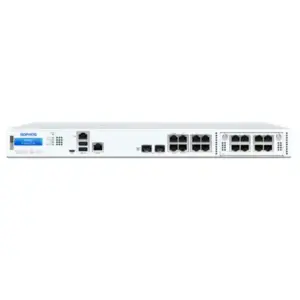
Direct answer for buyers
The MikroTik CCR2004-16G-2S+PC is a fanless Cloud Core Router intended for indoor business networks that need many copper Gigabit ports, fast SFP+ uplinks and the flexibility of RouterOS v7. It is commonly considered for office internet edge routing, branch aggregation, VLAN separation, inter-VLAN routing, traffic policy, VPN services and lab environments. It suits buyers who are comfortable with MikroTik administration or plan to use professional configuration support. Before proceeding, confirm the required throughput under your actual firewall, queue, VPN and packet-size conditions; the SFP or SFP+ modules and fibre type; the intended power arrangement; rack or desktop placement; and the configuration, migration and support scope.
What the CCR2004-16G-2S+PC does
Routes and controls business traffic
The router can operate as the central Layer 3 platform between internet connections, internal VLANs, server networks, guest networks and remote sites. RouterOS provides routing, firewalling, NAT, quality-of-service tools, VPN functions, monitoring and a wide set of network services. The exact design should reflect the organisation’s security policy, number of users, application mix and availability requirements.
Consolidates copper and fibre connectivity
Sixteen 10/100/1000 Ethernet ports allow direct copper connections or structured links to access switches, while two SFP+ cages support high-speed fibre or compatible direct-attach links. This combination can reduce the need for an additional small aggregation device in some deployments, although switching, PoE and port-density requirements may still call for dedicated managed switches.
Who should consider this model?
The CCR2004-16G-2S+PC is particularly relevant where quiet operation matters and where a network requires more interfaces than a typical desktop router provides. It may suit professional offices, design and media studios, education labs, managed service environments, small data rooms, branch sites, hospitality administration networks, retail back offices, engineering firms and advanced home labs. It is also a practical candidate for network teams that already standardise on RouterOS and want a familiar management model.
It may be less suitable when the project requires built-in wireless, Power over Ethernet output, redundant hot-swappable AC power supplies, very high multi-gigabit encrypted throughput under complex policy, or a fully managed security subscription platform with centralised threat services. Those requirements should lead to a broader comparison with MikroTik alternatives, dedicated switches, security appliances or larger routing platforms.
Business challenge map
Too many separate network boxes
A single router with sixteen copper ports and two SFP+ cages can simplify selected edge and aggregation designs when the port plan is appropriate.
Fan noise near staff or studios
Passive cooling helps avoid continuous fan noise, provided the router is installed in a dry, ventilated indoor location within its environmental limits.
Need for detailed traffic policy
RouterOS allows experienced administrators to build routing, firewall, VPN and queue policies, with performance dependent on configuration complexity.
10G uplink requirement
Two SFP+ cages can connect upstream and downstream infrastructure, subject to supported modules, cable type, link speed and topology.
Product-fit decision matrix
| Requirement | Suitable when | Confirm before ordering |
|---|---|---|
| Quiet routing platform | The router will operate near staff, recording spaces or a quiet lab. | Ventilation, ambient temperature and placement. |
| Many 1G copper links | Up to sixteen Ethernet interfaces support the planned topology. | Whether a managed PoE switch is also required. |
| 10G fibre or DAC uplinks | Two SFP+ cages meet upstream and downstream needs. | Transceiver, fibre, DAC and peer-device compatibility. |
| Advanced RouterOS policy | The team has RouterOS skills or buys configuration support. | Firewall, BGP, VPN, queue and monitoring scope. |
| Business edge routing | Expected real traffic remains within tested design limits. | Packet size, rule count, encryption and failover requirements. |
Verified technical specifications
| Brand | MikroTik |
|---|---|
| Product code | CCR2004-16G-2S+PC |
| Product type | Cloud Core Router, indoor |
| CPU | AL32400, four ARM 64-bit cores at 1.2 GHz |
| Memory | 4 GB DDR4 |
| Storage | 128 MB NAND |
| Ethernet | 16 × 10/100/1000 Ethernet ports |
| Fibre interfaces | 2 × SFP+ cages supporting suitable SFP/SFP+ modules |
| Console | RJ-45 serial console |
| USB | 1 USB port |
| Operating system | RouterOS v7 |
| Licence | RouterOS Level 6, preinstalled |
| Cooling | Passive |
| Power input | 36–57 V DC through DC jack or 2-pin terminal |
| Maximum power consumption | 36 W; 30 W without attachments |
| Dimensions | 272 × 195 × 44 mm |
| Tested ambient temperature | -20°C to 60°C |
| Enclosure rating | IP20 |
| Included items | Rack ears, 48 V power adapter and K-83 accessory kit, subject to regional package confirmation |
| Availability | Contact FourTeck for current UAE options, quantity and lead time |
Performance varies with packet size, firewall rules, queues, encryption, routing protocols and RouterOS configuration. Published laboratory results should be treated as reference data rather than a guarantee for a specific production design.
Dependencies and compatibility notice
SFP and SFP+ modules, direct-attach cables and fibre patch leads are not interchangeable by assumption. Buyers should confirm the media type, wavelength, connector, distance, supported data rate and compatibility with both the CCR2004 and the device at the opposite end. RouterOS features also depend on correct configuration, software version and network design. High availability requires a wider architecture that may include a second router, suitable switching, independent power and tested failover procedures. This model does not provide PoE output, built-in Wi-Fi or a security subscription service.
A practical purchase and deployment journey
Document internet speed, site count, VLANs, VPN users, application priorities and expected growth.
Map every copper port, SFP+ link, transceiver, switch connection and console requirement.
Prepare routing, firewall, NAT, VPN, queue, monitoring, backup and update requirements.
Include hardware, optics, cables, rack items, configuration, migration, testing and support.
Validate connectivity, failover, access control, throughput, monitoring and recovery procedures.
Port architecture and practical network design
The sixteen Gigabit Ethernet interfaces are divided across two switch-chip groups, with each group connected to the CPU by a 10 Gbps full-duplex path. Each SFP+ cage also has a separate 10 Gbps full-duplex connection. This architecture provides useful flexibility, but it does not remove the need for careful traffic engineering. A design that sends significant traffic between port groups, applies extensive firewall processing, uses many queues or encrypts multiple tunnels will place different demands on the CPU than simple forwarding.
For an office edge, one SFP+ cage may be used for an upstream internet or core connection and the other for a downstream distribution switch, while Gigabit ports serve specific network segments or management links. Another design may use both SFP+ links in a resilient topology. The correct arrangement depends on whether the router is acting mainly as a routed edge, a firewall, a VPN concentrator, a policy router or a combined edge and local aggregation platform.
The presence of sixteen Ethernet ports should not automatically replace a managed access switch. Dedicated switches remain preferable when the requirement includes PoE for phones or access points, large Layer 2 domains, extensive edge-port security, high-density access connectivity or stacking. FourTeck can help separate the router role from the switching role so that the final bill of materials is easier to operate and expand.
RouterOS flexibility and operational control
RouterOS v7 gives the CCR2004 access to a broad networking toolset. Depending on design and software support, administrators can create static and dynamic routing, firewall filters, network address translation, VLANs, bridges, traffic queues, VPN services, monitoring, logging and automation. This flexibility is valuable for organisations with skilled network personnel because one platform can be shaped around many routing and policy scenarios.
Flexibility also creates responsibility. A router with a wide configuration surface needs disciplined administration, secure credential handling, software maintenance, configuration backups, restricted management access and change control. Default access should be replaced with strong credentials during commissioning. Management services should be exposed only to trusted networks or protected remote-access paths. Configuration should be documented so another administrator can understand interface roles, addressing, routing policy, firewall logic and recovery procedures.
Buyers without in-house MikroTik experience should include professional configuration and handover in the quotation. A structured engagement can cover discovery, IP planning, VLAN design, internet setup, security policy, VPN requirements, quality of service, logging, backup and acceptance testing. The service scope should state what is included and what remains the customer’s responsibility.
Silent operation without ignoring thermal planning
Passive cooling is one of the defining characteristics of the CCR2004-16G-2S+PC. It avoids the acoustic impact and moving parts associated with fans, which is useful in studios, meeting-room cabinets, open offices and home labs. Fanless does not mean that the router can be enclosed without airflow. It should be installed indoors in a dry, ventilated location, away from water and heat sources, with enough surrounding space for natural heat dissipation.
The device supports rack mounting with the supplied ears or desktop placement. The compact chassis is approximately 272 mm deep, so buyers should check cabinet depth, cable bend radius, front access and power-adapter placement. Where ambient temperatures are high, particularly in poorly ventilated cabinets, the project team should review environmental conditions before installation. Temperature and voltage monitoring can support operational visibility, but monitoring does not substitute for proper placement.
Ideal business environments and use cases
Professional office edge
Routes internet and internal VLAN traffic for an office that needs multiple physical network segments and controlled 10G uplinks.
Media or recording studio
Provides a quiet routing platform where equipment noise must be minimised and fibre or DAC uplinks connect storage or switching infrastructure.
Branch aggregation
Consolidates routed links, VPN connectivity and local segmentation at a branch, subject to traffic and resilience assessment.
Training and lab network
Supports RouterOS learning, routing labs, protocol testing and segmented environments where a broad feature set is useful.
Integration and operational considerations
A successful deployment begins with the systems around the router. Confirm internet handoff type, provider addressing, VLAN tags, MTU, authentication, public IP allocation and whether the service arrives over copper or fibre. For internal connectivity, identify switch models, VLAN trunks, spanning-tree design, link aggregation, IP addressing, DHCP responsibility, DNS, authentication services and monitoring platforms.
VPN designs should state the remote endpoints, protocols, user count, encryption requirements, authentication approach, address pools and expected traffic. Performance figures from controlled tests cannot predict every production case, especially where many small packets, complex firewall chains or multiple encrypted sessions are involved. A proof-of-concept or staged migration is sensible for critical networks.
Operations teams should also plan backups, configuration exports, logging retention, alerting, software-update windows and recovery procedures. The serial console and Netinstall recovery options may be useful during troubleshooting, but only trained personnel should perform recovery or hardware work. Keep the router’s configuration, diagrams and credentials under controlled access.
Questions to resolve before ordering
Procurement checklist
✓ Exact model: CCR2004-16G-2S+PC
✓ Required quantity and destination
✓ Internet handoff and bandwidth
✓ Copper-port allocation
✓ SFP/SFP+ or DAC requirements
✓ Fibre type, distance and connector
✓ Rack or desktop installation
✓ DC power and resilience plan
✓ RouterOS configuration scope
✓ Firewall, VPN and routing requirements
✓ Migration and testing plan
✓ Documentation and handover
✓ Support expectation
✓ Warranty and lead-time confirmation
How FourTeck can assist
FourTeck can help translate a network requirement into a clearer procurement scope. Assistance may include model review, interface planning, transceiver and cable identification, RouterOS configuration scoping, migration planning, quotation coordination and delivery discussions. For broader infrastructure projects, buyers can also explore business network products and technology services.
The most useful enquiry includes the exact model, quantity, destination, required date, ISP speed, site count, network diagram, VLAN and VPN needs, SFP+ link details and desired support scope. This allows the quotation to cover the router and the components required to make it operational rather than only the base hardware.
UAE availability and support guidance
Contact FourTeck to confirm current UAE availability for the MikroTik CCR2004-16G-2S+PC. Availability may vary with quantity, supplier conditions and vendor lead time. Delivery and project coordination can be discussed after the exact requirement is confirmed. Where installation or configuration is needed, include that work in the quotation so the responsibilities, access requirements, testing method and handover deliverables are clear.
For projects across Dubai, Abu Dhabi, Sharjah and Ajman, FourTeck can review the destination, deployment environment and required service scope as one coordinated UAE requirement. On-site activity, if required, depends on location, schedule, access, project scope and commercial confirmation. Use the FourTeck contact page to share the bill of materials or request assistance.
GCC availability
FourTeck can assist organisations evaluating the CCR2004-16G-2S+PC for projects in the Gulf region, including requirements connected with the United Arab Emirates, Saudi Arabia, Kuwait, Qatar, Bahrain and Oman. Regional assistance can cover requirement review, model confirmation, optics and cable planning, quotation coordination, configuration scoping, installation planning and support discussions. Product availability, licensing considerations, delivery schedules, service visits and vendor lead times can differ by country, quantity and project conditions. Buyers should provide the destination country, required quantity, expected deployment date, SFP+ media, power requirements and RouterOS support needs. For Kuwait-related coordination, the FourTeck Kuwait resource may also help direct the enquiry. No local stock, fixed transit period or installation date should be assumed until the exact commercial and technical scope is confirmed.
Africa availability
Organisations planning MikroTik routing projects in Africa can contact FourTeck for product evaluation and procurement guidance. Assistance may include checking the exact model, quantity, compatible transceivers, power arrangements, RouterOS configuration scope, support expectations and regional fulfilment considerations. Availability can depend on destination, product quantity, power and regulatory requirements, shipping arrangements, vendor lead time, installation scope and local project conditions. Buyers should share the destination country, deployment environment, preferred schedule and whether remote configuration or local coordination is expected. FourTeck resources for African technology projects, Kenya enquiries and Uganda enquiries can help route requests. Inventory, customs outcomes and country-wide on-site coverage are not implied and must be confirmed for each project.
Related products, services and alternatives
Managed Ethernet switches
Consider when the site needs PoE, more access ports or dedicated Layer 2 switching.
SFP+ modules and DAC cables
Select only after confirming rate, media, distance, connector and peer-device compatibility.
CCR2004 active-cooled model
Review the CCR2004-16G-2S+ where chassis, power and cooling requirements differ.
Higher-capacity CCR platforms
Evaluate larger MikroTik models when CPU scale, redundancy or faster interfaces are required.
RouterOS configuration service
Define firewall, routing, VPN, queue, monitoring and documentation deliverables.
Why businesses contact FourTeck
Business buyers often need more than a model number. They need confirmation that the router, optics, switches, cabling, power, configuration and support scope work together. FourTeck can help clarify requirements, review a preliminary bill of materials, identify unanswered compatibility questions and coordinate a quotation. This approach reduces the risk of ordering a router without the transceivers, cables or implementation services needed for the planned deployment.
Frequently asked questions
Is the CCR2004-16G-2S+PC fanless?
Yes. MikroTik specifies passive cooling. The router still requires a dry, ventilated indoor installation with suitable clearance and ambient conditions.
How many Ethernet and SFP+ ports are included?
The model has sixteen 10/100/1000 Ethernet ports and two SFP+ cages, plus an RJ-45 serial console port.
Does it include RouterOS?
Yes. RouterOS v7 with a Level 6 licence is preinstalled. No separate base RouterOS licence purchase is required for normal use of the supplied device.
Are SFP+ transceivers included?
Do not assume optics are included. Confirm the required modules or DAC cables, fibre type, link distance and compatibility in the quotation.
Can it provide PoE to access points or cameras?
No PoE output is specified for this model. A suitable PoE switch or injectors are required for powered endpoints.
Is it suitable for a 10G internet connection?
The presence of 10G SFP+ interfaces does not guarantee 10G application throughput under every policy. Confirm packet size, firewall rules, queues, VPN load and routing design.
Can the router be rack-mounted?
Yes. MikroTik states that it can be rack-mounted with the provided ears or placed on a desktop. Check cabinet depth and ventilation.
What information is needed for a quotation?
Provide quantity, destination, target date, bandwidth, VLAN and VPN needs, SFP+ media, installation method and required configuration or support.
Is the model currently available in Dubai?
Availability changes with quantity and supply conditions. Contact FourTeck to confirm current Dubai and UAE options before placing an order.
Can FourTeck help with configuration?
Configuration support can be discussed for routing, VLANs, firewall policy, VPN, monitoring, migration and documentation. The final scope should be stated in the quotation.
Plan the complete MikroTik routing requirement
Send FourTeck the model, quantity, interface plan, SFP+ requirements, bandwidth, RouterOS configuration scope and delivery destination for an informed UAE quotation.