

MikroTik CCR2004-16G-2S+ in Dubai, UAE
A rackmount RouterOS platform for businesses that need dense Gigabit connectivity, two 10G SFP+ interfaces, strong single-core processing and flexible control over routing, firewalling, VPN, queues and network segmentation.
Direct answer for buyers
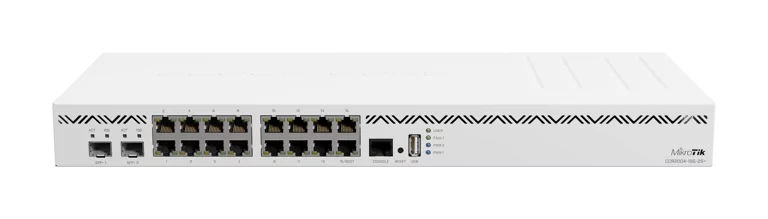
The MikroTik CCR2004-16G-2S+ is a 1U enterprise and service-provider router designed around sixteen Gigabit Ethernet interfaces and two 10G SFP+ cages. It is mainly used for internet edge routing, branch or campus aggregation, multi-WAN connectivity, VLAN routing, traffic control, VPN services and network segmentation. It is worth considering when a business needs more copper ports than a typical edge router provides but does not require a platform dominated by 25G or 100G interfaces. Before proceeding, confirm expected traffic patterns, packet sizes, firewall and queue complexity, VPN requirements, SFP+ module compatibility, rack cooling, power design and whether professional RouterOS configuration is needed.
What the CCR2004-16G-2S+ does
This model operates as a programmable routing platform rather than a simple unmanaged gateway. RouterOS v7 provides the framework for routing, firewall policies, network address translation, VLANs, quality of service, VPN services, monitoring and automation. The sixteen copper interfaces can be assigned individually or grouped according to the network design, while the two SFP+ cages can support 10G uplinks, downlinks or inter-router connections when compatible modules and cabling are selected.
Its role depends on configuration. In one project it may sit at the internet edge and terminate several service-provider links. In another it may aggregate office networks and route between VLANs. It may also serve as a compact router for a managed service provider, a hospitality property, a training campus, a warehouse, a retail group or a multi-tenant building. The correct use case should be based on measured traffic, required security policy and operational expectations rather than port count alone.
Who should consider this model
The router is relevant for buyers who value RouterOS flexibility and need a large number of 1G copper ports in a rackmount format. Typical decision-makers include IT managers modernising a server-room edge, integrators replacing older MikroTik CCR units, operators building segmented business networks and organisations that want two 10G interfaces without paying for a chassis designed around many higher-speed ports.
It is not automatically the right choice for every 10G internet requirement. A 10G physical interface does not mean every advanced firewall, queue, encryption or inspection configuration will sustain 10 Gbps. Buyers with very high encrypted throughput, large BGP tables, extensive filtering, heavy connection tracking or future 25G/100G growth should compare the CCR2004 against larger MikroTik platforms. FourTeck can help define that comparison before a bill of materials is finalised.
Business challenges this router can help address
Too many separate edge devices
The sixteen copper ports and RouterOS feature set can reduce the need to assemble multiple small routers for basic branch, office or service-edge functions. The final design still needs careful separation of routing, switching and security responsibilities.
Limited uplink headroom
Two SFP+ cages give the design room for 10G interconnects to a core switch, upstream provider, storage network or another router. Optics, DAC cables, fibre type and distance must be confirmed.
Complex traffic policy
RouterOS supports detailed queues, policy routing, firewall controls and monitoring. The more complex the policy set, the more important it is to validate performance under realistic traffic conditions.
Power resilience concerns
Dual built-in AC inputs can be connected to separate supported power paths. Redundancy benefits depend on the upstream UPS, PDU and electrical design, not only the router itself.
Product-fit decision matrix
| Requirement | Suitable when | Confirm before ordering |
|---|---|---|
| Dense copper connectivity | The design needs up to sixteen individually configurable 1G Ethernet interfaces. | Whether some ports should instead be delivered by a dedicated switch. |
| 10G uplinks | Two SFP+ ports are enough for the upstream and downstream topology. | Module type, fibre standard, DAC length, peer compatibility and heat. |
| Advanced RouterOS control | The IT team is comfortable managing routing, firewall, VPN and queue policies. | Internal skills, documentation, backup and support ownership. |
| High encrypted throughput | The measured VPN requirement fits the platform and chosen cryptography. | Tunnel count, cipher suite, packet size and concurrent services. |
| Rack deployment | A standard 1U location with appropriate front-to-rear airflow is available. | Rack depth, ambient temperature, fan noise and cable management. |
Verified technical information
The table below separates confirmed base hardware facts from design-dependent outcomes. Throughput varies according to packet size, RouterOS version, firewall rules, queues, VPN configuration and enabled services. Published laboratory figures should not be treated as a guaranteed application result.
Configuration and compatibility notice
The SFP+ cages do not remove the need for compatibility checking. Transceivers and direct-attach cables should be matched to the peer device, link speed, fibre type, wavelength, distance and operating environment. Heat output from some copper SFP+ modules can also affect port planning. RouterOS features are extensive, but actual forwarding, filtering and VPN performance varies with the configuration. Buyers should avoid sizing the router only from a headline interface speed or laboratory maximum.
The dual power inputs support a resilient power design only when connected to independent and properly protected sources. Similarly, high availability requires a wider architecture with a second router, routing protocol, virtual IP method, state considerations and tested failover procedures. FourTeck can help identify these dependencies during requirement review.
Purchase and deployment journey
Define traffic
Record internet bandwidth, east-west traffic, packet size, user count, tunnel load and expected growth.
Confirm interfaces
List copper ports, SFP+ links, optics, DAC cables, fibre distances and the connected device models.
Design policy
Document VLANs, firewall rules, routing protocols, VPNs, queues, monitoring and management access.
Build quotation
Include router, transceivers, cables, rack items, UPS or PDU dependencies and services where required.
Configure and test
Validate failover, routing, security rules, throughput, monitoring, backups and rollback procedures.
Single-core performance for detailed policy
Many routing tasks are not distributed evenly across every CPU core. Queues, individual connections, firewall processing and some protocol operations can place significant pressure on single-core performance. The CCR2004-16G-2S+ uses a 1.7 GHz quad-core ARM64 processor and was positioned by MikroTik for strong single-core performance within the CCR range.
For a buyer, the practical value is better headroom for policies that inspect or process traffic per connection. This does not remove the need for testing. Complex mangle rules, extensive address lists, connection tracking, logging, traffic shaping and encrypted tunnels can substantially change performance. A realistic design should model the actual rule set rather than assume that an empty fast-path benchmark represents production traffic.
Flexible port architecture for mixed networks
The combination of sixteen Gigabit Ethernet ports and two SFP+ cages can simplify mixed office and service-provider topologies. Copper interfaces may be used for WAN handoffs, internal routed links, management segments or dedicated customer connections. The SFP+ ports can link to a core switch, upstream router, server platform or transport circuit at 10G where compatibility is confirmed.
The internal architecture groups the Gigabit ports through separate switch chips, each with a 10 Gbps full-duplex connection to the CPU, while each SFP+ cage also has a separate 10 Gbps full-duplex path. This layout is useful, but it should still be considered in traffic planning. A design that sends all traffic repeatedly between port groups, applies heavy filtering and uses the CPU for every operation needs more analysis than a straightforward uplink/downlink pattern.
Operational control through RouterOS v7
RouterOS v7 gives experienced administrators a broad set of routing and network-control tools. Depending on the design, the router can support static and dynamic routing, VLANs, firewalling, NAT, DHCP, monitoring, VPNs, traffic queues, scripting and API-based administration. This flexibility is a major reason organisations choose MikroTik, but it also creates responsibility.
A production deployment should define secure management access, administrator roles, configuration backups, update procedures, logging, time synchronisation, monitoring and recovery steps. Default or inherited configurations should be reviewed rather than copied without validation. Where internal skills are limited, a scoped configuration and handover service can reduce operational risk and give the IT team a documented baseline.
Ideal business environments and use cases
Corporate internet edge
A business can use the router to terminate one or more WAN links, apply policy routing, firewall rules, NAT, traffic shaping and monitoring. The security design should be reviewed carefully because RouterOS flexibility does not replace a defined policy.
Branch or campus aggregation
The mix of copper and 10G interfaces can support routed connections between departments, buildings, switches or service networks. Fibre distances and redundancy paths should be included in the topology review.
Hospitality and multi-tenant networks
VLAN segmentation, bandwidth policy and multiple uplinks can be useful for hotels, serviced offices and compounds. User isolation, logging, captive portal design and regulatory obligations may require additional systems.
Managed service delivery
Service providers may use the CCR2004 for customer aggregation, routed handoffs or managed edge services. Standard templates, remote access controls, monitoring and spare strategy should be defined before scale deployment.
Education and training facilities
The platform can segment laboratories, administration, guest access and learning networks while providing detailed traffic policy. Peak usage and content-filtering dependencies should be assessed separately.
Warehouse and industrial office networks
Routed links can separate operational, office, surveillance and guest traffic. Environmental conditions, rack cooling, power quality and remote support access are important planning factors.
Integration and operational considerations
Switching versus routing responsibility
Although the CCR2004 has many Ethernet ports, a network design should decide which functions belong on the router and which belong on a managed switch. Access-layer switching, PoE delivery, large VLAN fan-out and endpoint density are often better handled by dedicated switches. The router can then concentrate on inter-VLAN routing, WAN policy, firewalling and VPN services. Combining every function on one device may save hardware initially but can make troubleshooting and future expansion harder.
Transceivers and cabling
SFP+ purchasing should be tied to the connected equipment. Confirm whether the link uses multimode fibre, single-mode fibre, a direct-attach copper cable or an RJ45 copper module. Check wavelength, connector, distance, supported data rate, module temperature and compatibility at both ends. For short rack links, a supported DAC may be simpler. For building or campus links, fibre design should consider patch panels, splice loss, route diversity and future maintenance.
Monitoring and lifecycle
A router should be integrated into the organisation’s monitoring and change-management process. Define what will be monitored, where logs will be sent, who receives alerts and how configuration changes are approved. RouterOS updates should be reviewed and tested before production rollout. Keep export files, binary backups where appropriate, diagrams, credentials and recovery procedures in a controlled location.
Security baseline
Secure management access is essential. Restrict administration to trusted networks, disable unused services, use strong authentication, protect management interfaces, maintain current software and review firewall rules. Internet exposure of management services should be avoided unless a specific secure access design is in place. Security requirements may also justify a dedicated next-generation firewall alongside the router, depending on inspection, reporting and compliance needs.
Buyer questions to resolve before ordering
Share peak Mbps or Gbps, packet size, concurrent sessions, user count, application mix and growth expectation.
Firewall, NAT, queues, VPN, dynamic routing, logging and monitoring can interact and affect performance.
Consider provider handoffs, core links, redundancy, storage links and future topology changes.
Dual power alone does not provide router-level high availability. Decide whether a second device and failover design are needed.
Define internal ownership, support escalation, documentation, backups and change-control procedures.
Clarify rack mounting, cabling, optics, configuration, migration, testing and handover in the quotation scope.
Procurement checklist
How FourTeck can assist
FourTeck can help turn a model request into a complete and reviewable requirement. Assistance may include checking whether the CCR2004-16G-2S+ fits the expected traffic profile, identifying required SFP+ modules and cables, reviewing rack and power dependencies, coordinating a quotation and defining optional configuration or installation work. Buyers can also discuss whether a larger CCR, a dedicated switch or a separate firewall should be included in the wider design.
For a useful quotation, share the number of sites, required quantity, internet bandwidth, interface plan, connected equipment, VLAN count, routing protocol, firewall expectations, VPN requirements, high-availability preference and target deployment period. Visit the FourTeck technology product catalogue for related infrastructure, review available installation and configuration services, or send the requirement through the FourTeck contact page.
UAE availability and support guidance
Contact FourTeck to confirm current UAE availability for the MikroTik CCR2004-16G-2S+, the applicable hardware revision, included accessories and estimated vendor lead time. Availability can vary according to quantity, regional supply, project timing and the exact bill of materials. A complete quotation may also need compatible SFP+ modules, fibre patch leads, DAC cables, rack accessories, UPS or PDU items and professional services.
FourTeck can coordinate requirements for organisations operating in Dubai, Abu Dhabi, Sharjah and Ajman through one combined review. Delivery and project coordination should be discussed after the exact destination, quantity and service scope are confirmed. Installation and configuration are not assumed to be included with hardware; request them explicitly when rack mounting, migration, policy configuration, testing or documentation is required.
GCC availability
FourTeck can assist organisations planning MikroTik routing projects across GCC markets by reviewing the exact destination, technical requirement and procurement scope before quotation. For the CCR2004-16G-2S+, buyers should provide the country, quantity, intended application, required SFP+ modules, power and rack conditions, configuration expectations and preferred project window. This information helps distinguish a simple hardware request from a complete deployment package.
Availability, licensing policy, delivery schedules, service visits and vendor lead times may vary between the United Arab Emirates, Saudi Arabia, Kuwait, Qatar, Bahrain and Oman. The correct approach is to confirm each project rather than assume that stock, accessories or service coverage are identical across the region. FourTeck can support model review, quotation coordination, delivery planning, configuration scope and installation planning where practical. For Kuwait-related enquiries, buyers may also review FourTeck Kuwait technology assistance. No fixed delivery or installation date should be assumed until the requirement and destination are formally reviewed.
Africa availability
Organisations planning connectivity projects in Africa can contact FourTeck for product evaluation, bill-of-material guidance and regional procurement coordination. The MikroTik CCR2004-16G-2S+ may suit selected enterprise, hospitality, education, service-provider and multi-site projects, but the final recommendation should account for local bandwidth services, power quality, rack environment, fibre standards, available technical skills and support expectations.
Fulfilment can depend on destination country, quantity, product revision, shipping route, vendor lead time, power requirements, transceiver selection and installation scope. Buyers should share the exact country, project location, quantity, network diagram, desired schedule and whether remote or onsite support is expected. FourTeck resources for Africa technology projects, Kenya business technology requirements and Uganda project enquiries can help route regional discussions. Local inventory, customs outcomes and country-wide onsite coverage should be confirmed for each request rather than assumed.
Related products and services to evaluate
Higher-capacity CCR platforms
Consider larger MikroTik CCR models when the design requires more CPU capacity, additional 10G links, 25G or 100G growth, heavier BGP processing or greater encrypted throughput.
Managed access and core switches
A dedicated switch may be more appropriate for endpoint density, PoE, access VLANs or extensive Layer 2 aggregation, leaving the CCR focused on routing and policy.
SFP+ optics and DAC cables
Select modules only after checking link distance, fibre type, connector, peer device and environmental requirements. Compatibility must not be assumed from connector shape alone.
Firewall platforms
Organisations requiring advanced application inspection, threat prevention, central reporting or specific compliance controls may need a dedicated firewall alongside the router.
Configuration and migration service
Scope can include configuration review, policy build, migration planning, change window support, validation, backup and handover documentation.
Power and rack planning
Review UPS capacity, independent power paths, PDU outlets, rack depth, airflow, cable management and spare strategy as part of the deployment.
Why businesses contact FourTeck
Businesses contact FourTeck when they need practical help translating technical requirements into a suitable model and bill of materials. The discussion can cover whether the CCR2004-16G-2S+ has enough routing capacity, whether a dedicated switch or firewall is needed, which SFP+ items belong in the quotation, how power redundancy should be arranged and whether configuration or migration support should be added.
The objective is procurement clarity rather than unsupported claims. FourTeck can coordinate requirement review, model selection, compatibility questions, quotation preparation, installation planning, configuration scope and regional delivery discussions. Learn more about FourTeck’s business technology approach or submit a detailed request through the contact team.
Frequently asked questions
Is the MikroTik CCR2004-16G-2S+ suitable for a 10G internet connection?
It has 10G SFP+ interfaces, but achievable throughput depends on packet size, firewall rules, queues, VPN use, connection tracking and other RouterOS services. Share the complete traffic and policy requirement before treating it as a 10G edge solution.
Does the router include RouterOS?
Yes. The model is supplied with RouterOS v7 and a level 6 licence according to the manufacturer specification. Confirm the delivered hardware revision and software version during project preparation.
Are SFP+ transceivers included?
SFP+ optics or DAC cables should be treated as separate bill-of-material items unless a quotation explicitly states otherwise. The correct item depends on the link medium, distance and connected equipment.
Can all sixteen Ethernet ports be used as separate routed interfaces?
RouterOS allows flexible interface assignment, but the final design should consider the internal switch-chip architecture, traffic paths and whether a dedicated managed switch would provide a cleaner access-layer design.
Does dual power mean the network is fully redundant?
No. Dual AC inputs improve power-path resilience when connected correctly, but router redundancy requires a second device, failover architecture, routing or virtual IP design and tested operational procedures.
Is the CCR2004-16G-2S+ passively cooled?
This exact model uses active cooling with two fans. MikroTik also offers similarly named variants, so buyers should not confuse the CCR2004-16G-2S+ with the CCR2004-16G-2S+PC.
Can FourTeck configure the router?
Configuration can be discussed as a separate scope. Provide the WAN details, VLAN plan, IP scheme, routing, firewall, VPN, queue, monitoring and migration requirements so the work can be defined accurately.
What information is needed for a quotation?
Share quantity, destination, required date, bandwidth, user count, interface plan, SFP+ requirements, connected equipment, routing and security features, power design and any installation or support needs.
Is the product available in Dubai?
Contact FourTeck to confirm current UAE availability and vendor lead time. Availability may vary by quantity, hardware revision, accessories and project timing.
What warranty applies?
Warranty terms can depend on the seller, region and supply channel. Ask FourTeck to state the applicable warranty guidance in the quotation rather than assuming a term from another market.
Discuss your MikroTik routing requirement
Send FourTeck your bandwidth, port, SFP+, firewall, VPN, redundancy and deployment details for model review, UAE availability guidance and a structured quotation.
