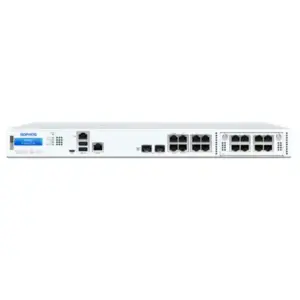
Fibre routing and network aggregation
MikroTik CCR2004-1G-12S+2XS in Dubai, UAE
A 1U Cloud Core Router for organisations that need dense 10G fibre connectivity, two 25G uplinks and the routing flexibility of RouterOS v7. FourTeck helps buyers validate the topology, select compatible optics and define configuration requirements before quotation.
Plan the complete router package
Confirm traffic load, interfaces, optics, cabling, redundancy and RouterOS services before ordering.
Direct answer for buyers
The MikroTik CCR2004-1G-12S+2XS is a rack-mounted high-speed router built around twelve SFP+ ports for 1G or 10G links, two SFP28 ports for 25G links and a separate Gigabit Ethernet management interface. It is mainly considered for service-provider routing, enterprise aggregation, data-centre edge connectivity and fibre-rich backbone designs. Buyers should consider it when interface density, routing flexibility and compact rack use matter, but should first confirm real traffic patterns, RouterOS feature requirements, optical-module compatibility, power design and expected growth. Performance varies with packet size and enabled services, so an accurate recommendation should be based on the intended configuration rather than a single headline throughput figure.
What the CCR2004 does
This model routes traffic between multiple high-speed fibre segments. It can terminate or pass traffic for core, aggregation, peering, transit, inter-building and server-network connections, depending on the configuration. RouterOS v7 provides the operating environment for IP routing, BGP, OSPF, VLANs, firewalling, quality-of-service policies, VPN functions, monitoring and automation. The precise combination should be planned because every enabled service uses processing and memory resources.
Unlike an access router dominated by copper Ethernet ports, this unit is intended for designs where SFP-family interfaces are central. The cages accept compatible modules or direct-attach cables; they are not optical transceivers themselves. This distinction matters when preparing a bill of materials.
Who should consider it
The router may fit internet service providers, managed network operators, hosting environments, enterprises with fibre-based distribution, campuses with multiple buildings, security integrators and organisations consolidating several 10G links. It is also relevant where two 25G connections are required for upstream, downstream or redundant backbone paths.
It is less suitable when the project mainly needs many copper access ports, Power over Ethernet, integrated wireless connectivity or a turnkey security subscription. In those cases, a different router, switch, firewall or combined architecture may be more appropriate.
Business challenges this router can help address
Fibre-port concentration
Networks with many separate 10G routers can become difficult to cable, power and manage. The CCR2004 brings twelve SFP+ interfaces into one rack unit, subject to an appropriate resilience design.
Uplink capacity planning
Two SFP28 cages support 25G connectivity for higher-capacity upstream links. The connected switch, router, optic and cabling must all support the chosen speed and standard.
Routing policy control
RouterOS v7 gives engineers tools for dynamic routing, policy handling, firewall rules, queues, virtual routing and monitoring. Design quality remains essential for predictable operation.
Rack-space efficiency
The 1U form factor supports dense deployment in communications rooms and data racks. Cooling, airflow, service access and power-feed arrangement still need to be checked.
Product-fit decision matrix
| Requirement | Suitable when | Confirm before ordering |
|---|---|---|
| 10G fibre aggregation | Several SFP+ links must be routed in one platform. | Optic type, distance, fibre connector, speed and link budget. |
| 25G backbone | One or two SFP28 links are part of the topology. | Peer-device support, DAC or optic compatibility and redundancy. |
| Dynamic routing | BGP, OSPF or policy routing is required. | Route scale, convergence expectations and policy complexity. |
| Firewall and queues | Router-based filtering and traffic shaping are needed. | Rule count, connection volume, packet size and required throughput. |
| High availability | The design includes redundant routers, links and power paths. | Failover protocol, state requirements, dual feeds and test plan. |
Verified technical information
| Brand and model | MikroTik CCR2004-1G-12S+2XS |
|---|---|
| Product type | Cloud Core Router, rack-mount network device |
| Architecture and processor | ARM 64-bit; AL32400 quad-core CPU at 1.7 GHz nominal frequency |
| Memory and storage | 4 GB RAM; 128 MB NAND storage |
| High-speed interfaces | 12 × 10G SFP+ cages and 2 × 25G SFP28 cages |
| Management interface | 1 × 10/100/1000 Ethernet port |
| Operating system | RouterOS v7 with RouterOS licence level 6 |
| Form factor and dimensions | 1U rack mount; 443 × 224 × 44 mm |
| Power design | Dual AC inputs; exact site power and redundancy arrangement should be confirmed |
| Tested ambient range | -20°C to 60°C; rack airflow and room conditions remain project considerations |
| Availability | Contact FourTeck for current UAE options, quantity planning and vendor lead time |
Performance depends on packet size, traffic direction and enabled RouterOS features. Transceivers, DACs, fibre patching and deployment services should be confirmed separately.
Compatibility and dependency notice
SFP+ and SFP28 cages are physical interfaces, not included optical links. A working connection requires modules or direct-attach cables that match the CCR2004, the remote device, the selected speed, fibre type, wavelength, distance and connector. Some SFP+ interfaces can operate with supported 1G modules, but compatibility should still be checked against current MikroTik guidance. For 25G links, confirm SFP28 support at both ends and verify whether the design uses multimode optics, single-mode optics or DAC cabling.
RouterOS features do not remove the need for engineering. BGP policy, firewall state, connection tracking, NAT, queues, tunnels, encryption, logging and monitoring can change resource use and forwarding results. Buyers should provide a realistic traffic profile and a list of required services. Firmware and RouterOS should be maintained using a controlled change process, with configuration backups and a rollback plan.
A practical purchase and deployment journey
Map the traffic
Document current and forecast bandwidth, packet characteristics, routes, peers, VLANs and security policies.
Define every link
List port speed, fibre medium, distance, connector, remote equipment and required redundancy for each interface.
Build the bill of materials
Add optics, DACs, patch cords, rack accessories, power feeds and any spare components required by the operating plan.
Prepare RouterOS design
Define routing protocols, filters, firewall policy, queues, management access, logging, backups and update procedures.
Test and hand over
Validate failover, monitoring, route policy, throughput under realistic services and operational documentation.
Dense 10G connectivity without treating every port the same
The twelve SFP+ cages are the defining feature of this CCR2004 model. They allow a designer to connect several 10G switches, upstream providers, server networks, distribution nodes or inter-building links to one routing platform. This can simplify physical design, but only when the logical architecture is equally clear. A port connected to an internet transit provider has different security, routing and monitoring requirements from a port connected to an internal storage network or customer access switch.
Each interface should therefore have an assigned purpose, address plan, VLAN policy, maximum expected load, optic specification and failure response. Spare-port planning is also useful. Filling every cage on day one may leave no easy path for expansion or troubleshooting. Some buyers reserve one or two interfaces for migration, temporary bypass, out-of-band testing or future capacity.
When links run at 1G through compatible modules, the design should still consider whether a lower-speed connection belongs on a high-density core router or on an access switch. Using the CCR2004 for the connections that genuinely require routing policy, isolation or high-speed aggregation generally leads to a cleaner architecture.
25G uplinks for growth, redundancy or high-capacity interconnection
The two SFP28 cages give the CCR2004 an upgrade path beyond 10G for selected links. A business may use them as dual upstream connections, a pair of links toward a core switch, separate data-centre fabrics or primary and recovery paths. The best use depends on traffic direction and failure design. Two physical links do not automatically provide uninterrupted service; routing, bonding, gateway protocols, upstream cooperation and application behaviour must all be considered.
A 25G interface also requires end-to-end compatibility. Both endpoints must support the same rate and media. The chosen transceiver must match fibre type and distance, while DAC cables must be suitable for the equipment and rack layout. Heat, bend radius, cable management and port accessibility become practical issues in dense racks.
For buyers moving from 10G to 25G, FourTeck can help separate immediate requirements from future options. This avoids buying unnecessary optics while preserving a sensible expansion path. The quotation can identify which modules are required at deployment and which items may be retained as optional spares.
RouterOS v7 management and routing flexibility
RouterOS v7 supports a broad set of routing and network-control functions, making the CCR2004 adaptable to different roles. A service provider may focus on BGP sessions, route filters, customer separation and traffic policy. An enterprise may need inter-VLAN routing, OSPF, firewall control, NAT, site-to-site connectivity, monitoring and administrative access restrictions. A hosting environment may combine public routing with isolated tenant or service networks.
Flexibility can create complexity. Configuration standards, naming conventions, administrator roles, backup schedules and change approval should be established before the router enters production. Management services should not be exposed unnecessarily. Access should be restricted to trusted networks, strong authentication should be used, and unused services should be disabled. Logging destinations and time synchronisation should be configured so that events can be investigated.
Software maintenance is part of the product lifecycle. Updates should be reviewed, tested where practical and installed according to the organisation’s change window. A current export, binary backup, documentation set and recovery method should be maintained. FourTeck can discuss initial configuration scope and handover requirements, but continuing administration responsibilities should be agreed clearly.
Suitable business environments and use cases
ISP aggregation edge
Multiple fibre-facing customer, distribution or upstream links can be routed through one unit. Route scale, DDoS exposure, shaping policy and redundancy should be assessed carefully.
Enterprise core or distribution
The router can connect high-speed switch domains and WAN services where RouterOS policy control is required. Campus scale and east-west traffic patterns should be reviewed.
Data-centre edge
Ten- and twenty-five-gigabit interfaces can support edge routing or service interconnection. It should not be selected without checking route policy, failover and security architecture.
Inter-building fibre backbone
Organisations with several fibre-connected buildings may use the router for Layer 3 boundaries, route control and resilient links, supported by a documented optical plan.
Network lab and service staging
Engineering teams can use the platform for routing tests and migration preparation, provided production and laboratory access are separated appropriately.
Managed network platform
Integrators may deploy it within a managed service, but responsibilities for monitoring, updates, backup, incident response and replacement should be documented.
Integration and operational considerations
The CCR2004 should be evaluated as one component of a larger network. Connected switches must support the intended VLAN, MTU, link and redundancy design. Firewalls or security gateways may remain necessary when the project requires advanced threat inspection, subscription-based security services, central policy orchestration or regulated reporting. A router firewall and a dedicated security appliance serve overlapping but not identical purposes.
Monitoring integration should be planned before handover. Decide whether the operations team will use SNMP, syslog, flow information, RouterOS tools, API-based monitoring or a third-party platform. Establish meaningful alerts for interface state, optical levels where available, CPU load, memory, temperature, route changes, power events and configuration modifications. Alert thresholds should reflect normal behaviour rather than generic defaults.
Time, identity and configuration management also matter. Use reliable time synchronisation, restrict management protocols, maintain administrator accountability and document emergency access. Where the router participates in BGP or other dynamic routing, prefix filters, maximum-prefix limits and route-policy review can reduce the impact of mistakes. For internet-facing deployments, a secure management plane and a tested recovery procedure are fundamental.
Buyer questions to resolve before requesting a quotation
What traffic will pass through it?
Provide average and peak throughput, packet-size profile, connection volume and expected growth, not just internet circuit speed.
Which RouterOS services are required?
List routing protocols, firewalling, NAT, queues, VPNs, VLANs, monitoring and automation requirements.
Which optics connect each port?
State speed, distance, fibre type, wavelength, connector and remote-device model for every planned link.
How will failure be handled?
Define redundant routers, links, power circuits, upstreams, routing behaviour and acceptable recovery time.
Who will operate the platform?
Clarify administrator skills, support responsibilities, monitoring ownership, update process and escalation path.
What services should FourTeck include?
Identify whether the requirement covers supply only, configuration, rack installation, migration, testing or documentation.
Procurement checklist
✓ Exact model: CCR2004-1G-12S+2XS
✓ Required quantity and spare-unit strategy
✓ Rack location and available rack depth
✓ Ten-gigabit interface count and purpose
✓ Twenty-five-gigabit uplink requirement
✓ Optical module or DAC specification per link
✓ Fibre type, connector and cable distance
✓ RouterOS routing and security functions
✓ Expected route, session and traffic scale
✓ Dual-power feed and UPS arrangement
✓ Redundancy and failover design
✓ Installation, configuration and migration scope
✓ Monitoring, backup and handover requirements
✓ UAE delivery location and preferred project window
How FourTeck can support the requirement
FourTeck can help translate a network diagram or requirement list into a clearer product package. Assistance may include model review, interface planning, optics and cable selection, accessory identification, quotation coordination, installation planning and initial RouterOS configuration scoping. The actual services included depend on the agreed quotation and project information.
For an accurate proposal, buyers should share the deployment location, quantity, connected equipment, route scale, internet or private-link capacities, required protocols, security controls, high-availability expectations and desired handover format. Where the environment is being migrated from an existing router, configuration exports and a sanitised topology can help identify dependencies. Sensitive credentials should never be sent in an unsecured requirement document.
Businesses can review other network and security products, discuss deployment and configuration services, or contact the FourTeck Dubai team with the bill-of-material request.
UAE availability and support guidance
Contact FourTeck to confirm current UAE availability for the CCR2004-1G-12S+2XS, compatible optical modules, direct-attach cables and related deployment services. Availability may depend on quantity, vendor lead time and the precise accessories requested. Delivery and project coordination can be discussed after the complete requirement is confirmed. Installation and RouterOS configuration should be included explicitly in the quotation when required; they should not be assumed to be part of hardware supply.
For projects across Dubai, Abu Dhabi, Sharjah and Ajman, provide the delivery or installation location, site-access constraints, rack readiness, required completion window and responsible technical contact. This supports better coordination without making an unverified delivery or visit commitment.
GCC availability
FourTeck can assist organisations planning MikroTik routing projects across GCC markets with requirement review, model selection, quotation coordination, optical-component planning, configuration scope and deployment preparation. A project in the United Arab Emirates, Saudi Arabia, Kuwait, Qatar, Bahrain or Oman may have different purchasing, shipping, service and site-access conditions. Product availability, licensing considerations, delivery schedules, service visits and vendor lead times can vary by country, quantity and exact bill of materials. Buyers should provide the destination country, required router quantity, SFP+ and SFP28 module list, deployment location, intended RouterOS functions and expected project timeline. This information allows the team to discuss realistic options. For Kuwait-related technology requirements, buyers may also review FourTeck Kuwait information. Stock, customs outcomes, fixed delivery dates and local installation coverage should be confirmed in the final quotation rather than assumed from the product page.
Africa availability
Organisations planning high-speed routing deployments in Africa can contact FourTeck for product evaluation, accessory selection, quotation support and regional procurement planning. Requirements in East Africa or other regions may differ because of destination, available fibre infrastructure, power standards, shipping arrangements, vendor lead time and local project conditions. Buyers should share the country, quantity, expected traffic, transceiver specifications, preferred deployment schedule and any configuration or support expectations. FourTeck can then help clarify an appropriate product and service scope without implying local inventory or guaranteed shipment. For regional enquiries, explore FourTeck Africa technology support, Kenya project guidance or Uganda technology enquiries. Regulatory, import, onsite and warranty arrangements should be reviewed for the exact destination and quotation.
Related products and services to consider
CCR2004-16G-2S+
A nearby CCR2004 option for designs that need more Gigabit copper ports and fewer 10G cages. It is not a direct substitute for a fibre-dense requirement.
CCR2116-12G-4S+
A higher-tier Cloud Core Router that may suit more demanding processing requirements. Interface mix and workload should be compared carefully.
SFP+ and SFP28 optics
Optical modules and DACs must be selected by speed, media, distance and compatibility. They should be itemised in the quotation.
RouterOS configuration support
Initial routing, VLAN, firewall, monitoring, backup and handover scope can be discussed as a separate professional service.
Why businesses contact FourTeck
Technology buyers often need more than a model number. They need confidence that interfaces, optics, connected devices, routing requirements and deployment responsibilities have been considered together. FourTeck focuses on practical requirement clarification, bill-of-material guidance, compatibility review, quotation coordination and service scoping. This is particularly useful for the CCR2004-1G-12S+2XS because the final package can vary significantly according to fibre distances, module standards and RouterOS design.
The objective is to reduce avoidable purchasing gaps. A router delivered without the correct optics, rack plan, power design or configuration brief may delay a project even when the hardware model is correct. Clear information at the quotation stage helps the customer, procurement team and implementation engineer work from the same scope.
Frequently asked questions
Is the CCR2004-1G-12S+2XS a router or a switch?
It is a Cloud Core Router running RouterOS. It has many high-speed interfaces, but buyers should select it for routing and network-control requirements rather than assume it replaces every switching role.
Are SFP+ or SFP28 transceivers included?
Optical modules and direct-attach cables should be treated as separate bill-of-material items unless a quotation explicitly states otherwise. The correct type depends on speed, distance, fibre and connected equipment.
Can the SFP+ ports operate at 1G?
MikroTik documentation indicates that the SFP+ interfaces can be used in 1G mode with supported modules. Exact module compatibility and the intended remote connection should still be verified.
Does it support 25 Gigabit Ethernet?
Yes. The model has two SFP28 cages intended for 25G connectivity. Both ends of the link and the selected module or DAC must support the same standard.
Which RouterOS licence is supplied?
The manufacturer specifies RouterOS licence level 6 and RouterOS v7 for this model. Buyers should confirm the planned software version and maintenance process before production deployment.
Can it be used for BGP?
RouterOS v7 supports BGP, and the unit can be considered for BGP deployments. Route scale, policy complexity, convergence expectations and overall workload should be reviewed for the exact network.
Is it a replacement for a dedicated firewall?
RouterOS provides firewall functions, but a dedicated security appliance may still be required for advanced inspection, subscribed threat services, central security management or compliance needs.
Does the router support redundant power?
The product includes dual AC power inputs. The rack, UPS circuits and operational design must also be arranged correctly to obtain meaningful power resilience.
What information is needed for a quote?
Provide quantity, location, interface map, optic or DAC requirements, traffic profile, routing features, redundancy needs and installation or configuration scope.
How can I confirm Dubai availability?
Contact FourTeck with the exact model, quantity and accessory list. Current availability and lead time can then be checked for the complete requirement.
Confirm the router, optics and deployment scope together
Send FourTeck your network diagram, expected traffic, SFP requirements and RouterOS service list for a requirement-based CCR2004 quotation.