

MikroTik DDQ+85MP01D in Dubai, UAE
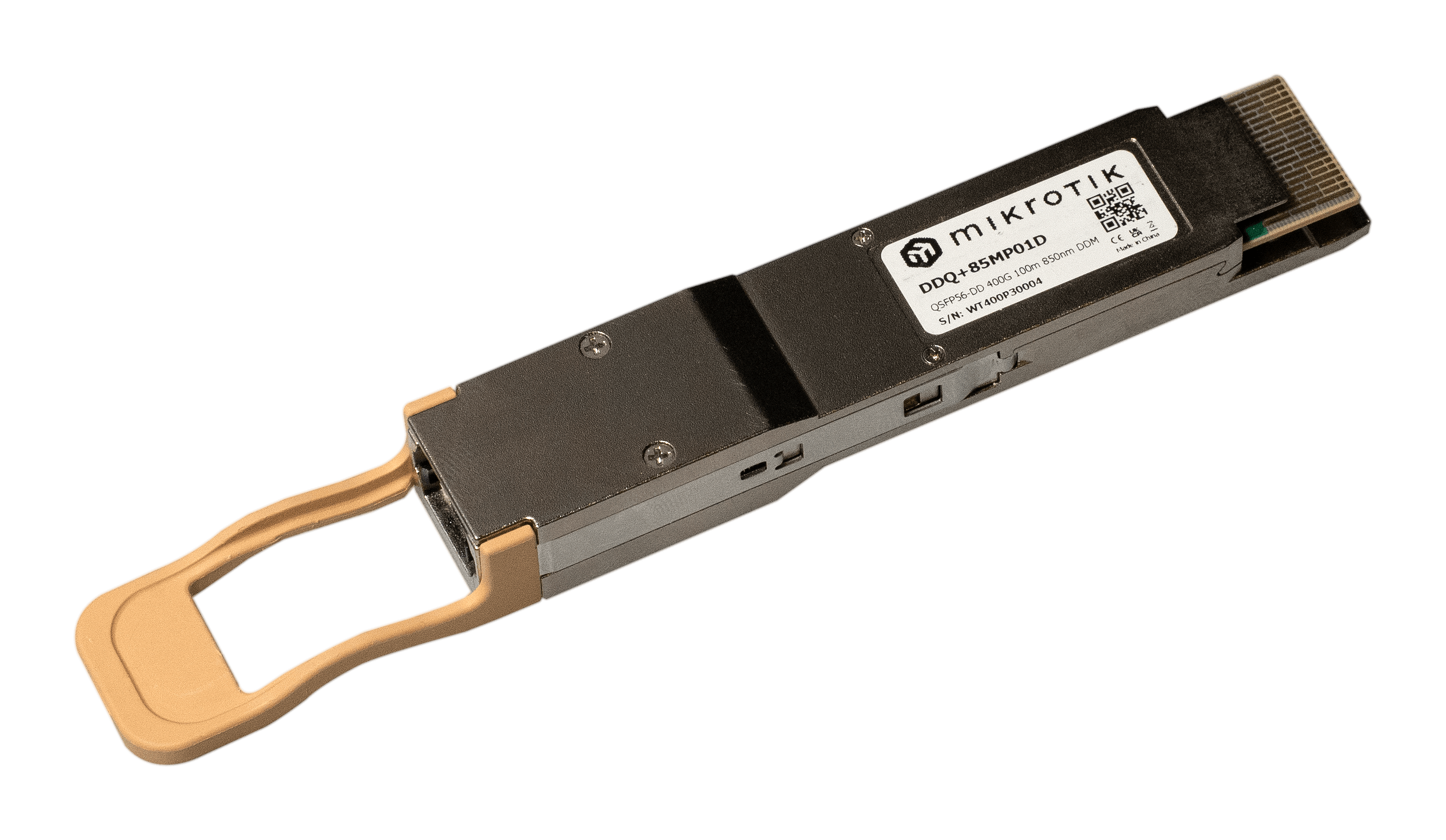
A compact 400 Gigabit optical module for compatible MikroTik QSFP-DD switching environments, designed for multimode fibre links up to 100 metres where DAC reach is insufficient.
Direct answer for buyers
The MikroTik DDQ+85MP01D is a QSFP-DD optical transceiver used to create a 400G link between compatible network devices over multimode fibre. It is primarily intended for data-centre, aggregation, AI-cluster and high-capacity core connections that exceed the practical reach of a short DAC cable but remain within 100 metres. Organisations considering it should already have, or be planning, compatible QSFP-DD switching hardware. Before proceeding, confirm the exact host platforms at both ends, the required link distance, the fibre grade, the MTP/MPO-16 connector arrangement, Type-B polarity, quantity and any configuration services needed. FourTeck can help validate these details before quotation.
What the module does
The DDQ+85MP01D converts electrical 400G data from a compatible QSFP-DD port into an optical signal for transmission across a suitable multimode fibre assembly. The module uses eight independent full-duplex channels, each supporting up to 50 Gbps, to deliver an aggregate data rate of 400 Gbps. This architecture allows very high bandwidth within a compact hot-pluggable transceiver format. Its practical role is straightforward: it bridges racks, rows or nearby equipment zones where a copper direct-attach cable would be too short or operationally inconvenient.
Who should consider it
The product is best suited to network architects, data-centre engineers, system integrators and procurement teams building around compatible MikroTik 400G switches. Typical users include organisations deploying high-speed leaf-spine fabrics, AI or GPU clusters, media processing networks, service-provider aggregation, research computing and campus-core upgrades. It is not a general-purpose SFP module and should not be ordered solely because a device has an optical port. The host must specifically support the required QSFP-DD interface and link mode.
Business challenges this 400G optic helps address
DAC reach is too limited
Direct-attach cables are useful within a rack or across very short distances, but they may not suit links running between equipment rows or separated cabinets. The DDQ+85MP01D extends a compatible 400G connection to as much as 100 metres using the specified optical cabling.
East-west traffic is growing
AI workloads, distributed storage, virtualisation and high-resolution media can create heavy server-to-server traffic. A 400G link can reduce the number of parallel lower-speed uplinks needed, provided the switching architecture and endpoints are designed for that capacity.
Operations need better visibility
The integrated digital diagnostic functions expose parameters such as optical power, voltage, temperature and laser bias current. This information can support troubleshooting and maintenance decisions, although thresholds and reporting depend on the host platform and configuration.
Core capabilities at a glance
Designed for dense, high-speed ports used in modern 400G switching platforms.
Eight full-duplex lanes provide up to 50 Gbps per channel.
Suitable for short-reach links inside many data-centre and campus facilities.
Digital diagnostics support visibility into key optical and module health values.
Product-fit decision matrix
| Requirement | Suitable when | Confirm before ordering |
|---|---|---|
| 400G optical uplink | Both endpoints support the intended QSFP-DD 400G mode. | Exact device models, port type, RouterOS version and interface settings. |
| Link beyond DAC distance | The planned path is no longer than 100 metres. | Measured route length, patching overhead and fibre grade. |
| MPO-based cabling | The site can use MTP/MPO-16 female-to-female Type-B cabling. | Connector gender, key orientation, polarity and cassette design. |
| Operational monitoring | The host can read digital diagnostic values. | Monitoring method, thresholds, alerting and documentation. |
Verified technical information
| Brand | MikroTik |
|---|---|
| Product code | DDQ+85MP01D |
| Product type | QSFP-DD optical transceiver module |
| Aggregate bandwidth | Up to 400 Gbps |
| Channel architecture | Eight independent full-duplex channels, up to 50 Gbps each |
| Maximum stated distance | Up to 100 metres with suitable multimode fibre infrastructure |
| Connector | MTP/MPO |
| Required optical cable | Female-to-female Type-B polarity MTP/MPO-16 |
| Digital diagnostics | Optical power, voltage, temperature, laser bias current and other key values |
| Stated MTBF | Approximately 200,000 hours at 25°C |
| Related MikroTik platforms | CRS812 DDQ and CRS804 DDQ are identified by MikroTik as related products; confirm exact software and port compatibility for the proposed design. |
| Availability | Contact FourTeck for current UAE options, lead time and quantity confirmation. |
| Warranty guidance | Confirm the applicable warranty terms in the final quotation and regional supply channel. |
Compatibility and cabling notice
A 400G module purchase must be treated as part of a complete link design, not as a standalone accessory. The DDQ+85MP01D requires a compatible QSFP-DD port at each relevant endpoint, the correct link mode and a female-to-female Type-B polarity MTP/MPO-16 optical cable. A cable that looks physically similar may still be unsuitable if its fibre count, polarity, connector gender or key orientation is wrong.
Confirm the switch models, software release, port configuration, FEC requirements, patch-panel route and fibre certification before deployment. When connecting to non-MikroTik equipment, both sides should comply with the applicable interface standards and must be tested as a complete system. FourTeck can review the proposed topology and bill of materials before procurement.
A practical purchase and deployment journey
Define the link
Document both endpoints, required bandwidth, route distance and whether the link is point-to-point or part of a wider fabric.
Validate compatibility
Check QSFP-DD support, software, FEC expectations and any platform-specific interface configuration.
Confirm the fibre assembly
Specify MTP/MPO-16 female-to-female Type-B polarity, fibre type, length, patching and labelling.
Quote the complete BOM
Include modules for both ends, cables, cleaning tools, patching components and configuration services where required.
Install and test
Inspect and clean connectors, insert modules correctly, bring up the link and test traffic, errors, FEC and diagnostics.
400G capacity for high-density network fabrics
The central value of the DDQ+85MP01D is bandwidth density. A single transceiver can carry an aggregate 400 Gbps through eight 50 Gbps channels, allowing compatible switches to exchange large volumes of traffic through one compact optical interface. This can be valuable in leaf-spine architectures, where uplink capacity must keep pace with many server-facing ports, or in AI clusters where nodes exchange data continuously rather than sending most traffic toward an external network.
High port speed alone does not guarantee application performance. The switch fabric, server adapters, storage architecture, packet sizes, buffering, routing design and software workload all affect results. Buyers should therefore size the full path, not just the optic. A 400G module is most useful when the endpoints and traffic pattern can consume the bandwidth and when the connection reduces congestion, uplink complexity or the number of parallel lower-speed links.
For many organisations, the business case is operational rather than purely technical. Fewer high-capacity links may simplify topology, free front-panel space and create a clearer upgrade path. However, spare strategy, cable handling and troubleshooting procedures become more important because each link carries significant aggregate traffic. FourTeck can help translate traffic forecasts and port requirements into a practical module and cabling quantity.
Short-reach optical flexibility beyond copper DAC
Copper DAC is often the simplest option for very short 400G connections, particularly within the same rack. Its reach and handling characteristics can become limiting when switches are separated by rows, mounted in different zones or connected through overhead and underfloor pathways. The DDQ+85MP01D provides an optical alternative for links up to 100 metres, offering more placement freedom within many data-centre rooms, labs and campus facilities.
The 100-metre figure should be treated as a maximum design reference, not a substitute for route measurement. Real projects must account for patch leads, cassettes, trunk segments, bend radius, connector loss, contamination and future re-patching. An optical power budget and certified fibre path are particularly important when the route includes several connection points. Keeping connectors clean is essential because high-density parallel optics can be sensitive to contamination across any lane.
The required female-to-female Type-B MTP/MPO-16 cable is a critical part of the purchase. Fibre count and polarity must match the module. A legacy MPO-12 assembly used for a 40G or 100G link is not automatically suitable. Procurement documents should identify the exact cable construction and length so the installation team does not discover a mismatch during the change window.
Digital diagnostics for maintenance and troubleshooting
The module includes digital diagnostic monitoring for optical power, supply voltage, temperature, laser bias current and other operating parameters. These values can help engineers distinguish between a cabling problem, an optical level issue, an environmental condition and a configuration fault. They are especially helpful when several 400G links are installed and the operations team needs consistent evidence rather than relying only on a link-up or link-down state.
Diagnostics should be incorporated into an operational process. Teams may record a baseline after installation, define alert thresholds, review drift over time and compare both ends of a link during incident response. The actual visibility available depends on the host device, operating system and monitoring platform. Not every value is necessarily exposed in the same way on every third-party endpoint.
Monitoring does not replace physical inspection. An abnormal optical reading may still require connector cleaning, route testing or module replacement. A good runbook should include safe removal, cleaning materials, spare handling, electrostatic precautions, approved interface commands and rollback steps. FourTeck can include configuration and testing support in a project quotation when the scope is defined in advance.
Ideal business environments and use cases
AI and GPU clusters
High east-west traffic between compute nodes, storage and aggregation layers can justify 400G links, provided the wider fabric is designed for the workload.
Data-centre leaf-spine fabrics
A compatible QSFP-DD uplink can connect leaf and spine switches across racks or rows while reducing reliance on multiple lower-speed connections.
Media and content processing
Large video, rendering and broadcast workflows may need predictable high-capacity transport between processing and storage systems.
Service-provider aggregation
Providers consolidating traffic from multiple lower-speed access or distribution links can use 400G where the platform and traffic model support it.
Research and test labs
Labs evaluating next-generation networking may need compact, monitorable 400G optical links between test platforms.
Campus-core modernisation
Large campuses with concentrated traffic may consider 400G for selected core or distribution links after validating distance, fibre and resilience requirements.
Integration and operational considerations
Start with the exact network diagram. Identify which ports will host the optics, how the fibre path is patched, what redundancy model is used and what happens if the link fails. In a dual-fabric design, each path may require its own pair of modules and cable. A spare policy should reflect the impact of a failed 400G link and the expected replenishment lead time.
Review switch software before installation. MikroTik documents multiple high-speed interface modes and configuration considerations for QSFP-family ports. The intended 400G mode, FEC behaviour and negotiation settings should be confirmed for the specific platforms at both ends. When one endpoint is a third-party device, interoperability testing should be planned rather than assumed.
Physical handling deserves equal attention. MTP/MPO connectors contain multiple fibre positions, so end-face contamination can affect one or more channels. Use appropriate inspection and cleaning tools, protect dust caps, avoid tight bends and label each trunk clearly. Keep a record of module serials, switch ports, fibre routes and diagnostic baselines. This documentation reduces troubleshooting time and makes future capacity work safer.
Questions to resolve before requesting a quote
Procurement checklist
☐ Confirm product code DDQ+85MP01D.
☐ State required quantity for both link ends.
☐ Add an agreed spare quantity.
☐ Record exact host device models.
☐ Confirm QSFP-DD port support and software.
☐ Measure the complete fibre route.
☐ Specify MTP/MPO-16 female-to-female Type-B cable.
☐ Confirm fibre grade and patch-panel design.
☐ Identify any third-party endpoint.
☐ Include inspection and cleaning requirements.
☐ Define configuration and testing scope.
☐ Confirm delivery destination and project window.
How FourTeck can assist
FourTeck can support the procurement process by reviewing the intended topology, confirming the exact model reference, checking the host platforms and identifying the associated cable requirement. This is useful when a quotation must include not only the optic but also the correct MTP/MPO assembly, quantities for both ends, spare units and any installation or configuration work.
For projects that need technical services, the scope can include link planning, configuration coordination, installation support, interface verification, diagnostic checks and handover documentation. These activities should be described in the quotation because requirements vary according to the site, existing fibre, change-control procedures and whether the endpoints are already commissioned.
Buyers can also explore related network and security products, review available deployment and support services, or send the full requirement through the FourTeck contact page.
UAE availability and support guidance
Contact FourTeck to confirm current UAE availability for the MikroTik DDQ+85MP01D. Supply timing may depend on quantity, vendor lead time, regional allocation and the complete bill of materials. Delivery and project coordination can be discussed after the exact requirement is confirmed. Installation and configuration scope should be included in the quotation when required.
For organisations operating in Dubai, Abu Dhabi, Sharjah and Ajman, FourTeck can coordinate requirement review, quotation preparation and delivery planning through one project discussion. Site access, installation timing, fibre testing and change-window support are variable services and should be confirmed before order placement.
GCC Availability
Businesses planning 400G connectivity across the GCC can contact FourTeck for requirement review, model selection, quotation coordination and deployment planning. Projects in the United Arab Emirates, Saudi Arabia, Kuwait, Qatar, Bahrain and Oman may have different procurement processes, delivery routes and service conditions. Availability of the DDQ+85MP01D, the correct MTP/MPO-16 cable, spare quantities and related switching hardware can vary according to the destination, quantity and vendor lead time. Licensing is not normally the main purchase dependency for an optical module, but switch software, platform support and interface configuration remain important. Buyers should share the destination country, exact endpoint models, link quantity, cable length, required project date and any configuration or installation expectations. FourTeck can then prepare region-appropriate guidance without assuming stock, customs outcomes or a fixed delivery schedule. For Kuwait-focused coordination, visit FourTeck Kuwait.
Africa Availability
FourTeck can assist organisations in Africa that are evaluating the MikroTik DDQ+85MP01D as part of a data-centre, aggregation or high-performance network project. The review can cover compatible switches, module quantities, spare strategy, MTP/MPO-16 cabling, fibre-path requirements, configuration scope and support expectations. Availability and fulfilment depend on the destination, order quantity, regional product allocation, shipping arrangement, power and regulatory context for the wider equipment, vendor lead time and local project conditions. Buyers should provide the destination country, exact requirement, planned link length, endpoint models, preferred deployment schedule and whether remote or onsite assistance is expected. FourTeck can coordinate suitable guidance for East African and wider regional projects through resources such as FourTeck Africa, Kenya technology support and Uganda project coordination. Local inventory, immediate shipment and country-wide onsite coverage should be confirmed for each request.
Related options and services
MikroTik CRS812 DDQ
A related high-capacity switching platform identified by MikroTik for 400G environments. Confirm the exact port plan and required accessories.
MikroTik CRS804 DDQ
A compact 400G switch option for dense network fabrics. Suitability depends on port count, topology, routing and redundancy requirements.
400G DAC alternatives
For very short links, a compatible direct-attach cable may be simpler. Reach, bend radius and equipment placement should guide the choice.
Fibre inspection and testing
Parallel optics benefit from disciplined cleaning, inspection and link verification before production traffic is enabled.
Network design consultation
Use a design review to validate capacity, redundancy, interface mode, cabling and the complete bill of materials.
Why businesses contact FourTeck
A high-speed optical module is easy to describe but less easy to specify correctly in a live network. Organisations contact FourTeck to clarify model references, align both endpoints, review interface compatibility, select the correct cable, build a complete bill of materials and coordinate a quotation. This reduces the chance of purchasing the right transceiver with the wrong fibre assembly or using it in a port that does not support the required mode.
FourTeck can also help scope installation, configuration, testing and documentation. The service level is agreed according to the project rather than assumed. Buyers with broader requirements can learn more about FourTeck business technology support or discuss multi-site requirements through the main technology consultation channel.
Frequently asked questions
What is the MikroTik DDQ+85MP01D used for?
It is used to create a short-reach 400G optical link between compatible QSFP-DD network devices over suitable multimode fibre.
How far can the module transmit?
MikroTik states a maximum reach of up to 100 metres. The installed fibre route, patching and connector condition must still be validated.
Which cable does it require?
It requires a female-to-female Type-B polarity MTP/MPO-16 optical cable. MPO-12 assemblies should not be assumed compatible.
Does it support digital diagnostics?
Yes. The module includes monitoring for optical power, voltage, temperature, laser bias current and other key operating parameters.
Is the DDQ+85MP01D compatible with every QSFP port?
No. The host must support the relevant QSFP-DD interface and link mode. Compatibility should be checked for each endpoint.
Can it connect MikroTik equipment to another brand?
Interoperability may be possible when both devices follow the relevant standards, but the complete link should be validated and tested before production use.
Is a software license included or required?
The optic itself is a hardware module. Any platform software, feature licensing or support requirement depends on the host device and project design.
What information is needed for a Dubai quote?
Provide the endpoint models, quantity, link distance, cable requirement, delivery destination, target schedule and any installation or configuration scope.
Is UAE stock guaranteed?
No. Contact FourTeck to confirm current availability, vendor lead time and delivery coordination for the required quantity.
Confirm the complete 400G link before ordering
Share the switch models, required quantity, fibre route and service scope. FourTeck can prepare a quotation covering the DDQ+85MP01D and the associated deployment requirements.
