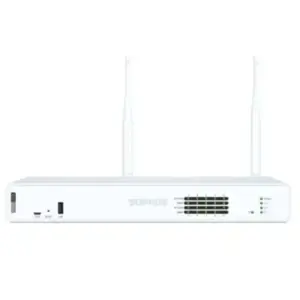
MikroTik hAP be³ Media in Dubai, UAE
A modern network can require more than basic internet sharing. The MikroTik hAP be³ Media combines triple-band Wi-Fi 7, five 2.5 Gigabit Ethernet interfaces, RouterOS routing and firewall functions, container support, local storage connectivity and smart-environment integration in one compact platform. It is designed for buyers who want strong control over wired, wireless and local-service workloads without moving immediately to a rack-based architecture.
Triple-band 2×2 Wi-Fi 7
5 × 2.5G Ethernet
ARM64, 2 GB RAM
RouterOS v7, License 6
Direct answer for buyers
The MikroTik hAP be³ Media is an all-in-one indoor router, Wi-Fi 7 access point and compact local-services platform. It is mainly used to connect multi-gigabit internet, wired workstations, network storage, wireless devices and selected container or IoT workloads through RouterOS. It may suit advanced homes, small offices, content-production rooms, labs and branch sites that need more flexibility than a consumer router provides. Before proceeding, confirm the exact product code MA53UG+HbeH, local 6 GHz rules, compatible wireless clients, expected coverage, required Ethernet topology, power method, storage accessories and configuration responsibility. Current availability and lead time should also be confirmed for the UAE.
What it does
The device can act as the main internet router, local firewall, wireless access point and multi-gigabit Ethernet hub for a compact site. RouterOS supports routing, VLANs, bandwidth controls, VPN services, scripting, monitoring and many advanced network functions. The hardware also offers USB and microSD options for selected storage and local-service use cases.
Its value is not simply the presence of Wi-Fi 7. The broader benefit is the combination of modern wireless, five 2.5G ports and a flexible operating environment in one enclosure.
Who it suits
It is relevant for technically managed homes, small companies, creative teams, consulting offices, training rooms, network laboratories and edge locations where several fast wired and wireless devices share local resources. It can also suit buyers who prefer detailed RouterOS control over a simplified consumer interface.
It may be unnecessarily complex for users seeking only a basic plug-and-play router. Larger sites with many rooms, high client density or strict availability requirements may need multiple managed access points, switching and a separate gateway.
Business challenges this platform can help address
Multi-gigabit bottlenecks
Five 2.5G Ethernet ports provide a practical foundation for faster WAN access, NAS connections and modern workstation links. Actual throughput depends on configuration, traffic type and enabled services.
Congested wireless spectrum
Triple-band operation adds the 6 GHz band for compatible clients and can create more room for demanding wireless applications. Range and permitted channels vary by country and physical environment.
Too many separate appliances
Routing, firewalling, wireless access, lightweight containers and local storage connections can be consolidated where the workload remains within the device’s practical capacity.
Limited network control
RouterOS provides detailed policy, VLAN, VPN, routing and monitoring options. This flexibility requires careful design, secure administration and ongoing software maintenance.
Product-fit decision matrix
| Requirement | Suitable when | Confirm before ordering |
|---|---|---|
| Wi-Fi 7 upgrade | New clients can use 5 GHz or 6 GHz Wi-Fi 7 features | Client capability, local channel rules and coverage |
| Fast local network | NAS, PCs or switches have 2.5G interfaces | Cabling, port allocation and upstream capacity |
| Advanced routing | The administrator needs VLANs, VPNs, policy or dynamic routing | Configuration complexity and performance under selected rules |
| Local applications | Lightweight container services are appropriate at the edge | Storage, memory, security, backups and workload limits |
| Large premises | Used as a gateway within a wider managed design | Number and placement of additional access points |
Verified technical information
| Brand | MikroTik |
|---|---|
| Product name | hAP be³ Media |
| Product code | MA53UG+HbeH |
| Architecture and CPU | ARM 64-bit, IPQ-5322, four cores, up to 1.5 GHz |
| Memory and storage | 2 GB RAM and 512 MB NAND |
| Operating system | RouterOS v7, License Level 6 |
| Wireless | Triple-band 2×2 MIMO Wi-Fi 7 on 2.4, 5 and 6 GHz; MLO in TR-MLMR AP mode |
| Ethernet | 5 × 2.5G Ethernet ports |
| Peripheral connectivity | USB-C, two USB-A connections and microSD card slot; exact usage should be checked against current RouterOS support |
| IoT connectivity | Thread radio and Bluetooth 5.4 |
| Power input | 24–57 V DC jack or 802.3af/at PoE-in |
| Power consumption | Up to 29 W; up to 20 W without attachments |
| Cooling and environment | Passive cooling; tested ambient temperature from -30°C to 50°C; IP20 indoor enclosure |
| Included items | 24 V 1.5 A power adapter, case base and Torx tool according to manufacturer information |
Wireless data rates are theoretical link rates, not guaranteed application throughput. Router, VPN, firewall, container and storage performance changes with packet size, rules, encryption, software version, client capability and configuration. Confirm the latest regional specifications before purchase because wireless parameters and supported features can change with firmware and regulatory settings.
Dependencies that affect the buying decision
6 GHz availability
The 6 GHz band is regulated differently across markets. Permitted channels, power levels and indoor-use conditions depend on country settings and current rules. Buyers should not assume that every advertised channel or width is available at every UAE location.
Client compatibility
Wi-Fi 7 benefits require compatible endpoints. Existing Wi-Fi 5, Wi-Fi 6 and Wi-Fi 6E devices may connect using supported legacy modes, but they cannot use every Wi-Fi 7 capability. Confirm drivers, operating systems and security modes.
RouterOS design
RouterOS offers substantial flexibility, but the final outcome depends on secure and accurate configuration. VLAN design, firewall policy, VPN selection, DNS, update procedures and administrative access should be planned rather than left at defaults.
Containers and storage
Container workloads require suitable external storage, package support, resource planning and security controls. A router should not automatically replace a dedicated application server or backup platform for critical workloads.
A practical purchase and deployment journey
Document the requirement
Record internet bandwidth, number of users, floor area, wall construction, wired devices, target VLANs, VPN connections, storage needs and any container or IoT plan.
Validate product fit
Check whether one indoor unit can provide adequate coverage and port capacity. For larger sites, define the gateway, switch and access-point architecture rather than treating a single router as the whole design.
Confirm the bill of materials
Confirm the MA53UG+HbeH device, required cables, mounting location, PoE source if used, storage media, upstream switch requirements and any installation services.
Configure and test
Update RouterOS, set the correct country, replace default credentials, configure firewall and wireless policies, test wired throughput, validate roaming or coverage and verify remote-access controls.
Operate and maintain
Keep configuration backups, monitor logs and capacity, apply reviewed updates, protect external storage and document recovery procedures. Periodically review whether the network has outgrown a single-device design.
Multi-gigabit wired and wireless capacity
The combination of five 2.5G Ethernet ports and three wireless bands addresses a common mismatch in modern compact networks: fast endpoints are often connected through a gateway that still has only Gigabit Ethernet. A 2.5G-capable ISP connection, NAS, workstation and managed switch can be connected without immediately introducing a separate multi-gigabit switch, provided the five-port count is sufficient.
The port specification does not mean every workload will simultaneously achieve 2.5 Gbit/s at the application layer. Routing rules, packet sizes, firewall processing, encryption, queues, bridge filters and CPU-intensive services all influence results. MikroTik publishes laboratory test values under specific conditions, but a business should size around its own traffic mix rather than treating a maximum test figure as guaranteed production performance.
On wireless, the 2.4 GHz band remains useful for range and legacy or IoT devices, while 5 GHz serves a broad range of current laptops and phones. The 6 GHz band can provide cleaner spectrum for compatible devices, but it normally has different propagation characteristics and regulatory constraints. Placement remains important. A centrally located router with clear surroundings will usually perform more consistently than a unit hidden inside a cabinet or behind dense building materials.
RouterOS control for segmented and remote networks
The hAP be³ Media is differentiated from many consumer Wi-Fi routers by RouterOS v7. It can support network segmentation, static and dynamic routing, VPNs, traffic shaping, firewall policies, DHCP services, monitoring and automation. These functions are useful when a small company needs separate networks for employees, guests, cameras, lab devices or smart systems.
Flexibility creates responsibility. A powerful platform can be configured poorly as easily as it can be configured well. Buyers should define which interfaces are trusted, which services may be exposed, who has administrative access and how configuration backups are protected. Remote administration should be limited and secured. Unused services should be disabled, strong credentials should be applied and RouterOS updates should be reviewed regularly.
For VPN design, the correct protocol depends on endpoint compatibility, authentication policy, expected throughput and operational support. For advanced routing or multiple tunnels, request configuration guidance and performance validation. The product can run sophisticated functions, but the complete configuration must remain proportionate to the hardware and the business impact of failure.
Local services, containers and smart-environment integration
The media-oriented design adds USB connectivity, microSD expansion, container support, Bluetooth 5.4 and a Thread radio. This creates possibilities for local dashboards, file access, network tools, automation services and selected edge applications. Keeping lightweight services close to users can reduce dependence on external platforms and may simplify laboratory or personal-cloud projects.
A router-hosted container should be treated as part of the security boundary. Container images need trusted sources, updates and access restrictions. External storage requires backup, integrity and capacity planning. Critical company files should not exist on one removable medium without a separate backup. Resource-intensive databases, video analytics or large business applications generally belong on dedicated computing and storage infrastructure.
Thread and Matter-related projects also depend on the exact software, controller role and ecosystem design. Buyers should confirm the current RouterOS implementation and the requirements of their chosen smart devices. Integrated radios make the platform interesting, but compatibility should be proven for the planned use case before a commercial rollout.
Ideal environments and realistic use cases
Creative studio
Connect editing workstations, a 2.5G NAS, cloud applications and modern wireless devices in a compact office. Confirm storage throughput and backup architecture separately.
Advanced home office
Use one platform for high-speed internet, segmented work and personal networks, secure remote access and local file or automation experiments.
Small branch
Provide routing, firewalling, Wi-Fi and VPN connectivity for a modest user group. Assess whether redundancy and support requirements justify separate business appliances.
Training or lab space
Build VLANs, routing policies, VPNs, container services and test networks on an ARM64 RouterOS platform with multi-gigabit ports.
Media room
Serve high-bitrate streams and local content to wired and wireless devices, subject to storage speed, client capability and application design.
IoT test environment
Explore local Thread, Bluetooth and container-supported automation while keeping experimental systems isolated from business-critical networks.
Integration and operational considerations
Start with the physical design. Cat5e may support 2.5G over appropriate distances and conditions, but existing cabling should be tested rather than assumed. Identify which port will serve the internet uplink, which ports connect high-speed endpoints and whether a managed switch is needed for more devices or PoE delivery. The hAP be³ Media accepts PoE-in but does not replace a PoE switch for powering multiple endpoints.
For wireless planning, note the floor plan, ceiling height, wall materials, interference sources and expected client density. A single access point may cover a compact open space, but larger villas, offices or multi-floor premises normally require multiple access points. In such cases, decide whether the hAP be³ Media will remain the gateway while dedicated MikroTik access points provide distributed coverage.
Management should include a documented IP plan, VLAN map, administrative roles, update procedure, backup schedule and incident-recovery method. Configuration can be performed through WinBox, WebFig or MikroTik applications, but secure access policy matters more than the interface chosen. Keep copies of tested configurations away from the device.
Where business continuity is important, evaluate the effect of combining routing, Wi-Fi and local services on one appliance. Consolidation is convenient, yet maintenance or failure affects several functions at once. A separate gateway, switch, access points and application host may be more appropriate for sites that cannot accept a single point of failure.
Questions to resolve before ordering
An accurate quotation begins with the operating requirement, not only the model name. Share the following information so the product, accessories and services can be reviewed together:
• What internet speed and handoff does the provider supply?
• How many wired and wireless devices will be active?
• Which endpoints support 2.5G Ethernet or Wi-Fi 7?
• Is 6 GHz operation required and permitted for the deployment?
• How many rooms or floors need dependable coverage?
• Are VLANs, guest Wi-Fi or isolated IoT networks required?
• Which VPN protocols and remote users must be supported?
• Will containers or file services run on the router?
• What external storage and backup method will be used?
• Is DC power or PoE-in preferred?
• Is configuration, installation or training required?
• What support and recovery expectations apply?
Procurement checklist
How FourTeck can assist
FourTeck can help translate a general request for a fast Wi-Fi router into a clearer deployment requirement. Assistance may include confirming the exact MikroTik model, reviewing port and coverage needs, identifying whether additional switching or access points are required, preparing quotation details and defining optional configuration or installation scope.
For RouterOS projects, the required services should be described explicitly. A basic internet and wireless setup is different from a segmented design with VLANs, site-to-site VPNs, policy routing, guest access, monitoring and container services. Sharing the current network diagram and desired outcome helps prevent omissions in the bill of materials and service scope.
Explore additional business technology products, review available network services, or contact FourTeck with your user count, floor plan, internet speed and required features.
UAE availability and support guidance
Contact FourTeck to confirm current UAE availability for the MikroTik hAP be³ Media. Availability may depend on the product code, required quantity, regional version, vendor production and shipment lead time. A listed manufacturer suggested price or overseas reseller price should not be treated as the final Dubai selling price because freight, currency, taxes, sourcing route and service scope may differ.
Delivery and project coordination can be discussed after the exact requirement is confirmed. Installation and configuration should be included in the quotation when required. Warranty terms, return procedures and included components should be stated on the supplier quotation rather than assumed from information published for another region.
FourTeck can coordinate requirements for Dubai, Abu Dhabi, Sharjah and Ajman through one combined review. Share the deployment address, quantity, preferred timeline and whether the request covers supply only, basic setup or a broader network project. This allows the commercial and technical scope to be separated clearly.
GCC Availability
FourTeck can assist GCC organisations evaluating the MikroTik hAP be³ Media for compact offices, technical labs, high-speed residential networks and edge deployments. Requirement review can cover the destination country, wireless-region considerations, product code, quantity, 2.5G port plan, client compatibility, RouterOS configuration and any additional access points or switching. Requests may be coordinated for markets such as the United Arab Emirates, Saudi Arabia, Kuwait, Qatar, Bahrain and Oman, subject to the applicable sourcing and project conditions. Product availability, wireless settings, delivery schedules, service visits and vendor lead times can vary by country, model, quantity and scope. Buyers should provide the destination, required quantity, expected deployment date, internet bandwidth and installation or configuration expectations. For regional enquiries, use the FourTeck technology contact channel or review FourTeck Kuwait information where relevant. No local stock, customs outcome or fixed installation date should be assumed until confirmed in writing.
Africa Availability
Organisations planning MikroTik deployments in Africa can contact FourTeck for product and requirement guidance. The review can include the exact MA53UG+HbeH model, wireless-region requirements, quantity, power method, compatible client devices, storage accessories, RouterOS configuration, remote-access design and support expectations. Availability and fulfilment may depend on the destination, shipment arrangements, vendor lead time, local power or regulatory conditions and the practical scope of installation. Buyers in East Africa and other regions should share the country, site location, required quantity, preferred schedule and whether the request includes supply, configuration or ongoing assistance. FourTeck resources for Africa technology projects, Kenya requirements and Uganda enquiries can support regional coordination. Local inventory, immediate shipment, customs results and country-wide onsite coverage should not be assumed unless they are specifically confirmed for the project.
Related options and complementary services
Managed access points
For multi-room or multi-floor coverage, consider a distributed wireless design rather than relying on one router location.
2.5G managed switching
Add port capacity, VLAN control and suitable uplinks when five Ethernet interfaces are insufficient.
Network storage
Use dedicated NAS infrastructure for larger, critical or multi-user storage and backup requirements.
RouterOS configuration
Define VLANs, firewall rules, VPNs, bandwidth policies and monitoring according to an approved network plan.
Wi-Fi survey and planning
Assess coverage, capacity and access-point locations for larger or more demanding environments.
Business firewall options
Sites requiring subscription security services, formal reporting or high availability may need a separate security appliance.
Why businesses contact FourTeck
Technology buyers often know the model they are considering but still need to confirm whether it fits the wider design. FourTeck can assist with requirement clarification, model verification, bill-of-material guidance, compatibility questions, quotation coordination and the definition of installation or configuration services.
This practical approach is particularly useful for a multi-function product. The right decision depends on more than the headline wireless class. Coverage, port count, cabling, client capability, RouterOS administration, container plans, business continuity and support expectations all affect suitability. Learn more about FourTeck or discuss the deployment through the product consultation channel.
Frequently asked questions
Is the MikroTik hAP be³ Media a Wi-Fi 7 router?
Yes. It is a triple-band 2×2 Wi-Fi 7 router and access point supporting 2.4 GHz, 5 GHz and 6 GHz. Available channels and features depend on regional settings, RouterOS version and client support.
What is the exact product code?
The manufacturer lists the product code as MA53UG+HbeH. Use this code in quotation requests to avoid confusion with other hAP models.
Does every Ethernet port support 2.5 Gigabit?
The published specification lists five 2.5G Ethernet ports. Actual end-to-end speed also requires suitable cabling, connected devices and a configuration that does not introduce another bottleneck.
Does it require a RouterOS subscription?
The device includes RouterOS v7 with License Level 6 according to MikroTik. No separate RouterOS license purchase is normally required for the base product. Third-party services used in containers may have their own terms.
Can it run containers?
Yes, the ARM64 platform supports RouterOS containers. The planned image, storage, memory use, security policy and backup method should be reviewed before production deployment.
Can one unit cover a large villa or office?
Coverage depends on placement, wall construction, interference, floor area and client radios. Larger or multi-floor sites commonly require additional managed access points and a planned wired backhaul.
Can it be powered through PoE?
Yes. The published specification supports 802.3af/at PoE-in at 24–57 V, as well as a 24–57 V DC jack. Confirm the available PoE source and cable path.
Is configuration included in the product price?
Do not assume installation or custom RouterOS configuration is included. Request a quotation that separates hardware, delivery coordination, setup, advanced configuration and support.
How can I confirm Dubai availability?
Contact FourTeck with the product code, quantity, deployment location and preferred timeline. Availability and lead time can then be checked for the specific request.
What information is needed for an accurate quote?
Provide quantity, internet speed, user and device count, floor plan, required VLANs or VPNs, expected storage or container use, power preference and any installation or configuration scope.
Confirm the model, network fit and UAE quotation
Share your quantity, floor plan, internet speed, wired-device list and RouterOS requirements. FourTeck can help review the MikroTik hAP be³ Media deployment and coordinate the appropriate quotation scope.