Direct answer for buyers
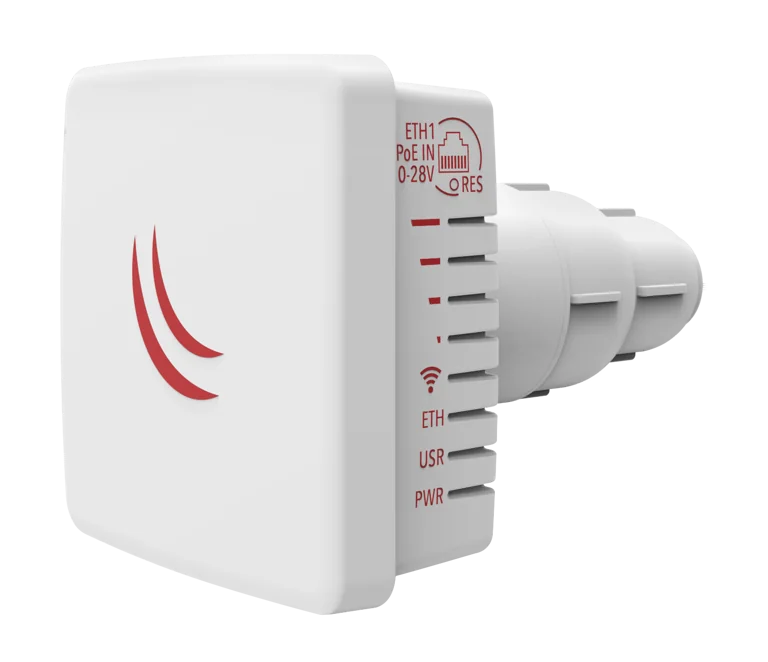
The MikroTik LDF 5 is an outdoor 5 GHz wireless system with a built-in feed antenna that is intended to be mounted in a standard satellite offset dish. Its main role is to create a directional wireless endpoint for point-to-point or point-to-multipoint network designs. It may suit service providers, remote-site operators, farms, warehouses, temporary projects and businesses linking locations where a wired route is not practical. Before proceeding, confirm clear line of sight, dish dimensions, path distance, expected usable bandwidth, mounting and grounding, passive PoE compatibility, local channel restrictions and whether the 10/100 Ethernet interface is sufficient for the required application.
What the LDF 5 does
The LDF 5 converts an ordinary offset satellite dish into the reflector element of a directional wireless system. The device itself contains the radio, processing hardware, built-in feed antenna, Ethernet interface and RouterOS software. When it is placed correctly in the dish feed holder, the dish focuses radio energy toward the desired remote endpoint. This arrangement can provide substantial directional gain compared with using the compact feed unit alone, although the actual gain depends on dish size, geometry, alignment and installation quality.
In practical deployments, one LDF 5 may be used as a client device connected to a compatible 5 GHz access point, or two suitable directional endpoints may be configured for a point-to-point link. The design should be planned around the required throughput rather than the headline wireless data rate. Environmental interference, channel width, signal level, modulation, protocol overhead, Ethernet limitations and RouterOS configuration all influence real application performance.
Who should consider it
This model is most relevant to buyers who need a cost-conscious directional 5 GHz endpoint and are comfortable working with an offset dish. It may be appropriate for internet service provider customer connections, CCTV backhaul between separated buildings, agricultural sites, staff accommodation, remote gates, temporary field offices, warehouses and operational locations where a cable route would be disruptive or expensive.
It should not be selected solely because a long distance is mentioned. Reliable outdoor wireless requires a path survey, unobstructed Fresnel zone where possible, accurate alignment, suitable mounting strength, compliant frequency settings and realistic traffic expectations. Buyers seeking higher Ethernet capacity or 802.11ac support should compare the LDF 5 ac or another modern directional radio before finalising the bill of materials.
Business challenges this model can help address
Difficult cable routes
Trenching, road crossings, rented premises and temporary sites can make new copper or fibre routes impractical. A properly engineered wireless bridge may provide network access without disturbing the entire path between locations.
Remote operational points
Gates, pumps, monitoring stations, cameras and distant workshops often need modest data connectivity. The LDF 5 can form part of a link where the traffic profile matches its 10/100 Ethernet interface and wireless capabilities.
Reuse of dish hardware
Standard offset dishes are widely available. The 40 mm feed-mount concept lets installers use a suitable dish as the reflector, but dish quality, shape, rigidity and exact mounting position must be checked before installation.
Controlled directional coverage
A dish-based endpoint concentrates the radio pattern in a defined direction. This may improve link budgeting and reduce unwanted coverage compared with an omnidirectional approach, though it does not remove interference or regulatory constraints.
Core capabilities in practical terms
Product-fit matrix
| Requirement | Suitable when | Confirm before ordering |
|---|---|---|
| Directional outdoor link | A clear path exists and an offset dish can be securely installed. | Path profile, Fresnel clearance, mounting height and alignment access. |
| Moderate network traffic | The application fits within a Fast Ethernet-connected 802.11n platform. | Real throughput target, traffic peaks and future growth. |
| Existing satellite dish | The dish has a compatible 40 mm offset feed mount and adequate structural condition. | Dish diameter, shape, rigidity, feed orientation and mounting hardware. |
| Passive PoE deployment | The power design can provide the supported voltage through suitable outdoor cable. | Injector voltage, cable length, surge protection and grounding. |
| RouterOS-based operation | The technical team can configure and maintain RouterOS securely. | Management method, password policy, updates, backups and monitoring. |
Verified technical information
| Brand | MikroTik |
|---|---|
| Product name | LDF 5 |
| Product code | RBLDF-5nD |
| Product type | Outdoor dual-chain 5 GHz wireless dish-feed system |
| Architecture / CPU | MIPSBE, AR9344, single core at 600 MHz |
| Memory and storage | 64 MB RAM, 16 MB flash |
| Operating system | RouterOS with Level 3 licence |
| Wireless band and standards | 5 GHz, IEEE 802.11a/n, two chains |
| Maximum wireless data rate | 300 Mbit/s physical-layer rate; usable throughput is deployment dependent |
| Built-in antenna gain | 9 dBi feed antenna; final dish-system gain depends on reflector size and installation |
| Ethernet | One 10/100 Ethernet port |
| Power input | Passive PoE, one PoE-in input |
| Input voltage | Official product specification lists 10–30 V; installation guide references passive PoE and warns against standard 48 V 802.3af injectors |
| Maximum power consumption | 6 W |
| Dimensions | 84 × 84 × 115 mm |
| Environmental rating | IP54; tested ambient temperature from -40°C to 70°C |
| Included components | 24 V 0.38 A power adapter and PoE injector, subject to regional package confirmation |
| Frequency range | International model supports 5150–5875 MHz, with actual channels limited by country regulations |
| UAE availability | Contact FourTeck for current model, quantity and lead-time confirmation |
Compatibility and deployment dependencies
The LDF 5 is not a complete long-distance link by itself. A working deployment requires a compatible remote radio, suitable offset dish, secure mounting arrangement, outdoor-rated Ethernet cabling, power injection, grounding, surge protection where appropriate, accurate alignment and a compliant RouterOS configuration. Frequency availability and maximum permitted transmit power depend on local regulation and the country setting applied in RouterOS.
The model has one 10/100 Ethernet port, so it is not the right choice where a Gigabit wired handoff is mandatory. It also uses 802.11a/n rather than 802.11ac. Buyers comparing current deployments should evaluate whether the LDF 5 ac, LHG models, SXTsq models or another directional platform provides a better capacity and lifecycle fit. FourTeck can help review the intended endpoint, target traffic, dish availability and management approach before quotation.
From requirement to operational link
Define the application
State what must cross the link: internet access, cameras, voice, business applications, monitoring traffic or general LAN connectivity. Include peak and average bandwidth expectations.
Survey the path
Confirm distance, endpoint coordinates, heights, obstacles, Fresnel clearance, interference and physical access. A map alone is not a substitute for a proper path assessment.
Build the bill of materials
Select the radios, dishes, mounts, cable, power equipment, surge protection and network-side components. Confirm whether each endpoint uses the same or a different device.
Install and align
Use qualified personnel, secure mounting, correct dish-feed orientation, downward-facing cable openings, suitable grounding and careful signal alignment.
Configure and validate
Apply the correct country profile, strong credentials, appropriate wireless settings, management restrictions and software updates. Test stability and usable throughput under expected traffic.
Dish-based gain and link planning
The distinctive feature of the MikroTik LDF 5 is its use of a conventional offset satellite dish as the main reflector. This can be attractive where dishes are easy to source or already installed, but the apparent simplicity should not lead to casual planning. The dish diameter, surface condition, feed arm geometry and focal point all influence the resulting antenna pattern. A feed that is too far forward, too far back or rotated incorrectly can reduce signal quality even when the dish appears to face the remote location.
A link budget should consider transmit power, antenna gain at both ends, free-space path loss, cable and connector conditions, regulatory limits, fade margin and likely interference. Strong received signal alone is not enough; signal-to-noise ratio, channel occupancy, modulation stability and retransmissions determine whether the link supports business traffic reliably. For sites carrying CCTV or voice, test performance during busy radio periods rather than accepting a single quiet-time speed result.
The frequency band also influences propagation. Five-gigahertz links normally require good line of sight and adequate Fresnel-zone clearance. Trees, cranes, moving vehicles, new construction and seasonal changes can affect a path that initially looked clear. FourTeck can discuss the information needed for a preliminary requirement review, while final engineering may require an onsite or specialist wireless survey depending on project risk.
RouterOS control and secure administration
RouterOS gives the LDF 5 more operational flexibility than a simple unmanaged wireless bridge. Depending on the design, the device can bridge traffic, route between networks, apply firewall rules, participate in MikroTik wireless modes and expose monitoring information to administrators. This flexibility is valuable when the technical team understands the platform and maintains a controlled configuration standard.
A new deployment should never be left with default access conditions. Administrators should set strong credentials, restrict management services, use trusted management networks, back up the configuration and keep RouterOS at an approved stable release. Remote management over the public internet should be designed carefully, preferably through a secure management path rather than broad exposure of administrative services.
Configuration must match the intended topology. A transparent bridge may be suitable for some building links, while routed separation can reduce broadcast domains and improve operational control in others. Spanning-tree behaviour, VLAN handling, DHCP placement, monitoring and fault isolation should all be considered before the link is introduced into a production network. FourTeck can include configuration assistance in the quotation when the required topology and handover expectations are clearly defined.
Power, cabling and outdoor installation quality
The LDF 5 uses passive PoE rather than standard 48 V IEEE 802.3af power. This distinction is important because using an unsuitable injector can prevent operation or damage equipment. The original package includes a compatible injector and power adapter according to the manufacturer, but buyers should confirm regional package contents when ordering. For longer cable runs, voltage drop, conductor quality and connector workmanship need attention.
Outdoor cable should be selected for UV exposure and the local environment. The weather-sealing gland must be assembled correctly, and cable openings should face downward as recommended in the installation guidance. The dish, mast and network equipment should be grounded according to applicable electrical and lightning-protection practice. Surge risk is site-specific; exposed rooftops, towers and remote poles may require additional protective design beyond the basic product package.
Mechanical stability is just as important as electrical work. A small movement at the feed or dish can cause a large change in alignment over a long path. The mounting structure must withstand wind and vibration, and the dish should not flex excessively. Access for future realignment, inspection and cable replacement should be considered before the final mount location is approved.
Suitable business environments
Wireless service provider access
The LDF 5 can act as a directional customer-premises endpoint where the provider network, protocol choices and capacity requirements are compatible. Provider approval and correct radio configuration are required.
Warehouse and campus links
Separate buildings may exchange operational data without trenching. The design should account for corporate VLANs, broadcast behaviour, redundancy expectations and future bandwidth growth.
CCTV backhaul
Remote cameras can use a directional link when aggregate video bitrate, recording patterns and latency expectations fit the available throughput. Camera quantity and codec settings must be calculated.
Agriculture and remote operations
Farms, yards, pumps and field offices may need connectivity over open ground. Power reliability, mast access, dust, heat and maintenance travel should be included in planning.
Temporary project sites
Construction and event locations may benefit from a relocatable wireless path. Mounting safety, changing site obstructions and rapid revalidation after relocation are important.
Remote gate or access systems
A modest-bandwidth link may carry access-control, intercom or monitoring data. Critical-life-safety functions should not rely on a single unprotected wireless path without proper risk assessment.
Operational and integration considerations
Integrating an outdoor wireless bridge into a business network requires more than achieving a radio connection. Network teams should decide whether the link extends the same Layer 2 domain or connects routed subnets. Extending a flat LAN can be quick, but it may also carry broadcasts, spanning-tree changes and faults across sites. Routed boundaries often improve isolation, although they require address planning and policy decisions.
Monitoring should cover radio signal, noise, modulation rates, Ethernet errors, CPU load, uptime and traffic utilisation. A link that remains associated can still deliver poor application performance if interference or alignment causes heavy retransmission. Establish a baseline after commissioning and document expected readings so support teams can distinguish normal variation from degradation.
Business continuity also needs consideration. The LDF 5 has a single Ethernet port and a single PoE power path. Sites that require high availability may need dual independent links, backup cellular connectivity, resilient power or a different architecture. No single low-cost radio should be treated as a complete resilience strategy. FourTeck can discuss alternative topologies when the acceptable outage period and business impact are known.
Questions to resolve before requesting a quotation
Procurement checklist
☐ Confirm exact model RBLDF-5nD and required quantity.
☐ Record endpoint addresses, coordinates and proposed mounting heights.
☐ Confirm target bandwidth and primary applications.
☐ Verify whether one or two radios are required.
☐ Confirm dish availability, diameter and 40 mm feed compatibility.
☐ Review the remote endpoint radio and wireless protocol compatibility.
☐ Confirm UAE-compliant channel and power settings.
☐ Check passive PoE voltage, cable length and power-source placement.
☐ Specify outdoor cable, waterproofing, grounding and surge-protection scope.
☐ Decide whether installation and precision alignment are included.
☐ Define RouterOS configuration, VLAN and management requirements.
☐ Confirm package contents, warranty route and current lead time.
Sharing these details reduces quotation ambiguity and helps avoid purchasing an endpoint that does not match the intended capacity or installation environment.
How FourTeck can assist
FourTeck can support the buying process by clarifying the intended use, checking whether the LDF 5 is a reasonable fit, reviewing nearby MikroTik alternatives and coordinating a quotation based on quantity and delivery location. Assistance can also cover bill-of-material discussions, dish and mounting questions, passive PoE requirements, RouterOS configuration scope and installation planning.
For projects that require engineering input, buyers should provide endpoint coordinates, photographs, approximate heights, link distance, traffic requirements and any known obstructions. This information supports a more useful first review. It does not replace a formal onsite survey where path risk, structural work or mission-critical traffic makes direct verification necessary.
Related support can be discussed through the FourTeck technology services page. Buyers comparing broader network options can also review the business technology product range or contact the team through the FourTeck Dubai enquiry page.
UAE availability and support guidance
Contact FourTeck to confirm current UAE availability for the MikroTik LDF 5. Supply timing can vary with the exact international model, quantity, package version and vendor lead time. A quotation should state whether the requirement is for hardware only or also includes dishes, mounting accessories, cabling, surge protection, installation, alignment and configuration.
For deployments across Dubai, Abu Dhabi, Sharjah and Ajman, FourTeck can coordinate requirement review and commercial guidance after the site count and destination details are provided. Delivery and project scheduling should be discussed only after the complete scope is understood. Buyers should also confirm the applicable UAE radio configuration and ensure that installation is completed by qualified personnel in line with electrical, structural and radio-frequency requirements.
GCC Availability
FourTeck can assist organisations planning MikroTik LDF 5 deployments in GCC markets with requirement review, model confirmation, quotation coordination, accessory planning and configuration-scope discussions. Projects in the United Arab Emirates, Saudi Arabia, Kuwait, Qatar, Bahrain and Oman may differ in permitted radio channels, power limits, import conditions, delivery arrangements and onsite support options. Availability should therefore be confirmed for the destination country rather than assumed from a quotation prepared for another market. Buyers should share the exact product code, quantity, endpoint locations, expected link distance, dish requirements, preferred deployment schedule and whether installation or RouterOS configuration is needed. Product supply, service visits and vendor lead times can vary by country and project size. For Kuwait-related coordination, buyers may also review FourTeck Kuwait technology support. No local inventory, customs outcome or fixed deployment date should be assumed until the final destination and scope have been reviewed.
Africa Availability
Organisations evaluating the MikroTik LDF 5 for African projects can ask FourTeck for product-selection and regional procurement guidance. A dish-based directional radio may be useful for farms, campuses, service-provider access, warehouses and remote facilities, but the final design must reflect the local spectrum rules, site geography, power reliability, weather exposure and maintenance capability. Availability and fulfilment may depend on destination, quantity, model region, shipping route, vendor lead time and the required installation package. Buyers should provide the destination country, endpoint coordinates, expected bandwidth, number of links, dish size, preferred schedule and support expectations. FourTeck resources for regional discussions include Africa technology project coordination, Kenya business technology enquiries and Uganda technology support enquiries. Local inventory, customs clearance, country-wide onsite coverage and guaranteed delivery should not be assumed without written confirmation for the exact project.
Related products and services to evaluate
MikroTik LDF 5 ac
Consider the 802.11ac version where higher wireless capability and a Gigabit Ethernet interface are important. Exact compatibility and capacity should be reviewed.
MikroTik QMP-LDF mount
A mounting accessory for LDF-series devices that may provide more flexible pole or wall installation. Confirm whether it is required for the chosen dish arrangement.
Directional LHG alternatives
Integrated dish-style MikroTik radios may reduce dependence on a separate satellite dish. Compare frequency, Ethernet speed, antenna gain and target distance.
Wireless link assessment
A requirement and path review can help determine whether the LDF concept is appropriate before hardware is ordered.
Installation and alignment
Professional mounting, grounding, cabling and fine alignment can be included as a separate project scope where available.
RouterOS configuration support
Configuration assistance can cover bridging, routing, wireless parameters, secure administration and handover documentation.
Why businesses contact FourTeck
Businesses contact FourTeck when they need help translating a connectivity problem into a practical product requirement. For the LDF 5, that may mean determining whether the 802.11n platform and Fast Ethernet interface are sufficient, whether an offset dish is available, which accessories are needed and how configuration should fit the existing network.
FourTeck can help organise the quotation around real project inputs rather than a bare product code. This includes quantity, endpoint locations, traffic profile, mounting conditions, dish requirements, cable lengths, power design, installation expectations and support scope. The goal is procurement clarity: a buyer should understand what is included, what remains site dependent and what must be confirmed before deployment.
For company background, visit about FourTeck Dubai. For a project discussion, use the contact page and include as much endpoint and bandwidth information as possible.
Frequently asked questions
What is the MikroTik LDF 5 used for?
It is used as a directional outdoor 5 GHz wireless endpoint, typically with a standard offset satellite dish acting as the reflector. Common applications include point-to-point links and customer-premises connections.
Does the LDF 5 include the satellite dish?
The product is the dish-feed radio, not the complete dish assembly. A suitable offset dish and mounting arrangement must be sourced or confirmed separately.
How much throughput can I expect?
The wireless physical-layer rate is listed up to 300 Mbit/s, but usable application throughput is lower and depends on signal quality, interference, channel settings, protocol overhead and the 10/100 Ethernet port.
Is RouterOS included?
Yes. The device is supplied with RouterOS and a Level 3 licence. Buyers should still plan for secure configuration, software updates and configuration backups.
Can it be powered by a normal 48 V PoE switch?
The LDF 5 uses passive PoE. MikroTik’s installation guidance warns that it does not operate with a standard 48 V IEEE 802.3af injector. Confirm the exact power source before connection.
Is professional installation required?
MikroTik states that its radio devices must be professionally installed. Correct mounting, grounding, dish alignment and country-specific radio configuration are important for safety and performance.
What is the difference between LDF 5 and LDF 5 ac?
The LDF 5 uses 802.11a/n and one 10/100 Ethernet port. The LDF 5 ac supports 802.11ac and includes a Gigabit Ethernet port, making it more suitable where higher capacity is required.
Can FourTeck configure the units?
Configuration support can be discussed as part of the quotation. Provide the topology, IP plan, wireless mode, VLAN requirements, management method and remote endpoint details.
Is the MikroTik LDF 5 available in Dubai?
Contact FourTeck to confirm current UAE availability, quantity, package contents and vendor lead time. Availability should not be assumed until the requirement is checked.
What information is needed for a quote?
Share the quantity, endpoint locations, link distance, mounting heights, target throughput, dish availability, power and cabling requirements, and whether installation or configuration support is needed.
Confirm the right wireless link design before ordering
Send FourTeck the endpoint locations, distance, required throughput, dish details and preferred installation scope. The team can help confirm whether the MikroTik LDF 5 is appropriate and coordinate a Dubai or UAE quotation.