

MikroTik RBGPOE-CON-HP in Dubai, UAE
The RBGPOE-CON-HP helps bridge a common power mismatch in MikroTik deployments: an available 42–57V PoE source on one side and a compatible 24V passive-PoE RouterBOARD device on the other. It keeps Gigabit Ethernet data connectivity while converting the power supplied across the cable, making it a practical accessory for structured business networks, wireless links and infrastructure upgrades.
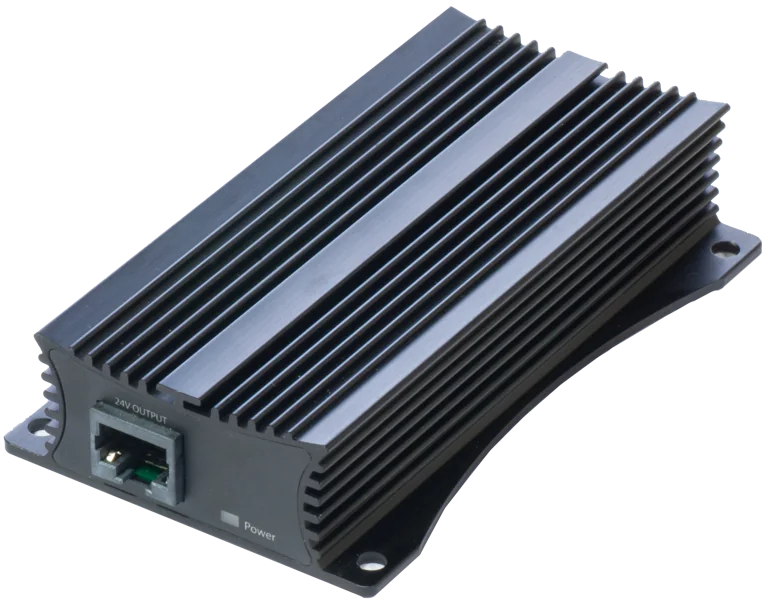
Product type: Gigabit PoE voltage converter
Primary task: convert supported high-voltage PoE to 24V passive PoE
Direct answer for buyers
The MikroTik RBGPOE-CON-HP is an inline PoE converter for powering compatible RouterBOARD devices from a higher-voltage PoE source. It accepts supported 42–57V PoE input, including IEEE 802.3af/at and certain passive or telecom PoE sources, then delivers 24V passive PoE through a Gigabit Ethernet connection. It should be considered by network administrators, wireless installers, system integrators and businesses that need to reuse existing 48V PoE infrastructure without feeding an incompatible voltage directly into a lower-voltage MikroTik device. Before proceeding, confirm the exact powered-device input range, wattage requirement, PoE pinning, upstream switch or injector standard, cable quality, grounding plan and environmental location.
What it does
This accessory sits between a powered Ethernet cable and the compatible MikroTik device. On the upstream side, it receives a supported 42–57V PoE feed. Internally, it converts that supply and presents 24V passive PoE on the downstream Ethernet port. Data continues across the same link at 10/100/1000Mbps, subject to the connected equipment and cabling. The result is a cleaner way to integrate devices that use different PoE voltage expectations without adding a separate local AC socket beside the RouterBOARD unit.
Who it suits
The RBGPOE-CON-HP is relevant to office networks, service-provider installations, managed wireless links, campus infrastructure, warehouses, retail branches and other sites where a PoE switch or injector already supplies a higher voltage. It is especially useful when a selected RouterBOARD device is technically suitable for the network but cannot be connected directly to the available PoE source. It is not a universal adapter for every powered device, and it should not be selected only because the connectors physically fit.
Business problems this converter can help address
Voltage mismatch
A network may use 48V PoE switching while the endpoint requires lower-voltage passive PoE. The converter creates an appropriate power interface when both sides fall within its documented limits.
Lack of a nearby socket
Roof, mast, ceiling and remote cabinet locations may not have convenient AC power. Reusing an Ethernet cable for both data and power can reduce local electrical work, subject to site design.
Infrastructure reuse
A business may want to preserve its existing PoE switching and structured cabling while introducing a compatible RouterBOARD endpoint that operates on a different passive-PoE voltage.
Cleaner deployment
Centralised PoE can simplify power distribution, UPS planning and cable routes. The converter supports that approach without turning a voltage difference into a reason to redesign the complete link.
Core capabilities at a glance
Product-fit matrix
| Requirement | Suitable when | Confirm before ordering |
|---|---|---|
| Use a 48V-class PoE source | The upstream source supplies a supported 42–57V PoE method. | Source standard, available wattage and port configuration. |
| Power a 24V passive-PoE endpoint | The connected device accepts passive PoE within the required voltage range. | Device datasheet, polarity, pinout and maximum input voltage. |
| Maintain Gigabit data | Both endpoints and the cable support Gigabit Ethernet. | Cable category, termination quality, link length and endpoint capability. |
| Centralise network power | The network design uses central PoE and possibly a protected UPS source. | PoE budget, redundancy expectations and failure-domain impact. |
| Deploy in a structured location | The converter can be mounted, ventilated and protected from unsuitable environmental exposure. | Indoor/outdoor protection, grounding, heat, moisture and cable strain. |
Verified technical information
| Brand | MikroTik |
|---|---|
| Product name | RBGPOE-CON-HP |
| Product code | RBGPOE-CON-HP |
| Product type | Inline Gigabit PoE voltage converter |
| Input voltage | 42–57V PoE |
| Supported PoE input types | Passive PoE, telecom PoE, IEEE 802.3af and IEEE 802.3at PoE+ |
| PoE output | 24V passive PoE |
| Output current limit | 1A |
| Maximum output | Up to 24W, subject to the upstream PoE source and applicable standard limits |
| 802.3af limitation | When powered from an 802.3af-compliant PSE, total output should not exceed 12.95W |
| Ethernet ports | 2 × 10/100/1000Mbps Ethernet |
| Enclosure | Rugged metal design with integrated heatsink and mounting holes |
| Shielding | Ethernet shield contacts are provided within the connectors for shielded cabling and grounding design |
| Approximate physical envelope | About 111mm × 67mm × 24.2mm based on the manufacturer dimension drawing |
| MTBF guidance | Approximately 100,000 hours at 25°C, as stated by the manufacturer |
| Certifications listed by manufacturer | CE and RoHS |
| Availability | Contact FourTeck for current UAE availability, quantity planning and lead-time confirmation |
Compatibility and power-budget notice
Passive PoE does not perform the same powered-device negotiation as IEEE 802.3af or 802.3at. That means the downstream device must be explicitly compatible with the converter’s 24V passive output. Do not infer compatibility from the RJ45 connector alone. Confirm the endpoint’s accepted voltage range, PoE input method, polarity, pin assignment and maximum power demand from the exact model documentation.
The upstream source also matters. Although the converter can provide up to 24W under suitable conditions, an IEEE 802.3af source imposes a lower available-power ceiling. The complete link must be designed around the weakest power budget in the chain, including switch allocation, cable losses and endpoint startup demand. For higher-load RouterBOARD devices, ask FourTeck to review both the PSE source and the powered-device specification before purchase.
A sensible purchase and deployment journey
Identify both endpoints
Record the exact PoE switch or injector model and the exact RouterBOARD device to be powered. Similar-looking models can have different input limits.
Check the power path
Verify input voltage, PoE standard, port power allocation, output requirement, startup draw, cable length and environmental losses.
Plan mounting and grounding
Choose a protected location with cable strain relief, suitable airflow and an appropriate shield or grounding arrangement for the site.
Test before final handover
Confirm stable startup, negotiated Ethernet speed, device operation under load, cable condition and recovery after a controlled power cycle.
Capability focus: converting power without sacrificing Gigabit data
A PoE converter has two jobs: it must handle the electrical requirement and preserve the network path. The RBGPOE-CON-HP supports 10/100/1000Mbps Ethernet across its two ports, so it is designed for links where the connected switch, endpoint and cable are capable of Gigabit operation. This matters in wireless backhaul, branch networking and RouterBOARD deployments where the endpoint may carry more than basic management traffic. A converter limited to 100Mbps could become the hidden constraint in an otherwise Gigabit design.
The achievable throughput still depends on the complete chain. The upstream switch port, the downstream RouterBOARD interface, cable category, termination quality, cable length, electromagnetic conditions and configured link speed all influence the result. The converter does not upgrade a Fast Ethernet endpoint to Gigabit, and it cannot correct poor cabling. During commissioning, the installer should verify the negotiated speed on both connected devices and check for interface errors, unexpected downshifts or intermittent link changes.
For business buyers, the practical value is design continuity. A team can resolve the PoE-voltage mismatch without deliberately introducing a lower data-rate accessory. That makes the product easier to incorporate into a current network bill of materials, provided the electrical and mechanical requirements are also respected.
Capability focus: usable output power with clear limits
The converter’s stated output is 24V with a current limit of 1A, corresponding to a theoretical maximum of 24W under suitable input conditions. That figure is useful, but it should not be treated as a promise that every upstream PoE port can deliver the full amount. The source standard and power allocation control how much energy is available. MikroTik specifically notes that when an IEEE 802.3af-compliant power-sourcing device is used, total output should remain at or below 12.95W. This distinction is essential when comparing an endpoint’s typical consumption with its maximum or startup consumption.
A sound design includes margin rather than operating permanently at the edge of the available budget. Cable loss, ambient temperature, connector quality and device load changes can all affect real-world behaviour. If the powered RouterBOARD has attached USB devices, SFP modules, radio chains or PoE-output responsibilities of its own, those additions may change the required input. The endpoint’s complete configuration must therefore be reviewed, not only the bare chassis specification.
FourTeck can help buyers compare the PoE source budget with the endpoint’s documented requirements and identify whether the RBGPOE-CON-HP is appropriate or whether a different power design should be considered. This review is particularly important for multi-device rollouts, where a small mismatch repeated across many ports can create recurring instability.
Capability focus: a deployment-friendly metal enclosure
The RBGPOE-CON-HP uses a metal housing with an integrated heatsink profile and mounting holes. Those physical details are relevant because PoE accessories are often installed in equipment rooms, low-voltage cabinets, wall positions or protected outdoor enclosures where loose adapters are undesirable. A mountable converter can be positioned to reduce connector strain, maintain orderly cable routing and keep indicator visibility available to the technician.
The manufacturer’s dimensional drawing indicates an approximate overall envelope of 111mm by 67mm by 24.2mm. These measurements help the buyer assess cabinet clearance, mounting-surface space and cable bend radius. The mounting arrangement should still allow enough room for RJ45 plugs and should avoid crushing or sharply bending the Ethernet cable near the connector. Because the metal body participates in heat dissipation, it should not be wrapped in insulating material or placed where airflow is unnecessarily restricted.
Metal construction does not automatically make the converter weatherproof. Outdoor or dusty locations require an appropriately rated enclosure, correct cable glands, moisture management and suitable surge or grounding design. The integrated shield contacts can support the use of shielded Ethernet cabling, but grounding decisions should follow the wider site design rather than being improvised at the converter alone.
Ideal environments and practical use cases
Wireless point-to-point links
A building may already have a 48V PoE switch or injector while the selected outdoor RouterBOARD radio accepts lower-voltage passive PoE. The converter can support the transition when the exact radio input and power draw are verified.
Branch and retail networking
Businesses standardising on central PoE may need to add a compatible MikroTik router, switch or wireless device without installing a local power supply at the endpoint.
Managed service deployments
Integrators can use a documented conversion accessory to make the power design repeatable across sites, provided the bill of materials specifies the same validated source and endpoint models.
Equipment cabinets and remote rooms
The wall-mountable metal enclosure can help maintain an organised installation where the converter needs to remain accessible for inspection and cable replacement.
Network refresh projects
A company replacing its PoE core may retain lower-voltage RouterBOARD endpoints. The converter may reduce immediate endpoint replacement if compatibility is confirmed and the lifecycle plan remains sensible.
Lab and staging environments
A controlled staging area can use the converter to validate endpoint behaviour, power draw and link negotiation before a wider field rollout is approved.
Integration and operational considerations
Treat the converter as part of the power system, not merely as a cable coupler. Document the upstream port number, PoE mode, switch power budget, cable route, converter position, downstream device model and expected load. This information helps future technicians avoid replacing the converter with an unsuitable inline adapter or connecting a different endpoint that cannot accept 24V passive PoE.
Where the upstream PoE switch is managed, record the port’s power status and any configured maximum. Some switches allow per-port power limits, schedules, priority settings or administrative disablement. A configuration that is too restrictive may prevent the endpoint from starting even though the total switch budget appears sufficient. Conversely, remote port power cycling can be operationally useful for maintenance, provided the restart procedure is tested and the powered system can tolerate it.
Cable testing remains important. Gigabit Ethernet uses all four twisted pairs, while power is also transported through the link. Poor terminations, damaged conductors or unsuitable patching can produce confusing symptoms such as a powered device with an unstable data link, or a stable low-speed link that fails to negotiate at Gigabit. Use appropriate cabling and test both continuity and network performance.
For sites exposed to lightning, long outdoor cable runs or differing earth potentials, the project may require surge protection, bonding and specialised grounding measures beyond the converter itself. Those choices should be handled as part of the complete network and electrical design.
Buyer questions to resolve before ordering
The exact model number determines the accepted voltage range, PoE pinning and maximum power demand.
Confirm whether it is 802.3af, 802.3at, telecom or passive PoE, and verify its actual voltage and port budget.
Use maximum configured demand, not only typical idle consumption, and include attached modules or peripherals.
The lower 12.95W output limitation must be considered when the converter is fed from an 802.3af PSE.
Plan protection from moisture, heat, dust, mechanical damage and cable strain.
The answer depends on the site, outdoor exposure, rack practice and wider bonding design.
Procurement checklist
How FourTeck can assist
FourTeck can help translate a general request for a PoE converter into a complete, orderable requirement. The review can include the exact source device, downstream RouterBOARD model, quantity, power budget, cabling environment and deployment location. This reduces the risk of choosing an accessory based only on voltage labels while overlooking power limits, passive-PoE behaviour or installation conditions.
For project quotations, share the bill of materials or at least the source and endpoint model numbers. FourTeck can coordinate product availability guidance, related accessories, delivery planning and optional installation or configuration scope. For broader infrastructure requirements, buyers can review FourTeck technology products, explore network and security services, or send the requirement through the FourTeck contact page.
The quotation should state whether the request is product supply only or includes site assessment, cabling checks, mounting, testing and documentation. These activities are scope dependent and should be agreed before deployment.
UAE availability and support guidance
Contact FourTeck to confirm current UAE availability for the MikroTik RBGPOE-CON-HP. Availability may depend on requested quantity, vendor lead time, shipping arrangements and the timing of the project. The product should not be ordered as a generic 48V-to-24V adapter without confirming the complete PoE path. Share the source PoE device, downstream RouterBOARD model and quantity so the request can be reviewed accurately.
Delivery and project coordination can be discussed after the exact requirement is confirmed. Installation and configuration scope should be included in the quotation when required. For multi-site projects, provide a site list and indicate whether each location uses the same switch, cabling and powered device, as differences between sites may change the suitability assessment.
Dubai, Abu Dhabi, Sharjah and Ajman coverage
FourTeck can coordinate product enquiries and project discussions for businesses across Dubai, Abu Dhabi, Sharjah and Ajman. Coverage details, delivery planning, site attendance and installation support depend on the confirmed requirement and agreed quotation. Buyers should provide the destination, access conditions, quantity and expected deployment date so the appropriate commercial and technical guidance can be prepared.
GCC Availability
FourTeck can assist organisations planning MikroTik accessory requirements across GCC markets, including the United Arab Emirates, Saudi Arabia, Kuwait, Qatar, Bahrain and Oman. For the RBGPOE-CON-HP, the useful starting point is a technical review of the upstream PoE source and the downstream RouterBOARD device rather than a quantity request alone. FourTeck can support model confirmation, compatibility discussion, quotation coordination, delivery planning and the definition of any installation or testing scope. Product availability, delivery schedules, service visits, vendor lead times and local fulfilment arrangements can vary by country, quantity and project conditions. Buyers should share the destination country, required quantity, source switch or injector model, powered-device model, deployment location and expected timeline. For Kuwait-based enquiries, regional coordination can also be discussed through FourTeck Kuwait resources. No local stock, fixed customs outcome or guaranteed installation date should be assumed until the requirement is formally reviewed.
Africa Availability
FourTeck can help businesses, integrators and project teams evaluate MikroTik accessories for deployments in Africa, including East African requirements and selected projects in other regions. Assistance may cover product identification, source-and-endpoint compatibility, quantity planning, related cabling or mounting needs, quotation preparation and support-scope discussion. Availability and fulfilment can depend on the destination, model, quantity, power requirements, shipping route, vendor lead time and local project conditions. Buyers should provide the destination country, exact powered device, upstream PoE equipment, required quantity, preferred deployment schedule and any expectation for installation or remote commissioning. Regional information is available through FourTeck Africa, with additional resources for Kenya technology projects and Uganda business requirements. Local inventory, immediate shipment, customs outcomes and country-wide onsite coverage are not implied and must be confirmed for the specific request.
Related products and services to consider
Compatible MikroTik RouterBOARD endpoint
Confirm the exact device that will receive 24V passive PoE. Compatibility must be based on that model’s current input specification and configured power demand.
Managed PoE switch or injector
The upstream source must deliver a supported voltage and sufficient port power. Managed switching can also provide useful port monitoring and remote power control.
Shielded Ethernet cabling
Suitable cable, connectors and grounding design may be important for outdoor, industrial or interference-prone locations. The project environment should determine the cable specification.
Surge protection and bonding
Long external cable runs may require additional protection. Selection depends on exposure, earthing arrangement, enclosure design and applicable site standards.
Installation and commissioning
FourTeck can discuss mounting, cable verification, power testing, link-speed validation and documentation as a separate project scope.
Network design consultation
For broader refresh projects, review the converter as part of the full PoE architecture, switch budget, UPS design, endpoint lifecycle and support model.
Why businesses contact FourTeck
A small accessory can create a large operational problem when its electrical role is misunderstood. Businesses contact FourTeck for practical requirement clarification: checking the exact model, comparing the source and endpoint specifications, defining a bill of materials and separating product supply from installation or commissioning work.
FourTeck can also help coordinate quotations, related accessories, delivery planning and support discussions without presenting uncertain availability or compatibility as confirmed. Learn more about the company through the FourTeck business technology profile or discuss the network requirement directly with the sales team.
Frequently asked questions
What is the MikroTik RBGPOE-CON-HP used for?
It converts a supported 42–57V PoE input into 24V passive PoE for compatible RouterBOARD devices while carrying 10/100/1000Mbps Ethernet data.
Can it power any MikroTik device?
No. The connected device must accept the converter’s 24V passive-PoE output and remain within the available current and power limits. Confirm the exact model documentation before connection.
Does it support Gigabit Ethernet?
Yes, the converter has two 10/100/1000Mbps Ethernet ports. The final negotiated speed also depends on the switch, endpoint and cabling.
What PoE input standards are supported?
MikroTik lists support for 42–57V passive PoE, telecom PoE, IEEE 802.3af and IEEE 802.3at PoE+ input arrangements.
How much output power is available?
The output is rated at 24V and up to 1A, or up to 24W when the upstream source allows it. With an 802.3af-compliant source, MikroTik states that total output should not exceed 12.95W.
Is the converter suitable for outdoor installation?
The metal enclosure is rugged and mountable, but it should not be assumed to be weatherproof. Outdoor use requires an appropriate protective enclosure and a suitable grounding and surge-protection design.
Does it need configuration?
The converter itself is an inline hardware accessory and does not require software configuration. The upstream PoE port may still need correct power settings, and the complete link should be tested after installation.
What information is needed for a quotation?
Provide the required quantity, upstream switch or injector model, downstream RouterBOARD model, deployment city, expected timeline and whether installation, cabling checks or commissioning are required.
Is the RBGPOE-CON-HP currently available in Dubai?
Availability can change with quantity and vendor lead time. Contact FourTeck to confirm current UAE availability and delivery coordination for the requested quantity.
Can FourTeck help verify compatibility?
Yes. Share the exact source and endpoint models so FourTeck can review the documented voltage, PoE method and power requirements before preparing the quotation.
Confirm the PoE path before you order
Send FourTeck the upstream PoE source, the powered RouterBOARD model, quantity and deployment location. The team can coordinate compatibility review, UAE availability guidance and a project quotation.
