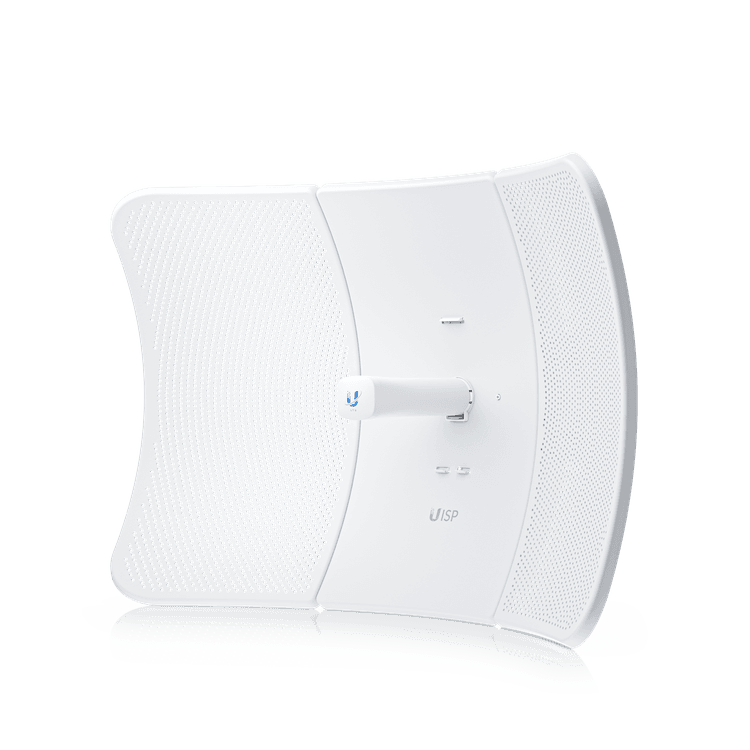
Ubiquiti LTU Extreme-Range LTU-XR in Dubai, UAE
The LTU-XR is built for network teams that need a focused, high-gain customer-premises radio for long-distance wireless connectivity. It combines a 29 dBi integrated antenna, a narrow 5.5-degree 3 dB beamwidth, flexible channel widths and UISP-based management tools in a weather-resistant outdoor assembly. Choosing it correctly requires more than checking a distance figure: the link path, spectrum conditions, regulatory limits, base-station compatibility, mounting structure and required service capacity all need review.
Before requesting a quotation
Share the proposed link distance, coordinates, tower heights, required capacity, expected subscriber role, base-station model, destination country and installation scope.
Model, firmware, regional frequency permissions and accessory requirements should be confirmed for the intended deployment.
Direct answer for buyers
The Ubiquiti LTU-XR is an outdoor 5 GHz LTU client designed for highly directional, long-distance wireless links. It is mainly used as customer-premises equipment with an LTU Rocket base station in point-to-multipoint networks, while supported firmware also enables point-to-point operation. It should be considered by WISPs, remote-site operators, campuses and infrastructure teams that have clear line of sight and need a high-gain integrated radio. Before proceeding, confirm the link budget, Fresnel clearance, local spectrum rules, expected interference, mounting strength, firmware level, base-station compatibility, power method, required throughput and whether the project needs installation or alignment support.
What the LTU-XR does
The radio provides a directional wireless connection between a remote site and an LTU network. Its integrated antenna concentrates radio energy into a narrow beam, which helps establish links over substantial distances when the path is clear, alignment is accurate and the permitted radio parameters support the design.
It is not a conventional indoor Wi-Fi access point and it is not intended to connect phones or laptops directly. Its role is network backhaul or subscriber access within a planned outdoor fixed-wireless architecture.
Who should consider it
The LTU-XR may suit wireless service providers connecting distant subscribers, enterprises linking remote facilities, educational or industrial campuses, utility environments, construction operations and rural sites where trenching fibre is difficult.
It is most appropriate where a technical team can validate the path and manage directional alignment. A shorter-range LTU model, a 60 GHz platform, a licensed microwave solution or fibre may be more suitable when the path, capacity, interference or regulatory conditions differ.
Business challenges this radio can help address
Distant subscriber connection
A high-gain client can help reach remote premises that are beyond the practical scope of lower-gain customer radios, provided the base station, path profile and regulatory power limits support the link.
Fibre deployment constraints
Fixed wireless may provide a practical alternative where digging, permits, road crossings or temporary-site requirements make a new cable route difficult. It still requires proper tower, earthing, surge and network planning.
Directional interference control
The narrow antenna pattern can help focus reception toward the intended base station. It does not remove interference, so spectrum analysis and channel planning remain necessary.
Field setup and monitoring
Bluetooth setup through the UISP App, a web interface, alignment tools, speed testing, cable testing and remote-management services can support commissioning and ongoing operations.
Product-fit decision matrix
| Requirement | Suitable when | Confirm before ordering |
|---|---|---|
| Long-distance 5 GHz client link | There is clear line of sight, adequate Fresnel clearance and an LTU-compatible network design. | Coordinates, distance, heights, terrain, local frequency rules and link budget. |
| PtMP subscriber role | An LTU Rocket is planned as the base station and the sector design can support the subscriber. | Sector frequency, channel width, timing, capacity allocation and firmware compatibility. |
| Supported PtP operation | The selected firmware supports the intended mode and both ends are engineered correctly. | Firmware release, directional capacity needs and whether another platform better fits the application. |
| Outdoor tower installation | The pole, bracket, wind loading, grounding and cable route are suitable. | Pole diameter, structural condition, access method, surge protection and local safety requirements. |
| High service capacity | The spectrum, modulation, channel width, signal level and frame ratio support the target. | Real traffic profile, uplink/downlink ratio, interference margin and realistic throughput target. |
Verified technical information
| Brand | Ubiquiti |
|---|---|
| Product name and model | LTU Extreme-Range, LTU-XR |
| Product type | 5 GHz LTU outdoor client radio |
| Operating modes | PtMP CPE and PtP; PtP depends on supported firmware |
| Maximum stated throughput | 900+ Mbps with firmware 2.3.0 or later; actual throughput is deployment dependent |
| Operating frequency | 5.15 to 5.95 GHz, subject to regulatory region |
| Channel bandwidth | 10, 20, 30, 40, 50, 60, 80 and 100 MHz; 100 MHz support depends on firmware 2.3.0 or later |
| Antenna gain | 29 dBi integrated antenna |
| Beamwidth | 5.5 degrees at 3 dB and 7.5 degrees at 6 dB for horizontal and vertical polarization |
| Network interface | One Gigabit Ethernet RJ45 port |
| Power | Passive PoE, 24 V 0.5 A Gigabit PoE adapter included; supported voltage 22–27 V DC |
| Maximum power consumption | 9 W according to the current online technical specification |
| Dimensions and weight | 747 × 525 × 347 mm; 3.2 kg |
| Mounting | Integrated pole mount included; pole diameter 35 to 60 mm |
| Weatherproofing | IPX6 |
| Operating environment | -40 to 55°C; 5 to 95% non-condensing humidity |
| Management | Bluetooth setup through UISP App and web user interface |
| Important note | Frequency, transmit power, channels and permitted operation depend on the destination region and local regulations. |
Compatibility, firmware and regulatory dependencies
An LTU-XR purchase should be treated as part of a complete radio system rather than as an isolated device. In point-to-multipoint service, the client is designed to operate with an LTU Rocket base station. A buyer replacing an airMAX client should not assume direct protocol compatibility simply because both products use the 5 GHz band. The base station, client family, firmware train and network architecture must match.
Some capabilities depend on firmware. The current manufacturer technical specification associates 900+ Mbps maximum throughput and 100 MHz channel support with firmware 2.3.0 or later. Point-to-point mode was introduced in supported 1.5.x firmware. Feature availability can evolve, so the intended operating mode should be confirmed against the planned firmware before deployment.
The usable frequency range, transmit power and channel options vary by regulatory domain. A radio that can technically tune across a broad range must still be configured within the rules of the destination country. FourTeck can help review the requested regional version and bill of materials, but final frequency planning should follow local authority requirements and the installer’s compliance responsibilities.
A practical purchase and deployment journey
Define the service target
State the required downlink and uplink capacity, traffic profile, availability expectation, subscriber count or point-to-point purpose. A peak headline rate alone is not enough for design.
Validate the path
Use coordinates, elevations, tower heights and terrain data to check direct line of sight and Fresnel clearance. Site surveys may be needed where maps, buildings or vegetation create uncertainty.
Review spectrum and rules
Assess existing 5 GHz activity, legal channels, EIRP limits and suitable bandwidth. Wider channels can increase capacity but also require cleaner spectrum and may reduce deployment flexibility.
Confirm the complete BOM
Verify the exact regional model, LTU base station, PoE arrangement, outdoor cable, surge protection, earthing, mast hardware and any installation services required.
Install and align
Secure the structure, route and protect the cable, apply power correctly, update firmware as planned, configure the radio and align the narrow beam with care.
High-gain RF design for difficult distances
The integrated 29 dBi antenna is the defining characteristic of the LTU-XR. Higher antenna gain concentrates energy into a smaller angular area, which can improve the link budget and reduce reception from directions outside the main beam. For a distant subscriber, this can be valuable because received signal strength and signal-to-noise ratio usually become harder to maintain as path loss rises.
The same narrow beam that supports distance also increases the importance of alignment. A 5.5-degree 3 dB beamwidth leaves less tolerance for rough aiming than a broad client antenna. The installer should use stable mounting, suitable tools and the radio’s alignment feedback. A pole that twists in wind or an improvised bracket can turn a technically sound link budget into inconsistent service.
Gain does not overcome an obstructed path. Buildings, terrain, trees and insufficient Fresnel clearance can introduce loss and multipath effects. Long-range link design should therefore begin with geometry and site conditions, not with the antenna number alone. The buyer should also consider future construction or vegetation growth that could change the path after installation.
Flexible channel planning and traffic ratios
LTU-XR supports channel widths from 10 MHz through 100 MHz on current firmware. This range gives network planners choices, but each choice involves trade-offs. Narrow channels use less spectrum and may be easier to place in a busy band, while wider channels can support higher aggregate capacity when noise, signal quality and regulations allow. Selecting the largest available width without a spectrum assessment can reduce stability rather than improve it.
The platform supports uplink/downlink ratios of 25/75, 33/67 and 50/50. This matters because many subscriber networks carry more downstream traffic, whereas enterprise links, camera systems or data replication may require more balanced capacity. The radio should be assessed against the actual direction of traffic. A nominal aggregate throughput figure does not mean that the full amount is simultaneously available in both directions.
Modulation, frame configuration, channel width, interference, signal level, firmware and Ethernet overhead all influence real throughput. The manufacturer’s maximum value is useful for comparing platform capability, but it is not a guaranteed application rate. FourTeck can help translate a buyer’s target into questions for link design, including minimum committed capacity, busy-hour demand and the amount of engineering margin needed.
Management and operational visibility
Commissioning tools
Bluetooth management supports initial setup through the UISP mobile application, while the web interface allows browser-based configuration. Alignment, discovery, ping, traceroute, speed test, cable test and constellation tools can help field technicians diagnose installation conditions.
Remote operations
Supported services include SNMP, SSH, dynamic DNS, remote logging and a ping watchdog. Their use should follow the organisation’s security policy, management design and access-control requirements. Unnecessary services should not be exposed to untrusted networks.
Bridge and router modes
The radio can operate in bridge mode, while router mode is available in PtMP CPE operation. The correct design depends on how addressing, VLANs, subscriber isolation and upstream routing are handled. Confirm the intended mode before preparing configuration templates.
Suitable environments and realistic use cases
Wireless ISP subscriber access
A WISP may use LTU-XR as a distant customer radio connected to an LTU Rocket sector. The subscriber should fall within the sector’s planned coverage, capacity and timing design. The high gain is especially relevant where a lower-gain client would not provide adequate margin. The operator should still check that one distant client does not create undesirable airtime or service-policy effects for the wider sector.
Remote commercial premises
A warehouse, farm, quarry, utility site or project office may need connectivity to a network point located many kilometres away. The LTU-XR can be considered where a clear path exists and a compatible far-end radio architecture is available. Critical business traffic may require a backup path, service monitoring and clear responsibilities for tower access and maintenance.
Campus and estate links
Large estates sometimes contain buildings separated by roads, undeveloped land or protected areas. A directional radio link may reduce the civil-work burden. Before selection, compare the LTU option with fibre, 60 GHz and other point-to-point platforms based on distance, spectrum, capacity and resilience.
Temporary and phased infrastructure
Construction, event or development sites may need network service before permanent ducts are completed. A reusable wireless link can support a phased project, but temporary does not mean unplanned. Mast stability, electrical safety, lightning protection, environmental exposure and authorised frequency use still require attention.
Video and operational data
Remote cameras, telemetry and operational systems can use a fixed wireless link when their aggregate bandwidth and latency needs fit the design. Camera bitrates, recording patterns, uplink ratios and traffic bursts should be calculated. The radio itself does not replace network security, segmentation or application-level resilience.
Locations where it may not be the right fit
The LTU-XR may not be appropriate when there is no clear line of sight, when the intended base station uses another protocol, when local rules restrict the required frequency or power, when the mast cannot support the antenna and wind load, or when the required service demands licensed-spectrum predictability. A smaller LTU model may also be more economical for shorter links with strong signal margin.
Integration and installation considerations
The LTU-XR uses a single Gigabit Ethernet connection for data and passive PoE. Cabling should be outdoor-rated and routed to minimise water ingress, mechanical damage and electromagnetic exposure. The PoE adapter and downstream switch arrangement should be checked carefully because passive PoE is not the same as automatic standards-based PoE negotiation. Connecting incompatible power can damage equipment.
Outdoor radio installations should include an appropriate grounding and surge-protection plan. The exact requirements depend on the tower, building, local electrical code and lightning environment. The network-side equipment should be protected as part of the same design. It is not enough to attach the radio to a pole and connect an indoor patch cable.
The integrated mount supports poles between 35 and 60 mm in diameter. The mounting structure must also be assessed for the published wind loading. The radio’s 3.2 kg static weight does not by itself describe the forces generated in high wind. A qualified installer should confirm the condition, loading and access safety of the chosen structure.
At the network layer, buyers should decide whether the device will bridge traffic or operate in supported router mode, how management access is separated, how addressing and VLANs are handled and how logs or monitoring data are collected. Configuration should align with the organisation’s operational and cybersecurity standards.
Buyer questions to resolve before ordering
Procurement checklist
How FourTeck can assist
FourTeck can help turn a product enquiry into a clearer technical and procurement requirement. Assistance may include reviewing whether LTU-XR fits the intended distance and subscriber role, identifying information needed for a link assessment, checking compatibility with the proposed LTU base station, confirming requested regional variants, preparing a bill-of-material discussion and coordinating a quotation.
Where installation support is required, the scope can address mounting, outdoor cabling, power, surge protection, configuration, alignment and testing. These activities should be stated in the quotation rather than assumed to be included with hardware supply. For an existing network, share the current base station, firmware, channel plan, signal data and reason for replacement so that the recommendation considers the operational context.
Buyers can explore additional business networking products, review available deployment and support services, or send project details through the FourTeck contact team.
UAE availability and support guidance
Contact FourTeck to confirm current LTU-XR availability in the UAE. Supply can depend on the requested regional model, quantity, vendor lead time and the completeness of the bill of materials. A quotation should distinguish the radio from installation services, outdoor cabling, surge devices, tower hardware and any base-station equipment required for the finished link.
For projects in Dubai, Abu Dhabi, Sharjah and Ajman, FourTeck can coordinate requirement review, quotation, delivery planning and the discussion of installation or configuration scope. Site access, tower work, permits, safety requirements and frequency compliance remain project-specific. Providing these details early helps reduce changes after equipment has been selected.
Pricing shown in product schema is an indicative market-reference amount rather than a confirmed FourTeck selling price. Request a current quotation for the exact regional variant, quantity and service scope.
GCC Availability
FourTeck can assist organisations planning LTU-XR deployments across GCC markets with requirement review, model selection, quotation coordination and deployment-scope discussion. The same radio design cannot automatically be assumed suitable in every country because permitted 5 GHz channels, power limits, regional product variants and operating conditions can differ. Buyers in the United Arab Emirates, Saudi Arabia, Kuwait, Qatar, Bahrain and Oman should provide the destination country, exact quantity, intended link role, coordinates, required throughput and preferred project schedule. Availability, licensing or regulatory suitability, delivery planning, service visits and vendor lead times can vary by country and requirement. FourTeck can help prepare the equipment and service questions, while the buyer and installer should ensure that the final frequency plan and site work comply with local rules. For regional coordination, see FourTeck’s Kuwait technology support information or contact the UAE team with the full project brief.
Africa Availability
Organisations evaluating the LTU-XR for projects in Africa can ask FourTeck for product-selection and regional procurement guidance. Long-distance wireless links are often considered for rural access, industrial operations, campuses and remote facilities, but the correct solution depends on destination-country regulations, path conditions, local spectrum use, mounting infrastructure and support expectations. Availability and fulfilment may vary according to the exact model, quantity, regional frequency requirements, shipping arrangement, vendor lead time and installation scope. Buyers should share the destination country, link coordinates, proposed tower heights, required capacity, far-end equipment and preferred deployment schedule. FourTeck can help structure the quotation and technical questions without promising local stock or fixed delivery dates. Regional enquiries can also review FourTeck information for technology projects in Kenya, technology requirements in Uganda and broader Africa project coordination.
Related products and services to consider
LTU Rocket base station
The base-station radio used for LTU point-to-multipoint networks. Sector antenna choice, frequency plan, client count and capacity should be designed together.
Lower-gain LTU clients
LTU Pro, LTU Long-Range or LTU Lite may be more appropriate for shorter paths. Selection should be based on link margin and sector design rather than choosing maximum gain by default.
Outdoor installation services
Mounting, cable routing, grounding, surge protection, alignment and acceptance testing can be included as defined project services.
Alternative wireless platforms
For different distance, spectrum or availability requirements, compare LTU with airFiber, Wave or licensed microwave solutions. No alternative should be treated as equivalent without a path and capacity review.
Why businesses contact FourTeck
The value of a product supplier is not limited to identifying a part number. Buyers often need help confirming whether the selected radio belongs in the proposed architecture, what other components are needed and which assumptions must be validated before purchase. FourTeck focuses the discussion on practical matters such as model selection, compatibility, quantity, bill of materials, quotation coordination and installation planning.
For LTU-XR, that means clarifying the role of the LTU Rocket, confirming that the path has been assessed, separating maximum platform capability from realistic link throughput, identifying passive PoE and mounting needs and documenting the required services. This approach helps procurement teams receive a quotation that is easier to compare and gives technical teams a clearer starting point for deployment.
To understand the company’s wider technology scope, visit about FourTeck or discuss a specific requirement through the business technology contact channel.
Frequently asked questions
Is the LTU-XR a Wi-Fi access point?
No. It is a fixed outdoor LTU client radio for engineered wireless links. Standard phones, laptops and ordinary Wi-Fi clients do not connect to it as they would to an office access point.
Does LTU-XR work with an airMAX base station?
Do not assume compatibility. LTU uses its own platform and, for point-to-multipoint service, the client is designed to work with an LTU Rocket base station. Confirm the complete architecture before ordering.
Can LTU-XR be used for point-to-point links?
The manufacturer lists PtP mode on supported firmware. The intended firmware, endpoint design, traffic ratio and suitability compared with dedicated point-to-point platforms should be reviewed for the project.
Will the radio deliver 900 Mbps on every link?
No. The stated 900+ Mbps is a maximum platform figure on current firmware. Actual service throughput depends on channel width, signal quality, interference, modulation, frame ratio, distance, regulations and network overhead.
How far can the LTU-XR operate?
Distance should be determined by a link budget and path analysis rather than a single universal number. Clear line of sight, Fresnel clearance, antenna alignment, permitted power, interference and target capacity all affect the result.
Is the PoE adapter included?
The current manufacturer specification lists a 24 V, 0.5 A Gigabit passive PoE adapter as included. Confirm package contents and regional plug type on the quotation.
What must be checked for installation?
Check pole diameter and strength, wind exposure, line of sight, safe access, outdoor cabling, grounding, surge protection, PoE placement, alignment and the required network configuration.
Is a separate software licence required?
The radio’s standard operating features are not presented as a separate per-device subscription in the manufacturer specification. Confirm any broader UISP hosting, support or service requirements for the planned management environment.
How can I obtain a Dubai quotation?
Send FourTeck the exact model, quantity, destination, link coordinates, base-station details, capacity target and required installation or configuration scope. Current price and availability can then be confirmed.
What warranty applies?
Warranty terms can depend on the supply channel and current vendor policy. Ask FourTeck to confirm the applicable warranty guidance on the formal quotation before purchase.
Plan the LTU-XR as a complete link, not a standalone box
Share your distance, endpoint coordinates, tower heights, required capacity, base-station details and destination. FourTeck can help confirm the model, prepare the bill of materials, discuss installation scope and coordinate a current UAE quotation.