
Direct answer: what the F600.F20 Revision D is designed to do
The Barracuda CloudGen Firewall F600.F20 Revision D is a mid-range hardware appliance intended for organizations that need substantially more than baseline perimeter firewalling. It combines stateful inspection, intrusion prevention, application control, TLS inspection, secure SD-WAN, dynamic routing, VPN, traffic shaping, centralized management options, and subscription-based advanced protection services on a rack-mount platform. For Dubai and wider UAE deployments, the model is particularly relevant where a headquarters, large branch, campus, logistics site, hospitality group, healthcare environment, education network, industrial operation, or multi-site enterprise requires a resilient security edge with both copper and fiber access choices.
Barracuda’s current hardware datasheet lists the F600D.F20 at up to 15 Gbps firewall throughput, 3.8 Gbps SD-WAN throughput, 4.8 Gbps IPS throughput, 4.2 Gbps NGFW throughput, and 4.0 Gbps threat-protection throughput. It supports approximately 2.1 million concurrent sessions and up to 115,000 new sessions per second under Barracuda’s stated test methodology. Those numbers are laboratory “up to” figures rather than a promise that every production configuration will achieve the same result. Real throughput depends on packet sizes, enabled inspection engines, TLS decryption volume, application mix, logging, policy complexity, WAN behavior, firmware, and surrounding infrastructure. That distinction matters during sizing because a firewall selected from raw Layer-3 throughput alone can become undersized once IPS, application control, web filtering, antivirus, ATP workflows, and TLS inspection are enabled.
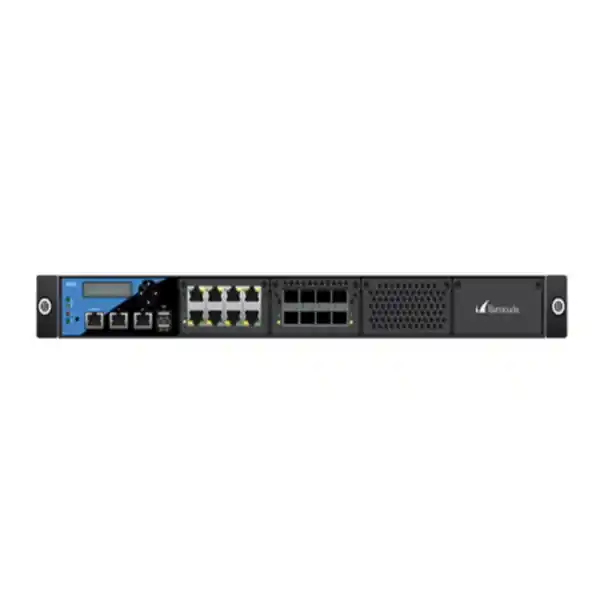
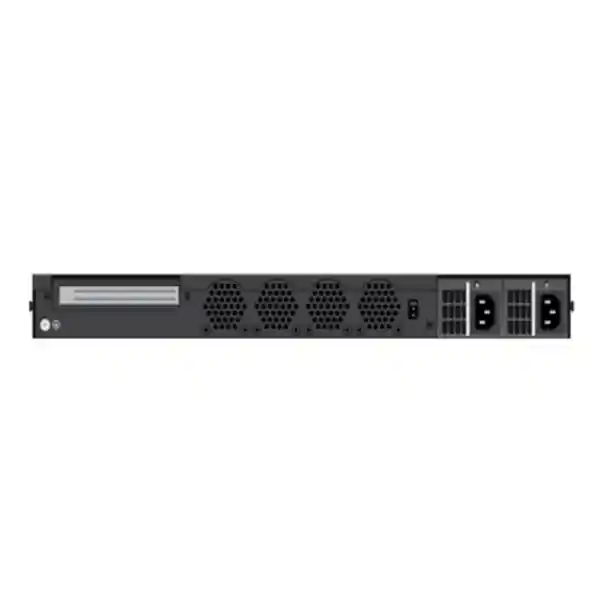
The F20 submodel is also differentiated by its interface mix and power design. The current F600D family table shows the F20 with 10 x 1 GbE copper Ethernet interfaces and 8 x 1 GbE SFP fiber interfaces in a 1U rack-mount chassis. Unlike single-power variants in the same family, the F600D.F20 uses dual internal hot-swap power supplies, which makes it better suited to racks with separate A/B power feeds and sites where replacing or servicing a power module without deliberately shutting down the appliance is operationally valuable. For procurement, sizing, and deployment assistance in the UAE, FourTeck can combine firewall supply with network assessment and implementation through FourTeck UAE and specialized firewall project support through Firewall Dubai.
F600D.F20 verified hardware and performance profile
Security throughput
Barracuda publishes up to 15 Gbps firewall, 4.8 Gbps IPS, 4.2 Gbps NGFW, and 4.0 Gbps threat-protection performance for the F600D.F20. The NGFW and threat-protection figures are the more useful reference points when estimating real inspection-heavy use because those test profiles activate multiple security services rather than measuring simple forwarding only.
SD-WAN capacity
The published SD-WAN result is up to 3.8 Gbps for the F600D.F20 under the vendor’s standardized test conditions. Barracuda SD-WAN combines encrypted connectivity, dynamic bandwidth and latency measurement, application-aware routing, multi-uplink usage, transport selection, quality-of-service controls, and resilience features intended to keep business traffic on the most appropriate available path.
Session scale
The platform is rated at roughly 2.1 million concurrent sessions and 115,000 new sessions per second. Session rate can matter as much as aggregate bandwidth for busy user populations, guest Wi-Fi, web-heavy workloads, campus environments, distributed applications, API traffic, or sites with many short-lived cloud connections.
1U connectivity
The F600D.F20 provides 10 x 1 GbE RJ45 copper ports plus 8 x 1 GbE SFP fiber ports. This is useful where the security edge must connect simultaneously to WAN handoffs, access or core switches, DMZ segments, HA links, management networks, server zones, partner networks, and fiber-distributed switching without relying entirely on external media conversion.
Platform hardware
Barracuda’s February 2026 F600 Revision D hardware documentation lists an Intel Core i3 four-core CPU, 16 GB RAM, SSD storage of 240 GB or higher, active fan cooling, a front display, two USB 2.0 ports, and an RJ45 serial console. These platform details are distinct from earlier marketing overviews, so revision-specific documentation should be used for procurement validation.
Rack and power
The Revision D chassis is 1U. Current hardware documentation lists approximately 440 mm width, 480 mm depth, and 44 mm height, with appliance weight around 10 kg. The F20 uses dual internal hot-swap power supplies, supports 100-240 V AC at 50-60 Hz with auto-sensing, and should be connected to properly engineered rack power and UPS infrastructure.
Why throughput numbers must be interpreted correctly
Firewall datasheets often present several performance numbers because each measures a different workload. The 15 Gbps firewall figure represents an optimized forwarding scenario with large packets and high port utilization. It is valuable for understanding the upper forwarding envelope, but it does not represent a fully inspected production stream. IPS throughput introduces signature inspection and protocol analysis. NGFW throughput introduces a broader mix that includes intrusion prevention, application control, Advanced Threat Protection integration, and web filtering under the vendor’s published test methodology. Threat-protection throughput goes further by adding antivirus and TLS inspection to the enabled set. That is why the F600D.F20’s 4.0 Gbps threat-protection number can be more informative than the 15 Gbps firewall number for an organization that intends to decrypt and inspect a substantial percentage of internet traffic.
Sizing should therefore start with the protected traffic profile rather than the ISP circuit label. A UAE office with a 2 Gbps internet service may still need more than 2 Gbps of internal firewall capacity because east-west segmented traffic, site-to-site tunnels, DMZ services, cloud connections, backup flows, and redundant links can all traverse the same appliance. Conversely, a nominal 5 Gbps internet service does not necessarily require a 5 Gbps full-security firewall if actual sustained utilization is far lower, selected flows bypass particular security engines by policy, or the architecture distributes services across multiple gateways. The correct design looks at peak and 95th-percentile bandwidth, current and projected users, concurrent sessions, TLS percentage, SaaS behavior, traffic growth, VPN encryption, inspection policies, high-availability overhead, and operational headroom.
For technical teams, a sensible planning method is to establish three envelopes: the raw traffic envelope, the inspected traffic envelope, and the failure-state envelope. The raw envelope captures total expected traffic across all routed and bridged zones. The inspected envelope estimates how much of that traffic will run through IPS, application control, URL filtering, malware controls, and TLS inspection. The failure-state envelope asks what happens when a WAN circuit fails, an HA peer is under maintenance, or a major application shifts traffic paths. A firewall that performs acceptably in normal steady state but saturates during a routine link failure is not correctly sized for resilient operation.
Port architecture and practical interface mapping
The F600D.F20’s mix of ten 1 GbE copper interfaces and eight 1 GbE SFP interfaces gives network architects flexibility at the 1-gigabit access layer. In a typical Dubai headquarters deployment, two copper interfaces might be assigned to separate ISP Ethernet handoffs, two to HA or synchronization functions depending on the final topology, others to management or out-of-band paths, and fiber SFP ports to distribution switches, a DMZ aggregation switch, or physically separated building networks. The actual allocation should be driven by failure domains and security zones rather than by an arbitrary one-port-per-purpose convention.
Copper and SFP density also helps when the firewall sits between differently cabled environments. Carrier demarcation may arrive over copper, while the campus core may use fiber. A data room may require fiber for EMI resilience or distance, while local management stays on copper. By having both media types on the chassis, the F20 can reduce the need for media converters or intermediate switching purely for physical adaptation. However, SFP optics are not generic assumptions: transceiver type, wavelength, fiber mode, connector, maximum reach, digital diagnostics, and vendor compatibility should be confirmed before quotation. Single-mode 1000BASE-LX, multimode 1000BASE-SX, and copper SFP possibilities solve different physical requirements and should not be treated interchangeably.
The absence of 10 GbE SFP+ on the F20 is an important architectural boundary. The current F600D table places 10 GbE SFP+ ports on the E20 submodel, not the F20. Therefore, if a design requires a 10-gigabit physical uplink to the core, a 10-gigabit WAN handoff, or more than 1 Gbps per single interface without link aggregation options supported by the final design, the F20 may not be the right physical variant even if its aggregate security throughput appears adequate. This is a common procurement error: selecting a firewall on security throughput while overlooking the speed of individual interfaces. Physical port speed, aggregate platform performance, and inspection performance are separate constraints.
A good port plan is documented before rack installation. It should record the interface label, connected device, media type, optic part number where applicable, VLAN handling, IP addressing, security zone, management access policy, HA role, monitoring requirement, and cable destination. This simplifies installation and creates a baseline for support. FourTeck can incorporate the firewall into broader switching, WAN, and managed infrastructure work through FourTeck IT Services UAE when the requirement includes rack integration, VLAN redesign, routing migration, monitoring, or multi-vendor coordination.
Stateful security, IPS, application control, and TLS inspection
At the base of the CloudGen Firewall stack is a stateful deep packet inspection engine. Stateful inspection evaluates connection context instead of treating every packet independently. That state can be combined with user identity, application recognition, destination, protocol, source, schedule, and other policy conditions to create controls that more closely reflect business intent. For example, an organization can distinguish sanctioned collaboration applications from unsanctioned file-sharing services, allow administrative protocols only from management zones, and apply different inspection profiles to public services than to general outbound browsing.
Barracuda’s IPS capability is designed to identify and block exploit patterns, protocol anomalies, evasions, scanning behavior, and other suspicious activity. The vendor documents protections for attack classes such as SQL injection, code execution attempts, privilege escalation, cross-site scripting, buffer overflows, denial-of-service patterns, directory traversal, probing, backdoors, Trojans, rootkits, viruses, worms, and spyware. Signature-based controls are complemented by packet anomaly protection and anti-evasion processing. The practical value of an IPS is not simply turning it on; administrators need to tune policies around actual exposed services, monitor false positives, stage changes, keep signatures current, and distinguish internet-facing risk from internal segmentation requirements.
Application Control adds Layer-7 classification to access decisions. Barracuda describes its engine as using deep packet inspection and behavioral analysis to classify thousands of applications and sub-applications, including applications that use port hopping, non-standard ports, or encrypted transports. Application recognition can feed allow, block, throttle, QoS, or routing decisions. This enables a security policy to say that a particular business application may use the lowest-latency link while bulk software downloads are moved to a secondary provider, rather than making every decision from source IP and TCP or UDP port alone.
TLS inspection is increasingly important because a large proportion of modern traffic is encrypted. Without decryption, some security controls have less visibility into application content. Barracuda allows security services such as IPS, antivirus, application control, URL filtering, and Advanced Threat Protection workflows to be applied to eligible decrypted sessions. The design must still respect privacy, regulatory, operational, and technical constraints. Financial services, healthcare systems, pinned applications, client-certificate services, and sensitive personal traffic can require exclusions. Certificate deployment and endpoint trust must be engineered carefully. TLS decryption also consumes substantial compute resources, so the percentage of decrypted traffic belongs in the sizing worksheet.
Barracuda describes its inspection model as a single-pass architecture in which, after a packet or stream is opened for inspection, enabled security mechanisms can be applied without repeatedly handing the same traffic through unrelated proxy chains. From a design standpoint, this is intended to reduce duplicated processing while maintaining a combined security pipeline. The buyer should still size against the vendor’s multi-service throughput figures and validate the most demanding policy set expected in production.
Secure SD-WAN for UAE multi-site and cloud-connected networks
Barracuda CloudGen Firewall is designed to treat WAN connectivity and security as a coordinated system. Secure SD-WAN can use multiple WAN connections and multiple carriers, distribute encrypted traffic across available transports, measure bandwidth and latency, select paths dynamically, and apply application-aware traffic policies. This is useful for UAE organizations that combine DIA, business broadband, MPLS, 4G or 5G backup, metro Ethernet, or other carrier services across several offices. Rather than keeping an expensive private circuit as the only preferred path and an internet link idle as a backup, an SD-WAN design can actively use multiple links while preserving performance objectives for selected applications.
Dynamic bandwidth and latency detection is central to this behavior. The firewall can measure actual path conditions between VPN endpoints and use those measurements when deciding whether a transport is suitable for a particular application. Voice and interactive video are sensitive to latency, jitter, and packet loss; cloud file transfers are more tolerant of delay but may consume large amounts of bandwidth. Application-aware routing allows these traffic classes to receive different treatment. If the best link for voice begins to degrade, selected sessions can move to a better transport while less critical traffic is shifted elsewhere.
Adaptive session balancing extends this idea across active paths. Instead of balancing only new sessions and leaving every existing flow fixed indefinitely, Barracuda’s SD-WAN capabilities can use current link measurements to make better use of available capacity. Traffic duplication can send duplicate packet streams across primary and secondary VPN transports for very loss-sensitive applications, allowing the receiving side to use the surviving packets. Forward error correction can add resilience on lossy broadband or wireless paths by transmitting recovery information that can reduce the need for retransmission. These features should be used selectively because duplication and FEC consume additional bandwidth.
The platform’s TINA VPN technology is another component of the Barracuda WAN design. TINA is used for encrypted site-to-site communication and is integrated with SD-WAN path selection. In a distributed enterprise, this can support hub-and-spoke, meshed, or dynamically established relationships depending on the architecture and management model. The operational advantage comes when common VPN, routing, security, and SD-WAN policy can be centrally coordinated instead of individually engineered on every branch appliance.
UAE networks often have significant cloud dependence, whether the workload sits in Microsoft Azure, public SaaS platforms, regional data centers, or a hybrid environment. Traditional backhaul that sends every branch connection to headquarters before allowing it to reach the internet can increase latency and consume central WAN capacity. A secure local-breakout model uses the firewall at each location to enforce security close to the user while choosing the best path toward the cloud service. Barracuda’s zero-touch deployment and Firewall Control Center options are particularly relevant when many remote appliances must receive consistent policy without a specialist physically configuring every site.
High availability, power resilience, and failure-domain design
The F600D.F20’s dual hot-swap internal power supplies improve hardware power resilience, but redundant power does not by itself create a highly available firewall service. A robust design considers appliance redundancy, switch redundancy, WAN diversity, rack power, UPS systems, PDU feeds, upstream carrier equipment, routing behavior, DNS dependencies, and operational procedures. Barracuda supports active-passive high availability with encrypted HA communication and is designed for transparent failover while preserving sessions in supported conditions. For environments where a security gateway outage would stop revenue-generating operations, two appropriately licensed appliances are normally the design starting point rather than a single appliance with two power supplies.
In a well-designed HA pair, each firewall should have equivalent interface reachability and be connected so that the failure of one access switch or one PDU does not isolate both nodes. If both firewalls connect every critical interface through the same single switch, the switch becomes the true single point of failure. If both power supplies from both appliances terminate on the same PDU or UPS, dual power modules provide limited protection against upstream power failure. Where the data center or server room provides A and B power, each appliance’s power modules should be distributed across independent feeds within electrical design constraints.
Carrier diversity is equally important. Two logical WAN circuits from different ISPs can still share the same building entrance, fiber duct, metro aggregation node, or last-mile provider. SD-WAN can switch traffic only when an alternative physical or logical path actually exists. Critical UAE deployments should therefore ask carriers for route diversity information, CPE redundancy options, and demarcation design. For secondary access, a physically diverse broadband or cellular path may sometimes provide more real resilience than a second premium circuit delivered through the same infrastructure.
Failure testing belongs in acceptance criteria. During commissioning, the project team should simulate loss of each WAN, loss of an HA appliance, loss of a relevant switch uplink, loss of a power feed where safe to test, and recovery from those events. Tests should validate not only that traffic returns, but also how long recovery takes, whether critical VPNs re-form, whether dynamic routing reconverges correctly, whether public services remain reachable, and whether monitoring generates actionable alerts. A resilient design is one whose failure behavior is understood and documented, not merely one that contains redundant components.
Routing, segmentation, and policy architecture
Barracuda CloudGen Firewall supports standard enterprise routing and segmentation functions including IPv4, IPv6, BGP, OSPF, RIP, multicast support, 802.1Q VLANs, NAT, port address translation, routed operation, bridging, and routed bridging. The availability of dynamic routing matters in larger networks because a firewall is frequently part of the routing fabric rather than a simple default gateway. BGP may be used with carriers, data centers, or cloud-connected networks; OSPF may distribute internal routes across a campus or branch network; static routing may remain suitable for smaller deployments. The choice should be made from topology scale, convergence needs, failure behavior, administrative maturity, and security boundaries.
Segmentation is one of the highest-value uses of an enterprise firewall. Instead of placing users, servers, CCTV, access control, printers, voice, guest Wi-Fi, management systems, operational technology, and partner connectivity in broadly trusted networks, each can be placed in a dedicated VLAN or routing zone with explicitly permitted communication. The firewall can then inspect traffic between segments, apply identity-aware rules, log denied connections, and reduce the blast radius of a compromised endpoint. Segmentation policy should map to business flows. A camera network may need to reach only video recorders, DNS, NTP, and management servers; it does not require open access to finance systems. Guest Wi-Fi generally needs internet access but no route into corporate address space.
The rule base should be designed to remain understandable over years of change. Object-oriented address groups, service groups, application groups, user groups, and policy profiles are easier to maintain than a large set of one-off rules containing raw IP addresses. Rules should have business owners, change references, purpose descriptions, and review dates where practical. Temporary rules should expire. Broad “any-any” exceptions should require explicit justification. Administrative access to the firewall should be restricted to dedicated management sources and protected with strong authentication.
Policy testing is especially important during migration. Existing rule bases often contain obsolete objects, shadowed rules, duplicates, and historical exceptions nobody can explain. Copying every legacy rule into the new platform preserves technical debt. A controlled migration inventories active flows, identifies business owners, separates required from obsolete access, stages the new policies, and uses logging to confirm behavior. Barracuda documents a virtual rule-test capability and integrates with tools such as Tufin SecureTrack for broader policy visibility in heterogeneous environments, which can support governance where multiple firewall vendors coexist.
Malware protection, ATP, web controls, and DNS-layer defenses
CloudGen Firewall can extend protection beyond network-layer access control. Barracuda documents gateway malware inspection for web, email, and file-transfer traffic, including HTTP/S, SMTP/S, and FTP/S depending on service and configuration. Malware Protection uses signature and heuristic techniques, while Advanced Threat Protection is an optional cloud-assisted subscription for sandbox-style analysis of unknown or suspicious files. ATP can use file hashes for known samples and emulate unknown files in a controlled environment to identify malicious behavior. The objective is to improve detection of zero-day malware, targeted threats, and files that evade basic signature scanning.
Web filtering adds category and policy control to outbound browsing. This can block known malicious destinations, reduce exposure to unwanted content, and enforce organizational internet policies. Application Control and URL filtering solve related but different problems: URL filtering evaluates web destinations or categories, while application control tries to identify the actual application or service behavior. Using both can provide more precise control than either alone. For example, an organization may permit a broad collaboration category but block file-upload functions in a specific unsanctioned application, or allow a cloud platform while restricting categories known for malware distribution.
Botnet and spyware protection can also use DNS sinkholing. In this model, outbound DNS requests for known malicious domains are intercepted and redirected so the client cannot reach the command-and-control destination. The event also becomes a signal that the endpoint may already be compromised. DNS-based blocking is useful because many malware families must resolve a domain before communicating, but it is not a substitute for endpoint detection, patching, email security, or network inspection. Modern threats can use hard-coded IP addresses, encrypted DNS, compromised legitimate domains, or cloud services, so layered controls remain necessary.
Licensing must be mapped to required functions before purchase. Barracuda Energize Updates provides standard technical support, firmware updates, IPS signatures, Application Control definitions, and web-filter updates according to current product documentation. Additional services such as Advanced Threat Protection, Malware Protection, Advanced Remote Access, Firewall Insights, and replacement support can be offered separately depending on the required bundle and commercial program. A quotation should identify the exact appliance, subscription tier, term, support level, and HA entitlement rather than presenting “security license” as one ambiguous line item.
Remote access, identity, MFA, and zero-trust considerations
The F600D.F20 can act as a remote-access security gateway in addition to protecting site-to-site connectivity. Barracuda supports VPN clients across common desktop operating systems and includes capabilities for user authentication, client-to-site VPN, and browser-based remote access depending on licensing. Identity-aware security can integrate with systems such as Active Directory, LDAP or LDAPS, RADIUS, TACACS+, certificates, and other supported authentication mechanisms. User identity can then become an input to firewall, web, and application rules so policy follows the authenticated person or group rather than relying only on device IP address.
Multi-factor authentication should be treated as a baseline for administrative and remote access. Barracuda supports TOTP-based MFA and, for certain remote-access options, integrations such as RADIUS or RSA MFA depending on the licensed feature set. MFA reduces the risk that a stolen password alone can provide external access. It should be combined with least privilege, strong account lifecycle management, restricted administrative exposure, regular review of dormant accounts, certificate controls where practical, and logging of authentication events.
Advanced Remote Access adds browser-based SSL VPN and network access control functions. NAC can assess endpoint conditions and apply access restrictions based on defined security posture. This can be useful where contractors, remote workers, or managed corporate laptops require different trust levels. However, device posture is only one factor in a modern zero-trust strategy. Application sensitivity, user identity, device ownership, location, session risk, and explicit authorization all matter. Barracuda’s broader portfolio also includes SecureEdge access functions for zero-trust network access use cases, so buyers should clarify whether the F600 is intended to remain the primary remote-access gateway or to integrate into a newer service-edge architecture.
Remote-access sizing should not be based only on total headcount. A company with 4,000 employees may have only 300 concurrent VPN users, while a smaller organization may have nearly its entire workforce connected remotely during certain periods. Measure expected concurrent users, average bandwidth per remote session, video and voice behavior, VDI use, split-tunnel policy, authentication transactions, and inspection requirements. Also plan for emergency scenarios in which office access is suddenly unavailable and remote concurrency rises sharply.
Centralized management, automation, logging, and operations
For a single firewall, local administration may be manageable. For ten, fifty, or hundreds of distributed gateways, configuration consistency and change governance become the bigger challenge. Barracuda Firewall Control Center is designed to centrally manage large firewall estates, support multiple administrators and tenants, use templates and repositories, and enable zero-touch rollout. Central policy helps reduce configuration drift because common security objects, VPN settings, routing templates, and operational standards can be applied from a shared management point rather than independently recreated at every branch.
Zero-touch deployment is valuable when sites do not have local firewall specialists. A pre-staged appliance can be shipped to a branch, physically connected according to an installation guide, and then retrieve or receive the intended configuration through centralized processes. The success of zero-touch deployment still depends on accurate site data: WAN type, provider handoff, addressing, VLAN assignments, DHCP behavior, cabling, power, and out-of-band recovery options must be documented before shipment. Automation does not remove the need for site engineering; it reduces repetitive configuration work after the site is understood.
Barracuda documents REST API and lifecycle automation capabilities in addition to centralized management. API access can be used to integrate provisioning, inventory, change management, monitoring, or DevOps workflows. In mature environments, automation should use controlled credentials, versioned configuration artifacts, approval processes, and testing. The fastest way to create a large outage is to automate an incorrect change at scale. Therefore, centralized orchestration should be paired with staged rollout groups, configuration backup, rollback planning, and meaningful health validation.
Logging strategy is equally important. Firewall logs can contain connection events, security alerts, application recognition, IPS detections, VPN states, administrative changes, and authentication activity. Decide which events stay locally, which are exported to a SIEM or syslog platform, how long they are retained, and who reviews them. Alerting should focus on actionable events rather than generating thousands of low-value notifications. Examples include repeated administrative login failures, HA state changes, loss of a WAN transport, high CPU or memory utilization, IPS events against exposed services, sudden botnet detections, or abnormal outbound traffic volumes.
Operational readiness also requires backups, documented emergency access, support entitlements, spare optics and cables, escalation contacts, and maintenance windows. A firewall is a continuously operated security system, not a one-time installation. FourTeck can support organizations that require wider regional coordination through FourTeck Africa when UAE headquarters also manages African branch infrastructure, while preserving country-specific design and carrier requirements.
Deployment topologies for the F600.F20 Revision D
Internet edge at headquarters
In this topology, the F600D.F20 sits between one or more ISP handoffs and the campus or data-center distribution layer. It performs NAT, outbound security, inbound service publication where required, IPS, application control, web filtering, remote-access VPN, and SD-WAN. Separate security zones can isolate server DMZs, corporate users, voice, Wi-Fi, management, and third-party access. For high availability, a second matched appliance is added with redundant upstream and downstream switching.
Regional SD-WAN hub
A Dubai or Abu Dhabi site can operate as an SD-WAN hub connecting branches over multiple internet and private transports. The F600’s session scale and VPN performance make it suitable for aggregating many remote locations, subject to exact tunnel count, encrypted traffic volume, inspection policies, and growth. The hub should be sized for branch failure scenarios because traffic may concentrate on fewer transports during outages.
Segmentation firewall
The appliance can sit internally between campus, user, server, OT, guest, or partner zones rather than directly at the internet edge. This topology emphasizes east-west inspection, application-aware policy, dynamic routing, and segmentation. Because internal traffic can be very different from internet traffic, sizing must consider server backups, storage, virtualization, ERP, video, and other local flows that might cross the firewall.
Data-center service perimeter
For published applications, the F20 can protect DMZ networks, enforce inbound and outbound policies, provide IPS and application controls, and maintain separate paths for public services and administration. The single-interface 1 GbE limitation remains relevant; if individual server or switch uplinks require native 10 GbE, evaluate a platform or submodel with appropriate high-speed interfaces instead of relying on aggregate throughput figures.
Large branch security gateway
A large branch can use the F600D.F20 for direct internet breakout, secure connectivity to headquarters and cloud environments, local DHCP or DNS services where appropriate, traffic shaping, SaaS prioritization, and local threat inspection. Zero-touch workflows can reduce branch deployment effort, while central templates keep security consistent across locations.
Migration or consolidation platform
Organizations replacing older firewalls can consolidate separate VPN routers, web-control appliances, branch WAN optimizers, and security gateways into a more integrated architecture. Consolidation should follow a staged migration plan so every existing routing dependency, public IP, NAT rule, VPN, identity integration, and monitoring feed is identified before cutover.
Sizing methodology for Dubai and UAE projects
A production firewall should be sized from measured demand and future business plans. Start by collecting internet circuit speeds, average and peak utilization, current user population, expected growth over three to five years, number of sites, remote-access concurrency, VPN traffic, public-facing services, east-west routed traffic, and application criticality. If an existing firewall is available, export interface utilization, session counts, new-session rates, CPU, memory, and security-engine statistics over a representative period. A single busy day is not enough; month-end finance processing, software patch cycles, backups, seasonal retail activity, and special events may create peaks that normal office hours do not show.
Next, classify inspection policy. Estimate what percentage of traffic will receive only stateful inspection, what percentage will use IPS, what percentage will be TLS-decrypted, and which flows will pass through antivirus, web filtering, application control, or ATP workflows. Internet browsing may require nearly every engine, while encrypted backup traffic over a trusted private tunnel may follow a different policy. Public web services may need tightly tuned inbound IPS profiles. Guest Wi-Fi may require URL filtering and application controls but no access to internal resources. These different policies affect performance differently.
Then consider interface constraints. The F600D.F20 has substantial aggregate processing capacity, but its individual network interfaces are 1 GbE. If a network core uses 10 GbE, the firewall cannot accept a native 10 GbE SFP+ handoff on this submodel. Multiple 1 GbE interfaces can serve separate zones and may support aggregation in appropriate configurations, but a design that fundamentally requires single-flow or single-link throughput above 1 GbE should be validated against a model with native 10 GbE interfaces. This physical constraint should be checked before commercial approval.
Add resilience headroom. During maintenance or failure, one HA unit may carry the entire load, so each member must be sized for full service. When one ISP fails, traffic can move to another link and create higher utilization than normal. Security updates, reporting tasks, and unusual attack conditions can increase processing demand. Keeping normal utilization comfortably below maximum capacity gives the platform room to absorb these events. There is no universal headroom percentage because workload and risk tolerance differ, but purchasing a firewall that operates close to published maximum capacity on day one is rarely an efficient design.
Finally, map commercial term to lifecycle. Confirm appliance availability, support contract, subscription term, replacement entitlement, firmware support, and expected project life. Barracuda’s published performance values are subject to change with software and test revisions, and security products evolve throughout their lifecycle. Procurement should use the current official datasheet and revision-specific documentation at the time of purchase. The model name alone is not enough; the hardware revision, submodel, power configuration, included accessories, optics, licenses, and support bundle should all appear on the bill of materials.
For a quotation, FourTeck can use these inputs to determine whether one F600D.F20, an HA pair, a different F600D submodel, or another platform class better matches the requirement. This protects the buyer from both undersizing and unnecessary oversizing.
Licensing and subscription planning
Barracuda licensing should be planned as part of the architecture, not after hardware selection. The base platform provides core firewall and network capabilities, while update services and optional security functions depend on active entitlements. Energize Updates is particularly important because it covers standard support and keeps security intelligence current through firmware, IPS signatures, Application Control definitions, and web-filter updates. A firewall that is technically capable of IPS but no longer receives current signatures cannot deliver the same protection quality as a maintained system.
Advanced Threat Protection is an optional service that adds cloud-based dynamic analysis for suspicious or unknown content. Malware Protection provides gateway-based anti-malware functionality. Advanced Remote Access expands browser-based remote access and NAC capabilities. Firewall Insights adds centralized analytics and reporting across larger firewall estates. Instant Replacement Service can improve hardware support by providing defined replacement logistics and enhanced support coverage. Exact packaging, subscription names, and availability can change, so the commercial quote should identify the current SKU and term rather than relying on a generic feature list.
High availability requires commercial validation as well. Two physical appliances create a redundant pair, but the support and subscription design must match Barracuda’s current licensing rules. Organizations should confirm whether subscriptions are licensed per unit, how HA peers are covered, and how replacement hardware inherits entitlements. This is especially important for multi-year contracts because an emergency RMA should not become the first time the team investigates entitlement transfer.
License term should align with budget and lifecycle strategy. A one-year term lowers the immediate commitment but introduces annual renewal work and price variability. Longer terms can simplify lifecycle planning when the platform is expected to remain for several years. The right option depends on procurement policy, budget cycle, expected technology refresh, and the organization’s ability to track renewals. Whatever term is chosen, renewal dates should be monitored centrally and alerts should be created well before expiration.
Do not compare competing firewall quotes only by appliance purchase price. Normalize the comparison over the intended lifecycle: hardware, subscriptions, support, HA peer, optics, implementation, training, management software, reporting, replacement service, and annual renewal all affect total cost. An apparently cheaper appliance can cost more over three years if essential services are excluded from the initial quote.
UAE environmental, rack, and procurement factors
The F600 Revision D hardware documentation lists an operating temperature range of 0 to 40 degrees Celsius and operating humidity of 10% to 85% non-condensing. In the UAE, that makes controlled server-room conditions important. The firewall should not be installed in an unconditioned telecom cabinet exposed to summer heat, direct sunlight, or dusty airflow. Rack cooling should maintain stable inlet temperature, and the appliance’s fan paths should remain unobstructed. Where the rack is in a warehouse, industrial facility, retail back room, or remote branch, environmental monitoring for temperature, humidity, and power is strongly recommended.
Rack depth and cable management should be checked before delivery. Current Revision D documentation lists the appliance at approximately 440 x 480 x 44 mm and about 10 kg. A nominally 19-inch rack can still be too shallow or overcrowded for comfortable installation once power cables, fiber bend radius, patch leads, and rail requirements are considered. Plan front and rear access, label every connection, and avoid tight fiber bends. The two hot-swap power modules should remain accessible for replacement without disturbing adjacent cables.
Power design should account for the dual internal AC supplies and the site’s UPS architecture. The vendor documentation states 100-240 V AC, 50-60 Hz, auto-sensing, with a maximum power figure associated with dual-supply variants in the family. Each power feed should be connected according to the rack’s A/B strategy where independent feeds exist. If only one UPS is available, dual supplies still protect against a single power-module failure but do not protect against UPS or upstream circuit failure. This distinction should be documented in the resilience plan.
Lead time can be affected by appliance availability, licensing, optics, rail kits, customs logistics, and project scheduling. For urgent UAE projects, buyers should ask for confirmed stock status at the time of quotation rather than assuming immediate availability. If the project requires single-mode or multimode optics, include them in the BOM and verify connector type at both ends. For HA, order both appliances, matching subscriptions, compatible optics, and any necessary cross-connect materials together to avoid commissioning delays.
Support planning should also account for the organization’s operating hours. A 24/7 business such as a hotel, logistics hub, healthcare provider, or online service needs a different support response expectation from an office operating five days per week. The appropriate Barracuda support option, replacement coverage, and local implementation support should be selected from the business impact of downtime rather than from hardware price alone.
Migration from an existing firewall
A firewall migration succeeds when the project treats policy, routing, NAT, VPN, identity, DNS, certificates, logging, and operational dependencies as one system. The first phase is discovery. Export the current rule base, objects, routes, NAT policies, DHCP settings, VPN definitions, certificates, authentication configuration, interface maps, public IP assignments, and monitoring integrations. Collect real traffic data to identify which rules are actually used. Ask application owners which inbound services are business critical and which historic entries can be retired.
The second phase is translation. Firewall vendors use different terminology and policy structures, so a direct one-to-one conversion can be misleading. A service object, NAT rule, VPN selector, or application definition on the old platform may map differently on Barracuda. Rebuild the intended security behavior rather than mechanically copying configuration syntax. Group related objects, standardize names, remove duplicates, and create an explicit zone model before writing final rules.
The third phase is staging and testing. Build the F600D.F20 offline where practical, load subscriptions and updates, configure management access, create interfaces, establish HA if used, add routing, build security rules, and prepare VPNs. Validate configuration against a migration workbook. Where possible, test partner VPNs or secondary links before cutover. Export a known-good configuration backup. Create a rollback plan that states exactly how the old firewall can be reconnected if critical services fail.
During cutover, change control should assign clear roles: one engineer controls the firewall, another validates WAN and routing, application owners test services, and a coordinator tracks the checklist. DNS TTLs may need to be reduced before migration for public services. ARP behavior can delay cutover when public or internal gateway MAC addresses change; upstream devices may require cache clearing. Dynamic routing neighbors, site-to-site VPNs, remote access, inbound NAT, outbound browsing, SaaS access, voice, and business applications should be validated in a defined sequence.
After cutover, monitor deny logs, CPU and memory, interface errors, session rates, WAN loss and latency, VPN stability, and IPS events. A quiet user help desk does not prove the migration is complete; some monthly or infrequent services may not be exercised immediately. Keep the old configuration and rollback equipment available for the agreed stabilization period. Then document the new port map, policy ownership, support details, backup method, and renewal dates.
A migration is also an opportunity to improve security. Remove obsolete inbound exposure, enforce MFA for administration, separate management networks, add segmentation, tighten egress policy, enable appropriate TLS inspection, and establish centralized logging. Simply reproducing every legacy exception misses much of the value of moving to a new security platform.
Operational hardening checklist after deployment
Management plane
Restrict administrative access to dedicated sources, disable unnecessary management exposure on WAN interfaces, use unique named accounts, enforce MFA, synchronize time securely, forward administrator events to centralized logging, and review privileged access periodically. Emergency access should be documented but protected.
Security services
Confirm active subscriptions and update status, enable IPS profiles appropriate to exposed services, configure web and application controls, define TLS inspection scope, document exclusions, and verify that malware or ATP workflows behave as intended. Monitor rather than blindly enable every signature at maximum sensitivity.
Network controls
Use explicit zones and least-privilege rules, remove temporary migration exceptions, validate anti-spoofing, review NAT exposure, protect management networks, document dynamic routing peers, and test WAN failover. Keep configuration objects readable and tied to business owners.
Monitoring and recovery
Create alerts for HA transitions, WAN loss, abnormal resource usage, VPN failures, security detections, and subscription issues. Maintain recent configuration backups, record support identifiers, test restoration procedures, and ensure the operations team knows how to reach Barracuda and FourTeck support.
Frequently asked technical questions
Does the F600.F20 Revision D have 10 GbE ports?
The current F600D model table lists the F20 with 10 x 1 GbE copper interfaces and 8 x 1 GbE SFP interfaces, with no 10 GbE SFP+ ports. In the same family, the E20 is the variant shown with 10 GbE SFP+ interfaces. If the project needs a native 10 GbE physical uplink, this should be treated as a model-selection requirement rather than assumed from aggregate firewall throughput.
Is 15 Gbps the speed with all security services enabled?
No. The 15 Gbps figure is Barracuda’s published firewall throughput under optimized test conditions. The same datasheet lists 4.8 Gbps IPS, 4.2 Gbps NGFW, and 4.0 Gbps threat-protection throughput for the F600D.F20. Security-heavy sizing should use the metric that most closely matches the planned service set and then add operational headroom.
Can it support high availability?
Yes. Barracuda CloudGen Firewall supports active-passive HA with encrypted HA communication and transparent failover capabilities. A complete HA deployment requires two suitable appliances, compatible licensing and support, redundant network paths, and a failure-domain design that avoids putting both nodes behind the same single switch, power feed, or carrier dependency.
What is the benefit of dual hot-swap power on the F20?
Dual hot-swap supplies protect against failure of one power module and allow a module to be serviced without intentionally shutting down the appliance. When connected to independent A/B rack feeds, they also improve resilience to some upstream power failures. They do not replace an HA firewall peer or independently redundant UPS and PDU design.
Can the F600D.F20 be used as an SD-WAN hub?
Yes, it can participate in Barracuda secure SD-WAN and TINA VPN architectures, using multiple transports, dynamic path measurement, application-aware selection, traffic shaping, adaptive balancing, and other WAN optimization techniques. Hub sizing must account for aggregate encrypted branch traffic, failover concentration, inspection services, and expected growth.
Does it support centralized management?
Yes. Barracuda Firewall Control Center supports centralized administration for large firewall estates, including multi-administrator operation, multi-tenancy, templates, repositories, zero-touch deployment, and automation interfaces. This is particularly useful for organizations managing many branches from a UAE headquarters or regional NOC.
What information is needed for an accurate quote?
Provide the number of appliances, whether HA is required, subscription term, security services, support level, WAN speeds, required optics, copper and fiber handoffs, user count, remote-access concurrency, number of sites, SD-WAN design, rack location, and any migration services. For an existing environment, include the current firewall model and measured peak utilization if available.
Decision recap: when the F600D.F20 is a strong fit
Choose it when
You need a 1U mid-range NGFW with up to 15 Gbps base firewall throughput, roughly 4 Gbps class multi-service protection, 2.1 million concurrent sessions, integrated secure SD-WAN, centralized management options, strong 1 GbE port density, mixed copper and fiber connectivity, and dual hot-swap power in the F20 variant.
Reconsider it when
The design requires native 10 GbE interfaces on the firewall, inspected throughput significantly above the F20’s published NGFW or threat-protection range, very large VPN concentration beyond validated capacity, or a physical/environmental requirement that a standard 1U data-center appliance cannot meet. In those cases, evaluate another F600D submodel or a higher platform tier.
Validate before order
Confirm exact hardware revision, interface requirements, optics, HA quantity, license bundle, term, replacement support, current firmware compatibility, rack depth, power feeds, and expected production traffic. Do not rely on an older generic F600 datasheet when Revision D documentation is available.
Plan beyond day one
Include growth, TLS inspection, SaaS expansion, additional sites, new VPNs, higher WAN speeds, failover states, and subscription renewal. The best appliance is not the smallest device that passes today’s traffic; it is the platform that remains operationally comfortable throughout the intended lifecycle.
Quotation input checklist for FourTeck UAE
A precise bill of materials can be prepared faster when the technical requirement is clear. Use the following checklist before requesting commercial pricing. The answers also help determine whether the F600D.F20 is correctly sized or whether another model provides a safer or more economical fit.
FourTeck consultation for Barracuda F600.F20 Revision D
FourTeck can support the complete UAE project cycle: requirement discovery, model selection, HA architecture, license and support planning, copper and SFP mapping, rack and power review, SD-WAN topology, routing design, security policy migration, remote-access planning, deployment, testing, documentation, and operational handover. This is particularly useful where the firewall must integrate with existing switches, ISP circuits, Microsoft services, server networks, cloud workloads, and branch connectivity rather than being installed as an isolated appliance.
For procurement, provide the quotation checklist above together with your preferred project timeline. FourTeck can then validate whether the F600D.F20’s published performance and 1 GbE interface architecture fit the requirement and prepare an appropriately scoped BOM for Dubai or another UAE emirate.
Recommended next technical step
Send current WAN speeds, existing firewall model, peak utilization, number of users, VPN count, required security services, and whether high availability is mandatory. For replacement projects, include a redacted topology or port map if available.

Reviews
There are no reviews yet.