

FortiGate 30G Dubai
FortiGate 30G is a compact Fortinet next-generation firewall designed for secure networking at small offices, retail locations, service counters, clinics, project offices and distributed branch sites. It combines firewall policy, secure SD-WAN, IPsec VPN, application control and FortiGuard security services within the FortiOS platform. For Dubai buyers, the important question is not simply whether the appliance is fast; it is whether the published inspected-throughput figures, four Gigabit Ethernet interfaces, licensing choice and remote-access design match the actual workload.
FourTeck can help procurement and IT teams review the FG-30G against internet bandwidth, encrypted traffic, user and device count, branch connectivity, VPN needs, VLAN design, security inspection, growth and support requirements before a quotation is finalized. Published performance is a laboratory reference rather than a guarantee of production speed, so practical sizing should focus on the security features that will actually be enabled.

Direct Answer: What Is the FortiGate 30G?
The FortiGate 30G, model FG-30G, is a desktop next-generation firewall in Fortinet’s compact branch portfolio. Fortinet positions the 30G series as a converged firewall and secure SD-WAN platform running FortiOS and working with FortiGuard AI-powered security services. It is aimed at locations that need business-grade traffic control, threat inspection, site connectivity and centralized security capabilities without the physical scale of an enterprise rack appliance.
Fortinet’s current product matrix lists the FG/FWF-30G at up to 4/4/3.9 Gbps firewall throughput for 1518/512/64-byte UDP traffic, 3.5 Gbps IPsec VPN throughput, 800 Mbps IPS throughput, 570 Mbps NGFW throughput, 500 Mbps threat-protection throughput, 400 Mbps SSL inspection throughput, 600,000 concurrent TCP sessions and 30,000 new TCP sessions per second. The hardware provides four Gigabit Ethernet RJ45 interfaces in total. These figures are useful for comparison, but they should not be treated as simultaneous real-world guarantees because performance changes with traffic mix, FortiOS release, inspection profiles, logging, policy complexity, encryption and enabled subscriptions.
FortiGate 30G Verified Specification Snapshot
| Specification | Fortinet Published Figure / Detail | Why It Matters |
|---|---|---|
| Firewall throughput | 4 / 4 / 3.9 Gbps | Useful for baseline packet-forwarding comparison; not the figure to use alone for a fully inspected internet edge. |
| IPsec VPN throughput | 3.5 Gbps | Relevant to encrypted site-to-site links and IPsec remote-access planning, subject to configuration and traffic conditions. |
| IPS throughput | 800 Mbps | A more realistic planning reference where intrusion-prevention inspection is part of the policy. |
| NGFW throughput | 570 Mbps | Helpful when application control and IPS are central to the intended security design. |
| Threat protection | 500 Mbps | An important sizing figure for deployments that expect a broader security stack rather than basic stateful firewalling. |
| SSL inspection | 400 Mbps | Encrypted-traffic inspection can be one of the strongest performance constraints in real deployments. |
| Concurrent sessions | 600,000 TCP sessions | Shows session-table capacity, but user experience still depends on inspection load and internet-link conditions. |
| New sessions per second | 30,000 | Relevant where traffic creates many short-lived connections, such as web-heavy branch activity. |
| Interfaces | 4 × GE RJ45 total | Port planning matters for dual-WAN, LAN, FortiLink and segmentation designs; VLAN trunks may be needed where physical ports are limited. |
| Form factor | Desktop | Fits compact sites, but still needs secure placement, stable power, airflow and organized cabling. |
Sizing note: published laboratory figures use defined test methods. A production firewall can deliver different results when multiple security engines, SSL/TLS inspection, VPN encryption, logging, traffic shaping, SD-WAN probes and complex policies are active together.
Security, SD-WAN and Branch Connectivity
Firewall & Segmentation
Build policies between WAN, user, server, guest, CCTV, voice and management networks. The compact port count means thoughtful VLAN design is often more useful than dedicating one physical interface to every internal zone.
Secure SD-WAN
FortiOS can combine path health, application awareness and security policy for primary and secondary WAN links. Businesses should define which applications receive priority when a backup link has less bandwidth.
FortiGuard Services
Subscription bundles can add IPS, malware protection, application control, URL and DNS filtering and other security services. The selected entitlement should match the risk profile rather than simply the lowest hardware price.
IPsec VPN
Use IPsec for branch tunnels and, where appropriate, dial-up remote access. Current FortiOS releases have changed SSL-VPN behavior substantially, so remote access should be designed around the exact software release rather than legacy assumptions.
Important Remote-Access Note for Current FortiOS
Do not purchase the FortiGate 30G on the assumption that traditional SSL-VPN tunnel mode will be the long-term remote-access method. Fortinet replaced SSL-VPN tunnel mode with IPsec VPN starting in FortiOS 7.6.3 across FortiGate models. Fortinet’s current guidance also points customers toward IPsec VPN and other secure-access approaches as software capabilities evolve.
For a new Dubai deployment, document the required remote users, endpoint platforms, authentication source, MFA requirement, split-tunnel policy, DNS behavior, application destinations and support workflow. Then choose a supported IPsec or alternative secure-access design for the planned FortiOS version. This avoids buying a firewall around a remote-access workflow that may be unavailable after an upgrade.
FortiGuard and FortiCare Licensing for FortiGate 30G
FortiGate hardware and the security services applied to its traffic are separate commercial considerations. Fortinet currently offers FortiGuard services individually and in bundles such as Advanced Threat Protection, Unified Threat Protection and Enterprise Protection. The bundles build on different service sets, so a quotation should state exactly what security coverage, support entitlement and term are included.
ATP
Designed as a core security layer with services such as IPS, antivirus, sandbox detection, application control and inline CASB according to Fortinet’s current bundle description.
UTP
Builds on ATP and adds broader web and network protections including URL/DNS filtering and anti-botnet controls. It is commonly considered where the firewall is the primary branch web-security gateway.
Enterprise Protection
Adds a broader group of services for organizations that need more extensive data, SaaS, device and attack-surface protection. Confirm which features are supported and useful on the exact appliance and FortiOS release.
A buyer should ask for the appliance part number, bundle part number, subscription duration, FortiCare level, renewal date, any cloud-management or reporting additions, installation scope and configuration deliverables to be listed separately. This makes later renewal easier and reduces ambiguity over which security services are actually licensed.
How to Size the FortiGate 30G Correctly
Sizing should start with the workload rather than a user-count shortcut. Two offices with the same number of employees can create very different firewall loads: one may use basic email and SaaS applications, while another sends large encrypted backups, maintains multiple site-to-site tunnels, runs cloud voice, exposes public services and performs deep TLS inspection. The design must therefore consider the peak inspected traffic, not only the ISP headline speed.
Count laptops, phones, printers, cameras, access points, POS terminals, IoT and guest devices that may create sessions through the firewall.
Record primary and backup circuit speeds and whether future upgrades could push inspected traffic close to the 30G’s published NGFW or threat-protection figures.
Estimate the proportion of HTTPS and other encrypted flows that will require inspection, because TLS inspection is often more demanding than basic packet forwarding.
List site-to-site tunnels, remote users, cloud VPNs and application routes. Include redundancy and failover behavior when multiple links are involved.
Plan VLANs for staff, servers, voice, guest access, CCTV, management and special devices. Four physical data ports may require deliberate trunk design.
Consider branch expansion, additional WAN links, security inspection growth, future bandwidth and whether business continuity requires a larger model or paired-firewall architecture.
Dual-WAN and Secure SD-WAN Planning
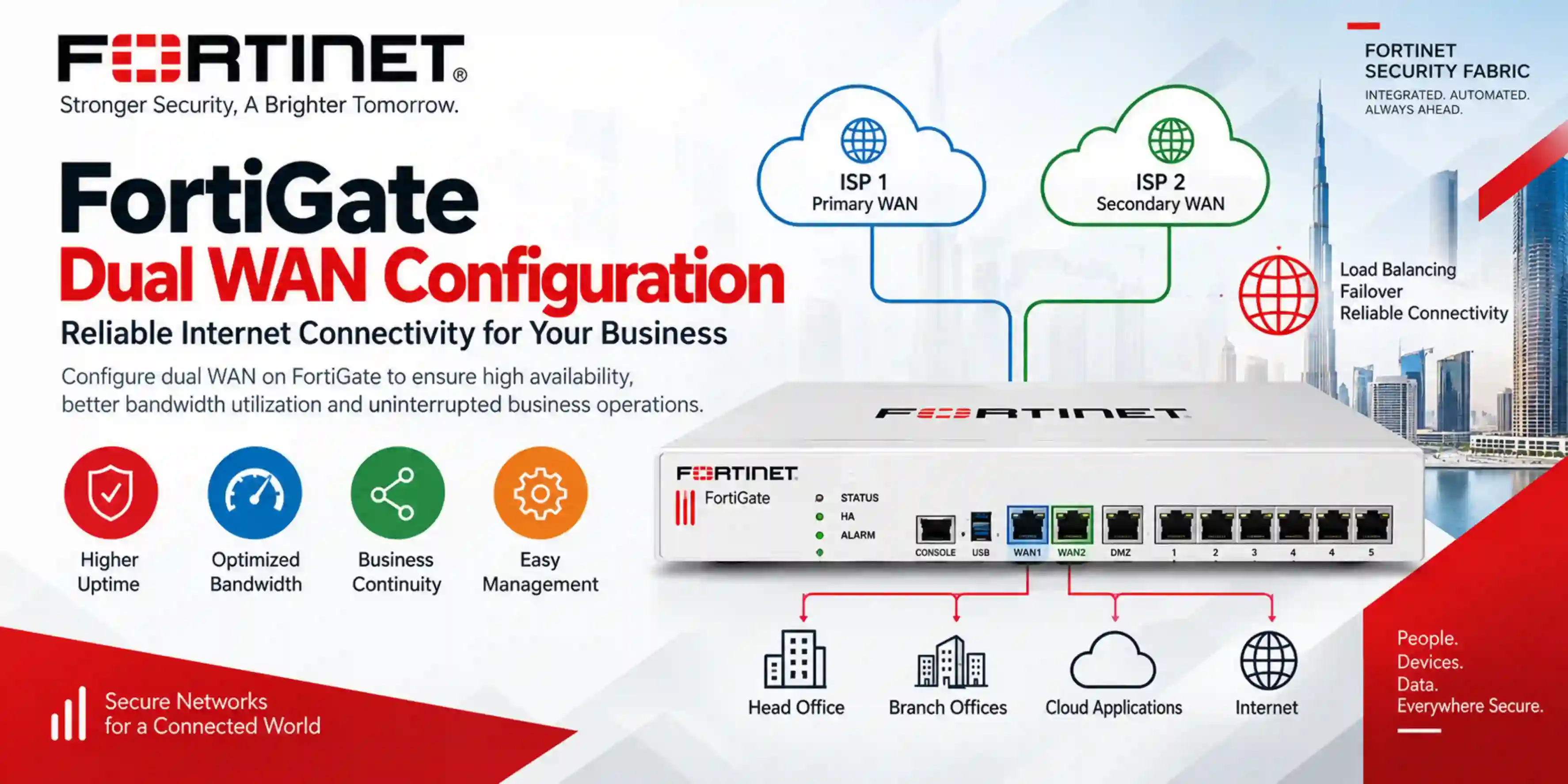
A compact branch often has more to gain from WAN resilience than from raw firewall throughput. FortiGate 30G can participate in secure SD-WAN designs where a primary and secondary uplink are monitored and traffic is steered according to health and policy. The key is to design failover around business priorities. If the backup circuit is slower, the firewall should preserve ERP, payment, voice, remote administration and required cloud applications before discretionary traffic.
The four-port platform also means cable planning matters. A dual-WAN design can consume two physical Ethernet roles quickly, leaving internal LAN and FortiLink or another zone to share the remaining ports. Managed switching and VLAN trunks may therefore be part of a clean architecture. Before deployment, document ISP handoff types, addressing, upstream NAT, public IP requirements, DNS, link-monitor targets and the acceptable failover behavior for active sessions.
FortiGate 30G Dubai
Dubai businesses often need security in compact locations where the network must support cloud applications, payment systems, business email, IP telephony, guest Wi-Fi, CCTV and remote administration from a small communications area. The FortiGate 30G can fit this pattern when the inspected workload remains within the appliance’s practical capacity and the four Gigabit interfaces are sufficient for the planned WAN and LAN architecture. A Deira trading office, Business Bay consultancy, JLT service company, Jebel Ali warehouse office or small retail site may all have very different traffic profiles, so the same model should not be recommended from employee count alone.
For a Dubai quotation, start by documenting the primary ISP speed, any secondary line, public IP requirements, VLANs, cloud applications, VPN destinations and whether TLS inspection will be used broadly. If the internet service is close to or above the published 500 Mbps threat-protection figure, the business should evaluate how much traffic will actually receive the full security stack and whether a larger FortiGate provides more growth room. This matters because a 4 Gbps headline firewall figure describes a different workload from IPS, NGFW and threat-protection testing.
Dubai sites also benefit from deployment discipline. The firewall should be placed in a secure, air-conditioned area with stable power and preferably UPS protection. ISP handoffs, patch-panel labels, switch trunks, VLAN IDs, admin access, backup files and FortiGuard renewal dates should be documented before handover. For remote access, current FortiOS direction favors IPsec-based approaches rather than legacy SSL-VPN tunnel assumptions, so the project should include the endpoint and authentication plan from the start.
FourTeck can assist Dubai buyers with requirement review, model comparison, license selection, configuration scope and deployment planning without assuming stock, price or delivery time before the actual quotation. Sharing user/device counts, bandwidth, branch locations, current firewall, required security profiles and target implementation date makes the commercial response more accurate and helps determine whether FG-30G is an efficient fit or whether additional capacity is warranted.
FortiGate 30G UAE
Across the UAE, a compact firewall must often support branch standardization as much as local internet security. Companies operating from Dubai, Abu Dhabi, Sharjah, Ajman or the Northern Emirates may want the same policy naming, VPN templates, security profiles and support process at every small site. FortiGate 30G can be considered for that repeatable branch role where each location has modest interface needs and the expected inspected traffic aligns with the appliance’s published performance envelope.
A UAE rollout should separate the model decision from the license decision. The appliance provides the FortiOS platform, while FortiGuard services and FortiCare entitlements determine the subscribed protection and support experience. Procurement teams should ask for the exact appliance SKU, subscription bundle, term, support level and any cloud-management or reporting additions as distinct line items. That structure makes multi-site renewal easier and lets finance teams see which costs are recurring. It also prevents a branch from being delivered with a security bundle that does not match the policy template used elsewhere.
WAN design can vary significantly across Emirates. One office may have a single business-fiber service; another may need two providers for continuity; a temporary project location may use a broadband line with a cellular backup device. Secure SD-WAN policy should therefore be standardized conceptually but tuned to the actual circuits. Critical applications, DNS behavior, health checks, link quality thresholds and degraded-mode traffic priorities need to be agreed before cutover.
For organizations with centralized IT, the strongest benefit can come from consistent configuration and documentation rather than the appliance alone. Define administrator roles, backup storage, firmware policy, branch naming, logging, VPN standards and change approval. If a site is expected to grow beyond compact branch requirements, add users, increase internet speed or perform extensive SSL inspection, the sizing review should compare the 30G with higher-capacity models before purchase instead of planning an early replacement.
FortiGate 30G Uganda
Uganda organizations evaluating FortiGate 30G may be securing a small head-office department, clinic, school administration block, hospitality site, retail branch, logistics office or distributed service location. The strongest fit is a site that needs structured firewall policy, IPsec connectivity, application control and subscribed security services but does not require a large number of physical Ethernet ports. Internet quality and link variability should be included in the design because security performance and user experience are affected by the WAN path as well as the firewall.
For multi-branch Ugandan networks, it is useful to define a standard branch template: LAN addressing, DHCP role, VLAN IDs, DNS, time synchronization, management access, site-to-site VPN parameters, SD-WAN health checks, security profiles and logging destination. A repeatable template reduces the time needed to deploy or troubleshoot a remote branch and makes future replacement easier. Where the branch has only one local IT contact, secure remote management and documented recovery steps become especially important.
Procurement should include the correct FortiGuard and FortiCare term rather than purchasing an appliance with unclear service entitlement. If web filtering, IPS, DNS security and malware protection are part of the requirement, confirm the bundle that delivers those services and record the renewal date centrally. Buyers should also confirm power-adapter requirements, UPS strategy, installation environment and whether the site requires integrated Wi-Fi; the wired FG-30G and FortiWiFi family variant are different purchasing decisions.
When requesting an Uganda quotation through FourTeck’s regional channels, provide the city, number of sites, user and device estimates, internet capacity, branch VPN design, preferred subscription duration and any staging requirements. The goal is to determine fit without implying a fixed user limit. A branch with modest users but intensive encrypted inspection can be more demanding than a larger office with simple browsing, so the final recommendation should remain workload based.
FortiGate 30G Kampala
Kampala businesses commonly operate from offices where cloud accounting, Microsoft 365 or Google Workspace, IP phones, CCTV, staff Wi-Fi, guest access and remote administration share one or two internet connections. FortiGate 30G can act as the security and routing edge for this kind of compact environment when the interface plan and inspected throughput are suitable. A careful network map should show which traffic belongs to staff, servers, voice, cameras, guests and management so those groups are not placed into one flat trusted network by convenience.
Because the appliance provides four Gigabit RJ45 interfaces, Kampala deployments with dual WAN and several internal zones should consider VLAN-aware managed switching. Two WAN connections can consume half of the physical data-port roles, while the remaining connectivity may need to carry a trunk with multiple logical networks. This is a normal architecture when planned correctly, but it should be documented so later support engineers understand which tagged networks, FortiLink relationships and security policies depend on each cable.
Power and environmental planning are also important. A small firewall may consume little power, yet any restart can interrupt cloud sessions, branch tunnels, voice calls and remote support. Place the device in a controlled indoor environment with stable power and a suitable UPS. Store a protected configuration backup after staging and after material policy changes. Administrators should also know how to reach the console or local management path if a remote change accidentally blocks access.
For a Kampala quote, share the primary and backup ISP details, approximate peak traffic, VPN requirements, security services, existing switch design and planned growth. If the organization expects a major bandwidth upgrade, widespread SSL inspection or heavier branch aggregation, use those future conditions in the sizing exercise. The objective is a firewall that remains supportable through the subscription term, not simply a device that meets today’s minimum connectivity need.
FortiGate 30G Arua
Arua organizations may use a compact firewall in branch offices where dependable connectivity, central access and straightforward support are more important than a large local infrastructure footprint. FortiGate 30G can be evaluated for small business, education, healthcare, retail, logistics or administrative locations that need controlled internet access, site-to-site VPN and FortiGuard security services. In a remote branch, however, the network design should expect that the nearest support engineer may not be physically present when a problem occurs.
That makes recoverability a core requirement. Document the WAN handoff, local IP plan, switch uplink, administrator accounts, backup configuration, VPN peers and emergency contact process. If a secondary internet link is available, decide whether it will operate as an active path, standby failover or policy-based route for selected applications. Secure SD-WAN can automate path selection, but it cannot create resilience when both links share the same upstream dependency or when the backup circuit is too limited for essential traffic.
Security subscriptions should be chosen deliberately. A branch that mainly needs encrypted connectivity to a centrally protected head office may have a different FortiGuard requirement from an autonomous site where local users browse the internet directly and depend on the branch firewall for web, DNS, IPS and malware controls. The quotation should therefore identify the expected inspection functions and the subscription term instead of treating licensing as a generic add-on.
For Arua procurement, also consider how firmware upgrades will be handled, who owns renewal tracking and how configuration changes are approved. A simple change-control template can prevent emergency allow rules from becoming permanent. Before ordering FG-30G, share expected internet speed, remote-access users, branch tunnels, internal VLANs, application requirements and future expansion. That information helps determine whether the compact four-port platform is appropriate or whether more interfaces and inspected-throughput headroom should be purchased from the start.
FortiGate 30G Mbarara
Mbarara businesses can use the FortiGate 30G as a compact security gateway where office users, cloud applications, branch connectivity and local devices need stronger control than a standard router provides. Suitable projects might include a professional office, clinic administration network, school office, retail location, hospitality back office or regional branch. The model decision should be driven by inspected traffic and network architecture rather than a simple statement that a particular number of users will fit.
One practical design task is deciding which devices belong together. Guest Wi-Fi should not automatically reach staff systems. CCTV and access-control equipment can be placed in a separate VLAN with only the communication it actually needs. Voice endpoints may require specific services and quality-of-service handling. Management interfaces should be restricted to trusted administrators. FortiOS security policies can enforce these boundaries, while a managed access switch provides the VLAN distribution when the firewall’s four physical ports are not enough to dedicate one cable per segment.
For organizations connecting Mbarara to Kampala or another head office, define the IPsec tunnel routes, failover behavior, DNS dependencies and what applications remain available when the WAN is degraded. If the site uses centralized servers, the VPN may be mission critical even when local internet browsing is less important. SD-WAN policies can prioritize the private business path and move it to a secondary connection where available, but health monitoring and application priorities need to be tested before production.
FourTeck can review a Mbarara requirement using user/device estimates, WAN speeds, security inspection, license needs, VLANs and support expectations. Include future bandwidth and branch growth rather than only the installation-day state. If the planned security stack will routinely approach the published 500 Mbps threat-protection or 400 Mbps SSL-inspection levels, compare a larger FortiGate model so normal traffic bursts and future services have operational headroom.
FortiGate 30G Gulu
Gulu branches often need network security that can be administered consistently from another location. FortiGate 30G is worth considering where a compact desktop firewall can cover internet edge security, branch IPsec, application visibility and FortiGuard services without requiring a large interface count. For distributed organizations, the operational process around the device may be as important as the device itself. Configuration standards, monitoring, backups and renewal ownership should be defined before the branch goes live.
A useful branch baseline includes named address objects, clearly described policies, separate networks for staff and guests, restricted management access, time synchronization, logging, secure DNS policy and documented VPN peers. Avoid broad any-to-any rules created only to make an application work quickly. When an exception is required, record its business purpose and review date. This discipline keeps a small firewall understandable even after years of changes and staff turnover.
Connectivity should be tested under failure, not only during normal operation. If the Gulu site has two WAN options, disconnect the primary path during commissioning and confirm that business-critical traffic follows the intended secondary route. Verify that the backup circuit can support the most important applications, that DNS continues to resolve, and that site-to-site tunnels recover as expected. Users should know which nonessential services may be intentionally restricted during degraded operation.
When asking FourTeck about FortiGate 30G for Gulu, include the support model and logistics requirements along with technical inputs. Procurement should confirm the exact appliance, FortiGuard bundle, term and accessories before purchase. Availability and delivery should be stated in the formal quotation rather than assumed. For an office expected to add many users, upgrade internet capacity or aggregate multiple branches, compare the 30G against models with more threat-protection capacity and interface flexibility before standardizing the rollout.
FortiGate 30G Kenya
Kenya businesses may evaluate FortiGate 30G for compact offices and branches in Nairobi, Mombasa, Kisumu, Nakuru and other commercial locations where internet access, cloud applications, branch VPN and user policy need to share a single manageable security platform. The appliance’s published 500 Mbps threat-protection figure is a useful planning reference for sites enabling a broad security stack, while the 4 Gbps raw firewall figure should not be used by itself to justify a high-speed inspected internet connection.
For a Kenyan multi-site project, decide whether each branch will break out directly to the internet or backhaul selected traffic to a central location. Direct internet access can reduce latency to SaaS platforms, but it makes local web, DNS and threat-inspection policy more important. Backhaul can centralize some controls but consumes WAN capacity and may add latency. Secure SD-WAN and IPsec design should reflect the applications used by each branch instead of copying one routing policy everywhere without measurement.
Licensing and support should be synchronized where multiple firewalls are ordered. A common renewal window can simplify procurement, but the business should verify whether all sites need the same FortiGuard bundle. Some locations may have direct internet users and require broader web-security services, while a highly controlled site may have different needs. Record serial numbers, contract terms, configuration owners and replacement procedures in an asset register.
A Kenya quotation should include the city, site count, internet circuits, number of VLANs, remote users, branch tunnels, planned security profiles, reporting requirements and deployment timeline. It is also useful to state whether equipment will be staged centrally before shipment. Central staging allows firmware, base policy, administrators, VPN templates and naming standards to be applied consistently. Final site-specific settings can then be added during installation, reducing time and configuration variance at remote branches.
FortiGate 30G Kuwait
Kuwait offices evaluating FortiGate 30G may need a compact firewall for a professional workspace, retail branch, service location, project office or distributed business site. The device can combine firewall policy, IPsec VPN, secure SD-WAN and subscription-based FortiGuard security in a desktop form factor. Before procurement, compare the intended internet bandwidth and encrypted-inspection load with the appliance’s NGFW, threat-protection and SSL-inspection figures rather than assuming the raw firewall rate represents full security performance.
Dual-WAN is a common resilience requirement. A Kuwait branch with two internet services should confirm whether the circuits are truly diverse, how public addresses change during failover, which applications can tolerate path changes and whether inbound services depend on a particular provider. SD-WAN health checks should monitor meaningful destinations rather than only the local ISP gateway. During commissioning, simulate loss and poor quality so the policy response is known before an actual outage.
The installation environment deserves attention even for a low-power desktop appliance. Keep the firewall in a secure, conditioned space away from dust, heat and accidental cable movement. Use labelled patching and UPS protection where practical. Save an encrypted or otherwise access-controlled configuration backup, and document how administrators can regain local access if a routing or firewall-policy change blocks remote management.
For commercial comparison, ask the quotation to separate hardware, FortiCare, FortiGuard bundle, subscription term, installation, migration and any ongoing support. This makes renewal planning transparent. If the Kuwait site requires many physical segments, a large number of locally attached networks or substantial growth, the four-port FG-30G may be less convenient than a larger platform even if throughput is adequate. Model fit should therefore balance interface architecture, security workload, supportability and future expansion.
FortiGate 30G Ghana
Ghana organizations can consider FortiGate 30G for compact business locations where a branch firewall must secure internet access, connect to other sites, control applications and support subscribed threat protection. A typical use case could be a small office, clinic administration network, retail outlet, education branch, logistics desk or professional service location. The correct decision depends on workload, not a generic claim about company size. Internet bandwidth, encrypted traffic, user/device behavior and security-policy depth should all be reviewed.
In distributed Ghana operations, centralized standards can reduce support effort. Decide how interfaces are named, how branch VLANs are numbered, what address ranges are allowed, where logs are retained and how VPN peers are documented. The firewall should not become a unique configuration that only one engineer understands. Use templates where practical, but still adapt them to local ISP, addressing and application requirements. A standard policy can fail if it assumes connectivity or DNS behavior that differs at a particular site.
Security licensing should be mapped to the role of the branch. If the site uses direct internet access and the firewall is expected to provide IPS, antivirus, application control, URL/DNS filtering and anti-botnet protections, confirm the FortiGuard bundle that contains those services. If certain controls are delivered elsewhere in the architecture, the subscription decision may differ. The important point is that the quote and design should use the same assumptions.
For Ghana procurement, include WAN speeds, number of offices, VPN destinations, remote users, internal segments, switch infrastructure, preferred license term and support expectation. Also note power and environmental conditions so deployment includes suitable UPS and placement planning. Where future bandwidth or inspection demand is uncertain, leave capacity headroom or compare a larger appliance. That is usually more economical than replacing a compact firewall soon after a branch grows.
FortiGate 30G Nigeria
Nigeria businesses often operate distributed sites that depend heavily on cloud applications and branch connectivity, making firewall and WAN planning inseparable. FortiGate 30G can be reviewed for small branches, service offices, retail points, clinics or other compact locations that need policy control, secure SD-WAN, IPsec VPN and FortiGuard services. The appliance is not intended to be selected solely because the raw firewall throughput appears higher than the internet line; inspected throughput and encrypted traffic are more relevant for a modern office.
Where a Nigerian branch uses two connectivity providers, define the role of each circuit and test failure behavior. A lower-capacity secondary service may need a restricted traffic policy that keeps finance systems, POS, voice, remote administration or essential SaaS active while delaying backups and nonessential media. SD-WAN can enforce this hierarchy when health checks and application rules are designed carefully. It should also account for link instability, not just complete outage.
Branch segmentation can improve resilience against local device compromise. Staff computers, guest wireless, CCTV, IoT and management systems should not automatically share unrestricted access. FortiGate policies can control traffic between VLANs, but the limited physical-port count means a capable managed switch may be required. Document VLAN trunks, switch ports and firewall-zone relationships so replacement and troubleshooting can be performed without reconstructing the network from guesswork.
For a Nigeria quote, provide exact deployment cities, number of devices, circuit capacities, VPN peers, inspection requirements, desired FortiGuard term and the planned support model. Procurement should confirm availability, delivery, warranty and subscription terms in the formal quotation rather than relying on a generic website statement. If the branch is expected to become an aggregation point for other locations or add substantial bandwidth, compare a larger FortiGate now to preserve operational headroom and interface flexibility.
FortiGate 30G Seychelles
Seychelles businesses may need compact network security for hospitality administration, professional offices, retail locations, service branches or remote facilities where rack space and local IT resources are limited. FortiGate 30G can be evaluated as a desktop security gateway providing firewall policy, IPsec VPN, secure SD-WAN and FortiGuard services. In island and remote-site scenarios, however, WAN reliability and supportability deserve as much attention as the security appliance itself.
A resilient design starts with understanding the available circuits. If a second connection is used for backup, verify that it has enough capacity for critical applications and that it does not share a single failure point with the primary service. Configure health checks, route priorities and degraded-mode application policy. Test the switchover while monitoring DNS, VPN, SaaS and voice behavior. A successful ping does not necessarily mean that the business applications have recovered correctly.
Remote administration should be secured and recoverable. Restrict management access, use strong authentication, keep a controlled configuration backup and document local recovery steps. If the site is far from specialist support, consider whether an out-of-band option or trained local contact is practical. Firmware and subscription renewal should be scheduled proactively so the branch does not depend on an expired security service or an unplanned major upgrade.
When preparing a Seychelles requirement, share internet capacity, user/device count, remote users, branch VPN destinations, security profiles, logging needs, switch and Wi-Fi design and future growth. For hospitality or guest-facing environments, pay particular attention to isolation between guest access and business systems. The FG-30G may be an efficient fit for a controlled compact site, but a larger model should be considered when throughput, interface count or resilience requirements exceed what a four-port entry platform can comfortably support.
Deployment Workflow for FortiGate 30G
Discovery
Map ISP links, current router or firewall, addressing, VLANs, switches, wireless, servers, cloud applications, VPN peers and support constraints.
Sizing
Compare inspected throughput, encrypted traffic, interfaces, session behavior, VPN, logging and future growth with the 30G specification and higher models where appropriate.
Build
Configure interfaces, routes, SD-WAN, VLANs, policies, NAT, security profiles, IPsec, admin access, time, DNS, logging and protected backups.
Cutover
Test internet access, SaaS, public services, voice, branch VPN, remote access, failover, DNS and required internal applications during an agreed change window.
Handover
Record policy purpose, VPN details, renewal date, backups, management process, firmware plan and escalation contacts so the firewall remains supportable.
Common FortiGate 30G Use Cases
Small Office Internet Edge
Apply web, DNS, application and IPS controls to employee internet access while segmenting visitors and connected devices from business systems.
Retail or Service Branch
Separate POS or operational traffic from staff browsing and guest access, maintain secure VPN to central resources and prioritize essential cloud services.
Remote Project Office
Use a compact firewall for temporary or satellite offices that need standardized policy, protected internet access and encrypted connectivity to headquarters.
Dual-ISP Branch
Combine WAN health monitoring and security policy so important applications retain connectivity when the preferred circuit fails or degrades.
Migration from an Existing Firewall
Replacing an older firewall should not mean copying every existing rule. Legacy configurations often contain duplicate address objects, temporary NAT entries, unused VPNs, broad access policies and administrator accounts whose original purpose has disappeared. A FortiGate 30G migration is an opportunity to identify the business traffic that still matters and rebuild it in a clean policy structure.
Prepare an inventory of interfaces, routes, public IPs, port forwards, VPN peers, remote users, DHCP scopes, DNS dependencies, server publishing, application exceptions and required logging. During cutover, validate each critical service against this inventory. Keep a rollback plan and current configuration backup. Where the old environment uses SSL-VPN tunnel mode, plan the remote-access migration around supported current FortiOS IPsec options before the new firewall goes live.
Frequently Asked Questions About FortiGate 30G
Is FortiGate 30G suitable for a small business in Dubai?
It can be suitable for compact business sites when the inspected bandwidth, interface count, VPN requirement and expected growth fit the platform. Sizing should compare your workload with the 500 Mbps threat-protection, 570 Mbps NGFW and 400 Mbps SSL-inspection figures rather than relying only on the 4 Gbps raw firewall number.
How many Ethernet ports does FG-30G have?
Fortinet lists four Gigabit Ethernet RJ45 interfaces in total for the 30G platform. A deployment with dual WAN and several internal security zones may therefore use VLAN trunks and managed switching to make efficient use of the available physical interfaces.
Does FortiGate 30G support IPsec VPN?
Yes. Fortinet publishes up to 3.5 Gbps IPsec VPN throughput for the 30G series. Actual results depend on encryption, packet size, traffic mix, CPU and security workload, so the number should be treated as a test reference rather than a guaranteed site result.
Can I use SSL-VPN tunnel mode on a new deployment?
Fortinet replaced SSL-VPN tunnel mode with IPsec VPN starting with FortiOS 7.6.3 across FortiGate models. New remote-access designs should therefore be based on the exact supported FortiOS release, with IPsec or other supported secure-access methods considered instead of legacy tunnel-mode assumptions.
Which FortiGuard bundle should I choose?
The answer depends on required services. Fortinet currently describes ATP as a core first line of defense, UTP as adding broader web/network protections and Enterprise Protection as adding more comprehensive services. Confirm the exact current bundle contents, term and support entitlement in the quotation.
Does the FortiGate 30G include local storage?
The base FG-30G is listed without local storage in Fortinet’s product matrix. The related FG-31G variant is the model in the family with 30 GB local storage. Confirm the exact model code when local storage is a requirement.
Can FortiGate 30G be used with two internet connections?
A dual-WAN or secure SD-WAN design is possible, but the four-port hardware means the physical port plan should be reviewed carefully. Confirm how WAN, LAN, FortiLink and any dedicated zones will be cabled, and use VLAN-aware switching where appropriate.
What information is needed for a FortiGate 30G quote?
Provide user and device counts, internet bandwidth, WAN links, number of offices, VPN users and tunnels, VLANs, security services, current firewall, renewal requirements, Wi-Fi needs, desired license term, deployment location and whether migration or configuration assistance is required.
Related Firewall Products / Solutions
If the FortiGate 30G’s port count, licensing model or inspected-throughput envelope does not match the requirement, comparing alternatives can clarify whether the issue is capacity, management preference or security architecture. The following verified FourTeck pages provide useful comparison context rather than assuming one model is suitable for every network.
Palo Alto Networks PA-410
A compact branch NGFW option for buyers comparing application-aware policy, PAN-OS operations and Palo Alto Networks subscription architecture with FortiGate.
Sophos XGS 88
A small-business firewall alternative worth comparing when management style, Sophos ecosystem integration, VPN requirements and licensing preference are key decision factors.
Barracuda CloudGen F12
A compact branch platform for organizations comparing centralized branch policy, secure connectivity and CloudGen SD-WAN capabilities against a Fortinet design.
Firewall Selection Recap
FortiGate 30G is a compact Fortinet NGFW and secure SD-WAN appliance with verified published figures of up to 4 Gbps firewall throughput, 800 Mbps IPS, 570 Mbps NGFW, 500 Mbps threat protection, 400 Mbps SSL inspection, 3.5 Gbps IPsec VPN, 600,000 concurrent sessions and four Gigabit Ethernet interfaces. Those specifications make it a candidate for smaller sites, but they do not replace workload-based sizing.
Choose it when the inspected traffic, VPN load, interface design and security subscriptions fit with reasonable growth headroom. Compare a higher model when internet bandwidth, deep inspection, branch aggregation, interface count or future expansion would keep the 30G near its practical limits. For remote access, design around current FortiOS support and IPsec rather than outdated SSL-VPN tunnel expectations.
Prepare for Your Firewall Quote
Providing the following information helps FourTeck review whether FG-30G is appropriate and prepare a clearer commercial scope.
FourTeck Consultation Panel
FourTeck can review FortiGate 30G requirements with IT managers, procurement teams, business owners and system integrators. The consultation can cover firewall sizing, subscription selection, IPsec VPN, SD-WAN, dual-WAN, VLAN segmentation, migration, configuration scope, backup, renewal planning and comparison with other firewall platforms where the 30G does not fit.
For complex environments, start with a current network diagram and a short list of business-critical applications. This makes it easier to distinguish must-have security controls from optional features and to identify whether a larger appliance, additional switching or a different deployment architecture is required.
Final Sales Invitation: Plan the FortiGate 30G Around Your Real Network
Send FourTeck your bandwidth, users, devices, WAN links, VPN requirements, security services, current firewall and preferred subscription term. The team can use those details to discuss whether FortiGate 30G is suitable, what licensing should be included and what configuration or migration work belongs in the quotation.

